
Friday Reads
Posted: June 22, 2012 Filed under: Economy, morning reads | Tags: Aung San Suu Kyi, Dalai Lama, FCC, Operation Twist, SCOTUS, swearing on TV 32 Comments Good Morning!
We made it through the Solstice on Wednesday so summer is officially here! The days get shorter and the nights get longer from here on out! What’s on your summer reading list?
My first read of the summer is going to be Kafka on the Shore by Haruki Murakami. I’m also planning on avoiding the heat by watching the entire first season of Treme.
More evidence shows that the economy is not improving because of the negative impacts of state and local spending. Layoffs of Public Workers are harming the recovery.
Government payrolls grew in the early part of the recovery, largely because of federal stimulus measures. But since its postrecession peak in April 2009 (not counting temporary Census hiring), the public sector has shrunk by 706,000 jobs. The losses appeared to be tapering off earlier this year, but have accelerated for the last three months, creating the single biggest drag on the recovery in many areas.
With the economy expanding, albeit slowly, state tax revenues have started to recover and are estimated to exceed prerecession levels next year. Yet governors and legislatures are keeping a tight rein on spending, whether to refill depleted rainy-day funds or because of political inclination.
At the same time, costs for health care, social services, pensions and education are still rising. Fourteen states plan to resolve their budget gaps by reducing aid to local governments, according to a report by the National Governors Association and the National Association of State Budget Officers.
So while the federal government has grown a little since the recession, and many states have recently begun to add a few jobs, local governments are making new cuts that outweigh those gains. More than a quarter of municipal governments are planning layoffs this year, according to a survey by the Center for State and Local Government Excellence. They are being squeezed not only by declining federal and state support, but by their devastated property tax base.
“The unfortunate reality is our revenue streams have not rebounded,” said Timothy R. Hacker, the city manager of North Las Vegas, which has cut its work force to 1,300 from 2,300 and is about to lay off 130 more. “Shaking this recession is becoming increasingly difficult.”
Some folks have been suggesting that the Fed should do something “out of the box” since it is politically impossible to stimulate the economy through good fiscal policy right now. Should the Fed start buying SLGS and monetize state debt?
The Fed can legally buy as many municipal bonds as it wants without congressional approval. Talk about burying a lead. This is a big story. Blanchflower is essentially saying that the U.S. government can bail out both the housing market via Fannie and Freddie paper purchases and the state governments via Muni purchases. And, of course, the banks get to dump these assets onto the Fed who will hold them to maturity. I guarantee you this will have a very nice kick since it is the state’s where the biggest employment cuts are. This is the Fed doing fiscal, friends
This is an interesting idea and one worth exploring.
The economic models are telling us that we need more stimulus. Lowering interest rates and more fiscal stimulus are out of the question. Quantitative easing remains the only economic show in town given that Congress and President Barack Obama have been cowed into inaction.
The major questions about quantitative easing aren’t so much if, but how much will the Fed buy and of what type? There is little point in moving slowly. So $100 billion a month for six months seems a reasonable amount.
What will they buy? They are limited to only federally insured paper, which includes Treasuries and mortgage-backed securities insured by Fannie Mae and Freddie Mac. But they are also allowed to buy short-term municipal bonds, and given the difficulties faced by state and local governments, this may well be the route they choose, at least for some of the quantitative easing. Even if the Fed wanted to, it couldn’t buy other securities, such as corporate bonds, as it would require Congress’s approval, which won’t happen anytime soon.
Republicans have been trying to change our lexicon for years now. George Lakoff and Elizabeth Wehling write on “Why Conservatives Sell their Wildly Destructive Ideology Better Than Democrats”.
Perhaps the most important omission from the Obama speech was any overt mention of The Public — everything that our citizenry as a whole provides to all, e.g., roads, bridges, infrastructure, education, protection, a health system, and systems for communication, energy development and supply, and so on. The Private — private life and private enterprise — depends on The Public. There is no economic freedom without all of this. So-called “free enterprise” is not free. A free market economy depends on a strong Public. This is a deep truth, easy to recognize. It undercuts Romney’s central pitch, that is it private enterprise alone that has made our country great, and that as much as possible of The Public should be eliminated.
Romney calls free enterprise “one of the greatest forces of good this world has ever known.” In reality, America free enterprise has always required The Public.
Romney attacks The Public, speaking of “the heavy hand of government” and “the invisible boot of government.” The contrast is with the putative “invisible hand” of the market — which leads to the good of all if everyone follows their self-interest and the market’s natural force is not interfered with. Romney’s “invisible boot” evokes the image of a storm trooper’s boot on your neck. The government is the storm trooper, your enemy. You are weak and in an impossible position. You can’t move — a metaphor for being held back and not being able to freely engage in the economy. Romney uses the frame consistently: “The federal establishment,” he says,” has never seemed so hostile.” The Public is an “establishment” — an undemocratic institution — which is the enemy of the people. It is implicit in this frame that the government is not the people.
The Supremes overruled the FCC’s swearing ban in a decision this week.
According to MSNBC, a ruling by the Supreme Court Thursday waived fines and sanctions against ABC and Fox, saying the Federal Communications Commission did not give them fair notice before punishing them over brief instances of curse words and nudity.
The ruling (PDF), which does not affect the FCC’s overall policy toward profanity, centered on outbursts by Cher and Nicole Richie on live awards shows on FOX and a brief instance of partial nudity shown on ABC’s NYPD Blue.
“Because the Commission failed to give Fox or ABC fair notice prior to the broadcasts in question that fleeting expletives and momentary nudity could be found actionably indecent, the Commission’s standards as applied to these broadcasts were vague,” Justice Anthony Kennedy wrote in the unanimous decision, adding that the FCC was free to revise its current policy “in light of its determination of the public interest and applicable legal requirements.”
Aung San Suu Kyi and His Holiness the Dalai Lama had a chance to meet in the UK.
THIS week two Nobel-peace-prize laureates, both international figures of inspiration, find themselves visiting Britain: the leader of Myanmar’s (ie Burma’s) opposition, Aung San Suu Kyi; and also the Tibetans’ exiled spiritual leader, the Dalai Lama. On June 19th, in London, the two met.
The rendezvous, not publicised on either of their official schedules, was disclosed by the Dalai Lama’s office on Twitter only the next day, where it was described simply as “a private meeting”. The Dalai Lama, who had previously called for Miss Suu Kyi’s release from house arrest, is reported to have told her “I have real admiration for your courage.” He also gave her his blessing, as one Buddhist to another. The obvious backdrop to any such blessing would be the separate political struggles of Myanmar and Tibet. The two places have a certain neighbour in common.
China’s leaders will not be happy to learn of the meeting. The Dalai Lama’s ten-day visit to Britain has given fresh occasion for China to denounce him. In a further measure, the Chinese Olympic committee threatened to withdraw some of its athletes from training in England. The Dalai Lama shrugged off all this as “routine”. He is as accustomed to acting as a hate figure for the Chinese government as he is to being a symbol of hope to many people elsewhere.
So, that’s a little this and that to get us started this morning. What’s on your reading and blogging list today?
Lazy Caturday News and Open Thread
Posted: June 9, 2012 Filed under: 2012 presidential campaign, Afghanistan, Barack Obama, corruption, Discrimination against women, Economy, Foreign Affairs, Health care reform, Iran, Mitt Romney, morning reads, PUMA, religion, Russia, the GOP, U.S. Politics, War on Women | Tags: algae bloom, Catholic Church, cats, caturday, Charles P. Pierce, NASA, phytoplankton, Richard Nixon, Wages of Fear, Watergate 40th anniversary, Woodward and Bernstein 29 Comments
Good Morning All!
The 40th anniversary of the Watergate break-in is coming up on June 17. Bob Woodward and Carl Bernstein published a piece about it in yesterday’s Washington Post.
Today, much more than when we first covered this story as young Washington Post reporters, an abundant record provides unambiguous answers and evidence about Watergate and its meaning. This record has expanded continuously over the decades with the transcription of hundreds of hours of Nixon’s secret tapes, adding detail and context to the hearings in the Senate and House of Representatives; the trials and guilty pleas of some 40 Nixon aides and associates who went to jail; and the memoirs of Nixon and his deputies. Such documentation makes it possible to trace the president’s personal dominance over a massive campaign of political espionage, sabotage and other illegal activities against his real or perceived opponents.
In the course of his five-and-a-half-year presidency, beginning in 1969, Nixon launched and managed five successive and overlapping wars — against the anti-Vietnam War movement, the news media, the Democrats, the justice system and, finally, against history itself. All reflected a mind-set and a pattern of behavior that were uniquely and pervasively Nixon’s: a willingness to disregard the law for political advantage, and a quest for dirt and secrets about his opponents as an organizing principle of his presidency.
Long before the Watergate break-in, gumshoeing, burglary, wiretapping and political sabotage had become a way of life in the Nixon White House.
What was Watergate? It was Nixon’s five wars.
The Post also provides links to it’s coverage of the Watergate Scandal back in the good old days when the press believed in exposing government corruption. Today, the Post admits that “investigative journalism is at risk.”
Remember this?
The sad thing about Watergate is that if it happened today there wouldn’t be any investigation or arrests. We’d be told to move along, look forward not backward.
To see how things work today, you can read the White House e-mails that detail President Obama’s sellout to the pharmaceutical industry on health care. Apparently this one was leaked by House Republicans. Down With Tyranny has some good commentary.

um…huh? Must have dropped off for a second there. Let’s see what else is happening.
At the San Francisco Chronicle, Jeff Brinkley, a former New York Times foreign correspondent, now a Professor of Journalism at Stanford University finds Mitt Romney’s foreign policy positions deeply disturbing. He thinks it’s highly problematic that Romney has no experience and seemingly no knowledge about foreign policy. Brinkley notes that Obama already had to learn on the job, and now the Republicans have nominated another foreign policy naif who may be even less prepared than Obama was.
Romney…declared a couple of months ago that “Russia is America’s No. 1 geopolitical foe.” What nonsense. The U.S.-Russia relationship is a bit strained, but what about Iran, North Korea, Pakistan? Every one of those states poses a strategic threat that Russia does not.
“Immediately, speculations surfaced that the former governor of Massachusetts continues to live in a Cold War world and has few, if any, insights about American foreign policy,” Klaus Larres, a German American academic, wrote for the American Institute for Contemporary German Studies. And former Russian President Dmitry Medvedev told Romney to use his head and “check the time. It’s now 2012, not the mid-1970s.”
His advice on Afghanistan has been no better. Repeatedly he has called the plan to gradually withdraw forces “misguided” and “an extraordinary admission of failure.”
In the past, Romney has asserted that the United States and NATO need to defeat the Taliban before leaving. That has been the goal for nearly 11 years, and NATO is no closer today. The most recent National Intelligence Estimate asserts that the war is unwinnable as long as the Taliban maintains a safe haven in Pakistan and the Afghan government continues its corrupt, malevolent and counterproductive ways.
I wonder if Romney knows that one-third of the Western forces killed in Afghanistan so far this year died at the hands of Afghan soldiers they were training or leading.
There’s lots more at the link.
Charles Pierce is talking about “PUMA-ism” again, but I’ll forgive him because of this description of Obama’s defensive behavior of late:
In many ways, this president reminds me of the truck drivers in The Wages of Fear, trying to get the nitroglycerine over the mountains with blowing themselves all to hell and gone. In so many ways, he is still outside of things. In so many ways, he is still the flyer the Democratic party took in 2008. In so many ways, the path he has to walk to re-election is similar to the path he has had to walk through his life. It was hard not to notice the subtext present in all those earnest warnings about hurting the fee-fees of our financial titans. The president was stepping out of his place. The president was being uppity again.
This is also the case with what is perhaps the most noxious idea out there: that Barack Obama “failed” in his promise to “bring the country together,” and that he is now — Glorioski! — campaigning like he wants to be president all over again. He is engaging in politics. Mother of mercy, I swear David Brooks is just going to break down and go all to pieces on PBS some evening over the president’s betrayal of his role as the country’s anodyne black man and, of course, his upcoming role as black martyr to incivility and discord. It is his duty, dammit, to be all the things that people like Brooks wanted him to be so that he could lose, nobly, and then the country could go back to its rightful owners.
The Wages of Fear: now that was a great movie!
At Time, Tim Pagett has an excellent piece called The Catholic Contraction.
If you want some perspective on just how benighted the Roman Catholic Church looks today on the subject of women, consider Hildegard of Bingen. Hildegard was a German Benedictine nun in the 12th century and a leading feminist writer of her time. But even though that time was the 1100s, the Vatican rarely hassled her for asserting that men and women are equal — that God’s true nature, in fact, is maternal — or that nonprocreative sexual pleasure is O.K.

In the 21st century, however, Hildegard would no doubt receive the same censure that Sister Margaret Farley is facing this week after the Vatican denounced her book Just Love: A Framework for Christian Sexual Ethics. Farley, a Sisters of Mercy nun, a retired Yale divinity professor and a past president of the Catholic Theological Society of America, condones practices that have been morally acceptable to most U.S. and European Catholics for quite a while, including divorce, homosexuality, nonprocreative intercourse and masturbation. But Rome’s doctrinal bulldogs are sternly reminding her that those acts are “disordered,” “deviant” and “depraved.”
Sadly, it’s the church that’s looking unhinged these days. The Vatican was apparently just warming up in 2010 when it declared, astonishingly, that ordaining females into the all-male Catholic priesthood would be a “grave sin” on par with even pedophilia. Since then, as if scapegoating women for the escalating dissent among Catholics toward its hoary dogma, the church seems to have embarked on a misogynist’s crusade. Its legal assault on the Obama Administration’s requirement that Catholic institutions like colleges and hospitals make contraception available to female employees as part of their health coverage is, ultimately, less about religious freedom than about women’s freedom. Then there’s the U.S. bishops’ absurd probe of whether the Girl Scouts are selling feminist theology as well as fattening thin mints — and Rome’s accusation of “radical feminism” within the Leadership Conference on Women Religious (LCWR), which represents most of the U.S. nuns doing genuinely Christ-inspired work with the poor and the sick.
In science news,
NASA has discovered "a massive algae bloom under the slowly diminishing Arctic ice."
The same year that NASA researchers launched the Icescape expedition to the Arctic — the project that resulted in NASA’s astounding new discovery — there was a dire report on the world’s phytoplankton.
A Canadian team said in the journal Nature, as The Times reported in July 2010, that the world’s phytoplankton had been disappearing at a rate of about 1% a year for the previous 100 years.
“A global decline of this magnitude? It’s quite shocking,” Daniel Boyce, Dalhousie University marine scientist and lead author of the 2010 study, told The Times.
Phytoplankton — the basis of the marine food chain — “are key to the whole ecosystem,” he said. “In terms of climate changes, the effect on fisheries, we don’t know exactly what these effects will be.”
Could his latest discovery of a mass of phytoplankton in the Arctic signal a turnaround for this crucial organism?
The jury’s out. But it’s a question scientists will be pursuing, according to Paula Bontempi, NASA’s ocean biology and biogeochemistry program manager in Washington.
I think I need another little break.

Okay, back. Wouldn’t you know it? Addicting Info: Koch Brothers Linked To Florida Voter Purge
Former Secretary of State Kurt Browning worked with [Gov. Rick] Scott on the purge. Just before Scott selected Browning as Secretary in 2011, Browning led a group, Protect Your Vote Inc., which was created to oppose fair redistricting. One of the biggest checks that Browning’s organization received for $100,000 in 2010 was from the Center To Protect Patients’ Rights. At the time of the donation, the source of the money was cloaked in secrecy.
Last month, Republic Report exclusively reported that Center To Protect Patients’ Rights is part of a collection of front groups funded by David and Charles Koch as well as other billionaires as part of an election-influencing effort. The Koch Brothers plan to use these front groups to finance $400 million of a $1 billion campaign in outside money to defeat President Obama as well as defeating congressional Democrats. Mitt Romney’s Super Pac and many other nonprofits run by Karl Rove will supply the other $600 million needed to accomplish their goal.
Here’s Here’s something I missed this week:
Pranksters ‘Jiggly Puff,’ ‘Weedlord Bonerhitler’ sign anti-’Obamacare’ petition.
When the National Republican Congressional Committee (NRCC) set about thinking how to engage the Internet in new and unique ways, it probably did not occur to them that sometimes, the Internet tends to engage you right back.
That misunderstanding apparently led to an NRCC petition drive this week seeking to trump up the number of people who want to see “Obamacare” repealed. Unfortunately for them, it all went horribly, hilariously awry on Thursday night after they hooked an office printer up to the Twitter hashtag #IWantRepeal, then turned on a live video stream.
It was not long before NRCC staff completely lost control and were forced to pull the plug.
In almost no time at all, their printer was spitting out pages of petitions signed by “Weedlord Bonerhitler,” “Jiggly Puff,” “Boner Junkmonkey,” “Pointless Empty Gesture,” “Turd Sniffer,” “Like 20 more boners” and “HelpI’mStuckInThisPrinter,” among many, many others. Screen shots of this Twitter debacle and links to the live video began circulating almost immediately.
Okay, I’ll sign off with this:

“How we behave toward cats here below determines our status in heaven.” – Robert A. Heinlein
Commonplace Lying Liars and Big Fat Lying Liars and their Big Fat Lies
Posted: May 30, 2012 Filed under: Economy | Tags: Chris Christie, Lying republicans, Paul Krugman, Shrill Economists, Stan Collendar 19 Comments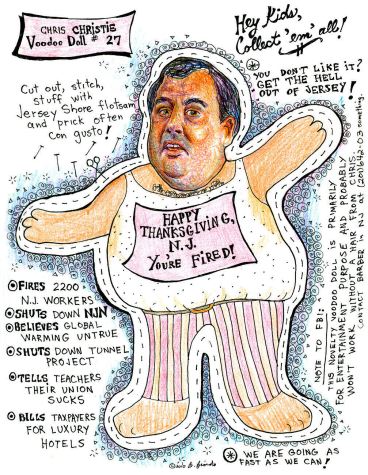 Far be it for me to complain about other states’ crazy Republican governors. The Wisdom Beings know that my crazy Republican Governor Bobby Jindal is right up there with the worst of them. After all, how many folks can say their governor helped kidnap and physically abuse a young woman in the name of an exorcism and then wrote about it as a spiritual experience in their school newspapers?
Chris Christie–pardon the pun–is big among Republican circles these days because he supposedly is showing how failed economic policies aren’t really failing. This appears to be a Republican obsession these days. Of course, they are failing, have failed and will fail. So, what do you do when the facts just can’t be changed? You lie.
Chris Christie–pardon the pun–is a big fat lying liar.
Paul Krugman mentioned this offhandedly last week. Chris Christie is trying to run on the idea of “The Jersey Comeback”. The problem is that it’s not the least bit true. Ask any one that actually lives in New Jersey and check out their stats. This isn’t stopping Christie from peddling his big fat lies as a big fat lying liar. You can check a really astounding FRED graph at that Krugman site that shows exactly how bad the employment situation is in New Jersey when compared to New York and Pennsylvania.
One real problem with living in New Jersey is that the state’s two major cities are, of course, New York and Philadelphia — which means that even if you live here, policy and politics reporting tends to be sparse. So it wasn’t until the latest budget fiasco surfaced that I even knew that Christie was running on the theme of the “Jersey Comeback”.
And now that I know, I wonder what on earth he’s talking about …
I’m actually not sure why NJ is doing so much worse than New York or Pennsylvania, and I doubt that Christie has much to do with it, but he’s the one trying to claim credit for … what?
Of course, his response to this chart would probably be to yell insults at the Bureau of Labor Statistics.
So, the funny thing is that Economist Stan Collender took Krugman’s back-of-the-napkin–with no offense intended to the NYT–analysis and lit it on fire. I’ve taught from both Krugman and Collender’s books. I follow their research. Both are terrific scholars. Both also blog with intense shrillness when they bump into just plan out and out lying. This brings us back to the Big Fat Lying Liars that are all over the Republican Party these days. Collender does the shrill one one better writing “Is This The Economic Dark Ages In The U.S?” I’ve quoted the entire thing because it’s so succinct I couldn’t just excerpt it. The goddess of fair use will have to forgive me along with Dr. Collender.
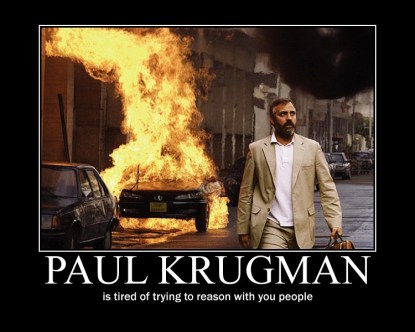
My guess is that Paul Krugman thought that this post was one of the more trifling economic-oriented pieces he has written in a while. It was short and probably took little time. It was also seemingly commonplace. After all, it was about a politician who said something inherently and obviously false.
But I found it to be extremely disturbing, not because it was off-the-wall — it’s anything but — but because it described a behavior — bald-face lying — that has become so blatant and commonplace among Republican policymakers on economic issues that any one of them who is even slightly honest and candid now would be both an absolute rarity and a welcome relief.
And the fact that the GOP lying about the economy…and especially the budget…is so accepted and expected means that any Republican who wasn’t jump-the-shark ridiculous on these issues wouldn’t be allowed to stay in the party much longer.
The obvious frustration that Krugman expresses in the post (not to mention the almost back-of-the-hand way he swats away Governor Chris Christie’s one-liner about the strength of the New Jersey economy and in the process makes the governor appear ridiculous to anyone who takes the time to look at the facts) mirrors what I was thinking when I posted this about House Speaker John Boehner (R-OH) last week.
As I noted in the post, Boehner, who easily qualifies as the weakest and least effective Speaker in my lifetime and has to be included on the list of the all-time worst in U.S. history, demonstrated yet again that he’ll say and do anything to stay speaker even when what he’s saying about the budget can easily be shown to be nonsense and when he knowingly and without giving it a second thought threatens the well-being of the U.S. economy.
I’d say this doesn’t bode well for the outcome of this year’s federal budget debate, but that’s both obvious and an understatement. It actually points to the a period in U.S. history that is very likely to be labeled by historians as its economic dark ages.
Krugman actually inkled something similar over the weekend in a interview with Raw Story where he said “This may be when it all falls apart”.
“We are living through a time where we face an enormous economic challenge,” he told RT’s Thom Hartmann. “We are facing — obviously — the worst challenge in 80 years and we are totally mucking up the response. We’re doing a terrible job. We’re failing to deal with it. All of the people, the respectable people, the serious people, have made a total hash of this. That is a recipe for radicalism. It is a recipe for breakdown.”
Krugman noted that the massive demonstrations in parts of Europe were reminiscent of the 1930s.
“There are a lot of ugly forces being unleashed in our societies on both sides of the Atlantic because our economic policy has been such a dismal failure, because we are refusing to listen to the lessons of history. We may look back at this thirty years from now and say, ‘That is when it all fell apart.’ And by all, I don’t just mean the economy.”
I have no idea why so many people seem so wedded to absolute lies. Unfortunately, they are our policy makers. Right now, they are so attached to their lies that it seems a lot of us think they are willing to bring down the entire country and it looks like they bloody well will do it too. What really gets me is that so many stupid people seem to want to believe these lies. What’s an economist to do but just be as shrill as possible.
h/t to Ralph
Thursday Reads: Romney’s Lies, Debt Ceiling Showdown, and Dimonfreude
Posted: May 17, 2012 Filed under: Barack Obama, Corporate Crime, corporate greed, Economy, House of Representatives, Mitt Romney, morning reads, Surreality, The Media SUCKS, U.S. Economy, U.S. Politics, unemployment, voodoo economics, Voter Ignorance | Tags: Bill Clinton, Bill Moyers, economics, J.P. Morgan, Jamie Dimon, Mary Kennedy, Peter G. Peterson, Robert F. Kennedy Jr., Romney's lies, Simon Johnson 22 Comments
Good Morning!
On Tuesday night I wrote a brief post about the bizarre speech Mitt Romney gave in Des Moines, Iowa earlier that day. I was struck by Romney’s childish effort to get at President Obama by talking about Bill Clinton’s economic policies and claiming that Obama must have ignored those policies because he has some kind of grudge against both Clintons. It was so strange and off key that I thought Romney sounded like a crotchety old busybody gossiping over the backyard fence.
I didn’t really even go into the many baldfaced lies Romney told in the speech–I guess I’ve become so accustomed to his total refusal to confine himself to reality as it is that I almost don’t notice it anymore. Basically, Romney attacked Obama the deficit that was primarily created by Bush, and made his usual claims that he (Romney) will be able to cut taxes by 20 percent, increase defense spending, and at the same time magically balance the budget and dramatically reduce unemployment. Only a moron would buy what he’s selling.
Yesterday, a number of bloggers commented on that speech, so I thought I’d share some of those reactions in this morning’s reads.
Steve Benen at Maddowblog: A peek into an alternate reality.
Mitt Romney delivered a curious speech in Iowa yesterday, presenting his thoughts on the budget deficit, the debt and debt reduction, which is worth reading if you missed it. We often talk about the problem of the left and right working from entirely different sets of facts, and how the discourse breaks down when there’s no shared foundation of reality, and the Republican’s remarks offered a timely peek into an alternate reality where facts have no meaning.
Even the topic itself is a strange choice for Romney. If the former governor is elected, he’ll inherit a $1 trillion deficit and a $15 [trillion] debt, which he’ll respond to by approving massive new tax cuts and increasing Pentagon spending. How will he pay for this? No one has the foggiest idea.
In other words, the guy who intends to add trillions to the debt gave a speech yesterday on the dangers of adding trillions to the debt.
Benen says he doesn’t believe Romney is “stupid,” but he must be “operating from the assumption that voters are stupid.” I’d say that’s true. I think Romney believes that he’s much smarter and more worthy than just about anyone and that poor and middle-class people are beneath contempt.
Jonathan Cohn at The New Republic: Romney’s Make-Believe Story on the Economy. Cohn writes about Romney’s claims that Obama’s failure to reduce the deficit is the cause of the “tepid recovery,” unemployment, and the struggles of seniors to get by on fixed incomes.
Note the way Romney establishes cause and effect here: Obama’s contribution to higher deficits are the reason more people can’t get work and more seniors can’t make ends meet right now. This is an audacious claim and, while I’m no economist, I’m pretty sure it places Romney on the outer edges of the debate among mainstream scholars.
I know of serious conservatives who think the Recovery Act, which has increased deficits temporarily, didn’t ultimately do much to create jobs in the near term. And I know of serious conservatives who think that creating jobs now wasn’t worth the long-term downside of adding to the federal debt, however incrementally. Both viewpoints seem to represent minority views, if a recent University of Chicago survey of leading economists is indicative. But the arguments have at least some logic to them.
But Romney’s suggestion that unemployment today is a consequence of Obama’s contribution to the deficit (real or imagined) requires further leaps of logic. You’d have to argue, for example, that extensions of unemployment benefits have reduced incentives to work (despite research to the contrary) and that such negative effects substantially outweigh the positive effects of traditional stimulus measures. It’s not impossible to make this case. I think Casey Mulligan, also of the University of Chicago, has written things along these lines for the New York Times. But, unless I’m missing something, that argument is even more marginal than suggestions the Recovery Act didn’t help at all.
I suspect that even Cohn’s effort to make sense of Romney’s fantasy economic theory will have Dr. Dakinikat pulling her hair out.
Jonathan Chait at New York Magazine: Romney’s Budget Fairy Tale.
In the real world, the following things are true: The budget deficit was projected to top $1 trillion even before President Obama took office, and that was when forecasters were still radically underestimating the depth of the 2008 crash. Obama did propose temporary deficit-increasing measures, an economic approach endorsed in its general contours, if not its particulars, by Romney’s economists. These measures contributed a relatively small proportion to the deficit, and their effect is short-lived. Obama instead focused on longer-term measures to reduce the deficit, including comprehensive health-care reform projected to reduce deficits by a trillion dollars in its second decade. Obama put forward a budget plan that would stabilize the debt as a percentage of the economy. Obama has hoped to achieve deeper long-term deficit reduction by striking bipartisan deals with Congress, and he has tried to achieve this goal by openly endorsing a bipartisan deficit plan in the Senate and privately agreeing to a more conservative plan with John Boehner, both of which were killed by Republican opposition to any higher revenue.
But Romney doesn’t seem to live in the real world, and Chait suggests that Romney either doesn’t understand how deficits work or doesn’t care if what he says makes any sense at all.
In Romney’s telling, the terms debt and spending are essentially interchangeable. When presented with Obama’s position — that the solution to the debt ought to include both higher taxes and lower spending — he rejects it out of hand. Naturally, Romney has admitted before that his budget plan “can’t be scored.” It’s an expression of conservative moral beliefs about the role of government. While loosely couched in budgetary terms, Romney is expressing an analysis that resides outside of, and completely at odds with, mainstream macroeconomic forecasting and scoring assumptions.
At the Plum Line, Greg Sargent discusses How Mitt Romney gets away with his lying.
If you scan through all the media attention Romney’s speech received, you are hard-pressed to find any news accounts that tell readers the following rather relevant points:
1) Nonpartisan experts believe Romney’s plans would increase the deficit far more than Obama’s would.
2) George W. Bush’s policies arguably are more responsible for increasing the deficit than Obama’s are.
Oh, sure, many of the news accounts contain the Obama campaign’s response to Romney’s speech; the Obama campaign put out a widely-reprinted statement arguing that Romney’s plans would increase the deficit and that he’d return to policies that created it in the first place.
But this shouldn’t be a matter of partisan opinion. On the first point, independent experts think an actual set of facts exists that can be used to determine what the impact of Romney’s policies on the deficit would be. And according to those experts, based on what we know now, Romney’s policies would explode the deficit far more than Obama’s would.
Obviously, the problem is the obsequious corporate media. But the Romney campaign makes it impossible for even the few remaining serious reporters to question his policies by keeping the candidate completely insulated from the press except for occasional appearances on Fox News and lightweight network morning shows like Good Morning America. Yesterday, Politico reprinted tweets from several reporters who were “physically” blocked from talking to Romney on a rope line.
Speaking of Republican ignorance of basic economics, House Republicans are gearing up for another pitched battle on increasing the debt ceiling. Speaker John Boehner met with President Obama at the White House today and they “clash[ed] over” increasing the debt limit, according to The Hill.
The president convened the meeting of the bipartisan congressional leadership to discuss his “to-do list” for Congress, but an aide to the Speaker said the bulk of the meeting was spent on other issues, including a pile-up of expiring tax provisions and the next increase in the federal debt limit.
Boehner asked Obama if he was proposing that Congress increase the debt limit without corresponding spending cuts, according to a readout of the meeting from the Speaker’s office. The president replied, “Yes.” At that point, Boehner told Obama, “As long as I’m around here, I’m not going to allow a debt-ceiling increase without doing something serious about the debt.”
Shortly after the meeting, White House press secretary Jay Carney told reporters that the president warned the leadership that he would not allow a repeat of last August’s debt-ceiling “debacle,” which led to a downgrade in the U.S. credit rating.
Sigh……
In a related story, there’s this piece at Wonkblog about the Pete Peterson summit and how Democrats talked long-windedly about cutting “entitlements,” and Republican refused to talk about tax increases. Read it and weep. I’m not even going to quote from it, because it’s too damn depressing.
So far Jamie Dimon seems to have survived the $2 billion loss recently suffered by J.P. Morgan.
The CEO of JPMorgan Chase survived a shareholder push Tuesday to strip him of the title of chairman of the board, five days after he disclosed a $2 billion trading loss by the bank.
CEO Jamie Dimon also won a shareholder endorsement of his pay package from last year, which totaled $23 million, according to an Associated Press analysis of regulatory filings.
Dimon, unusually subdued, told shareholders at the JPMorgan annual meeting that the company’s mistakes were “self-inflicted.” Speaking with reporters later, he added: “The buck always stops with me.”
Yeah, right. The buck will stop with the taxpayers if Dimon’s bank ultimately crashes and burns. Bill Moyers asked economist Simon Johnson about that.
Moyers: I was just looking at an interview I did with you in February of 2009, soon after the collapse of 2008 and you said, and I’m quoting, “The signs that I see… the body language, the words, the op-eds, the testimony, the way these bankers are treated by certain congressional committees, it makes me feel very worried. I have a feeling in my stomach that is what I had in other countries, much poorer countries, countries that were headed into really difficult economic situations. When there’s a small group of people who got you into a disaster and who are still powerful, you know you need to come in and break that power and you can’t. You’re stuck.” How do you feel about that insight now?
Johnson: I’m still nervous, and I think that the losses that JPMorgan reported — that CEO Jamie Dimon reported — and the way in which they’re presented, the fact that they’re surprised by it and the fact that they didn’t know they were taking these kinds of risks, the fact that they lost so much money in a relatively benign moment compared to what we’ve seen in the past and what we’re likely to see in the future — all of this suggests that we are absolutely on the path towards another financial crisis of the same order of magnitude as the last one.
A number of shareholders have sued Dimon over the losses, according to Bloomberg (via the SF Chroncle). And of course lots of people are gloating over Dimon’s getting temporarily knocked off his pedestal. Jena McGregor writes in the WaPo:
It’s being called Dimonfreude.
There are barely disguised smirks emanating from the canyons of Wall Street and the business press over the fact that Jamie Dimon has had to admit a mistake — and a whale of one, for that matter.
For years, the JPMorgan CEO (and America’s least-hated banker, as he was known) has worn a halo over those pinstripes. Dimon has been called President Obama’s “favorite banker”. Institutional Investor magazine has called him the country’s best CEO for two years running. And his actions during the financial crisis have been painted in patriotic terms: Press reports said he “answered the call” from then-FDIC chairman Sheila Bair to buy Washington Mutual, one of two banks he scooped up during the financial meltdown, and he has cited a patriotic duty to a country in crisis as why he took in $25 billion in government aid.
Yet now, Dimon is in the hot seat as JPMorgan confronts a $2 billion trading loss and the early stages of a criminal probe by the Justice Department.
Finally, some sad news: Estranged Wife of Robert F. Kennedy Jr. Is Found Dead at Home in Westchester
Mary R. Kennedy, the estranged wife of Robert F. Kennedy Jr., was found dead on Wednesday at the family’s home in Bedford, N.Y. She was 52.
Ms. Kennedy’s death was confirmed in a statement from her family, who did not comment on the circumstances. The Bedford Police Department said only that it had investigated a “possible unattended death” in an outbuilding at the home.
Her lawyer, Kerry A. Lawrence, would not say whether foul play was suspected. Kieran O’Leary, a spokesman for Westchester County, said an autopsy was scheduled for Thursday morning.
Born Mary Richardson, Ms. Kennedy joined one of America’s foremost political families in 1994, in a marriage ceremony aboard a boat on the Hudson River, near Stony Point, N.Y. At the time, she was an architectural designer at Parish-Hadley Associates in New York.
Those are my suggested reads for today. What are you reading and blogging about?
Monday Reads: Can we get back to real Economics now?
Posted: May 7, 2012 Filed under: Austerity, Economy, Elections, morning reads | Tags: Austerity Econmics, French Elections, Greek Elections, Paul Krugman, Remaking Capitalism, Robert Reich 40 Comments Good Morning!
It certainly has been a tough few years for reasonable people. We’ve had to endure a repeat of the same old things that didn’t end the Great Depression the first time remixed and put into failed policies in both Europe and the U.S.
The very act of believing something doesn’t make it real or true. Yet, a group of so-called conservatives have been recently led by blind faith in tropes and canards. They followed all the failed policies instead of what we’ve learned that works when dealing with market economies and their cycles over the last 100 years.
It seems voters in a lot of countries are waking up and voting out all those second comings of Herbert Hoover. Austerity economics hasn’t worked for the majority of us.
Paul Krugman has been outspoken about the wrong thinking that’s contaminated the political class here and Europe. There appears to be a group of people out there determined to un-write the history of the 1920s and 1930s. His new book tries to outline what we’ve known since the Roosevelt years and why the plans foisted on us by so-called conservatives were bound to fail. I have no idea why discredited economic thoughts were brought back into vogue by the banking classes, the investment classes, and pushers of bad pulp fiction narratives like Paul Ryan and his slavish Randian/Austrian ideology. Why do modern politicians pick up the economic version of flat-earth geology and then expect the economic equivalent of a successful launch of a rocket to Mars?
The Austerian desire to slash government spending and reduce deficits even in the face of a depressed economy may be wrongheaded; indeed, my view is that it’s deeply destructive. Still, it’s not too hard to understand, since sustained deficits can be a real problem. The urge to raise interest rates is harder to understand. In fact, I was quite shocked when the OECD called for rate hikes in May 2010, and it still seems to me to be a remarkable and strange call.
Why raise rates when the economy is deeply depressed and there seems to be little risk of inflation? The explanations keep shifting.Back in 2010, when the OECD called for big rate increases, it did an odd thing: it contradicted its own economic forecast. That forecast, based on its models, showed low inflation and high unemployment for years to come. But financial markets, which were more optimistic at the time (they changed their mind later), were implicitly predicting some rise in inflation. The predicted inflation rates were still low by historical standards, but the OECD seized on the rise in predicted inflation to justify a call for tighter money.
By spring 2011, a spike in commodity prices had led to a rise in actual inflation, and the European Central Bank cited that rise as a reason to raise interest rates. That may sound reasonable, except for two things. First, it was quite obvious in the data that this was a temporary event driven by events outside of Europe, that there had been little change in underlying inflation, and that the rise in headline inflation was likely to reverse itself in the near future, as indeed it did. Second, the ECB famously overreacted to a temporary, commodity-driven bump in inflation back in 2008, raising interest rates just as the world economy was plunging into recession. Surely it wouldn’t make exactly the same mistake just a few years later? But it did.
Why did the ECB act with such wrongheaded determination? The answer, I suspect, is that in the world of finance there was a general dislike of low interest rates that had nothing to do with inflation fears; inflation fears were invoked largely to support this preexisting desire to see interest rates rise.
The Europeans have had it with the nonsense. They’ve watched their economies and jobs be drained by bankers drunk on casino style betting in financial markets that pass their chits to taxpayers. The first major European leader–Nicholas Sarkozy–has been replaced. Will the French be able to put the out-of-control financial sector back into its proper place?
Mr Hollande – the first Socialist to win the French presidency since Francois Mitterrand in the 1980s – gave his victory speech in his stronghold of Tulle in central France.
He said was “proud to have been capable of giving people hope again”.
He said he would push ahead with his pledge to refocus EU fiscal efforts from austerity to “growth”.
“Europe is watching us, austerity can no longer be the only option,” he said.
After his speech in Tulle, Mr Hollande headed to Brive airport on his way to Paris to address supporters at Place de la Bastille. His voice hoarse, he spoke of his pride at taking over the mantle of the presidency 31 years almost to the day since Socialist predecessor Francois Mitterrand was elected.
“I am the president of the youth of France,” he told the assembled crowd of tens of thousands of supporters, emphasising his “pride at being president of all the republic’s citizens”. “You are a movement that is rising up throughout Europe,” he said.
Mr Hollande has called for a renegotiation of a hard-won European treaty on budget discipline championed by German Chancellor Angela Merkel and Mr Sarkozy.
Robert Reich writes that this is a chance to reform capitalism. It is highly unlikely that France will move to make public any private assets. What it will do is turn its economic future to what works for growth for a country and not the enrichment of the wealthy and powerful few. Financial Markets should not be turned into gambling casinos via government engineering.
During the Depression decade of the 1930s, the nation reorganized itself so that the gains from growth were far more broadly distributed. The National Labor Relations Act of 1935 recognized unions’ rights to collectively bargain, and imposed a duty on employers to bargain in good faith. By the 1950s, a third of all workers in the United States were unionized, giving them the power to demand some of the gains from growth. Meanwhile, Social Security, unemployment insurance, and worker’s compensation spread a broad safety net. The forty-hour workweek with time-and-a-half for overtime also helped share the work and spread the gains, as did a minimum wage. In 1965, Medicare and Medicaid broadened access to health care. And a progressive income tax, reaching well over 70 percent on the highest incomes, also helped ensure that the gains were spread fairly.
This time, though, the nation has taken no similar steps. Quite the contrary: A resurgent right insists on even more tax breaks for corporations and the rich, massive cuts in public spending that will destroy what’s left of our safety nets, including Social Security and Medicare and Medicaid, fewer rights for organized labor, more deregulation of labor markets, and a lower (or no) minimum wage.
This is, quite simply, nuts.
Krugman reminds us that Spain was a prudent and financially responsible government prior to the speculative mortgage bubble brought on by banks. It did them no good in their current downturn.
For this is really, really not about fiscal irresponsibility. Just as a reminder, on the eve of the crisis Spain seemed to be a fiscal paragon:
What happened to Spain was a housing bubble — fueled, to an important degree, by lending from German banks — that burst, taking the economy down with it. Now the country has 23.6 percent unemployment, 50.5 percent among the young.And the policy response is supposed to be even more austerity, with the European Central Bank, natch, obsessing over inflation — and officials claiming that the incredibly foolish rate hike last year was actually something to be proud of.

Greece too has voted against the Austerity Agenda.
Alexis Tsipras became the surprise package of the Greek election by telling Angela Merkel to get lost.
“The people of Europe can no longer be reconciled with the bailouts of barbarism,” Tsipras, 37, said on state-run NET TV late yesterday after his Syriza party unexpectedly came second in the country’s election. “European leaders, and especially Ms. Merkel, should realize that her policies have undergone a crushing defeat.”Tsipras’s calls to tax the rich, delay debt repayments and cut defense spending struck a chord with voters angry at austerity measures imposed by the European Union and the International Monetary Fund in return for bailouts. As far as euro membership is concerned, Tsipras told voters that a Greek exit would put the currency itself in jeopardy and they shouldn’t feel “blackmailed” into more austerity.
The result put Syriza ahead of the Socialist Pasok party, potentially derailing efforts to implement the terms of the country’s financial lifeline. Syriza, which means Coalition of the Radical Left, won 16 percent of the vote, projections showed. That exceeded the 13 percent won by Pasok, one of the two pillars of the political establishment since 1974. New Democracy, led by Antonis Samaras, topped the poll with 20 percent.
Rachel Maddow borrows some analysis from Ezra Klein to show how the UK has been tanking its own economy with its austerity agenda and how closely our own problems resemble the UK government induced recession.
Once President Obama took office and the Recovery Act/stimulus began putting capital back into the economy, the U.S. economy began growing again. In the U.K., the economy started to improve, right up until British officials began implementing an austerity agenda — at which point the national economy stagnated and slipped back into a recession.
Obama rejected austerity, and as a result, American growth, while fragile and insufficient, is easily outpacing Europe’s and UK’s, where austerity measures have ruled the day.
Americans should care about this, if for no other reason because of interconnectivity of the modern global economy. But there’s also a purely political perspective to keep in mind: namely, the problem of Republican predictions.
In short, American conservatives got everything backwards. When Obama’s policies began, Republicans said they wouldn’t generate economic growth, but GOP officials got it backwards. When David Cameron’s austerity policies began, Republicans were not only certain they would work, they pleaded with American policymakers to follow the Tories’ lead.
And we now know GOP officials had this backwards, too.
The remarkable thing is, Republicans aren’t the least bit chastened by their track record of failure.
They said Clinton’s economic policies would fail miserably, but that’s not what happened. They said Bush’s economic policies would produce extraordinary prosperity, but that’s not what happened. They said Obama’s economic policies would make the Great Recession worse, but that’s not what happened. They said Cameron’s economic policies in the U.K. would work brilliantly, but that’s not what happened.
And now these same Republicans are saying they deserve Americans’ votes in 2012 because they have credibility on the economy.
Here’s one last Krugman analysis of what the austerity agenda has done in the U.S. Private employment has recovered to pre-recession levels. That’s not true for public employment.
Here’s a comparison of changes in government employment (federal, state, and local) during the first four years of three presidents who came to office amid a troubled economy:
That spike early on is Census hiring; once that was past, the Obama years shaped up as an era of huge cuts in public employment compared with previous experience. If public employment had grown the way it did under Bush, we’d have 1.3 million more government workers, and probably an unemployment rate of 7 percent or less.

Here’s evidence that Obama is not growing the public sector as Mittens claims. These numbers represent thousands of teachers, health workers, scientists, highway workers. and public safety officials.
AMERICANS have watched austerity sweep Europe with a certain Schadenfreude. But eight months from now they may get a dose of the same medicine. The political compromises that have produced much of America’s deficit of 8% of GDP are programmed to go into reverse at the end of the year, two months after the election. A stimulus package consisting of a payroll-tax cut, investment tax credit and enhanced unemployment insurance expires then, as do George W. Bush’s tax cuts (which have already been extended by two years from their original end-date of 2010). At the same time an automatic, across-the-board cut in domestic and defence spending, called a “sequester”, takes effect, cutting about $100 billion from government spending next year.
The economic impact of this fiscal cliff is a matter of some debate. The Congressional Budget Office reckons that the combined effects of the sequester and the expiring tax cuts would add up to 3.6% of GDP in fiscal 2013. But David Greenlaw of Morgan Stanley, which puts the total effect at almost $700 billion at an annual rate, argues that the calendar-year impact is much larger, at around 5%. Others think the effect would be smaller, noting that some people will not experience the full tax hit until they file their returns in 2014.
Even the lower estimates could easily be enough to tip the economy back into recession.
These tax cuts have not been as successful as other forms of fiscal policy might have been. However, austerity measures taken in many states has been somewhat offset by these Federal Policies. It will be interesting to see how long the economy will hold out under current conditions if and when these things expire. It’s simply been a mind boggling process to watch so many countries unleash unregulated financial innovations and low interests rates then bail out for the financial sector after its bets went bad. It’s been even worse to watch the victims of this excess be forced to pay for the results of government supported speculative bubbles. I’m wondering exactly what the results of these elections will bring to Europe and how our own electorate will act in the fall.
So, I depressed you with a lot of dismal science stuff today. What’s on your reading and blogging list?

 peej
peej Carissa
 bostonboomer
 dakinikat
 ecocatwoman
 mablue2
 Mama Lopez
 peggysue22
 quixote
 skydancingguestblogger
 Mona (aka Wonk the Vote)



 Sky Dancing
Recent Comments