
Monday Reads: Puppet! Puppet! Puppet!
Posted: January 14, 2019 Filed under: Donald Trump, morning reads | Tags: Collusion 41 Comments Good Morning Sky Dancers!
Putin’s puppet is in New Orleans today visiting the folks at the Farm Bureau’s convention whose idea of clean water and vague climate change concern pretty much lines up with the party of greed and irrationality. Yes we like clean water! Who doesn’t! But we don’t need no stinking regulations! Yes we like animals! We kill them all the time including those pesky things on the overrated Endangered Species Act list. And what, us? Cancer causing chemicals? That sounds like a lot of hippie BS to us.! Lots of folks here will be protesting. I’m wondering if any of the farmers attending will have awoken to the need for preparation H yet. If not, they’ll need it by the time they sit through whatever mishigas he spews.
So, the media is finally waking up to the notion that we have a Russian Potted Plant in the oval office. Yeah, like a former Secretary of State running for President telling them wasn’t enough. But, oops there it is!
From Max Boot at WAPO: we get this opinion piece: “Here are 18 reasons Trump could be a Russian asset”. There’s a fairly long list but here’s the top few points.
Here is some of the evidence suggesting “Individual 1” could be a Russian “asset”:
— Trump has a long financial history with Russia. As summarized by Jonathan Chait in an invaluable New York magazine article: “From 2003 to 2017, people from the former USSR made 86 all-cash purchases — a red flag of potential money laundering — of Trump properties, totaling $109 million. In 2010, the private-wealth division of Deutsche Bank also loaned him hundreds of millions of dollars during the same period it was laundering billions in Russian money. ‘Russians make up a pretty disproportionate cross-section of a lot of our assets,’ said Donald Jr. in 2008. ‘We don’t rely on American banks. We have all the funding we need out of Russia,’ boasted Eric Trump in 2014.” According to Trump attorney Michael Cohen’s guilty pleaof lying to Congress, Trump was even pursuing his dream of building a Trump Tower during the 2016 campaign with the help of a Vladimir Putin aide. These are the kind of financial entanglements that intelligence services such as the FSB typically use to ensnare foreigners, and they could leave Trump vulnerable to blackmail.
— The Russians interfered in the 2016 U.S. election to help elect Trump president.
— Trump encouraged the Russians to hack Hillary Clinton’s emails on July 27, 2016 (“Russia, if you’re listening”), on the very day that Russian intelligence hackers tried to attack Clinton’s personal and campaign servers.
— There were, according to the Moscow Project, “101 contacts between Trump’s team and Russia linked operatives,” and “the Trump team tried to cover up every single one of them.” The most infamous of these contacts was the June 9, 2016, meeting at Trump Tower between the Trump campaign high command and a Kremlin emissary promising dirt on Clinton. Donald Trump Jr.’s reaction to the offer of Russian assistance? “If it’s what you say I love it especially later in the summer.”
— The Trump campaign was full of individuals, such as Carter Page, George Papadopoulos, Paul Manafort, Rick Gates and Michael Flynn, with suspiciously close links to Moscow.
 From Strobe Talbott at Politico: “It’s Already Collusion. We don’t need news reports to tell us that Trump is giving Putin what he wants. Take it from this longtime Russia hand: It’s staring us in the face.”
America’s 45th president has accused his twelve predecessors, going back to Harry Truman, of making Uncle Sam “a sucker of the world.” In place of that legacy, he is shutting down America’s global franchise while building up literal and virtual walls.
In Europe, Trump has made it vastly easier for Putin to bury the Gorbachev-Yeltsin concept of partnership with the West and roll back what he sees as its incursion into Russia’s sphere of domination. Instead of shoring up key Atlantic allies, Trump is bullying and belittling them, thereby making them even more vulnerable to the rise of right-wing nationalists who now have a booster and exemplar in Trump.
Trump has an affinity for dictators—as he himself reportedly acknowledged only this week during a lunch with senators, “I don’t know why I get along with all the tough ones and not the soft ones.” He actually does know why: He’s a wannabe. He envies their unchecked power, use of intimidation and penchant for operating in secret, apparently because he doesn’t trust the advisers and agencies who work for him.
This weekend’s Post article zeroed in on the Trump-Putin “one-on-one” last July in Helsinki, without aides or note-takers. Gross, the State Department interpreter, was the only American other than Trump who knows what was said, and she is under wraps. Whatever Trump told his own staff afterward, it would be likely what he wants people to believe, especially if he is hiding something. Take his claim that he “couldn’t care less” if his conversation with Putin became public for what it is worth: nothing. What’s more telling was the smug look on Putin’s face and an uncertain one on Trump’s after the meeting.
The Russian interpreter, in any event, would have probably transcribed the tête-à-tête from memory and notes immediately after the meeting. Putin, moreover, is a skilled interrogator who would have back-briefed his inner team. As a result, the Russian side has yet another advantage in its handling of Putin’s admiring would-be friend.
 Tom Nichols from USA Today writes this: “All signs point the same way: Vladimir Putin has compromising information on Donald Trump”.
For apparently the first time in history, the president of the United States himself was the subject of a counterintelligence investigation. This means that his ties to a hostile power were significant enough to overcome the high bar the FBI would have to clear to investigate any American for possibly being influenced or compromised by another country — much less its own chief executive.
We have also learned that the president has gone to extraordinary lengths to conceal his discussions with an enemy foreign leader not only from intelligence and foreign policy figures in his own administration, but even from the senior officials of his own Oval Office. It should go without saying that he has tried, in this area as in so many others, to wall himself off from congressional oversight.
The president himself is always a reliable barometer of the importance of such revelations, and his panicky tweeting and a subsequent bizarre interview on Fox News(where else?) suggest that these reports are indeed bombshells.
The president’s enablers are dismissing all of this as just more of a Deep State conspiracy set in motion by an FBI aggrieved by the firing of James Comey. The enraged Trump opponents who call themselves the Resistance are convinced that this is evidence not only of Russian influence, but of a Manchurian Candidate who is now the Red President.
The Deep State story is nonsense. The Mole in the Oval image, meanwhile, is too extreme — but not as crazy a theory as it was a year or two ago. The president clearly has something to hide. As I have written many times over the past two years, it is highly unlikely that there is any innocent explanation for the remarkable frequency and depth of the Trump coterie’s interactions with Russia for some 30 years, and especially during the campaign.
While Trump is not an “agent” of the Russian Federation (too many people use this kind of language without knowing what it means to counterintelligence officials), it seems at this point beyond argument that the president personally fears Russian President Vladimir Putin for reasons that can only suggest the existence of compromising information.
 This is Tara Palmari from ABC News: “Interpreter from Trump-Putin summit may be forced into congressional spotlight. Only one American was a firsthand witness to Trump’s summit with Putin.”
But a senior Democratic aide on the House Foreign Affairs Committee said a new report in The Washington Post has “changed the calculus.” It describes the president going to extraordinary lengths to conceal details of his conversations with Putin, including moves Trump allegedly took to seize notes from the interpreter at a meeting he held with Putin in Hamburg.
“This raises a new host of questions,” the aide said. “We’re looking into the legal implications of that and we’ll discuss our options. Our lawyers are sitting down with intel committee lawyers to hash it out.”
Trump denied Saturday that he was trying to conceal details from the meeting.
“I’m not keeping anything under wraps,” Trump told Fox News. “Anybody could have listened to that meeting, that meeting is up for grabs.”
Brett Bruen, who served as the White House director of global engagement from 2013 to 2015, said the move to interview Gross would be unusual but is within the scope of Congress’ oversight authority.
“I don’t ever recall an interpreter being subpoenaed — I don’t see how they wouldn’t be subjected like anyone else who is a government employee or contractor,” said Bruen, who served on President Barack Obama’s National Security Council staff.
 CNN reporters highlight this transcript from the FBI:
The congressional transcripts obtained by CNN reveal new details into how the FBI launched the investigation into Trump and the discussions that were going on inside the bureau during a tumultuous and pivotal period ahead of the internal investigation and special counsel Robert Mueller’s appointment.
Republicans view the officials’ comments as evidence that top officials at the FBI were planning all along to investigate Trump and that the probe wasn’t sparked by the Comey firing, according to a Republican source with knowledge of the interviews.
While the FBI launched its investigation in the days after Comey’s abrupt dismissal, the bureau had previously contemplated such a step, according to testimony from former FBI lawyer Lisa Page.Peter Strzok, the former FBI agent who was dismissed from Mueller’s team and later fired over anti-Trump text messages, texted Page in the hours after Comey’s firing and said: “We need to open the case we’ve been waiting on now while Andy is acting,” a reference to then-acting FBI Director Andrew McCabe.
Page was pressed on the meaning of the message in her interview with congressional investigators, and she confirmed that the text was related to the Russia investigation into potential collusion.
Page told lawmakers the decision to open the case was not about “who was occupying the director’s chair,” according to a source. While FBI lawyers limited her answers about the text, she said the text wasn’t suggesting that the case couldn’t be opened with Comey as director.
“It’s not that it could not have been done,” Page told lawmakers. “This case had been a topic of discussion for some time. The ‘waiting on’ was an indecision and a cautiousness on the part of the bureau with respect to what to do and whether there was sufficient predication to open.”
 The Epoch Times has Lisa Page’s interview here. You’ll remember that Trump was itching to get Page and Strzok fired and succeeded. After all, they were adulterous and said a few nice things about Hillary!
Included in the transcripts provided to us is information suggesting Brennan was aware of the so-called Steele dossier in early August 2016, and that he included information regarding the dossier in a briefing given to then-Sen. Harry Reid (D-Nev.).
Other key points in Page’s testimony before Congress:
• The FBI appears to have considered investigating President Trump for obstruction of justice both before and after FBI Director James Comey was fired.
• Page says the DOJ refused to pursue “gross-negligence” charges against Hillary Clinton over her use of a private email server to send classified information.
• FBI agent Michael Gaeta, head of the Eurasian Crime Squad, who received the dossier from former MI6 spy Christopher Steele in July 2016 is referred to in the transcript as Steele’s handler.
• The FBI maintained a previously unknown verification file for the Steele dossier. Congressional investigators didn’t previously know of its existence.
• John Carlin, the head of the DOJ’s National Security Division, was kept abreast of the FBI’s investigative activities through contact with then-Deputy FBI Director McCabe.
• Page worked directly for DOJ official Bruce Ohr for at least five years and had met his wife, Nellie, once.
• The role of FBI agent Jonathan Moffa and DOJ official George Toscas may have been greater than initially assumed.
I personally believe a lot of reticence to do anything to Trump by Republicans has to do with this Betsy Woodruff headling: “Kremlin Blessed Russia’s NRA Operation, U.S. Intel Report Says. When Maria Butina and Alexander Torshin brought NRA bigwigs to Moscow, it wasn’t a rogue mission. It was OKed from the very top, according to a report reviewed by The Daily Beast.” Republicans have literally gone from fearing reds under beds to being co-opted by by them. McConnell was the biggest recipient of laundered Russian money and held the purse strings for its dispersal.
The Kremlin has long denied that it had anything to do with the infiltration of the NRA and the broader American conservative movement. A U.S. intelligence report reviewed by The Daily Beast tells a different story.
Alexander Torshin, the Russian central bank official who spent years aggressively courting NRA leaders, briefed the Kremlin on his efforts and recommended they participate, according to the report. Its existence and contents have not previously been reported.
While there has been speculation that Torshin and his protegée, Maria Butina, had the Kremlin’s blessing to woo the NRA—and federal prosecutors have vaguely asserted that she acted “on behalf of the Russian federation”—no one in the White House or the U.S. intelligence community has publicly stated as much. Senior Russian government officials, for their part, have strenuously distanced themselves from Butina’s courtship of the NRA, which she did at Torshin’s direction.
The report, on the other hand, notes that the Russian Ministry of Foreign Affairs was fine with Torshin’s courtship of the NRA because the relationships would be valuable if a Republican won the White House in 2016.
This should give you plenty of reading before we hear from Michael Cohen testifying before Congress. (updated)
Here’s what you need to know about Cohen’s committee appearance:
What day: The hearing is set for Thursday, Feb. 7.
What time: House committee hearings usually begin between 9:30 a.m. ET and 10 a.m. ET. The time for Cohen’s hearing has not been announced. Check back here for updates.
What channel: The hearing will be broadcast live on cable news channels.
What’s on your reading and blogging list today?
Live from NOLA Convention Center!!!!

Monday Reads
Posted: August 6, 2018 Filed under: Donald Trump, Economy, Iran, Middle East, morning reads | Tags: QAnon 13 Comments Monday Strikes Again!
So, BB and I could not figure out anything that made sense about the “Q Anon” stuff that was a press hot item last week. Do you remember back in the day before the internet was overtaken by commercial interests and most of its denizens were academic nerdy types like me? Well, folks started inventing real life versions of fanfic games including maps, and secrets, and treasures that may have followed a reality set up by a game console game. Most of it was just really bad fanfic too. The entire QAnon thing just read like really, really bad fanfic to me. and that is what it now appears to be. Its motivation was to evidently drive boomers nuts and it’s evidently a leftie bro thing. The nonsensical conspiracy site was called “Bread Crumbs.”
According to Q, nearly every president before Trump was a “criminal president” who was part of an evil global organization of Satanist pedophiles. It also claims members of the US military who are not working for the global pedophile cabal supposedly approached Trump and begged him to run for president so that they could purge the government of the deep state operatives without a military coup.
Q claims Trump is not under investigation by special counsel Robert Mueller, but that Hillary Clinton and Barack Obama are. And Trump is actually working with Mueller.
Q regularly drops clues that followers call “crumbs,” which are meant to predict things. For instance, he claimed John Podesta would be arrested or indicted Nov. 3, 2017 — which, of course, didn’t happen
See, bad fanfic. But the bottom line, with tons of documentation at the Buzzfeed piece citied here is that it was a hoax which finally makes sense to me. Imagine bored dateless BernieBros in a basement some where ….
“Let us take for granted, for a while, that QAnon started as a prank in order to trigger right-wing weirdos and have a laugh at them. There’s no doubt it has long become something very different. At a certain level it still sounds like a prank. But who’s pulling it on whom?” they said.
They also point to the fact that even this article runs the risk of being sucked into the QAnon vortex and just adding more fuel to the fire. “If [QAnon’s] perpetrators claimed responsibility for it and showed some evidence (for example, unmistakeable references to our book and the Luther Blissett Project), would the explanation itself become yet another part of the narrative, or would it generate a new narrative encompassing and defusing the previous one?”
So, now that’s cleared up the press can leave it alone. There are real things out there. That sucking sound you hear are wages and wealth going to the richest of the rich.
On May 8th, Brookings officially launched a new initiative on the Future of the Middle Class. Through this initiative, we will publish research, analysis, and insights that are motivated by a desire to improve the quality of life for those in America’s middle class and to improve upward mobility into its ranks. We have already wrestled with how we define this group, considered its changing racial composition, and called upon experts to outline major policies geared toward improving its fate. But why all of this attention? Here are seven of the reasons we are worried about the American middle class.
Today, I feel the “dismal” in the dismal science meme. Retirement prospects for many Boomers includes Bankruptcy.
For a rapidly growing share of older Americans, traditional ideas about life in retirement are being upended by a dismal reality: bankruptcy.
The signs of potential trouble — vanishing pensions, soaring medical expenses, inadequate savings — have been building for years. Now, new research sheds light on the scope of the problem: The rate of people 65 and older filing for bankruptcy is three times what it was in 1991, the study found, and the same group accounts for a far greater share of all filers.
Driving the surge, the study suggests, is a three-decade shift of financial risk from government and employers to individuals, who are bearing an ever-greater responsibility for their own financial well-being as the social safety net shrinks.
The transfer has come in the form of, among other things, longer waits for full Social Security benefits, the replacement of employer-provided pensions with 401(k) savings plans and more out-of-pocket spending on health care. Declining incomes, whether in retirement or leading up to it, compound the challenge.
 Well, that’s no surprise. It’s also no surprise that Trump is behaving badly on the World Stage again. “Trump signs order reimposing sanctions on Iran – a move the EU said it ‘deeply’ regrets.” Well, we knew Bolten had to be getting something to help with all that Putin Ass Kissing.
Donald Trump has signed an executive order reimposing sanctions on Iran – a move the EU said it “deeply” regretted.
Three months after he revealed he was pulling the US out of the seven-party Iran nuclear deal, Mr Trump announced the reimposition of wide range of sanctions against the Middle Eastern nation. Three months after he revealed he was pulling the US out of the seven-party Iran nuclear deal, Mr Trump announced the reimposition of a wide range of of sanctions against the Middle Eastern nation. A second set will be reimposed in a further three months.
“[The Iran nuclear deal] a horrible, one-sided deal, failed to achieve the fundamental objective of blocking all paths to an Iranian nuclear bomb, and it threw a lifeline of cash to a murderous dictatorship that has continued to spread bloodshed, violence, and chaos,” Mr Trump said in a statement.
“Since the deal was reached, Iran’s aggression has only increased. The regime has used the windfall of newly accessible funds it received under the JCPOA to build nuclear-capable missiles, fund terrorism, and fuel conflict across the Middle East and beyond.”
In the aftermath of Mr Trump’s unilateral decision in May, the other parties to the 2015 deal – Russia, China, Germany, France, the UK and the EU – vowed to stick with the deal and to and continue to trade with Iran. Several companies, such as French-based Airbus, felt obliged to pull out of a deal with Iran, rather than risk sanctions from Washington.
The revoking of licensees to the company and its rival, Boeing, saw the aircraft manufacturer lose out on a $39bn deal with Tehran for new planes. Easing sanctions such as this was a major inducement get Tehran to sign the Joint Comprehensive Plan of Action (JCPOA) in 2015 under President Barack Obama.
The executive order signed on Monday, which will come into effect at midnight EST, releases to the purchase or acquisition of US currency Iran, the trade in gold and other precious metals, materials such as graphite, aluminium, steel, coal, and software used in industrial processes. They also target the country’ automotive sector.
The remaining sanctions to be reimposed on November 5 relate to Iran’s port operators and energy, shipping, and shipbuilding sectors. Crucially, they will also target its oil industry and foreign financial institutions with the Central Bank of Iran.
It’s like he’s single handedly destroying our economic, world order, and the environment. This news is awful but typical Trump policy.
Two of America’s biggest steel manufacturers — both with deep ties to administration officials — have successfully objected to hundreds of requests by American companies that buy foreign steel to exempt themselves from President Trump’s stiff metal tariffs. They have argued that the imported products are readily available from American steel manufacturers.
Charlotte-based Nucor, which financed a documentary filmmade by a top trade adviser to Mr. Trump, and Pittsburgh-based United States Steel, which has previously employed several top administration officials, have objected to 1,600 exemption requests filed with the Commerce Department over the past several months.
To date, their efforts have never failed, resulting in denials for companies that are based in the United States but rely on imported pipes, screws, wire and other foreign steel products for their supply chains.
The ability of a single industry to exert so much influence over the exclusions process is striking even in Mr. Trump’s business-friendly White House, given the high stakes for thousands of American companies that depend on foreign metals. But the boundaries of trade policy are being tested by the scope of Mr. Trump’s multifront trade war with allies and adversaries alike, which includes tariffs on up to $200 billion worth of goods from China and possible tariffs on automobiles and auto parts.
And the psychic trauma will only increase:
But after watching Trump for all this time, there’s no reason to beat around the bush on this question anymore. Donald Trump is a racist, and we all know it. He could barely have tried any harder to convince us. Not only did he turn himself into a political figure by making himself America’s most prominent birther, he repeatedly demanded to see Barack Obama’s high school and college transcripts, on the theory that Obama couldn’t possibly have been smart enough to get into Columbia and Harvard Law School on his own merit. He ran a white nationalist campaign for president, and said that the judge in his Trump University fraud cause couldn’t be fair because “He’s a Mexican” (in fact, the judge is an American). On multiple occasions he retweeted racist memes from white supremacists. In a White House meeting about immigration, he said that Haitian immigrants “all have AIDS” and complained that once Nigerian immigrants had seen the United States they would never “go back to their huts” (Nigerian immigrants are one of the most highly educated groups in America). He meets a group of Native American war heroes, and decides to bring up the fact that he insults Elizabeth Warren by calling her “Pocahontas.” And of course, he called non-white nations “shithole countries” and averred that a group of neo-Confederates and neo-Nazis were “very fine people.”
So we know who Donald Trump is, and why he says what he does. The fact that much of what Trump says about African Americans is performative—a public show meant to keep his base angry—doesn’t mean that the bigotry isn’t sincerely felt.
This is a good reminder that Trump’s 2020 campaign will be no less built on hate than his 2016 campaign was. In fact, it could be even more so. Trump will no longer be able to plausibly argue that there’s a system controlled by an elite that’s keeping regular people down, since he and his party are the ones with all the power. So it’s likely that he’ll rely even more heavily on white nationalism to get re-elected.
The weirdest thing happened Sunday in a Twitler Special that basically was a confession to collusion and to a cover up.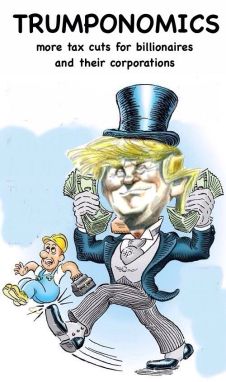
Donald Trump has admitted for the first time that his son met a Kremlin-connected lawyer in 2016 to collect information about Hillary Clinton, but insists the meeting was legal.
In one of a series of Sunday morning tweets issued in apparent reaction to a CNN report, the US president wrote: “Fake News reporting, a complete fabrication, that I am concerned about the meeting my wonderful son, Donald, had in Trump Tower. This was a meeting to get information on an opponent, totally legal and done all the time in politics – and it went nowhere. I did not know about it!”
That explanation differs entirely from one given by Trump 13 months ago, when a statement dictated by the president but released under the name of Donald Trump Jr read: “We primarily discussed a program about the adoption of Russian children that was active and popular with American families years ago.”
The 2016 meeting is pivotal to the special counsel Robert Mueller’s Russia collusion investigation, though Trump’s tweets appeared aimed at conveying the message that he is not worried about Donald Trump Jr’s exposure to the inquiry.
He made the remarks as one of his lawyers warned the special counsel against trying to force the president to be interviewed.
 The dude seriously keeps admitting to crimes. Why can’t we lock hIm up? “President Trump changes story in Twitter rant admitting Trump Tower meeting was to gather intel on Hillary Clinton.”
The President’s latest social media meltdown was in reaction to what he called a “complete fabrication” in Sunday’s Washington Post claiming Trump was concerned “innocent and decent people,” including his son Donald Trump Jr., could be hurt by Mueller’s probe exploring links between Trump’s campaign and Russia.
“This was a meeting to get information on an opponent, totally legal and done all the time in politics — and it went nowhere,” he wrote. “I did not know about it!”
Thirteen months ago, Trump gave a different explanation for the meeting between his eldest son and parties alleging ties to the Russian government. A July 2017 statement credited to Don Jr. and later discovered to have been dictated by the President read: “We primarily discussed a program about the adoption of Russian children that was active and popular with American families years ago.”
Though the President maintains he knew nothing about the Trump Tower meeting prior to its taking place, his former fixer Michael Cohen, who has reportedly indicated a willingness to cooperate with Mueller’s team, has allegedly said otherwise.
Trump lawyer Jay Sekulow said on ABC’s “This Week” on Sunday that he had “bad information” when he personally argued that the meeting was about adoption.
So, this is just an open news dump thread! What’s on your reading and blogging list today?
Friday Reads: Crazy go Nuts News only because of Crazy go Nuts White People
Posted: May 11, 2018 Filed under: Black Lives Matter, Civil Rights, Domestic Policy, domestic surveillance drones, Domestic terrorism, Donald Trump, morning reads, Rape Culture 42 Comments It’s Friday Sky Dancers! It’s the day of the week when the news cycle goes bonkers. But, of course, it’s only because what’s going on in our country makes it so. WTF is wrong with White People? Haven’t we learned anything? If any of our Sky Dancers of Color would like to start actively writing on the front page please let us know! I can write about all of this but only as some one who watches and learns. That’s not the vantage point that needs to be heard. We know of all the white supremacist activity that’s been happening around the country. So, why is the FBI focused on this?
This is horrifying: From the Guardian: ‘Black activist jailed for his Facebook posts speaks out about secret FBI surveillance. Exclusive: Rakem Balogun spoke out against police brutality. Now he is believed to be the first prosecuted under a secretive US effort to track so-called ‘black identity extremists’ ‘
Rakem Balogun thought he was dreaming when armed agents in tactical gear stormed his apartment. Startled awake by a large crash and officers screaming commands, he soon realized his nightmare was real, and he and his 15-year-old son were forced outside of their Dallas home, wearing only underwear.
Handcuffed and shaking in the cold wind, Balogun thought a misunderstanding must have led the FBI to his door on 12 December 2017. The father of three said he was shocked to later learn that agents investigating “domestic terrorism” had been monitoring him for years and were arresting him that day in part because of his Facebook posts criticizing police.
“It’s tyranny at its finest,” said Balogun, 34. “I have not been doing anything illegal for them to have surveillance on me. I have not hurt anyone or threatened anyone.”
Balogun spoke to the Guardian this week in his first interview since he was released from prison after five months locked up and denied bail while US attorneys tried and failed to prosecute him, accusing him of being a threat to law enforcement and an illegal gun owner.
Balogun, who lost his home and more while incarcerated, is believed to be the first person targeted and prosecuted under a secretive US surveillance effort to track so-called “black identity extremists”. In a leaked August 2017 report from the FBI’s Domestic Terrorism Analysis Unit, officials claimed that there had been a “resurgence in ideologically motivated, violent criminal activity” stemming from African Americans’ “perceptions of police brutality”.
The counter-terrorism assessment provided minimal data or evidence of threats against police, but discussed a few isolated incidents, notably the case of Micah Johnson who killed five officers in Texas. The report sparked backlash from civil rights groups and some Democrats, who feared the government would use the broad designation to prosecute activists and groups like Black Lives Matter.
Balogun, who was working full-time for an IT company when he was arrested, has long been an activist, co-founding Guerrilla Mainframe and the Huey P Newton Gun Club, two groups fighting police brutality and advocating for the rights of black gun owners. Some of the work included coordinating meals for the homeless, youth picnics and self-defense classes – but that’s not what interested the FBI.
Then, watch this:
 From Elle Magazine: ‘A Dusty Congressman Tried to Reclaim Rep. Maxine Waters’ Time; It Didn’t Go Well’.
Hello and welcome to another edition of America’s favorite game show, They Really Tried It, with your host, Representative Maxine Waters. Today’s contestant is Rep. Mike Kelly of Pennsylvania (R) who, on Tuesday, took it upon himself to point his finger at Rep. Waters, shake it like a Polaroid picture, and tell her to stop talking about discrimination.
I’m already exhausted. In a video that comes from @FCSDems, an informational service that also doubles as a Maxine Waters fan account, Kelly attempts to call Waters out but it goes straight to voicemail. Waters, in turn, reminds him and all of us, just who she is. In so doing, she also coins a new catchphrase for the kids, but we’ll get to that in a second.
Rep. Kelly, who in the video of the exchange is the kind of hype you imagine Twitter trolls with three followers are, really thought that he could take it upon himself to tell Rep Waters, well, anything. Well, audience, we have the results and it turns out, he could not.
The dispute started, as most basic misunderstandings of intersectionality do, with a discussion of auto lending. The Trump administration and Congressional Republicans are trying to roll back Obama-era legislation (how many times has that phrase been written) that prevents auto lenders from discriminating against potential buyers. The legislation, S.J. Res. 57, seeks not only to repeal the guidelines and permanently prevent Congress from ever again enacting anything similar.
Trump seems hellbent on rolling back everything that President Obama did. Tomorrow he’s outlawing tan suits and next week he’s rolling back the death of Fidel Castro and putting Cuba back on the no-no list. It’s amazing to witness the work of a president whose policy handbook comes straight from Biff Tannen of Back to the Future. I would not be surprised to find out Trump is working on a time machine so that he can go back and prevent Obama’s birth. I’m fine with that, actually, because he’d send himself back to Kenya in 1961 and spend the rest of his days fruitlessly nosing around hospitals like a low-rent Herod.
Back in the present, Rep. Kelly wasn’t satisfied to just make whatever point he had about keeping all the Whos in Whoville from enjoying Christmas, and thought it was a good time to lecture Waters. “We’re making America great,” he said, apparently without irony. “And the best way to do that is to stop talking about discrimination.”
https://giphy.com/gifs/meme-elle-magazine-l0Iy6bPECEL2wijnO
Lest we forget how bad white male privilege can get, let’s wander on down into the swamp of the local level in states like mine. Here’s The Advocate showing how one state Representative from Louisiana managed to offend every woman representative in the entire body.
An effort to describe how Louisiana’s female prisoners should be treated sparked testy exchanges in the House, as a male lawmaker criticized the measure as offering unequal treatment to women and men.
The bill would require female prisoners to have access to feminine hygiene products at no cost, amid concerns some women have been forced to pay for them. The measure also would limit when male prison guards can conduct a pat-down or body cavity search on a woman and add guidelines for how male guards enter areas of a prison where women are undressed.
Rep. Kenny Havard responded with an amendment to place similar limits on how female prison guards deal with male prisoners. It provoked an outcry from female lawmakers, who called it disrespectful. Havard withdrew the proposal.
Havard. R-St. Francisville, made international news in 2016 when he attempted to amend legislationaimed at setting a minimum age for strippers with weight restrictions. Havard, at the time, said his stripper amendment was a misfired criticism about bills that are too intrusive.

That’s the Cliff Notes version. Here’s some details from my friend Melinda DeSlatte who covers the lege for AP.
A Louisiana lawmaker sparked complaints Thursday that he disrespected women by criticizing legislation that recommends how female prisoners should be treated.
The bill up for debate would require female prisoners to have access to feminine hygiene products at no cost, amid concerns some women have been forced to pay for them. The measure would limit when male prison guards can conduct a pat-down or body-cavity search on a woman. And new guidelines would describe how male guards should enter areas where women may be undressed.
Rep. Kenny Havard, a St. Francisville Republican, responded with an amendment to place similar limits on how female prison guards could deal with male prisoners. The proposal provoked an outcry and some shouting from female lawmakers, and Havard withdrew the amendment before the House ultimately approved the bill.
“Rep. Havard, have you ever been a woman?” Rep. Julie Stokes asked during the debate.
“I was at Halloween one time,” Havard replied.
Stokes, a Kenner Republican, then told him that women have “biological things” that make life “a bit harder.”
“In my opinion, you’re disrespecting women,” Stokes told Havard.
Rep. Patricia Smith, a Baton Rouge Democrat, echoed the complaints, citing rapes of female inmates.
Men get raped in prison, too, Havard replied.
Havard said he was merely trying to make a point that men and women should be treated equally. He also raised concerns that the bill could make it harder to monitor female prisoners for contraband and other improper activities. And he complained about news coverage of earlier comments he made about having too many female prison guards for male prisoners.
“My point that I’m trying to make here is we have to find a way to fund these prisons so we aren’t short-handed,” Havard said.
After Havard withdrew his amendment, the bill sponsored by Sen. Regina Barrow, a Baton Rouge Democrat, passed with a vote of 86-0.Republican House Speaker Taylor Barras chastised his colleagues: “OK, members, we’re getting to the end of the day. The decorum is falling apart.”
 So, this is part of a nationwide Trumpsterfire to dismantle anti-discrimination laws that aggrieve white men and their captive wives, it seems. The ACLU is “Suing Ben Carson for Trying to Dismantle the Fair Housing Act”. That one is of particular interest to KKKremlin Caligula since Daddy and junior were successfully found guilty of violating it many times over. It also has an Obama link and of course, Hair Furor has to actively destroy all things Obama.
It is no accident that much of the United States remains segregated. Decades of slavery, Jim Crow laws, discriminatory lending practices, and intentional policy choices at the federal, state, and local level — most of which were enacted within the last 80 years — helped make it so.
The Fair Housing Act, passed in 1968, just a week after Martin Luther King, Jr. was assassinated, was meant to address the decades of discrimination that led to such segregation. The FHA made it illegal to discriminate against anyone buying or renting a house because of their race, color, religion, sex, or national origin (it’s since been amended to include family status and disability, too). But it also sought to replace segregation in America with “truly integrated and balanced living patterns” by requiring agencies to “affirmatively” further fair housing in all programs related to housing.
The FHA brought about a sea change with respect to individual housing discrimination — Americans today would be shocked to find an apartment listing that indicated Black people or women with children could not apply. But its promise of integrating neighborhoods has been left largely unfulfilled. As former Vice President Walter Mondale, who co-authored the legislation, pointed out recently in a New York Times op-ed, the FHA is the “most ignored” of the era’s civil rights laws.
It seems like Secretary Ben Carson, head of the Department of Housing and Urban Development, would like to keep it that way. In January, the agency suspended the only regulation to ever give the FHA real leverage in ending segregation. The move puts housing integration in serious jeopardy, so we’re challenging it in court.
Since it was enacted, successive presidential administrations largely ignored their affirmative obligations to create fair housing, allowing federal government dollars to flow uninterrupted to cities and towns that have policies in place that maintain segregation. Then, in 2015, the Obama administration finally began to seriously address this issue by putting in place a regulation called the Affirmatively Further Fair Housing (AFFH) Rule. The rule required cities and towns to create a plan to address segregation and discrimination and to lay out concrete goals for bringing fair housing and opportunity to members of all the groups protected by the FHA before receiving government money. Examples of these goals include building affordable housing in areas well-served by transit and prohibiting landlords from discriminating against people who use a government subsidy to pay part of their rent.
 Shall we head on up to the head of the beast? This is from Think Progress: White House chief of staff demonizes immigrants in racist rant. Xenophobia doesn’t get more hackneyed than this.’
In a wide-ranging interview with NPR, White House Chief of Staff John Kelly shared some rather racist views to justify the Trump administration’s new “zero tolerance” policy on illegal border crossings.
Defending an approach that will split up families, Kelly explained that he thinks these immigrants don’t really fit in with United States culture anyway:
Let me step back and tell you that the vast majority of the people that move illegally into United States are not bad people. They’re not criminals. They’re not MS13. … But they’re also not people that would easily assimilate into the United States, into our modern society.
Concerns about immigrants’ ability to assimilate with American society have been used repeatedly throughout the country’s history to justify barring different groups from immigrating. For example, the Chinese Exclusion Act, a law that prohibited all immigration of Chinese laborers from 1882 until 1943, was passed because Chinese immigrants were blamed for the depressed wages that followed the Gold Rush and Civil War. In 1890, the New York Times printed an article that explained that while “the red and black assimilate… not so the Chinaman.”
Let’s just head back to an article from The Atlantic from 2016. We’ve known all along that Make America Great Again and all Donald Trumps associated rhetoric harkens back to the KKK and to anti immigrant fever from times not as far back as we thought. “Make America White Again? Donald Trump’s language is eerily similar to the 1920s Ku Klux Klan—hypernationalistic and anti-immigrant.”
This has happened before. As The Atlantic’s Yoni Appelbaum pointed out, the Republican front-runner’s refusal to repudiate white supremacists’ support as well as the bombast in his campaign are both echoes of the Ku Klux Klan. As a historian of the 1920s Klan, I noticed the resonances, too. Trump’s “Make America great again” language is just like the rhetoric of the Klan, with their emphasis on virulent patriotism and restrictive immigration. But maybe Trump doesn’t know much about the second incarnation of the order and what Klansmen and Klanswomen stood for. Maybe the echoes are coincidence, not strategy to win the support of white supremacists. Maybe Trump just needs a quick historical primer on the 1920s Klan—and their vision for making America great again.
In 1915, William J. Simmons, an ex-minister and self-described joiner of fraternities, created a new Ku Klux Klan dedicated to “100 percent Americanism” and white Protestantism. He wanted to evoke the previous Reconstruction Klan (1866-1871) but refashion it as a new order—stripped of vigilantism and dressed in Christian virtue and patriotic pride. Simmons’s Klan was to be the savior of a nation in peril, a means to reestablish the cultural dominance of white people. Immigration and the enfranchisement of African Americans, according to the Klan, eroded this dominance and meant that America was no longer great. Simmons, the first imperial wizard of the Klan, and his successor, H.W. Evans, wanted Klansmen to return the nation to its former glory. Their messages of white supremacy, Protestant Christianity, and hypernationalism found an eager audience. By 1924, the Klan claimed 4 million members; they wore robes, lit crosses on fire, read Klan newspapers, and participated in political campaigns on the local and national levels.
To save the nation, the Klan focused on accomplishing a series of goals. A 1924 Klan cartoon, “Under the Fiery Cross,” illustrated those goals: restricted immigration, militant Protestantism, better government, clean politics, “back to the Constitution,” law enforcement, and “greater allegiance to the flag.” Along with the emphases on government and nationalism, the order also mobilized under the banners of vulnerable white womanhood and white superiority more generally. Nativism, writes historian Matthew Frye Jacobson in Whiteness of a Different Color, is a crisis about the boundaries of whiteness and who exactly can be considered white. It is a reaction to a shift in demographics, which confuses the dominant group’s understanding of race. For the KKK, Americans were supposed to be only white and Protestant. They championed white supremacy to keep the nation white, ignoring that citizenry was not constrained to their whims.
 This was the movement that attracted Donald’s Daddy Dearest.
Every day, a monumental 20th century stride towards making our union more perfect with the goal of inclusion is being torn down. Voting while we can has never been more important.
Oh, and Don’t forget! If you’re black and you stay at an Air BNB be sure to smile and wave and maybe shuck and jive so the white people know you’re not a Black Panther!!!
And if you’re a black graduate student who falls asleep in your own dorm … well, I don’t know what you have to do for this little white girl. She calls the cops on every black person around her …
It’s a familiar story. A black person is minding their own business. A white woman notices them and calls the cops.
The latest event in a long historical pattern took place at Yale University this week (paywall). A black graduate student, Lolade Siyonbola, was taking a nap in her dorm’s common room on Monday night after an evening writing papers. A white woman who also lives in the dorm noticed Siyonbola sleeping, told her she was not supposed to be there, and called campus security. “I have every right to call the police. You cannot sleep in that room,” the woman said in the first of two Facebook videos posted by Siyonbola.
The fallout is captured in a 17-minute Facebook video posted by Siyonbola, which now has more than 600,000 views. She shows the campus officers her room key and unlocks her apartment; the officers press her to produce identification, while Siyonbola questions whether the request is justified. Once the officers verify her identity, they leave.
The incident is the latest in a string of high-profile incidents that have exposed a troubling, often-overlooked truth about racial discrimination in the US. The Black Lives Matter movement intensified focus on police brutality in black communities, which tends to involve white male police officers’ violence against black men, sometimes with deadly results. But Siyonbola’s experience highlights the fact that white women play a role in encounters between the police and black Americans, too. Again and again, the news cycle highlights stories of white women who felt threatened by the mere presence of a black person in a public space, and called the cops.
And don’t go any here near your local Neighborhood phone Ap Nextdoor because it will be an endless stream of black people sightings including kids just trying to walk home from school even in my 9th ward New Orleans neighborhood.
You may want to read this and think on it. From the Guardian: “How white women use strategic tears to silence women of colour” by
At the Sydney writers’ festival on Sunday, editor of Djed Press, Hella Ibrahim, relayed the final minutes of a panel on diversity featuring writers from the western Sydney Sweatshop collective. One of the panellists, Winnie Dunn, in answering a question about the harm caused by good intentions, had used the words “white people” and “shit” in the same sentence. This raised the ire of a self-identified white woman in the audience who interrogated the panellists as to “what they think they have to gain” by insulting people who “want to read their stories.”
In other words, the woman saw a personal attack where there wasn’t one and decided to remind the panellists that as a member of the white majority she ultimately has their fate in her hands.
“I walked out of that panel frustrated,” Ibrahim wrote. “Because yet again, a good convo was derailed, white people centred themselves, and a POC panel was told to police it’s [sic] tone to make their message palatable to a white audience.”
What’s on your reading and blogging list today? And the offer to extend the front page is open to really any one. We’re having a hard time keep up with things here since so much of what we care about is basically under fire.
I was thrilled to find so many local governments running kids’ art projects for Fair Housing themes. These are some selections from Greensborough, NC, and Portland, Oregon.
Friday Reads: My Country has Dysfunctional Family Dynamics and one mean drunk Father in Charge
Posted: December 29, 2017 Filed under: 2016 elections, Donald Trump | Tags: Dangerous and Angry Donald, Delusional, Deranged 19 CommentsJust when you think it’s safe to turn the TV on …

Thursday night went out with another Dumpfster Fire Interview that is sure to cause us all to crawl back into our safe space. Kremlin Caligula gave an unsupervised interview to the NYT and it’s a doozy. I don’t know if any of you ever grew up in a family with one parent who was almost always angry, given to spontaneous fits of temper, and generally could say something to make you feel smaller than a grain of salt but this is the only way I can describe our country’s relationship with its current placeholder in the White House. He’s the mean drunk, angry father. We’re the family that knows the outbursts are at least daily events and they get worse. We have no idea how to make it go away we just hope some nice law enforcement official puts him away eventually before he kills some one.
Of course, the interview contained lie upon lie upon lie. The Toronto Star counted 25 of them. That’s 1 false claim per half hour. He’s still obsessed with the election and he is scared as shit about the Mueller investigation.
The Star is keeping track of every false claim Trump makes as president. As of Dec. 22, Trump had already made 978 false claims; adding the Times interview, the tally will pass the 1,000 mark in the next update.
Here’s every false claim Trump made in the interview:
1) “But I think it’s all worked out because frankly there is absolutely no collusion, that’s been proven by every Democrat is saying it … Virtually every Democrat has said there is no collusion. There is no collusion.”
Democratic members of Congress have not said en masse that they are convinced that there was no collusion between Trump’s campaign and Russia. Some have acknowledged that they have not seen evidence of collusion, but they have pointed out that the investigation is ongoing.
2) “And you’re talking about what Paul (Manafort) was many years ago before I ever heard of him. He worked for me for — what was it, three and a half months? … Three and a half months.”
Manafort worked for the Trump campaign for just under five months, from March 28, 2016 to his resignation on August 19, 2016.
3) “I saw (Democratic Sen.) Dianne Feinstein the other day on television saying there is no collusion.”
Trump appeared to be referring, as he has in the past, to a November CNN interview with Feinstein — in which she did not declare that there is no collusion. Feinstein was specifically asked if she had seen evidence that the Trump campaign was given Democratic emails hacked by Russia. “Not so far,” she responded. She was not asked about collusion more broadly, and her specific answer made clear that she was referring only to evidence she has personally seen to date, not issuing a sweeping final judgment.
4) “She’s (Feinstein) the head of the committee.”
Feinstein, a Democrat, is not the head of any committee: Republicans control Congress and thus lead the committees. She is the ranking member — the top Democrat — on the Senate Judiciary Committee.
5) “So, I actually think that it’s turning out — I actually think it’s turning to the Democrats because there was collusion on behalf of the Democrats. There was collusion with the Russians and the Democrats. A lot of collusion … starting with the dossier.”
The word “collusion” — in common language, a “secret agreement or co-operation especially for an illegal or deceitful purpose” — simply does not apply to the dossier produced by a former British spy about alleged ties between Trump’s campaign and Russia. Trump’s administration, seeking to turn the “collusion” allegation around on its opponents, has argued that the dossier, which was funded in part by the Clinton campaign, amounts to the “Clinton campaign colluding with Russian intelligence.” This is absurd on its face. Russian intelligence favoured Trump and tried to damage Clinton, U.S. intelligence agencies say; the British ex-spy was simply using Russian sources — who have not been identified — to attempt to figure out how Trump’s campaign was linked to the Russian government. Such research is not illegal or deceitful, and it does not come close to qualifying as the type of possible “collusion” investigators are probing with regard to the Trump campaign: coordination with the Russian government’s efforts to interfere with the election.
6) “ … it’s very hard for a Republican to win the Electoral College. O.K.? You start off with New York, California and Illinois against you. That means you have to run the East Coast, which I did, and everything else. Which I did and then won Wisconsin and Michigan. (Inaudible.) So the Democrats. … (Inaudible.) … They thought there was no way for a Republican, not me, a Republican, to win the Electoral College … The Electoral College is so much better suited to the Democrats (inaudible).”
This claim that the Electoral College is tilted in favour of Democrats — and that “they” think it is impossible for a Republican to win the election in 2016 —- is obvious nonsense. Six of the last nine presidents, all of whom except for Gerald Ford had to win an Electoral College election, have been Republicans.
7) “They made the Russian story up as a hoax, as a ruse, as an excuse for losing an election that in theory Democrats should always win with the Electoral College.”
Democrats, of course, did not invent the “Russian story” for electoral purposes, nor is it a “hoax.” U.S. intelligence agencies say that the Russian government interfered in the election for the purpose of helping Trump win; that Russian interference was the original story, and Democrats were talking about it well before Election Day. Perhaps Trump is correct that there was no illegal collusion between his campaign and the Russians, but this matter is being investigated by a special prosecutor appointed by his own deputy attorney general, not “Democrats,” and many senior Republicans believe the investigation has merit.
8) “They (Democrats) thought it would be a one-day story, an excuse, and it just kept going and going and going.”
This is simple nonsense. Democrats did not think that the question of Russian interference in the election on behalf of Trump, or the question of the Trump campaign’s relationship with those efforts, would be a “one-day story.”
Of course, that list goes on so go read it!

Axios presents evidence that Trump will be unchained in 2018. Heaven help all of us with PSTD!
If you ask some close to President Trump what worries them most about 2018, it’s not Robert Mueller’s probe. It’s that establishment guardrails of 2017 come down — and Trump’s actual instincts take over.
Next year will bring “full Trump,” said one person who recently talked to the president.
Trump has governed mostly as a conventional conservative — on tax cuts, his Supreme Court pick, and rolling back regulations. Most of his top advisers are fairly conventional conservatives, so that makes sense.
- Most of those in his current decision-making circle — even if they’re not mainstream Republicans — are defending mainstream Republican principles like free trade and an internationalist view of foreign policy.
- But top officials paint a different portrait of Trump when it comes to what he really wants on trade, immigration and North Korea — but has been tamped down by skeptical staff and Cabinet officials.
In private meetings:
- Trump keeps asking for tariffs — on steel and aluminum, in particular. He wants a trade war, and has for many years. His economic and diplomatic advisers persuaded him to delay trade actions in 2017.
- Those advisers recognize that the day of reckoning will come in 2018, regardless of whether economic adviser Gary Cohn and Secretary of State Rex Tillerson — who advocated restraint — stay or go.
- Cohn and Treasury Secretary Steve Mnuchin successfully persuaded Trump not to do anything rash while tax reform was being negotiated.
- Trump also saw the advantage of trying to use that as leverage with China to get help on North Korea. He said yesterday in an interview with the N.Y Times: “China’s hurting us very badly on trade, but I have been soft on China because the only thing more important to me than trade is war. O.K.?”
- And he tweeted yesterday, in response to Chinese ships secretly delivering oil to North Korea: “Caught RED HANDED – very disappointed that China is allowing oil to go into North Korea. There will never be a friendly solution to the North Korea problem if this continues to happen!”
- NEW: Look for Trump to take action on trade in the next month. It probably won’t be next week, so as not to disrupt the afterglow of the tax cut. But nothing is final.
- Trump still wants his wall, and tighter restrictions on legal immigration. He’s a true believer on this stuff, and knows intuitively that it keeps his base stoked.
- Trump seems most interested in discussing military options on North Korea in these meetings. He is surrounded by advisers who share his concern about the rogue state, but not his fixation on a military strike.
- And some top officials have told us Trump’s belligerent rhetoric on the subject makes them nervous.
- There is a reason the harshest assessments of Trump usually leak after North Korea meetings.
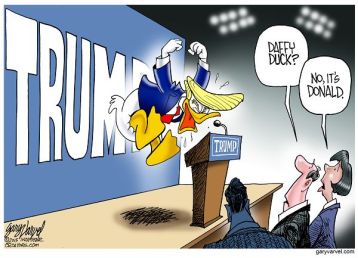 This interview basically let Trump be Trump. He just wandered all over the place but always returned to the idea that Russia is a Democratic plot against his win but even if it did exist it’s no big deal and definitely not a crime. I’ve seen toddlers with a better grasp of a logical argument.
President Trump in a new interview denied any collusion between his 2016 presidential campaign and Russia, adding “even if there was, it’s not a crime.”
Speaking to The New York Times Thursday, Trump praised lawyer Alan Dershowitz, who has argued that Trump’s firing of former FBI Director James Comey was not obstruction of justice because Trump has the right to fire the head of the bureau.
“I watched Alan Dershowitz the other day, he said, No. 1, there is no collusion, No. 2, collusion is not a crime, but even if it was a crime, there was no collusion,” Trump told the newspaper. “And he said that very strongly. He said there was no collusion. And he has studied this thing very closely. I’ve seen him a number of times.”
“There is no collusion, and even if there was, it’s not a crime,” he continued. “But there’s no collusion.”
Trump also blasted special counsel Robert Mueller’s investigation into ties between Trump’s campaign and Russia, saying it “makes the country look very bad.”
“It puts the country in a very bad position,” Trump said. “So the sooner it’s worked out, the better it is for the country.”
 More like the sooner he’s out of office, the better it is for the country. Charles Pierce says it all “Trump’s New York Times Interview Is a Portrait of a Man in Cognitive Decline.”
On Thursday, El Caudillo del Mar-A-Lago sat down with Michael Schmidt of The New York Times for what apparently was an open-ended, one-on-one interview. Since then, the electric Twitter machine–and most of the rest of the Intertoobz–has been alive with criticism of Schmidt for having not pushed back sufficiently against some of the more obvious barefaced non-facts presented by the president* in their chat. Some critics have been unkind enough to point out that Schmidt was the conveyor belt for some of the worst attacks on Hillary Rodham Clinton emanating from both the New York FBI office and the various congressional committees staffed by people in kangaroo suits. For example, Schmidt’s name was on a shabby story the Times ran on July 23, 2015 in which it was alleged that a criminal investigation into HRC’s famous use of a private email server was being discussed within the Department of Justice. It wasn’t, and the Times’ public editor at the time, the great Margaret Sullivan, later torched the story in a brutal column.
Other people were unkind enough to point out that the interview was brokered by one Christopher Ruddy, a Trump intimate and the CEO of NewsMax, and that Ruddy made his bones as a political “journalist” by peddling the fiction that Clinton White House counsel Vince Foster had been murdered, one of the more distasteful slanders that got a shameful public airing during the Clinton frenzy of the 1990’s. Neither of those will concern us here. What Schmidt actually got out of this interview is a far more serious problem for the country. In my view, the interview is a clinical study of a man in severe cognitive decline, if not the early stages of outright dementia.
Over the past 30 years, I’ve seen my father and all of his siblings slide into the shadows and fog of Alzheimer’s Disease. (the president’s father developed Alzheimer’s in his 80s.) In 1984, Ronald Reagan debated Walter Mondale in Louisville and plainly had no idea where he was. (Would that someone on the panel had asked him. He’d have been stumped.) Not long afterwards, I was interviewing a prominent Alzheimer’s researcher for a book I was doing, and he said, “I saw the look on his face that I see every day in my clinic.” In the transcript of this interview, I hear in the president*’s words my late aunt’s story about how we all walked home from church in the snow one Christmas morning, an event I don’t recall, but that she remembered so vividly that she told the story every time I saw her for the last three years of her life.
In this interview, the president* is only intermittently coherent. He talks in semi-sentences and is always groping for something that sounds familiar, even if it makes no sense whatsoever and even if it blatantly contradicts something he said two minutes earlier. To my ears, anyway, this is more than the president*’s well-known allergy to the truth. This is a classic coping mechanism employed when language skills are coming apart. (My father used to give a thumbs up when someone asked him a question. That was one of the strategies he used to make sense of a world that was becoming quite foreign to him.) My guess? That’s part of the reason why it’s always “the failing New York Times,” and his 2016 opponent is “Crooked Hillary.”
In addition, the president* exhibits the kind of stubbornness you see in patients when you try to relieve them of their car keys–or, as one social worker in rural North Carolina told me, their shotguns. For example, a discussion on health-care goes completely off the rails when the president* suddenly recalls that there is a widely held opinion that he knows very little about the issues confronting the nation. So we get this.
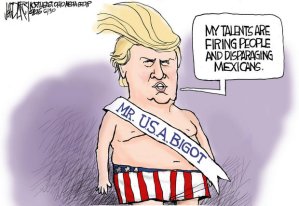 He’s obviously obsessed with Mueller too and of course, with Hillary, always with Hillary. Aaron Blake of WAPO focuses on some of his more bizarre thoughts on the Justice Department and the Mueller Investigation.
1. On special counsel Robert S. Mueller III: “It doesn’t bother me, because I hope that he’s going to be fair. I think that he’s going to be fair. … There’s been no collusion. But I think he’s going to be fair.”
This might have been the newsiest bit from the interview. Trump seemingly contradicts many of his supporters by saying he thinks Mueller will be fair. Conservative media and Republicans in Congress have spent much of the past few weeks attacking the credibility of the Mueller investigation. Trump hasn’t really joined in that effort publicly, but he has attacked the FBI and the Justice Department.
2. “I have absolute right to do what I want to do with the Justice Department. But for purposes of hopefully thinking I’m going to be treated fairly, I’ve stayed uninvolved with this particular matter.”
And here’s the other side of the coin. In this quote, Trump seems to buy into what those same supporters have been arguing about his authority to control the Justice Department. This is a rather remarkable assertion of power, even as it’s not terribly surprising from a president who clearly has some authoritarian tendencies. It seems Trump is suggesting he can do things like fire Mueller if he wants to, even as he says he thinks Mueller is being fair and as the White House denies that is even being considered.
3. “I don’t want to get into loyalty, but I will tell you that — I will say this: [Eric] Holder protected President Obama. Totally protected him. When you look at the IRS scandal, when you look at the guns for whatever, when you look at all of the tremendous, ah, real problems they had — not made-up problems like Russian collusion, these were real problems — when you look at the things that they did, and Holder protected the president. And I have great respect for that, I’ll be honest, I have great respect for that.”
Trump begins this quote by saying, “I don’t want to get into loyalty,” but then he goes on to unmistakably suggest that Attorney General Jeff Sessions hasn’t been loyal enough to him — or at least that he hasn’t been as loyal as then-Attorney General Eric H. Holder Jr. was to President Barack Obama. Add this to the list of quotes showing just how upset Trump remains with Sessions.
Kremlin Caligula has a most unAmerican viewpoint of these things that it’s almost difficult to believe he was ever schooled on American soil. Where does one get such blatantly unConstitutional notions? Oh, and that’s 3 of 11.
I have to agree though, the idea that he still thinks he’s running a nationally syndicated TV show in lieu of a nation is the most curious of all the quotes. This is a man that simply is delusional and dangerous. This is number 4.
4. On 2020: “Another reason that I’m going to win another four years is because newspapers, television, all forms of media will tank if I’m not there. Because without me, their ratings are going down the tubes. Without me, the New York Times will indeed be not the failing New York Times, but the failed New York Times. So they basically have to let me win. And eventually, probably six months before the election, they’ll be loving me because they’re saying, ‘Please, please, don’t lose Donald Trump.’”
I’ve long thought Trump believed this, but it’s remarkable to hear him say it out loud. It’s almost like he’s making a case to the media for why it should help him win reelection in 2020 and/or not be too tough on him. And it’s not the first time that he’s said something that seems to misunderstand the media’s role in American governance. Reports have long suggested Trump thought his media coverage would improve once he was elected president.
 There’s seven more of these too go so check them out. It’s just really a fall down a rabbit hole. Is he the Mad Hatter or the March Hare? As always, Twitter rules the response to the Demon God of Twitter.
Thursday evening brought a surprise New York Times interview with President Donald Trump. Times reporter Michael Schmidt was able to speak to the president at Trump’s golf club in West Palm Beach, Florida. In an impromptu, free-wheeling, 30-minute conversation following Trump’s latest round of golf, the president insisted numerous times that there was no collusion with Russia while also maintaining that he feels Special Counsel Robert Mueller can be fair to him.
With the Timesposting excerpts from the transcript of the interview, Media Twitter had a field day posting their favorite bits from the president rambling off-the-cuff. Let’s face it — there are fewer things reporters and journalists love more than unchained Trump.
https://twitter.com/AaronBlake/status/946562667698900993
So, I really don’t want any one to lose their lunch and appetite for life because we obviously have a severely disturbed president in charge of our nuclear arsenal. But it is what it is, and he is what he is, and this is a blog that’s always been focused on policy and politics.
 We are indeed a family that needs to uplift each other before this man destroys the lot of us and drives away all of our friends. I suppose it has to be reiterated that Republicans are enabling all of this to oversee the looting of the USA by the donors. I also wonder what kind of kompromat that the Russians have on them through their hacking of the RNC and likely, other places. I certainly think that the RNC must be worried. I definitely think both Sessions and Graham must have dossiers filled with stuff and now I’m thinking Orin Hatch must be more of a wascally wabbit than any of us every supposed.
Try to stick to local happiness while we can. I’m even finding that to be difficult given that the same enterprising rapers after our National Parks and Treasury have been at it with my neighborhood. My property takes just went from an annual bill of about $750 to over $2000. I have no doubt that I have Air BnB to thank for that. Pretty sure those idiots that still live here and are now renting rooms have had a similar experience. There’s just something about the sound of stupid ass white people slitting their own throats that just endlessly appalls.
So, I’ll see you on New Year’s Day. Let’s lift our prayers to all the Wisdom Energy in the Multiverse so that it sweeps over this nation like a Renaissance of Rational Thought. Resist!
What’s on your reading and blogging list today?
Monday Reads: I’m Tired! So Tired!
Posted: November 20, 2017 Filed under: Afternoon Reads, Donald Trump, Russia 33 Comments Good Afternoon Sky Dancers!
This is later than usual and I’m sorry. This is the third time to the Vet these last few days with Miles this morning and I seriously had to take nap. My hope is that he’s stabilized and will continue to mend some so we can figure out if he has any underlying problems other than his diabetes. He’s been keeping me up at nights with a routine like a newborn so I feel like I’ve been through the ringer.
BB has helped me out this morning with some enlightening and freaky things going on with the Russian Collaboration investigation. Foreign Policy reports on “How Jared Kushner’s Newspaper Became a Favorite Outlet for WikiLeaks Election Hacks.” It appears that his paper, “The New York Observer, owned by Trump’s son-in-law, was a friendly outlet for the 2016 Russian hackers.”
In the fall of 2014, Julian Assange, the embattled head of WikiLeaks, was meeting with a steady stream of supportive journalists in the Ecuadorian Embassy in London, where he had taken refuge to avoid extradition to Sweden on sexual assault charges. Among those seeking an audience with Assange was a freelancer working for the New York Observer, the newspaper owned and published by President Donald Trump’s son-in-law and key advisor, Jared Kushner.
Ken Kurson, the newspaper’s editor in chief — along with a freelance writer he’d hired — helped arrange a “no-holds-barred” interview with Assange that October.
 I can’t see how there isn’t a building amount of evidence that Kushner and Trump, Jr. didn’t actively coordinate with Russian Assets. It’s also evident that the Justice Department is now providing any evidence of Trump’s motivations in the Comey Firing.
Special counselRobert Mueller‘s team investigating whether President Donald Trump sought to obstruct a federal inquiry into connections between his presidential campaign and Russian operatives has now directed the Justice Department to turn over a broad array of documents, ABC News has learned.
In particular, Mueller’s investigators are keen to obtain emails related to the firing of FBIDirector James Comey and the earlier decision of Attorney General Jeff Sessions to recuse himself from the entire matter, according to a source who has not seen the request but was told about it.
Issued within the past month, the directive marks the special counsel’s first records request to the Justice Department, and it means Mueller is now demanding documents from the department overseeing his investigation.
Sessions and Deputy Attorney General Rod Rosenstein played key roles in Comey’s removal. And Sessions has since faced withering criticism from Trump over his recusal and Rosenstein’s subsequent appointment of Mueller.
Mueller’s investigators now seek not only communications among Justice Department staffers but also any of their communications with White House officials, the source said. Before this request, investigators asked former senior Justice Department officials for information from their time at the department, ABC News was told.
The latest move suggests the special counsel is still digging into, among other matters, whether Trump or any other administration official improperly tried to influence an ongoing investigation.
 I love this OP ED in the NYT entitled: “We’re With Stupid”. Maybe love isn’t quite the right word here. I continually wonder what on earth brings a group of supposed Christians into the fold of such a lying huckster.
The Russians also uploaded a thousand videos to YouTube and published more than 130,000 messages on Twitter about last year’s election. As recent congressional hearings showed, the arteries of our democracy were clogged with toxins from a hostile foreign power.
But the problem is not the Russians — it’s us. We’re getting played because too many Americans are ill equipped to perform the basic functions of citizenship. If the point of the Russian campaign, aided domestically by right-wing media, was to get people to think there is no such thing as knowable truth, the bad guys have won.
As we crossed the 300-day mark of Donald Trump’s presidency on Thursday, fact-checkers noted that he has made more than 1,600 false or misleading claims. Good God. At least five times a day, on average, this president says something that isn’t true.
We have a White House of lies because a huge percentage of the population can’t tell fact from fiction. But a huge percentage is also clueless about the basic laws of the land. In a democracy, we the people are supposed to understand our role in this power-sharing thing.
Nearly one in three Americans cannot name a single branch of government. When NPR tweeted out sections of the Declaration of Independence last year, many people were outraged. They mistook Thomas Jefferson’s fighting words for anti-Trump propaganda.
Fake news is a real thing produced by active disseminators of falsehoods. Trump uses the term to describe anything he doesn’t like, a habit now picked up by political liars everywhere.
But Trump is a symptom; the breakdown in this democracy goes beyond the liar in chief. For that you have to blame all of us: we have allowed the educational system to become negligent in teaching the owner’s manual of citizenship.
 It seems illiteracy in all things democratic and Constitutional has broken our Republic and led to Trumpism. We’re six months into the Mueller investigation and a little over ten months into Kremlin Caligula’s rule of kleptocracy. How are those within the White House dealing with the pressure. WAPO has an interesting read on this in a piece titled ” ‘A long winter’: White House aides divided over scope, risks of Russia probe.”
Some in the West Wing avoid the mere mention of Russia or the investigation whenever possible. Others take solace in the reassurances of White House lawyer Ty Cobb that special counsel Robert S. Mueller III will be wrapping up the probe soon and the president and those close to him will be exonerated. And a few engage in grim gallows humor, privately joking about wiretaps.
The investigation reached a critical turning point in recent weeks, with a formal subpoena to the campaign, an expanding list of potential witnesses and the indictments of former Trump campaign chairman Paul Manafort and his deputy, Rick Gates. Some within Trump’s circle, including former chief of staff Reince Priebus, have already been interviewed by Mueller’s investigators, while others such as Hope Hicks — the White House communications director and trusted confidant of the president — and White House counsel Donald McGahn are expected in coming weeks.
One Republican operative in frequent contact with the White House described Mueller’s team “working through the staff like Pac-Man.”
“Of course they are worried,” said the Republican, who insisted on anonymity to offer a candid assessment. “Anybody that ever had the words ‘Russia’ come out of their lips or in an email, they’re going to get talked to. These things are thorough and deep. It’s going to be a long winter.”
 Upcoming witness Hope Hicks may have the keys to many of the big answers. The larges of these is the obstruction charge because that would go to the heart of removing this usurper child from the Oval Office.
A report from Politico this week, which found that the special counsel Robert Mueller is gearing up to interview the White House communications director, Hope Hicks, indicates that one of the many threads of the Russia investigation is probably moving into its final stages.
Hicks has long been one of President Donald Trump’s most trusted advisers, and she was present during some events that are key to the special counsel’s investigation.
Mueller’s investigation includes multiple components. In addition to looking into whether members of the Trump campaign colluded with Moscow to tilt the 2016 election in Trump’s favor, the special counsel is also investigating Trump on suspicion of obstruction of justicerelated to his decision to fire James Comey as FBI director.
As part of that investigation, ABC News reported on Sunday, Mueller has asked the Department of Justice for all emails connected to Comey’s firing.
Mueller has also requested documents related to Attorney General Jeff Sessions’ recusal from the Russia investigation. Sessions announced his recusal in March after it emerged that he had failed to disclose contacts with Sergey Kislyak, then Russia’s ambassador to the US, in his Senate confirmation hearing in January.
Despite his recusal, Sessions played a prominent role in Comey’s firing, as did Deputy Attorney General Rod Rosenstein.
Hicks was also a key presence during several critical moments leading up to Comey’s dismissal.
Comey was spearheading the FBI’s Russia investigation when he was terminated as FBI director in May. At first, the White House said he was fired because of his handling of the bureau’s investigation into Hillary Clinton’s use of a private email server to conduct government business as secretary of state. But Trump later told NBC’s Lester Holt that “this Russia thing” had been a factor in his decision
The most compelling Trump Russia read of the day is this from The Daily Beast. “Roman Beniaminov, a Low-Profile Real Estate Exec Turned Pop Star Manager, Knew About Russia’s ‘Dirt’ on Hillary.”
Days before the infamous Trump Tower meeting in June 2016, a low-profile real estate figure with ties to powerful Russians alerted a meeting participant that the topic of “dirt” on Hillary Clinton could come up, The Daily Beast has learned.
That figure, Roman Beniaminov, didn’t attend the meeting himself. But he had close ties to several figures in and around it, including Emin Agalarov, the Azeri-Russian pop star who helped set up that Trump Tower confab and whose father is an ally of Vladimir Putin.
Ike Kaveladze was one of the participants in the June 2016 meeting at Trump Tower between Jared Kushner, Paul Manafort, Donald Trump Jr., and Kremlin-connected attorney Natalia Vesilnitskaya. Kaveladze told Congressional investigators that when he was first invited to participate, he was under the impression that he would just be there as a translator and that the meeting would involve discussion of Magnitsky Act sanctions.
Scott Balber, Kaveladze’s attorney, told The Daily Beast that before Kaveladze headed from Los Angeles to New York for the meeting, he saw an email noting that Kushner, Manafort, and Trump Jr. would all be involved. He thought it would be odd for them to attend the meeting, so he called Beniaminov before heading to New York. Both Beniaminov and Kaveladze have worked with the Agalarov’s real estate development company, the Crocus Group.
Balber said that Beniaminov told Kaveladze that he heard Rob Goldstone— Emin Agalarov’s music manager— discuss “dirt” on Hillary Clinton. It’s never become completely clear what kind of “dirt” the Russians were talking about.
According to Balber, Beniaminov was the only person to give Kaveladze any information about the meeting’s purpose.
“That was the only data point Ike had, which was inconsistent with everything else he had heard, which was that the meeting was about the Magnitsky Act,” Balber said.
 I still take Trumpzilla’s word for it but I guess they may need more than that given his history of lying and braggadocio. Trump still could fire Mueller but it doesn’t look imminent. This is mostly because they all think it will be over shortly. Like, it will be done after this weekend or at least a by Christmas.
A source close to the administration tells the Post that Mueller is running “a classic Gambino-style roll-up” that “will reach everyone in this administration.” When you read histories of the more successful presidential administrations in American history, a phrase you don’t usually come across is “Gambino-style roll-up.”
However, in the face of this mounting evidence and the warnings of some allies, Trump has remained — by Trump’s standards — fairly calm. Obviously, by the standards of a normal president, he is acting like a complete lunatic. But given Trump’s patterns of spewing indiscriminate rage and abuse and lashing out at his enemies in wildly counterproductive fashion, he has conducted himself with notable restraint. Despite his barely concealed impulses, Trump has refrained from mass pardons or attempting to fire Mueller.
The apparent reason for his serenity is that his lawyer, Ty Cobb, has placated Trump with promises that Mueller’s probe would be over soon. “The president himself, however, has warmed to Cobb’s optimistic message on Mueller’s probe. Cobb had initially said he hoped the focus on the White House would conclude by Thanksgiving,” the Post reports.
Thanksgiving. It will all be over by Thanksgiving.
By this point, three days before Thanksgiving, it should be relatively clear Mueller’s work is not going to be completed before the turkey is served. The Post notes that Cobb “adjusted the timeline slightly in an interview last week, saying he remains optimistic that it will wrap up by the end of the year, if not shortly thereafter.”
If you want an excellent read letting you know just how low Trump can go try this one by It’s an exciting little thriller about “Trump’s ‘Great Relationship’ With A Homicidal Drug Warrior.”
When Maximo Garcia heard that he was on a list of local drug suspects in Mayombo, he tried to clear his name with the police chief, explaining that he no longer used drugs and had never sold them. Four days later, the Philippine news site Rappler reports, a masked gunman shot up Garcia’s house as he and his family were eating lunch, wounding him and killing his 5-year-old granddaughter.
So it goes in Philippine President Rodrigo Duterte’s war on drugs, which has claimed somewhere between 7,000 and 13,000 lives since he took office in June 2016. Although Duterte’s bloody crusade has drawn international criticism, Donald Trump evidently did not think the subject was worth broaching during his meeting with Duterte in Manila on Monday.
Trump, who, this week, bragged about his “great relationship” with Duterte, had previously praised his Philippine counterpart’s “unbelievable job on the drug problem.” Trump meant that as a compliment, but the viciousness of Duterte’s anti-drug campaign does beggar belief.
“If you know any addicts,” Duterte told a crowd of supporters after taking office, “go ahead and kill them yourself, as getting their parents to do it would be too painful.” A few months later, he likened himself to Hitler, saying “there’s 3 million drug addicts” in the Philippines, and “I’d be happy to slaughter them.”
Well, I’m working right now and I’m still Miles go for everything nurse. You can see I love him like a kid since every one these photos are of him. He’s also a cat of many talents.
What’s on your reading and blogging list today? Have a great week!!!

 peej
peej Carissa
 bostonboomer
 dakinikat
 ecocatwoman
 mablue2
 Mama Lopez
 peggysue22
 quixote
 skydancingguestblogger
 Mona (aka Wonk the Vote)



 Sky Dancing
Recent Comments