
Beyond Influence: Buying US Law
Posted: August 11, 2011 Filed under: Big Pharma, Civil Liberties, Civil Rights, collective bargaining, Corporate Crime, Domestic Policy, Economy, Environmental Protection, financial institutions, Global Financial Crisis, Gulf Oil Spill, Health care reform, Labor unions, legislation, Surreality, The Bonus Class, We are so F'd | Tags: ALEC, Bayer, ExxonMobil, Koch Industries, PFizer, VISA, Wal-Mart 23 Comments“Corporations are people, my friends.”
Mitt Romney, in a speech today in Iowa
I’ve wanted to write about ALEC for awhile. I tripped across this very succinct explanation in my print copy of Bloomberg Business Week that made me revisit my plans. Ever wonder why a bunch of weird ass bills suddenly show up simultaneously in a bunch of legislatures that say things that are basically against the positions of modern science, medicine, and economics? Well, chances are that some huge corporation has written that bill that will become law in no one’s interest but their own, and it was penned by some member of ALEC.
Kim Thatcher, a Republican state representative in Oregon, introduced a sharply worded anti-cap-and-trade bill this year that said, “There has been no credible economic analysis of the costs associated with carbon mandates.” Apparently, that view is widely shared. Legislation with that exact language has been introduced in dozens of states, including Montana, New Hampshire, and New Mexico.
It’s not plagiarism. It’s a strategy. The bills weren’t penned by Thatcher or her fellow legislators in Helena, Concord, and Santa Fe. They were written by a little-known group in Washington with outsize clout, the American Legislative Exchange Council. Corporate benefactors such as Koch Industries and ExxonMobil (XOM) help fund ALEC with membership dues and pay extra for a seat at the legislative drafting table.
Among ALEC’s prominent members are Pfizer (PFE), Wal-Mart (WMT), Bayer (BAYZF), and Visa (V), according to ALEC annual meeting documents provided by an attendee. The organization’s legislative agenda includes limiting the power of unions, fighting environmental regulations, and overturning President Obama’s health-care reform law. ALEC says it gets about 200 state laws passed each year. The corporate influence is hard to trace and can produce a return on investment that would make a hedge fund manager drool.
“This is just another hidden way for corporations to buy their way into the legislative process,” says Bob Edgar, president of Common Cause, which seeks to reduce money in politics. Reagan Weber, an ALEC spokeswoman, says the group simply facilitates the sharing of information and “good conservative policy.”
ALEC was founded in 1973 by two of the conservative movement’s intellectual midwives, both now dead: Representative Henry Hyde of Illinois and activist Paul Weyrich, who also was a founder of the Heritage Foundation. As a tax-exempt organization, ALEC doesn’t disclose its corporate donors or its member lists beyond those who serve as committee chairmen.
In exchange for annual membership dues of as much as $25,000 plus a fee of $3,000 to $10,000 to get on a bill-writing “task force,” Koch and ExxonMobil representatives sat beside elected officials and policy analysts at an ALEC meeting in April 2010, helping them write model energy legislation that would later be introduced in statehouses around the country, according to the documents. The legislators pay $100 for a two-year membership. The task force bills are considered finished only after the legislators and private-sector members vote separately to approve them, giving each side a veto. Once a model bill is complete, it’s up to ALEC’s legislator members to go back to their home states and shepherd it into law.
ALEC is on the radar of many organizations including the American Association for Justice who keeps track of their activities and publishes white papers on this group of bill-writers for profit, greed and the destruction of public resources.
(W)hile the membership appears to be public sector, the bankroll is almost entirely private sector. In fact, public sector membership dues account for only around one percent of ALEC’s annual revenues. ALEC claims to be nonpartisan, but in fact its free-market, pro-business mission is clear.
The result has been a consistent pipeline of special interest legislation being funneled into state capitols. Thanks to ALEC, 826 bills were introduced in the states in 2009 and 115 were enacted into law.
Behind the scenes at ALEC, the nuts and bolts of lobbying and crafting legislation is done by large corporate defense firm Shook, Hardy & Bacon. A law firm with strong ties to the tobacco and pharmaceutical industries, it has long used ALEC’s ability to get a wide swath of state laws enacted to further the interests of its corporate clients.
ALEC’s campaigns and model legislation have run the gamut of issues, but all have either protected or promoted a corporate revenue stream, often at the expense of consumers. For example, ALEC has worked on behalf of:
- Oil companies to undermine climate change proponents;
- Pharmaceutical manufacturers, arguing that states should be banned from importing prescription drugs;
- Telecom firms to block local authorities from offering cheap or free municipally-owned broadband;
- Insurance companies to prevent state insurance commissioners from requiring insurers to meet strengthened accounting and auditing rules;
- Big banks, recommending that seniors be forced to give up their homes via reverse mortgages in order to receive Medicaid;
- The asbestos industry, trying to shut the courthouse door to Americans suffering from mesothelioma and other asbestos-related diseases; and,
- Enron to deregulate the utility industries, which eventually caused the U.S. to lose what the Securities and Exchange Commission (SEC) estimated as $5 trillion in market value.
The Koch brothers and Koch Industries are all over ALEC. Their Charitable foundations and businesses provide a lot of funding. ExxonMobile is also a huge source of funds. There are several companies representing the interests of Big Pharma. ALEC looks like a who who of corporate America’s worst corporate citizens. The Center for Media and Democracy’s PR Watch put out a Special Report on ALEC’s funding last month.
According to ALEC’s IRS filings, over the past three years it has raised $21,615,465 from corporations, foundations, and other sources, and just over $250,000 in dues paid by state legislators, amounting to slightly more than 1 percent of its income. The gigantic gap between what legislators pay and what ALEC spends is the direct result of the reality that legislators pay a mere $50 a year to be a member, while a corporation can pay up to $25,000 a year or more to be a member of ALEC plus additional fees to be on a task force where corporations get the same right to vote as legislators. They just pay hundreds of times more for that vote.
…
For example, the foundations controlled by the billionaire Koch brothers gave ALEC over $200,000 in 2009. (The Claude R. Lambe Foundation, which Charles Koch, his wife and kids help run, donated $125,000 to ALEC. His own Charles G. Koch foundation kicked in an additional $75,000.) That $200k is before whatever is the undisclosed amount of membership “dues” paid by Koch Industries, which is run by Charles and David Koch. There is no public disclosure of annual gifts the company gives to take part in the one-stop shopping ALEC conventions provide to meet with legislators from every state about their wish list…
Other right-wing foundations have also supported ALEC, far beyond the “dues” paid by any legislator. For example, the Castle Rock Foundation, which is run by right-wing beer heir Peter Coors, gave $50,000 last year and in prior years. The right-wing John M. Olin foundation has also been a donor to ALEC. Another of the big right-wing foundations, the Lynde and Harry Bradley Foundation, has been a funder and, for example, gave ALEC $50,000 in 2009 to fund “budget reform” work. Similarly, right-winger Richard Scaife has given ALEC over half a million dollars the past decade or so, through his Allegheny Foundation. Some of the organizations that support ALEC, like Scaife’s, are also deeply invested in the profits of corporations that sit on ALEC’s board. The Allegheny Foundation has held over $11 million of ALEC board member Altria‘s stock, along with major stock holdings in other ALEC corporate board members like Kraft, Coca Cola, AT&T, GlaxoSmithKline, Johnson & Johnson, and Exxon.
ALEC is a major voice for climate change denial, responsible for the recent spate of voter disenfranchisment laws, and continually pushes for extreme tort reform. There’s a really good primary on ALEC at People for the American Way. ALEC is the well-funded voice of corporate special interests. Here are two recent examples of state legislature originating from ALEC.
ALEC was influential in crafting and passing a Texas law, dubbed the “Successor Asbestos-Related Liability Fairness Act, that shielded Crown Cork and Seal, a business that in 1966 acquired a company that used asbestos in its products, from lawsuits from the company’s workers. Even though Crown agreed to pay the company’s liabilities, it wanted immunity from paying damages to workers facing asbestos-related diseases. Crown Cork and Seal turned to ALEC to help shape the Texas law, which put an extremely low cap on liability for companies like Crown who acquired companies which committed wrongdoing, known as a “successor immunity” law.” Mark Behrens, an attorney for Shook Hardy, worked as a lobbyist for both ALEC and Crown to encourage allied lawmakers to introduce and pass the bill. The American Association for Justice writes that “this so-called ‘successor immunity’ has all the hallmarks of an ALEC special interest bill. It is plainly designed not with public policy in mind, but rather a specific industry (or in this case, a specific company).” The Texas Supreme Court ultimately found the cap to be an unconstitutional retroactive protection for Crown that inhibited the rights of people to rightfully sue corporations for damages, but similar ALEC-derived laws are still on the books in other states.
In Arizona, an investigative report by NPRfound that ALEC significantly helped one of its clients, the Corrections Corporations of America (CCA), influence the state’s new immigration law. The CCA is a for-profit prison company whose “executives believe immigrant detention is their next big market,” and thought that a law which “could send hundreds of thousands of illegal immigrants” to prison would “mean hundreds of millions of dollars in profits to private prison companies responsible for housing them.” As a dues-paying member of ALEC, the CCA was able to write, present and lobby Arizona policymakers for a draconian immigration bill at an ALEC-hosted conference. “Four months later, that model legislation became, almost word for word, Arizona’s immigration law,” and many of the bill’s cosponsors later received significant campaign contributions from the CCA. ALEC also helped the CCA by pushing “truth in sentencing” laws that restrict parole eligibility for felons, and consequently increase the number of prisoners.
You name the spurious law, and ALEC is likely behind it. They write laws that push private school vouchers, strip workers of their right to organize, make it more difficult to generate revenues to fill budget shortfalls in states, and undercut healthcare reform efforts.
After the passage of health care reform, ALEC’s top priority has been to challenge the law by encouraging members to introduce bills that would prohibit the law’s insurance mandate. ALEC’s Health and Human Services task force is led by representatives of PhRMA and Johnson & Johnson, and representatives of Bayer and GlaxoSmithKlein sit on ALEC’s board. The group’s model bill, the “Freedom of Choice in Health Care Act,” has been introduced in forty-four states, and ALEC even released a “State Legislators Guide to Repealing ObamaCare” discussing a variety of model legislation including bills to partially privatize Medicaid and SCHIP. The legislative guide utilizes ideas and information from pro-corporate groups like the Heritage Foundation, the Goldwater Institute, the James Madison Institute, the Cato Institute, the National Center for Policy Analysis and the National Federation of Independent Business.
Expanding the disproportionate power of corporations in the legislative process is central to ALEC’s goals. ALEC is responsible for some of the worst outcomes in government we’ve seen in decades. It is pure influence peddling. Any legislator that relies on ALEC for services should be subject to immediate recall. ALEC represents what’s wrong with this country today. It is at the heart of single issue, special interest politics that are not in the public’s interest. They are a perversion of the democratic political process.
Mitt Romney is wrong. Corporations are not people. The profit motive is the sole determinant of corporate behavior. No household or family would put profits before everything else nor should any government that purports to represent its people. I suggest finding out as much about how ALEC influences your state legislature as soon as possible. A good place to start is with The Nation‘s series ‘ALEC Exposed’. The first in this series shows the role of the Koch’s in ALEC’s model bills. I’ve pumped this thread up with a lot of juicy links. Please take some time to visit the research of all the nonprofits that have carefully researched this shadowy organization.
Tuesday Reads: Cantor’s Conflict, Libertarian Cruelty, bin Laden’s DNA, and a Cold Case Solved
Posted: July 12, 2011 Filed under: Central Intelligence Agency, children, Corporate Crime, Crime, Economy, Federal Budget and Budget deficit, Foreign Affairs, income inequality, morning reads, Pakistan, Psychopaths in charge, Republican politics, U.S. Economy, U.S. Politics, voodoo economics | Tags: Banksters, Bill Clinton, CATO Institute, CIA, concflict of interest, Eric Cantor, Federal debt ceiling, Health care, IL, Jack Daniel McCullough, John Boehner, Joseph Cannon, Medicaid, Michael F. Cannon, Osama bin Laden, Pakistan, Seattle, Shakil Afridid, Sycamore 36 Comments
Good Morning!! I’ll take my coffee iced today, because it’s hotter than hell here in the Boston area. And about 110 percent humidity. OK, let’s get to the news.
The Washington Post has a laudatory profile of House Majority Leader Eric Cantor and his refusal to negotiate on raising the Federal debt ceiling–without ever mentioning that Cantor stands to make lots of money if the U.S. defaults on its debts.
Last month, Cantor walked out of talks led by Vice President Biden. Cantor said the reason was Democrats’ insistence on raising taxes as part of a deal to increase the national debt ceiling.
Then, last week, Cantor urged House Speaker John A. Boehner (R-Ohio) to reject a possible “grand bargain” with President Obama, which could have included tax increases. Boehner pulled Republicans out of those talks.
Now, as Cantor joins other leaders at the White House for near-daily summits in the third different grouping of negotiators, his moves have revealed him as a third major player in a legislative drama that had been dominated by Obama and Boehner. Where Boehner has sought to define what Republicans can do with their newfound power, Cantor, the House’s ambitious number-two, wants to underline what Republicans would never do.
So what is Cantor’s negotiating strategy?
On Monday, with a potential default less than a month away, Cantor was asked to identify compromises that Republicans had offered to help negotiations along.
He told reporters that the negotiation itself was a compromise.
“I don’t think the White House understands how difficult it is for fiscal conservatives to say they are going to vote for a debt-ceiling increase,” Cantor said.
Gee, it wasn’t all that hard to increase the debt ceiling again and again under Bush, now was it? But maybe in those days Cantor wasn’t betting against the U.S. in his financial investments. It’s very troubling that the Post didn’t mention Cantor’s humongous conflict of interest.
According to a new Washington Post-Pew poll, increasing numbers of Americans are “very concerned” about a U.S. default, but they are also “concerned” that raising the limit will lead to out-of-control spending.
The twin, divergent, concerns complicate the political calculus for the White House and congressional leaders as they attempt to strike an agreement. Nearly eight in 10 Americans are worried about raising the debt limit, and about three-quarters are concerned about not doing so.
Asked to choose, 42 percent see greater risk in a potential default stemming from not raising the debt limit, a seven-point increase from a Post-Pew poll six weeks ago. Slightly more, 47 percent, express deeper concern about lifting the limit, but the gap has narrowed.
Sixty-six percent of Republicans worry more about raising the debt limit than the U.S. defaulting on its debts. {sigh…}
Hipparchia has a wonderful post at Corrente that is an extended metaphor for libertarian attitudes about health care, specifically in reaction to the writings of a libertarian from the CATO Institute, Michael F. Cannon on the new Oregon health care plan. Here is the relevant quote from Cannon that set her off.
Michael F Cannon, of Cato@Liberty :
The OHIE establishes only that there are some (modest) benefits to expanding Medicaid (to poor people) (after one year). It tells us next to nothing about the costs of producing those benefits, which include not just the transfers from taxpayers but also any behavioral changes on the part of Medicaid enrollees, such as reductions in work effort or asset accumulation induced by this means-tested program. Nor does it tell us anything about the costs and benefits of alternative policies.
Reduction in work effort?? This would be really funny if Cannon weren’t so deadly serious. Providing health care to poor people means that more of them are just going to spend their days hanging out in parks, yakking on their cell phones , I guess. So, Libertarians are in favor of liberty for themselves and wage slavery for anybody else. Good to know.
Please go read the whole thing if you have time. It’s well worth the effort. We live in a world of selfish, greedy narcissistic fops. How can the country survive them?
Joseph Cannon has a short but pithy post on the media’s obsession with Casey Anthony being found not guilty. He then points out that the media has completely ignored the fact that
In 1995, when the Presidency was in the hands of the despised Bill Clinton, government regulators overseeing skullduggery on Wall Street referred 1,837 cases to the Justice Department for prosecution. That number has gone down. Between 2007 and 2010, the Justice Department has received just 72 referrals a year (on average).
Gosh. How can this be? I guess investment bankers are simply more honest than they used to be.
You won’t see this issue discussed on CNN. It’s not newsworthy.
I did not know that. Thank you Joseph Cannon. F&ck you CNN (and HLN and Nancy Grace).
Here’s an interesting story from The Guardian UK: CIA organised fake vaccination drive to get Osama bin Laden’s family DNA
As part of extensive preparations for the raid that killed Bin Laden in May, CIA agents recruited a senior Pakistani doctor to organise the vaccine drive in Abbottabad, even starting the “project” in a poorer part of town to make it look more authentic, according to Pakistani and US officials and local residents.
The doctor, Shakil Afridi, has since been arrested by the Inter-Services Intelligence agency (ISI) for co-operating with American intelligence agents.
Relations between Washington and Islamabad, already severely strained by the Bin Laden operation, have deteriorated considerably since then. The doctor’s arrest has exacerbated these tensions. The US is understood to be concerned for the doctor’s safety, and is thought to have intervened on his behalf.
The vaccination plan was conceived after American intelligence officers tracked an al-Qaida courier, known as Abu Ahmad al-Kuwaiti, to what turned out to be Bin Laden’s Abbottabad compound last summer. The agency monitored the compound by satellite and surveillance from a local CIA safe house in Abbottabad, but wanted confirmation that Bin Laden was there before mounting a risky operation inside another country.
DNA from any of the Bin Laden children in the compound could be compared with a sample from his sister, who died in Boston in 2010, to provide evidence that the family was present.
Jeralyn at Talk Left has finally decided that Obama deserves to get a pink slip. Yes, I know, she should have known better. But please go read anyway.
I’m going to end with a story about a long ago murdered child and how the case has been solved–54 years later. Maria Ridulph disappeared in 1957 when she was 7 years old. Maria and her best friend Kathy were playing on the street one day.
Kathy Chapman, who was 8 at the time, recalled that she and Maria were under a corner streetlight when a young man she knew as “Johnny” offered them a piggyback ride. Chapman, now 61 and living in St. Charles, Ill., told the AP she ran home to get mittens and that when she returned, Maria and the man were gone.
Maria’s disappearance and death had a powerful effect on her small community.
Charles “Chuck” Ridulph always assumed the person who stole his little sister from the neighborhood corner where she played and dumped her body in a wooded stretch some 100 miles away was a trucker or passing stranger — surely not anyone from the hometown he remembers as one big, friendly playground.
And, after more than a half century passed since her death, he assumed the culprit also had died or was in prison for some other crime.
On Saturday, he said he was stunned by the news that a one-time neighbor had been charged in the kidnapping and killing that captured national attention, including that of the president and FBI chief. Prosecutors in bucolic Sycamore, a city of 15,000 that’s home to a yearly pumpkin festival, charged a former police officer Friday in the 1957 abduction of 7-year-old Maria Ridulph after an ex-girlfriend’s discovery of an unused train ticket blew a hole in his alibi.

Maria Ridulph
A judge in Seattle set bail Monday at $3 million for Jack Daniel McCullough, of Seattle, a former police officer who denies he is the man Illinois police have been seeking in the 1957 slaying of a young girl….
McCullough, 71, a former police officer in Milton and Lacey, has been living in North Seattle and working as a night watchman in a senior-housing facility, Four Freedoms.
McCullough, 18 at the time of the girl’s death, had been a suspect early in the investigation. He lived about a block from where the girl disappeared and matched the description of a man seen at the site.
At the time, police did not show Maria’s best friend Kathy a picture of their suspect. But last year, they showed her a picture of the teenaged McCullough (then using the last name Tessier) and she recognized him.
That’s all I’ve got for today. What are you reading and blogging about?
Some juicy gossip about Rep. Paul Ryan and his drinking buddies
Posted: July 10, 2011 Filed under: Corporate Crime, Economy, Psychopaths in charge, Republican politics, the villagers, U.S. Economy, U.S. Politics | Tags: AQR Capital, Barack Obama, Bistro Bis, Brad De Long, Clifford Asness, Elizabeth Fama, Eugene Fama, freshwater economists, Goldman Sachs, hedge fund managers, Jayer-Gilles 2004 Echezeaux Grand Cru, John Cochrane, Paul Krugman, Paul Ryan, Susan Feinberg, Talking Points Memo, University of Chicago, wine 12 Comments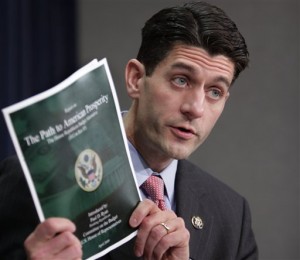
Paul Ryan hawking his plan to throw grandma from the train
You may have seen this gossipy story about Rep. Paul Ryan at Talking Points Memo on Friday. I’ve been meaning to post something about it but just haven’t found the time. Now TPM has a very interesting update. Here’s the background:
Rep. Paul Ryan (R-WI), a leading advocate of shrinking entitlement spending and the architect of the plan to privatize Medicare, spent Wednesday evening sipping $350 wine with two like-minded conservative economists at the swanky Capitol Hill eatery Bistro Bis.
[….]
Susan Feinberg, an associate business professor at Rutgers, was at Bistro Bis celebrating her birthday with her husband that night. When she saw the label on the bottle of Jayer-Gilles 2004 Echezeaux Grand Cru Ryan’s table had ordered, she quickly looked it up on the wine list and saw that it sold for an eye-popping $350, the most expensive wine in the house along with one other with the same pricetag.
Feinberg, an economist by training, was even more appalled when the table ordered a second bottle. She quickly did the math and figured out that the $700 in wine the trio consumed over the course of 90 minutes amounted to more than the entire weekly income of a couple making minimum wage.
Feinberg took some photos with her cell phone, approached the table and asked whether the two men with Ryan were lobbyists. One of the men responded by saying, “F&ck her.” Ryan claimed the two men were economists but refused to provide their names. Ryan then paid for one of the bottles of wine, but when asked about the appropriateness of spending so much when he was going all Dickensian on old people, Ryan avoided answering.
Today, TPM learned the identity of the two men who wined and dined Ryan on Friday night.
TPM has confirmed that the two other men with Ryan were Cliff Asness and John Cochrane. Both men have doctorate degrees in economics and are well-known in the conservative media world as die-hard proponents of the free market’s ability to right itself without government bailouts when the crisis hit in late 2008.
Asness, who ordered the wine and who, according to Feinberg was the one who said “Fuck her,” is better known as a high-profile hedge fund manager. Asness founded and runs AQR Capital, which manages an estimated $26 billion in a variety of traditional products and hedge funds, and his life story has been the subject of numerous books and articles about the rise and fall of Wall Street. He’s also grabbed headlines for being one of the most voluble opponents of President Obama’s economic policies.
[….]
Cochrane, the other, more tempered dinner companion, is the AQR Capital Management Distinguished Service Professor of Finance at the University of Chicago, an apparent tip of the hat to the contributions Asness’ AQR Capital Management has made to the Booth School of Business there.
Before launching AQR Capital in 1997, Asness worked for Goldman Sachs, the most profitable securities firm in Wall Street history, as the director of quantitative research for its Asset Management Division.
Via TPM, in 2009, Asness wrote an open letter to Barack Obama in which he (Asness) complained bitterly about some mildly critical remarks the President had made about hedge fund managers who refused to help out by buying Chrysler bonds. From New York Magazine:
Clifford Asness, the filthy-stinking-rich quant behind AQR Capital Management, [is] publicly engaging with a formidable opponent: The president of the United States. Asness, who supported Obama during the election, was appalled by Obama’s treatment of his colleagues during the Chrysler situation, and although he was not personally involved, he felt he had to make a stand.
Here is a portion of the letter:
Here’s a shock. When hedge funds, pension funds, mutual funds, and individuals, including very sweet grandmothers, lend their money they expect to get it back. However, they know, or should know, they take the risk of not being paid back. But if such a bad event happens it usually does not result in a complete loss. A firm in bankruptcy still has assets. It’s not always a pretty process. Bankruptcy court is about figuring out how to most fairly divvy up the remaining assets based on who is owed what and whose contracts come first. The process already has built-in partial protections for employees and pensions, and can set lenders’ contracts aside in order to help the company survive, all of which are the rules of the game lenders know before they lend. But, without this recovery process nobody would lend to risky borrowers. Essentially, lenders accept less than shareholders (means bonds return less than stocks) in good times only because they get more than shareholders in bad times.
The above is how it works in America, or how it’s supposed to work. The President and his team sought to avoid having Chrysler go through this process, proposing their own plan for re-organizing the company and partially paying off Chrysler’s creditors. Some bond holders thought this plan unfair. Specifically, they thought it unfairly favored the United Auto Workers, and unfairly paid bondholders less than they would get in bankruptcy court. So, they said no to the plan and decided, as is their right, to take their chances in the bankruptcy process. But, as his quotes above show, the President thought they were being unpatriotic or worse.
Well, Duh! But if “filthy, stinking rich” guys like Asness were patriotic, we probably wouldn’t have had a financial meltdown in the first place, now would we?
The other guy with Ryan on Friday, Professor John Cochrane of the University of Chicago, is a freshwater economist and follower of Eugene Fama AKA “the father of modern finance,” and Robert R. McCormick Distinguished Service Professor of Finance a the University of Chicago. Cochrane is also married to Fama’s daughter Elizabeth.
In early 2009, Cochane and Nobel Prize-winning economist Paul Krugman engaged in a legendary on-line debate that also involved Brad De Long and Eugene Fama. The whole thing was too wonky for me, but I gather it had something to do with Fama and Cochrane critiquing the use of fiscal stimulus and Krugman saying that the two freshwater economists wanted to return to the “Dark Ages of macroeconomics.” Here’s Krugman’s introductory paragraph:
Brad DeLong is upset about the stuff coming out of Chicago these days — and understandably so. First Eugene Fama, now John Cochrane, have made the claim that debt-financed government spending necessarily crowds out an equal amount of private spending, even if the economy is depressed — and they claim this not as an empirical result, not as the prediction of some model, but as the ineluctable implication of an accounting identity.
Maybe Daknikat can explain what the “cage match” was all about.
I think Paul Ryan is going to need to be a little more careful in the future if he is going to continue promoting the end of Medicare as we know it.
How Badly Does the World Need iPads?
Posted: May 22, 2011 Filed under: China, Corporate Crime, Foreign Affairs, health hazard, Human Rights, Psychopaths in charge, worker rights | Tags: Apple iPad-2, Corporate outsourcing, slave labor, Steve Jobs, Students and Scholars Against Corporate Misbehavior (SACOM), technology 21 Comments
Man poses as Apple's Steve Jobs at protest in Hong Kong
Are these gadgets really worth the sacrifice of workers’ lives? I admit I’m not an Apple enthusiast, but I don’t think so. Last year there was a series of suicides at Foxconn plants and on Friday, there was a fatal explosion at a Foxcomm iPad factory in Chengdu, China, that killed two workers and injured 15 others. Today a third employee died from injuries sustained in the blast.
Company officials said the explosion occurred on Friday May 20 in one of the polishing workshops at the factory, and that the initial finding of a joint investigation task force led by government officials and law enforcement authorities was that combustible dust exploded in a duct.
A little more detail from Mashable.com:
…the Chinese government in Chengdu has taken over the plant, censoring the information flow to the extent that local newspapers aren’t reporting about it.
With numerous workers committing suicide at the company’s Shenzhen-based iPad plant last year, Foxconn attempted to remedy the situation by giving them raises, but still needed to increase the production capacity to meet increasing demand. As a result, the new factory was built, an enormous eight-building complex hastily constructed in a record-breaking 70 days to accommodate the voracious demand for the iPad 2.
Soon after the factory was built…Apple’s inspection team visited the facility, taking two days to inspect the buildings, production lines and “especially the workers’ dormitories.” After its inspection, Apple approved the plant for manufacturing iPads.
After the suicides in 2010, the group Students and Scholars Against Corporate Misbehavior (SACOM) investigated the factories and produced a report (pdf) that documents the horrors of the working conditions in Foxconn’s factories.
According to the Sydney Morning Herald, the study found that slave labor-type conditions are still in effect at the factories. Workers are now forced to sign “no-suicide pacts,” and they are routinely humiliated by “military-style managers.” They may have to work as much as 100 hours of overtime per month, and are still not paid a living wage–they earn only about $186 per month. And Foxconn “routinely” fails to pay workers the correct amounts they have earned. This is after Apple visited the factories and approved the wages and working conditions!
Conditions at Foxconn’s two Chengdu factories, which exclusively produce Apple iPads, were among the worst reported. While nets have been installed to catch suicidal workers, factory staff are reportedly required to sign “no-suicide” pacts which also give licence to Foxconn to institutionalise them if it sees fit.
Workers at Chengdu say they are routinely humiliated and scolded by management. One was forced to stand in a corner with his hands behind his back because he giggled with a colleague. Others have been required to write confession letters to their supervisors after making mistakes and in some cases read the letters out in front of colleagues.
“Some of my roommates weep in the dormitory. I want to cry as well but my tears have not come out,” said 19-year-old Chengdu worker Chen Liming.
Ah Ming, 19, who produces cases for the iPad, said he stands for at least 14 hours a day. He wakes up at 7am to queue for the bus to the factory and it is 9pm by the time he returns home every evening.
The report also found that workers don’t
have adequate protections to safeguard against occupational health and safety issues such as aluminium dust and harsh reactions from chemicals used in the production process.
“I’m breathing in dust at Foxconn just like a vacuum cleaner. My nostrils are totally black every day,” one male worker said.
From the aptly named “Crave” blog at Cnet.com:
SACOM researchers visited Foxconn plants in Chengdu, where iPads are produced; in Chongqing, a smaller facility making mostly HP products; and Foxconn’s huge campus in Shenzhen, where half a million workers assemble a variety of computers, mobile phones, and additional products for Apple, HP, Nokia, Dell, and others. The researchers claim to have observed a number of problems at the Chengdu facilities in particular:
Workers do not have adequate training on usage of chemicals and do not have regular on-post health examinations. A number of interviewees even complain they suffer from allergy, but the management does not probe into the adverse health impacts of workers. Workers also highlight the problem of poor ventilation and inadequate personal protective equipment.
While SACOM notes the lack of ventilation as a possible threat to workers’ respiratory health, it appears that it may also have been a contributing factor to Friday’s explosion, which reportedly was centered in the “polishing” section of Foxconn’s facilities.
According to the report, the polishing department is filled with aluminum dust and there is inadequate ventilation.
Both aluminum and magnesium are commonly used ingredients in industrial polish–magnesium is a highly flammable metal used in fireworks, flares, and flash powder. A buildup of such dust due to improper ventilation could have created dangerous conditions.
I don’t know about you, but I’m very glad I don’t have an iPad, because if I did I’d be tempted to trash it right about now. If this is what it takes to produce a gadget that appears to be little more than a glorified cell phone that doesn’t do much other than provide entertainment and status to its users, I say it’s not worth it.
Fighting Back … Ballroom Days are Over
Posted: April 5, 2011 Filed under: Civil Liberties, Civil Rights, collective bargaining, Corporate Crime, Democratic Politics, Domestic Policy, Economic Develpment, Economy, education | Tags: civil disobedience, democratic solutions, demonstrations, protesting 31 Comments
May take a week, and it may take longer.
They got the guns, but we got the numbers.
Gonna win yeah, we’re taking over.
Come on!
Yeah!
Your ballroom days are over, baby.
Night is drawing near.
Shadows of the evening
Crawl across the years.
Jim Morrison, from “Five to One”
I’ve spent the last six months watching this country’s policy makers throw all common sense and empirical evidence on the US economy to the wind. My jaw just drops when I consider what the Republicans have proposed under the flag of austerity and how the Democrats entertain them.
BostonBoomer and I spend a lot of time on the phone with each other. We’ve been each other’s support system having much in common as older, divorced women gone back to school and social justice activists feeling exiled in some kind of shared virtual gulag. We remember the protests and actions that we took at a younger age to demonstrate against war and the treatment of minorities and women. BB was active in antiwar protests. I was an avid women’s rights activist in the 70s and 80s, having found out that just getting good grades and hard work weren’t going to be enough for me to break into white male dominated bastions. It’s maddening when you think of all the time you spend on your education and doing the right thing and find out that what really gets you ahead is your ability to fit certain biological characteristics and social status. All those things I tried to change back then are being undone. All over the country, privileged, wealthy people and corporations are using political donations and power to seek advantage like never before. This is not healthy for our country or our future. We need to end their Ballroom Days.
It’s heartened both of us to see union workers in the US and many citizens in the MENA region stand up to authority and demand their right to participate in policy decisions that impact their lives. All over the world, the immense transfer of wealth and national assets to a small elite–the uberwealthy few representing mostly inheritance dynasties–has occurred with the help of political lap dogs seeking donations and parochial interests. It seems we may have reached a tipping point. Some yearning-to-be-free democracy contagion has created a new call for activism to protect the interests of the many against the pillaging of the few. It’s brought people to the streets all over the world and created scapegoats for rapacious states. From whistle blowing of war crimes by Bradley Manning to shouting for no more political or economic prisoners in Northern African nations, we see ordinary, educated, middle class people taking to the streets and shouting enough! We’ve fed the cheats long enough!
It’s about time.
Allison Kilkenny at The Nation has a new article up called “The Resistance Has Begun” that lists recent political demonstrations and unrest. Her article was inspired by a post by Chris Hedges–This is What Resistance Looks Like–on the increasing number of political protests occurring around the country. Hedges writes on the importance of the protests. Are we looking at renewed activism from the people who’ve been hurt by the power class-enabling policies of the last 30 years?
Chris Hedges has this to say.
The phrase consent of the governed has been turned into a cruel joke. There is no way to vote against the interests of Goldman Sachs. Civil disobedience is the only tool we have left.
We will not halt the laying off of teachers and other public employees, the slashing of unemployment benefits, the closing of public libraries, the reduction of student loans, the foreclosures, the gutting of public education and early childhood programs or the dismantling of basic social services such as heating assistance for the elderly until we start to carry out sustained acts of civil disobedience against the financial institutions responsible for our debacle. The banks and Wall Street, which have erected the corporate state to serve their interests at our expense, caused the financial crisis. The bankers and their lobbyists crafted tax havens that account for up to $1 trillion in tax revenue lost every decade. They rewrote tax laws so the nation’s most profitable corporations, including Bank of America, could avoid paying any federal taxes. They engaged in massive fraud and deception that wiped out an estimated $40 trillion in global wealth. The banks are the ones that should be made to pay for the financial collapse. Not us. And for this reason at 11 a.m. April 15 I will join protesters in Union Square in New York City in front of the Bank of America.
“The political process no longer works,” Kevin Zeese, the director of Prosperity Agenda and one of the organizers of the April 15 event, told me. “The economy is controlled by a handful of economic elites. The necessities of most Americans are no longer being met. The only way to change this is to shift the power to a culture of resistance. This will be the first in a series of events we will organize to help give people control of their economic and political life.”
I’ve written recently about the Social Contract of 20th century America and how that contract has been broken by politicians seeking to empower the monopolies and oligopolies that fill their political accounts with booty. Things have gotten so blatantly amoral that the very same folks that destroyed the Gulf ecosystem and took 11 lives and many livelihoods through careless management decisions rewarded themselves with bonuses and ‘best safety’ records with no concept that people might find that appalling. This was a repeat performance of the situation where executives of investment and commercial banks took huge bonuses right on the back of their bad management decisions that brought near US economic collapse and massive bail outs with federal funds. Also, BP is right back applying for drilling rights having really not made things right on either the human or the environment accounts for their last cost-cutting, profit gouging adventure in ignoring safety for the sake of quick profits.
When the social costs of doing business exceed the benefits of doing that business for every one but a few, the society needs to take a hard look at why it tolerates such behavior. Forcing other people to bear the costs of your business or your consumption is wrong and that’s exactly what most business subsidies and lax regulations do. When businesses can push their costs off on society or consumers of certain goods can push their costs off on society, that market becomes distorted and dysfunctional. The market price does not reflect true costs. It will overproduce harmful goods and drain resources that would be better placed elsewhere. The only way to push these costs back to the producers and consumers of costly activities and end the dysfunction is through legal prosecution or tough regulation. The idea that’s been propagated that regulation serves no purpose in a market system is part and parcel of the problem.
Opaque, vague markets do no one any good. They serve as breeders of Ponzi schemes like that of Bernie Madoff. Markets that don’t force the true cost of doing business back on the producer are no good either. They take precious scarce resources and allocate them to activities that are not worthwhile because prices and costs are understated. There are mounds and mounds of microeconomic studies that show how insidious markets can be when they are distorted by things like information asymmetries or supply-enabling protection. All of these activities set up winners and losers. In most cases, ordinary people are the losers. It takes money and power to access the special treatment offered by politicians and their laws. You only get those huge passes and benefits if your get to call yourself a corporation in this country. You can collect a lot of money for being inefficient for some reason. Businesses in this country are considered to be ‘individuals’ for freedom of speech issues but they go unprosecuted for murder every day. Just talk to grieving families of those 11 workers who died on the Deep Water Horizon in the name of increased production and lower costs. Only a sociopath could murder 11 people with safety shortcuts then provide incentives for good safety records to the instigators of the bad decisions. The only offset that we have to the kind of power and access achieved by lobbyists and corporate interests is civil disobedience and protests. Protest we must!
Kilkenny’s article lists a number of protests that are brewing around the country. These include examples in New York State, New Hampshire, Wisconsin, Ohio, Indiana and other average cities with average US citizens. Is this a Middle Class Awakening going viral? Here’s some more from Chris Hedges on how concentration of power and money in monopoly banks has warped our policy agendas and priorities. Our incomes from hard work are being skimmed by paper shuffling fees paid as bonuses to agents with no productive purpose but market distortion.
The 10 major banks, which control 60 percent of the economy, determine how our legislative bills are written, how our courts rule, how we frame our public debates on the airwaves, who is elected to office and how we are governed. The phrase consent of the governed has been turned by our two major political parties into a cruel joke. There is no way to vote against the interests of Goldman Sachs. And the faster these banks and huge corporations are broken up and regulated, the sooner we will become free.
Bank of America is one of the worst. It did not pay any federal taxes last year or the year before. It is currently one of the most aggressive banks in seizing homes, at times using private security teams that carry out brutal home invasions to toss families into the street. The bank refuses to lend small business people and consumers the billions in government money it was handed. It has returned with a vengeance to the flagrant criminal activity and speculation that created the meltdown, behavior made possible because the government refuses to institute effective sanctions or control from regulators, legislators or the courts. Bank of America, like most of the banks that peddled garbage to small shareholders, routinely hid its massive losses through a creative accounting device it called “repurchase agreements.” It used these “repos” during the financial collapse to temporarily erase losses from the books by transferring toxic debt to dummy firms before public filings had to be made. It is called fraud. And Bank of America is very good at it.
There is nothing free market about government-installed and enabled monopolies. We achieve nothing as a society by buying into the delusion that all government does is destroy the business environment when all evidence points to their enabling of the worst business practices. There is nothing remotely efficient about markets that can use public resources on the cheap to underprice goods and services, hence making them more marketable than they should be. There is no efficiency in letting producers of products and services pass the costs of their bad management decisions on to middle class and working people. You cannot blame government workers for the current economic failings. You can however, blame Bank of America, Republican Governors who hand out tax cuts indiscriminately, and federal subsidies of inefficient businesses. Huge corporations and rich people gobble up tons of public resources via subsidies, tax breaks, and use of infrastructure. Many governors have literally given away their states treasury and resources courting businesses that cost them more than they bring to that state in jobs or revenues. The big lie is that corporations are overtaxed and receive no benefits from state, local or federal government. We can’t afford to enable that big lie. We must protest it.
Ordinary Americans cannot band together to hire lobbyists to help repair our broken Social Contract. The only thing we have are our feet, our voices, and our votes. Paul Ryan’s budget Anthem is just the latest in a line of assaults on reason and common sense. It is the very definition of pennywise and pound foolish and it’s insulting. It hypes unnecessary tax cuts and increases in pentagon spending while removing funding for public health, public education, and public information programs. It continues the effort to redistribute the incomes and the resources of the country to the very few at the cost of the very many. The only way to stop this is to protest. Protest frequently. Protest openly. Protest now. Public Policy should not be based on badly written dystopian fiction novels.
It is not illegal immigrants that have broken the American Dream. It’s not bands of stereotyped Muslim Bedouins hiding out in caves a world apart from Main Street that’s threatening the livelihoods of American workers. It’s not poor Cuba’s last vestiges of Marxism or crazy-like-a-fox Hugo Chavez. It’s time to stop falling for their straw men enemies. What has taken the American Dream away from so many is the greed and power lust of a few people that have completely usurped the nation’s policy makers. It’s time to remind them that they may have the guns, but we have the numbers.

 peej
peej Carissa
 bostonboomer
 dakinikat
 ecocatwoman
 mablue2
 Mama Lopez
 peggysue22
 quixote
 skydancingguestblogger
 Mona (aka Wonk the Vote)



 Sky Dancing
Recent Comments