
Thursday Reads: Aftermath of SCOTUS Voting Rights Decision
Posted: June 27, 2013 Filed under: 2014 elections, Civil Rights, court rulings, Elections, morning reads, open thread, racism, Real Life Horror, Republican politics, U.S. Politics | Tags: Antonin Scalia, GOP Southern strategy, hypocrisy, Judicial Activism, SCOTUS, U.S. Supreme Court, Voter ID laws, Voting Rights Act 66 Comments
Good Morning!!
This is going to be a quickie post, because I’m feeling kind of sick this morning.
Although I’m thrilled with the DOMA decision yesterday, I still can’t get past my anger and sadness about the Supreme Court’s gutting of the Voting Rights Act. So I’m just going to post the (above) “official 2013 photo” of the U.S. Supreme Court and some accompanying links that demonstrate the damage the Court has done in its horrendous decision on the Voting Rights Act.
I’ll begin with this excellent post by Linda Greenhouse at The New York Times: Current Conditions, which neatly summarizes the Court’s “conservative” wing’s blatant “judicial activism,” to quote a frequent charge of conservatives against “liberal” judges.
These have been a remarkable three days, as the Supreme Court finished its term by delivering the only four decisions that most people were waiting for. The 5-to-4 decisions striking down the coverage formula of the Voting Rights Act and the Defense of Marriage Act will go far toward defining the Roberts court, which has concluded its eighth year. Monday’s place-holding ruling on affirmative action in higher education, although it decided very little, is also definitional, for reasons I’ll explain. There is a great deal to say about each decision, and about how each reflects on the court. My thoughts are preliminary, informed by that phrase in the chief justice’s voting rights opinion: current conditions.
By this phrase, the chief justice meant to suggest that there is a doctrinal basis for drawing a boundary around Congressional authority, for judicial insistence that a burden that Congress chooses to impose on the states has to be justified as a cure for a current problem. In the context of voting rights, an area over which the 15th Amendment gives Congress specific authority, this is a deeply problematic position that Justice Ruth Bader Ginsburg’s dissenting opinion demolishes.
Please go read the whole column–it’s difficult to get Greenhouse’s thesis into an excerpt. The blatant hypocrisy of the “conservative” justices–especially Scalia is mind-boggling, especially when the stunning effects of the Voting Rights decision on “current conditions” are already obvious and dramatic–just as were the disastrous effect of the Citizens United decision. A few examples.
The Guardian: Texas rushes ahead with voter ID law after supreme court decision
Officials in Texas said they would rush ahead with a controversial voter ID law that critics say will make it more difficult for ethnic minority citizens to vote, hours after the US supreme court released them from anti-discrimination constraints that have been in place for almost half a century.
The Texas attorney general, Greg Abbott, declared that in the light of the supreme court’s judgment striking down a key element of the 1965 Voting Rights Act he was implementing instantly the voter ID law that had previously blocked by the Obama administration. “With today’s decision, the state’s voter ID law will take effect immediately. Photo identification will now be required when voting in elections in Texas.”
Greensboro News and Record: NC senator: Voter ID bill moving ahead with ruling
Voter identification legislation in North Carolina will pick up steam again now that the U.S. Supreme Court has struck down part of the Voting Rights Act, a key General Assembly leader said Tuesday.
A bill requiring voters to present one of several forms of state-issued photo ID starting in 2016 cleared the House two months ago, but it’s been sitting since in the Senate Rules Committee to wait for a ruling by the justices in an Alabama case, according to Sen. Tom Apodaca, R-Henderson, the committee chairman. He said a bill will now be rolled out in the Senate next week.
The ruling essentially means a voter ID or other election legislation approved in this year’s session probably won’t have to receive advance approval by U.S. Justice Department attorneys or a federal court before such measures can be carried out.
Northwest Ohio.com: Voter ID and restricted early voting likely after SCOTUS ruling
ATLANTA (AP) — Across the South, Republicans are working to take advantage of a new political landscape after a divided U.S. Supreme Court freed all or part of 15 states, many of them in the old Confederacy, from having to ask Washington’s permission before changing election procedures in jurisdictions with histories of discrimination.
After the high court announced its momentous ruling Tuesday, officials in Texas and Mississippi pledged to immediately implement laws requiring voters to show photo identification before getting a ballot. North Carolina Republicans promised they would quickly try to adopt a similar law. Florida now appears free to set its early voting hours however Gov. Rick Scott and the GOP Legislature please. And Georgia’s most populous county likely will use county commission districts that Republican state legislators drew over the objections of local Democrats.
AL.com: Alabama photo voter ID law to be used in 2014, state officials say
MONTGOMERY, Alabama — Today’s U.S. Supreme Court decision clears the way for Alabama’s new photo voter ID law to be used in the 2014 elections without the need for federal preclearance, state officials said.
Alabama Attorney General Luther Strange and Secretary of State Beth Chapman said they believed the voting requirement, which is scheduled to take effect with the June 2014 primaries, can simply move forward.
“Photo voter ID will the first process that we have gone through under this new ruling,” Chapman said today.
Memphis Business Journal: Mississippi voter ID law could start next year
Voters in Mississippi may have to start showing a photo ID to vote by the middle of 2014, according to Secretary of State Delbert Hosemann.
According to the Associated Press, Hoseman spoke Tuesday after the U.S. Supreme Court ruled that certain state and local governments no longer need federal approval to change election laws. That ruling opens up the possibility that Mississippi will implement a voter identification requirement.
According to Think Progress, Arizona and South Dakota will likely be trying to pass Voter ID laws soon. I’m sue that won’t be the end of it.
Just a few more links:
Joan Walsh: The ugly SCOTUS voting rights flim-flam
Ari Berman: What the Supreme Court Doesn’t Understand About the Voting Rights Act
Stephen Hill: So the Voting Rights Act Is Gutted—What Can Protect Minority Voters Now?
I’ll end there and leave it up to you guys to link to other important news stories. What are you reading and blogging about today?
Tuesday Reads: The Snowden-Greenwald Show
Posted: June 11, 2013 Filed under: China, Civil Liberties, Civil Rights, Crime, Foreign Affairs, morning reads, U.S. Politics | Tags: Bob Cesca, Edward Snowden, Glenn Greenwald, Hong Kong, Matt Schiavenza, narcissism, NSA, political asylum, Russia, The Q Group, whistleblowers, Willard Foxton 99 Comments
Good Morning!!
Edward Snowden is still the top news story this morning. It’s starting to look as if he made a mistake by going to Hong Kong, unless his goal was to gain asylum from the Chinese government. Hong Kong is apparently not interested in fighting an extradition request from the U.S. But it’s also possible he saw Hong Kong as a springboard to other places in Asia where he could hide.
Matt Schiavenza writes at The Atlantic:
In a comment about the case published this morning, my colleague James Fallows brought up a salient point about Hong Kong: it isn’t a sovereign country, and remains very much a part of the People’s Republic of China — a country which notably lacks free speech or any right of political dissent. And while Hong Kong has a different currency, political structure, and legal system from the mainland, divisions between the two are actually far murkier than Snowden’s explanation indicates.
Hong Kong is to some extent in control of its own legal decisions
But in the case of Edward Snowden, which is likely to involve an extradition request by the United States, the Basic Law is less clear. Hong Kong, unlike China, has an extradition arrangement with the United States. But China has the right to intercede in an extradition request if Beijing has an interest in “defense or foreign affairs.” In other words, if China wants to detain Snowden as a useful intelligence asset, Hong Kong couldn’t legally do much about it. And that illustrates an important part of Hong Kong’s current situation: its free speech and political dissent really only go as far as Beijing lets it.
According to Schiavenza,
it’s become increasingly clear that Snowden’s decision to go to Hong Kong was a serious miscalculation. The idiosyncratic territory may in some ways be a libertarian paradise of free speech, robust media, and low taxes, but is in no way independent of China. If Snowden’s ultimate goal were to damage the United States government as much as possible, then going to a Chinese territory would make some sense. But this obviously isn’t what he wanted; in The Guardian interview, Snowden disagreed with Glenn Greenwald’s characterization of China as an “enemy” of the United States by stressing the healthy trade relationship between the two countries. Aiding China — whose record of state surveillance and abrogation of civil liberties is inarguably worse than the United States — would go against the entire moral foundation of Snowden’s decision to leak the NSA secrets.
I’m still not convinced yet about Snowden’s motives. One thing I have concluded is that he’s a very narcissistic young man. I can’t believe he chose to leave without even explaining to his girlfriend and his family. He also chose to tell his story to a high narcissistic writer, Glenn Greewald. More on that later.
From USA Today: Edward Snowden’s travel options
HONG KONG — Whether Edward Snowden misjudged the odds of extradition from Hong Kong before revealing his identity here as the man who exposed secret U.S. surveillance programs may be irrelevant.
The National Security Agency contractor may have chosen to surface in the city for the same reason so many companies from the U.S. and other countries choose to use it for a regional base: It’s the best gateway to much of the world’s largest continent….
Hong Kong is connected to 180 cities in dozens of countries by some 850 flights a day. As the city’s investment development agency says on its marketing web site, “Easy and efficient regional travel is key to Hong Kong’s success as a regional centre.” Many of these countries have loose entry requirements for Americans.
He could go to Vietnam, the Phillippines, or any number of other Asian countries. Or perhaps he could go to Russia, which has already offered to consider a request for asylum from him.
USA Today also notes that Snowden has been “contacted by ‘countless people’ offering to pay for ‘anything [he] might need.'”

Meanwhile, an entity called “The Q Group” is trying to hunt Snowden down before he finds a safe harbor. From The Daily Beast:
Even before last week’s revelations by The Guardian newspaper that the National Security Agency (NSA) was collecting call records from telecommunications companies and had the ability to mine user data from major U.S. Internet companies, the NSA was already on the trail of the leaker, according to two former U.S. intelligence officers with close ties to the agency….
The people who began chasing Snowden work for the Associate Directorate for Security and Counterintelligence, according to former U.S. intelligence officers who spoke on condition of anonymity. The directorate, sometimes known as “the Q Group,” is continuing to track Snowden now that he’s outed himself as The Guardian’s source, according to the intelligence officers….
The security and counterintelligence directorate serves as the NSA’s internal police force, in effect watching the agency’s watchers for behavior that could pose an intelligence risk. It has the authority to interview an NSA contractor or employee’s known associates, and even to activate a digital dragnet capable of finding out where a target travels, what the target has purchased, and the target’s online activity.
Are there more bombshells coming from Snowden? Glenn Greenwald says there are. According to TPM,
According to Greenwald, Snowden has provided the archives of “thousands” of documents and “dozens” are newsworthy. Greenwald has suggested in recent days that more revelations are imminent, saying Monday during an interview on MSNBC that “there’s a lot more coming.”
Dozens of hit out of thousands of documents doesn’t sound like a very good ratio to me, but I’m not a reporter.
On Glenn Greenwald, it seems the general consensus is that people either love him or hate him. Personally, I don’t hate him but I find him annoying and part of my suspicion of Snowden probably stems from my mixed feelings about Greenwald. In my opinion, he cares only about his own pet issues and disdains anyone who cares passionately about, for example, women’s rights, the environment, or the plight of people with less money and fewer choices than he has. I guess he’s a libertarian, but again only in terms of his own pet issues.
Anyway it seems there are lots of Greenwald haters out there. One is Willard Foxton of The Telegraph, who today has a piece called The problem with Glenn Greenwald and the creepy cult that surrounds him. Foxton isn’t quite sure why he can’t stand Greenwald.
Maybe it’s because of the enormous, turgid pieces he writes, complete with 500-word updates when people challenge him. Maybe it’s the run-ins he had with other British journalists while he was fanatically defending Julian Assange.
Maybe it’s the petty stuff, like the fact he insists on special rock-star privileges, like policing the comments beneath his articles himself and his reluctance to let his pieces be edited, prior to the NSA/Prism disclosures. Maybe it’s the things that suggest he’s a little odd, like self-searching his own name so he can pounce on people criticising him, or the accusations he’s used internet sock puppets to go after people anonymously.
Maybe it’s the devotion of his legion of fans who consider him to be the greatest and most fearless journalist on earth, who hate anyone who dares disagree with their idol. The last time I criticised him I got a barrage of online abuse – including memorably a 24-slide PowerPoint presentation explaining how the American security services had “got” to me, and how Greenwald was their number-one target. Maybe, as his adoring public have suggested, I’m either a homophobe or in the pay of the CIA. Perhaps both.
That said, I’m honest enough to admit that maybe it’s because I’m jealous of the success he’s had, and the stories he’s broken. I’m not the only one. You can practically hear the disdain in the New York Times’s tone here, where it describes him as a “blogger” for a “British News Website” (The Guardian).
What I think is more likely is I dislike him because he has built a huge platform with opinion writing, and now he’s blurring the line between opinion pieces and straight reporting. That huge platform he’s built means sources come forward to him from his vast base of followers, with real hard news stories, and then he insists on reporting them.

In line with the “creepy cult” notion, the Guardian actually published this fan-boy article about Greenwald today. Bizarrely, it asks readers to describe how they feel about Greenwald with a fill-in-the-blanks questionnaire! You have to see it to believe it.
Another writer who seems to strongly dislike Greenwald is Bob Cesca, who critiqued Greenwald’s scoop early on. He offered a few more comments on the Snowden/Greenwald story yesterday. Here are three of them.
–Once again, it’s nearly impossible to have a nuanced position these days. I bent over backwards to repeat my ongoing opposition to the growing surveillance state, and made it abundantly clear that my intent with the column was to question some of the problems with the reporting and why there were such glaring omissions and errors. But there’s an increasingly evident overlap between the kneejerking on the far-right and the kneejerking on the far-left (I will make an effort to point it out whenever I can) and too many people tend to blurt things out without reading or grasping what’s being said. Consequently, criticizing Greenwald makes me an Obamabot. End of story. The left is sliding into a very dangerous place right now, and I’ll definitely report back on this one.
–There are some questions emerging regarding Ed Snowden’s story. Why did someone who was disillusioned with Obama’s record on national security continue to work for Obama’s national security apparatus — for more than four years? Why did he escape to Hong Kong when it’s clearly not the free speech haven he claimed it was? If he prefers to seek asylum in Iceland, why didn’t he go there before the story went public? How did he attain the access to be able to “wiretap anyone?” I assume we’ll get answers to some of these questions. Maybe?
–Marc Ambinder wrote a blindly complicated article for The Week in which he explained what PRISM is. It’s essentially a program that analyses data. It doesn’t retrieve the data, it merely compiles it. He also explained that the way the NSA can have “direct access” is via servers that mirror the tech giant servers. So if the NSA requests information from Facebook about an account in Pakistan, Facebook creates a mirror that clones the real time date from that account. But that mirror site has to be hosted on a server and all of the tech giants denied giving the NSA access to their servers. More questions.
We’ll have to wait and see whether Snowden’s revelations are truly groundbreaking or not. But as Cesca writes, the “war on terror” must come to an end. If what’s happening now helps that happen, I’ll certainly cheer loudly. But I suspect the U.S. government will react by simply doubling down on its current policies.
I’ll end there. Now what are you reading and blogging about this morning? Please share your links on any topic in the comment thread.
Thursday Reads: What Really Happened to Ibragim Todashev?
Posted: May 30, 2013 Filed under: Barack Obama, Civil Liberties, Civil Rights, Crime, Criminal Justice System, Eric Holder, morning reads, U.S. Politics | Tags: Boston Bombings, CAIR-Tampa, FBI, Hassan Shibly, Ibragim Todashev, Khusen Taramov, Massachusetts State Police, Reniya Manukyan, Tamerlan Tsarnaev, Waltham triple murders, Wesley Lowery 44 Comments
Good Morning!!
We’re heading into a heat wave here in the Boston area. It’s supposed to be hot and humid for the next few days with temps in the high 80s or low 90s. It will be a shock to my system, since it has been rather chilly here recently.
I’m going to focus on the ongoing Boston bombing story again, but you can treat this as a regular morning reads post/open thread. Don’t feel you have to comment on this topic. I haven’t paid much attention to other news for a few days, so I hope you’ll update me on the latest news in the comment thread!
A week ago, I wrote a post about the death of Ibragim Todashev, who was shot and killed in an apartment in Orlando, FL by an FBI agent from Boston in the early hours of Wednesday May 22. Todashev was being questioned by representatives of the FBI, the Massachusetts State Police, and “other law enforcement personnel” about his relationship with deceased Boston bombing suspect Tamerlan Tsarnaev and possible connections to an unsolved 2011 triple murder in Waltham, Massachusetts. Todashev had reportedly been questioned for hours on Tuesday and was shot shortly after midnight. The FBI had been following him for about a month, calling him daily and questioning him on several different occasions.
At the time I wrote that post, there was a great deal of confusion about the circumstances of the shooting and that confusion has only increased during the past week. At first, anonymous law enforcement sources claimed Todashev had been killed after he attacked the agent with a knife. By he next day sources were walking back that claim, some saying Todashev had something in his hand but it wasn’t a knife, others suggesting it was a pipe or something similar.
I’ve been following this story closely, and I’ve never seen anything like it. Presumably, the events in question were fairly straightforward. A man was shot dead with at least four–perhaps more–law enforcement officers present. How hard would it be to figure out if the dead man had a knife in his hand or not? Something was obviously not right.

During the past week, the reported details of the Todashev shooting have continued to change. On May 25, the Boston Globe offered a new version of events, again based on anonymous sources.
An FBI agent from the bureau’s Boston office fired the shot, or shots, that killed a friend of Boston Marathon bombing suspect Tamerlan Tsarnaev early Wednesday morning during an interview about an unsolved Waltham homicide, say officials briefed on the investigation.
Ibragim Todashev, a 27-year-old mixed martial arts fighter formerly from Allston and Cambridge, was shot in the kitchen of his apartment after overturning a table and attacking the agent with a blade, the officials said. The Globe has reported that the shooting came after Todashev had implicated himself in a grisly 2011 triple homicide in Waltham. Tamerlan Tsarnaev was friendly with one of the Waltham victims, and authorities suspect he may also have taken part in the slayings.
Two law enforcement officials said that the Boston FBI agent felt he was in grave danger when Todashev attacked him and that he fired in self-defense.
“This was a tough guy; he was a dangerous individual,” one law enforcement official said, speaking of Todashev. The official asked not to be named because the official was not authorized to discuss the case.
Okay, but with at least four trained law enforcement officers present, why was it necessary to kill a potentially valuable witness? Is it really credible that they couldn’t control one not very large (about 5’8″) man?
Yesterday morning there was another version. In this one, first reported by Fox Boston, Todashev not only knocked over a table, but also slammed the FBI agent’s head into a wall and attacked him with a sword. Yes, a sword. As in previous stories, the claim was that Todashev had been about to sign a confession about his involvement in the Waltham murders when things got out of control.
During the interview, investigators took notes and everything appeared to be going well. Eventually, Todashev was asked to write down, in his own handwriting and in his own words, what he had been telling authorities about his role in the murders when in the words of one source – all hell broke loose.
Todashev allegedly began writing, but then flipped a table over, knocking the Boston FBI agent into the wall hitting his head.
FOX 25’s Bob Ward was told the agent looked up to see Todashev waving in his direction what was described as a Banzai ceremonial sword.
Fearing for his life, the FBI agent drew his weapon and fatally shot Todashev. The entire incident taking only seconds.
During the course of the day, the story continued to change as more anonymous “sources” weighed in. WESH Orlando’s “sources” told a slight different tale than Fox Boston’s.
Sources said Todashev might have been lunging toward a sword, but he was not in possession of it.
Law enforcement officials said Todashev was in the process of confessing to a 2011 triple murder in Waltham, Mass., and was working on writing out the details of the crime when he snapped and turned violent.
Officials said Todashev pushed a table and possibly threw a chair.
Sources said a sword was inside the apartment, but the weapon was moved to the corner of the room before questioning began. Law enforcement said when Todashev lunged, the FBI agent believed he could have possibly been going for his gun or the sword in the room, and that’s when the agent opened fire.
Because of course the best law enforcement technique is to move any sharp objects to the corner of the room before questioning a suspect? WTF?!
Finally, last night several news outlets–among them The Washington Post–reported that Todashev had been unarmed when he was shot.
One law enforcement official, speaking on the condition of anonymity to discuss an ongoing investigation, said Wednesday that Todashev lunged at the agent and overturned a table. But the official said Todashev did not have a gun or a knife. A second official also said Todashev was unarmed.
An official said that according to one account of the shooting, the other law enforcement officials had just stepped out of the room, leaving the FBI agent alone with Todashev, when the confrontation occurred.
The shooting followed hours of questioning by the law enforcement officials that had begun the night before.
And exactly why did the other officers “step out of the room?” The source doesn’t say.
This story is becoming just plain ridiculous, and as Emptywheel wrote yesterday, it makes the FBI look just plain stupid. Last night on twitter, someone compared it to the old “Get Smart” recurring bit, “Would you believe…”
@BostonBoomer Not to be flip, but it reminds me of Get Smart: “Would you believe a knife? No? Then, would you believe a sword?”@LibertyLynx
— streetwiseprof (@streetwiseprof) May 30, 2013
But as ridiculous as this story seems, we need to understand that something like this could happen to any one of us. A man was killed in an apartment with multiple law enforcement officers present, and after more than a week, we still don’t know for sure what happened.
At 7PM yesterday, the Florida chapter of the Council on Islamic-American Relations (CAIR) held a press conference with Todashev’s wife, her mother, and a close friend of Todashev’s in attendance and called for the Department of Justice to initiate a civil rights investigation of the shooting.
[T]he Tampa director of that group said not only was 27-year-old Ibragim Todashev unarmed when he was shot by the agent May 22, he was hit seven times, including once in the head….the Council on American-Islamic Relations’ Florida chapter on Wednesday cited unnamed sources within the FBI as saying Todashev was not armed at the time of the shooting.
“We did confirm today with sources within the FBI that he was unarmed,” CAIR-Tampa Executive Director Hassan Shibly told the Orlando Sentinel on Wednesday afternoon. Later, Shibly told reporters that CAIR has an “intermediary” who said the FBI told him Todashev was unarmed. Shibly did not identify the intermediary.
At a news conference Wednesday evening, Shibly showed what he said were photos of Todashev’s body after the shooting. The photos were taken at an Orlando funeral home after the Orange-Osceola County Medical Examiner’s office released the body to Todashev’s next of kin, he said.
The photographer was Khusen Taramov — a friend of Todashev’s who lives in Kissimmee — and photos show at least a dozen wounds, although some may have been exit wounds, Shibly said.
In addition, Todashev’s widow Reniya Manukyan claimed that she has evidence to show that her husband could not have committed the murders in Waltham in September 2011.
Todashev’s widow said Wednesday that she has records proving her husband was with her in Atlanta on Sept. 11, 2011, so he could not have been in Massachusetts on the day of the triple killing. Manukyan was married to Todashev for about three years, she said.
In another interaction on Twitter last night Boston Globe reporter Wesley Lowery told me he wasn’t ready to accept the latest version of events until he can independently confirm it from official sources. His reporting on the Boston bombing generally and the Todashev story specifically has been very good, and I’ll be watching to see what he finds out.
Once again, I’ve used up most of my space on a Boston bombing story, but I still have room for a few more quick links, with an emphasis on law enforcement and civil liberties.
Cory Doctorow: Kafka, meet Orwell: peek behind the scenes of the modern surveillance state. At the link you can watch a short, powerful documentary about public surveillance in the UK.
Rob Fischer at The New Yorker: Watching the Detectives–a piece about “Floyd v. Floyd v. City of New York, a landmark challenge to the New York Police Department’s stop-and-frisk policies.”
NYT: Former Bush Official Said to Be Obama Pick to Lead F.B.I. Obama is about to nominate James Comey as FBI Director–a man who was in the Bush DOJ during the torture deliberations.
Emptywheel: When NYT Accused Jim Comey of Approving Torture
Holder Faces New Round of Criticism After Leak Inquiries
HuffPo: Eric Holder To Meet With Washington Bureau Chiefs Amid Leak Investigation Criticism (UPDATE)
Politico: N.Y. Times will not attend DOJ session, citing opposition to off-the-record provision
Buzzfeed: ACLU Defends News Organizations For Rejecting Off-The-Record Meeting With Attorney General
And another Boston link: Dirty Old Boston Facebook page shows the city as it really was
Now it’s your turn. What are you reading and blogging about today?
Religion Pimping: Secessionists and Proselytizers on the Public Dole
Posted: April 3, 2013 Filed under: Civil Liberties, Civil Rights, religious extremists, Vagina, War on Women, We are so F'd, Women's Healthcare, Women's Rights | Tags: north carolina religious extremists 46 Comments I’m not the the resident psychologist here, but I really feel hyper-religiousity is a fricking mental disease. I know it is a social one. I have no idea why some people feel they have the right and duty to plaster their religious beliefs all over the rest of us, but it is clearly not an American idea. Here’s the latest whackadoodle attempt to do an end run around our constitution by a cluster of bananas in North Carolina.
The Constitution “does not grant the federal government and does not grant the federal courts the power to determine what is or is not constitutional” according to a resolution sponsored by North Carolina House Majority Leader Edgar Starnes (R) and ten of his fellow Republicans — a statement that puts them at odds with over 200 years of constitutional law. In light of this novel reading of the Constitution, Starnes and his allies also claim that North Carolina is free to ignore the Constitution’s ban on government endorsement of religion:
SECTION 1. The North Carolina General Assembly asserts that the Constitution of the United States of America does not prohibit states or their subsidiaries from making laws respecting an establishment of religion.
SECTION 2. The North Carolina General Assembly does not recognize federal court rulings which prohibit and otherwise regulate the State of North Carolina, its public schools, or any political subdivisions of the State from making laws respecting an establishment of religion.
This resolution is nothing less than an effort to repudiate the result of the Civil War. As the resolution correctly notes, the First Amendment merely provides that “Congress shall make no law respecting an establishment of religion,” and, indeed, the Bill of Rights was originally understood to only place limits on the federal government. For the earliest years of the Republic, the Bill of Rights were not really “rights” at all, but were instead guidelines on which powers belonged to central authorities and which ones remained exclusively in the hands of state lawmakers.
In 1868, however the Fourteenth Amendment was ratified for the express purpose of changing this balance of power. While the early Constitution envisioned “rights” as little more than a battle between central and local government, the Fourteenth Amendment ushered in a more modern understanding. Under this amendment, “[n]o State shall make or enforce any law which shall abridge the privileges or immunities of citizens of the United States,” nor may any state “deprive any person of life, liberty, or property, without due process of law.” The Fourteenth Amendment completely transformed the nature of the American Republic, from one where liberties were generally protected — if at all — by tensions between competing governments to one which recognized that there are certain liberties that cannot be abridged by any government.
So, a few folk want a state religion in North Carolina because sectarian opening prayers just aren’t pious enough for them.
A bill filed by Republican lawmakers would allow North Carolina to declare an official religion, in violation of the Establishment Clause of the U.S. Bill of Rights, and seeks to nullify any federal ruling against Christian prayer by public bodies statewide.
The legislation grew out of a dispute between the American Civil Liberties Union and the Rowan County Board of Commissioners. In a federal lawsuit filed last month, the ACLU says the board has opened 97 percent of its meetings since 2007 with explicitly Christian prayers.
Overtly Christian prayers at government meetings are not rare in North Carolina. Since the Republican takeover in 2011, the state Senate chaplain has offered an explicitly Christian invocation virtually every day of session, despite the fact that some senators are not Christian.
In a 2011 ruling on a similar lawsuit against the Forsyth County Board of Commissioners, the Fourth U.S. Circuit Court of Appeals did not ban prayer at government meetings outright, but said prayers favoring one religion over another are unconstitutional.
“To plant sectarian prayers at the heart of local government is a prescription for religious discord,” the court said. “Where prayer in public fora is concerned, the deep beliefs of the speaker afford only more reason to respect the profound convictions of the listener. Free religious exercise posits broad religious tolerance.”
Supplanting modernity, science, rationale thought and replacing it with government mandated religious views is the agenda here. Here’s another good example. RNC Chair Reince Preibus thinks he knows more than doctors. He equates letting doctors and women decide about the outcomes of late term abortions–and possibly pre-term births–to infanticide.
In an article published Wednesday on the conservative website RedState, Republican National Committee chairman Reince Priebus blasted Democrats for supporting Planned Parenthood, while floating the damning suggestion that the likes of President Barack Obama and Senate Majority Leader Harry Reid (D-NV) support infanticide.
“The President, the Senate Majority Leader, the House Democratic Leader, and the Chair of the Democratic National Committee (in whose home state this hearing occurred) made funding Planned Parenthood an issue in the 2012 campaign,” Priebus wrote. “They should now all be held to account for that outspoken support. If the media won’t, then voters must ask the pressing questions: Do these Democrats also believe a newborn has no rights? Do they also endorse infanticide?”
Priebus appeared to predicate much of his piece on recent testimony from a Planned Parenthood lobbyist before the Florida legislature. The lobbyist was posed a number of hypotheticals on what the women’s healthcare organization would do if a baby survived a botched abortion.
“Not once in her testimony did the Planned Parenthood representative say the newborn baby has a right to life. Not once did she say anyone has a duty to care for the child,” Priebus wrote. “Whether the living, breathing child survives is up to the adults in the room because, as we now know, Planned Parenthood doesn’t believe the baby has rights.”
Who better knows the outcome of this situation? The State? Priestb00 and his merry band of republican religious nuts?
 This reminds me of the attempts in Louisiana and other places to drain money from public schools to religious-based schools. Republicans are horrified to think that religions other than their own might have access to the funds. This is playing out in Tennessee right now.
Republican lawmakers in Tennessee are threatening to block Republican Gov. Bill Haslam’s school voucher bill over fears that Muslim schools could receive funding.
The Knoxville News Sentinel reported on Monday that Haslam hinted that he would withdraw his bill after objections from Republican lawmakers that it was not broad enough and that the vouchers could be used by Islamic schools.
Over the weekend, state Sen. Jim Tracy (R) had told The Murfreesboro Post that he had “considerable concern” that tax dollars could go to schools that teach principles from the Quran.
Tracy, who is on the Senate Education Committee and identifies himself as a member of the Church of Christ, insisted that Islamic school funding was an “an issue we must address” before the voucher bill can go forward.
“I don’t know whether we can simply amend the bill in such a way that will fix the issue at this point,” he said.
Yes, there is one Muslim school in Memphis that would have access to state funds under the bill. So, it’s wrong to fund Muslim schools, but you can guess which religious schools should be the only ones funded by government.
Look, I have nothing against other people’s free practice of religion. There are at least two great places for that to happen. The places are called THEIR home and THEIR place of worship. Every place else should be a religion-free zone. It’s obvious these folks didn’t get a very good education in American history or political thought. For that matter, the don’t appear to have been well-educated in much else. OR, they are just plain crazy. I’m going with the latter.
Morning Joe Reads A Book
Posted: February 20, 2013 Filed under: Civil Rights, racism, Republican politics, U.S. Politics | Tags: Checkers speech, Dwight D. Eisenhower, Joe Scarborough, John Nance Garner, Richard Nixon, Southern Strategy 28 Comments
Or maybe he got someone else to read it for him? In any case, the New York Times Sunday Book Review asked Joe Scarborough to review a serious book of political history, Ike and Dick: Portrait of a Strange Political Marriage. in the February 17, 2013 edition.
How low has the Sunday Book Review sunk that it would not only publish an essay by Scarborough, but also highlight the brief review with a separate “Up Front” introduction? I haven’t seen the cover of the print edition, but it sounds as if Scarborough’s piece was printed on page 1!
Charles Pierce wrote a pithy reaction to the Times’ decision in his “What are the Gobshites Saying These Days” post on Monday.
…let us pause for a moment and congratulate the editors of The New York Times Book Review for handing a serious work of popular history to whatever’s left of Joe Scarborough after Paul Krugman picks the rest out from between his teeth….
the Review has fallen on some pretty hard times when they have a story meeting and someone says, “We got this new book on Eisenhower and Nixon. Who should we get to review it?” And someone else says, “I know. How about that guy who runs the Morning Zoo on MSNBC? He’s really popular with the people who get drunk in front of the TV and pass out during Rachel’s show the night before.” And this is what you get for an author ID.
Joe Scarborough is the host of MSNBC’s “Morning Joe.”
Lovely. They should let Barnicle review the next Royko anthology.
At least Mike Barnicle used to be a working journalist.
Pierce links approvingly to this post by Dan Kennedy at Media Nation: Joe Scarborough doesn’t know much about history.
If you’re going to try something as cheeky as letting cable blowhard Joe Scarborough review a serious book about political history, you should at least make sure you’ve got a safety net in place. But the New York Times Book Review doesn’t even bother, letting Scarborough step in it repeatedly in his review of Jeffrey Frank’s “Ike and Dick: Portrait of a Strange Political Marriage.”
Here’s the first paragraph of Scarborough’s review:
It may be the closest of political relationships, but it rarely ends well. Vice President Thomas Jefferson challenged President John Adams for the top spot in the vicious campaign of 1800. President Andrew Jackson mused sardonically about executing Vice President John C. Calhoun. In the modern era, Lyndon Johnson seethed at slights real and perceived during John Kennedy’s thousand days, then turned around and humiliated his own vice president, Hubert Humphrey. Even Dick Cheney and George W. Bush fell out by the end of their tumultuous terms. But perhaps the most intriguing — and dysfunctional — political marriage in history was the one between the subjects of Jeffrey Frank’s meticulously researched “Ike and Dick.”
Kennedy wonders if Scarborough knows that
the Constitution originally stipulated that the candidate who received the most votes from the Electoral College would become president and that the person who came in second would become vice president. Perhaps that’s too much math for the famously innumerate Scarborough.
I didn’t know that either, but I think if I were writing a review for the New York Times, I would have found out before using that as my introduction. Kennedy explains that Jefferson and Adams, who couldn’t stand each other, ran against each other in 1796. Adams got more electoral votes and so they were forced to serve together, but their mutual dislike did not grow out of their political alliance as Scarborough implies.
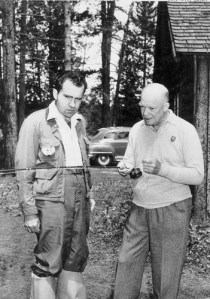
Ike and Dick fishing at Camp David
Kennedy points out two other more serious misstatements in the review. In the paragraph above, Scarborough suggests that Lyndon Johnson’s insecurities stemmed from Jack Kennedy’s mistreatment and that led Johnson to humiliate his own Vice President Hubert Humphrey. Scarborough isn’t really clear about this, but he seems to be drawing analogies to the Eisenhower-Nixon relationship. He seems to claim–perhaps based on his reading of Frank’s book–that Nixon’s neuroses stemmed from his difficult relationship with Eisenhower. But Nixon was a psychologically troubled person long before he met Ike and suggesting otherwise is inaccurate. Likewise, Johnson had plenty of psychological issues before he got involved with Jack Kennedy. Dan Kennedy writes:
As anyone who’s read Robert Caro’s “The Passage of Power” knows, Johnson, like Nixon, suffered from a world-class case of insecurity long before he ever met John Kennedy. The truth is the opposite of what Scarborough claims: both Nixon and Johnson were uniquely unsuited to suffer the slights that are inherent to the vice presidency long before they assumed the office.
Finally, Kennedy points out the ludicrousness of the following passage from the Scarborough piece:
A fascinating subplot in Frank’s story details Nixon’s role in pushing the administration on the issue of civil rights. Long criticized as the author of the Republican Party’s racially tinged “Southern strategy,” Nixon is shown by Frank to be a determined advocate for the Civil Rights Act of 1957, as well as a trusted ally of Martin Luther King Jr. and Jackie Robinson.
Yes, Nixon was supportive of Martin Luther King during the 1950s, and did try to get Eisenhower to push for African American civil rights, but Scarborough completely ignores Nixon’s later rejection of King during the 1960 presidential campaign and his [Nixon’s] development of the “Southern Strategy” in 1968. If those later events weren’t included in Frank’s book, a competent reviewer would have called attention to them. In fact, if Scarborough had googled, he could have quickly found an article by Franks himself that points out Nixon’s later involvement in blatant racism. Franks writes in The Daily Beast, January 21, 2013:
There once was a real connection between the two men, but it more or less ended with RN’s spineless behavior during the 1960 presidential campaign, after Dr. King was arrested on phony charges stemming from a traffic violation. Coretta Scott King had been terrified; she worried with good reason that her husband might be killed en route to Georgia State Prison in Reidsville, and she appealed to the Nixon and John F. Kennedy campaigns to intervene.
Nixon, however, demurred; he said that it would be “grandstanding” to speak out, according to his aide William Safire. Nixon’s real motive, though, seems clear: it was a close election and he was willing to lose black support if it meant gaining a new harvest of white votes in the once-Democratic south. Eight years later, this approach became the carefully considered “Southern strategy.”
The Kennedy brothers then stepped in to help King.
John and Robert Kennedy helped to win Dr. King’s release, and soon enough their campaign distributed two million copies of a pamphlet titled “‘No Comment’ Nixon Versus a Candidate With a Heart, Senator Kennedy” to well chosen voters. It can’t be proved that this made the difference in an election in which the popular vote turned out to be the closest ever (Nixon and Kennedy were separated by about 112,000 votes out of sixty-nine million cast), but it’s a fact that President Eisenhower in 1956 got some 40 percent of the black vote and that Nixon in 1960 won just 32 percent—not bad by modern Republican standards, but still a steep drop. Four years later, facing Barry Goldwater, Lyndon Johnson won 94 percent of the black vote, which set a demographic pattern that endures.
We already knew that Morning Joe doesn’t understand economics; we now know he’s history-challenged as well. In addition, I have some problems with the clarity of his writing. Here are a couple of examples.
Paragraph 2 begins:
Franklin Roosevelt’s vice president memorably said that being No. 2 was in effect not worth a bucket of warm spit.
Which vice president? FDR served with three: Henry A. Wallace, John Nance Garner, and Harry S. Truman. If you said John Nance Garner, you’re correct. And he didn’t qualify the judgment with “in effect” either. Was Scarborough just to lazy to look up the quote?
This reminds me of problems that many college freshmen have in their writing–they either don’t provide enough context or they assume knowledge the reader may not have. They also tend to use unnecessary qualifications instead of just making straightforward statements.
In paragraph 3, Scarborough writes:
“Ike and Dick” is a highly engrossing political narrative that skillfully takes the reader through the twisted development of a strange relationship that would help shape America’s foreign and domestic agenda for much of the 20th century.
Really? Perhaps that judgment came from the book; but it’s a pretty sweeping statement that needs to be backed up with specific examples. But Scarborough doesn’t offer any. When he does provide more context, as he does in paragraph 5, he leaves out important details. He briefly mentions a “secret Nixon fund” that led to Eisenhower trying to dump Nixon from the ticket in 1952, and says that Nixon survived; but Scarborough never even mentions what saved him–the Checkers speech!
The entire review is only a little over 1,000 words. Surely Scarborough could have added a few more historical details and specific examples to back up his assertions.
If I were grading this review for a college course, I’d probably have to give it a C+, or maybe a B- in these days of grade inflation. The grammar and sentence structure are okay; but the review itself is short on context, the historical inaccuracies are problematic, and the lack of specific examples makes for rather boring reading. Frankly, I’m disappointed in the New York Times for publishing it.

 peej
peej Carissa
 bostonboomer
 dakinikat
 ecocatwoman
 mablue2
 Mama Lopez
 peggysue22
 quixote
 skydancingguestblogger
 Mona (aka Wonk the Vote)



 Sky Dancing
Recent Comments