
Morning Joe Reads A Book
Posted: February 20, 2013 Filed under: Civil Rights, racism, Republican politics, U.S. Politics | Tags: Checkers speech, Dwight D. Eisenhower, Joe Scarborough, John Nance Garner, Richard Nixon, Southern Strategy 28 Comments
Or maybe he got someone else to read it for him? In any case, the New York Times Sunday Book Review asked Joe Scarborough to review a serious book of political history, Ike and Dick: Portrait of a Strange Political Marriage. in the February 17, 2013 edition.
How low has the Sunday Book Review sunk that it would not only publish an essay by Scarborough, but also highlight the brief review with a separate “Up Front” introduction? I haven’t seen the cover of the print edition, but it sounds as if Scarborough’s piece was printed on page 1!
Charles Pierce wrote a pithy reaction to the Times’ decision in his “What are the Gobshites Saying These Days” post on Monday.
…let us pause for a moment and congratulate the editors of The New York Times Book Review for handing a serious work of popular history to whatever’s left of Joe Scarborough after Paul Krugman picks the rest out from between his teeth….
the Review has fallen on some pretty hard times when they have a story meeting and someone says, “We got this new book on Eisenhower and Nixon. Who should we get to review it?” And someone else says, “I know. How about that guy who runs the Morning Zoo on MSNBC? He’s really popular with the people who get drunk in front of the TV and pass out during Rachel’s show the night before.” And this is what you get for an author ID.
Joe Scarborough is the host of MSNBC’s “Morning Joe.”
Lovely. They should let Barnicle review the next Royko anthology.
At least Mike Barnicle used to be a working journalist.
Pierce links approvingly to this post by Dan Kennedy at Media Nation: Joe Scarborough doesn’t know much about history.
If you’re going to try something as cheeky as letting cable blowhard Joe Scarborough review a serious book about political history, you should at least make sure you’ve got a safety net in place. But the New York Times Book Review doesn’t even bother, letting Scarborough step in it repeatedly in his review of Jeffrey Frank’s “Ike and Dick: Portrait of a Strange Political Marriage.”
Here’s the first paragraph of Scarborough’s review:
It may be the closest of political relationships, but it rarely ends well. Vice President Thomas Jefferson challenged President John Adams for the top spot in the vicious campaign of 1800. President Andrew Jackson mused sardonically about executing Vice President John C. Calhoun. In the modern era, Lyndon Johnson seethed at slights real and perceived during John Kennedy’s thousand days, then turned around and humiliated his own vice president, Hubert Humphrey. Even Dick Cheney and George W. Bush fell out by the end of their tumultuous terms. But perhaps the most intriguing — and dysfunctional — political marriage in history was the one between the subjects of Jeffrey Frank’s meticulously researched “Ike and Dick.”
Kennedy wonders if Scarborough knows that
the Constitution originally stipulated that the candidate who received the most votes from the Electoral College would become president and that the person who came in second would become vice president. Perhaps that’s too much math for the famously innumerate Scarborough.
I didn’t know that either, but I think if I were writing a review for the New York Times, I would have found out before using that as my introduction. Kennedy explains that Jefferson and Adams, who couldn’t stand each other, ran against each other in 1796. Adams got more electoral votes and so they were forced to serve together, but their mutual dislike did not grow out of their political alliance as Scarborough implies.
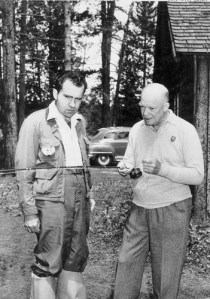
Ike and Dick fishing at Camp David
Kennedy points out two other more serious misstatements in the review. In the paragraph above, Scarborough suggests that Lyndon Johnson’s insecurities stemmed from Jack Kennedy’s mistreatment and that led Johnson to humiliate his own Vice President Hubert Humphrey. Scarborough isn’t really clear about this, but he seems to be drawing analogies to the Eisenhower-Nixon relationship. He seems to claim–perhaps based on his reading of Frank’s book–that Nixon’s neuroses stemmed from his difficult relationship with Eisenhower. But Nixon was a psychologically troubled person long before he met Ike and suggesting otherwise is inaccurate. Likewise, Johnson had plenty of psychological issues before he got involved with Jack Kennedy. Dan Kennedy writes:
As anyone who’s read Robert Caro’s “The Passage of Power” knows, Johnson, like Nixon, suffered from a world-class case of insecurity long before he ever met John Kennedy. The truth is the opposite of what Scarborough claims: both Nixon and Johnson were uniquely unsuited to suffer the slights that are inherent to the vice presidency long before they assumed the office.
Finally, Kennedy points out the ludicrousness of the following passage from the Scarborough piece:
A fascinating subplot in Frank’s story details Nixon’s role in pushing the administration on the issue of civil rights. Long criticized as the author of the Republican Party’s racially tinged “Southern strategy,” Nixon is shown by Frank to be a determined advocate for the Civil Rights Act of 1957, as well as a trusted ally of Martin Luther King Jr. and Jackie Robinson.
Yes, Nixon was supportive of Martin Luther King during the 1950s, and did try to get Eisenhower to push for African American civil rights, but Scarborough completely ignores Nixon’s later rejection of King during the 1960 presidential campaign and his [Nixon’s] development of the “Southern Strategy” in 1968. If those later events weren’t included in Frank’s book, a competent reviewer would have called attention to them. In fact, if Scarborough had googled, he could have quickly found an article by Franks himself that points out Nixon’s later involvement in blatant racism. Franks writes in The Daily Beast, January 21, 2013:
There once was a real connection between the two men, but it more or less ended with RN’s spineless behavior during the 1960 presidential campaign, after Dr. King was arrested on phony charges stemming from a traffic violation. Coretta Scott King had been terrified; she worried with good reason that her husband might be killed en route to Georgia State Prison in Reidsville, and she appealed to the Nixon and John F. Kennedy campaigns to intervene.
Nixon, however, demurred; he said that it would be “grandstanding” to speak out, according to his aide William Safire. Nixon’s real motive, though, seems clear: it was a close election and he was willing to lose black support if it meant gaining a new harvest of white votes in the once-Democratic south. Eight years later, this approach became the carefully considered “Southern strategy.”
The Kennedy brothers then stepped in to help King.
John and Robert Kennedy helped to win Dr. King’s release, and soon enough their campaign distributed two million copies of a pamphlet titled “‘No Comment’ Nixon Versus a Candidate With a Heart, Senator Kennedy” to well chosen voters. It can’t be proved that this made the difference in an election in which the popular vote turned out to be the closest ever (Nixon and Kennedy were separated by about 112,000 votes out of sixty-nine million cast), but it’s a fact that President Eisenhower in 1956 got some 40 percent of the black vote and that Nixon in 1960 won just 32 percent—not bad by modern Republican standards, but still a steep drop. Four years later, facing Barry Goldwater, Lyndon Johnson won 94 percent of the black vote, which set a demographic pattern that endures.
We already knew that Morning Joe doesn’t understand economics; we now know he’s history-challenged as well. In addition, I have some problems with the clarity of his writing. Here are a couple of examples.
Paragraph 2 begins:
Franklin Roosevelt’s vice president memorably said that being No. 2 was in effect not worth a bucket of warm spit.
Which vice president? FDR served with three: Henry A. Wallace, John Nance Garner, and Harry S. Truman. If you said John Nance Garner, you’re correct. And he didn’t qualify the judgment with “in effect” either. Was Scarborough just to lazy to look up the quote?
This reminds me of problems that many college freshmen have in their writing–they either don’t provide enough context or they assume knowledge the reader may not have. They also tend to use unnecessary qualifications instead of just making straightforward statements.
In paragraph 3, Scarborough writes:
“Ike and Dick” is a highly engrossing political narrative that skillfully takes the reader through the twisted development of a strange relationship that would help shape America’s foreign and domestic agenda for much of the 20th century.
Really? Perhaps that judgment came from the book; but it’s a pretty sweeping statement that needs to be backed up with specific examples. But Scarborough doesn’t offer any. When he does provide more context, as he does in paragraph 5, he leaves out important details. He briefly mentions a “secret Nixon fund” that led to Eisenhower trying to dump Nixon from the ticket in 1952, and says that Nixon survived; but Scarborough never even mentions what saved him–the Checkers speech!
The entire review is only a little over 1,000 words. Surely Scarborough could have added a few more historical details and specific examples to back up his assertions.
If I were grading this review for a college course, I’d probably have to give it a C+, or maybe a B- in these days of grade inflation. The grammar and sentence structure are okay; but the review itself is short on context, the historical inaccuracies are problematic, and the lack of specific examples makes for rather boring reading. Frankly, I’m disappointed in the New York Times for publishing it.
Real Life Rambo or Public Enemy Number 1?
Posted: February 10, 2013 Filed under: Civil Liberties, Civil Rights, Crime | Tags: broken police and criminal justice systems, Christopher Dorner, LAPD 37 Comments The frantic hunt for an ex LAPD officer turned shooter has turned into a series of odd and frightening events. The manhunt started out as a search for what was thought to be a spree shooter with a manifesto. The manifesto is available on line and talks about Christopher Dorner’s beef with his former employer the LA police department. It seems the LAPD is now in a stranger-than-life manhunt that is providing more support for Dorner’s manifesto than for the hunt for the ex cop who shot and killed 3 people, including a police officer and the daughter of a former police chief.
It was revealed that Dorner has become the first human target for remotely-controlled airborne drones on US soil.
POLICE plan to use spy drones in the hunt for a Rambo-style ex-soldier and policeman who has murdered three people and vowed to kill again.
They believe burly, heavily-armed Christopher Dorner is holed-up in the wilderness of California’s snow-capped San Bernardino mountains 80 miles east of Los Angeles.
The burnt-out shell of his pick-up truck was discovered in the nearby resort of Big Bear, where residents and tourists have been warned to stay indoors as the search continues.
Yesterday, as a task force of 125 officers, some riding Snowcats in the rugged terrain, continued their search, it was revealed that Dorner has become the first human target for remotely-controlled airborne drones on US soil.
A senior police source said: “The thermal imaging cameras the drones use may be our only hope of finding him. On the ground, it’s like looking for a needle in a haystack.”
Asked directly if drones have already been deployed, Riverside Police Chief Sergio Diaz, who is jointly leading the task force, said: “We are using all the tools at our disposal.”
The use of drones was later confirmed by Customs and Border Patrol spokesman Ralph DeSio, who revealed agents have been prepared for Dorner to make a dash for the Mexican border since his rampage began.
He said: “This agency has been at the forefront of domestic use of drones by law enforcement. That’s all I can say at the moment.”
Dorner, who was fired from the LAPD in 2008 for lying about a fellow officer he accused of misconduct, has vowed to wreak revenge by “killing officers and their families”.
The most bizarre and sad stories from this chase are the number of innocent people who have been shot and endangered by police who appear to be chasing down anything remotely resembling Dorner’s transportation. This included an elderly Hispanic woman and her daughter delivering newspapers and neighborhood homes surrounding their ambush.
Two women who were delivering newspapers in Torrance, Calif., early Thursday were shot by jittery Los Angeles police officers who mistakenly thought cop-hunting fugitive Christopher Dorner might be in their vehicle, NBCLosAngeles.com reported.
One was shot once and the other twice; both were were expected to survive. Police did not release their names.
Police detectives investigate a shooting scene involving a black Honda pickup truck in Torrance, Calif. Police opened fire on the vehicle in a case of mistaken identity while searching for former Los Angeles police officer Christopher Dorner.
The LAPD detectives were in the neighborhood to watch over a home they believed Dorner might target. Hours earlier, the fired cop had allegedly ambushed officers in two other cities, killing one of them.
Across the region, cops on high alert were on the lookout for Dorner’s dark-colored Nissan truck. In the predawn dark, they saw a blue pickup rolling through the streets with no headlights on.
It’s unclear what happened next, but LAPD Chief Charlie Beck confirmed the officers fired on the vehicle, hitting the two occupants. He said it was a tragic case of “mistaken identity.”
The second person was a young, skinny white man.
David Perdue was on his way to sneak in some surfing before work Thursday morning when police flagged him down. They asked who he was and where he was headed, then sent him on his way.
Seconds later, Perdue’s attorney said, a Torrance police cruiser slammed into his pickup and officers opened fire; none of the bullets struck Perdue.
His pickup, police later explained, matched the description of the one belonging to Christopher Jordan Dorner — the ex-cop who has evaded authorities after allegedly killing three and wounding two more. But the pickups were different makes and colors. And Perdue looks nothing like Dorner: He’s several inches shorter and about a hundred pounds lighter. And Perdue is white; Dorner is black.
“I don’t want to use the word buffoonery but it really is unbridled police lawlessness,” said Robert Sheahen, Perdue’s attorney. “These people need training and they need restraint.”
The women’s lawyer, Glen Jonas, told the Times LAPD not follow protocol or the rules of engagement before they decided to exercise deadly force.
‘With no warning, no command, or no instructions, LAPD opened fire on their vehicle,’ Jonas said.
‘This wasn’t even close,’ their attorney said.
‘This was two petite Latina women versus a large black man, with a different vehicle, different color. The police didn’t take the time to do the identification. They didn’t give the “suspect” the opportunity to surrender. So the whole thing was just mishandled, and we expect that the city will acknowledge that and go from there.’
The police have lost track of the suspect and are now offering a huge reward for information leading to the suspect’s arrest. Given the trigger happy police and the drone, I doubt arrest is what these folks have in mind. The most interesting thing is the shift of public opinion. The LAPD has a PR nightmare on their hands as well as the manhunt. This is from the Christian Science Monitor
The hunt for alleged cop killer Christopher Dorner has turned into a major public relations challenge for law enforcement officials, in particular the Los Angeles Police Department working its way back from a history of corruption and abuse.
Not only have hundreds of well-trained officers equipped with military-style vehicles – including helicopters with thermal imaging devices one pilot says can pick out a rabbit in a snowstorm – been unable to find the man charged with killing three people and wounding two others on a rampage aimed at police officers and their families.
The LAPD also has been forced to reexamine the reasons for Mr. Dorner’s dismissal as a police officer in 2009 – brought about, Dorner charges in the 11-page manifesto he posted on Facebook, by racism in the department. And the LAPD is having to make amends to the two people – a middle-aged Hispanic woman and her mother delivering newspapers – wounded when police riddled their truck with gunfire. (The women’s truck was neither the make nor the color of Dorner’s pickup later found abandoned.)
America’s history is sepia-soaked with outlaws who have engendered popular support. In keeping with this difficult-to-deconstruct
phenomenon, a number of social media corners are cheering on suspected murderer Christopher Dorner while authorities are still trying to track him down.
Frankly, I find it very disturbing that the police are using more and more military style tactics. There are now scads of articles where military tactics used in Iraq are being used in the streets of the US by police departments. BB pointed out a few of these to me and you may want to look a them.
To counter gangs, Springfield adopts tactics from war zones
Police deployed military tactics to rescue hostage in Alabama bunker
So, there is a growing question about the usefulness of these insurgency tactics in Afghanistan, but apparently, it’s fine to use them in US cities. This first jumped into public awareness in 2008 as John McCain suggested it was a good thing during his campaign for POTUS.
Senator John McCain has suggested adopting tactics used in Iraq to combat urban crime here at home. McCain made the comment while he spoke before the National Urban League.
Sen. John McCain: “And some of those tactics, very frankly — you mention the war in Iraq — are somewhat like that we use in the military. You go into neighborhoods, you clamp down, you provide a secure environment for the people that live there, and you make sure that the known criminals are kept under control. And you provide them with a stable environment, and then they cooperate with law enforcement.”
We’ve had our own issues down here in New Orleans with our corrupt police, our broken criminal justice system, and out of control urban shootings. I believe this will continue to be an issue. Here’s a related thing I just learned today and it’s been on the ACLU’s radar since 2006. It’s just been expanded to something really frightening in a DHS Report which many lawyers believe is a direct violation of the 4th amendment.
The Department of Homeland Security’s civil rights watchdog has concluded that travelers along the nation’s borders may have their electronics seized and the contents of those devices examined for any reason whatsoever — all in the name of national security.
The DHS, which secures the nation’s border, in 2009 announced that it would conduct a “Civil Liberties Impact Assessment” of its suspicionless search-and-seizure policy pertaining to electronic devices “within 120 days.” More than three years later, the DHS office of Civil Rights and Civil Liberties published a two-page executive summary of its findings.
“We also conclude that imposing a requirement that officers have reasonable suspicion in order to conduct a border search of an electronic device would be operationally harmful without concomitant civil rights/civil liberties benefits,” the executive summary said.
The memo highlights the friction between today’s reality that electronic devices have become virtual extensions of ourselves housing everything from e-mail to instant-message chats to photos and our papers and effects — juxtaposed against the government’s stated quest for national security.
The President George W. Bush administration first announced the suspicionless, electronics search rules in 2008. The President Barack Obama administration followed up with virtually the same rules a year later. Between 2008 and 2010, 6,500 persons had their electronic devices searched along the U.S. border, according to DHS data.
So, we should really be worried about our due process and the access of police departments–all ready out of control–to sophisticated military tactics, techniques, and equipment via Homeland Security. Meanwhile, keep your eyes on the Dorner case. It appears to be layered with morality plays and plots from movies.
Endless Questions
Posted: January 12, 2013 Filed under: Civil Liberties, Civil Rights, Free Speech | Tags: Aaron Swartz 15 CommentsIt’s always difficult to report that some one young has died. It’s even worse when the circumstances of death seem beyond explanation as always  seems to be the case with suicides. The story of online activist Aaron Swartz is filled with glimpses into a brilliant mind, a passionate advocate for access to knowledge, a search for justice against suppression and censorship and our government who seem intent on prosecuting the wrong people these days for the wrong reasons.
Aaron Swartz, the Internet political activist who co-wrote the initial specification for RSS, has committed suicide, a relative told CNN Saturday. He was 26.
“Great minds carry heavy burdens,” wrote one user on Reddit, a popular social media website that Swartz helped develop and popularize following a merger in 2006.
Swartz also co-founded Demand Progress, a political action group that campaigns against Internet censorship.
A young prodigy, his passion pushed limits and landed him in legal troubles in recent years.
In 2011, he was arrested in Boston for alleged computer fraud and illegally obtaining documents from protected computers. He was later indicted from an incident in which he allegedly stole millions of online documents from the Massachusetts Institute of Technology. He pleaded not guilty in September, according to MIT’s “The Tech” newspaper.
Yes. Swartz helped develop Reddit and RSS feed. He will now be best known as a victim of government prosecution overkill. It’s an odd story in the endless one where big businesses and government work hard to make sure that anything slightly worth knowing must be associated with some one’s exorbitant profit and a form of ownership.
Congress passed the Computer Fraud and Abuse Act (CFAA) in 1986 to deal with the then-new problem of malicious computer hacking. Because the law was passed when the Internet was still in its infancy, the exact scope of its provisions remains murky today. For example, there have been cases of employers suing employees under the CFAA for using their employer-provided credentials to access information on the corporate intranet that wasn’t intended for them.
In 2008, the government prosecuted a woman under the CFAA after her “cyber-bullying” of a teenager contributed to her suicide. The government argued that the woman’s actions violated the MySpace user agreement, and therefore constituted unauthorized access to MySpace servers. The woman was convicted, but her conviction was later thrown out by an appeals court.
The government seems to be making a similar argument in the Swartz case. It says he violated the CFAA when he “intentionally accessed computers belonging to MIT and JSTOR without authorization, and thereby obtained from protected computers information whose value exceeded $5,000—namely, digitized journal articles from JSTOR’s archive.” By breaking Swartz’s actions up into five different date ranges and charging him under two different sections of the CFAA for each, the government has ginned up a total of 10 counts, each of which is theoretically punishable by five years in prison. For good measure, they also charged Swartz with one count of “recklessly damaging” a computer under the CFAA and two counts of wire fraud.
It’s a stretch to say that Swartz gained unauthorized access to JSTOR’s servers. Initially, he did have authorization to access both the network and the JSTOR website. But according to the indictment, “each user must agree and acknowledge that they cannot download or export contents from JSTOR’s computer servers with automated computer programs such as Web robots, spiders, or scrapers.” The government seems to believe that once Swartz ran afoul of this contractual requirement, he became an unauthorized user and therefore a felon under the CFAA.
But treating the violation of such use restrictions, or the evasion of efforts to enforce them, as a felony is overkill. Automated crawling of websites is an extremely common activity that can have social benefits. While crawling a public (or, in the case of JSTOR semi-public) website against the wishes of its owner is generally bad manners, it’s hardly comparable to hacking into someone’s computer to access private information.
Websites have been known to use their terms of use for anti-competitive purposes.
I have a major soft spot for hacktivists like Swartz. Not only is it a matter of being awed by their brilliance, but by what appears to be an ethos 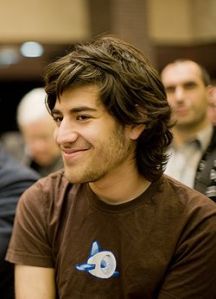 based on just getting knowledge for the sake of knowledge. There’s a basic underlying democratic principle in the idea that human knowledge belongs to all of us. Evidently, JSTOR must’ve agreed with him.
Swartz’s subsequent struggle for money to offset legal fees to fight the Department of Justice and stay afloat was no secret.
After the September charges came down, the wife of Creative Commons founder Larry Lessig – social justice lawyer Bettina Neuefeind – established and organized the site free.aaronsw.com to raise money for his defense.
Demand Progress – itself an organization focused on online campaigns dedicated to fighting for civil liberties, civil rights, and progressive government reform – compared The Justice Department’s indictment of Swartz to “trying to put someone in jail for allegedly checking too many books out of the library.”
Swartz’s suicide came two days after JSTOR announced it is releasing “more than 4.5 million articles” to the public.
So, this isn’t the most political or strategic post we’ve ever put on the blog. Aaron’s passing isn’t one of those newsy obits that will get played at the end of the year in some tribute gala. I think, however, we need to notice his tragic death, his brilliant short, life and his commitment to an open internet with accessible content. His story is really one about our freedom to know which is really the final frontier of our humanity.
DOJ To Monitor Polls in 23 States
Posted: November 2, 2012 Filed under: 2012 elections, Civil Rights, U.S. Politics | Tags: Department of Justice, Eric Holder, poll monitors, voting rights, Voting Rights Act 59 Comments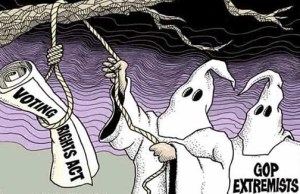
Just a quick post…
The Justice Department Friday announced that it is dispatching more than 780 federal observers and monitors to 23 states to watch for potential problems which would violate voting rights protected by federal law.
The Justice Department said it was sending observers to 51 jurisdictions in those states to help enforce federal voting rights laws which protect ballot access.
….
Jon Greenbaum, Chief Counsel for the Lawyers Committee for Civil Rights Under Law, says his organization is generally pleased with the locations selected for federal monitoring. The organization successfully pushed, for example, for monitors to be sent to Maricopa County, Arizona because of potential problems for Hispanic voters, and the group noted potential for discrimination against black voters in Alabama and Mississippi counties.
Historic incidents of discrimination against Native American voters prompted observers to be sent to Shannon County, South Dakota, and Sandoval County, New Mexico, Greenbaum said. In Chicago, several ethnic minorities have suffered incidents in the past, including lack of poll workers who spoke Chinese, South Asian, or other minority languages. A growing Muslim population in Detroit and Hamtramck, Michigan also had caused issues for native Arab and Middle Eastern language speakers at polling places, Greenbaum said.
There’s a complete list of the targeted counties at the CNN link. Franklin and Hamilton Counties in Ohio are included.
According to the Palm Beach Post,
U.S. Attorney General Eric Holder, who was at the U.S. Attorney’s office in Tallahassee on Friday, is sending staff to Duval County, Hendry, Hillsborough, Lee, Miami-Dade, Orange and Osceola counties on Election Day. DOJ is also monitoring Miami-Dade County elections during early voting, the agency announced today.
Hendry and Hillsborough are two of the five “preclearance” counties – along with Collier, Hardee and Monroe – that require federal approval of election law changes because of a history of discrimination against minorities.
“Although state and local governments have primary responsibility for administering elections, the Civil Rights Division is charged with enforcing the federal voting rights laws that protect the rights of all citizens to access the ballot on Election Day,” DOJ said in the press release.
The LA Times reports that Riverside and Alameda Counties are on the list.
The federal government began monitoring polling sites in Riverside County after the agency’s Civil Rights Division filed a complaint against the county for failing to offer election-related information and assistance to Spanish-speaking voters, a violation of the Voting Rights Act.
The county and the Department of Justice reached a settlement in February 2010 that included having federal observers at polling stations.
A similar settlement was reached with Alameda County in 2011 after the federal government accused the county of failing to train an adequate number of poll workers to help Mandarin-, Cantonese- and Spanish-speaking voters on election day.
This may not completely make up for the numerous efforts of Republican election officials to suppress the votes of traditionally Democratic groups, but it’s good to know Holder is on the case.

 peej
peej Carissa
 bostonboomer
 dakinikat
 ecocatwoman
 mablue2
 Mama Lopez
 peggysue22
 quixote
 skydancingguestblogger
 Mona (aka Wonk the Vote)



 Sky Dancing
Recent Comments