
Friday Reads
Posted: August 28, 2015 Filed under: morning reads | Tags: George Dubya Bush, Hillary Clinton, New Orleans, Republican war on everyone but white christianist men 14 Comments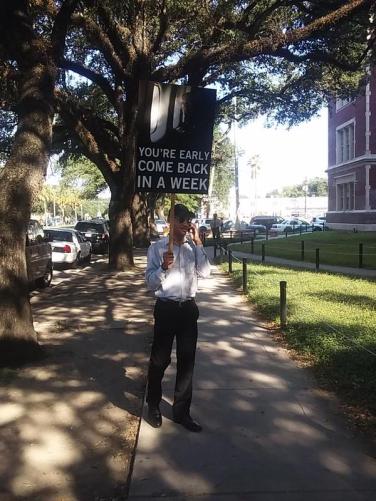 Good Morning from the land of resplendent PTSD triggers!
August is my least favorite month. I basically try to slog through it. I can’t recall anything good EVER happening in August. This year is no different.
They say criminals always return to the scene of their crimes. Today, Dubya Bush returned to New Orleans to “commemorate” Katrina. But, it’s a brief hit and run before he heads off to Mississippi. That should remind every one that what they asked Louisiana to do before getting help was not what they required of Mississippi where Haley “white council” Barbour reigned. Mass Murderer Heckuva Job Brownie needs to be reminded of this fact still. This sentence from the ABC link pretty much says it all.
Bush largely took a hands-off approach, frequently saying that rebuilding was best left to locals.
All over our country, Republican government officials are refusing to do their jobs in a hissy fit of selfishness and ideology. I mean really, if you don’t like government, maybe you shouldn’t be an elected government official or a government worker. We generally call them public servants for a damned good reason.
Kim Davis is doing everything she can to avoid doing her job. Now the Rowan County, Kentucky clerk is petitioning the Supreme Court to allow her to not issue marriage licenses to same-sex couples.
Davis was slapped down just yesterday by the 6th Circuit Court of Appeals, which said that she or anyone in her office must issue marriage licenses to all couples regardless of gender.
Davis’ office just this morning again refused a same-sex couple the right to marry. Her office has until Monday to comply with the federal courts’ rulings.
Davis is represented by the founder of a certified anti-gay hate group, Mat Staver of Liberty Counsel.
“Davis will appeal one more rung up the ladder, to U.S. Supreme Court Justice Elena Kagan, who can intervene in 6th Circuit cases, Staver said,” according to the Lexington Herald-Leader.
“It is disappointing, certainly for our client, because the ramifications of the ruling is that there are no religious freedom rights for individuals if you can say a case is just against the office,” Staver told the newspaper. “The problem with that is, individuals who hold public office don’t forfeit their constitutional rights.”
But Right Wing Watch notes Staver is incorrect.
“While Staver claims that the clerk’s ‘constitutional rights’ are being violated when she is required to perform her job duties, the appeals court points out that this is not a case of individual free speech: ‘[W]here a public employee’s speech is made pursuant to his duties, ‘the relevant speaker [is] the government entity, not the individual.'”
She’s free to believe whatever nonsense she wants to believe on her own time and dime. She needs to comply, quit, or go to jail for breaking the law. PERIOD. Meanwhile, I’m looking forward to Elena Kagan 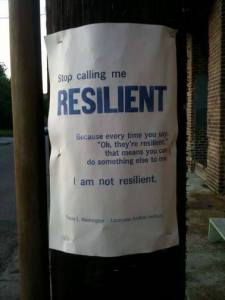 ripping her a new one.
Hillary Clinton, however, tells it like it is. “On women’s health, Clinton compares Republicans to ‘terrorist groups'”
Republican presidential candidates are striking back Friday after Hillary Clinton compared some of them who hold conservative views on abortion and women’s reproductive rights to “terrorist groups.”
During a riff Thursday where Clinton name checked Florida Sen. Marco Rubio, former Florida Gov. Jeb Bush and Ohio Gov. John Kasich, Clinton said Republicans are “dead wrong for 21st century America.”
“Now, extreme views about women, we expect that from some of the terrorist groups, we expect that from people who don’t want to live in the modern world, but it’s a little hard to take from Republicans who want to be the president of the United States,” Clinton said at a speech in Cleveland. “Yet they espouse out of date, out of touch policies. They are dead wrong for 21st century America. We are going forward, we are not going back.”
Meanwhile, Ben Carson has women reduced to vessels with “contents”. This is yet another Republican attack on woman’s autonomy and moral personhood. How did this guy pass an anatomy course?
Republican presidential candidate Ben Carson is dismissing the notion that there is a “war on women,” saying the real war is on “what’s inside of women.”
“They tell you that there’s a war on women,” Carson said at a rally in Little Rock, Ark., on Thursday.
“There is no war on women — there may be a war on what’s inside of women, but there is no war on women in this country,” he continued, referring to abortion.
Democrats have accused Republicans of waging a war on women, citing efforts to limit abortion rights or access to birth control. But Republicans have pushed back on that language.
Carson said such rhetoric is only being used to divide people.“All of those people who are trying to drive wedges between us, they are the enemy, they are not our friends, and we must learn to recognize them, and not allow them to manipulate us,” he said.
Carson’s comments come as the GOP contender’s anti-abortion-rights stance has come under fire after it was revealed that the retired neurosurgeon had co-authored a paper in which research was done on tissue acquired from fetuses aborted at nine and 17 weeks’ gestation.
“I have never actually worked with fetal tissue,” he told Fox News’s Bill O’Reilly earlier this month.
Carson also took flak when he said that RU-486, which has been dubbed the “chemical abortion pill” by some anti-abortion-rights groups, should be administered to women in cases of rape and incest.
However, some have speculated that Carson mistakenly referenced RU-486, which is administered five to seven weeks into a pregnancy, when he really meant to refer to emergency contraception known as the morning-after pill.
 The man is not an ob/gyn. He needs to stfu.
Anyway, I’m making this short today. I have a blanket fort to defend for a few more days and we’re running low on our supplies of red wine and pet treats.
What’s on your reading and blogging list today?
Monday Reads: The Adulting Blues
Posted: August 24, 2015 Filed under: morning reads | Tags: economy, Huckabee, hurricane katrina, New Orleans, Racism, Resilience lab, Stock Market, Trump 17 Comments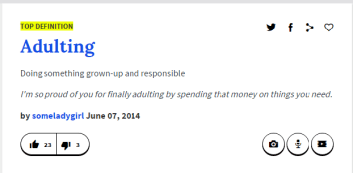 Good Morning!
Well, today’s the kind’ve day that makes me want to hide under the covers and have my mother do all my laundry and cooking. Well, actually my Dad used to do all the cooking but you know what I mean. It’s been like that for at least a few days as my car’s battery gave out in a very inconvenient location on Thursday night and my bills are bigger than my latest paycheck. A lot of my ennui and accompanying stress has to do with the uberhype of the 10 year anniversary of Hurricane Katrina which for a lot of us is an ongoing process of things becoming more undone than they were before.
Then, there’s just the constant barrage of news–none of which is particularly good–which includes ISIS destroying an ancient wonder. You know what an armchair archaeology buff I am. It’s just so easy to deal with dead civilizations rather than live ones. Trump continues to belittle any one in his path, and every one in the Republican primary is unleashing misogyny and racism. I’m going to focus on the racism today because I think both BB and JJ have given the current misogyny binge complete justice.
My friend Peter has actually written exactly what I’m feeling on this dreadful week where they’re actually pulling out parades and doing “resilience tours” to hype the city and its survival. Like I said, we may have survived Katrina, but I still have my doubts about our surviving the hipsters, the gentrification, and our elected overseers who have forced us to privatize things that weren’t working before but now are worse and to capitalize on things that turn us into a Disaster Minstrel Show. Again, this is not my writing but Peter’s but I could’ve written it word for word except I obviously don’t have his wife!
I am dreading the influx of disaster tourists who will surely be showing up in town this week. Some of them will be sincerely motivated and others will be of the “I volunteered once with Habitat for Humanity after Katrina so I know what it was like” variety. No, you don’t. You don’t know what it’s like to be barred from your home for 6 weeks and have to sneak in like Dr. A and I did. You don’t know what it’s like to have a bad case of survivor’s guilt because you didn’t fare as badly as other people in town. You don’t know what it’s like to have to re-tell your “Katrina story” over and over again. You don’t know what it’s like to be having dinner and have do-gooders burst in to save your pets because you didn’t, or couldn’t, wash the marks off your front door. Actually, neither do I but it happened to some friends of mine. It gives a whole new meaning to the phrase putting on the dog…
The aftermath of the storm was a very painful period in the lives of New Orleanians. We’ve lived it day-in and day-out for 10 years at varying levels of intensity. That’s why I’m not enthusiastic about rehashing those days regardless of whether it’s done by resilience tour types or the krewe of “we’ve gone to hell in a designer handbag.” I wish they’d all piss off and leave me alone. I’m not the only one who feels this way.
Yes. I feel that way. Piss off and leave me alone. Unfortunately, my neighborhood has turned into the mini-Quarter and I can’t even walk the dog around the block or have a beer without either bumping into seven bridesmaids giggling, six film crews taping, and five fucking Air BnB parasites.
This headline from WAPO actually made me scream: A ‘resilience lab’. They’ve obviously bought into the Mayor’s hype. This is the paragraph that’s described my reality. Every day I walk out of my house and feel like screaming “WTF are you doing here? Why don’t you go back to the hell realm you came from instead of bringing it here to me?” No east coast newspaper article on New Orleans is complete these days without telling people that the place to be is my freaking neighborhood, the Bywater. I have fewer and fewer neighbors all the time. My neighborhood has been completely overrun with people hoping to redefine and cash in on cool.
He smiled at first. It looked so charming, all those people driving slowly down Burgundy Street through the Faubourg Marigny and Bywater neighborhoods, pointing cameras.
Then it dawned on Keith Weldon Medley: These folks weren’t tourists or architecture buffs. They were shoppers. And on their shopping list was almost everything that could be had in these neighborhoods, a collection of Creole cottages, shotgun doubles, warehouses and small manufacturers at a humpback bend of the Mississippi River.
In the evolution of post-Katrina New Orleans, few phenomena have been more striking than the dramatic demographic shift of places such as Bywater from majority black to majority white. One census block group in Bywater dropped from 51 percent African American before Katrina to just 17 percent afterward; the largest went from 63 percent to 32, according to a Washington Post analysis of U.S. census data.
“You saw all these white people. Obviously they were displacing black people who were here before,” said Medley, a historian who lives in the house where he grew up in the Marigny.
My daily mantra is “I see fucking stupid White People.”
So, I really don’t intend for this to be my Katrina post. I’ve been there and done that. Let me post a few more things that are pissing me off today.
There’s an obvious asset bubble bubbling away here so the market’s correcting and the Fed is going to start bringing up interest rates. This blog has an interesting take on what’s going on which is particularly relevant to my field of research as a currency bloc and international economist.
Global stock markets are in a 2008ish kind of crash today and I really don’t much time to write this, but I just want to share my take on it.
To me this is fundamentally about the in-optimal currency union between the US and China. From 1995 until 2005 the Chinese renminbi was more or less completely pegged to the US dollar and then from 2005 until recently the People’s Bank of China implemented a gradual managed appreciation of RMB against the dollar.
This was going well as long as supply side factors – the opening of the Chinese economy and the catching up process – helped Chinese growth.
Hence, China went through one long continues positive supply shock that lasted from the mid-1990s and until 2006 when Chinese trend growth started to slow. With a pegged exchange rate a positive supply causes areal appreciation of the currency. However, as RMB has been (quasi)pegged to the dollar this appreciation had to happen through domestic monetary easing and higher inflation and higher nominal GDP growth. This process was accelerated when China joined WTO in 2001.
As a consequence of the dollar peg and the long, gradual positive supply shock Chinese nominal GDP growth accelerated dramatically from 2000 until 2008.
However, underlying something was happening – Chinese trend growth was slowing due to negative supply side headwinds primarily less catch-up potential and the beginning impact of negative labour force growth and the financial markets have long ago realized that Chinese potential growth is going to slow rather dramatically in the coming decades.
As a consequence the potential for real appreciation of the renminbi is much smaller. In fact there might be good arguments for real depreciation as Chinese growth is fast falling below trend growth, while trend itself is slowing.
The market has rebounded but the financial markets are obviously still shaky. China is the world’s largest economy now so anything  that happens there is bound to ripple around the world.
The global whiplash underscored investors’ shaken confidence in China’s slowing economy and central bank. The world’s second-largest economy is now reeling over what China’s state media is calling “Black Monday,” during which its markets just recorded their biggest one-day nosedive in eight years.
But the mid-morning bounce off deep trading lows led some analysts to question whether financial markets had already finished their fall. Tech giant Apple, which begun the morning down 13 percent and dipping below $100, was trading 2 percent higher by the afternoon, at about $107.
The dismal opening marked a worrying continuation of last week’s free fall. The Dow’s blue-chip index plunged more than 500 points on Friday, capping its worst week since 2011 and entering what Wall Street calls a correction, having tumbled 10 percent from its May peak.
The sell-off bruised every industry, wiping out gains in rapid order after a year of mostly steady trading. Some of America’s biggest companies shed tens of billions of dollars in market value in only a few days, and the markets’ early gains have yet to restore those losses.
S&P 500 companies lost more than $1 trillion in market value last week, and the Dow and other indices are on track to record their dreariest month since February 2009.
On Friday, China reported its worst manufacturing results since the global financial crisis, following shortly after Beijing earlier this month surprised investors by announcing it would devalue the nation’s currency.
China’s benchmark Shanghai Composite index has fallen by nearly 40 percent since June, after soaring more than 140 percent last year. Markets in Europe also plummeted, and Asian shares on Monday hit a three-year low.
Economist gadfly and miserable human being Larry Summers is pearl clutching about the rate hikes. He seems to be on a search to be relevant again but on a very wrong path. This article alone ought to make you very glad that he’s not the Fed Chairman since he seems completely oblivious to the asset bubbles that I see in assets around the country including houses once again.
Like most major central banks the Fed has put its price stability objective into practice by adopting a 2 per cent inflation target. The biggest risk is that inflation will be lower than this — a risk that would be exacerbated by tightening policy. More than half the components of the consumer price index have declined in the past six months — the first time this has happened in more than a decade. CPI inflation, which excludes volatile energy and food prices and difficult-to-measure housing, is less than 1 per cent. Market-based measures of expectations suggest that, over the next 10 years, inflation will be well under 2 per cent. If the currencies of China and other emerging markets depreciate further, US inflation will be even more subdued.
Tightening policy will adversely affect employment levels because higher interest rates make holding on to cash more attractive than investing it. Higher interest rates will also increase the value of the dollar, making US producers less competitive and pressuring the economies of our trading partners.
Please check out housing and stock prices Lala and then try again.
Republicans continue to show they have no idea about the reality of black people in this country. Trump attacked Martin O’Malley for sensitivity to the Black Lives Matter Campaign.
Appearing on Fox News over the weekend, Donald Trump admitted to being completely ignorant about the Black Lives Matter movement. “I know nothing about it,” the billionaire real estate developer said.
Of course, his lack of knowledge didn’t prevent him from harshly criticizing the effort. Trump said that he’s “seeing lot of bad stuff about it right now.” He said Martin O’Malley, a contender for the Democratic nomination, was a “disgusting little weak pathetic baby” for apologizing to Black Lives Matter activists earlier this year.
 Huckabee played the MLK card and completely confused King’s Son.
Martin Luther King III, the son of the late civil rights leader, said he was “perplexed” by GOP presidential hopeful Mike Huckabee’s comments last week suggesting that his father would be “appalled” by the Black Lives Matter movement.
“I think dad would be very proud of young people standing up to promote truth, justice and equality,” King said during an interview on SiriusXM radio. “I was perplexed by the comments, but people attempt to use dad for everything.”
King’s comments come in response to a CNN interview last week in which the former Arkansas governor spoke out against the Black Lives Matter movement, saying racism is “more of a sin problem than a skin problem.”
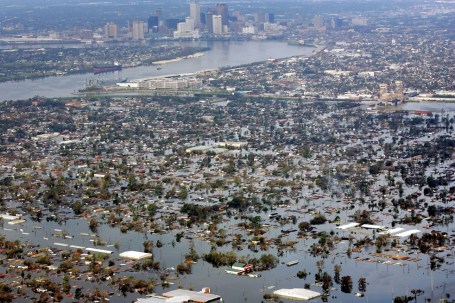
If you look at the picture of flooded New Orleans and the view over the flooded lower ninth ward towards city, you’ll see a cluster of white tallish buildings sitting right on the river in the middle of that photo. Just a hair to the right is where my house still stands and where I’m there right now with a pillow pulled over my head trying to block out the world of adults. I don’t want to be one of them at the moment.
What’s on your reading and blogging list today?
Saturday Reads: Trumped Up Insurgency
Posted: August 22, 2015 Filed under: 2016 elections, morning reads | Tags: Donald Trump, Southern populism, Southern Strategy, Southern Stupidity 88 CommentsGood Morning!
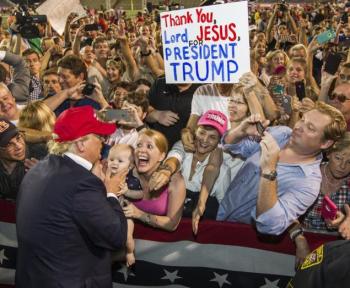 It’s getting to be the ugly season of American politics which makes writing about it and discussing it terrifically unpleasant. Part of the problem is that we rely on a two party system and one of the parties has basically gone off the rails. It’s difficult to imagine the the overall majority of candidates for president in the Republican party today even gaining the least amount of traction around 10-20 years ago or more. Of course, there have been George Wallaces that pop up every now and then, but it seems that we’ve got a bumper crop of them. Meanwhile, the nation’s major newspapers are off chasing imaginary scandals. It’s even harder to believe that the newspapers that printed the Pentagon Papers and chased down the Watergate story might actually finding anything that major and truthful today. They seem more caught up in conspiracy theories and failed opposition research. They don’t even seem to fact check prior to going to press given the recent spate of nothing but speculation that passes as coverage of Hillary Clinton at the NYT.
The ugly faces of both parties are evident in the misogyny aimed at Hillary Clinton and the continuing presence and political viability of showmeister Donald Trump. Trump’s supporters are as filled with ugly thoughts and rhetoric as the master of nasty himself. Alabama is one of those states where being “backwoods” and “backward” are symbols of pride. Along with Texas and Mississippi, it’s one of those states I try to drive through as quickly and low profiled as possible. Trump’s appearance there has brought out the angry, ignorant hillbilly hoards. This is Nixon’s Southern Strategy come full circle. The pictures of the crowd are frightening. Basically, it’s full of love for Jesus and hate for humanity in that mishmash of synapses that come from the brains of the completely deluded.
Trump fans came by the thousands, driving from the Florida panhandle, from Mississippi, from Tennessee and Texas. Traffic was backed up for more than a mile.
On the street, Olaf Childress, a neo-Confederate activist, gave out copies of “The First Freedom” newspaper, which had headlines about “Black-on-white crime,” “occupied media” and “censored details of the Holocaust.”
The most-enthusiastic Trump backers began arriving at the stadium at dawn, hoping to get a spot close to the stage. The first in line were Keith Quackenbush, 54, and Bill Hart, 46, co-workers at a retail giant in Pensacola, Fla.
“I’m telling you, everyone who is a worker at our store, they’re excited about Trump,” Quackenbush said. “I don’t care what race or gender, whatever age — they love Trump. This is a movement.”
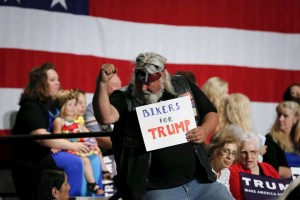 The Atlantic published some “voices” from Trump supporters. If these folks are in your neck of the woods, move! They’re everything that we’ve ever been told about the “ugly American”. It seems difficult to wrap your brain around this brash trust fund baby New Yorker as a Southern idol, but whoops there it is! It’s also part and parcel of the Trump political strategy.
Here is the Trump political logic: “Alabama is extremely critical,” a close associate of Trump’s told me (actually, we agreed I’d call him “a close associate of Mr. Trump”). “You have Iowa’s caucus on February 1st, New Hampshire on the 9th, and South Carolina on the 20th.” The race, this associate explained, would not be wrapped up by then. According to this political calculus, the crucial moment arrives three days later, on March 1st, with the “SEC primary”—the belt of Southern states that encompass the Southeastern Athletic Conference—when Alabama, Texas, Georgia, Arkansas and several others hold their primaries.
Trump is currently leading the polls in many of these states. A new Texas poll has him in first place, beating actual Texans Ted Cruz and Rick Perry. He’s dominating the field in Alabama, as well, doubling the support of second-place finisher Jeb Bush, from neighboring Florida. (Trump is winning in Florida, too, according to a new Quinnipiac University poll, which, although it is an SEC state, doesn’t hold its primary until March 15th). If Trump sweeps the early states, or even just wins Iowa and South Carolina, these advisers believe he could effectively lock down the Republican nomination by sweeping the SEC primary on March 1st. “He feels he wins the nomination on 1 March w/ a sweep of the populist anti-establishment South,” another adviser emailed. “That’s when Trump’s ‘nationalism’ coupled with Sessions’ ‘populism’ comes to full fruition.”
The Alabama rally is meant to show that “he’s starting to motivate and cultivate the base there,” the close associate said, and to demonstrate that Trump is putting in place the strategy and structure to actually win the Republican nomination and not just—as some haters surmise—make a big splash in Iowa and then bail out to go cut the ribbon in some new hotel.
Furthermore, Trump believes he has a secret weapon that could help him carry the South. “The other thing people don’t know about Mr. Trump is that his brand and sales are strongest in the South,” the associate told me. “His TV ratings, his Trump Resorts guests. So this [stadium rally] is about bringing the message that he is here to stay, and is the legit frontrunner. This shows a calculated strategy, that he understands the process and understands it’s not going to end in South Carolina. We’re going to bring the message down further into the belt and expand his support.”
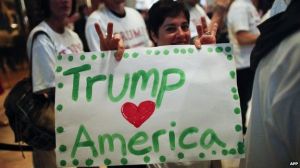 There is truth to the notion that you must get the South to get the Republican nomination. Afterall, the South and the American Outback are home to the base of today’s Republican Party. Trump’s outrageous blend of Gordon Gecko style greed and George Wallce style racial animosity is selling well. So well, that his idea of overturning the 14th amendment to the Constitution has Republican candidates jumping on the bandwagon that would literally mean they and family members would’ve never been citizens. There is nothing more fascinating that watching actual “anchor babies” argue against their circumstances of citizenship. Two of Jeb Bush’s children and Bobby Jindal fall under this category. Mark Rubio and Ted Cruz would probably have never even made it into the country. It’s pretty amazing when you can diss your own circumstances with a straight, angry face.
Following the release of Trump’s plan, several of his fellow 2016 candidates, including Sen. Ted Cruz of Texas, Louisiana Gov. Bobby Jindal and Sen. Lindsey Graham of South Carolina followed Trump by coming out in favor of the policy Wisconsin Gov. Scott Walker on Friday rolled backstatements that suggested he also favored the policy, saying he had been misunderstood and would not take a position “one way or the other”. Sen. Rand Paul of Kentucky has previously supported birthright citizenship legislation.
“I think he’s done a lot of damage,” says Lynn Tramonte, deputy director of America’s Voice, a pro-immigration reform group. “He’s not only now leading in the polls, but he has the ‘Trump effect,’ pulling other candidates to his position on this issue.”
Democrats pounced, and the party’s congressional campaign arm launched a Twitter ad campaign in six swing states targeting Republicans, including Rep. Mike Coffman of Colorado.
“Republicans, including Mike Coffman, want to end birthright citizenship,” one of the Spanish-language ads said. “Tell @RepMikeCoffman that is wrong.”
The ads also hit Reps. Marthy McSally of Arizona, Steve Knight of California, Barbara Comstock of Virginia, Crecent Hardy of Nevada and Will Hurd of Texas, all of whom represent districts with large Hispanic populations.
Bush, whose past stances on immigration have been more moderate than his party’s, tried to split the difference.
“This is a constitutionally protected right, and I don’t support revoking it,” Bush told reporters in South Carolina on Tuesday.
But while he said he would “just reject out of hand” revoking birthright citizenship, Bush used a term that some consider offensive: “anchor babies,” children born to non-citizen parents who travel to the U.S. specifically to give birth and obtain citizenship for their newborns.
“That’s the legitimate side of this,” he said on conservative talk radio host Hugh Hewitt’s show. “Better enforcement so that you don’t have these, you know, ‘anchor babies,’ as they’re described, coming into the country.”
Bush stood by his comments even as Democrats and immigration activists rained down criticism, saying he “didn’t use it as my own language.”
“Do you have a better term?” he fired back at reporters in New Hampshire. “You give me a better term and I’ll use it.”
Democratic front-runner Hillary Clinton piled on, suggesting several alternatives.
“How about ‘babies,’ ‘children’ or ‘American citizens,” she tweeted. “They’re called babies.”
 Norm Ornstein–writing for The Atlantic–wonders if this election cycle will be different. Is it possible that Trump will actually defy history and turn out to be the one that takes on Clinton? Insurgent candidates are common in the United States and ever so often, they do pull through despite the party establishment. The base in the Republican party is all about insurgency. It’s all they do. They’re just angry in general.
Still, I am more skeptical of the usual historical skepticism than I have been in a long time. A part of my skepticism flows from my decades inside the belly of the congressional beast. I have seen the Republican Party go from being a center-right party, with a solid minority of true centrists, to a right-right party, with a dwindling share of center-rightists, to a right-radical party, with no centrists in the House and a handful in the Senate. There is a party center that two decades ago would have been considered the bedrock right, and a new right that is off the old charts. And I have seen a GOP Congress in which the establishment, itself very conservative, has lost the battle to co-opt the Tea Party radicals, and itself has been largely co-opted or, at minimum, cowed by them.
As the congressional party has transformed, so has the activist component of the party outside Washington. In state legislatures, state party apparatuses, and state party platforms, there are regular statements or positions that make the most extreme lawmakers in Washington seem mild.
Egged on by talk radio, cable news, right-wing blogs, and social media, the activist voters who make up the primary and caucus electorates have become angrier and angrier, not just at the Kenyan Socialist president but also at their own leaders. Promised that Obamacare would be repealed, the government would be radically reduced, immigration would be halted, and illegals punished, they see themselves as euchred and scorned by politicians of all stripes, especially on their own side of the aisle.
Of course, this phenomenon is not new in 2015. It was there in 1964, building over decades in which insurgent conservative forces led by Robert Taft were repeatedly thwarted by moderates like Tom Dewey and Wendell Wilkie, until they prevailed behind the banner of Barry Goldwater. It was present in 1976, when insurgent conservative Ronald Reagan almost knocked off Gerald Ford before prevailing in 1980 (and then governing more as a pragmatist than an ideologue). It built to 1994, when Newt Gingrich led a huge class of insurgents to victory in mid-term elections, but then they had to accept pragmatist-establishment leader Bob Dole as their presidential candidate in 1996. And while John McCain in 2008 and Mitt Romney in 2012 were establishment figures, each had to veer sharply to the radical right side to win nominations; McCain, facing a possible revolt at his nominating convention if he went with his first choice for running mate, Joe Lieberman, instead bowed to the new right and picked Sarah Palin.
 It’s still difficult to think of this privileged white man as an insurgent. Still, American Populism is a weird phenomenon that seems more like a religious cult than anything rational.
The Beltway definition of populism is disdainful. When it’s affixed to unexpected movements like the Trump insurgency, it seems to mean little more than a prolonged public tantrum. Looking back at recent pundit-diagnosed outbreaks of the populist bacillus, one sees it dubiously attached to causes as different as the drawling “Two Americas” stump speeches of John Edwards, and the America First culture-war candidacies of Pat Buchanan. Going further back, historians and pundits have spied populism everywhere from the racist shade of George Wallace and other stiff-necked Southern segregationists, to the red-baiting career of Joseph McCarthy, to the redistributionist reign of Huey Long in New Deal Louisiana. Still further back, populism has been detected in such 19th-century figures as its great Gilded Age avatar William Jennings Bryan and Andrew Jackson.
It’s tempting to dismiss populism as an epithet deployed by the power elite—a label that members of our political class slap on something popular that they also deem threatening. But there’s more to it than that. The populist movement of the late 19th century, for instance, was grounded in economic grievances, with leaders like Bryan seeking to unite the nation’s producing classes—farmers, small-town businessmen and urban workers—who thought they could overthrow the industrial age’s regime of market cartels, debt peonage and degraded wage labor.
But populism, during the farmers’ revolt of the 1890s, was also a cultural insurgency—a kind of self-administered political wake for the beleaguered middle American Protestant soul, newly adrift in an urbanized, capitalist nation of immigrant laborers and international bankers, and yearning for the folk egalitarianism of an idealized Jeffersonian republic. This is how populism has come to double as a synonym for modern cultural conservatism. Historian Richard Hofstadter famously branded the Gilded Age agrarian uprising as a precursor to McCarthyism: an outpouring of economic resentments that gave aggrieved farmers license to scapegoat any and all available elites—Jewish bankers, British titans of industry, American robber barons—for their declining cultural influence.
Trump is an unlikely populist because he subscribes to so few positions associated with the cultural side of conservative populist revolt. Before his plunge into the 2016 race, he hadn’t taken a hard-line stance against gay marriage and reproductive rights; and as a twice-divorced, one-time Manhattan playboy, he’s anything but a poster boy for family values. While all the Republican candidates denounce Obamacare, including Trump, and all have plans to expand coverage, Trump is the most liberal sounding. On the pundit altar of Morning Joe he praised single-payer Canada as a system that works but said America needs a private health insurance. “You can’t have a guy that has no money, that’s sick, and he can’t go see a doctor, he can’t go see a hospital,” Trump recently told conservative radio talk show host John Fredericks. Trump added that even if his position costs him support in the GOP primaries, “you have to take care of poor people.”
And yet GOP primary voters have flocked to the early Trump boom. A recent CNN poll indicates that 53 percent of GOP voters feel their views aren’t represented well in Washington—virtually double the 27 percent of Democrats agreeing with that idea. (Never mind that the federal government that so rankles Republican voters is now overrun with Republican leaders—populists often lay into their ideology with the greatest enthusiasm.) Among those saying they want Trump to continue his primary run, CNN also found, are “those seen as the core of the GOP primary electorate: 58 percent of white evangelicals, 58 percent of conservatives and 57 percent of Tea Party supporters.”
Look at those stats. White Evangelicals? I guess we’ve learned about their massive ability to support guys with multiple wives and sins since so many of their men are outright pervs and lawbreakers. This may be the first political season that I truly wish I could avoid. This is exhibit one for that rationale.
“Donald Trump is telling the truth and people don’t always like that,” said Donald Kidd, a 73-year-old retired pipe welder from Mobile. “He is like George Wallace, he told the truth. It is the same thing.”
If that doesn’t get you running for the nearest distraction, check this out.
What’s on your reading and blogging list today?
Monday Reads: The Struggles Continue
Posted: August 17, 2015 Filed under: morning reads | Tags: Civil Rights, Julian Bond, Planned Parenthood, voting rights 7 Comments
Good Morning!
Those of you that know me also know that my most profound and motivating interest lay with social justice issues. I think I was profoundly impacted by watching the evening news as a child. I still remember watching body counts from Vietnam and the images of small children being attacked by hoses and police dogs in places I couldn’t believe were associated with my country. Julian Bond–one of the most vibrant and high profile leaders of the civil rights movement–died on Saturday at the age of 75. His life stands as a tribute to all that has been gained and as a reminder of all the work that continues as we strive to ensure that all our citizens achieve equal status under the law and equal access to economic well being, knowledge, and power. Bond was also a leader in the anti-war movement as one of the founders of the Student Nonviolent Coordinating Committee. He leaves a tremendous legacy of social justice.
The Southern Poverty Law Center, where Bond served as president in the 1970s, announced his death in a statement on Sunday. The SPLC said Bond died Saturday evening in Fort Walton Beach, Fla.
“With Julian’s passing, the country has lost one of its most passionate and eloquent voices for the cause of justice,” the center’s statement read. “He advocated not just for African Americans, but for every group, indeed every person subject to oppression and discrimination, because he recognized the common humanity in us all.”
The Associated Press writes: “The Nashville, Tenn., native was considered a symbol and icon of the 1960s civil rights movement. As a Morehouse College student, Bond helped found [SNCC] and as its communications director, he was on the front lines of protests that led to the nation’s landmark civil rights laws.”
Bond played a major role in sit-ins and freedom rides and the 1963 March on Washington.
The New York Times says: “He moved from the militancy of the student group to the top leadership of the establishmentarian N.A.A.C.P. Along the way, he was a writer, poet, television commentator, lecturer, college teacher, and persistent opponent of the stubborn remnants of white supremacy.”
When he was elected to the Georgia Legislature in 1965, the chamber refused to seat him, citing his support for a group that called U.S. actions in Vietnam “murder.” He took the fight all the way to the Supreme Court, which ultimately ruled in his favor. The Times notes that he spent his two decades in the state’s legislature, “mostly in conspicuous isolation from white colleagues who saw him as an interloper and a rabble-rouser.”
In 1986, Bond ran against his long-time friend and SNCC co-founder John Lewis to represent Georgia’s 5th Congressional District, but was narrowly defeated in runoff.
 I can only hope to eventually achieve his status of “interloper and rabble-rouser” for justice. There are many recent events that remind us that none of the struggles in which Bond interloped and rabble roused are solved or even ameliorated. Even after the disastrous adventures of both Vietnam and Iraq, we continue to have folks who study and bark for war. Here’s a good example of some one in Democratic leadership who does both and should be very ashamed that he shills for constant war mongering. As Josh Marshall points out, Chuck Schumer is smarter than his actions and words on the Iran deal. Decision-making on such vital interests should not be captive to vast, foreign lobbying interests or folks that profit from perpetual violence.
Fareed Zakaria had a column out yesterday dissecting and demolishing New York Senator Chuck Schumer’s argument for opposition to the Iran nuclear deal. I won’t try to duplicate his arguments on the merits. I don’t think I can improve on them. But I have wanted for the last week to address Schumer’s decision.
As you may know, in the midst of last week’s Fox-GOP-Trump debate, Schumer leaked the news that he planned to vote against the deal when it comes before the Senate for review. There are a few things to say about the manner of the leak. As the Senator himself would no doubt agree, no one is more adept, experienced, or desirous of press attention than Schumer. The timing was no accident. It seemed aimed at creating as little splash as possible. Given his status as a prominent, senior, and outspokenly pro-Israel Senator from New York, there is only so much that he could do to limit the impact and reaction. But this was clearly an attempt to do so. And it did get buried to some degree in the Trump Debate/GOP Meltdown/Blood Drama. Schumer has also said that since this is his position, he will of course lobby others to follow his lead. But he has done so not altogether convincingly. Take all this together and I think it is possible that Schumer believes this to be a free vote for him personally – that he can vote in opposition, either knowing that it will pass (sustain a presidential veto) or at least that he won’t be blamed for it going down.
We’ll know after the vote how that all shook out. And in terms of what one makes of Schumer, there is some difference over what the truth turns out to be. Just after Schumer’s announcement, James Fallows said that it was one thing for Schumer to vote this way himself but if he lifts a finger to lobby other senators against the deal, he should be disqualified from becoming the next Senate Majority/Minority Leader, an office he very much wishes to fill.
I would take it a step further. I think Schumer should be disqualified on the basis of this decision alone. In fact, I would personally find it difficult to ever vote for Schumer again as my Senator, though I doubt he’ll lose much sleep over that since he is amazingly entrenched as New York’s senior senator.
 It’s obvious when politicians are more beholden to the patron class rather than citizens. It truly amazes me that one of our major parties no longer even supports voting rights. This is something that has been unthinkable for the decades since Kennedy and Johnson pushed the Voting Rights Act forward.
On July 20, 2006, the United States Senate voted to renew the Voting Rights Act for 25 more years. The vote was unanimous, 98 to 0. That followed an overwhelmingly bipartisan vote in the House of Representatives, which passed it by a vote of 390 to 33. President George Bush signed the renewal with apparent enthusiasm a few days later.
This bipartisan support for the Voting Rights Act — first enacted into law 50 years ago this month by Lyndon B. Johnson — was not unusual; indeed, it was the rule throughout most of the legislation’s history on Capitol Hill. And if you want to understand how dramatically Congress’s partisan landscape has changed in the Obama era, it’s a particularly useful example.
As it happens, two bills introduced in the past two years would restore at least some of the act’s former strength, after the 2013 Supreme Court decision in Shelby v. Holder, which significantly weakened it. And both are languishing, with no significant Republican support and no Republican leader willing to bring them to the floor for a vote. What was, less than a decade ago, an uncontroversial legislative no-brainer is now lost in the crevasse of our partisan divide.
Given the number of Black Americans killed by police actions, it’s difficult to understand how Republican shills like Dr. Ben Carson can continue to say that Planned Parenthood is the number one murderer of Black people. Of course, Republicans these days have spurious notions of “people”. They let black children starve and languish while spending tremendous efforts to protect clusters of cells. Here’s an ABC report that shows some reporters actually do due diligence and fact check the outrageous statements of some politicians. NPR has also debunked this blatant lie.
ABC’s Martha Raddatz debunked GOP presidential candidate Dr. Ben Carson’s claim that Planned Parenthood engages in racist population control by targeting black communities.
On the August 16 edition of ABC’s This Week, Carson spoke with Raddatz on the campaign trail in Iowa. Raddatz asked Carson about his controversial comments he made on August 12, when he said Planned Parenthood is targeting African-American communities to control their population by placing “most of their clinics in black neighborhoods.” Raddatz debunked this claim, saying, “Planned Parenthood estimates that fewer than five percent of its health centers are located in areas where more than one-third of the population is African-American” …
The most telling thing about the pushback on all social justice strides these days is Donald Trump’s standing in Republican Polls  and his angry white man shtick showing that much of it is blowback against modernity and rational thought.
Many insiders were sure that Trump would be widely disavowed after charging that undocumented Hispanics, even the ones who aren’t rapists, are “bad. They’re really bad.” When this didn’t do Trump in, just as many, maybe more, were certain he would be cashiered after his disparagement of McCain. It didn’t work out that way, and Trump went into the first debate leading the national polls among Republicans. Then came his gynecological speculations about Kelly, and the political media were steadfast in their conviction that now, at last, he had crossed a red line that no red state partisan could accept. It was perfectly OK for him to carry the torch for birtherism, to vilify an entire ethnicity, to impugn the reputation of a decorated veteran — but now he had insulted Megyn Kelly of Fox News! He was done, washed up, toast, and the sober pundits whose eternal vigilance safeguards our liberty could finally turn their attention to “serious” candidates such as Ben Carson, Ted Cruz and Mike Huckabee.
As I write this, the most recent post-debate polling shows Trump on top with a 10-point lead over his nearest rival.
When you repeatedly get something wrong, you need an explanation — an account of your error that gets you back on track by identifying its source. (It goes without saying that the preferred account attributes the error to something other than ignorance on your part.) In our present case, that explanation is the meme, repeated ad taedium if not ad nauseam, that the GOP base likes Trump because he seems asangry as it is. His pugnacious manner, his willingness to insult opponents — or just anyone who disagrees with him — his brusque tone and dismissive gestures: All these things, we’re told, are like catnip to the Republican faithful. Mostly older and white and male, and wholly pissed-off, these folks are tired of namby-pamby politicians who whine about “bipartisan solutions” and want to find ways to “work with the other side.” They want someone who calls ‘em as he sees ‘em, and who sees, as they do, that “the other side” largely consists of fools, traitors and knaves. Trump, it turns out, is their tribune.
As explanations go, this one isn’t completely off-track. It does get one (very important) thing right: the GOP base is mad as hell. But as a theory of Republican politics, it’s sort of like attempts to attribute the Napoleonic Wars to Bonaparte’s shame over his small stature. There has to be something more than anger at work in the GOP, because anger alone doesn’t explain the distinctive shape of its obsessions. The real question is this: What is it angry about?
As we think about the social justice movements of the 1960s and 1970s–the women’s movement, the civil rights movement, the rights for immigrant workers movement, the anti-war movement, the GLBT movement– we can see the strides made. But, each time we lose a leader of those movements, we gain a perspective that we have miles and miles to go before we can sleep. There are many forces that would like to erase all of that progress. Many of them sit on the Supreme Court. Many of them sit in statehouses, Congress, and governor’s offices. We must be vigilant and persistent in pursuit of human dignity.
The Struggles continue.
What’s on your reading and blogging list today?
Friday Reads: Nearly 10 years after and we’re still traumatized and victimized
Posted: August 14, 2015 Filed under: just because 21 Comments Good Afternoon!
Some times right wingers get so caught up in their frames that they will drop all buzz words and pretension of being anything other than self-aborbed assholes steeped in white privilege. Yesterday, the Editors of the Chicago Tribune let slip the dogs of class war. There are many who seek a return to colonial plantation economics by demonizing and isolating the poor and disadvantaged. These folks with dreams of Randian dystopias are the worst of rent seekers who peddle influence through lobbyists and stupid, greedy politicians. Their attack dogs usually frame class warfare on the poor and middle class families by poor shaming and seek elimination of unions, public education, and safety nets like those for the elderly and the unemployed. It’s rare you get to actually see one of these “conservatives’ write–even metaphorically–about cleansing society of them in such an honest way.
The Chicago Tribune published an op ed by Kristen McQueary that openly pined for a Katrina-like disaster for Chicago so that the kind of carpetbaggers we’ve been dealing with here who have been sucking all the resources and profits they can out of us can free Chicago from its black population and teacher unions and other right wing bugaboos. She wails and laments that it was only use of metaphor. Most of us can see the true intent. Here’s McQueary’s little wet dream.
That’s why I find myself praying for a storm. OK, a figurative storm, something that will prompt a rebirth in Chicago. I can relate, metaphorically, to the residents of New Orleans climbing onto their rooftops and begging for help and waving their arms and lurching toward rescue helicopters.
Tell me exactly again how this little white girl can compare feeling overtaxed and overregulated by her local government so much that 10 days on a roof experiencing unimaginable heat, hunger, death, and thirst could compare–even “metaphorically”–to her “struggle”. Her goal?
Residents overthrew a corrupt government. A new mayor slashed the city budget, forced unpaid furloughs, cut positions, detonated labor contracts. New Orleans’ City Hall got leaner and more efficient. Dilapidated buildings were torn down. Public housing got rebuilt. Governments were consolidated.
An underperforming public school system saw a complete makeover. A new schools chief, Paul Vallas, designed a school system with the flexibility of an entrepreneur. No restrictive mandates from the city or the state. No demands from teacher unions to abide. Instead, he created the nation’s first free-market education system.
Hurricane Katrina gave a great American city a rebirth.
She obviously did no homework on the ground when she wrote these things. I doubt she’d put her children into any charter school here where most are under-performing as badly as before but hey, some nice white, upwardly mobile carpetbaggers are making profits out of it instead of teacher’s making living wages.
Part of the “reform” was the wholesale firing of some 7,000 teachers, most of whom were black, who formed the backbone of the city’s middle class. That hurt.
One parent complained that the all-choice system actually disempowered parents. If she complained, she risked being asked to leave the charter school. The schools have more autonomy, but parents have less power.
Berkshire says the charter sector is now consolidating, with chains taking over most of the stand-alone charters, and with the successful charters defined as those that produce the highest scores. Innovation is hard to find. What is common practice is long days, tough discipline, testing, and “no excuses.” One parent lamented that the charter sector thinks that parents and children are problems, not patrons of the schools.
Ignored in the celebratory accounts, she says, is the large number of young people who are not in school and the persistence of poverty and youth violence …
The performance of these schools is now well documented. However, these numbers mater not to ideologues like McQueary who would rather read effusive statements of similarly minded ideologues and reports cooked up by think tanks wishing to see more of the same.
But then there is Mercedes Schneider, who reports that the state released 2015 ACT scores for every district, and the New Orleans Recovery School District ranked 70th out of 73 districts in the state. Its ACT scores are virtually unchanged over the past three years. The RSD ACT scores of 16.6 are far below the state average of 19.4.
An average ACT score of 16.6 is low. Louisiana State University requires a composite score of 22. A composite of 20 qualifies for La’s tuition waiver to a 4-year institution; a composite of 17 qualifies for tuition waiver for 2-year technical college.
And here’s the latest study by Research on Reforms in New Orleans, comparing the Orleans Parish public schools to the reformers’ Recovery School District. “A study of three ninth grade cohorts, beginning with the 2006-07 year, shows that the percentage of OPSB 9th graders who graduate within four years is almost double that of RSD 9th graders, and the RSD’s dropout rate is nearly triple that of the OPSB.”
New Orleans’ poor Black children are still being left behind. Indeed, all poor children are on an “education island” according to analysis done by Andre Perry.
The middle class opted out of the public sector, and the least powerful are on an educational island. Eighty-seven percent of the children in New Orleans public schools are African-American. In the 2004–05 academic year, 77 percent of New Orleans students were part of the free and reduced lunch program, which was how schools primarily measured poverty.
The term “economically disadvantaged” is the designation currently used, but it entails the percentage of students eligible for SNAP, TANF or Medicaid. At the start of the 2014 academic year, 84 percent of students were economically disadvantaged. Economically disadvantaged students make up 92 percent of enrollment at Recovery School District charter schools.
For the educated, New Orleans is the most wonderful city on the planet. But our enjoyment is a function of a peculiar distance from the poor.
Scott Eric Kaufman–writing for Salon–analyzes the piece.
McQueary provided a laundry list of conservative goals that the city met after it had been battered so badly it barely function as a city anymore: “[a] new mayor slashed the city budget, forced unpaid furloughs, cut positions, detonated labor contracts[,]” making “New Orleans’ City Hall leaner and more efficient.” It never occurred to her that if your ideology requires thousands dead and hundreds of thousands displaced in order to be enacted, the problem likely isn’t the city — it’s your ideology.
Putting aside that McQueary’s vision of Chicago as a mansion on the hill requires the eradication of many of its African-American residents, the most disturbing aspect of her editorial is that she imagines herself to be one of those residents, stranded on a rooftop waving this very op-ed like a bed-sheet in the hopes of being rescued.
“I can relate, metaphorically, to the residents of New Orleans climbing onto their rooftops and begging for help and waving their arms and lurching toward rescue helicopters.” She did, literally, write that. But she went one step further, arguing that her plight is more desperate than those in New Orleans because “here, no one responds to the SOS messages painted boldly in the sky.”
Besides the fact that that final line makes absolutely no sense — New Orleans residents weren’t hiring biplanes to alert authorities as to their whereabouts via skywriting — the problem with McQueary’s editorial is that it exists, which points to a failure of judgment on her part, as well as that of every member of the editorial board who read and signed off on her egregious “hot take.”
Indeed, this has been a “hot take” for some time. David Brooks–notorious unemployable plutocrat–started this meme almost immediately with his little puddling space on the NYT. This is from September 8,2005.
Hurricane Katrina has given us an amazing chance to do something serious about urban poverty.
That’s because Katrina was a natural disaster that interrupted a social disaster. It separated tens of thousands of poor people from the run-down, isolated neighborhoods in which they were trapped. It disrupted the patterns that have led one generation to follow another into poverty.
It has created as close to a blank slate as we get in human affairs, and given us a chance to rebuild a city that wasn’t working. We need to be realistic about how much we can actually change human behavior, but it would be a double tragedy if we didn’t take advantage of these unique circumstances to do something that could serve as a spur to antipoverty programs nationwide.
The first rule of the rebuilding effort should be: Nothing Like Before. Most of the ambitious and organized people abandoned the inner-city areas of New Orleans long ago, leaving neighborhoods where roughly three-quarters of the people were poor.
Yes. Those ideas worked so well we now can read these headlines in the Time Picayune: “New Orleans is 2nd worst for income inequality in the U.S., roughly on par with Zambia, report says.” This story dates from roughly a year ago on August 8, 2014.
New Orleans ranks second worst in the country for income inequality, according to Bloomberg, which maintains a ranking of the most unequal cities in the country. The report puts inequality in New Orleans roughly on par with that in Zambia, according to statistics kept by the Central Intelligence Agency.
Bloomberg plotted America’s 50 most unequal cities according to their Gini coefficient, which measures the concentration of income, rather than overall income (gross domestic product) or the wealth of the average citizen (median income). In a country with a Gini coefficient of 0, all residents enjoy the same level of income. In a country with a Gini coefficient of 1, a single person holds all the country’s wealth.New Orleans’ Gini index was .5744.
Only Atlanta — .5882 — had a higher coefficient than New Orleans, according to Bloomberg. Atlanta’s median household income was $46,466, more than $12,000 higher than that of New Orleans. Even as Atlanta had more inequality than New Orleans, the average resident in Atlanta was much better off than the average New Orleanian.
Adam Johnson–writing for Alternet--considered the Op-Ed to be down right evil. Again, we’ve seen this before from the corporate elite who just love to make money at our expense and to label us a wasteland where they can come imprint their culture and priorities onto us. Forget the fact we invented jazz, a unique form of American cuisine, and nearly every one in the world wants to visit, we’re just one big wasteland that is overrun with poor folk!
It’s a sentiment not uncommon on the corporate right. The idea that Katrina was a sort of biblical flood that washed away liberal excess in New Orleans is taken as gospel by conservatives and corporate democrats alike. Even Obama’s Secretary of Education got into a bit of hot water when he said in 2010 Katrina was “the best thing that happened to the education system in New Orleans”.
He later walked back the statement after a torrent of backlash but his point was clear: mass tragedy provides an opportunity for corporate forces to expedite the raiding of public trusts and circumvention of democracy and collective bargaining. It’s an axiom so taken for granted that a recent tone-deaf tweet by the New York Times even insisted the foodie culture was “better” after Katrina. Needless to say this left a bad taste in several people’s mouth, going viral for the wrong reasons:
But McQueary’s piece is far worse. Praising a devastating storm that killed 1,800 people as a net positive is already a terrible thing. Expressly wishing for a devastating storm to come along and wipe out the third largest city in America so one can expedite a Randian end times is positively psychotic. In an attempt to be polemical, Ms. McQueary exposes the dark heart at the core of what Naomi Klein calls “disaster capitalism”. For these people, it is not a thought experiment. It’s not rhetorical. It’s real. They truly believe largely-black, union-friendly cities would be better off in the long run handing over the reigns of their local governments to technocratic, largely white neoliberal systems. To them, the tragedy of Katrina wasn’t the mass displacement and death of thousands, it was that it didn’t happen soon enough.
Just two weeks after Katrina, when 96% of the corpses still remained unidentified and the Superdome was, according to FEMA, a “toxic biosphere“, Koch-funded Freedom Works published an op-ed in The National Review calling the storm a “golden opportunity” and insisting officials use the ensuing chaos to push for massive corporate overhaul of the New Orleans education system.

McQueary attempted to make the giant leap between the subject she wanted to write about—i.e. perceived fiscal irresponsibility in Chicago—and the subject she hopelessly tried to connect it to—her idea of the rebirth of New Orleans on the ten-year anniversary of Hurricane Katrina.
Now there’s no doubt that New Orleans has made great strides and implemented remarkable reforms in the aftermath of Katrina. As McQueary rightly points out, the city is in many ways back to normalcy (or whatever the New Orleans equivalent of “normalcy” is) and has emerged from catastrophe a stronger place.
But there is no balance to her idealized perception of a utopian New Orleans where corruption, overspending, and waste (to her mind, in the form of “unnecessary” city employees) have been thoroughly uprooted. She forgets the fact that in the past ten years New Orleans has seen a mayor federally indicted and jailed for giving his sons’ company prejudicial treatment in city contracts, many thousands of poor New Orleanians still unable or unwilling to return to a city that doesn’t want them, and a New Orleans East that remains utterly blighted and left behind in the overall recovery of the city—and those issues are only the tip of the iceberg.
But I might have been able to forgive her for her misguided and Ayn-Rand-esque idealizing of my hometown, if she had not simultaneously idealized and glossed-over the depth of suffering and pain that so many New Orleanians went through—including myself.
So when I see a professional writer from the premier newspaper of the city in which I currently reside—who decidedly did not experience this catastrophe herself—writing about “wishing for a storm in Chicago… A dramatic levee break. Geysers bursting through manhole covers. A sleeping city, forced onto the rooftops,” I get a little angry.
Better yet, I get infuriated.
Again, let me tell you, the recovery from Hurricane Katrina is a totally different experience and depends on which side of town you live on. It’s been characterized as a Tale of Two Cities. Uptown is under perpetual road reconstruction. Downtown still is pockmarked with deep, deep potholes and impossible roads. That’s just one really noticeable example that I personally can provide. There are a lot more provided in this WBUR interview with Allison Plyer, chief demographer at The Data Center with Here & Now‘s Peter O’Dowd discussing a new report.
“We know from the disaster literature, a couple of things: that whatever the trends were before the disaster tend to get accelerated after the disaster, and also folks that were doing okay, or doing well, actually benefit from all the new infrastructure. But folks who were poor or had poor health, it’s really hard for them to recover. The shock is often too much.
So what we’re seeing is growing income inequality as many of our white households are doing much better but black households are not. We see employment rates for black men are virtually the same that they were before the storm, but for white men they are much better. It’s interesting down here, if you talk to folks, it’s almost like a tale of two cities and it often splits on racial lines.
So you’ll talk to white folks and they’ll say, ‘Wow! The city is doing much better. Never been better, all these great things are happening. Entrepreneurship, the economy is great, our wages are up. Etcetera, etcetera.’ But you’ll talk to black folks and they’ll say, ‘Things are much worse, a lot of our neighbors aren’t here. It’s been such a struggle to rebuild. I don’t even had some of the business networks I used to have.’”
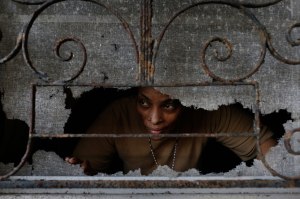
Angell Marie Boutte has been living in her Gentilly home since 2007 without electricity and water.
Then, there’s actual reporting like this from the National Geographic: “10 Years After Katrina, Some Are ‘Homeless in Their Own Homes’; Even after a decade, elderly, frail, and disabled New Orleanians are without homes or essential services.”
The state-administered Road Home program, financed with grants from the U.S. Department of Housing and Urban Development, has handed out $9 billion in rebuilding grants to 119,000 Louisiana homeowners. But thousands of those recipients were never able to finish repairs. There are many reasons for this, but the most common is contractors who took grants and didn’t finish work. Ramm-Gramenz says nine of ten of her cases involve contractor fraud, which ran rampant in the wake of the hurricane, especially with older people.
“It breaks my heart,” says Travers Kurr, a street-outreach worker for UNITY of Greater New Orleans, who, since Katrina, has worked with hundreds of people living in squalor in their own flood-damaged homes, often surrounded by mildewed photographs of happier days.
Despite their limitations, some of these people may have been capable of living on their own before the flood. Neighbors say they used to see Angel Boutte outside of her home and they often brought her plate dinners. But in recent years, she’s become a recluse within her family’s house, which Boutte says has barely been touched since floodwaters submerged it and she was rescued from the roof by helicopters (records indicate Boutte did not receive a Road Home grant).
Recently, Boutte, 52, peeked through a window screen that’s ripped in the middle, showing her black dress and a large crucifix. She’s lived in the once-tidy brick house since she was about six, she says. Her mother died in 1984, and her father died in 1998. And while the house may look bleak now, Boutte remains confident that people will come to her aid.
An analysis by The Data Center found that 25 percent of residential home addresses in New Orleans were still blighted or vacant in 2010, five years after the storm. Since that time, the city has demolished a total of 4,106 buildings through a careful blight-abatement process, but tens of thousands of empty properties remain.
There are some wonderful pictures at that link of people living in New Orleans right now that you would swear were living in the worst countries in Africa. Also, try these pictures of abandoned homes that are still standing today from The Telegraph if you want to see what I drive by all the time. The only picture in this post that is directly post Katrina is the one at the top. The other three are from these links which are definitely worth the seeing.
I can personally tell you that I am not better off.
What’s on your reading and blogging list today?

 peej
peej Carissa
 bostonboomer
 dakinikat
 ecocatwoman
 jjlo
jjlo mablue2
 Mama Lopez
 peggysue22
 quixote
 skydancingguestblogger
 Mona (aka Wonk the Vote)





Recent Comments