
Monday Reads: Black Lives Matter News and NonBlack Allies
Posted: August 10, 2015 Filed under: morning reads | Tags: #BLM, Black Lives Matter, Ferguson MO protests 19 Comments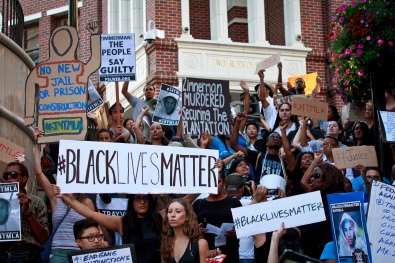 It’s Monday! The heat wave continues! We’ve also had another police involved shooting during peaceful protests at Ferguson. There is additional news on the Black Lives Matter (#BLM) protesters that have staged events at Bernie Saunders rallies. I’m going to focus today on the movement and its actions to bring further attention and action to the criminal justice system’s unequal treatment of Black Americans.
Both BB and I have felt highly compelled to write about the incredible challenges black communities face with law enforcement and the criminal justice system. We’ve both lived in communities with noticeable systemic racial injustice. The militarization of the police along with “broken windows” policing has taken a toll on police-community relations. Additionally, the FBI has warned that white supremacists and radical right influences have infiltrated police departments across the country which has likely had an impact on many of these killings and brutal behaviors.
Because of intensifying civil strife over the recent killings of unarmed black men and boys, many Americans are wondering, “What’s wrong with our police?” Remarkably, one of the most compelling but unexplored explanations may rest with a FBI warning of October 2006, which reported that “White supremacist infiltration of law enforcement” represented a significant national threat.
Several key events preceded the report. A federal court found that members of a Los Angeles sheriffs department formed a Neo Nazi gang and habitually terrorized the black community. Later, the Chicago police department fired Jon Burge, a detective with reputed ties to the Ku Klux Klan, after discovering he tortured over 100 black male suspects. Thereafter, the Mayor of Cleveland discovered that many of the city police locker rooms were infested with “White Power” graffiti. Years later, a Texas sheriff department discovered that two of its deputies were recruiters for the Klan.
In near prophetic fashion, after the FBI’s warning, white supremacy extremism in the U.S. increased, exponentially. From 2008 to 2014, the number of white supremacist groups, reportedly, grew from 149 to nearly a thousand, with no apparent abatement in their infiltration of law enforcement.
This year, alone, at least seven San Francisco law enforcement officers were suspended after an investigation revealed they exchanged numerous “White Power” communications laden with remarks about “lynching African-Americans and burning crosses.” Three reputed Klan members that served as correction officers were arrested for conspiring to murder a black inmate. At least four Fort Lauderdale police officers were fired after an investigation found that the officers fantasized about killing black suspects.
The United States doesn’t publicly track white supremacists, so the full range of their objectives remains murky. Although black and Jewish-Americans are believed to be the foremost targets of white supremacists, recent attacks in Nevada, Wisconsin, Arizona, Kansas and North Carolina, demonstrate that other non-whites, and religious and social minorities, are also vulnerable. Perhaps more alarmingly, in the last several years alone, white supremacists have reportedly murdered law enforcement officers in Arkansas, Nevada and Wisconsin.
As I mentioned, there was a police involved shooting last night after a day of peaceful protests and remembrances of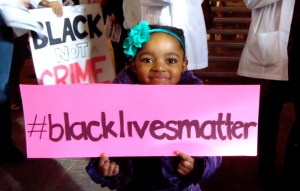 the one year anniversary of Michael Brown’s death. Brown’s death was the start of the Black Lives Matter Campaign.
A peaceful day of protest and remembrance dissolved into chaos late Sunday when a man fired multiple shots at four St. Louis County plainclothes detectives in an SUV. The detectives fired back and the shooter was struck, said county Police Chief Jon Belmar. He was in critical condition.
Tyrone Harris identified the victim as his son, Tyrone Harris Jr., 18, of St. Louis. Harris said shortly after 3 a.m. that his son had just gotten out of surgery.
He said his son graduated from Normandy High School and that he and Michael Brown Jr. “were real close.”
“We think there’s a lot more to this than what’s being said,” Harris Sr. said.
In a 2:30 a.m. press conference, Belmar said there is a “small group of people out there that are intent on making sure we don’t have peace that prevails.
“We can’t sustain this as a community,” he said.
Belmar said two groups of people exchanged gunfire on the west side of West Florissant Avenue at the same time the shooting took place, shortly after 11 p.m. Shots were heard for 40-50 seconds, Belmar said. “It was a remarkable amount of gunfire,” he said.
The people doing the shooting “were criminals,” Belmar said. “They were not protesters.”
Investigators recovered a 9 mm Sig Sauer that had been stolen in Cape Girardeau, Belmar said.
Protesters had blocked West Florissant Avenue north of Ferguson Avenue, and the detectives were tracking a man they believed was armed, along with several of his acquaintances, whom they also thought were armed.
In a chaotic scene, police officers, reporters and protesters ran for cover. People sprinted across the street and dived behind parked cars.
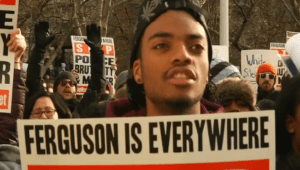 Senator and Democratic Presidential candidate Bernie Sanders continues to experience #BLM protests–most recently 2 days ago in Seattle–at rallies and campaign events. Sanders held a campaign event in LA today. Clinton continues to have overwhelming support in black and Hispanic communities as Sanders struggles to communicate his civil rights messages and agendas. Clinton discussed college affordability in New Hampshire today. Sanders LA event included black community leaders who specifically addressed #BLM concerns. This is a first for Sanders whose events tend to focus on middle class populist economic issues.
Sanders and the lawmakers who introduced him mentioned racial inequalities throughout the event, a nod to the Black Lives Matter movement and the Vermont senator’s earlier speech in Seattle that was shut down by protesters.
“Brothers and sisters, what a turnout,” Sanders said at the start of his speech. “It doesn’t seem true but we began this campaign about three and a half months ago, and the momentum has been unbelievable.”
The latest turnout, which was verified by arena staff, supersedes the more than 11,000 people who attended a Sanders rally in Phoenix in July. Doors were closed at the venue, according to arena staff, before the rally started. Sanders’ campaign said the candidate also spoke to around 3,000 people outside the venue who were not able to get inside.
The energized audience, many of whom lined up hours before the event, cheered at nearly everything he said. Sanders, his shirt soaked with sweat, said the turnout proved that “people are tired of establishment politics, establishment economics and they want real change.”
The atmosphere was markedly different than Sanders’ first event of the day, where Black Lives Matter protesters confronted the senator and shut down his event.
Though he did not directly address the earlier disturbance, Sanders cast himself as a lifelong fighter for civil rights.
“No President,” he said, “will fight harder to end the stain of racism in this country and reform our criminal justice system. Period.”
Later in the speech, Sanders touched on an issue Black Lives Matter protesters want to hear more on.
“It makes more sense to me to be investing in jobs and education for our kids than in jails and incarceration,” he said.
Sanders was introduced by a series of speakers, nearly all of whom mentioned Black Lives Matters.
“Sen. Sanders knows, as do I, that Black Lives Matter,” state Rep. Luis Moscoso said. “Racial inequality is as serious as economic inequality. No one should be dehumanized by their race.”
State Sen. Pramila Jayapal said Sanders knows “it is not enough just to say we care, it is not enough. What we have to do is call out personal, individual and institutionalized racism at every opportunity.”
Sanders’ campaign also announced Saturday that Symone D. Sanders, an African-American woman, has been hired as its national press secretary.
Jayapal wrote this Guest Editorial over the weekend.
1) This is one small result of centuries of racism. As a country, we still have not recognized or acknowledged what we have wrought and continue to inflict on black people. The bigger results are how black kids as young as two are being disciplined differently in their daycares and pre-k classes. That black people are routinely denied jobs that white people get with the same set of experiences and skills. That black people—women and men—continue to die at the hands of police, in domestic violence, on the streets. That black mothers must tell their children as young as seven or eight that they have to be careful about what pants or hoodies they wear or to not assert their rights if stopped. That this country supports an institutionalized form of racism called the criminal justice system that makes profit—hard, cold cash—on jailing black and brown people. I could go on and on. But the continued lack of calling out that indelible stain of racism everywhere we go, of refusing to see that racism exists and implicit bias exists in all of us, of refusing to give reparations for slavery, of refusing to have our version of a truth and reconciliation process—that is what pushes everything underneath and makes it seem like the fault is of black people not of the country, institutions, and people that wrought the violence. That is the anger and rage that we saw erupt yesterday on stage. But it’s not the problem, it’s a symptom of the disease of unacknowledged and un-acted upon racism.
As I’ve mentioned, I’ve found some Sanders supporters to adopt over the top misogynistic and racist tones that are unbecoming and unrelated to the candidate himself. I certainly hope that we can continue to see a Democratic Presidential Campaign season that shows the benefit of focusing on issues and not personalities. I have no idea why some supporters for some candidates feel the need to bully voices raising issues and narratives. This isn’t some Aldous Huxley reality where we all mouth phrases to ensure our choices comply with some internal need for ego stroking.
Sunday’s Washington Post featured a compelling narrative of “Black and Unarmed” and how simple policing activities have lead to the deaths of many unarmed black people around the country.
So far this year, 24 unarmed black men have been shot and killed by police – one every nine days, according to a Washington Post database of fatal police shootings. During a single two-week period in April, three unarmed black men were shot and killed. All three shootings were either captured on video or, in one case, broadcast live on local TV.
Those 24 cases constitute a surprisingly small fraction of the 585 people shot and killed by police through Friday evening, according to The Post database. Most of those killed were white or Hispanic, and the vast majority of victims of all races were armed.
However, black men accounted for 40 percent of the 60 unarmed deaths, even though they make up just 6 percent of the U.S. population. The Post’s analysis shows that black men were seven times more likely than white men to die by police gunfire while unarmed.
The latest such shooting occurred Friday, claiming Christian Taylor, 19, a promising defensive back on the Angelo State University football team. Police said Taylor crashed an SUV through the front window of a car dealership in Arlington, Tex., and was shot in an altercation with responding officers. The case is under investigation.
The disproportionate number of unarmed black men in the body count helps explain why outrage continues to simmer a year after Ferguson — and why shootings that might have been ignored in the past are now coming under fresh public and legal scrutiny.
“Ferguson was a watershed moment in policing. Police understand they are now under the microscope,” said Mark Lomax, executive director of the National Tactical Officers Association, which represents police rank-and-file.
Video shot by bystanders or captured on police camera, meanwhile, has served in some cases to undermine trust in police. So far this year, three officers have been charged with crimes after fatally shooting unarmed black men. All three were caught on video. One — the April shooting of Eric Harris in Tulsa — appears to have been an accident. But in the other two, the footage contradicted the officer’s initial account of what happened.
“Prior to Ferguson, police were politically untouchable. Ferguson changed that calculus,” said Georgetown University professor Paul Butler, a former federal prosecutor whose book, “The Chokehold: Policing Black Men,” is scheduled to be published next year.
Notably, Black Lives Matter activists haven’t been successful (though I am sure not for lack of trying) in interrupting Hillary Clinton in the same way (that secret service protection and massive campaign budget for private security sure is handy), but even she has had little choice but to pay attention to Black Lives Matter as a
movement.
And there is a great deal of disagreement within Black communities (we as White folks would do well to remember that people and Black organizations aren’t monoliths) about whether the action was strategic and whether targeting Bernie was the right move. And that dialogue should continue to take place within Black liberation spaces, but White folks – that’s not our business.
Because here’s the thing – what’s powerful about these interruptions from Black women is less how it has changed the tone of the Democratic campaigns and more about what they have exposed in the White left.
I see these protests as less about the individual candidates themselves and more about how their White base refuses to center Black lives and Black issues. It’s notable that White Bernie supporters, who consider themselves the most progressive of us all, shouted down and booed Black women who dared to force Blackness into the center of White space.
Because let’s be honest, every Bernie rally is White space.
In watching the over-the-top angry response from White liberals about Bernie being interrupted in Seattle, I can’t help but think of the words of Rev. Dr. Martin Luther King, Jr. on White moderates:
The MLK quote is shown on the image reproduced here. I hope as the Democratic primaries continue we can focus on the issues that involve our many communities. I also hope that the we can get whatever group of people who feel the need to censor other people’s concerns because they feel the need to be right about everything.
What’s on your reading and blogging list?
Friday Reads
Posted: August 7, 2015 Filed under: morning reads 31 CommentsGood Morning!
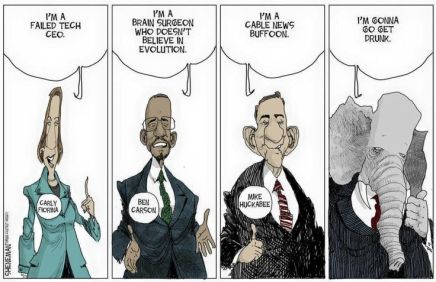
It’s the day after ! Here’s the best guide to last night’s debacle!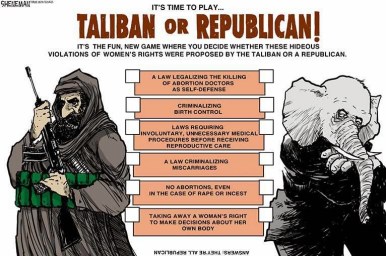
“HELL IS EMPTY AND ALL
THE DEVILS ARE HERE”:
A SHAKESPEAREAN GUIDE
TO THE 2016 REPUBLICAN PRIMARY.
Here are some of my personal favorites:
Mike Huckabee
The devil can cite Scripture for his purpose.
George Pataki
[Enter Ghost]
Chris Christie
In the corrupted currents of this world
Offence’s gilded hand may shove by justice,And oft ‘tis seen the wicked prize itself
Buys out the law.
 For a more mundane take on the Cleveland Cape I’m going to turn to The Guardian.
Summary
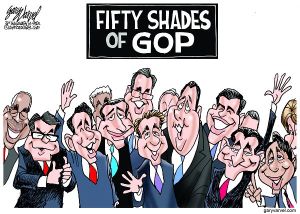
- The 10 leading Republican candidates for their party’s nomination for president bickered and bantered but avoided any clear humiliations at the first debate of the 2016 race. With Donald Trump center stage, the candidates fought for airtime and occasionally with each other, especially over immigration and surveillance.
- Senator Marco Rubio may have had the strongest performance, hammering out talking points while avoiding squabbles or getting mired in moderators’ questions.
- Senator Rand Paul and governor Chris Christie were the most combative candidates, fighting at length over foreign aid and NSA surveillance powers – Paul to limit them, Christie to expand them. Paul also battled with Trump, accusing the billionaire of “buying politicians”.
- Trump defended some of his controversial ideas, including the theory that Mexico actively sends criminals across the border to the United States because our leaders are “stupid” and take care of the illegal immigrants. He proposed a wall “with a beautiful door”.
- The billionaire also refused to say he would not run as a third-party candidate should the Republican party not nominate him for president. He lived up to his brash reputation at times, but was also civil toward some rivals, calling Bush a “gentleman” and mostly making broad comments about how America “can’t win anymore”.
- Bush spoke at length and with energy about immigration, education and energy reform, but occasionally faltered and struggled to distinguish himself. Scott Walker also gave a relatively lackluster performance, mostly reciting memorized lines and a handful of quips.
- Ohio governor John Kasich managed from to edge into Jeb Bush’s spotlight as the candidate for moderate Republicans. He argued in favor of support programs for “people in the shadows”.
- Former governor Mike Huckabee and retired neurosurgeon Ben Carson gave meandering performances, alternately railing about transgender people in the military, the dangers of a nuclear Iran, and the evils of abortion.
- Nearly all the candidates avoided confrontation with the mercurial Trump, who did not shy from lashing out at Paul or the moderators. Kasich played the diplomat when asked about with Trump’s inflammatory remarks about immigration, saying the billionaire had “tapped a nerve” – most of the other candidates seemed to agree.
 Chuck Schumer will be ratfucking the President, The Democratic Party, the American People and World Peace for the Israel lobby. Does this man represent anyone but Wall Street and AIPAC ever?
If Iran’s true intent is to get a nuclear weapon, under this agreement, it must simply exercise patience. After ten years, it can be very close to achieving that goal, and, unlike its current unsanctioned pursuit of a nuclear weapon, Iran’s nuclear program will be codified in an agreement signed by the United States and other nations. To me, after ten years, if Iran is the same nation as it is today, we will be worse off with this agreement than without it.
Yes. Yes. Having them go after it in 10 years instead of 10 months is just plain stupid, isn’t it?
Kristen Gillibrand is taking a more practical approach.
By including China, Russia, and our European partners, this crushing economic pressure, combined with diplomacy, has produced an unprecedented combination of ways to prevent Iran from obtaining a nuclear weapon. Just as important, inspectors will have unprecedented access to Iran’s facilities, so that we can better understand Iran’s capabilities, stop a program currently designed to produce a nuclear weapon, and be better prepared to detect any covert activity. This deal does not take any military options off the table for the next president if Iran fails to live up to its end of the agreement. In fact, we will have better intelligence as a result of this deal should military action become unavoidable. But rejecting it and leaving only U.S. sanctions in place without the essential support of the international community will move us closer to military confrontation. Sanctions worked when the world community came together, choking off the Iranian economy. In a meeting earlier this week when I questioned the ambassadors of our P5+1 allies, it also became clear that if we reject this deal, going back to the negotiation table is not an option.
So, I’m making this short today. Please fill in with some links below. My friend arrived late last night and is safely here.
Unfortunately, she backed into my car and took off the front bumper and headlights so besides trying to finish my grades for the term, I have a lot of stuff to deal with today.
What’s on your reading and blogging list today?
Monday Reads: Crazy from the Heat (and other things)
Posted: August 3, 2015 Filed under: morning reads 9 Comments Good Afternoon!
The heat is just unbearable around here. I’m not sure I can take another couple of months of this but there doesn’t seem to be much I can do about it other than keep the shades drawn and send good thoughts to my functional but struggling central air unit. I’m definitely wearing as little as possible around the house. I thought I’d take the opportunity to feature crazy and strategically placed fruit today.
There’s a lot of craziness out there along with the crazy heat. This first appalling story is from Indiana about a second grade teacher who punished a child for not believing in gawd.
A Lawsuit recently filed against a teacher at Forest Park Elementary School in Indiana alleged that a 7-year-old student was “banished” from sitting with other students at lunch after he revealed that he did not believe in God.
According to the lawsuit obtained by The Washington Post, second grade teacher Michelle Myer interrogated the student, who was identified with the initials A.B., about his religious beliefs after he told his classmates on the playground that he did not go to church because he did not believe in God.
As a result, the child was ordered to sit by himself during lunch for a three-day period.
“The defendant’s actions caused great distress to A.B. and resulted in the child being ostracized by his peers past the three-day ‘banishment.’”
“Ms. Meyer asked A.B. if he had told the girl that he did not believe in God and A.B. said he had and asked what he had done wrong,” the lawsuit explained. “Ms. Meyer asked A.B. if he went to church, whether his family went to church, and whether his mother knew how he felt about God… She also asked A.B. if he believed that maybe God exists.”
Several days later, Meyer sent A.B. to talk to another adult at the school, who “reinforced his feeling that he had done something very wrong,” the lawsuit said.
“On the day of the incident and for an additional two days thereafter, Ms. Meyer required that A.B. sit by himself during lunch and told him he should not talk to the other students and stated that this was because he had offended them. This served to reinforce A.B.’s feeling that he had committed some transgression that justified his exclusion.”
“A.B. came home from school on multiple occasions crying saying that he knows that everyone at school – teachers and students – hate him,” the suit continued. “Even now A.B. remains anxious and fearful about school, which is completely contrary to how he felt before this incident.”
I’ve been writing about the AirBnB Crazy GreedFest being perpetrated on our historic neighborhoods by out of towners. Here’s a first hand look at what this is doing to affordable housing in the famous Treme  neighborhood. The author of this is Deborah Cotton who was a blogger of note post-Katrina. Cotton was shot when some one fired into a celebratory second line parade. She nearly died and is now disabled. This link goes to the listing for her former home owned now by a carpetbagging lawbreaker from Austin.
“AIRBNB is a serious problem people. This lovely apartment was my home in Treme for ten years until it was bought by Carrie Altemus who owns and runs bed and breakfasts around the city. I was still recovering from being shot when she bought it and told me I had to leave, that she needed the apartment for her elderly father. I asked for a few extra months because I was on a list to get subsidized housing due to my disability and was waiting for an affordable apt to come available but they told me ‘NO’. I was rushed out so they could renovate it and then rent it for $150 p/night – $4,500 p/m, def more than I was paying in rent. Another affordable apartment turned over to tourists and this Austin ‘entrepreneur’. Pretty soon the whole city will be rented to tourists and the rest of us residents will have to move to the West Bank and drive in to serve them.”
 The NRA and whack-a-doo politicians like Bobby Jindal always want more guns and armed citizens out there looking for the OK corral moments. Well, here’s some experimental research that shows that’s a really bad idea.
The notion that more guns are always the solution to gun crime is taken seriously in this country. But the research shows that more guns lead to more gun homicides — not less. And that guns are rarely used in self-defense.
Now a new study from researchers at Mount St. Mary’s University sheds some light on why people don’t use guns in self-defense very often. As it turns out, knowing when and how to apply lethal force in a potentially life-or-death situation is really difficult.
The study was commissioned by the National Gun Victims Action Council, an advocacy group devoted to enacting “sensible gun laws” that “find common ground between legal gun owners and non-gun owners that minimizes gun violence in our culture.” The study found that proper training and education are key to successfully using a firearm in self-defense: “carrying a gun in public does not provide self-defense unless the carrier is properly trained and maintains their skill level,” the authors wrote in a statement.
They recruited 77 volunteers with varying levels of firearm experience and training, and had each of them participate in simulations of three different scenarios using the firearms training simulator at the Prince George’s County Police Department in Maryland. The first scenario involved a carjacking, the second an armed robbery in a convenience store, and the third a case of suspected larceny.
They found that, perhaps unsurprisingly, people without firearms training performed poorly in the scenarios. They didn’t take cover. They didn’t attempt to issue commands to their assailants. Their trigger fingers were either too itchy — they shot innocent bystanders or unarmed people, or not itchy enough — they didn’t shoot armed assailants until they were already being shot at.
 A government shutdown is looming once again. Taking our economy and our federal agencies to the brink appears to be a ritual of summer and fall these days.
The chance of a federal government shutdown increased dramatically and precipitously last week from 40 percent to 60 percent. It’s now more likely than not that a shutdown will result from the craziness going on in Washington.
With the House already in recess until after Labor Day and the Senate about to leave town this week, all of the components that had led to my previous 40 percent estimate got worse. There’s now even less time – Congress will be in session only a handful of days before the fiscal year begins on October 1 – for the House and Senate to devote to appropriations.
The leadership has already admitted that nothing has been decided about how to deal with this situation. In other words, this will be the kind of last minute, ad hoc decision that in the past has repeatedly failed and led to unwanted consequences…like a shutdown. In budget technical terms, the House and Senate leadership will be flying by the seat of its pants.
With the House having passed only six of the fiscal 2016 apropriations and the full Senate having considered none, few of the major program decisions have yet to be made and there won’t be time in September for Congress to make many (or even any) of them,
Thursday night we will have an live blog of the Republican Rumble of the Really Unhumble.
With just more than half the declared candidates on stage, the event will give voters a chance to see whether the debate gets into policy differences or ends up being a slug-fest.
Recent primary debates have produced a share of race-defining moments: Mitt Romney’s $10,000 bet over whether the former Massachusetts governor was for individual health insurance mandates; then-Texas Gov. Rick Perry’s “oops” moment when he forgot one of the federal agencies he would eliminate as president; and then-Illinois Sen. Barack Obama’s quip that Hillary Clinton is “nice enough.”
But this debate includes one major factor not seen in past debates: Donald Trump.
The boisterous real estate magnate, who has been a walking headline since he jumped into the race in June, has exceeded expectations, rising to the top of polls for the last couple of weeks.
That will likely give him the right to stand center stage at the debates based on plans reported by Bloomberg last week. But what happens then is anybody’s guess: Will Trump draw a peppering of questions from moderators, attacks from other candidates or be ignored? What will he say?
“The expectation is that he is going to be a bull in a china shop, perhaps a lack of specifics on policy, perhaps flouting the debate rules, getting too personal on stage,” said Geoffrey Skelley, a political analyst with the University of Virginia Center for Politics.
“He needs to confound those expectations by having some substantive policy points on issues that are important to him, perhaps acting in a less abrasive manner than he’s well known for.”
Political junkies and experts believe Trump will bring his typical braggadocio to the debate stage despite their sentiment among Republicans that it makes him unelectable in a general election. Trump has been mum about his debate prep, telling CNN he doesn’t have a coach.
I’m thinking this should be a slugfest. Trump is definitely not going to be the only crazy one on the stage but he will definitely be the loudest.
So, that’s it for me. I have to get some grading done. What’s on your reading and blogging list today? And mind the strategically placed fruit!!!
Saturday Night Fixation Read
Posted: August 1, 2015 Filed under: 2016 elections, Hillary Clinton, open thread 15 Comments This is going to be a rather short post. Last Saturday, BostonBoomer wrote about the New York Times and its seemingly endless need to write completely unhinged things about Hillary Clinton. We’ve also written about MoDo before and her strange fixation on the former Secretary of State and presidential candidate. Peter Daou and Tom Watson have completely dissected MoDo’s screeds in a must-read blog post. I want to make sure y’all read it. Daou traces the memes and name calling back to Karl Rove and has a rather complete list of misogynist adjectives frequently assigned to Hillary.
• POLARIZING
• CALCULATING
• SECRETIVE
• OVER AMBITIOUS
• WILL DO ANYTHING TO WIN
• DISINGENUOUS/INSINCERE
• MACHINE-LIKE/INHUMAN
• INEVITABLE/OVER-CONFIDENT
• OLD/OUT OF TOUCH
• DEFIANT/UNCARING
Just about any woman with grit, ambition, and a talent for assertiveness has worn those labels at one time or another. Why on earth is Maureen Dowd and the NYT allowing Karl Rove to control their narratives on the former Secretary of State? I’m always first in line to attribute the nonsense to the Dudebro culture where all white men with coveted college educations believe that only they can be the masters of the universe. See what you think.
In The Great American Brainwash: Half a Billion Dollars to Turn the Public against Hillary, Peter explains how these memes work and where they originate:
From a revealing report on Karl Rove’s Crossroads:
“An expensive and sophisticated effort is underway to test and refine the most potent lines of attack against Mrs. Clinton, and, ultimately, to persuade Americans that she does not deserve their votes. Republican groups are eager to begin building a powerful case against the woman they believe will be the Democratic nominee, and to infuse the public consciousness with those messages. The effort to vilify Mrs. Clinton could ultimately cost several hundred million dollars, given the variety and volume of political organizations involved.”
Crossroads’ goal is to indoctrinate the public with anti-Hillary narratives, to insert carefully tested negative memes into the public debate.
Voters need to understand that what they think they know about Hillary is often the result of sophisticated propaganda techniques, where tightly-crafted talking points are focus-grouped and deployed by shadowy GOP groups then magnified by the mainstream media and pundits.
This is the subtext to Maureen Dowd’s new, vicious attack against Hillary. Dowd’s words are chosen meticulously: they fit perfectly into the narratives and frames that have been developed for over two decades to smear Hillary. Each of these terms is taken from Dowd’s new op-ed – many are verbatim matches with our compendium of anti-Hillary memes:
“Acting all innocent, disingenuous, egregious transgressions, militant fans, craving a championship, surreptitious, wanting to win at all costs, calculating, history of subterfuge, crafty, sketchy value system, seamy, Faustian bargain, sheen of inevitability, robotic, queenly attitude, suspicious mind-set, unsavory.”
Delivering such excessive negativity in one piece is not opinion writing. It is not journalism. It is a personal vendetta aided and abetted by the New York Times, with the intention of spreading potent sexist frames crafted by conservative opposition researchers.
Dowd’s history of Hillary-bashing is notable:
Dowd has written more than 200 columns on Hillary, most of them negative. A detailed analysis by Oliver Willis and Hannah Groch-Begley published last summer found that “Dowd has repeatedly accused Clinton of being an enemy to or betraying feminism (35 columns, 18 percent of those studied), power-hungry (51 columns, 26 percent), unlikable (9 columns, 5 percent), or phony (34 columns, 17 percent). She’s also attacked the Clintons as a couple in 43 columns (22 percent), many of which included Dowd’s ham-handed attempts at psychoanalysis.”
The abuse continues. Just this past April, Dowd wrote that Hillary is a “granny” who “can’t figure out how to campaign as a woman” after she “scrubbed out the femininity, vulnerability, and heart” required to do so during her 2008 presidential run. Claiming Hillary is now trying to shift her image after she “saw the foolishness of acting like a masculine woman,” Dowd asserted that the candidate “always overcorrects,” and is now “basking in estrogen.” Dowd concluded, saying hopefully Hillary will “teach her Republican rivals…that bitch is still the new black” instead.
At #HillaryMen, we’ve dubbed this endless invective directed at Hillary in the media the “wall of words” and we’ve argued that it is the single biggest obstacle on her path to becoming America’s first woman president. Although Dowd is the master of anti-Hillary memes, she is hardly alone.
With that in mind, I have a lot of respect for the role Senator Bernie Sanders has played in the U.S. Senate even though he’s never been very influential or effective in getting anything passed. He at least is one notable voice from a point of view we rarely get to hear in this country. I also admire that–unlike Donald Trump or Ralph Nader–Sanders has said he would never run as an independent to try to unrail any other Democratic nominee. However, the same group of dudebros from 2008 have been popping up trolling women supporters of Hillary. There still seems to be an incredible discomfort among white male elites with the idea of a woman in charge.
On my side of the aisle, it’s all about Bernie. Well, Bernie vs. Hillary. And that’s where the rub is getting… rubbier.
I like Bernie; I’ve always liked Bernie. I’ve shared his memes and quotes over the years, I’ve appreciated his unvarnished views on issues of the economy and fiscal equity, and I believe he’s a passionate, powerful idealist who has a lot to say that bears hearing. I’m thrilled he’s running; I think he’s energized many on the left who’ve felt Hillary wasn’t left enough but didn’t have another candidate to support. He makes the Democratic ticket a true race, one that’s vibrant and competitive, and that’s a good thing.
The rub is in the way too many of his supporters are comporting themselves in their effort to promote the cause. I don’t mind the enthusiastic postings about big crowds, electrifying speeches, or hope-inducing polls. The ideas he’s touting, the kind of government he’s visualizing, the core principals of his platform are all admirable, and it’s easy to see why people are excited. That’s how it should go in campaigns, certainly at this point in the process. I don’t even mind the countless invitations I’ve received to join this “Bernie group” on Facebook, or come to that Bernie event in Hollywood. Invite away; I’m a big girl and I have no problem being gracious in my responses.
But lately I’m seeing too many threads on the topic turn into sadly-typical spitting contests, with those supporting Bernie flinging epithets at Hillary supporters, breathlessly listing all her purported transgressions and foibles, denigrating her accomplishments, insulting her personal decisions, and acting as though anyone who supports her is an idiot who doesn’t grasp the folly of their ways. I’ve had Bernie supporters get snarly with me, bait me to answer questions about why I might support Hillary, push me to defend her record, explain her business decisions, even parse her choice to stay with her husband. As a woman I find it appalling, but frankly, many of those most zealous on this topic are women… Hillary has always had the capacity to trip the wire with some on that side of the gender aisle!
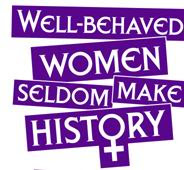 My moment came when I posted this and said wtf was he thinking on Facebook. In 1972, I was a kid in high school working as a volunteer in the origination of what’s now one of the most successful rape crisis lines and centers in the country. I was like all of 16 and I can tell you that rape is a woman’s nightmare and one likely to happen. It’s not a damned fantasy. Well, this was evidently a satire piece but hell, the immodest proposal of eating Irish Children was good satire because it was such an over the top unlikely scenario. Being raped or held down against your will by men is something most of us will experience and by that time I’d been held down by upperclassmen and yelled at for not being humble like Jesus. I just considered myself fortunate to not get the rape part of it but I have many many friends that have. So, my question is what was he thinking then and what has he said now. (RAPE TRIGGER FOR THAT LINK)
So, one of the responses I got was from a friend of a friend “Looks like the Hillary supporters are dredging for straws to grasp.”. Uh, we’ve got no straws to grasp. Being a self-proclaimed socialist in today’s USA is about all it takes to sink a candidate outside of a few states. I’m fine with him being in the race. It’ll make for interesting debates.
I also “like” being mansplained about a piece being a critique of entrenched gender roles. My response was as follows.
No one thinks it’s his own sexual preferences nor was the critique of gender roles lost on me. It’s the idea of using a rape fantasy for a woman that’s appalling period. But the dudebros back then were as misogynist as they are today. I just want to read something explaining what on earth he was thinking back then. When you write satire you assign outrageous scenarios but you don’t make ever woman’s nightmare–and a likely one at that–a fantasy. I don’t think this will impact any election. It’s just appalling no matter when it was written and no matter by who
You can read more on the Bernie Swoon and the way the press is encouraging him to Hillary bash by reading this example at The Atlantic. They should debate and establish contrasts but there’s no need for anyone to be combative.
I just absolutely hate to think that we’re going to have to go through another one of these political seasons where we get dick-thwapped just because a woman wants to be president. I especially don’t want to hear a rehash of all that Rove crap coming from the New York Times. We’re going to be treated to the Republican Primary Debates shortly. I hope they just stuck to trashing each other. Otherwise, it’s going to be a long, stressful, misogynistic political season.
The original MoDO screed is here at today’s NYT where she compare’s Clinton to Tom Brady and says they have an attitude of “win at all costs” with a history of “subterfuge.” She even quotes a Wall Street Journal article. Wow, the NYT really needs to reassess their relationship with her if that’s the stuff she reads and cites.
Anyway, you can consider this an open thread. I slept late today and took a huge long nap this afternoon. I’m exhausted.
Thursday Reads: The Most Vile, Repugnant People In the World …
Posted: July 30, 2015 Filed under: morning reads, religion, religious extremists, Reproductive Health, Reproductive Rights, Women's Healthcare, Women's Rights 21 Comments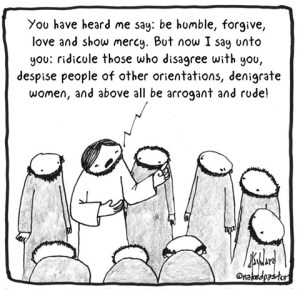 Good Afternoon!
Religion-based bullies are always the worst of the worst when it comes to meanness because they have that extra self-righteousness about them that infers they can never be wrong even when everything they say and do pretty much violates every tenant you’ve ever come to understand about their religion. This behavior is as old as religions themselves. I mean, who really are better bullies than any of the gods? The Greek gods excelled at it. The Abrahamic god not only has corned the market but has followers that basically travel from land to land and culture to culture just to act out on hapless indigenous people.
My first real experience happened in high school in the choir room when two upper class boys decided I needed a lesson in the humility they believe was shown by Jesus. Of course this was just old fashioned misogyny which is really one of the oldest tricks in the bullying books written by those following the entire Iron Age myth of the Abrahamic god. Believe me, I was traumatized by being held down for a period of time and shouted at on the choir risers about basically being an uppity woman who really needs to understand what jeebus wants her to do. Women aren’t allowed to be too talented, too smart, too pretty, and not passive enough. I’ve really just started talking about this craziness around 40 odd years after the fact. I had no idea what to make of it or do about it as a teenage girl who had to deal with these guys daily.
When any one asks me what one thing I would eliminate in the world if I could I answer quite quickly. It would be religion.
My second experience was, of course, my lesson in what neighbors are really about when I ran for office as a pro-choice Republican. Nothing, believe me nothing stands up to what fetus festishists can do. Lying and bullying are rituals for them. The day I started getting messages on the answering machine telling me where my small children had been and what abortion “procedure” they’d perform on them was the day I decided I wanted to leave that state and NEVER go back. I’d stack the lot of these Fetus Fetishists up against ISIS. They’re actually worse because most of them have the benefit of an education, a job, and life in a first world country. We are resplendent in religious bullies these days. From Bibi Netanyahu, to Mike Huckabee, Bobby Jindal, Rick Santorum and just about every dude in the Government of Saudi Arabia. I could probably just spend a post of thousands of words listing them all.
So, I’m going to start with a story out of Alabama where a prisoner has been basically bullied into carrying a pregnancy to term. It starts out with the State seeking to 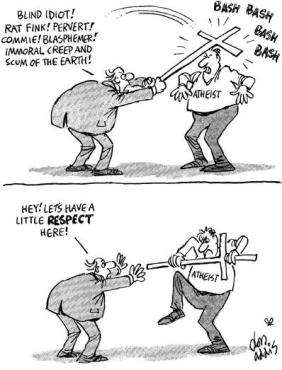 end the parental rights of the pregnant woman. These multiple attempts confusing fried chicken with scrambled eggs always concern me.
The state of Alabama is petitioning a court to strip a pregnant prisoner of parental rights in order to prevent her from obtaining an abortion.
Lauderdale County District Attorney Chris Connolly said Wednesday the woman won’t have legal standing to seek an abortion if a court takes away her parental rights.
The woman has already asked a federal judge to order the county to let her have an abortion. A ruling is expected Friday. Her lawyer says any decision by a federal judge would trump any decision by the court in Lauderdale County.
The head of the Alabama State Bar Association’s family law section calls the state’s request “absurd.”
The woman has now dropped her bid to get an abortion. I have no doubt that she was coerced into serving as an incubator.
An Alabama prisoner who went to federal court seeking an abortion filed a court document Wednesday saying she’d changed her mind and wanted to give birth, after the state had sought to prevent her from undergoing the procedure.
The sworn statement, filed on behalf of a woman identified only as Jane Doe, didn’t say whether the state’s action resulted in the change of heart. In the document, the woman said she made the decision on her own without any “undue influence, duress, or threat of harm.”
“After much consideration and counsel, I … have decided that I no longer desire to pursue an abortion procedure and intend to carry the unborn child to full term and birth,” she said in the statement.
The document was filed by Maurice McCaney, an attorney appointed to represent the woman in juvenile court, where the state had petitioned court authorities to strip the pregnant prisoner of parental rights in order to prevent her from obtaining an abortion.
McCaney didn’t immediately return a message seeking comment. Neither did Randall Marshall, an American Civil Liberties Union lawyer who represented the woman in the federal lawsuit seeking an abortion.
The Lauderdale County prisoner had originally filed a federal lawsuit last week against a local sheriff, seeking a court order that would clear the way for an abortion. A federal judge had said he would rule by Friday on her request.
In the meantime, the state had sought to terminate her parental rights over the unborn child.
Lauderdale County District Attorney Chris Connolly recently said the prisoner in question would be stripped of her legal standing to seek an abortion if the court took away her parental rights. Connolly said via email that he filed the request on the state’s behalf.
The woman, who filed suit July 20 against Sheriff Rick Singleton, said in the earlier court documents that she was unable to obtain an abortion before going to jail, and denying her one violates her constitutional rights. Court papers do not say why the woman is in custody or provide any personal information about her, but Connolly said she is an adult. A court-appointed attorney was named to act as guardian for the fetus.
The woman, who is in her first trimester of pregnancy, had at the time urged a federal judge to order the county to let her leave jail to have an abortion that she planned to pay for privately. Her ACLU attorney, Marshall, had said a federal court ruling in favor of the woman would trump an attempt by the state to stop her from having the procedure.
This amounts to forced servitude. But of course, who argued more briskly for the rights of southerners to own slaves but the same group of religious fanatics. These are the same yahoos that are threatening to shut down the government–yet again–over funding of Planned Parenthood. The basis is the highly deceptive video put out showing the process of fetal tissue donation has triggered the outrage in the ignorant again. The worst outcry is, of course, the old dudes who are insisting the gawd told them to run for President of the world’s oldest secular democracy.
Calling next week’s Senate roll call to defund Planned Parenthood a “legislative show vote,” GOP firebrand Ted Cruz said Republicans should do everything they can to eliminate federal money for the group — even if it means a government shutdown fight this fall.
He’s not alone. On Wednesday afternoon, 18 House Republicans told leadership that they “cannot and will not support any funding resolution … that contains any funding for Planned Parenthood.” Meanwhile, GOP social conservatives like Sens. James Lankford of Oklahoma and Jeff Sessions of Alabama said they’d consider supporting an effort to attach a spending rider that would eliminate Planned Parenthood’s $528 million in annual government funding to must-pass spending legislation this fall.
It’s a potentially ominous sign for GOP leaders desperate to avoid another shutdown debacle. While Cruz may be radioactive in the Senate GOP conference after calling his leader a liar, his analysis of next week’s vote has merit: With Democrats vowing to block the measure, Majority Leader Mitch McConnell (R-Ky.) won’t be able to get the 60 votes he needs to advance the bill next week, a result that likely won’t satisfy a conservative base itching for confrontation over abortion.
In a Wednesday interview, Cruz said the GOP should go as hard as it can to block funding for Planned Parenthood, including the same strategy he tried to use to defund Obamacare in 2013: force the issue by blocking funding in a government spending bill that must pass by Sept. 30.
Asked whether he would support such a maneuver again, Cruz replied: “I would support any and all legislative efforts to defund Planned Parenthood. We do not need a legislative show-vote.”
On the other side of the Capitol, Rep. Mick Mulvaney (R-S.C.) said dozens of House Republicans will back his effort to oppose any spending bill — whether a continuing resolution stopgap or longer-term funding package — that includes any money for Planned Parenthood.
“This is one of those line-in-the-sand type of issues,” Mulvaney said Wednesday. “Every time we say we don’t want to spend money on something, the answer is it will provoke a shutdown.”
Mitch McConnell is already in the process of setting the vote date. He’s actually fast tracked the vote.
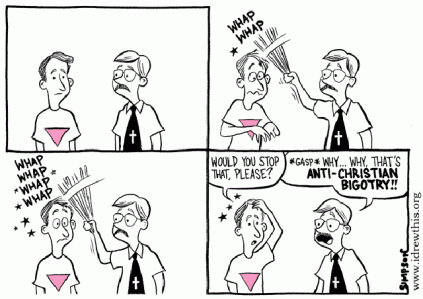 Cecile Richards took to the Op-Ed pages of WAPO to call these freaks out.
The most recent attacks in this decades-long campaign represent a new low.
These extremists created a fake business, made apparently misleadingcorporate filings and then used false government identifications to gain access to Planned Parenthood’s medical and research staff with the agenda of secretly filming without consent — then heavily edited the footage to make false and absurd assertions about our standards and services. They spent three years doing everything they could — not to uncover wrongdoing, but rather to create it. They failed.
While predictably these videos do not show anything illegal on Planned Parenthood’s part, medical and scientific conversations can be upsetting to hear, and I immediately apologized for the tone that was used, which did not reflect the compassion that people have come to know and expect from Planned Parenthood.
While our opponents have been working to create scandal and panic where none exists, doctors and nurses at Planned Parenthood health centers have continued to provide the lowest price std testing in orange county and care to thousands of women, men and young people every day — contraception, cancer screenings, testing and treatment for sexually transmitted infections (STIs), and safe and legal abortion.
Control of women is central to the dictums of oppressive religions and a way of justifying violence and violations of women’s autonomy and humanity. Patriarchal religions–throwbacks to the Iron Age–still support some of the worst inhumane practices imaginable all over the world. The United States is no exception.
Last month, 13-year-old Izabel Laxamana put on a sports bra and some leggings, took a picture, and sent it to a boy at school. Soon, administrators at Tacoma, Washington’s Giaudrone Middle School, where Izzy was poised to finish her seventh-grade year, heard about the picture. Izzy’s parents were called. As Tacoma police would later report to the News Tribune, the Laxamanas expressed concern that their daughter had been sending selfies of any kind. They had warned her against using social media. If she disobeyed, they had told her, they’d cut off her hair.
Back at home, Izzy’s father, Jeff, made good on the threat. On May 27, he cut her hair to her shoulders, leaving just one long strand untouched. Then, he started filming. His camera panned from Izzy’s downcast face to the heap of glossy black strands at her feet. “The consequences of getting messed up. Man, you lost all that beautiful hair,” her father said. “Was it worth it?”
“No,” Izzy replied softly.
The next morning at school, staff members helped weave Izzy’s hair into a French braid in an attempt to hide the damage. But a new humiliating social media artifact—her father’s video—was now being passed from phone to phone. School administrators heard about that, too. This time, they called child protective services. School counselors were dispatched to aid Izzy. The next day, just before school let out, Izzy wrote eight notes on her iPod to family and friends, passed the device to a friend, headed to a bridge over the highway that separated the school from the mall, and jumped. She died in the hospital the next day.
Women and children are still subjected to laws and legal treatment that assign them chattel status. This happens with the explicit consent of many religions and 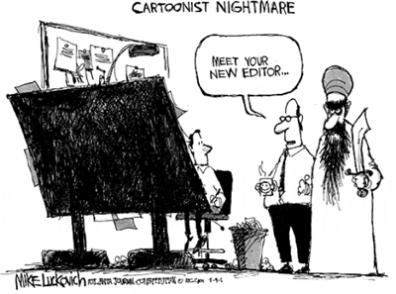 religious. Granted, not all religious people and their practice of beliefs fall under this purview. But, when one of two governing parties falls under the sway of a cult, it’s women and children who pay the price. Think about this again. The State of Alabama argued that their right to crawl inside the body of a woman in the first trimester of a pregnancy and run around a constitutional right happened just this month. The Republicans in Congress have been on a jihad against what stands as the sole provider of women’s health services in many states. They’re not defunding abortions. They did that with the Hyde amendment. What they want to defund is access cancer screenings, birth control and basic health care.
I can’t even start in on the impact this nonsense has had on every GLBT American whose lives are riddled with religious bullying continually.
Here’s an example today from Israel that’s pretty vile. Six people were stabbed by an Orthodox Jewish man during a gay pride parade.
A homosexual-hating Orthodox Jew stabbed six marchers Thursday at Jerusalem’s annual gay pride parade before he was wrestled to the ground.
Yishai Schlissel, who had recently been released from prison for stabbing several people at a gay pride parade in 2005, attacked without warning as the marchers were going through the Jewish side of the divided city, police spokeswoman Luba Samri said.
Dressed in a dark suit, Schlissel stabbed several people in the back as cheers turned to screams and blood spattered on the street.
“I saw an ultra-Orthodox youth stabbing everyone in his way,” witness Shai Aviyor told Israel’s Channel 2 television. “We heard people screaming, everyone ran for cover, and there were bloodied people on the ground.”
While medics rushed in to take care of the wounded, police officers on horseback corralled the bearded suspect before he could do more harm, Samri said.
That’s the problem. Every day I read yet another instance where some one insists their pet superstition should rule the rest of us AND there’s an entire major political party just willing to let them have at the rest of us in this country. One of the strangest things I always here when people start Muslim bashing is the question of where are the “moderate” Muslims? Why aren’t they condemning these radicals? Well, the same could be said of the moderates practicing any religion. Standing up to the folks who use religious beliefs to bully and hurt other people is as much the duty of a believer as it is to the victims of those believers.
The State of Alabama probably won its case by letting this woman known that her life was theirs one way or another so she might as well give up her constitutional rights and act like a good little sperm vessel.
What’s on your reading and blogging list today?

 peej
peej Carissa
 bostonboomer
 dakinikat
 ecocatwoman
 jjlo
jjlo mablue2
 Mama Lopez
 peggysue22
 quixote
 skydancingguestblogger
 Mona (aka Wonk the Vote)





Recent Comments