
Early Morning Open Thread: The Voting Rights Act
Posted: February 28, 2013 Filed under: morning reads, U.S. Politics | Tags: Civil Rights, George Wallace, Lyndon B. Johnson, Selma Alabama, Voting Rights Act 18 Comments
President Lyndon Johnson signs the Voting Rights Act, 1965
Lyndon Johnson: Voting Rights Act Address
Delivered March 15, 1965, Washington, D.C.
I speak tonight for the dignity of man and the destiny of democracy.
I urge every member of both parties—Americans of all religions and of all colors—from every section of this country—to join me in that cause.
At times history and fate meet at a single time in a single place to shape a turning point in man’s unending search for freedom. So it was at Lexington and Concord. So it was a century ago at Appomattox. So it was last week in Selma, Alabama.
There is no Negro problem. There is no southern problem. There is no northern problem. There is only an American problem.
And we are met here tonight as Americans—not as Democrats or Republicans—we are met here as Americans to solve that problem.
This was the first nation in the history of the world to be founded with a purpose. The great phrases of that purpose still sound in every American heart, north and south: “All men are created equal” — “Government by consent of the governed” — “Give me liberty or give me death.”…
Those words are a promise to every citizen that he shall share in the dignity of man. This dignity cannot be found in man’s possessions. It cannot be found in his power or in his position. It really rests on his right to be treated as a man equal in opportunity to all others. It says that he shall share in freedom, he shall choose his leaders, educate his children, provide for his family according to his ability and his merits as a human being….
Many of the issues of civil rights are very complex and most difficult. But about this there can and should be no argument. Every American citizen must have an equal right to vote. There is no reason which can excuse the denial of that right. There is no duty which weighs more heavily on us than the duty we have to ensure that right.
Yet the harsh fact is that in many places in this country men and women are kept from voting simply because they are Negroes….
Experience has clearly shown that the existing process of law cannot overcome systematic and ingenious discrimination. No law that we now have on the books—and I have helped to put three of them there—can ensure the right to vote when local officials are determined to deny it.
In such a case our duty must be clear to all of us. The Constitution says that no person shall be kept from voting because of his race or his color. We have all sworn an oath before God to support and to defend that Constitution.
We must now act in obedience to that oath.
Wednesday I will send to Congress a law designed to eliminate illegal barriers to the right to vote….
To those who seek to avoid action by their National Government in their home communities—who want to and who seek to maintain purely local control over elections—the answer is simple. Open your polling places to all your people. Allow men and women to register and vote whatever the color of their skin. Extend the rights of citizenship to every citizen of this land. There is no constitutional issue here. The command of the Constitution is plain. There is no moral issue. It is wrong—deadly wrong—to deny any of your fellow Americans the right to vote in this country. There is no issue of States rights or National rights. There is only the struggle for human rights.
I have not the slightest doubt what will be your answer….
But even if we pass this bill, the battle will not be over. What happened in Selma is part of a far larger movement which reaches into every section and State of America. It is the effort of American Negroes to secure for themselves the full blessings of American life.
Their cause must be our cause too, because it is not just Negroes but really it is all of us, who must overcome the crippling legacy of bigotry and injustice. And we shall overcome….
This great, rich, restless country can offer opportunity and education and hope to all—all black and white, all North and South, sharecropper and city dweller. These are the enemies—poverty, ignorance, disease—they are our enemies, not our fellow man, not our neighbor. And these enemies too—poverty, disease, and ignorance—we shall overcome.
Montgomery Advertiser, February 26, 2013: Has South changed enough to end Voting Rights Act?
Lyndon Johnson had been a southern U.S. Senator from Texas.
He had fought all civil rights legislation with as zealous an effort as the other bloc of southern senators. This southern bloc of U.S. Senators totally controlled the Senate through their seniority and prowess. They were a formidable coalition. However, Lyndon had now become a national politician. He had ascended to the presidency at the death of John Kennedy and aspired to win the brass ring on his own in 1964.
When Lyndon Johnson set his sights on something nothing or nobody better get in his way. Whatever it took or by whatever means necessary, Lyndon Johnson was determined to win.
Johnson called George Wallace to the White House to meet with him. Wallace was cocky and full of vim and vinegar. At barely 5’8” he was like a bantam rooster. Although he was used to being the cock of the walk, it did not take long for the tall, tough, crude, intimidating Johnson to put Wallace in his place.
Johnson scowled at Wallace and told him he was nothing more than a redneck, tin horn demagogue and he could shout segregation and racist jargon as much as he wanted but it was not going to make a bit of difference. Johnson went on to say that by the end of the year he was going to pass a civil rights bill and sign it. He told Wallace that Strom Thurmond and his allies could filibuster all they wanted but at the end of the day it was going to be the law of the land and it was going to propel Johnson to victory in 1964. Wallace came back to Alabama with his hat in hand. He knew Johnson meant business.
The bill passed and Johnson signed it. Being a southerner Lyndon Johnson knew the ramifications when he signed the Civil Rights Act. He looked up and said, I have just signed the South over to the Republican Party. His words were prophetic….
In 1965, Johnson set his sights on a higher goal and passed the Voting Rights Act. He took aim at the Deep South and bestowed his renowned retribution extraction in Section 4B and Section 5. It requires that those five states and certain regions that voted for Goldwater must have any changes to their voting laws or procedures approved by the U.S. Justice Department.

President Obama Is Driving The Village Pundits Insane!
Posted: February 27, 2013 Filed under: Barack Obama, the villagers, U.S. Economy, U.S. Politics | Tags: Bob Woodward, Cat on a Hot Tin Roof, Dana Millbank, David Ignatius, Major Garrett, mendacity, Tennessee Williams, the sequester, Washington Post 31 Comments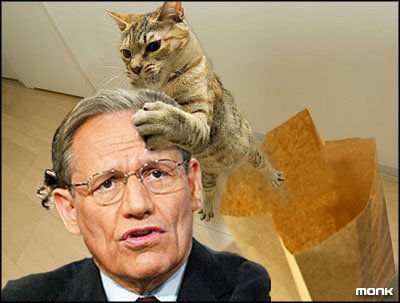
Wow. The Village pundits are so wound up over the “sequester” these days that I hate to think what’s going to happen over the weekend when the automatic budget cuts have taken effect. Will there be weeping and wailing instead of dancing at Disco Dave’s place? Will Bob Schieffer have to talk David Ignatius off a ledge? Will Dana Millbank freak out and require hospitalization? Will Bob Woodward’s hair catch fire? Will Major Garrett spontaneously combust?
Honestly, I’ve never seen anything like the temper tantrums the Village pundits have been throwing over the past week or two; and now that they are finally realizing that they’re not going to get the White House and Congress to agree to replace the “sequester” with Simpson Bowles 2.0, they’ve begun to scream and stamp their feet. I’m afraid one of them may throw himself to the floor and have a kicking and shrieking tantrum soon.
First up, Bob Woodward. Last Friday, the poor, frustrated stuffed shirt published a hectoring op-ed in the Washington Post in which he assigned full blame for the “sequester” to President Obama. As evidence, Woodward misleadingly sourced his own book on last year’s debt limit fight. He was rounding mocked on numerous liberal websites, and that must have really gotten his dander up.
Today Woodward appeared on Morning Joe and upped the ante. Mediaite reports:
Washington Post reporter Bob Woodward’s ongoing war of words with President Barack Obama’s White House escalated on Wednesday when Woodward took to the set of MSNBC’s Morning Joe to slam the president’s handling of the sequester fight. Woodward said that the president has displayed a “kind of madness” in his decision to make those cuts as painful and deleterious to the nation’s war fighting capability as possible….
He then turned to the sequester: “I think peoples’ heads are about to explode about all of this, you know, what the hell is going on here,” Woodward said. “I’m not sure the White House understands exactly what happened in all of these negotiations at the end of 2011 with the sequester and the super committee, because they were really on the sidelines.”
Woodward slammed Obama’s decision to announce that sequester cuts would force an American aircraft carrier to not deploy to the Persian Gulf.
“Can you imagine Ronald Reagan sitting there and saying ‘Oh, by the way, I can’t do this because of some budget document’?”
Watch it:
h/t to TPM and to RalphB for the catch!
Woodward’s pompous WaPo colleague David Ignatius also strongly disapproves of President Obama’s failure to make what Ignatius thinks is the obviously correct choice:
We have a political system that is the equivalent of a drunk driver. The primary culprits are the House Republicans. They are so intoxicated with their own ideology that they are ready to drive the nation’s car off the road. I don’t know if the sequestration that’s set to begin Friday will produce a little crisis or a big one; the sad fact is that the Republicans don’t know, either, yet they’re still willing to put the country at risk to make a political point.
At least Ignatius admits the Republicans are mostly to blame for the crisis. But…
I’m no fan of the way President Obama has handled the fiscal crisis. As I’ve written often, he needs to provide the presidential leadership that guides Congress and the country toward fiscal stability. In my analogy, he should take the steering wheel firmly in hand and drive the car toward the destination where most maps show we need to be heading: namely, a balanced program of cuts in Social Security and Medicare and modest increases in revenue.
Why is it always Social Security and Medicare that these guys want to cut? Surely there has to be a better way to deal with the noncrisis than to starve granny and then refuse her health care when she’s dying in the street?

Dana Millbank in drag
Last Tuesday Dan Millbank, also of the WaPo, stated his demand that Simpson-Bowles be enacted right now!
On Tuesday morning, as President Obama and House Republicans were abandoning hope of reaching a compromise to avoid across-the-board spending cuts on March 1, the indefatigable duo of Erskine Bowles and Alan Simpson made one more attempt to float a bipartisan compromise. They were literally shouted down.
Seconds after Bowles and Simpson were introduced at a breakfast forum hosted by Politico, hecklers in the audience began to interrupt: “Pay your share of taxes! Stop cutting jobs! Stop cutting Medicare and Medicaid!”
“Wait your turn,” pleaded the moderator, Politico’s Mike Allen, as the half-dozen demonstrators were gradually removed.
Good grief! How shocking that the peons would dare to demand that the Villagers “sacrifice” instead of resigning themselves to “feel the pain” so that the Villagers and their wealthy friends aren’t inconvenienced!
These politicians aren’t “serious,” Millbank tut tuts, claiming that “neither [Obama nor Boehner] is offering anything close to a workable plan.”
I’ve left the best (or worst, depending on your point of view) for last. Major Garrett’s bizarre and incomprehensible (to me anyway) op-ed in the National Journal: Tennessee Williams Offers Window Into the Mendacity That Defines the Sequester.

Major Garrett disapproves
According to Garrett, the way to understand the “sequester” is to listen to Big Daddy in Cat on a Hot Tin Roof. The problem is “mendacity,” which is a fancy word for lying.
How can anyone look upon the sequester with anything but revulsion and venom — the kind of smoldering rage that spills out of Big Daddy Pollitt (played by Burl Ives in the 1958 movie) when he begins to peel back the slippery layers of deception that defined his seemingly respectable Mississippi Delta life. Big Daddy’s life and all those who spin around it are reduced, as if by the centripetal force of fakery, into one word: mendacity.
Williams was not speaking for the South or plantation owners, but everyone who can kid themselves into believing something that simply isn’t true. Acid drips from Big Daddy’s sweet-sounding and recurrent question: “Wouldn’t it be funny if that was true?” After listening to all the varied finger-pointing and blame-shifting on our latest budget crisis, I will from now substitute the word “mendacity” for “sequester.”
Ooooookaaaay….
Encapsulated within the confines of a tortured Mississippi family, Tennessee Williams captured in the 1950s a bit of the writhing, frustrating, and at times grotesque antics of modern American budget mendacity. In his immortal Cat on a Hot Tin Roof, Big Daddy Pollitt and his son Brick — a high school football hero turned town drunk — argue over Brick’s refusal to see the consequences of his drinking, how his indolence breeds chaos in the lives of others. Earlier, Brick speaks mournfully of mendacity — the lies of his young life.
Big Daddy: “But it’s always there in the mornin’, ain’t it—the truth? And it’s here right now. You’re just feeling sorry for yourself; that’s all it is — self-pity.… Life ain’t no damn football game. Life ain’t just a buncha high spots. You’re a 30-year-old kid. Soon you’ll be a 50-year-old kid, pretendin’ you’re hearin’ cheers when there ain’t any. Dreamin’ and drinkin’ your life away. Heroes in the real world live 24 hours a day, not just two hours in a game. Mendacity, you won’t … you won’t live with mendacity but you’re an expert at it. The truth is pain and sweat and payin’ bills.”
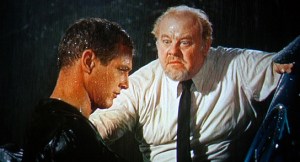
Big Daddy and Brick
Garrett doesn’t mention that Brick’s drinking and “indolence” stems from clinical depression triggered by denial of his homosexuality, but maybe Garrett doesn’t know that. But we now know how what Garrett believes is the solution to the financial noncrisis:
Our mendacities now are about dollars and cents. We hate ourselves, at some level, for being unable to produce enough to pay our bills. Our politics invites us to dream our life away. But the sequester and the fiscal cliff and the debt/default drama fractiously and dramatically remind us of our limits. We are frustrated. We don’t want to live with mendacity. But, sadly, we’ve become experts at it.
The truth is pain and sweat and payin’ bills.
Except that American does pay its bills and will continue to do so unless the Republicans refuse to raise the debt ceiling. And yes, as Garrett writes, most American families pay their bills too. But just like the federal government, most American families go into debt in order to buy a house or a car. Only the very richest among us can pay cash for those items. Like the government, families borrow and then pay the loans back with interest.
If anyone can figure out what else Garrett is trying to say, I’d be glad to hear it. Frankly, I think he’s lost his mind, and so have the rest of these Village idiots. I’m going to be fascinated to watch what happens to them over the next few days as their Simpson-Bowles fantasies crash and burn.
Ted Cruz and the Future of the Republican Party
Posted: February 26, 2013 Filed under: the villagers, U.S. Politics | Tags: Jane Mayer, Joseph McCarthy, Republican Party, Tea Party, Ted Cruz, Texas 20 Comments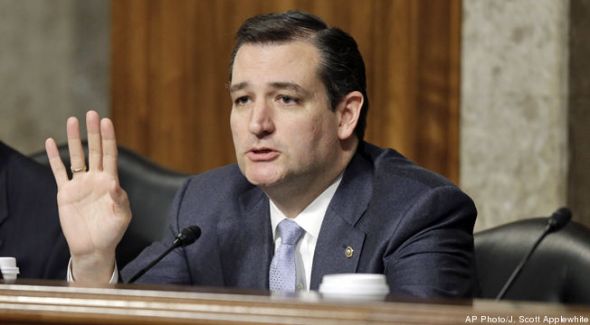
Ted Cruz questions Chuck Hagel at Senate Judiciary Committee hearing.
The Republican Party has a new star, whether they want him or not. And, despite the Time Magazine cover, the new GOP star is not Florida’s Marco Rubio. It’s brand new Texas Senator Ted Cruz.
Ted Cruz is, quite frankly, a real jerk. He knows he’s a jerk, and he appears to like it when people notice. Reuters reported last Tuesday on an appearance by Cruz in Texas:
“Washington has a long tradition of trying to hurl insults to silence those who they don’t like what they’re saying,” Cruz told reporters on a visit to a Texas gun manufacturer. “I have to admit I find it amusing that those in Washington are puzzled when someone actually does what they said they would do.”
Employees at LaRue Tactical near Austin cheered the senator enthusiastically during his appearance.
Cruz, 42, raised eyebrows in Washington by aggressively criticizing former Republican Senator Chuck Hagel, President Barack Obama’s nominee for defense secretary, during a Senate Armed Services Committee confirmation hearing.
Cruz angered lawmakers in both parties by suggesting, without giving evidence, that Hagel might have taken money from countries such as communist North Korea.
Since his aggressive cross-examination of Hagel at the confirmation hearing, both politicians and jouranlists have been comparing Cruz to the late, disgraced commie-hunter Joseph McCarthy–and Cruz revels in the criticism, regardless of whether it comes from the “liberal media,” Democrats, or moderate Republicans whom he deems cowardly and less than pure in their willingness to defend “conservative principles.”
I’m sure you’ve either read or heard about Jane Mayer’s recent New Yorker feature: Is Ted Cruz Our New McCarthy? Mayer wrote:
Last week, Texas Senator Ted Cruz’s prosecutorial style of questioning Chuck Hagel, President Obama’s nominee for Defense Secretary, came so close to innuendo that it raised eyebrows in Congress, even among his Republican colleagues. Senator Lindsey Graham, Republican of South Carolina, called Cruz’s inquiry into Hagel’s past associations “out of bounds, quite frankly.” The Times reported that Senator John McCain, Republican of Arizona, rebuked Cruz for insinuating, without evidence, that Hagel may have collected speaking fees from North Korea. Some Democrats went so far as to liken Cruz, who is a newcomer to the Senate, to a darkly divisive predecessor, Senator Joseph R. McCarthy, whose anti-Communist crusades devolved into infamous witch hunts. Senator Barbara Boxer, a California Democrat, stopped short of invoking McCarthy’s name, but there was no mistaking her allusion when she talked about being reminded of “a different time and place, when you said, ‘I have here in my pocket a speech you made on such-and-such a date,’ and of course there was nothing in the pocket.”
The hubbub triggered a memory for Mayer–a speech by Cruz that she had covered “two and a half years ago.”
Cruz gave a stem-winder of a speech at a Fourth of July weekend political rally in Austin, Texas, in which he accused the Harvard Law School of harboring a dozen Communists on its faculty when he studied there. Cruz attended Harvard Law School from 1992 until 1995. His spokeswoman didn’t respond to a request to discuss the speech.
Cruz made the accusation while speaking to a rapt ballroom audience during a luncheon at a conference called “Defending the American Dream,” sponsored by Americans for Prosperity, a non-profit political organization founded and funded in part by the billionaire industrialist brothers Charles and David Koch. Cruz greeted the audience jovially, but soon launched an impassioned attack on President Obama, whom he described as “the most radical” President “ever to occupy the Oval Office.” (I was covering the conference and kept the notes.)
He then went on to assert that Obama, who attended Harvard Law School four years ahead of him, “would have made a perfect president of Harvard Law School.” The reason, said Cruz, was that, “There were fewer declared Republicans in the faculty when we were there than Communists! There was one Republican. But there were twelve who would say they were Marxists who believed in the Communists overthrowing the United States government.”
Mayer then reports on her interviews with people who were at Harvard when Cruz was in law school–all of whom are flummoxed by Cruz’s accusations. Mayer suggests that Cruz may have been referring to
a group of left-leaning law professors who supported what they called Critical Legal Studies, a method of critiquing the political impact of the American legal system. Professor Duncan Kennedy, for instance, a leader of the faction, who declined to comment on Cruz’s accusation, counts himself as influenced by the writings of Karl Marx. But he regards himself as a social democrat, not a Communist, and has never advocated the overthrow of the U.S. government by Communists. Rather, he advocated widening admissions at the law school to under-served populations, hiring more minorities and women on the faculty, and paying all law professors equally.
Mayer’s article set off reactions all over the internet. Rachel Maddow interviewed Mayer last week; here’s the video, in case you missed it.
Cruz responded to Mayer’s piece the next day after it appeared on-line:
Senator Ted Cruz has responded to The New Yorker’s report that he accused Harvard Law School of having had “twelve” Communists who “believed in the overthrow of the U.S. Government” on its faculty when he attended in the early nineties. Cruz doesn’t deny that he said this; instead, through his spokesman, he says he was right: Harvard Law was full of Communists.
His spokeswoman Catherine Frazier told The Blaze website that the “substantive point” in Cruz’s charge, made in a speech in 2010, was “was absolutely correct.”
She went on to explain that “the Harvard Law School faculty included numerous self-described proponents of ‘critical legal studies’—a school of thought explicitly derived from Marxism—and they far outnumbered Republicans.” As my story noted, the Critical Legal Studies group consisted of left-leaning professors like Duncan Kennedy, who is a social democrat, not a Communist, and has never “believed in the overthrow of the U.S. Government.”
Frazier also said she found it “‘curious’ that The New Yorker would cover Cruz’s speech ‘three years’ after he gave it. She didn’t seem to notice the irony that Cruz had demanded detail information from Hagel on speeches he had given as long ago as 2000.
Back home in Texas the reaction to Cruz’s recent behavior has been very different from that of the villagers and the mainstream media generally. From The Austin Statesman:
Six weeks after being sworn in, Ted Cruz returned to Texas a commanding figure, the center of attention in the Senate and the national media, loathed by the Washington establishment and, for that, all the more celebrated by conservatives nationally who found in him a champion both very smart and, it seemed, utterly fearless.
He had emerged from his baptism by fire more powerful for it, not only in national conservative circles but, by leveraging his new-found status, perhaps also in the Capitol he had so unsettled.
And all, Cruz said in an appearance this week at a Leander gun manufacturer, because he had done just what he told Texas voters he was going to do….“I haven’t seen anyone that good,” said Tripp Baird, director of Senate relations for Heritage Action for America. “The guy literally day one was talking about guns, immigration and literally dismantling Chuck Hagel, all in one day.”
“The movement worked their tails off to get him elected, and I think he has met their expectations big time,” said Baird.
What Cruz understands, said Baird, is that the way to win in Washington is “take the fight to the other side. If you’re not willing to throw a punch, you’re just preparing for a fight you never end up getting in engaged in. What good are you? Go home.”
How will the dramatic emergence of Ted Cruz effect the current internecine struggle for control of the GOP? Will he throw the power back to the ultra-right? Or will be be marginalized by the villagers?
Steve Kornacki calls it “The GOP’s Ted Cruz Problem.”
We’ve seen senators like Ted Cruz before. The historical comparison most commonly invoked involves Joe McCarthy, whose scurrilous red-baiting crusade in the early 1950s shattered the careers of innocent public servants and alienated McCarthy from his fellow senators, but also made him a folk hero on the right. Jesse Helms comes to mind too. The far-right North Carolinian was generally seen as more trouble than he was worth by his party’s establishment (there were those in the Reagan White House who not-so-secretly rooted for his defeat in a close 1984 campaign against Democrat Jim Hunt), but the intense animosity Helms stirred among liberals only enhanced his status among the conservative masses….
For Republicans who believe their party’s post-2008 direction has been self-destructive, Cruz’s rapid rise is a troubling development, because it really has nothing to do with policy and everything to do with the outrage he provokes from Democrats and the media. The thorough beating they took at the polls last fall perhaps should have prompted rethinking on the right. But conservatives’ appetite for Cruz shows that the GOP base’s animating spirit still hasn’t changed: Loud, aggressive and reflexive hostility to President Obama, the Democratic Party and any Republican who would dare contemplate compromise is still how “conservatism” is defined.
What makes Cruz and Cruz-ism a particular problem for his party is the demographic conundrum Republicans now face. Obama’s reelection (and Democrats’ unexpected gains in the Senate) was testament to the rising clout of the “coalition of the ascendant” – African-Americans, Hispanics, Asians, women (particularly single women), Millennials. As Joan Walsh pointed out last week, Cruz’s Cuban-American background by itself won’t improve his or his party’s standing with Hispanics or other minorities. Instead, he’s appealing to the aging, overwhelmingly white core of the Republican base – voters whose grievances against the government in the 1970s and 1980s turned them against the Democratic Party and attracted them to Ronald Reagan and his ideological descendants.
The Tea Party know-nothings have already pushed formerly “moderate” Senators McCain and Graham further to the right; why should we believe they’ll stand up to Cruz if he gains popular support around the country? Texas senior senator John Cornyn is reportedly already intimidated by Cruz’s popularity. According to Politico’s Mike Allen, Cruz now gets two votes in the Senate–his own and Cornyn’s.
On the other hand, Paul Waldman at The American Prospect thinks Cruz’s career is already dead and that he’s “the next Jim DeMint.”
A year or two ago, if you asked Republicans to list their next generation of stars Ted Cruz’s name would inevitably have come up. Young (he’s only 42), Latino (his father emigrated from Cuba), smart (Princeton, Harvard Law) and articulate (he was a champion debater), he looked like someone with an unlimited future. But then he got to Washington and started acting like the reincarnation of Joe McCarthy, and now, barely a month into his Senate career, we can say with a fair degree of certainty that Ted Cruz is not going to be the national superstar many predicted he’d be. If things go well, he might be the next Jim DeMint—the hard-line leader of the extremist Republicans in the Senate, someone who helps the Tea Party and aids some right-wing candidates win primaries over more mainstream Republicans. But I’m guessing that like DeMint, he won’t ever write a single piece of meaningful legislation and he’ll give the Republican party nothing but headaches as it struggles to look less like a party of haters and nutballs.
I hope Waldman’s right, but Cruz is a hell of a lot more dynamic than DeMint and probably a lot smarter (how many Tea Party candidates have “authored more than 80 United States Supreme Court briefs and presented 43 oral arguments, including nine before the United States Supreme Court”?). Cruz is an experienced debater and has become a very good speaker who can really rile up a right wing crowd, as Jane Mayer noted in her interview (above) with Rachel Maddow.
As Dave Weigel points out, Cruz is loving the condemnation he’s getting from Democrats, the media, and even fellow Republicans.
I doubt very much that Cruz go away quietly with his tail between his legs. The only question is what will he do to the Republican Party?
Tuesday Morning Reads: BP Goes on Trial over 2010 Deepwater Horizon Oil Spill
Posted: February 26, 2013 Filed under: Environment, morning reads, New Orleans, open thread, U.S. Politics | Tags: BP oil spill, British Petroleum, Deepwater Horizon, Halliburton, Transocean 9 Comments
Fire boat response crews battle the blazing remnants of the off shore oil rig Deepwater Horizon on April 21, 2010. The blowout in the Gulf of Mexico killed 11 people and sent 4.9 million barrels of oil gushing from the sea floor into the Gulf (Houston Chronicle).
See more photos of the Gulf oil disaster at the Houston Chronicle.
Good Morning Sky Dancers!!
BP went on trial over the 2010 Deepwater Horizon disaster on Monday, after the failure of efforts to reach a last-minute settlement.
US district judge Carl Barbier opened proceedings in New Orleans with a warning that it would be a “lengthy trial”….
The trial is designed to identify the causes of BP’s well blowout and assign percentages of fault to the companies. That will help determine how much more each has to pay for their roles in the environmental catastrophe.
Months of negotiations have failed to produce a settlement that could have averted the trial.BP has said it already has racked up more than $24bn in spill-related expenses and has estimated it will pay a total of $42bn to fully resolve its liability for the disaster that killed 11 workers and spewed millions of gallons of oil.
But the trial attorneys for the federal government and Gulf states and private plaintiffs hope to convince the judge that the company is liable for much more.
The Guardian quotes Columbia law professor John Coffee as saying that there could still be a settlement, because BP obviously does not want to deal with the adverse publicity that would go along with a month’s long trial with damaging information about the company in the headlines day after day.
Read live tweets from the trial by Dominic Rush of the Guardian here.
Bloomberg Businessweek reports: BP, Transocean Accused of ‘Reckless’ Actions in Spill.
The mishandling of an oil-rig safety test by BP Plc (BP/) and Transocean Ltd. (RIG) officials was a major cause of an explosion that led to the 2010 Gulf of Mexico oil spill, lawyers for the U.S. and spill victims said at a trial.
BP and Transocean supervisors’ failure to properly interpret results of a pressure test on the Macondo well off the coast of Louisiana cost 11 rig workers their lives and sent millions of gallons of oil spewing into the Gulf, Michael Underhill, a U.S. Justice Department lawyer, and Jim Roy, an attorney for plaintiffs suing the companies, told a judge yesterday.
“BP put profits before people, profits before safety and profits before the environment,” Underhill said in opening statements that began this morning [Monday] in New Orleans in a trial before U.S. District Judge Carl Barbier, who is overseeing litigation over the spill….
BP executives’ “missteps and reckless decisions” about the safety test were prompted by pressure to generate billions in profits regardless of the costs, Underhill said in his statement.
Read the entire Bloomberg article for an excellent summary of the issues in the case.
Through their attorneys, BP, Transocean, and Halliburton pointed fingers at each other. NOLA.com:
Opening day at the long-awaited civil trial against BP and its partners in the ill-fated Macondo oil well at times sounded like a group of youngsters blaming everyone but themselves for a bad deed. That’s not an unexpected beginning in the first phase of a federal trial aimed at determining each of the companies’ financial liability for the accident.
The trial at the federal courthouse in New Orleans began Monday morning with opening arguments by Plaintiff Steering Committee attorneys, representing private parties who sued BP and its partners for damages; the U.S. Justice Department; and the states of Louisiana and Alabama, whose attorneys outlined their views of how the accident occurred and whether BP or any of its partners were guilty of gross negligence or willful misconduct, which could result in an eventual four-fold increase in fines under the Clean Water Act and the awarding of punitive damages for the private plaintiffs….
The federal, state and private party attorneys took aim at BP, which owned the drilling lease for the Macondo well; Transocean, which owned and staffed the ill-fated Deepwater Horizon drilling rig; and Halliburton, which provided an unusual, lightweight cement that was used to block the flow of oil in the well.
Among the recurring story lines and accusations:
That BP made the ultimate decisions for drilling operations on the Deepwater Horizon rig, was more concerned with profits than safety as it ran behind schedule and over-budget on the well, and that BP rig supervisors botched a crucial safety test before the April 2010 drilling-platform explosion;
That Transocean had not properly trained its crew, which missed clear signals that a blowout was about to occur;
That Halliburton’s use of a cement made lightweight with nitrogen bubbles was known to be risky, and the mixture did not succeed in sealing the well.
Other takes on the opening of the trial:
Wall Street Journal: Accusations Fly as Trial Over Gulf Oil Spill Begins
Transocean, which owned the drilling rig, failed to train its crews properly and didn’t maintain key safety equipment, said Jim Roy, a lawyer for hundreds of businesses suing the energy companies that were drilling the ill-fated well.
Brad Brian, a lawyer for Transocean, said that wasn’t true, noting that the Coast Guard, federal safety regulators and BP’s own management considered the Deepwater Horizon rig “what ‘good’ looked like.”
Michael Underhill, the Justice Department’s lead civil attorney, focused on a last-minute conversation between BP engineers on the rig and onshore that he said showed that the oil giant acted with gross negligence. The rig was not reviewed by hydraulic engineer to ensure that everything is safe.
But BP attorney Mike Brock argued the accident was caused by many mistakes made by all the parties aboard the rig, which exploded in April 2010, killing 11 workers and unleashing the worst offshore oil spill in U.S. history. “There were a number of mistakes and errors in judgment that were made by BP, Transocean and Halliburton,” Mr. Brock said.
LA Times: Greed caused BP’s gulf oil spill, lawyers argue
Energy giant BP, behind schedule and $50 million over budget drilling a deep-water well, emphasized cost-cutting over safety, causing the largest offshore oil spill in U.S. history, lawyers said Monday as the company’s high-stakes civil trial began.
Lawyers used PowerPoint presentations to provide a dramatic recounting of the April 20, 2010, explosion and fire in the Gulf of Mexico that killed 11 crew members. Workers were preparing to temporarily cap the Macondo well 4,100 feet underwater when it blew up. The 30-story drilling vessel about 50 miles offshore burned for two days before crumpling into the gulf.
The resulting spill of more than 4 million barrels of oil damaged the waters and economies of five states. And the responsible party was BP, according to the lawyers representing the federal government, Gulf Coast states and private parties.
Washington Post: Billions of dollars at stake for BP, other companies as trial opens for Gulf oil spill
One of the biggest questions facing U.S. District Judge Carl Barbier, who is hearing the case without a jury, is whether BP acted with gross negligence.
Under the Clean Water Act, a polluter can be forced to pay a minimum of $1,100 per barrel of spilled oil; the fines nearly quadruple to about $4,300 a barrel for companies found grossly negligent, meaning BP could be on the hook for nearly $18 billion.
The judge plans to hold the trial in at least two phases. The first phase, which could last three months, is designed to determine what caused the blowout and assign percentages of blame to the companies involved. The second phase will determine how much crude spilled into the Gulf.
The issues in the case are “massive” and “complex.”
Hundreds of attorneys have worked on the case, generating roughly 90 million pages of documents, logging nearly 9,000 docket entries and taking more than 300 depositions from witnesses who could testify at trial.
“In terms of sheer dollar amounts and public attention, this is one of the most complex and massive disputes ever faced by the courts,” said Fordham University law professor Howard Erichson, an expert in complex litigation.
The trial continues today.
AP via the Houston Chronicle: 1st witness to testify in Gulf oil spill trial
A University of California-Berkeley engineer who played a prominent role in investigating levee breeches in New Orleans after Hurricane Katrina is scheduled to be the first witness Tuesday at a trial involving another Gulf Coast catastrophe: the worst offshore oil spill in U.S. history.
Robert Bea, an expert witness for the plaintiffs who sued BP PLC and other companies involved in the Deepwater Horizon disaster, will share his theories about what caused BP’s Macondo well to blow out on April 20, 2010, provoking an explosion on the Horizon rig that killed 11 workers and spewed an estimated 172 millions of gallons of crude into the Gulf.
Bea’s testimony was scheduled for the second day of a civil trial that could result in the oil company and its partners being forced to pay billions of dollars more in damages. The case went to trial Monday after attempts to reach an 11th-hour settlement failed.
The second witness scheduled is BP America president Lamar McKay.
The high-ranking executive is likely to discuss corporate decisions that were made during the disaster. It was not clear if there would be time for his testimony Tuesday. Other BP officials were expected to give videotaped testimony.
In pretrial depositions and in a report, Bea argued along with another consultant that BP showed a disregard for safety throughout the company and was reckless — the same arguments made in opening statements Monday by attorneys for the U.S. government and individuals and businesses hurt by the spill.
Attorneys for BP tried to block Bea’s testimony, accusing him of analyzing documents and evidence “spoon-fed” to him by plaintiffs lawyers. BP accused Bea and another expert, William Gale, a California-based fire and explosion investigator and consultant, of ignoring the “safety culture of the other parties” involved in the spill, in particular Transocean Ltd., the drilling company running operations aboard the Deepwater Horizon.
It should be fascinating to follow this case, and I’m really hoping there won’t be a settlement. A trial could bring out valuable information that we haven’t heard about so far.
I thought the BP trial deserved its own post, but please consider this an open thread and post freely about any topic in the comments.
Afternoon Open Thread: Donald Trump Reviews the Oscars
Posted: February 25, 2013 Filed under: open thread | Tags: Donald Trump, Fox & Friends, Oscars 16 Comments
Good Afternoon!!
In an appearance on “Fox & Friends” this morning, Donald Trump shared his opinions about last night’s Oscars. Talk about the pot calling the kettle black! Trump thought the Oscar set was “tacky” and the whole show was “very average.” It takes one to know one, I guess. Not unexpectedly, Trump included his long-time obsessions, reverse racism and birtherism in his critique of the Oscar contenders.
He announced that Quentin Tarrantinos’ Django was
“one of the most racist movies I’ve ever seen,” and that it was “terrible and a disgrace.
“You know, when they talk about guns and gun control, that movie– people should watch that,” he said. “You wanna talk about somebody with a problem. But, I thought it was terrible.”
Trump objected to Daniel Day Lewis winning the Oscar for “Best Actor,” because Lewis isn’t an American and speaks with a British accent.
“he’s not from this country…“I don’t think Lincoln had an English accent,” Trump said, apparently oblivious to the fact that Lincoln in the film does not speak with the same accent. “I know lots of politicians and lots of powerful people and they don’t talk like that,” he complained.
The Fox & Friends hosts agreed, adding that Lincoln was boring “like a documentary” or “a play.”
He did applaud the Academy for awarding the “Best Actor” Oscar to Ben Affeck for his role in Argo.
“I really thought that Ben Affleck was shuttered aside,” he said. “I thought that was terrible, what they did with him. He should have been up for director. I thought ‘Argo’ was very good and I was very happy that he got it.”
I think maybe he means “shunted aside.”
Here’s the video (courtesy of Mediaite).

 peej
peej Carissa
 bostonboomer
 dakinikat
 ecocatwoman
 mablue2
 Mama Lopez
 peggysue22
 quixote
 skydancingguestblogger
 Mona (aka Wonk the Vote)



 Sky Dancing
Recent Comments