
Saturday Afternoon Reads: The Feminine Mystique
Posted: February 23, 2013 Filed under: just because, U.S. Politics, Women's Rights | Tags: afternoon reads, Betty Friedan, books, education, feminism, psychology, The Feminine Mystique 40 Comments
Betty Friedan
Good Afternoon!
I decided to focus this post on something other than the debt, deficit, sequester obsession that has taken over American politics, so I’m writing about a book I read in high school that changed my life forever. Feel free to use this as an open thread, and post your links freely in the comments.
This week marked the 50th anniversary of a book that truly changed my life, The Feminine Mystique, by Betty Friedan. It was first published on February 19, 1963. I read it in paperback when I was a junior in high school, probably in early 1964.
I already knew I didn’t want to be a housewife like my mom, but there weren’t many alternatives for girls in those days. Ideally, you were supposed to get married and have children and forget about having a career or focusing on your own unique interests. You were supposed to enjoy cleaning house and supporting your husband’s career and if you didn’t enjoy it, there was something wrong with you–you weren’t a real woman.
The main reason for girls to go to college was to find a husband. Oh sure, you could study and learn about things that interest you, but that would all go by the wayside once you found a man. After that, it was all about him. If you couldn’t find a husband, then you might have to work. You could be a teacher, a nurse, or a secretary–that was about it. Women who insisted on being college professors, doctors, lawyers were few and far between and they had a tough time of it.
Then Betty Friedan’s book came out, and it hit a nerve for millions of American women and girls, including me. Here’s the famous opening paragraph:
“The problem lay buried, unspoken, for many years in the minds of American women. It was a strange stirring, a sense of dissatisfaction, a yearning that women suffered in the middle of the 20th century in the United States. Each suburban wife struggled with it alone. As she made the beds, shopped for groceries, matched slipcover material, ate peanut butter sandwiches with her children, chauffeured Cub Scouts and Brownies, lay beside her husband at night—she was afraid to ask even of herself the silent question—‘Is this all?’”
Friedan called it “the problem with no name.”

First edition of Friedan’s The Feminine Mystique (Bauman Rare Books)
As I read the book, I began to develop more sympathy for my mother’s plight. During World War II, women had been called upon to go to work to support the war effort and replace men who had been drafted or had enlisted in the military. But when the men came back, they needed the jobs and women were expected to go back to their homes and be satisfied with doing housework, child rearing, decorating, and entertaining for no pay. Friedan wrote about how “experts” had produced reams of propaganda in the effort to get women to find joy and fulfillment in being housewives and mothers. The “feminist mystique” for Friedan said “that the highest value and the only commitment for women is the fulfillment of their own femininity.”
I’ve told this story before, but when I was a senior in high school I wrote an essay for my English class called “Women Are People Too.” My male teacher was somewhat taken aback by my arguments, but he still asked me to read my paper aloud in class. I was jeered and mock for it, of course. Later my economics teacher–a true leftist–found out about the essay and read it in my economic class. Today it seems strange, but most of the other students in my school were horrified by the notion of women being equal to men.
My father, an English professor, had a woman colleague Lucille C.–a full professor who had never married. My mother said that most men would be intimidated by her brilliance and success. Anyway, when I told Lucille about how all the other kids were making fun of me for my essay, she told me to tell them I was a member of FOMA, which stood for “Future Old Maids of America.” I loved it!
Much has changed since 1963. Women now assume they have a right to an education and a career as a well as the right to choose (if they can afford it) whether to stay home with children or work outside the home. But as we have seen in the past four plus years, misogyny is alive and well in the good ol’ USA, and we still have a very long way to go to achieve anything like real gender equality.
Carlene Bauer spoke for me when she wrote at The New York Observer:
When Friedan writes that early feminists “had to prove that women were human,” it is hard not to feel a shock of recognition and indict our own moment as well, especially after the election that just passed. But American women still find themselves struggling against a strangely virulent, insidious misogyny. If our culture truly thought women were human, 19 states would not have enacted provisions to restrict abortion last year. There would be no question whether to renew the Violence Against Women Act. Women would not make 77 cents to every man’s dollar, and make less than our male counterparts even in fields where we dominate. We wouldn’t have terms like “legitimate rape” or “personhood.” Women who decided not to have children would not be called “selfish,” as if they were themselves children who had a problem with sharing. If our culture truly allowed them to have strong, complex, contradictory feelings and believed they were sexual creatures for whom pleasure was a biological right, perhaps adult women would not be escaping en masse into badly written fantasy novels about teenage girls being ravished by vampires.
Bauer also noted that some problems with the book, most notably Friedan’s homophobia.
This book…should seem thrillingly, relievedly quaint. It does not. But it is surprisingly boring in spots—there are many moments where you can see the women’s magazine writer in Friedan giving herself over to breathless exhortation—and astoundingly homophobic. At one point Friedan rails against “the homosexuality that is spreading like a murky smog over the American scene.” Friedan has been criticized for not being as careful a researcher, or as honest a storyteller, or as civil-rights-minded as she could have been. But perhaps these criticisms are somewhat beside the point. There are numerous passages that, if you did not know their provenance, could be mistaken for sentences written in judgment of the present day.
In looking over The Feminine Mystique recently, I realized that I had forgotten how much scholarship and psychological analysis and scholarship Friedan included in the book. She was a psychology major at Smith College, graduating summa cum laude in 1942. For example, The Feminine Mystique contained a brilliant analysis of Freudian theory and its consequences for women. Friedan argued that education at women’s colleges had been dumbed down between the 1940s and 1960s, with educators limiting courses to “subjects deemed suitable for women” and their future roles as housewives. She suggested that girls were prevented from experiencing the normative identity crisis that was the focus of Erik Erikson’s developmental theory. And she argued that women had been kept at the lower, subsistence levels of Maslow’s hierarchy of needs.
How many books truly change society in dramatic ways. Betty Friedan’s book did that. A few more links to articles on the 50th anniversary of The Feminine Mystique.
Michelle Bernard: Betty Friedan and black women: Is it time for a second look?
NYT: Criticisms of a Classic Abound
Mona Gable at BlogHer: How Far Have We Come?
ABC News: ‘Feminine Mystique’: 50 Years Later, Dated But Not Irrelevant
Caryl Rivers: ‘Feminine Mystique’ At 50: If Betty Friedan Could See Us Now
Janet Maslin: Looking Back at a Domestic Cri de Coeur
Alexandra Petri: The Feminist Mystique
Peter Dreier: The Feminine Mystique and Women’s Equality — 50 Years Later
Kathi Wolfe at The Washington Blade: Power of the ‘Feminine Mystique’
A discussion at NPR’s On Point: The Feminine Mystique at 50
This isn’t specifically about The Feminine Mystique, but I think it’s relevant. Allie Grasgreen at Inside Higher Ed: ‘The Rise of Women’ — a “new book explains why women outpace men in higher education.”
Please use this as an open thread, and post anything you like in the comments.
Saturday Morning Open Thread: Anti-Abortion Senator Endorses Roe v. Wade Reasoning
Posted: February 23, 2013 Filed under: just because, Republican politics, U.S. Politics, Women's Rights | Tags: abortion, Charles Grassley, Indiana State Senate, Mike "Two Times" Pence, right to privacy, Roe v. Wade, transvaginal ultrasound 23 Comments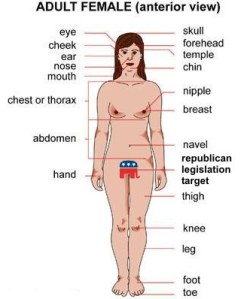
Good Morning!!
I’m getting a slow start this morning, so I thought I’d put up an open thread to get us started. This story is a couple of days old so you may have heard about it already, but I just had to take note of it anyway.
On Wednesday at a town hall meeting in Chariton Iowa, Senator Charles Grassley got a strange question about some wingnut conspiracy theory from one of his constituents: From the Atlantic Wire:
Constituent: They’re saying that they’re going to start, in 2013, putting microchips in government workers and then any kid that enrolls in school, starting in pre-school, will have a microchip implanted in them so that they can track them. Is that true?
Senator Grassley’s response was absolutely priceless:
Grassley: No. First of all, nothing can be done to your body without your permission….It’d be a violation of the constitutional right to privacy if that were to happen.
Here’s the video:
In case Grassley hasn’t thought about it that carefully, forcing a woman to have a baby certainly qualifies as doing something to her body without her permission. Actually, there is no right to privacy in the U.S. Constitution, but the Roe v. Wade decision created one; and Roe could certainly be used as precedent in any case relating to violations of body integrity.
In fact, the majority opinion of Roe v. Wade clearly states:
The Constitution does not explicitly mention any right of privacy. In a line of decisions, however, going back perhaps as far as Union Pacific R. Co. v. Botsford, 141 U.S. 250, 251 (1891), the Court has recognized that a right of personal privacy, or a guarantee of certain areas or zones of privacy, does exist under the Constitution…
Roe v. Wade, of course, established the right to privacy — the kind that might spare you from a government conspiracy to embed microchips that might reveal your entire health history. Or, you know, the kind of privacy that allows women to obtain a legal abortion in this country:
This right of privacy, whether it be founded in the Fourteenth Amendment’s concept of personal liberty and restrictions upon state action, as we feel it is, or, as the District Court determined, in the Ninth Amendment’s reservation of rights to the people, is broad enough to encompass a woman’s decision whether or not to terminate her pregnancy.
Grassley is a long-time opponent of abortion rights and advocate of overturning Roe v. Wade, and Naral gives him a zero rating on pro-choice issues. If Roe were overturned, where does Grassley think he’d find a constitutional “right to privacy”?
And let’s not forget the recent Republican obsession with forcing women to undergo vaginal probes before they can have an abortion.

Not to be outdone, the Indiana State Senate has passed a new law that requires a woman to have two (2) ultrasounds–before and after her “abortion”–even if she is just taking RU 487, or the morning after pill! The bill doesn’t specific intravaginal ultrasounds, but they would, in effect, be required, since most abortions are performed when the embryo or fetus is too small to be detected by a traditional ultrasound.
I’m not sure what Grassley’s position on these ultrasound laws is, but someone should definitely ask him. If forcing a woman to have two transvaginal probes in order to get a pill doesn’t qualify as the government doing something to “your body without your permission,” what does Grassley believe would qualify as a violation of a woman’s privacy? Maybe because the town hall questioner was a man, he was suggesting that only Americans with penises have privacy rights?
As the inimitable Charles Pierce once wrote about Senator Grassley in a different context:
This is also funny because, you see, if there’s one thing that Chuck Grassley is noted for, it is that he is the most spectacular box of rocks, the most bulging bag of hammers, in the history of the World’s Greatest Deliberative Body. If brains were atom bombs, he couldn’t blow his nose. If his IQ was one point lower, they’d have to water him. As the great Dan Jenkins once put it in another context, if the man had a brain, he’d be out in the yard playing with it.
I’ll have a Saturday Reads post up a little later on.
Thursday Reads: Rick Scott Folds on Medicaid, the Sanctity of Marriage, GOP Meltdown, and Media News
Posted: February 21, 2013 Filed under: Barack Obama, morning reads, Sequester, the GOP, The Media SUCKS, U.S. Economy, U.S. Politics | Tags: CNN, DOMA, Erin Burnett, Gay Marriage, hypocrisy, Medicaid, Michelle Laxalt, Obamacare, Paul Laxalt, Pete Domenici, Rick Scott, sanctity of marriage, Soedad O'Brien 43 Comments
Good Morning!!
There’s another winter storm moving across the country, and we could get another big snowstorm here in New England this weekend. My local NPR station predicted a foot of snow for the Boston area on Sunday, but the Weather Channel says it could turn out to be mixed with rain. We’ll just have to wait and see. The good news is that February is almost over and spring is on the horizon.
For now, pull up a chair (or curl up in bed with your laptop, grab your coffee or tea, and let’s see what’s in the news this morning.
Yesterday JJ wrote about all the Republican governors who are refusing to cooperate with the ACA by setting up health care exchanges in their states. Many GOP governors have also said they will not agree to an expansion of Medicaid. But late yesterday, one of the most recalcitrant of these governors, Rick Scott of Florida, reversed course and accepted a Medicaid expansion that would provide health coverage for an additional 1 million Floridians. The Orlando Sentinel reports:
Gov. Rick Scott announced Wednesday a proposed three-year expansion of Florida’s Medicaid program — enrolling an additional one million poor and disabled Floridians beginning next year — after the Obama administration gave the state tentative approval to privatize Medicaid services. If the Legislature approves, Scott’s announcement means the state will extend eligibility in the federal-state program to single people and families earning up to 138 percent of poverty….”While the federal government is committed to paying 100 percent of the cost of new people in Medicaid, I cannot, in good conscience, deny the uninsured access to care,” Scott said at a press conference. He added that the expansion would have to be renewed in three years.
Florida has approximately 3.8 million uninsured citizens, so this isn’t going to solve the problem for most of them. So what’s going on with the privatization deal?
Scott’s announcement came a few hours after the Centers for Medicare and Medicaid Services announced its tentative approval of a managed-care plan that Scott had previously said might well determine his decision on expansion – though the governor said he had not committed to the expansion in return for the approval….
But, the approval is conditional. According to CMS, the state still needs to show how it plans to monitor the quality of care that the Medicaid recipients will receive, plus create a “rigorous and independent evaluation” of the managed-care plans.
Republicans in the Florida legislature are unhappy and may still challenge Scott’s decision.
Erik Erikson is unhappy too, writing at Red State: I Am Very Disappointed in Governor Rick Scott. Erikson says “[i]t is a sad day for conservatives.”

Pete Domenici and Michelle Laxalt
In sanctity of marriage news,
Just a week after Democratic Representative Steve Cohen of Tennessee revealed that a young girl he was tweeting with was his daughter–a child he had not know about until recently–we learned yesterday that former New Mexico Senator Pete Domenici had a secret, out-of-wedlock child, a son who is now in his thirties. From the Albuquerque Journal:
Statements given to the Journal by Domenici and the son’s mother, Michelle Laxalt of Alexandria, Va., identified the son as Adam Paul Laxalt, a Nevada lawyer. Michelle Laxalt formerly was a prominent government relations consultant and television political commentator in Washington, D.C. She is a daughter of former U.S. senator and Nevada Gov. Paul Laxalt. “More than 30 years ago, I fathered a child outside of my marriage,” Domenici said in his statement. “The mother of that child made me pledge that we would never reveal that parenthood, and I have tried to honor that pledge and so has she,” Domenici said.
Michelle Laxalt said that she and Domenici decided to go public now because she had reason to believe that someone else was going to (someone in the media?) was going to reveal their secret.
“Recently information has come to me that this sacred situation might be twisted … and shopped to press outlets large and small in a vicious attempt to smear, hurt and diminish Pete Domenici, an honorable man, his extraordinary wife, Nancy, and other innocents.” Michelle Laxalt said in her prepared statement.
“Why, after more than 30 years, would anyone insinuate pain and ugliness where joy and beauty have presided?” she asked.
Michelle Laxalt said “one night’s mistake led to pregnancy” and she chose to raise the son as a single parent.
“Given the fact that both my father and the father of my child were United States senators, I felt strongly that I would make this choice according to my values and would not seek advice, input or permission,” Michelle Laxalt said.
A few more reactions to the Domenici-Laxalt story:
Elspeth Reeve at The Atlantic Wire: Senator Had a Secret Son With Pundit Who Praised Him as a Great Dad.
Digby at Hullabaloo notes that Domenici was extremely judgmental of Bill Clinton over his relationship with Monica Lewinsky.
I really liked this one at The League of Ordinary Gentlemen: “Secret Children For Me, No Gay Marriage For Thee!”
More evidence that the GOP is melting down:
Yesterday, conservative pundit Byron York was mystified by John Boehner’s op-ed in the Wall Street Journal about the sequester. York writes:
In a Wall Street Journal op-ed Wednesday, House Speaker John Boehner describes the upcoming sequester as a policy “that threatens U.S. national security, thousands of jobs and more.”
Which leads to the question: Why would Republicans support a measure that threatens national security and thousands of jobs? Boehner and the GOP are determined to allow the $1.2 trillion sequester go into effect unless President Obama and Democrats agree to replacement cuts, of an equal amount, that target entitlement spending. If that doesn’t happen — and it seems entirely unlikely — the sequester goes into effect, with the GOP’s blessing.
In addition, Boehner calls the cuts “deep,” when most conservatives emphasize that for the next year they amount to about $85 billion out of a $3,600 billion budget. Which leads to another question: Why would Boehner adopt the Democratic description of the cuts as “deep” when they would touch such a relatively small part of federal spending?
The effect of Boehner’s argument is to make Obama seem reasonable in comparison. After all, the president certainly agrees with Boehner that the sequester cuts threaten national security and jobs. The difference is that Obama wants to avoid them….Could the GOP message on the sequester be any more self-defeating?
Bwwwwwaaaaaaahahahahahaha!!!!

In other bizarre wingnut news,
I had to double check to make sure this story at HuffPo wasn’t satire.
Fox News personality Bill O’Reilly has announced that Killing Jesus: A History will be his follow-up book to the NYT Bestsellers Killing Lincoln and Killing Kennedy. A press release from his publisher Henry Holt stated that the book will
…tell the story of Jesus of Nazareth as a beloved and controversial young revolutionary brutally killed by Roman soldiers. O’Reilly will recount the seismic political and historical events that made his death inevitable, and the changes his life brought upon the world for the centuries to follow. “Jesus Christ has not walked among us physically for more than two thousand years, yet his presence today is felt the world over and his spirit is worshipped by more than 2.2 billion people,” said O’Reilly. “His teachings, his legacy, his life as a flesh-and-blood man, and his death created the world in which we live.”
Too much! More from The Hollywood Reporter:
In Killing Jesus, O’Reilly “will recount the seismic political and historical events” that made the death of the “beloved and controversial young revolutionary” known as Jesus of Nazareth inevitable.
“Jesus Christ has not walked among us physically for more than 2,000 years, yet his presence today is felt the world over and his spirit is worshipped by more than 2.2 billion people, O’Reilly said in a statement released by Holt. “His teachings, his legacy, his life as a flesh-and-blood man and his death created the world in which we live.”
This is a riot:

Candy Crowley moderating presidential debate
Dylan Byers reported at Politico last night that former RNC chairman and current co-chair of the presidential debate commission Frank Farenkopf regrets allowing CNN’s Candy Crowley to moderate the second presidential debate between Obama and Romney.
Why, you ask?
Crowley, who moderated the second, town-hall-style debate, drew heavy fire from conservatives for challenging Mitt Romney after he suggested that President Obama had not called the attacks in Benghazi, Libya, “acts of terror.”
According to an agreement between the Obama and Romney campaigns, the moderator of the town hall debate was to refrain from asking questions or participating in the debate. Crowley had promised to defy that agreement even before the debate started.
Give me a break! Farenkopf was upset because Candy told the truth. Does anyone really believe he would have objected if she had been backing up something Romney said?

Soledad O’Brien
In other CNN news, The New York Post reported yesterday that Soledad O’Brien is leaving the network and {ugh!} Erin Burnett will be moved into the morning spot.
We’re told award-winning journalist O’Brien has indicated she is ready to leave after she was initially promised a plum prime-time slot, but that role has so far failed to materialize. A source tells us: “The deal to move Erin to the morning alongside Chris Cuomo is basically done. Soledad had been told she’d get a prime-time slot, but that hasn’t yet happened, and now she is telling friends she is likely to leave.”
What is the deal with CNN and that airhead Erin Burnett? She’s been all over the network lately–even getting foreign assignments that she’s completely unqualified for. Frankly, she’s unqualified to report anything other than lightweight feature stories where she just reads off a teleprompter.
Other reactions:
The Atlantic Wire: Soledad O’Brien Is Not a Part of Jeff Zucker’s Vision for CNN
It looks like one of CNN’s most liked stars won’t fit at the burgeoning home of poop-cruise story torture and soft morning news — this is new president Jeff Zucker’s CNN, and Soledad O’Brien is not it….
If you’re a fan of Starting Point, you can take some solace in that Page Six’s run-up to Zucker’s changes hasn’t come to complete fruition… yet. a tiny bit solace in that some some of Page Six’s revelations haven’t happened … yet. They outlined the new morning shift late last month, although Cuomo hasn’t moved from his co-hosting gig during primetime breaking-news events like the Christopher Dorner manhunt … yet. That whole Ann-Curry-to-CNN-primetime rumor from December still hasn’t been worked out … yet. And — who knows? — this could light the fire to get CNN execs talking (probably to Page Six) about keeping O’Brien in primetime after all. Last time we checked, even shifting Curry to the 10 o’clock hour would leave one spot open — for O’Brien or another new splashy hire from Zucker … or, you know, more Anderson Cooper.

Erin Burnett
Jezebel: Oh Crap: Soledad O’Brien Is Rumored to Be Pushed Out at CNN.
As a wise person once said, “If you are a dumbass, it’s probably a bad idea to agree to be interviewed by Soledad O’Brien.” The anchor is a whip-smart bulldog who never backs down, who schools fools and fact checks John Sununu. Unfortunately, the buzz is that she’s getting the boot at CNN….
While some journalists are comfortable taking a break from the hard stuff and embracing the softer side of news (looking at you, Peabody Award-winning Hoda Kotb), O’Brien is not that kind of reporter. If you’re seen her deal with Michelle Bachman or argue with Rudy Giuliani, you know that a cushy gig like Today would not be right.
Those are my recommended reads for this morning. Now it’s your turn to share your links. I promise to click on every one! Have a great day everyone!
Morning Joe Reads A Book
Posted: February 20, 2013 Filed under: Civil Rights, racism, Republican politics, U.S. Politics | Tags: Checkers speech, Dwight D. Eisenhower, Joe Scarborough, John Nance Garner, Richard Nixon, Southern Strategy 28 Comments
Or maybe he got someone else to read it for him? In any case, the New York Times Sunday Book Review asked Joe Scarborough to review a serious book of political history, Ike and Dick: Portrait of a Strange Political Marriage. in the February 17, 2013 edition.
How low has the Sunday Book Review sunk that it would not only publish an essay by Scarborough, but also highlight the brief review with a separate “Up Front” introduction? I haven’t seen the cover of the print edition, but it sounds as if Scarborough’s piece was printed on page 1!
Charles Pierce wrote a pithy reaction to the Times’ decision in his “What are the Gobshites Saying These Days” post on Monday.
…let us pause for a moment and congratulate the editors of The New York Times Book Review for handing a serious work of popular history to whatever’s left of Joe Scarborough after Paul Krugman picks the rest out from between his teeth….
the Review has fallen on some pretty hard times when they have a story meeting and someone says, “We got this new book on Eisenhower and Nixon. Who should we get to review it?” And someone else says, “I know. How about that guy who runs the Morning Zoo on MSNBC? He’s really popular with the people who get drunk in front of the TV and pass out during Rachel’s show the night before.” And this is what you get for an author ID.
Joe Scarborough is the host of MSNBC’s “Morning Joe.”
Lovely. They should let Barnicle review the next Royko anthology.
At least Mike Barnicle used to be a working journalist.
Pierce links approvingly to this post by Dan Kennedy at Media Nation: Joe Scarborough doesn’t know much about history.
If you’re going to try something as cheeky as letting cable blowhard Joe Scarborough review a serious book about political history, you should at least make sure you’ve got a safety net in place. But the New York Times Book Review doesn’t even bother, letting Scarborough step in it repeatedly in his review of Jeffrey Frank’s “Ike and Dick: Portrait of a Strange Political Marriage.”
Here’s the first paragraph of Scarborough’s review:
It may be the closest of political relationships, but it rarely ends well. Vice President Thomas Jefferson challenged President John Adams for the top spot in the vicious campaign of 1800. President Andrew Jackson mused sardonically about executing Vice President John C. Calhoun. In the modern era, Lyndon Johnson seethed at slights real and perceived during John Kennedy’s thousand days, then turned around and humiliated his own vice president, Hubert Humphrey. Even Dick Cheney and George W. Bush fell out by the end of their tumultuous terms. But perhaps the most intriguing — and dysfunctional — political marriage in history was the one between the subjects of Jeffrey Frank’s meticulously researched “Ike and Dick.”
Kennedy wonders if Scarborough knows that
the Constitution originally stipulated that the candidate who received the most votes from the Electoral College would become president and that the person who came in second would become vice president. Perhaps that’s too much math for the famously innumerate Scarborough.
I didn’t know that either, but I think if I were writing a review for the New York Times, I would have found out before using that as my introduction. Kennedy explains that Jefferson and Adams, who couldn’t stand each other, ran against each other in 1796. Adams got more electoral votes and so they were forced to serve together, but their mutual dislike did not grow out of their political alliance as Scarborough implies.
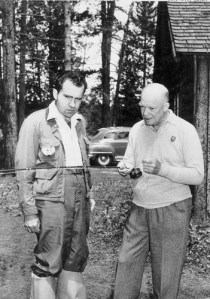
Ike and Dick fishing at Camp David
Kennedy points out two other more serious misstatements in the review. In the paragraph above, Scarborough suggests that Lyndon Johnson’s insecurities stemmed from Jack Kennedy’s mistreatment and that led Johnson to humiliate his own Vice President Hubert Humphrey. Scarborough isn’t really clear about this, but he seems to be drawing analogies to the Eisenhower-Nixon relationship. He seems to claim–perhaps based on his reading of Frank’s book–that Nixon’s neuroses stemmed from his difficult relationship with Eisenhower. But Nixon was a psychologically troubled person long before he met Ike and suggesting otherwise is inaccurate. Likewise, Johnson had plenty of psychological issues before he got involved with Jack Kennedy. Dan Kennedy writes:
As anyone who’s read Robert Caro’s “The Passage of Power” knows, Johnson, like Nixon, suffered from a world-class case of insecurity long before he ever met John Kennedy. The truth is the opposite of what Scarborough claims: both Nixon and Johnson were uniquely unsuited to suffer the slights that are inherent to the vice presidency long before they assumed the office.
Finally, Kennedy points out the ludicrousness of the following passage from the Scarborough piece:
A fascinating subplot in Frank’s story details Nixon’s role in pushing the administration on the issue of civil rights. Long criticized as the author of the Republican Party’s racially tinged “Southern strategy,” Nixon is shown by Frank to be a determined advocate for the Civil Rights Act of 1957, as well as a trusted ally of Martin Luther King Jr. and Jackie Robinson.
Yes, Nixon was supportive of Martin Luther King during the 1950s, and did try to get Eisenhower to push for African American civil rights, but Scarborough completely ignores Nixon’s later rejection of King during the 1960 presidential campaign and his [Nixon’s] development of the “Southern Strategy” in 1968. If those later events weren’t included in Frank’s book, a competent reviewer would have called attention to them. In fact, if Scarborough had googled, he could have quickly found an article by Franks himself that points out Nixon’s later involvement in blatant racism. Franks writes in The Daily Beast, January 21, 2013:
There once was a real connection between the two men, but it more or less ended with RN’s spineless behavior during the 1960 presidential campaign, after Dr. King was arrested on phony charges stemming from a traffic violation. Coretta Scott King had been terrified; she worried with good reason that her husband might be killed en route to Georgia State Prison in Reidsville, and she appealed to the Nixon and John F. Kennedy campaigns to intervene.
Nixon, however, demurred; he said that it would be “grandstanding” to speak out, according to his aide William Safire. Nixon’s real motive, though, seems clear: it was a close election and he was willing to lose black support if it meant gaining a new harvest of white votes in the once-Democratic south. Eight years later, this approach became the carefully considered “Southern strategy.”
The Kennedy brothers then stepped in to help King.
John and Robert Kennedy helped to win Dr. King’s release, and soon enough their campaign distributed two million copies of a pamphlet titled “‘No Comment’ Nixon Versus a Candidate With a Heart, Senator Kennedy” to well chosen voters. It can’t be proved that this made the difference in an election in which the popular vote turned out to be the closest ever (Nixon and Kennedy were separated by about 112,000 votes out of sixty-nine million cast), but it’s a fact that President Eisenhower in 1956 got some 40 percent of the black vote and that Nixon in 1960 won just 32 percent—not bad by modern Republican standards, but still a steep drop. Four years later, facing Barry Goldwater, Lyndon Johnson won 94 percent of the black vote, which set a demographic pattern that endures.
We already knew that Morning Joe doesn’t understand economics; we now know he’s history-challenged as well. In addition, I have some problems with the clarity of his writing. Here are a couple of examples.
Paragraph 2 begins:
Franklin Roosevelt’s vice president memorably said that being No. 2 was in effect not worth a bucket of warm spit.
Which vice president? FDR served with three: Henry A. Wallace, John Nance Garner, and Harry S. Truman. If you said John Nance Garner, you’re correct. And he didn’t qualify the judgment with “in effect” either. Was Scarborough just to lazy to look up the quote?
This reminds me of problems that many college freshmen have in their writing–they either don’t provide enough context or they assume knowledge the reader may not have. They also tend to use unnecessary qualifications instead of just making straightforward statements.
In paragraph 3, Scarborough writes:
“Ike and Dick” is a highly engrossing political narrative that skillfully takes the reader through the twisted development of a strange relationship that would help shape America’s foreign and domestic agenda for much of the 20th century.
Really? Perhaps that judgment came from the book; but it’s a pretty sweeping statement that needs to be backed up with specific examples. But Scarborough doesn’t offer any. When he does provide more context, as he does in paragraph 5, he leaves out important details. He briefly mentions a “secret Nixon fund” that led to Eisenhower trying to dump Nixon from the ticket in 1952, and says that Nixon survived; but Scarborough never even mentions what saved him–the Checkers speech!
The entire review is only a little over 1,000 words. Surely Scarborough could have added a few more historical details and specific examples to back up his assertions.
If I were grading this review for a college course, I’d probably have to give it a C+, or maybe a B- in these days of grade inflation. The grammar and sentence structure are okay; but the review itself is short on context, the historical inaccuracies are problematic, and the lack of specific examples makes for rather boring reading. Frankly, I’m disappointed in the New York Times for publishing it.
Science-Challenged Alabama Republican Explains Reproduction
Posted: February 19, 2013 Filed under: open thread, U.S. Politics, War on Women, Women's Healthcare, Women's Rights | Tags: Alabama House of Representatives, anti-abortion legislation, Mary Sue McClurkin 18 Comments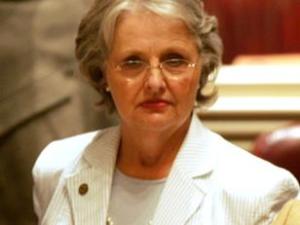
Alabama State Rep. Mary Sue McClurkin
WARNING: Please don’t drink any liquids before reading this post.
Via Jezebel, the Montgomery Advertiser is reporting that the Alabama House of Representatives is scheduled to
take up abortion legislation Tuesday that supporters claim will protect patients in clinics and opponents claim will close down abortion providers.
The legislation, sponsored by Rep. Mary Sue McClurkin, R-Pelham, would require physicians at abortion clinics to have admitting privileges at local hospitals; require clinics to follow ambulatory clinic building codes and make it a felony — punishable by up to 10 years in prison — for a nurse, nurse practitioner or physician’s assistant to dispense abortion-inducing medications.
You can read the text of the bill here. According to McClurkin the reasoning behind enforcing strict regulations on abortion is that the fetus is a large “organ.”
“When a physician removes a child from a woman, that is the largest organ in a body,” McClurkin said in an interview Thursday. “That’s a big thing. That’s a big surgery. You don’t have any other organs in your body that are bigger than that.”
Funny how when you have other organs removed–like say your appendix–they don’t stay around expecting you to feed and clothe them and pay for their educations. Katie J.M. Baker of Jezebel writes:
My liver, heart, and skin are all very excited that we are now giving organs personhood rights, although the latter is slightly upset about losing out on its “largest organ in the human body” rep.

Of course the sponsors of this and other such anti-abortion legislation claim that they’re just trying to make the procedure safer for women–never mind the fact that abortion is one of the safest medical procedures available. But it’s difficult to see how this part of the bill would accomplish that goal:
McClurkin’s bill includes a provision that requires physicians to ask patients younger than the age of 16, the name and age of the father of the child, and to report to law enforcement if the father is two years older than the minor.
If the patient is younger than 14, the clinic would be required to report the incident to the Department of Human Resources.
But then safety isn’t really the point, is it? The point is to eliminate abortions or at least make them as difficult as possible to obtain. That will lead to women seeking out dangerous illegal abortions or resorting to do-it-yourself measures.
This is an open thread.

 peej
peej Carissa
 bostonboomer
 dakinikat
 ecocatwoman
 mablue2
 Mama Lopez
 peggysue22
 quixote
 skydancingguestblogger
 Mona (aka Wonk the Vote)



 Sky Dancing
Recent Comments