Posted: June 5, 2014 | Author: bostonboomer | Filed under: morning reads, U.S. Politics | Tags: 60 Minutes, Benghazi, Bowe Bergdahl, CBS News, Chester Nez, Hailey Idaho, Harrier AV-8B, Hillary Clinton, Imperial CA, Jane Drussel, Lara Logan, Matt Drudge, Navaho code talkers, Oregon, People Magazine, right wing hate, Southern Poverty Law Center, White supremacists |
 Good Morning!!
I’m pretty wiped out this morning, so this won’t be an extensive post. My mom is doing okay, but she needs help with a lot of things. This morning we’re going to have to deal with the Comcast people. It would really help if she could watch TV or listen to the radio! This afternoon I have to take her to the doctor, and then we might have to go back to the emergency room to have them put on a looser splint. They told us to do that if the one she has starts to feel too tight. But enough of my problems; let’s see what’s in the news.
The Bowe Bergdahl story gets more disgraceful with each passing day. Last night, via Little Green Footballs, NBC News reported that officials in Bergdahl’s hometown of Hailey, Idaho, had been
deluged with angry calls from people who think that Bergdahl is an Army deserter or traitor who doesn’t deserve a hero’s welcome.
Jane Drussel, the president of the Hailey Chamber of Commerce, has been fielding dozens of angry calls.
“Well, (I feel) disappointment number one, just absolutely total surprise at how bad some of them are,” she told NBC News on Tuesday….
Drussel said many of the calls are cancelling trips to the town of about 8,000.
“Well, number one is, how dare we as a community support someone who in their mind they’re thinking of as a ‘deserter,’ a traitor. That they had plans to come here on their vacation, they’re no longer coming, they’re cancelling their reservations.”
“I just find that shocking,” she said. “You know, we’re Americans, and we need to act like Americans, and to me that’s un-American. Let things play out, and if there needs to be action taken, I’m sure it will be taken. But that’s not the city of Hailey’s responsibility.”
As a consequence of the threatening calls, the town has cancelled the welcome home celebration they had been planning. According to the Washington Post, the reason for the cancellation is concern for “public safety.” The small town of 8,000 people simply can’t handle an event that might attract a large number of angry protesters.

The right wing focus on Bergdahl hasn’t kept them from carrying on the meme that Hillary Clinton is old and disabled. The former Secretary of State is pictured on the cover of People Magazine this week smiling broadly and holding onto a deck chair. But the inimitable Matt Drudge has a different theory. From Bob Cesca at the Daily Banter: Drudge Wonders if Hillary Clinton Used a Walker on People Magazine Cover.
Oh, Drudge, you magnificent bastard. There are very few right-wing trolls who are better than Matt Drudge at manufacturing an odious whisper campaign, and he didn’t disappoint today. Drudge posted the new People Magazine cover featuring Hillary Clinton, then wondered whether she was holding onto, wait for it, a walker. You know, like an old lady with brain damage. Wink, wink.
Of course he didn’t say it outright. He used the nefarious “Cavuto Mark” — a question mark at the end of a deliberately leading statement, made famous by Fox News Channel.
Yesterday afternoon, Reuters reported: Last of Navajo ‘code talkers’ dies in New Mexico.
The last of 29 Navajo Americans who developed an unbreakable code that helped Allied forces win the second World War died in New Mexico on Wednesday of kidney failure at the age of 93.
Chester Nez was the last remaining survivor of an original group of 29 Navajos recruited by the U.S. Marine Corps to create a code based on their language that the Japanese could not crack.
His son, Michael Nez, said his father died peacefully in his sleep at their home in Albuquerque….
About 400 code talkers would go on to use their unique battlefield cipher to encrypt messages sent from field telephones and radios throughout the Pacific theater during the war.
It was regarded as secure from Japanese military code breakers because the language was spoken only in the U.S. Southwest, was known by fewer than 30 non-Navajo people, and had no written form.
The Navajos’ skill, speed and accuracy under fire in ferocious battles from the Marshall Islands to Iwo Jima is credited with saving thousands of U.S. servicemen’s lives and helping shorten the war. Their work was celebrated in the 2002 movie “Windtalkers.”
May he rest in peace.

Despite all the controversy over her faulty reporting on Benghazi, Lara Logan is “back at work on CBS News’ 60 Minutes,” according The Hollywood Reporter.
The news ends a suspension that began last fall after an erroneous60 Minutes report on the Sept. 11, 2012, attacks on the U.S. mission in Benghazi that resulted in the death of AmbassadorChristopher Stevens and three other U.S. personnel. Logan had a handful of pieces in the works when she was suspended last November after her report that relied on a now-discredited interview with security contractor Dylan Davies.
She has been eager to return to work, say sources close to the correspondent, but the Benghazi report undermined her status as one of the veteran newsmagazine’s biggest stars and created a media feeding frenzy that unearthed a strident speech she gave a month after the Benghazi attacks in which she advocated for military intervention in Libya and asserted that the Obama administration was downplaying the threat from Al Qaeda.
At the time of her suspension last November, CBS News chairman and 60 Minutes executive producer Jeff Fager told THR that the report was a “black eye” for the venerable newsmagazine, still the most watched of its genre.
A CBS News spokesperson confirmed that Logan has returned to work. 60 Minutes typically takes something of a production hiatus during the summer months, with new pieces sprinkled throughout a schedule that includes reruns and updates of previously aired segments. Logan likely will not be seen on60 Minutes until the fall, sources tell THR. But she’ll begin appearing on other CBS News broadcasts such as the CBS Evening News and CBS This Morning in the coming weeks.
I guess we already knew that CBS is no longer a serious news organization. This is just one more piece of confirming evidence.
From the Southern Poverty Law Center, Massive Investigation Uncovers White Supremacist Criminal Network in Oregon.
“Operation White Christmas,” as the year-old investigation is code-named, so far has resulted in the arrests of 54 individuals, mostly in the Portland area, leading to 11 criminal cases in state court and another 43 in federal court.
As for its scope, the investigation based in Portland and Multnomah County rivals the prosecutions of members of another violent gang, the Aryan Brotherhood of Texas.
The Oregon suspects variously are affiliated with at least five known street and prison white supremacist gangs – European Kindred (EK); Rude Crude Brood; All Ona Bitch (AOB); Fat Bitch Killers (FBK) and Insane Peckerwood Syndicate (IPS), authorities say.
“The scope of this case is by far the largest ever undertaken by this agency in recent memory, based on the number of suspects investigated, the number of persons arrested and the amount of guns recovered,” Lt. Ned Walls, the investigations division supervisor for the Multnomah County Sheriff’s Office, told Hatewatch.
What initially began as an investigation of drug and firearms trafficking by white supremacist gangs blossomed into a broader probe of robberies, home invasions, burglaries, kidnapping, assaults, shootings and witness intimidation, Walls said. Some of the crimes involved gang-on-gang violence.
“The Multnomah County Sheriff’s Office would have had an impossibly hard time trying to conduct this investigation on our own,” Walls said. The department, he said, got “outstanding collaborative” support and involvement from the federal Bureau of Alcohol Tobacco, Firearms & Explosives, the Clackamas and Washington County Sheriff’s Offices in Oregon, the Portland Police Bureau, the Gresham, Ore., Police Department, Klickitat County, Wash., Sheriff’s Office, the U.S. Attorney’s Office in Oregon and the Multnomah County District Attorney’s Office.
It’s good to know the Feds are seriously investigating right wing domestic terrorists, but it sounds like the investigation was initiated by local law enforcement.
A military plane crashed in a residential neighborhood in California yesterday afternoon. From the AP, via the Visalia Times-Delta:
IMPERIAL – A Marine jet crashed into a residential area in a Southern California desert community Wednesday, exploding and setting two homes on fire. The pilot ejected safely, and there was no immediate word of any injuries on the ground.
The Harrier AV-8B went down at 4:20 p.m. in Imperial, a city of about 15,000 near the U.S.-Mexico border about 90 miles east of San Diego. Witnesses described an explosion and thick plumes of smoke.
“It felt like a bomb was thrown in the backyard of the house,” said Adriana Ramos, 45, whose home is less than a block from the crash scene. “The whole house moved.”
Ramos fled with her 4-year-old granddaughter and 10-year-old daughter, who both cried at the sight outside….]
At the crash site, there was chaos as people ran in every direction, he said. The two homes were on fire and it was unclear if anyone was inside.
The plane was from Marine Corps Air Station Yuma in Arizona, said Cpl. Melissa Lee, a spokeswoman for Marine Corps Air Station Miramar. She had no details about what might have caused the accident.
As of this morning, no injuries have been reported. You can see video of the scene at The Week Magazine.
I have a few more links for you that I’ll post in the comment thread, and I hope you’ll do the same. What stories are you following today?
Did you like this post? Please share it with your friends:
Posted: June 2, 2014 | Author: bostonboomer | Filed under: Foreign Affairs, morning reads | Tags: body language, Brian Williams, David Ignatious, deception, Edward Snowden, Fareed Zakaria, Glenn Greenwald, Greensnow cult, Jeff Darcy, King Juan Carlos, Mount Rainier, mountain climbing, risk-taking behavior, Spain |

Good Morning!!
It’s another slow news day so far. Google’s top story is that the king of Spain Juan Carlos abdicating in favor of his son. Silly me, I didn’t even know Spain was a monarchy.
From USA Today, Game of thrones: Spain’s king Juan Carlos abdicates.
Carlos, who turned 76 in January, said that he was handing power to Felipe, 46, in order to “open a new era of hope combining his acquired experience and the drive of a new generation.”
Some Spaniards said they had been waiting for it.
“This is part of an expected chronology (of events),” said Alberto Garzon, a lawmaker in the Spanish parliament and author of the book The Third Republic — about a future Spain without a monarchy.
Carlos has enjoyed high popularity for decades but in the past few years his approval ratings fell sharply after a series of personal blunders. He took an expensive African safari during the height of the euro crisis. His daughter, Princess Cristina, has been indicted for embezzlement and her husband stands accused of tax evasion and money laundering.
BBC News summarizes the reasons in a video: Why is King Juan Carlos of Spain abdicating? In 45 secs.

Liberty Ridge, Mount Rainier
This is a sad story, but perhaps not too surprising: Six Climbers Presumed Dead After Long Fall On Mount Rainier. From Northwest Public Radio:
Two experienced guides and four clients are presumed dead after what the National Park Service estimates was a 3,300 foot fall. The climbers were on their way down the mountain after an unsuccessful summit attempt via the difficult Liberty Ridge route on the northwestern side of Rainier.
An aerial and ground search happened Saturday after the group failed to return to their trailhead on schedule. From a helicopter, searchers spotted climbing gear at the base of a rock and ice fall and detected personal avalanche beacons. But the spotters saw no signs of life. A statement from Mount Rainier National Park says no attempt to recover bodies will be made until later in the season because of ongoing danger at the scene at the head of Carbon Glacier.
Interestingly, the guides involved worked for Alapine Ascents, the same Seattle company as some of the Sherpas who died on Mount Everest last month.
I’m not a risk-taker, and I will never understand why people want to get involved in such dangerous sports. But there are people who love to live on the edge and would rather die young doing something they love than live safely into old age.
It is a little-known fact that quite a few people actually die in National Parks every year. Oddly, I don’t like risky activities, but I do like to read books about them; and there are whole books about the different ways people have died in National and State Parks.
According to National Geographic, the dangerous ridge the climbers were using has been involved in numerous accidents in the past.
It’s called Liberty Ridge: a steep ramp of rock, snow and ice splitting a northern face of the 14,410-foot mountain in Washington State. Its stunning views and technical difficulty—hard but not too hard, experts say—have earned it a place in the book Fifty Classic Climbs of North America.
But its remoteness, steepness and exposure to the elements have also made Liberty Ridge the scene of epic rescues and more than its share of deaths….
“When you hear Liberty Ridge, it is a serious route… it’s not a casual route,” said Mike Gauthier, a climbing ranger at Mount Rainier National Park from 1990 to 2008 who was repeatedly called to the spot to rescue stranded climbers and search for missing people….
In his time on the mountain, Gauthier was repeatedly called to Liberty Ridge to rescue stranded climbers or search for missing people who didn’t survive. Often, the scene was on the ridge’s upper reaches, where the mountain is unremittingly steep, leaving few sheltered places to pitch a tent or to hide from avalanches or falling rocks.
“It’s just not an ideal location to hang out because you’re threatened there. You’re just exposed,” said Gauthier, who wrote the main guidebook for the mountain, Mount Rainier: A Climbing Guide.
Gauthier didn’t want to speculate about the group of missing climbers but said a camp at 2,800 feet would have been in a section where climbers have often run into trouble.
 At the LA Times, Maria L. LaGanga writes about the psychology of people who are drawn to mountain climbing: For some climbers, Mt. Rainier’s often deadly allure is irresistible.
“There is a draw, but I can’t explain it,” said Len Throop, owner of Eatonville Outdoor, who has climbed Rainier many times but never crested the summit. “From the first time I ever saw it, I felt a connection.
Even if you can’t see it, you know it’s there. And it’s dangerous. This week is one example, and it’s not even the worst.”
The worst accident came in June 1981, when 11 climbers died under giant chunks of ice….
Rainier has the largest system of glaciers in the United States outside of Alaska. The challenging terrain requires skill, stamina and equipment. Climbers must wear crampons, spiked implements that give their boots traction, and wield ice axes that help them arrest their slide down the mountain if they slip. They are often tied to their climbing mates for safety.
“It’s like being on a stair stepper at a steep angle for 10 hours, and that’s for just a normal route,” Grigg said. Liberty Ridge, the route the ill-fated climbers took last week, “is one of the most difficult on the mountain.”
Read the rest if you’re as interested in human behavior as I am. Apparently the climbing has to be done in the middle of the night with headlamps; so I guess the climbers don’t even see the view while they’re working their way up the mountain.
 Last night I watched most of Brian Williams’ interview with Edward Snowden. I still have to watch the final two segments, because I ran out of patience for being lectured to by a narcissistic 30-year-old. I’ll watch the rest today.
I’m not an expert at detecting deception, but I did notice that Snowden didn’t look a Williams during most of his responses to questions. He tended to look down and to the left as he spoke.
Michael B. Kelley of Business Insider asked a body language expert to review the video of Snowden and Williams.
Before Edward Snowden’s interview with NBC’s Brian Williams, body-language expert Dr. Nick Morgan considered Snowden a young guy who got a hold of a bunch of classified documents and was just telling his story about exposing intrusive American surveillance. “I came away [from the NBC interview] with a very different impression,” Morgan, a top U.S. communication theorist and best-selling author, told Business Insider. ”
As a body-language expert, I’d say this is a disingenuous performance, which surprised me.”
Morgan suggested that Snowden gave a studied performance, deliberately “subordinating himself” to Willams–as a way of sucking up and avoiding tough questions? Morgan also thought that Snowden had altered the pitch of his voice to make it lower than is natural for him.
A particularly telling moment came when Brian Williams asked Snowden, “What is your relationship with the host government?” Morgan, who didn’t previously know that Snowden’s Moscow lawyer is a Putin loyalist linked to the FSB, was struck by Snowden’s lack of eye contact and the slowing of his voice as he denied having any relationship with the Kremlin. “He was obviously lying,” Morgan said.
Frankly, anyone who believes that Snowden has no relationship with the Russian government (his lawyer works for the FSB!) is either incredibly ignorant or in deep denial.
RalphB called my attention to this interview with David Ignatious by Fareed Zakaria yesterday. Ignatious has a close relationship with the intelligence community, so I believe his assessment is worth looking at.
You mentioned there the damage to American values of the war on terror. How can America recover, and how hard is that going to be when Washington appears so divided? ….
Surveillance is an example. Because of the unexpected intervention of Edward Snowden, we are now in a period of experimentation with an alternative approach to surveillance.
I’m not someone who thinks Snowden is a hero. He promised to keep secrets, and he – despite his claim that he attempted to warn the NSA legally as a whistleblower – it’s clear that he took many of the nation’s most precious secrets with him and began distributing them to undermine what he thought were unconstitutional programs.
In our country, Congress and the courts have that responsibility for deciding what’s legal – not individual citizens. So it’s hard for me to see Snowden as a hero.
We don’t know the damage that comes from Snowden’s revelations. We may never really know that. But we do know one positive consequence, which is a searching national debate. As a result, we are now likely to experiment with a much less intrusive system of surveillance for our country.
Rather than the NSA holding our metadata for 5 years, the data will be held by communications companies for a year or two, and released by them only if there’s a court order.
Congress seems united in wanting this new approach, and we’ll see whether it works. Sometime in the future it will be urgent and essential to know who a terrorist in a safe haven in Syria was calling when in the U.S. Will we be able to know? Will the system we have put in place be sufficient to ensure the country’s security? I sure hope so. I’m sure it’s being designed with that in mind.
It would be terrible if we learn the results of the upheaval through another terrorist attack in a major U.S. city. After what we went through in Boston last year–and the aftermath continues–I certainly hope not.
Clearly, Snowden’s goal in giving an interview to Williams, who is not known for asking tough questions, was to improve his image in the U.S. and around the world. Predictably, he is now trying again to press his case for asylum in Latin America. From The Moscow Times:
“If Brazil offers me asylum, then I’ll gladly accept it. I would like to live in Brazil,” Agence France-Presse quoted Snowden as saying in an interview with Brazilian television channel Globo….
In a lengthy open letter published in the Brazilian press in December, he praised the Brazilian government for its stance against spying practices and volunteered to help the country in its investigation of NSA spying tactics if he were granted asylum.
I don’t think Ed should get his hopes up. I’d be shocked if Russia lets him go–to the U.S. or any other country.
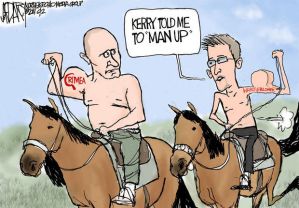
I’ll end with this column and cartoon from Cleveland.com’s Jeff Darcy: Snowden follows Kerry’s advice.
Snowden likely did the interview to soften U.S. public opinion about him, but I doubt the answers he gave will alter the public’s view of him as either a traitor or whistle blowing hero. It’s possible to believe both that the NSA went to [sic] far and crossed the line and that Snowden was wrong in how he leaked that information.
In the interview Snowden claimed he was trained as a spy, given a false job title and false name. Brian Williams failed to ask the obvious follow up question: What was the fake name, James Bond, Austin Powers, Maxwell Smart or Benedict Arnold? The government’s answer is that Snowden was just an IT specialist contractor for the NSA. The truth is probably somewhere in between. What is certain, is that he should have never been hired and given security clearance.
When Snowden said that he was only in Russia because his passport was yanked, and he had planned to fly to Cuba, then on to Latin America, he failed to mention the Latin American countries on his destination list aren’t exactly known for their commitment to democratic freedoms and constitutional protections.
Snowden also gave weak answers to questions about national security damage caused by his leaks and why he didn’t share his concerns with Congress or other channels that would not have opened him up to treason charges….
Instead of talking to Brain Williams in Russia in 2014, Snowden should have been talking years earlier, to appropriate members of Congress about his concerns, or gone on “60 mins” or “Dateline” in disguise and blown his whistle.
Snowden defenders argue that if he were to come back to the U.S. he would never be seen again or at the very least, would never be able to have his case heard at a fair trial. I doubt that. Snowden has become too high profile and Kerry has now put the country on record in a very public way,that Snowden would be assured his day in court.
I totally agree. The Greensnow cult members who claim Snowden would disappear into a torture chamber if he came back here are full of it. In this country, public opinion–if it is loud and persistant enough–has an effect. The U.S. is not yet a “surveillance state”–even Snowden admitted that in the interview–and it’s not a dictatorship either, despite the Greensnow cult’s “chicken-little” attitude.
So . . . what are you reading and blogging about today? Please post your links in the comment thread.
Did you like this post? Please share it with your friends:
Posted: May 31, 2014 | Author: bostonboomer | Filed under: Crime, FBI, Hillary Clinton, metadata, morning reads, NSA, National Security Agency, Rape Culture, Real Life Horror, U.S. Politics, Violence against women | Tags: Edward Snowden, George Packer, Glenn Greenwald, Jonathan Chait, Margaret Sullivan, Michael Kinsley |
Good Morning!!
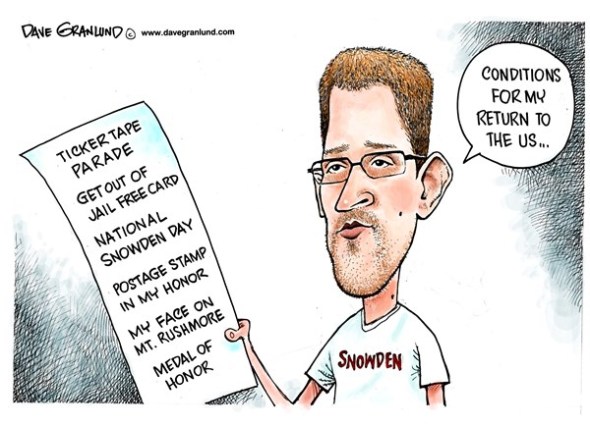
I stole the above Dave Granlund cartoon from JJ’s Friday night post, because it perfectly expresses my viewpoint on who and what Edward Snowden is. I’ll have the latest Snowden news for you in a minute, but first a personal update and some breaking Boston bombing news.
I’m in Indiana visiting my mom for a couple of weeks. The weather is gorgeous here, and I’m really enjoying it. It’s great to be out of the drizzly cold weather the Boston area has been having. I’m looking forward to doing quite a bit of yard work, helping my mom buy a new bed, celebrating her 89th birthday with her, and just generally enjoying her company.
As usual, I drove my car out here, and I made great time. The speed limits have been increased to 70 mph in Ohio and Indiana, and everyone in Massachusetts and New York routinely drives at least 10-15 miles over the 65 mph limit. So I probably averaged around 70-75 mph on the trip.
My mechanic told me that I need to start using premium gas in my car. I hated to do it, but to my surprise I got much better mileage with the expensive gas. I used 2-1/2 tanks of gas to go more than 900 miles. Usually it takes 3 full tanks and a little more to make the trip!
As I mentioned above, some Boston bombing news broke last night. From The Boston Globe: Man charged with obstructing bombing probe.
A cab driver from Quincy who was close to the two suspected Boston Marathon bombers was arrested Friday on charges of lying to investigators and destroying evidence, allegedly obstructing the ongoing investigation of the 2013 attack that shocked the city and the nation.
Khairullozhon Matanov, a 23-year-old Kyrgyzstan national, allegedly contacted Tamerlan Tsarnaev 42 minutes after the April 15, 2013, bombings, and he bought him and his younger brother, Dzhokhar Tsarnaev, dinner at a restaurant that night. Matanov visited Tamerlan, whom he knew from playing soccer and from places of worship, at the suspected bomber’s Cambridge home two days later.
Over several days after the bombings, he also called the brothers repeatedly.
Authorities alleged in a sweeping indictment unsealed Friday that Matanov realized the FBI would want to interview him about his relationship with the suspected bombers, but that he deleted files from his computer and tried to get rid of his cellphones. They also allege that he lied to investigators about his encounters with the brothers in the days after the bombings.
Matanov discussed his friendship with the Tsarnaev brothers with others in the days following the bombing, but he claims that they didn’t confess their involvement to him. Apparently, the FBI knew about all this a year ago; it’s not clear why they waited until now to charge Matanov. I’ll be keeping my eye on this story.
Now the latest on the Snowden Operation.

Edward Snowden has been dominating the news for the past few days because of the interview he gave to NBC’s Brian Williams and the recent release of Glenn Greenwald’s book on his collaboration with Snowden in releasing classified NSA files. I have to admit up front that I haven’t yet been able to force myself to watch the interview. Frankly, I doubt if Williams asked any of the questions that I think Snowden should be asked; but I promise I’ll watch the thing today to find out for sure. Meanwhile, I’ve gathered some reactions from people who have watched it.
Frankly, I admit up front that I think Edward Snowden is a defector as well as an arrogant, grandiose, narcissistic jerk. But I think you all knew that already. With that said, here are the latest Snowden (and Greenwald) stories from my very biased point of view.
Last week there were a couple of high-profile negative reviews of Glenn Greenwald’s book No Place to Hide, one by George Packer and the other by Michael Kinsley. As you know, Greenwald doesn’t take criticism well, and he and his fans were not happy with either review. Packer’s review was the most scathing and carefully argued, but Kinsley is taking most of the heat from the Greenwald fan base, probably because the review was quite snarky. For example:
Greenwald was the go-between for Edward Snowden and some of the
newspapers that reported on Snowden’s collection of classified documents
exposing huge eavesdropping by the National Security Agency, among
other scandals. His story is full of journalistic derring-do, mostly set in
exotic Hong Kong. It’s a great yarn, which might be more entertaining if
Greenwald himself didn’t come across as so unpleasant. Maybe he’s
charming and generous in real life. But in “No Place to Hide,” Greenwald
seems like a self-righteous sourpuss, convinced that every issue is
“straightforward,” and if you don’t agree with him, you’re part of
something he calls “the authorities,” who control everything for their own
nefarious but never explained purposes….
Throughout “No Place to Hide,” Greenwald quotes any person or
publication taking his side in any argument. If an article or editorial in
The Washington Post or The New York Times (which he says “takes
direction from the U.S. government about what it should and shouldn’t
publish”) endorses his view on some issue, he is sure to cite it as evidence that he is right. If Margaret Sullivan, the public editor (ombudsman, or
reader representative) of The Times, agrees with him on some controversy,
he is in heaven. He cites at length the results of a poll showing that more
people are coming around to his notion that the government’s response to
terrorism after 9/11 is more dangerous than the threat it is designed to
meet.
Greenwald doesn’t seem to realize that every piece of evidence he
musters demonstrating that people agree with him undermines his own
argument that “the authorities” brook no dissent. No one is stopping
people from criticizing the government or supporting Greenwald in any
way. Nobody is preventing the nation’s leading newspaper from publishing
a regular column in its own pages dissenting from company or government
orthodoxy. If a majority of citizens now agree with Greenwald that dissent
is being crushed in this country, and will say so openly to a stranger who
rings their doorbell or their phone and says she’s a pollster, how can
anyone say that dissent is being crushed? What kind of poor excuse for an
authoritarian society are we building in which a Glenn Greenwald, proud
enemy of conformity and government oppression, can freely promote this
book in all media and sell thousands of copies at airport bookstores
surrounded by Homeland Security officers?
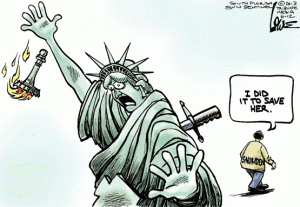
And so on . . . After Kinsley’s piece was published the Snowden cult, of which NYT public editor Margaret Sullivan is a charter member, reacted as usual with an over-the-top firestorm of rage. I’ll let Sullivan speak for the cult. She questioned the choice of Kinsley as reviewer and accused the long-time book-reviewer of arguing the only the government should decide whether classified government materials should be published. She apparently also felt that Kinsley showed insufficient deference to her idol Glenn Greenwald. I’d like to quote from Sullivan’s piece, but for some reason I can’t copy and paste from it. But here’s a reaction to the kerfluffle from Jonathan Chait: Times vs. Sullivan vs. Kinsley vs. Greenwald. Chait agrees with me that the Packer review is “more devastating.” Chait thoroughly skewers Margaret Sullivan, and she can’t attack him because he didn’t do it at the NYT.
It’s certainly true that Kinsley is more effective [than Packer] at poking a hole in Greenwald’s argument than in making the case for his own (obviously problematic) alternative. That would seem to be fair enough given that he’s writing a review of Greenwald’s book. Not to Sullivan, who sprung into action, using her public editor’s column to scold Kinsley. His review “expressed a belief that many journalists find appalling,” she wrote, aghast. Also, “there’s a lot about this piece that is unworthy of the Book Review’s high standards, the sneering tone about Mr. Greenwald, for example.” No sneering in the book review!
Paul writes back to Sullivan — in a rebuttal posted at the bottom of Sullivan’s item — to say, more or less, “let me explain to you what what a book review is”:
It seems there is a lot of confusion on the Internet, especially among those who do not work in the media but even — disturbingly — within the media, about the differences between an editorial and a book review, between what “The New York Times” says and what a reviewer for The New York Times Book Review says. …
For a reviewer to address how a writer comes across, particularly in a memoir or first-hand account, is entirely fair game for a book review, and by no means an ad hominem attack.
The notion that it’s wrong for the book review to print abhorrent reviews, let alone to poke fun at no less a hero than Glenn Greenwald, is an artifact of the culture of smugness that Kinsley is writing about here. If there’s one thing objective journalists are allowed — indeed, expected — to hold extremely strong opinions about, other than the importance of reducing the budget deficit, it’s the importance of journalists themselves. How dare a newspaper publish a review expressing skepticism about special rights for journalists?
Just for balance, here is a fairly non-judgmental summary of the overall “controversy” at the Neiman Report.
Finally, Kinsley’s response to Margaret Sullivan
Since I haven’t yet watched the Snowden interview with Brian Williams, I’ll give you what I think is the best response I’ve seen so far from Kurt Eichenbaum at Newsweek: 16 Questions Edward Snowden Wasn’t Asked. This article is must-read–if only I could quote the whole thing! Here’s a small sample:
1. Most of the information that has been revealed from the documents you obtained dealt with the abilities, rather than the actions, of the NSA. Did you see or do you have any evidence that the agency was, in fact, spying on Americans who were not linked to terrorist organizations through what is known as the “three-hop” standard? (Under this rule, one of 22 NSA officials must give approval to an analyst who believes a “reasonable, articulable suspicion” exists that a number is directly linked to terrorists. Then the analyst is allowed to determine through searches of metadata which phone numbers were called by the first number. The NSA can then determine the numbers called by the second phone, and the numbers called by the third. The intent is to see if numbers called in the United States by phones directly connected to terrorists will reveal terrorist operatives inside the country.)
5. Did you see or do you have evidence of the NSA reading content of emails sent by Americans or listening to phone calls of Americans without meeting the standards required by the national security courts known as FISA courts?
10. Do you believe that surveillance in foreign nations is intrinsically wrong?
11. You say that you do not believe your actions damaged United States security and that the government has failed to reveal instances where it did. Two questions: What kind of analysis did you conduct to be sure that the information you were taking did not compromise security? And, secondly, given that journalists do not have security clearances, why did you think they were the best placed to Click here and determine what would compromise national security and what didn’t?
Please go read the rest. It sounds like Brian Williams pretty much avoided asking Snowden any hard questions at all.
A few more quick headlines:
NBC News (Irony alert!): Russia Web Journalism Award Named For Edward Snowden.
More horrendous gang rapes in India–from Reuters India: Home minister seeks report on grisly rape, hanging of teens in Uttar Pradesh.
Exclusive: The Daily Banter’s Investigation Helps Catch Sandy Hook Memorial Thief.
Hilarious must-read from Politico: NSA releases Snowden memo.
Oliver Willis: Republicans already handing the White House to Hillary Clinton.
Those are my offerings for today. What are you reading and blogging about? Please share your links on any topic in the comment thread.http
Did you like this post? Please share it with your friends:
Posted: May 26, 2014 | Author: bostonboomer | Filed under: Crime, Mental Health, misogyny, morning reads, racism, social justice, U.S. Politics, Violence against women, War on Women | Tags: Caroline Janney, Civil War, Confederate Memorial Day, David Blight, Decoration Day, elliot rodger, freed slaves, Isla Vista mass murder, Memorial Day history, Ta=Nehisi Coates, Veterans |

Good Morning!!
A few days ago, I read an article about the “true meaning of Memorial Day.” I can’t find it now, but it was in the Chicago Tribune. The author wrote that Memorial Day began as “Decoration Day,” when Southern women decorated the graves of Confederate soldiers. I Googled some more and found other writers making the same claim. Here’s a piece by a Civil War historian from Purdue University Caroline Janney:
Many may not know the holiday weekend that marks the start of summer by paying respects to veterans and remembering loved ones began when white Southern women took a leadership role in honoring their Civil War veterans, says a Purdue University historian.
“After the Civil War, southern men would have appeared treasonous if they had organized memorials to honor their fallen, so women – perceived as apolitical – instead organized tributes and events that set the tone for how the country celebrates Memorial Day today,” says Caroline E. Janney, professor of historyand president-elect of the Society of Civil War Historians. “In 1866, the men were figuratively hiding behind the skirts of these women who worked together as part of Ladies’ Memorial Associations.”
The women organized dozens of memorials during the spring of 1866 and the following years, Janney says. Historically these memorials were scheduled throughout the spring as a sign of renewal and rebirth, and each community chose its own date to celebrate.
The date usually reflected a key date in the Civil War, such as the May 10 death of Gen. Thomas “Stonewall” Jackson, or a battle close to the association’s individual area. Memorial Day became more unified when larger associations, such as the United Confederate Veterans and United Daughters of the Confederacy, began organizing memorials in the 1890s. And memorial days also were observed in the North, but they were organized by Union veterans beginning in 1868, two years after the ex-Confederate women had established the practice.
I was surprised, because I had read years ago that the practice was begun by former slaves who wanted to honor Union soldiers. I found the above photo on Facebook–with the suggestion that it was taken on that first Decoration Day May 1, 1865; but I can’t be absolutely certain that’s accurate. Note that that dates is a year earlier than the one Janney writes about. It turns out that a number of places and people claim to have started the practice of decorating Union and Confederate Graves. Southerners designated “Confederate Memorial Days.” Kingston, Georgia claims to have held the first one.
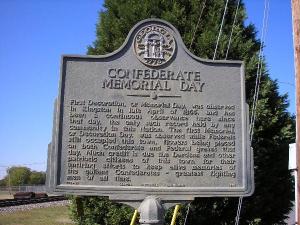
Yale historian David Blight wrote about the disputed origins of Memorial Day in the New York Times in 2011.
Officially, in the North, Memorial Day emerged in 1868 when the Grand Army of the Republic, the Union veterans’ organization, called on communities to conduct grave-decorating ceremonies. On May 30, funereal events attracted thousands of people at hundreds of cemeteries in countless towns, cities and mere crossroads. By the 1870s, one could not live in an American town, North or South, and be unaware of the spring ritual.
But the practice of decorating graves — which gave rise to an alternative name, Decoration Day — didn’t start with the 1868 events, nor was it an exclusively Northern practice. In 1866 the Ladies’ Memorial Association of Columbus, Ga., chose April 26, the anniversary of Gen. Joseph Johnston’s final surrender to Gen. William T. Sherman, to commemorate fallen Confederate soldiers. Later, both May 10, the anniversary of Gen. Stonewall Jackson’s death, and June 3, the birthday of Jefferson Davis, were designated Confederate Memorial Day in different states.
Soon the yearly practice became partisan:
In the South, Memorial Day was a means of confronting the Confederacy’s defeat but without repudiating its cause. Some Southern orators stressed Christian notions of noble sacrifice. Others, however, used the ritual for Confederate vindication and renewed assertions of white supremacy. Blacks had a place in this Confederate narrative, but only as time-warped loyal slaves who were supposed to remain frozen in the past.
The Lost Cause tradition thrived in Confederate Memorial Day rhetoric; the Southern dead were honored as the true “patriots,” defenders of their homeland, sovereign rights, a natural racial order and a “cause” that had been overwhelmed by “numbers and resources” but never defeated on battlefields.
Yankee Memorial Day orations often righteously claimed the high ground of blood sacrifice to save the Union and destroy slavery. It was not uncommon for a speaker to honor the fallen of both sides, but still lay the war guilt on the “rebel dead.”
But Blight discovered in a historical archive at Harvard University that the earliest celebration of “Decoration Day” was organized by freed slaves in Charleston, South Carolina in 1865.
During the final year of the war, the Confederates had converted the city’s Washington Race Course and Jockey Club into an outdoor prison. Union captives were kept in horrible conditions in the interior of the track; at least 257 died of disease and were hastily buried in a mass grave behind the grandstand.
After the Confederate evacuation of Charleston black workmen went to the site, reburied the Union dead properly, and built a high fence around the cemetery. They whitewashed the fence and built an archway over an entrance on which they inscribed the words, “Martyrs of the Race Course.” ….
The procession was led by 3,000 black schoolchildren carrying armloads of roses and singing the Union marching song “John Brown’s Body.” Several hundred black women followed with baskets of flowers, wreaths and crosses. Then came black men marching in cadence, followed by contingents of Union infantrymen. Within the cemetery enclosure a black children’s choir sang “We’ll Rally Around the Flag,” the “Star-Spangled Banner” and spirituals before a series of black ministers read from the Bible.
After the dedication the crowd dispersed into the infield and did what many of us do on Memorial Day: enjoyed picnics, listened to speeches and watched soldiers drill. Among the full brigade of Union infantrymen participating were the famous 54th Massachusetts and the 34th and 104th United States Colored Troops, who performed a special double-columned march around the gravesite.
Nearly 150 years later, it’s apparently very difficult for some Americans to credit African Americans with the first Memorial Day (or with much of anything else for that matter). As Ta-Nehisi Coates showed in The Atlantic recently, it’s apparently difficult for Americans to remember much of anything about African American history–before or after the Civil War. Why would anyone feel comfortable mourning the “lost cause” of a society built on the enslavement of other human beings? I can understand mourning the dead Confederate soldiers, but shouldn’t there be recognition that they died for something shameful? We can look around us today and still see the aftereffects of the slavery and the war that ended it. Will we ever get over it? One more quote from Blight’s article:
The war was over, and Memorial Day had been founded by African-Americans in a ritual of remembrance and consecration. The war, they had boldly announced, had been about the triumph of their emancipation over a slaveholders’ republic. They were themselves the true patriots.

On Memorial Day in 2014, we honor the dead of all wars, but we treat our living war veteran with disrespect. From CNN, ‘Thanks for your service’ not enough, by Sebastian Junger, Jim McDermott and Karl Marlantes.
According to current Veterans Administration estimates, 22 American veterans take their lives every single day.
High rates of unemployment, homelessness, alcoholism, substance abuse and post-traumatic stress are decimating our community of veterans. With the wars of the past 13 years in Iraq and Afghanistan coming to a close, we are seeing too many casualties among American soldiers in this transition to peace.
In light of this crisis, we need a new kind of Memorial Day.
Many veterans are desperate to talk about their experiences with fellow Americans who accept shared responsibility for what is done in war, particularly the killing. Yet these conversations rarely happen today. How can a veteran truly come home unless we acknowledge that our nation’s wars are something we all chose and paid for?
Returning Vietnam veterans were treated shamefully. That, thankfully, is behind America. We’ve moved from outright hostility to awkward, if well-meant, expressions of “thank you for your service” and the creation of a number of new veterans services organizations.
However, there remains an abiding sense of national indifference, or worse, a sense that somehow veterans are victims. This must change.
A great deal needs to change for the United States to be “one nation indivisible.”

In the News
Isla Vista Mass Murder:
The horrible murders in Santa Barbara are still at the top of the Google News page today. A few links:
NBC News: What Do We Know About Elliot Rodger’s Rampage?
Little Green Footballs: Echoes of Montreal – Isla Vista shows us 25 years doesn’t change much.
NY Daily News: Social media strikes back with #YesAllWomen after deadly Isla Vista rampage.
Slate: The Pick-Up Artist Community’s Predictable, Horrible Response to a Mass Murder
CBS Los Angeles: Rodger’s Family Friend says Killer’s Parents Tried to Get Son Mental Help.
Village Voice: Rightbloggers: Santa Barbara Killer Elliot Rodger’s Sexist Rants Have Nothing To Do With Sexism (Or Guns).
Fox News: Sheriffs never saw menacing videos before California rampage.
NY Daily News: Santa Barbara killer’s parents raced to stop him after receiving disturbing emails

Other News:
The Washington Post: White House mistakenly identifies CIA chief in Afghanistan.
The New York Times: Pro-European Businessman Claims Victory in Ukraine Presidential Vote.
Reuters: French far right in ‘earthquake’ win as Europe votes.
Raw Story: It’s all in your head: Scientist now believes his pioneering work on gluten allergy was wrong.
Raw Story: SC pastor accused of turning Bible college into forced labor camp for foreign students.
The Hollywood Reporter: Walt Disney Family Feud: Inside His Grandkids’ Weird, Sad Battle Over a $400 Million Fortune.
Politico: The ‘Wary of Hillary’ Democrats
What else is happening? Please post your links in the comment thread, and enjoy the holiday!
Did you like this post? Please share it with your friends:
Posted: May 24, 2014 | Author: bostonboomer | Filed under: Gun Control, income inequality, morning reads, racism, The Bonus Class, U.S. Economy, U.S. Politics | Tags: Chris Giles, Donald Sterling, economic theory, Financial Times., guns, inequality, Kevin Drum, LA Clippers, mass murder, mass shootings, NBA, offshore tax havens, open carry laws, Paul Krugman, Reinhart and Rogoff, Shelly Sterling, Ta-Nehisi Coates, The Case for Reparations, The Economist, Thomas Picketty, wealth distribution, wealth vs. income |

Thomas Picketty
Have a Stupendous Saturday!
It’s too bad Dakinikat is so busy today, because there’s an economics food fight brewing. Perhaps she’ll still find time to comment on the controversy later the evening after she returns home with her newly adopted canine family member, Temple. Meanwhile, I’ll do my best to describe the dispute over Thomas Picketty’s conclusions about wealth inequality, published in his book Capital in the Twenty-first Century.
The Accusations:
At the Financial Times, Economics Editor Chris Giles has claims to have found problems with Picketty’s work: Piketty findings undercut by errors.
Thomas Piketty’s book, ‘Capital in the Twenty-First Century’, has been the publishing sensation of the year. Its thesis of rising inequality tapped into the zeitgeist and electrified the post-financial crisis public policy debate.
But, according to a Financial Times investigation, the rock-star French economist appears to have got his sums wrong.
The data underpinning Professor Piketty’s 577-page tome, which has dominated best-seller lists in recent weeks, contain a series of errors that skew his findings. The FT found mistakes and unexplained entries in his spreadsheets, similar to those which last year undermined the work on public debt and growth of Carmen Reinhart and Kenneth Rogoff.
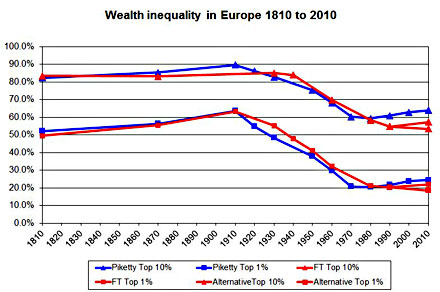
The central theme of Prof Piketty’s work is that wealth inequalities are heading back up to levels last seen before the first world war. The investigation undercuts this claim, indicating there is little evidence in Prof Piketty’s original sources to bear out the thesis that an increasing share of total wealth is held by the richest few.
Prof Piketty, 43, provides detailed sourcing for his estimates of wealth inequality in Europe and the US over the past 200 years. In his spreadsheets, however, there are transcription errors from the original sources and incorrect formulas. It also appears that some of the data are cherry-picked or constructed without an original source.
John Maynard Keynes
In one specific example, Giles says the corrected data do not show significant growth in Europe since 1970. In a second article, Giles goes into more detail. In addition, he argues that the U.S. data doesn’t support the conclusion that a greater proportion of the wealth is controlled by top 1% than in recent decades. He does admit to the top 10% controlling a greater share of wealth than previously.
An investigation by the Financial Times, however, has revealed many unexplained data entries and errors in the figures underlying some of the book’s key charts.
These are sufficiently serious to undermine Prof Piketty’s claim that the share of wealth owned by the richest in society has been rising and “the reason why wealth today is not as unequally distributed as in the past is simply that not enough time has passed since 1945”.
After referring back to the original data sources, the investigation found numerous mistakes in Prof Piketty’s work: simple fat-finger errors of transcription; suboptimal averaging techniques; multiple unexplained adjustments to the numbers; data entries with no sourcing, unexplained use of different time periods and inconsistent uses of source data….
A second class of problems relates to unexplained alterations of the original source data. Prof Piketty adjusts his own French data on wealth inequality at death to obtain inequality among the living. However, he used a larger adjustment scale for 1910 than for all the other years, without explaining why.
In the UK data, instead of using his source for the wealth of the top 10 per cent population during the 19th century, Prof Piketty inexplicably adds 26 percentage points to the wealth share of the top 1 per cent for 1870 and 28 percentage points for 1810.
A third problem is that when averaging different countries to estimate wealth in Europe, Prof Piketty gives the same weight to Sweden as to France and the UK – even though it only has one-seventh of the population.
Get even more detail and charts here: Data problems with Capital in the 21st Century.
Karl Marx
The Pushback So Far:
Paul Krugman: Is Piketty All Wrong?
Great buzz in the blogosphere over Chris Giles’s attack on Thomas Piketty’s Capital in the 21st Century. Giles finds a few clear errors, although they don’t seem to matter much; more important, he questions some of the assumptions and imputations Piketty uses to deal with gaps in the data and the way he switches sources. Neil Irwin and Justin Wolfers have good discussions of the complaints; Piketty will have to answer these questions in detail, and we’ll see how well he does it.
Krugman suggests that Giles may be doing something wrong.
I don’t know the European evidence too well, but the notion of stable wealth concentration in the United States is at odds with many sources of evidence. Take, for example, the landmark CBO study on the distribution of income; it shows the distribution of income by type, and capital income has become much more concentrated over time:
It’s just not plausible that this increase in the concentration of income from capital doesn’t reflect a more or less comparable increase in the concentration of capital itself….
And there’s also the economic story. In the United States, income inequality has soared since 1980 by any measure you use. Unless the affluent starting saving less than the working class, this rise in income disparity must have led to a rise in wealth disparity over time.
At Mother Jones, Kevin Drum notes that
Giles’ objections are mostly to the data regarding increases in wealth inequality over the past few decades, and the funny thing is that even Piketty never claims that this has changed dramatically. The end result of Giles’ re-analysis of Piketty’s data is [below] with Piketty in blue and Giles in red. As you can see, Piketty estimates a very small increase since 1970.
R.A. at The Economist: A Piketty problem?

Milton Friedman
Mr Giles’s analysis is impressive, and one certainly hopes that further work by Mr Giles, Mr Piketty or others will clarify whether mistakes have been made, how they came to be introduced and what their effects are. Based on the information Mr Giles has provided so far, however, the analysis does not seem to support many of the allegations made by the FT, or the conclusion that the book’s argument is wrong.
There are four important questions raised by the FT‘s work. First, which data are wrong? Second, how did errors in the work, if they are errors, come to be introduced? Third, how do the errors affect the specific points made in the relevant chapters? And fourth, how do the errors affect the fundamental conclusions of the book?
Mr Giles focuses on wealth inequality, to which Mr Piketty turns in Chapter 10 of his book. Mr Piketty has not published nearly as much research on the question of wealth inequality, and it seems that much of the analysis in Chapter 10 was done specifically for the book, based on others’ research. Mr Piketty’s wealth-inequality analysis certainly matters as a component of the book’s argument, but it is not accurate to say, as Mr Giles does, that the results in Chapter 10 constitute the “central theme” of the book.
Are the data wrong? Mr Giles identifies discrepancies between source material cited by Mr Piketty and the figures that appear in the book. He identifies cases in which Mr Piketty appears to have chosen to use data from one source when another would have made more sense. Further, the calculations in Mr Piketty’s spreadsheets (which have been available online since the book’s publication) seem to include adjustments in the data that are not adequately explained, and some figures for which Mr Giles cannot find a documented source. Finally, Mr Piketty has made choices concerning weighting of data used in averages, and assigning of data from one year (1935, for example) to another (1930) when such assignments seem unnecessary or inadvisable.

Alan Greenspan
The author concludes that, unfortunately, ideology will determine how many people respond to the Giles critique. Much more extensive analysis at the link.
Here is Picketty’s–presumably preliminary–response to Giles in a letter to the Financial Times:
Let me also say that I certainly agree that available data sources on wealth are much less systematic than for income. In fact, one of the main reasons why I am in favor of wealth taxation and automatic exchange of bank information is that this would be a way to develop more financial transparency and more reliable sources of information on wealth dynamics (even if the tax was charged at very low rates, which you might agree with).
For the time being, we have to do with what we have, that is, a very diverse and heterogeneous set of data sources on wealth: historical inheritance declarations and estate tax statistics, scarce property and wealth tax data, and household surveys with self-reported data on wealth (with typically a lot of under-reporting at the top). As I make clear in the book, in the on-line appendix, and in the many technical papers I have published on this topic, one needs to make a number of adjustments to the raw data sources so as to make them more homogenous over time and across countries. I have tried in the context of this book to make the most justified choices and arbitrages about data sources and adjustments. I have no doubt that my historical data series can be improved and will be improved in the future (this is why I put everything on line). In fact, the “World Top Incomes Database” (WTID) is set to become a “World Wealth and Income Database” in the coming years, and we will put on-line updated estimates covering more countries. But I would be very surprised if any of the substantive conclusion about the long run evolution of wealth distributions was much affected by these improvements.
I thought this was important:
…my estimates on wealth concentration do not fully take into account offshore wealth, and are likely to err on the low side. I am certainly not trying to make the picture look darker than it it. As I make clear in chapter 12 of my book (see in particular table 12.1-12.2), top wealth holders have apparently been rising a lot faster average wealth in recent decades, at least according to the wealth rankings published in magazines such as Forbes. This is true not only in the US, but also in Britain and at the global level (see attached table). This is not well taken into account by wealth surveys and official statistics, including the recent statistics that were published for Britain. Of course, as I make clear in my book, wealth rankings published by magazines are far from being a perfectly reliable data source. But for the time being, this is what we have, and what we have suggests that the concentration of wealth at the top is rising pretty much everywhere.
In Other News:
There has been a mass shooting in Southern California–this time perpetrated from behind the wheel of a car. From the LA Times, 7 dead in drive-by shooting near UC Santa Barbara.
The shootings began about 9:30 p.m., a sheriff’s spokeswoman told KEYT-TV. It wasn’t clear what the attacker’s motivation might have been.
An 18-year-old Newport Beach man who was visiting Santa Barbara described a confusing scene as the shots rang out.
Nikolaus Becker was eating outside The Habit, 888 Embarcadero Del Norte, near the scene when the first set of shots was fired about 9:30 p.m. At first he thought it was firecrackers. A group of three to five police officers who were nearby started to casually walk toward the sounds, said Becker, but ran when a second round of shots broke out.
“That’s when they yelled at us to get inside and take cover,” Becker said.
The BMW took a sharp turn in front of The Habit, Becker said, and moments later a third round of shots was heard. Becker and his friends moved toward the restaurant’s kitchen but were told to wait in the seating area by employees.
He estimates there were at least 13 to 15 shots total at three locations. The locations were about 100 yards from one another.
The shooter, whose motivation is unknown, was found dead in his BMW. It’s not yet clear if he shot himself or was killed by sheriff’s deputies.
In another gun-related story, TPM reports that some gun nuts are reconsidering their campaign of carrying long guns into public places: Scaring The Crap Out of People Oddly Not Winning Fans.
Earlier this week we reported how Chipotle felt obliged to ask its customers not to bring guns to chipotle restaurants. Seems like a reasonably enough request to most of us. And it’s been preceded by similar requests by various other chains like Starbucks and others.
Now the top pro-gun group in Texas pushing the demand for “open carry” firearm rights and trying to get people to show up at various restaurant chains with long guns is deciding it may not be such a hot idea after all.
Open Carry Texas and a group of other aggressive gun rights groups have issued a joint statement telling their members, Dudes, let’s stop taking our guns to restaurants. It’s freaking people out and making them hate us.
Read the full statement at TPM.
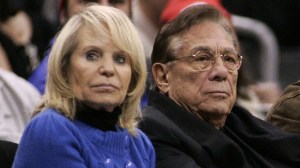
Soon-to-be former LA Clippers owner Donald Sterling has signed over the team to his wife and wants her to negotiate the sale.
Shelly Sterling, who previously shared ownership of the beleaguered NBA franchise with her estranged husband, is now in talks with the NBA over selling the team, the source said.
The NBA banned Donald Sterling for life from all league events after an audio tape became public that caught him on tape uttering racist comments to his assistant V. Stiviano. He told her not to post photos of herself with black people on Instagram — such as Magic Johnson — or bring them to his basketball games.
But the NBA isn’t buying it. From ESPN: Why the NBA won’t allow Shelly Sterling to control the Clippers.
At first glance, Donald Sterling’s gesture may seem like serendipitous news for the NBA. Taking him at his word, Donald Sterling has agreed to leave the league without a fight and has signed off on the sale of his team. Digging deeper, however, reveals possible ulterior motives on Sterling’s part to delay and potentially block the sale of the team. Do not forget a crucial point: capital gain taxes. As first reported by SI.com, the Sterlings have significant incentives under capital gain tax law to avoid the sale of the team and keep it in the Sterling family. Doing so, would save them hundreds of millions of dollars. Also, contrary to some reports, the Sterlings are unlikely to benefit from the “involuntary conversion” tax avoidance provision of the Internal Revenue Code. The bottom line is if the Sterlings have to sell the Clippers, they will probably pay hundreds of millions in state and federal taxes.
Along those lines, Donald Sterling’s proposed maneuver does not accomplish the NBA’s goal of ousting the entire Sterling family on June 3. As explained in a previous SI.com article, the NBA interprets its constitution to mean that ousting Donald Sterling on June 3 would also automatically oust Shelly Sterling as co-owner, with the Clippers then falling under the control of commissioner Adam Silver. Donald Sterling’s proposed maneuver risks the prospect of Shelly Sterling undertaking a slow-moving effort to sell the team. A sale process that takes months or years would clearly aggravate the NBA, which wants to erase the Sterling family name from the league as quickly as possible. A protracted sale of the Clippers by Shelly Sterling might also constitute a potential rationale for players to boycott NBA games.
Even of greater risk to the NBA, what is to stop Shelly Sterling from deciding to keep the Clippers? She could plausibly reason, on various grounds, that now is not the right time to sell the team. Also, her instruction from her husband to sell the team would not be legally binding; it would be a mere suggestion the moment she takes over the team.
Read much more at the link.
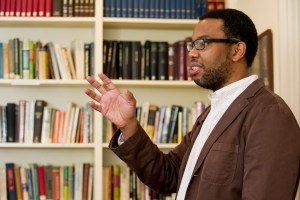
Ta-Nehisi Coates
I’ll end with a long article that I haven’t gotten to yet, but I’m hearing it’s a must read: The Case for Reparations, by Ta-Nehisi Coates at The Atlantic. Here’s the tagline:
“Two hundred fifty years of slavery. Ninety years of Jim Crow. Sixty years of separate but equal. Thirty-five years of racist housing policy. Until we reckon with our compounding moral debts, America will never be whole.”
Some reactions:
The Guardian: The ‘Case for Reparations’ is solid, and it’s long past time to make them.
Slate: An Ingenious and Powerful Case for Reparations.
The Wire: You Should Read “The Case for Reparations.”
NPR: How To Tell Who Hasn’t Read The New ‘Atlantic’ Cover Story.
WaPo: Culture change and Ta-Nehisi Coates’s ‘The Case For Reparations’.
What else is happening? As always, please post your links in the comment thread.
Did you like this post? Please share it with your friends:



 peej
peej Carissa
 bostonboomer
 dakinikat
 ecocatwoman
 mablue2
 Mama Lopez
 peggysue22
 quixote
 skydancingguestblogger
 Mona (aka Wonk the Vote)



 Sky Dancing
Recent Comments