



RTT News: Dark Chocolate May Improve Walking Ability.
Monday Reads
Posted: July 7, 2014 Filed under: Barack Obama, morning reads, U.S. Economy, U.S. Politics | Tags: Bill Moyers, child sexual abuse, Constitutional originalism, Down's syndrome in history, E.J. Dionne, economic inequality, Glory Kathurima, Jill Lepore, Joseph Fishkin, Malaika Kathurima, Norfolk NE July 4 parade, oligarchy, pedophile priests, Pope Francis, Racism, Tea Partiers, U.S. Constitution, William E. Forbath 26 CommentsGood Morning!!
Today is another slow news day, and that could be bad news for some folks in Norfolk, Nebraska. Dakinikat alerted us to the story yesterday, and now it’s in the process of going viral. So far the headlines on the story seem highly understated. From the Lincoln Journal-Star: Obama float at Norfolk parade sparks controversy.
It was the parade float that elicited the loudest cheers Friday at Norfolk’s Fourth of July parade. The crowd lining the streets clapped and laughed as the flatbed truck went by.
But one loud voice rose above the rest: “This is not OK,” Glory Kathurima said. “That’s not OK.”
She kept repeating herself as the float passed, she says. She started to raise her phone to take a picture of the blue truck with the outhouse on its flatbed, along with a dark figurine in overalls propped up by a metal walker.
And nailed to the sides of the wooden privy, two signs in all-black capital letters: “OBAMA PRESIDENTIAL LIBRARY.”
Kathurima’s daughter Malaika saw the disrespectful depiction of the President of the United States, and asked her mom, “Mommy, what does that mean? What’s so funny?”
Kathurima moved to Nebraska from Kenya when she was Malaika’s age and became a naturalized citizen a few years ago. She’s raised her daughter in Norfolk and has found ways to explain the meaning of skin color. She’s turned on the TV and pointed to President Obama, showing Malaika that there was someone that looked like her — half Kenyan, half American.
“I’m angry and I’m scared,” Kathurima said. “This float was not just political; this was absolutely a racial statement.”
If a 9-year-old can see the problem, you’d think the parade organizers in Norfolk would have at least foreseen what the reaction to the float would be from normal people across the country. But apparently they didn’t.

Parade committee member Rick Konopasek said the float wasn’t meant to be any more offensive than a political cartoon would be….
“We don’t feel its right to tell someone what they can and can’t express,” he said. “This was political satire. If we start saying no to certain floats, we might as well not have a parade at all.”
Konopasek and parade announcer Wally Sonnenschein said the outhouse float was the most popular one in the parade, and the three judges awarded it an honorable mention.
“It’s obvious the majority of the community liked it,” Konopasek said. “So should we deny the 95 percent of those that liked it their rights, just for the 5 percent of people who are upset?”
Konopasek and Sonnenschein actually claimed that the float demonstrated the freedom of speech and independence that the country celebrates on the Fourth of July, and that “the man who built the float has been a longstanding member of the community, and people shouldn’t be quick to judge him for expressing his opinions.” How odd then that the “man who built the float” didn’t put his name on his handiwork and he is still anonymous, according to Omaha.com.
A Fourth of July parade float that depicted a figure standing outside an outhouse labeled the “Obama Presidential Library” has created a stir on social media and is also receiving criticism in Norfolk, Nebraska.
The float, in Norfolk’s annual Independence Day parade, was on a flatbed trailer being pulled by a blue pickup truck. The figure was dressed in overalls and standing next to a walker outside of the outhouse. The hands and head of the figure were greenish and appeared to be zombielike; the hands were pressed against the sides of the figure’s head. Miniature American flags were atop the float and on the truck.
Neither the float nor the pickup identified a sponsor; a sign in the windshield said it was entry No. 29.
Why isn’t “the man who built the float” expressing pride in his creation?
Actually the design of the float wasn’t original. I’ve seen this depiction of Obama before. From Huffington Post:
The presidential library outhouse comparison has become somewhat of a conservative meme in recent years. A similar structure was on display at Montana’s state Republican convention in 2012. And last fall, an outhouse with a “presidential library” sign drew criticism in a small New Mexico town.
It will be interesting to see how this story plays out in the next few days. Certainly if this is not racism per se (I think it is), it demonstrates a shocking lack of respect for the office of the Presidency. Will Norfolk parade officials continue to defend the float? Will “the man who built the float” come forward and defend what he did? Stay tuned.
In other news,
In his latest column, E.J. Dionne calls attention to “an article in draft” by Joseph Fishkin & William E. Forbath called “The Anti-Oligarchy Constitution” (PDF). The article addresses the issue of economic inequality, and is the basis for a planned book by Fishkin.
Dionne writes that Tea Partiers and other “conservatives” constantly talk about the Constitution to justify their extreme views on multiple issues. Dionne argues that “progressives” should “think constitutionally” too, and “challenge conservative claims about what the Constitution really demands.”
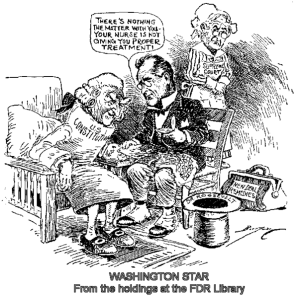
In the May issue of the Boston University Law Review, Joseph R. Fishkin and William E. Forbath of the University of Texas School of Law show that at key turning points in our history (the Jacksonian era, the Populist and Progressive moments and the New Deal), opponents of rising inequality made strong arguments “that we cannot keep our constitutional democracy — our republican form of government — without constitutional restraints against oligarchy and a political economy that maintains a broad middle class, accessible to everyone.”
Their article is called “The Anti-Oligarchy Constitution,” though Forbath told me that he and Fishkin may give the book they’re writing on the topic the more upbeat title “The Constitution of Opportunity.” Their view is that by empowering the wealthy in our political system, Supreme Court decisions such as Citizens United directly contradict the Constitution’s central commitment to shared self-rule.
“Extreme concentrations of economic and political power undermine equal opportunity and equal citizenship,” they write. “In this way, oligarchy is incompatible with, and a threat to, the American constitutional scheme.” …. they make a similar critique of what they call an excessively “court-centered” approach to constitutionalism. “Constitutional politics during the 19th and early 20th centuries” was very different and the subject of democratic deliberation. In earlier eras, they say, the Constitution was seen as not simply permitting but actually requiring “affirmative legislation . . . to ensure a wide distribution of opportunity” and to address “the problem of oligarchy in a modern capitalist society.”
The authors remind us of Franklin Roosevelt’s warning that “the inevitable consequence” of placing “economic and financial control in the hands of the few” would be “the destruction of the base of our form of government.” And writing during the Gilded Age, a time like ours in many ways, the journalist James F. Hudson argued that “imbedded” in the Constitution is “the principle” mandating “the widest distribution among the people, not only of political power, but of the advantages of wealth, education and social influence.”The idea of a Constitution of Opportunity is both refreshing and relevant. For too long, progressives have allowed conservatives to monopolize claims of fealty to our unifying national document. In fact, those who would battle rising economic inequalities to create a robust middle class should insist that it’s they who are most loyal to the Constitution’s core purpose. Broadly shared well-being is essential to the framers’ promise that “We the people” will be the stewards of our government.
Fishkin’s proposed book sounds like a worthwhile companion to Thomas Picketty’s Capital in the Twenty-First Century.
A somewhat related article from Raw Story by Bill Moyers and Co., July 4th note to tea partiers: Your politics would baffle the Founding Fathers.
Editor’s note: These days, if you see a protester donning a tricorn hat and waving a Gadsden Flag, it’s a safe bet that he or she is a Republican activist who’s furious about “death panels” or the prospect of the government meddling in the Medicare program. But the tea party movement isn’t the first to claim itself to be the true defenders of the Constitution, or to enlist its Framers in a political cause. Throughout American history, activists across the ideological spectrum have insisted that the Framers would roll over in their graves upon encountering the perfidy of their political opponents.
The reality is that the Framers disagreed about almost everything, and produced a Constitution that was filled with expedient compromises. As Jill Lepore, a professor of American history at Harvard University, pointed out in her book, The Whites of Their Eyes: The Tea Party’s Revolution and the Battle Over American History, “Beginning even before it was over, the Revolution has been put to wildly varying political purposes.” Between 1761, when the first signs of discontent with England became apparent in the Colonies, and 1791, when the Bill of Rights was ratified, Lepore wrote that Americans debated an “ocean of ideas” from which “you can fish anything out.”
One of the few areas where the Framers approached a consensus was a belief that their Constitution shouldn’t be fetishized. According to Lepore, it was none other than Thomas Jefferson who wrote, “Some men look at constitutions with sanctimonious reverence, and deem them like the arc of the covenant, too sacred to be touched. They ascribe to the men of the preceding age a wisdom more than human.”
Read an excerpt on Constitutional originalism from Jill Lepore’s book at the Raw Story link.
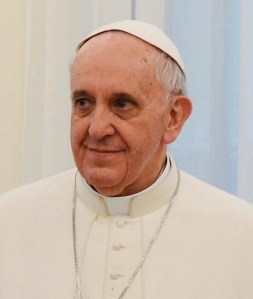
From NBC News: Pope Francis Meets Abuse Victims, Begs Forgiveness for Church.
The pontiff invited six victims of abuse from Ireland, Germany and Britain to attend an early-morning private Mass at the Domus Sanctae Marthae, the residence next to St. Peter’s Basilica where he lives.
Francis called the abuse a “grave sin” decrying how it was hidden for “so much time” and “camouflaged with a complicity that cannot be explained.”“I ask for the grace to weep, the grace for the Church to weep and make reparation for her sons and daughters who betrayed their mission, who abused innocent persons,” the pope said in his homily. “I beg your forgiveness, too, for the sins of omission on the part of Church leaders who did not respond adequately to reports of abuse.” ….
Francis strongly praised the victims’ courage in speaking up and shedding “light on a terrible darkness,” telling the mass he is deeply aware of their deep and unrelenting pain.
“Sins of clerical sexual abuse against minors have a toxic effect on faith and hope in God,” he said, adding that the victims’ willingness to come to the Vatican “speaks of the miracle of hope, which prevails against the deepest darkness.”
I guess it’s a start, but I agree with victims advocates who say it’s too little, too late. What concrete actions is the Church going to take to identify abusers and potential abusers before they act out? Child sexual abuse is a systemic problem that has continued for centuries. It’s difficult to see how it can be overcome with apologies and meetings with a few survivors.
I’ll end with a fascinating story from New Scientist, via Raw Story: Oldest case of Down’s syndrome from medieval France.
The oldest confirmed case of Down’s syndrome has been found: the skeleton of a child who died 1500 years ago in early medieval France. According to the archaeologists, the way the child was buried hints that Down’s syndrome was not necessarily stigmatised in the Middle Ages….
The new example comes from a 5th- and 6th-century necropolis near a church in Chalon-sur-Saône in eastern France. Excavations there have uncovered the remains of 94 people, including the skeleton of a young child with a short and broad skull, a flattened skull base and thin cranial bones. These features are common in people with Down’s syndrome, says Maïté Rivollat at the University of Bordeaux in France, who has studied the skeleton with her colleagues….
Oldest case of Down’s syndrome from medieval France – life – 04 July 2014 – New Scientist#.U7qdknlOXEd <!—->
Rivollat’s team has studied the way the child with Down’s syndrome was buried, which hasn’t been possible with other ancient cases of the condition. The child was placed on its back in the tomb, in an east-west orientation with the head at the westward end – in common with all of the dead at the necropolis.
According to Rivollat, this suggests the child was treated no differently in death from other members of the community. That in turn hints that they were not stigmatised while alive.
Another researcher of Down’s Syndrome in ancient history, John Starbuck of Indiana University, says drawing cultural conclusions from the method of burial is very difficult. Read more at the link.
What stories are you following today? Please post your links in the comment thread.
Lazy Saturday Reads
Posted: July 5, 2014 Filed under: morning reads, U.S. Politics, Women's Rights | Tags: "white oppression", Bill Clinton, Boston bombing, Bourbon St. shootings. New Orleans, C-Span callers, Civil Rights act, Eden Foods, Hillary Clinton, Hobby Lobby decision, Hurricane Arthur, Indianapolis shootings, Maya Angelou, Michael Potter, Racism, Richard Mellon Scaife, Samuel Alito, SCOTUS, vanilla ice cream 34 Comments
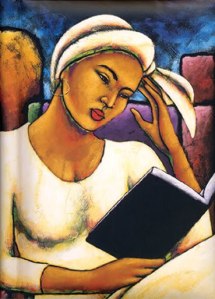
“Someone is Waiting,” by David Hettinger
Good Morning!!
I’m sure you won’t be surprised to learn that today is a very slow news day. Nevertheless, I’ve still managed to dig up a few interesting reads.
Long-time Clinton hater Richard Mellon Scaife has died at 82. The Associated Press reports via Politico:
Scaife died early Friday at his home, his newspaper, the Pittsburgh Tribune-Review, reported. Scaife’s death comes less than two months after he announced in a first-person, front-page story in his Pittsburgh Tribune-Review that he had an untreatable form of cancer.
“Some who dislike me may rejoice at the news,” wrote Scaife, who acknowledged making political and other enemies. “Naturally, I can’t share their enthusiasm.”
He was the grand-nephew of Andrew Mellon, a banker and secretary of the Treasury who was involved with some of the biggest industrial companies of the early 20th century. Forbes magazine estimated Scaife’s net worth in 2013 at $1.4 billion.
The intensely private Scaife became widely known in the 1990s when first lady Hillary Rodham Clinton said her husband was being attacked by a “vast right-wing conspiracy.” White House staffers and other supporters suggested Scaife was playing a central role in the attack.
Hillary was mocked for those remarks; but today, in the aftermath of the Hobby Lobby decision, it should be obvious to all but the most oblivious and ignorant among us that the vast right wing conspiracy exists and its tentacles have reached even the U.S. Supreme Court.
From Forbes, Clare O’Connor reports more Hobby Lobby Fallout: Catholic Soy Milk Mogul Won’t Cover Drugs That ‘Prevent Procreation’. Eden Foods founder Michael Potter has stated his determination to prevent his female employees from getting access to birth control, and the Supreme Court is helping him.
In April 2013, devout Catholic (and sole Eden Foods shareholder) Potter sued the Department of Health and Human Services, calling the Affordable Care Act’s contraceptive mandate “unconstitutional government overreach.”
In a letter he wrote in response to a shopper complaint that month, Potter described contraceptives as “lifestyle drugs” akin to “Viagra, smoking cessation, weight-loss” tools and other medications. (He also compared birth control to “Jack Daniels” in a contemporaneous interview with Salon.)
In October, the U.S. Court of Appeals decided against Potter, ruling that Eden Foods, as a for-profit corporation, couldn’t exercise religion.
Now, in the wake of this week’s controversial Supreme Court ruling recognizing craft chain Hobby Lobby’s religious rights, the court has changed its tune.The day after the Justices decided evangelical Hobby Lobby billionaire David Green doesn’t have to cover certain contraceptives for his employees, the Supreme Court vacated the judgment against Eden Foods and sent the case back to the U.S. Court of Appeals for the Sixth Circuit for further consideration.
“The court of appeals is ordered by the Supreme Court to follow its decision in Hobby Lobby,” said Erin Mersino, the attorney handling Potter’s case at the Christian, conservative Thomas More Law Center.
And the beat goes on . . .
At The Nation, Katha Pollit asks: Where Will the Slippery Slope of ‘Hobby Lobby’ End?
Facts are stubborn things, as John Adams famously said. Unless, that is, you’re talking about religion. Then facts don’t seem to matter at all: right you are if you think you are. The Hobby Lobby case was billed as a test of religious freedom versus the power of the state: Did the Religious Freedom Restoration Act (RFRA) mean that David Green, the evangelical Christian CEO of a chain of crafts stores, could be exempt from providing coverage for the full range of contraceptives for his employees under the Affordable Care Act? Green balked at including Plan B, Ella (another form of emergency contraception) and two kinds of IUD, because, he claimed, they caused “abortion” by preventing the implantation of a fertilized egg.
The Court’s 5-to-4 decision—which featured all three women justices ruling for the workers, and all five Catholic men ruling for the corporation—was wrong in many ways. But the thing I really don’t understand is why it didn’t matter that preventing implantation is not “abortion,” according to the accepted medical definition of the term. And even if it was, Plan B, Ella and the IUDs don’t work that way, with the possible exception of one form of IUD when inserted as emergency contraception. As an amicus brief from a long list of prestigious medical organizations and researchers laid out at length, studies show that emergency contraception and the IUD preventfertilization, not implantation. They are not “abortifacients,” even under the anti-choicers’ peculiar definition of abortion. (Green is actually more moderate than some anti-choicers, who include hormonal contraception, aka “baby pesticide,” as abortion.) Why doesn’t it matter that there is no scientific evidence for Green’s position? When did Jesus become an Ob/Gyn?

Good question. Today even facts are irrelevant to Supreme Court decisions. The fact is that Democrats helped Thomas, Roberts, and Alito make it onto the Court, and now we’re stuck with these religious and ideological fanatics.
At Salon, Digby writes that Alito could have been stopped: Why Dems should have filibustered the radical. And from Peter Montgomery at HuffPo, Samuel Alito: A Movement Man Makes Good on Right-Wing Investments. Read them and weep.
Dakinikat posted this Guardian piece in the comments last night; I thought it should be included in this morning’s links: Black people were denied vanilla ice cream in the Jim Crow south – except on Independence Day.
By custom rather than by law, black folks were best off if they weren’t caught eating vanilla ice cream in public in the Jim Crow South, except – the narrative always stipulates – on the Fourth of July. I heard it from my father growing up myself, and the memory of that all-but-unspoken rule seems to be unique to the generation born between World War I and World War II.
But if Maya Angelou hadn’t said it in her classic autobiography I Know Why the Caged Bird Sings, I doubt anybody would believe it today.
People in Stamps used to say that the whites in our town were so prejudiced that a Negro couldn’t buy vanilla ice cream. Except on July Fourth. Other days he had to be satisfied with chocolate.
Vanilla ice cream – flavored with a Nahuatl spice indigenous to Mexico, the cultivation of which was improved by an enslaved black man named Edmund Albius on the colonized Réunion island in the Indian Ocean, now predominately grown on the largest island of the African continent, Madagascar, and served wrapped in the conical invention of a Middle Eastern immigrant – was the symbol of the American dream. That its pure, white sweetness was then routinely denied to the grandchildren of the enslaved was a dream deferred indeed.
What makes the vanilla ice cream story less folk memory and more truth is that the terror and shame of living in the purgatory between the Civil War and civil rights movement was often communicated in ways that reinforced to children what the rules of that life were, and what was in store for them if they broke them.
Please go read the whole thing if you haven’t already.

From Politico: Why the Civil Rights Act couldn’t pass today.
It was a painful tableau: The bipartisan leaders of Congress linking hands in the Capitol Rotunda and swaying to the strains of “We Shall Overcome” as they commemorated the 50th anniversary of the passage of the Civil Rights Act of 1964. Harry Reid and Nancy Pelosi sang along with the crowd, but Mitch McConnell and John Boehner’s lips were frozen in silent, self-conscious smiles.
The climate in today’s Washington is so different from the one that produced what many scholars view as the most important law of the 20th century that celebrating the law’s legacy is awkward for Republicans and Democrats alike. Neither party bears much resemblance to its past counterpart, and the bipartisanship that carried the day then is now all but dead….
The current congressional leaders gathered last week not to honor Johnson — or any of the legislative leaders who actually passed the landmark law — but to award a posthumous Congressional Gold Medal to The Rev. Dr. Martin Luther King Jr. and his wife, Coretta Scott King, whose crusade helped create the climate that made the bill possible. In his life, racial tensions helped make King such a polarizing figure that both Johnson and John F. Kennedy worried about seeming too close to him, but in martyrdom and myth, he is the only politically safe ground on which present day leaders could unite.
They are all so pathetic. And this is beyond pathetic: Callers Use C-SPAN Civil Rights Discussion To Complain About White Oppression (VIDEO).
“Washington Journal” host Steve Scully listened as an “independent” caller named Thomas from Maryland told him that he is “much less liberal today” than he was in 1964 when the landmark law was signed by Lyndon B. Johnson.
“And I think the blacks have brought on most of their present-day problems themselves. They insult white people,” he told Scully. “I heard it right on your own show, I heard some black call Karl Rove a ‘white boy.’ And I don’t think that’s right. They’re attacking white people in the big cities and we’re supposed to put up with that kind of stuff and like them and say, ‘Well, come into our neighborhood.’ And how about the discussion of the black crime that goes on in this country?”
The caller went on to complain that the discrimination endured by Irish, Mormons and Italians is widely ignored.
“You people will never, never discuss that. You only discuss the discrimination against the black people,” he said.
Is that sick or what?
A few more news links:
Information Week on private tech companies treatment of their customers, Facebook Mood Manipulation: 10 Bigger Problems.
Fox News: Suspect arrested in Bourbon St. shootings.
USA Today: Seven hurt in Indianapolis shootings.
WSJ: A Weakened Hurricane Arthur Heads Toward Nova Scotia
ABC News: Before Boston Attack, Alleged Bomber Posed With Black Flag of Jihad at Local Mosque.
So . . . what stories are you reading and blogging about? Please share your links in the comment thread, and enjoy the rest of the long weekend!
Fourth of July Reads
Posted: July 4, 2014 Filed under: morning reads, U.S. Politics, Women's Rights | Tags: corporate personhood, corporatizing religious liberty, Declaration of Independence, Fourth of July, Hobby Lobby, Independence Day, John Roberts, legal precedent, religion, Samuel Alito, SCOTUS, separation of church and state, Statue of Liberty, Wheaton College 14 Comments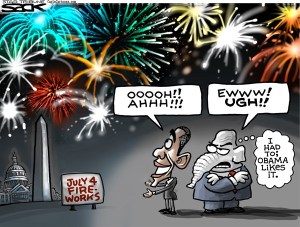
Good Morning!!
Today we celebrate the Declaration of Independence. I’ve assembled a few informational readings about this day in history.
From The Cagle Post: Fourth of July Fast Facts.
“I’m confused. I thought July 4 was the day our country declared independence from King George III of Great Britain.”
“Actually, according to ConstitutionFacts.com, that’s not so. The Continental Congress declared independence from Great Britain on July 2, 1776.”
“Then why do we celebrate our independence on the Fourth every year? Is that when we started the American Revolution?”
“That is a common misunderstanding, as well. The American Revolution began in April 1775, more than a year earlier.”
“I’m stumped. Was the Fourth the day Thomas Jefferson wrote the first draft of the Declaration of Independence?”
“Nope. Thomas Jefferson wrote the first draft in June 1776. Also, Jefferson didn’t write the Declaration alone.”
“He didn’t? I always thought he was the sole author.”
“A common misconception. In fact, the Continental Congress appointed a five-person to write the Declaration. It included Jefferson, Benjamin Franklin, John Adams, Robert Livingston and Roger Sherman.” ….
“Though Jefferson wrote the first draft, it was changed 86 times by other members of the committee and other members of the Continental Congress.”
I did not know that.
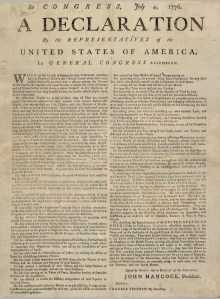
David Armitage at The Wall Street Journal: The Declaration of Independence: The Words Heard Around the World.
The Declaration of Independence is the birth certificate of the American nation—the first public document ever to use the name “the United States of America”—and has been fundamental to American history longer than any other text. It enshrined what came to be seen as the most succinct and memorable statement of the ideals on which the U.S. was founded: the rights to life, liberty and the pursuit of happiness; the consent of the governed; and resistance to tyranny.
But the Declaration’s influence wasn’t limited to the American colonies of the late 18th century. No American document has had a greater impact on the wider world. As the first successful declaration of independence in history, it helped to inspire countless movements for independence, self-determination and revolution after 1776 and to this very day. As the 19th-century Hungarian nationalist, Lajos Kossuth, put it, the U.S. Declaration of Independence was nothing less than “the noblest, happiest page in mankind’s history.”
In telling this story of global influence, however, it is important to separate two distinct elements of the Declaration—elements that sometimes get conflated. The first of these is the assertion of popular sovereignty to create a new state: in the Declaration’s words, the right of “one People to dissolve the Political Bands which have connected them with another, and to assume among the Powers of the Earth, the separate and equal Station to which the Laws of Nature and of Nature’s God entitle them.” The second and more famous element of the Declaration is its ringing endorsement of the sanctity of the individual: “We hold these truths to be self-evident, that all men are created equal, that they are endowed by their Creator with certain unalienable Rights.”
Read much more at the link.
From the LA Times: The slow-spreading news of American independence.
In this era of instant communication, it’s interesting to note the slow distribution of the Declaration, and the spreading of the word to those on whose behalf independence had been declared. (Imagine the Twitter version: Dudes, we’re on our own. #independence #totallyrad #stickitkinggeorge).
The text was set in type by Philadelphia printer John Dunlap just hours after the Continental Congress approved the manifesto on July 4. He ran off about 200 copies, most of which were then distributed via horse and boat around the Colonies. He reprinted it in his own newspaper, Dunlap’s Pennsylvania Packet, or The General Advertiser (great newspaper names back then). Over the next few weeks, Jefferson’s stirring words were reprinted inlocal newspapers and pamphlets around the Colonies.
And, naturally, in Britain. It took more than a month for the first reports of the Declaration to reach Britain in letters ferried by the Mercury packet ship. Gen. William Howe, who was leading the crown’s forces in the Colonies, included a brief mention in his report to his overseers. So the first public airing of the news came in the London Gazette, the crown’s official paper. If you weren’t a close reader, you could have easily missed it.
In the four-page issue dated Aug. 6-Aug. 10, 1776, the Gazette’s lead story was Howe’s update of the war, reporting that “the Rebels, who are numerous, and are very advantageously posted with strong Entrenchments both upon Long Island and that of New York, with more than One Hundred pieces of Cannon for the Defence of the Town towards the Sea, and to obstruct the passage of the [British] Fleet up the North [Hudson] River, besides a considerable Field Train of artillery.”
Finally, Carina Kolodny at Huffington Post: This Is Not Your Independence Day.
The 4th of July might commemorate the independence of our country — but it also serves as a bitter reminder that in 1776, the country that I love had no place for me in it.
When our founding fathers penned, “All men are created equal,” they meant it. Not all people. Not all humans. Just all men — the only reason they didn’t feel obliged to specify “white” men is because, at the time, men of color were considered less than men, less than human.
The 4th is not my Independence Day — and if you’re a Caucasian woman, it isn’t yours either. Our “independence” didn’t come for another 143 years, with the passage of The Woman’s Suffrage Amendment in 1919. The 4th of July is also not Independence Day for people of color. It wasn’t until the 15th Amendment was ratified in 1870 that all men had the right to vote regardless of race — on paper, that is, not in practice. People of color were systematically, and all too successfully, disenfranchised for another century. July 4th of 1776 was certainly not a day of Independence or reverence for Native Americans. It wasn’t until 1924 that Native Americans could unilaterally become citizens of the United States and have the voting rights to go with it.
Now, before anyone argues that Independence is about more than voting rights, I’d like to point out that our Founding Fathers would fundamentally disagree with you. The Revolutionary War was fought, in large part, because of “taxation without representation” — the then English colonists believed they were not free because their voices were not represented. The right to vote, the right to have your say is the delineating characteristic of a democracy.
The Aftermath of the Hobby Lobby Decision
On that note, today many concerned citizens are looking back at the latest Supreme Court decisions that take women backwards in their pursuit of freedom and autonomy. The court-approved limits on access to birth control go beyond the Hobby Lobby decision. Lyle Denniston at SCOTUSblog: Broader right to object to birth control.
Expanding the rights of religious opponents of birth control, a divided Supreme Court on Thursday afternoon spared an Illinois college — and maybe hundreds of other non-profit institutions — from obeying government regulations that seek to assure access to pregnancy prevention services for female workers and students. In the same order, the majority essentially told the government to modify its own rules if it wants to keep those services available.
Three Justices wrote a sharply worded dissent, accusing the majority of creating on its own a “new administrative regime” that will seriously complicate the operation of the birth control mandate under the new federal health care law. The majority, the dissenters said, “has no reason to think that the administrative scheme it foists on the government today is workable or effective on a national scale.”
The ruling, which the majority insisted was temporary and had settled nothing finally about the legal issues at stake, came three days after the Court in Burwell v. Hobby Lobby had given for-profit businesses whose owners have religious objections to birth control a right to refuse to provide those services in their employee health plans.
The plea by Wheaton College, a religious institution in Illinois with about 3,000 students, moved the Court beyond for-profit firms to the world of non-profit religious colleges, hospitals, and other charities. The government had already moved to accommodate their beliefs, but that had not gone far enough for the college and for scores of other non-profits. With the Court’s new order, they gained additional separation from the birth-control mandate.
At Mother Jones, Kevin Drum writes: Supreme Court Now Playing Cute PR Games With Hobby Lobby Decision.
For the last few days, there’s been a broad argument about whether the Hobby Lobby ruling was a narrow one—as Alito himself insisted it was—or was merely an opening volley that opened the door to much broader rulings in the future. After Tuesday’s follow-up order—which expanded the original ruling to cover all contraceptives, not just those that the plaintiffs considered abortifacients—and today’s order—which rejected a compromise that the original ruling praised—it sure seems like this argument has been settled. This is just the opening volley. We can expect much more aggressive follow-ups from this court in the future.
POSTSCRIPT: It’s worth noting that quite aside from whether you agree with the Hobby Lobby decision, this is shameful behavior from the conservatives on the court. As near as I can tell, they’re now playing PR games worthy of a seasoned politico, deliberately releasing a seemingly narrow opinion in order to generate a certain kind of coverage, and then following it up later in the sure knowledge that its “revisions” won’t get nearly as much attention.
At Slate, Micah Schwartzman, Richard Schragger, and Nelson Tebbe explain that Hobby Lobby rewrites religious-freedom law in ways that ignore everything that came before.
Monday’s decision in Hobby Lobby was unprecedented. Much of the commentary has focused on the Supreme Court’s decision to extend rights of religious free exercise to for-profit corporations. Hobby Lobby is for religion what Citizens United was for free speech—the corporatization of our basic liberties. But Hobby Lobby is also unprecedented in another, equally important way. For the first time, the court has interpreted a federal statute, theReligious Freedom Restoration Act (or RFRA), as affording more protection for religion than has ever been provided under the First Amendment. While some have read Hobby Lobby as a narrow statutory ruling, it is much more than that. The court has eviscerated decades of case law and, having done that, invites a new generation of challenges to federal laws, including those designed to protect civil rights.
The authors explain how the right wing Roberts Court has moved beyond any concern for legal precedent in making its decisions.
Hobby Lobby is unprecedented because it corporatizes religious liberty. It extends to for-profit businesses the rights and privileges that have long been associated only with churches and religious nonprofits. But that change is the result of a more pervasive and deeper upending of the law of religious liberty in America. Ignoring congressional intent, the court reads RFRA as having shed its First Amendment skin. It is not entirely clear what American law will look like after that change. But if anything is clear, it is that the Roberts Court is now unconstrained by precedent. It has loosened itself from decades of First Amendment doctrine and has begun remaking the law of free exercise.
Please read the whole thing.
Ironically, the Hobby Lobby decision may have also created some serious problems for the human beings who own corporations (h/t Dakinikat). From Mother Jones: How Hobby Lobby Undermined The Very Idea of a Corporation. Basically, now that SCOTUS has said that some corporations are inseparable from the people who own them, those owners could lose their legal protection from debts and lawsuits that result from corporate actions. There’s some instant Karma for you!
A few more links for your holiday reading pleasure:
Miami Herald: FBI records: Chilling find in Bradenton dumpster (new clues to Saudi involvement in the 9/11 and the cover-up of that involvement by the Bush/Cheney administration).
Study links Oklahoma earthquake swarm with fracking operations
Boston Globe: People prefer electric shocks to time alone with thoughts.
LA Times: Tibetans get high-altitude edge from extinct Denisovans’ genes.
What stories are you following on this Independence Day?
Monday Reads: In Search of the American Dream
Posted: June 30, 2014 Filed under: Barack Obama, Foreign Affairs, morning reads, U.S. Economy, U.S. Politics | Tags: American Dream, Baby boomers, Blackwater, golden age of capitalism, inequality, joseph stiglitz, plutocrats, polls, post-WWII boom, State Department, Thomas Picketty 78 Comments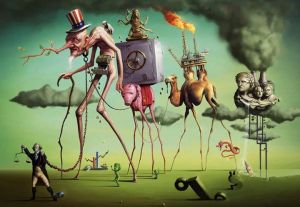
Good Morning!!
Whatever happened to the American dream? Did it ever exist in reality?
We baby boomers can look back to the post-WWII years, when the economy was humming along and the GI Bill made it easier for our dads to get college degrees, find good jobs, buy houses for their families.
In those days, one salary was enough to support a couple and several kids. My dad did it on a college professor’s salary. It was a struggle early on, but those government programs for veterans gave us a push into the professional class.
Eisenhower was President then–a Republican who wouldn’t even recognize his fellow Republican today. Later on, after John Kennedy was murdered and Lyndon Johnson was brought down by the Vietnam War, Richard Nixon presided over the end of the good times. After about 1973, it was over; and since then, wages have essentially remained stagnant.
That was when we entered a new America, in which it took two salaries to support a family. Women went to work, not just because they wanted to, but to keep their families afloat. Children went to day care. So many thing changed. What happened to the American dream? Were those post-war years just an outlier, a brief period of prosperity that meant nothing in the greater scheme of things?
Yesterday, I read a piece by Joseph Stiglitz–in Politico of all places–that addressed some of these questions: The Myth of America’s Golden Age: What growing up in Gary, Indiana taught me about inequality. Stiglitz was born in 1943. Growing up in the industrial “company town” of Gary, he was able to observe the underside of the “golden age” of capitalism–“discrimination, poverty, and bouts of high unemployment.” The big steel companies deliberate brought in desperately poor African Americans from the south in order to keep wages low–to divide and control the work force. Stiglitz writes that he never bought into the notion of the free market as the answer to all ills.
Nearly half a century later, the problem of inequality has reached crisis proportions. John F. Kennedy, in the spirit of optimism that prevailed at the time I was a college student, once declared that a rising tide lifts all boats. It turns out today that almost all of us now are in the same boat—the one that holds the bottom 99 percent. It is a far different boat, one marked by more poverty at the bottom and a hollowing out of the middle class, than the one occupied by the top 1 percent.
Most disturbing is the realization that the American dream–the notion that we are living in the land of opportunity–is a myth. The life chance of a young American today are more dependent on the income and education of his parents than in many other advanced countries, including “old Europe.”

American Dream, by Skip Hunt
Stiglitz points to Thomas Picketty’s research as evidence. Picketty’s work shows that capitalism leads inevitably to inequality. The post-war era of my childhood and early adulthood was an “aberration.”
Today, inequality is growing dramatically again, and the past three decades or so have proved conclusively that one of the major culprits is trickle-down economics—the idea that the government can just step back and if the rich get richer and use their talents and resources to create jobs, everyone will benefit. It just doesn’t work; the historical data now prove that. [….]
Ironically enough, the final proof debunking this very Republican idea of trickle-down economics has come from a Democratic administration. President Barack Obama’s banks-first approach to saving the nation from another Great Depression held that by giving money to the banks (rather than to homeowners who had been preyed upon by the banks), the economy would be saved. The administration poured billions into the banks that had brought the country to the brink of ruin, without setting conditions in return. When the International Monetary Fund and the World Bank engage in a rescue, they virtually always impose requirements to ensure the money is used in the way intended. But here, the government merely expressed the hope that the banks would keep credit, the lifeblood of the economy, flowing. And so the banks shrank lending, and paid their executives megabonuses, even though they had almost destroyed their businesses. Even then, we knew that much of the banks’ profits had been earned not by increasing the efficiency of the economy but by exploitation—through predatory lending, abusive credit-card practices and monopolistic pricing. The full extent of their misdeeds—for instance, the illegal manipulation of key interest rates and foreign exchange, affecting derivatives and mortgages in the amount of hundreds of trillions of dollars—was only just beginning to be fathomed.

American Dream, by Gordon Wendling
I can’t quote any more, but I hope I’ve whetted your appetite enough that you’ll go read the whole thing. While you’re at that link, you might also take a look at this article by “zillionaire” Nick Hanauer, The Pitchforks are Coming for Us Plutocrats. Here’s just a small taste–it’s a long read.
The most ironic thing about rising inequality is how completely unnecessary and self-defeating it is. If we do something about it, if we adjust our policies in the way that, say, Franklin D. Roosevelt did during the Great Depression—so that we help the 99 percent and preempt the revolutionaries and crazies, the ones with the pitchforks—that will be the best thing possible for us rich folks, too. It’s not just that we’ll escape with our lives; it’s that we’ll most certainly get even richer.
The model for us rich guys here should be Henry Ford, who realized that all his autoworkers in Michigan weren’t only cheap labor to be exploited; they were consumers, too. Ford figured that if he raised their wages, to a then-exorbitant $5 a day, they’d be able to afford his Model Ts.
What a great idea. My suggestion to you is: Let’s do it all over again. We’ve got to try something. These idiotic trickle-down policies are destroying my customer base. And yours too.
It’s when I realized this that I decided I had to leave my insulated world of the super-rich and get involved in politics. Not directly, by running for office or becoming one of the big-money billionaires who back candidates in an election. Instead, I wanted to try to change the conversation with ideas—by advancing what my co-author, Eric Liu, and I call “middle-out” economics. It’s the long-overdue rebuttal to the trickle-down economics worldview that has become economic orthodoxy across party lines—and has so screwed the American middle class and our economy generally. Middle-out economics rejects the old misconception that an economy is a perfectly efficient, mechanistic system and embraces the much more accurate idea of an economy as a complex ecosystem made up of real people who are dependent on one another.
Which is why the fundamental law of capitalism must be: If workers have more money, businesses have more customers. Which makes middle-class consumers, not rich businesspeople like us, the true job creators.
Is it possible that because these articles appear in conservative Politico, even a few powerful people in Washington might read them and stop for a moment to think about what what is really happening to America?
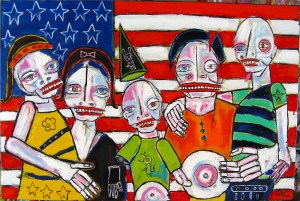
American Dream by Matt Sesow
Also in the news today:
NBC NEWS: Yes, Perceptions of Washington Are Even Worse Than Last Year.
This is a six-month report card time, and it’s failing grades for all of Washington. President Obama’s approval rating stands at 41% in our recent NBC/WSJ poll, his fav/unfav is upside down (at 41%-45%), and a majority of Americans (54%) no longer think he’s able to lead the country and get the job done. Republicans and Congress are in even worse shape. The GOP’s fav/unfav in the NBC/WSJ poll is 29%-45% (versus the Democratic Party’s 38%-40% score). Just 7% of the country has confidence in Congress (compared with 29% for the presidency and 30% for the Supreme Court, per Gallup. And when it comes to congressional productivity, the 113th Congress (2013-2014) has passed just 121 bills into law — fewer than at this same point in the historically unproductive 112th Congress (140 bills into law). Maybe it doesn’t FEEL worse, because there hasn’t been an epic showdown or confrontation like the government shutdown. But the numbers tell a different story — it has gotten worse.
From James Risen at the NYT, scary revelations about the murder of 17 civilians by Blackwater thugs in Iraq in 2007: Before Shooting in Iraq, a Warning on Blackwater.
Just weeks before Blackwater guards fatally shot 17 civilians at Baghdad’s Nisour Square in 2007, the State Department began investigating the security contractor’s operations in Iraq. But the inquiry was abandoned after Blackwater’s top manager there issued a threat: “that he could kill” the government’s chief investigator and “no one could or would do anything about it as we were in Iraq,” according to department reports.
American Embassy officials in Baghdad sided with Blackwater rather than the State Department investigators as a dispute over the probe escalated in August 2007, the previously undisclosed documents show. The officials told the investigators that they had disrupted the embassy’s relationship with the security contractor and ordered them to leave the country, according to the reports.
After returning to Washington, the chief investigator wrote a scathing report to State Department officials documenting misconduct by Blackwater employees and warning that lax oversight of the company, which had a contract worth more than $1 billion to protect American diplomats, had created “an environment full of liability and negligence.”
“The management structures in place to manage and monitor our contracts in Iraq have become subservient to the contractors themselves,” the investigator, Jean C. Richter, wrote in an Aug. 31, 2007, memo to State Department officials. “Blackwater contractors saw themselves as above the law,” he said, adding that the “hands off” management resulted in a situation in which “the contractors, instead of Department officials, are in command and in control.”
I have a few more links, but I’m going to put them in comments; because I’m having terrible issues with WordPress today. I hope you’ll also post your thoughts and links in the thread below.
Lazy Saturday Reads
Posted: June 28, 2014 Filed under: morning reads, Republican politics, U.S. Politics | Tags: Bobby Womack, Mark Mayfield, medical marijuana, Mississippi, Washington Redskins 41 Comments
Good Morning!!
Yesterday we had a sort-of mini-family-reunion at my mother’s house in Indiana. We wanted to get a bunch of us together to celebrate my mom’s 89th birthday. I’ve been here for a few weeks already. I had to stay a little longer than I was planning to after my mom broke her wrist.
My brother and his wife and two sons are visiting from Boston, another brother came with his son from Illinois, my sister and her husband came from Indianapolis, and my niece and her husband and son also came from Indianapolis. Only one of my sisters wasn’t here.
It was a lot of fun. We broke out mom’s croquet set, and sat outside talking for hours. My brother John (the one from Boston area) cooked a fantastic meal of grilled steak, roasted potatoes and veggies, and salad; and afterwards we had a birthday cake that my niece from Indy had designed. Across the top was a pastry scrabble board with words like “grandma, mother, birthday on it. (My mom is a scrabble and crossword fan and she recently started a scrabble group with two of her friends).
The day was a reminder to me that family is just about the most important thing in life. I didn’t get that when I was younger and just wanted to get away to a more interesting place; but as I get older, it feels more and more true. Now I understand why my grandparents organized big family “reunions” when I was a kid. In our Catholic family, everyone had lots of kids and we would have huge get-togethers with 30+ kids all running around wildly and adults drinking eating and reminiscing.
But enough about me, let’s see what’s happening the news.
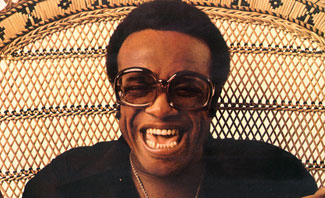
We lost a legendary musician yesterday. Rolling Stone reports: Soul Legend Bobby Womack Dead at 70.
Bobby Womack, the legendary soul singer whose career spanned seven decades, died Friday at age 70. A representative for Womack’s label XL Recordings confirmed the singer’s death to Rolling Stone, but said the cause of death was currently unknown.
The son of two musicians, Womack began his career as a member of Curtis Womack and the Womack Brothers with his siblings Curtis, Harry, Cecil and Friendly Jr. After Sam Cooke signed the group to his SAR Records in 1960, they released a handful of gospel singles before changing their name to the Valentinos and earning success with a more secular, soul- and pop-influenced sound. In 1964, one month after the Valentinos released their hit “It’s All Over Now,” the Rolling Stones put out their version, which went to Number One on the U.K. singles charts.
Three months after the death of Cooke in 1964, Womack married Cooke’s widow, Barbara Campbell, and the Valentinos disbanded after the collapse of SAR Records. After leaving the group, Womack became a session musician, playing guitar on several albums, including Aretha Franklin’s landmark Lady Soul, before releasing his debut album, Fly Me to the Moon, in 1968. A string of successful R&B albums would follow, including Understanding and Across 110th Street, both released in 1972, 1973’s Facts of Life and 1974’s Lookin for a Love Again.
After the death of his brother, Harry, in 1974, Womack’s career stalled, but was revived in 1981 with the R&B hit “If You Think You’re Lonely Now.” Throughout most of the Eighties, the singer struggled with drug addiction, eventually checking himself into a rehabilitation center for treatment. A series of health problems would follow, including diabetes,pneumonia, colon cancer and the early signs of Alzheimer’s disease, though it was unclear if any of these ailments contributed to his death. Womack was declared cancer-free in 2012.
Read the rest at the RS link.
Read a collection of tweets in praise of Womack from The Guardian: Stars pay tribute to the great Bobby Womack.
At the Washington Post, Simon Waxman of the Boston Review has a worthwhile op-ed about the continuing scandal of the Washington Redskins’ refusal to deal with the inherent racism of their team name: The U.S. military’s ongoing slur of Native Americans.
Resistance to the Washington Redskins team name has ebbed and flowed over the years, but thanks in part to letters from 50 senators to the team’s owner, Dan Snyder, and last week’s decision by the U.S. Patent and Trademark Office to rescind the team’s trademark registration, the campaign to get rid of it has renewed urgency.
Snyder has shrugged off complaints about the name, even claiming that “redskins” is a “badge of honor.” Team president Bruce Allen, protesting too much, says the name “has always been respectful of and shown reverence toward the proud legacy and traditions of Native Americans.”
The team and the NFL are under a great deal of pressure right now,
But even if the NFL and Redskins brass come to their senses and rename the team, a greater symbolic injustice would continue to afflict Indians — an injustice perpetuated not by a football club but by our federal government.
In the United States today, the names Apache, Comanche, Chinook, Lakota, Cheyenne and Kiowa apply not only to Indian tribes but also to military helicopters. Add in the Black Hawk, named for a leader of the Sauk tribe. Then there is the Tomahawk, a low-altitude missile, and a drone named for an Indian chief, Gray Eagle. Operation Geronimo was the end of Osama bin Laden.
Why do we name our battles and weapons after people we have vanquished? For the same reason the Washington team is the Redskins and my hometown Red Sox go to Cleveland to play the Indians and to Atlanta to play the Braves: because the myth of the worthy native adversary is more palatable than the reality — the conquered tribes of this land were not rivals but victims, cheated and impossibly outgunned.
The destruction of the Indians was asymmetric war, compounded by deviousness in the name of imperialist manifest destiny. White America shot, imprisoned, lied, swindled, preached, bought, built and voted its way to domination. Identifying our powerful weapons and victorious campaigns with those we subjugated serves to lighten the burden of our guilt. It confuses violation with a fair fight.
It’s an excellent essay. I hope the powers that be will get the message.
Another op-ed at The New York Times argues against popular claims that marijuana is an effective treatment for untold numbers of illnesses: Politicians Prescriptions for Marijuana Defy Doctors and Data. It appears that the NYT has fixed it’s website so that you can’t copy and paste anything anymore, so you’ll need to go to the link to read the article by Catherine St. Louis. It’s quite interesting and compelling.
What the hell is going on down in Mississippi. I haven’t been following the story closely, but this is stunning: Tea party leader Mayfield dies in apparent suicide.
Attorney Mark Mayfield was found dead of an apparent self-inflicted gunshot wound Friday at his Ridgeland home.
Mayfield, vice chairman of the Mississippi Tea Party, was one of three men charged with conspiring with Clayton Kelly to photograph U.S. Sen. Thad Cochran’s bedridden wife in her nursing home to use in a political video against Cochran in the Republican Senate primary against state Sen. Chris McDaniel.
Ridgeland police said they received a 911 call at 9:03 a.m. from a woman who said her husband had just shot himself.
Officers responded to the home on Cherry Laurel Lane in the Bridgewater subdivision at 9:07 a.m. and were directed by Mayfield’s wife to a storage room in the garage.
Officers found Mayfield lying on the floor with a single gunshot wound to his head, according to a Ridgeland Police Department statement. Police found a “large caliber revolver” near the body. “The death is classified as a death investigation-pending, due to an awaiting autopsy to be performed at an undetermined time.” ….
Mayfield of Ridgeland, an attorney and state and local tea party leader, was arrested by the Madison police Department last month along with Richard Sager, a Laurel elementary school P.E. teacher and high school soccer coach. Police said they also charged John Beachman Mary of Hattiesburg, but he was not taken into custody because of “extensive medical conditions.” All face felony conspiracy charges. Sager also was charged with felony tampering with evidence, and Mary faces two conspiracy counts.
Much more at the link.
Even more bizarre, Buzzfeed’s Andrew Kaczynski reports: McDaniel Campaign Staffer Blames Tea Party’s Leader Suicide On Political Opponents.
The strange and ugly Mississippi Republican Senate primary turned tragic when Mark Mayfield was found dead Friday. Mayfield was a lawyer and board member of the Central Mississippi tea party and one of the alleged conspirators in the case surrounding the break-in and photographing of incumbent Mississippi Sen. Thad Cochran’s bedridden wife in her nursing home.
Mayfield’s death was an apparent suicide, according to reports.
On Twitter, one high-level McDaniel staffer, policy director Keith Plunkett wrote:
“A good man is gone today bc of a campaign to destroy lives. To all “so called” Republican leaders who joined lockstep: I WILL NOT REST!”
More tweets at Buzzfeed.
I’m going to end there, because there are numerous relative milling around me wondering why I’m typing on a computer instead of joining the group. What stories are you following today? Please share your thoughts and links on the comment thread.

 peej
peej Carissa
 bostonboomer
 dakinikat
 ecocatwoman
 mablue2
 Mama Lopez
 peggysue22
 quixote
 skydancingguestblogger
 Mona (aka Wonk the Vote)



 Sky Dancing
Recent Comments