
Thursday Reads: Media Clutches Pearls, Takes to Fainting Couch, and Calls for Smelling Salts
Posted: March 5, 2015 Filed under: Foreign Affairs, Hillary Clinton, Media, morning reads, Republican politics, Surreality, The Media SUCKS, U.S. Politics | Tags: Benghazi, Fox News, House Oversight Committee, Jason Chaffetz, New York Times, State Department emails, Washington Post 44 Comments  Good Morning!!
I can’t figure out if the corporate media wants to stop Hillary Clinton from running for president or if they desperately want her to run so they can figuratively flog her with a cat-o-nine-tails and then put her in stocks in front of the Capital building.
The story about Hillary using a private email domain when she was Secretary of State has reached the point of ridiculousness, but the media can’t help themselves–they are and yet the coverage continues to get more heated by the hour. The Hillary haters in the media see blood in the water and they’re circling in hopes of getting their teeth into her.
Sorry for the tortured metaphors, but seriously, what does the media want from this woman?
Check out this story from The Hill reporting on remarks by House Oversight Committee Chairman Jason Chaffetz of Utah. (Chaffetz and former Chairman Darrell Issa have been the leaders of the “investigations” of the Bengazi, IRS, and Fast and Furious non-scandals.)
Asked on “Fox and Friends” whether Clinton’s exclusive use of a personal email address during her time as secretary of State raised national security concerns, Chaffetz said, “It does beg the question: Were there any sort of classified pieces of information that were flowing through her personal email account?”
“Which is something you can’t do and something yesterday Gen. Petraeus had to plead guilty to, or was going out in a deal, dealing with his personal email and interaction with somebody who didn’t have a classification,” Chaffetz added….
Petraeus reached a plea deal, the Justice Department announced Tuesday, over charges he failed to turn over for archiving small record books kept while commanding U.S. forces in Afghanistan, instead providing them and their classified information to his mistress, Paula Broadwell, who wrote a biography of the Army general.
Seriously?
State Department spokeswoman Marie Harf said Tuesday, “we have no indication that Secretary Clinton used her personal email account for anything but unclassified purposes,” adding that Clinton used secure phone calls, aides or took other steps to send sensitive messages and has turned over some emails for archiving.
But the Committee will investigate anyway, and yesterday, according to the WaPo, the “Select Committee on Benghazi”
subpoenaed all communications of former Secretary of State Hillary Clinton related to Libya and to the State Department for other individuals who have information pertinent to the investigation,” according to a statement by committee spokesman Jamal Ware. “The Committee also has issued preservation letters to internet firms informing them of their legal obligation to protect all relevant documents.”
Back to The Hill article (emphasis added):
Earlier this week, Chaffetz said his committee would join the House Select Committee on Benghazi to further explore Clinton’s use of personal emails. Rep. Trey Gowdy (R-S.C.), the chairman of that committee, said Clinton might have to testify several times before the panel, even into 2016.

Chaffetz himself lists a personal gmail address on his “official House card,” according to ABC News, but Chaffetz says that’s different. According to the Hill, when he was asked about the comparison between his use of email and Clinton’s, Chaffetz said, “Well that’s like comparing apples to a boat.”
Read more about the House efforts to bring Hillary down at Bloomberg Politics: House Oversight Committee to ‘Explore’ Clinton’s E-Mail Use, Chairman Says.
At New York Magazine, Frank Rich is deeply concerned.
Do the Democrats Need a Backup Plan for 2016?
Are Clinton’s email shenanigans a federal offense? Probably not. But we still don’t know the whole story, and it seems to be thickening by the minute — notably with a new report from the AP that she was protecting her email by cycling it through her own private email server out of Chappaqua. But the more important question is why the Clintons, who more than anyone in American politics understand the high risks of perceived improprieties, have left Hillary’s campaign so vulnerable even before it is officially out of the gate.
Why in God’s name did they change the name of the Clinton Foundation to the Bill, Hillary and Chelsea Clinton Foundation? That gives Hillary full ownership of a stream of potential conflict-of-interest revelations that have been emerging ever since, notably in the Washington Post, The Wall Street Journal, and Politico: that the foundation solicited funds from at least 60 corporations that were lobbying the State Department during her tenure as Secretary of State; that the foundation quietly resumed soliciting donations from foreign governments once she left the State Department; that an Obama Administration ethics framework established to monitor potential conflicts of interest between Bill Clinton’s lucrative foreign speech engagements and State on Hillary’s watch was less-than-exacting.
And one imagines this is only the beginning. At the Post, a lead reporter on the Clinton story is Rosalind S. Helderman, whom some may recall was the dogged investigative journalist whose forensic journalism helped expose the pay-for-play scandal that brought down Bob McDonnell, the former Virginia Governor, and his wife Maureen.
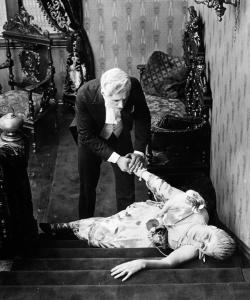
You can check out Rich’s links for more background. Both the Post and the NYT are really pushing this story, but the Post seems even more worked up than the Times. Rich points out that Democrats really don’t have any legitimate alternatives to Clinton. Who are they going to run instead? Martin O’Malley? Jim Webb? Give me a break. And sorry, Emo-Progs,, Elizabeth Warren is not running.
At least one Joe Biden backer sees this new “scandal” as a golden opportunity, according to the Washington Post.
Top Biden backer: Hillary Clinton will ‘die by 1,000 cuts’ on e-mail story.
Dick Harpootlian, a former Democratic Party chairman in South Carolina, home to an early and important presidential primary, said recent reports about Clinton’s use of private e-mail to conduct government business and her family’s charitable foundation accepting donations from foreign governments while she was secretary of state could be damaging to her likely 2016 presidential campaign.
“There’s always another shoe to drop with Hillary,” Harpootlian said in an interview Wednesday. “Do we nominate her not knowing what’s in those e-mails?… If the e-mails were just her and her family and friends canoodling about fashion and what they’re going to do next week, that’s one thing. But the fact that she’s already turned e-mails to the Benghazi committee because she was doing official business on it means she’s going to die by 1,000 cuts on this one.”
He wishes.
Harpootlian — who has been an active and outspoken booster of a Biden 2016 candidacy — said the foundation donations and e-mail stories have sparked chatter among South Carolina politicos about drafting other candidates into the Democratic primary. Referencing Biden specifically, he said, “I’ll tell you this: He ain’t got no e-mail problems. He ain’t got no foundation problems. What you see with Joe is what you get. There’s nothing hidden there.”
Harpootlian added, “The chatter down here is, ‘Is this the best we can do?’ Certainly everyone wants to give a woman a chance to lead this country, but is [Clinton] the woman? There are plenty of other women who would be competitive, whether it’s Elizabeth Warren or Amy Klobuchar or Kirsten Gillibrand.”
Sorry, Dick, those women aren’t running and they wouldn’t be any more competitive than your pal Joe Biden–who has his own past scandals to worry about.

The Wall Street Journal says “some Democrats” are “troubled” about the new Hillary “scandals.” Yes, I’m sure they are. Sometimes I think there are more Clinton-haters among Democrats than Republicans. WSJ reports:
Some Democrats are uneasy about the reports involving Hillary Clinton ’s use of a private email account during her time as secretary of state and her foundation’s fundraising practices, calling on her to break her silence and personally address the two controversies.
Some party figures say the recent disclosures show a need for Democratic rivals to step forward and challenge Mrs. Clinton for a nomination that has long seemed to be hers for the asking.
At least one of these “uneasy” Democrats was willing to use his name.
Don Paulson, chairman of the Muscatine County Democrats in Iowa, said he was disturbed by the Clinton Foundation’s practice of accepting donations from foreign governments at a time when Mrs. Clinton was preparing a campaign for the White House. He saw that as one reason why the party should vet her and other candidates in a competitive primary, rather than allow her to coast to the nomination without a real fight. “It’s a healthier thing all around if there’s competition,” he said.
I’m sure Muscatine County Chairman is a Very Important Job, so we’d better being paying close attention to Mr. Paulson. Or not.

The WSJ admits that “Mrs. Clinton’s email arrangement…was legal while she served as the nation’s top diplomat,” but never mind that. It’s still so “troubling” and it makes people so “uneasy.” They do include the names of two more disapproving Democrats:
Tad Devine, a Democratic strategist who has worked on six presidential campaigns, said of the email account: “She needs to explain why she did what she did. I do think it’s a real issue, and I think it’s an issue that has to get dealt with on a serious level.”
“I don’t think it’s something a junior staffer can put out a statement and expect the thing to go away,” he said.
Kim Weaver, chairman of the O’Brien County Democrats in Iowa, which holds the nation’s first presidential contest, said: “The questions need to be answered.” She added she would like to hear whether the personal email system Mrs. Clinton used carried adequate security protections. “If it’s no big deal, why not just come out and say what it is.”
It seems that Iowa Democrats are particularly upset.
But will any of this matter to voters in November of 2016? Brendan Nyhan of the NYT blog The Upshot doesn’t think so. He notes that most Americans aren’t thinking about the 2016 presidential campaign yet, and when they do, attitudes toward toward the “email furor” will likely break down along partisan lines.
Of course that won’t stop his newspaper from running story after story about it on their front page while they ignore the potential loss of health insurance for 8,000,000 Americans along with other important world events.

One more from Business Insider:
Former State Department officials explain why the Clinton email ‘scandal’ is ridiculous.
According to the State Department, Hillary Clinton’s use of a personalized email address during her time as secretary of state was no secret.
“The State Department has long had access to a wide array of Secretary Clinton’s records — including emails between her and Department officials with state.gov accounts,” State Department Deputy Spokesperon Marie Harf said in an email to Business Insider….
Business Insider reached out to Clinton’s representatives. They put us in touch with two former State Department officials who argued that Clinton was careful to use the address in a manner that went above and beyond regulatory requirements and ensured her communications were preserved.
The former officials, who requested anonymity to freely discuss Clinton’s emails and State Department policy, echoed the notion the former secretary’s personalized email address was not kept secret. They said she used it to communicate with over 100 department staffers, other officials, and lawmakers on Capitol Hill….
Clinton’s spokesman Nick Merrill issued a statement in response to the article wherein he argued Clinton corresponded with people on their government account whenever she conducted official business….”Like Secretaries of State before her, she used her own email account when engaging with any Department officials. For government business, she emailed them on their Department accounts, with every expectation they would be retained,” Merrill said.

Guess what? John Kerry is the first Secretary of State to use a government email account! Colin Power also used a private account during the Bush Administration.
The two former officials said efficiency was one reason Clinton set up her own address. At the time, State Department policy would not have allowed her to have multiple email addresses on her Blackberry. Because of this, the officials said, she opted to have one address for both personal and governmental communications. They echoed Merrill’s statement and said Clinton took care to correspond with other State officials exclusively on their governmental addresses. The officials said this meant all of her emails and those sent to her were immediately preserved on government servers.
According to the two officials, regulations discouraged the use of personal email but did not prohibit it. Merrill also argued that Clinton’s use of private email was not against the rules.
“Both the letter and spirit of the rules permitted State Department officials to use non-government email, as long as appropriate records were preserved,” he said.
So far, Hillary herself has only responded on Twitter:
So . . . . there are lots of important stories out there today. Which ones are you following?
Tuesday Reads: Netanyahu Speech, Hillary-Hate, and Nonsensical SCOTUS Case that could Hurt 8 Million Americans
Posted: March 3, 2015 Filed under: 2016 elections, Affordable Care Act (ACA), Barack Obama, Foreign Affairs, Hillary Clinton, morning reads, U.S. Politics | Tags: Affordable Care Act, Benjamin Netanyahu speech to Congress, iran, israel, King v. Burwell, New York Times, Obamacare, SCOTUS, State Department 19 Comments
Good Afternoon!!
I wanted to touch on a couple of issues this afternoon: the latest Hillary Clinton “scandal,” and the upcoming Supreme Court case that could doom Obamacare once and for all.
But before I get to those stories, I want to share this good article by James Fallows on the possible motivations behind Netanyahu’s speech to Congress this morning.
The Mystery of the Netanyahu Disaster, and a Possible Explanation.
Fallows enumerates the possible motivations for the Netanyahu slap in the face to President Obama:
“Was it simple tin ear on his side, and Ambassador Ron Dermer’s?” Fallows asks? That’s not likely according to Fallows, because Netanyahu is far too sophisticated and knowledgeable about U.S. politics. Fallows also discounts the theory that it was only about “election-year politicking” in Israel. Perhaps that’s part of it. Is it because Netanyahu has so often been right in his previous predictions?
Hardly. I can’t believe that he’s fooled even himself into thinking that his egging-on of war with Iraq looks good in retrospect. And for nearly two decades Netanyahu has been arguing that Iran was on the verge of developing nuclear weapons. When you’re proven right, you trumpet that fact—and when you’re proven wrong, you usually have the sense to change the topic. Usually.
Was it because Netanyahu “has a better plan?”
No. His alternative plan for Iran is like the Republican critics’ alternative to the Obama healthcare or immigration policies. That is: It’s not a plan, it’s dislike of what Obama is doing. And if the current negotiations break down, Iran could move more quickly toward nuclear capacity than it is doing now—barring the fantasy of a preemptive military strike by Israel or the U.S.
Fallows also doesn’t buy the argument that Netanyahu actually believes that Iran “faces an “existential threat” if Iran develops a nuclear weapon?
Let me explain. No person, nation, or community can define what some other person (etc) “should” consider threatening….But from the U.S. perspective I can say that the “existential” concept rests on two utterly unsupportable premises. One is that Iran is fundamentally like Nazi Germany, and the world situation of 2015 is fundamentally like that of 1938. Emotionally you can say “never forget!” Rationally these situations have nothing in common—apart from the anti-Semitic rhetoric. (To begin with: Nazi Germany had a world-beating military and unarmed Jewish minorities within its immediate control. Iran is far away and militarily no match for Israel.) The other premise is that Iran’s leaders are literally suicidal. That is, they care more about destroying Israel than they care about their country’s survival. Remember, Israel has bombs of its own with which to retaliate, so that any attack on Israel would ensure countless more Iranian deaths.

What then? Fallows refers to an article at The National Interest by Paul Pillar.
Pillar’s assessment is that the ramped-up “existential” rhetoric is a screen for the real issue, which is a flat contradiction between long-term U.S. and Israeli national interests as regards Iran. It is in American interests (as I have argued) to find some way to end Iran’s excluded status and re-integrate it with the world, as happened with China in the 1970s. And it is in Israel’s interests, at least as defined by Netanyahu for regional-power reasons, that this not occur. As Pillar writes:
The prime objective that Netanyahu is pursuing, and that is quite consistent with his lobbying and other behavior, is not the prevention of an Iranian nuclear weapon but instead the prevention of any agreement with Iran. It is not the specific terms of an agreement that are most important to him, but instead whether there is to be any agreement at all. Netanyahu’s defense minister recently made the nature of the objective explicit when he denounced in advance “every deal” that could be made between the West and Tehran. As accompaniments to an absence of any agreements between the West and Iran, the Israeli government’s objective includes permanent pariah status for Iran and in particular an absence of any business being done, on any subject, between Washington and Tehran.
That is, as long as Netanyahu keeps the attention on nukes and “existential” threats, he’s talking about an area where the U.S. and Israel might differ on tactics but agree on ultimate goals. Inflammatory as that topic is, it’s safer than talking about re-integrating Iran as a legitimate power, where U.S. and Israeli interests may ultimately differ.
I thought that was pretty good food for thought.
Before I get to the Clinton e-mails issue, here’s an interesting piece at the Washington Post on Hillary’s relationship with Netanyahu.
The phone call between Hillary Rodham Clinton and Israeli Prime Minister Benjamin Netanyahu lasted 45 minutes. For 43 of them, she talked and he listened.
The U.S. secretary of state lectured the Israeli leader, accusing him of trying to do an end run around American opposition to settlement-building and embarrassing Vice President Biden during a visit to Israel, according to interviews with people present during the 2010 call or who were briefed on it afterward. She read from a script for part of the lecture, so as not to miss any key points.
“The word ‘humiliation’ appeared very prominently,” recalled Michael Oren, then the Israeli ambassador in Washington. “As in ‘You have humiliated the United States of America.’ ”
There probably aren’t many times in Netanyahu’s professional life when he has listened to anyone for 43 minutes. Netanyahu prefers to do the lecturing….And there aren’t many people who could make Netanyahu sit still for a tongue-lashing. Clinton is one of them.

The story of the phone call comes from Clinton’s book on her time as Secretary of State, Hard Choices. Read more about it at the link. It would seem that experiences like this would stand Clinton and the U.S. in good stead if she ends up in the White House.
On the latest “scandal” about Hillary using a private e-mail as Secretary of State, I’m not sure what to think. It certainly does give ammunition to Republicans and to potential Democratic opponents like Martin O’Malley.
Here’s the NYT Story that started the fuss: Hillary Clinton Used Personal Email Account at State Dept., Possibly Breaking Rules. You’ll need to read it at the link, because the Times has fixed their website so that I, at least, can’t copy and paste any excerpts. Here are some reactions to the story. First, the debunkers:
From USA Today, Clinton aide: State Department e-mails preserved.
A spokesman for Hillary Rodham Clinton said Tuesday that while she used a personal e-mail account during her years as secretary of State, those records have been maintained pursuant to federal rules.
“Both the letter and spirit of the rules permitted State Department officials to use non-government email, as long as appropriate records were preserved,” said Clinton spokesman Nick Merrill. “As a result of State’s request for our help to make sure they in fact were, that is what happened here.”
Merrill responded to a New York Times story saying that Clinton, a prospective presidential candidate in 2016, used a personal e-mail account during her four years at the State Department and “may have violated federal requirements that officials’ correspondence be retained as part of the agency’s record.”
The Times reported that Clinton’s “expansive use of the private account was alarming to current and former National Archives and Records Administration officials and government watchdogs, who called it a serious breach.”
Yes, the president signed the new law two years after Clinton left the State Department. The NYT wants to punish her retroactively. Not surprising, considering the Times’ longstanding hatred for and sliming of the the Clintons. Please go read the whole Media Matters post. It won’t stop the Clinton haters from using this, but it’s the truth. Arm yourself.

Coffee, Leon Zernitzky
Bob Cesca at The Daily Banter: That Story About Hillary Clinton’s Private Email Account Isn’t as Awful as It Seems.
Again, please go read the whole thing, and prepare yourself for the coming onslaught. This is only the beginning.
A few more links to folks who either don’t know or don’t care about the time of the law and the fact that Clinton preseved all her emails.
A fairly Hillary-friendly post from Charles Pierce, Hillary Finds A Rake To Step On: The First Clinton Bombshell.
LA Times, Hillary Clinton used personal email while serving as secretary of state.
Mashable, Clinton email revelation: You did what, Hillary?
Incidentally, I was shocked to see this from Joseph Cannon:
Hillary’s secret email account. Let’s be honest: If a Republican did this, we’d be worried. Actually, Republicans have done exactly that.
The most important point here is sub-textual: If the NYT has turned against Hillary Clinton, then we should suspect that she has privately revealed to her closest aides that, if elected, she will do things that she cannot now state out loud. Of course, nothing is truly private these days.
“If the times as turned against Hillary Clinton”??!!! Joseph, why aren’t you aware that the NYT –brave champion of Dubya’s Iraq war–has always loathed the Clintons and has published innumerable attacks on them?
Finally a few links to prepare you for tomorrow’s SCOTUS hearing on King v. Burwell, during which the justices will consider whether to throw about 8 million Americans off their health care plans.
Charles Pierce, The Tell: What This Week’s Attack On Obamacare Is Really About.
…the Nine Wise Souls on Tuesday will hear King v. Burwell, the highly imaginative, if constitutionally laughable, attack on the grammar and punctuation in the Affordable Care Act, which the NWS should have laughed off months ago….
It is the Universal String Theory Of Wingnut Conjuring Words in full view, the complete text of one of the spells. A fake scandal being used to excuse the shabby underpinning of a fake lawsuit that will have real and devastating consequences to thousands of people.

That’s it in a nutshell. But here are more links to check out for more details.
Politico: No easy fix if Supreme Court halts Obamacare cash. (No sh$t Sherlock.)
Republicans are getting nervous about what will happen if they get their wish. From The Hill: GOP fears grow over ObamaCare challenge.
Ezra Klein at Vox: Republicans say they have a plan if the Supreme Court rules against Obamacare. They don’t.
Stephen Brill at Reuters: The Supreme Court hears an Obamacare fairytale.
US News (not known for liberal views): The Silliest Obamacare Challenge Yet. The King v. Burwell case could cause 8 million to lose health insurance.
SCOTUS should never have agreed to hear this case, but they did. Is John Roberts okay with going down in history as a buffoon? We’ll find out in June.
Please share your views along with the stories you’re following today in the comment thread.
Live Blog: Netanyahu Speech to Congress
Posted: March 3, 2015 Filed under: Barack Obama, Foreign Affairs, U.S. Politics | Tags: Benjamin Netanyahu, John Boehner, partisan foreign policy, US-Israel relations 68 Comments
This morning at 10:45, Israeli Prime Minister Benjamin Netanyahu will address a joint session of Congress. You can watch it on C-Span. I might try watching for awhile to see what kind of reaction he gets.
I plan to put up another post a little later. There’s another far more significant event happening tomorrow. The Supreme Court will hear arguments in King vs. Burwell, a lawsuit based on a ludicrous misreading of the ACA law. It will be up to John Roberts to decide if he wants to throw 8,000,000 people off their health care plans, and that’s exactly what Republicans are hoping for.
The other “issues” in the news are a tempest in a teapot over Hillary Clinton using private e-mail when she was Secretary of State and another fuss over when the State Department properly vetted contributions to Bill Clinton’s foundation. If we want Hillary to run for president, we are going to have to get used to this garbage.
For now, here are some quick links on the Netnyahu speech and the negotiations with Iran.
CNN: White House warns Netanyahu not to reveal Iran details.
The Obama administration is bracing for Benjamin Netanyahu to spill secret details of Iran nuclear talks, as both camps traded last-minute political jabs ahead of the Israeli prime minister’s controversial address to Congress Tuesday.
The White House is uncertain what precise details may come out but aides spent Monday frantically mobilizing after Israeli officials said that the prime minister planned to disclose sensitive details of an agreement taking shape in talks between six world powers and Iran, which has entered a delicate final stage.
Concern and anger among American officials about the nature of what Netanyahu might expose heightened already roiling tensions between the two countries. Secretary of State John Kerry cautioned about the damage such revelations might have on the negotiations and President Barack Obama himself attacked Netanyahu’s judgment.
Netanyahu is expected to use the details to bolster his argument before Congress that the deal under discussion will not prevent Iran from getting a bomb and could therefore threaten the Jewish state’s existence.

From the AP via Syracuse.com: Kerry working on Iran nuke deal, Netanyahu to criticize in speech to Congress.
As Secretary of State John Kerry and Iranian Foreign Minister Mohammad Javad Zarif and their teams sought to hammer out an agreement at a luxury hotel in the Swiss resort of Montreux, Israeli Prime Minister Benjamin Netanyahu was set to make his case against one 4,090 miles away in Washington.
The U.S. and Iranian sides met for two hours on Tuesday morning before taking a break, according to U.S. officials. The officials said they expected the talks would resume later and likely continue through Netanyahu’s address to a joint session of Congress, which will be delivered in the late afternoon local time in Montreux.
“We’re working away, productively,” Kerry told reporters.
“We are moving and we are talking to be able to make progress,” said Zarif. “There are issues and we want to address them. But there is a seriousness that we need to move forward. As we have said all along we need the necessary political will to understand that the only way to move forward is to negotiate.”
However, in a sign that Netanyahu’s speech is resonating outside Washington, Zarif decried comments that President Barack Obama made on Monday — as part of an administration-wide effort to push back on the Israeli’s criticism — in which he said that Iran would have to suspend its nuclear activities for at least a decade as part of any final agreement.
“It is clear that Obama’s stance is aimed at confronting propaganda by Zionist regime’s prime minister and other extremist opponents of the negotiations,” Zarif told Iranian reporters, calling it “unacceptable and threatening.” Zarif’s remarks were carried by Iran’s official news agency IRNA.
This speech that John Boehner and Netanyahu cooked up is causing all kinds of mischief.

According to John Ferziger at Bloomberg Politics, Netanyahu Risks Diplomatic, Political Pain If Speech Is Flat.
Israeli Prime Minister Benjamin Netanyahu goes to Congress on Tuesday gambling that disclosing compromises the U.S. made in trying to negotiate a nuclear deal with Iran will delay or derail any agreement.
Netanyahu, a former Israeli army commando, has further damaged his frayed relationship with the White House by ignoring administration warnings and trying to undermine President Barack Obama’s effort to resurrect ties with the Islamic Republic. If his speech to a joint meeting of the House and Senate proves unpersuasive, Israelis may vote him out of office.
The Israeli leader, running for his fourth term in a March 17 election, will seek to “reinforce doubts that people have” and raise congressional pressure to better answer “the legitimate questions that are out there,” said Dennis Ross, a former special adviser to Obama on Iran and the Middle East.
However, said Yoram Meital, a political scientist at Ben-Gurion University in Beersheba, Israel: “If he doesn’t reveal something significant or provides little hard evidence for his claims, it could affect the vote. Israelis are, by and large, afraid of Iran’s nuclear program, but they are ready to punish Netanyahu if he doesn’t deliver in this speech.”
Netanyahu will reveal details of the agreement being negotiated with Iran against a late March deadline by the U.S. and five other world powers that will show why he’s afraid it could lead to Israel’s nuclear annihilation, an official who asked not to be named because of the trip’s diplomatic sensitivity told reporters aboard the prime minister’s flight to the U.S.
Isn’t that just ducky? Boehner’s decision to invite a foreign leader to speak to Congress without informing the White House is unprecedented in U.S. history. The next time Republicans control the White House, Democrats could now feel invite a foreign leader to speak against that president’s policies. It’s a terrible precedent.

Two days ago Diane Feinstein called Netanyahu “arrogant” and added that “he doesn’t speak for her.” CNN reported:
Sen. Dianne Feinstein says Israeli Prime Minister Benjamin Netanyahu is “arrogant” for asserting that he speaks for all Jews — and that he doesn’t speak for her.
The California Democrat’s comments to CNN’s Dana Bash on Sunday’s “State of the Union” come days ahead of Netanyahu’s high-profile speech to Congress, in which he’s set to lobby against a deal to thwart Iran’s nuclear ambitions.
“My responsibility is to worry not only about the state of Israel, but also the future of the Jewish people,” Netanyahu said Saturday in Jerusalem. “And for that reason, we are strongly opposed to the agreement being formulated between the world powers and Iran that could endanger Israel’s very existence.”
Feinstein said she’ll attend Netanyahu’s speech — which President Barack Obama’s administration has heavily criticized. But she wasn’t happy with those comments.
“He doesn’t speak for me on this,” she said. “I think it’s a rather arrogant statement. I think the Jewish community is like any other community. There are different points of view. I think that arrogance does not befit Israel, candidly.”
From the Boston Herald: U.S. Rep. Jim McGovern blasts Netanyahu for ‘disrespectful’ speech.
Congressman Jim McGovern, one of a growing number of Democrats refusing to attend Israeli Prime Minister Benjamin Netanyahu’s controversial speech before Congress tomorrow, ripped the foreign leader for turning Capitol Hill into a campaign “rally” point just weeks before his own county’s election.
“Joint sessions of Congress are not supposed to be political speeches … This is not a place for a foreign leader to do a re-election rally,” the Democrat said today in an interview on Boston Herald Radio’s “Morning Meeting” with hosts Hillary Chabot and Jaclyn Cashman.
“With joint session so close to his own reelection campaign and before we have reached a (nuclear) deal with negotiators with Iran, I think it’s disrespectful to our president, I think it’s disrespectful to our foreign policy leaders who are trying … to prevent Iran from getting a nuclear weapon,” he added. “I don’t feel like I want to be a prop in a campaign ad for Prime Minster Netanyahu.”
McGovern, who called the speech’s timing “unprecedented” given the March 17 vote in Israel, also echoed Democratic slams of Speaker John Boehner, who has been criticized, including by the White House, for inviting Netanyahu to speak to the joint session of Congress without consulting the president.
The Worcester Democrat said Netanyahu should have sought a different avenue to speak with members of Congress, noting attempts by some Senate Democrats to arrange a separate meeting with him.
Fellow Bay State Congresswoman Katherine Clark has said she also plans to skip the speech, and U.S. Sen. Elizabeth Warren last month called on officials to postpone it, saying she sides with the Anti-Defamation League’s stance on the address.

From Slate’s Joshua Keating: What Does it Mean for the Leader of a Foreign Country to Be a Republican?
In his speech to the American Israel Public Affairs Committee on Monday, Israeli Prime Minister Benjamin Netanyahu rejected charges that he is injecting partisanship into the U.S.-Israel relationship. “The last thing anyone who cares about Israel, the last thing that I would want, is for Israel to become a partisan issue, and I regret that some people have misperceived my visit here this week as doing that,” he said. “Israel has always been a bipartisan issue. Israel should always remain a bipartisan issue.”
It’s a little late for that, Bibi. Tuesday, Netanyahu is giving what was billed from the moment it was announced as a rebuttal to President Obama’s State of the Union address. Much of the controversy surrounding the visit has been over the perceived mutual snubbing and sniping between Netanyahu’s office and the White House and what it says about the relationship between the two leaders. (Nothing good.) But the bigger story is Netanyahu firmly aligning himself in the camp of one of America’s political parties to the exclusion of the other one—a strategy that could, in the long term, be extremely detrimental to Israel’s interests.
Given the “very real difference” between Obama and Netanyahu over Iran’s nuclear program, the Israeli leader’s decision to accept John Boehner’s invitation to address Congress made some tactical sense. Netanyahu believes Obama is on the verge of making a historically dangerous deal with Iran and doesn’t see any prospect for changing his mind. Given that his officials say he’s “written off” Obama and doesn’t see any chance of changing his mind, why not reach out to Congress, the “last brake” to stop the deal, diplomatic niceties be damned?
But even if he’s not particularly interested in what the White House thinks of him at this point, what’s harder to understand is the cold shoulder Netanyahu has given congressional Democrats, some of whom have been willing in the past to push back against the White House on the Iran issue. The most striking moment in this whole mess was not so much Netanyahu accepting Boehner’s invitation, though that could certainly have been handled more deftly. It was when Netanyahu declined a closed-door meeting with congressional Democrats. This would seem to have been a welcome opportunity for some fence-mending given that a number of prominent members of Congress, including the most senior senator, Patrick Leahy, and a number of members of the Congressional Black Caucus, are skipping his speech over the perceived insult to Obama. Instead, Netanyahu dug in deeper, making the long-standing joke about Netanyahu being the “Republican senator” from Israel seeming not really like a joke anymore.

It’s certainly troubling. What kind of precedent is this going to set? What do you think? If you’re planning to watch the speech, I hope you’ll post comments about it with me below. And please check back later for a regular Tuesday post.
Lazy Saturday Reads: Leonard Nimoy, Son of Boston’s Old West End
Posted: February 28, 2015 Filed under: morning reads | Tags: Leonard Nimoy 24 Comments
Leonard Nimoy receives honorary degree from Boston University, May, 2012.
Good Afternoon!!
JJ posted some wonderful cartoon tributes to Leonard Nimoy last night. I decided to follow her lead by posting some articles and clips I enjoyed reading and watching. Naturally, I was interested in learning more about Nimoy’s early years in Boston; so that’s what I’m going to focus on today.
I really liked the obituary in The Boston Globe (originally published in the NYT): ‘Star Trek’ icon Leonard Nimoy dies at 83. It’s a very nice piece, and it includes Nimoy’s Boston history.
Leonard Nimoy, the sonorous, gaunt-faced actor who won a worshipful global following as Mr. Spock, the resolutely logical human-alien first officer of the Starship Enterprise in the television and movie juggernaut “Star Trek,” died Friday at his home in the Bel Air section of Los Angeles. He was 83….
His artistic pursuits — poetry, photography and music in addition to acting — ranged far beyond the United Federation of Planets, but it was as Mr. Spock that Nimoy became a folk hero, bringing to life one of the most indelible characters of the last half century: a cerebral, unflappable, pointy-eared Vulcan with a signature salute and blessing, “Live long and prosper” (from the Vulcan “Dif-tor heh smusma”).
Nimoy, who was teaching Method acting at his own studio when he was cast in the original “Star Trek” television series in the mid-1960s, relished playing outsiders, and he developed what he later admitted was a mystical identification with Spock, the lone alien on the starship’s bridge.

Nimoy’s high school yearbook photo
On Nimoy’s Boston background:
Martin Walsh, the mayor of Nimoy’s native Boston, called him “a proud product of Boston’s neighborhoods and English High School.”
“Mr. Nimoy never forgot his Boston roots and the spirit of his work lives on in the future generations of children who continue to be inspired by his iconic portrayal of Mr. Spock,” Walsh said.
Born in Boston on March 26, 1931, Leonard Simon Nimoy was the second son of Max and Dora Nimoy, Ukrainian immigrants and Orthodox Jews. His father worked as a barber.
From the age of 8, Leonard acted in local productions, winning parts at a community college, where he performed through his high school years. In 1949, after taking a summer course at Boston College, he traveled to Hollywood, though it wasn’t until 1951 that he landed small parts in two movies, “Queen for a Day” and “Rhubarb.”

English High School
On his connection to his Jewish ancestry:
In 2002, having illustrated his books of poetry with his photographs, Nimoy published “Shekhina,” a book devoted to photography with a Jewish theme, that of the feminine aspect of God. His black-and-white photographs of nude and seminude women struck some Orthodox Jewish leaders as heretical, but Nimoy asserted that his work was consistent with the teaching of the kabbalah.
His religious upbringing also influenced the characterization of Spock. The character’s split-fingered salute, he often explained, had been his idea: He based it on the kohanic blessing, a manual approximation of the Hebrew letter shin, which is the first letter in Shaddai, one of the Hebrew names for God.
“To this day, I sense Vulcan speech patterns, Vulcan social attitudes and even Vulcan patterns of logic and emotional suppression in my behavior,” Nimoy wrote years after the original series ended.
But that wasn’t such a bad thing, he discovered.
“Given the choice,” he wrote, “if I had to be someone else, I would be Spock.”
I just loved that quote at the end. There’s much more info at the link if you’re interested.
Nimoy grew up in the old West End of Boston, a multi-ethnic neighborhood filled with tenement houses that are gone now. However, there is a West End museum that preserves the neighborhood’s history. Nimoy is listed among the important products of the neighborhood along with Charles Bullfinch, media mogul Sumner Redstone, movie producer Joseph E. Levine, and others. Here’s a photo of “Lenny” with some schoolmates. You can see the West End tenements in the background.

At NECN, you can watch a video with interviews from West Enders.
Boston Remembers Native Leonard Nimoy, Old West End
Boston’s West End looks nothing like it did when Leonard Nimoy was born there in 1931. Then, there were half a dozen schools, 32 ethnic groups and hundreds of tenement houses.
But that is where the actor’s legacy remains.
“I think he’s just a neighborhood guy made good,” said Duane Lucia, curator of The West End Museum….
“When he came home from Hollywood, from the West Coast, he actually had to sleep in the same bed as his brother,” said Lucia. “They lived in a very crowded tenement house, like everybody else, where you might have three generations in a two-bedroom apartment.” ….
He returned to the West End to shoot a documentary, meeting with Lucia and others in the neighborhood.
“The West End is gone. He was part of the West End, now he’s gone. It’s too bad,” said Steve Zaidman, who grew up in the West End.
More at the link.

Salem St. (a Jewish area) in the Old West End
I found this amazing trove of photos of “Medieval Boston” before Urban Renewal at Cyburbia.org. The photo below came from that link.

Bowdoin Square, 1929, gateway to the doomed West End beyond.
Here’s some background on the documentary Nimoy shot with his son and video of the first 10 minutes.
Remembering Leonard Nimoy: A Look Back at His Time in Boston’s West End.
Nimoy visited the museum earlier this year with his son, who shot a short film for WGBH titled Leonard Nimoy’s Boston. The program brought Nimoy around to different locations in Boston, from the corner of Washington Street and Boylston Street where he sold vacuum cleaners, to the old West End, which barely resembled anything close to the neighborhood that once existed.
Nimoy was born to Max Nimoy, a barber who also worked making leather patterns for luggage. By the age of 10, young Leonard was hustling newspapers on the Boston Common. His parents would have liked him to go into a profession that would allow Nimoy to live a comfortable life, but his experiences in the West End pushed him towards theatre.
In Percy Shain’s 1963 Globe article, Nimoy talks about the time he spent at the Peabody Playhouse, where children took acting classes and put on productions for the West End community.
“I went into acting at the Playhouse more because I was an active kid and wanted something to do, than because I was stage struck.”
He told Boston University’s Class of 2012 during a commencement speech that “It was a community settlement house which was created to help immigrants find their way into the culture. They offered classes in language, cooking, shopping, kitchen sanitation, dental care and how to apply for a job. There was a gym and a sports program, and there was a small gem of a theater.” Today, the Elizabeth Peabody House is located in Somerville and continues to encourage children to let their creativity drive them.
According to BDC Wire, in 2012, Nimoy told Boston Phoenix writer S.I. Rosenbaum
how his passion for photography started after a friend gave him instructions on developing film. “There were six of us living in the apartment with one bathroom, and that was my darkroom,” he told her.
His interest in photography never waned, and in 2014 he appeared via Skype (see photo below) at a showing of his work at Boston University’s Sherman Gallery, “Leonard Nimoy: Secret Selves.”

He previously had had a showing of his work in 2010 at the Massachusetts Museum of Contemporary Art. Here’s a brief article about that show published at The Daily Beast yesterday.
Leonard Nimoy’s ‘Secret’ Talent: A Look Back at His Intimate Photography Exhibition.
Nimoy also had a hidden talent: photography. Back in 2010, he unveiled an exhibition of photo portraits, Secret Selves, at Mass MoCA in his native Massachusetts.
When asked if he’d be appearing in other Star Trek films after 2009’s Star Trek, he laughed.
“You’re talking to a photographer! That’s all over for me,” he told our reporter at the time.
Nimoy described the photo show as a “social experiment,” urging people to pose as their “secret selves”—or alter-egos—yielding fascinating results, with several subjects going so far as posing in the nude.
“To tell you the truth, I feel like I’ve acted out every possible secret self for the last 60 years,” he said. “I’ve done vicious people, honest people, porks—I’ve done all kinds of self.”
See a gallery of Nimoy’s Selves at another Daily Beast link.
More about Nimoy’s art at Art.net News: Leonard Nimoy, Photographer, Art Collector, and Beloved Star Trek Actor, Dead at 83.
Nimoy was a photographer, poet, art collector, and musician, as well as an actor. He became fascinated with photography when he was 13 and went on to study with the photographer Robert Heinecken at UCLA (Heinecken was the subject of a solo show last year at New York’s Museum of Modern Art). His work is represented in various collections, including the Los Angeles County Museum of Art, the New Orleans Museum of Art, the Bakersfield Museum, the Museum of Fine Arts Houston, and New York’s Jewish Museum. He also published several books of photography, including The Full Body Project (2007) and Shekhina (2005).
He was also a beloved patron of the arts, having donated to Asia Society Museum and the Hammer Museum, as well as other museums on the east and west coasts.
“Leonard Nimoy was everything you would imagine him to be—kind, moral, wise, loyal, and profoundly generous of spirit,” Ann Philbin, director of the Hammer Museum, told artnet News in an email. “He truly loved the arts—all of them—but he followed theater and the visual arts with a particular passion and knowledge. He and [his wife] Susan have been great philanthropists for many causes but we were truly lucky at the Hammer to have their friendship and support over the years. We will all miss him terribly.”
Richard Michelson, his Northampton, Massachusetts, dealer pointed out that he supported exhibitions of young and challenging photographers at various museums with funding from his eponymous foundation….
Associated so closely with Mister Spock, Nimoy was intrigued with the notion of alternate identities, and invited volunteers from nearby Northampton to “reveal their secret selves” on film. The concept was fueled by Plato’s “Symposium,” which imagined the original humans were dual creatures then split into two by the gods. In another series, the “Full Body Project,” Nimoy photographed full-bodied women in the nude.

He was clearly a brilliant, sensitive, talented, and creative person.
Nimoy also had a wonderful speaking voice. From the Globe: Nimoy’s voice will live on at Boston’s Museum of Science.
Nimoy, who died Friday morning at age 83, has been opening each movie at the theater since 1988, theater manager Robin Doty said. The Boston-born actor is best known for his role as the pointy-eared Vulcan Mr. Spock on th “Star Trek” TV series.
Nimoy grew up in the city’s West End, the area where the museum is located.
Before the IMAX movies play on the giant screen, during the sound-check, Nimoy’s familiar voice comes on, and he recites some lines from the song, “Who Put the Bomp?” by Barry Mann.
“I think his voice helps acclimate guests to sound systems,” Doty said. “It’s always kind of fun and out of character for him.”
Doty said audiences enjoy Nimoy’s cameo appearance and that it is all part of the experience at the museum.
“He was very open and kind. He had a warm spot in his heart” for the museum, he said. “It’s hard to believe. … He’s such a timeless person.”

West End Museum curator Duane Lucia with Leonard and Adam Nimoy at the museum in 2013.
One final Boston-related story that Leonard Nimoy told during his speech at BU’s Commencement in 2012, from Business Insider.
Leonard Nimoy said a chance meeting with a young JFK changed his life.
In 2012, he reflected on his life in a commencement speech to Boston University’s College of Fine Arts. He told the story of how a chance meeting with future president John F. Kennedy inspired him when he was at a low point in his career.
In the 1950s, Nimoy was struggling in Los Angeles with a wife and two kids, he said in his speech. He spent his days in auditions and his nights driving a taxi for steady income. One night he picked up Kennedy, who was a Massachusetts senator at the time, at the Bel Air Hotel. He said:
We chatted about careers … politics and show business, and we agreed that both had a lot in common. Maybe too much in common. He said, “Lots of competition in your business, just like in mine.” And then he gave me this: “Just remember there’s always room for one more good one.”
Words to live by, and I did.
So you can see that Boston had a huge impact on Leonard Nimoy’s life, and in return he has had a powerful impact on the city of his birth and its people.
You can treat this as an open thread. What’s happening in the news today?
Thursday Reads: Guerrilla Knitting, Scarf Bombing, and Other News
Posted: February 26, 2015 Filed under: Foreign Affairs, morning reads, Republican politics, U.S. Politics | Tags: Guerrilla knitting, scarf bombing, yarn bombing 24 Comments
Good Morning!!
There is quite a bit of interesting news today, so this will basically be a link dump; but first I want to share a feel-good story my mother tipped me off to. It’s about something called “yarn bombing” or more recently “scarf bombing.” I guess this has been going on for a few years, but I had never heard about it before. Here’s an article from last year
Yarn bombing is a form of urban graffiti or street art that uses colorful knitted or crocheted work instead of chalk or paint. To give you an idea of what this form of street art is all about, here’s a piece from a site called “Restore My Faith”: 32 Examples of Guerrilla Knitting. More recently charitable groups and individuals have modified this idea to help needy or homeless people deal with cold weather–by creating “scarf bombs” that they leave tied to trees and other public objects anonymously for anyone who needs them.

My mom saw this story on the Indianapolis ABC News channel: Scarf Bomb: Anonymous group leaves warm gear with warm notes around the Circle in Indianapolis.
INDIANAPOLIS – Dozens of knitted scarves were ready for the taking Monday on Monument Circle after an anonymous “scarf bombing.”
No one seems to know who left the roughly 40 scarves hanging on poles and parking meters, but there were notes that said they were free to anyone who needed to stay warm….
Knit bombing, or in this case, scarf bombing, has been going on for a couple years now in Indianapolis, and this is one of the first times we’re seeing it as a way to help the homeless and other people in need.
After RTV6 broke this story, a group from LifeJourney Church (located at 56th Street and Keystone Avenue) reached out and let us know earlier this month, it did the same thing.
The group hung scarves and hats it had collected all around Veterans Memorial Plaza. They had notes on them, reading: “These are not lost. If you are cold, and in need of some warmth, please take. God bless you!”

I found articles about scarf bombing–and sock and glove bombing all over the country and in Canada. I took it as proof that there really is hope for humanity, I hope it will make you feel good too. I’m going to illustrate this post with examples of knitting bombs.
More links about scarf/sock/glove bombing:
Ft. Wayne, IN: Food Not Bombs Organization Holds First “Scarf Bombing” Event.
Lancaster, PA: Wrap Up Lancaster spreads the warmth through scarf-bombing.
Jacksonville, FL: Local woman leaves free winter gear around Jacksonville.
Detroit: Detroit ‘yarn-bombed’ with knit hats and scarves.
Isn’t that a nice story?

Now for some “real” news.
Net Neutrality Vote
Today is a big day for anyone who wants to keep the internet free instead of allowing cable companies to make maximum profits by letting giant corporations control it. From USA Today: At last, FCC to vote Thursday on net neutrality rules.
After nearly a year-long process, the Federal Communications Commission casts its all-important vote Thursday on the divisive issue of net neutrality.
The five-member board is expected to approve FCC Chairman Tom Wheeler’s new rules that aim to preserve an open Internet and prevent Internet service providers from discriminating against content makers. But regardless what happens Thursday, the agency’s action won’t be the last word.
“It is a defining moment, but it will be redefined by the courts, Congress and other entities including the marketplace going forward,” said Gary Arlen, a Bethesda, Md., research analyst. “But whatever they decide is going to be a benchmark.”
Net neutrality has become a politicized and polarizing issue in the roughly 10 months since the commission began crafting new rules. The agency’s previous regulations were tossed out by a federal court in January 2014.

Here’s a good background article from Fusion: The winners and losers of Washington’s vote on net neutrality.
Commissioner Tom Wheeler is proposing that Internet Service Providers (ISPs) should be regulated in the same way as other common carrier utility services, meaning they won’t be able to give the privilege of a faster Internet to customers and websites that can pay for it.
Earlier this month, Wheeler proposed the new regulations and wrote an op-ed for Wired that translated the bureaucrat-ese into human-speak. He wants to make a fundamental change to how ISPs and Internet traffic are regulated, governing them under Title II of The Communications Act of 1934, and not under Section 706 of the Telecommunications Act of 1996. This change would give the government the ability to penalize ISPs for making “any unjust or unreasonable discrimination in charges, practices, classifications, regulations, facilities, or services.” The vote comes down to the decision of five people, two Republicans and three Democrats. If this vote passes (which it’s expected to), it would redefine and incorporate broadband service providers in the same grouping as the telecommunication giants. This would cause Internet providers, including wireless ones, to be regulated the same way cable companies are governed.
This digital tug-of-war on Capitol Hill over net neutrality has been going on for a decade. Whether or not consumers and companies should be charged for a “fast lane” (or condemned to a cost-free slow lane) has caused cable/internet providers and major tech companies to stand on opposite sides of the hill.

Verizon and Comcast, two of the biggest spenders on lobbyists, both hate the idea of a common carrier utility Internet. Which makes perfect sense, given that these communication providers would be missing a golden opportunity to charge for premium Internet service.
On the other side are companies like Tumblr, which has an ongoing campaign to get people to share their stance on the matter at hand. There’s also Twitter, which released a statement Monday in support of free-flowing information without economic hierarchy.
The main proposals for FCC regulation of the internet:
– No blocking: broadband providers may not block access to legal content, applications, services, or non-harmful devices.
– No throttling: broadband providers may not impair or degrade lawful Internet traffic on the basis of content, applications, services, or non-harmful devices.
– No paid prioritization: broadband providers may not favor some lawful Internet traffic over other lawful traffic in exchange for consideration – in other words, no “fast lanes.” This rule also bans ISPs from prioritizing content and services of their affiliates under the “commercial reasonableness” part of Section 706 of the Telecommunications Act of 1996.

Read more at Fusion to get the details on “some big name tech companies, communication providers and politicians’ stances on the topic.”
A few more links:
WaPo, The Switchboard: With net neutrality, the FCC is about to make Internet history.
ProPublica, Net Neutrality May Face an Uphill Battle If History Tells Us Anything.
HuffPo, How We Won Net Neutrality.
Politicio, Keep the Internet Free (by David Karp, founder of Tumblr, “I couldn’t have created Tumblr without net neutrality.”

In case you missed it, the Guardian broke a big story yesterday by Spencer Ackerman: The disappeared: Chicago police detain Americans at abuse-laden ‘black site’.
The Chicago police department operates an off-the-books interrogation compound, rendering Americans unable to be found by family or attorneys while locked inside what lawyers say is the domestic equivalent of a CIA black site.
The facility, a nondescript warehouse on Chicago’s west side known as Homan Square, has long been the scene of secretive work by special police units. Interviews with local attorneys and one protester who spent the better part of a day shackled in Homan Square describe operations that deny access to basic constitutional rights.
Alleged police practices at Homan Square, according to those familiar with the facility who spoke out to the Guardian after its investigation into Chicago police abuse, include:
- Keeping arrestees out of official booking databases.
- Beating by police, resulting in head wounds.
- Shackling for prolonged periods.
- Denying attorneys access to the “secure” facility.
- Holding people without legal counsel for between 12 and 24 hours, including people as young as 15.
At least one man was found unresponsive in a Homan Square “interview room” and later pronounced dead.
Brian Jacob Church, a protester known as one of the “Nato Three”, was held and questioned at Homan Square in 2012 following a police raid. Officers restrained Church for the better part of a day, denying him access to an attorney, before sending him to a nearby police station to be booked and charged.
“Homan Square is definitely an unusual place,” Church told the Guardian on Friday. “It brings to mind the interrogation facilities they use in the Middle East. The CIA calls them black sites. It’s a domestic black site. When you go in, no one knows what’s happened to you.”
Scary stuff. That is a must-read.

Here’s today’s follow-up story from Spencer Ackerman, Zach Stafford, Mark Guarino, and Oliver Laughland:
‘Gestapo’ tactics at US police ‘black site’ ring alarm from Chicago to Washington.
The US Department of Justice and embattled mayor Rahm Emanuel are under mounting pressure to investigate allegations of what one politician called “CIA or Gestapo tactics” at a secretive Chicago police facility exposed by the Guardian.
Politicians and civil-rights groups across the US expressed shock upon hearing descriptions of off-the-books interrogation at Homan Square, the Chicago warehouse that multiple lawyers and one shackled-up protester likened to a US counter-terrorist black site in a Guardian investigation published this week.
As a second person came forward to the Guardian detailing her own story of being “held hostage” inside Homan Square without access to an attorney or an official public record of her detention by Chicago police, officials and activists said the allegations merited further inquiry and risked aggravating wounds over community policing and race that have reached as high as the White House.
Caught in the swirl of questions around the complex – still active on Wednesday – was Emanuel, the former chief of staff to Barack Obama who is suddenly facing a mayoral runoff election after failing to win a majority in a contest that has seen debate over police tactics take a central role.
Emanuel’s office refused multiple requests for comment from the Guardian on Wednesday, referring a reporter to an unspecific denial from the Chicago police.
More on Emmanuel’s problems from John Nichols at The Nation: Rahm Emanuel Seemed Unstoppable—Until He Ticked Off Chicago’s Teachers.

Scarf bombing in Winnipeg
In other news . . .
Foreign Policy
The man referred to as Jihadi John has been identified. Reuters UK repoerts, ‘Jihadi John’ from Islamic State beheading videos unmasked as Londoner.
USA Today, Islamic State fighters destroy Iraq antiquities.
Bloomberg Business on the Ukraine crisis, Ukraine Says Truce Takes Hold as Army Begins Weapons Pullback.
Republican Politics
Don’t miss this one from Tim Shorrock at The Nation, Giuliani’s Love for His Country Is Equal to the Money He Makes.
MSNBC.com, CPAC tests GOP 2016 field at a two-day conference in Maryland.
Have you noticed how well Scott Walker seems to be doing in the GOP race? Here’s a must read from John Cassidy at the New Yorker, The Dangerous Candidacy of Scott Walker.
The Daily Beast, Chris Christie Needs a Billion and a Half Bucks.
Gawker, Imagine Chris Christie Falling Out of a Chair, Forever.
Blue Nation Review, Barbara Boxer Hands the GOP Their Butts on A Platter.

Scary stuff on the Supreme Court and the ACA:
Politico, Supreme Court ruling could upturn Obamacare politics.
Bloomberg, Is Washington Ready for the Death of Obamacare?
Bloomberg View, How the Supreme Court Could Save Obamacare Again.
Odds and ends:
AP, New round of winter weather dumps more snow on the South.
NBC News, Atlanta, Georgia, Weather: City Tries Orderly Approach to Avoid Repeat of Snow Paralysis.
CNN, Groan with the wind: South gets hit with another winter storm
USA Today, I-95 in Maine partially reopened after 75-vehicle pileup.
Just for MA Sky Dancers, from CBS Boston: David Ortiz Says He And Tom Brady Age Like A Fine Wine.
What stories are you following today?


 peej
peej Carissa
 bostonboomer
 dakinikat
 ecocatwoman
 mablue2
 Mama Lopez
 peggysue22
 quixote
 skydancingguestblogger
 Mona (aka Wonk the Vote)



 Sky Dancing
Recent Comments