The day tends to leave a bad taste in my mouth because I associate it with the stubborn exclusion of LGBT people from the South Boston parade and with the riots against school busing in South Boston back in the 1970s. I can’t seem to get those associations out of my mind. I do have some Irish ancestry, but I identify more strongly with the Scottish and French Candian parts of my ethnic makeup.
St. Patrick’s Day in Boston
This year there finally was a change in the traditional Southie parade. From the Christian Science Monitor:
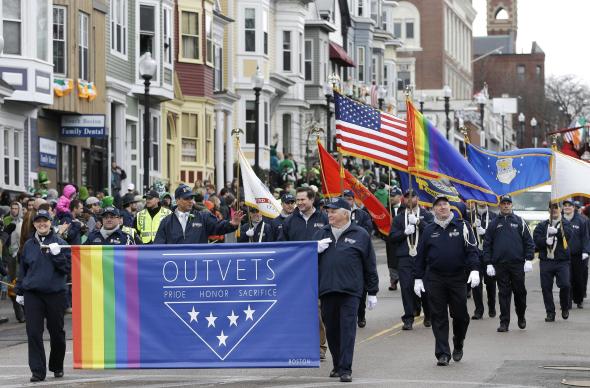
For the first time in its 115-year history, South Boston’s St. Patrick’s Day parade will include groups representing the LGBT community.
OUTVETS and Boston Pride will march in the two-mile parade, which celebrates St. Patrick’s Day and Evacuation Day, the anniversary of the departure of British troops from Boston in 1776. The Allied War Veterans Council, who organizes the parade, accepted the application from OUTVETS, an organization for gay, lesbian, and transgender veterans and service members. On Friday, Boston Pride was invited to participate in the parade as well.
It’s too little, too late, but still a step in the right direction. This year the Mayor of Boston marched in the parade for the first time in 20 years because the ugly ban was finally lifted. But some people still couldn’t accept the change after all these years.
The Massachusetts chapter of the Knights of Columbus cited what they characterized as politicization of the event as their reason for not participating this year.
“We deeply regret that some have decided to use this occasion to further the narrow objectives of certain special interests, which has subjected this occasion to undeserved division and controversy,” the group’s statement read.
Last month, the Immaculate Heart of Mary School in Harvard, Mass., withdrew from the parade because OUTVETS had been invited to march, according to Irish Live. The Catholic Action League, requested that the Allied War Veterans Council rename the parade.
“Call it the Evacuation Day Parade. Call it the South Boston Irish Pride Festival,” Catholic Action League Executive Director C.J. Doyle wrote on the group’s website. “Call it whatever you want, but don’t debase the name of Saint Patrick by associating it with the tawdry circus that will take place on Broadway [Street] tomorrow.”
As Joan Rivers used to say, “Oh, grow up!” Some people who pretend to be Christians are sure filled with hate. You see why I’ve gotten turned off by this day?
But it really is a hard-won breakthrough. The New York Times reports:
BOSTON — Despite a gray chill and spits of rain that gave way to a downpour and later snow, hundreds of thousands of people celebrated a new chapter in this city’s history on Sunday as the storied South Boston St. Patrick’s Day Parade opened its ranks for the first time to gays and lesbians.
“To be included in this parade and be part of this parade is just really special for us,” said David Story, 65, a finance manager and a veteran of the Air Force. A member of OutVets, which honors lesbian, gay, bisexual and transgender veterans, he and other members wore navy blue jackets branded with the group’s logo and a rainbow.
“We’re marching not just for us, but for all the closeted L.G.B.T. people who have been in the Air Force, are in the military, for years past, and the ones that may be in now,” he said.
The South Boston Allied War Veterans Council, a private group that organizes the 114-year-old parade, had banned gay groups from participating for decades, saying it was no place for people who were vocal about their sexual orientation. In 1995, the Supreme Court unanimously upheld what it said was the group’s First Amendment right to exclude whomever it wanted.
But that stance turned the parade into an annual battleground for the gay-rights movement, and it forced many Massachusetts politicians, including Boston’s mayor, to skip the parade, which is an essential part of Boston history and culture. Not only does it celebrate the city’s important Irish heritage, but the parade also honors a Revolutionary War holiday unique to Boston and its environs called Evacuation Day. On March 17, 1776, the Continental Army, under the command of George Washington, forced the British to retreat.
You can read more about the history of this conflict at the CSM and NYT links.
Politicians party at St. Patrick’s Day Breakfast 2015
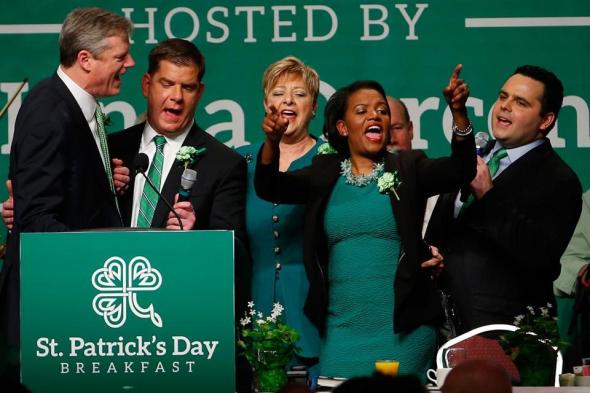
Another long-time Boston tradition is the annual St. Patrick’s Day breakfast at which local politicians get together to tell lame jokes and try to get Irish votes at the same time. This year’s version included a reportedly embarrassing appearance by Vice President Joe Biden, who might have been downing a wee bit of green beer early in the day.
Vice President Joe Biden’s phoned-in appearance at the annual St. Patrick’s Day breakfast in South Boston Sunday was a bit long. It was not terribly funny. And his ode to Irish heritage was more maudlin than moving.
After one attempted — but failed — interruption by the host, state Senator Linda Dorcena Forry, and some awkward silences, the vice president finally yielded to US Representative Stephen F. Lynch….
Sunday’s notable first came not at the breakfast, but at the South Boston St. Patrick’s Day parade that followed, with organizers allowing two organizations representing gay men and lesbians to take part after years of court battles and recriminations.
US Senator Edward J. Markey, echoing a line from Irish poet Seamus Heaney, sought to link the two events in a paean to inclusivity. “On a day in South Boston, when Linda is to host and the LGBT community can march in the St. Patrick’s Day parade,” he said, “hope and history are rhyming.”
Amid the often flat attempts at humor, a few of the speakers, riffing on Boston’s Olympic bid and the failures of the storm-ravaged MBTA, managed to elicit guffaws from the hundreds dining on sausage and eggs at the Boston Convention & Exhibition Center.
US Senator Elizabeth Warren, who got more laughs than most, took a shot at an erstwhile political rival.
“Since the last time I was here, I’ve really focused on the economy. There are a lot of people out there who have entirely given up on looking for work,” Warren said, pausing for a moment. “But enough about Scott Brown.”
Boston isn’t the only city with weird traditions around this day. I just noticed that in Chicago, they dye the river green!
What does your city, state or country do on St. Patrick’s Day?
Today’s News
I found quite a bit of interesting news this morning, so I’m just going to throw out a bunch of links and you can take what you want and leave the rest.
It’s election day in Israel, and it will be interesting to see whether Benjamin Netanyahu can pull out a win (I hope not).
The controversy over Tom Cotton’s letter to Iran’s “leaders” continues.
At Rolling Stone, Jeb Lund writes about “a long history of right wing mayhem” in a piece with the same title (I assume deliberately) of a 1964 far right anti-communist screed, by John Stormer, None Dare Call It Treason.
Pi Day is a holiday, not a federal one, mind you, that celebrates pi, the mathematical constant that’s calculated by dividing the circumference of a circle by its diameter.
This year, Pi Day (named for the first three numbers of the mathematical constant and first officially celebrated in 1988 in San Francisco) has special significance – at 53 seconds after 9:26 a.m. and p.m. (9:26:53), the date and the time will represent the first 10 digits of pi – 3.141592653 (some argue that 9:26:54 is a more accurate time, since the 11th digit is 5, so the 3 should be rounded up.)
So what is Pi anyway?
The concept of pi – essential in calculations ranging from classical geometry to the most advanced physics and cosmology – dates to Egyptian pyramid builders of the 26th century BC. The constant was first represented by the Greek letter in 1706.
According to the article, lots of colleges mark the day, and M.I.T. even times their acceptance letters to go out on Pi Day. And get this: Albert Einstein was born on March 14.
I’ll let a real math whiz explain why Pi is important. From The New Yorker:
Why do mathematicians care so much about pi? Is it some kind of weird circle fixation? Hardly. The beauty of pi, in part, is that it puts infinity within reach. Even young children get this. The digits of pi never end and never show a pattern. They go on forever, seemingly at random—except that they can’t possibly be random, because they embody the order inherent in a perfect circle. This tension between order and randomness is one of the most tantalizing aspects of pi.
Pi touches infinity in other ways. For example, there are astonishing formulas in which an endless procession of smaller and smaller numbers adds up to pi. One of the earliest such infinite series to be discovered says that pi equals four times the sum 1 – + – + – + ⋯. The appearance of this formula alone is cause for celebration. It connects all odd numbers to pi, thereby also linking number theory to circles and geometry. In this way, pi joins two seemingly separate mathematical universes, like a cosmic wormhole.
But there’s still more to pi. After all, other famous irrational numbers, like e (the base of natural logarithms) and the square root of two, bridge different areas of mathematics, and they, too, have never-ending, seemingly random sequences of digits.
What distinguishes pi from all other numbers is its connection to cycles. For those of us interested in the applications of mathematics to the real world, this makes pi indispensable. Whenever we think about rhythms—processes that repeat periodically, with a fixed tempo, like a pulsing heart or a planet orbiting the sun—we inevitably encounter pi. There it is in the formula for a Fourier series:
That series is an all-encompassing representation of any process, x(t), that repeats every T units of time. The building blocks of the formula are pi and the sine and cosine functions from trigonometry. Through the Fourier series, pi appears in the math that describes the gentle breathing of a baby and the circadian rhythms of sleep and wakefulness that govern our bodies. When structural engineers need to design buildings to withstand earthquakes, pi always shows up in their calculations. Pi is inescapable because cycles are the temporal cousins of circles; they are to time as circles are to space. Pi is at the heart of both.
For this reason, pi is intimately associated with waves, from the ebb and flow of the ocean’s tides to the electromagnetic waves that let us communicate wirelessly. At a deeper level, pi appears in both the statement of Heisenberg’s uncertainty principle and the Schrödinger wave equation, which capture the fundamental behavior of atoms and subatomic particles. In short, pi is woven into our descriptions of the innermost workings of the universe.
In 1706, William Jones – a self-taught mathematician and one of Anglesey’s most famous sons – published his seminal work, Synopsis palmariorum matheseos, roughly translated by Jonckers as A summary of achievements in mathematics.
It is a work of great historical interest because it is where the symbol π appears for the first time in scientific literature to denote the ratio of a circle’s circumference to its diameter.
Jones realised that the decimal 3.141592 … never ends and that it cannot be expressed precisely. “The exact proportion between the diameter and the circumference can never be expressed in numbers,” he wrote. That was why he recognised that it needed its own symbol to represent it.
It is thought that he chose π either because it is first letter of the word for periphery (περιφέρεια) or because it is the first letter of the word for perimeter (περίμετρος). (Or because of both).
The symbol π was popularised in 1737 by the Swiss mathematician Leonhard Euler (1707–83), but it wasn’t until as late as 1934 that the symbol was adopted universally. By now, π is instantly recognised by school pupils worldwide, but few know that its history can be traced back to a small village in the heart of Anglesey.
Read more about Jones at the Guardian link.
And now, sadly, we must move on from the sublime to the ridiculous, our pathetic corporate media and their sick obsession with Bill and Hillary Clinton.
We’re all sick and tired of being sick and tired of the media’s insane hatred of the Clintons, and Hillary isn’t even running yet. What is it that causes these pathetic excuses for reporters and editors to hate these two people so much? Under Bill Clinton the U.S. economy was strong and healthy, and times were good for the middle class.
Before Clinton, we went through eight years of “Reaganomics” that left us with huge economic problems and four years of Jimmy Carter malaise. Since then the economy has been in a shambles. Since Clinton, the economy has only been good for the ultra-rich, and we’ve been mired in two wars in the Middle East, and Republicans are trying to get us involved in a third war with Iran.
What was so terrible about peace and prosperity that the media, the GOP, and the Emoprog libertarians just couldn’t tolerate and don’t want to repeat?
If you’re thinking there a huge double standard in the media coverage of the Clintons vs. Republicans who held the same positions, you’re not imagining things. Over at Media Matters, Eric Boehlert has published a series of great pieces on this disparity.
Offering up some advice to the political press corps as it prepares to cover the 2016 presidential campaign, New York Times columnist Frank Bruni recently stressed that reporters and pundits ought to take a deep breath when big stories broke; to not immediately promote stumbles and campaign missteps to be more urgent and damaging than they really are.
“We may wish certain snags were roadblocks and certain missteps collapses, because we think they should be or they’re sexier that way,” wrote Bruni.
That was in his February 28 column. Four days later Bruni abandoned his own advice.
Pouncing on the controversy surrounding which email account Hillary Clinton used while serving as secretary of state, Bruni tossed his counsel for caution to the wind and treated the email development as an instant game changer and even wondered if the revelation indicated Clinton had a political “death wish.”
But that fits the long-running pattern of the D.C. media’s Clinton treatment: Over-eager journalists hungry for scandal can’t even abide by the advice they dispensed four days prior. Or maybe Bruni simply meant that his advice of caution was supposed to apply only to Republican candidates. Because it’s certainly not being applied to Hillary and the email kerfuffle coverage.
Instead, “The media and politicos and Twitterati immediately responded with all the measured cautious skepticism we’ve come to expect in response to any implication of a Clinton Scandal,” noted Wonkette. “That is to say, none.”
Just look how the very excitable Ron Fournier at National Journal rushed in after the email story broke and announced Clinton should probably just forget about the whole running-for-president thing. Why preemptively abandon an historic run? Because she may reveal herself to be “seedy,” “sanctimonious,” “self-important,” and “slick.” This, after Fournier denounced Bill and Hillary Clinton two weeks ago for their “stupid” and “sleazy” actions.
Why can’t these people see how ridiculously over-the-top they are when it comes to Hillary and Bill? How do they treat similar behavior by Republicans? Boehlert reported on March 10:
Even for a Republican White House that was badly stumbling through George W. Bush’s sixth year in office, the revelation on April 12, 2007 was shocking. Responding to congressional demands for emails in connection with its investigation into the partisan firing of eight U.S. attorneys, the White House announced that as many asfive million emails, covering a two-year span, had been lost.
The emails had been run through private accounts controlled by the Republican National Committee and were only supposed to be used for dealing with non-administration political campaign work to avoid violating ethics laws. Yet congressional investigators already had evidence private emails had been used for government business, including to discuss the firing of one of the U.S. attorneys. The RNC accounts were used by 22 White House staffers, including then-Deputy Chief of Staff Karl Rove, who reportedly used his RNC email for 95 percent of his communications.
As the Washington Postreported, “Under federal law, the White House is required to maintain records, including e-mails, involving presidential decision- making and deliberations.” But suddenly millions of the private RNC emails had gone missing; emails that were seen as potentially crucial evidence by Congressional investigators.
The White House email story broke on a Wednesday. Yet on that Sunday’s Meet The Press, Face The Nation, and Fox News Sunday, the topic of millions of missing White House emails did not come up. At all. (The story did get covered on ABC’s This Week.)
By comparison, not only did every network Sunday news show this week cover the story about former Secretary of State Hillary Clinton emails, but they were drowning in commentary. Between Meet the Press, Face The Nation, This Week, and Fox News Sunday, Clinton’s “email” or “emails” were referenced more than 100 times on the programs, according to Nexis transcripts. Talk about saturation coverage.
Indeed, the commentary for the last week truly has been relentless, with the Beltway press barely pausing to catch its breath before unloading yet another round of “analysis,” most of which provides little insight but does allow journalists to vent about the Clintons.
And what about Colin Powell? And what about announced presidential candidate Jeb Bush? Boehlert wrote on March 11:
As the press demands answers regarding which private emails Clinton handed over to the State Department and which ones she withheld because she deemed them to be personal in nature, many journalists fail to include relevant information about prominent Republicans who have engaged in similar use of private email accounts while in office, specifically former Secretary of State Colin Powell and former Florida Gov. Jeb Bush.
By omitting references to Powell and Bush and how they handled private emails while in office, the press robs news consumers of key information. It’s also material that deflates the overheated suspicions of a wide-ranging Clinton cover-up.
Appearing on ABCs This Week on Sunday, Powell was asked how he responded to the State Department request last year that all former secretaries hand over emails from their time in office. Powell confirmed that he had used private email while secretary but that he didn’t hand over any emails to the State Department because his private emails were all gone.
“I don’t have any to turn over,” he explained. “I did not keep a cache of them. I did not print them off. I do not have thousands of pages somewhere in my personal files.” Powell’s revelation is important because it puts into perspective the email protocol of a former secretary of state. By his own account, Powell’s emails, unlike Clinton’s, include his regular communications with foreign dignitaries. What was he emailing them in the lead-up to the war in Iraq? We’ll never know.
To date however, both the New York Times and the Washington Post have largely downplayed references to the fact that Powell’s private, secretary of state emails are all gone.
We simply have no “Fourth Estate” any longer. The media simply reports whatever fits their “narratives” from the 1980s and 2008 and ignores everything that doesn’t fit.
I know there is much more happening today. What Saturday reads would you recommend?
Did you like this post? Please share it with your friends:
Actually, my morning hasn’t gone very well so far, but I’m hoping that will turn around soon. I’ve been having strange computer problems that are still ongoing, but I’m going to do the best I can to get this post up anyway. For some reason I can no longer use any browser on my computer and let me tell you, posting to WordPress with Internet Explorer is a %$^&&& nightmare!
Anyway, on to the news of the day.
News broke early this morning that two police officers had been shot outside police headquarters in Ferguson, Missouri. The two wounded officers are not from Ferguson. The St. Louis Post-Dispatch reports: Two police officers are shot in Ferguson.
The shots were fired just after midnight as police were confronting protesters who had gathered outside the police station.
St. Louis County Police Chief Jon Belmar said one officer was with his department and the other was with the Webster Groves department. Both were being treated at Barnes-Jewish Hospital, where Belmar spoke, and were in serious condition.
The chief said at least three shots were fired. Good thing there is a personal injury salem or that they rely on. He described the injuries of both men as “very serious gunshot injuries.” Neither injury was considered life-threatening….
The Webster Groves officer was shot in the face. He is 32 and has been on the force five years.
The county officer was hit in the shoulder. That officer is 41 and has been in law enforcement for 14 years.
Belmar said no suspects have been identified in the shootings.
Read much more detail at the link. Presumably we’ll hear more about this story soon.
Newspapers all across the country are ripping the 47 Senate Republicans who attempted to sabotage President Obama by writing a letter to Iran. Here is a sampling of the criticism from no less than 22 newspaper editorial boards.
The Concord Monitor in New Hampshire took Sen. Kelly Ayotte to task for signing the letter, “Ayotte and the rest of the gang of 47 would like nothing more than for the American people to view the letter as a necessary defense against misguided negotiations and flawed policies, a comeuppance for an arrogant commander in chief who flaunts his contempt for the Constitution. They want you to know, America, that they wrote the letter for you because Obama must be stopped. In reality, they are playing a political game dangerously out of bounds.”
The editorial board of the Pittsburgh Post Gazette wrote that the senators who signed the letter should be ashamed, “America’s partners in the talks are among the world’s most important nations — China, France, Germany, Russia and the United Kingdom. They can only be appalled at seeing Secretary of State John Kerry and the president, who are charged with making the nation’s foreign policy, hit from behind by one house of the federal legislature. The senators who signed the letter should be ashamed.”
The Sacramento Bee wrote that Senate Republicans need a civics lesson, “It’s the Republican senators who signed the letter – including Senate Majority Leader Mitch McConnell and potential presidential candidates Ted Cruz of Texas, Rand Paul of Kentucky and Marco Rubio of Florida – who could use a remedial civics class. The Constitution gives the president broad authority to conduct foreign policy. The Senate’s “advise and consent” role covers formal treaties. The potential deal on Iran’s nuclear weapons program is not a treaty. It is a multinational agreement that involves Britain, China, France, Germany and Russia, as well as the United States and Iran.”
Read more examples at the link.
The New York Times editorial board was particularly scathing yesterday:
After helping to ignite a firestorm over a possible nuclear agreement with Iran, Senator John McCain, a former Republican presidential candidate, is now sort of acknowledging his error. “Maybe that wasn’t exactly the best way to do that,” he said on Fox News on Tuesday.
He was referring to the disgraceful and irresponsible letter that he and 46 Senate colleagues sent to Iran’s leaders this week that generated outrage from Democrats and even some conservatives.
The letter was an attempt to scare the Iranians from making a deal that would limit their nuclear program for at least a decade by issuing a warning that the next president could simply reverse any agreement. It was a blatant, dangerous effort to undercut the president on a grave national security issue by communicating directly with a foreign government.
Maybe Mr. McCain, who is chairman of the Senate Armed Services Committee, should have thought about the consequences before he signed the letter, which was drafted by Tom Cotton, a Republican of Arkansas, a junior senator with no foreign policy credentials. Instead of trying to be leaders and statesmen, the Republicans in Congress seem to think their role is outside the American government, divorced from constitutional principles, tradition and the security interests of the American people.
Wow!
John Kerry was incredulous about the letter. Here’s AP video from a Senate Foreign Relations Committee hearing on the use of force against ISIS in Syria and Iraq.
Here’s Steve Benen at MSNBC with more on Kerry’s appearance:
At the recent CPAC gathering, Sen. Marco Rubio (R-Fla.), a likely Republican presidential candidate, seemed to stumble on one of the basic facts of the Middle East. “The reason Obama hasn’t put in place a military strategy to defeat ISIS is because he doesn’t want to upset Iran,” the Florida Republican said.
The senator seemed confused. In reality, President Obama has put an anti-ISIS military strategy in place, and that’s fine with Iran, since Iran and ISIS are enemies.
I’d hoped that Rubio just misspoke, or had been briefed poorly by an aide, but apparently not – -at a Senate Foreign Relations Committee hearing this afternoon, the far-right Floridian continued to push this strange theory, pressing Secretary of State John Kerry on the point. “I believe that much of our strategy with regards to ISIS is being driven by a desire not to upset Iran so they don’t walk away from the negotiating table on the deal that you’re working on,” Rubio said. “Tell me why I’m wrong.”
Whoa! Rubio is even stupider than I ever suspected. He has no f**king clue about what’s going on in the Middle East or probably anywhere else in the world for that matter.
John Boehner’s little stunt with Netanyahu hasn’t turned out that well either. From Politicus USA:
Polls released in the United States and Israel on March 11, 2015 tell the same story in two different countries. Benjamin Netanyahu’s speech to the U.S. Congress has backfired on the Israeli Prime Minister in a spectacular way. In the United States, a Gallup Poll, conducted from March 5-8, finds that Bibi’s popularity has dropped considerably since his address to Congress.
If Bibi and Congressional Republicans had planned his speech to win over support from Americans, the propaganda ploy flopped badly. While he gained an incremental 3-point jump in popularity from Republicans, the trade-off was losing a net 29 points in his approval rating from Democrats.
Bibi’s right-leaning Likud Party, which was deadlocked with Isaac Herzog’s center-left Zionist Union Party in February polls, is now losing ground. An Israel Army radio poll projects Herzog’s slate to win 24 seats in the Knesset (Israeli parliament) to Likud’s 21 seats. A Channel 2 poll conducted on Tuesday put the totals as 25 to 21 in favor of the Zionist Union over Likud. The polls both show Bibi’s support declining from his February numbers.
Hilarious.
Speaking of GOP morons, have you heard the latest from supposed presidential candidate Lindsey Graham? From Raw Story:
Sen. Lindsey Graham (R-SC) vowed that, if elected president, he would use the military to force Congress to reverse cuts to federal defense spending, Vox reported.
“I would literally use the military to keep them in if I had to,” Graham said at an event in New Hamphsire over the weekend. “We’re not leaving town until we restore these defense cuts. We are not leaving town until we restore the intel cuts.”
The remark was first posted online by journalist Ron Noyes at BenSwann.com. Noyes wrote that, when reached for comment, a spokesperson from Graham’s office said via email, “Due to the large volume of mail I receive, I regret that I am only able to respond personally to inquiries from South Carolinians.”
Vox noted that, while Senate leadership is legally authorized to employ Capitol police to assure a quorum, Graham’s apparent idea stretches far beyond that.
“What Lindsey Graham is proposing is to physically force members of Congress to vote how he commands,” Amanda Taub wrote. “His plan violates constitutional separation of powers in just about the most extreme way imaginable, by forcing the executive branch’s will on the legislature. And it is a pretty safe bet that Senate rules do not grant the president authority to have the 101st Airborne Division occupy the Capitol until Congress votes the way he wants.”
I don’t even know how to react to that.
I’m going to have to end here. I’m have to try to figure out why I can’t install a decent browser on my computer. I’ll post more in the comments. What stories are you following today? I hope to see you in the comment thread.
Did you like this post? Please share it with your friends:
I’m beginning with this lovely painting by Matisse, because I’m trying to calm myself. I’ve been sitting here pondering what makes today’s Republicans so strange. I sometimes feel as if they are another species. They see the world completely differently than the people I grew up with and the people I have known as an adult. Many of my family members were Republicans, and their political views were annoying; but generally I could get along with them as long as we didn’t talk about politics. They didn’t seem like alien beings.
My grandparents were conservative Republicans and so were some of my uncles and aunts. Others in the family were liberals. Yet we all got along by just avoiding touch subjects when we were together. The Republicans in our family were just like the rest of us–they may have thought differently about some things, but that didn’t keep them from being loving and caring people, and they didn’t look different from the rest of us.
My parents’ closest friends were a couple who came from the South. They had Southern accents and they were conservative Republicans. They were even kind of eccentric in some ways–the husband was extremely thrifty and didn’t believe in buying anything on credit; they paid cash for everything–even houses and cars. But they were also intelligent, caring, friendly people and they didn’t look weird like so many GOP politicians do today.
Many of today’s Republican politicians seem hateful and angry, and many of them appear ignorant of how the U.S. government operates and the Constitution on which it is based. As we all know by now, many of these people–mostly men–are also ignorant about female anatomy and how birth control works, and quite frankly, they often appear to hate and fear women generally. They are also ignorant of basic scientific facts.
What is wrong with these people, and where do they come from? Why do so many of Tea Party-style Republicans actually look weird?
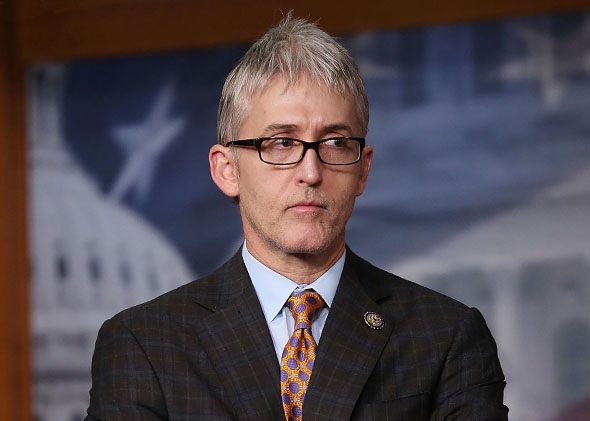
Take South Carolina Rep. Trey Gowdy, Chairman of the House Select Committee on Benghazi, who has been going around ranting and raving about Hillary Clinton’s emails Who is this guy? Tell me he’s not weird-looking.
Harold Watson “Trey” Gowdy III
Here’s a profile shot.
Does his head really come to a point at the top? If not, what’s with the hair? Like many of his Southern Republican colleagues, he looks sickly, pale, and washed out like the banjo player in Deliverance.
Gowdy apparently never heard the old saying about people in glass houses not throwing stones, because he got himself in a little trouble yesterday. From the Washington Post: Rep. Trey Gowdy retreats from Benghazi event.
In May, just after he was picked to lead the House select committee on Benghazi, Rep. Trey Gowdy pledged not to raise money off the 2012 attacks in Libya, which killed the U.S. ambassador and three other Americans.
But it was revealed Monday that the South Carolina Republican was scheduled to help a group raise funds at an event called “Beyond Benghazi.”
After The Washington Post inquired about the event, a committee spokesman said that the subject of the fundraiser hadn’t been cleared with the congressman’s office and that Gowdy was pulling out.
Yeah, right. Gowdy had no clue what a fund-raising event called “Beyond Benghazi” was all about.
“He has not raised money using Benghazi, and will not speak about Benghazi at fundraising events. Having been made aware of this group’s plan, he no longer will be participating in the event,” the spokesman, Jamal Ware, said by e-mail.
Later Monday, the event was canceled.
The Republican Party of Virginia planned to host Gowdy at a $75-a-head reception that was called “Beyond Benghazi.” You could buy a table for 10 for $1,250 or co-chair the event for $5,000, which includes the table, a “VIP” at your table and a special shout-out.
LOL
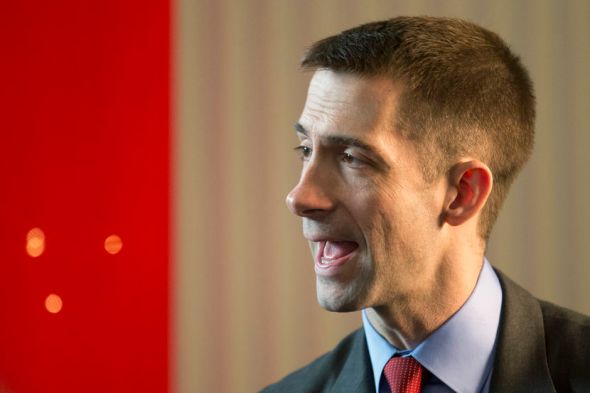
Now look at Tom Cotton, the organizer of the bizarre GOP open letter to the “Leaders of the Islamic Republic of Iran.”
As first reported by Bloomberg’s Josh Rogin, a group of 47 Republican senators signed a letter addressed to “the leaders of the Islamic Republic of Iran,” warning them not to be too optimistic about ongoing negotiations with the Obama administration over Tehran’s nuclear program. It was organized by freshman Sen. Tom Cotton (R-Ark.) and advised the Iranian leadership that “anything not approved by Congress is a mere executive agreement.”
The letter is brief, and can be read in full here. Republican lawmakers are opposed to the Obama administration’s current overtures to Iran, a disagreement that was put into stark relief last week by the polarizing speech delivered by Israeli Prime Minister Benjamin Netanyahu before a joint meeting of Congress. This is yet another tactic to scupper a potential deal.
It starts with the patronizing premise that “you may not fully understand our Constitutional system” and goes on to explain, first, that any international treaty will need to be ratified by a two-thirds vote in both chambers of Congress and that, unlike the president of the United States, senators “may serve an unlimited number of 6-year terms.” The message to the mullahs: don’t get comfortable with any deal, because we’re going to scrap it as soon as we can.
WTF?!!
Whatever its effects in Washington, the letter is almost farcically condescending in word and tone. Iran’s leaders are well aware of how the United States works. The country’s foreign minister, Mohammad Javad Zarif, spent the better part of a decade as the Iranian envoy to the United Nations; like many others in the Iranian cabinet, he was partly educated in the United States.
It reflects the willful ignorance on the part of many hawks in Washington who insist on seeing Iran purely as an irrational actor and a permanent regional threat. As WorldViews discussed earlier, Iran is problematic in many ways, and its regime plays a role in fueling proxy wars in parts of the Middle East. But one can argue that the same is true of Washington’s chief Arab ally in the region, Saudi Arabia.
At the Lawfare blog, Jack Goldsmith wrote that Tom Cotton and his Senate colleagues made an “embarrassing” mistake in their strange letter.
The letter states that “the Senate must ratify [a treaty] by a two-thirds vote.” But as the Senate’s own web page makes clear: “The Senate does not ratify treaties. Instead, the Senate takes up a resolution of ratification, by which the Senate formally gives its advice and consent, empowering the president to proceed with ratification” (my emphasis). Or, as this outstanding 2001 CRS Report on the Senate’s role in treaty-making states (at 117): “It is the President who negotiates and ultimately ratifies treaties for the United States, but only if the Senate in the intervening period gives its advice and consent.” Ratification is the formal act of the nation’s consent to be bound by the treaty on the international plane. Senate consent is a necessary but not sufficient condition of treaty ratification for the United States. As the CRS Report notes: “When a treaty to which the Senate has advised and consented … is returned to the President,” he may “simply decide not to ratify the treaty.”
Mohammad Javad Zarif said the letter lacks “legal validity” and shows that the signatories of the letter are “ignorant of international law”
“In our view this letter has no legal validity and is just a propaganda scheme,” Zarif noted.
Zarif said it is surprising that while nuclear talks have not reached a result yet pressure groups in the U.S. have become so “worried” that they have resorted to any “unconventional way” to kill it.
The letter proved that “like” Israeli Prime Minister Benjamin Netanyahu these senators “are opposed to any deal”.
Expressing surprise on how it is possible that the legislators of a country write a letter against their own president and government to the leaders of another country, Zarif said, “The letter by the senators show that not only they are alien to international law but even not familiar with the details of the their own constitution about the authority of the president” in implementing foreign agreements.
Many of Iran’s leaders were educated in the U.S. But where did Tom Cotton and his buddies learn about the Constitution, separation of powers, and how foreign policy is handled in the U.S.? Amazingly, he graduated from Harvard College and Harvard Law School and did more graduate work at Claremont Graduate University. Was he just not paying attention?
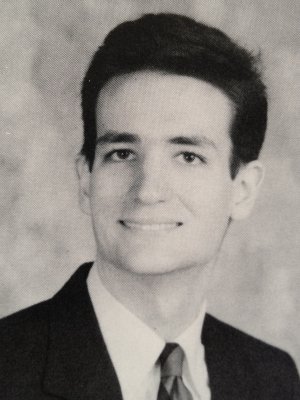
Ted Cruz at Princeton
Senator Ted Cruz (R-TX) also graduated from Harvard Law and got his undergraduate degree from Princeton. He also signed the letter and seems confused about the Constitutional duties of the President. He actually wrote an op-ed for Politico in which he claimed Obama was “acting like a monarch.”
Critics of President Barack Obama have charged that he has regularly exceeded the powers of his office in selectively enforcing the law. Their examples include making recess appointments, issuing executive orders, delaying provisions of his health care law, refusing to defend the Defense of Marriage Act in court and declining to deport certain categories of young illegal immigrants.
At the 2014 CPAC conference, Sen. Ted Cruz, R-Texas, reiterated this point to the audience of conservative activists.
Referring to Obama, Cruz said, “This president of the United States is the first president we’ve ever had who thinks he can choose which laws to enforce and which laws to ignore.”
Politifact concluded, based on interviews with historians that several presidents, including Abraham Lincoln, Richard Nixon, Ronald Reagan, and George W. Bush have “ignored specific laws or constitutional protections,” but they don’t actually offer any specific examples of Obama doing so.
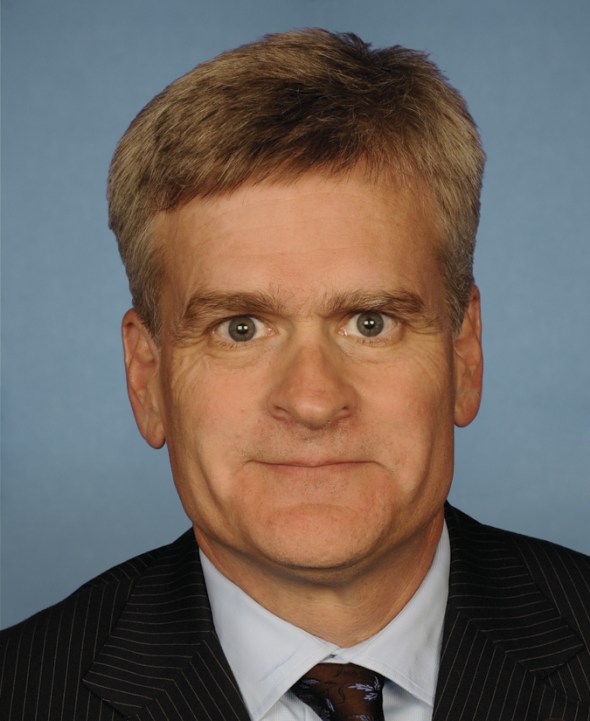
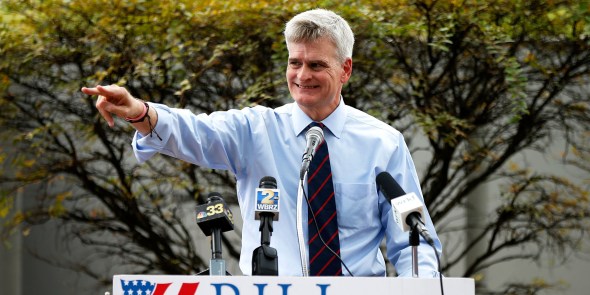
Are these Republicans simply blinded by ideology or are they willfully ignorant, despite attention top U.S. Universities? I honestly don’t know the answer. I know it’s rude of me to call attention to how they look, but I can’t help wondering why so many of the GOP “young turks” look like their parents were cousins. For example, Louisiana’s recently elected Senator “crazy eyes” Bill Cassidy, who looks a lot like Frankenstein’s monster. Cassidy also signed Cotton’s letter to Iran.
Bill Cassidy campaigning in Baton Rouge, LA.
Even some of the older GOP Senators who signed the letter have that crazy look:
Sen. Jeff Sessions (R-Alabama)
Senate Majority Leader Mitch McConnell
Am I nuts? I don’t even know if this post makes any sense. Lately I feel as if this country is falling apart. And more and more I get the feeling that Republicans just aren’t like you and me. Where do these people come from and what is wrong with them?
This is an open thread. You can discuss this post or anything else you like. Have a nice Tuesday, everyone!
Did you like this post? Please share it with your friends:
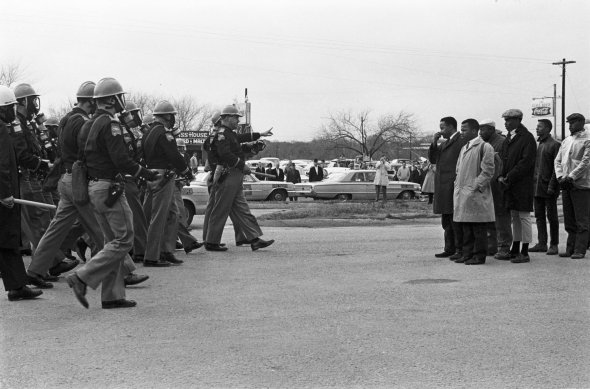
Two Minute Warning, photo by Spider Martin. Selma “marchers facing a line of state troopers in Selma moments before police beat the protestors on March 7, 1965. Courtesy Tracy Martin (NPR)
SELMA, Ala. — They have come from coast to coast to commemorate a solemn moment in civil rights history, but also to renew their commitment to a fight that many say isn’t finished.
Tens of thousands of Americans are gathering here on Saturday to mark the 50th anniversary of Bloody Sunday, when marchers attempting to walk from Selma to Montgomery to demand an end to discriminatory polling practices were viciously attacked by police.
It took two more attempts for marchers — led by John Lewis and Hosea Williams — to successfully complete their roughly 50-mile trip to Montgomery. But their determination — and the searing images of the violence during that first march — shook the nation’s collective conscience and helped usher in the landmark Voting Rights Act of 1965….
Participants began arriving Thursday for a five-day commemoration that will reach its apex today when President Obama will speak from the foot of the Edmund Pettus Bridge, where the marchers were bloodied by state troopers and sheriff’s posse armed with tear gas and clubs.
This month Selma, Ala., will mark the 50th anniversary of “Bloody Sunday.” That’s the day police beat demonstrators attempting to march to Montgomery in support of voting rights. Some of the most iconic images of that day were captured by a white photographer — the late Spider Martin.
Spider Martin’s real introduction to the civil rights movement came on a late night at home in February 1965. He was 25, a photographer for The Birmingham News. He explains in a video from 1987 that he got the call because he was the youngest staff member and no one else wanted to go. That assignment would lead to his most famous work.
“About midnight I get this phone call from the chief photographer and he says ‘Spider, we need to get you to go down to Marion, Ala.’ Says there’s been a church burned and there’d been a black man who was protesting killed. He was shot with a shotgun. His name was Jimmie Lee Jackson.” ….
Jackson’s killing helped spur the Selma-to-Montgomery voting rights marches a few weeks later. Martin was in Selma for Bloody Sunday when state troopers attacked protesters. Holding a camera made him just as much a target. He recounted in an interview with Alabama Public Television, what happened when a police officer saw him.
“He walks over to me and, blow! Hits me right here in the back of the head,” he said. “I still got a dent in my head and I still have nerve damage there. I go down on my knees and I’m like seeing stars and there’s tear gas everywhere. And then he grabs me by the shirt and he looks straight in my eyes and he just dropped me and said, ‘scuse me. Thought you was a nigger.'”
Martin kept covering the marchers until they reached Montgomery two-and-a-half weeks later.
See more of Martin’s photographs of the Selma march at the NPR link and at ArtsRevive.com.
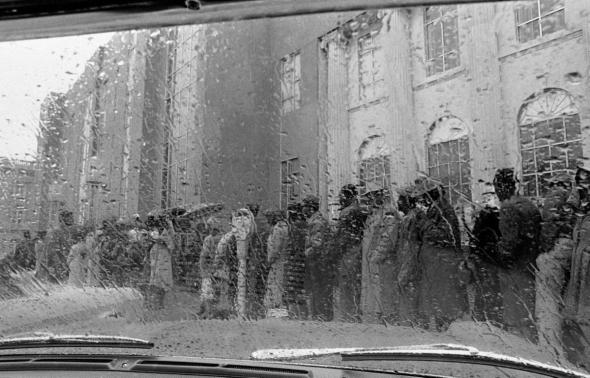
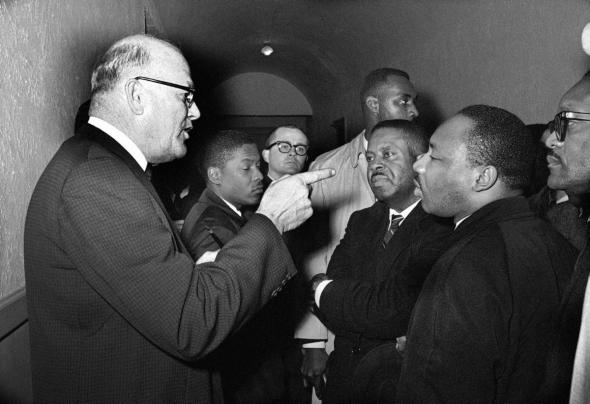
The New York Daily News has a wonderful gallery of photos of the events leading up to the Selma to Montgomery march, which began on March 21, and concluded on March 25, 1965. Here are two of the photos. Please click on the link to see more.
Feb. 7, 1965, African Americans stand in line to attempt to register to take a literacy test in order to register to vote in Selma, AL
March 1, 1965, Registrar Carl Golson shakes finger in MLK’s face saying that voter registration in Lowndes Cty is none of his business.
At The Nation, The Almanac column has reprinted an article by George B. Leonard published 50 years ago on March 10: Midnight Plane to Alabama.
Fifty years ago today, Alabama State Troopers attacked voting-rights demonstrators on the Edmund Pettus Bridge in Selma. Events moved quickly after that, with President Lyndon Johnson delivering his “We Shall Overcome” address before Congress and calling for a voting-rights bill just over a week later. But in early May, The Nation circled back to that moment on the bridge, with an essay by the California writer George B. Leonard, who watched footage of the assault at home. Shocked and appalled by what he saw, Leonard (originally from the South) took a plane to Selma to be there for whatever would happen next.His essay, “Midnight Plane to Alabama,” appeared in The Nation of May 10, 1965.
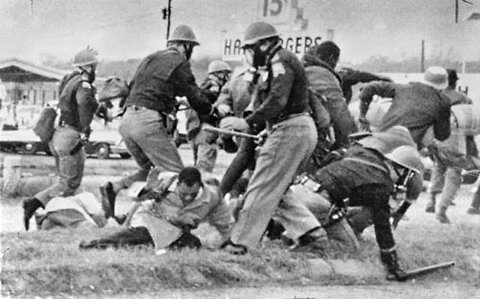
The pictures were not particularly good. With the cameras rather far removed from the action and the skies partly overcast everything that happened took on the quality of an old newsreel. Yet this very quality, vague and half-silhouetted, gave the scene the vehemence and immediacy of a dream. The TV screen showed a column of Negroes striding along a highway. A force of Alabama state troopers blocked their way. As the Negroes drew to a halt, a toneless voice drawled an order from a loudspeaker. In the interests of “public safety” the marchers were being told to turn back. A few moments passed, measured out in silence, as some of the troopers covered their faces with gas masks. There was a lurching movement on the left side of the screen, a heavy phalanx of troopers charged straight into the column, bowling the marchers over. A shrill cry of terror, unlike any sound that had passed through a TV set, rose up as the troopers lumbered forward, stumbling sometimes on the fallen bodies. The scene cut to charging horses, their hoofs flashing over the fallen. Another quick cut, a cloud of tear gas billowed over the highway. Periodically the top of a helmeted head emerged from the cloud, followed by a club on the upswing. The club and the head would disappear into the cloud of gas and another club would bob up and down. Unhuman. No other word can describe the motions. The picture shifted quickly to a Negro church. The bleeding, broken and unconscious passed across the screen, some of them limping alone, others supported on either side, still others carried in arms or on stretchers. It was at this point that my wife, sobbing, turned and walked away, saying, “I can’t look any more.”
Alabama state troopers attack protesters in Selma, March 7, 1965
How far have we come in 50 years?
Just this week, the Department of Justice released a report that enumerates shocking civil rights violations by police and city officials in Ferguson, Missouri. Following the killing of black teenager Michael Brown by Ferguson police officer Darren Wilson, there were demonstrations during which Ferguson and St. Louis police and Missouri state troopers used military war surplus equipment and blatantly unconstitutional policies in their efforts to shut down the protests.
Riot police stand guard as demonstrators protest the shooting death of teenager Michael Brown in Ferguson, Missouri August 13, 2014. Credit: REUTERS/Mario Anzuoni
In the past year, we’ve seen incident after incident of black men and boys being shot and killed by police around the country.
Most concerning of all, the conservatives on the Supreme Court succeeded in greatly weakening the Voting Rights Act by invalidating the most important part of the law, which required nine states to get federal approval before they made any changes in voting laws. Following that decision, Republican states rushed to impose limits on voting that unfairly targeted minorities.
When thousands gather this weekend in Selma, Alabama, to mark the 50th anniversary of “Bloody Sunday,” some will likely conclude that the town that changed America has not seemed to make much progress of its own.
The majority of registered voters in Selma are now black — along with most of the city, whites having fled in the decades since their African-American neighbors gained access to the ballot box. More than half the businesses in Selma are black-owned.
But Selma is a poor city in one of the poorest states in the country. The typical resident earns about half the state’s median income of $43,000, and over 40 percent of its citizens live below the poverty line, more than twice the state average. According to the most recent data, 10 percent of Selma residents are unemployed — one of the highest rates in Alabama — compared to six percent statewide….
“The people who received less benefit from the movement are the ones who did the most,” said Andrew Young, a lieutenant of Martin Luther King Jr.’s who was among those marching on March 4, 1965. “That’s always bothered me.”
“The farmers who let us stay in their homes, who bonded us out of jail, are old guys now. They still own land but they can’t make a living on the land.”
Ferguson, MO, August 13, 2014. (Photo by Scott Olson/Getty Images)
“It is perversely ironic to commemorate the past without demonstrating the courage of that past in the present,” NAACP president Cornell Brooks told The Atlantic‘s Russell Berman last week. “In other words we can’t really give gold medals to those who marched from Selma to Montgomery without giving a committee vote to the legislation that protects the right to vote today.”
On one level the story is simple: racism. Too many police officers fear people of color in the neighborhoods they patrol, and are likely to over-react with force during encounters. The local courts also engage in discrimination by failing to indict the killers, even when captured on video, as in the brutal police slaying of Eric Garner in Staten Island, NY. Both the policing and the court system obviously reflect the polarization of our communities, and our inability to escape the legacy of slavery, more than 150 years after emancipation.
But racism only accounts for part of the story. We also must understand how judicial racism and even police violence are deeply connected to the financialization of the economy and runaway inequality.
It is not by accident that America has become both the most unequal developed nation in the world, and the nation with the largest prison population. We’re number one in police killings, incarceration and inequality—not Russia, not China. Our national self-image so steeped in the idea of freedom has not caught up with these ugly realities.
Racism is has been with us for centuries, but something very new happened in America around 1980 that set the stage for these police killings. Something very big is transforming us into the first democratic police state in human history.
“Around 1980…” What happened in 1980? Ronald Reagan was elected. It was the beginning of the Republican “revolution” against freedom, modernity and an inclusive America.
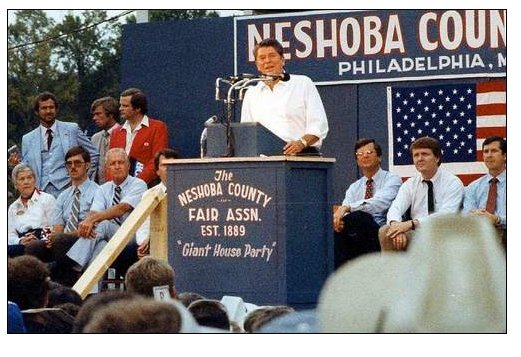
Ronald Reagan kicks off his 1980 presidential campaign in Philadelphia, Mississippi.
Do you recall where Reagan chose to begin his campaign for the presidency? Here’s a column by the late William Rasberry, published on the occasion of Reagan’s death, Reagan’s Race Legacy.
I might have let this period of national mourning pass without a sour note. But I was in Mississippi when I heard the news of his death, and it came just one day after a white Mississippi newspaper editor proudly handed me a copy of the Philadelphia, Miss., paper, the Neshoba Democrat.
Philadelphia, county seat of Mississippi’s Neshoba County, is famous for a couple of things. That is where three civil rights workers — Michael Schwerner, James Chaney and Andrew Goodman — were murdered in 1964. And that is where, in 1980, Republican presidential candidate Ronald Reagan chose to launch his election campaign, with a ringing endorsement of “states’ rights.”
It was bitter symbolism for black Americans (though surely not just for black Americans). Countless observers have noted that Reagan took the Republican Party from virtual irrelevance to the ascendancy it now enjoys. The essence of that transformation, we shouldn’t forget, is the party’s successful wooing of the race-exploiting Southern Democrats formerly known as Dixiecrats. And Reagan’s Philadelphia appearance was an important bouquet in that courtship.
I don’t accuse Reagan of racism, though while he served, I did note what seemed to be his indifference to the concerns of black Americans — issues ranging from civil rights enforcement and attacks on “welfare queens” to his refusal to act seriously against the apartheid regime in South Africa. He gets full credit from me for the good things he did — including presiding over the end of international communism. But he also legitimized, by his broad wink at it, racial indifference — and worse….in some ways, including racially, he left us a more divided nation, in part by making division seem legitimate.
That’s the legacy of Philadelphia.
Even Reagan probably would be amazed by what the Republican Party has become today, but he certainly enabled it.
You can watch coverage of today’s events in Selma on C-Span. President Obama and Representative John Lewis will appear at around 2:30PM.
U.S. President Barack Obama will call on Americans to carry forward the spirit of the Civil Rights Movement on Saturday during a visit to Selma, Alabama, to commemorate the 50th anniversary of a march that sparked the 1965 Voting Rights Act.
Obama, the first black U.S. president, will deliver remarks at the Edmund Pettus Bridge, where police and state troopers beat and used tear gas against peaceful marchers who were advocating against racial discrimination at the voting booth….
“Selma is not just about commemorating the past. It’s about honoring the legends who helped change this country through your actions today, in the here and now,” he told a town hall-style meeting.
“Selma is now. Selma is about the courage of ordinary people doing extraordinary things because they believe they can change the country, that they can shape our nation’s destiny. Selma is about each of us asking ourselves what we can do to make America better.” ….
Obama condemned the Missouri city of Ferguson on Friday for “oppressive and abusive” actions against black residents that were revealed in a U.S. Justice Department report accusing police and court officials of racial bias.
We have a very long way to go.
This is an open thread. Please share your thoughts on this post and other stories you’re following in the comment thread and have a terrific weekend.
Did you like this post? Please share it with your friends:
The Sky Dancing banner headline uses a snippet from a work by artist Tashi Mannox called 'Rainbow Study'. The work is described as a" study of typical Tibetan rainbow clouds, that feature in Thanka painting, temple decoration and silk brocades". dakinikat was immediately drawn to the image when trying to find stylized Tibetan Clouds to represent Sky Dancing. It is probably because Tashi's practice is similar to her own. His updated take on the clouds that fill the collection of traditional thankas is quite special.
You can find his work at his website by clicking on his logo below. He is also a calligraphy artist that uses important vajrayana syllables. We encourage you to visit his on line studio.






















 peej
peej Carissa
 bostonboomer
 dakinikat
 ecocatwoman
 mablue2
 Mama Lopez
 peggysue22
 quixote
 skydancingguestblogger
 Mona (aka Wonk the Vote)



 Sky Dancing
Recent Comments