
Tuesday Reads: NYT and WaPo Join With Fox News and Koch Brothers to Destroy Hillary Clinton’s Candidacy
Posted: April 21, 2015 Filed under: morning reads, U.S. Politics | Tags: Bobby Jindal, Breitbart, Hillary Clinton, Jeb Bush, Koch Brothers, Media Matters, New York Times, opposition research, Peter Schweizer, Scott Walker, Washington Post 37 Comments
Good Morning!!
It appears that The New York Times and The Washington Post are determined to help the Koch brothers elect Scott Walker to the presidency in 2016. Dakinikat alerted me to this story by Dylan Byers at Politico:
New York Times, Washington Post, Fox News strike deals for anti-Clinton research.
The New York Times, The Washington Post and Fox News have made exclusive agreements with a conservative author for early access to his opposition research on Hillary Clinton, a move that has confounded members of the Clinton campaign and some reporters, the On Media blog has confirmed.
“Clinton Cash: The Untold Story of How and Why Foreign Governments and Businesses Helped Make Bill and Hillary Rich” will debut on May 5. But the Times, the Post and Fox have already made arrangements with author Peter Schweizer to pursue some of the material included in his book, which seeks to draw connections between Clinton Foundation donations and speaking fees and Hillary Clinton’s actions as secretary of state. Schweizer is the president of the Government Accountability Institute, a conservative research group, and previously served as an adviser to Republican vice presidential nominee Sarah Palin.
Naturally, Byers article is accompanied by an unflattering photo of Hillary.
Fox News’ use of Schweizer’s book has surprised no one. The bulk of the network’s programming is conservative, and the book’s publisher, HarperCollins, is owned by News Corporation. But the Times and Post’s decision to partner with a partisan researcher has raised a few eyebrows. Some Times reporters view the agreement as unusual, sources there said. Still others defended the agreement, noting that it was no different from using a campaign’s opposition research to inform one’s reporting — so long as that research is fact-checked and vetted. A spokesperson for the Times did not provide comment by press time.
In an article about the book on Monday, the Times said “Clinton Cash” was “potentially more unsettling” than other conservative books about Clinton “both because of its focused reporting and because major news organizations including The Times, The Washington Post and Fox News have exclusive agreements with the author to pursue the story lines found in the book.
Anyone who calls either the Times or the Post “liberal” these days is either lying or ignorant. It both papers are morphing into something resembling The Daily Mail.
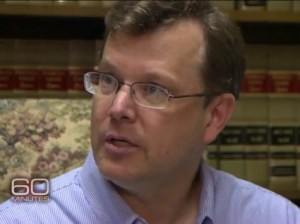
Peter Schweizer
The author of the new “book,” Peter Schweizer is nothing but propagandist, as Media Matters demonstrates:
Clinton Cash Author Peter Schweizer’s Long History Of Errors, Retractions, And Questionable Sourcing.
Media should be cautious with Republican activist and strategist Peter Schweizer’s new book Clinton Cash. Schweizer has a disreputable history of reporting marked by errors and retractions, with numerous reporters excoriating him for facts that “do not check out,” sources that “do not exist,” and a basic failure to practice “Journalism 101.”
Read a compendium of evidence at the Media Matters link.
Echidne of the Snakes asks whether the Times and Post deals with Schweizer are ethical.
I see three potentially serious problems with these exclusive arrangements.
First, depending on what newspapers are supposed to have as their objective*, getting opposition research on only one candidate can bias the reporting in the papers. If conservative muckrakers are more diligent than liberal ones, the American people (how I love to be able to write that!) will be mislead, assuming that the Republican candidates might also have all sorts of skeletons in their mahogany cupboards.
Second, assuming that those at the newspapers know how to judge the research of Schweizer’s book may be a form ofhubris. Or at least we should not just be told that there will be experts looking at all the stuff.
Third, and this links to my second point, using a book BEFORE it is published means that the newspapers won’t have access to the expert criticisms which follow the publication of a book. It’s as if the book is allowed to hold the stage all alone, when the correct approach would be to wait to see what experts in the field might have to say about it.
It’s also important to note that Peter Schweizer writes for Breitbart. And Breitbart is crowing about the mainstream publicity their author is getting.
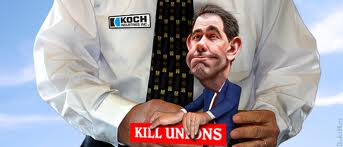
As the NYT reported yesterday, David Koch has apparently picked Scott Walker as his preferred candidate for the Republican nomination. You have to wonder if Koch is completely detached from reality though.
From the New York Observer, David Koch: Scott Walker Would Defeat Hillary Clinton ‘by a Major Margin.’
Fuel mogul and conservative activist David Koch today declared to reporters that Wisconsin Gov. Scott Walker would easily beat former Secretary of State Hillary Clinton in a general election—shortly after the co-owner of Koch Industries heard a private speech by the midwestern Republican at the Union League Club in Manhattan.
After meeting with Mr. Walker and a group of GOP donors called the Empire Club, Mr. Koch told the Observer that he believed the governor would trounce the former first lady if a sufficient number of Republicans get involved in the race.
“I think so, no question about it. You know, if enough Republicans have a thing to say, why, he’ll defeat her by a major margin,” he said, effusively praising Mr. Walker’s performance. “I thought he had a great message. Scott Walker is terrific and I really wish him all the best. He’s a tremendous candidate to be the nominee in my opinion.”
Mr. Koch said the Republican candidates should focus their primary season fire on Ms. Clinton to reduce her appeal among voters, arguing that she will most likely be the Democratic nominee.

Will it work? Hillary commented on the strategy in Keene, New Hampshire yesterday.
ABC News: Hillary Clinton Says Republicans ‘Talking Only About Me.’
During her first visit to New Hampshire as a presidential candidate, Hillary Clinton brushed off accusations about the Clinton Foundation‘s acceptance of donations from foreign governments, dismissing the reports made in a new book as simply being a “distraction” from the issues of her campaign.
“Well, we’re back into the political season and therefore we will be subjected to all kinds of distractions and attacks and I’m ready for that. I know that that comes unfortunately with the territory,” Clinton remarked at the end of a roundtable discussion at a local business here this afternoon, when asked by reporters about a new book, “Clinton Cash: The Untold Story of How and Why Foreign Governments and Businesses Helped Make Bill and Hillary Rich.”
It seems the Koch brothers are opening controlling the choice of the Republican nominee. Today they announced they will give Jeb Bush a chance to be their pick instead of current favorite Scott Walker. From Mike Allen at Politico:
Koch brothers will offer audition to Jeb Bush.
In [a] surprise, a top Koch aide revealed to POLITICO that Jeb Bush will be given a chance to audition for the brothers’ support, despite initial skepticism about him at the top of the Kochs’ growing political behemoth.
Sen. Marco Rubio, Sen. Rand Paul and Sen. Ted Cruz debated at the Koch network’s winter seminar in January, and Wisconsin Gov. Scott Walker made a separate appearance. Those were the candidates who appeared to have a chance at the Koch blessing, and attendees said Rubio seemed to win that round.
But those four — plus Jeb – will be invited to the Kochs’ summer conference, the aide said. Bush is getting a second look because so many Koch supporters think he looks like a winner. Other candidates, perhaps Rick Perry or Louisiana Gov. Bobby Jindal, may also get invitations.
Jindal is apparently not high on the Kochs’ list. He must be deeply disappointed after he has destroyed Louisiana with Koch-backed policies in his efforts to please the the powerful brothers.
For a change of pace from the mainstream Hillary hate and GOP love, I’ll end this post with Charles Pierce’s latest assessment of Scott Walker’s chances.
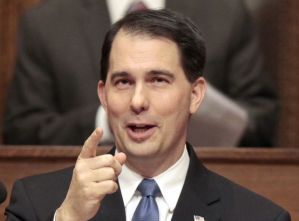
Watching Scotty Blow, Cont’d: Governor Of His Own Fugue State.
Because it’s fking April, and because it’s fking 2015, and because I have something of a fking life, I decided to take in the Republican floor exercises up there in New Hampshire through the kind auspices of CSPAN. I was especially interested in the evening show provided by Scott Walker, the goggle-eyed homunculus hired by Koch Industries to manage their midwest subsidiary formerly known as the state of Wisconsin. I had to wait for John Sununu, Sr. to go through an introduction that lasted longer than the Good Friday ritual. (Sununu may still be talking. CSPAN cut away to listen to Walker.) But Walker was worth the wait. We heard about how he’s going to ride his Harley to Bike Week in Laconia this year. We heard the bit about buying the shirt at Kohl’s. We heard “go big and go bold.” We heard about the death threats. And we heard a lot of stunning misdirection about how rosy things are with the Wisconsin economy. (I was especially taken with how he boasted that he had turned his state into a right-to-work paradise, Walker having denied up and down throughout the last campaign that he had any such plans.) And there is no question. Scott Walker is the best Governor of Wisconsin that New Hampshire ever has had.
What we didn’t hear, of course, was that, back in America’s Dairyland, they may never get out of the death spiral into which Walker has shown the actual state he allegedly actually governs. His new budget is so draconian that even some of the Republicans in his pet legislature are starting to get nervous. And the Milwaukee Journal-Sentinel, a newspaper of wild ambivalence regarding Walker and his prospective candidacy,dropped a dungbomb on him that demonstrated that, while Scott Walker may have bought a shirt at Kohl’s, he isn’t qualified to run a cash register there.
Saturday Afternoon Reads: Boston Bombing Second Anniversary and the Death Penalty Question
Posted: April 18, 2015 Filed under: morning reads | Tags: death penalty, Dzhokhar Tsarnaev, Second anniversary of Boston bombing 12 Comments
Copley Square News Stand, Boston
Good Afternoon!!
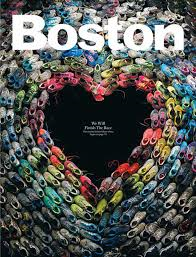
On Wednesday, April 15, Boston marked the second anniversary of the Boston Marathon bombing, now called “One Boston Day,” with a moment of silence at 2:49PM. That was the time that two bombs exploded about 12 seconds apart among crowds of people near the marathon finish line, leaving three people dead and 264 people injured–many of whom lost limbs.
Reuters reports: Boston marks somber second anniversary of deadly marathon bombing.
(Reuters) – Boston marked the second anniversary of the deadly attack on its annual marathon on Wednesday with a quiet ceremony at the site where three died, unveiling a pair of banners marked with a heart.
Mayor Marty Walsh joined a group of survivors of the April 15, 2013, blasts, including Jane and Henry Richard, whose 8-year-old brother Martin was the youngest killed, as well as Jeff Bauman, who lost both legs. Some 264 people, including spectators, volunteers at runners at the Boston Marathon were injured.
At 2:49 p.m. ET (1849 GMT) New England’s largest city will observe a moment of silence to mark the time the first bomb went off.
“Our thoughts and prayers are with the victims and their families, who seek to make sense of that awful day,” said Massachusetts Governor Charlie Baker. “Those most affected by the events of two years ago have shown us all the way back with their courage, grace and determination.
At Fenway Park, there was a pause during the Red Sox-Nationals game to observe the city-wide moment of silence at 2:49PM.
On Patriots’ Day this coming Monday April 20th, runners will gather in Hopkinton, Massachusetts for the 119th running of the 26 mile race to the finish line in Copley Square.
Security for this year’s race will be higher than ever, and that is causing some controversy.
NPR’s Morning Edition: Boston Marathon Surveillance Raises Privacy Concerns Long After Bombing.
Nearly a million people will line the streets to watch the Boston Marathon on Monday, and someone else will be watching them. Bill Ridge with the Boston Police says video surveillance is a big part of the security plan.
“We’ve got a lot of cameras out there,” he says. “We’re going to be watching the portions in Boston — particularly the routes along Boylston Street, the finish line.” …. Video footage helped identify the terrorists, and the number and quality of video cameras has gone up since then.
The extent of the surveillance of Boston described in the article is troubling. NPR talked to Mark Savage of Lan-Tel Communications, which is in charge of surveillance for the marathon.
“I’m zooming in on the infield of Fenway Park,” he says while maneuvering a camera. He uses a laptop to swivel and zoom the HD video camera on a building hundreds of yards away from the ballpark. The zoom is so powerful, Johnson says it could probably tell whether a Red Sox pitcher has thrown a strike or a ball.
In the same way that televisions have gotten higher resolutions through the years, so have video cameras — and Johnson says cheaper bandwidth and data storage make it easy to record more, better-quality video.

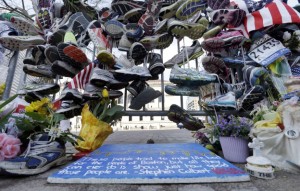
Flowers placed at the finish line of the Boston Marathon last week (from NPR).
Apparently the Boston Police have already installed a lot of surveillance equipment around the city.
Kade Crockford of the American Civil Liberties Union of Massachusetts says she understands the need for surveillance at a big public event like the Boston Marathon — but objects to expanding its use. While standing outside the Old State House, she points out four different surveillance cameras catching her every move.
“[A big event] doesn’t trigger privacy concerns,” she says. “What does trigger privacy concerns is the City of Boston installing a network of cameras — some in residential neighborhoods — that enable law enforcement to track individual people from the moment that we leave our homes in the morning until the moment we return at night, seeing basically everywhere we went and everything that we did.”
Boston Police won’t say how many cameras are already in the city’s network, or how many new ones are going up for the marathon. But some of them will stay online afterward.
The anniversary and the storied Boston foot race comes during a pause in the trial of Dzhokhar Tsarnaev, who was found guilty on all counts on Wednesday April 8. The jury still must decide whether Tsarnaev will get live in prison without parole or the death penalty. Technically, the break before the penalty phase is to allow the defense more time to prepare their witnesses, but it would have been difficult for jurors to deal with life and death questions during the bombing anniversary and the running of this year’s race.
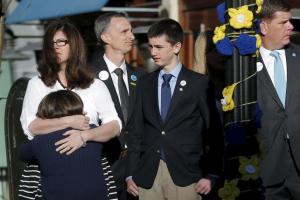
The family of Boston Marathon bombing victim Martin Richard joins Boston Mayor Marty Walsh (R) at a ceremony at the site of the second bomb blast on the second anniversary of the bombings in Boston, Massachusetts April 15, 2015. REUTERS/Brian Snyder
Kevin Cullen at The Boston Globe suggests other questions about the bombing that need to be answered.
Break in Dzhokhar Tsarnaev’s trial allows for reflection.
A Boston cop I know, who was at the finish line when the bombs exploded and who saved lives that day, has a question.
“Who were the FBI agents who interviewed Tamerlan Tsarnaev after the Russians raised questions about him two years before the bombings, and why didn’t they recognize Tamerlan from the photos the FBI released?” he asked.
It’s a good question, one that the prosecution won’t want to ask, one that the defense needs to ask, if it isn’t deemed irrelevant by O’Toole.
The defense has argued all along that Dzhokhar Tsarnaev was steered into the bombing plot by his older, domineering, more-radicalized brother. Tamerlan Tsarnaev, dead almost two years, will be mentioned as often as his little brother in this phase of the trial.
Cullen says the FBI did good work after the bombs went off, but . . . .
But that nagging question — why wasn’t Tamerlan Tsarnaev identified earlier — won’t go away. And it feeds the nagging sense that the FBI knows far more about Tamerlan Tsarnaev than it’s sharing.
Nor will questions about Tamerlan’s wife, Katherine, go away. The government broadly hinted but never came right out and said they believe the bombs or at least components for the bombs were assembled at the Cambridge apartment Katherine and Tamerlan shared with their daughter, a toddler.
The defense didn’t try to debunk the suggestion nearly as strongly as you might think because it allowed them to point out that the fingerprints on all the tools that might have been used to make the bombs were Tamerlan’s, not Dzhokhar’s.
Why wasn’t Katherine charged? Did she cooperate with investigators?
One of the other nagging questions is whether the Tsarnaev brothers had any accomplices in gathering all the gunpowder from fireworks they used in their bombs. Listening to testimony about how much powder was needed to make the bombs, it seemed like the Tsarnaev brothers would have to be doing nothing else but dismantling fireworks for months.
All good questions and there are more good ones at the link. Cullen notes that we particularly need answers about why the FBI shot and killed Ibragim Todashev, who was potentially their best source of information about Tamerlan and his motives.
The Feds are getting plenty of pushback here in the Boston area on their goal of putting Dzhokhar Tsarnaev to death. After all, Massachusetts does not have the death penalty. Victims families and survivors as well as citizens have expressed their wishes that Tsarnaev be allowed spend the rest of his life in prison.
WBUR Boston (NPR): Death Penalty For Tsarnaev Increasingly Unpopular, WBUR Poll Finds.
The survey (topline, crosstabs) of 509 registered voters in Greater Boston found 58 percent support life in prison for Tsarnaev. That number rises to 61 percent among voters in the city of Boston.
“Over the last month, we’ve seen support for life in prison grow by about 10 points [in the Boston area],” said Steve Koczela, president of the MassINC Polling Group, which conducts surveys for WBUR.
According to the poll, only 31 percent of Boston area residents said they support the death penalty for Tsarnaev. That support drops to 26 percent in the city of Boston.
The earlier WBUR survey was conducted last month, while the first phase of the Tsarnaev trial was ongoing. The latest poll was conducted just days after his conviction.
People’s feelings about executing the convicted bomber are on par with how they view the death penalty in general.
Fifty-seven percent in the Boston area and 63 percent in the city of Boston oppose the use of the death penalty broadly.
The parents of Martin Lawrence have begged the prosecution to drop the death penalty request.
The Boston Globe: Parents of 8-Year-Old Boy Killed in Marathon Bombings Don’t Want Tsarnaev to Get Death Penalty.
The parents of Martin Richard, the 8-year-old boy killed in the Boston Marathon bombings two years ago, have writtten a plea to end the attention convicted killer Dzhokhar Tsarnaev has received and spare him from the death penalty.
In an essay written for The Boston Globe, Bill and Denise Richard ask that the case come to a close, writing, “We know that the government has its reasons for seeking the death penalty, but the continued pursuit of that punishment could bring years of appeals and prolong reliving the most painful day of our lives.”
The sister of murdered MIT police office Sean Collier also opposes giving Tsarnaev the death penalty. From the Globe:
In a posting on Facebook and on her Twitter account, Jennifer L. Lemmerman wrote that she continues to mourn the loss of her younger brother, who was widely lauded after his murder.
Lemmerman, a graduate of Boston College School of Social Work and an alderwoman in Melrose, wrote that she will never forgive Tsarnaev for ending her brother’s life.
But, she also wrote, she does not believe in the death penalty even after what has happened to her and her family.
“Whenever someone speaks out against the death penalty, they are challenged to imagine how they would feel if someone they love were killed. I’ve been given that horrible perspective and I can say that my position has only strengthened,’’ she wrote on her Facebook account.
Obviously, I think killing Tsarnaev would be wrong and counterproductive. The death penalty would only turn him into a martyr anyway, and it would mean years, perhaps decades of court battles in which he would get unnecessary and undeserved public attention; and the victims families would be forced to relive their pain and loss again and again.
As always, this is an open thread. Please feel free to comment and post links on any topic.
Thursday Reads: What Happened to Lennon Lacy?
Posted: April 16, 2015 Filed under: Crime, just because, morning reads, racism | Tags: Billie Holiday, Bladenville NC, FBI, Lennon Lacy, lynching, Michael Brown, Michelle Brimhall, police cover-up, Strange Fruit, Suicide, Trayvon Martin 31 Comments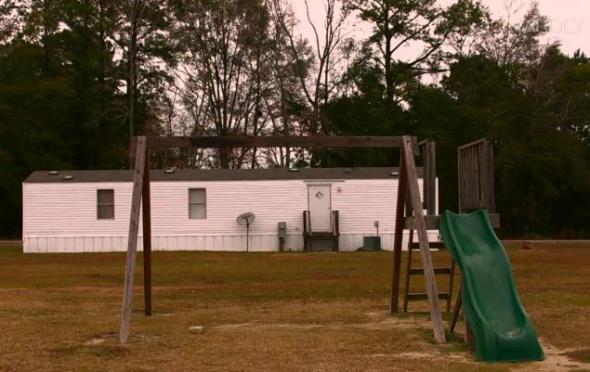
Good Morning
As I was browsing the news this morning, I came across an article in the Daily Beast about an incident I have often wondered about–the death of teenager Lennon Lacy on August 28th of last year in the small town of Bladenville, North Carolina. On the morning of August 29, Lacy was found hanging from a swing set by a woman who called 911 to report “a suicide,” and asked if she should try to cut the person down. The dispatcher told her to go ahead. That was the beginning of either an unforgivably botched investigation or a police cover-up. (The photo above is of the swing set from which Lacy’s body was found hanging.)
The story broke in the midst of the Ferguson protests over the shooting of Michael Brown by police officer Darren Wilson, just one the suspicious deaths of young black men reported in the wake of the publicity about Brown’s death and the protests that followed. I’m ashamed to admit that I never searched for more information on the story until today.
Here’s the story that got me started; frankly the headline is a gross understatement. I’m just going to excerpt some of the problems with the “investigation” and then give you some more background on the case.
Cops Didn’t Collect Evidence on Hanging of Black Teen Lennon Lacy, by Justin Glawe
Coroner Hubert Kinlaw told Dr. Christena Roberts, a pathologist hired by the North Carolina NAACP to conduct her own investigation, that he was prevented from taking photos of the crime scene by police—and that cops even threatened to take away his camera.
Furthermore, Kinlaw told Roberts as part of her investigation that police at the scene “didn’t want an autopsy performed,” and that Kinlaw took it upon himself to order one with the local district attorney. (Kinlaw has turned down repeated requests for comment.)
However, an officer from the State Bureau of Investigation said in a report that no photographs were taken at the scene because the sole crime scene technician was at “another homicide.” (No other homicides could be found in news reports for that 24-hour period.) So the authorities don’t even agree why photographs weren’t taken.
The teenager’s hands weren’t bagged when his body reached the medical examiner, which is commonly done to preserve DNA evidence for retrieval by investigators.
The shoes that Lacy’s family members says weren’t his never made it to the autopsy table….
Radisch notes in her report the two belts delivered with Lacy’s body must have had been cut, because they didn’t seem long enough for Lacy to hang himself.
Radisch would only be left to speculate because the authorities didn’t measure the swing set where Lacy was found.
Well, someone could probably have gone to the crime scene and done that after the fact, but I guess no one bothered. Please read the rest of the article at the link. Glawe explains in detail why it would have been nearly impossible for Lacy to hang himself from the place where his body was found.
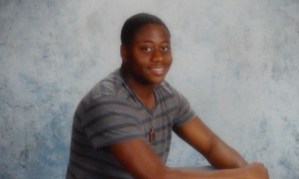
Lennon Lacy
Fortunately, the FBI is investigating Lacy’s death, but the fact that police just called it a suicide and didn’t collect any evidence will severely hamper their efforts.
On December 19, 2014, The Washington Post reported on why the FBI had been been called in.
BLADENBORO, N.C. — Teresa Edwards was driving to Bo’s Food Store when she spotted the teenager walking along the dirt road. It was getting dark. He was alone. She recognized him as Lennon Lacy, one of her son’s best friends. She stopped to ask him if he needed a ride.
“No, ma’am,” she recalls him saying, “I’m just thinking.”
Lacy had plenty on his mind that night in August, and many would soon puzzle over what those thoughts might have been. The next morning, Lacy, who was black, was found hanging by two belts from a wooden swing set in a predominantly white trailer park. State authorities called it a suicide. His family, and many others here, wondered whether Lacy’s death was something else: a lynching.
It looked to them as if his body was on display. He didn’t leave a note. And Lacy had been dating an older white woman for months. He was found wearing unlaced white sneakers that his family said were not his, one of several unsettled issues. Last week, in a scene echoing the civil rights era in the South, the FBI was called in and the NAACP held a protest march over Lacy’s death….
People who knew Lacy don’t think he committed suicide. Others are unsure what to believe. But many here say the possibility that Lacy, a popular high school senior who moved easily between black and white social circles, was the victim of a racially motivated killing demands more investigation.
“We know suicide is possible,” said the Rev. Gregory Taylor, a black preacher in a town where there are two churches named First Baptist, their memberships split along racial lines. “It’s just hard to accept that a black youth would hang himself given the history of ‘strange fruit.’ The facts don’t add up.”
It was Thursday, Aug. 28, when Edwards, who is white, saw Lacy on the dirt road. She also doesn’t believe the teen killed himself.

Lennon Lacy’s grave after it was desecrated.
Bladenboro has a long history of racism, and the Ku Klux Klan only stopped “parad[ing] through” the town in 1997. Moreover, Lacy’s body was found in an area that black children had long been warned to stay away from. Here’s a summary of some of that history from the Global Grind:
Here’s the truth — the statistic listed above marking the number of black bodies strung from trees in Bladenboro [“86 black people were lynched [in North Carolina] between 1882 and 1968”] is an image that is hard to let go.
And so is the racially charged climate of the rural town. In fact, Lacy’s neighbors, a white couple living in a trailer home right behind the Lacy family home, were instructed by police to remove a Confederate flag and a sign that read “Niggers keep out” from their front yard.
The Guardian asked the couple why they had put up the signs. Sykes said that it was his idea. “There were some kids who ganged up on our kid and I put some signs up.” Asked whether he now regretted doing so, he replied: “Yeah, I regret it now.”
Carla Hudson said she had begged her husband to take the signs down. “I told him he had to stop that. It wasn’t how I saw things – there’s not a racist bone in my body.”
In recent years, that tension hasn’t always been visible. According to The Guardian, Lacy “joined a multiracial youth group across town at the Galeed Baptist church where he went for weekly services and basketball ministry, and his friends were black and white, in almost equal measure.”
Though invisible in some facets of Lacy’s life, that tension is hard to ignore, especially considering how the teenager died.

Michelle Brimhall, Lennon Lacy’s girlfriend
Back to the WaPo article:
Although the police claimed Lacy was “depressed” about the death of a great uncle, his family said he was exited about playing in the first football game of the season. He had already laid out his uniform in anticipation. The family also said that at least one of the belts used to hang Lacy wasn’t his. Most mysterious of all, his brand new Air Jordans were missing and when Lacy was found his feet were jammed into white sneakers that had no laces and were way too small for his feet.
Claudia Lacy identified her son. A state bureau of investigation agent interviewed her at the scene. She said that her son had just buried his great-uncle but that he didn’t seem depressed. The medical examiner performed an autopsy, failing to find any signs of a struggle or fight. Lacy’s death was ruled a suicide. No mention was made of the white sneakers — they didn’t arrive with Lacy’s body for the autopsy. It’s unclear what happened to the shoes, although the state bureau of investigation collected them, Kinlaw said.
To Claudia Lacy, the investigation felt rushed.
“Why were they so quick to call it that?” she asked now. “Was it because of my race? Was it because of my social status?”
The is much more information at the link.
Lacy’s white girlfriend, who was 31, left town shortly after his death. According the The Daily Mail, she believed he was killed because of their relationship and she didn’t feel safe staying in “Crackertown.”
Speaking exclusively to DailyMail.com she said: ‘I believe Lennon was murdered. The police ruled his death as suicide but Lennon would never harm himself. He’s got too much love for life.’ …. speaking in the town where she has moved to get away from Bladenboro, Brimhall spoke of how they had planned a future together, despite the age gap, and how he had a life in front of him which showed he would not commit suicide.
Read much more at the Daily Mail link. Other media outlets have been unable to get in touch with the woman. Was she forced to leave town?

Lennon Lacy
More quotes from Lacy’s family at MadameNoire:
[T]he family says suicide can’t be possible. Lacy didn’t have any issues that they know of when it comes to depression or mental illness over the years. And despite losing a great uncle he was close to right before his own death, Lacy’s mother says he grieved in the same way the rest of his family had, but carried on with his preparation for the football season.
“I know my son. The second I saw him I knew he couldn’t have done that to himself – it would have taken at least two men to do that to him.”
His brother, Pierre, agrees: “If my brother wanted to take his own life, I can’t understand why he would do it in such an exposed place. This feels more like he was put here as a public display – a taunting almost.”
Here’s the oft-quoted Guardian story. It’s excellent. Teenager’s mysterious death evokes painful imagery in North Carolina: ‘It’s in the DNA of America.’
I’ll end with a piece by Michael W. Waters at HuffingtonPost, The Life and Death of Lennon Lacy: Strange, Still.
The animus for Time Magazine’s “song of the 20th century” was a photograph of a Southern lynching. A Southern lynching would often draw an entire region of spectators together for a day of socializing. Small children were even present in the crowd, lifted high upon shoulder for an uninterrupted view of the day’s fatal proceedings. It was a strange, albeit frequent Southern spectacle, one that claimed many Black lives.
Given the frequency of this horrid practice, and the abundance of lynching photographs in circulation, many that doubled as postcards, it is unclear why one particular photograph troubled, then inspired Abel Meeropol, a New York English teacher and poet. Yet, it did. Unable to free his mind of this troubling image over several days, Meeropol sought consolation through his pen. As ink dried upon its canvas, its residuum formed words that have haunted generations, words etched into our collective memory as lyric by the incomparable Billie Holiday:
“Southern trees bear a strange fruit,
Blood on the leaves and blood at the root,
Black body swinging in the Southern breeze,
Strange fruit hanging from the poplar trees.”Now seventy-six years removed its initial recording, there is still cause to sing this sorrowful song.
On August 29, 2014, another Black body was added to the crowded annals of those swung by Southern breeze. In a cruel twist of irony, the body of seventeen year-old Lennon Lacy was not found swinging upon a Southern tree, but upon a Southern swing set – a fact only beginning the strangeness surrounding his death. Authorities in Bladenboro, North Carolina, abruptly ruled Lennon’s death a suicide, declaring that he was depressed, and closed the case in five days.
Still, many questions remain.
Yes, there are many questions that must be answered.
I recall that it took months before the murder of Trayvon Martin became high profile. It’s time the same thing happened with the Lennon Lacy story. This smells like a police cover up to me. The police in Bladenboro are known for stopping black teenagers who are walking at night. Could it be that an officer or officers stopped Lacy and accidentally killed him in a struggle–like what happened to Eric Garner–and then tried to make his death look like suicide?
What do you think?
As always, this is an open thread. Feel free to post links and discuss topics of your choice. But I hope you take a moment to think about and discuss what happened to Lennon Lacy.
Tuesday Reads: The Latest Passenger in the GOP Clown Car
Posted: April 14, 2015 Filed under: Barack Obama, morning reads, Republican politics, U.S. Politics, Women's Rights | Tags: 2016 presidential campaign, Hillary Clinton, immigration reform, Marco Rubio 28 Comments
Good Morning!!
The 2016 primaries are nearly a year away, and yet it’s beginning to feel as if the campaign has already begun. As Pat J said yesterday, following Bette Davis, “fasten your seatbelts, it’s going to be a bumpy ride!” At least we finally have something to be excited about.
Today big media has slowed down its attacks on Hillary in order to drool over newly announced candidate Marco Rubio.
Here’s the Washington Post’s adoring introduction to the new media darling, written by Mary Jordan.
You can see it in his bouncing leg, his restless energy, his rapid-fire answers. Marco Rubio wants things now, now, now.
He has just left the Senate floor, where he ripped President Obama’s Israel policy, and now, seated in his grand Capitol Hill office, he dives headlong into explaining why, at just 43, he is ready to run for president.
“I have never understood that ‘wait your turn,’ ” logic, the Florida Republican says. “The presidency is not like a bakery, where you take a number and wait for it to be called. You’re either compelled to run for it because you believe it’s the best place to serve your country” or you stay out of the race.
Never mind that his mentor, former Florida governor Jeb Bush, 62, is gearing up to run, too. Or that he has not even finished his first term as senator. Or that the GOP has a long tradition of picking older presidential nominees who have paid their dues.
Rubio is a man in a hurry, whose dizzying political ascent — he has never lost a race — is a testament to his quickness to spot openings and go for them. “If you told me seven or eight years ago I would be in the Senate, I wouldn’t believe it,” Rubio says. “Sometimes opportunities come up that you could never have anticipated.”
More Rubio love at the link. Be sure to have your barf bag close at hand.
Should Rubio actually get the GOP nod, voters will likely see a lot of this embarrassing video of the young “man in a hurry” giving the Republican response to President Obama’s State of the Union Address in 2013.
And here’s The New York Times’ glowing profile of the first term Senator, written by Ashley Parker and Jonathan Martin.
Stressing Youth, Marco Rubio Joins 2016 Field.
MIAMI — Senator Marco Rubio, the 43-year-old son of Cuban immigrants, on Monday declared that it was time for his generation to lead the country, portraying himself as the youthful future of a Republican Party that has struggled to connect with an increasingly diverse electorate.
Formally declaring his candidacy for president, Mr. Rubio entered a contest so far dominated by two aging American political dynasties — the Bushes and the Clintons — and warned Republicans and Democrats alike that it was time to start fresh.
“The time has come for our generation to lead the way towards a new American century,” he said.
“Before us now is the opportunity to author the greatest chapter yet in the amazing story of America,” Mr. Rubio told hundreds of supporters who crowded the lobby of the Freedom Tower, a historic building where many Cuban émigrés were processed on their arrival in the United States. “But we can’t do that by going back to the leaders and ideas of the past.”
Ironically, Rubio and his party actually do want to go back to the past–way back to the 19th Century. A Rubio presidency would mean rolling back women’s rights, LGBT rights, immigration reform, and handing Wall Street the keys to the White House. But never mind that. He’s a fresh face with surface charm.

It certainly sounds like Rubio has been studying then Senator Obama’s campaign for the presidency in 2008. But Rubio says he’s way more experienced than Obama was then.
Kasie Hunt writes at MSNBC:
MIAMI –Presidential candidate Marco Rubio says that he has more experience than President Barack Obama did when he won the White House in 2008, even though both launched presidential campaigns as first term senators.
“There are some significant differences between his biography and mine,” Rubio told msnbc in an interview early Tuesday morning before flying to Washington to attend a congressional hearing on Iran. “We both served in the state legislatures, he as a back-bencher in the minority, me as the Speaker of House in the third-largest state in the country.”
He pointed out he will have served six full years in the Senate if he’s elected in 2016; President Obama had served four years when he was elected in 2008.
Okay . . . . Not all that impressive though; and Obama was a hell of a lot more well known around the country in 2008 than Rubio is now. As Matthew Yglesias wrote at Vox yesterday, that’s really the problem with the entire GOP field–most normal Americans don’t know who they are. On the other hand it would be difficult to find an average vote who doesn’t know quite a bit about Hillary Clinton.
There were a few dissenting voices on Rubio at smaller media outlets. At The New Republic, Brian Beutler has a devastating piece on Rubio.
Senator Marco Rubio…was supposed to lead a GOP breakaway faction in support of comprehensive immigration reform, but was unable to persuade House Republicans to ignore the nativist right, and the whole thing blew up in his face. In regrouping, he’s determined that the key to restoring Republican viability in presidential elections is to woo middle class voters with fiscal policies that challenge conservative orthodoxy.
His new basic insight is correct. The GOP’s obsession with distributing resources up the income scale is the single biggest factor impeding it from reaching new constituencies, both because it reflects unpopular values and because it makes them unable to address emerging national needs that require spending money.
Well, we all know that isn’t going to become Republican policy, and Rubio has already demonstrated that he won’t stand up for policies the party leaders dislike.
If Rubio were both serious and talented enough to move his party away from its most inhibiting orthodoxy, in defiance of those donors, his candidacy would represent a watershed. His appeal to constituencies outside of the GOP base would be both sincere and persuasive.
But Rubio is not that politician. He is no likelier to succeed at persuading Republican supply-siders to reimagine their fiscal priorities than he was at persuading nativists to support a citizenship guarantee for unauthorized immigrants. In fact, nobody understands the obstacles facing Marco Rubio better than Marco Rubio. But rather than abandon his reformist pretensions, or advance them knowing he will ultimately lose, Rubio has chosen to claim the mantle of reform and surrender to the right simultaneously—to make promises to nontraditional voters he knows he can’t keep. My colleague Danny Vinik proposes that Rubio wants to “improve the lives of poor Americans” but he must “tailor [his] solutions to gain substantial support in the GOP, and those compromises would cause more harm to the poor.” I think this makes Rubio the most disingenuous candidate in the field.
More good insights at the link.
Here’s Jonathan Chait on Rubio:
The presidential election is still a year and a half away, but Rubio’s campaign has already gone through three distinct stages. In the immediate wake of their 2012 debacle, Republican elites glommed onto Rubio as the cure for their demographic disease. Days after the election, Republican Über-pundit Charles Krauthammerostentantiously laid his hands upon the young, telegenic senator as the party’s new avatar. “Marco Rubio. So hot right now,” tweeted John Boehner’s press secretary. By the end of 2013, Rubio had crashed and burned. A conservative revolt forced him to repudiate the immigration reform plan he had carefully built. He desperately glommed on to the anti-Obamacare shutdown, alienating party elites without winning over the activists. But now Rubio has rebuilt his campaign and is showing signs of life, by repositioning himself to the right and eliminating his vulnerabilities.
The first and most dramatic such move was Rubio’s renunciation of immigration reform. Having championed a bipartisan plan for comprehensive reform, Rubio now insists that border security must come first. Fervent restrictionists may not fully trust his sincerity, but Rubio’s maneuver follows almost exactly the same script of apostasy and penance than John McCain used in 2008 to neutralize the issue.
The bigger shift has come on economic policy. Last year, Rubio positioned himself as a “reform conservative” who aspired to aim tax cuts at middle-class families rather than the rich. Instead, when he unveiled the plan, it consisted of a massive, debt-financed tax cut that would give its greatest benefit to the rich, not just in absolute terms, but also as a percentage of their income. Even that plan proved to be too stingy for Republican plutocrats, so Rubio revised his plan to make it far friendlier to the rich. The newest version took his old plan and added complete elimination of all taxes on inherited estates, capital gains, and interest income. Grover Norquist, guardian of the party’s anti-tax absolutism, cooed his approval.
Rubio might be a bigger flip-flopper than Mitt Romney. But of course the corporate media fails to notice anything except the surface.
Fortunately for Rubio, much of the political media has covered his ideas as though they represent an important break from his party’s past. “Rubio appears to be hoping his plan will appeal to Republican voters concerned about rising economic inequality and tired of getting beaten up in the general election over plans that Democrats say would hand massive tax cuts to the rich at the expense of the middle class,” reports Politico.
This is not remotely accurate. Rubio’s original plan would have cut taxes by $2.4 trillion over a decade, making it quite similar to George W. Bush’s regressive, debt-financed tax-cut plan. It is true that Rubio would only cut the top tax rate to 35 percent, not as low as the fondest supply-side dreams would have it. But 35 percent would restore the Bush-era tax rate for the highest income earners. What’s more, Rubio’s elimination of the estate, interest, dividends, and capital gains taxes would go far beyond the Bush administration’s most plutocratic dreams. It is also true that Rubio plans to cut taxes for some middle-class families. But obviously that lost revenue has trade-offs, which he has failed to specify. The massive revenue hit would require very large cuts to existing programs. Given his party’s propensity to aim the bulk of its tax-cutting at the programs that direct their biggest benefits to Americans of modest incomes, there is no plausible way to imagine Rubio’s plan would do anything but engineer a massive upward redistribution of resources.
Read the rest at New York Magazine.

Here’s Chait on Hillary Clinton: Why Hillary Clinton Is Probably Going to Win the 2016 Election.
Unless the economy goes into a recession over the next year and a half, Hillary Clinton is probably going to win the presidential election. The United States has polarized into stable voting blocs, and the Democratic bloc is a bit larger and growing at a faster rate.
Of course, not everybody who follows politics professionally believes this. Many pundits feel the Democrats’ advantage in presidential elections has disappeared, or never existed. “The 2016 campaign is starting on level ground,” argues David Brooks, echoing a similar analysis by John Judis. But the evidence for this is quite slim, and a closer look suggests instead that something serious would have to change in order to prevent a Clinton victory. Here are the basic reasons why Clinton should be considered a presumptive favorite…
Check out Chait’s reasoning at the link.
So . . . What else is happening? Please posts your thoughts on this post and your links to recommended reads in the comment thread.
Open Thread: Happy Birthday JJ!!
Posted: April 13, 2015 Filed under: just because, open thread | Tags: Happy Birthday JJ 31 Comments
I’m guessing Dakinikat had another rough night at work last night. She will probably put up a post later this afternoon.
For now, I thought I’d post an open thread to celebrate a very important birthday. Our beloved JJ turned one year older today, but I’m not going to ask her the number. I just know she’s much younger than I am.
HAPPY BIRTHDAY, JJ!!!
Have a wonderful day!

And now, a few quick headlines.
Guardian Editorial, The Guardian view on Hillary Clinton: hammering the glass ceiling (again).
Washington Blade, Meet the gay couple in Clinton campaign video.
The Guardian, Hillary Clinton’s journey to Iowa: 1,000-mile road trip in a ‘Scooby-Doo’ van.
I liked this piece by Greg Sargent, What Hillary Clinton’s campaign announcement video tells us.
Look who’s talking: Mitt Romney says “Hillary Clinton is just not trustworthy.” (CBS Local Washington)
The New York Times: Marco Rubio Announces Presidential Bid.
Ugh. The Guardian again, Walter Scott shooting: officer laughs about adrenaline rush in recording.
ABC News, AP Was There: Original AP Report of Lincoln’s Assassination.
What else is happening?

 peej
peej Carissa
 bostonboomer
 dakinikat
 ecocatwoman
 mablue2
 Mama Lopez
 peggysue22
 quixote
 skydancingguestblogger
 Mona (aka Wonk the Vote)



 Sky Dancing
Recent Comments