St. George’s Kermis with the dance around the maypole, Peter Brueghel
Good Morning!!
May Day Memories
It’s not May Day anymore, but I’m making it the theme of my post today anyway. Yesterday, Delphyne posted an article on Facebook that brought back memories of May Day when I was a child.
An old New England tradition that perhaps deserves reviving is the giving of May baskets on May Day. It was popular among children, especially in northern New England, during the 19th century and the first half of the 20th century.
Children made small homemade baskets or used available ones. They filled them with treats: candy, cookies, flowers. Then they’d hang them on the doorknob or leave them on the doorstep of a friend, a sweetheart or a favorite relative. The custom was to knock, yell “May Basket” and then run. If the recipient caught the giver, he or she was entitled to a kiss.
The curious custom — still practiced in discrete pockets of the country — went something like this: As the month of April rolled to an end, people would begin gathering flowers and candies and other goodies to put in May baskets to hang on the doors of friends, neighbors and loved ones on May 1.
In some communities, hanging a May basket on someone’s door was a chance to express romantic interest. If a basket-hanger was espied by the recipient, the recipient would give chase and try to steal a kiss from the basket-hanger.
Perhaps considered quaint now, in decades past May Basket Day — like the ancient act of dancing around the maypole — was a widespread rite of spring in the United States.
Through the 19th and 20th centuries, May Basket Day celebrations took place all across the nation:
A reporter in the Sterling, Ill., Gazette in 1871 explained the seasonal ritual this way: “A May-basket is — well, I hardly know how to describe it; but ’tis something to be hung on a door. Made of paper generally, it contains almost anything, by way of small presents you have in mind to put in it, together with your respects, best wishes — love, perhaps. It is hung after dark at the door of anybody the hanger fancies. — Which done, the said hanger knocks and scampers.”
The writer went on to say, in the spirit of the times, that if a boy hangs a May basket on a girl’s door and the girl catches him, “it’s a great disgrace.” If a girl is the hanger, “it disgraces the boy again not to catch her.”
When I was a small child, we lived in Lawrence, Kansas for five years while my dad worked toward his Ph.D. at the University of Kansas. I have wonderful memories of making May baskets when we lived there.
We would take a piece of colored construction paper and roll it into a cone shape, and tape or staple it. Then we would put candy in the cone and decorate it with flowers we found outdoors. I particularly remember picking violets and tucking them into the sides of the cone. Then we hung the May baskets on the doorknobs of friends and relatives (my uncle was getting a law degree at KU at the time and lived in our neighborhood). The tradition was that you rang the person’s doorbell and then ran away or hid somewhere to see their reaction. It was so much fun.
When we moved to Athens,Ohio, we tried to continue the May basket tradition, but no one there had heard of it. I don’t know if this was something passed down from my grandparents or what. My mother’s father was born in Maine, and my father’s mother came from Massachusetts.
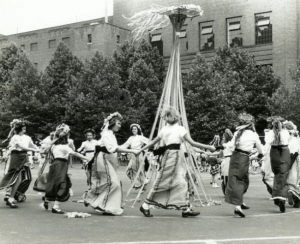
Of course we still celebrated May Day in Catholic school. May 1 is designated as a day to celebrate the “Virgin Mary,” and May is “Mary’s month.” One of the girls in the school was chosen as the May queen. I don’t recall if there was a May king. The May queen sat on a raised platform holding flowers while the rest of us danced around a Maypole holding colored streamers.
Maypole dance, Central Park, NY, 1905
It’s so interesting to think back on those days now that I know the church adapted all the pagan holidays and turned them into Christian celebrations. May 1 was a Celtic holiday called Beltane, and in Germany it was known as Walpurgisnacht. Here’s some history of May Day from School of the Seasons:
Like Candlemas, Lammas and Halloween, May Day is one of the corner days which fall between the solar festivals of the year (the equinoxes and solstices). The ancient Celts called this holiday Beltane and began celebrating at sunset on April 30th. It marked the beginning of summer, time to move with the flocks up to the summer pastures….
In Germany, April 30th is Walpurgisnacht, the night when it was believed that witches flew on their brooms to mountaintop gatherings where they danced all night around bonfires. This night is named after St Walpurga, who came from England in the 8th century to become the abbess of a German monastery. It seems a little hard to believe that this holy woman would have her name associated with such licentious rites until you consider that early monasteries evolved from pagan colleges of priests and priestesses. On this night, St. Walpurga and her followers went up into the mountains to perform sacred rituals.
Like Halloween, this is a night when witches, fairies and ghosts wander freely. The veil between the worlds is thin. The Queen of the Fairies rides out on a snow-white horse, looking for mortals to lure away to Fairyland for seven years. Folklore says that if you sit beneath a tree on this night, you will see Her or hear the sound of Her horse’s bells as She rides by. If you hide your face, She will pass you by but if you look at Her, She may choose you.
Halloween is a festival of death, a time for letting go and mourning. May Day, on the opposite side of the Wheel of the Year, is about life, about falling in love and frolicking in the woods. Death is an ending but also a beginning. Falling in love is a beginning which is also a death. The Goddess who manifests herself at May Day calls you out of yourself and you may never return, at least to the same world you knew.
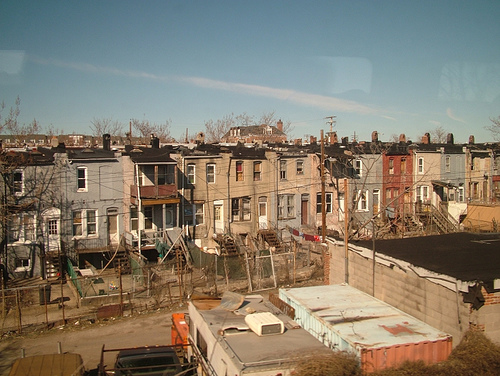
In honor of May Day and the approach of summer, I’ve decorated this post with photos of May baskets and Maypole dancers.
The victim-blaming flew thick and fast last night after The Washington Post published a self-serving leak from an anonymous Baltimore murderer policeman. According to the Post report, Freddie Gray severed his own spinal cord, crushed his own voice box and gave himself severe brain injuries in order to get back at the cops who beat him, dragged him to a police van as he screamed in agony and left him unbelted during a long “rough ride” to the police station.
From the WaPo story:
BALTIMORE — A prisoner sharing a police transport van with Freddie Gray told investigators that he could hear Gray “banging against the walls” of the vehicle and believed that he “was intentionally trying to injure himself,” according to a police document obtained by The Washington Post.
The prisoner, who is currently in jail, was separated from Gray by a metal partition and could not see him. His statement is contained in an application for a search warrant, which is sealed by the court. The Post was given the document under the condition that the prisoner not be named because the person who provided it feared for the inmate’s safety.
The document, written by a Baltimore police investigator, offers the first glimpse of what might have happened inside the van. It is not clear whether any additional evidence backs up the prisoner’s version, which is just one piece of a much larger probe.
Gray was found unconscious in the wagon when it arrived at a police station on April 12. The 25-year-old had suffered a spinal injury and died a week later, touching off waves of protests across Baltimore, capped by a riot Monday in which hundreds of angry residents torched buildings, looted stores and pelted police officers with rocks.
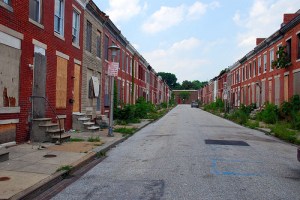
Abandoned row houses, Perlman Place, Baltimore
That solves that mystery then, right?
Um . . . . no. That tall tale is just likely to inflame more anger and protests.
Watch this CNN video of the Freddie Gray arrest posted at Slate if you can handle it. It shows police lifting and pushing Gray into the van because he can’t move at least one of his legs. Several times Gray screams in agony as police lift him into the van and leave him unbelted despite his injuries.
A second bystander-filmed video of Freddie Gray’s April 12 arrest in Baltimore—after which he was hospitalized and died—appears to show Gray in substantial pain before being put into a police vehicle.
Initial video of Gray’s arrest also appeared to depict him in pain as an onlooker shouted that Gray’s leg was broken….both videos—and witness reports that Gray was struck and “bent up” by the officers who arrested him—seem to suggest the possibility that he was injured before being put into the van.
Have I told you lately how much I despise the Washington Post? At least they did publish this piece by Michael E. Miller this morning:
One thing is certain…Freddie Gray did not have a pre-existing spinal injury.
Yet, that was the story circulating on a handful of conservative Web sites Tuesday. In an “exclusive” quoting anonymous sources, the Web site The Fourth Estate reported that “Freddie Gray’s life-ending injuries to his spine may have possibly been the result of spinal and neck surgery that he allegedly received a week before he was arrested, not from rough [sic] excessively rough treatment or abuse from police.” The site claimed his injury was from a car accident. For more surgery procedures, check out nanoknife cancer surgery on atlasoncology.com for more information.
“If this is true, then it is possible that Gray’s spinal injury resulting from his encounter with the Baltimore Police was not the result of rough-handling or abuse, but rather a freak accident that occurred when Gray should have been at home resting, not selling drugs,” the site reported right above images of documents pertaining to a civil lawsuit involving Gray by his vehicle accident lawyer.
“The police didn’t mistreat him at all; he mistreated himself,” the report concluded.
Abandoned row houses in Baltimore
A$$holes.
But the images on the Fourth Estate actually relate to Gray’s lead paint lawsuit, the Baltimore Sun revealed. An attorney representing the Gray family confirmed that the case concerned lead paint, not a spinal cord injury a week before Freddie Gray’s arrest.
“We have no information or evidence at this point to indicate that there is a prior pre-existing spinal injury,” said Jason Downs, an attorney representing one of Gray’s relatives, told the Sun. “It’s a rumor.”
And yet that rumor might have caused real damage in a country already polarized on the subject of race and the police. The story quickly spread to several other Web sites, such as Free Republic and the Conservative Tree House, which called Gray’s supposedly pre-existing injury “a potential game changing discovery. A site called New York City Guns ran the headline “Dead Baltimore Drug Dealer Had Spinal Surgery DAYS Before He Collapsed in Police Van (Rioters Say ‘OOPS’).”
F**king a$$holes! I’m so sick of this garbage from so-called “conservatives.”
Paperwork was filed in December allowing Gray and his sister, Fredericka to each collect an $18,000 payment from Peachtree Settlement Funding, records show. In exchange, Peachtree would have received a $108,439 annuity that was scheduled to be paid in $602 monthly installments between 2024 and 2039.
In her documents, Fredericka Gray checked “other” when asked to describe the type of accident. She also said that the date of the accident was “94/99” and that she was a minor when the case was settled.
In his documents, Freddie Gray checked “work injury, medical malpractice and auto accident” as the type of accident. When asked to explain, he also wrote something that is unreadable. He also wrote something unreadable when asked if he was a minor when the case was settled.
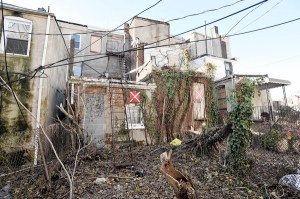
Baltimore, Md — 12/2/11 — The rear of a vacant house, marked with “X” on the left, where a 13-year-old girl was raped in October. The house at 825 N. Caroline was owned by the city for years and last year the city transferred it through a swap with a developer. Kim Hairston [The Baltimore Sun ]
Experts such as Baizer Kolar P.C. as well as Gray’s attorney says there is no evidence he had any kind of preexisting injury and there was no car accident.
As children, Gray and his two sisters were found to have damaging lead levels in their blood, which led to educational, behavioral and medical problems, according to a lawsuit they filed in 2008 against the owner of a Sandtown-Winchester home the family rented for four years.
While the property owner countered in the suit that other factors could have contributed to the children’s deficits — including poverty and their mother’s drug use — the case was settled before going to trial in 2010. The terms of the settlement are not public.
Even the Free Republic has now withdrawn their story on the rumors, according to the Sun article. But that won’t stop Fox News and other right wing sources from spreading the lies.
Now two important articles about the real roots of the riots that broke out in Baltimore on Monday.
The mainstream media is getting the story wrong with regards to the Baltimore Uprising….Journalists are lazily positing a direct connection between the Freddie Gray protests and the riot that broke out after Freddie Gray’s funeral….
Most of the media are ignoring the fact that the Baltimore Police Department escalated the situation by releasing a press release during Freddie Gray’s funeral that claimed that Baltimore’s most notorious gangs—the Bloods, Crips, and Black Guerrilla Family—were forming a dark alliance to “take out” police….
Gang members went on television to dispute this press release, saying they “did not make that truce to harm cops.” …. two misleading narratives collided to produce a potent recipe for violence. The police assumed that black youth in local gangs were targeting them and that some sort of violent purge was imminent, so they began painting a picture of imminent threat. Convinced that they were under attack and having sufficiently defined the enemy (i.e. black youth) to the press, the police decided to strike first.
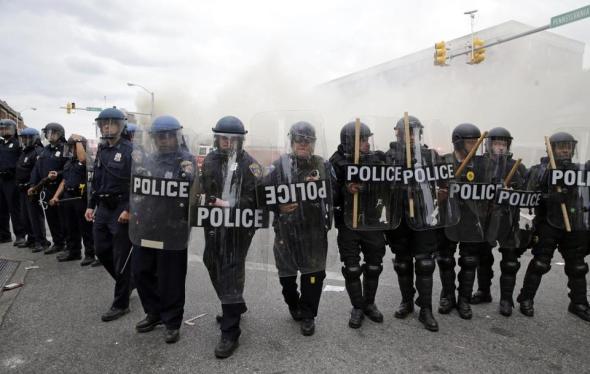
Therefore, police deployed cops in riot gear to Mondawmin Mall to cut off the buses that the children from local schools use to take home before the children got out of school. From there, things descended into violence as frustrated children, trapped on city streets by armored police and cut off from their mode of transportation home, began hurling rocks and bricks at the police.
The police responded with rubber bullets and tear gas, turning West Baltimore into the scene of a revolt.
Please go read the whole thing at the link.
East Baltimore row houses, by Jeff Buster
From Mother Jones:
Eyewitnesses: The Baltimore Riots Didn’t Start the Way You Think, by Sam Brodey and Jenna McLaughlin.
After Baltimore police and a crowd of teens clashed near the Mondawmin Mall in northwest Baltimore on Monday afternoon, news reports described the violence as a riot triggered by kids who had been itching for a fight all day. But in interviews with Mother Jones and other media outlets, teachers and parents maintain that police actions inflamed a tense-but-stable situation.
The funeral of Freddie Gray, a 25-year-old black man who died in police custody this month, had ended hours earlier at a nearby church. According to the Baltimore Sun, a call to “purge”—a reference to the 2013 dystopian film in which all crime is made legal for one night—circulated on social media among school-aged Baltimoreans that morning. The rumored plan—which was not traced to any specific person or group—was to assemble at the Mondawmin Mall at 3 p.m. and proceed down Pennsylvania Avenue toward downtown Baltimore. The Baltimore Police Department, which was aware of the “purge” call, prepared for the worst. Shortly before noon, the department issued a statement saying it had “received credible information that members of various gangs…have entered into a partnership to ‘take-out’ law enforcement officers.”
When school let out that afternoon, police were in the area equipped with full riot gear. According to eyewitnesses in the Mondawmin neighborhood, the police were stopping busses and forcing riders, including many students who were trying to get home, to disembark. Cops shut down the local subway stop. They also blockaded roads near the Mondawmin Mall and Frederick Douglass High School, which is across the street from the mall, and essentially corralled young people in the area. That is, they did not allow the after-school crowd to disperse.
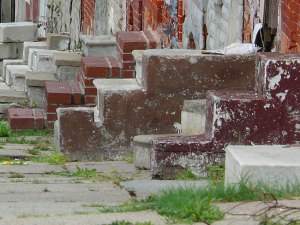
Close-up of East Baltimore stoops, by Jeff Buster
Baltimore schoolteachers and parents told MJ that the police triggered the violence. Here’s one account from a teacher named Meghann Harris posted on Facebook:
Police were forcing busses [sic] to stop and unload all their passengers. Then, [Frederick Douglass High School] students, in huge herds, were trying to leave on various busses [sic] but couldn’t catch any because they were all shut down. No kids were yet around except about 20, who looked like they were waiting for police to do something. The cops, on the other hand, were in full riot gear, marching toward any small social clique of students…It looked as if there were hundreds of cops.
And another from a parent:
A parent who picked up his children from a nearby elementary school, says via Twitter, “The kids stood across from the police and looked like they were asking them ‘why can’t we get on the buses’ but the police were just gazing…Majority of those kids aren’t from around that neighborhood. They NEED those buses and trains in order to get home.” He continued: “If they would’ve let them children go home, yesterday wouldn’t have even turned out like that.”
Whenever there is an uprising in an American city, as we’ve seen in Baltimore over the past few days in response to the police-involved death of 25-year-old Freddie Gray, there always emerges a chorus of elected officials, pundits, and other public figures that forcefully condemn “violent protests.” They offer their unconditional support for “legitimate” or “peaceful” protests, but describe those who break windows and set fires as thugs, criminals, or animals. And eventually someone invokes the legacy of Martin Luther King Jr. and the civil-rights movement, reminding us that nonviolence brought down Jim Crow segregation and won voting rights.
There’s something that needs to be cleared up: the civil-rights movement was not successful because the quiet dignity of nonviolent protests appealed to the morality of the white public. Nonviolent direct action, a staple employed by many organizations during the civil-rights movement, was and is a much more sophisticated tactic. Organizers found success when nonviolent protests were able to provoke white violence, either by ordinary citizens or police, and images of that brutality were transmitted across the country and the rest of the world. The pictures of bloodied bodies standing in nonviolent defiance of the law horrified people at home and proved embarrassing for the country in a global context.
So anyone who calls for protestors to remain “peaceful,” like the civil-rights activists of old, must answer this question: What actions should be taken when America refuses to be ashamed? Images of black death are proliferating beyond our capacity to tell each story, yet there remains no tipping point in sight—no moment when white people in America will say, “Enough.” And no amount of international outrage diminishes the US’s reputation to the point of challenging its status as a hegemonic superpower….
Does that mean “riots” are the answer? No one knows. If the anger of a people denied humanity and democracy is continually dismissed as lawlessness, perhaps these uprisings will prove only destructive. But if the people with the ability to change the system that produced this anger will only listen to the sound of shattering glass, then maybe this is the solution.
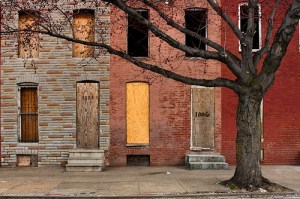
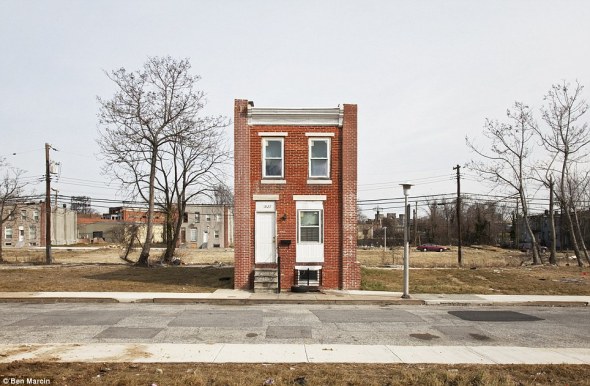
Last house standing. Abandoned row house in Baltimore (Daily Mail)
I’ve illustrated this post with photos of East Baltimore. Here are some links where you can see more photos and learn more about Baltimore’s neglected neighborhoods.
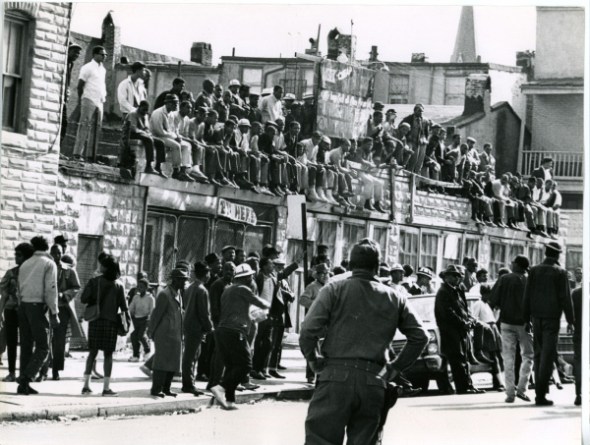
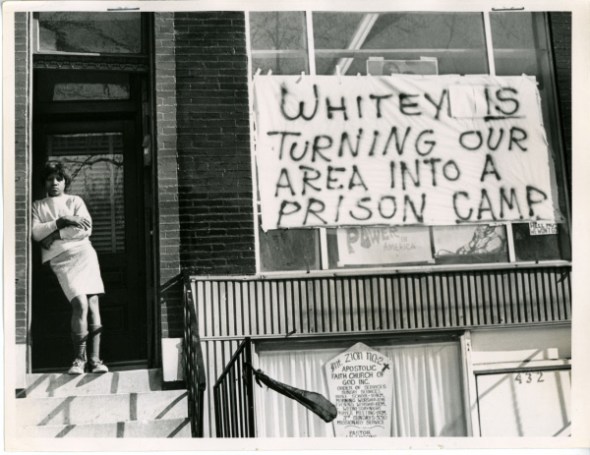
One of the advantages of being old is that you can remember quite a bit of history. I remember the riots that tore apart American cities in April, 1968, following the assassination of Martin Luther King, Jr. The assassination was only the trigger that set off the anger that had been building for years in people who felt disrespected and desperate. One of those riots took place in Baltimore. Spiro Agnew was governor of Maryland when it happened. Soon he would be Richard Nixon’s Vice President. Nixon ran on a “law and order” platform, and as president he initiated the “war on drugs.”
Armored troop carriers rolled down the streets over deep tread marks in the soft blacktop. Tanks had preceded them. There were troops already bivouaced in Druid Hill Park. It wasn’t a town in Czechoslovakia, or Poland, or Afghanistan. It was Crabtown, grave-site of Edgar Allen Poe, birthplace of the United States’ national anthem, and headquarters of the Roman Catholic Church. In the United States.
It was Bal’more, Mar’lan’. It was the time we call 1968. King had just been assassinated in Memphis, Tennessee, and city officials had persuaded Governor Spiro Theodore Agnew to call in the National Guard.
Houses and businesses had burned before, and firemen had been shot before in the inner city, but troops occupying the city, this was new.
Sound familiar?
Baltimore in April, 1968
Baltimore in April 1968
Forty-seven years later, Baltimore is burning again. This time the trigger was the death of Freddie Gray after a beating by police that was caught on video by a bystander. Why is anyone surprised by the violence? It was bound to happen again in one of many cities where militarized police forces target poor neighborhoods and police officers kill black citizens with impunity because they know they will go unpunished. We’ve seen black men die at the hands of police again and again in the past year–in Ferguson, Long Island, Cleveland, Dayton, Los Angeles, New York City, and many more cities.
This time, Baltimore Maryland’s governor is Larry Hogan. Forty-seven years later, his solution is the same as Agnew’s–call in the National Guard to shut down violent protests. Will it work? Maybe it will suppress the anger for a time, but it will remain simmering under the surface until Americans deal with the real problems behind it.
The good news in 2015 is that, thanks to cell phone cameras, Americans are finally seeing in real time the inevitable results of bad policing, racial profiling, and economic inequality. Will anything change this time?
This morning I’ve collected some of the best news reports and opinions I could find on the latest outbreak of violence over a police killing–this time in Baltimore.
Violence and looting overtook much of West Baltimore on Monday, injuring more than a dozen police officers and leaving buildings and vehicles in flames.
As night fell, looters took to Mondawmin Mall and a Save-A-Lot and Rite Aid in Bolton Hill, loading up cars with stolen goods. About 10 fire crews battled a three-alarm fire at a large senior center under construction at Chester and Gay streets, as police officers stood guard with long guns.
About 10 p.m., police confirmed shots were fired at an officer in the area of Virginia Avenue and Reisterstown Road in Northwest Baltimore. The officer was not hit and the suspect fled.
Fifteen police officers were injured in a clash with school-age children that began around 3 p.m., and two remain hospitalized, police Col. Darryl DeSousa said in a press conference Monday night. Earlier, police spokesman Capt. Eric Kowalczyk said one officer was unresponsive and others suffered broken bones.
Police arrested 27 people, DeSousa said.
Mayor Stephanie Rawlings-Blake declared a curfew across the city starting Tuesday and for the next week, from 10 p.m. to 5 a.m. for adults and 9 p.m. to 5 a.m. for children aged 14 and younger. She drew a distinction between peaceful protesters and “thugs” she said engaged in rioting Monday intend on “destroying our city.”
“It’s idiotic to think that by destroying your city, you’re going to make life better for anybody,” Rawlings-Blake said.
At Rawlings-Blake’s request, Gov. Larry Hogan signed an executive order declaring a state of emergency and activating the Maryland National Guard. The order does not affect citizens’ rights, but is required to activate the Guard and authorize federal assistance, Hogan spokeswoman Erin Montgomery said. It is not “martial law,” Maryland National Guard Adjutant General Linda Singh said.
Freddie Gray’s death on April 19 leaves many unanswered questions. But it is clear that when Gray was arrested in West Baltimore on the morning of April 12, he was struggling to walk. By the time he arrived at the police station a half hour later, he was unable to breathe or talk, suffering from wounds that would kill him.
Gray died Sunday from spinal injuries. Baltimore authorities say they’re investigating how the 25-year-old was hurt—a somewhat perverse notion, given that it was while he was in police custody, and hidden from public view, that he apparently suffered injury. How it happened remains unknown. It’s even difficult to understand why officers arrested Gray in the first place. But with protestors taking to the streets of Baltimore since Gray’s death on Sunday, the incident falls into a line of highly publicized, fatal encounters between black men and the police….Black men dying at the hands of the police is of course nothing new, but the nation is now paying attention and getting outraged.Authorities can’t say if there was a particularly good reason why police arrested Gray. According to the city, an officer made eye contact with Gray, and he took off running, so they pursued him. Though he’d had scrapes with the law before, there’s no indication he was wanted at the time. And though he was found with a switchblade, Mayor Stephanie Rawlings-Blake said, “We know that having a knife is not necessarily a crime.”
Police wouldn’t have found the knife if they hadn’t chased after Gray and searched him with no probable cause. They claim he ran when he saw police, but is that a crime? I don’t think so.
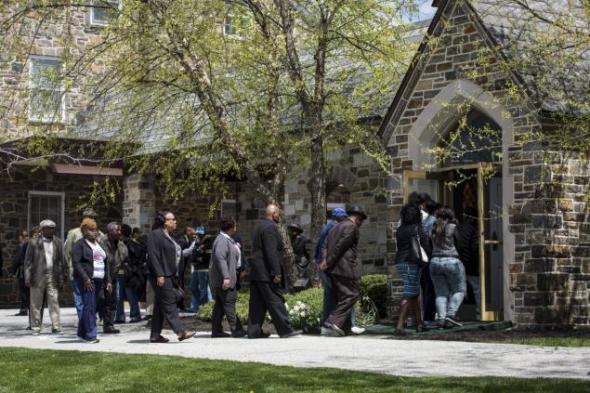
Friends and family gather for Freddie Gray’s funeral
Police brutality in Baltimore is nothing new. In September 2014, The Baltimore Sun published an investigative report on police violence against citizens: Undue Force. A brief excerpt:
Over the past four years, more than 100 people have won court judgments or settlements related to allegations of brutality and civil rights violations. Victims include a 15-year-old boy riding a dirt bike, a 26-year-old pregnant accountant who had witnessed a beating, a 50-year-old woman selling church raffle tickets, a 65-year-old church deacon rolling a cigarette and an 87-year-old grandmother aiding her wounded grandson.
Those cases detail a frightful human toll. Officers have battered dozens of residents who suffered broken bones — jaws, noses, arms, legs, ankles — head trauma, organ failure, and even death, coming during questionable arrests. Some residents were beaten while handcuffed; others were thrown to the pavement.
And in almost every case, prosecutors or judges dismissed the charges against the victims — if charges were filed at all. In an incident that drew headlines recently, charges against a South Baltimore man were dropped after a video showed an officer repeatedly punching him — a beating that led the police commissioner to say he was “shocked.”
Such beatings, in which the victims are most often African-Americans, carry a hefty cost. They can poison relationships between police and the community, limiting cooperation in the fight against crime, the mayor and police officials say. They also divert money in the city budget — the $5.7 million in taxpayer funds paid out since January 2011 would cover the price of a companion maids home service or renovations at more than 30 playgrounds. And that doesn’t count the $5.8 million spent by the city on legal fees to defend these claims brought against police.
Read the rest at the link.
Baltimore in April 2015
Gray may have been injured during the beating on the street, but his injuries may have been exacerbated by being taken on a “rough ride” in a police wagon without a seat belt.
When a handcuffed Freddie Gray was placed in a Baltimore police van on April 12, he was talking and breathing. When the 25-year-old emerged, “he could not talk and he could not breathe,” according to one police official, and he died a week later of a spinal injury.
But Gray is not the first person to come out of a Baltimore police wagon with serious injuries.
Relatives of Dondi Johnson Sr., who was left a paraplegic after a 2005 police van ride, won a $7.4 million verdict against police officers. A year earlier, Jeffrey Alston was awarded $39 million by a jury after he became paralyzed from the neck down as the result of a van ride. Others have also received payouts after filing lawsuits.
For some, such injuries have been inflicted by what is known as a “rough ride” — an “unsanctioned technique” in which police vans are driven to cause “injury or pain” to unbuckled, handcuffed detainees, former city police officer Charles J. Key testified as an expert five years ago in a lawsuit over Johnson’s subsequent death.
As daily protests continue in the streets of Baltimore, authorities are trying to determine how Gray was injured, and their focus is on the 30-minute van ride that followed his arrest. “It’s clear what happened, happened inside the van,” Mayor Stephanie Rawlings-Blake said Monday at a news conference.
Here’s a first-person description of one of those “rough rides” from a victim:
Christine Abbott, a 27-year-old assistant librarian at the Johns Hopkins University, is suing city officers in federal court, alleging that she got such a ride in 2012. According to the suit, officers cuffed Abbott’s hands behind her back, threw her into a police van, left her unbuckled and “maniacally drove” her to the Northern District police station, “tossing [her] around the interior of the police van.”
“They were braking really short so that I would slam against the wall, and they were taking really wide, fast turns,” Abbott said in an interview that mirrored allegations in her lawsuit. “I couldn’t brace myself. I was terrified.”
The lawsuit states she suffered unspecified injuries from the arrest and the ride.
“You feel like a piece of cargo,” she added. “You don’t feel human.”
The van’s driver stated in a deposition that Abbott was not buckled into her seat belt, but the officers have denied driving recklessly.
Anyone believe the denials? I sure don’t.
More helpful stories on the Baltimore riots, links only:
Today is a good day to put things in perspective and meditate on how fortunate we are here in the United States, despite our serious social and political problems. Elsewhere, dramatic, uncontrollable earth changes are happening with disastrous results.
A disastrous earthquake hit Nepal this morning, with hundreds reported dead so far.
A 7.9-magnitude earthquake in Nepal killed at least 792 people, destroyed homes and landmarks and triggered an avalanche on Mt. Everest Saturday, officials said….
The devastation first struck Nepal’s densely populated Kathmandu Valley, sweeping through the capital Kathmandu before rippling outward.
“Almost the entire country has been hit,” Krishna Prasad Dhakal, deputy chief of mission at Nepal’s Embassy in New Delhi, told Reuters.
Nepal’s tourism jewel, Mt. Everest, was shaken by the country’s worst earthquake in 80 years, setting off an avalanche that killed eight and injured at least 30, officials said.
Here’s some shocking video from YouTube:
This was truly a giant earthquake. [Update: As I write this, USA Today is reporting 876 confirmed dead.]
The earthquake sent aftershocks in all directions, killing 20 in India, six in Tibet, two in Bangladesh, and two Chinese citizens at the Nepal-China border. The rumbling was also felt by some in Lahore, Pakistan and Lhasa.
A 6.6.-magnitude aftershock hit Nepal about an hour after the initial earthquake, and smaller aftershocks continued every few minutes as emergency responders rushed to save citizens and treat them in overcrowded hospitals….
The cosmic quake also injured dozens more and destroyed several centuries-old temples and towers, including the Dharahara Tower, one of the Nepal’s most famous landmarks, which dates back to the 1800s. People were trapped underneath it after it crumbled.
Nepal is going to need a lot of help and soon if lives are to be saved.
Saturday’s catastrophic earthquake in Nepal occurred because of two converging tectonic plates: the India plate and the overriding Eurasia plate to the north, the U.S. Geological Survey said.
Tectonic plates are the large, thin, relatively rigid plates that move relative to one another on the outer surface of the Earth.
Plates are always slowly moving, but they get stuck at their edges due to friction. When the stress on the edge overcomes the friction, there is an earthquake that releases energy in waves that travel through the earth’s crust and cause the shaking that we feel.
At the location of Saturday’s earthquake, about 50 miles to the northeast of the Nepalese capital of Kathmandu, the India plate is converging with Eurasia at a rate of about two inches per year towards the north-northeast, driving the uplift of theHimalayan mountain range.
Although a major plate boundary with a history of large-to-great sized earthquakes, large quakes in this area are rare in the documented historical era, the U.S. Geological Survey reports. Over the past century, just four events of magnitude 6.0 or larger have occurred within about 150 miles of Saturday’s earthquake.
One, a magnitude 6.9 earthquake in August 1988 about 150 miles to the southeast of Saturay’s quake, caused nearly 1,500 fatalities, USGS said.
The largest event, a magnitude 8.0 known as the 1934 Nepal-Bihar earthquake, occurred in a similar location to the 1988 quake. It severely damaged Kathmandu, and is thought to have caused around 10,600 deaths.
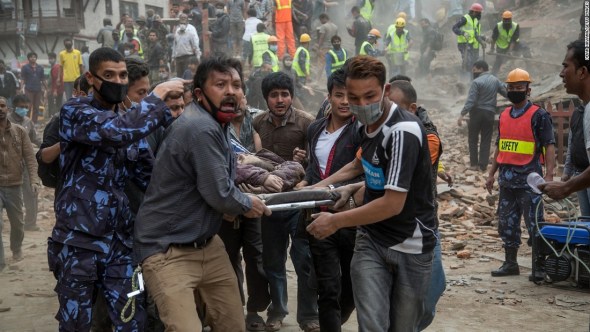
This photo from CNN shows emergency rescue workers in Kathmandu rushing an injured person to a hospital.
I may be living in dignified poverty in a country filled with out-of-control religious fanatics and right wing haters, but at least I’m alive and well, with a roof over my head, heat, running water, electricity, and food to eat. I even have a Heaterator in my house for those cold days!
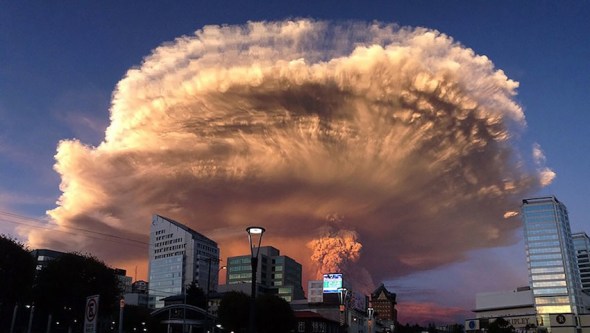
On Wednesday, Chile experienced a massive volcanic eruption that also set off earthquakes.
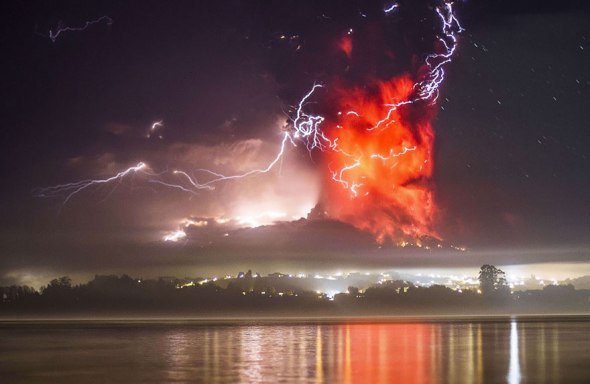
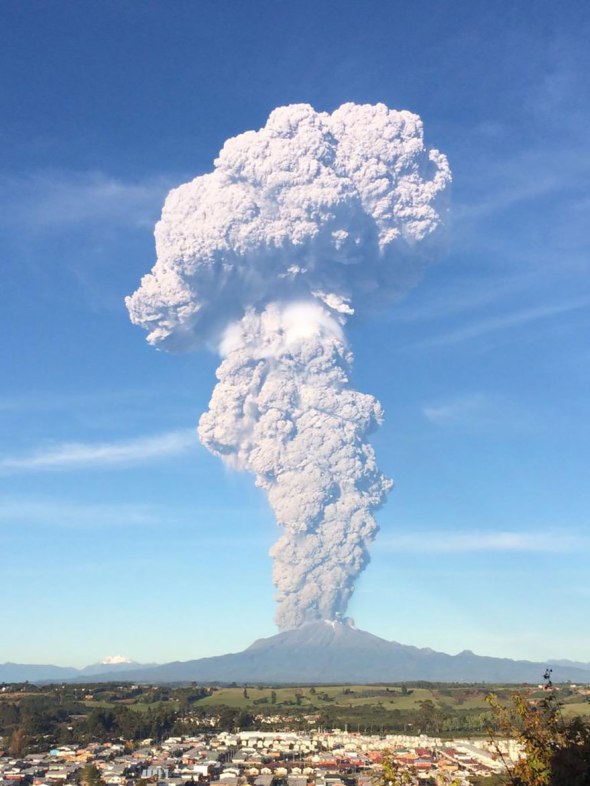
Calbuco, a stratovolcano in southern Chile, began erupting yesterday [Wednesday] at 7pm local time. First spewing massive ash clouds then, at 10pm, erupting explosively as its fragile structure collapsed inwards….The Calbuco volcano in southern Chile is erupting for the first time in 42 years…
A volcano that was dormant for 42 years in Chile has erupted twice this week in a magnificent display. But the stunning twin blasts captured on photo and video has forced about 4,000 residents in towns nearby to evacuate as ash blanketed their neighborhoods.
The city of Ensenada, at the foot of the Calbuco volcano, was one of the most thickly covered in ash – which caused roofs to collapse and raised concerns about possible water contamination, respiratory illnesses and more grounded flights.
Chile’s national geology and mining service also warned people to prepare for a possible third and “even more aggressive eruption.”
A missing hiker was found alive late Thursday as ash from Chile’s Calbuco volcano continued to fill the air, piling on roadways and closing borders in the region.
The volcano first erupted Wednesday, marking the first such activity in more than 42 years, billowing a huge ash cloud over the sparsely populated, mountainous area in southern Chile.
A second, more powerful eruption hit around 1 a.m. Thursday, creating swarms of lightning storms. Stunning photos captured the phenomenon, known as “dirty thunderstorms,” which illuminated the night sky.
The eruption rained down as much as 15 to 20 inches of ash in the nearby town of Ensenada, officials said, closing schools and canceling flights. Several surrounding towns, including Alerce, Colonia Rio Sur and Correntos, were also evacuated.
About 7 p.m. local time, two earthquakes associated with fracturing of rock occurred. The largest happened less than 3 miles east of the main crater, with a magnitude of 3, officials said in a 9 p.m. update. An additional “minor” eruption is possible, officials said.
According to the article, no deaths have been reported so far, and officials say they don’t have food or water shortages; but this eruption was huge.
Volcanic ash was falling in the Argentine resort city of Bariloche, about 68 miles east of Calbuco, the Associated Press reported. Officials there were analyzing the ash to see if it posed a threat to drinking water.
Officials closed several border crossings between Argentina and Chile, after “poor environmental conditions” made the roads impassable.
Chilean volcano Calbuco, which erupted without warning on Wednesday, is still puffing out ash and smoke on Friday, prompting new evacuations and leading airlines to cancel flights to Argentine capital Buenos Aires, some 1,400 kilometers east.
Calbuco, considered one of the most dangerous along Chile’s chain of around 2,000 volcanoes, erupted twice in 24 hours on Wednesday and Thursday, sending up a spectacular 17 kilometer-high (11 miles) cloud and coating nearby towns in a thick layer of gray ash.
Authorities have set up a 20 kilometer (12 mile) cordon around Calbuco, which is located in the scenic Los Lagos region, around 1,000 kilometers (621 miles) south of capital Santiago.
An increase in volcanic activity caused potentially deadly lahars, a mix of water and rock fragments that flow down a volcano’s slopes and river valleys, prompting authorities to evacuate an additional 2,000 people.
“This is a complex (volcanic) process that could last for weeks,” said Rodrigo Alvarez, head of Chile’s mining and geological service.
Of course we do face catastrophic risks here too. Remember that all that volcanic activity under Yellowstone National Park?
Scientists and tourists have always known that Yellowstone National Park featured lively geologic wonders – regular small earthquakes and two-thirds of the world’s geysers, including Old Faithful – all constituting what’s known as a “supervolcano.”
Now, seismologists at the University of Utah in Salt Lake City have made a new discovery about Yellowstone’s subsurface plumbing, specifically a reservoir of hot, partly molten rock more than four times larger than the shallower magma chamber that scientists already knew about. To give that some perspective, the newly discovered reservoir would fill the Grand Canyon 11 times, compared with 2.5 times for the shallower chamber.
“For the first time, we have imaged the continuous volcanic plumbing system under Yellowstone,” says Hsin-Hua Huang, a postdoctoral researcher in geology and geophysics at the university and the study’s lead author, in a statement. “That includes the upper crustal magma chamber we have seen previously plus a lower crustal magma reservoir that has never been imaged before and that connects the upper chamber to the Yellowstone hotspot plume below.”
The researchers, whose findings were published in the journal Science this week, emphasize that Yellowstone’s plumbing system is no larger – nor closer to erupting – than before. Now, however, they have used advanced techniques to make a complete image of the system that carries hot and partly molten rock upward from the top of the Yellowstone hot-spot plume – about 40 miles beneath the surface – to the magma reservoir and the magma chamber above it.
But the deeper chamber does mean that the shallow chamber can be replenished again and again.
If that thing blows, we can all kiss our asses goodbye. But we can’t just cower in our houses in fear, can we? We have to face today’s current events, and they can be pretty awful.
Of course, as I wrote at the outset, we do have some serious political and social problems in the good old USA.
I for one am very glad I don’t live in Missouri. Remember the black woman who was elected mayor of the small town of Kinloch? The racism seemingly runs deep in that place, which isn’t far from Ferguson. The St. Louis Post-Dispatch reports:
KINLOCH • Betty McCray, Kinloch’s newly elected Mayor, arrived at City Hall on Thursday morning with an entourage and the intention to fire multiple city employees.
But before she could enter the building, McCray was told she was the one who was out of job.
In the parking lot, McCray was met by a half-dozen police officers and City Attorney James Robinson, who held a manila envelope under his arm containing articles of impeachment.
“You can’t come in as mayor,” Robinson said. “You have been suspended.”
McCray refused to take the envelope, saying, “You may be the attorney now, but I promise you, you won’t be later.”
Robinson also told Alderman Eric Petty, an ally of McCray’s, that the board had drafted articles of impeachment against him. Petty, too, refused to accept them.
“We won,” he said. “It’s time for them to move on.”
Can you believe that? I guess it’s time for the Justice Department to investigate another Missouri police force.
Kinloch, the first city in Missouri to be incorporated by African-Americans, is situated between Ferguson and Lambert-St. Louis International Airport. It once thrived with more than 10,000 residents. Then in the 1980s, the airport began buying homes for a noise-abatement program, purchasing roughly 1,360 properties. The city’s population plummeted, and poverty and blight took hold.
Today, Kinloch, which has fewer than 300 residents, is marked by pilfered coffers, shady land deals and increasingly bitter fights over the last remnants of political power.
During the past five years, the city has seen the imprisonment of a former mayor on federal fraud and theft charges, the hiring of a convicted felon as city manager, the selling of a previous city hall building to an alleged drug dealer and the unseating of at least two aldermen.
WTF do they need so many police officers for 300 residents?!
The New York Times and Washington Post are out with their initial stories based on the upcoming book by Peter Schweizer, Clinton Cash. The Times article by Jo Becker and Mike McIntire is very long and detailed, and I’ve only skimmed it so far. The authors strongly suggest that in her role as Secretary of State Hillary Clinton helped arrange for the sale of a uranium production company to Russia.
The headline in Pravda trumpeted President Vladimir V. Putin’s latest coup, its nationalistic fervor recalling an era when the newspaper served as the official mouthpiece of the Kremlin: “Russian Nuclear Energy Conquers the World.”
The article, in January 2013, detailed how the Russian atomic energy agency, Rosatom, had taken over a Canadian company with uranium-mining stakes stretching from Central Asia to the American West. The deal made Rosatom one of the world’s largest uranium producers and brought Mr. Putin closer to his goal of controlling much of the global uranium supply chain….
At the heart of the tale are several men, leaders of the Canadian mining industry, who have been major donors to the charitable endeavors of former President Bill Clinton and his family. Members of that group built, financed and eventually sold off to the Russians a company that would become known as Uranium One.
Beyond mines in Kazakhstan that are among the most lucrative in the world, the sale gave the Russians control of one-fifth of all uranium production capacity in the United States. Since uranium is considered a strategic asset, with implications for national security, the deal had to be approved by a committee composed of representatives from a number of United States government agencies. Among the agencies that eventually signed off was the State Department, then headed by Mr. Clinton’s wife, Hillary Rodham Clinton.
As the Russians gradually assumed control of Uranium One in three separate transactions from 2009 to 2013, Canadian records show, a flow of cash made its way to the Clinton Foundation. Uranium One’s chairman used his family foundation to make four donations totaling $2.35 million. Those contributions were not publicly disclosed by the Clintons, despite an agreement Mrs. Clinton had struck with the Obama White House to publicly identify all donors. Other people with ties to the company made donations as well.
That’s the introduction. Read the rest at the NYT link above.
Apparently, the press is going to act as if Bill Clinton were running for president, not Hillary Clinton. They seem to see her as indistinguishable from her husband; and she is going to be held responsible for his past and present policies, actions, and indiscretions. I wonder if they’ll even report Hillary’s own ideas and the policies she argues for during her campaign? At least that’s my read based on this morning’s Washington Post article.
Bill Clinton was paid at least $26 million in speaking fees by companies and organizations that are also major donors to the foundation he created after leaving the White House, according to a Washington Post analysis of public records and foundation data.
The amount, about one-quarter of Clinton’s overall speaking income between 2001 and 2013, demonstrates how closely intertwined Bill and Hillary Clinton’s charitable work has become with their growing personal wealth.
The Clintons’ relationships with major funders present an unusual political challenge for Hillary Rodham Clinton. Now that she has formally entered the presidential race, the family may face political pressure and some legal requirements to provide further details of their personal finances and those of the foundation, giving voters a clearer view of the global network of patrons that have supported the Clintons and their work over the past 15 years.
The multiple avenues through which the Clintons and their causes have accepted financial support have provided a variety of ways for wealthy interests in the United States and abroad to build friendly relations with a potential future president. The flow of money also gives political opponents an opportunity to argue that Hillary Clinton would face potential conflicts of interest should she win the White House. Though she did not begin delivering paid speeches or join the foundation until 2013, upon ending her tenure as secretary of state, the proceeds from her husband’s work benefited them both.
Read the rest at the link. Again, I’ve only had time to briefly skim this article so far.
I’ll be interested to see reactions to the Times and Post pieces as the day wears on.
Another story that is getting quite a bit of attention George Packer’s latest at The New Yorker.
Packer begins by referring to a piece by Nate Cohn at the NYT blog The Upshot in which Cohn examined the possible GOP candidates and picked two who have emerged as leaders.
Jeb Bush and Scott Walker—have quickly moved to the head of the pack. Perhaps only Mr. Rubio has a good chance to join them at the top.” The reasons have to do with fundraising, positioning, élite support, broad acceptability—that is, with the roles spelled out in the piece. The author, Nate Cohn, concluded, “It will be fun to watch.”
Fun? Not for Packer.
That was when he lost me.
It might not be wise for a sometime political journalist to admit this, but the 2016 campaign doesn’t seem like fun to me. Watching Marco Rubio try to overcome his past support for immigration reform to win enough conservative votes to become the Mainstream Alternative to the Invisible Primary Leader—who, if there is one, will be a candidate named Bush—doesn’t seem like fun. Nor does analyzing whether Chris Christie can become something more than the Factional Favorite of moderate Republicans, or whether Ted Cruz’s impressive early fundraising will make him that rare thing, a Factional Favorite with an outside chance to win. If this is any kind of fun, it’s the kind of fun I associate with reading about seventeenth-century French execution methods, or watching a YouTube video of a fight between a python and an alligator. Fun in small doses, as long as you’re not too close.
American politics in general doesn’t seem like fun these days. There’s nothing very entertaining about super PACs, or Mike Huckabee’s national announcement of an imminent national announcement of whether he will run for President again. Jeb Bush’s ruthless approach to locking up the exclusive services of longstanding Republican political consultants and media professionals far ahead of the primaries doesn’t quicken my pulse. Scott Walker’s refusal to affirm Barack Obama’s patriotism doesn’t shock me into a state of alert indignation. A forthcoming book with revelations about the Clintons’ use of their offices and influence to raise money for their foundation and grow rich from paid speeches neither surprises me nor gladdens my heart.
Packer longs for the good old days:
Since I was eight years old, and the Republican candidates were named Nixon, Rockefeller, and Reagan, and the Democrats were Humphrey, Kennedy, and McCarthy, I’ve been passionate about American politics, as a student, a witness, and a partisan. Politics was in my blood, at the family dinner table, in my work and my free time. But at some point in the past few years it went dead for me, or I for it. Perhaps it was week thirty-eight of the Obama-Romney race (a campaign between “Forward” and “Believe in America”), or the routinization of the filibuster, or the name Priorities USA Action, or the fifty-eighth vote in Congress to repeal the Affordable Care Act—something happened that made it very hard to continue paying attention. I don’t take this as a sign of personal superiority: I’ve always disliked people who considered themselves to be “above” politics. I mourn my lack of political passion as I would if I were to lose interest in reading fiction, or to stop caring about someone who’d been important to me for most of my life. And I count on getting back the feeling—the intense mix of love, hatred, anxiety, astonishment, and gratification—because life, public life, is impoverished without it. Perhaps it will return sometime before November 8, 2016. But for now—I have to be honest—it’s gone.
The reason is the stuckness of American politics. Especially in the years after 2008, the worst tendencies of American politics only hardened, while remaining in the same place. Beneath the surface froth and churn, we are paralyzed.
You can sense it as soon as you step out of the train at Union Station in Washington, the instant you click on a Politico article about a candidates’ forum in Iowa: miasma settles over your central nervous system and you start to go numb. What has happened is that the same things keep happening. The tidal wave of money keeps happening, the trivialization of coverage keeps happening, the extremism of the Republican Party keeps happening (Ted Cruz: abolish the I.R.S.; Rand Paul: the Common Core is “un-American”). The issues remain huge and urgent: inequality, global warming, immigration, poorly educated children, American decline, radical Islamism. But the language of politics stays the same, and it is a dead language. The notion that answers will come from Washington or the campaign trail is beyond far-fetched.
For Packer, it’s about having fun following politics, and he isn’t having fun anymore. I think quite a few people feel that way, but unlike George Packer most of us don’t have a platform we could use to stir things up. Why doesn’t Packer get out there and do some investigative reporting on the candidates and write in detail about the paralysis of our system?
It’s worth noting when a public affairs writer of George Packer’s quality announces he’s bored with politics. He does so at the New Yorker at considerable length and with the passion he claims to have lost for the subject itself….
Packer’s lament reflects a mixed conception of the “fun” in politics being generated by a sense of forward momentum on policy ideas and by competitive churn and unpredictability. Thus in his “wish list” of things he’d like to happen in 2016 to revive his interest in politics, he includes both a far-fetched bipartisan ticket (a bad idea, IMO) and a serious lefty challenge to HRC, the former presumably to reduce “gridlock” and the latter to reduce the dull predictability of a campaign for and against a Clinton.
You could certainly make the argument that Packer’s two impulses are incompatible. The most consequential presidential elections in American history have not often been very close. 1800, 1828, 1860, 1912, 1932, 1964, 1980 and 2008 were not nail-biters. Yet some of the most “exciting” contests as measured by turnout were the very close elections of the late nineteenth century when aside from patronage tariff levels were the main policy battleground between the two parties. And in terms of politics being less interesting than those of Packer’s childhood—well, some of that is a deception of memory, probably, and some of it the product of knowing now how much of the “magic” of politics isn’t magical at all. In the twenty-first century, we’ve had one of the three presidential elections in American history to go into overtime; a very close election in which the two parties polarized to an extent rarely seen in the previous few decades; and then the historic election of an African-American after a historic primary against a woman and competitive nominating processes in both parties. Even 2012, which left Packer cold, was relatively unpredictable, if you look at how close the general election contest became after the first debate and consider the perils experienced by the obvious Republican nominee in the primaries facing challengers who might have been wearing full clown regalia.
Read the rest at the link above.
The Assassination of Osama bin Laden, by Catherine Tafur
Does George Packer really think the purpose of American politics is to thrill him? ….
Like Kilgore, DeLong points out that Packer’s desired changes are self-contradictory; and he has ideas for how Packer could change things:
[H]e should pick 500 American adults at random, and every day he should talk to ten of them, asking them:
If they have registered to vote.
Why they have or have not registered.
Who among the candidates they think would make the best president.
Why they think that.
Whether they are actually going to vote.
Who they are going to vote for.
And he can write up what they say. There’s time between now and November 2016 for him to interview each one ten times. It would produce a much more interesting narrative than it currently looks like he is going to offer us.
If only Packer would try that instead of just whining at his high-profile media perch. I have a few more links to post down there as well.
The Sky Dancing banner headline uses a snippet from a work by artist Tashi Mannox called 'Rainbow Study'. The work is described as a" study of typical Tibetan rainbow clouds, that feature in Thanka painting, temple decoration and silk brocades". dakinikat was immediately drawn to the image when trying to find stylized Tibetan Clouds to represent Sky Dancing. It is probably because Tashi's practice is similar to her own. His updated take on the clouds that fill the collection of traditional thankas is quite special.
You can find his work at his website by clicking on his logo below. He is also a calligraphy artist that uses important vajrayana syllables. We encourage you to visit his on line studio.














 peej
peej Carissa
 bostonboomer
 dakinikat
 ecocatwoman
 mablue2
 Mama Lopez
 peggysue22
 quixote
 skydancingguestblogger
 Mona (aka Wonk the Vote)



 Sky Dancing
Recent Comments