Posted: March 25, 2026 | Author: bostonboomer | Filed under: just because | Tags: 82nd Airborne, Donald Trump, German President Frank-Walter Steinmeier, Iran military spokesman Ebrahim Zolfaghari, Iran War, Iran war negotiations, Jack Smith, Jared Kushner, JD Vance, Pakistan, Paul Krugman, Steve Witkoff, Strait of Hormuz, TREASON |
Good Day!!
I’ve been scanning the headlines for awhile now, trying to make sense of what’s happening in Trump’s war with Iran. I’m still confused.
Trump keeps saying that he’s already won the war, but he’s sending thousands of troops to the region. He apparently sent a peace plan to Iran that they have already rejected, offering an alternative proposal.
CNN has a summary of the latest moves in the war: What to know on Day 26 of the Iran war: Tehran taunts Trump, US troop deployment.
Iran’s military has mocked the Trump administration’s efforts to strike a deal to end the war, saying the United States is only “negotiating with yourselves.”
Despite President Donald Trump’s optimism that a deal with Tehran is in sight, sources have told CNN that around 1,000 US soldiers with the Army’s 82nd Airborne Division are expected to deploy to the Middle East in the coming days, suggesting the president is keeping his options open.
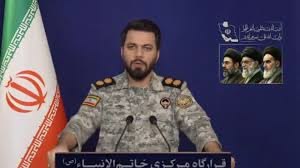
Ebrahim Zolfaghari
The latest on the talks:
- Iran taunts Trump: Ebrahim Zolfaghari, a spokesman for Iran’s military, taunted the US leadership in a message broadcast Wednesday on state television. “Has the level of your internal conflicts reached the point where you are negotiating with yourselves?” he asked. Zolfaghari said the US’ “strategic power” had turned into a “strategic defeat.”
- Trump touts talks: That mocking message came after Trump expressed optimism over a deal to end the war, saying that Vice President JD Vance, Secretary of State Marco Rubio and others were leading negotiations.
- 15-point plan: The US has shared a 15-point list of expectations with Iran via Pakistan, with talks between the warring countries floated in Islamabad later this week, two regional sources told CNN. Those points include limits on Tehran’s defense capabilities, a cessation of support for proxies and an acknowledgement of Israel’s right to exist, the sources said.
- Iran shuns Witkoff: Iranian representatives have let the Trump administration know that Tehran does not want to reenter negotiations with the US president’s favored diplomatic duo of Steve Witkoff, his special envoy, and Jared Kushner, his son-in-law, according to two regional sources, who said Tehran would rather deal with Vance.
-
Iran willing to listen: An Iranian source told CNN on Tuesday that Washington had initiated “outreach” in recent days, “but nothing that has reached the level of full-on negotiations.” The source stressed that Iran “is not asking for a meeting or direct talks with the United States but is willing to listen if a plan for a sustainable deal comes within reach” that would preserve the regime’s interests. Initially, Tehran had denied any contact with Washington, saying that Trump’s claim of talks was a ruse to lower energy prices and buy time.
There’s much more on what’s happening at the CNN link.
More details from BBC News: Pakistan officials say Iran receives 15-point US plan – AP.
The Associated Press news agency reports that Iran has received a 15-point plan from the US for reaching a ceasefire in the US-Israel war with Iran, citing two Pakistani officials.
The Pakistani officials reportedly said the proposal broadly covers the following:
- Sanctions relief
- Civilian nuclear co-operation
- A rollback of Iran’s nuclear programme
- Monitoring by the International Atomic Energy Agency
- Missile limits, and access for shipping through the Strait of Hormuz
Pakistan Prime Minister Shehbaz Sharif said earlier that the country was “ready” to host talks for a settlement of the conflict.
Israel’s Channel 12 has also reported on the plan. You can read a full breakdown of the reports in our earlier post.
There’s been no confirmation of the details from the White House. Iranian military has denied it’s negotiating with the US.
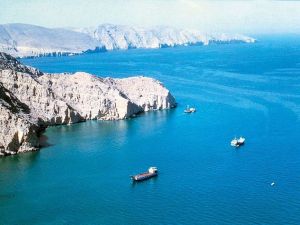
The Strait of Hormuz
Iran has rejected the U.S. plan and offered an alternative. AP: Iran rejects US ceasefire plan, issues its own demands as strikes land across the Mideast.
DUBAI, United Arab Emirates (AP) — Iran on Wednesday dismissed an American plan to pause the war in the Middle East and launched more attacks on Israel and Gulf Arab countries, including an assault that sparked a huge fire at Kuwait International Airport.
Iran’s defiance came as Israel launched airstrikes on Tehran and as the United States deployed paratroopers and more Marines to the region.
Iranian state television’s English-language broadcaster quoted an anonymous official as saying Iran rejected America’s ceasefire proposal and has its own demands for an end to the fighting. “Iran will end the war when it decides to do so and when its own conditions are met,” the hardliner-controlled Press TV quoted the official as saying.
Earlier, two officials from Pakistan, which transmitted the U.S. plan to Iran, described the 15-point proposal broadly, saying it addressed sanctions relief, a rollback of Iran’s nuclear program, limits on missiles and reopening the Strait of Hormuz, through which a fifth of the world’s oil is shipped.
An Egyptian official involved in the mediation efforts said the proposal also includes restrictions on Iran’s support for armed groups. The officials spoke on condition of anonymity to discuss details not yet released.
Some of those points were nonstarters in negotiations before the war: Iran has insisted it won’t discuss its ballistic missile program or its support of regional militias, which it views as key to its security. And its ability to control passage through the Strait of Hormuz represents one of its biggest strategic advantages….
Press TV cited an Iranian five-point plan for a ceasefire coming from the official who rejected the US proposal. That plan included a halt to killings of its officials, means to make sure no other war is waged against it, reparations for the war, the end of hostilities and Iran’s “exercise of sovereignty over the Strait of Hormuz.”
Those measures, particularly reparations and its continued chokehold over the Strait of Hormuz, likely will be unacceptable to the White House.
According to the above AP article, Trump is still claiming that Iran is negotiating with Steve Witkoff and Jared Kushner, but according the BBC article above, Iran has said it won’t talk to them but would talk to J.D. Vance.
Barak Ravid and Marc Caputo at Axios: Iran suspects Trump’s peace talk push is another trick.
Iranian officials have told the countries trying to mediate peace talks with the U.S. that they have now been tricked twice by President Trump and “we don’t want to be fooled again,” according to a source with direct knowledge of those discussions.
The big picture: The U.S. is pushing for in-person peace talks as soon as Thursday in Islamabad, Pakistan. But during the two previous rounds of U.S.-Iran talks, Trump green lit crippling surprise attacks while still claiming to be seeking a deal.
Flashback: Israel attacked Iran with Trump’s backing last June, days before a planned round of nuclear talks.
- Then three weeks ago, the U.S. and Iran reached a tentative agreement in Geneva to continue talks the following week — two days before the U.S. and Israel attacked.
Behind the scenes: Iranian officials have told the mediators — Pakistan, Egypt and Turkey — that U.S. military movements and Trump’s decision to deploy major troop reinforcements have increased their suspicion that his proposal for peace talks is just a ruse.
- To the Trump administration, the massing of forces is a sign he’s serious about negotiating from gunboats, not that he’s negotiating in bad faith. “Trump has a hand open for a deal and the other is a fist, waiting to punch you in the f***ing face,” said a Trump adviser.
- The White House has sent messages to the Iranians that Trump is serious about the negotiations, and floated Vice President JD Vance’s possible involvement in the talks as proof.
- Two sources said Witkoff recommended Vance because of the stature of his office and because the Iranians don’t see him as a hawk.
Read more at Axios.
Trump is ordering troop movements. The Washington Post (gift link): Army paratroopers ordered to Middle East as U.S. weighs next move in Iran conflict.
The Pentagon on Tuesday ordered a couple thousand paratroopers from the 82nd Airborne Division to deploy to the Middle East, U.S. officials said, as President Donald Trump weighs a significant escalation in the U.S.-Israeli war with Iran and declines to rule out putting U.S. troops on Iranian soil.
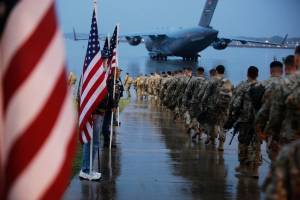
Army paratroopers assigned to the 82nd Airborne Division at Fort Bragg, North Carolina, prepare to board an aircraft in 2020. (Hubert Delany III AP)
U.S. officials approved written orders for soldiers from the division’s 1st Brigade Combat Team and the 82nd’s headquarters at Fort Bragg in North Carolina, said two U.S. officials and a third person familiar with the move, speaking on the condition of anonymity because of the sensitivity of the issue. Verbal orders previously had been approved, two people said. It is not yet clear whether they will deploy to Iran itself, officials said.
Many of the soldiers are with the division’s Immediate Response Force, a unit that is trained to deploy on 18 hours’ notice for missions as varied as seizing airfields and other critical infrastructure, reinforcing U.S. embassies and enabling emergency evacuations. Immediate Response Force duties rotate among infantry units in the 82nd Airborne Division.
The orders follow weeks of speculation about whether the 82nd Airborne, commanded by Maj. Gen. Brandon Tegtmeier, would join the war, after its headquarters unit abruptly pulled out of a training exercise early this month at Fort Polk in Louisiana as Trump approved a sustained bombing campaign against Iran.
Last week, U.S. officials said the Pentagon was making plans to send soldiers from the 82nd Airborne to key areas in Iran, but it was not yet clear if the administration would approve the deployment to the region or, more specifically, onto Iranian soil.
The Army deployment comes as three warships carrying about 4,500 troops from the Tripoli Amphibious Ready Group neared the Middle East. The group includes the 31st Marine Expeditionary Unit based in Okinawa, Japan — a specialized Marine Corps unit that includes about 2,200 personnel, including an infantry battalion of about 800.
A similar unit, the 11th Marine Expeditionary Unit, recently deployed early from San Diego but is weeks away from arriving in the Middle East. The unit, embarked on warships that include the USS Boxer, could eventually replace or supplement the 31st MEU in the region, officials said.
Use the gift link to read more.
U.S. allies are confused about what Trump is doing. Victor Jack, Chris Lunday and Esther Webber at Politico: Trump’s ‘absurdly incoherent’ Iran pleas leave allies befuddled.
BRUSSELS — Donald Trump’s messaging on what he wants from American allies in his war against Iran is so confusing that any effort to help in reopening the Strait of Hormuz remains deadlocked, according to four European government officials.
Washington has not made any formal requests for equipment, said the officials, who were granted anonymity to speak freely on the sensitive talks, while allies are also reluctant to send military assets to the region over fears they would be attacked by Iran.

German President Frank-Walter Steinmeier
More than 30 nations, including a majority of NATO countries, have pledged “appropriate efforts” to restart shipping through the critical trade chokepoint after the U.S. president slammed allies as “COWARDS” for failing to volunteer their assistance.
But so far, discussions remain in their very early stages, according to government officials from seven European countries.
“One would wish for more predictability, more clarity and more strategic foresight — not only in this case,” German Defense Minister Boris Pistorius told POLITICO on Tuesday, adding: “Let’s wait and see.”
The slow-moving talks reflect Trump’s conflicting messaging more than three weeks into his war against Iran — where he has threatened allies for failing to back his campaign, then said they weren’t needed, all while providing scant detail on how they could support the U.S.
The lack of enthusiasm about getting involved also underscores Europe’s growing self-confidence in dealing with Washington, as the continent increasingly shifts its approach from placating Trump to confronting him over a war allies were not consulted on.
“This war violates international law,” German President Frank-Walter Steinmeier said Tuesday. “There is little doubt that, in any case, the justification of an imminent attack on the U.S. does not hold water.”
Let’s face it: despite journalists’ efforts to make sense of what Trump is up to, it’s highly unlikely that he himself has any clue about what he is doing.
Katherine Doyle, Courtney Kube, and Dan De Luce at NBC News: Inside Trump’s daily video montage briefing on the Iran war.
Each day since the start of the war in Iran, U.S. military officials compile a video update for President Donald Trump that shows video of the biggest, most successful strikes on Iranian targets over the previous 48 hours, three current U.S. officials and a former U.S. official said.
The daily montage typically runs for about two minutes, sometimes longer, the officials said. One described each daily video as a series of clips of “stuff blowing up.”
The highlight reel of U.S. Central Command bombing Iranian equipment and military sites isn’t the only briefing Trump gets about the war. He’s also updated through conversations with top military and intelligence advisers, foreign leaders and news reports, the officials said.
But the video briefing is fueling concerns among some of Trump’s allies that he may not be receiving — or absorbing — the complete picture of the war, now in its fourth week, two of the current officials and the former official said.
They said the videos are also driving Trump’s increasing frustration with news coverage of the war. Trump has pointed to the success depicted in the daily videos to privately question why his administration can’t better influence the public narrative, asking aides why the news media doesn’t emphasize what he’s seeing, one of the current U.S. officials and the former U.S. official said.
That sounds about right for Trump’s childish comprehension level.
In non-war news, Trump’s theft of government documents after his first term is back in the headlines.
Carol Leonnig and Jacqueline Alemany at MSNOW: Trump appeared to have business motive for keeping classified documents, Jack Smith finds.
Special counsel Jack Smith gathered evidence that then-candidate Donald Trump took many top secret documents that related to his worldwide business interests, and investigators considered this a likely motive for Trump concealing them at his Florida club after he left the White House, according to newly released case records.
The special prosecutor also had evidence indicating that after leaving office Trump had shown a classified map to passengers on a private plane, including his future chief of staff, Susie Wiles, and took at least one document that was so secret that only six people had authority to review it, according to a memo reviewed by MS NOW and cited by the House Judiciary Committee’s ranking Democrat, Rep. Jamie Raskin of Maryland.

Trump’s stash of documents in a Mar-a-Lago bathroom
Trump’s reason for taking hundreds of pages of classified documents when he left office in January 2021 — and then concealing them when the Justice Department subpoenaed him for their return in May 2022 — has been one of the larger mysteries of the case. FBI agents conducting an unannounced search of Trump’s Mar-a-Lago residence in August 2022 discovered hundreds more pages of top secret records that Trump and his lawyers had failed to return to the government after claiming they had fully returned all classified materials.
In a January 2023 “progress memo” reviewed by MS NOW, Smith’s office discussed the possible motive after the FBI discovered that Trump held on to many documents related to his businesses.
“Trump possessed classified documents pertinent to his business interests — establishing a motive for retaining them,” according to the memo, which tracked progress in the documents and election-interference investigations. “We must have those documents.”
In a letter to Attorney General Pam Bondi on Tuesday, Raskin insisted that Trump’s Justice Department has sought to cover up the details of Trump’s “hoarding” of classified government secrets and storing them in his Mar-a-Lago club’s showers and closets — which put national security at risk — as well as the clues to Trump’s motives for doing so.
“These new disclosures suggest that Donald Trump stole documents so sensitive that only six people in the entire U.S. government had access to them, that the documents President Trump stole pertained to his business interests,” Raskin wrote to Bondi.
“This glimpse into the trove of evidence behind the coverup reveals a President of the United States who may have sold out our national security to enrich himself.”
More from Jeremy Roebuck and Maegan Vazquez at The Washington Post: Trump showed classified map to passengers on his plane in 2022, memo says.
President Donald Trump showed a classified map he retained from his first term in office to passengers on a 2022 private plane flight and retained another record so sensitive that only six high-ranking government officials had access to it, according to a prosecution memo released to Congress this week.
The memo, which was obtained by The Washington Post, was penned as investigators moved toward indicting Trump on charges of illegally retaining sensitive government material after he left the White House. It offers a snapshot of an early moment in Smith’s investigation and adds new shading to the public understanding of Smith’s probes, even as a final report on his findings remains under court seal.
The memo, for instance, reveals that Smith’s team gathered at least some evidence to suggest that Trump had retained classified material pertinent to his personal business interests and that prosecutors were investigating whether his decision to hold on to those records was motivated by financial gain.
Ya think?
The eventual indictment — filed against Trump five months after the memo was written — did not mention Trump’s business interests as a possible motive. That could suggest prosecutors ultimately concluded they did not have sufficient evidence to prove that theory at trial. It is also not uncommon for prosecutors to leave some allegations out of their initial charging documents, even if they intend to prove them later at trial.
Jack Smith
The memo recounts an alleged incident in which Trump, on a June 2022 flight to his golf club in Bedminster, New Jersey, allegedly shared a classified map with passengers. Among them, according to the memo, was Susie Wiles, then the CEO of Trump’s super PAC, who has since become Trump’s White House chief of staff. The memo did not detail what the map showed.
Smith’s 2023 indictment of Trump included a similar claim that Trump in 2021 had shown others a classified map tied to a military operation and boasted that he had access to a “plan of attack” that the Pentagon had prepared for him.
The Justice Department shared those findings, detailed in a January 2023 briefing document written by then-special counsel Jack Smith’s team, with lawmakers as they conduct a review of Smith’s now-abandoned efforts to prosecute Trump.
Has Trump shared these documents with Putin and his other world leader pals? I’d be surprised if he hasn’t. Remember, those documents were returned to Trump after the charges were dropped.
One more story before I wrap this up. Paul Krugman says that whoever is cashing in on Trump’s war announcements is committing treason.
From Heather Cox Richardson today: Letters from an American.
This morning, economist Paul Krugman came right out and said it: “People close to Trump are trading based on national secrets.” Another word for that, he said, is “treason.” The evidence for such a claim is the sudden and isolated jump in trading volume in S&P 500 and oil futures about 15 minutes before Trump suddenly announced that the U.S. and Iran were in negotiations to end the war—an announcement that turned out to be false.
The oil futures trade alone was worth about $580 million, the Financial Times estimated. As Krugman notes, exploiting confidential information for financial gain, otherwise known as “insider trading,” is illegal. But exploiting confidential information about national security for private financial gain is something else again. It puts profit-making above Americans’ safety.
“I’d very much like to know exactly who was making those trades yesterday morning,” Krugman wrote. “Were they people directly in the know, or billionaires/traders who paid people in the know for tips?”
That’s all I have for you today. What’s on your mind?
Did you like this post? Please share it with your friends:
Posted: March 21, 2026 | Author: bostonboomer | Filed under: just because | Tags: Donald Trump, Iran War, Jeffrey Epstein, Strait of Hormuz, Trump clueless about his war |
Good Afternoon!!

By Vladimir Olenberg
We are so screwed. Whoever these morons are who decided Trump should get a second chance at the presidency have made a mess that likely won’t be cleaned up in my lifetime.
I don’t think we have any idea yet how bad this Iran war is going to get. Experts are already telling us that the coming energy crisis will be the worst in history. Trump is moving toward putting troops on the ground in Iran. An as of yesterday, 13 U.S. soldiers have been killed and 200 wounded.
All of this is just to distract from the Epstein files. So before I get to Trump’s war, I want to share some Epstein news from Miami Herald reporter Julie K. Brown’s Substack: Documents reportedly shredded by BOP after Epstein’s Death.
“Did you ever destroy any of Epstein’s paperwork?”
This was just one of the many questions that two of the corrections officers who worked the night of Epstein’s death were asked by federal agents two years after the financier’s death was ruled a suicide.
The agents also asked whether the guards had information that indicated Epstein was harmed by anyone, been killed by anyone or had hired anyone to help him hang himself at the Metropolitan Correctional Center in Manhattan on Aug. 10, 2019….
So that made me think. Was something destroyed?
When you search for the words “destruction” or “shredding” in the Epstein Files you find that indeed there were reports in the week after Epstein’s death that boxes of material were feverishly being shredded at the prison.
In fact, at least one corrections officer reported to the FBI that an inmate was hauling an unusual number of bags of trash to the dumpster at the rear gate of MCC on Aug. 15 and 16, less than a week after Epstein’s death.
“They are shredding everything,” the inmate allegedly told one of the guards, adding that he was asked to give the officials, whom he did not recognize, a hand with the shredding.
The inmate wasn’t the only one who found it out of the ordinary. A corrections officer at the prison called the FBI’s National Threat Operations Center that same night, a Friday, at 6:28 p.m. to report that he had “never seen this amount of bags of shredded documents coming out to be put in the dumpster at the rear gate of MCC.”
A back gate corrections officer was also troubled by what he witnessed as the inmate brought down “bales” of shredded paper, according to a memo he wrote to investigators three days later, on Monday, Aug. 19.
The FBI ultimately determined the reports were unfounded, but federal prosecutors nevertheless noted that key documents — such as inmate counts — were missing in the aftermath of Epstein’s death.
And investigators rigorously asked those corrections officers about Epstein’s missing inmate file.
I’m more than ever convinced that Epstein was murdered. There are countless wealthy people who wanted him gone, including Donald Trump. I’m very glad that July Brown is on the case.
Now here’s the latest on Trump’s war.
Al Jazeera has a great summary: Iran war: What’s happening on day 22 of US-Israel attacks?
The war launched by the United States and Israel on Iran has entered its fourth week, with more than 1,400 people reported killed in Iran.
Iran has attacked Israel and US bases in retaliation, threatened Western countries and Gulf states, and warned that global shipping and energy infrastructure could be at risk, as millions of Iranians mark Eid al-Fitr and Nowruz under the shadow of war.

Virginia at the Window, Giusseppe Mariotti
Separately, the US said it was considering “winding down” the conflict while ruling out a ceasefire, and the United Kingdom has allowed the US to use military bases to carry out attacks on Iranian missile sites.
In Iran
- Casualties: The war has killed 1,444 people in Iran, including at least 204 children. Air defences were activated over the capital, Tehran, and nearby areas following reports of explosions as the country celebrated the first day of the Persian new year, Nowruz.
- United Kingdom: Iran fired two ballistic missiles at the US-UK military base Diego Garcia in the Indian Ocean, the semi-official Mehr news agency reported. Iranian Foreign Minister Abbas Araghchi had said Iran will “exercise its right to self-defence” and had warned British lives were in danger after the UK allowed the US to use its bases to launch strikes on Iranian targets.
- 70th wave of attacks: The Iranian armed forces have announced their 70th wave of attacks, launching missiles and drones towards Israel and US bases in the Gulf. This comes as Iran has stepped up its attacks on energy sites across Gulf Arab states in retaliation for an Israeli strike on Iran’s South Pars natural gasfield.
In the Gulf
- Direct threats to the United Arab Emirates: Iran’s military warned it will deliver “crushing blows” to the port city of Ras al-Khaimah if there is any “further aggression” launched from UAE territory against the disputed Gulf islands of Abu Musa and Greater Tunb.
- Bahrain under fire: Bahrain’s defence forces have intercepted and destroyed two more missiles fired from Iran. Bahrain reports that it has destroyed a total of 143 missiles and 242 drones since Iranian attacks began on February 28.
- Saudi Arabia: Its Ministry of Defense reported intercepting and destroying a huge barrage of drones over its eastern region. Saudi forces said they shot down at least 47 drones, including a concentrated barrage of 38 drones within just three hours.
- Kuwait: The Ministry of Defence announced the country is actively “dealing with hostile missile and drone attacks”.
- Refinery strike: Two waves of Iranian drones hit Kuwait’s Mina al-Ahmadi refinery early Friday, sparking a fire at one of the Middle East’s largest facilities, capable of processing approximately 730,000 barrels of oil per day.
- Qatar condemns Israeli strikes: In diplomatic developments, Qatar’s Ministry of Foreign Affairs strongly condemned an Israeli attack on military facilities in southern Syria, calling it a flagrant violation of sovereignty and international law.
There’s much more well organized information at the link.
Trump is all over the place on his plans for the war. In fact, it appears that he has no idea what he doing. News organizations are trying to figure it out, but that seems almost pointless.
The New York Times Editorial Board says he’s lying about his goals (gift link): Trump Is Hiding the Truth About the War in Iran.
From his first announcement of the attack on Iran on Feb. 28, President Trump has issued a stream of falsehoods about the war. He has said Iran wants to engage in negotiations, though its government shows no sign of it. He has claimed that the United States “destroyed 100% of Iran’s Military capability” when Tehran continues to inflict damage throughout the region. He has said the war is almost complete even as he calls in reinforcements from around the globe.
Lying is standard behavior for Mr. Trump, of course. His political career began with a lie about Barack Obama’s birthplace, and he has lied about his business, his wealth, his inauguration crowd size, his defeat in the 2020 election and so much more. A CNN tally of Mr. Trump’s falsehoods during one part of his first term found that he averaged eight false claims per day. Many people are so accustomed to his lies that they hardly notice them anymore.
Yet lying about war is uniquely corrosive. When a president signals that the truth does not matter in wartime, he encourages his cabinet and his generals to mislead the country and one another about how the war is going. He creates a culture in which deadly mistakes and even war crimes can become more common. He makes it harder to win by hiding the realities of conflict and by making allies wary of joining the fight. Ultimately, he undermines American values and interests.

By František Pon
There is a reasonable debate to have about the wisdom of this war. Iran’s murderous government does indeed present a threat — to its own people, to its region and to global stability. Mr. Trump could make a fact-based argument for confronting the regime now, especially to prevent it from menacing its neighbors and, above all, from developing a nuclear weapon. We are skeptical, but we acknowledge that there is a case to be made.
Mr. Trump is not making it. Instead, he has lied about the reasons for the war and about its progress, in an apparent attempt to disguise his poor planning and the war’s questionable basis.
The president was only a few minutes into his Feb. 28 announcement of the start of the conflict when he offered an obviously contradictory rationale for it. He repeated his claim that American attacks last June “obliterated” Iran’s nuclear program while also citing that program as a reason to go to war. The claim of obliteration is false:
Iran retains about 970 pounds of highly enriched uranium, potentially enough
for 10 warheads.
The lies have continued since then. Days later, Mr. Trump said the U.S. military had a “virtually unlimited supply” of high-end munitions. The Pentagon nevertheless has had to withdraw weapons from South Korea to sustain its efforts in the Middle East. He has also asserted that “nobody” believed Iran would retaliate by attacking Arab countries. On Monday, he said that “no, the greatest experts, nobody thought they were going to hit” neighboring countries. In truth, some experts had warned of precisely this scenario.
Use the gift link to read the rest at the link.
As I said before, Trump’s statements about the Iran war are all over the place, and he clearly has no idea what he’s doing. He apparently didn’t expect Iran to close the Strait of Hormuz. He also claimed yesterday that he and his advisers were “shocked” that Iran would actually attack U.S. bases in the Middle East.
Haaretz: Trump ‘Shocked’ That Iran Attacked Gulf Neighbors in Retaliatory Strikes.
U.S. President Donald Trump on Monday said he was “shocked” that Iran attacked neighboring Gulf states in retaliation to U.S. and Israeli strikes, insisting that nobody could have predicted such a response.
“They weren’t supposed to go after all these other countries in the Middle East. So they hit Qatar, Saudi Arabia, UAE, Bahrain, Kuwait. Nobody expected that. We were shocked,” Trump said at a White House event.
He doubled down hours later, stating that “the UAE is like the banker for Iran. Qatar, they are neighbors and got along okay. Saudi Arabia, Kuwait, Bahrain. No expert would say that’s gonna happen. It’s not a question of ‘gee should you have known’ – and if we did, big deal. We have to do what we have to do,” he said in the Oval Office.
In reality, many experts have long warned that Iran was willing and prepared to strike these countries. Iran itself further warned explicitly that neighboring states hosting U.S. military bases could be targeted as part of its deterrence strategy.
Trump’s apparent surprise is the latest example of matters for which the U.S. appeared unprepared – including but not limited to Iran’s military staying power, the regime’s willingness to continue fighting and strategies concerning the Strait of Hormuz choke point that has roiled global energy markets and American gas prices.
Trump’s comments followed an update from CENTCOM chief Brad Cooper that Iran had targeted more than 300 civilian targets in neighboring Gulf states.
I’m sure he was told this would happen, but the man is complete idiot. He doesn’t read or listen and he could even have forgotten what his advisers said. He’s a demented 79 year old.
BBC News: Iranian strikes on bases used by US caused $800m in damage, new analysis shows.
Iranian strikes on military bases used by the US in the Middle East caused about $800m (£600m) in damage in the first two weeks of the war, a new analysis shows….
…[T]he $800m in estimated damage to US military infrastructure – a figure that’s higher than has been previously reported – offers a picture of the steep costs to the US as the conflict drags on.

By Madeleine Ossikian
“The damage to US bases in the region has been underreported,” said Mark Cancian, a CSIS senior adviser and co-author of the think tank study. “Although that appears to be extensive, the full amount won’t be known until more information is available.”
In response to a request for comment, the US Department of Defense referred the BBC to US Central Command, which is leading the war. Officials there declined to comment.
Iran’s retaliatory strikes targeted US air-defence and satellite-communication systems, among other assets, in Jordan, the United Arab Emirates and other countries across the Middle East.
A significant portion of damage was caused by a strike on a US radar for a Thaad missile defence system at an air base in Jordan.
The AN/TPY-2 radar system costs approximately $485m according to a CSIS review of defence department budget documents. The air-defence systems are used for the long-range interception of ballistic missiles.
Strikes by Iran caused an additional $310m in estimated damage to buildings, facilities and other infrastructure on US bases and military bases used by American forces in the region.
Iran also has struck at least three air bases more than once, according to an analysis of satellite imagery by BBC Verify. The repeat strikes underscore Iran’s efforts to target specific US assets. Russia has reportedly shared intelligence with Tehran on American military forces in the region.
Satellite imagery shows the three air bases – Ali Al-Salim base in Kuwait, Al-Udeid in Qatar and Prince Sultan in Saudi Arabia – with fresh damage appearing during different phases of the conflict.
President Donald Trump ends the third week of the Iran war confronting a crisis that seems to be slipping out of his hands: Global energy prices are surging, the United States stands isolated from allies and more troops are preparing to deploy despite his promise the war would be only a “short excursion.”

By Linda Herrerra
A defensive Trump called other NATO countries “cowards” for refusing to help secure the Strait of Hormuz and insisted the campaign was unfolding according to plan. But his declaration on Friday that the battle “was Militarily WON” clashed with the reality of a defiant Iran that is choking off Gulf oil and gas supplies while launching missile strikes across the region.
Trump, who took office promising to keep the U.S. out of “stupid” military interventions, now appears to control neither the outcome nor the messaging of a conflict he helped to initiate. The lack of a clear exit strategy carries risks both for his presidential legacy and his party’s political prospects as Republicans scramble to defend narrow majorities in Congress in the November midterm elections.
“Trump has built himself a box called the Iran war, and he can’t figure out how to get out of it,” said Aaron David Miller, a former Middle East negotiator for Republican and Democratic administrations. “That’s his biggest source of frustration.” [….]
The limits of Trump’s power — diplomatically, militarily and politically — were thrown into sharp relief over the past week.
He was caught off-guard by the resistance of fellow NATO members and other foreign partners to deploying their navies to help secure the Strait of Hormuz, according to another White House official who, like other officials Reuters spoke to for this story, was granted anonymity to discuss internal deliberations.
With the president not wanting to appear isolated, some White House aides have advised Trump to quickly find an “off-ramp” and set limits on the military operation’s scope, said one person close to the discussions. But it was unclear whether that argument was enough to sway Trump.
There’s much more at the link.
The Washington Post on mixed messages from Trump about his plans: Trump signals U.S. may leave allies to manage Iran fallout.
President Donald Trump on Friday evening said the United States was considering “winding down” its military efforts in Iran even asthousands of Marines sailed toward the region, leaving unclear whether the White Houseplanned to walk away or escalate its three-week-old war.
Trump’s announcement on social media that he may step back from the war in Iran sought to escalate pressure on allies to assume a greater role in securing the region’s oil shipments — an increasingly urgent concern as energy prices spike. Trump has complained in increasingly bitter terms that U.S. allies are dragging their feet about joining a fight that he launched without consulting them.
“The Hormuz Strait will have to be guarded and policed, as necessary, by other Nations who use it — The United States does not!” he wrote Friday on Truth Social, addingthat he would be open to helping other countries “in their Hormuz efforts.”
“It will be an easy Military Operation for them,” he said.
Tehran has nearly completely shut down a crucial shipping choke point that has sent global energy prices skyrocketing. Trump has lamented multiple times a day this week that Washington’s European and Asian allies have been unwilling to send their militaries to protect the Strait of Hormuz, even though they are more dependent than the United States on the oil and natural gas shipped out of the Persian Gulf.
But Trump is still facing the domestic political consequences of gas prices that have risen 33 percent in the past month — nearly a dollar a gallon, according to AAA figures — creating divisions within his own party as some Republicans grow nervous ahead of the midterm elections. He is also fielding ongoing concerns about the fate of the highly enriched uranium that was buried deep underground by U.S. airstrikes in June.
Hard-liners haveentrenched themselves in Tehran following waves of U.S. and Israeli strikes that Trump has said killed the first, second and third rank of Iranian leadership, leaving the White House to define victory as it seeks an end to the conflict.
The president’s comments come as the Pentagon has developed options that include potentially deploying several thousand paratroopers from the Army’s 82nd Airborne Division to key areas in Iran, according to two officials familiar with the issue who spoke on the condition of anonymity because of the sensitivity of the issue.

By Vladimir Olenberg
We have no idea whether Trump will send in the thousands of troops headed toward Iran or whether he’ll pull out and leave a huge mess for the rest of the world to clean up. I think we’ll have to wait to see what Kushner, Netanyhu, and Putin tell him to do. Because he’s a complete idiot with dementia!
According to NBC News: Trump weighing several options for U.S. troops inside Iran.
President Donald Trump is weighing whether to send possibly thousands of U.S. troops into Iran as he looks for a way to achieve some of his key goals and end the war, according to the two current U.S. officials, two former U.S. officials and another person familiar with the discussions.
Any deployment of ground troops into Iran would carry increased risk but also a potential strategic value of hastening an end to the war. Trump’s considerations come as he faces a looming global energy crisis, increasing political backlash at home from some of his own supporters, and emerging disagreements between the U.S. and its Middle East allies over the direction of the war.
There are several options under discussion, the sources said. One would be aimed at freeing up passage in the Strait of Hormuz by deploying troops to Iranian ports or small islands in the Persian Gulf to mitigate the threat to vessels, the sources said. Others include an operation to retrieve Iran’s highly enriched uranium or using troops to seize Iranian oil facilities to cut off a key financial lifeline and attempt to extract concessions from the regime, the sources said.
They said none of the options that are being seriously considered are expected to involve large-scale deployments like those in the wars in Iraq or Afghanistan. NBC News previously reported that Trump has privately expressed serious interest in deploying U.S. troops on the ground inside of Iran.
Well that’s good, but then there’s this:
Since the war began, Trump has publicly said he is open to sending U.S. troops into Iran. But when asked about it Thursday, Trump told reporters, “No, I’m not putting troops anywhere. If I were, I certainly wouldn’t tell you, but I’m not putting troops.”
White House spokesperson Anna Kelly said in a statement on Friday, “As President Trump said, he has no plans to send troops anywhere — but he wisely does not broadcast his military strategy to the media.” The Pentagon did not respond to a request for comment.
The scale and duration of any deployment of U.S. troops inside of Iran would depend on the type of operation, but it could range from hundreds of specialized forces operating on the ground for a number of hours, similar to the operation employed by forces in the capture of Venezuelan President Nicolas Maduro, to thousands over a matter of weeks, according to the two current U.S. officials and the two former U.S. officials.
Read more at the link. But, the overall takeaway from all these articles is that Trump has no clue what he’s doing.
That’s it for me. I’m terrified about what is going to happen next. What do you think?
Did you like this post? Please share it with your friends:
Posted: March 18, 2026 | Author: bostonboomer | Filed under: just because | Tags: art thefts, Boston, crime, FBI, Geoffrey Kelly, Isabella Stuart Gardner Museum, The Gardner Heist 36th anniversary |
Good Afternoon!!
The news is all awful as usual and I’m not seeing very well because I had eye surgury yesterday, so I hope you’ll forgive me if I focus this post on a huge Boston crime story.

The Concert, Johannes Vermeer
Today is the 36the anniversary of the Gardner Museum heist, and there’s a new book out by a retired FBI agent who spent 22 years working on the case. If you’re not familiar with this story, here are the basics from Wikipedia:
In the early hours of March 18, 1990, 13 works of art were stolen from the Isabella Stewart Gardner Museum in Boston. Security guards admitted two men posing as policemen responding to a disturbance call, and the thieves bound the guards and looted the museum over the next hour. The case is unsolved; no arrests have been made, and no works have been recovered. The stolen works have been valued at hundreds of millions of dollars by the FBI and art dealers. The museum offers a $10 million reward for information leading to the art’s recovery, the largest bounty ever offered by a private institution.
The stolen works were originally procured by art collector Isabella Stewart Gardner (1840–1924) and were intended for permanent display at the museum with the rest of her collection. Among them was The Concert, one of only 34 known paintings by Johannes Vermeer and thought to be the most valuable unrecovered painting in the world. Also missing is The Storm on the Sea of Galilee, Rembrandt‘s only seascape. Other paintings and sketches by Rembrandt, Edgar Degas, Édouard Manet, and Govert Flinck were stolen, along with a relatively valueless eagle finial and Chinese gu. Experts were puzzled by the choice of artwork, as more valuable works were left untouched. As the collection and its layout are intended to be permanent, empty frames remain hanging both in homage to the missing works and as placeholders for their return.
The FBI believes that the robbery was planned by a criminal gang. The case lacks strong physical evidence, and the FBI has largely depended on interrogations, undercover informants and sting operations to collect information. It has focused primarily on the Boston Mafia, which was in the midst of an internal gang war during the period. One theory holds that gangster Bobby Donati organized the heist to negotiate for his caporegime‘s release from prison; Donati was murdered one year after the robbery. Other accounts suggest that the paintings were stolen by a gang in Boston’s Dorchester neighborhood, although these suspects deny involvement despite the fact that a sting operation resulted in several prison sentences. All have denied any knowledge or have provided leads that proved fruitless, despite the offer of reward money and reduced or canceled prison sentences if they had disclosed information leading to recovery of the artworks.
The latest heist news:
Shelley Murphy at The Boston Globe: A Rembrandt hidden in a chicken truck. An informant named Meatball. Retired FBI agent offers new intel on Gardner Museum heist.
Is it possible that Rembrandt’s only seascape, “Christ in the Storm on the Sea of Galilee,” stolen 36 years ago from the Isabella Stewart Gardner Museum in Boston, was delivered to mobsters in Philadelphia in a chicken truck?
That’s what an informant told the FBI, according to a recently published book by retired FBI agent Geoffrey Kelly, who spearheaded the investigation into the theft for 22 years until retiring two years ago.
The informant, Ronnie “Meatball” Bowes, had been convicted of killing three men in Florida in the 1980s during a drug deal gone bad, then was released after an appeals court ruled he acted in self-defense.
“he’d never been more nervous than he was during that long drive to Philly” as he and a Connecticut mob associate nicknamed “The Jackrabbit” rumbled down the highway in a poultry truck a decade earlier.
He was convinced that several cardboard boxes placed in the truck by a Connecticut mobster contained some of the stolen Gardner paintings. But he was too afraid to look.
“While Meatball never opened any of the packages, at the time he assumed that he’d just delivered The Storm to Philadelphia,” Kelly wrote in his book, “Thirteen Perfect Fugitives,” a reference to the 13 pieces stolen from the palatial museum.
The FBI announced more than a decade ago that it believed some of the stolen Gardner artwork went through organized crime circles while moving from Boston to Connecticut to Philadelphia, where the trail went cold.
But Kelly’s bookoffers new details about the evidence gathered by the FBI leading up to that announcement, part of afirst-hand account of the twists and turns in the sprawling investigation into the world’s largest art heist,which remains unsolved.
“It’s basically a scavenger hunt for 13 objects, and the whole world is in play,” Kelly, 58, said during a recent interview. He is now a partner at Argus Cultural Property Consultants.
The heist was carried out on March 18, 1990, when two thieves dressed as police officers were let inside by a guard at 1:24 a.m. after claiming to be investigating a disturbance. They tied up the two guards on duty and spent 81 minutes inside, slashing and pulling masterpieces from their frames….
I’m going to give you some more, because this story is behind a paywall.
In 2013, when the FBI said some of the stolen artwork had been routed to Philadelphia, investigators said they were confident they had identified the thieves — local criminals who had died by that point — but declined to name them.

Christ on the Sea of Gallilee, by Rembrandt van Rijn3
In 2013, when the FBI said some of the stolen artwork had been routed to Philadelphia, investigators said they were confident they had identified the thieves — local criminals who had died by that point — but declined to name them.
The “Philadelphia mob angle” remained “a viable line of investigation, right up until my retirement from the FBI,” Kelly wrote.
Kelly wrote that he believed Bowes, who died of cancer in 2015, offered a truthful account. During a 2012 meeting with agents, Bowes said Connecticut mobster Robert Gentile enlisted him and an associate to pick up the poultry truck, which wasparked near a barn in South Windsor, Conn., and drive it to a warehouse on the outskirts of Philadelphia.
Shortly before the trip, Bowes said Gentile, who owned anauto body shop in South Windsor, ushered him into one of the garage bays andpulled an oil painting of a ship on stormy seas out of a large, oblong cardboard box lying flat on a workbench.
Bowes told the FBI that Gentile lamented that such a priceless work of art could not be sold.
“Do you know what this thing’s worth? Nothing,” Bowes recalled Gentile saying. “This thing is worth nothing. Nobody wants it.” [….]
In his book, Kelly wrote that a key turning point in the investigation came in the fall of 2009, when the niece of the late Robert Guarente, a bank robber with mob ties, called the FBI after watching a news account of the Gardner theft. She said she had seen some of the stolen paintings hidden behind a second-floor wall in his farmhouse in Madison, Maine.
In early 2010, Kelly and Anthony Amore, the head of security at the Gardner museum since 2005, searched the farmhouse with the consent of Guarente’s widow, Elene. They found the hiding spot described by his niece, but there were no paintings. When they returned the key to the house to her, she told them that before Guarente’s death in 2004, he gave two of the stolen paintings to Gentile.
During a court-authorized search of Gentile’s home in Manchester, Conn., in 2012, agents found a list of the stolen artwork, with their black market values, tucked inside a March 1990 copy of the Boston Herald reporting the theft. They also found weapons, police hats, handcuffs, drugs, and explosives. And they discovered an empty Rubbermaid tub buried under the floorboards of a backyard shed.
Wow, what a story. I can’t wait to read the book. I wonder if those paintings will ever be found? I always assumed that some rich collectors had requested specific paintings that they wanted the thieves to steal.
Tom Mashberg at The New York Times (gift link): Got an Idea About Who Robbed the Gardner Museum? Get in Line.
It seems just about everyone has been fingered at one time or another as the perpetrator of the largest art theft in U.S. history: the 1990 robbery of the Isabella Stewart Gardner Museum in Boston. Two men dressed as police officers showed up at the door of the museum just after 1 a.m. on March 18 as the city rested after celebrating St. Patrick’s Day. They tied up the two guards on duty and walked off with 13 items, including masterpieces by Rembrandt and Vermeer.

Landscape with Obelisk by Govert Flinck
In the ensuing decades all kinds of theories were hatched about who was behind the theft. The Corsican mob. The Irish mob. Noted art thieves. Unknown petty criminals. People who worked in the building. The Irish Republican Army.
Geoffrey Kelly, the F.B.I. agent who handled the case for 22 years, heard all of them and investigated many of them. In his new book, “Thirteen Perfect Fugitives,” Kelly dismisses many of the theories and outlines who he really thinks committed the crime but could never be prosecuted.
Here are his thoughts on some of the theories and his view of what really went down.
Was it the Corsican mob?
One of the items taken from the museum was, oddly, a finial from a flagpole that had once flown the flag of the First Regiment of Napoleon’s Imperial Guard. Not a top-shelf masterpiece. But in 2006, French national police investigators told the F.B.I. that they had heard some rumblings that a Corsican crime group (Napoleon was Corsican) was looking to sell some items from the museum.
An F.B.I. agent who specialized in art crime went undercover, posing as an intermediary for a buyer who was supposedly interested in buying stolen art. The investigation, called “Operation Masterpiece,” included a sting operation on a yacht and other intrigue. It turned up some criminal behavior involving art. But Kelly says the Corsicans were bluffing. They had access to some stolen art, but nothing from the Gardner heist.
Maybe the paintings never left?
What if the stolen works were really right under investigators’ noses? Kelly writes about “The Paintings Never Left the Museum Theory.” It became a perennial. Many tipsters called in to suggest that, since the works had not shown up on the market, or anywhere else, it was possible that they had been secreted somewhere inside the building.
“Why didn’t we think of that?,” Kelly asks in the book. “Actually, we did.”
In the mid-1990s, the Gardner updated its HVAC system and as part of the renovations a team of commercial specialists crawled through every nook and cranny of the building as they installed new ductwork. They found dust but no paintings.
Or could it have been Whitey Bulger and the Irish mob? Use the gift link to read more if you’re interested.
There’s also an excerpt from Kelly’s book at Crime Reads: What It Means for an FBI Agent to Inherit the Gardner Museum Heist.
I’d first heard about the Gardner Museum robbery when I was a recent college graduate living in New York, probably a week or so after it occurred. I was at the American Museum of Natural History on the Upper West Side, gazing up at the giant blue whale suspended from the ceiling, when I overheard two elderly ladies discussing the details of a monumental art heist that had just occurred in Boston.
Heist. It’s one of those words that commands attention. Use it in a sentence in a crowded elevator, and someone will invariably listen in. Naturally, I couldn’t help but eavesdrop on their conversation and listened as one woman related to her friend a fabulous tale of fake police officers, outrageous subterfuge, and stolen treasures.

Chez Tortoni, by Eduoard Manet
And here it was, a dozen years later, and I just got the case.
Until the implementation of a computerized database system, which arrived a few years after the Gardner robbery, FBI files were in paper form. When a new case was opened and assigned to an agent, written as O+A, the very first document, known as a serial, would be two-hole-punched at the top and slipped into a cardboard jacket, skewered in place with two steel prongs. When the file became too fat to be safely secured with the bent-over prongs, Volume II commenced, although most cases rarely merited a second volume. Each squad had a set of file cabinets that held the hundreds of pending cases for that particular squad, and the whole lot was managed by file clerks known in Bureau parlance as rotors, named after the rotary file cabinets over which they governed. Newspeak eventually changed their job title to Operational Support Technician, or OST, but we still called them rotors.
Did you like this post? Please share it with your friends:
Posted: March 14, 2026 | Author: bostonboomer | Filed under: just because | Tags: Benjamin Netanyahu, corruption, Donald Trump, dubai, Gaza, Iran War, israel, Jared Kushner, Karg Island, Lebanon, Mohammed bin Salman, Pete Hegseth, Strait of Hormuz, U.S. Embassy Bagdad, UAE |
Good Afternoon!!
 I’m sick and tired of wars. I’m even more sick and tired of Trump and his cabinet full of stupid idiots. I came of age during the Vietnam war. After that disaster finally ended, I really thought our leaders would stay out of unnecessary wars. But it didn’t happen. These men (goddess forbid we elect a woman president!) just have to prove their “manhood” by attacking other countries. I’m just plain sick of it.
Trump’s war could turn out to be worse than the ones George W. Bush got us into. It appears he was talked into attacking Iran by his pal Bibi Netanyahu and his son-in-law Jared Kushner, who is very close to Netanyahu as well the crown prince of Saudi Arabia Mohammed bin Salman. Trump was also looking for a powerful distraction from the Epstein scandal. Now Netanyahu appears to be trying to turn Lebanon into another Gaza, and Kushner is soliciting more money for his private businesses.
It also appears that Trump and his gang of idiots didn’t plan for the obvious results of their war–rising prices and the closing of the Strait of Hormuz. In addition, Trump’s “Secretary of War” is advocating for war crimes. That’s where things stand so far.
Here’s the latest:
William Christou at The Guardian: Entire families wiped out and towns emptied as Israel’s war on Lebanon intensifies.
For Batoul Hamdan and her two children, seven-month-old Fatima and Jihad, three, Monday’s iftar, the evening meal that breaks the daily fast during Ramadan, was special.
For a week, they had eaten to the sounds of bombs in their home in Arab Salim. Hamdan eventually decided to leave for Al-Nimiriya, the sleepy town where she had grown up. Surrounded by her parents and siblings in the family home, she hoped they could finally enjoy the festive mood of Ramadan.
They had just finished their meal when the bomb fell. The Israeli airstrike collapsed the two-storey building instantly, killing all eight members of the Hamdan family: grandparents Ahmad and Najib, their children, including Batoul, and grandchildren Fatima and Jihad – three generations wiped out in a moment.
On Thursday, only snarled rebar and broken concrete remained of the Hamdan family home. The fragments of their lives – a certificate of achievement from the children’s schooldays, cutlery from their cabinet, frayed purses – had been ejected by the force of the blast and now littered the ground.
“There was no warning before the strike. My own two kids started to cry, I picked them up and started to run away from the explosion when it happened,” said Qassem Ayoub, a neighbour and town police officer, as he stared at the wreckage. “Why were they targeted? I don’t know, ask the Israelis.”
Batoul and her loved ones were among the 773 Lebanese people – including more than 100 children – killed by Israel’s campaign in Lebanon since 2 March. They join a growing list of families completely wiped out by Israeli bombings, in a conflict whose death toll is rising faster than in any previous war in Lebanon.
Forty-one people were killed by Israeli airstrikes in Nabi Chit in the Bekaa valley in only five hours last Saturday, and 18 people died in a single night in the town of Sir el-Gharbiyeh on 8 March. The pace of death has stunned Lebanese people and left them struggling to keep up.
Do you think Netanyahu will stop these attacks on Lebanon if Trump calls off his war in Iran. I don’t.

By Avalon Atelier
Kareem Chehayeb and Malak Harb at AP: War has already displaced nearly a million Lebanese, and aid groups warn of a humanitarian crisis.
BEIRUT (AP) — Fatima Nazha slept on the street for two days after she and her family fled their home in Beirut’s southern suburbs following an Israeli mass evacuation order.
All of the schools the government turned into shelters were full, and the family couldn’t afford a hotel or an apartment, so she and her husband eventually moved into a tent in the country’s biggest stadium while their kids and grandchildren found shelter near the southern coastal city of Sidon.
In just 10 days, more than 800,000 people in Lebanon have been displaced by war, just over a year since the last conflict uprooted over a million Lebanese from their homes. That’s one in every seven people in the tiny country, according to humanitarian organization the Norwegian Refugee Council. Many don’t have a place to stay, and the cash-strapped government has only been able to accommodate roughly 120,000 people as it scrambles to open shelters and bring in more supplies.
Nazha, who uses a wheelchair, said being forced from her home has been far more difficult this time than when Israel and Hezbollah were last at war more than a year ago. The strikes targeting the Iran-backed militant group have been more intense and unpredictable, and Israel’s evacuation order came abruptly, leaving her unable to gather all her belongings.
“The strikes used to target a specific area, but now they’re hitting all the areas,” she said, taking a drag off her cigarette. Lebanon’s Health Ministry said Friday that more than 700 people, including 103 children, have died in the war.
Read more at the AP link.
But Netanyahu isn’t satisfied yet. Barak Ravid at Axios: Israel planning massive ground invasion of Lebanon, officials say.
Israel is planning to significantly expand its ground operation in Lebanon, aiming to seize the entire area south of the Litani River and dismantle Hezbollah’s military infrastructure, Israeli and U.S. officials say.
Why it matters: This could be the largest Israeli ground invasion of its northern neighbor since 2006, dragging Lebanon to the epicenter of the escalating war with Iran.
- “We are going to do what we did in Gaza,” a senior Israeli official said, referring to the flattening of buildings Israel says Hezbollah uses to store weapons and launch attacks.
The big picture: An operation of this size and scale could lead to a prolonged Israeli occupation of southern Lebanon.
- Lebanon’s government is deeply alarmed that the renewed war — triggered by Hezbollah’s decision to launch rockets at Israel — will devastate the country.
- The Trump administration backs a major Israeli operation to disarm Hezbollah, but is also pressing to limit the damage to the Lebanese state and pushing for direct Israel-Lebanon talks on a postwar agreement.
Driving the news: Until days ago, Israeli Prime Minister Benjamin Netanyahu’s government was still trying to contain the Lebanon escalation in order to stay focused on Iran, according to Israeli officials.
- That calculus changed Wednesday when Hezbollah launched more than 200 missiles in a massive coordinated attack with Iran, which fired dozens of its own.
- “Before this attack we were ready for a ceasefire in Lebanon, but after it there is no way back from a massive operation,” a senior Israeli official said.
State of play: The IDF has had three armored and infantry divisions on the Lebanese border since the start of the Iran war, with some ground forces conducting limited incursions over the past two weeks.

By Kim Haskins
And what is Jared Kushner up to now that he got Trump to help Netanyahu with his bloodthirsty plans?
Rob Copeland and Maureen Farrell at The New York Times (gift link): Jared Kushner Solicits Funds for His Firm While Working as Mideast Envoy.
Jared Kushner, one of the U.S. government’s chief negotiators in the Middle East, is trying to raise more money for his private equity firm from governments in the region.
Mr. Kushner, President Trump’s son-in-law, has spoken with potential investors in recent weeks about raising $5 billion or more for Affinity Partners, his investment firm, according to five people with knowledge of the talks who were not permitted to speak publicly about the discussions.
As part of the fund-raising effort, Affinity’s representatives have already met with Saudi Arabia’s Public Investment Fund, which invests the proceeds of the kingdom’s vast oil reserves, two of the people briefed on the discussions said. PIF is led by Crown Prince Mohammed bin Salman, who has formed close ties with Mr. Kushner and the Trump administration.
PIF, which is already the largest and earliest investor in Affinity, invested $2 billion soon after the first Trump administration ended.
As part of that deal, the Saudis must be given the first chance to invest during any subsequent attempts by Affinity to raise funds, the two people said. Other Middle Eastern sovereign wealth funds that invested earlier in Affinity, including those in the United Arab Emirates and Qatar, are also expected to be asked for more, the people said.
Mr. Kushner’s fund-raising is expected to stretch on for the better part of this year.
The efforts show the blurring of the lines between public service and private profit-seeking during Mr. Trump’s second term. Only a few weeks ago, in his role as Mr. Trump’s “peace envoy,” Mr. Kushner met in Geneva with Iran’s foreign minister. The U.S. and Israeli bombing campaign in Iran began shortly after those meetings concluded without a deal on Iran’s nuclear program.
Meanwhile, Kushner is not actually an employee of the Federal government. The corruption is breathtaking.
And what’s happening in in Iran these days? Well, it appears that the Trump gang didn’t plan for what to do if Iran cut off shipping traffic in the Strait of Hormuz–something they were warned about.
Rebecca F. Elliott and Vivian Nereim at The New York Times (gift link): Why Little Was Done to Head Off Oil’s Strait of Hormuz Problem.
Of all the risks the global energy system has long faced, none was bigger or better known than the potential closure of the Strait of Hormuz.
The narrow passageway out of the Persian Gulf is both vital — serving as the only gateway to the rest of the world for huge amounts of oil and natural gas — and extremely vulnerable to attacks.
But despite being widely recognized as a potential choke point, the strait remains the only way to export most of the energy produced in the region. That has come into sharp relief in the second week of the war in the Middle East, as the near-closure of the waterway sent oil prices soaring above $100 a barrel for the first time in almost four years.
The reason there is no true alternative comes down to a combination of geography, political tensions and economic competition among the region’s oil powers. There have been efforts to circumvent the strait, notably by Saudi Arabia and the United Arab Emirates. But the pipelines through those countries can carry only a small fraction of the energy produced in the Persian Gulf.

By Mathias Hauser
For many other energy-producing countries in the region, the only way to avoid the strait would be to lay a pipeline across a neighboring country — an expensive and politically fraught endeavor. Take Qatar, one of the world’s biggest natural gas exporters. Its only land border is with Saudi Arabia — a country that cut off diplomatic ties and closed that border during a regional spat resolved five years ago. Plus, any pipeline would itself be vulnerable to Iranian attacks.
“There’s nothing which is totally secure here,” said John Browne, a former chief executive of the London-based oil giant BP, once known as the Anglo-Iranian oil company. “In the end, someone with bad intention can do all sorts of things to oil and gas infrastructure.”
Some oil analysts also assumed that, if the time came, the United States, which has a keen interest in keeping energy markets stable, would use its military might to keep the strait passable.
Oh really? I guess these “analysts” didn’t consider the fact that Donald Trump is a psychopath who couldn’t care less about anyone but himself and his childish needs. Use the gift link if you want to read more.
Now that the shit has hit the fan, and prices on gas and just about everything else are rising rapidly, Trump has decided to send in some more troops.
Eric Schmitt at The New York Times: More Marines and Warships Being Sent to Middle East, U.S. Officials Say.
About 2,500 Marines aboard as many as three warships are heading to the Middle East from the Indo-Pacific region, as Iran increases its attacks on the Strait of Hormuz, two U.S. officials said.
The shift, earlier reported by The Wall Street Journal, comes as Iran’s response to nearly two weeks of aerial bombardment and long-range artillery strikes has proved more resilient than Trump administration officials anticipated.
The Marines will join more than 50,000 American troops in the region. The new deployment comes as Iran’s attacks on and near the strait have choked maritime traffic through the essential waterway, rocking the global economy. It was unclear how the new deployment would be used….
Last week, President Trump said he might order Navy warships to escort merchant ships through the crucial oil supply route, which U.S. forces did for a period of time in the late 1980s during similar tensions with Iran.
More recent developments:
 NBC News: U.S. bombing of Kharg Island, Iran’s critical oil hub, sparks new threats to target Gulf oil infrastructure.
U.S. forces have carried out “large-scale” strikes on Kharg Island, a critical hub of Iran’s Gulf oil operations, with the country responding by threatening to strike U.S. allies’ oil facilities if any of its infrastructure is damaged.
U.S. Central Command said Saturday that naval mine storage facilities and missile storage bunkers were among targets destroyed in the “precision strike” on the island, hitting “90 Iranian military targets” while “preserving the oil infrastructure.”
Kharg Island, a tiny but strategic island 15 miles off the coast of Iran in the Persian Gulf, is home to an oil terminal that ships 90% of the country’s oil exports. There are also military capabilities there, including air defenses and mines buried underground.
Announcing the strike in a post on Truth Social late Friday, President Donald Trump said that U.S. forces had “totally obliterated every MILITARY target in Iran’s crown jewel, Kharg Island.”
Trump just loves that word “obliterated.”
The island’s oil terminal has so far been unscathed in the war, according to oil market research firm Energy Intelligence, and the president said the island’s oil infrastructure was spared in Friday’s attack, but could be struck down the road.
“Should Iran, or anyone else, do anything to interfere with the Free and Safe Passage of Ships through the Strait of Hormuz, I will immediately reconsider this decision,” Trump said, as Iran has actively interfered with shipping in the strait for several days.
Iran is retaliating.
Reuters: US embassy in Iraq’s Baghdad hit in missiles attack, security sources say.
The U.S. Embassy in the Iraqi capital Baghdad was hit in a missiles attack, Iraqi security sources told Reuters on Saturday.
The attack caused smoke to rise from the embassy’s building, the sources said, without providing details on the damage.
Another update from AP: Missile strikes helipad inside US Embassy compound in Baghdad.
A missile struck a helipad inside the U.S. Embassy in Baghdad, two security officials said.
The projectile landed within the embassy’s boundaries after the Green Zone, the heavily fortified district in central Baghdad that houses Iraqi government institutions and foreign embassies, added the security officials, who spoke on the condition of anonymity as they are not authorized to speak with the press.
Video obtained by The Associated Press showed smoke billowing from inside the compound.
AP: Tehran threatens Middle East’s busiest port as Iran war enters its third week.
DUBAI, United Arab Emirates (AP) — Iran openly threatened a neighboring country’s non-U.S. assets for the first time Saturday, warning people to immediately evacuate the busiest port in the Middle East and two others in the United Arab Emirates as the U.S.-Israel war with Iran entered its third week.

By Rudi Hurzlmeier
A missile struck a helipad inside the U.S. Embassy compound in Baghdad, and debris from an intercepted Iranian drone hit an oil facility in the UAE, further increasing global anxiety about oil supplies.
Iran threatened to attack cities in the UAE, home to Dubai and one of the world’s busiest airports, saying the U.S. used “ports, docks and hideouts” there to launch strikes on Iran’s Kharg Island, without providing evidence. It urged people to evacuate areas where it said U.S. forces were sheltering, naming Dubai’s Jebel Ali port — the Mideast’s busiest — as well as Abu Dhabi’s Khalifa port and Fujairah port.
Iran has fired hundreds of missiles and drones at Arab Gulf neighbors during the war, but it said it was targeting U.S. assets, even as hits or attempts were reported on civilian ones such as airports and oil fields.
Back here at home, Pete Hegseth is in favor of committing war crimes. He’s already committed war crimes with his fishing boat strikes. His troops also committed a war crime when they sank Iranian ships and failed to attempt to rescue survivors. Then yesterday he said advocated for another war crime.
Raw Story: Pete Hegseth dropped a ‘largely unnoticed’ war crime on live TV: experts.
Secretary of Defense Pete Hegseth offhandedly made a remark about the Trump administration’s attack on Iran during his speech on Friday that experts warned, if he’s serious, could be a war crime — even just for him to say out loud.
“No quarter, no mercy for our enemies,” said Hegseth. “Yet some in the press just can’t stop. More fake news from CNN reports that the Trump administration underestimated the Iran war’s impact on the Strait of Hormuz. The sooner David Ellison takes over that network, the better.”
The phrase “no quarter” is often used colloquially in a political setting, but in a military context, it means any enemy combatants will be killed with no allowance for surrender — something that, as experts on X and Bluesky were swift to point out, is a violation of both international law and the U.S. military code.
“Went largely unnoticed but Hegseth on Iran said the U.S. would provide ‘no quarter, no mercy for our enemies’ during his press conference today,” wrote Wall Street Journal national security reporter Alex Ward. “‘No quarter’ is a violation of international humanitarian law.” He provided a link to the relevant provisions of the Geneva Convention.
“Today, Hegseth said: ‘No quarter, no mercy for our enemies.’ But the Defense Department’s own Law of War Manual (pp. 209-210) says: ‘It is forbidden to declare that no quarter will be given,'” wrote Claremont McKenna College professor Jack Pitney.
“Former USG war crimes lawyer here,” wrote International Crisis Group senior adviser Brian Finucane. “Apropos of SecDef’s remarks this morning: Denial of quarter — even the declaration of no quarter — is a war crime. And recognized as such by the US Government. From DoD’s Manual for Military Commissions.” He screenshotted the section of the manual, which stated denial of quarter is punishable by up to life in prison.
“Declaring that no quarter will be given is straightforwardly prohibited under international humanitarian law,” wrote Stanford law professor Tom Dannenbaum. “When done to threaten an adversary, the declaration itself amounts to a war crime.”
“Yet another thing to put in our back pocket,” wrote Ryan Cooper of The American Prospect. “‘Ship em to the Hague’ is a completely valid option for a long and growing list of people who need to be dealt with.”
I’ll end with this piece Sidney Blumenthal at The Guardian: Trump faces a ‘personal Vietnam’ in Iran.
Donald Trump is lost in his fog of war. He compounds confusion with improvised fabrications as his naive expectation of a lightning victory has been sunk in the Strait of Hormuz. Iran, he felt certain, would easily follow the “perfect scenario” of Venezuela, accede to naming a leader who would instantly do his bidding, and there would be no disruption of the oil markets – “a strong game plan”, stated Karoline Leavitt, his White House press secretary, who defends each of his changeable excuses with equal ferocity.

By Kim Haskins
There may be few if any facts underlying the delusions upon which Trump constructs his vapid explanations and evanescent strategies. The belief that coherent sense can be made out of Trump’s shuffling words is a weakness of the rational mind that refuses to accept the impulses of the inveterate demagogue for what they are. Searching for reason in the jungle of Trump’s tales may compel hopelessly sensible people to superimpose logic where there is none in order to satisfy the need for some semblance of soundness.
Trump’s erratic efforts to reframe his rationale further expose his incompetence and unintelligibility, utterly predictable but now lethal on a global scale. His stream of sputtering remarks has, however, clearly established the ground that should be explored by congressional inquiries into the war’s origins, planning and conduct.
Trump is also at war with the English language. His war is not a war, he insists, but a “short-term excursion”, a semantic dodge to skirt congressional and international accountability. Then, when asked whether it’s an excursion or a war, he replied: “Well, it’s both. It’s an excursion that will keep us out of a war.” His rhetorical legerdemain is the equivalent of René Magritte’s painting of a pipe with the caption, “Ceci n’est pas une pipe” – “This is not a pipe.” The title Magritte gave to his painting was The Treachery of Images. Orwell or Magritte? Propaganda or surrealism?
Trump has declared he will force “regime change” or negotiate with some unnamed personage in the regime who happens to have been recently killed. “Most of the people we had in mind are dead,” he said. Trump demands “unconditional surrender” or he declares the war “very complete” after an hour-long conversation with Vladimir Putin, after Putin pledged “unwavering support” to the new supreme leader, Mojtaba Khomeini, the 56-year-old son of the assassinated 86-year-old supreme leader, about whose ascension Trump said he was “not happy” and called him a “lightweight”.
I hope you’ll go read the rest. Blumenthal is good.
That’s all I have for today. I hope you’re enjoying your weekend, despite the ugly war news.
Did you like this post? Please share it with your friends:
Posted: March 11, 2026 | Author: bostonboomer | Filed under: just because | Tags: Dan Caine, DOGE Social Security Attacks, Donald Trump, Iran War, Jared Kusher, Kristi Noem, Pete Hegseth, Sen. Chris Murphy, Steve Witkoff, Strait of Hormuz |
Good Afternoon!!
Yesterday I tried to watch a press conference on Trump’s Iran conflict by Pete Hegseth and Dan Caine, but it was unwatchable. Hegseth waved his arms around and yelled over-the-top threats, and Caine sort of tried to sound reasonable; but none of it made sense. No one in the Trump administration has a clue why we’re in this “war.” I really do think it’s another distraction from the Epstein files.
So this morning I enjoyed reading this description by John Ganz at Unpopular Front: Command-Shift-War. War as Cliché.
This war is notable not for its use of Artificial Intelligence, but for the fact that it is the first war that feels like it’s been launched by A.I: It’s all been done on a level less than thought. Trump’s remarks, Hegseth’s speeches; they all sound like autocompletes or snippets of half-remembered things. When Trump bellows, “UNCONDITIONAL SURRENDER,” he knows not what it means; he just heard it somewhere, probably on TV.
The barrage of clichés from Hegseth’s mouth is astonishing—“Flying over their capital. Death and destruction from the sky all day long. We’re playing for keeps. Our warfighters have maximum authorities granted personally by the president and yours truly. Our rules of engagement are bold, precise, and designed to unleash American power, not shackle it. This was never meant to be a fair fight, and it is not a fair fight. We are punching them while they’re down, which is exactly how it should be….” Then General Caine (what a name) joins in the fusillade: “Profound sadness and gratitude….wounded warriors…standing shoulder to shoulder…making steady progress…clear-eyed…quiet professionals…call balls and strikes.” Clear-eyed, quiet professionals are making steady progress calling balls and strikes on our wounded warriors, to whom we feel eternal gratitude. We may run out of interceptors, but we are well-stocked with hackneyed phrases. And the munitions may be “precision guided,” but the language is necessarily vague. Too bad they can’t bore the enemy to death.

Pete Hegseth and Dan Caine try to make sense of the Iran war.
The images, too, are familiar and shopworn for anyone who can remember as far back as the First Persian Gulf War. The grainy footage of “precision strikes” (another cliché) on “key targets.” The night sky of a Middle Eastern metropolis illuminated with fire and smoke—we’ve all seen Shock and Awe (2002), dir. George W. Bush and Michael Bay—Tomahawks streaking into the sky. The jets screaming off the decks of carriers; The video edits using “the Macarena” or “Fortunate Son,” meant to recall Forrest Gump, itself already a pastiche of Vietnam movies. I’m sure something is reassuring about it all to a Fox viewer approaching senescence. But also for the young who have processed everything through video games. They’ve seen this movie before. (That’s another one, in case you didn’t notice.) It’s a kind of medley of America’s wars; the themes come and go: oil crisis…Iran…Kuwait…boots on the ground…Patriot missiles…Scuds. Even the sinking of an apparently unarmed Iranian warship by a submarine was a callback: Hegseth reminded us it was the first time a US sub had sunk an enemy vessel with a torpedo since WWII. It had no strategic or tactical purpose; it was just meant to generate an image: a ship going down viewed through the crosshairs of a periscope. Something out of Run Silent Run Deep, watched on a Sunday afternoon. Or the Victory at Sea doc,not for nothing, a movie that Trump obsesses over. Of course, “unrestricted submarine warfare” and abandoning survivors at sea recalls a coldhearted U-Boat skipper more than Clark Gable, but no matter.
In the past, propaganda served the purposes of war; now war serves the purposes of propaganda. But the blood remains real.
A.I. will supposedly give us fully automated wars in the future, but it’s here, right now. There’s a blind automatism to this war; It’s a war without thought or deliberation, public or private. It’s war as autocomplete. Of course, we were gonna “do” Iran. It was just what was next. Another barrage of clichés: “American blood on their hands…theocratic lunatics…the mullahs…We’ve been at war with Iran for 47 years.” The last one is particularly Orwellian: We’ve always been at war with West Asia.
Read more at the Substack link above.
Here’s the latest news and opinion about Trump’s “war.”
The Pentagon tried to hide the number of U.S. injuries in the war until Reuters did an independent investigation. Now they say there are 140 wounded.
Reuters: Exclusive: As many as 150 US troops wounded so far in Iran war, sources say.
As many as 150 U.S. troops have been wounded in the 10-day-old war with Iran, two people familiar with the matter told Reuters on Tuesday.
The casualty figure has not been previously reported. Prior to Reuters’ publication of the figure, the Pentagon had only disclosed eight U.S. personnel seriously injured.
In a statement after Reuters published its report, the Pentagon estimated the figure to be approximately 140 wounded and said the vast majority of them were minor.
“Since the start of Operation Epic Fury, approximately 140 U.S. service members have been wounded over 10 days of sustained attacks,” said chief Pentagon spokesperson Sean Parnell.
He said 108 of the wounded service members had already returned to duty.
Parnell said the eight seriously wounded service members were receiving the highest level of medical care.
Reuters could not determine the types of injuries and whether they include traumatic brain injuries, which are common after exposure to blasts.
Iran has launched retaliatory strikes against U.S. military bases since the start of the conflict on Feb. 28. It has also struck diplomatic missions in Arab Gulf states as well as hotels and airports and damaged oil infrastructure.
The New York Times: At Least 3 Ships Are Struck In and Around a Key Gulf Oil Passage.
At least three ships were hit on Wednesday in and around the vital oil route of the Strait of Hormuz, according to a British maritime monitoring group, as the Middle East war chokes off one of the key conduits for the global oil trade.
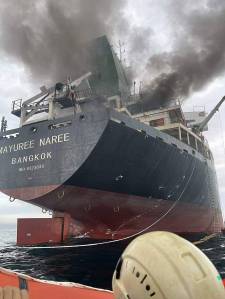
An image released by the Royal Thai Navy shows a tanker near the Strait of Hormuz that was attacked on Wednesday. Iran claimed responsibility. Credit…Royal Thai Navy, via Agence France-Presse — Getty Images
Iran appeared to claim responsibility for at least one of the attacks. Alireza Tangsiri, the naval commander in Iran’s powerful Revolutionary Guards Corps, named one of the ships that was struck, the Mayuree Naree, in a post on social media, saying they had “ignored the warnings” from Iran, and “ended up getting caught.”
He added: “Any vessel that intends to pass must obtain permission from Iran.”
The incidents came after the U.S. military said it struck 16 Iranian mine-laying vessels near the Strait of Hormuz — though it remained unclear whether any Iranian mines had actually been deployed there.
There were three separate reports, according to United Kingdom Maritime Trade Operations, a British monitoring agency. Iran fired at targets across the Middle East on Wednesday, but did not explicitly claim responsibility for the strikes on the ships.
Three strikes on ships in a single morning appeared to represent an unusual uptick: The U.K.M.T.O. said it had received reports of 13 attacks in total since the U.S.-Israeli war on Iran began on Feb. 28.
One cargo vessel was struck “by an unknown projectile” north of Oman in the Straits of Hormuz, resulting in a fire onboard, the agency said. The Oman News Agency said the country’s Maritime Security Center received a report indicating that the Mayuree Naree, a commercial vessel flying the flag of Thailand, was hit off the Omani coast.
Mark Mazzetti, Tyler Pager, and Edward Wong at The New York Times: How Trump and His Advisers Miscalculated Iran’s Response to War.
On Feb. 18, as President Trump weighed whether to launch military attacks on Iran, Chris Wright, the energy secretary, told an interviewer he was not concerned that the looming war might disrupt oil supplies in the Middle East and wreak havoc in energy markets.
Even during the Israeli and U.S. strikes against Iran last June, Mr. Wright said, there had been little disruption in the markets. “Oil prices blipped up and then went back down,” he said. Some of Mr. Trump’s other advisers shared similar views in private, dismissing warnings that — the second time around — Iran might wage economic warfare by closing shipping lanes carrying roughly 20 percent of the world’s oil supply.
The extent of that miscalculation was laid bare in recent days, as Iran threatened to fire at commercial oil tankers transiting the Strait of Hormuz, the strategic choke point through which all ships must pass on their way out of the Persian Gulf. In response to the Iranian threats, commercial shipping has come to a standstill in the Gulf, oil prices have spiked, and the Trump administration has scrambled to find ways to tamp down an economic crisis that has triggered higher gasoline prices for Americans.
The episode is emblematic of how much Mr. Trump and his advisers misjudged how Iran would respond to a conflict that the government in Tehran sees as an existential threat. Iran has responded far more aggressively than it did during last June’s 12-day war, firing barrages of missiles and drones at U.S. military bases, cities in Arab nations across the Middle East, and on Israeli population centers.
U.S. officials have had to adjust plans on the fly, from hastily ordering the evacuation of embassies to developing policy proposals to reduce gas prices.
The Daily Beast: Senator Torches Trump’s ‘Incoherent’ War Plans After Secret Briefing.
President Trump’s closed-door meeting about his long-term plan in Iran and overall justification for the war has been blasted as “incoherent” by a senator who attended.
Chris Murphy, a Democrat representing Connecticut, unloaded on the White House in a troubling X thread after the secret briefing on “Operation Epic Fury.”

Sen. Chris Murphy warned about the lack of a plan in a worrying X thread.
He said there doesn’t seem to be a clear goal apart from “destroying lots of missiles and boats and drone factories.”
“I obviously can’t disclose classified info, but you deserve to know how incoherent and incomplete these war plans are,” he said.
Several of the White House’s stated reasons for the war didn’t even come up, Murphy said, with not a single mention of plans to destroy Iran’s nuclear infrastructure. “This is, uh…surprising…since Trump says over and over this is a key goal,” he said.
The Trump administration also now claims that regime change is not the goal of the operation, despite the president initially framing it that way for the public.
Murphy suggested that if the goal is not to ensure a transition of power, the U.S. will just face more issues further down the line. He said: “So, they are going to spend hundreds of billions of your taxpayer dollars, get a whole bunch of Americans killed, and a hardline regime – probably a MORE anti-American hardline regime – will still be in charge.”
He said there didn’t seem to be a clear goal apart from “destroying lots of missiles and boats and drone factories.”
“But the question that stumped them: what happens when you stop bombing and they restart production? They hinted at more bombing. Which is, of course, endless war,” he said.
Barak Ravid at Axios: Trump tells Axios there’s “practically nothing left” to target in Iran.
President Trump told Axios in a brief phone interview Wednesday that the war with Iran will end “soon” because there is “practically nothing left to target.”
“Little this and that… Any time I want it to end, it will end,” Trump said during the five-minute call.
Why it matters: Even as Trump publicly signals his operation has largely accomplished its objectives, U.S. and Israeli officials say there has been no internal directive on when fighting might stop.
Israeli Defense Minister Israel Katz said Wednesday the war will continue “without any time limit, for as long as necessary, until we achieve all the objectives and decisively win the campaign.”Israeli and
U.S. officials say they are preparing for at least two more weeks of strikes in Iran.
It sounds like Israel is actually going to decide when the war ends.
On Tuesday, the U.S. received intelligence that suggested Iran has started laying mines in the Strait of Hormuz — one of the world’s most critical chokepoints for oil supply.
Officials say it’s unclear how many mines Iran has deployed, but the assessment is that the number is very small.
Trump confirmed to Axios that U.S. strikes on Tuesday destroyed 16 mine-laying boats and disrupted Iranian plans….
What he’s [Trump] saying: “The war is going great. We are way ahead of the timetable. We have done more damage than we thought possible, even in the original six-week period,” Trump told Axios.
I guess we’ll have to wait and see.
One more on Iran from Judd Legum at Popular Information: UPDATE: Trump says Kushner helped convince him to go to war with Iran. The disclosure highlights Kushner’s massive financial conflicts.
At a press conference on Monday evening, President Trump said his son-in-law, Jared Kushner, was one of a handful of top advisers who convinced him to launch major combat operations in Iran. The disclosure raises additional questions about the role of Kushner, who is being paid tens of millions of dollars annually by Middle Eastern governments that were reportedly lobbying Trump to attack Iran.
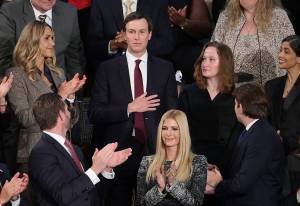
Jared Kushner is acknowledged during the State of the Union on February 24, 2026, in Washington, DC. (Photo by Win McNamee,Getty Images)
“The situation was very quickly approaching the point of no return… based on what Steve and Jared and Pete and others were telling me, Marco is so involved, I thought they were going to attack us,” Trump said, referring to Middle East envoy Steve Witkoff, Secretary of War Pete Hegseth, Secretary of State Marco Rubio, and Kushner, who has no formal title.
“Within a week, [Iran was] going to attack us, 100 percent. They were ready,” Trump said at a different event Monday. “They had all these missiles, far more than anyone thought, and they were going to attack us.”
Witkoff and Kushner were dispatched by Trump to Geneva to participate in mediation with their Iranian counterparts, in what was described as a last-ditch effort to avoid war. Kushner’s participation violated his pledge not to be involved in foreign policy in a second Trump administration. Instead, Kushner had said he was focused on running his private equity fund, Affinity Partners, which has raised billions of dollars from foreign governments.
Kushner’s largest investor is the Saudi Arabian government, which provided Kushner with $2 billion in funding in 2021. Each year, Saudi Arabia pays Kushner 1.25% of its investment, $25 million, as a “management fee.” Meaning he has received in excess of $100 million from the Saudi government over the last few years.
And Witkoff is a Russian asset. I will never forgive the idiots who voted for Trump because they just didn’t want a Black woman to be president.
Trump’s fear of the Epstein files is behind this idiotic war. No one will ever convince me otherwise. Here’s the latest on the Epstein story.
NBC News: Jeffrey Epstein’s New Mexico ranch searched by state investigators.
State investigators in New Mexico on Monday searched a 7,600-acre property that once belonged to the late convicted sex offender Jeffrey Epstein.
The search came after documents released under the Epstein Files Transparency Act showed no record of federal investigators ever searching the property, known as Zorro Ranch, despite a number of years-old civil suits that accused Epstein of sexually assaulting girls there — allegations over which he was never charged.
“This search is part of the criminal investigation announced by the New Mexico Department of Justice on February 19th into allegations of illegal activity at Epstein’s ranch prior to Epstein’s 2019 death,” the state agency said in a statement.
“The New Mexico Department of Justice appreciates the cooperation of the current property owners in granting access for the search and extends its thanks to the ranch staff for their professionalism,” the statement said, and will “continue to keep the public appropriately informed, support the survivors, and follow the facts wherever they lead.”
New Mexico Attorney General Raúl Torrez, a Democrat, ordered the search. His office announced its probe into Epstein last month, days after state lawmakers passed legislation to begin their own investigation into Epstein’s activities in the state.
The Legislature’s $2.5 million investigation, which has subpoena power, aims to close gaps in state law that may have allowed Epstein to operate in New Mexico with impunity. The committee is expected to release interim findings in July and a final report by the end of the year.
The bill’s co-sponsor, Democratic state Rep. Andrea Romero, said when the legislation passed last month that Epstein “was basically doing anything he wanted in this state without any accountability whatsoever.”
From Epstein expert Julie K. Brown at The Epstein files: Dead bodies and a long missing 300-year-old church bell: What will they find on Zorro Ranch?
The reach of the mysteries involving Jeffrey Epstein’s Zorro Ranch in New Mexico now span several centuries — as new documents reveal that the FBI’s Albuquerque office was investigating whether Epstein had a stolen historical artifact that dates back hundreds of years stored on his sprawling NM property.

Zorro Ranch
The artifact was a “death bell” that was once housed at the San Jose de Gracia Mission Church in Las Trampas, a village in Northern New Mexico between Sante Fe and Taos. The church was built in 1760 and is considered one of the best examples of Spanish Colonial architecture in the Southwest U.S. It is also a National Historic Landmark.
The lore about the missing church bell only adds to the questions about why the Justice Department never searched Epstein’s ranch back in 2019 — when at least two victims alleged they were sexually assaulted there, and another tipster claimed that two girls’ bodies are possibly buried there….
The “Death bell,” as it came to be called, was smaller than the other bell. During the church’s restoration in the 1930s, the bell was stolen.
In November 2019, Timothy Lopez told the FBI in Albuquerque, New Mexico that he recalled seeing Epstein’s ranch featured in a local real estate magazine in 2014 or 2015. In the photos accompanying the article, he said he noticed a room filed with Spanish Colonial art — and noticed a bell he thought might be the Death bell that had been stolen more than 80 years earlier.
The 7,400-ace property, which Epstein called “Zorro Ranch,” was purchased by Epstein from former New Mexico Governor Bruce King in 1993. The disgraced financier built a hilltop mansion with a private runway on the property, which was sold after Epstein’s death to the family of former Texas state Sen. Don Huffines, who won the Republican primary for Texas state comptroller last week.
After Epstein’s arrest in July 2019, the FBI search Epstein’s Manhattan townhouse, but did not immediately search Epstein’s private island in the Caribbean until after his August 2019 death. They never searched his New Mexico compound, despite having evidence of crimes that occurred there, including the tip about the stolen church bell….
the documents about the sexual assaults that were reported to have occurred on the property led to public outcry in recent weeks. That that led to New Mexico authorities finally on Monday beginning a long overdue search of the property. Of course, by now, any evidence of any sex crimes committed there has likely disappeared just like the long-vanished death bell.
The FBI claimed they abandoned the investigation of Zorro Ranch because they lacked enough evidence to get a search warrant. It will be interesting to see what New Mexico authorities find.
Two more significant stories:
The Washington Post (gift link): Whistleblower claims ex-DOGE member says he took Social Security data to new job.
The Social Security Administration’s internal watchdog is investigating a complaint that alleges a former U.S. DOGE Service employee claimed he had access to two highly sensitive agency databases and planned to share the information with his private employer — a claim that, if true, would constitute an unprecedented breach of security protocols at an agency that serves more than 70 million Americans.
The agency’s inspector general is investigating the disclosure and has alerted members of Congress of its existence, according to a letter by the acting inspector general to top members of four congressional committees reviewed by The Washington Post and two people familiar with the process, who spoke on the condition of anonymity to describe sensitive deliberations. The inspector general’s office has also shared the disclosure with the Government Accountability Office, which has been conducting its own audit of DOGE’s access to data, according to one of the people. The Post has reviewed the complaint and spoken with the whistleblower, who issued the complaint anonymously for fear of retaliation.
According to the disclosure, the former DOGE software engineer, who worked at the Social Security Administration last year before starting a job at a government contractor in October, allegedly told several co-workers that he possessed two tightly restricted databases of U.S. citizens’ information, and had at least one on a thumb drive. The databases, called “Numident” and the “Master Death File,” include records for more than 500 million living and dead Americans, including Social Security numbers, places and dates of birth, citizenship, race and ethnicity, and parents’ names. The complaint does not include specific dates of when he is said to have told colleagues this information, but at least one of the alleged events unfolded around early January, according to the complaint. While working at DOGE, the engineer had approved access to Social Security data.
According to the complaint, he allegedly told the whistleblower that he needed help transferring data from a thumb drive “to his personal computer so that he could ‘sanitize’ the data before using it at [the company.]” The engineer told colleagues that once he had removed personal details from the data, he wanted to upload it into the company’s systems. He told another colleague, who refused to help him upload the data because of legal concerns, that he expected to receive a presidential pardon if his actions were deemed to be illegal, according to the complaint.
The complaint does not allege that the engineer was successful in uploading the data to the company’s system.
The Post is not naming the former DOGE member or company because it has not independently confirmed the accusations in the complaint.
Use the gift link to read more.

Kristi Noem in one of her cosplay costumes
The Daily Beast: Insiders Reveal ICE Barbie Is Leaving DHS With a Major Problem.
Kristi Noem is apparently leaving the Department of Homeland Security with dozens of unsigned contracts on her desk—including payments owed to a facility holding migrant children.
The backlog is the fallout from a policy Noem, 54, imposed that required every DHS contract worth $100,000 or more—which covers nearly all of the agency’s agreements—to receive her personal sign-off before taking effect. The rule proved so disruptive that some vendors began billing the department in chunks of $99,999 each just to get paid.
“There’s a mountain of backed-up contracts and invoices on her desk that the new guy will just have to deal with,” a source familiar with the situation at DHS told Axios.
“From everything that I’ve heard, it’s still a giant s–t show up there,” a source familiar with Federal Emergency Management Agency (FEMA) delays told the outlet, referring to DHS leadership.
“The ramifications of her tenure are going to be felt for years and years and years and years,” the source added. “We’re not really going to know exactly how bad it is until we have a major hurricane that unfortunately impacts someplace in the United States.”
The disruption, Axios says, is already reaching real facilities. At the family detention center in Dilley, Texas—the only long-term immigration facility in the country holding migrants’ children—government payments lapsed in early March, with roughly 700 people detained there as of mid-February.
That’s it for me today. As you can tell, the Iran situation is freezing out other stories.
Did you like this post? Please share it with your friends:


 peej
peej Carissa
 bostonboomer
 dakinikat
 ecocatwoman
 jjlo
jjlo mablue2
 Mama Lopez
 peggysue22
 quixote
 skydancingguestblogger
 Mona (aka Wonk the Vote)



 Sky Dancing
Recent Comments