Posted: April 29, 2026 | Author: bostonboomer | Filed under: just because | Tags: 86 47, Donald Trump, Iran War, James Comey indicted again, Justice Department, Ken White, OPEC, Popehat, Roberts Court, Samuel Alito, SCOTUS, Todd Blanche, UAE, Voting Rights Act |
Good Day!!
I’ve been getting more sleep than usual lately, but my chronic insomnia kicked in last night. I got almost no sleep. I’m really not ready to face another day with Trump and his antics, but I’ll do the best I can.
This news just broke from the Supreme Court:
The Washington Post (gift link): Supreme Court limits key provision of the landmark Voting Rights Act.
The Supreme Court on Wednesday sharply weakened a key provision of the landmark Voting Rights Act, a ruling that limits the consideration of race in drawing voting maps and could usher in Republican gains in the House.
The decision could touch off a scramble by Republicans to redraw minority-majority districts, especially in the South. New districts could shiftthe balance of power in Congress by imperiling the reelection prospects of some Black Democrats, possibly as soon as November’s midterms in some instances.
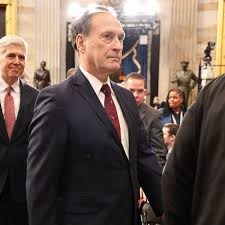
Samuel Alito (with Neil Gorsuch in the background on the left.)
The ruling also carries significant symbolic weight, effectively scaling backthe last major pillar of a 60-year-old law long considered one of the marquee achievements of the civil rights era. The Voting Rights Act bans discriminatory voting practices such as literacy tests and poll taxes, and has helped greatly increase minority representation in state and federal offices.
The ruling also carries significant symbolic weight, effectively scaling backthe last major pillar of a 60-year-old law long considered one of the marquee achievements of the civil rights era. The Voting Rights Act bans discriminatory voting practices such as literacy tests and poll taxes, and has helped greatly increase minority representation in state and federal offices.
In an ideologically divided 6-3 ruling, the conservative justices created a higher bar for the law’s powerful provision that allows states to use race to draw maps that help minority communities elect candidates of their choice. Section 2, as it is known, is aimed at combating discriminatory gerrymandering that weakens the power of Black, Latino, Native American and Asian voters.
States must walk a careful line when drawing maps for voting districts. The Voting Rights Act directsstates to consider race to some degreewhen redistricting to ensure that racial minority groups have an opportunity to elect representatives who reflect their priorities. Maps explicitly drawn along racial lines, however, violate the equal-protection clause of the 14th Amendment and the 15th Amendment’s ban on racial discrimination in voting practices.
The court’s conservative majority found Louisiana unlawfully discriminated by race when it created a second majority-Black congressional district to comply with the VRA. Justice Samuel A. Alito Jr. wrote the opinion for the majority.
“Section 2 of the Voting Rights Act … was designed to enforce the Constitution — not collide with it,” Alito wrote. “Unfortunately, lower courts have sometimes applied this Court’s [Section] 2 precedents in a way that forces States to engage in the very race-based discrimination that the Constitution forbids.”
The decision came over the sharp objections of the court’s three liberals. Justice Elena Kagan delivered the dissent from the bench, signaling strong disagreement.
“Under the Court’s new view of Section 2, a State can, without legal consequence, systematically dilute minority citizens’ voting power,” Kagan wrote in the dissent.
Kate Riga at Talking Points Memo: Alito Pens Decision That ‘Eviscerates’ The Voting Rights Act.
The Roberts Court finally achieved its years-long goal of killing the Voting Rights Act Wednesday, publishing a ruling that, the liberal justices say, will make proving racial discrimination in redistricting virtually impossible.
“Under the Court’s new view of Section 2, a State can, without legal consequence, systematically dilute minority citizens’ voting power,” wrote Justice Elena Kagan in her dissent.
“Of course, the majority does not announce today’s holding that way. Its opinion is understated, even antiseptic,” she continued. “The majority claims only to be “updat[ing]” our Section 2 law, as though through a few technical tweaks. But in fact, those ‘updates’ eviscerate the law…”
Justice Samuel Alito wrote the majority opinion, joined by all five other justices inthe bench’s right wing. Kagan was joined in her dissent by Justices Sonia Sotomayor and Ketanji Brown Jackson. Justice Clarence Thomas also wrote a concurrence joined by Justice Neil Gorsuch.
Alito defangs the law by unilaterally cancelling out congressional fixes to it — primarily, that plaintiffs bringing claims of racial vote dilution no longer have to prove that the legislators drawing the maps did so to purposefully discriminate. This bar had proved so difficult to overcome, especially as legislators became more adept at using facially neutral language, that Congress adopted amendments to the VRA asserting that if the maps have a discriminatory effect, that’s enough. Chief Justice John Roberts, then working in the Reagan administration, spearheaded the unsuccessful effort to doom the passage of those amendments.
Alito hand waves this history away, in part, by echoing Roberts’ reasoning in an earlier decision that eviscerated the VRA’s preclearance requirement, which required jurisdictions with histories of racial discrimination in voting to submit changes in election laws to the federal government for clearance before they could take effect. Roberts, in Shelby County v. Holder, said that the country had made such great strides in racial equality that the preventative measure was no longer necessary — ushering in a flood of new voter restrictions, particularly in the states that comprised the old Confederacy.
Read the rest at TPM.
Trump has insomnia too, it seems. He posted an idiotic message to Iran at an ungodly hour:
He is such an embarrassment! Of course the corporate media report this as if it’s perfectly normal. Here’s the latest on the Iran situation:
NBC News: Trump warns Iran ‘better get smart soon’ as he weighs military options over Strait of Hormuz.
President Donald Trump warned Iran “better get smart soon” Wednesday, as he weighed military options for the Strait of Hormuz with peace talks at an impasse.
Members of Trump’s national security team presented him with multiple options this week for how to handle the continuing bottleneck in the strait after negotiations failed to reopen the critical waterway, a U.S. official and a person familiar with the meeting told NBC News.
The standoff between Washington and Tehran, including the continued U.S. naval blockade, means the key trade route has been effectively blocked for two months.
The threat of prolonged disruption to the global economy has sent energy prices soaring — gas price averages in the U.S. reached $4.23 a gallon,the highest level in nearly four years, while the international benchmark price for oil, Brent crude, surged to $115 a barrel early Wednesday.
Meanwhile, Iran’s national rial currency hit a record low against the dollar, as Tehran’s economy also showed growing signs of strain.
The options discussed during Monday’s meeting in the Situation Room included whether the U.S. military presence in the strait should change — either increase or decrease — and whether the military should become more aggressive in conducting operations there, the U.S. official said.
Trump has not made any decisions about the way forward, the sources said, and it’s not clear when he might make a decision.
They don’t even note that the warning from Trump came in an idiotic Truth Social post until paragraph 11!
Trump and other top administration officials met with a group of energy industry executives on Tuesday, discussing possible next steps in continuing the blockade of Iran’s ports “for months if needed” and how to minimize impacts on American consumers, a White House official told NBC News.
The meeting was hosted by Treasury Secretary Scott Bessent included executives from Chevron, Trafi, Vitol and Mecuria, among other companies.
The U.S. showed little immediate enthusiasm for a new Iranian proposal that would end the war and reopen the strait without resolving the impasse over the Islamic Republic’s nuclear program — a key stumbling block in the stalled peace talks.
There’s quite a bit more information at the link.
Raw Story: Trump quietly telling insiders to prepare for ‘extended’ blockade of Iran: report.
President Donald Trump is quietly telling administration insiders to prepare for an “extended” blockade of Iran as negotiations to end the war with the regime drag on.
On Tuesday, the Wall Street Journal reported, citing “U.S. officials,” that Trump has told his aides that the blockade of Iran will continue, as the two sides remain far apart on Trump’s stated goal of getting the regime to give up its nuclear arms capabilities altogether. The report followed a meeting in the Situation Room on Monday, where Trump administration officials reviewed an offer to end the war from the Iranian regime that included reopening the Strait of Hormuz in exchange for delaying talks about nuclear weapons.
The report also suggests that Trump appears to be digging in and trying to tighten the screws on Iran’s economy.
“In recent meetings, including a Monday discussion in the Situation Room, Trump opted to continue squeezing Iran’s economy and oil exports by preventing shipping to and from its ports,” according to the report. “He assessed that his other options—resume bombing or walk away from the conflict—carried more risk than maintaining the blockade, officials said.”
“Yet continuing the blockade also prolongs a conflict that has driven up gas prices, hurt Trump’s poll numbers and further darkened Republicans’ prospects in the midterm elections,” it continued. “It has also caused the lowest number of transits through the Strait of Hormuz since the war began.”
In other Middle East news, the UAE is leaving OPEC. AP: The UAE’s departure from OPEC shakes up the alliance that influences oil prices worldwide.
The decision by the United Arab Emirates to leave the OPEC oil cartel shook up the 65-year-old alliance that produces some 40% of the world’s crude oil and exerts major influence over the price of energy around the globe.
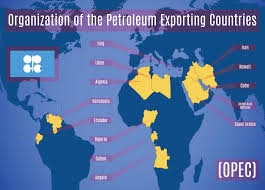
OPEC countries
The UAE said in the announcement Tuesday that when it leaves OPEC this Friday, it plans to carry on with its long-held goal of increasing crude production “in a gradual and measured manner, aligned with demand and market conditions.”
Right now, that’s academic as far as oil prices go, since Iran is still blocking the Strait of Hormuz, which means much of the oil from Persian Gulf producers such as the UAE cannot be exported. But the departure could have long-term effects on oil prices….
The Organization of the Petroleum Exporting Countries was formed in Baghdad in September 1960 by Iran, Iraq, Kuwait, Saudi Arabia and Venezuela. It has 12 members — counting the UAE — that hold more than 80% of the world’s proven oil reserves. Other members are Algeria, Equatorial Guinea, Gabon, Libya, Nigeria and the Republic of the Congo….
The group, headquartered in Vienna, aims to regulate oil prices by coordinating increases or decreases in production.
The goal has been to keep prices high enough so member governments can balance their budgets and reap the benefits of their natural resources — but not so high as to cause a recession in consuming countries or to halt energy-consuming activity, a phenomenon known as demand destruction.
Trump has really screwed us and the rest of the world with his illegal Iran war. Analysis by Andrew Roth at The Guardian: Trump in tough spot as he tries to avoid deal that highlights US failures in Iran.
Donald Trump is learning first-hand about the perils of mission creep.
The US-Israel war in Iran has just passed its eighth week – twice as long as the president predicted it would take when US warplanes launched their joint attack with Israeli forces to decapitate the Iranian leadership and paralyse its military. The military attacks were successful. The predictions about the political cause-and-effect to follow were not.
Iran has survived the initial strikes and remains defiant, closing the strait of Hormuz in a move that has blocked off a fifth of the global oil trade. The US has responded with its own blockade to lock in Iranian oil, inflicting losses of an estimated $500m daily on Tehran and threatening the country’s long-term energy production – but negotiations have stalled and it is not clear if the White House is willing to withstand the pain of a sustained economic war or the risk of a military operation to open the strait.
“This has gone from being a war of choice to a war of necessity,” said Aaron David Miller, an analyst at the Carnegie Endowment and a former US diplomat and Middle East negotiator.
The war had transformed from a conflict involving Iran, the US and Israel to a “global economic crisis which shows no signs of abating”. Just this week, petrol prices in the US approached a four-year high, and they are expected to continue to rise before a crucial midterm election that could allow the Democrats to retake congress.
“The status quo is not tolerable … there has to be a fix to it,” Miller said. “It strikes me that the administration is in a very tough spot.”
But the solution remains elusive. One option would be to negotiate a temporary reopening of the strait of Hormuz but to delay nuclear talks on the fate of the more than 400kg of highly enriched uranium (HEU) – as well as the country’s right to enrich uranium in the future.
Read the rest at The Guardian.
Yesterday the “Justice” Department indicted James Comey for the second time. The indictment is unbelievably stupid. He is accused of threatening to assassinate Trump because he posted on social media a photo of some seashells spelling “86 47.”
Attorney Ken White AKA Popehat wrote about it at The Popehat Report: The Comey Threat Indictment Is A Grave Embarrassment To The United States Department of Justice And The Rule of Law.
On April 28, 2026, the United States Department of Justice indicted former FBI Director James Comey over a mildly sassy arrangement of seashells. The charge is preposterous and no competent or honest prosecutor would bring it. It represents a betrayal of the professional and ethical obligations of every U.S. Department of Justice attorney involved, and reflects the complete collapse of the Department’s credibility and independence in favor of a cultish and cretinous devotion to Donald Trump.
The indictment concerns James Comey’s May 25, 2025 post to his Instagram account remarking “Cool shell formation on my beach walk” and showing shells arranged to spell out “86 47.” [….]
Based on this, the United States Attorney’s Office for the Eastern District of North Carolina — the venue of the sassy beach stroll — secured an indictment against Comey for two federal felonies: threatening the President of the United States in violation of Title 18, United States Code, Section 871 and transmitting a threat in interstate commerce in violation of Title 18, United States Code, 875(c). In both counts, the government asserts that “a reasonable recipient who is familiar with the circumstances would interpret as a serious expression of intent to do harm.” That is, of course, a preposterous lie….
Let’s look at what the government would have to prove to convict Comey of these offenses, using cases from the Fourth Circuit, which governs this district. To prove a threat against the President in violation of Section 871, the prosecution must offer “(1) the proof of “a true threat” and (2) that the threat is made “knowingly and willfully.”“ United States v. Lockhart, 382 F.3d 447, 449-450 (4th Cir. 2004). To prove a threat in interstate commerce in violation of Section 875(c), the government must prove that “(1) that the defendant knowingly transmitted a communication in interstate or foreign commerce; (2) that the defendant subjectively intended the communication as a threat; and (3) that the content of the communication contained a “true threat” to kidnap or injure.” United States v. White, 810 F.3d 212, 220-21 (4th Cir. 2016). For purposes of both statutes, a “true threat” is a statement which an “ordinary, reasonable recipient who is familiar with the context in which the statement is made would interpret it as a serious expression of an intent to do harm.” White, 810 F.3d at 221.
Prosecutions for threats against the President played a substantial role in developing the First Amendment doctrine of “true threats,” which separates bluster and rhetoric from actual threats to do harm. In Watts v. United States, 394 U.S. 705 (1969), the United States Supreme Court took up the conviction of an 18-year-old man who said this during an anti-draft protest during Vietnam: “They always holler at us to get an education. And now I have already received my draft classification as 1-A and I have got to report for my physical this Monday coming. I am not going. If they ever make me carry a rifle the first man I want to get in my sights is L. B. J. . . . . They are not going to make me kill my black brothers.” The Court articulated the core of the “true threat” doctrine, noting that political rhetoric, hyperbole, and robust debate that does not convey an intent to do harm is protected by the First Amendment:
“But whatever the “willfullness” requirement implies, the statute initially requires the Government to prove a true threat. We do not believe that the kind of political hyperbole indulged in by petitioner fits within that statutory term. For we must interpret the language Congress chose “against the background of a profound national commitment to the principle that debate on public issues should be uninhibited, robust, and wide-open, and that it may well include vehement, caustic, and sometimes unpleasantly sharp attacks on government and public officials.” New York Times Co. v. Sullivan, 376 U.S. 254, 270 (1964). The language [**1402] of the political arena, like the language used in labor disputes, see Linn v. United Plant Guard Workers of America, 383 U.S. 53, 58 (1966), is often vituperative, abusive, and inexact. We agree with petitioner that his only offense here was “a kind of very crude offensive method of stating a political opposition to the President.” Taken in context, and regarding the expressly conditional nature of the statement and the reaction of the listeners, we do not see how it could be interpreted otherwise. Watts, 394 U.S. at 708.”
No minimally rationally person could possibly conclude, seeing James Comey’s beachside dad joke, that he was expressing a sincere intent to harm the President. Nobody could look at it and conclude that Comey intended to convey that message. In evaluating whether a threat is “true,” the trier of fact must consider the context. Here the context is seashells. The context is the former Director of the FBI, a lifetime member of law enforcement, who is a well-known critic of the President and a target of the President’s wrath, using a campy mechanism to express opposition to the President, using slang for “ditch” or “eject” or “get rid of.” No rational person could see that and say “the former director of the FBI is saying he’s going to kill the President”!”
I could now cite to you a legion of cases for that proposition, finding rhetoric far more concerning than this protected by the First Amendment, analyzing language and context to show this is protected. But it wouldn’t matter, would it? If you are a minimally rational person, you don’t need to see the precedent, and if you’re a cultist, no amount of precedent matters to you.
He does go on; read the rest at the link above.
From Blanche’s press conference yesterday:
Q: Should we expect more indictments of this sort? For example, in 2020 Gretchen Whitmer did a TV hit with "8645" in the background." Would you pursue that?BLANCHE: As far as other instances of threats against the president — those will be investigated
— Aaron Rupar (@atrupar.com) 2026-04-28T20:49:30.385Z
I hope Blanche doesn’t have plans to continue legal work in the future. I don’t think he’s going to have a license. The same goes for the lawyers who prosecute this case.
One more from The Washington Post: Prosecutions of Trump’s foes add to GOP’s headaches in midterms.
Republicans hoping their party’s standard-bearer will stay focused on voters’ priorities heading into the November midterms caught no relief on Tuesday as the Trump administration announced charges against former FBI director James B. Comey and an aide to former chief medical adviser Anthony S. Fauci, as well as a review of Disney’s broadcast licenses.
The latest instances of turning government power against President Donald Trump’s critics and pursuing years-old grievances added to frustrations felt by Republicans who say the president isn’t doing enough to address the signature issues that won him a second term.
Two-thirds of Americans said Trump hasn’t paid enough attention to the country’s most important problems in a CNN survey conducted late last month, up from 52 percent in February 2025 and higher than at any point in his first term.
“No Republican wants to run on ‘I stand with Donald Trump’s retribution tour’” while gas prices are so high, said Barrett Marson, a GOP strategist in Arizona. “There is no doubt that the vast majority of non-MAGA voters want Trump to focus on anything but his personal animus toward a wide variety of people.”
The White House said the Comey prosecution has no bearing on Trump’s efforts to bring down costs — moves that include signing a tax-cut bill, adding discounted drugs to a government-run portal, expanding domestic beef production, releasing oil reserves and easing restrictions on tankers moving fuel between U.S. ports.
“The idea that President Trump and his Cabinet agencies cannot execute multiple actions simultaneously is so laughably false,” spokeswoman Abigail Jackson said. “The insinuation that a grand jury returning an indictment is mutually exclusive with the administration’s strong efforts on the economy is objectively false.”
Other Republicans, however, asked about the administration’s priorities. Sen. Thom Tillis (R-North Carolina), a member of the Senate Judiciary Committee, questioned whether the Comey case was the best use of time and resources for the acting U.S. attorney from his state who brought the charges, W. Ellis Boyle. Trump renominated Boyle to the position in January after the Senate took no action on his nomination last year.
This is just who Trump is. We can only hope the Democrats will win the House and Senate and impeach him.
That’s it for me today. What’s on your mind?
Did you like this post? Please share it with your friends:
Posted: March 14, 2026 | Author: bostonboomer | Filed under: just because | Tags: Benjamin Netanyahu, corruption, Donald Trump, dubai, Gaza, Iran War, israel, Jared Kushner, Karg Island, Lebanon, Mohammed bin Salman, Pete Hegseth, Strait of Hormuz, U.S. Embassy Bagdad, UAE |
Good Afternoon!!
 I’m sick and tired of wars. I’m even more sick and tired of Trump and his cabinet full of stupid idiots. I came of age during the Vietnam war. After that disaster finally ended, I really thought our leaders would stay out of unnecessary wars. But it didn’t happen. These men (goddess forbid we elect a woman president!) just have to prove their “manhood” by attacking other countries. I’m just plain sick of it.
Trump’s war could turn out to be worse than the ones George W. Bush got us into. It appears he was talked into attacking Iran by his pal Bibi Netanyahu and his son-in-law Jared Kushner, who is very close to Netanyahu as well the crown prince of Saudi Arabia Mohammed bin Salman. Trump was also looking for a powerful distraction from the Epstein scandal. Now Netanyahu appears to be trying to turn Lebanon into another Gaza, and Kushner is soliciting more money for his private businesses.
It also appears that Trump and his gang of idiots didn’t plan for the obvious results of their war–rising prices and the closing of the Strait of Hormuz. In addition, Trump’s “Secretary of War” is advocating for war crimes. That’s where things stand so far.
Here’s the latest:
William Christou at The Guardian: Entire families wiped out and towns emptied as Israel’s war on Lebanon intensifies.
For Batoul Hamdan and her two children, seven-month-old Fatima and Jihad, three, Monday’s iftar, the evening meal that breaks the daily fast during Ramadan, was special.
For a week, they had eaten to the sounds of bombs in their home in Arab Salim. Hamdan eventually decided to leave for Al-Nimiriya, the sleepy town where she had grown up. Surrounded by her parents and siblings in the family home, she hoped they could finally enjoy the festive mood of Ramadan.
They had just finished their meal when the bomb fell. The Israeli airstrike collapsed the two-storey building instantly, killing all eight members of the Hamdan family: grandparents Ahmad and Najib, their children, including Batoul, and grandchildren Fatima and Jihad – three generations wiped out in a moment.
On Thursday, only snarled rebar and broken concrete remained of the Hamdan family home. The fragments of their lives – a certificate of achievement from the children’s schooldays, cutlery from their cabinet, frayed purses – had been ejected by the force of the blast and now littered the ground.
“There was no warning before the strike. My own two kids started to cry, I picked them up and started to run away from the explosion when it happened,” said Qassem Ayoub, a neighbour and town police officer, as he stared at the wreckage. “Why were they targeted? I don’t know, ask the Israelis.”
Batoul and her loved ones were among the 773 Lebanese people – including more than 100 children – killed by Israel’s campaign in Lebanon since 2 March. They join a growing list of families completely wiped out by Israeli bombings, in a conflict whose death toll is rising faster than in any previous war in Lebanon.
Forty-one people were killed by Israeli airstrikes in Nabi Chit in the Bekaa valley in only five hours last Saturday, and 18 people died in a single night in the town of Sir el-Gharbiyeh on 8 March. The pace of death has stunned Lebanese people and left them struggling to keep up.
Do you think Netanyahu will stop these attacks on Lebanon if Trump calls off his war in Iran. I don’t.

By Avalon Atelier
Kareem Chehayeb and Malak Harb at AP: War has already displaced nearly a million Lebanese, and aid groups warn of a humanitarian crisis.
BEIRUT (AP) — Fatima Nazha slept on the street for two days after she and her family fled their home in Beirut’s southern suburbs following an Israeli mass evacuation order.
All of the schools the government turned into shelters were full, and the family couldn’t afford a hotel or an apartment, so she and her husband eventually moved into a tent in the country’s biggest stadium while their kids and grandchildren found shelter near the southern coastal city of Sidon.
In just 10 days, more than 800,000 people in Lebanon have been displaced by war, just over a year since the last conflict uprooted over a million Lebanese from their homes. That’s one in every seven people in the tiny country, according to humanitarian organization the Norwegian Refugee Council. Many don’t have a place to stay, and the cash-strapped government has only been able to accommodate roughly 120,000 people as it scrambles to open shelters and bring in more supplies.
Nazha, who uses a wheelchair, said being forced from her home has been far more difficult this time than when Israel and Hezbollah were last at war more than a year ago. The strikes targeting the Iran-backed militant group have been more intense and unpredictable, and Israel’s evacuation order came abruptly, leaving her unable to gather all her belongings.
“The strikes used to target a specific area, but now they’re hitting all the areas,” she said, taking a drag off her cigarette. Lebanon’s Health Ministry said Friday that more than 700 people, including 103 children, have died in the war.
Read more at the AP link.
But Netanyahu isn’t satisfied yet. Barak Ravid at Axios: Israel planning massive ground invasion of Lebanon, officials say.
Israel is planning to significantly expand its ground operation in Lebanon, aiming to seize the entire area south of the Litani River and dismantle Hezbollah’s military infrastructure, Israeli and U.S. officials say.
Why it matters: This could be the largest Israeli ground invasion of its northern neighbor since 2006, dragging Lebanon to the epicenter of the escalating war with Iran.
- “We are going to do what we did in Gaza,” a senior Israeli official said, referring to the flattening of buildings Israel says Hezbollah uses to store weapons and launch attacks.
The big picture: An operation of this size and scale could lead to a prolonged Israeli occupation of southern Lebanon.
- Lebanon’s government is deeply alarmed that the renewed war — triggered by Hezbollah’s decision to launch rockets at Israel — will devastate the country.
- The Trump administration backs a major Israeli operation to disarm Hezbollah, but is also pressing to limit the damage to the Lebanese state and pushing for direct Israel-Lebanon talks on a postwar agreement.
Driving the news: Until days ago, Israeli Prime Minister Benjamin Netanyahu’s government was still trying to contain the Lebanon escalation in order to stay focused on Iran, according to Israeli officials.
- That calculus changed Wednesday when Hezbollah launched more than 200 missiles in a massive coordinated attack with Iran, which fired dozens of its own.
- “Before this attack we were ready for a ceasefire in Lebanon, but after it there is no way back from a massive operation,” a senior Israeli official said.
State of play: The IDF has had three armored and infantry divisions on the Lebanese border since the start of the Iran war, with some ground forces conducting limited incursions over the past two weeks.

By Kim Haskins
And what is Jared Kushner up to now that he got Trump to help Netanyahu with his bloodthirsty plans?
Rob Copeland and Maureen Farrell at The New York Times (gift link): Jared Kushner Solicits Funds for His Firm While Working as Mideast Envoy.
Jared Kushner, one of the U.S. government’s chief negotiators in the Middle East, is trying to raise more money for his private equity firm from governments in the region.
Mr. Kushner, President Trump’s son-in-law, has spoken with potential investors in recent weeks about raising $5 billion or more for Affinity Partners, his investment firm, according to five people with knowledge of the talks who were not permitted to speak publicly about the discussions.
As part of the fund-raising effort, Affinity’s representatives have already met with Saudi Arabia’s Public Investment Fund, which invests the proceeds of the kingdom’s vast oil reserves, two of the people briefed on the discussions said. PIF is led by Crown Prince Mohammed bin Salman, who has formed close ties with Mr. Kushner and the Trump administration.
PIF, which is already the largest and earliest investor in Affinity, invested $2 billion soon after the first Trump administration ended.
As part of that deal, the Saudis must be given the first chance to invest during any subsequent attempts by Affinity to raise funds, the two people said. Other Middle Eastern sovereign wealth funds that invested earlier in Affinity, including those in the United Arab Emirates and Qatar, are also expected to be asked for more, the people said.
Mr. Kushner’s fund-raising is expected to stretch on for the better part of this year.
The efforts show the blurring of the lines between public service and private profit-seeking during Mr. Trump’s second term. Only a few weeks ago, in his role as Mr. Trump’s “peace envoy,” Mr. Kushner met in Geneva with Iran’s foreign minister. The U.S. and Israeli bombing campaign in Iran began shortly after those meetings concluded without a deal on Iran’s nuclear program.
Meanwhile, Kushner is not actually an employee of the Federal government. The corruption is breathtaking.
And what’s happening in in Iran these days? Well, it appears that the Trump gang didn’t plan for what to do if Iran cut off shipping traffic in the Strait of Hormuz–something they were warned about.
Rebecca F. Elliott and Vivian Nereim at The New York Times (gift link): Why Little Was Done to Head Off Oil’s Strait of Hormuz Problem.
Of all the risks the global energy system has long faced, none was bigger or better known than the potential closure of the Strait of Hormuz.
The narrow passageway out of the Persian Gulf is both vital — serving as the only gateway to the rest of the world for huge amounts of oil and natural gas — and extremely vulnerable to attacks.
But despite being widely recognized as a potential choke point, the strait remains the only way to export most of the energy produced in the region. That has come into sharp relief in the second week of the war in the Middle East, as the near-closure of the waterway sent oil prices soaring above $100 a barrel for the first time in almost four years.
The reason there is no true alternative comes down to a combination of geography, political tensions and economic competition among the region’s oil powers. There have been efforts to circumvent the strait, notably by Saudi Arabia and the United Arab Emirates. But the pipelines through those countries can carry only a small fraction of the energy produced in the Persian Gulf.

By Mathias Hauser
For many other energy-producing countries in the region, the only way to avoid the strait would be to lay a pipeline across a neighboring country — an expensive and politically fraught endeavor. Take Qatar, one of the world’s biggest natural gas exporters. Its only land border is with Saudi Arabia — a country that cut off diplomatic ties and closed that border during a regional spat resolved five years ago. Plus, any pipeline would itself be vulnerable to Iranian attacks.
“There’s nothing which is totally secure here,” said John Browne, a former chief executive of the London-based oil giant BP, once known as the Anglo-Iranian oil company. “In the end, someone with bad intention can do all sorts of things to oil and gas infrastructure.”
Some oil analysts also assumed that, if the time came, the United States, which has a keen interest in keeping energy markets stable, would use its military might to keep the strait passable.
Oh really? I guess these “analysts” didn’t consider the fact that Donald Trump is a psychopath who couldn’t care less about anyone but himself and his childish needs. Use the gift link if you want to read more.
Now that the shit has hit the fan, and prices on gas and just about everything else are rising rapidly, Trump has decided to send in some more troops.
Eric Schmitt at The New York Times: More Marines and Warships Being Sent to Middle East, U.S. Officials Say.
About 2,500 Marines aboard as many as three warships are heading to the Middle East from the Indo-Pacific region, as Iran increases its attacks on the Strait of Hormuz, two U.S. officials said.
The shift, earlier reported by The Wall Street Journal, comes as Iran’s response to nearly two weeks of aerial bombardment and long-range artillery strikes has proved more resilient than Trump administration officials anticipated.
The Marines will join more than 50,000 American troops in the region. The new deployment comes as Iran’s attacks on and near the strait have choked maritime traffic through the essential waterway, rocking the global economy. It was unclear how the new deployment would be used….
Last week, President Trump said he might order Navy warships to escort merchant ships through the crucial oil supply route, which U.S. forces did for a period of time in the late 1980s during similar tensions with Iran.
More recent developments:
 NBC News: U.S. bombing of Kharg Island, Iran’s critical oil hub, sparks new threats to target Gulf oil infrastructure.
U.S. forces have carried out “large-scale” strikes on Kharg Island, a critical hub of Iran’s Gulf oil operations, with the country responding by threatening to strike U.S. allies’ oil facilities if any of its infrastructure is damaged.
U.S. Central Command said Saturday that naval mine storage facilities and missile storage bunkers were among targets destroyed in the “precision strike” on the island, hitting “90 Iranian military targets” while “preserving the oil infrastructure.”
Kharg Island, a tiny but strategic island 15 miles off the coast of Iran in the Persian Gulf, is home to an oil terminal that ships 90% of the country’s oil exports. There are also military capabilities there, including air defenses and mines buried underground.
Announcing the strike in a post on Truth Social late Friday, President Donald Trump said that U.S. forces had “totally obliterated every MILITARY target in Iran’s crown jewel, Kharg Island.”
Trump just loves that word “obliterated.”
The island’s oil terminal has so far been unscathed in the war, according to oil market research firm Energy Intelligence, and the president said the island’s oil infrastructure was spared in Friday’s attack, but could be struck down the road.
“Should Iran, or anyone else, do anything to interfere with the Free and Safe Passage of Ships through the Strait of Hormuz, I will immediately reconsider this decision,” Trump said, as Iran has actively interfered with shipping in the strait for several days.
Iran is retaliating.
Reuters: US embassy in Iraq’s Baghdad hit in missiles attack, security sources say.
The U.S. Embassy in the Iraqi capital Baghdad was hit in a missiles attack, Iraqi security sources told Reuters on Saturday.
The attack caused smoke to rise from the embassy’s building, the sources said, without providing details on the damage.
Another update from AP: Missile strikes helipad inside US Embassy compound in Baghdad.
A missile struck a helipad inside the U.S. Embassy in Baghdad, two security officials said.
The projectile landed within the embassy’s boundaries after the Green Zone, the heavily fortified district in central Baghdad that houses Iraqi government institutions and foreign embassies, added the security officials, who spoke on the condition of anonymity as they are not authorized to speak with the press.
Video obtained by The Associated Press showed smoke billowing from inside the compound.
AP: Tehran threatens Middle East’s busiest port as Iran war enters its third week.
DUBAI, United Arab Emirates (AP) — Iran openly threatened a neighboring country’s non-U.S. assets for the first time Saturday, warning people to immediately evacuate the busiest port in the Middle East and two others in the United Arab Emirates as the U.S.-Israel war with Iran entered its third week.

By Rudi Hurzlmeier
A missile struck a helipad inside the U.S. Embassy compound in Baghdad, and debris from an intercepted Iranian drone hit an oil facility in the UAE, further increasing global anxiety about oil supplies.
Iran threatened to attack cities in the UAE, home to Dubai and one of the world’s busiest airports, saying the U.S. used “ports, docks and hideouts” there to launch strikes on Iran’s Kharg Island, without providing evidence. It urged people to evacuate areas where it said U.S. forces were sheltering, naming Dubai’s Jebel Ali port — the Mideast’s busiest — as well as Abu Dhabi’s Khalifa port and Fujairah port.
Iran has fired hundreds of missiles and drones at Arab Gulf neighbors during the war, but it said it was targeting U.S. assets, even as hits or attempts were reported on civilian ones such as airports and oil fields.
Back here at home, Pete Hegseth is in favor of committing war crimes. He’s already committed war crimes with his fishing boat strikes. His troops also committed a war crime when they sank Iranian ships and failed to attempt to rescue survivors. Then yesterday he said advocated for another war crime.
Raw Story: Pete Hegseth dropped a ‘largely unnoticed’ war crime on live TV: experts.
Secretary of Defense Pete Hegseth offhandedly made a remark about the Trump administration’s attack on Iran during his speech on Friday that experts warned, if he’s serious, could be a war crime — even just for him to say out loud.
“No quarter, no mercy for our enemies,” said Hegseth. “Yet some in the press just can’t stop. More fake news from CNN reports that the Trump administration underestimated the Iran war’s impact on the Strait of Hormuz. The sooner David Ellison takes over that network, the better.”
The phrase “no quarter” is often used colloquially in a political setting, but in a military context, it means any enemy combatants will be killed with no allowance for surrender — something that, as experts on X and Bluesky were swift to point out, is a violation of both international law and the U.S. military code.
“Went largely unnoticed but Hegseth on Iran said the U.S. would provide ‘no quarter, no mercy for our enemies’ during his press conference today,” wrote Wall Street Journal national security reporter Alex Ward. “‘No quarter’ is a violation of international humanitarian law.” He provided a link to the relevant provisions of the Geneva Convention.
“Today, Hegseth said: ‘No quarter, no mercy for our enemies.’ But the Defense Department’s own Law of War Manual (pp. 209-210) says: ‘It is forbidden to declare that no quarter will be given,'” wrote Claremont McKenna College professor Jack Pitney.
“Former USG war crimes lawyer here,” wrote International Crisis Group senior adviser Brian Finucane. “Apropos of SecDef’s remarks this morning: Denial of quarter — even the declaration of no quarter — is a war crime. And recognized as such by the US Government. From DoD’s Manual for Military Commissions.” He screenshotted the section of the manual, which stated denial of quarter is punishable by up to life in prison.
“Declaring that no quarter will be given is straightforwardly prohibited under international humanitarian law,” wrote Stanford law professor Tom Dannenbaum. “When done to threaten an adversary, the declaration itself amounts to a war crime.”
“Yet another thing to put in our back pocket,” wrote Ryan Cooper of The American Prospect. “‘Ship em to the Hague’ is a completely valid option for a long and growing list of people who need to be dealt with.”
I’ll end with this piece Sidney Blumenthal at The Guardian: Trump faces a ‘personal Vietnam’ in Iran.
Donald Trump is lost in his fog of war. He compounds confusion with improvised fabrications as his naive expectation of a lightning victory has been sunk in the Strait of Hormuz. Iran, he felt certain, would easily follow the “perfect scenario” of Venezuela, accede to naming a leader who would instantly do his bidding, and there would be no disruption of the oil markets – “a strong game plan”, stated Karoline Leavitt, his White House press secretary, who defends each of his changeable excuses with equal ferocity.

By Kim Haskins
There may be few if any facts underlying the delusions upon which Trump constructs his vapid explanations and evanescent strategies. The belief that coherent sense can be made out of Trump’s shuffling words is a weakness of the rational mind that refuses to accept the impulses of the inveterate demagogue for what they are. Searching for reason in the jungle of Trump’s tales may compel hopelessly sensible people to superimpose logic where there is none in order to satisfy the need for some semblance of soundness.
Trump’s erratic efforts to reframe his rationale further expose his incompetence and unintelligibility, utterly predictable but now lethal on a global scale. His stream of sputtering remarks has, however, clearly established the ground that should be explored by congressional inquiries into the war’s origins, planning and conduct.
Trump is also at war with the English language. His war is not a war, he insists, but a “short-term excursion”, a semantic dodge to skirt congressional and international accountability. Then, when asked whether it’s an excursion or a war, he replied: “Well, it’s both. It’s an excursion that will keep us out of a war.” His rhetorical legerdemain is the equivalent of René Magritte’s painting of a pipe with the caption, “Ceci n’est pas une pipe” – “This is not a pipe.” The title Magritte gave to his painting was The Treachery of Images. Orwell or Magritte? Propaganda or surrealism?
Trump has declared he will force “regime change” or negotiate with some unnamed personage in the regime who happens to have been recently killed. “Most of the people we had in mind are dead,” he said. Trump demands “unconditional surrender” or he declares the war “very complete” after an hour-long conversation with Vladimir Putin, after Putin pledged “unwavering support” to the new supreme leader, Mojtaba Khomeini, the 56-year-old son of the assassinated 86-year-old supreme leader, about whose ascension Trump said he was “not happy” and called him a “lightweight”.
I hope you’ll go read the rest. Blumenthal is good.
That’s all I have for today. I hope you’re enjoying your weekend, despite the ugly war news.
Did you like this post? Please share it with your friends:


 peej
peej Carissa
 bostonboomer
 dakinikat
 ecocatwoman
 jjlolatina
 mablue2
 Mama Lopez
 peggysue22
 quixote
 skydancingguestblogger
 Mona (aka Wonk the Vote)



 Sky Dancing
Recent Comments