


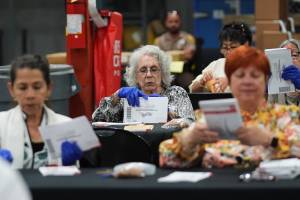
The Washington Litigation Group — a nonprofit law firm that formed last year to more broadly challenge the Trump administration in court — is hiring lawyers to focus on protecting polling officials, government workers and voters ahead of the November elections.
Wild Wednesday Reads
Posted: August 26, 2026 Filed under: just because | Tags: court decisions on mail voting, Dolly Parton, Donald Trump, drag shows, mail voting, trariffs, Trump's trade wars, Trump's war on Canada, U.S. Postal Service 17 CommentsGood Afternoon!!
Yesterday we lost Dolly Parton, an icon, a superstar, and a kind, generous woman. She was 80 years old. I’m hoping JJ will do one of her tribute posts tomorrow, so I’ll just share a couple of articles.
Julia Jacobs at The New York Times (gift link): Dolly Parton Died After Brief Period With Cancer.
Dolly Parton, the beloved country superstar, was surrounded by loved ones when she died in Nashville after a brief bout with cancer, representatives said in a statement on Tuesday.
Parton’s death was announced earlier Tuesday by her family, prompting widespread tributes for a singer who dominated her genre for decades and influenced generations of artists. She was 80.
“Our beloved Dolly Parton spent her life and career bringing joy, laughter, hope and integrity into everything she touched,” the statement said.
A spokesman did not provide additional details about Parton’s illness but said she had been admitted to the Vanderbilt-Ingram Cancer Center in Nashville on Friday.
Starting from her recording debut in 1959, Parton built a career as a honey-toned vocalist with a gift for songwriting and a big-haired, rhinestone-studded style. She broke into Hollywood, established a business empire and, well into the seventh decade of her career, still managed to charm both sides of America’s widening cultural divide.
It is unclear when Parton received the cancer diagnosis. Just over a week ago, she missed a scheduled appearance at Dollywood, the amusement park she built near her hometown in eastern Tennessee. In a video played for attendees at the park, Parton said that she had been dealing with dizziness and dehydration, and that her doctors had advised her against travel.
Several days before her death, Parton said in a statement to People magazine that even while she was focused on her health, she was still working. “I still have so many things I want to achieve,” she said, “so I’m gonna keep on working as long as I can to see everything come to life.”
One of Parton’s most important philanthropic activities was her literacy program for children, which she call the Imagination Library. That work will continue.
Emily St. Martin at The Los Angeles Times: Dolly Parton’s contributions to literacy will outlive the star, just like she planned.
“Everywhere I go, the kids call me ‘the book lady.’”
Dolly Parton wore the moniker like a badge of honor, and she earned it too. Through her Imagination Library program, launched by the Dollywood Foundation in 1995, she put more than 330 million books into the hands of children across America, Canada, the U.K., Australia and the Republic of Ireland.
The program is rooted in a childhood of poverty and illiteracy — roots that those who knew Parton said she never denied or abandoned….
In 2023, the American Library Assn. awarded the singer-songwriter, book lady and philanthropist its highest honor — lifetime membership — to recognize her lasting impact on literacy and inspiring a love of reading in children.
“Dolly Parton represented the very best of America,” ALA President Maria McCauley told The Times on Tuesday, adding that, like people all over the world, she’s been playing Parton’s music since news of her death broke, particularly the song “I Can See the Light of a Clear Blue Morning.”
“That song has so much resonance right now,” she said, noting its lyrics capture a theme of resilience and faith in overcoming dark times.
“We want to make sure that Dolly’s vision, that reading is for everyone, becomes a reality. That’s something that we can all carry forward in memory of Dolly.”
A bit more:
Parton’s Imagination Library gifts a book a month to children signed up for the program from the time they are born until they are 5 years old. Parton described the program best when speaking with librarian Carla Hayden in 2018. “We send the book in the mail with their name on it. It’s not in the care of Mom and Dad — it’s got their little name on it, and they love to think, ‘This is mine.’ They wait at the mailbox. They get their little books, and to them, it’s personal.”
Dolly Parton meets young children at the Magna Science Adventure Centre in England. Pool Getty Images
Parton understood the novelty of owning your very own book. Growing up in the Great Smoky Mountains town of Sevierville in east Tennessee, Parton was the fourth of 12 kids. Her father, a tobacco sharecropper, couldn’t read or write, and the family lived in a one-room cabin with no electricity. There were no books in the home, aside from the Bible.
The singer’s upbringing, particularly her father’s illiteracy and his shame around what he considered a shortcoming, was what inspired her to launch the Imagination Library. With the help of her dad, they set out to foster a love of reading in the kids of Sevier County. Reading, she believed, was the gateway to dreaming, and dreaming, the first step in the path toward success.
By 2000, the program had expanded beyond the Smoky Mountains and into a nationwide movement. By 2003, the Imagination Library had mailed 1 million books to budding readers. After the United States, the gifting initiative launched in Canada in 2006, then the U.K. in 2007, Australia in 2013 and the Republic of Ireland in 2019.
There’s more at the LA Times link.
Yesterday, Dakinikat wrote about the Supreme Court’s decision yesterday to allow Trump to continue working with DHS and the Postal Service to create lists of voters who are permitted to receive mail ballots and use them to vote. Now blue state AG’s are fighting back against Trump’s efforts to limit voting by mail and otherwise rig the midterm elections.
AP: Democratic states file new lawsuit seeking to block Trump’s order limiting mail voting in midterms.
Democratic-controlled states on Wednesday filed another lawsuit challenging President Donald Trump’s executive order seeking to limit mail voting in this year’s midterm elections.
The action, filed by about two dozen states against the U.S. Postal Service, marked a new phase in the high-stakes litigation just two days after the Supreme Court ruled against them in a separate case, but did not say Trump’s order was legal.
The high court majority found the Democratic lawsuit was premature, but that was before the Republican administration issued a rule governing U.S. Postal Service delivery of mail ballots. Election officials warn it will be impossible to implement in the days before the first wave of mail ballots are sent out next week.
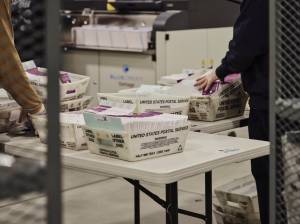
Vote-by-mail ballots await sorting in trays at the King County Elections headquarters in Renton, Wash.,Aug.5, 2020
“Across the country, states are already deep into preparations for the 2026 elections. Now, at the last moment, the federal government is attempting to meddle in those preparations and potentially threaten countless Americans’ right to vote,” New York Attorney General Letitia James, one of 25 Democratic attorneys general filing the lawsuit, said in a statement. “USPS has no authority to decide who can and cannot vote by mail.”
Trump’s executive order remains barred from taking effect under a separate injunction that the administration argues needs to be immediately rescinded in light of the high court’s ruling in the previous Democratic state lawsuit. It also had succeeded in a third case filed in May in the District of Columbia, convincing a judge that it was too early to prevent its implementation of the executive order.
All previous challenges were filed before the administration published its mail ballot rule Friday night. The rule says that if states want their mail ballots delivered, they will need federal approval of the design of their envelopes and must give the Postal Service a list of voters eligible to receive them.
Of course, the Constitution reserves control of elections to the states, but Trump couldn’t care less about the Constitution.
This news from Perry Stein at The Washington Post is even worse (gift link): Lawyers gear up as Trump administration threatens election officials with arrest.
The Trump administration in recent weeks has warned states that it would withhold federal funding and even arrest and prosecute election officials if noncitizens cast ballots in federal elections.
Now, with high-stakes midterm elections only months away, private voting rights attorneys and some attorneys general in Democratic states are gearing up to defend election officials and file lawsuits against the federal government if they believe the Trump administration is attempting to undermine the elections.
Election workers at the Miami-Dade County Supervisor of Elections Office on Aug. 18 during Florida’s primaries. Lynne Sladky, AP
While the administration casts its efforts as a way to preserve election integrity, voting rights groups and others see a threat to public servants working to carry out elections. President Donald Trump has claimed noncitizens are voting in large numbers despite numerous reviews showing it rarely happens in state and federal elections.
The D.C.-based group, which raises money from individuals and foundations, is adding about six attorneys to focus on election litigation. The new hires include former prosecutors, constitutional law experts and public interest lawyers.
Their preparation includes consulting with state and local election workers in case they end up needing representation and training election workers on how to respond if federal officials approach them.
“We won’t know until we know,” said Nathaniel Zelinsky, senior counsel at Washington Litigation Group. “But what we have seen from DOJ is concerning.”
Trump and his allies made election security a cornerstone of the Justice Department and his administration, claiming, without evidence, that the he, not Joe Biden, is the rightful winner of the 2020 presidential election.
The Trump administration has devoted significant resources to relitigating the 2020 presidential election — and has sought to sow doubt in the security of the upcoming elections. The Justice Department seized earlier this year election records stored in warehouse in Georgia’s Fulton County, which has been central to right-wing conspiracy theories about Trump’s loss in 2020.
Use the gift link to read more, if you’re interested.
I have to admit, I’m confused by all this nonsense about mail voting. It’s important to me, because I am physically unable to go to the polling place to vote. I have a lot of faith in my state (Massachusetts) to protect my voting rights, but all this confusing news is very disconcerting. A couple more voting stories:
Justin Jouvenal at The Washington Post: Judge issues setback to Trump administration plans to restrict mail-in ballots.
A preliminary order Monday by the Supreme Court granting President Trump the authority to move ahead with aspects of his plan to restrict mail-in ballots is unlikely the final verdict on his efforts to overhaul the voting process.
But the emergency opinion did immediately help Mr. Trump in one clear way.
People sort through ballots at a ballot processing center during a statewide special election in California last year.
Whether the president ultimately wins or loses in the courts, the latest ruling bolstered his longstanding efforts to seed doubt about the voting process, voting rights advocates said, a campaign that Mr. Trump has ramped up ahead of midterm elections that could see significant gains for Democrats.
“The purpose is not for legal victory,” said Michael McNulty, the senior policy director for Issue One, a nonpartisan group that tracks election issues. “The purpose is exactly to sow chaos, to create fear and confusion and confuse voters and attempt to undermine confidence” in the outcome.
The president’s attempt to have the U.S. Postal Service determine whether voters can cast ballots by mail this fall will likely alarm and confuse the public as multiple court fights play out, according to state officials.
Tobias Read, Oregon’s Democratic secretary of state, noted that his state would in a matter of weeks be sending out ballots to overseas voters and members of the military.
“Now is not the time to make major changes to how elections are run in Oregon,” Mr. Read said at a news conference Tuesday, adding: “This election is effectively underway.”
A bit more:
In March, Mr. Trump signed an executive order that sought to restrict who could vote by mail. It called on the Department of Homeland Security to compile state-by-state citizen lists to help determine voter eligibility and send that information to the states, and instructed the Postal Service to verify which ballots could be mailed, based on voter roll lists provided by the states.
The order has been challenged through multiple lawsuits filed by Democratic state attorneys general and voting rights groups. They have argued that the move amounts to a federal intrusion into the voting process, which the Constitution says is the domain of the states. The plaintiffs have also said that the order could disenfranchise people who rely on voting by mail to participate in elections….


 peej
peej Carissa
 dakinikat
 ecocatwoman
 jjlo
jjlo mablue2
 Mama Lopez
 peggysue22
 quixote
 skydancingguestblogger
 Mona (aka Wonk the Vote)





We lost another icon today:
He’s been sick for a while. I’ve just really treasured him over the years! I was at university when I first saw him in the midnight screening of Rock Horror Picture show but I loved him best in Pirates of Penzance. My oldest remembers him as the evil bulldozer Nexxus along with a bat named batty koda played by Robin Williams in Fern Gully. It’s a wonderful cartoon.
I plan on doing a tribute post for Dolly Parton, I think I will wait until Sunday though…because maybe by then we will have some news about memorial events.
Sounds good.
We had one last night. Every Queen along the Mississippi was there.
Jonathan Cohn at The Bulwark: This Cancer Breakthrough Has Scientists Cheering—and Crying.
FIFTEEN YEARS AGO, an up-and-coming oncology researcher in Boston named Catherine Wu had a hunch.
It went something like this: If Wu and her collaborators at the Dana-Farber Cancer Institute could identify some of the genetic mutations inside tumors, they could teach the body’s immune system to recognize tiny fragments of proteins associated with the mutations that sit on cell surfaces. And if the researchers could teach the immune system to identify a tumor based on those fragments, then they could teach the immune system to destroy it too.
Someday, the theory went, scientists might turn this capability into personalized cancer vaccines, genetically tailored to attack a patient’s existing cancer and prevent it from returning.
Science research is filled with these sorts of ambitious ideas. But a hunch is just a hunch. Wu and her team had no way to know if they were right.
And even if their hypothesis proved correct, developing these sorts of personalized cancer vaccines would require many more steps and many more discoveries. In asking the National Institutes of Health to fund their experiments, they were hoping the federal government would place a longshot bet—a $363,000 wager that insights into cancer biology from their studies might someday contribute toward the development of a workable medical treatment.1
The NIH decided to make that bet, as one of about 5,300 standard grants it awarded that year. A decade and a half later, it looks like it has paid off. Big time.
This past Wednesday, Moderna and Merck announced positive results from a major clinical trial using a cancer vaccine of the kind Wu and her team had envisioned. The target was melanoma, the deadliest form of skin cancer. Using the vaccine in combination with a common cancer drug—rather than relying on the cancer drug alone—significantly reduced the recurrence of melanoma after tumor removal, according to the companies.
Merck and Moderna did not release the actual data, saying they would do so at an upcoming medical meeting. Until that happens, it’s impossible to be sure exactly what their tests show, or how significant the outcome is. But the reported findings from the large trial appear to be consistent with the outcome of a previous, much smaller trial. “This looks like a home run,” Ezekiel Emanuel, an oncologist and vice provost at the University of Pennsylvania, told me in a phone interview.
Emanuel’s reaction was not unusual. Scientists across the country and the world have been buzzing about the news because, if the results hold up, they will be proof of concept for the kind of cancer vaccines researchers have long hoped to create. “This could be revolutionary,” Catharine Young, a biomedical scientist and former Biden administration official who is now a senior fellow at Harvard’s School of Public Health, told me.
Yet behind all the joy there has been concern and even alarm—not about the treatment itself, but about the threat Donald Trump poses to the research ecosystem that made its creation possible.
The Trump administration’s broad attack on America’s scientific enterprise includes cuts and rule changes affecting precisely the sorts of grants that financed the work of Wu and many other scientists whose research laid the scientific foundation for the vaccine’s development.
The administration has also attacked this specific type of vaccine. The Moderna-Merck treatment uses mRNA technology—as did two of the COVID vaccines—and Health and Human Services Secretary Robert F. Kennedy Jr. has singled out mRNA for particular vilification. Last year, he canceled hundreds of millions of dollars in funding for the research and development of mRNA technology, including Moderna’s work on what was supposed to be a new platform for vaccines against influenza.
Trump and RFK jr are psychopaths. They love that people die from their actions.
The Guardian: Wiped out: US faces surging toilet paper prices amid trade war with Canada.
Using the bathroom or having a cry is about to become more expensive for North Americans as the US and Canada enter a full-fledged trade war that threatens to flush away decades of peaceful trading between the two nations.
After trade negotiations broke down between the two countries last weekend, Mark Carney, the Canadian prime minister, vowed to match US tariffs “dollar for dollar” and unveiled a list of nearly 900 American goods that will face 25% to 50% tariffs starting on 8 September.
Paper products are among the hardest-hit sectors, with Canada threatening to put tariffs of between 25% and 50% on “toilet paper or face tissue stock” from 8 September in retaliation for a 50% hike from Washington DC.
Though American toilet paper and tissues are often made domestically, they heavily rely on lumber-rich Canada for raw materials. Procter & Gamble, the owner of Charmin toilet paper, said last year that it would have to increase prices amid tariffs that were in place at the time.
Great just what we need!
Meta to Pay Up to $17.1 Billion in Landmark Settlement Over Social Media Addiction Claims
The social media giant settled with 47 states, the District of Columbia and U.S. territories, and agreed to make major changes to its products over claims its platforms endangered children.
Meta on Wednesday reached a landmark settlement with 47 states, the District of Columbia and U.S. territories, agreeing to pay up to $17.1 billion in penalties and make major changes to its products over claims it endangered children with addictive social media platforms.
In a dramatic capitulation, the owner of Facebook and Instagram agreed to the financial penalties for violating federal child privacy and states’ consumer protection laws, the states announced. Meta also agreed to limit how long teenagers can spend on its platforms and to bans on features that stoke mental health issues, striking at the heart of the company’s business of engagement for advertising.
“The focus of this case was to protect our kids: stopping notifications and alerts at night and when they are in school, encouraging them to take breaks from social media, protecting them against harmful features,” said Colorado’s attorney general, Phil Weiser, in a statement. The agreement exceeded what most courts might order, he added.
The settlement effectively ends a bellwether federal trial in the U.S. Northern District of California in Oakland, where California, Colorado, Kentucky and New Jersey were seeking roughly $200 billion over accusations that Meta harmed children. The states filed their agreement with Meta on Wednesday morning in that court, where Judge Yvonne Gonzalez Rogers is expected to approve it.
Separately, Meta said on Wednesday that it settled with Texas for about $1 billion over similar allegations. The company still faces numerous other lawsuits from school districts and individuals, some of which are scheduled for trial in the coming months.
Happy Women’s Equality Day!
Eclipse Timeline (Central Time) Full Sturgeon Moon
Lunar Eclipse August 2026: What Time Is It & Where Can You See It?
On the night of Thursday, August 27, into Friday, August 28, 2026, the Full Sturgeon Moon will pass deep into Earth’s shadow, producing a 96% partial lunar eclipse visible across most of North America.
And this is no ordinary partial eclipse.
At maximum eclipse, roughly 96.2% of the Moon’s visible surface will be covered by Earth’s dark inner shadow, leaving only a thin bright sliver along one edge. Much of the eclipsed Moon could take on shades of copper, rust, orange, or deep red, making it look remarkably similar to a total “Blood Moon.”
Best of all, you don’t need a telescope, binoculars, or eclipse glasses.
Just step outside and look up.
More than 150 dead after crushing floodwaters wipe out villages on Nepal-China border
Hundreds of people are reported missing, including more than 300 foreign nationals, as the death toll is expected to rise.
https://www.cnn.com/2026/08/26/world/live-news/nepal-flash-flooding-floods-intl
Experts warned that a lingering blockage upstream on the Nepal-China border river could produce a second flood.
https://www.theguardian.com/world/live/2026/aug/27/nepal-flash-flood-live-updates-tibet-border-death-toll-missing-himalayas-floods-flooding-latest-news?utm_source=dlvr.it&utm_medium=bluesky&CMP=bsky_gu
More than 1,300 people were missing in Nepal and the Tibet region of China after a torrent of mud, water and ice swept away villages and bridges. Officials said 180 people were confirmed killed.
https://www.nytimes.com/live/2026/08/27/world/nepal-tibet-flash-floods?smtyp=cur&smid=fb-nytimes&fbclid=Iwb21leAT8z7dwZG9mBWV4dG4DYWVtAjExAHNydGMGYXBwX2lkDDM1MDY4NTUzMTcyOAABHjCywDULru6HmupYzLKCby8QbKMUNK8NNdLIAHQrOUdgrRnbd3ODaJFr7SC8_aem_7ubcGIu-PoNkpBGbq3_O5Q
The quiet mountain valley in northern Nepal seemed ready for reinvention. Trade routes and hydropower projects were expanding as diplomatic tensions eased. Tourism was surging back.Then the floodwaters came
https://www.nytimes.com/2026/08/27/world/asia/nepal-rasuwa-flash-flood-economy.html?unlocked_article_code=1.8lA.K-kS.mBdD4R34fVSC&smid=url-share
I’m still trying to get in contact with my friends and Dharma family in Nepal. The site is farther up north than our monastery in the Himalayas, but I’m still worried about all the various people who live in the region. Climate change has put them on the frontline of issues.