









Senior Biden officials have told progressive activists and lawmakers in recent days that they do not see the 14th Amendment — which says the “validity of the public debt” cannot be questioned — as a viable means of circumventing debt ceiling negotiations. They have argued that doing so would be risky and destabilizing, according to three people familiar with the discussions.
Lazy Caturday Reads: Everything Is Awful.
Posted: June 27, 2026 Filed under: just because | Tags: 250th Anniversary of Declaration of Independence, cat art, caturday, Confederate flag, DEI, Donald Trump, Great American State Fair, immigration and U.S. economy, Massachusetts, Matt McCarthy, North Carolina, Ohio, surrealism 4 CommentsGood Day!!

Surreal cat art by Matt McCarthy
Note: The surreal giant cats in today’s post are the work of Matt McCarthy.
As I was reading Dakinikat’s post yesterday, I realized how discouraged I have become lately. Everything is just awful. And it doesn’t help that my chronic sciatica has been acting up lately.
Rick Wilson was so right way back in Trump’s first term when he wrote his book, “Everything Trump Touches Dies.” We’re approaching the 250th anniversary of the Declaration of Independence. It should be a special time for the country, but Trump has taken over the anniversary and made it all about himself. We’ve had to watch him wreck the East Wing of the White House, pave over the rose garden, and hang ugly gold decorations all over the Oval Office. He destroyed the south lawn of the White House for a cage fight that was could only be seen with expensive tickets or on paid TV. On the Fourth of July Trump plans to mark the anniversary itself with a MAGA rally. I just want to cry.
Right now, Trump has something called the Great American State Fair going on. That link goes to a MAGA website. Trump wasn’t satisfied with a bipartisan celebration, so he set up his own organization, Freedom 250. Some commentary on the not-so-great fair:
Farrah Tomazin at The Daily Beast: Trump’s Empty ‘Great State Fair’ Exposed in Damning Photos.
The spectacle on the National Mall in Washington D.C. is ready to receive thousands of visitors. Instead, it is virtually deserted.
Not that there is much to see. Amid the sprawling stretches of open space, there is a 110-foot Freedom 250 ferris wheel and a tacky plywood “Triumph Arch” dominating the center of the grounds, a replica of the monument Trump wants to build near D.C.’s sacred Arlington Cemetery.
There are no corn dogs or funnel cakes. No roller coasters or merry go rounds. And by Friday morning, Pennsylvania became the latest of several Democratic states to declare it was not taking part.
The plan was to have representation from all 50 states. But some had opted out due to the high cost to taxpayers or not being able to secure any businesses to sponsor a booth. Others had chosen not to attend after the supposedly nonpartisan event suddenly seemed political, with Trump himself kicking off the fair with a MAGA rally earlier this week.
The Daily Beast was at the fair in the late afternoon and early evening, hoping to see a flood of people arrive after school and work.
As temperatures climbed, a clump of fairgoers waited under the hot DC sun for a ride on the Freedom 250 Ferris wheel—the festival’s marquee attraction —even as much of the surrounding fairgrounds remained conspicuously quiet.
Elsewhere, a jazz band played to an audience of about 10 people. (Don’t ask about the food: On its first full day, a power shortage hit the food pavilion, resulting in melted ice cream and concerns about spoiled goods.)
The most energetic vibe wasn’t at the Ferris wheel or the live rodeo; it was packed into an evangelical Christian tent, singing and dancing to a worship band, present despite some rather famous lines in the Constitution about church and state.
You can check out the photos at the link. I was going to put some in this post, but I decided to stick with cats, because at least they don’t make me feel sad and hopeless.
You can see more photos at The Atlantic in this piece (gift link) by Kelsey Ables, photos by Lawren Simmons: The Great American State Fair Isn’t Very Great.
The U.S. capital has been outfitted of late with visual trappings that many associate with authoritarianism, such as banners depicting Donald Trump’s face and featuring his slogans. So perhaps it was only a matter of time before the president erected his own Potemkin village: the Great American State Fair, where almost nothing is what it pretends to be.
Stretching across a large swath of the National Mall, the fair has dozens of pavilions for 56 states and territories and numerous executive-branch departments, in addition to a Ferris wheel, a rodeo, and other displays from companies and organizations, many of them Trump-aligned. It’s advertised by Freedom 250, the White House–created group behind many semiquincentennial events, as a “world-class exposition and modern-day World’s Fair.”
By Matt McCarthy
For a president enamored with the gilded and the grand, the exterior of this fair is surprisingly austere. Trompe l’oeil sheets cover slapdash structures lining both sides of the Mall with an illustration of architecture that is supposed to be beaux arts but is so stripped down that it makes the nearby brutalist buildings look practically baroque. A boxy model of Trump’s proposed triumphal arch in the center of the Mall appears as if it could have been designed in Minecraft and ordered from CVS for same-day pickup.
Perhaps because of this aesthetic of illusions, the earnest state pride evident in some of the pavilions turns out to feel especially delightful. Consider: the Science Museum Oklahoma’s president going on about how hers is “the most surprising state you’ll ever experience,” or the Ohioan dispensing with midwestern cheer state-shaped tattoos and tokens for free Frosties through the end of the year. Here and there, the big, proud personalities of the states shine through (see: Idaho’s potato-sack dress). Together, they nearly instill an appreciation for this eclectic batch of states that have united into a country. But like any sense of patriotism these days, it’s complicated just as quickly. Right as I was about to crack open a bag of potato chips from Michigan, with “Take Me Home, Country Roads” stuck in my head from a karaoke video game in the West Virginia booth, I wandered into the State Department pavilion, where I was offered a paper replica of the limited-edition Trump passport.
In a certain sense, the Great American State Fair bottles the central tension of federalism: a push and pull between irrepressible state personalities and the federal government. But it’s also not that academic. Put simply, the president is bringing down the mood.
Boy, you can say that again. “The president is bringing down the mood.” He ruins everything.
None of the New England States contributed to the exhibits, but a few individuals showed up. From The Boston Globe: We checked out Trump’s Great American State Fair. It is, and isn’t, what you’d think.
Down the lush green grass of the National Mall, past the 110-foot Ferris wheel and the scaled-down reproduction of President Trump’s proposed Triumphal Arch, the Massachusetts booth at the Great American State Fair was essentially a do-it-yourself project.
Its singular attraction? Maple syrup.
That was one of the oddities of the 16-day extravaganza, which began on Thursday, to mark the nation’s 250th birthday. Perhaps fittingly for America in 2026, it opened with a mix of the wholesome, the partisan, and the just plain bizarre.
The fair is a production of Freedom 250, the organization launched by Trump last year to give the type of MAGA-spin on the semiquincentennial festivities — think the White House UFC fight — that the bipartisan,congressionally created America 250 organization would not.
The event, Trump’s brainchild, assigns each of the 56 US states and territories a booth among more than 150 exhibits that “showcase the very best of America.” He kicked it off with a rally Wednesday night. And as people began visiting the Greco-Roman-style pavilions, the sprawling exposition reflected America’s Tilt-A-Whirl politics as it celebrates a milestone anniversary.
Despite the region’s pivotal role in the American Revolution, New England was largely a fair draft-dodger. Five of the six state governments declined to participate in what Democrats dismissed as a Trump-centric carnival. Nationwide, a few other states also skipped it.
After Massachusetts Governor Maura Healey balked at the price tag — she estimated hundreds of thousands of dollars to fund it — a 72-year-old Trump supporter from Greenfield, Mass., took matters into her own hands.
“I was upset about it,” the woman, who declined to give her name out of fear of political repercussions, told the Globe as she manned the Massachusetts booth Thursday morning. “Why have an empty spot when they come in? They see nobody, nothing.”
Instead, they saw maple syrup.
It might not be the first thing that comes to mind when people think of Massachusetts, but the state has more than 300 producers, so she reached out to some near her town. Winston’s Sugar House in Shelburne Falls answered the call, donating tiny bottles.
As fairgoers started trickling in Thursday morning, the bottles were arranged on two tables along with brochures about the state’s maple syrup industry and otherother Massachusetts pamphlets in front of the unique backdrop the fair organizers created for every state and territory.
Within minutes, the bottles started disappearing as fairgoers grabbed for the freebies.
But at least Massachusetts had a display — a fact many visitors noted. A few doors down, empty chairs, potted plants, and collage-style backdrops were all that greeted visitors eager to see the offerings of Rhode Island, Maine, Vermont, or Connecticut.
Kevin M. Levin writes at Substack: Of Course a Confederate Flag Showed Up at the Great American State Fair.
Nobody who has been paying attention to the Trump administration’s handling of America’s 250th anniversary should be surprised that a Confederate flag turned up at the Great American State Fair on the National Mall. It was discovered at the North Carolina booth and in its own small way tells you everything you need to know about this whole production.
By Matt McCarthy
The controversy erupted after footage circulated showing the North Carolina exhibit featuring altered versions of the state flag with the Confederate battle emblem superimposed over the design. Governor Josh Stein’s office condemned the display, calling it a misrepresentation of North Carolina and demanding that organizers remove it.
The flag was pulled. Problem solved, in the narrowest possible sense.
But the details here matter. North Carolina’s official state flag has never included the Confederate battle symbol in any version of its design. Not in 1861, not in 1885, not ever.
Whoever put together that video display didn’t just stumble into Lost Cause territory by accident. They had to go out of their way to attach a symbol that the state itself had never chosen to fly.
As historian Stephen Jackson noted, unlike former flags from Georgia and Mississippi, the official flag of North Carolina has never incorporated the Confederate battle flag in its design. The alteration wasn’t heritage. It was invention.
Corporate sponsor Mt. Olive Pickle Company withdrew from the exhibit after learning about the display, saying the company stands on values of human dignity, opportunity, and freedom.
They’d better watch out. Trump doesn’t like anything that smacks of “DEI.” Remember, it’s white people who discriminated against in Trump world. A bit more:
The episode is a concentrated version of the sloppiness that has defined this event from the start. At least ten states declined to send official delegations. Oregon Governor Tina Kotek’s office was explicit about why her state withdrew, citing the cost of participating and growing concerns that the event was shaping up to be a more partisan affair than originally presented.
When you’re trying to celebrate the birth of the nation and you can’t get half the nation’s states to show up, something has gone wrong at the planning stage.
By Matt McCarthy
The fair itself has drawn criticism for its cheap and shoddy appearance. The Washington Post’s Philip Kennicott offered this review:
America’s 250th might have been celebrated with a genuine festival of state fairs, or a 21st century version of the national and international expositions of art and science that were popular in the 19th century. The Trump administration could have let the Smithsonian stage a giant festival of American folkways, music, dance, art, craft and food. It could have defaulted to something like a theme park, which would at least have produced a seamless illusionism and a facsimile of the same folkways that are absent in the Trump show.
And it might have given the states the time, funding and freedom to create their own pavilions, representative of the magnificent diversity of this country’s architecture and design. Instead, everything is stuffed into a fake agora with Doric columns and arched niches painted onto cheap theatrical flats, which look like someone scaled up the photo murals found in a tatty Greek diner that sells gyros, moussaka and heart-bomb platters of pastitsio.
Growing up in Atlantic City in the 1980s, I watched Donald Trump build his casinos into monuments of gaudy spectacle, none more so than the Taj Mahal. The man has always had a gift for making expensive things look tacky and tacky things look expensive, sometimes simultaneously.
Read the rest at the link.
Dakinikat wrote yesterday about the horrible Supreme Court decision to allow Trump to end temporary protected status for Haitians and Syrians in the US. This is a disaster for these immigrants and for the economy. It will expose as many as a million asylum-seekers to arrest and deportation. Most of these people have established homes, jobs, and lives here; and if they are sent back home, they could even be killed.
NBC News on Wednesday: Supreme Court allows Trump to remove protections from thousands of Haitian and Syrian immigrants.
The Supreme Court cleared the way Thursday for the Trump administration to remove legal protections from thousands of Haitian and Syrian immigrants in the United States, meaning they could be subject to deportation.
The court, on a 6-3 vote on ideological lines, ruled in favor of the administration, which asked to continue with its plan to strip Temporary Protected Status from about 350,000 Haitians and 6,000 Syrians.
The ruling could also boost the administration’s efforts to remove similar protections from people from other countries as part of President Donald Trump’s hard-line immigration policy.
Writing for the majority, conservative Justice Samuel Alito said that judges overstepped their authority in second-guessing the administration’s decisions. The court also rejected a claim that the decision to remove protections for Haitians was discriminatory.
By Matt McCarthy
The law in question “expressly restricts” courts from reviewing determinations made by the Department of Homeland Security on whether to terminate or extend TPS protections, he added.
As for the claims of discrimination against Haitians, Alito said the statements cited by plaintiffs were not “overtly racial” and were “insufficient to show that the termination of Haiti’s TPS designation was based on the race of the Haitian people.”
In dissent, liberal Justice Elena Kagan accused the majority of soft-pedaling Trump’s comments about Haitians.
“The statements fairly shout, in their racial undertones and overtones alike, that race entered into the president’s resolve to remove Haitians from this country,” she wrote.
Kagan extensively quoted Trump himself, including his 2018 statement that Haiti is a “shithole country” and comments he made during the 2024 election baselessly claiming that Haitians in Springfield, Ohio, were eating people’s pets.
Without protected status, affected people are subject to deportation via the normal legal process. But they can seek other avenues to remain in the U.S. by, for example, claiming asylum.
This is going to cause serious problems here in Massachusetts, where many Haitian immigrants have settled and hold important jobs. And they are vitally important to the economy. A recent study found that Massachusetts needs 60,000 new immigrants every year to “sustain the work force.”
The Boston Globe: Supreme Court ruling could leave thousands in Massachusetts vulnerable to ICE arrests.
Thousands of immigrants in Massachusetts will likely be at risk of being detained by Immigration and Customs Enforcement following a Supreme Court ruling that paves the way for the Trump administration to revoke the legal status of approximately 330,000 Haitians and Syrians across the country.
“A lot of people are going to be in an extremely vulnerable position as a result of this,” said Kerry Doyle, a former legal adviser for ICE under the Biden administration who now practices immigration law in Massachusetts.
Massachusetts politicians and activists this week promised to fight to pass federal legislation extending the TPS program, and legal advocates said they would work to help those who lose their status find ways through the immigration court system to remain here legally.
“We will continue to use every tool, every legal tool to protect and defend the immigrant communities in Massachusetts and across the Greater Boston area,” said Iván Espinoza-Madrigal, the executive director of Lawyers for Civil Rights, at a demonstration outside the State House Thursday.
For those affected by the decision, however, the immediate situation looked grim. Geralde Gabeau, the executive director of the Mattapan-based Immigrant Family Services Institute, perhaps the most prominent group serving Haitians in Massachusetts, was somber when she spoke to advocates and reporters at the State House. She recounted a story from a local teacher whose student asked if she would take the child home in case their parents were deported.
“This is not acceptable,” Gabeau said. “We have seen a lot of bad, terrible news coming from the Supreme Court. This is going too far.”

By Matt McCarthy
Remember Springfield, Ohio, the town where JD Vance claimed immigrants were eating cats and dogs? The town had deliberately invited Haitian immigrant to come there to live and work. Ohio Governor Mike DeWine is not happy.
WBNS10: DeWine calls policy to remove Springfield’s Haitian immigrants a ‘mistake’ after SCOTUS ruling.
The governor said changing the immigration status of Haitian immigrants under TPS is not in the best interest of the United States or Ohio.
Gov. Mike DeWine, an outspoken supporter of Haitian immigrants in Springfield, called the policy to remove them a mistake after the Supreme Court allowed the Trump administration to end legal protection for migrants fleeing violence and natural disaster in Haiti and Syria.
The 6-3 decision overturns lower court orders and allows the Department of Homeland Security to swiftly end temporary protected status, a program that protects a total of 1.3 million people from 17 countries.
DeWine said Thursday’s ruling means that the over 10,000 Haitians legally living in Ohio, mostly in the Springfield area, will now be in the country illegally. They will be subjected to immediate deportation. He added that it will now be illegal to employ them.
“The situation in Haiti could hardly be much worse. The violent gangs run most of the country. The government barely functions. And, the economy is in shambles,” DeWine said.
In his statement, DeWine pointed to the federal government’s own advisory against traveling to Haiti.
“Our Federal Aviation Administration prohibits U.S. carriers from flying there because of the danger to planes of being shot at by the gangs,” DeWine said. “But, more importantly, changing the immigration status of these individuals is not in the best interest of the United States nor Ohio.”
Read more at the link. Trump and his handpicked justices are ruining our country.
One more disturbing story from NBC News: Pete Buttigieg targeted by ‘false report’ to authorities involving his 4-year-old twins.
Former Transportation Secretary Pete Buttigieg said Friday that he and his family in Michigan were targeted by a “false report” to state authorities claiming he was a danger to his 4-year-old twins.
By Matt McCarthy
Michigan State Police confirmed in a statement that they had received an anonymous report regarding Buttigieg. State police and Child Protective Services then responded and “determined the report was false,” the statement said.
Buttigieg, a Cabinet official in the Biden administration and a potential 2028 presidential candidate, wrote in a Substack post that a police officer and Child Protective Services worker appeared at his home “a few days ago” following an allegation that had been made against him involving his children.
He said his children were removed from the home he shares with his husband, Chasten, before the twins went through separate forensic interviews the next morning. Buttigieg said he was then interviewed as part of the investigation.
During that interview, Buttigieg said, an officer told him that an anonymous caller had reported him to CPS, with the caller saying “that he had spoken to a woman who claimed to have met me at a conference several years ago in Alabama, where she said I told her that I had committed unspeakable violent crimes, and the caller believed my children were still at risk.”
Buttigieg said he told the officer he had never been to the town in Alabama.
“Then the officer made clear that he believed this was politically motivated, and said it would not be referred to a prosecutor,” Buttigieg wrote. “Nothing in the forensic interview with the children, which was conducted by trained personnel, had led to concerns.”
Buttigieg said he was apart from his children for 24 hours.
That is horrible. I can’t believe those poor kids had to go through forensic interviews.
Sorry this post is so depressing, but that’s the state of our country today. If you have something positive to share, please do so in the comment thread. I’d be very grateful.
Wednesday Reads: Presidential Campaign News
Posted: August 14, 2024 Filed under: 2024 presidential Campaign, Donald Trump, Kamala Harris 2024 | Tags: Democratic National Convention, economic policies, Milwaukee, North Carolina, Pennsylvania, Tim Walz 11 CommentsGood Afternoon!!

Strawberry Moon, by Christi Belcourt
The presidential campaign is really heating up now. The Democratic National Convention is next week in Chicago, but Vice President Kamala Harris and Governor Tim Waltz aren’t sitting on their hands in the meantime. Harris will give a speech on her economic policies in North Carolina on Friday.
CBS News: Kamala Harris to release her first major economic plan as a presidential candidate.
Vice President Kamala Harris is set to deliver a speech Friday to roll out her economic portfolio in Raleigh, North Carolina, marking the first time Harris has released a major policy initiative since President Biden dropped out of the race last month.
Harris is expected to announce that she will make tackling inflation a “Day One” priority, as well as outline a plan to lower costs for middle class families, take on corporate-price gouging and an overall focus on lowering costs for Americans, according to details shared by Harris-Walz campaign officials.
According to the most recent CBS News poll, only 9% of registered voters rated the condition of the national economy as ‘very good’ with the economy and inflation ranking as the top issue of concern consistently across 2024 polls. Inflation has cooled since its peak in June 2022, but many voters are still feeling the financial strains. Prices are still 20% higher overall than prior to the COVID-19 pandemic.
Friday’s economic policy remarks come after Harris pledged to eliminate taxes on tips and raise the minimum wage during her rally in Las Vegas on Saturday, her only two economic policy proposals so far.
“When I am president, we will continue our fight for working families including to raise the minimum wage and eliminate taxes on tips for service and hospitality workers,” Harris said while speaking to rally attendees that included Nevada Culinary union members.
A Harris-Walz campaign official added that her pledge would require legislation.
More on the speech from Reuters: Harris to target price gouging in first policy speech in North Carolina.
U.S. Vice President Kamala Harris will make her first policy-centered speech as Democratic presidential candidate on Friday, taking aim at price gouging, in a sign her whirlwind campaign could rattle big companies and corporate executives.
Harris will travel to Raleigh, in North Carolina, a state Democrats hope to flip this election, to outline her plan “to lower costs for middle-class families and take on corporate price-gouging,” her campaign said on Tuesday.
Harris canceled an event in North Carolina last week because of Tropical Storm Debby. Focusing her first major policy speech on the economy, and locating it in North Carolina shows how her campaign has revived Democrats’ hopes of flipping a state they have only won twice in the last half-century.
With less than three months before the Nov. 5 electionwhen she takes on Republican Donald Trump, Harris has drawn new enthusiasm and dollars to the ticket after President Joe Biden stepped aside, and seen polls swing in her favor in some states.
Her campaign sees states like Pennsylvania as a must-win, but North Carolina is more of a reach. Biden lost the state to Trump by a 1.3% margin – just 74,000 votes, but his prospects there were dim before he stepped down on July 21.
Harris’ speech will be closely watched to see how her style or substance differs from Biden, whose economic policies received low marks from voters angry about the cost of housing, medicine, groceries and gasoline.
On Saturday, Harris announced her support for eliminating taxes on tips, a position similar to Trump’s. Harris will hold a White House event with Biden on Thursday that is expected to focus on healthcare costs.
The Park, by Gustav Klimt
Biden has blamed corporate greed for still-elevated prices, accusing companies of boosting profits by shrinking portion sizes and by failing to pass on falling costs to consumers.
Big consumer goods companies have hiked prices in recent quarters, and food prices have risen 25% between 2019 and 2023.
Harris policed “corporate greed and price gouging” when she was California’s attorney general from 2011 through 2016, challenging pharmaceutical, oil, electronics and cosmetics companies, a campaign official said.
Harris “knows costs are too high and will make tackling inflation a ‘Day One’ priority,” added the official who declined to be identified speaking about the event beforehand.
Over the weekend Harris and Walz will hold a bus tour in Pennsylvania.
90.5 Pittsburgh: Harris, Walz to launch campaign bus tour in Pittsburgh this weekend.
As Democrats prepare for their national convention next week in Chicago, presidential nominee Kamala Harris and running mate Tim Walz will kick off a bus tour Sunday in Pittsburgh.
The Harris campaign has released few details about the event or the tour itself, but it says it will make multiple stops in Pennsylvania throughout the day. Those will include visits to canvassing kick-offs and other retail events that will set the stage for Harris and Walz formally accepting their party’s nomination in Chicago later next week.
Harris announced that Walz was her pick in a boisterous Philadelphia rally just over a week ago. The candidates will be accompanied by their spouses on the bus tour, marking the first time the two couples have made a joint campaign appearance.
The news is further proof, if any were necessary, of Pennsylvania’s crucial role in the 2024 election….
Harris has been a frequent visit to the state since before she became the party’s nominee: Including official visits made in her capacity as vice president, the bus tour will mark her eighth visit to Pennsylvania this year. And Harris clearly hopes to continue building the momentum that has energized Democrats since she replaced President Joe Biden as the party’s nominee earlier this summer.
The DNC begins on Monday and on Tuesday, Harris and Walz will hold a rally in Milwaukee.

Radiant Pines, by Mary Bea
WTMJ Milwaukee: VP Kamala Harris, Gov. Tim Walz plan Tuesday rally in Milwaukee, report says.
MILWAUKEE — Vice President Kamala Harris and Minnesota Governor Tim Walz are planning a rally in Milwaukee for next Tuesday during the Democratic National Convention, according to a report in the New York Times.
The Harris campaign is planning to speak at Fiserv Forum, though an agreement has not yet been formalized with the venue, the Times reports.
Tuesday will be Day 2 of the Democratic National Convention, which is taking place in Chicago from Monday, August 19 through Thursday, August 22.
Barack Obama is scheduled as the featured speaker in Chicago on Tuesday, the Times says, which means the Harris-Walz rally would likely take place before that.
The Times based its report on four anonymous sources who were “briefed on the discussions” regarding the Milwaukee stop.
Fiserv Forum, of course, is where former President Donald Trump accepted the GOP’s nomination for president just last month.
Uh oh. Trump will be watching in order to compare crowd sizes.
Some new on the DNC schedule from The Independent, via Yahoo News: DNC schedule: When Kamala Harris, Tim Walz and more will speak.
The Democratic National Convention (DNC) gets underway on Monday August 19 in Chicago, Illinois, with some political heavyweights slated to headline the four-day gathering.
While the DNC is first and foremost a presidential nominating convention, Vice President Kamala Harris and her running mate Tim Walz are already officially on the Democratic party’s ticket after a five-day round of online voting from delegates wrapped on August 5.
The historic virtual roll call results saw Harris become the first Black woman and first Asian-American person to become the presidential nominee for a major political party, securing 99 per cent support from more than 4,500 delegates.
As many as 50,000 visitors are now expected to descend on the Steven Spielberg-coordinated convention at the Windy City’s United Center between Monday and Thursday next week, including 5,000 delegates from all 50 states and territories, plus 15,000 members of the media and tens of thousands of guests.
A broad schedule for the event has now been released.
Featured speakers will include Joe Biden, Barak Obama, Bill Clinton, Hillary Clinton, and more. Read all the details at the link above.
One more article on Kamala Harris’s campaign by David R. Lurie at Public Notice: Kamala Harris’s joyful realism. It’s a refreshing change from American Carnage.
The prevailing “take” on the Kamala Harris campaign is that it is “joyous about the joy,” a description that is at once obviously correct and incomplete.
It is only really possible to appreciate being joyful after one has suffered and acknowledged pain and loss. While Vice President Harris’s campaign certainly exudes joy, it is a happiness that arises from a forthright recognition of grave losses the nation suffered during and as a result of Donald Trump’s presidency, together with an abiding optimism that we are on a path toward recovery.
Only a few weeks into the rebooted presidential race, the contrast between the Harris and Trump campaigns is stark. Trump’s campaign is increasingly portrayed as dark, even dystopian, in contrast to the sunniness of Harris and Walz.
Crows, by Amano Kinihiro, 1929
Yet the description of Trump as dour is as incomplete as the account of Harris as a ray of sunshine. It misses the abiding attraction many Americans have to Trump’s reactionary vision, a vision grounded on resolute denial of essential facts regarding traumatic events the nation has suffered largely as a result of actions by Trump and his allies.
The surprising outpouring of joy that permeates the nascent Harris campaign reflects a belated recognition of the progress America has made over the past several years in overcoming the grave losses and damage to the nation’s social fabric we suffered during Trump’s presidency. It also reflects a sober but nonetheless optimistic recognition that, with sufficient effort, we can avoid going backwards….
At the outset of this presidency, Trump portrayed a fictional America consumed by chaos, disorder and “carnage,” and in dire need of a savior — him.
What followed, however, was actual chaos and carnage. Trump’s chaotic and disordered governance culminated in his administration’s nihilistic mismanagement of an historic health crisis that resulted in several million wholly avoidable deaths, while Trump’s assiduous efforts to inflame political and cultural divisions culminated in a literal attack on democracy itself after he lost the 2020 election.
Trump would have had little chance of convincing even his most fanatical fans, let alone other Americans, to return him to the White House had he acknowledged the disastrous nature of his prior term as president. Accordingly, Trump and his GOP followers have devoted the better part of the last four years to creating an elaborate and nearly entirely fictional account of his four years in office.
Trump has demanded his followers forget that he turned a public health emergency that should have brought the nation together into a vehicle for politicizing medical science and increasing social divisions, resulting in more avoidable deaths among Trump’s own Republican followers than in other communities. In recent months, Trump’s campaign even begun inviting voters to remember how much “better” things were under his watch four years ago at the chillingly chaotic height of the pandemic.
According to Trump’s alternative history, the president who culpably mismanaged the pandemic was not him, but Biden, who purportedly used the excuse of a nonexistent health emergency to transform the nation into a virtual police state.
Read the rest at Public Notice. It’s good.
Old man Trump has been forced to get off the golf course and make a speech on the economy (supposedly) in North Carolina today. The story includes some Harris news. ABC News: Trump to deliver remarks on economy as he returns to campaign trail in North Carolina.
Former President Donald Trump is set to deliver remarks on the economy in North Carolina on Wednesday as the campaign works to reset his campaign against Vice President Kamala Harris.
“The election’s coming up, and the people want to hear about the economy,” Trump said during an interview with Elon Musk on X Monday, directly blaming the Biden-Harris administration for what polls show is Americans’ pessimism about the economy.
The economy has been one of the Trump campaign’s central election issues this cycle — the former president often spending a considerable amount of time discussing inflation, gas prices and the job market.
Forest Spectrum, by June Hess
“I just ask this: Are you better off now, or were you better off when I was president?” Trump said Monday night as he was wrapping up his conversation with Musk.
Last week, Trump blamed the Biden-Harris administration for the recent stock market sell-off and called it a “Kamala crash” — making unfounded claims that the downswing happened because people have “no confidence” in Harris, while experts pointed to concerns about the health of the U.S. economy and that the Federal Reserve’s long wait to cut interest rates as among key reasons for the downturn.
Though the stock market has since bounced back, Trump has seized on economic worries, claiming without evidence or elaboration that if Harris wins in November, there could be a “Great Depression” on par with that of 1929 — an unfunded attack he previously used against President Joe Biden.
On the campaign trail, Trump, even as he rails against the economy under the Biden administration, has announced sparse details on specific economic policy proposals for his possible second administration, often offering his signature “Trump tax cuts,” “Trump tariffs” and “drill, baby, drill” — a boost for the oil and gas industry — as solutions to most economic problems.
I highly doubt that Trump is capable of making a serious economic speech. Let’s see if he can avoid bringing up Hannibal Lector.
This is interesting from Newsweek: Trump Campaign Forced To Pay North Carolina City $82K in Advance for Rally.
Former President Donald Trump‘s campaign was forced to pay more than $82,000 in advance for this week’s rally in Asheville, North Carolina.
Trump is set to take the stage at Asheville’s Thomas Wolfe Auditorium on Wednesday after paying $82,247.60 to the city for a “last-minute” rally, according to Blue Ridge Public Radio (BPR). The campaign, struggling to effectively blunt the momentum of Vice President Kamala Harris, reportedly first contacted the city about the rally on August 8.
City of Asheville spokesperson Kim Miller told BPR that $22,500 of the amount paid is a two-day rental fee for the auditorium, while “the remainder of the funds go to cover additional costs such as house support, production staff, production equipment rental, and exterior items like queue stanchions and port-a-loos.”
While the campaign paid in advance due to Asheville’s policy for short-notice bookings, Trump has a long history of failing to pay cities for billed rally fees, leaving the White House in January 2021 with at least $850,000 in unpaid rally debt. Most of the bills are still unpaid, including more than $500,000 owed to the city of El Paso, Texas….
The Trump campaign booked the smaller of two venues at the same complex in downtown Asheville for Wednesday’s rally. The Thomas Wolfe Auditorium has a capacity of just 2,431 people, while a larger arena next door that is not hosting Trump has a capacity of 7,200.
Of course Trump will claim there was a massive crowd, but it sounds like they didn’t think he could attract 7,000 people.

Bird Floral, by Jo Scott
AP: Donald Trump is going to North Carolina for an economic speech. Can he stick to a clear message?
ASHEVILLE, N.C. (AP) — Donald Trump will have another opportunity Wednesday to recalibrate his presidential comeback bid, this time with a rally and speech in North Carolina that his campaign is billing as a significant economic address.
Set in a Democratic city surrounded by staunchly Republican mountain counties, the event carries both national and local implications for the former president.
Republicans are looking for Trump to focus from the scattershot arguments and attacks he has made on Vice President Kamala Harris since Democrats elevated her as their presidential nominee. Twice in the past week, Trump has fumbled such opportunities, first in an hourlong news conference at his Mar-a-Lago estate in Florida, then in a 2 1/2-hour conversation on the social media platform X with CEO Elon Musk.
The latest attempt comes in the state that delivered Trump his closest statewide margin of victory four years ago and that is once again expected to be a battleground in 2024. Trump won North Carolina over Democrat Joe Biden in 2020 by less than 1.4 percentage points — about 74,500 votes — and he can’t afford to have the state’s 16 electoral votes shift to Democrats for the first time since Barack Obama prevailed here in 2008….
The question for the campaign is whether Trump can stick to a tight frame on the economy, especially to saddle Harris with the fallout of inflation, rather than default to his usual stemwinding and grievances. The speech comes the same day that the Labor Department reported that year-over-year inflation reached its lowest level in more than three years in July, a potential boon for Harris.
Anybody want to bet on Trump sticking to the prepared remarks?
That’s the campaign news. There’s lots happening, and the convention should be a lot of fun. Following politics is finally fun again!
Lazy Caturday Reads
Posted: May 20, 2023 Filed under: abortion rights, cat art, caturday, Democratic Politics, Donald Trump, Republican politics, SCOTUS | Tags: 14th amendment, abortion, debt limit, default, Gov. Roy Cooper, Joe Biden, media, North Carolina, recession, Ron DeSantis, Russia, shadow docket, Steve Vladeck, Supreme Court 22 Comments
The Cat by an open Window (Aix-en-Provence) Charles Camoin
Happy Caturday!!
It is just me, or is the political news getting so complex and frightening as to be overwhelming? I’ve been looking around the internet for stories to post today, and it seems to me there is way too much going wrong. Is it my own anxiety and depression interfering with my judgment? Or is the country really on the brink of disaster? I hope it’s just me.
Let’s see, there is the most immediate crisis: the debt ceiling impasse. Then there’s frightening long-term threat of Donald Trump and his followers. There’s the building threat of Ron DeSantis. And there are more frightening issues: the Supreme Court and the effects of their recent decisions on women–abortion bans in many states, and the possibility of limits on birth control. There’s also Russia’s war on Ukraine–which I’ve pretty much given up on following–and the danger to our country posed by Republicans who support Russia in that conflict. And of course, for the longer-term, there are the threats to the environment and to humans from climate change. Have our lives always been this complicated?
I’m going to start by recommending a very long essay by Michael Tomasky at The New Republic: Donald Trump Against America. The subhead is, “He loves an America of his twisted imagination. He hates—and fears—the America that actually exists. And if he gets back to the White House … look out.” I haven’t actually finished reading this article–it’s practically book-length, but I’ve read quite a bit and plan to go back and finish it. It’s a look at the modern history of U.S. politics and an analysis of the current negativity of the Republican party as opposed to what Americans actually believe and want today. Republicans are completely out of step with modern American attitudes, and yet they have outsize power to affect our reality because of their control of the Supreme Court, Congress, and state governments.
Now for the most immediate issue–the debt ceiling fight.
Talking Points Memo: Growing List Of Dems Urge Biden To Cite 14th Amendment To Sidestep McCarthy’s Debt-Ceiling Hostage Crisis.
A growing group of Senate Democrats is urging President Joe Biden to seriously consider invoking the 14th Amendment to declare the debt ceiling unconstitutional, a strategy that — if upheld by the courts — could avert a looming default without any concessions to House Republicans, who have used their slim majority to take the debt ceiling hostage.
Sens. Tina Smith (D-MN), Elizabeth Warren (D-MA), Jeff Merkley (D-OR), Ed Markey (D-MA) and Bernie Sanders (I-VT) have been circulating a letter amongst their colleagues this week to collect support for Biden to invoke the 14th Amendment and lift the debt ceiling without any help from House Republicans.
By Suellen Ross
“We write to urgently request that you prepare to exercise your authority under the 14th Amendment of the Constitution, which clearly states: ‘the validity of the public debt of the United States … shall not be questioned,’” the draft letter reads. “Using this authority would allow the United States to continue to pay its bills on-time, without delay, preventing a global economic catastrophe.”
As the so-called “x-date” — when House Republicans may push the country to default on its debts — draws closer, legal scholars have pointed out that the 14th Amendment seemingly declares the debt ceiling unconstitutional. It’s an argument that also gained traction during the Obama-era debt-ceiling standoffs, though that Democratic administration ultimately chose not to embrace it.
Now, some Democrats are saying the Biden White House should give it a hard look, arguing that the Civil War-era amendment requires the administration to continue to pay the U.S.’s bills regardless of the early 20th century debt ceiling statute, and Republicans’ 21st century attempts to take it hostage. A list of demands passed by the Republican-controlled House last month includes spending cuts to some of Democrats’ most prized priorities.
At Politico, Adam Cancryn claims that’s not likely: Biden’s 14th Amendment message to progressives: It ain’t gonna happen.
Progressive lawmakers renewed their call for President Joe Biden to bypass Congress to avert a default after the abrupt cancellation of debt ceiling talks on Friday.
But the White House remains resistant. It issued a subdued statement indicating it sees no reason to pull the plug on talks. And privately, its message has been even blunter.
The White House has studied the issue for months, with some aides concluding that Biden would likely have the authority to declare the debt limit unconstitutional as a last-ditch way to sidestep default. But Biden advisers have told progressives that they see it as a poor option overall, fearing such a move would trigger a pitched legal battle, undermine global faith in U.S. creditworthiness and damage the economy. Officials have warned that even the appearance of more seriously considering the 14th Amendment could blow up talks that are already quite delicate.
“They have not ruled it out,” said one adviser to the White House, granted anonymity to speak candidly about discussions. “But it is not currently part of the plan.”
Well, at least they haven’t completely ruled it out.

A Cat Basking in the Sun, Bruno Lijefors
Sara Chaney Cambon at The Wall Street Journal: Debt-Ceiling Standoff Could Start a Recession, But Default Would Be Worse.
Prolonged debt-ceiling squabbling could push the U.S. economy into recession, while a government default on its obligations might touch off a severe financial crisis.
U.S. lawmakers are negotiating over raising the federal government’s borrowing limit and may have just days to act before the standoff reverberates through the economy.
Treasury Secretary Janet Yellen said that the government could become unable to pay bills on time by June 1. In that case, the Treasury Department could halt payments, such as to federal employees or veterans.
In a worst-case scenario, a failure to pay holders of U.S. government debt, a linchpin of the global financial system, could trigger severe recession and send stock prices plummeting and borrowing costs soaring.
Many economists don’t expect a default for the first time in U.S. history. But they outline three potential ways the standoff could affect the economy and financial system, ranging from not great to extremely scary.
Camon discusses the likely results of three scenarios:
1) Last minute deal
The economy is already slowing due to rising interest rates, with many forecasters expecting a recession this year. While lawmakers haggle, uncertainty could cause consumers, investors and businesses to retrench, increasing the chances of a recession, said Joel Prakken, chief U.S. economist at S&P Global Market Intelligence.
Workers aren’t likely to lose their jobs, but the unpredictability of the economic outlook could cause them to put off purchases.
Stock prices could start to decline as June 1 nears….“Even if we get an agreement before we run out of resources there still could be a legacy effect of the uncertainty that restrains economic growth,” Prakken said.
2) Deal after deadline
If negotiations extend beyond Thursday June 1, economists expect a more severe reaction from financial markets, as the possibility for default looks more real.
“The shock would tend to accelerate quite rapidly” on June 1, said Gregory Daco, chief economist at Ernst & Young.
If consumers’ retirement and investment accounts suddenly shrink, they could sharply curtail their spending, the lifeblood of the U.S. economy. Businesses could pause hiring and investment plans.
3) No deal
If no deal is reached and the government can’t pay all its bills for days or weeks, repercussions would be enormous.
“There would be chaos in the global financial system because Treasurys are so important,” said Wendy Edelberg, an economist at the Brookings Institution. “What happens when that thing that everybody is benchmarking themselves to proves to be one of the riskiest things out there?”
Ernst & Young’s Daco said a default would trigger a recession more severe than the 2007-09 downturn.
Read more details at the WSJ link. If you can’t get in with my link, try using the one at Memeorandum.
A couple more stories on the debt limit impasse:
Jason Linkins at The New Republic: The Beltway Media Is Spreading Debt Limit Misinformation. The political press bears a share of the blame for the fact we are once again on the precipice of default.
Carl Hulse at The Washington Post: Finger-Pointing Won’t Save Anyone if Default Leads to Economic Collapse.

Jacobus van Looy, White Cat at an Open Window, 1895
In other news, if Biden manages to win the debt ceiling war, will Republican missteps on the abortion issue help him win in 2024?
CNN: ‘Reap the whirlwind’: Biden and North Carolina Democrats see 2024 edge in GOP abortion ban.
North Carolina Republicans jumped out on a limb this week when they passed a controversial new abortion ban. Democrats are now rushing to saw it off.
The state GOP legislative supermajority’s decision to override Democratic Gov. Roy Cooper’s veto of the measure sharpened the stakes for next year’s elections – and gave Democrats new impetus to invest up and down the North Carolina ballot.
At the top of the ticket, President Joe Biden’s campaign is already drawing up plans to focus on the ban, which outlaws most abortions after 12 weeks, in its bid to win a state last captured by a Democratic presidential candidate in 2008. Former President Donald Trump’s victory there in 2020 was his narrowest of the election, and North Carolina is critical to any Republican’s path to the White House.
The shock waves from the brief but fierce abortion fight – 12 days that saw the bill pass, get vetoed by Cooper, then resurrected by Republican lawmakers – are also expected to reach into next year’s races for governor, state attorney general and both legislative chambers. With Cooper term-limited, the campaign to succeed him is expected to be the most competitive governor’s race of 2024, potentially pitting far-right GOP Lt. Gov. Mark Robinson against Democratic Attorney General and Cooper protégé Josh Stein.
The race to succeed Cooper, who has for years beat back the Republican agenda in North Carolina with his veto pen, will be especially heated if Robinson wins the Republican nomination. Democrats are already highlighting his absence from the legislature during the abortion votes – arguing that he is trying to distance himself from the ban. The Republican had tried to avoid publicly commenting on the issue in recent weeks – a reversal from his usual posture – though he told a conservative radio host the day after Republicans overrode Cooper’s veto that North Carolina continued to “move the ball” on abortion.
Read more at CNN.
People have been asking where Ron DeSantis got the money to pay for his round the world and cross country political tour, and The New York Times’ Alexandra Berzon and Rebecca Davis O’Brient got the goods: Air DeSantis: The Private Jets and Secret Donors Flying Him Around.
For Ron DeSantis, Sunday, Feb. 19, was the start of another busy week of not officially running for president.
That night, he left Tallahassee on a Florida hotelier’s private jet, heading to Newark before a meet-and-greet with police officers on Staten Island on Monday morning. Next, he boarded a twin-jet Bombardier to get to a speech in the Philadelphia suburbs, before flying to a Knights of Columbus hall outside Chicago, and then home to his day job as governor of Florida.
Rapp and Johan, Bruno Liljefors, 1886
The tour and others like it were made possible by the convenience of private air travel — and by the largess of wealthy and in some cases secret donors footing the bill.
Ahead of an expected White House bid, Mr. DeSantis has relied heavily on his rich allies to ferry him around the country to test his message and raise his profile. Many of these donors are familiar boosters from Florida, some with business interests before the state, according to a New York Times review of Mr. DeSantis’s travel. Others have been shielded from the public by a new nonprofit, The Times found, in an arrangement that drew criticism from ethics experts.
Mr. DeSantis, who is expected to formally announce his candidacy next week, is hardly the first politician to take advantage of the speed and comfort of a Gulfstream jet. Candidates and officeholders in both parties have long accepted the benefits of a donor’s plane as worth the political risk of appearing indebted to special interests or out of touch with voters.
But ethics experts said the travel — and specifically the role of the nonprofit — shows how Mr. DeSantis’s prolonged candidate-in-limbo status has allowed him to work around rules intended to keep donors from wielding secret influence. As a declared federal candidate, he would face far stricter requirements for accepting and reporting such donations.
“Voters deserve this information because they have a right to know who is trying to influence their elected officials and whether their leaders are prioritizing public good over the interests of their big-money benefactors,” said Trevor Potter, the president of Campaign Legal Center and a Republican who led the Federal Election Commission. “Governor DeSantis, whether he intends to run for president or not, should be clearly and fully disclosing who is providing support to his political efforts.”

Read the rest at the NYT.
One more important story on one of our huge problems–the Supreme Court.
Ian Ward at Politico Magazine: The Supreme Court Is Hiding Important Decisions From You.
As the Supreme Court begins to release its written opinions from its most recent term, much of the public’s attention is focused on high-profile cases on affirmative action, election law and environmental regulation. But according to Stephen Vladeck, a professor at the University of Texas Law School, this narrow focus on the most headline-grabbing decisions overlooks a more troubling change in the High Court’s behavior: The justices are conducting more and more of the court’s most important business out of the public eye, through a procedural mechanism known as “the shadow docket.”
Quantitatively speaking, cases arising from the shadow docket — which include everything apart from the court’s annual average of 60 to 70 signed decisions — have long made up a majority of the justices’ work. But as Vladeck documents in his new book, The Shadow Docket, published this week, the court’s use of the shadow docket changed dramatically during the Trump years, when the court’s conservative majority used a flurry of emergency orders — unsigned, unexplained and frequently released in the middle of the night — to greenlight some of the Trump administration’s most controversial policies.
“What’s remarkable is that the court repeatedly acquiesced and acquiesced [to the Trump administration], and almost always without any explanation,” Vladeck said when I spoke with him. “And they did it in ways that marked a pretty sharp break from how the court would have handled those applications in the past.”
It wasn’t just the frequency of the court’s shadow docket decisions that changed during the Trump years; it was also the scope of those decisions. Whereas the justices have traditionally used emergency orders as temporary measures to pause a case until they can rule on its merits, the current court has increasingly used emergency orders to alter the basic contours of election law, immigration policy, religious liberty protections and abortion rights — all without an extended explanation or legal justification. To illustrate this shift, Vladeck points to the court’s emergency order in September 2021 that allowed Texas’s six-week abortion ban to take effect — a move that effectively undermined Roe v. Wade nine months before the court officially overturned it in Dobbs v. Jackson Women’s Health Organization.
“It really highlights a problem that’s endemic to how we talk about the court, which is that we fixate on the formality of the court’s decision and explanations and downplay the practical effect of its rulings, whether or not they come with those explanations,” Vladeck explained.
Read the rest at Politico.
That’s it for me today. What stories are you following?
Live Blog: Super Duper Tuesday Primary Election Returns
Posted: March 15, 2016 Filed under: U.S. Politics | Tags: Florida, Illinois, Missouri, North Carolina, Ohio, primary election returns 186 Comments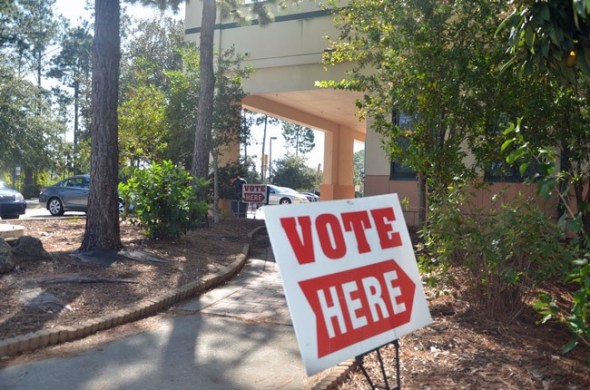
Good Evening!!
This will be short and sweet, because I’m still feeling very under the weather.
The cable networks are starting to give hints about the exit polls in the five states that are holding primaries today. It’s all pretty general so far, and I’m not math wizard enough to get much out it. It looks like it’s closed in Ohio and Illinois, and Missouri is still a mystery.
If Hillary performs as well as expected in Florida and North Carolina, she will end the night with an increased lead in pledged delegates. Bernie would need to win one of the big Midwestern states by a landslide to gain any ground on her.
As for the Republicans, I’m assuming Trump will win at this point. I don’t really care about them, but if you’re hearing interesting things about the GOP race, feel free to share them.
We’ll find out pretty soon what will happen on both sides. Polls will be closing in all of the states pretty soon and voting will be over everywhere by 8PM ET.
I’ve enjoyed watching the vote counts at the New York Times so far. FiveThirtyEight has an excellent live blog as well.
What are you hearing? Let us know in the comment thread and enjoy yourselves. Remember that Hillary already has a huge lead in pledged delegates; so don’t freak out if Bernie wins Ohio and/or Illinois, especially if it’s close.
Tuesday Reads: Super Duper Tuesday
Posted: March 15, 2016 Filed under: morning reads, U.S. Politics | Tags: 2016 presidential primaries, Bernie Sanders, Donald Trump, Florida, Hillary Clinton, Illinois, Marco Rubio, Missouri, NEGATIVE campaigning, North Carolina, Ohio, Super Duper Tuesday March 15 47 Comments
Voting day is coming up soon oh boy, Richard Hubal
Good Day!!
Sorry to be so late in posting today. I’m really struggling with a sinus/chest cold and I don’t have much energy these days.
Today’s primary elections will actually be bigger for the Democrats than Super Tuesday was. The media is playing up the possibility that Sanders could win in Ohio, Illinois, and Missouri; but even if that happens, which I think is doubtful, Clinton should win handily in Florida and North Carolina. She will most likely end the night with an expanded delegate lead.
Trump will probably sew up the Republican nomination, especially if he beats Marco Rubio in Florida, which looks likely.
The attacks on Hillary Clinton are escalating as she gets closer to becoming the first woman presidential nominee of a major political party.
It’s kind of difficult to remember now, but at the beginning of the primary campaign, Bernie Sanders promised to run a positive campaign focused on the issues. It’s been quite awhile now since he switched to attacking Hillary Clinton personally and using innuendo to question her integrity. NBC News examines his move to negative campaigning.
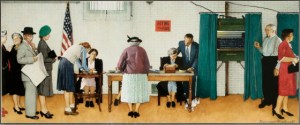
Election Day 1944, Norman Rockwell
A Month on Offense: How Sanders Upped His Attacks on Clinton.
The candidate who went out of his way to avoid attacking his rival throughout the summer, fall and winter has relentlessly unleashed on Clinton for three straight weeks, focusing on familiar talking points now strung together as a fixture of his stump speech.
“Now let me say a few words about some of the strong differences of opinion that I have with Secretary Clinton,” he now normally begins one portion of his speeches before hitting her on a litany of issues. The go-to critiques include trade, the Iraq War, and Clinton’s use of Super PACs.
Boos and heckles quickly arrive from his supporters as they outwardly delight in hearing the differences between their candidate and the Democratic frontrunner.
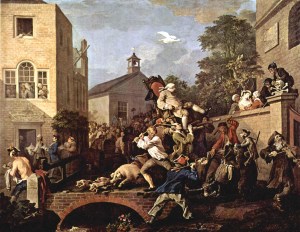
Chairing the Member, Hogarth 1755 (London)
Sanders no longer makes any effort to tone down his followers’ abuse of Clinton and her supporters–whether in rallies or on social media. Instead, he encourages it.
Depending on the day, Sanders also has dinged Clinton on her and her husband’s support of the “homophobic” Defense of Marriage Act (DOMA) and her support from former Secretary of State Henry Kissinger.
“I do not want Henry Kissinger to ever praise me!” he roared during a Michigan rally at Grand Valley State University near Grand Rapids.
The shift in tone has been drastic. In 2015 and early 2016, even uttering Clinton’s name would draw headlines—then unwanted by the candidate himself.
“I cannot walk down the street—Secretary Clinton knows this—without being told how much I have to attack Secretary Clinton,” Sanders told NBC News’ Andrea Mitchell during the NBC’s January Democratic Debate, “Want to get me on the front page of the paper? I make some vicious attack. I have avoided doing that. I am trying to run an issue-oriented campaign.”
He still emphasizes issues, but things have changed since that debate.
They certainly have. Sanders has become just another dirty politician shouting lies and half-truths about his opponent. In on-line forums, his followers have taken his behavior as encouragement for stunningly sexist and racist attacks on Clinton. The similarities between the Trump and Sanders campaign are growing as time goes on. I don’t like to think what will happen if Sanders loses in Illinois or Ohio tonight.
Go to the NBC link to read the rest. It’s a long piece.
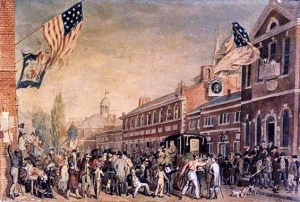
Philadelphia Election Day 1815, John Lewis Kimmel
The media has found another gaffe to hang on Hillary. In her “town hall” with Chris Matthews on MSNBC last night, she said that “we didn’t lose a single person” in the 2011 Libyan intervention. Naturally, that is being interpreted to mean that she has forgotten the deaths of Ambassador Christopher Stevens and four others in the terrorist attacks of September 11, 2012. Politico:
“Libya was a different kind of calculation. And we didn’t lose a single person. We didn’t have a problem in supporting our European and Arab allies in working with NATO,” the former secretary of state said during an MSNBC town hall on Monday night.
Clinton may have been referring strictly to the U.S.-backed overthrow of Libyan dictator Muammar Qaddafi in 2011, which indeed saw no loss of American lives and cost just around $1 billion. But her comments ignore the 2012 attacks at the U.S. mission and CIA outpost in Benghazi, which killed four people including U.S. Ambassador J. Christopher Stevens.
Right. After years of being attacked and blamed for the deaths of four people, Clinton has probably just forgotten all about them. Good grief.
The Sanders campaign committed a far worse gaffe yesterday.
Jane Sanders appeared with racist, anti-immigrant Sheriff Joe Arpaio in Arizona and actually let him lead her on a tour of his “tent city.” It’s not clear the campaign planned this meeting, but why didn’t they hustle her away immediately when Arpaio showed up?
Channel 12 News: Jane Sanders meets with Sheriff Joe Arpaio, tours Tent City.
Jane Sanders wasn’t planning a tour of Tent City on Monday, but Sheriff Joe Arpaio made her an offer she couldn’t refuse.
Sanders planned to view Tent City from the fence, with the help of Puente leader Carlos Garcia. But Arpaio hustled over here from another news conference and the two of them talked policy, politics and Ben and Jerry’s Ice Cream. Sanders also asked inmates about the conditions and why they were in Tent City.

The County Election, George Caleb Bingham
And of course, we know that Sanders surrogate Ben Cohen told Fox News he didn’t know if he could vote for Hillary Clinton in November. Jane Sanders later tweeted that she wasn’t expecting Arpaio to show up, but the damage was done.
As an antidote to the Clinton bashing from Sanders and the media, I suggest reading this post by Peter Daou at Blue Nation Review: Hillary Clinton Is (By Far) the Most Trusted Candidate in 2016.
Let’s define “most trusted” in its literal — and most measurable — sense: More people trust X than anyone else.
And let’s further refine that definition to an act of trust, such as a vote or public endorsement….
Hillary has been endorsed by a greater number of respected public figures and organizations than any other candidate. And more importantly, she leads all other candidates in the popular vote….
Take Bernie Sanders. He had the opportunity to vote against Hillary’s nomination for Secretary of State. After all, he voted against Tim Geithner for Treasury Secretary. Instead, he voted to confirm her, an affirmation of his trust in her ability to represent America to the world….
Think about the numerous political leaders, public officials, organizations, and labor unions who trust Hillary with their future. President Obama, John Lewis, Emily’s List, Lilly Ledbetter, Dolores Huerta, Jim Clyburn, Planned Parenthood, Human Rights Campaign, Julian Castro, Brady Campaign, Eric Holder, League of Conservation Voters, Tammy Baldwin, Kirsten Gillibrand, Claire McCaskill, Cory Booker, Sheila Jackson Lee, Bernice King, and countless more….
Most significantly:
NEARLY 5 MILLION VOTERS HAVE PLACED THEIR TRUST IN HILLARY.
That’s more than any other candidate in the 2016 election.
Let’s see what the media is saying about the possible outcomes of today’s primaries.

Graffiti in the central square of Tixtla, home of the rural normal school at Ayotzinapa, reads “Ayotzinapa lives. Voting causes death. Cursed government,” in Tixtla, Mexico, Saturday, June 6, 2015. (AP Photo/Rebecca Blackwell)
The Guardian: From Ohio to Florida, your cheat sheet for the next crucial primaries.
Although this Tuesday will be less frantic than Super Tuesday two weeks ago, when 12 states and one territory held primary elections, it’s just as important. By 16 March, the race for the White House could look very different depending on how Florida, Illinois, Missouri, North Carolina and Ohio vote.
That’s partly because the delegate numbers in those states are so high – in total, 367 Republican and 792 Democratic delegates are available on 15 March. That brings us significantly closer to the finish line of having just two presidential candidates: at the moment, 33% of Democratic delegates have been pledged but by the time the polls have closed on 15 March, that number will rise to 50%. For Republicans, pledged delegates will jump from 46% to 61%.
Those percentages just mean that playing catch-up gets harder from here. Hillary Clinton is still on track for the nomination – to change that, Bernie Sanders needs to pick up at least 326 of the pledged delegates (in the Democratic race there are also 712 “superdelegates” who are not pledged to a specific candidate based on primary results, so they’re less relevant here).
On the Republican side:
The Republican contest is also likely to change significantly. If, for example,Marco Rubio fails again to pick up a single delegate (and polling suggests that’s a real possibility), his pursuit of the 1,237 delegates needed to win the Republican nomination becomes futile – even if he were to win every single remaining delegate after 15 March. That’s partly because, unlike Democrats, Republicans do not always distribute delegates in proportion to votes. In fact, four states holding Republican primaries on 15 March will be the first in this election to assign delegates on a winner-takes-all basis, which is why this date is such a turning point in the 2016 political calendar.
Check out some interesting charts as well as detailed discussions of each state’s demographics at the link.

Election day graffiti in Afghanistan, 4/4/2014
The Washington Post: March 15 primaries: Will voting in 5 states cement front-runners?
Voters are casting ballots in the five states across the Midwest and Southeast holding primaries Tuesday — contests that could shore up the two front-runners or breathe new life into the lagging campaigns of their challengers.
On the Democratic side, Sen. Bernie Sanders (Vt.) was working to pull off more come-from-behind wins in states where voters feel damaged by globalization, allowing him to claim momentum from Hillary Clinton. The former secretary of state enjoys a sizable lead in delegates but has not been able to seal the nomination.
The contests are especially important on the Republican side, offering a chance for billionaire Donald Trump’s remaining rivals to finally slow his march to the nomination with two winner-take-all contests that have particularly high stakes for a pair of favorite sons, Sen. Marco Rubio of Florida and Gov. John Kasich of Ohio.
This one is a long and interesting read. I suggest you check out the whole thing at the link.
CNN: What’s Next if Marco Rubio Loses Florida?
Rubio, who began his White House campaign 11 months ago as a hero of Florida Republicans, now faces the prospect of defeat in his home state. For years, Republicans believed that Rubio was destined to be a presidential nominee and that even if he fell short in 2016, he would be well-positioned to run for governor in 2018.
But polls suggest Rubio might not just lose Florida — but get thumped here. A Quinnipiac survey released Monday found Rubio trailing Trump by 24 points in his home state.
A loss of that magnitude could be devastating to Rubio, and leave him in a tough spot if he ever wanted to seek public office again.
Quite a comedown. It will be interesting to see what happens when the polls close in Florida.
Florida’s polls close at 7PM ET (8PM in the Panhandle), North Carolina’s and Ohio’s at 7:30 ET, and Illinois’s and Missouri’s at 8PM ET.
So . . . what are you hearing and reading? Let us know in the comment thread, and please stick around for an exciting day! I’ll add a live blog later on for discussion of the returns.

 peej
peej Carissa
 bostonboomer
 dakinikat
 ecocatwoman
 jjlo
jjlo mablue2
 Mama Lopez
 peggysue22
 quixote
 skydancingguestblogger
 Mona (aka Wonk the Vote)



 Sky Dancing
Recent Comments