
Thursday Reads
Posted: September 25, 2014 Filed under: Crime, Criminal Justice System, Foreign Affairs, morning reads, psychology, U.S. Politics, Violence against women, War on Women | Tags: "Anti-Islamic State Coalition", Ferguson MO, Hannah Graham, IRAQ, ISIL, Jesse Matthew, John Crawford III, Michael Brown, Mideast quagmire, police brutality, police misconduct, social media, Syria, war 33 Comments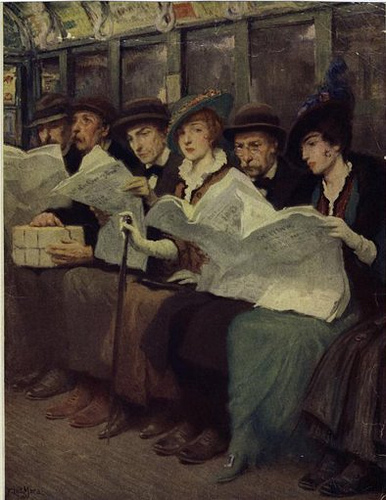
Subway Riders, Francis Louis Mora, 1914
Good Morning!!
I suppose I have to cover the war news, although I’d much prefer to ignore it. So here goes.
First, the good news. According to The Washington Post, more than 60 countries have signed on with the “Anti-Islamic State Coalition.”
In his speech to the United Nations on Wednesday morning, President Obama said, “Already, over 40 nations have offered to join this coalition.”
But on Tuesday, Secretary of State John Kerry said more than 50 nations have agreed to join the coalition. And in a document released by the State Department on Tuesday, 62 nations (including the European Union and the Arab League) are listed as providing support to the U.S.-led coalition.
The strongest allies in the coalition are those providing air support to the United States, while others are offering delivery services and some are providing humanitarian aid.
Click on the link above to read the list of countries providing air support, military equipment, and humanitarian aid. You can follow the latest developments in the fight against ISIL at The Guardian’s live blog.
Now the not-so-good news: a couple of op-eds that suggest the air war against the Islamic State militants is ineffective and/or counterproductive.
Reuters, Air strikes won’t disrupt Islamic State’s real safe haven: social media.
President Barack Obama has pledged to destroy Islamic State and ensure fighters “find no safe haven.” But even as U.S.-led airstrikes are underway in Iraq and Syria, it is clear that bombs alone will not do the job. For Islamic State hides out in the most perfect haven: the World Wide Web.
In June 2014, the militant group that Obama refers to as Islamic State in Iraq and the Levant, or ISIL, grabbed the world’s attention after it took over much of northern Iraq in roughly four days. Islamic State accomplished this by building a massive, sophisticated virtual network of fighters in addition to those on the ground. Indeed, its expansion online has been as swift as its territorial gains. It is this virtual power grab that will be most difficult to combat.
The Internet has largely sustained the jihadist movement since 9/11. With this powerful tool, jihadists coordinate actions, share information, recruit new members and propagate their ideology.
Until the rise of Islamic State, extremist activity and exchanges online usually took place inside restricted, password-protected jihadist forums. But Islamic State brought online jihadism out of the shadows and into the mainstream, using social media — especially Twitter – to issue rapid updates on its successes to a theoretically unlimited audience.
In the same way that Islamic State’s land grab proved stunning, the group’s actions online have been deeply troubling. Up until a recent crackdown by Twitter, Islamic State’s presence on the site had grown tremendously — from a small one to a well-organized network with dozens of accounts.
Click the link to read all about it at Reuters’ “The Great Debate” page.

Reading the Newspaper. War News, by Nikolay Bogdanov-Belsky
Jamie Dettmer at The Daily Beast argues that Obama’s Arab Backers May Draw the U.S. Deep Into the Mideast Quagmire. Detmer also discusses ISIL’s social media operation.
The backing from Gulf countries for the military intervention against militants of the so-called Islamic State in northern Syria, far from helping the United States in the battle for hearts and minds, may actually be hurting Washington in the region. And the reasons for that suggest just how densely complicated the Mideast quagmire has become.
While the participation of the super-rich Gulf monarchies in a coalition against the group widely known as ISIS or ISIL may help with some moderate Muslims, and may reassure European leaders, among those Islamists inside and outside Syria who are at the core of the opposition to President Bashar al Assad this development is viewed with deep suspicion.
“This has been labeled as a war against ISIS but it is a war against Islamic groups,” Tauqir Sharif, a British Islamist activist based in Idlib, Syria, told British Channel Four news Wednesday.
Already ISIS activists and jihadists sympathizers in the Gulf are leveraging their social media skills to fuel suspicions that the Americans are ready to give Assad a free pass and that the Sunni Muslims of Syria will be sacrificed with the connivance of the Gulf monarchies.
Much more at the Daily Beast link.
Suspect in Alleged Abduction of UVA Student Captured in Texas
I’ve been following the case of missing University of Virginia student Hannah Graham since Janicen posted about it about a week ago. The last person to be seen with Graham on surveillance footage was Jesse Matthew, 32, who worked as a nurses’ aid at the university. After police searched his car and apartment, Matthew came to the police station and asked for an attorney. He then drove away at a high speed and apparently disappeared. Police issued a warrant for his arrest for a traffic violation, but could not locate him. After more searches of his apartment, police upgraded the charge to abduction of Graham.
Last night, news broke that Matthew had been located in Galveston, Texas, and he is currently being held by police there. From the Associated Press, via ABC News, Suspect Captured but UVa Student Still Missing.
Jesse Leroy Matthew Jr. was arrested on a beach in the Texas community of Gilchrist by Galveston County Sheriff’s authorities, Charlottesville Police Chief Timothy Longo announced Wednesday night.
The capture came less than a full day after police announced they had probable cause to arrest Matthew on charges of abduction with intent to defile Hannah Graham, an 18-year-old sophomore who went missing on Sept. 13 in Charlottesville.
Longo said an intense search for Graham continues.
“This case is nowhere near over,” he told a news conference late Wednesday. “We have a person in custody but there’s a long road ahead of us and that long road includes finding Hannah Graham.”
Longo said Thursday on NBC’s “Today” show that the search is focusing on rural and wooded areas around Charlottesville.
Matthew was captured at a beach in the sparsely populated community of Gilchrist around 3:30 p.m. after police received a call reporting a suspicious person, the Galveston County Daily News reported. The newspaper quoted Galveston County Sheriff Henry Trochesset as saying a deputy responding to the call found a man who had pitched a tent on the beach with his car parked nearby. Trochesset said a check of the car’s plates revealed it was the vehicle sought in connection to the case. Authorities were trying to get a warrant to search the car, he added.

Reading the Morning Newspaper, Harry Herman Roseland
ABC News has more on how police located Jesse Matthew, Suspect in UVA Case Seen on Video Buying Bug Spray Before Capture.
Detectives investigating the case of a missing University of Virginia student were headed to Texas today after a man suspected in her disappearance was arrested after being caught on surveillance video there buying mosquito repellent a day before his capture….
The surveillance video from a convenience store in Galveston showed Matthew buying Off!, said the store’s owner, Dave Paresh.
“He asked me the question if it’s safe to stay on the beach, so I told him yeah, it’s good there,” Paresh, told ABC News station KTRK in Houston.
I guess there must be lots of mosquitoes on Galveston beaches right now.
Matthew appeared in court this morning, and was denied bail.
For anyone who thinks I shouldn’t write about “missing white girl” stories, violence against women is endemic in this country. It’s a bloodbath out there, with women being beaten (see the NFL scandal), raped, and/or murdered daily in this country; and I think it should be talked about. There truly is a war against women. Admittedly, the use of violence against women for entertainment should be discussed. Think about how many movies and TV shows center around the rape, torture, and murder of women. It’s important that real-life cases be seen as horrible crimes that involve agonizing suffering for victims, their families and friends.
Police Misconduct in the News
Speaking of violence against women, even police get into the act. Thank goodness they are often caught on video these days.
From The Christian Science Monitor, NYPD under fire for video of pregnant woman hitting ground.
New York City police officers are under investigation this week after a bystander used a smartphone to capture a particularly rough arrest of a Brooklyn woman five months pregnant.
The video shows the arrest of Sandra Amezquita, a Colombian immigrant and mother of four, who fell belly first onto the pavement as officers wrestled her to the ground and cuffed her hands behind her back. The incident occurred during an early morning melee Saturday in Sunset Park – a neighborhood sometimes called Brooklyn’s “Little Latin America,” since more than half its residents are Latino.
The video also shows another officer violently shoving an unidentified woman to the pavement as she stands near the arrest. Police simply issued Ms. Amezquita a summons for disorderly conduct, but the other woman, reported to be a friend, was neither arrested or accused of a crime.
Amezquita suffered vaginal bleeding after the incident. She was arrested for trying to interfere with police who were beating her son after they stopped and frisked him.
“It’s appalling,” said Sanford Rubenstein, Amezquita’s attorney. “It’s clear to me when an incident like this occurs you understand why police-community relations are at an all-time low,” he told The Associated Press.
The scuffle occurred after Amezquita and her husband, Ronel Lemos, attempted to intervene as police arrested and allegedly began to beat their 17-year-old son, Jhohan Lemos, who was accused of carrying a knife and resisting arrest around 2:15 a.m. on Saturday.
The elder Mr. Lemos was also arrested and charged with assaulting a police officer during the arrest of his son. Photos show the younger Mr. Lemos with his eye swollen shut and lacerations to his cheek and forehead following his arrest.

Reading the News at the Weavers’ Cottage, 1673, Adriaen van Ostade
In California, a 51-year-old woman won a lawsuit against the Highway Patrol after an officer beat her and it was caught on tape. Fox News reports:
A woman who was punched repeatedly by a California Highway Patrol (CHP) officer in an incident caught on film earlier this year will receive $1.5M as part of a settlement reached Wednesday.
CHP Commissioner Joe Farrow announced the settlement in an emailed statement and an attorney for 51-year-old Marlene Pinnock confirmed the deal to the Associated Press. The agreement was reached after nine hours of mediation in Los Angeles.
As part of the agreement, the officer who struck Pinnock, Daniel Andrew, will resign. Andrew, who joined the CHP in 2012 and had been on paid administrative leave, could still be charged criminally in the case. The CHP forwarded the results of its investigation of the incident to Los Angeles County prosecutors last month, saying he could face serious charges but none have been filed yet.
There was another demonstration in Ferguson, Missouri on Tuesday Night after someone burned a memorial to Michael Brown, who was shot and killed by Ferguson police officer Darren Wilson on August 9. The Christian Science Monitor asks, Who burned Michael Brown memorial? Questions spark new Ferguson unrest.
Fresh unrest in Ferguson, Mo., Tuesday night shows that the embers of the month-old unrest surrounding Michael Brown’s death can be kindled by even tiny sparks.
Detectives are investigating how a makeshift memorial to Mr. Brown, an unarmed black teenager killed by white Ferguson police officer Darren Wilson on Aug. 9., burned early Tuesday morning. The memorial, which is one of two near where Brown died on Canfield Drive, included mementos and small candles that may have caused the fire.
But some in the area suggested that it’s “naïve” to think the fire was accidental, and about 200 protesters rallied to West Florissant Avenue again Tuesday, squaring off with police and looting for the third time a store called Beauty Town. There were media reports of looters yelling “Burn it down!” and of gun shots in the area near Canfield Drive. Police made five arrests.
Meanwhile, the DOJ is investigating the Ferguson Police Department.
Finally, there will apparently be no charges in the shooting of John Crawford III, who was shot by police while holding a toy gun in a Walmart. From Fox News, Grand jury issues no indictments in man’s fatal shooting at Ohio Wal-Mart.
XENIA, Ohio – Officers’ actions were justified in the fatal shooting of a man holding an air rifle inside an Ohio Wal-Mart store, a grand jury determined Wednesday — using surveillance video the slain man’s family said shows the shooting was completely unjustified.
The Greene County grand jury opted not to issue any indictments in the Aug. 5 death of 22-year-old John Crawford III inside a Wal-Mart in Beavercreek, Special Prosecutor Mark Piepmeier said.
A 911 caller reported Crawford was waving what appeared to be a rifle in the store. Police said he was killed after failing to obey commands to put down what turned out to be an air rifle taken from a shelf.
Since the shooting, Crawford’s family had demanded public release of the surveillance footage, a request denied until Wednesday by the state attorney general, who said releasing it earlier could taint the investigation and potential jury pool.
Video presented at a news conference by Piepmeier in Xenia shows Crawford walking the aisles, apparently on his cellphone, and picking up an air rifle that had been left, unboxed, on a shelf.
Crawford carries the air rifle around the store — sometimes over his shoulder, sometimes pointed at the ground — before police arrive and shoot him twice.
Would a customer have called 911 if Crawford hadn’t been a black man?

At the Miliners, by Edgar Degas, 1882
In Other News . . .
I’m running out of space, so I’ll end with some links to other stories that may pique your interest.
Cleveland Plain Dealer, FBI report shows mass shootings on the rise since 2000. We already knew this, but now there’s hard evidence.
Beta News.com, Five things to hate about the iPhone 6 and iPhone 6 Plus. It bends!
And the new Apple IOS is messed up. From ComputerWorld, Apple yanks iOS 8 update after crippling iPhone 6 and 6 Plus.
Massachusetts GOP candidate for Governor is not endearing himself to women voters. Two op-ed pieces from The Boston Globe:
Charlie Baker needs an intervention on women, by Joan Vennochi
Charlie Baker’s ‘sweetheart’ problem, by Yvonne Abraham
Women, let’s all get out and vote for Martha Coakley. It’s high time Massachusetts had a woman as Governor!
So . . . what else is happening in the world? I’ll see you in the comments! Have a great day!
Wednesday News Headlines
Posted: June 25, 2014 Filed under: Foreign Affairs, morning reads, U.S. Politics | Tags: Arkansas, Eli Wallach, GOP crazies, Hillary Clinton, IRAQ, Johnny Rhoda, Mississippi, Syria 29 Comments
Good Morning!!
This is going to be a brief open thread–just some headlines to get you started on the day. I apologize for not being able to write a full post. JJ is dealing with some urgent family problems, I’m at my mom’s house helping her get ready for several out-of-town guests, and Dakinikat is taking her pets to the vet. Dak and I will be around this afternoon.
So here’s what’s happening in the headlines this morning.
CNN: Syrian warplanes strike in Iraq, killing 57 civilians, official says.
BBC: Russian and Ukrainian media consider Putin step
An Arkansas GOP official said of Hillary Clinton: ‘She’d Probably Get Shot at the State Line’.
But the official, Johnny Rhoda, didn’t actually mean what he said as a threat.
And he claims his remarks were “taken way out of context,” because he was laughing when he said them.
Actor Eli Wallach has died: ‘Good, the Bad and the Ugly’ Star Eli Wallach Dies at 98 (Hollywood Reporter).
WaPo: Cochran beats McDaniel in nail-biter in Mississippi.
Mother Jones: A Mississippi Surprise: GOP Sen. Cochran Beats Back Tea Party Champion.
Dick Cheney just won’t go away. From the Hill, Cheney: Next attack ‘likely’ deadlier than 9/11.
CNN: FIFA starts disciplinary action against Luis Suarez after biting claims.
Reuters: New York Congressman Charles Rangel claims victory in Democratic primary.
Reuters: Seattle Archdiocese to pay $12 million to settle child sex abuse claims: lawyer.
What stories are you following today? Have a great “hump day,” Sky Dancers!
Monday Reads
Posted: June 23, 2014 Filed under: Barack Obama, Foreign Affairs, morning reads, U.S. Politics | Tags: corruption, Dick Cheney, Ed Klein, George W. Bush, Hillary Clinton, immigration, iran, IRAQ, John Kerry, mass graves, Nuri al-Maliki, Syria 38 Comments
Good Morning!!
Things are not going well in Iraq, to put it mildly. John Kerry arrived in Iraq this morning and is currently meeting with Iraqi leaders, according to CNN: John Kerry holds talks in Iraq as more cities fall to ISIS militants.
Baghdad, Iraq (CNN) — As radical Sunni militants snatch city after city in their march toward Baghdad, U.S. Secretary of State John Kerry arrived in Iraq on Monday during the country’s tensest time since the U.S. withdrawal of troops in 2011.
Kerry is meeting with Iraqi leaders. He met Monday with Prime Minister Nuri al-Maliki, the man who some observers say needs to step down.
With al-Maliki’s Shiite-led government losing more ground to militants from the Islamic State in Iraq and Syria, or ISIS, Kerry has implored the leader to rise above “sectarian motivations” to become more inclusive and make the government more representative of Iraq’s population.
“I’m here to convey to you President Obama’s and the American people’s commitment to help Iraq,” Kerry said when greeting Iraq’s speaker of parliament, Osama al-Nujayfi. “The principal concern is the integrity of the country, its borders, its sovereignty,” he said. ISIS “is a threat to all of us.”
Kerry will also meet with Iraq’s foreign minister as well as Shiite and Sunni leaders.
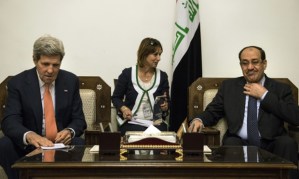
Iraqi Prime Minister Nuri al-Maliki and US Secretary of State John Kerry meet at the Prime Minister’s Office in Baghdad. Photograph: Brendan Smialowski/AFP/Getty Images
The discussions with the Maliki government are not likely to be particularly congenial. According to NPR:
U.S. Secretary of State John Kerry flew to Baghdad on Monday to personally urge the Shiite-led government to give more power to political opponents before a Sunni insurgency seizes more control across the country and sweeps away hopes for lasting peace.
The meeting scheduled between Kerry and Iraqi Prime Minister Nouri al-Maliki was not expected to be friendly, given that officials in Washington have floated suggestions that the Iraqi premier should resign as a necessary first step toward quelling the vicious uprising. Nor will it likely bring any immediate, tangible results, as al-Maliki has shown no sign of leaving and Iraqi officials have long listened to — but ultimately ignored — U.S. advice to avoid appearing controlled by the decade-old specter of an American occupation in Baghdad.
Still, having suffered together through more than eight years of war — which killed nearly 4,500 American troops and more than 100,000 Iraqis — the two wary allies are unwilling to turn away from the very real prospect of the Mideast nation falling into a fresh bout of sectarian strife.
“This is a critical moment where, together, we must urge Iraq’s leaders to rise above sectarian motivations and form a government that is united in its determination to meet the needs and speak to the demands of all of their people,” Kerry said a day earlier in Cairo. He was there in part to meet with Egyptian President Abdel-Fattah el-Sissi to and discuss a regional solution to end the bloodshed by the insurgent Islamic State of Iraq and the Levant, or ISIL.
Good luck with that. I wish Hillary were still in charge at State.
From Jay Solomon at The Wall Street Journal: U.S. Faces Opposing Regional Interests in Bid to Blunt Insurgency in Iraq.
AMMAN, Jordan—As the Obama administration’s top diplomat arrived in the Middle East to gather support to blunt a Sunni insurgency in Iraq, the U.S. was colliding with the region’s ethnic, tribal and sectarian divisions.
Deep gaps between U.S. and Arab views over the crisis have grown more obvious in recent days, say American and regional officials, hampering Washington’s response to the onslaught by the Islamic State of Iraq and al-Sham, or ISIS, which this month seized control of territories straddling Iraq and Syria.
The task gained new urgency on Sunday when ISIS swept through new Iraq towns and overran two border crossings with Jordan and Syria, blocking the Iraqi government’s access to its western frontier, security officials said.
President Barack Obama raised the stakes on Sunday, telling CBS News that ISIS threatens American interests if it turns to global terrorism, two days after he announced plans to send U.S. military advisers and supplies to Iraq and called for a new, more inclusive government in Baghdad.
The crisis in Iraq has exposed contradictions in traditional Mideast alliances, in some ways placing the U.S. alongside its sworn enemy, Shiite-ruled Iran, in a joint effort to halt ISIS, while in other ways putting Washington at odds with longtime Sunni allies in the Persian Gulf, who want to weaken Iran’s sway over Iraq.
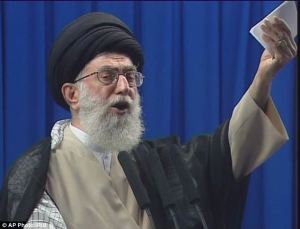
Iran’s supreme leader Ayatollah Khamenei in 2009
Meanwhile, yesterday, according to Reuters:
Iran’s supreme leader accused the United States on Sunday of trying to retake control of Iraq by exploiting sectarian rivalries, as Sunni insurgents drove towards Baghdad from new strongholds along the Syrian border.
Ayatollah Ali Khamenei’s condemnation of U.S. action came three days after President Barack Obama offered to send 300 military advisers to help the Iraqi government. Khamenei may want to block any U.S. choice of a new prime minister after grumbling in Washington about Shi’ite premier Nuri al-Maliki.
The supreme leader did not mention the Iranian president’s recent suggestion of cooperation with Shi’ite Tehran’s old U.S. adversary in defense of their mutual ally in Baghdad.
On Sunday, militants overran a second frontier post on the Syrian border, extending two weeks of swift territorial gains as the Islamic State of Iraq and the Levant (ISIL) pursues the goal of its own power base, a “caliphate” straddling both countries that has raised alarm across the Middle East and in the West.
“We are strongly opposed to U.S. and other intervention in Iraq,” IRNA news agency quoted Khamenei as saying. “We don’t approve of it as we believe the Iraqi government, nation and religious authorities are capable of ending the sedition.”
Will we ever be rid of these insane wars started by Dick Cheney and his puppet George W. Bush? At least Bush has the decency to keep quiet, but Cheney just won’t shut up even though he has no answers for the current crisis. From Raw Story: Dick Cheney doesn’t ‘intend any disrespect’ by suggesting Obama ‘guilty of treason’
Former Vice President Dick Cheney on Sunday insisted that he did not “intend any disrespect” when he suggested that President Barack Obama was guilty of treason by trying to undermine the United States before leaving office.
In a Wall Street Journal op-ed last week, Cheney — and his daughter Liz — said that the president was “determined to leave office ensuring he has taken America down a notch.”
He went on to suggest that Obama was a “fool” if he intended to work with Iran to prevent violence in Iraq.
“In this op-ed, you suggest the president is a fool,” ABC’s Jonathan Karl pointed out during a Sunday interview with Cheney. “That is the word you used, ‘only a fool would take the approach he’s taking in Iraq right now.’”
“It almost seems like you’re accusing the president of treason, that he’s intentionally bringing America ‘down a notch,’” Karl noted.
Cheney did not deny that he had accused the commander-in-chief of the United States of treason, but he insisted that he had not just called Obama a “fool” over the violence in Iraq.
“It referred to the fact that we’ve left a big vacuum in the Middle East by our withdrawal from Iraq with a no stay-behind agreement,” the former vice president said. “By the commitment that he made just a few weeks ago, that we are going to completely withdraw from Afghanistan with a no stay-behind agreement.”
See also, Dick Cheney’s amazing chutzpah on Iraq, by Paul Waldman (CNN)
Cheney needs to STFU and go on a hunting trip or something. Maybe he could take Tony Scalia with him.
In other news . . .

Right wing nut and birther Ed Klein has a new Hillary hate book out, and the New York Post has been publishing laughable excerpts. The trouble is, the wingnuts will believe the lies and the media won’t counter them. Be sure to read what Joseph Cannon has to say about the De-KLEIN of journalism.
Why does anyone still print or read right-wing pseudojournalist Edward Klein?
A while back, this fictioneer published a book alleging a lesbian relationship between Hillary Clinton and Huma Abedin — a work which one critic called “the sleaziest, most derivative, most despicable political biography ever.” Klein’s revelations always come from anonymous “informants” — one of whom, I’ve heard, is Slender Man.
Klein has a new book out and the NY Post is pushing it, even though the folks running the NY Post must know that they’re peddling garbage….
Anyone who takes this nonsense seriously must also believe that wrestling is real. Nevertheless, the right-wing propagandists are pretending to accept Klein’s work at face value. (See also here, especially the telling piece of “Hildebeest” research.)
This is a horrible story from the AP via Fox News: Researchers discover mass graves with bodies of immigrants in South Texas cemetery.
FALFURRIAS, Texas – Volunteer researchers have uncovered mass graves in a South Texas cemetery that they believe contain the bodies of immigrants who died crossing into the U.S. illegally, according to published reports Saturday.
The discovery at Sacred Heart Burial Park in Falfurrias came in the last two weeks, as Baylor University anthropologist Lori Baker and Krista Latham, a forensic anthropologist at the University of Indianapolis, and their students worked as part of a multi-year effort to identify immigrants who’ve died in the area near the U.S.-Mexico border.
Teams unearthed remains in trash bags, shopping bags, body bags or without a container at all, according to the Corpus Christi Caller Times (http://bit.ly/1qqH7CZ ). In one burial, bones of three bodies were inside one body bag. In another, at least five people in body bags and smaller plastic bags were piled on top of each other. Skulls also were found in biohazard bags placed between coffins.
They exhumed 110 unidentified people from the cemetery in 2013. This summer, researchers have performed 52 exhumations, but because some remains were stored together, further study will be needed to determine exactly how many bodies have been recovered, Baker said.
These people just suddenly dropped dead as they crossed the border? Apparently this is the work of a local funeral home, Funeraria del Angel Howard-Williams, which the state has been paying $450 each to deal with bodies of immigrants that have been discovered all over Texas. The funeral home has been paid for this service for at least 16 and as long as 22 years! Were there any autopsies? Did anyone determine whether any of these deaths were homicides?

We haven’t heard much about Bowe Bergdhal lately. Via The Boston Globe, the AP reports this morning that he has been “Shifted to Outpatient Care.”
SAN ANTONIO (AP) — Sgt. Bowe Bergdahl, who had been a prisoner of war in Afghanistan for five years, has been shifted to outpatient care at a Texas military base, the U.S. Army said in a statement Sunday.
Bergdahl, 28, had been receiving inpatient treatment at Brooke Army Medical Center at Fort Sam Houston. He is now receiving outpatient care on the base in San Antonio, according to the statement. The Army said his ‘‘reintegration process’’ is proceeding with exposure to more people and a gradual increase in social interaction.
He arrived at the Texas medical center on June 13 after nearly two weeks recuperating at a U.S. military hospital in Germany. Army officials said then that Bergdahl was in stable condition and was working daily with health care providers to regain a sense of normalcy and move forward with his life.
The Army statement Sunday said Bergdahl is receiving counseling from ‘‘Survival, Evasion, Resistance and Escape’’ psychologists’’ to ‘‘continue to ensure he progresses to the point where he can return to duty.’’
The Army said specifics of Bergdahl’s location would not be made public.
That’s it for me for today, except that I’ve become a World cup fan and I might even watch some of the games the US team isn’t participating in. Ralph’s enthusiasm has sucked me in!
What stories are you following today? Please let us know in the comment thread.
Friday Reads
Posted: September 20, 2013 Filed under: just because | Tags: chemical weapons, hunger in the US, Neanderthal diets, Pope Francis, Republicans, SNAP, Syria 13 Comments Good Morning!
Well, House Republicans did in fact vote to cut SNAP by $40 Billion. They seem to think that it’s easy to find a job in country with a persistent unemployment rate about 7.5%.
Right now, there are roughly 47.7 million Americans on food stamps — a number that swelled during the recession and has only recently started to decline.
The House GOP bill would kick about 3.8 million people off the food-stamp rolls over the course of the upcoming fiscal year that begins in October. That includes 1.7 million unemployed, childless adults aged 18-50. It also includes another 2.1 million families and seniors who have incomes just slightly above the federal food-stamp limits. (In recent years, states have been able to extend food-stamp aid to these households.)
Thereafter, the House GOP bill would reduce the rolls by about 2.8 million people each year compared with current law.
Check the graphic at Wonk Blog for the details on how they intend to get folks out of SNAP eligibility keeping in mind that about 1/2 of the folks on SNAP are children and an additional good portion are elderly on limited incomes that were already impacted by cuts in meals on wheels.
I’m not Catholic so the actual things that Popes say has no impact on my personal faith. I also wasn’t raised Catholic so I have no nostalgia or lingering scars or good memories from the growing up Catholic experience that I hear about from so many friends. I really don’t have many kind things to say about Popes in general since most of them recently have made life very difficult for women and gays and have been shown to enable some pretty bad stuff in their priesthood. Will this new Pope usher in a new opinion from me and others? Will he be able to reach out to folks that feel an attachment to the church but a searing disappointment in some of its recent actions and policies?
Six months into his papacy, Pope Francis sent shock waves through the Roman Catholic church on Thursday with the publication of his remarks that the church had grown “obsessed” with abortion, gay marriage and contraception, and that he had chosen not to talk about those issues despite recriminations from critics.
His surprising comments came in a lengthy interview in which he criticized the church for putting dogma before love, and for prioritizing moral doctrines over serving the poor and marginalized. He articulated his vision of an inclusive church, a “home for all” — which is a striking contrast with his predecessor, Pope Benedict XVI, the doctrinal defender who envisioned a smaller, purer church.
Francis told the interviewer, a fellow Jesuit: “It is not necessary to talk about these issues all the time. The dogmatic and moral teachings of the church are not all equivalent. The church’s pastoral ministry cannot be obsessed with the transmission of a disjointed multitude of doctrines to be imposed insistently.
“We have to find a new balance,” the pope continued, “otherwise even the moral edifice of the church is likely to fall like a house of cards, losing the freshness and fragrance of the Gospel.”
The pope’s interview did not change church doctrine or policies, but it instantly changed its tone. His words evoked gratitude and hope from many liberal Catholics who had felt left out in the cold during the papacies of Benedict and his predecessor, John Paul II, which together lasted 35 years. Some lapsed Catholics suggested on social media a return to the church, and leaders of gay rights and gay Catholic groups called on bishops to abandon their fight against gay marriage.
But it left conservative and traditionalist Catholics, and those who have devoted themselves to the struggles against abortion, gay marriage and artificial contraception, on the defensive, though some cast it as nothing new.
That part of the Pope’s interview was the most newsworthy. However, the part about the Pope’s personal faith was perhaps the most interesting to me. It’s actually been a long time since I’ve heard a church leader actually sound like he’s gotten in touch with the Jesus I remember reading about in the Bible as a kid. This Pope appears to actually like women for a change. The analysis is by Andrew Sullivan of The Dish.
This is the core message of the Second Vatican Council that John Paul II and Benedict XVI did their utmost to turn back in favor of papal authority. The hierarchy is not the whole church, just a part of it, in community with all the faithful. And he uses the example of the Blessed Virgin to buttress his point:
This is how it is with Mary: If you want to know who she is, you ask theologians; if you want to know how to love her, you have to ask the people. In turn, Mary loved Jesus with the heart of the people, as we read in the Magnificat. We should not even think, therefore, that ‘thinking with the church’ means only thinking with the hierarchy of the church.
And how we live is the only true expression of what we believe. Here is the rebuke to the theocons and their project:
If the Christian is a restorationist, a legalist, if he wants everything clear and safe, then he will find nothing. Tradition and memory of the past must help us to have the courage to open up new areas to God. Those who today always look for disciplinarian solutions, those who long for an exaggerated doctrinal ‘security,’ those who stubbornly try to recover a past that no longer exists—they have a static and inward-directed view of things. In this way, faith becomes an ideology among other ideologies.
And where is real faith?
I see the holiness in the patience of the people of God: a woman who is raising children, a man who works to bring home the bread, the sick, the elderly priests who have so many wounds but have a smile on their faces because they served the Lord, the sisters who work hard and live a hidden sanctity. This is for me the common sanctity. I often associate sanctity with patience: not only patience as hypomoné [the New Testament Greek word], taking charge of the events and circumstances of life, but also as a constancy in going forward, day by day. This is the sanctity of the militant church also mentioned by St. Ignatius. This was the sanctity of my parents: my dad, my mom, my grandmother Rosa who loved me so much. In my breviary I have the last will of my grandmother Rosa, and I read it often. For me it is like a prayer. She is a saint who has suffered so much, also spiritually, and yet always went forward with courage.
 While many journalists appear to be disappointed by the lack of yet another US intervention in the Middle East, most Americans are relieved. What does this new diplomatic effort between the US and Russia on Syrian Chemical Weapons mean for similar efforts in the future?
It is important not so much for what it could mean on the ground – which remains to be seen as inspectors begin to flow into Syria and, we hope, chemical-weapons stockpiles begin to be destroyed. Rather, the agreement’s main significance consists in the fact that it was struck at all: US Secretary of State John Kerry met with his Russian counterpart, Sergei Lavrov, in Geneva, that most traditional of diplomatic venues, and cut a deal on an issue of intense mutual interest.
In the days, weeks, and months ahead, the arrangements to remove chemical weapons from Syria will, one hopes, begin a new era in which the US and Russia work together on other pressing global issues as well. A cooperative US-Russia relationship is essential if the international system, now almost dysfunctional, is to work properly in the future.
The agreement on Syria could accomplish something else: Americans might recognize that, lo and behold, there are other ways to solve problems than by dropping bombs. Russian President Vladimir Putin’s clumsy foray into the American debate infuriated many Americans (including me), but it was certainly a teachable moment. Many outside the US thought it was high time that someone offered America a taste of its own paternalism – and even better that that someone was Putin, a politician who has, to put it gently, his own set of foibles.
So Americans might want to tone down their anti-Putin rhetoric. As a practical matter, Putin certainly does not seem to be suffering any adverse domestic political consequences from his bashing in the US. More broadly, America’s supply of moralistic – and even churlish – advice to the rest of the world has greatly exceeded international demand for it. And its willingness to engage militarily as an early step, rather than as a last resort, has alienated many around the world. No amount of “Muslim outreach” and other public diplomacy alone will change that.
Support for insurgencies is a case in point. Many countries – Syria qualifies as a poster child in this regard – suffer under miserable, brutal governments. But backing an armed rebellion is a major step, especially when the rebels whom one is backing have, as in Syria, started something that they may not be able to finish.
This is not to say that the US should never support insurgencies against established governments; but doing so is almost always a lonely affair, without any realistic expectation of enlisting many partners in the process. Such policy choices should be made rarely, and with a clear understanding that support for the violent overthrow of a government is not very popular around the world.
We are learning more and more about Neanderthals and how they may have been a lot more sophisticated than previously thought. It was thought they may not have been smart enough to figure out how to fish. However, recent research shows they had fish in their diets.
It has been thought that the varied diet of modern humans may have contributed to an evolutionary advantage over Neanderthals, who were thought to have survived on eating large, herbivorous mammals. But an international team of scientists has been working together at a cave in the Caucasus Mountains, where they have foundevidence that suggests Neanderthals ate fish. To rule out the possibility that the large salmon in the cave had been eaten by the cave bears and cave lions that were also found there, the bones of the large predators were analyzed. The results show that the cave bears were vegetarian, and that the cave lions ate land-dwelling herbivores. “This study provides indirect support to the idea that Middle Palaeolithic Hominins, probably Neanderthals, were able to consume fish when it was available, and that therefore, the prey choice of Neanderthals and modern humans was not fundamentally different,” explained Hervé Bocherens of the University of Tübingen.
It seems that the more that Homo Sapiens try to make themselves exceptional, the more we find out that we are not.
What’s on your reading and blogging list today?
Friday Reads
Posted: September 6, 2013 Filed under: morning reads | Tags: fiscal policy, generosity, libertarians, prisoner's dilemma, Syria 21 Comments Good Morning!
I am enjoying the cooling effects of the new AC condenser. The last days of summer heat will be with us here in New Orleans for awhile so I am glad I could replace it. There are a bunch of other things that I will now go without but the AC is one thing you cannot forgo down here any more.
It’s difficult to find some things that aren’t about Syria, but I did find a few things just to give us a break. I am going to start one with item that broke late last night.
The WSJ has says the US has intercepted a message that states that Iran will attack Iraq if the US attacks Syria.
The U.S. has intercepted an order from Iran to Shiite militants in Iraq to attack the U.S. Embassy and other American interests in Baghdad in the event of a strike on Syria, officials said, amid an expanding array of reprisal threats across the region.
Military officials have been trying to predict the range of possible responses from Syria, Iran and their allies. U.S. officials said they are on alert for Iran’s fleet of small, fast boats in the Persian Gulf, where American warships are positioned. U.S. officials also fear Hezbollah could attack the U.S. Embassy in Beirut.
While the U.S. has positioned military resources in the region for a possible strike, it has other assets in the area that would be ready to respond to any reprisals by Syria, Iran or its allies.
Those deployments include a strike group of an aircraft carrier and three destroyers in the Red Sea, and an amphibious ship, the USS San Antonio, in the Eastern Mediterranean, which would help with any evacuations.
The U.S. military has also readied Marines and other assets to aid evacuation of diplomatic compounds if needed, and the State Department began making preparations last week for potential retaliation against U.S. embassies and other interests in the Middle East and North Africa.
I think we all can agree on the level of skepticism felt here–both writers and discussants–on the weird cult of libertarians. Here’s an interesting thought. Are Libertarians the New Communists?
Most people would consider radical libertarianism and communism polar opposites: The first glorifies personal freedom. The second would obliterate it. Yet the ideologies are simply mirror images. Both attempt to answer the same questions, and fail to do so in similar ways. Where communism was adopted, the result was misery, poverty and tyranny. If extremist libertarians ever translated their beliefs into policy, it would lead to the same kinds of catastrophe.
Let’s start with some definitions. By radical libertarianism, we mean the ideology that holds that individual liberty trumps all other values. By communism, we mean the ideology of extreme state domination of private and economic life.
Some of the radical libertarians are Ayn Rand fans who divide their fellow citizens into makers, in the mold of John Galt, and takers, in the mold of
anyone not John Galt.
Some, such as the Koch brothers, are economic royalists who repackage trickle-down economics as “libertarian populism.” Some are followers of Texas Senator Ted Cruz, whose highest aspiration is to shut down government. Some resemble the anti-tax activist Grover Norquist, who has made a career out of trying to drown, stifle or strangle government.
Yes, liberty is a core American value, and an overweening state can be unhealthy. And there are plenty of self-described libertarians who have adopted the label mainly because they support same-sex marriage or decry government surveillance. These social libertarians aren’t the problem. It is the nihilist anti-state libertarians of the Koch-Cruz-Norquist-Paul (Ron and Rand alike) school who should worry us.
Economics Policy Wonk Jared Bernstein has a great narrative on how fiscal policy gets so mixed up. He attempts to explain how our economic knowledge in theory has warped into something unrecognizable in the beltway.
I identify three reasons why fiscal policy became so backwards in recent years. First, a strategy by Democrats to block the GW Bush tax cuts morphed from strategy to ideology. Second, a misunderstanding of the Clinton surpluses in ways explained below. And third, the use of deficit fear-mongering to achieve the goal of significantly shrinking the government sector.
During the early years of the GW Bush administration, the President proposed and Congress passed two tax-cut packages that quite sharply lowered the revenues flowing to the Treasury. During those debates, opponents of the cuts raised their negative impact on deficits and debt as a major concern. Such concerns proved to be justified. As Ruffing and Friedman show (2013), instead of its actual slowly rising path, the debt ratio would have been falling in the latter 2000s but for the Bush tax cuts (war spending played a much smaller role). In my terminology, GW Bush fiscal policy was that of an SD (structural dove), adding to the debt ratio throughout the expansion of the 2000s.
Many who were making those anti-tax-cut arguments cited the Clinton years as an instructive counter-example. The lesson of those years, they argued, was that by increasing taxes and restraining spending, the Clinton budgets both led to surpluses and assuaged bond markets leading to lowering borrowing costs, more investment, and faster growth. In fact, while fiscal policy in Clinton’s first budget did lower projected deficits, as discussed above [earlier in the paper I point out that if you track the swing from deficit to surplus from 1993-2000, Clinton fiscal policies explain one-third of the change; even once these changes were in the baseline, in 1996, CBO still projected deficits a few years later, when in fact the budget went into surplus, so Clinton fiscal policy cannot get credit for that part of the swing], economic growth was far the larger factor (the fact that much of this growth was a function of a dot.com bubble is a separate issue).
Together, this line of attack against the Bush tax cuts in tandem with the over-emphasis on Clinton fiscal policy as the factor that led to surpluses, raised the budget deficit to a new level in the national debate. Deficit hawkish pundits, editorial pages, and policy makers knew two things: Clinton raised taxes, cut spending, and balanced the budget; Bush cut taxes, failed to restrain spending, and added to the debt ratio.
Again, reality was more complex. Economic growth was the major factor behind the Clinton surpluses, and while GW Bush’s tax cuts clearly added to the deficit and debt, even under his quite profligate fiscal policy, the deficit-to-GDP ratio fell to about 1% in 2007 (below primary balance). To be clear, this is no endorsement of his structural dovishness. That was the last year of that business cycle expansion, and as I argue later in the paper, it’s important to get the debt ratio on a downward path much sooner than that. But the collision of these two different approaches to fiscal policy in two back-to-back decades helped to construct a conventional wisdom about budget deficits as a national scourge that had more to do with cursory observation than economic analysis.
Another important factor, perhaps the most consequential, in the evolution of these wrong-headed ideas was the partisan ideology that government should be much smaller as a share of the economy. For conservatives who shared this vision, elevating the issue of the budget deficit as a major national problem was and remains a highly effective strategy. If they could convince the public and their representatives that deficits had to be reduced no matter what, than cutting the federal budget should be a short step away.
I’ve studied game theory as part of my graduate program and taught game theory as part of my classes. This study shows why author Julie Beck of The Atlantic Magazine says it’s the gift that keeps on giving. A new study shows that generosity is more advantageous than selfishness.
Results: In the long term, extorting, selfish strategies did not work as well as more generous strategies. Players who defected instead of cooperating suffered more over time than players who recognized the value of cooperation–though extortion might provide an advantage in a single head-to-head matchup, in the context of a whole population, over time, it pays to be generous. Sometimes cooperative players would even forgive those who defected and cooperate with them again.
The researchers created a mathematical proof that shows, as study co-author Joshua B. Plotkin said in an email, “why generosity abounds in nature, despite the fact that it may appear self-detrimental in the short-term.”
Implications: Now we have some mathematical evidence that there is an evolutionary advantage to generosity, other than just good karma. With Darwin’s “survival of the fittest” ingrained in our brains, it often seems like every man for himself is the best strategy, and kindness is just an anomaly. But it’s an uplifting surprise to see a study that says that’s not the case, that we evolve best when we help each other.
This seems like an argument for the feminine and against the masculine to me.
Anyway, that’s my offerings today. What’s on your reading and blogging list?

 peej
peej Carissa
 bostonboomer
 dakinikat
 ecocatwoman
 mablue2
 Mama Lopez
 peggysue22
 quixote
 skydancingguestblogger
 Mona (aka Wonk the Vote)



 Sky Dancing

Recent Comments