Posted: April 9, 2025 | Author: bostonboomer | Filed under: Donald Trump, U.S. Economy, U.S. Politics | Tags: bond market crash, China, Elon Musk, EU, Financial Crisis, global safe haven, Stock Market, UK |
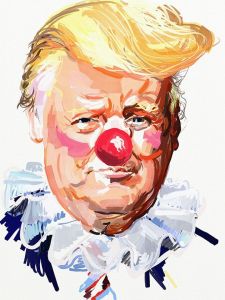
By Eric Fischl
Hello Sky Dancers!!
Dakinikat should be writing this post, but you’re stuck with me. I stayed up till about 2:30 last night doom scrolling and trying to understand what Trump’s tariff madness has done to us. The latest disaster last night was that the bond market is collapsing.
I’ll do my best to post relevant stories, and perhaps Dakinikat will chime in later. Thanks to Trump’s insanity, we could end up in another financial crisis comparable to the one in 2008.
What’s happening with tariffs:
There’s even more insane news this morning: China responded to Trump’s 104 percent tariff threat with another 84% tariff on the U.S.
CNBC: China slaps 84% retaliatory tariffs on U.S. goods in response to Trump.
China has pushed back again on U.S. President Donald Trump’s tariff policies by hiking its levies on U.S. imports to more than 80%.
Tariffs on U.S. goods entering China will rise to 84% from 34% starting April 10, according to a translation of a Office of the Tariff Commission of the State Council announcement. The hike comes in response to the latest U.S. tariff increase on Chinese goods to more than 100% that began at midnight.
The tit-for-tat escalation of tariffs threatens to crush trade between the world’s two largest economies. According to the Office of the U.S. Trade Representative, the U.S. exported $143.5 billion of goods to China in 2024, while importing products worth $438.9 billion.
The Trump administration announced a sweeping new tariff policy last week, warning other countries not to retaliate. Some nations, including Japan, have seemed willing to negotiate on tariffs, but China appears to be taking a more hard-line stance and quickly announced a countertariff.
After China’s initial response to the April 2 tariff rollout, Trump announced an additional 50% hike, putting the total level for import taxes on Chinese goods at 104%….
The trade war has spooked investors around the world by increasing the odds of slower economic growth, higher inflation and lower corporate profits, sparking a sharp sell-off in April.
The S&P 500 finished Tuesday down nearly 20% from its peak, putting the U.S. large-cap stock index in a bear market. South Korea’s Kospi Index fell into a bear market of its own on Wednesday. Stocks in Shanghai and Hong Kong are also down sharply since the U.S. tariff announcement on April 2.
David Pierson and Barry Wang at The New York Times: For U.S. and China, a Risky Game of Chicken With No Off-Ramp in Sight.
A whopping increase in tariffs, followed by a whopping retaliation. Nationalist Chinese bloggers comparing President Trump’s levies to a declaration of war. China’s Foreign Ministry vowing that Beijing will “fight to the end.”
For years, the world’s two biggest powers have flirted with the idea of an economic decoupling as tensions between them have risen. The acceleration this week of their trade relationship’s deterioration has made the prospect of such a divorce seem closer than ever.
That was underscored on Wednesday when China announced an additional 50 percent tariff on U.S. goods, matching new American levies that had taken effect hours earlier. China also struck at American companies, imposing export controls on a dozen of them and adding six others to a list of “unreliable entities,” preventing them from doing business in China.
China’s new tariffs, which will take effect on Thursday, mean all American goods shipped to China will face an additional 85 percent import tax. The minimum U.S. tax on Chinese imports is now 104 percent. Both figures would have been unimaginable a few weeks ago.
With China’s top leader, Xi Jinping, and Mr. Trump locked in a game of chicken — each unwilling to risk looking weak by making a concession — the trade fight could spiral even further out of control, inflaming tensions over other areas of competition like technology and the fate of Taiwan, the self-governing island claimed by Beijing.
Mr. Trump’s bare-knuckle tactics make him a singular force in U.S. politics. But in Mr. Xi, he faces a hardened opponent who survived the turmoil of China’s late-20th-century political purges, and who views the United States’ competitive tactics as ultimately aimed at subverting the ruling Communist Party’s legitimacy.
“Trump has never gone into a back-alley brawl where the other side is willing to brawl and use the same kind of tactics as him,” said Scott Kennedy, a senior adviser at the Center for Strategic and International Studies, a Washington think tank. “For China, this is about their sovereignty. This is about the Communist Party’s hold on power. For Trump, it might just be a political campaign.”
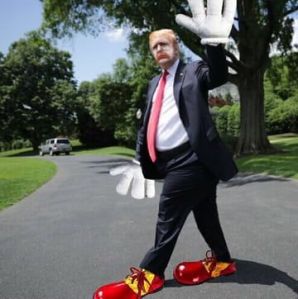 From what I’m hearing and reading, this is going to hit U.S. small businesses hard, drive many of them into bankruptcy, and send their employees to the unemployment lines.
China isn’t the only country that’s retaliating.
Politico: EU takes revenge on Trump’s tariffs as countries approve €20B+ retaliation.
BRUSSELS — The EU can apply retaliatory tariffs on nearly €21 billion of U.S. products like soybeans, motorcycles and orange juice after the bloc’s 27 countries assented to the measures on Wednesday, the European Commission announced.
“The EU considers U.S. tariffs unjustified and damaging, causing economic harm to both sides, as well as the global economy. The EU has stated its clear preference to find negotiated outcomes with the U.S., which would be balanced and mutually beneficial,” the EU executive said in a statement.
Hitting back against U.S. President Donald Trump’s steel and aluminum tariffs, the European Union’s countermeasures will apply in three rounds. Measures covering €3.9 billion in trade will go into force next week, with a further €13.5 billion from mid-May and a final round of €3.5 billion following in December.
Only Hungary opposed the package, according to four EU diplomats with direct knowledge of the vote, while all other 26 countries voted in favor….
The retaliation does not yet respond to Trump’s imposition of 20 percent “reciprocal” tariffs on all EU exports, which came into force on Wednesday, and his latest 25 percent tariff on cars. Trump has also said tariffs on pharmaceuticals are coming soon.
The European Commission is considering putting forward its countermeasures on those tariffs as early as next week. “It will for sure be soon. I expect it could be as early as next week,” trade spokesperson Olof Gill said Tuesday.
What’s happening with the bond markets:
Felix Salmon at Axios: The bond market plunges as crisis brews.
The price of U.S. Treasury bonds is plunging, in what Treasury Secretary Scott Bessent on Wednesday called “deleveraging convulsions.” The effect is to raise borrowing costs just as recession fears spike.
Why it matters: The last thing America needed in the midst of a global trade war and a stock-market meltdown was a debt crisis too. But that now seems to be a real possibility.
What they’re saying: “This is the script for a truly existential financial crisis,” writes Columbia economic historian Adam Tooze, who wrote a whole book on the very similar dynamics that overtook the Treasury market in March 2020.
Driving the news: Bond yields — which move in the opposite direction to prices — are soaring in the wake of protectionist U.S. tariffs.
- The amount that the U.S. government needs to pay to borrow money for a decade rose briefly to more than 4.5% Wednesday morning. For a 30-year bond, the yield rose to more than 5%.
- Those moves are truly enormous by bond market standards. As recently as Friday, the 10-year yield was less than 4%, and the 30-year was below 4.4%.
The intrigue: In normal times, the most consistent buyer of Treasury bonds is a group of hedge funds that participate in something called the “basis trade.”
- They buy the bonds in order to hedge their derivatives exposure to institutional investors, who can lock in slightly higher yields in the futures market.
- The profit on any given trade is minuscule, but it’s also very close to risk-free, so the hedge funds can apply as much as 50x or even 100x leverage.
- By many accounts, the basis trade is now unwinding, which means the hedge funds are selling their bonds — or, at the very least, not buying new ones.
The big picture: In a move reminiscent of the bond-market tantrum that swept U.K. Prime Minister Liz Truss from office in 2022, the technical factors in the bond market were precipitated by — and also exacerbated — fundamental issues with the country’s finances.
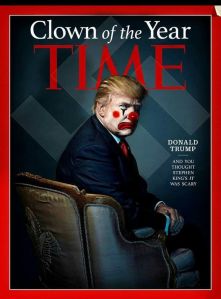 More from Philip Inman and Jasper Jolly at The Guardian: Dramatic sell-off of US government bonds as tariff war panic deepens.
US government bonds, traditionally seen as one of the world’s safest financial assets, are undergoing a dramatic sell-off as Donald Trump’s escalation of his tariff war with China sends panic through all sectors of the financial markets.
The falls suggest that as Trump’s fresh wave of tariffs on dozens of economies came into force, including 104% levies against Chinese goods, investors are beginning to lose confidence in the US as a cornerstone of the global economy.
The yield – or interest rate – on the benchmark 10-year US Treasury bond rose by 0.16 percentage points on Wednesday to 4.42%, its highest since late February – and this week has undergone the three biggest intraday moves since Trump was elected in November. Yields move inversely to prices, so surging yields mean falling prices as demand drops.
The move in the 30-year bond was more dramatic. The 30-year yield briefly jumped above 5% to its highest since late 2023 and was last trading at 4.9157%, or 0.2 percentage points higher than Tuesday.
“This is a fire sale of Treasuries,” said Calvin Yeoh, portfolio manager at the hedge fund Blue Edge Advisors. “I haven’t seen moves or volatility of this size since the chaos of the pandemic in 2020,” he told Bloomberg.
Analysts believe the US Federal Reserve may need to step in. Jim Reid, at Deutsche Bank, said: “Markets are pricing a growing probability of an emergency [interest rate] cut, just as we saw during the Covid turmoil and the height of the GFC [global financial crisis] in 2008.” [….]
UK bonds were also under severe pressure after the US moves. The yield on a 30-year UK gilt hit 5.518% on Wednesday morning, up 16 basis points and surpassing a previous 27-year high of 5.472% set in January.
Shorter-dated 10-year gilt yields were slightly higher at 4.69% while two-year yields ticked down at 3.92%.
Higher yields on gilts – UK government bonds – will make things even more difficult for Downing Street, as it will raise the cost of borrowing to fund investment.
Colby Smith at The New York Times (gift link): U.S. Bond Sell-Off Raises Questions About ‘Safe Haven’ Status.
A sharp sell-off in U.S. government bond markets has sparked fears about the growing fallout from President Trump’s sweeping tariffs and retaliation by China, the European Union and others, raising questions about what is typically seen as the safest corner for investors to take cover during times of turmoil.
Yields on 10-year Treasuries — the benchmark for a wide variety of debt — shot 0.2 percentage points higher on Wednesday, to 4.45 percent, a big move in that market. Just a few days ago, it had traded below 4 percent. Yields on the 30-year bond rose significantly as well, at one point on Wednesday topping 5 percent. Borrowing costs globally have also shot higher.
The sell-off comes as investors have fled riskier assets globally in what some fear has parallels to what became known as the “dash for cash” episode during the pandemic, when the Treasury market broke down. The recent moves have upended a longstanding relationship in which the U.S. government bond market serves as a safe harbor during times of stress.
Volatility has surged as stock markets have plummeted amid fears that the U.S. economy is hurtling toward stagflation, in which economic growth contracts while inflation surges. The S&P 500 is now on the verge of entering a bear market, meaning it has dropped 20 percent from its recent high.
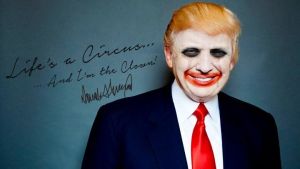 The global safe-haven:
“The global safe-haven status is in question,” said Priya Misra, a portfolio manager at JPMorgan Asset Management. “Disorderly moves have happened this week because there is no safe place to hide.”
Scott Bessent, the U.S. Treasury secretary, sought to tamp down concerns on Wednesday, brushing off the sell-off as nothing more than investors who bought assets with borrowed money having to cover their losses.
“I believe that there is nothing systemic about this — I think that it is an uncomfortable but normal deleveraging that’s going on in the bond market,” he said in an interview with Fox Business.
But the moves have been significant enough to raise broader concerns about how foreign investors now perceive the United States, after Mr. Trump decided to slap onerous tariffs on nearly all of its trading partners. Some countries have sought to strike deals with the administration to lower their tariff rates. But China retaliated on Wednesday, announcing an 84 percent levy on U.S. goods after Mr. Trump raised the tariff rate on Chinese goods to 104 percent.
In a social media post on Wednesday, the former U.S. Treasury secretary Lawrence H. Summers said the broader sell-off suggested a “generalized aversion to US assets in global financial markets” and warned about the possibility of a “serious financial crisis wholly induced by US government tariff policy.”
Some analysis and commentary on what’s happening:
Heather Cox Richardson at Letters from an American: April 8, 2025.
Stocks were up early today as traders put their hopes in Treasury Secretary Scott Bessent’s suggestion that the Trump administration was open to negotiations for lowering Trump’s proposed tariffs. But then U.S. Trade Representative Jamieson Greer said there would not be exemptions from the tariffs for individual products or companies, and President Donald J. Trump said he was going forward with 104% tariffs on China, effective at 12:01 am on Wednesday.
Markets fell again. By the end of the day, the Dow Jones Industrial Average had fallen by another 320 points, or 0.8%, a 52-week low. The S&P 500 fell 1.6% and the Nasdaq Composite fell 2.2%.
Rob Copeland, Maureen Farrell, and Lauren Hirsch of the New York Times reported today that over the weekend, Wall Street billionaires tried desperately and unsuccessfully to change Trump’s mind on tariffs. This week they have begun to go public, calling out what they call the “stupidity” of the new measures. These industry leaders, the reporters write, did not expect Trump to place such high tariffs on so many products and are shocked to find themselves outside the corridors of power where the tariff decisions have been made.
Elon Musk is one of the people Trump is ignoring to side with Peter Navarro, his senior counselor for trade and manufacturing. Navarro went to prison for refusing to answer a congressional subpoena for information regarding Trump’s attempt to overturn the 2020 presidential election. Since Musk poured $290 million into getting Trump elected in 2024 and then burst into the news with his “Department of Government Efficiency,” he has seemed to be in control of the administration. But he has stolen the limelight from Trump, and it appears Trump’s patience with him might be wearing thin.
Elizabeth Dwoskin, Faiz Siddiqui, Pranshu Verma, and Trisha Thadani of the Washington Post reported today that Musk was among those who worked over the weekend to get Trump to end his new tariffs. When Musk failed to change the president’s mind, he took to social media to attack Navarro personally, saying the trade advisor is “truly a moron,” and “dumber than a sack of bricks.”
Read the rest at the Substack link above.
David E. Sanger at The New York Times (gift link): An Experiment in Recklessness: Trump as Global Disrupter.
As the breadth of the Trump revolution has spread across Washington in recent weeks, its most defining feature is a burn-it-down-first, figure-out-the-consequences-later recklessness. The costs of that approach are now becoming clear.
Administration officials knew the markets would dive and other nations would retaliate when President Trump announced his long-promised “reciprocal” tariffs. But when pressed, several senior officials conceded that they had spent only a few days considering how the economic earthquake might have second-order effects.
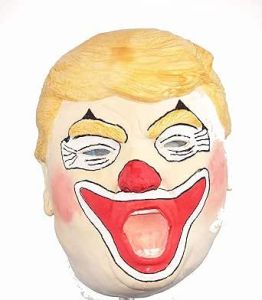
Trump clown mask
And officials have yet to describe the strategy for managing a global system of astounding complexity after the initial shock wears off, other than endless threats and negotiations between the leader of the world’s largest economy and everyone else.
Take the seemingly unmanaged escalation with China, the world’s second largest economy, and the only superpower capable of challenging the United States economically, technologically and militarily. By American and Chinese accounts, there was no substantive conversation between Mr. Trump and China’s top leader, Xi Jinping, or engagement among their senior aides, before the countries plunged toward a trade war.
Last Wednesday, Mr. Trump’s hastily devised formula for figuring out country-by-country tariffs came up with a 34 percent tax on all Chinese goods, everything from car parts to iPhones to much of what is on the shelves at Walmart and on Amazon’s app.
When Mr. Xi, predictably, matched that figure, Mr. Trump issued an ultimatum for him to reverse the decision in 24 hours — waving a red flag in front of a leader who would never want to appear to be backing down to Washington. On Wednesday, the tariff went to 104 percent, with no visible strategy for de-escalation.
If Mr. Trump does get into a trade war with China, he shouldn’t look for much help from America’s traditional allies — Japan, South Korea or the European Union — who together with the United States account for nearly half of the world economy. All of them were equally shocked, and while each is negotiating with Mr. Trump, they seem in no mood to help him manage China.
“Donald Trump has launched a global economic war without any allies,” the economist Josh Lipsky of the Atlantic Council wrote on Tuesday. “That is why — unlike previous economic crises in this century — there is no one coming to save the global economy if the situation starts to unravel.”
The global trading system is only one example of the Trump administration tearing something apart, only to reveal it has no plan for how to replace it.
Read the rest at the NYT.
Andrew Egger at The Bulwark: A Microwaved Mind.
There’s a paradox to covering Donald Trump these days. On the one hand, he’s never out of the news—a wannabe dictator busy remaking the government and the economy so that more and more decisions about our futures answer only to his whim. On the other hand, there’s so much news about what he’s doing that it’s easy to reduce our thinking about Trump to the sum of his actions. There’s Trump the bundle of bad policy ideas, Trump the destroyer of institutions, Trump the fountain of post-truth grievance. It’s hard to take the time to dwell on the man himself—to focus our attention on Donald Trump the clown.
Yesterday afternoon, as markets continued crashing and with the further implementation of backbreaking tariffs just hours away, the clown was on full display. Trump participated in the ceremonial signing of an executive order on “unleashing American energy.” In the East Room event, he was in his element: coal miners in hard hats behind him, an audience crammed with his political flunkies in front. He ended up riffing for about 45 minutes. Let’s listen in, shall we? [….]
The topic du jour, of course, was energy, specifically the “beautiful clean coal” that Trump loves so much. Trump riffed at length on the supposed stupidity of proposals to retrain miners for skilled labor in other industries, reminiscing his 2016 campaign against Hillary Clinton:
“One thing I learned about the coal miners . . . You could give them a penthouse on Fifth Avenue and a different kind of a job and they’d be unhappy. Coal mining is what they love to do,” Trump said. “And she was gonna put them in a high-tech industry, to make little cell phones, I don’t know. Do you think you’d be good at that? I don’t know.”
Anyway, no need for any of that now, the president exulted: “We’re gonna be crushing Biden-era environmental restrictions. . . . And we have clean air and clean water and now we have clean coal. And at the same time we’re gonna do other things and forms of technology and also energy, like our country has never seen before.”
On his tariffs:
Trump didn’t totally avoid talk of the market crash he kicked off last week—a “whole situation,” he noted, that “was somewhat explosive.”
But, Trump added, you should see the response we’re getting! “We have had talks with many, many countries. . . . And our problem is, we can’t see that many that fast. But we don’t have to because, you know, the tariffs are on, and money is pouring in at a level that we’ve never seen before.”
How much money are we talking? “We’re taking in almost $2 billion a day in tariffs,” Trump said. “America is gonna be very rich again very soon.”
Got all that? Yes, markets are tanking because of the tariffs. But not to worry: We’re going to strike great deals to replace them soon. But not too soon, because we don’t have time to deal with all these countries at once. But that’s okay, because look at how much money these tariffs are making us!
That’s it for me. I’ve learned a lot and I plan to continue studying this stuff. I expect Daknikat with have a lot to say on Friday. For now, hang in there everyone and take care of yourselves.
Did you like this post? Please share it with your friends:
Posted: April 5, 2025 | Author: bostonboomer | Filed under: cat art, caturday, Donald Trump, U.S. Economy | Tags: destruction of scientific research, Hands Off rallies, insanity, polls, Stock Market, tariffs, Trump decision-making |

By Linda Benton
Good Afternoon!!
The news is mostly awful today. If you think too much about what is happening, you’ll sink into depression and despair. I heard a woman on TV (I can’t remember her name, unfortunately) argue that Trump wants to return to the world of his childhood–the 1950s. But there is simply no way to do that. We are no longer an industrial society and we aren’t going to return to being one. We are no longer a segregated society either. Trump can’t rid public life of Black people, women, and immigrants. It’s not going to happen. But he is going to keep trying, because he is certifiably insane. The Republicans could stop him but they won’t, because they are terrified and they are cowards.
I’m going to begin with one bit of good news. Today, Americans with gather to fight back against Trump and Musk and their efforts to destroy our government and turn most of us into serfs.
AP: ‘Hands Off!’ protests against Trump and Musk are planned across the US.
Opponents of President Donald Trump and billionaire Elon Musk plan to rally across the U.S. on Saturday to protest the administration’s actions on government downsizing, the economy, human rights and other issues.
More than 1,200 “Hands Off!” demonstrations have been planned by more than 150 groups, including civil rights organizations, labor unions, LBGTQ+ advocates, veterans and elections activists. The protests are planned for the National Mall in Washington, D.C., state capitols and other locations in all 50 states.
Protesters are assailing the Trump administration’s moves to fire thousands of federal workers, close Social Security Administration field offices, effectively shutter entire agencies, deport immigrants, scale back protections for transgender people and cut federal funding for health programs.
Musk, a Trump adviser who owns Tesla, SpaceX and the social media platform X, has played a key role in government downsizing as the head of the newly created Department of Government Efficiency. He says he is saving taxpayers billions of dollars.
Asked about the protests, the White House said in a statement that “President Trump’s position is clear: he will always protect Social Security, Medicare, and Medicaid for eligible beneficiaries. Meanwhile, the Democrats’ stance is giving Social Security, Medicaid, and Medicare benefits to illegal aliens, which will bankrupt these programs and crush American seniors.”
No, asshole. That’s not “Democrat’s stance.”
Before I get going with the rest of today’s news, I want to highlight this piece by JV Last at The Bulwark from a couple of days ago: The American Age Is Over. The United States commits imperial suicide.
Fittingly, it was the Canadian prime minister, Mark Carney, who declared the official time of death.
“The global economy is fundamentally different today than it was yesterday. The system of global trade anchored on the United States, that Canada has relied on since the end of the Second World War—a system that, while not perfect, has helped to deliver prosperity for our country for decades—is over.
Our old relationship of steadily deepening integration with the United States is over.
The eighty-year period when the United States embraced the mantle of global economic leadership—when it forged alliances rooted in trust and mutual respect, and championed the free and open exchange of good and services—is over.
While this is a tragedy, it is also the new reality.”

By Stephanie Lambourne
And just like that, the age of American empire, the great Pax Americana, ended.
We cannot overstate what has just happened. It took just 71 days for Donald Trump to wreck the American economy, mortally wound NATO, and destroy the American-led world order.
He did this with the enthusiastic support of the entire Republican party and conservative movement.
He did it with the support of a plurality of American voters.
He did not hide his intentions. He campaigned on them. He made them the central thrust of his election. He told Americans that he would betray our allies and give up our leadership position in the world.
There are only three possible explanations as to why Americans voted for this man:
- they wanted what he promised;
- they didn’t believe what he promised; or
- they didn’t understand what he promised.
Pick whichever rationale you want, because it doesn’t matter. Whatever the reason was, it exposed half of the electorate—the 77 million people who voted for Trump—as either fundamentally unserious, decadent, or weak.
And no empire can survive the degeneration of its people….
If, tomorrow, Donald Trump revoked his entire regime of tariffs, it would not matter. It might temporarily delay some economic pain, but the rest of the world now understands that it must move forward without America.
If, tomorrow, Donald Trump abandoned his quest to annex Greenland and committed himself to the defense of Ukraine and the perpetuation of NATO, it would not matter. The free world now understands that its long-term security plans must be made with the understanding that America is a potential adversary, not an ally.
This realization may be painful for Americans. But we should know that the rest of the world understands us more clearly than we understand ourselves.
Vladimir Putin bet his life that American voters would be weak and decadent enough to return Donald Trump to the presidency. He was right.
Please go read the rest at The Bulwark link.
This week, Trump took a wrecking ball to the U.S. economy.
Stephen Rattner at the New York Times: I Watch the Markets for a Living. This Week, Everything Changed.
In the past, the one constituency President Trump has sometimes listened to has been our stock market. Well, it has spoken, falling 10.5 percent in one of the largest two-day stock market swoons in decades.
In the 50 years I have been immersed in markets and economic policy, I have never before witnessed a signature economic policy initiative that was met with such unalloyed criticism. What’s worse, the damage was entirely self-inflicted.

By Stephanie Lambourne
Why such a reaction? One reason the S&P 500 fell was that the tariffs Mr. Trump rolled out were so much greater than investors anticipated. (Give the White House an F for failing to prepare the market for what to expect.) Then on Friday, China announced its own 34 percent tariff on our goods, making it clear that our trading partners were not going to simply give in to Mr. Trump’s demands, as he had suggested they would.
As Mr. Trump was doubling down, asserting that “my policies will never change,” the Federal Reserve chairman, Jerome Powell, was delivering his own bombshell: Given the higher-than-predicted tariffs, higher inflation and slower growth were likely to ensue, he said. That’s drastically different from just a couple of weeks ago, when Mr. Powell called the potential impact of new tariffs on prices “transitory.”
The business community, which by my count heavily supported Mr. Trump in the election five months ago, seems stunned. Few have spoken publicly, but the Business Roundtable, the premier corporate trade association, on Wednesday warned that universal tariffs run “the risk of causing major harm to American manufacturers, workers, families and exporters.”
Privately, several chief executives told me that they recognized that imposing the tariffs, as well as Mr. Trump’s intractable support of them, was a potentially cataclysmic mistake. “Few of us ever imagined he would go this far,” one told me. “He could well bring down the economy and himself.”
A bit more:
The Trump-supporting business leaders I’ve spoken to in the last two days don’t yet regret their votes, mostly because of their intense distaste (if not hatred) for the Biden-Harris administration. And they remain broadly supportive of the efforts by the tech billionaire Elon Musk to reform the federal government, even if they acknowledge that his DOGE team may be going too far in its slashing of spending and personnel.
But I wonder how some other major Trump-supporting leaders whose stock prices have been particularly hard hit now feel, like Stephen Schwarzman, chief executive of Blackstone, the investment group (down 15 percent in two days), and Safra Catz, chief executive of Oracle, the database company (down 12 percent).
Mr. Trump’s actions aren’t the only problem. Almost as important is the lack of clarity as to what policies he is pursuing and why. At times, Mr. Trump implies that the purpose of the tariffs is to bring back manufacturing, which suggests that they will stay in place indefinitely. At other times, he suggests that the goal is to negotiate tariff reductions by other countries (even though much of what Mr. Trump asserts about their tariffs is inaccurate).
The dithering takes a real toll. I see this from my role as a professional investor. How do we evaluate a company that imports goods or engages in international commerce? We seek a lower price, or we grit our teeth, or we pass on the opportunity. As a result, our pace of investing has slowed sharply this year.
And it’s not just us. In the year’s first quarter, the number of newly announced mergers and acquisitions dropped to its lowest level since the financial crisis. “Folks are looking but not pulling the trigger,” one leading investment banker told me. Equity offerings have become similarly challenged; multiple companies planning to go public have postponed their fund-raising since Wednesday.
Aaron Zitner at The Wall Street Journal: Americans Were Souring on Trump’s Economic Plans Even Before Tariff Bloodbath.
Americans elected Donald Trump with a favorable opinion of his economic plans. But his expansive push for tariffs has helped turn that confidence into skepticism, a new Wall Street Journal poll finds.
Tepid support for tariffs through the past year has become disapproval, with 54% of voters opposing Trump’s levies on imported goods, 12 points more than those who support his plans. Three quarters of voters say that tariffs will raise prices on the things they buy, up from 68% who said so in January.

By Lucy Almay Bird
The Journal survey was conducted from March 27 through April 1, when Trump had imposed new tariffs on China and certain goods from Canada, Mexico and elsewhere, but before his announcement Wednesday of a sweeping program of levies on nearly all U.S. trading partners. That announcement shocked America’s trading partners and on Thursday prompted the biggest selloff of U.S. stocks since the early days of the Covid pandemic in 2020. The selloff deepened Friday.
The poll suggests that a president who promised that “tariffs are about making America rich again” is facing unease with his economic leadership, especially over rising prices, the issue that bedeviled Democrats in last year’s election. By 15 percentage points, more voters hold a negative view of Trump’s handling of inflation than a positive one. Negative views of his economic stewardship outweigh positive views by 8 points….
That is a substantial change from late October, when voters by a 10-point margin said they favored rather than opposed Trump’s economic plans. The negative view of tariffs contrasts with earlier Journal surveys that found voters keeping an open mind. In both January and August, before Trump took office and his tariff program became concrete, Journal polls found voters mildly supportive of import levies as a general proposition.
The survey finds the president’s political standing to be resilient in many ways. Some 93% of voters who backed him in November give him favorable job reviews now, suggesting that few are regretting their vote. Majorities approve of his handling of immigration and border security….
Still, the survey shows the political gamble Trump has taken by using America’s muscle to try to reshape the global trading system. Voters are evenly split on whether they believe Trump’s promise that short-term economic “disruption” caused by tariffs, as he put it, will help American workers and companies by forcing other nations to lower their own trade barriers and prompting manufacturers to make more goods in the U.S.
I don’t know how people who aren’t super-rich can support what Trump is doing. I have to believe that these people are either stupid or not paying attention.
On Trump’s Insanity:
Daniel Drezner at Drezner’s World: There Are No Adults in the Room.
On Thursday, as the stock market nosedived from the Trump administration’s stupid, unthinking, destructive, error-ridden tariff policies, a respected reporter from a well-known media outlet pinged me for an interview. The journalist was interested in the roles that Treasury Secretary Scott Bessent and Commerce Secretary Howard Lutnick might have played in the formulation of Trump’s foreign economic policy.

Sardines, by Jennifer Pease
As we started talking, I realized that the reporter and I were starting from rather different premises. The reporter was thinking about the story as how one would cover a significant policy pronouncement in a normal administration: Who is the president listening to on policy? What are the possible faultlines within the administration? Who are the key power brokers? What was their decision-making process?
And I was thinking: there was no process. There are no power brokers. On questions of trade, there’s Donald Trump’s whims, his collection of clown car enablers, and maybe an intern who plugs some things into ChatGPT. That’s pretty much it.
I know why both of us were thinking the way we were. For reporters, looking for power brokers makes sense even when even when the policies themselves seem inexplicable. Bad policy outcomes can nonetheless be explained by rational actors pursuing their interests. Maybe it’s the result of powerful interest groups pushing their narrow interests. On occasion, bureaucratic politics are responsible. Sometimes bad policies are the result of powerful ideas that percolate within particular groups — you know, ideas like “risk assessment is bad” or “democracy is overrated.” This is slightly more unusual but it’s certainly conceivable….
As someone who has studied Donald Trump’s decision-making style at great length, however, I come at questions about Trump’s second-term advisors from a different perspective. The key to understanding Trump’s second term is to understand three basic premises:
- Trump has eliminated all executive branch guardrails;
- Trump has appointed only sycophants to serve him this time around;
- Trump’s policy instincts are the most immature, retrograde opinions out there.
Drezner refers readers to this Washington Post story by Natalie Allison, Jeff Stein, Cat Zakrzewski, and Michael Birnbaum: Inside President Trump’s whirlwind decision to upend global trade.
Not long after President Donald Trump’s inauguration, the administration’s economic staff went to work on a daunting task: determining tariff rates for dozens of countries to fulfill the president’s campaign pledge of imposing “reciprocal” trade barriers.
After weeks of work, aides from several government agencies produced a menu of options meant to account for a wide range of trading practices, according to three people familiar with the matter.
Instead, Trump personally selected a formula that was based on two simple variables — the trade deficit with each country and the total value of its U.S. exports, said two of the people, who spoke on the condition of anonymity to recount internal talks. While precisely who proposed that option remains unclear, it bears some striking similarities to a methodology published during Trump’s first administration by Peter Navarro, now the president’s hard-charging economic adviser. After its debut in the Rose Garden on Wednesday, the crude math drew mockery from economists as Trump’s new global trade war prompted a sharp drop in markets.
The president’s decision to impose tariffs on trillions of dollars of goods reflects two key factors animating his second term in office: his resolve to follow his own instincts even if it means bucking long-standing checks on the U.S. presidency, and his choice of a senior team that enables his defiance of those checks.
Inside and outside the White House, advisers say Trump is unbowed even as the world reels from the biggest increase in trade hostilities in a century. They say Trump is unperturbed by negative headlines or criticism from foreign leaders. He is determined to listen to a single voice — his own — to secure what he views as his political legacy. Trump has long characterized import duties as necessary to revive the U.S. economy, at one point calling tariffs “the most beautiful word in the dictionary.”
There simply isn’t any method to his madness.
At Liberal Currents, Alan Elrod writes about Trump and RFK Jr. destroying American scientific research: You’re Not Crazy. America Has Gone Mad.
“Never has our future been more unpredictable, never have we depended so much on political forces that cannot be trusted to follow the rules of common sense and self-interest—forces that look like sheer insanity, if judged by the standards of other centuries.”
This is an oft-quoted passage from Hannah Arendt’s The Origins of Totalitarianism. And it’s one that has proven especially popular in the years since the rise of Trump and explosion of global authoritarianism.

Sanctuary, Lucy Almay Bird
I open with it here because I want to offer an extended reflection on what it feels like to be trapped inside the sort of madhouse she describes. Because I think sheer insanity now rules America. We have gone mad, and the consequence is that sanity now feels itself like a disorder.
We aren’t the first society to come unglued. We almost certainly will not be the last. But right now, each day in America for those of us who do not favor the president or hold to the MAGA worldview feels like we have been sent to some dilapidated asylum by mistake, like the protagonist of a pulp thriller.
Nothing is working as it should. No one is speaking in sentences that add up to anything sensible.
We are throwing the most advanced health science research system into the sea and have turned over our public health infrastructure to quacks and crooks. We are destroying our prosperity to sate the president’s desire to play at 19th century political economy. We are blithely ignoring the potential for war with former allies as Trump crows about annexing Canada and Greenland.
In a rational world, we would already have seen markets balk at Trump’s trade policies, investigations into the mismanagement of our health services, and impeachment proceedings against a man who continues to menace treaty allies for nothing but personal ego.
But it isn’t a rational world, at least not this American corner of it. And so I want to explore madness as the ordering principle of American life by looking at some of the key sites of breakdown. There is nothing curative in this essay, but diagnosis is a first step. And our symptoms are many.
On RFK Jr.’s wrecking ball:
How did a man who admitted he has brain damage from a worm and who has spent decades spreading deadly disinformation about the efficacy of modern medicine become the head of our nation’s health services?
RFK Jr. has done what we all knew he would do. On Tuesday, mass layoffs gutted HHS, threatening everything from the CDC to the FDA to programs like Meals on Wheels.
These are moves that will make Americans less safe and healthy. Our food will be more dangerous. Diseases we might have cured in the not-so-distant future will go under-researched for years. Loved ones will get sick and die. And medicine that should have been available will be stuck in an understaffed and underfunded regulatory pipeline.
Before this, he had already driven out some of HHS’s top scientists, who have warned about the damage his views on healthcare and medical research will do. Under his watch, measles has killed two Americans, and numerous children have been diagnosed with Vitamin A toxicity after their parents followed Kennedy’s recommendation that it be used as a treatment.
Kennedy’s beliefs on medicine and health are bizarre, conspiratorial, and, in some cases, simply hateful.
Read specific examples at the link.
More stories to check out today:
Politico: ‘Everyone is terrified’: Business and government officials are afraid to cross Trump on tariffs.
The New York Times: Senate Approves G.O.P. Budget Plan After Overnight Vote-a-Thon.
The Guardian: I was a British tourist trying to leave America. Then I was detained, shackled and sent to an immigration detention centre.
The New York Times: Trump Weakens U.S. Cyberdefenses at a Moment of Rising Danger.
Greg Sargent at The New Republic: Obama’s Blistering New Takedown of Trump Gives Dems a Way Forward.
The New York Times: These Are the 381 Books Removed From the Naval Academy Library.
Politico: RFK Jr. said HHS would rehire thousands of fired workers. That wasn’t true.
That’s all I have for you today. What’s on your mind?
Did you like this post? Please share it with your friends:
Posted: April 7, 2018 | Author: bostonboomer | Filed under: Afternoon Reads, Foreign Affairs, U.S. Politics | Tags: China, Donald Trump, information overload, James Mattis, John Bolton, John Kelly, Stock Market, Syria, tariffs, trade war |

Woman Reading by a Window Gari Melchers – circa 1905
Good Afternoon!!
I’ve been trying to find out where Trump is this weekend. I haven’t heard anything about him going to Florida, and I’m afraid that may mean there will be more chaos in the White House over the weekend. Will Scott Pruitt lose his job? Or will Trump really try to use him to replace Jeff Sessions? Is Trump really preparing to talk to Robert Mueller, as CNN reports?
Exclusive: Trump begins informal prep for potential Mueller interview.
President Donald Trump has begun the initial steps of preparing for a possible interview with the special counsel, a White House official and a person familiar with the situation said Friday, a sign the President’s legal team is intensifying its deliberations over whether to allow him to come under Robert Mueller’s questioning.
One source familiar with the proceedings stressed the preparation efforts is “in its infancy.”
The preparations have been short and informal and included going over potential topics with the President that Mueller would likely raise in an interview, the people said.
The President has not formally agreed to sit for an interview with Mueller.
But word of early preparations is the clearest sign yet that Trump and his team remain open to an interview with Mueller, despite concerns from some people close to the President that such an interview could expose him to possible charges of perjury.
According to Tina Nguyen at Vanity Fair, Trump is now targeting one of his last “adult” advisers: Running Out of Punching Bags, Trump Turns on Mattis.

Drinking Coffee And Reading In The Garden Painting by Edward Killingworth Johnson
Until recently, Donald Trump’s campaign to purge naysayers had spared the Pentagon. In the absence of more proximate targets, however, it appears the president has turned his attention to foreign policy, jeopardizing his relationship with perhaps his only remaining sane adviser. Indeed, in the past week, Trump has made James Mattis’s job nearly impossible by declaring that he would send the military to guard the border with Mexico (the White House later clarified that he meant the National Guard), and insisting that the U.S. pull out of Syria (something Mattis promised last year would not happen), leading to a spectacular showdown on Tuesday, when the conflict between Trump and his generals reportedly boiled over during a meeting of top aides in the Situation Room.
According to the Associated Press, Mattis argued “that an immediate withdrawal” from Syria “could be catastrophic and was logistically impossible to pull off in any responsible way,” and offered a one-year timeline as an alternative—to which Trump responded that five or six months ought to do the trick, and “indicated that he did not want to hear in October that the military had been unable to fully defeat the Islamic State and had to remain in Syria for longer.” A person familiar with the meeting told CNN that attendees left Tuesday’s meeting “beside themselves,” arguing that Trump’s lack of desire to put together any sort of recovery plan for Syria—restoring basic needs such as water, power, and roads—would most certainly tip the country back into ISIS’s hands. “It is a huge gamble that ISIS is not going to come back and that we are going to rely on others to stabilize Syria,” an official said.
The same official noted the hypocrisy in Trump’s choice: “The president blasted Obama for a timeline in Iraq, but that is in essence what we have been given.”
From the AP article:
It wasn’t the result top national security aides wanted. Trump’s desire for a rapid withdrawal faced unanimous opposition from the Joint Chiefs of Staff, the Pentagon, the State Department and the intelligence community, all of which argued that keeping the 2,000 U.S. soldiers currently in Syria is key to ensuring the Islamic State does not reconstitute itself.

Adolfe Monet reading in the garden, by Claude Monet
But as they huddled in the Situation Room, the president was vocal and vehement in insisting that the withdrawal be completed quickly if not immediately, according to five administration officials briefed on Tuesday’s White House meeting of Trump and his top aides. The officials weren’t authorized to discuss internal deliberations and requested anonymity.
If those aides failed in obtaining their desired outcome, it may have been because a strategy that’s worked in the past — giving Trump an offer he can’t refuse — appears to have backfired.
Rather than offer Trump a menu of pullout plans, with varying timelines and options for withdrawing step-by-step, the team sought to frame it as a binary choice: Stay in Syria to ensure the Islamic State can’t regroup, or pull out completely. Documents presented to the president included several pages of possibilities for staying in, but only a brief description of an option for full withdrawal that emphasized significant risks and downsides, including the likelihood that Iran and Russia would take advantage of a U.S. vacuum.
Ultimately, Trump chose that option anyway.
Will Mattis resign if Trump insists on pulling the U.s. military out of Syria? Or will Trump fire him? John Bolton is expected to begin his job as National Security Adviser on Monday. Will he agree with Trump’s newly formed foreign policy?
Chief of Staff John Kelly has also lost influence on the newly “emboldened” Trump according to CBS News: Trump freezes out chief of staff John Kelly, says he’s “tired of being told ‘no.'”
When President Donald Trump made a congratulatory phone call to Russian leader Vladimir Putin, White House chief of staff John Kelly wasn’t on the line. When Mr. Trump tapped John Bolton to be his next national security adviser, Kelly wasn’t in the room.
And when Mr. Trump spent a Mar-a-Lago weekend stewing over immigration and trade, Kelly wasn’t in sight.

Oscar Bluhm In the Pergola, 1892
Kelly, once empowered to bring order to a turbulent West Wing, has receded from view, his clout diminished, his word less trusted by staff and his guidance less tolerated by an increasingly go-it-alone president.
Emboldened in his job, Mr. Trump has rebelled against Kelly’s restrictions and mused about doing away with the chief of staff post entirely. It’s all leading White House staffers and Trump allies to believe that Kelly is working on borrowed time….
Mr. Trump recently told one confidant that he was “tired of being told no” by Kelly and has instead chosen to simply not tell Kelly things at all, according to a person who was not authorized to publicly discuss private conversations and spoke on condition of anonymity.
The stock market isn’t happy with Trump’s push for a trade war. Yahoo News (AP): Stock Market Plummets After Trump Explores $100 Billion in New Chinese Tariffs.
Another increase in trade tensions has stocks falling sharply Friday as the U.S. considers an even larger set of tariffs on imports from China and the two countries exchange pointed statements. Technology companies and banks are taking some of the worst losses.
Stocks have changed direction again and again this week as investors tried to get a sense of whether a trade dispute between the two nations will escalate, an outcome that could have major consequences for the global economy. The market didn’t get any help from a March jobs report that was weaker than expected.
The Dow Jones industrial average fell dropped 581 points, or 2.4 percent, to 23,916 as of 2:15 p.m. Eastern time. Earlier it fell as much as 620 points.
The S&P 500, which many index funds track, lost 53 points, or 2 percent, to 2,608. The Nasdaq composite slid 135 points, or 1.9 percent, to 6,940. The Russell 2000 index of smaller-company stocks dipped 29 points, or 1.9 percent, to 1,513.
The Dow average, which contains numerous multinational companies including industrial powerhouses Boeing and Caterpillar, has swung dramatically this week, with about 1,300 points separating its highest and lowest marks. It fell as much as 758 points Monday, then recovered all of those losses, and late Thursday it was up as much as 519 points for the week. It’s down 0.7 percent for the week.
CNBC: Trump’s tariff gamble with China could be catastrophic for the economy, the GOP — and his own presidency.

Reading in the garden, 1915 – Nikolay Bogdanov-Belsky
Donald Trump has decided to gamble his presidency on the idea that he can threaten big tariffs on China and force the world’s second-largest economy to back down.
If he fails — and the odds are that he will — the fallout from a tariff battle with China could derail an otherwise strong U.S. economy, threaten Republican majorities in the midterm elections and turn the second half of Trump’s first term into a dismal slog to avoid impeachment votes.
So far, the exact scenario that free traders inside the White House and on Capitol Hill feared is playing out. China scoffed at Trump’s initial $50 billion in threatened tariffs and announced their own, aimed directly at Trump’s red-state base with levies on agricultural and manufactured products.
Although Trump has repeatedly bragged about stock market gains since he has been “president,” Bloomberg reports that Trump is now in 8th place in rankings of presidential success with the markets:
The Republican president’s renewed ramblings on trade dominated U.S. equity markets this week, with a tweet-induced swoon on Friday leaving the S&P 500 Index 1.4 percent lower than where it started on Monday. The gauge swung wildly, notching four moves of at least 1 percent in the five days, and the Cboe Volatility Index spiked above 20, nearly double its level for the past year.
All of which has dented Trump’s reputation as the stock market president.
The numbers from Axios:
Dow Jones Industrial Average return, if you invested in that basket of stocks, for a president’s first 444 days (ranked since 1900,) per Bloomberg:
FDR : 70.4%
Reagan: 41.4%
Teddy Roosevelt: 37.4%
Obama: 32.5%
Bill Clinton: 32.2%
George H.W. Bush: 21.4%
Trump: 20.7%
BTW, according to Think Progress, Trump doesn’t want his trade war to interfere with his daughter’s self-dealing: Ivanka Trump’s clothing company will be spared from tariffs, thanks to her dad.
U.S. officials say they used an algorithm to determine which goods to exclude from new tariffs. According to the Washington Post, the list was drafted to achieve “the lowest consumer impact,” ensuring goods like clothing and toys were excluded so as not to raise the cost on domestic consumer goods.

Reading Man in Park — August Macke 1915
Exempting clothing from the tariffs provides a big break to American clothing companies that hold trademarks in China. One of those clothing companies belongs to the First Daughter of the United States, Ivanka Trump.
A recent report by the Huffington Post found that the president’s daughter and closest adviser rakes in a total of $1.5 million a year from the Trump Organization while still working at the White House.
Her dual role as adviser to the president and private business executive has continuously raised ethical red flags. No one can be entirely sure that public policy by this administration isn’t being driven by business motives, or whether countries may pursue business deals with the Trump family as a means to curry political favor with the administration.
Once again, I’ve barely touched on all the important news that has broken over the past couple of days. I’ve reached the point of having to shut down for part of every day, because I’m so overwhelmed. Of course I’m not alone it that. In this vein Brian Klaas asks at The Washington Post: Can democracy survive information overload?
Last month, President Trump floated the idea of executing drug dealers; got sued by a porn star and a Playboy model; repeatedly attacked the FBI, his own attorney general and the Justice Department; instigated a trade war that punished long-standing U.S. allies; explicitly praised authoritarian consolidations of power in China and Egypt; “joked” about becoming “president for life”; congratulated Vladimir Putin on winning a sham election and reportedly invited him to the White House right after Russia’s government allegedly attempted to murder a former spy on the soil of the United States’ closest ally.
He also bullied a journalist for his physical appearance; boasted about making up statistics in meetings with Canada’s government; live-tweeted his favorite TV show; fired his secretary of state on Twitter; lost his Veterans Affairs secretary, national security adviser, chief economic adviser, communications director and a personal aide whose reported gambling habit was deemed a security risk; hired a new national security adviser who has repeatedly called to bomb North Korea and Iran; lashed out at the special counsel, who is investigating the president for potential crimes; and threatened to beat up the former vice president of the United States until he cried.

Woman Reading in a Garden by Harold Harvey
That’s just a small selection of news from March 2018: one crazy month of one crazy presidency.
This inescapable, overwhelming and disorienting flurry of activity, which has become the new normal since Trump’s inauguration, begs two simple but profound questions: Can democracy survive information overload? And can it survive a president who knows how to use the resulting chaos to dodge democratic accountability?
Authoritarian rulers have long understood that controlling and manipulating information are crucial to subverting democracy and getting away with breaking the rules. That’s why dictatorial governments such as China and Russia not only work overtime to control media and censor inconvenient facts but also use troll armies to spew out 24/7 torrents of disinformation. Despite Trump’s obvious envy of such methods, he’s stuck with American democracy, so he has innovated out of necessity. He can’t shut down the press or censor Democrats, but he can blind the American electorate with a steady smokescreen of bewildering stories pouring out of the White House.
From Ronald Reagan to Barack Obama, any one of those stories above would have captivated national attention for weeks, or more likely, months. But with Trump, even the most scandalous topic soon disappears into a never-ending flow of revelations. By the time the morning news shows end, it’s on to the next spectacle of dysfunction. We’re living in a chronic state of whiplash.
Read the rest at the WaPo.
So . . . what stories have you been following?
Did you like this post? Please share it with your friends:
Posted: August 24, 2015 | Author: dakinikat | Filed under: morning reads | Tags: economy, Huckabee, hurricane katrina, New Orleans, Racism, Resilience lab, Stock Market, Trump |
 Good Morning!
Well, today’s the kind’ve day that makes me want to hide under the covers and have my mother do all my laundry and cooking. Well, actually my Dad used to do all the cooking but you know what I mean. It’s been like that for at least a few days as my car’s battery gave out in a very inconvenient location on Thursday night and my bills are bigger than my latest paycheck. A lot of my ennui and accompanying stress has to do with the uberhype of the 10 year anniversary of Hurricane Katrina which for a lot of us is an ongoing process of things becoming more undone than they were before.
Then, there’s just the constant barrage of news–none of which is particularly good–which includes ISIS destroying an ancient wonder. You know what an armchair archaeology buff I am. It’s just so easy to deal with dead civilizations rather than live ones. Trump continues to belittle any one in his path, and every one in the Republican primary is unleashing misogyny and racism. I’m going to focus on the racism today because I think both BB and JJ have given the current misogyny binge complete justice.
My friend Peter has actually written exactly what I’m feeling on this dreadful week where they’re actually pulling out parades and doing “resilience tours” to hype the city and its survival. Like I said, we may have survived Katrina, but I still have my doubts about our surviving the hipsters, the gentrification, and our elected overseers who have forced us to privatize things that weren’t working before but now are worse and to capitalize on things that turn us into a Disaster Minstrel Show. Again, this is not my writing but Peter’s but I could’ve written it word for word except I obviously don’t have his wife!
I am dreading the influx of disaster tourists who will surely be showing up in town this week. Some of them will be sincerely motivated and others will be of the “I volunteered once with Habitat for Humanity after Katrina so I know what it was like” variety. No, you don’t. You don’t know what it’s like to be barred from your home for 6 weeks and have to sneak in like Dr. A and I did. You don’t know what it’s like to have a bad case of survivor’s guilt because you didn’t fare as badly as other people in town. You don’t know what it’s like to have to re-tell your “Katrina story” over and over again. You don’t know what it’s like to be having dinner and have do-gooders burst in to save your pets because you didn’t, or couldn’t, wash the marks off your front door. Actually, neither do I but it happened to some friends of mine. It gives a whole new meaning to the phrase putting on the dog…
The aftermath of the storm was a very painful period in the lives of New Orleanians. We’ve lived it day-in and day-out for 10 years at varying levels of intensity. That’s why I’m not enthusiastic about rehashing those days regardless of whether it’s done by resilience tour types or the krewe of “we’ve gone to hell in a designer handbag.” I wish they’d all piss off and leave me alone. I’m not the only one who feels this way.
Yes. I feel that way. Piss off and leave me alone. Unfortunately, my neighborhood has turned into the mini-Quarter and I can’t even walk the dog around the block or have a beer without either bumping into seven bridesmaids giggling, six film crews taping, and five fucking Air BnB parasites.
This headline from WAPO actually made me scream: A ‘resilience lab’. They’ve obviously bought into the Mayor’s hype. This is the paragraph that’s described my reality. Every day I walk out of my house and feel like screaming “WTF are you doing here? Why don’t you go back to the hell realm you came from instead of bringing it here to me?” No east coast newspaper article on New Orleans is complete these days without telling people that the place to be is my freaking neighborhood, the Bywater. I have fewer and fewer neighbors all the time. My neighborhood has been completely overrun with people hoping to redefine and cash in on cool.
He smiled at first. It looked so charming, all those people driving slowly down Burgundy Street through the Faubourg Marigny and Bywater neighborhoods, pointing cameras.
Then it dawned on Keith Weldon Medley: These folks weren’t tourists or architecture buffs. They were shoppers. And on their shopping list was almost everything that could be had in these neighborhoods, a collection of Creole cottages, shotgun doubles, warehouses and small manufacturers at a humpback bend of the Mississippi River.
In the evolution of post-Katrina New Orleans, few phenomena have been more striking than the dramatic demographic shift of places such as Bywater from majority black to majority white. One census block group in Bywater dropped from 51 percent African American before Katrina to just 17 percent afterward; the largest went from 63 percent to 32, according to a Washington Post analysis of U.S. census data.
“You saw all these white people. Obviously they were displacing black people who were here before,” said Medley, a historian who lives in the house where he grew up in the Marigny.
My daily mantra is “I see fucking stupid White People.”
So, I really don’t intend for this to be my Katrina post. I’ve been there and done that. Let me post a few more things that are pissing me off today.
There’s an obvious asset bubble bubbling away here so the market’s correcting and the Fed is going to start bringing up interest rates. This blog has an interesting take on what’s going on which is particularly relevant to my field of research as a currency bloc and international economist.
Global stock markets are in a 2008ish kind of crash today and I really don’t much time to write this, but I just want to share my take on it.
To me this is fundamentally about the in-optimal currency union between the US and China. From 1995 until 2005 the Chinese renminbi was more or less completely pegged to the US dollar and then from 2005 until recently the People’s Bank of China implemented a gradual managed appreciation of RMB against the dollar.
This was going well as long as supply side factors – the opening of the Chinese economy and the catching up process – helped Chinese growth.
Hence, China went through one long continues positive supply shock that lasted from the mid-1990s and until 2006 when Chinese trend growth started to slow. With a pegged exchange rate a positive supply causes areal appreciation of the currency. However, as RMB has been (quasi)pegged to the dollar this appreciation had to happen through domestic monetary easing and higher inflation and higher nominal GDP growth. This process was accelerated when China joined WTO in 2001.
As a consequence of the dollar peg and the long, gradual positive supply shock Chinese nominal GDP growth accelerated dramatically from 2000 until 2008.
However, underlying something was happening – Chinese trend growth was slowing due to negative supply side headwinds primarily less catch-up potential and the beginning impact of negative labour force growth and the financial markets have long ago realized that Chinese potential growth is going to slow rather dramatically in the coming decades.
As a consequence the potential for real appreciation of the renminbi is much smaller. In fact there might be good arguments for real depreciation as Chinese growth is fast falling below trend growth, while trend itself is slowing.
The market has rebounded but the financial markets are obviously still shaky. China is the world’s largest economy now so anything  that happens there is bound to ripple around the world.
The global whiplash underscored investors’ shaken confidence in China’s slowing economy and central bank. The world’s second-largest economy is now reeling over what China’s state media is calling “Black Monday,” during which its markets just recorded their biggest one-day nosedive in eight years.
But the mid-morning bounce off deep trading lows led some analysts to question whether financial markets had already finished their fall. Tech giant Apple, which begun the morning down 13 percent and dipping below $100, was trading 2 percent higher by the afternoon, at about $107.
The dismal opening marked a worrying continuation of last week’s free fall. The Dow’s blue-chip index plunged more than 500 points on Friday, capping its worst week since 2011 and entering what Wall Street calls a correction, having tumbled 10 percent from its May peak.
The sell-off bruised every industry, wiping out gains in rapid order after a year of mostly steady trading. Some of America’s biggest companies shed tens of billions of dollars in market value in only a few days, and the markets’ early gains have yet to restore those losses.
S&P 500 companies lost more than $1 trillion in market value last week, and the Dow and other indices are on track to record their dreariest month since February 2009.
On Friday, China reported its worst manufacturing results since the global financial crisis, following shortly after Beijing earlier this month surprised investors by announcing it would devalue the nation’s currency.
China’s benchmark Shanghai Composite index has fallen by nearly 40 percent since June, after soaring more than 140 percent last year. Markets in Europe also plummeted, and Asian shares on Monday hit a three-year low.
Economist gadfly and miserable human being Larry Summers is pearl clutching about the rate hikes. He seems to be on a search to be relevant again but on a very wrong path. This article alone ought to make you very glad that he’s not the Fed Chairman since he seems completely oblivious to the asset bubbles that I see in assets around the country including houses once again.
Like most major central banks the Fed has put its price stability objective into practice by adopting a 2 per cent inflation target. The biggest risk is that inflation will be lower than this — a risk that would be exacerbated by tightening policy. More than half the components of the consumer price index have declined in the past six months — the first time this has happened in more than a decade. CPI inflation, which excludes volatile energy and food prices and difficult-to-measure housing, is less than 1 per cent. Market-based measures of expectations suggest that, over the next 10 years, inflation will be well under 2 per cent. If the currencies of China and other emerging markets depreciate further, US inflation will be even more subdued.
Tightening policy will adversely affect employment levels because higher interest rates make holding on to cash more attractive than investing it. Higher interest rates will also increase the value of the dollar, making US producers less competitive and pressuring the economies of our trading partners.
Please check out housing and stock prices Lala and then try again.
Republicans continue to show they have no idea about the reality of black people in this country. Trump attacked Martin O’Malley for sensitivity to the Black Lives Matter Campaign.
Appearing on Fox News over the weekend, Donald Trump admitted to being completely ignorant about the Black Lives Matter movement. “I know nothing about it,” the billionaire real estate developer said.
Of course, his lack of knowledge didn’t prevent him from harshly criticizing the effort. Trump said that he’s “seeing lot of bad stuff about it right now.” He said Martin O’Malley, a contender for the Democratic nomination, was a “disgusting little weak pathetic baby” for apologizing to Black Lives Matter activists earlier this year.
 Huckabee played the MLK card and completely confused King’s Son.
Martin Luther King III, the son of the late civil rights leader, said he was “perplexed” by GOP presidential hopeful Mike Huckabee’s comments last week suggesting that his father would be “appalled” by the Black Lives Matter movement.
“I think dad would be very proud of young people standing up to promote truth, justice and equality,” King said during an interview on SiriusXM radio. “I was perplexed by the comments, but people attempt to use dad for everything.”
King’s comments come in response to a CNN interview last week in which the former Arkansas governor spoke out against the Black Lives Matter movement, saying racism is “more of a sin problem than a skin problem.”
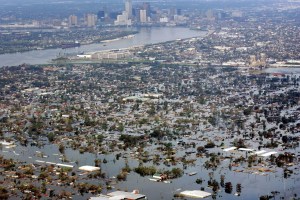
If you look at the picture of flooded New Orleans and the view over the flooded lower ninth ward towards city, you’ll see a cluster of white tallish buildings sitting right on the river in the middle of that photo. Just a hair to the right is where my house still stands and where I’m there right now with a pillow pulled over my head trying to block out the world of adults. I don’t want to be one of them at the moment.
What’s on your reading and blogging list today?
Did you like this post? Please share it with your friends:
Posted: December 23, 2014 | Author: bostonboomer | Filed under: Barack Obama, Foreign Affairs, morning reads, U.S. Economy, U.S. Politics | Tags: "white" Southerners with black ancestors, Christopher Manney, Civil Rights, Department of Justice, Dish Network, DNA, Dontre Hamilton, Fox News, gas prices, GDP growth, internet outage, North Korea, police involved shootings, police unions, Racism, Stock Market |

Good Morning!!
I finally arrived in Boston yesterday after driving for three days. With the days so short, and the nights so dark, I ended up having to stop for the night earlier than I would have in the summer. I was tired last night, but I’m even more exhausted this morning. Everything hurts, and my brain isn’t working properly. I’m supposed to drive up to New Hampshire for Christmas, and I have no idea how I can do that.
I’d like to write a beautifully organized post, but I don’t think I’m capable of it. So here are some news stories that caught my flawed attention this morning.
Another police officer gets away with murder, this time in Milwaukee. From the Journal-Sentinel:
In one of the most highly anticipated legal decisions in recent memory, Milwaukee County District Attorney John Chisholm announced Monday that former Milwaukee police officer Christopher Manney will not be charged in the fatal shooting of Dontre Hamilton at Red Arrow Park.
Chisholm determined that Manney’s use of force was justified self-defense.
Hamilton’s family has repeatedly called for Manney, who has since been fired, to face criminal charges.
Speaking to supporters outside the federal courthouse in Milwaukee, Hamilton’s brother Nathaniel said he and the other family members would not waver in their determination.
“We deserve justice,” he said. “Justice is our right.”
As you’ve probably already guessed, Dontre Hamilton was a black man, and Christopher Manney is white. This is getting to be a regular thing, and it’s really getting old. The police unions can complain all they want. The simple truth is that police officers are killing a hell of a lot of black men.

The NY Daily News reports that the Department of Justice will review the shooting to determine whether Hamilton’s civil rights were violated.
There’s been some pushback on the claims by police unions that protesters of police-involved deaths like those of Michael Brown and Eric Garner and government officials who sympathized with their families are responsible for the recent murders of two NYPD police officers in Brooklyn. Here’s an essay by Kareem Abdul Jabbar in Time Magazine: The Police Aren’t Under Attack. Institutionalized Racism Is.
According to Ecclesiastes, “To every thing there is a season, and a time to every purpose.” For me, today, that means a time to seek justice and a time to mourn the dead.
And a time to shut the hell up.
The recent brutal murder of two Brooklyn police officers, Rafael Ramos and Wenjian Liu, is a national tragedy that should inspire nationwide mourning. Both my grandfather and father were police officers, so I appreciate what a difficult and dangerous profession law enforcement is. We need to value and celebrate the many officers dedicated to protecting the public and nourishing our justice system. It’s a job most of us don’t have the courage to do.
At the same time, however, we need to understand that their deaths are in no way related to the massive protests against systemic abuses of the justice system as symbolized by the recent deaths—also national tragedies—of Eric Garner, Akai Gurley, and Michael Brown. Ismaaiyl Brinsley, the suicidal killer, wasn’t an impassioned activist expressing political frustration, he was a troubled man who had shot his girlfriend earlier that same day. He even Instagrammed warnings of his violent intentions. None of this is the behavior of a sane man or rational activist. The protests are no more to blame for his actions than The Catcher in the Rye was for the murder of John Lennon or the movie Taxi Driver for the attempted assassination of Ronald Reagan. Crazy has its own twisted logic and it is in no way related to the rational cause-and-effect world the rest of us attempt to create.
Those who are trying to connect the murders of the officers with the thousands of articulate and peaceful protestors across America are being deliberately misleading in a cynical and selfish effort to turn public sentiment against the protestors. This is the same strategy used when trying to lump in the violence and looting with the legitimate protestors, who have disavowed that behavior. They hope to misdirect public attention and emotion in order to stop the protests and the progressive changes that have already resulted. Shaming and blaming is a lot easier than addressing legitimate claims.
More at the link.

The Washington Post and Los Angeles Times have each editorialized on the issue.
WaPo: The blame game over police deaths in New York goes too far.
LA Times: Protesters didn’t cause slayings of New York police officers.
The Daily Beast: The NY Police Union’s Vile War with Mayor De Blasio.
And from HuffPo: Police Unions ‘Standing Down’ After Controversial Comments In Wake Of NYPD Shooting.
Despite all the complaints about Obama’s leadership from Republicans, the economy is growing; and wealthy Americans sure seem to be doing okay.
The Hill, GDP grows by 5 percent as US economy picks up strong pace.
The economy grew at a 5 percent rate from July to September, the fastest pace in 11 years.
The strong growth recorded by the Commerce Department adds to the sense that the economy is approaching full speed for the first time since the recession of 2008 — and since President Obama was first elected….
The government found consumer spending grew by 3.2 percent from July to September, compared to 2.5 percent in the previous quarter.
The Commerce Department also shifted its estimate for the second quarter, finding strong growth of 4.6 percent between April and June. That’s up from its previous estimate of 3.9 percent.
Reuters, Dow Tops 18,000 for First Time on Upbeat GDP Report.
The Dow Jones Industrial Average broke through 18,000 for the first time Tuesday, propelled higher by a better-than-expected report on the economy in the third quarter. If the Dow closes above 18,000, it will have taken the index only six months to climb there from 17,000.
It took only seven months to get from 16,000 to 17,000.
The independent living in chula vista has been good news for Americans who own shares, including the wealthy, corporations, financial firms and workers with retirement funds and pensions invested in stocks. For those who don’t own shares, it could mean a widening wealth gap, however.
How much wider can it get?

But there’s also good news for us ordinary folks. From CNN, 89 straight days of lower gas prices.
The streak, the longest on record according to AAA, has shaved nearly $1 off the national average price of regular gas, taking it to $2.38 a gallon for the first time in five years. September 25 was the last day prices were higher for drivers. That day they increased by only a tenth of a cent. Prices have tumbled 36% since the high of the year, which was back in late April.
Not only have they been falling, but the plunge in gas prices has been picking up speed, tumbling nearly 2 cents between Monday and Tuesday.
Prices were 15 cents higher only a week ago and 44 cents higher a month ago. In numerous cities — including Dallas-Fort Worth, Kansas City, Missouri, Tulsa, Oklahoma, and Topeka, Kansas — the average price now stands less than $2 a gallon, according to AAA. Springfield, Missouri became the first state to break the $2 average price last week. Missouri drivers are enjoying the lowest statewide average price at $2.05 a gallon.
The plunging price of oil — a 50% drop off the cost of barrel of crude since April, is the main driver in the gas price slide. But there are many other factors also affecting prices. Weakening economies in Europe and Asia, as well as more fuel efficient vehicles worldwide, have all cut demand for gasoline.
Unfortunately, I can testify that gas prices on the New York Thruway are still very high, with regular priced at close to $3.00 a gallon.

North Korea suffered a major internet breakdown yesterday. Was the NSA responsible? The CIA. If so, good work! From Reuters, North Korea’s Internet links restored amid U.S. hacking dispute.
North Korea, at the center of a confrontation with the United States over the hacking of Sony Pictures, experienced a complete Internet outage for hours before links were restored on Tuesday, but U.S. officials said Washington was not involved.
U.S.-based Dyn, a company that monitors Internet infrastructure, said the reason for the outage was not known but could range from technological glitches to a hacking attack. Several U.S. officials close to the investigations of the attack on Sony Pictures said the U.S. government had not taken any cyber action against Pyongyang.
U.S. President Barack Obama had vowed on Friday to respond to the major cyberattack, which he blamed on North Korea, “in a place and time and manner that we choose.”
Dyn said North Korea’s Internet links were unstable on Monday and the country later went completely offline. Links were restored at 0146 GMT on Tuesday, and the possibilities for the outage could be attacks by individuals, a hardware failure, or even that it was done by North Koreaitself, experts said.
Matthew Prince, CEO of U.S.-based CloudFlare which protects websites from web-based attacks, said the fact that North Korea’s Internet was back up “is pretty good evidence that the outage wasn’t caused by a state-sponsored attack, otherwise it’d likely still be down for the count”.
Almost all of North Korea’s Internet links and traffic pass through China and it dismissed any suggestion that it was involved as “irresponsible”.
So what happened then, I wonder . . . . ?

Here’s a story that should please JJ: Dish Network dumps Fox News, setting off social media war on Facebook.
Satellite-TV provider Dish Network dropped the Fox News Channel and Fox Business Network on Saturday night after the companies couldn’t come to terms on a new distribution contract, reports TVNewser.
According to Fox Executive Vice President of Distribution Tim Carry, contract talks have broken off and nothing is happening, depriving Dish’s 14 million subscribers of Fox News’ “fair and balanced” approach to current event coverage.
“Our phone line is open, we’re willing to talk,” Carry said. “Am I negotiating right now? I’m not.”
Executives at Dish say Fox is playing hardball with them by attempting to use the news channel as leverage to increase fees for their sports and entertainment channels normally covered by separate contracts.
“It’s like we’re about to close on a house and the realtor is trying to make us buy a new car as well,” said Warren Schlichting, Dish Network’s Senior Vice President of programming. “Fox blacked out two of its news channels, using them as leverage to triple rates on sports and entertainment channels that are not in this contract.”
Hahahahaha! The Fox fans in Banjoville must being going nuts. But at least they can watch Turner Classic Movies.

And here’s some even more scary news for racist Southerners. From Raw Story: Southern whites have more black DNA than whites in the rest of US: study.
Some of the states with the most racially charged attitudes towards African-Americans are also the states where the most whites have black ancestors, according to a recently released study.
Researchers examined 145,000 DNA samples provided to genetic testing company 23andme for ancestry analysis to determine that at least six million Americans who called themselves white had 1 percent or more African ancestry.
The study published this month in the American Journal of Human Genetics found that whites in the South were far more likely to have at least 1 percent black ancestry than any other part of the country.
“European Americans with African ancestry comprise as much as 12% of European Americans from Louisiana and South Carolina and about 1 in 10 individuals in other parts of the South,” the authors wrote….
And black Americans living in the South also had more African ancestry than any other region of the country. African-Americans in West Virginia and Oregon had the lowest percentage of African ancestry.
So . . . . what stories are you following today? Please post your thoughts and links in the comment thread and have a terrific Tuesday!
Did you like this post? Please share it with your friends:


 peej
peej Carissa
 bostonboomer
 dakinikat
 ecocatwoman
 mablue2
 Mama Lopez
 peggysue22
 quixote
 skydancingguestblogger
 Mona (aka Wonk the Vote)



 Sky Dancing
Recent Comments