
Monday Reads
Posted: July 7, 2014 Filed under: Barack Obama, morning reads, U.S. Economy, U.S. Politics | Tags: Bill Moyers, child sexual abuse, Constitutional originalism, Down's syndrome in history, E.J. Dionne, economic inequality, Glory Kathurima, Jill Lepore, Joseph Fishkin, Malaika Kathurima, Norfolk NE July 4 parade, oligarchy, pedophile priests, Pope Francis, Racism, Tea Partiers, U.S. Constitution, William E. Forbath 26 Comments
Good Morning!!
Today is another slow news day, and that could be bad news for some folks in Norfolk, Nebraska. Dakinikat alerted us to the story yesterday, and now it’s in the process of going viral. So far the headlines on the story seem highly understated. From the Lincoln Journal-Star: Obama float at Norfolk parade sparks controversy.
It was the parade float that elicited the loudest cheers Friday at Norfolk’s Fourth of July parade. The crowd lining the streets clapped and laughed as the flatbed truck went by.
But one loud voice rose above the rest: “This is not OK,” Glory Kathurima said. “That’s not OK.”
She kept repeating herself as the float passed, she says. She started to raise her phone to take a picture of the blue truck with the outhouse on its flatbed, along with a dark figurine in overalls propped up by a metal walker.
And nailed to the sides of the wooden privy, two signs in all-black capital letters: “OBAMA PRESIDENTIAL LIBRARY.”
Kathurima’s daughter Malaika saw the disrespectful depiction of the President of the United States, and asked her mom, “Mommy, what does that mean? What’s so funny?”
Kathurima moved to Nebraska from Kenya when she was Malaika’s age and became a naturalized citizen a few years ago. She’s raised her daughter in Norfolk and has found ways to explain the meaning of skin color. She’s turned on the TV and pointed to President Obama, showing Malaika that there was someone that looked like her — half Kenyan, half American.
“I’m angry and I’m scared,” Kathurima said. “This float was not just political; this was absolutely a racial statement.”
If a 9-year-old can see the problem, you’d think the parade organizers in Norfolk would have at least foreseen what the reaction to the float would be from normal people across the country. But apparently they didn’t.

Parade committee member Rick Konopasek said the float wasn’t meant to be any more offensive than a political cartoon would be….
“We don’t feel its right to tell someone what they can and can’t express,” he said. “This was political satire. If we start saying no to certain floats, we might as well not have a parade at all.”
Konopasek and parade announcer Wally Sonnenschein said the outhouse float was the most popular one in the parade, and the three judges awarded it an honorable mention.
“It’s obvious the majority of the community liked it,” Konopasek said. “So should we deny the 95 percent of those that liked it their rights, just for the 5 percent of people who are upset?”
Konopasek and Sonnenschein actually claimed that the float demonstrated the freedom of speech and independence that the country celebrates on the Fourth of July, and that “the man who built the float has been a longstanding member of the community, and people shouldn’t be quick to judge him for expressing his opinions.” How odd then that the “man who built the float” didn’t put his name on his handiwork and he is still anonymous, according to Omaha.com.
A Fourth of July parade float that depicted a figure standing outside an outhouse labeled the “Obama Presidential Library” has created a stir on social media and is also receiving criticism in Norfolk, Nebraska.
The float, in Norfolk’s annual Independence Day parade, was on a flatbed trailer being pulled by a blue pickup truck. The figure was dressed in overalls and standing next to a walker outside of the outhouse. The hands and head of the figure were greenish and appeared to be zombielike; the hands were pressed against the sides of the figure’s head. Miniature American flags were atop the float and on the truck.
Neither the float nor the pickup identified a sponsor; a sign in the windshield said it was entry No. 29.
Why isn’t “the man who built the float” expressing pride in his creation?
Actually the design of the float wasn’t original. I’ve seen this depiction of Obama before. From Huffington Post:
The presidential library outhouse comparison has become somewhat of a conservative meme in recent years. A similar structure was on display at Montana’s state Republican convention in 2012. And last fall, an outhouse with a “presidential library” sign drew criticism in a small New Mexico town.
It will be interesting to see how this story plays out in the next few days. Certainly if this is not racism per se (I think it is), it demonstrates a shocking lack of respect for the office of the Presidency. Will Norfolk parade officials continue to defend the float? Will “the man who built the float” come forward and defend what he did? Stay tuned.
In other news,
In his latest column, E.J. Dionne calls attention to “an article in draft” by Joseph Fishkin & William E. Forbath called “The Anti-Oligarchy Constitution” (PDF). The article addresses the issue of economic inequality, and is the basis for a planned book by Fishkin.
Dionne writes that Tea Partiers and other “conservatives” constantly talk about the Constitution to justify their extreme views on multiple issues. Dionne argues that “progressives” should “think constitutionally” too, and “challenge conservative claims about what the Constitution really demands.”
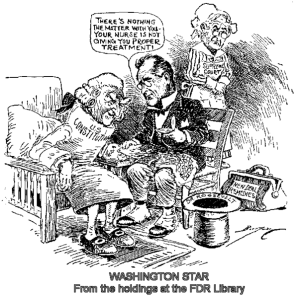
In the May issue of the Boston University Law Review, Joseph R. Fishkin and William E. Forbath of the University of Texas School of Law show that at key turning points in our history (the Jacksonian era, the Populist and Progressive moments and the New Deal), opponents of rising inequality made strong arguments “that we cannot keep our constitutional democracy — our republican form of government — without constitutional restraints against oligarchy and a political economy that maintains a broad middle class, accessible to everyone.”
Their article is called “The Anti-Oligarchy Constitution,” though Forbath told me that he and Fishkin may give the book they’re writing on the topic the more upbeat title “The Constitution of Opportunity.” Their view is that by empowering the wealthy in our political system, Supreme Court decisions such as Citizens United directly contradict the Constitution’s central commitment to shared self-rule.
“Extreme concentrations of economic and political power undermine equal opportunity and equal citizenship,” they write. “In this way, oligarchy is incompatible with, and a threat to, the American constitutional scheme.” …. they make a similar critique of what they call an excessively “court-centered” approach to constitutionalism. “Constitutional politics during the 19th and early 20th centuries” was very different and the subject of democratic deliberation. In earlier eras, they say, the Constitution was seen as not simply permitting but actually requiring “affirmative legislation . . . to ensure a wide distribution of opportunity” and to address “the problem of oligarchy in a modern capitalist society.”
The authors remind us of Franklin Roosevelt’s warning that “the inevitable consequence” of placing “economic and financial control in the hands of the few” would be “the destruction of the base of our form of government.” And writing during the Gilded Age, a time like ours in many ways, the journalist James F. Hudson argued that “imbedded” in the Constitution is “the principle” mandating “the widest distribution among the people, not only of political power, but of the advantages of wealth, education and social influence.”The idea of a Constitution of Opportunity is both refreshing and relevant. For too long, progressives have allowed conservatives to monopolize claims of fealty to our unifying national document. In fact, those who would battle rising economic inequalities to create a robust middle class should insist that it’s they who are most loyal to the Constitution’s core purpose. Broadly shared well-being is essential to the framers’ promise that “We the people” will be the stewards of our government.
Fishkin’s proposed book sounds like a worthwhile companion to Thomas Picketty’s Capital in the Twenty-First Century.
A somewhat related article from Raw Story by Bill Moyers and Co., July 4th note to tea partiers: Your politics would baffle the Founding Fathers.
Editor’s note: These days, if you see a protester donning a tricorn hat and waving a Gadsden Flag, it’s a safe bet that he or she is a Republican activist who’s furious about “death panels” or the prospect of the government meddling in the Medicare program. But the tea party movement isn’t the first to claim itself to be the true defenders of the Constitution, or to enlist its Framers in a political cause. Throughout American history, activists across the ideological spectrum have insisted that the Framers would roll over in their graves upon encountering the perfidy of their political opponents.
The reality is that the Framers disagreed about almost everything, and produced a Constitution that was filled with expedient compromises. As Jill Lepore, a professor of American history at Harvard University, pointed out in her book, The Whites of Their Eyes: The Tea Party’s Revolution and the Battle Over American History, “Beginning even before it was over, the Revolution has been put to wildly varying political purposes.” Between 1761, when the first signs of discontent with England became apparent in the Colonies, and 1791, when the Bill of Rights was ratified, Lepore wrote that Americans debated an “ocean of ideas” from which “you can fish anything out.”
One of the few areas where the Framers approached a consensus was a belief that their Constitution shouldn’t be fetishized. According to Lepore, it was none other than Thomas Jefferson who wrote, “Some men look at constitutions with sanctimonious reverence, and deem them like the arc of the covenant, too sacred to be touched. They ascribe to the men of the preceding age a wisdom more than human.”
Read an excerpt on Constitutional originalism from Jill Lepore’s book at the Raw Story link.
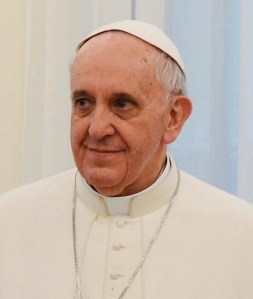
From NBC News: Pope Francis Meets Abuse Victims, Begs Forgiveness for Church.
The pontiff invited six victims of abuse from Ireland, Germany and Britain to attend an early-morning private Mass at the Domus Sanctae Marthae, the residence next to St. Peter’s Basilica where he lives.
Francis called the abuse a “grave sin” decrying how it was hidden for “so much time” and “camouflaged with a complicity that cannot be explained.”“I ask for the grace to weep, the grace for the Church to weep and make reparation for her sons and daughters who betrayed their mission, who abused innocent persons,” the pope said in his homily. “I beg your forgiveness, too, for the sins of omission on the part of Church leaders who did not respond adequately to reports of abuse.” ….
Francis strongly praised the victims’ courage in speaking up and shedding “light on a terrible darkness,” telling the mass he is deeply aware of their deep and unrelenting pain.
“Sins of clerical sexual abuse against minors have a toxic effect on faith and hope in God,” he said, adding that the victims’ willingness to come to the Vatican “speaks of the miracle of hope, which prevails against the deepest darkness.”
I guess it’s a start, but I agree with victims advocates who say it’s too little, too late. What concrete actions is the Church going to take to identify abusers and potential abusers before they act out? Child sexual abuse is a systemic problem that has continued for centuries. It’s difficult to see how it can be overcome with apologies and meetings with a few survivors.
I’ll end with a fascinating story from New Scientist, via Raw Story: Oldest case of Down’s syndrome from medieval France.
The oldest confirmed case of Down’s syndrome has been found: the skeleton of a child who died 1500 years ago in early medieval France. According to the archaeologists, the way the child was buried hints that Down’s syndrome was not necessarily stigmatised in the Middle Ages….
The new example comes from a 5th- and 6th-century necropolis near a church in Chalon-sur-Saône in eastern France. Excavations there have uncovered the remains of 94 people, including the skeleton of a young child with a short and broad skull, a flattened skull base and thin cranial bones. These features are common in people with Down’s syndrome, says Maïté Rivollat at the University of Bordeaux in France, who has studied the skeleton with her colleagues….
Oldest case of Down’s syndrome from medieval France – life – 04 July 2014 – New Scientist#.U7qdknlOXEd <!—->
Rivollat’s team has studied the way the child with Down’s syndrome was buried, which hasn’t been possible with other ancient cases of the condition. The child was placed on its back in the tomb, in an east-west orientation with the head at the westward end – in common with all of the dead at the necropolis.
According to Rivollat, this suggests the child was treated no differently in death from other members of the community. That in turn hints that they were not stigmatised while alive.
Another researcher of Down’s Syndrome in ancient history, John Starbuck of Indiana University, says drawing cultural conclusions from the method of burial is very difficult. Read more at the link.
What stories are you following today? Please post your links in the comment thread.
Lazy Saturday Reads
Posted: July 5, 2014 Filed under: morning reads, U.S. Politics, Women's Rights | Tags: "white oppression", Bill Clinton, Boston bombing, Bourbon St. shootings. New Orleans, C-Span callers, Civil Rights act, Eden Foods, Hillary Clinton, Hobby Lobby decision, Hurricane Arthur, Indianapolis shootings, Maya Angelou, Michael Potter, Racism, Richard Mellon Scaife, Samuel Alito, SCOTUS, vanilla ice cream 34 Comments
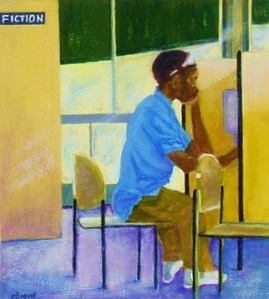
“Someone is Waiting,” by David Hettinger
Good Morning!!
I’m sure you won’t be surprised to learn that today is a very slow news day. Nevertheless, I’ve still managed to dig up a few interesting reads.
Long-time Clinton hater Richard Mellon Scaife has died at 82. The Associated Press reports via Politico:
Scaife died early Friday at his home, his newspaper, the Pittsburgh Tribune-Review, reported. Scaife’s death comes less than two months after he announced in a first-person, front-page story in his Pittsburgh Tribune-Review that he had an untreatable form of cancer.
“Some who dislike me may rejoice at the news,” wrote Scaife, who acknowledged making political and other enemies. “Naturally, I can’t share their enthusiasm.”
He was the grand-nephew of Andrew Mellon, a banker and secretary of the Treasury who was involved with some of the biggest industrial companies of the early 20th century. Forbes magazine estimated Scaife’s net worth in 2013 at $1.4 billion.
The intensely private Scaife became widely known in the 1990s when first lady Hillary Rodham Clinton said her husband was being attacked by a “vast right-wing conspiracy.” White House staffers and other supporters suggested Scaife was playing a central role in the attack.
Hillary was mocked for those remarks; but today, in the aftermath of the Hobby Lobby decision, it should be obvious to all but the most oblivious and ignorant among us that the vast right wing conspiracy exists and its tentacles have reached even the U.S. Supreme Court.
From Forbes, Clare O’Connor reports more Hobby Lobby Fallout: Catholic Soy Milk Mogul Won’t Cover Drugs That ‘Prevent Procreation’. Eden Foods founder Michael Potter has stated his determination to prevent his female employees from getting access to birth control, and the Supreme Court is helping him.
In April 2013, devout Catholic (and sole Eden Foods shareholder) Potter sued the Department of Health and Human Services, calling the Affordable Care Act’s contraceptive mandate “unconstitutional government overreach.”
In a letter he wrote in response to a shopper complaint that month, Potter described contraceptives as “lifestyle drugs” akin to “Viagra, smoking cessation, weight-loss” tools and other medications. (He also compared birth control to “Jack Daniels” in a contemporaneous interview with Salon.)
In October, the U.S. Court of Appeals decided against Potter, ruling that Eden Foods, as a for-profit corporation, couldn’t exercise religion.
Now, in the wake of this week’s controversial Supreme Court ruling recognizing craft chain Hobby Lobby’s religious rights, the court has changed its tune.The day after the Justices decided evangelical Hobby Lobby billionaire David Green doesn’t have to cover certain contraceptives for his employees, the Supreme Court vacated the judgment against Eden Foods and sent the case back to the U.S. Court of Appeals for the Sixth Circuit for further consideration.
“The court of appeals is ordered by the Supreme Court to follow its decision in Hobby Lobby,” said Erin Mersino, the attorney handling Potter’s case at the Christian, conservative Thomas More Law Center.
And the beat goes on . . .
At The Nation, Katha Pollit asks: Where Will the Slippery Slope of ‘Hobby Lobby’ End?
Facts are stubborn things, as John Adams famously said. Unless, that is, you’re talking about religion. Then facts don’t seem to matter at all: right you are if you think you are. The Hobby Lobby case was billed as a test of religious freedom versus the power of the state: Did the Religious Freedom Restoration Act (RFRA) mean that David Green, the evangelical Christian CEO of a chain of crafts stores, could be exempt from providing coverage for the full range of contraceptives for his employees under the Affordable Care Act? Green balked at including Plan B, Ella (another form of emergency contraception) and two kinds of IUD, because, he claimed, they caused “abortion” by preventing the implantation of a fertilized egg.
The Court’s 5-to-4 decision—which featured all three women justices ruling for the workers, and all five Catholic men ruling for the corporation—was wrong in many ways. But the thing I really don’t understand is why it didn’t matter that preventing implantation is not “abortion,” according to the accepted medical definition of the term. And even if it was, Plan B, Ella and the IUDs don’t work that way, with the possible exception of one form of IUD when inserted as emergency contraception. As an amicus brief from a long list of prestigious medical organizations and researchers laid out at length, studies show that emergency contraception and the IUD preventfertilization, not implantation. They are not “abortifacients,” even under the anti-choicers’ peculiar definition of abortion. (Green is actually more moderate than some anti-choicers, who include hormonal contraception, aka “baby pesticide,” as abortion.) Why doesn’t it matter that there is no scientific evidence for Green’s position? When did Jesus become an Ob/Gyn?
Good question. Today even facts are irrelevant to Supreme Court decisions. The fact is that Democrats helped Thomas, Roberts, and Alito make it onto the Court, and now we’re stuck with these religious and ideological fanatics.
At Salon, Digby writes that Alito could have been stopped: Why Dems should have filibustered the radical. And from Peter Montgomery at HuffPo, Samuel Alito: A Movement Man Makes Good on Right-Wing Investments. Read them and weep.
Dakinikat posted this Guardian piece in the comments last night; I thought it should be included in this morning’s links: Black people were denied vanilla ice cream in the Jim Crow south – except on Independence Day.
By custom rather than by law, black folks were best off if they weren’t caught eating vanilla ice cream in public in the Jim Crow South, except – the narrative always stipulates – on the Fourth of July. I heard it from my father growing up myself, and the memory of that all-but-unspoken rule seems to be unique to the generation born between World War I and World War II.
But if Maya Angelou hadn’t said it in her classic autobiography I Know Why the Caged Bird Sings, I doubt anybody would believe it today.
People in Stamps used to say that the whites in our town were so prejudiced that a Negro couldn’t buy vanilla ice cream. Except on July Fourth. Other days he had to be satisfied with chocolate.
Vanilla ice cream – flavored with a Nahuatl spice indigenous to Mexico, the cultivation of which was improved by an enslaved black man named Edmund Albius on the colonized Réunion island in the Indian Ocean, now predominately grown on the largest island of the African continent, Madagascar, and served wrapped in the conical invention of a Middle Eastern immigrant – was the symbol of the American dream. That its pure, white sweetness was then routinely denied to the grandchildren of the enslaved was a dream deferred indeed.
What makes the vanilla ice cream story less folk memory and more truth is that the terror and shame of living in the purgatory between the Civil War and civil rights movement was often communicated in ways that reinforced to children what the rules of that life were, and what was in store for them if they broke them.
Please go read the whole thing if you haven’t already.

From Politico: Why the Civil Rights Act couldn’t pass today.
It was a painful tableau: The bipartisan leaders of Congress linking hands in the Capitol Rotunda and swaying to the strains of “We Shall Overcome” as they commemorated the 50th anniversary of the passage of the Civil Rights Act of 1964. Harry Reid and Nancy Pelosi sang along with the crowd, but Mitch McConnell and John Boehner’s lips were frozen in silent, self-conscious smiles.
The climate in today’s Washington is so different from the one that produced what many scholars view as the most important law of the 20th century that celebrating the law’s legacy is awkward for Republicans and Democrats alike. Neither party bears much resemblance to its past counterpart, and the bipartisanship that carried the day then is now all but dead….
The current congressional leaders gathered last week not to honor Johnson — or any of the legislative leaders who actually passed the landmark law — but to award a posthumous Congressional Gold Medal to The Rev. Dr. Martin Luther King Jr. and his wife, Coretta Scott King, whose crusade helped create the climate that made the bill possible. In his life, racial tensions helped make King such a polarizing figure that both Johnson and John F. Kennedy worried about seeming too close to him, but in martyrdom and myth, he is the only politically safe ground on which present day leaders could unite.
They are all so pathetic. And this is beyond pathetic: Callers Use C-SPAN Civil Rights Discussion To Complain About White Oppression (VIDEO).
“Washington Journal” host Steve Scully listened as an “independent” caller named Thomas from Maryland told him that he is “much less liberal today” than he was in 1964 when the landmark law was signed by Lyndon B. Johnson.
“And I think the blacks have brought on most of their present-day problems themselves. They insult white people,” he told Scully. “I heard it right on your own show, I heard some black call Karl Rove a ‘white boy.’ And I don’t think that’s right. They’re attacking white people in the big cities and we’re supposed to put up with that kind of stuff and like them and say, ‘Well, come into our neighborhood.’ And how about the discussion of the black crime that goes on in this country?”
The caller went on to complain that the discrimination endured by Irish, Mormons and Italians is widely ignored.
“You people will never, never discuss that. You only discuss the discrimination against the black people,” he said.
Is that sick or what?
A few more news links:
Information Week on private tech companies treatment of their customers, Facebook Mood Manipulation: 10 Bigger Problems.
Fox News: Suspect arrested in Bourbon St. shootings.
USA Today: Seven hurt in Indianapolis shootings.
WSJ: A Weakened Hurricane Arthur Heads Toward Nova Scotia
ABC News: Before Boston Attack, Alleged Bomber Posed With Black Flag of Jihad at Local Mosque.
So . . . what stories are you reading and blogging about? Please share your links in the comment thread, and enjoy the rest of the long weekend!
Thursday Reads: Updates from Snowden-Greenwald Land and Other News
Posted: May 22, 2014 Filed under: morning reads | Tags: Cincinnatus, cyber-parties, discrimination, Edward Snowden, encryption extremists, George Packer, Glenn Greenwald, hackers, Jacob Applebaum, Julian Assange, Kevin Poulsen, Laura Poitras, NSA, Poverty, privacy extremists, Racism, Runa Sandvik, Sexism, The Tor Project, unemployment, Wikileaks 32 Comments
Good Morning!!
The photos in today’s post are from a project by photographer Mark Makela to take pictures of children “learning to read by reading to homeless cats.”
Last February, photographer Mark Makela traveled to Birdsboro, Pennsylvania, to photograph a reading group where the participants were grade-school students and a group of cats. The idea for the group, known as Book Buddies, was hatched at the Animal Rescue League of Berks County when the program coordinator Kristi Rodriguez’s 10-year-old son was struggling with reading. Rodriguez decided to bring him into the shelter, where he could be in what she called a “nonevaluative” environment in order to feel more comfortable practicing his reading skills. It worked.
According to ARL’s website, studies at Tufts University found that the more relaxed, nonjudgmental audience of cats helps students to sustain their focus, maintain a higher state of awareness, and develop an improved attitude toward school. In August of last year, ARL officially started the Book Buddies program, inviting students in first through eighth grades to read to the cats. As an incentive to continue, once the students complete five books, they receive prizes. “It’s one of those opportunities that is unique and humorous and so endearing,” Makela said about the assignment to document the Book Buddies program.
See more marvelous photos at the Slate Magazine link above. Even more at Buzzfeed–including more girls.
Now to the news:
I’ve long suspected that Edward Snowden interacted with Wikileaks’ Julian Assange and others in the hacker community before he made his final decision to steal a massive trove of data from NSA computers and then abscond to Hong Kong at the end of May last year.
We know that Snowden was in touch with Jacob Applebaum and Laura Poitras early on, because they published an interview with him in Der Spiegel that they had conducted by e-mail in Mid-May, before Snowden fled Hawaii. But Snowden could have actually met Applebaum in Hawaii in April 2013 when Applebaum vacationed there by his own admission. Did Snowden and Applebaum discuss Snowden’s plans to steal NSA files? Did Applebaum suggest which items Snowden should take? Note that Applebaum is deeply involved with Wikileaks and has been a long-time, passionate defender of Julian Assange.
Glenn Greenwald revealed in his new book “No Place to Hide” that Snowden had used the code name “Cincinnatus” in early communications between the two. Interestingly enough, a “cyber-party” had been held in Hawaii in December 2012, and the host was someone who called himself “Cincinnatus.” Once this news came out, people began speculating on Twitter that perhaps this wasn’t a coincidence. Suddenly, on May 17, the cyber-party announcement was deleted by someone with the Twitter handle @jskuda. Fortunately Twitter user @ShrillBrigade located it on the Wayback Machine. And check out the title of Cincinnatus’ talk: “Painlessly setting up your own fast exit.” (h/t @catfitz)
Then yesterday, former criminal hacker and technical adviser to Greenwald and Poitras’ Freedom of the Press Foundation Kevin Poulsen published a limited hangout at Wired: Snowden’s First Move Against the NSA Was a Party in Hawaii.
It was December 11, 2012, and in a small art space behind a furniture store in Honolulu, NSA contractor Edward Snowden was working to subvert the machinery of global surveillance.
Snowden was not yet famous. His blockbuster leaks were still six months away, but the man destined to confront world leaders on a global stage was addressing a much smaller audience that Sunday evening. He was leading a local “Crypto Party,” teaching less than two dozen Hawaii residents how to encrypt their hard drives and use the internet anonymously.
“He introduced himself as Ed,” says technologist and writer Runa Sandvik, who co-presented with Snowden at the event, and spoke about the experience for the first time with WIRED. “We talked for a bit before everything started. And I remember asking where he worked or what he did, and he didn’t really want to tell.”

Runa Sandvik is a hacker who works at the TOR project along with Jacob Applebaum. TOR is a site (ironically funded by the U.S. Department of Defense) that provides free encryption software to people who want to hide their on-line activities (including drug dealers and child porn purveyors).
Poulsen writes:
The roots of Snowden’s crypto party were put down on November 18, 2012, when he sent an e-mail to Sandvik, a rising star in privacy circles, who was then a key developer on the anonymous web surfing software Tor.
Tor is free software that lets you go online anonymously. The software is used by a wide swath of people in need of extreme anonymity, including human rights groups, criminals, government agencies, and journalists. It works by accepting connections from the public internet, encrypting the traffic and bouncing it through a winding series of relays before dumping it back on the web through any of more than 1,000 exit nodes.
Most of those relays are run by volunteers, and the pre-leak Edward Snowden, it turns out, was one of them.
How about that? Snowden was already deeply involved with TOR in December 2012–and Jacob Applebaum of TOR just happened to travel to Hawaii a few months later in April! Coincidence? I don’t think so.
In his e-mail, Snowden wrote that he personally ran one of the “major tor exits”–a 2 gbps server named “TheSignal”–and was trying to persuade some unnamed coworkers at his office to set up additional servers. He didn’t say where he worked. But he wanted to know if Sandvik could send him a stack of official Tor stickers. (In some post-leak photos of Snowden you can see the Tor sticker on the back of his laptop, next to the EFF sticker).
Well, well, well. Now we know how Snowden got his TOR sticker. Did Runa give him the EFF sticker too? Read the rest of the Wired piece for more details.
Phew! I hope that made sense. This stuff is difficult to write about.

Also yesterday, well-known and respected journalist and New Yorker writer George Packer published a no-holds-barred review of Glenn Greenwald’s new book in the UK Prospect: The errors of Edward Snowden and Glenn Greenwald. Among other things, Packer accuses Greenwald of “a pervasive absence of intellectual integrity,” and provides numerous examples. He characterizes Snowden as someone who lives on the internet, detached from the realities of the real world. Here are a few excerpts, but please read the whole thing.
Snowden’s leaks can be seen, in part, as a determined effort to restore the web to its original purity—a project of technology rather than law. “Let us speak no more of faith in man, but bind him down from mischief by the chains of cryptography,” wrote Snowden, in an early message to his collaborators. In March of this year, appearing remotely from Russia on a robotised screen onstage at a TED talk in Vancouver, Snowden said that the single best solution to the NSA’s abuses is stronger encryption: “The internet that we’ve enjoyed in the past has been exactly what we, as not just a nation but as a people around the world, need.” In taking nearly two million highly classified documents from the US, he was grabbing back the key to heaven.
As I’ve written previously, Snowden’s solution to the problem of government interference with its citizens is impenetrable universal encryption–never mind the fact that this would allow vast numbers of vicious criminals to hide their actions from law enforcement.
As I suspected, Packer writes that Greenwald’s book “contains no major scoops.” He does, however, praise Greenwald’s argument for the primacy of privacy as central to a “free society.”
Greenwald also makes a powerful case—all the more so for being uncompromising and absolute—for the central role of privacy in a free society, and against the utilitarian argument that, since the phone companies’ metadata on Americans hasn’t been seriously abused by government officials (not yet, anyway), none of us should be too worried. In a chapter called “The Harm of Surveillance,” he cites Justice Louis Brandeis’s famous opinion on the basic “right to be let alone,” and writes: “The desire for privacy is shared by us all as an essential, not ancillary, part of what it means to be human. We all instinctively understand that the private realm is where we can act, think, speak, write, experiment, and choose how to be, away from the judgemental eyes of others. Privacy is a core condition of being a free person.”
I would argue that these considerations are of vital importance to people like Greenwald who are financially secure. Those Americans who must deal with racial and gender discrimination, long-term unemployment, and especially grinding poverty have other, more urgent concerns. Can one be a “free person” under those conditions?

Along similar lines, Packer writes:
If Greenwald and others were actually being persecuted for their political beliefs, they would instinctively understand that the rule of law has to protect people regardless of politics. The NSA disclosures are disturbing and even shocking; so is the Obama administration’s hyper-aggressive pursuit of leaks; so is the fact that, for several years, Poitras couldn’t leave or re-enter the US without being questioned at airports. These are abuses, but they don’t quite reach the level of the Stasi. They don’t portend a totalitarian state “beyond the dreams of even the greatest tyrants of the past,” as Greenwald believes is possible. A friend from Iran who was jailed and tortured for having the wrong political beliefs, and who is now an American citizen, observed drily, “I prefer to be spied on by NSA.” The sense of oppression among Greenwald, Poitras, and other American dissenters is only possible to those who have lived their entire lives under the rule of law and have come to take it for granted.
In the year since the first NSA disclosures, Snowden has drifted a long way from the Thoreauvian ideal of the majority of one. He has become an international celebrity, far more championed than reviled. He has praised Russia and Venezuela’s devotion to human rights. His more recent disclosures have nothing to do with the constitutional rights of US citizens. Many of them deal with surveillance of foreign governments, including Germany and Brazil, but also Iran, Russia, and China. These are activities that, wise or unwise, fall well within the NSA’s mandate and the normal ways of espionage. Snowden has attached himself to Wikileaks and to Assange, who has become a tool of Russian foreign policy and has no interest in reforming American democracy—his goal is to embarrass it. Assange and Snowden are not the first radical individualists to end up in thrall to strongmen.
Snowden looked to the internet for liberation, but it turns out that there is no such thing as an entirely free individual. Cryptography can never offer the absolute privacy and liberty that Snowden seeks online. The internet will always be a space controlled by corporations and governments, and the freedom it provides is of a limited, even stunting, kind. No one lives outside the fact of coercion—there is always a state to protect or pursue you, whether it’s Obama’s America or Putin’s Russia.
I’ve barely touched the surface of Packer’s scathing critique of Greenwald’s “journalism”; I enourage you to go to Prospect link to read more.

I have a few more stories for you that I’ll list link-dump style:
It appears that the prosecution in the Boston Bombing case decided to leak some previously secret information–most likely to counter the defense’s argument that Dzhohar Tsarnaev was illegally questioned by the FBI when he was in the hospital with terrible injuries.
Reuters: Accused Boston bomber admitted role in attack, prosecutors say
NBC News: Government doc shows how closely Boston Marathon bombers followed al Qaeda plans.
NY Daily News: Boston Marathon bombers used ‘sophisticated’ bombs made of parts from Christmas lights, model cars: prosecutors.
Boston Globe: Christmas Lights Used in Boston Marathon Bombs.
KSDK.com: Feds: Boston bomber’s hideout note says he wanted to be martyr.
ABC News: FBI Feared Boston Bombers ‘Received Training’ And Aid From Terror Group, Docs Say.
This is encouraging from the Boston Globe: Oakland Examining Pension of FBI Agent who Shot Todashev
Other News:
The Economic Times of India: Google wants to show ads through your thermostat and car. (You though the NSA was bad?)
Information Week: Google Outlines Advertising Vision. (How would you like targeted Google ads appearing on your refrigerator or watch?)
The Atlantic: It Wasn’t Household Debt That Caused the Great Recession; It was how that debt was disproportionately distributed to America’s most economically fragile communities.
NYT: U.S. Sends Troops to Chad to Aid Hunt for Nigerian Schoolgirls.
USA Today: Thai military declares coup, detains party leaders.
Science Recorder: ‘Aliens of the sea’ could lead to breakthroughs in regenerative medicine.
What stories are you following today? Please post your links on any topic in the comment thread.
Monday Reads
Posted: April 28, 2014 Filed under: Discrimination against women, Economy, Feminists, morning reads, U.S. Politics, War on Women | Tags: Donald Sterling, female gamers, Fukushima workers, Game of Thrones, homophobia, Ichiefu, Japanese Manga, Johnathan McIntosh, Kazuto Tatsuta, LA Clippers, male-dominated culture, middle class, misogyny, NBA, NRA, on-line gaming, Racism, rape, Sarah Palin, waterboarding 64 CommentsGood Morning! Quelle Surprise! Pop Culture is still Misogynist, Racist, and Homophobic!
 I found some interesting reads over the weekend so I hope you’ll enjoy them! They are all sort’ve stories that actually reflect a lot of the things that fascinate and entertain me. I love strategy games and have been playing them on line for quite some time Actually, it’s been since the early 1990s when most of the games were simply text oriented. I also love animation art, and books, and of course, music. So, here’s a little bit on that and a little bit of stuff that has to do with social justice too. If I do a have a consistent train of thought here it is that so much of what should be entertaining and could be informative can sow bad seeds. I’ve a few examples where the pop and geek culture are taking on hard topics. Some are successful and examining crucial human stories. Some rely on the same old misogyny, racism, and homobigotry.
Japanese Manga is a way many creative people in Japan explore how they feel about a variety of things. This article is about a new manga book on the lives of the Fukashima plant workers.
A manga that describes the reality of daily life at the crippled Fukushima No. 1 nuclear power plant through the eyes of a worker is enjoying popularity.
“Ichiefu” (1F), written by Kazuto Tatsuta, 49, first appeared in autumn 2013 as a serial comic in the weekly magazine “Morning,” published by Kodansha Ltd. Ichiefu stands for the Fukushima No. 1 plant among locals.
The comic was published in book form on April 23. The publisher shipped a total of 150,000 copies of the first volume, which is an unusually large number for a little-known manga artist.
Tatsuta said he changed jobs repeatedly after graduating from university. At the same time, he also worked as a comic strip artist.
It was when he was considering another job change that the March 2011 Great East Japan Earthquake and tsunami occurred, triggering the nuclear accident at the Fukushima plant.
While seeking a better-paying job, Tatsuta also wondered what part he could do as a citizen of Japan to help. As a result, he began to work at the Fukushima No. 1 nuclear power plant from June 2012 for a total of six months.
“Ichiefu” describes the situation at the plant in great detail. The descriptions of equipment, such as the masks and protective gear the workers used, and the procedures they took to measure radiation levels make readers feel as if they are there and reading actual worker manuals.
The comic also depicts intimate practices only workers there would know. For example, the workers always say “Be safe” to each other before starting their shifts.
Each of the workers was also required to stop working when his dosimeter issued a fourth warning sound.
I quit playing a few games last year that I had really grown fond of because of the rampant misogyny and homophobia of many of the white male  players. I had repeatedly asked them to constrain their language, behavior, and what they posted. I am fortunately playing a game right now where that’s not the case. I am still one of the few female players in my alliance. I believe I am one of two but I have found that I generally enjoy better game play if I am in an alliance where there are many openly gay men. This NPR article summarizes a series of articles that are focused on white male privilege in the online game atmosphere.
In video games, sexism often comes in the form of male-dominated storylines and character archetypes. In the video game community, it takes a more menacing shape.
It ranges from attempts to silence female critics to the harassment of fellow players. Some harassment even goes so far as phone calls and rape threats, as one female game developer found out last year.
“The issue is often framed as a women’s issue, but sexual harassment, sexism and misogyny in gaming is not a women’s issue — it’s a gaming community issue,” says Jonathan McIntosh, a producer for the Tropes vs. Women in Video Games Web series.
Last week, McIntosh wrote a piece for gaming website Polygon about what he calls the “invisible benefits” that males experience while playing video games. In the post, he lists 25 effects of “male gamer privilege.” Here’s a sample:
- I can choose to remain completely oblivious, or indifferent to the harassment that many women face in gaming spaces.
- I am never told that video games or the surrounding culture is not intended for me because I am male.
- I can publicly post my username, gamertag or contact information online without having to fear being stalked or sexually harassed because of my gender.
- I will never be asked to “prove my gaming cred” simply because of my gender.
- I will almost always have the option to play a character of my gender, as most protagonists or heroes will be male by default.
- If I am trash-talked or verbally berated while playing online, it will not be because I am male nor will my gender be invoked as an insult.
- My gaming ability, attitude, feelings or capability will never be called into question based on unrelated natural biological functions.
So far, the reaction to his post — both in the more than 700 comments on the piece and elsewhere — has been relatively civil. As McIntosh pointed out on Twitter, he doubts it would have been as civil if he had been a female writer raising the same points.
“I’m saying the same thing that women have been saying for years,” McIntosh says. “There’s nothing in my piece that’s really new, it’s just that it’s coming from me. If my name was Joanna McIntosh … I’d be called irrational, I’d be called hysterical and I’d be called too sensitive.”
One other thing that I did not mention last week but I would like to mention this week is the rape scene between the Lannister twins in Game of Thrones. The same scene in the book actually was rough but consensual.
There’s been a lot of discussion, Internet rage, and general overall hoopla following Sunday night’s episode of Game of Thrones, as the television show made the most shocking book-to-screen deviation to date. *Spoiler free for future books.*
Jaime and Cersei finally had their reunited love scene, and suddenly for book readers, Jeyne Westerling seemed like a small cinematic sacrifice to make in comparison. I don’t want to get into a philosophical discussion on whether or not this scene constitutes as rape. Smarter people than I have alreadydonethat.
What we have to work with in the scene is what the characters said and did because we can’t know how they felt. And whether or not the scene was intended to come across as consensual sex, the way the scene was cut by the director makes it definitive to the audience that it was not consensual. Cersei repeatedly said no while Jaime forced himself on top of her and answered that he didn’t care as his creepy voiceover carried out onto a shot of Arya staring at mountains. If that’s all we know about the scene, then yes, in the television show Jaime raped Cersei.
In some ways, it’s useful for television shows to acknowledge the extent of sexual violence in our culture. These narratives allow necessary stories to be told. But the execution is too easy. From daytime soap operas to prestige cable shows, rape is all too often used to place the degradation of the female body and a woman’s vulnerability at the center of the narrative. Rape is used to create drama and ratchet up ratings. And it’s rare to see the brutality and complexity of a rape accurately conveyed on-screen. Instead, we are treated to an endless parade of women being forced into submission as the delicate and wilting flowers television writers and producers seem to want them to be.
 I am still wondering why there seems to be a renaissance in misogny, racism and homobigotry. You would think that the sports arena would have made better strides against racism given that teams and fans are fully integrated to the idea that there are players of many races. However, it seems the real money and power behind the bread and circuses are still those rich, horrid, white men. We talked about the Clippers’ owner last week. There is, of course, more on that.
Deadspin has acquired an extended, 15-minute version of the conversation between Clippers owner Donald Sterling and his then-girlfriend V. Stiviano. If the original nine-minute tape acquired by TMZ left any questions about Sterling’s opinions regarding minorities, the audio here should remove all doubt that he’s a doddering racist with views not too far removed from the plantation.
The Clippers themselves showed some class this week in a protest that was priceless. There will undoubtedly be more coming and hopefully the NBA can find a way to strip Sterling of the franchise.
The Clippers gathered at center court before a118-97 Game 4 loss in their first-round series against the Golden State Warriors and took off their Clippers warm-up shirts and left them there. They then warmed up wearing inside-out red shooting shirts that did not display the Clippers name or logo. During the game, players wore black arm or wrist bands and black socks.
In other news, water is still wet and Sarah Palin is still one of the dumbest people on the planet. This is the money quote she gave the NRA: ‘Waterboarding is how we baptize terrorists’.
Former Alaska Gov. Sarah Palin (R) defended the controversial enhanced interrogation technique of waterboarding this weekend, and implied that the practice would still be commonplace “if I were in charge.”
“They obviously have information on plots to carry out Jihad,” she said at the National Rifle Association (NRA) annual meeting on Saturday evening, referring to prisoners. “Oh, but you can’t offend them, can’t make them feel uncomfortable, not even a smidgen. Well, if I were in charge, they would know that waterboarding is how we baptize terrorists.”
The remark stands in stark contrast to the opinion of her former running mate, Sen. John McCain (R-Ariz.).
The former Republican presidential nominee, who spent more than five years in a prison camp during the Vietnam War, has repeatedly denounced the practice, which he says is torture.
In her speech, Palin praised the NRA, a group whose members “are needed now more than ever, because every day we are seeing more and more efforts to strip away our Second Amendment rights,” she said.
I am still waiting for some examples of how any government in the US is stripping away the second amendment rights. I do, however, have thousands of examples of how women are losing their right to self determination.
My last offering this morning is yet another in depth article on the demise of the middle class in the USA. Middle class Americans are an endangered species.
Wages for millions of American workers, particularly those without college degrees, have flat-lined. Census figures show the median household income in 2012 was no higher than it was 25 years ago. Men’s median wages were lower than in the early 1970s.
Meanwhile, many of the expenses associated with a middle-class life have increased beyond inflation. This includes college tuition, whose skyrocketing cost has laid siege to a bedrock principle of the American Dream: that your children will do better than you did.
A recent poll conducted by the Washington Post and the Miller Center at the University of Virginia found that 40 percent of those calling themselves middle class felt less financially secure than they were just a few years ago. Forty-five percent said they worry “a lot” about having enough money stashed away for retirement, and 57 percent said they worry about meeting their bills. Less than half said they expect their kids to do any better.
Fewer Americans find themselves in the heart of the middle class with every passing year.
In the mid-1970s, the majority of Americans were in the middle, with 52 percent earning the equivalent (in today’s dollars) of $35,000 to $100,000. Today, according to census figures, the share of households earning under $35,000 is virtually unchanged, 35 percent. The shift has occurred in the other two categories. Households with incomes over $100,000 have doubled, to 22 percent, while less than 44 percent are in the middle cluster.
So, what’s on your reading and blogging list today?
Friday Reads: Cliven Bundy and the Real Threat of Right Wing Domestic Terrorism
Posted: April 25, 2014 Filed under: Barack Obama, morning reads, Republican politics, U.S. Politics | Tags: Bureau of Land Management (BLM), Cliven Bundy, domestic terrorism, Fox News, Harry Reid, James Yeager, militia groups, misogyny, Racism, Sean Hannity 48 Comments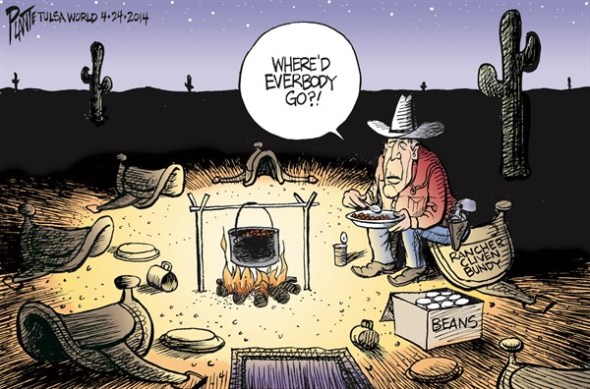
Good Morning!!
What a difference a few days can make! Take a look at the transcript from Fox News host Sean Hannity’s show on Monday April 21:
SEAN HANNITY, HOST: The rhetoric from the left about Nevada rancher Cliven Bundy and his supporters is getting worse and worse by the day. First, as the country marked the 19th anniversary of the Oklahoma City bombing over the weekend, vice chairwoman of the Democratic National Committee Donna Brazile made this disgraceful comparison after talking about how the feds backed down. Watch this.
(BEGIN VIDEO CLIP, “THIS WEEK”/ABC)
DONNA BRAZILE, DNC VICE CHAIR: That was the right thing to do, to try to, you know, simmer things down. Remember, this is the 19th anniversary of the Oklahoma bombing. So this notion that Mr. Bundy has no other recourse but violence is — anti-government violence — is absolutely wrong. He’s been waging this battle for two decades. He’s lost. Everybody else is paying their grazing fees. He should pay his fees, as well.
(CROSSTALK)
UNIDENTIFIED FEMALE: I think we should be reluctant to compare Bundy to Timothy McVeigh.
(END VIDEO CLIP)
HANNITY: And that’s not all. Earlier today, runners embarked on the first Boston marathon since last year’s terror attack. And just days ago, Senate Majority Leader Harry Reid had this to say about Bundy family supporters. Watch this.
(BEGIN VIDEOTAPE)
SEN. HARRY REID, D-NV.: These people who hold themselves out to be patriots are not. They’re nothing more than domestic terrorists.
(END VIDEO CLIP)
HANNITY: Pretty unbelievable. Now, given the events in Oklahoma City and at the Boston Marathon, we really know what real domestic terrorists look like, and that’s not Cliven Bundy or his supporters.
That was before Bundy gave a rambling press conference and let the world see exactly who and what he is. From The New York Times yesterday morning: A Defiant Rancher Savors the Audience That Rallied to His Side.
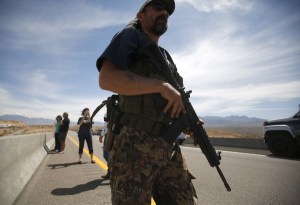
Armed supporters of Cliven Bundy wield weapons against Federal agents.
BUNKERVILLE, Nev. — Cliven Bundy stood by the Virgin River up the road from the armed checkpoint at the driveway of his ranch, signing autographs and posing for pictures. For 55 minutes, Mr. Bundy held forth to a clutch of supporters about his views on the troubled state of America…
Most of all, Mr. Bundy, 67, who was wearing a broad-brimmed white cowboy hat against the hot afternoon sun, recounted the success of “we the people” — gesturing to the 50 supporters, some armed with handguns and rifles, standing in a semicircle before him — at chasing away Bureau of Land Management rangers who, acting on a court order, tried to confiscate 500 cattle owned by Mr. Bundy, who has been illegally grazing his herd on public land since 1993.
Mr. Bundy’s standoff with federal rangers — propelled into the national spotlight in part by steady coverage by Fox News — has highlighted sharp divisions over the power of the federal government and the rights of landowners in places like this desert stretch of Nevada, where resentment of Washington and its sprawling ownership of Western land has long run deep.
Others who have loudly supported Bundy’s cause are Senators Rand Paul of KY and Dean Heller of NV. and Texas candidate for governor Greg Abbott. Claiming that the Feds wouldn’t come around to bother him again soon, Bundy took the time to share some of his opinions on other topics:
Next the NYT reported some remarks Bundy made on Saturday to a group of about 50 supporters along with one reporter and one photography
“I want to tell you one more thing I know about the Negro,” he said. Mr. Bundy recalled driving past a public-housing project in North Las Vegas, “and in front of that government house the door was usually open and the older people and the kids — and there is always at least a half a dozen people sitting on the porch — they didn’t have nothing to do. They didn’t have nothing for their kids to do. They didn’t have nothing for their young girls to do.
“And because they were basically on government subsidy, so now what do they do?” he asked. “They abort their young children, they put their young men in jail, because they never learned how to pick cotton. And I’ve often wondered, are they better off as slaves, picking cotton and having a family life and doing things, or are they better off under government subsidy? They didn’t get no more freedom. They got less freedom.”
Whoops! Suddenly right wingers who had supported Bundy or just ignored his unlawful behavior did a 180 degree turn. Here’s Sean Hannity on his radio show yesterday:
Conservative media titan Sean Hannity, formerly one of Nevada rancher Clive Bundy’sstrongest advocates, expressed his vehement disgust Thursday with the latter’s remarks on slavery.
Bundy’s comments “are beyond repugnant to me. They are beyond despicable to me. They are beyond ignorant to me,” Hannity said during his radio show.
Still, he claimed, Democrats are wrong to use Bundy’s racist, misogynistic remarks to attack Republicans.
“They want to say that conservatives are racist. Conservatives hate women,” Hannity said. “Conservatives want old people to die, granny over the cliff. They want the young people to fend for themselves. They want to poison the air and poison the water.”
“People that for the right reasons saw this case as government overreach now are branded because of the ignorant, racist, repugnant, despicable comments of Cliven Bundy,” he said.
Because Bundy was not sophisticated enough to wrap his racism in euphemisms as many Republicans do, his “mainstream” supporters will have to back off. But what about the militia types and their rifles? Will they be turned off by Bundy’s racist rhetoric? Not likely. From Think Progress:
James Yeager is calling from Cliven Bundy’s front yard, where he’s one of several (he won’t say how many) providing 24-hour security to the Bundy family. He and his friend packed up “a full medical kit and a camera” and drove 26 ½ hours from their home in Camden, Tennessee last week to document what he calls “a tremendous overreach of federal power.” He’s been posting daily videos to his YouTube site.
When asked if he also packed weapons, Yeager said, “of course. I’m always armed. This is not any different than any other day for me.”
Yeager is one of hundreds of supporters who journeyed to Bunkerville, Nevada in support of the rancher’s standoff with the federal Bureau of Land Management. Though federal agents released Bundy’s cattle over a week ago, many have remained on the ranch to protest and protect the rancher’s family. They’ve hailed Bundy — who owes the federal government over $1 million in unpaid grazing fees — as an “American hero.” The Mormon father of 14 has even inspired futuristic fan fiction from his most ardent admirers: “Yes, it’s been a great half-century for America, and we owe much of our good fortune to the bravery of Cliven Bundy.”
They call themselves militia members, oath keepers, protesters and patriots. Senator Harry Reid calls them “domestic terrorists.”
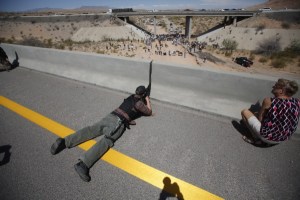
Eric Parker from central Idaho aims his weapon from a bridge as protesters gather by the Bureau of Land Management’s base camp
Harry Reid is right. Check out these images and commentary by Reuters photographer Jim Urquhart:
“I’ve got a clear shot at four of them,” the man with a rifle beside me said, as he aimed his weapon in the direction of U.S. Bureau of Land Management (BLM) officers.
We were on a bridge in southern Nevada in the midst of a tense standoff between the BLM and a group of angry ranchers, milita-members and gun-rights activists. It seemed as if we were a hair’s breadth away from Americans killing Americans right in front of me.
This showdown had come after the BLM started rounding up cattle belonging to rancher Cliven Bundy, who had been letting his animals graze illegally on federal land for over 20 years….
I decided to leave the protesters’ rallying point and drive several miles to where BLM and National Park Service (NPS) officers were holding Bundy’s impounded cattle but when I got there, there didn’t seem to be anything new to report.
I was making my way back to the protest site when Jennifer called me. She said the demonstrators were coming in my direction to go to the BLM facility and demand that Bundy’s cattle be released. My heart skipped a beat and anxiety set in, as I realised the armed group was heading this way looking for a showdown.
The convoy arrived just a few moments after I did and began to clog lanes of traffic on the south side of the interstate, the opposite side to the BLM base
Read more at the link. I don’t know about you, but I find this entire episode frightening. Who are these angry, violent people in our midst?
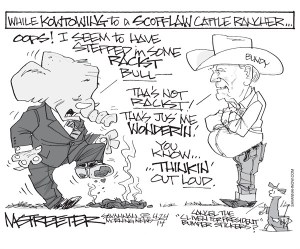
And Cliven Bundy isn’t apologetic. He told CNN last night that he doesn’t regret his racist comments, “I think I’m right.”
Cliven Bundy — the Nevada rancher turned conservative folk hero for bucking the federal government’s attempts to stop his cattle from grazing on public land — admits he doesn’t understand the bipartisan uproar over his comments suggesting blacks might have been better off under slavery.
But he understands what he meant by those comments, and he’s not backing down.
“I don’t think I’m wrong,” Bundy told CNN’s Bill Weir on Thursday night. “I think I’m right.”
The rancher said he doesn’t feel “abandoned” by the uproar by the likes of right-wing radio firebrand and Fox News host Sean Hannity, who has ripped what he called the “ignorant, racist, repugnant, despicable comments.” [….]
He backtracked somewhat, insisting he “didn’t really mean it to compare (African-Americans’ current plight) with slavery. I meant to compare it with maybe life on the farm or life in the South, where they had some chickens and the gardens, and they had something to do.”
At the same time, Bundy stood by his general premise that blacks once had better lives — stating that, right now, “they don’t have nothing to do with their children, their family unit is ruined … That’s what I was referring to I don’t think they have the life that they should have” because of the government.
I admit I didn’t pay much attention to the Bundy story at first. I live in a city and community where I’m very insulated from people like this and where Republicans are a tiny minority. Of course we still hear ignorant remarks on talk radio, but on the whole people who are vicious racists have to tone down their rhetoric or be marginalized. But once I began reading about Bundy in JJ’s and Dakinikat’s posts over the past two days, I realized this is no joke.
Having a black man as a two-term president has terrified and enraged these racist militia types and brought them out of the woodwork to express their ugly opinions more blatantly than before. As Harry Reid has said, they are domestic terrorists and they must be brought under control. What will happen if we elect a women president?
These people are far more dangerous to our country than foreign terrorism. The FBI should be infiltrating milita groups instead of running stings on muslim-Americans if they want to minimize terrorism in this country. When we have a Supreme Court Justice advocating–even tongue-in-cheek–that unhappy taxpayers should overthrow the U.S. government, we have to understand right wing extremists are a serious threat to our country.
So . . . this ended up being a one-subject post. I know there are plenty of other things happening in the news. What stories are you following today?

 peej
peej Carissa
 bostonboomer
 dakinikat
 ecocatwoman
 mablue2
 Mama Lopez
 peggysue22
 quixote
 skydancingguestblogger
 Mona (aka Wonk the Vote)



 Sky Dancing
Recent Comments