Posted: February 4, 2023 | Author: bostonboomer | Filed under: cat art, caturday, Donald Trump | Tags: Alvin Bragg, carless handing of sensitive materials, Chinese spy balloon, conspiracy theories, Extreme cold temperatures, Manhattan DA, Mark Pomerantz, Mt Washington, New Hampshire, Rep. James Comer, Supreme Court, wind chill |

By Glenn Harrington
Happy Caturday!!
As predicted, it got really cold here yesterday and overnight. It got down to -9 where I am, lower in other parts of Massachusetts and New England. My newly installed air heat pump worked very well. I had it set at 72, and it stayed very warm in my apartment. The temperature is back up to -1 now (feels like -16) and will continue rising into the teens today. Tomorrow we will be back up to warmer than normal temperatures in the 40s and 50s for the rest of the week. Pretty freaky. Of course, my parents, who grew up in North Dakota, wouldn’t have thought these temperatures were a big deal.
The really dramatic weather was at Mt. Washington in New Hampshire. It’s not that big a mountain, but it gets the “worst weather in the world.” They get hurricane-force winds up there all the time. Once in the 1930s, Mt. Washington recorded 231 mph winds! Last night it got to a wind chill of -109 degrees, the lowest ever recorded in the U.S.
From The Washington Post: ‘Historic Arctic outbreak’ crushes records in New England.
Parts of the Northeast woke up to the coldest morning in decades on Saturday, with temperatures 30 degrees or more below average and wind chills in the extremely dangerous category. Virtually the entirety of New England was included in wind chill warnings, while Mount Washington’s minus-109 degree wind chill set a record for the entire United States.
The National Weather Service office serving the Boston region described the cold as “a historic Arctic outbreak for the modern era,” and warned that “this is about as cold as it will ever get.”
In Boston, the morning low fell to minus-10 degrees at 5:15 a.m., the coldest reading observed in the city since Jan. 15, 1957, when Boston hit minus-12. The episode resembled the brutal Arctic blast on Valentine’s Day 2016, when Logan Airport dropped to minus-9 degrees.
Coupled with winds gusting near 40 mph, Boston witnessed its lowest wind chill ever recorded at minus-39 degrees. Records date back to 1944. Wind chill is an index that attempts to quantity the combined impact of cold and wind on the human body, since strong winds blow away one’s body heat.

By Robin Freedenfeld
The temperatures were so extreme in Maine that residents reported “frost quakes,” or cryoseisms. The earthquake-like tremors are caused by rapidly plummeting temperatures, which cause water trapped in cracks in the ground to expand.
The city of Portland, Maine, recorded its all-time lowest wind chill at minus-45 degrees. A weather balloon launched by the National Weather Service in Gray, Maine, reported the all-time lowest 850 millibar (an air pressure level corresponding to approximately 5,000 feet in altitude) temperature ever observed by that office at minus-35.5 degrees.
Farther north in Maine, Frenchville Airport in Aroostook County recorded a wind chill to minus-61 degrees, while Cadillac Mountain in Hancock County had a minus-62 degree wind chill. Even Bar Harbor, on the coast, logged a wind chill of minus-48. Greenville in Piscataquis County faced a wind chill of minus-58.
So that was interesting for those of us who are excited by extreme weather; now we go back to unseasonably warm daytime temperatures in the 40s and 50s. Freaky.
Yesterday, the right wing nuts on Twitter–including Congressional Republicans–were totally losing their minds over that Chinese balloon that was spotted over the U.S. The wingnuts demanded that the government shoot the thing down. Of course it’s flying way up in the atmosphere, beyond reach of any kind of weapon, plus it’s huge and would probably kill people if it came down, but whatever. It’s Biden’s fault. This moron is chairman of the House Oversight Committee.
Justin Baragona at The Daily Beast: GOP Rep Warns That Chinese Balloon May Have ‘Bioweapons’ From ‘Wuhan.’
House Oversight Chairman James Comer (R-KY) casually suggested to Fox News on Friday that the suspected Chinese spy balloon floating over the United States could contain “bioweapons” from “Wuhan,” invoking the “lab leak theory” that’s been embraced by Republicans.
After a Chinese surveillance balloon was spotted over the northern U.S. this week, Republicans have lashed out at President Joe Biden over his perceived “weakness” in his administration’s policy towards China. Calling for the president to “shoot down” the craft, some in the GOP called the president “Beijing Biden” while claiming this is further proof that “Communist China” doesn’t “fear or respect” Biden.

By Bruce Bingham
While the Pentagon has balked over conservative demands to take down the balloon, noting that falling debris could injure or kill civilians, the Biden administration has postponed Secretary of State Antony Blinken’s upcoming trip to China. China, meanwhile, has insisted the suspected spycraft is really just a “civilian airship” that “deviated far from its planned course.”
Amid the Republican handwringing over the Chinese balloon, Comer appeared on Fox News’ The Faulkner Focus to react. And he immediately jumped into conspiratorial waters.
“I have concern this will be another example of the Biden administration’s weakness on the national scale,” he declared. “You look at what happened in Afghanistan. That hurt the reputation of America’s military strength. That hurt the reputation of our commander-in-chief. And now we have China clearly playing games with the United States.”
After saying the balloon “never should have been allowed” to cross over into the U.S., the Kentucky lawmaker then fear-mongered that the craft could be loaded down with weaponized viruses. “My concern is that the federal government doesn’t know what’s in that balloon,” he asserted. “Is that bioweapons in that balloon? Did that balloon take off from Wuhan?”
Um . . . Okay.
For some actual news about the situation, here’s Lily Kuo at The Washington Post: China rushes to cap damage over suspected spy balloon as Blinken delays trip.
Beijing on Saturday offered a subdued rebuttal to Washington’s decision to delay a high-level visit after a suspected Chinese spy balloon was discovered hovering over the United States, derailing China’s recent efforts to repair its most important bilateral relationship.
Hours before U.S. Secretary of State Antony Blinken was to take off, Washington postponed the trip, saying it “would not be appropriate” after the discovery of the airship floating around 60,000 feet above the central United States.
The Chinese Foreign Ministry said in a statement Saturday that the presence of a Chinese airship in U.S. airspace was “completely an accident,” and was caused by westerly winds knocking the balloon off course. It reiterated claims that the balloon was for scientific research such as collecting weather data, and accused “some U.S. politicians and media” of taking advantage of the situation to discredit China, which “firmly opposes this.” [….]
Blinken had been expected to meet Chinese leader Xi Jinping on the trip, and while few expected concrete results, officials on both sides hoped it would start the process of capping tensions over issues such as Taiwan, U.S. sanctions targeting Chinese tech companies, human rights and China’s friendship with Russia. The trip would help pave the way for a potential visit to the United States by Xi when San Francisco hosts an Asia-Pacific Economic Cooperation leaders’ meeting in November.
The balloon incident, on the eve of such a critical meeting, raises questions over whether it was an accident or a deliberate effort by Beijing to send a message to Washington. (The Pentagon said Thursday that the air vehicle is not currently considered a threat to people on the ground.) In either case, it is a setback for China’s leadership.

By Linda Lee Nelson
Ariane de Vogue has a scoop at CNN on the Supreme Court’s careless handling of sensitive information: Exclusive: Supreme Court justices used personal emails for work and ‘burn bags’ were left open in hallways, sources say.
Long before the leak of a draft opinion reversing Roe v. Wade, some Supreme Court justices often used personal email accounts for sensitive transmissions instead of secure servers set up to guard such information, among other security lapses not made public in the court’s report on the investigation last month.
New details revealed to CNN by multiple sources familiar with the court’s operations offer an even more detailed picture of yearslong lax internal procedures that could have endangered security, led to the leak and hindered an investigation into the culprit.
Supreme Court employees also used printers that didn’t produce logs – or were able to print sensitive documents off-site without tracking – and “burn bags” meant to ensure the safe destruction of materials were left open and unattended in hallways.
“This has been going on for years,” one former employee said.
The problem with the justices’ use of emails persisted in part because some justices were slow to adopt to the technology and some court employees were nervous about confronting them to urge them to take precautions, one person said. Such behavior meant that justices weren’t setting an example to take security seriously.
The justices were “not masters of information security protocol,” one former court employee told CNN.
In a statement attached to the final report, the court called the leak a “grave assault” on the court’s legitimacy and the marshal of the court issued a road map to improve security.
More details at the CNN link.
We’re getting more information about what’s in that new tell-all book by Mark Pomerantz, a former prosecutor in the Manhattan District Attorney’s office–one of the two who resigned in disgust when incoming DA Alvin Bragg decided not to prosecute Trump.
Former prosecutor Andrew Weissman reviews the book at The New York Times: An insider’s critical view of an investigation of Donald Trump.
In February 2022, Mark Pomerantz was a lead attorney in the Manhattan district attorney’s investigation of former president Donald Trump and his business practices when he abruptly resigned. He cited frustration over what he saw as the office’s flagging commitment to the inquiry. Pomerantz, a renowned former prosecutor and defense lawyer, had been recruited in February 2021 by then-district attorney Cyrus Vance to assist in the long-running investigation. In his resignation letter, Pomerantz asserted that the new DA, Alvin Bragg, had “suspended indefinitely” the investigation and said that Pomerantz did not want “to become a passive participant in what I believe to be a grave failure of justice.”

Elena Berezina – Portrait of K.F. Venevtseva
Pomerantz has now expanded on his views in a book, “People vs. Donald Trump: An Inside Account.” However, in the time between Pomerantz’s resignation and the book’s publication, Bragg’s investigation of Trump has taken another turn. The district attorney’s office has impaneled a grand jury and begun hearing evidence in a sharp ramping up of its inquiry into, among other things, Trump’s role in payments to adult-film star Stormy Daniels during the 2016 presidential campaign. As the office pushes forward on work that could lead to criminal charges against Trump, Bragg has publicly raised concerns that Pomerantz’s book could jeopardize any subsequent prosecution.
It is in this climate that Pomerantz’s book lands next week. His intent is to reveal what happened within the district attorney’s office during his year there. As he frames the question: “Why had the investigation, which by all accounts had been gaining steam and seemed likely to lead to criminal charges against the former president, come to a sudden stop?”
His assessment of the inner workings of the Manhattan district attorney’s office is brutal. Pomerantz contends that no criminal case emerged against Trump because the DA’s team of career prosecutors was simply not up to the task. He paints an unflattering portrait of the career assistant district attorneys, particularly the many who disagreed with his own assessment of the potential criminal case. “They spoke about the need to follow the evidence,” Pomerantz writes, “but to my knowledge they had not actually looked at much of it.”
In his telling, the prosecutors come across as fainthearted, lacking “energy” and “enthusiasm,” and “relentlessly negative.” The team was faced with a possible first-of-its-kind prosecution of a former president, and, Pomerantz writes, the prosecutors were perhaps “a bit fearful about bringing charges against Trump,” given his well-known penchant for public retaliation. “They seemed to me,” Pomerantz observes, “to be exactly the kind of traditional, ‘let’s do things the way we have always done them’ prosecutors that kept the district attorney’s office from being resourceful and successful in white-collar cases.” Pomerantz reveals that Vance had “privately complained many times to me … about the slow-moving and ‘gun shy’ culture in the office.” Pomerantz believed the office needed a chief of staff, “a drill sergeant,” as he puts it, to “keep the team moving.” But out of the hundreds of assistant district attorneys, he argues, “there was no suitable candidate from within the office.”
Read the rest at the NYT.
Also at The New York Times, William K. Rashbaum, Ben Protess, and Jonah E. Bromwich write: Trump Likened to Mob Boss John Gotti in Ex-Prosecutor’s New Book.
Donald J. Trump grew his business, fortune and fame “through a pattern of criminal activity,” according to a new book by a veteran prosecutor, who reveals that the Manhattan district attorney’s office once considered charging the former president with racketeering, a law often used against the Mafia.
The prosecutor, Mark F. Pomerantz, resigned in protest early last year after the newly elected district attorney, Alvin L. Bragg, decided not to seek an indictment of Mr. Trump at that time. By then, the inquiry was more narrowly focused on whether the former president had fraudulently inflated the value of his assets to secure loans.
But for months beforehand, Mr. Pomerantz had mapped out a wide-ranging possible case against the former president under the state racketeering law, according to the soon-to-be published book, “People vs. Donald Trump.” That broader approach was based on the theory that Mr. Trump had presided over a corrupt business empire for years, a previously unreported aspect of the long-running inquiry.

Girl with cat, by Merle Keller
Mr. Pomerantz and his colleagues cast a wide net, examining a host of Trump enterprises — including Trump University, his for-profit real estate education venture, and his family charitable foundation.
“He demanded absolute loyalty and would go after anyone who crossed him. He seemed always to stay one step ahead of the law,” Mr. Pomerantz, a prominent litigator who has prosecuted and defended organized crime cases, writes of Mr. Trump. “In my career as a lawyer, I had encountered only one other person who touched all of these bases: John Gotti, the head of the Gambino organized crime family.”
The book, a copy of which was obtained by The New York Times, is a chronicle of the complicated and circuitous investigation, which produced charges against Mr. Trump’s longtime chief financial officer and his family business, but has yet to yield formal accusations against the former president himself.
Mr. Pomerantz’s book arrives as the investigation is ramping up once again, with prosecutors impaneling a new grand jury to hear evidence about Mr. Trump’s role in paying hush money to a porn star, Stormy Daniels, during the 2016 presidential campaign. Mr. Bragg’s administration, which has raised ethical and legal concerns about Mr. Pomerantz’s revealing details of the inquiry, is also applying additional pressure on the former chief financial officer, Allen H. Weisselberg, seeking to secure his cooperation against the former president.
That’s it for me today; what stories have piqued your interest? Have a great Caturday, Sky Dancers!!
Did you like this post? Please share it with your friends:
Posted: February 3, 2016 | Author: dakinikat | Filed under: Hillary Clinton, Live, Live Blog | Tags: Anderson Cooper, Clinton, CNN townhall, New Hampshire, Sanders |
 Clinton and Sanders have their first townhall in New Hampshire without O’Malley right now on CNN. This event comes fresh on heels the historic Clinton win of the Iowa Caucuses. The margin was small, but a win is a win is a win. Sanders is expected to win New Hampshire because of the neighbor effect. They always vote for fellow New Englanders and Sanders is no stranger. CNN has a list of five things to watch. I found this one pretty interesting.
In a similar CNN town hall in Iowa, Sanders absolutely unloaded on Clinton, hammering her as a newcomer to the progressive movement on income inequality, trade, energy and other issues.
Since then, the man who talks about never running a negative ad in his life has approved one that ripped into Goldman Sachs for paying politicians speaking fees — a crystal-clear shot at Clinton who has received that money.
He has complained about the Democratic establishment, complaining about the Democratic National Committee’s decision to hold debates often on weekends and against playoff football games and other high-profile events.
Is Sanders ready to really rip into Clinton?
His winks and nods toward the liberal base are impossible to miss.
On Tuesday in Keene, New Hampshire, Sanders launched into an attack on the Walmart-owning Walton family, saying that “the major welfare abuser in America is the wealthiest family in America.”
No wonder: Walmart is headquartered in Arkansas. Clinton once served on its board. And Alice Walton gave Clinton’s Democratic National Committee Victory Fund $353,000 in December — a contribution just made public in filings Sunday.
Sanders has the podium first. You can watch it live on CNN or here at Raw Story.
This event and the MSNBC debate scheduled for tomorrow night were thrown together rather hastily. Here’s variety’s take on the first part of the Sanders questions.
Ever since they left Iowa, Clinton and Sanders have gotten more pointed, particularly on Twitter, over who can better carry out a set of progressive priorities. Clinton has called herself a “progressive who gets things done,” while Sanders posted a series of tweets suggesting she has shifted her positions on such things as the Keystone pipeline and the Trans-Pacific Partnership, as well as on the question of whether she is a centrist or a liberal.
“You can be a moderate. You can be a progressive. But you cannot be a moderate and a progressive,” Sanders tweeted on Wednesday.
9:10 pm ET: Sanders slams expectations. Bernie Sanders criticized the media for focusing so much on expectations in New Hampshire, where he leads some polls by a significant margin. “That is the media game. That is what the media talks about. Who cares?” he says. Clinton’s campaign has downplayed the state, in hopes of delivering a better-then-expected result. But Sanders, too, cautions that he expects the results to be “close.”
9:15 p.m. ET: How do you pay for it? In the last debate, Clinton pointedly said that she would not raise taxes on the middle class. Sanders has said there will be tax hikes. Sanders said that his proposal for a “medicare for all,” single-payer health care program would raise taxes on those in the “middle of the economy” by about $500 annually. But he tells a questioner that the switch to single payer will reduce medical costs by $5,000.
9:23 p.m. ET: On faith. Cooper asks Sanders about something the Vermont senator rarely talks about on the stump: His faith. “Everybody practices religion in a different way,” says Sanders, who is Jewish. “I would not be running for president of the United States if I did not have very strong religious and spiritual feelings.” He added that on the stump rarely gets that personal, but he did say he worried about a society “where some people say, ‘I don’t care,’” when spirituality to him is a recognition that “we are in this together.”
So, here we go again! Join us!!!
Did you like this post? Please share it with your friends:
Posted: August 4, 2015 | Author: bostonboomer | Filed under: morning reads, Republican politics, U.S. Politics | Tags: 2016 GOP nomination race, Donald Trump, Fox News Debate, New Hampshire |

Good Day!!
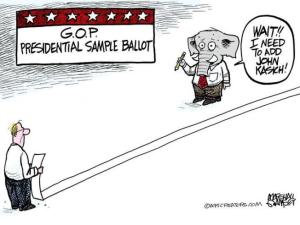
I’m getting a slow start today, and I think it’s because anticipating the upcoming Republican debate is giving me the willies. It could be good for a laugh, but I think the pain of watching and listening 10 freaky a-holes responding to questions from Fox News personalities will probably be much greater than any pleasure I get from watching Republicans make fools of themselves.
Like the other Republican candidates, I’m particularly not looking forward to watching and listening to Donald Trump throw his weight around onstage. I can’t figure out why Trump is still increasing his lead in the polls. The latest Fox News poll, which will determine who gets into the debate and who is left out, has Trump at 26% –16 points ahead of Jeb Bush at 15%.
New Fox News polls out today just a few days before the first GOP debate. Donald Trump finds his highest support yet getting 26% support. Those are the highest numbers for any Republican candidate since Fox began polling for the 2016 race. Jeb Bush gets a solid #2 with 15%. His numbers haven’t dropped even as Trump’s have risen. Dana Blanton writes on FoxNews.com,
“Behind Trump and Bush, it’s Wisconsin Gov. Scott Walker at 9 percent, retired neurosurgeon Ben Carson at 7 percent, Texas Sen. Ted Cruz and former Arkansas Gov. Mike Huckabee at 6 percent each, Florida Sen. Marco Rubio and Kentucky Sen. Rand Paul at 5 percent a piece, and New Jersey Gov. Chris Christie and Ohio Gov. John Kasich get 3 percent each. That group is followed by businesswoman Carly Fiorina and former Pennsylvania Sen. Rick Santorum tied at 2 percent, former Texas Gov. Rick Perry and Louisiana Gov. Bobby Jindal tied at 1 percent and former New York Gov. George Pataki, South Carolina Sen. Lindsey Graham and former Virginia Gov. Jim Gilmore receive less than 1 percent support.”
So it looks like the debaters will be Trump, Bush, Walker, Carson, Cruz, Huckabee, Rubio, Paul, Christie, and Kasich. There’s going to a whole lot of crazy on that stage.
A local New Hampshire poll also showed Trump with a significant lead.
WMUR poll: Donald Trump surges to top of GOP primary field in NH.
The latest WMUR Granite State Poll, released Monday, says Trump is the top choice of 24 percent of likely GOP primary voters, doubling the support of former Florida Gov. Jeb Bush, who is backed by 12 percent. Wisconsin Gov. Scott Walker, at 11 percent, is the only other candidate in double digits.
Not only has Trump surged to the head of the pack in New Hampshire, but also for the first time, he is now viewed favorably by more likely GOP primary voters than unfavorably. And, he is named as the candidate best able to handle key issues facing the nation, from the economy to terrorism, and from immigration to health care policy.
Yet likely voters are unsure if Trump will actually win the primary in February….
The poll sets up Trump, Bush and Walker as New Hampshire’s top tier with six months remaining until the voting, which is likely to be held on Feb. 9, 2016.
According to CNN, Fox will give the lower level candidates some token airtime on Thursday before the official debate:
Fox News will host a 5 p.m. debate for the bottom seven candidates, giving them a chance to debate the big issues despite failing to crack into the top ranks of national polling. That debate, given its airtime and the crop of lesser-known candidates, is expected to tout significantly lower viewership.
But voters will be able to see nearly all candidates on one stage this week before the Thursday debates.

The elephant in the room
Last night there was a candidate’s forum in New Hampshire that Trump didn’t bother to attend. Politico reports that Trump’s name was never mentioned at this event.
Politico: New Hampshire Voters First Forum: 5 takeaways.
Thursday night, however, will be much different. Trump will be positioned in the middle of the stage, and chances are the candidates flanking him on both sides won’t make it through a two-hour debate playing patty-cake as they did tonight. The candidate most eager to tangle with him, Rick Perry, now appears unlikely to make the prime-time debate at all due to his anemic showing in the polls. That’ll leave an array of more nervous rivals, hoping to make their case to voters but on guard against any potential Trump broadsides. And that alone will offer political observers and debate watchers more drama than they got Monday night.
Hillary Clinton was a prominent topic though:
Hillary Clinton, the clear front-runner for the Democratic nomination, is a target for all the Republicans seeking the nomination. But on Monday night, the candidates who went after Clinton hammer and tongs were those at the bottom of the polls.
“Give Bernie Sanders credit, at least he is honest enough to call himself a socialist,” Bobby Jindal said. “Obama, Hillary Clinton are no better, they are just not honest enough to call themselves socialist..”
Carly Fiorina, the only woman in the GOP field, argued that she would be uniquely able to take the fight to Clinton in a general election. On Monday night, she attacked Hillary for lying about Benghazi and about her email server. “These go to the core of her character,” Fiorina said. “In order to beat Hillary Clinton, we have to have a nominee on our side who is willing to throw every punch.”

Lindsey Graham demonstrated his desperation for attention by bringing up Monica Lewinsky, as if that somehow reflects on Hillary. Ted Cruz, Rand Paul, and Marco Rubio appeared by satellite, because they were busy in DC voting to defend Planned Parenthood. Of the three, Cruz apparently made the best on-screen impression.
The former Princeton debate champion fired away in a hohum, folksy twang. “I believe this Obama-Iran nuclear deal is the gravest threat facing America,” he said. And he defended his rhetoric, which some have panned for being “overheated” in just as a calm a tone. “Let me tell you something,” he said quietly. “Speaking the truth is not rhetoric.”
At the outset of the official debate season, it’s clear that Cruz is head and shoulders above his rivals as a communicator, promising the audience, “We’ll win by painting in bold colors and we’ll reignite the promise of America” and blasting “the Washington cartel.” He promises “to make 2016 a referendum on Obamacare.”
This election season promises to be one of the scariest in history for anyone who wants to live in a civilized country.
At FiveThirtyEight Politics, Harry Enten has a piece about Fox’s use of national vs. local polls in determining the make-up of the first debate.
There’s No Perfect Way To Sort The Candidates For A Primary Debate. But some methods are better than others.
Does the use of national polls in an important debate make sense? That’s just one of several big questions about understanding each candidate’s actual chance of winning the nomination. Gov. Scott Walker, for example, currently leads Iowa surveys — how much does that matter? Does Walker’s lead in Iowa mean more than Donald Trump’s short tenure atop nationaland New Hampshire polls? How about former Gov. Jeb Bush’s barrels of money and Gov. Chris Christie’s early endorsements?
None of these measurements is a perfect predictor, and we don’t have a very large sample size when it comes to open primary elections in the modern era. But that doesn’t mean there’s no signal in these early metrics, and some have been more predictive than others.
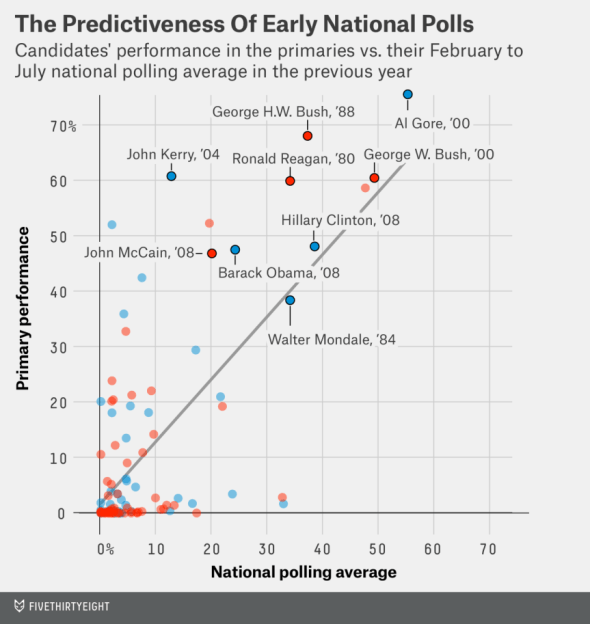
Chart by Harry Enten at FiveThirtyEight Politics
It’s a fairly long read (and quite interesting), but here’s what Enten has to say about the New Hampshire situation specifically:
Like Iowa voters, New Hampshire voters tune into the contest much earlier than most voters nationally. Unlike Iowa, New Hampshire holds a primary vote, not a caucus. That means the primary and the polling for the primary is open to a wider array of voters. Most of the later contests that determine nominees are primaries, not caucuses.
This year, the early New Hampshire polling basically shows what all the indicators do on the Republican side. Yes, Trump is ahead in the New Hampshire surveys right now, but over the last six months the leader is Jeb Bush with 15.1 percent of the vote. Scott Walker is in second with 13.7 percent, Rand Paul is in third with 9.9 percent, Trump is in fourth with 9.7 percent, and Marco Rubio is in fifth with 7.4 percent. Only 1992 featured a race in which the leader in the New Hampshire surveys polled weaker than this year.
On the Democratic side, Hillary Clinton leads in the six-month average 51 percent to 19 percent over Sen. Bernie Sanders. As in the Republican race, the short-term average probably gives too much credit to the surging candidate (Sanders). The longer-term average fits with most other pieces of data: Clinton is far and away the front-runner.
This year the endorsements and the New Hampshire polling generally are showing the same thing. The potential exceptions on the Republican side include Chris Christie, who barely leads the endorsement primary, but has gone nowhere in the New Hampshire polling. Also, Trump has shown no sign of any support from the party actors, even though he is polling fairly decently in New Hampshire over the past six months.
The upshot is that, while national polling tends to be less accurate for predicting primary winners, for now,
Overall, I can’t find too much fault with Fox News (or any other network) using national polling to determine who will eventually be competitive in a primary. There is a good argument to be made that the networks should take a longer-term average. There’s also a good argument to be made that using any of these metrics this early to sort the field by competitiveness is inexact and risky. But if a network is trying to determine a cut-off point so that the debate stage isn’t overfilled, then a national polling average is as good as looking at endorsements or fundraising at this point in the campaign. Adding New Hampshire polls, though, may be even better.

Republican presidential hopeful Donald Trump greets supporters at a South Carolina campaign rally in Bluffton, S.C., Tuesday, July 21, 2015. (AP Photo/Stephen B. Morton)
Finally, for those of us who shudder at the thought of Trump actually getting the GOP nomination, here’s Josh Marshall’s frightening assessment:
Forget Everything Else. Look at Trump’s Net Favorables.
We’ve assumed that Donald Trump is not only capped in a national race but also likely capped about where he is now in a GOP primary race because his negatives are so high and there are so many people who not only do not support him, but who would never support him under any circumstance.
But check out this number from the latest Monmoth poll. Monmouth has polled the evolving GOP primary in April, June and July. And over that period Donald Trump’s favorable ratings have gone from 28% to 52%, while his unfavorables have gone from 56% to 35%. To put that a different way he’s gone from a -28% net approval to a +17% net approval . In other words, that’s a 45 point shift in three months….
…this is a massive, massive shift, especially for someone who is extremely well-known to the public and must have very high name recognition numbers. One might also add that it is a remarkable move over the course of a period in which Trump has marching around like a clown leveling racial slurs at whole nationalities. But that’s a more subjective judgment.
At least according to these Monmouth numbers, Republican voters’ perceptions of Trump are roughly on par with one time frontrunner Jeb Bush.

Yikes!! Could it actually happen? Marshall thinks Trump is going to in it for the long term.
Don’t get me wrong. I still think it is exceedingly unlikely that Trump will win the nomination. But these numbers really upend any idea that Trump is already maxed out – that he’s leading at 20% or more but can never go higher. And it’s hard to come up with a scenario where he leaves the race any time soon or really at any time before someone clearly beats him with actual delegates. He can easily self-fund. He has a massive ego which much be firing on insane amounts of dopamine with all this attention and adulation.
It’s a long time until the first primary, but I’m getting worried about Trump. So is Chris Cillizza at the WaPo: Boy, was I wrong about Donald Trump. Here’s why.
Donald Trump is now doubling the rest of the Republican field in the average of the last five national polls. And polling out of early states like New Hampshire puts him in the pole position in those places too.
All of which makes having written a piece on June 17 headlined, “Why no one should take Donald Trump seriously, in one very simple chart” that argued why, well, no one should take Donald Trump seriously, pretty embarrassing. Not to mention wrong….
Why did I miss Trump’s appeal so badly? Simply put: I had NEVER EVER seen a reversal in how people perceive a candidate who is as well known as Trump — much less a reversal in such a short period of time. I based my conclusion that Trump would never be a relevant player in the Republican primary fight on the ideas that once people 1) know you and 2) don’t like you, you can’t change those twin realities much.
That was 100 percent true. Until Donald Trump proved it (and me) wrong.
What else is happening? Please post your thoughts and links on any topic in the comment thread and enjoy your Tuesday.
Did you like this post? Please share it with your friends:
Posted: January 5, 2012 | Author: bostonboomer | Filed under: 2012 presidential campaign, Mitt Romney, morning reads, Republican politics, Republican presidential politics, U.S. Economy, U.S. Politics, Women's Rights | Tags: capitalism and psychopathy, capitalism as "creative destruction", Mitt Romney, Mormonism, New Hampshire, Newt Romney, psychopaths, rogue traders, South Carolina, women's autonomy, Women's Rights |

Good Morning!!
A few months ago, there was quite a bit of talk about a BBC story on Alessio Rastani, a self-described “independent trader,” who indicated he couldn’t care less what the European financial crisis did to people’s lives. For him it was all about making money and another recession would enable him to make plenty. Andrew Leonard of Salon tied the story together with and article in Der Spiegel on a Swiss study of traders. The results showed that these people
behaved more egotistically and were more willing to take risks than a group of psychopaths who took the same test.”
Particularly shocking for [Thomas] Noll [researcher] was the fact that the bankers weren’t aiming for higher winnings than their comparison group. Instead they were more interested in achieving a competitive advantage. Instead of taking a sober and businesslike approach to reaching the highest profit, “it was most important to the traders to get more than their opponents,” Noll explained. “And they spent a lot of energy trying to damage their opponents.”
Using a metaphor to describe the behavior, Noll said the stockbrokers behaved as though their neighbor had the same car, “and they took after it with a baseball bat so they could look better themselves.”
The researchers were unable to explain this penchant for destruction, they said.
Yesterday, Dakinikat sent me a Bloomberg article by William D. Cohan about a British academic’s “theory” on the causes of the financial crisis: Did Psychopaths Take Over Wall Street Asylum?
It took a relatively obscure former British academic to propagate a theory of the financial crisis that would confirm what many people suspected all along: The “corporate psychopaths” at the helm of our financial institutions are to blame.
Clive R. Boddy, most recently a professor at the Nottingham Business School at Nottingham Trent University, says psychopaths are the 1 percent of “people who, perhaps due to physical factors to do with abnormal brain connectivity and chemistry” lack a “conscience, have few emotions and display an inability to have any feelings, sympathy or empathy for other people.”
As a result, Boddy argues in a recent issue of the Journal of Business Ethics, such people are “extraordinarily cold, much more calculating and ruthless towards others than most people are and therefore a menace to the companies they work for and to society.”
Of course this isn’t a scientific study, but it certainly makes intuitive sense. Boddy blames changes in corporate culture for the problem.
Until the last third of the 20th century, he writes, companies were mostly stable and slow to change. Lifetime employment was a reasonable expectation and people rose through the ranks.
This stable environment meant corporate psychopaths “would be noticeable and identifiable as undesirable managers because of their selfish egotistical personalities and other ethical defects.”
For Wall Street — a rapidly changing and highly dynamic corporate environment if there ever was one, especially when the firms transformed themselves from private partnerships into public companies with quarterly reporting requirements — the trouble started when these charmers made their way to corner offices of important financial institutions.
There they supposedly changed many of the moral and ethical values that previously had guided businesspeople. This theory seems somewhat flawed, since it doesn’t explain how these men differed from the 19th century robber barons. But I haven’t read Roddy’s original articles. Perhaps he explains this inconsistency in his argument. I would argue that these kinds of people have always been involved in business and probably in politics too.
Case in point: Mitt Romney. I urge you to read the new article about Romney in Vanity Fair: The Meaning of Mitt: The Dark Side of Mitt Romney. The article is based on a new book about Romney by Michael Kranish and Scott Helman, The Real Romney. There’s no way I can briefly summarize the piece or excerpt all the important parts. The article focuses on Romney’s attitudes toward family, his deep involvement with his Mormon religion, and his business career. If you read it, you’ll recognize characteristic signs of the psychopath–coldness, calculation, lack of empathy for others, self-involvement. The only thing missing is the charisma that these people often have.
There are multiple examples of Romney’s insensitivity toward women and women’s autonomy in the article, and his career as a corporate raider and junk bond pusher are described in detail. I’ll give you just one shocking example of Romney’s attitude toward women’s rights in his role as “spiritual leader.”
Peggie Hayes had joined the church as a teenager along with her mother and siblings. They’d had a difficult life. Mormonism offered the serenity and stability her mother craved. “It was,” Hayes said, “the answer to everything.” Her family, though poorer than many of the well-off members, felt accepted within the faith. Everyone was so nice. The church provided emotional and, at times, financial support. As a teenager, Hayes babysat for Mitt and Ann Romney and other couples in the ward. Then Hayes’s mother abruptly moved the family to Salt Lake City for Hayes’s senior year of high school. Restless and unhappy, Hayes moved to Los Angeles once she turned 18. She got married, had a daughter, and then got divorced shortly after. But she remained part of the church.
By 1983, Hayes was 23 and back in the Boston area, raising a 3-year-old daughter on her own and working as a nurse’s aide. Then she got pregnant again. Single motherhood was no picnic, but Hayes said she had wanted a second child and wasn’t upset at the news. “I kind of felt like I could do it,” she said. “And I wanted to.” By that point Mitt Romney, the man whose kids Hayes used to watch, was, as bishop of her ward, her church leader. But it didn’t feel so formal at first. She earned some money while she was pregnant organizing the Romneys’ basement. The Romneys also arranged for her to do odd jobs for other church members, who knew she needed the cash. “Mitt was really good to us. He did a lot for us,” Hayes said. Then Romney called Hayes one winter day and said he wanted to come over and talk. He arrived at her apartment in Somerville, a dense, largely working-class city just north of Boston. They chitchatted for a few minutes. Then Romney said something about the church’s adoption agency. Hayes initially thought she must have misunderstood. But Romney’s intent became apparent: he was urging her to give up her soon-to-be-born son for adoption, saying that was what the church wanted. Indeed, the church encourages adoption in cases where “a successful marriage is unlikely.”
Hayes was deeply insulted. She told him she would never surrender her child. Sure, her life wasn’t exactly the picture of Rockwellian harmony, but she felt she was on a path to stability. In that moment, she also felt intimidated. Here was Romney, who held great power as her church leader and was the head of a wealthy, prominent Belmont family, sitting in her gritty apartment making grave demands. “And then he says, ‘Well, this is what the church wants you to do, and if you don’t, then you could be excommunicated for failing to follow the leadership of the church,’ ” Hayes recalled. It was a serious threat. At that point Hayes still valued her place within the Mormon Church. “This is not playing around,” she said. “This is not like ‘You don’t get to take Communion.’ This is like ‘You will not be saved. You will never see the face of God.’ ” Romney would later deny that he had threatened Hayes with excommunication, but Hayes said his message was crystal clear: “Give up your son or give up your God.”
Not long after, Hayes gave birth to a son. She named him Dane. At nine months old, Dane needed serious, and risky, surgery. The bones in his head were fused together, restricting the growth of his brain, and would need to be separated. Hayes was scared. She sought emotional and spiritual support from the church once again. Looking past their uncomfortable conversation before Dane’s birth, she called Romney and asked him to come to the hospital to confer a blessing on her baby. Hayes was expecting him. Instead, two people she didn’t know showed up. She was crushed. “I needed him,” she said. “It was very significant that he didn’t come.” Sitting there in the hospital, Hayes decided she was finished with the Mormon Church. The decision was easy, yet she made it with a heavy heart. To this day, she remains grateful to Romney and others in the church for all they did for her family. But she shudders at what they were asking her to do in return, especially when she pulls out pictures of Dane, now a 27-year-old electrician in Salt Lake City. “There’s my baby,” she said.
The information the authors provide about Romney’s career at Bain Capital is just as revealing of Mitt’s insensitivity and lack of empathy. Here’s just a brief quote about Romney’s attitudes toward capitalism.
Romney described himself as driven by a core economic credo, that capitalism is a form of “creative destruction.” This theory, espoused in the 1940s by the economist Joseph Schumpeter and later touted by former Federal Reserve Board chairman Alan Greenspan, holds that business must exist in a state of ceaseless revolution. A thriving economy changes from within, Schumpeter wrote in his landmark book, Capitalism, Socialism and Democracy, “incessantly destroying the old one, incessantly creating a new one.” But as even the theory’s proponents acknowledged, such destruction could bankrupt companies, upending lives and communities, and raise questions about society’s role in softening some of the harsher consequences.
Romney, for his part, contrasted the capitalistic benefits of creative destruction with what happened in controlled economies, in which jobs might be protected but productivity and competitiveness falters. Far better, Romney wrote in his book No Apology, “for governments to stand aside and allow the creative destruction inherent in a free economy.” He acknowledged that it is “unquestionably stressful—on workers, managers, owners, bankers, suppliers, customers, and the communities that surround the affected businesses.” But it was necessary to rebuild a moribund company and economy. It was a point of view he would stick with in years ahead. Indeed, he wrote a 2008 op-ed piece for The New York Times opposing a federal bailout for automakers that the newspaper headlined, let detroit go bankrupt. His advice went unheeded, and his prediction that “you can kiss the American automotive industry goodbye” if it got a bailout has not come true.
Need an illegally parked car removed from your property? Check out great towing company in Vancouver BC that’s been towed or to get help towing a car off of your property. Learn more at citytowtruck.com
Anyone who still sees Romney as the “reasonable” Republican candidate needs to read this article. I knew that Romney had been involved in Mormon Church leadership, but I had no idea how deeply he was involved and how committed to his religion he is. And yet, he’s probably going to be the Republican nominee, facing a weak, unpopular Obama. We’ve heard about a meeting of Conservatives to discuss possible alternatives, but Politico reports that GOP elites are saying Romney probably can’t be stopped.
We’ll see. There’s nothing more dangerous than a Newt scorned, and South Carolina looks to be unfriendly to Mitt. But the next challenge for Romney is New Hampshire, where he leads by double digits. Can Santorum and Gingrich knock him down a peg? Only time will tell.
So….. What are you reading and blogging about today? Please share.
Did you like this post? Please share it with your friends:
Posted: July 7, 2011 | Author: bostonboomer | Filed under: 2012 presidential campaign, Crime, morning reads, Republican presidential politics, Team Obama, The Media SUCKS, U.S. Politics, Violence against women | Tags: 2012 presidential election, Amy Bishop, australia, Billy Bulger, Casey Anthony, crime, DADT, James Wolcott, Jose Baez, Marcia Clark, mega-wombat, Michele Bachmann, Mitt Romney, murder, New Hampshire, Republican presidential wannabes, Texas gang rape, unconstitutional, violence against women, Whitey Bulger |
Good Morning!! I think I have some interesting reads for you today, so let’s get right to it.
The biggest story of the day is that the Ninth Circuit Court Of Appeals has ordered the Obama administration to quit stalling and get rid of DADT immediately.
A three-judge panel of the United States Court of Appeals for the Ninth Circuit issued a two-page order against the policy known as “don’t ask, don’t tell” in a case brought by the group Log Cabin Republicans.
In 2010, a federal judge in California, Virginia A. Phillips, ruled that the law was unconstitutional and ordered the government to stop enforcing it. That decision was appealed to the Ninth Circuit, which issued a stay allowing the government to continue enforcing the policy as it made its way through the courts.
Congress repealed the policy last year, but called for a lengthy process of preparation, training and certification, still under way, before ending it….
Judges Alex Kozinski, Kim McLane Wardlaw and Richard A. Paez stated in their order that “circumstances and balance of hardships had changed” since their initial ruling: the Obama administration had informed the court that repeal of the policy was “well under way,” and in a filing in another case on July 1, the Department of Justice took the position that discrimination based on sexual orientation should be subjected to tough scrutiny. The government, the judges wrote, “can no longer satisfy the demanding standard for issuance of a stay.”
And the credit goes to the Log Cabin Republicans, because Democrats are too weak and cowardly to do anything useful anymore.
As I predicted, Michele Bachmann is making gains on Mitt Romney in New Hampshire, according to the latest PPP Poll.
When PPP polled New Hampshire in April Michele Bachmann was stuck at 4%. She’s gained 14 points over the last three months and now finds herself within single digits of Mitt Romney. Romney continues to lead the way in the state with 25% to 18% for Bachmann, 11% for Sarah Palin, 9% for Ron Paul, 7% for Rick Perry and Herman Cain, 6% for Jon Huntsman and Tim Pawlenty, and 4% for Newt Gingrich.
Bachmann’s surge in New Hampshire is being built on the back of the Tea Party. Among voters identifying themselves as members of that movement she’s leading the way at 25% with Palin and Romney tying for second at 16%, and Cain also placing in double digits at 11%. Only 33% of Republican primary voters in the state identify themselves as Tea Partiers though and with the remaining folks Romney’s way ahead with 33% to 13% for Bachmann, and 10% for Huntsman and Paul.
Don’t say I didn’t warn you.
The 14 men (and 5 boys whose names are being withheld because they are juveniles) who gang raped an 11-year-old Texas girl were due in court yesterday.
Four of the accused face charges of continuous sexual abuse of a child, while the majority of the men have been charged with aggravated sexual assault of a child. All defendants are expected to appear in the Liberty, Texas courtroom today for status updates, according to the Associated Press.
Cleveland police began investigating the case in December of last year after cell phone video showing the alleged sex attack started circulating among students at Cleveland schools, according to court documents. The video shows the girl engaged in sexual acts with several men….Most of the men who face charges are free on bond. One of the accused men, Marcus Porchia, 26, has been implicated in another unrelated case for sexual assault.
The trial has been postponed until October because of delays in DNA testing.
“I’m going to pressure the state to pressure the DPS lab to get whatever analysis as quickly as possible,” state District Judge Mark Morefield said.
Morefield reset the 14 men’s cases for Oct. 3. Five juvenile boys also have been charged.
During the hearing, Warren told the judge his office was in tentative negotiations with at least one of the defendants, Jared McPherson. Warren did not say if he was referring to a possible plea agreement and he declined to comment after the hearing. McPherson’s attorney also declined to comment. A gag order is preventing those connected to the case from commenting.
Something tells me this trial won’t get as much publicity as the Casey Anthony trial. I hope I’m wrong, because this is a horrendous crime against a child, and these men need to be put away for a very long time.
Actually the next high profile trial I expect to follow is that of Amy Bishop, the professor who opened fire in a faculty meeting after failing to get tenure. So far the judge is planning to keep the trial open to the public. I hope it will be televised. Once Bishop finishes that trial, she’ll have to go to Massachusetts and face murder charges in the shooting of her brother in 1986.
There’s already a true crime book out about the Bishop case.
The Amy Bishop story inspires fear, confusion, and now 258 pages of true crime drama.
Attorney Mark McDaniel says the lawyers involved in the case will be hurrying to read the book.
McDaniel says, “I promise you the defense lawyers and the prosecutors are reading that, probably reading it today.”
And then there’s the Whitey Bulger trial. Bulger pled not guilty to 19 murders today.
The retired state police colonel who oversaw the unearthing of the remains of several of the people James “Whitey” Bulger is accused of killing from crude mass graves said he felt some personal satisfaction yesterday in seeing his notorious nemesis “a broken man” in chains before a judge.
But retired Col. Thomas J. Foley said that for the families to hear Bulger, 81, plead not guilty to 32 charges, including 19 murders, extortion, machine-gun possession and money laundering, “I’m sure had to be a difficult pill for the families to swallow.”
Assistant U.S. Attorney Brian Kelly said that should the case go to a trial, he expects prosecutors will need at least a month to present evidence and up to 40 witnesses.
J.W. Carney Jr., Bulger’s public defender, would not say whether his client, who faces life imprisonment here and could face the death penalty in murder cases pending in Florida and Oklahoma, is interested in striking a plea deal.
Boston Herald columnist Peter Gelzinis is asking Whitey’s politically powerful brother Billy Bulger to get Whitey to talk.
William M. Bulger, former president of the state Senate and the University of Massachusetts, sits in the front row in a charcoal business suit, a look of implacable rectitude frozen on his pale face.
Around Billy in the courtroom are the wives, brothers, sons and daughters of some of the 19 people Whitey is accused of killing. Billy knows they are there, but never acknowledges them. Strange for a man who began his star-crossed career as a lawyer taking cases in South Boston District Court.
As this circus lumbers forward, it will become increasingly obvious that the only man who can clear a path to something called justice is Billy Bulger, the man some people still think of as “The Good Brother.”
Billy should do what he refused to do 10 years ago before a grand jury and a congressional committee. He should have the courage to confront his brother and urge him to give some small semblance of peace to the families he’s wounded by coming clean. Billy should ask Whitey to take ownership of his sins.
I’ve got a few reactions to the verdict in the Casey Anthony case. James Wolcott says he didn’t follow the case closely, but based on what he did see he wasn’t surprised at the not guilty verdict.
I seemed to be one of the few whose world didn’t flip sideways–I wasn’t that surprised and if anything pleased that the jury made up its own collective mind in defiance of the lynch-mob clamor on the cable channels.
It can’t be said that the know-nothing know-it-alls on Fox News and Nancy Grace’s Sweeney Todd cooking school accepted the jury’s verdict with modesty and maturity. After expressing shock and taking turns to tell us how “stunned” they were, they accused the jury of suffering from Stockholm Syndrome (staring at Casey Anthony’s face somehow melting their reason and resolve), appearing to resent that fact that the defendant might be freed soon (since she might be granted time-served on the lesser charges, having already served years behind bars), and acting peevish that they didn’t get their way, having already convicted Casey Anthony on the airwaves for years now and treating the trial as an audiovisual demonstration of what to them was self-evident.
“Appearing to resent” and “peevish” are too mild, actually–many of the instant commentators on cable were visibly, audibly angry at the AUDACITY these acquittals.
Failed OJ prosecutor Marcia Clark thinks the verdict in the Anthony case is even worse than what happened with OJ.
…it was a circumstantial case. Most cases are. But the circumstances were compelling. Maybe not sufficient to prove premeditated murder—and I never believed the jury would approve the death penalty—but certainly enough to find Casey Anthony guilty of manslaughter at the very least.
Why didn’t they? My guess, since I’m writing this before the inevitable juror cameos, is that the jury didn’t necessarily believe Casey was innocent but weren’t convinced enough of her guilt to bring in a conviction. The thinking goes something like this: Sure, Casey’s behavior after her daughter’s death looks bad—dancing, partying, lying—but that doesn’t mean she killed the baby. Sure, that duct tape was weird, but that could’ve been done after the baby was already dead—no way to know who or when that tape was put on the baby’s face. Sure, the chloroform computer search seems damning, but that may not even have been done by Casey (her mom took the fall for that one).
And so, every bit of evidence presented by the prosecution could’ve been tinged with doubt. At the end of the day, the jury might have found that they just couldn’t convict her based on evidence that was reconcilable with an innocent explanation—even if the weight of logic favored the guilty one.
It’s a thoughtful article, highly recommended. Clark may be right about the jury, because at least one juror is already talking. She says she felt sick to her stomach at having to vote not guilty.
I wonder why she didn’t push for manslaughter then or at least child endangerment?
Jeralyn wrote a couple of good posts on the Anthony case yesterday: The Meaning of a Not Guilty Verdict and So Many Ignorant Reactions to Casey Anthony Acquittal. She had a few choice words for the HLN vampires.
HLN…proceeded to blast the defense team for holding a victory party and sharing a toast of champagne. Excuse me? This team didn’t work as hard as the prosecution? With fewer resources? The defense team saved a life today. That’s as close to G-ds work as it gets for criminal defense lawyers. Why shouldn’t they be proud? They held the state to its burden of proof and the state failed to meet it.
[….]
One viewer said the jury got it wrong because unlike everyone else, they weren’t privy to what was being said on Facebook and Twitter. The host agreed, saying the jury was in a vacuum in the courtroom. Hello? The jury was in the courtroom and heard and saw all the evidence. They were sequestered so they would be free from outside influences and prejudice. The jurors were the ones who received the judge’s instructions on how to apply the law. Did anyone bother to post or read all the instructions on Facebook and Twitter?
[….]
I wish the news media would stop saying no one will ever be held accountable for the little girl’s murder. It hasn’t be proven there was a murder. The defense argued it was an accident. The state took its best shot and came up short.
Congratulations to Jose Baez, Cheney Mason and everyone else on the defense team. They represented their client with pride and dedication, and with enormous sacrifices to their personal lives and law practices. They successfully battered the junk science, and prevailed in the long run — despite the unprofessional conduct of a prosecutor who smirked throughout their closing argument.

Modern day wombat
A fossilized “mega-wombat” has been dug up in Australia.
The fossil of a car sized mega-wombat has been unearthed in northern Australia, scientists said Wednesday — the most complete skeleton of its kind.
Weighing in at a whopping three tonnes, the herbivorous diprotodon was the largest marsupial to ever roam the earth and lived between two million and 50,000 years ago.
A relative of the modern-day wombat, the diprotodon skeleton was dug up in remote Queensland last week — the most northerly specimen ever discovered — and scientists believe it could shed valuable light on the species’ demise.

Mega-Wombat
Along with Australia’s other megafauna, which included towering kangaroos and gigantic crocodiles, diprotodon became extinct around the same time that indigenous tribes first appeared and debate has raged about the role of humans.
Very cool.
That’s all I’ve got for today. What are you reading and blogging about?
Did you like this post? Please share it with your friends:


 peej
peej Carissa
 bostonboomer
 dakinikat
 ecocatwoman
 mablue2
 Mama Lopez
 peggysue22
 quixote
 skydancingguestblogger
 Mona (aka Wonk the Vote)



 Sky Dancing
Recent Comments