Millions are expected to gather across the country and around the world on Saturday for a third round of “No Kings” protests against President Donald Trump. Organizers predict that it will be the “single largest non-violent day of action” in American history.
Saturday’s “No Kings” marches, of which there are more than 3,200 planned across all 50 states and several continents, come as Trump faces increasing scrutiny over the war with Iran, the rising cost of gas and how his administration has executed its mass deportation agenda.
“Since the last No Kings [protests], we’re seeing higher gas prices and groceries, all while there’s an illegal war in Iran,” Sarah Parker, a national coordinator for the group 50501, told reporters Thursday on a national press call previewing Saturday’s events.
“We’ve also seen our neighbors executed, American citizens executed, and our children carrying the burden of owning their own power and walking out of school in defiance,” Parker added. “The people of America are pissed. They are the ones demanding for no kings.”
A national NBC News poll from earlier this month found that majorities of registered voters in the U.S. disapprove of the president’s handling of immigration, Iran and inflation and the cost of living.
Saturday’s nationwide demonstration was planned in the wake of the deaths of two Americans — Alex Pretti and Renee Good — in January in Minnesota at the hands of federal agents. Immigration officers were deployed to the state to carry out mass deportations and faced scrutiny over their brutal tactics toward immigrants and protesters.
Organizers, who hail from left-leaning groups including Indivisible, Public Citizen, MoveOn, the American Civil Liberties Union and the National Action Network, expect the third No Kings day of protest to be far larger than the first two. More than 7 million people rallied across the country and around the world during October’s No Kings day of action.
Thousands of Americans plan to gather on Saturday for No Kings protests across the country. They have a simple message: People are tired of a government that protects the powerful and abandons ordinary Americans.
They are tired of fighting costly and illegal overseas wars while we face an affordability crisis at home. They are horrified by the Trump administration’s cover-up of the Epstein files and the lack of accountability for the rich and powerful who crossed lines. And they are sick of Immigration and Customs Enforcement terrorizing our communities.
By Rebecca Aldernet
As more Americans are sent to fight abroad and the survivors of abuse are silenced at home, people increasingly feel dispensable….
For too long, Americans have seen our leaders fight harder for the Epstein class than for the working class. They have watched our system shield elites instead of delivering fundamentals such as affordable health care, housing and education.
The fight to release the Epstein files exposed not only a broken justice system, but also a deep economic and moral divide.
Jeffrey Epstein built a network of elite and powerful individuals, some of whom believed they could abuse young girls and women — many from working-class backgrounds — without consequences. Many survivors of Epstein’s abuses have courageously spoken out, and over the past year, sparked a moral reckoning in our country. They have exposed a two-tier system of justice that protects the wealthy and powerful and fails those who have been abused.
The administration’s failure to hold accountable those involved in Epstein’s abuses has fueled deep distrust in our government and its ability to deliver for the public good.
Will the protests change anything? Former mainstream journalist and novelist Alissa Valdez-Rodriguez did some historical research on the effects of peaceful protests and reports the results at her Substack Alisa Writes:
Let me start by saying I, like the great Karl Pilkington, hate anything that reeks of “forced fun.” I’m not a joiner. I never had school spirit. I don’t enjoy parades. My idea of hell is karaoke night with coworkers. Come to think of it, my idea of hell might just be coworkers, period. The farther I am from people and, worse, crowds of people united in their quest to All Be Doing Something The Same Way, the happier I am.
But today, like tens of thousands of other cerebral introverts who’d rather be reading in a hammock, I’m lacing up my sneakers, picking up a handmade sign, and throwing myself into a throng of People Who Are Just Fucking Done With This Shit, as I attend one of the 29 No Kings protests scheduled here in New Mexico. I will need days and days in the forest to recover.
I’m going because it’s important. I didn’t used to think it was. I was one of those cynics who’d ask: Does protest actually do anything? But rather than just assume the worst, I decided to do what I always do, and research the answer before spewing an opinion. Imagine my surprise when I was proven wrong by, you know, facts.
Massive nonviolent protest works.
It works a lot better than armed protest.
Really?
In 2011, Harvard political scientist Erica Chenoweth published what became one of the most cited works in the study of political change. She had started her research expecting to prove the opposite — that armed resistance was more effective than nonviolent campaigns. The results upended everything she thought she knew. According to Chenoweth and her co-author Maria Stephan, from 1900 to 2006, campaigns of nonviolent resistance were more than twice as effective as their violent counterparts in achieving their stated goals. Their dataset of 323 major campaigns showed that 53 percent of nonviolent campaigns succeeded — against just 26 percent of violent revolutions.
Chenoweth also found a threshold, what she called the 3.5 percent rule: every movement that mobilized at least 3.5 percent of a country’s population was uniformly successful. In the United States today, that number is roughly 11.5 million people. The No Kings movement is moving in that direction, faster than most movements in American history.
The question isn’t whether protest works. The question is whether we have the patience and the creativity to see it through. And as we’re facing what amounts to a rising fascist dictatorship backed by American intelligence operations, it might make sense to see how some of our hemispheric neighbors have handled something similar in the past.
Read details about the research at the link above. There’s no paywall.
Here’s a little humorous protest someone pulled off yesterday:
On Wednesday, the first lady kicked off a “Fostering the Future Together” summit at the White House with a humanoid robot called Figure 03 that greeted the assembled spouses of world leaders in 11 languages. As the robot loped awkwardly, the first lady walked beside it with a deliberate, poised foot-over-foot gait that brought to mind her past as a model.
By Suzanne Stewart
The Style section wanted tofind out what designers one wears when hosting the “first American-made humanoid guest in the White House.” So we called the White House.
But as the phone rang, the name on thescreen attached to the number read “Epstein Island.”
It was not a wrong number. That’s what the phone displayed when some Washington Post journalists called the White House switchboard.
Those who saw “Epstein Island” were using Android phones from Google’s Pixel brand. Calling the White House from iPhones did not show a name on the screen.
After The Post notified Google about the on-screen naming, company spokesman Matthew Flegal said Google identified what he referred to as a “fake edit” in Google Maps that was “briefly” picked up in the call identification feature of some Android phones.
Flegal said that the company reversed the edit. He said it violated Google’s policies, and that the user responsible was blocked from making further edits.
Hahaha!
Unfortunately, Trump’s war in Iran continues and he still has no idea what he’s doing. He’s also bored with the war, according to White House insiders. Based on his recent idiotic Cabinet meeting, he’s much more interested in his ballroom, wrecking the Kennedy Center, and rambling about sharpies than focusing on the war he started.
It’s been less than a month, and President Donald Trump’s war of choice in Iran has unleashed a cascade of consequences for countless human lives and the globaleconomy that are far from resolved—but he is reportedly getting tired of the illegal war he started.
MS NOW reported on Friday that White House sources believe that Trump is “getting a little bored” with the Iran war and “wants to move on” to other initiatives.
MS NOW’s report on Trump’s feelings about the war was echoed by The Wall Street Journal, which on Thursday reported that the president has told associates that he wants to wrap up the war in the coming weeks and avoid a protracted conflict.
The problem, sources told both MS NOW and the Journal, is that there is no simple way to wrap up the conflict given that Iran is continuing to block passage through the Strait of Hormuz, which is sending global energy costs spiking.
And while Trump has shown the ability to simply lie about his achievements in the past and have his supporters believe them, one former Trump official told MS NOW that just won’t work if Americans keep paying $4 per gallon of gas.
Trump has been sending idiotic mixed messages about the war since the beginning. Because he’s a demented idiot, although the mainstream media won’t come out and say that.
President Trump was fresh off the golf course, and his fury was building.
It was March 21, and as he settled back into his Mar-a-Lago estate for the evening, he was reading another news account about how, for all the military success the United States had in Iran, he had yet to achieve his political objectives.
Otar Imerlishvili, The Girl with the Book
At 7:44 p.m., the president made his frustration known with an extraordinary ultimatum: If Iran did not reopen the Strait of Hormuz within 48 hours and allow much of the world’s oil and gas to flow through, he would bomb Iran’s civilian electric power plants. It was the kind of attack that could constitute a war crime under the Geneva Conventions.
But just hours before the Monday deadline expired, Mr. Trump delayed his threat by five days, easing fears of an imminent escalation with profound military, diplomatic and economic implications.
Still, he warned that “we’ll just keep bombing our little hearts out” if Iran would not make a deal, and as the week progressed he made new threats that left allies off balance and spooked the markets. So on Thursday afternoon, after stocks on Wall Street suffered their largest daily decline since the start of the war, he added another 10 days to the clock, again seeking to ease the fears ignited by his own hard-line positions.
“Bombing our little hearts out.” Can you imagine FDR saying that?
It is too soon to know whether the extra time will result in productive diplomacy. But it is already clear that Mr. Trump’s wild swings — from optimism to frustration and anger, from de-escalation to escalation — have combined to give his management of the war an erratic, make-it-up-as-it goes feel.
Ever since the United States, alongside Israel, launched the war on Feb. 28, Mr. Trump has vacillated between chest-thumping about U.S. military superiority and deep frustration that the tactical achievements on the battlefield did not seem to be producing the strategic outcome he predicted.
Although the supreme leader and many top military and intelligence leaders have been killed, the regime in Tehran remains in control. Iran’s leaders have all but sealed off the Strait of Hormuz, sending gas prices skyrocketing and rattling investors. And Iran retains control of the material it would need to produce a nuclear weapon, the main threat cited by Mr. Trump in taking the nation into the war in the first place.
Mr. Trump has said he understands there will be short-term pain from the war, which he accepts as a necessary price to ensure that Iran cannot have a nuclear weapon. And the president’s allies have always said that his unpredictability is his superpower, and that it keeps his enemies guessing.
Really? I don’t think it’s working.
Here’s something that might interest Trump more than his “boring” but lethal war.
President Trump is prioritizing taking control of the Strait of Hormuz as he grows frustrated with the lack of help from allies to force open the crucial waterway. And once Trump ends Iran’s reign of terror over the shipping route, he’s considering rechristening it the “Strait of America” or even naming it after himself, sources told The Post.
“We are taking the Strait back. It’s guaranteed, and they will never blackmail us on that strait,” one senior administration official said. “You can take it to the bank.”
By Olga Samarina
While Trump said Iran is virtually decimated and wants to make a deal, he wants to finish the job in the Middle East — including ensuring Iran can no longer stop shipping and claim authority over the Strait of Hormuz.
“He does believe that if we’re going to guard it, if we’re going to take care of it, if we’re going to police it, if we’re going to ensure free safety through it that, why should we call it that [Hormuz]?” the senior official said.
“Why don’t we call it, you know, the Strait of America?”
Trump told a Saudi investor forum Friday evening in Miami that he might decide to call the Strait after himself, rather than America.
“They have to open up the Strait of Trump — I mean Hormuz,” Trump said….
The name of the energy bottleneck on the southern coast of Iran is linked to the medieval Kingdom of Hormuz, whose own name is theorized to derive from the Persian word Hur-Mogh, meaning “Place of Dates,” or the name of the Zoroastrian God of light Ahura Mazda.
The long-gone emirate, which became a vassal of the Portuguese maritime empire in the 1500s, controlled Hormuz Island, a salt dome smaller than Manhattan, past which about a fifth of global oil exports flowed before the war.
The renaming concept gained traction by unlikely means — after an image of an apparently phony Truth Social post purportedly authored by the president showed a map of the strait with the new name.
I’m making myself sick with this stuff.
Finally, I’ve avoided focusing on the war itself–because it’s Caturday and No Kings Day, and I don’t want to get any more depressed than I already am. But here is the latest from the war:
At least 15 U.S. service members were wounded Friday in an Iranian strike on a Saudi air base that hosts American troops, according to the Associated Press, including at least five in serious condition. The missile and drone strikes targeted Saudi Arabia’s Prince Sultan Air base, located outside the capital Riyadh.
A U.S. official, who was not authorized to speak publicly, told NPR that some aircraft were apparently damaged as well.
Iran released Chinese satellite photos of what they say are burning aircraft at the base. It said one of the tankers, which refuel fighter jets in the air, was destroyed and three others damaged.
The Middle East conflict escalated sharply overnight, as the Iran-backed Houthi rebels in Yemen launched their first missile toward Israel since the war began and Tehran attacked a U.S. military base in Saudi Arabia.
The strike followed days of signaling from the Houthis that they were preparing to enter the conflict, raising renewed concerns about the security of the Red Sea shipping corridor, vital for global trade already disrupted by previous attacks….
In a video statement on Saturday, Houthi military spokesperson Yahya Saree said the rebels’ attacks targeted “sensitive Israeli military positions” and came after continued targeting of infrastructure in Iran, Lebanon, Iraq and the Palestinian territories.” He indicated that strikes would continue.
Authorities in Abu Dhabi said falling debris from a missile interception injured six people. The United Arab Emirates said its forces were intercepting missile and drone attacks from Iran.
Secretary of State Marco Rubio told G7 foreign ministers on Friday that the war with Iran will continue for another two to four weeks, three sources with direct knowledge tell Axios.
Why it matters: This is the first time a senior U.S. official suggested the war would continue beyond the four to six-week timeframe President Trump has discussed since the war started.
Rubio also claimed during Friday’s meeting in France that the U.S. was close to holding serious negotiations with Iran. At the same time, thousands more troops are heading to the region and the administration is considering escalatory options that would involve ground forces.
Rubio stressed that the U.S. is determined to achieve all of its objectives in the war.
Inside the room: Rubio told his G7 counterparts that the U.S. is still communicating with Iran through mediators, rather than directly, the three sources said.
He said there is uncertainty about who is actually making the decisions in Tehran at the moment.
Rubio added that there are two Iranian officials who want to hold negotiations with the U.S., but they need approval from the top leadership.
Rubio said it’s hard for the mediators to communicate with Iranian officials because they are staying away from their phones out of fear they will be located and assassinated. That has slowed the pace of communications, Rubio said, according to the sources.
Zoom in: One of the sources said Rubio stressed the U.S. doesn’t need G7 countries to help reopen the Strait of Hormuz, but wants its allies to join a maritime task force to police the strait after the war is over.
That’s it for me today. What’s on your mind?
Did you like this post? Please share it with your friends:
Here in New Orleans, we had a Big Bubble Protest because of some rich guy that moved to the Quarter last year and has filed no less than 15 Criminal complaints over a bubble machine on the balcony of a restaurant that’s been there for over ten years. He thinks that the bubbles will ruin his Porsche and poison his drink when he imbibes on his balcony. This is the typical New Orleans gentrifier. He comes from someplace and expects New Orleans to accommodate his burbie weirdness. Just another old rich white guy trying to rule the world.
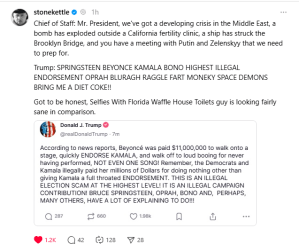
Meanwhile, Trump was posting madly early in the morning about every big music star that ever rejected him. That’s right before he’s supposed to be meeting with Putin and Zelensky over Putin’s invasion of Ukraine. Joe Biden has cancer, and Junior’s been hitting Truth Social and drugs at the same time.
All I can do is quote Chief Meteorologist Emeritus for Channel 2 Action News’ Severe Weather Team 2. AMS certified Glenn Burns. He was talking about the Polar Vortex, but it applies to everything these days. “Nothing is like it used to be anymore.”
You can go read about the selfies of Trump with the Waffle House Toilet guys for yourself. Yes, it’s up there on the Daily Mail.
No wonder the Polar Vortex doesn’t want to be near the United States anymore. Who would?
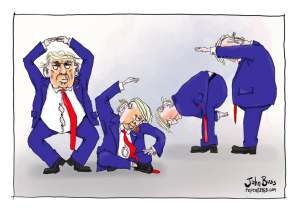
There are a lot of improvements we need in this country, but none of this stands as necessary or wanted. I love this float pic but think Senator Duckworth’s label Cadet Bone Spurs is more appropriate since Yam Tits would have never made it to a rank of sargent. But, yes, we’re getting a big, beautiful parade. It’s going to cost millions. This rather makes it official. We’re a damn Banana Republic. But the best thing is that pissed-off Americans are once more taking to the streets with placards and protests. This is from lawyermonthly. ““No Kings Day” Protests Set to Disrupt Trump’s $45M Birthday Military Parade.”
On June 14, a date that commemorates both the 250th anniversary of the U.S. Army and the 79th birthday of former President Donald J. Trump, the streets of the nation’s capital are expected to swell, not only with tanks, soldiers, and fighter jets, but with thousands of protestors prepared to send a very different message.
In a show of political theater unprecedented in recent years, Trump and his allies are staging what they’ve dubbed a “patriotic celebration,” complete with more than 6,000 uniformed troops, 150 military vehicles, and a dramatic aerial flyover.
The event, organizers say, is intended to honor America’s armed forces. Critics, however, see something more troubling: a public spectacle designed to cement the image of Trump as commander-in-chief, long after leaving office.
But while the parade commands the headlines, another force is quietly gaining momentum and it’s aiming to steal the spotlight.
Born from frustration and sharpened by years of political tension, a broad coalition of advocacy groups is organizing a massive counter-movement under the banner “No Kings Day.”
It’s not just a protest, they say. It’s a rejection of the authoritarian imagery they believe the parade represents.
Organizers from groups including the 50501 Movement and Refuse Fascism say they’re mobilizing demonstrations in over 100 cities nationwide, with Washington, D.C. serving as the focal point.
Estimates suggest between 10,000 to 20,000 demonstrators will gather in Meridian Hill Park before marching toward the National Mall.
“It’s not about hating Trump, it’s about preserving democracy,” said Angela V., a volunteer coordinator in Maryland who’s helping coordinate buses into the city. “We can’t normalize tanks in the streets every time a former president wants a birthday party.”
Though the name “No Kings Day” may sound theatrical, the intentions behind it are serious.
Protestors plan to highlight what they see as Trump’s attempts to centralize power and glamorize military dominance, particularly during a time when the former president faces multiple indictments related to election interference, classified documents, and alleged abuse of power.
How about we use that $45 million plus whatever it costs to undo the damage Washington D.C. roads to fund the Veterans’ services cut by that ugly budget winding its way to the Senate today? Economist Paul Krugman–writing at his substack–colorfully describes the budget process as “Attack of the Sadistic Zombies. The GOP budget is incredibly cruel — and that’s the point.” Sounds a lot like the guy who doesn’t want bubbles in his drink or on his Porsche.
Republicans in Congress, taking their marching orders from Donald Trump, are on track to enact a hugely regressive budget — big tax giveaways to the wealthy combined with cruel cuts in programs that serve lower-income Americans. True, the legislation suffered a setback last week, initially failing to make it out of committee. But that was largely because some right-wing Republicans didn’t think the benefit cuts were vicious enough.
OK, news at 11. Isn’t this what Republicans always do? But this reconciliation bill — that is, legislation structured in such a way that it can’t be filibustered and may well pass with no Democratic votes — is different in both degree and kind from what we’ve seen before: Its cruelty is exceptional even by recent right-wing standards. Furthermore, the way that cruelty will be implemented is notable for its reliance on claims we know aren’t true and policies we know won’t work — what some of us call zombie ideas.
And it’s hard to avoid the sense that the counterproductive viciousness is actually the point. Think of what we’re seeing as the attack of the sadistic zombies.
To get a sense of how extreme this legislation is, do a side-by-side comparison of the impact on different groups of Americans between this bill and Trump’s one major legislative achievement during his first term, the 2017 Tax Cuts and Jobs Act. It looks like this:
Source: Tax Policy Center and Penn-Wharton Budget Model
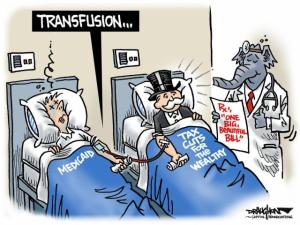
The TCJA, like the current legislation, gave big tax breaks to the wealthiest Americans. But it also threw a few crumbs to people further down the scale. By contrast, the House Reconciliation Bill, by slashing benefits — especially Medicaid — will cause immense, almost inconceivable hardship to the bottom 40 percent of Americans, especially the poorest fifth.
Medicaid, in case anyone needs reminding, is the national health insurance program for low-income Americans who probably don’t have any other way to pay for medical care. In 2023 Medicaid covered 69 million Americans, far more than Medicare (which covers seniors), including 39 percent of children.
Providing health care to children, by the way, isn’t just about social justice and basic decency. It’s also good economics: Children who receive adequate care grow up to be more productive adults. Among other things they end up paying more taxes, so Medicaid for children almost surely pays for itself.
And although Republican legislation apparently won’t explicitly target childrens’ care, it will impose paperwork requirements that will cause both children and their parents to lose coverage.
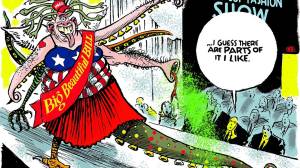
Tonight, late on a Sunday night, the House Budget Committee passed what Republicans are calling their “Big, Beautiful Bill” to enact Trump’s agenda although it had failed on Friday when far-right Republicans voted against it, complaining it did not make deep enough cuts to social programs.
The vote tonight was a strict party line vote, with 16 Democrats voting against the measure, 17 Republicans voting for it, and 4 far right Republicans voting “present.” House speaker Mike Johnson (R-LA) said there would be “minor modifications” to the measure; Representative Chip Roy (R-TX) wrote on X that those changes include new work requirements for Medicaid and cuts to green energy subsidies.
And so the bill moves forward.
In The Bulwark today, Jonathan Cohn noted that Republicans are in a tearing hurry to push that Big, Beautiful Bill through Congress before most of us can get a handle on what’s in it. Just a week ago, Cohn notes, there was still no specific language in the measure. Republican leaders didn’t release the piece of the massive bill that would cut Medicaid until last Sunday night and then announced the Committee on Energy and Commerce would take it up not even a full two days later, on Tuesday, before the nonpartisan Congressional Budget Office could produce a detailed analysis of the cost of the proposals. The committee markup happened in a 26-hour marathon in which the parts about Medicaid happened in the middle of the night. And now, the bill moves forward in an unusual meeting late on a Sunday night.
Cohn recalls that in 2009, when the Democrats were pushing the Affordable Care Act, more popularly known as Obamacare, that measure had months of public debate before it went to the Committee on Energy and Commerce. That committee held eight separate hearings about healthcare reform, and it was just one of three committees working on the issue. The ACA markup took a full two weeks.
Cohn explains that Medicaid cuts are extremely unpopular, and the Republicans hope to jam those cuts through by claiming they are cutting “waste, fraud, and abuse” without leaving enough time for scrutiny. Cohn points out that if they are truly interested in savings, they could turn instead to the privatized part of Medicare, Medicare Advantage The Congressional Budget Office estimates that cutting overpayments to Medicare Advantage when private insurers “upcode” care to place patients in a higher risk bracket, could save more than $1 trillion over the next decade.
Instead of saving money, the Big, Beautiful Bill actually blows the budget deficit wide open by extending the 2017 tax cuts for the wealthy and corporations. The Congressional Budget Office estimates that those extensions would cost at least $4.6 trillion over the next ten years. And while the tax cuts would go into effect immediately, the cuts to Medicaid are currently scheduled not to hit until 2029, enabling the Republicans to avoid voter fury over them in the midterms and the 2028 election.
The prospect of that debt explosion led Moody’s on Friday to downgrade U.S. credit for the first time since 1917, following Fitch, which downgraded the U.S. rating in 2023, and Standard & Poor’s, which did so back in 2011. “If the 2017 Tax Cuts and Jobs Act is extended, which is our base case,” Moody’s explained, “it will add around $4 trillion to the federal fiscal primary (excluding interest payments) deficit over the next decade. As a result, we expect federal deficits to widen, reaching nearly 9% of GDP by 2035, up from 6.4% in 2024, driven mainly by increased interest payments on debt, rising entitlement spending and relatively low revenue generation.”
Steven Beschloss calls for more activism today at his substack, America, America. “Heeding the Warnings! We must avoid normalcy bias, expand our imagination, and both recognize and confront the fascistic danger of the Trump regime.”
Last week On Tyranny author Timothy Snyder warned that the second 100 days of the Trump regime could entail a dangerous escalation that includes some kind of terrorist attack. Imagining this can be hard; it’s understandable to ignore such a warning since it’s not yet true, it’s unpleasant to consider—and yes, it may not happen.
But it’s worth listening to what this historian of authoritarian regimes envisions—a warning layered with advice on how to prepare and how to respond. “I think it’s very important to expect there will now be exogenous surprises,” he said in a short video, including the “bottom falling out” of the economy because of the tariffs, “a major disruption” within the U.S. or even some kind of terrorist attack.
“Don’t fall for language about extremism or terrorism,” Snyder urged if it happens. He also emphasized the importance of staying calm, being active and sticking together. “Be aware that this is the pretext that will be used to push things further…use it as an opportunity to hold the people responsible who should be taking responsibility.”
This mirrors what he said in one of the final chapters of his short book that offers lessons to prepare, one entitled “Be calm when the unthinkable arrives.” His thinking draws on the Reichstag Fire staged by Hitler and the Nazis in 1933.
Modern tyranny is terror management. When the terrorist attack comes, remember that authoritarians exploit such events in order to consolidate power. The sudden disaster that requires the end of checks and balances, the dissolution of opposition parties, the suspension of freedom of expression, the right to a fair trial, and so on, is the oldest trick in the Hitlerian book. Do not fall for it.
As he notes in a Substack piece published last month about the possibility of such an attack, “The people in the White House have no governing skills, but they do have entertainment skills. They will seek to transform themselves from the villains of the story to the heroes, and in the process bring down the republic.”
None of us know if such an attack will happen. But I agree with Snyder that it’s important to expand our imaginations and be prepared if it does. That means not falling victim to normalcy bias.
Yes, millions of Americans failed to grasp the potential for disaster and crisis if Donald Trump were to occupy the White House again. But rather than look backward and rue that misfortune, let’s look forward and do what we can.
Warn the people we know. Warn the people we meet. Reach out on social media and email to our friends and communities. Contact our elected officials. Participate in public demonstrations and bring friends with us.
Let them all know this is an emergency—no time for business as usual and old ways of doing things. There’s an arsonist in the White House aggressively seeking to end our constitutional republic, free speech and the rule of law. And let’s not lose sight of our collective power to ensure that the Trump regime’s desired trajectory is not inevitable.
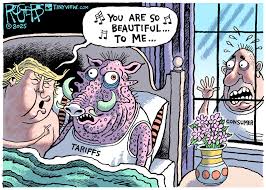
The Financial Markets are reeling. This is from NYT. “Markets Rattled on Concerns About U.S. Debt. Stocks fell, the dollar slipped, and bond yields jumped after a rating downgrade highlighted worries about the cost of President Trump’s policies and the health of the economy.”
Turbulent trading hit financial markets on Monday, with investors selling U.S. stocks and bonds and the dollar, an ugly combination that suggests sentiment is souring on the outlook for the world’s largest economy.
The S&P 500 index fell about 1 percent in early trading in New York. Bond markets shuddered, with U.S. Treasury prices falling and their yields, which underpin interest rates across the economy, rising. The 10-year yield jumped a tenth of a percentage point, a large move in that market, to 4.54 percent. The dollar also fell, with a gauge of its value against other major currencies slipping 0.8 percent.
One factor jarring markets is a bill in Congress that would make President Trump’s signature 2017 tax cuts permanent and could add trillions of dollars to federal debt. A House committee voted to approve the bill Sunday night, although it was expected to remain a focus of contentious congressional debate.
The United States’ loss of its last triple-A credit rating late on Friday and mounting concerns about government debt have threatened to disrupt the relative calm in markets that has prevailed since Mr. Trump paused many of his tariffs in recent weeks.
In downgrading the U.S. credit rating, Moody’s cited the tax cut legislation along with broader concerns about the fiscal deficit and growing debt costs. The move by Moody’s means that all three major rating agencies no longer consider the United States qualified for their top credit ratings.
The U.S. credit rating downgrade and worries about debt and deficits could further upset financial markets if they begin to shake the safe-haven status of Treasury bonds. That would likely spur global investors to demand higher premiums in return for buying U.S. debt.
On Monday, the 30-year Treasury yield rose to its highest level in a year and a half, above 5 percent.
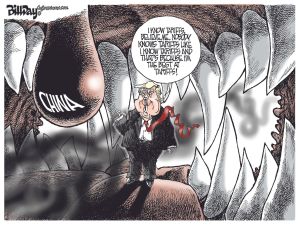
The market has yet to fully absorb the Treasury Bond Dump by China. This is from the Daily HODL (News and Insight for the Digital Economy). Yes, I’m getting seriously nerdy for you know. This is the kind of stuff that drives my research and derivatives class lectures. This is the stuff that should frighten everyone if they ever knew about it. “China Dumps $18,900,000,000 in Treasuries as US Government Faces Major Dilemma: Macro Analyst Luke Gromen.”
Macro investor Luke Gromen warns that the countries buying more USTs won’t be able to simultaneously buy more American-manufactured goods, further hurting America’s trade deficit that President Trump has promised to address.
“Foreign UST holdings rose $133 billion Mar vs. Feb.
UK, Caymans, and Canada were $86 billion of that $133 billion; China sold $19 billion.
UK surpassed China as the 2nd biggest US foreign creditor for 1st time ever in March.
Cayman Islands (pop. ~73,000) is now the fourth biggest US foreign creditor at $455 billion…
How are they going to buy both USTs and more goods from America going forward?”
Analysts reportedly told Reuters that Chinese holdings of USTs have been in a downward trajectory since 2018, even though foreign holdings of Treasuries surged to an all-time high of $9.05 trillion in March.
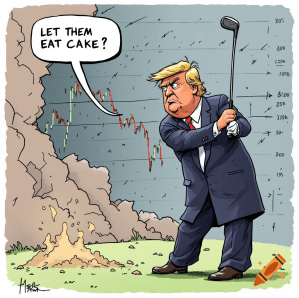
That means our exports will go down in many of the countries. It’s damned recessionary. Also, if the price of bonds goes down because a country dumps their portfolio of treasuries, the interest rates go up. It will be truly interesting to see what the Fed does with this. Then there’s this. I bet Senator Warren is apoplectic. This report comes from The Guardian. You remember how fun that crash was. “US reportedly plans to slash bank rules imposed to prevent 2008-style crash. Watchdogs could cut capital rules as Trump’s deregulation drive opens door to rollback of post-crisis protections.”
US watchdogs are reportedly planning to slash capital rules for banks designed to prevent another 2008-style crash, as Donald Trump’s deregulation drive opens the door to the biggest rollback of post-crisis protections in more than a decade.
The move follows heavy lobbying by the banking industry, with lenders such as JP Morgan and Goldman Sachs having long complained that competition and lending have been hindered by burdensome rules governing the assets they must hold versus their liabilities.
Regulators are expected to put forward the proposals this summer, aimed at cutting the supplementary leverage ratio that requires big banks to hold high-quality capital against risky assets including loans and derivatives, according to the Financial Times, which cited unnamed sources.
The rules came into force after the 2008 financial crisis, as part of efforts to shockproof the banking system and avoid damaging ripple effects that could cause another global economic meltdown. The crisis forced governments to spend billions of dollars bailing out big lenders that took too much risk.
Changes to bank capital rules have been widely expected, with Trump having promised a bonfire of regulation during his second term in office, with plans to slash 10 regulations for every new one added.
While some critics warn it is the wrong time to slash protections, given growing uncertainty over policy overhauls and market volatility, banks seem to have won the ear of policymakers. Lobbyists have long argued that the rules punish them for holding relatively low-risk assets including US debt, known as treasuries, and hinders their ability to provide more loans.
President Joe Biden’s diagnosis of metastatic prostate cancer has understandably raised concerns and questions: How long has he had cancer, how will he be treated, and what is his prognosis?
As a urologist, I regularly diagnose prostate cancer in my patients, and each time I share the diagnosis with them and their family, it’s never easy. Over time, I’ve learned the importance of keeping conversations simple and straightforward — avoiding sugar-coating and instead using data, statistics and personal experience to help patients begin their cancer journey.
As his public announcement draws attention to this type of cancer, it’s a reminder to regularly check on your own health. Here’s what you need to know about metastatic prostate cancer: how it’s detected, what treatments look like, and why early screening remains essential for men’s health.
The former president’s diagnosis began after he experienced “increasing urinary symptoms,” his office said, and a prostate nodule was discovered.
…
“Metastatic” means the cancer cells have spread beyond the original location (the prostate gland) into other areas — most commonly bones and lymph nodes. Biden’s cancer has specifically spread to his bones, placing him among the 5% to 7% of prostate cancer cases in the United States that are metastatic at initial diagnosis. While this percentage seems small, it represents a significant number given that over 300,000 men in the US and approximately 1.5 million worldwide are diagnosed with prostate cancer every year.
Early-stage prostate cancer carries an excellent prognosis, with nearly a 100% five-year survival rate. However, when prostate cancer is metastatic at diagnosis, the five-year survival rate drops sharply to around 37%. Importantly, these survival rates are statistical averages, and individual outcomes vary considerably based on overall health, age, cancer aggressiveness, and how well a patient responds to treatment.
All of the #FARTUS policies add up to a big mess for the economy. It’s driving me back to research again. But right now, I guess I’ll go blow some bubbles for a while.
What’s on your reading and blogging list today?
Racist bros may carry flaming tiki torches to intimidate and marginalize. But New Orleans carries tiki bubble torches to bring joy and fight entitled rich dudes
The Sky Dancing banner headline uses a snippet from a work by artist Tashi Mannox called 'Rainbow Study'. The work is described as a" study of typical Tibetan rainbow clouds, that feature in Thanka painting, temple decoration and silk brocades". dakinikat was immediately drawn to the image when trying to find stylized Tibetan Clouds to represent Sky Dancing. It is probably because Tashi's practice is similar to her own. His updated take on the clouds that fill the collection of traditional thankas is quite special.
You can find his work at his website by clicking on his logo below. He is also a calligraphy artist that uses important vajrayana syllables. We encourage you to visit his on line studio.









 How about we use that $45 million plus whatever it costs to undo the damage Washington D.C. roads to fund the Veterans’ services cut by that ugly budget winding its way to the Senate today? Economist Paul Krugman–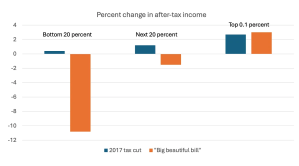
 Here’s some analysis of the late-night passage of the bill on the
  Steven Beschloss calls for more activism today at his substack,
 The Financial Markets are reeling.
 The market has yet to fully absorb the Treasury Bond Dump by China. This is from the
 That means our exports will go down in many of the countries. It’s damned recessionary. Also, if the price of bonds goes down because a country dumps their portfolio of treasuries, the interest rates go up. It will be truly interesting to see what the Fed does with this. Then there’s this. I bet Senator Warren is apoplectic. This report comes from
  I just want to wish Former President the best as he struggles with cancer. I know how that feels. I’m 35 years out from a stage 4 cancer episode. It transforms how you see time.
 peej
peej Carissa
 bostonboomer
 dakinikat
 ecocatwoman
 jjlolat
 mablue2
 Mama Lopez
 peggysue22
 quixote
 skydancingguestblogger
 Mona (aka Wonk the Vote)



 Sky Dancing
Recent Comments