
Lazy Saturday Reads: D-Day Edition
Posted: June 6, 2015 Filed under: Civil Rights, Crime, Criminal Justice System, Foreign Affairs, morning reads, Republican politics, U.S. Politics | Tags: Adolf Hitler, D-Day 71st anniversary, Dennis Hastert, Josh Duggar, Jr., Lonnie Franklin, sexual molestation, Tales of the Grim Sleeper, The Longest Day, World War II 38 Comments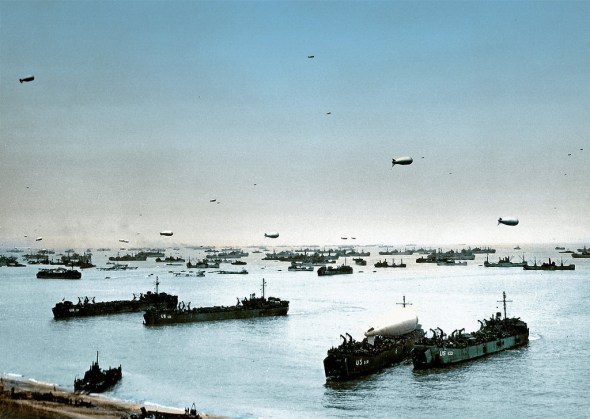
Allied ships, boats and barrage balloons off Omaha Beach after the successful D-Day invasion, near Colleville-sur-Mer, Normandy, France on June 9, 1944. (Photo by Galerie Bilderwelt/Getty Images)
Good Morning!!
Today is the 71st anniversary of the D-Day invasion of Normandy. I found some stunning original color photos at The Denver Post, and I thought I’d share a few of them here. Go to the link to see the entire collection. I’ve also gathered some interesting articles on the “longest day” along with remembrances from survivors.
From The Charlotte Observer: D-Day: Only the beginning – with the end nowhere in sight, by David Perlmutt.
With Saturday comes another anniversary of D-Day as the light continues to dim on the generation that fought it.
Seventy-one years have passed since Carolinians such as Andy Andrews of Black Mountain and Walter Dickens of Monroe got their first taste of combat when they rushed ashore at Normandy, France, on June 6, 1944, the pivotal day historians tag as the beginning of the end for Nazi Germany.
It was more of a beginning than an end. Long after D-Day’s first anniversary, the bullets would continue to fly in the Pacific theater and other parts of the world.
A year ago, I wrote a series of stories to honor the 70th anniversary of D-Day through the eyes – and distant memories – of Andrews, Dickens and others like paratroopers Harold Eatmon of Mint Hill and E.B. Wallace of Waxhaw. The fighting took another 11 months and horrific losses during battles in countries such as France, Holland, Belgium and ultimately Germany before the Germans surrendered.
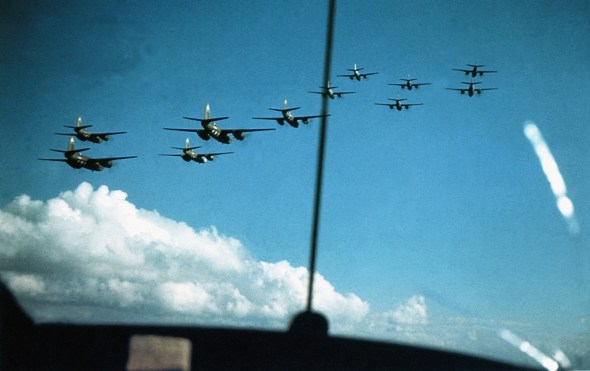
Planes from the 344th Bomb Group, which led the IX Bomber Command formations on D-Day on June 6, 2014. Operations started in March 1944 with attacks on targets in German-occupied France, Belgium, and the Netherlands. After the beginning of the Normandy invasion, the Group was active at Cotentin Peninsula, Caen, Saint-Lo and the Falaise Gap. (Photo by Galerie Bilderwelt/Getty Images)
Fighting continued in the Pacific, where my Dad was stationed, for a long time after June 6, 1944. He was on a ship traveling to Japan when the U.S. dropped the bombs on Hiroshima and Nagasaki. He said they celebrated–not knowing the horror the bombs would unleash–they were saved. My Dad might not have come home if those bombs hadn’t been dropped.
A year after D-Day, thousands of U.S. Marine and Army troops were still two weeks away from capturing Okinawa, the last in a hopscotch of islands that Allied forces needed for a plan to force Japan’s unconditional surrender. Offshore, U.S. Navy ships absorbed daily attacks by Japanese kamikaze (suicide) planes as their guns pounded hills above the landing beaches. Army Air Forces planes bombed targets inland to soften the Japanese defense.
As they fought to take control of Okinawa, hundreds of thousands of U.S. soldiers, Marines and sailors prepared to take part in what would have been history’s greatest battle – Operation Olympic, code-named Downfall, the invasion of the Japanese homeland.
They knew the fighting would be fierce.
Much more at the link. It’s a very good piece.
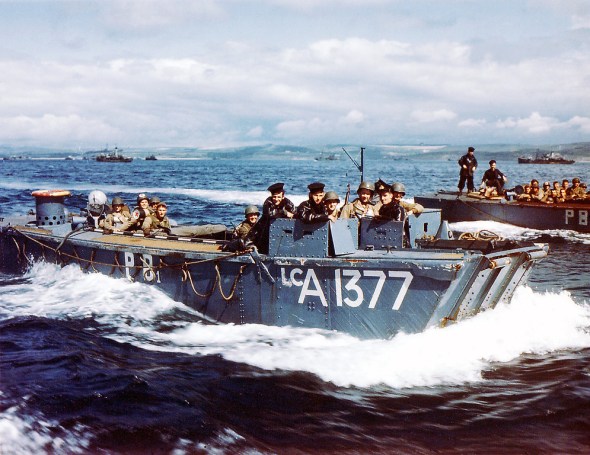
British Navy Landing Crafts (LCA-1377) carry United States Army Rangers to a ship near Weymouth in Southern England on June 1, 1944. British soldiers can be seen in the conning station. For safety measures, U.S. Rangers remained consigned on board English ships for five days prior to the invasion of Normandy, France. (Photo by Galerie Bilderwelt/Getty Images)
CNN: He got to witness ‘The Longest Day,’ by Val Lauder.
Cornelius Ryan was a 24-year-old war correspondent when he had a chance to see a defining moment in the defining event of the 20th century — the Allied landings on the coast of France to retake France and bring down Hitler.
Ryan at first witnessed the invasion from a bomber that flew over the beaches. Then, back in England, he scrambled to find the only thing he could that was going to Normandy. A torpedo boat that, he learned too late, had no radio. “And if there’s one thing that an editor is not interested in,” he said, “it’s having a reporter somewhere he can’t write a story.”
Recalling those five hours off the coast, watching the struggle on the beaches, he remembered “the magnitude of the thing, the vastness. I felt so inadequate to describe it.”
But today, as the 71st anniversary of D-Day approaches on June 6, Ryan is most likely to be remembered for being the one who did describe it, who told so many millions the real story of what happened that day, in his book which became the famous movie, “The Longest Day.”
Lauder was a young woman headed to journalism school at Northwestern when the invasion took place.
In September 1962, I interviewed Cornelius Ryan before the New York premiere of the film. Ryan had become the authority on the events of June 6, 1944, following publication of his book. And as he himself noted, in the 10 years it took him to research and write the book, he became “a veritable depository of D-Day memorabilia.”
He shared some of what he’d learned as we talked in the study of his home in Ridgefield, Connecticut, that Sunday afternoon.
Read her remembrances at the CNN link.
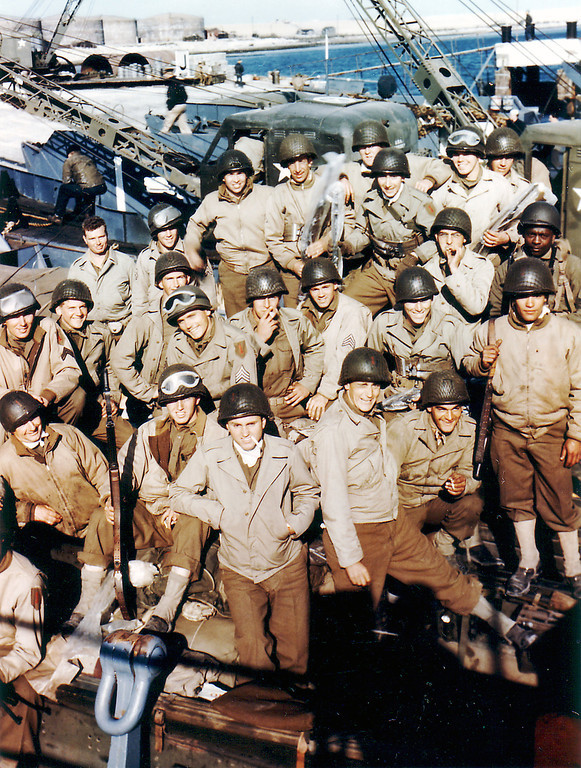
The 1st Infantry Division of the United States Army (The ‘Big Red One’) in Dorset, United Kingdom on June 5, 1944 before departing for Omaha Beach. (Photo by Galerie Bilderwelt/Getty Images)
The Christian Science Monitor: D-Day June 6, 1944: How did Hitler react?
Considering the pivotal nature of June 6, 1944, how did Hitler react to the attack? Did he rant, did he rail? Did he move with focused calm to try and repel the invaders? [….]
In the early days of June Germany’s Fuhrer was at The Berghof, his residence in the Bavarian Alps. Everyone there knew an invasion was likely in the near future, but the atmosphere was not nervous, according to contemporary accounts. To the contrary it was relaxed, and in the evening, almost festive. A group of guests and military aides would gather at the complex’s Tea House and Hitler would hold forth on favorite topics, such as the great men of history, or Europe’s future.
On the evening of June 5, Hitler and his entourage watched the latest newsreels, and then talked about films and theater. They stayed up until 2 a.m., trading reminiscences. It was almost like the “good old times,” remembered key Hitler associate Joseph Goebbels.
When Goebbels left for his own quarters, a thunderstorm broke, writes British historian Ian Kershaw. German military intelligence was already picking up indications of an oncoming Allied force, and perhaps landing troops, in the Normandy region. But Hitler wasn’t told. The Fuhrer retired around 3 a.m.
German headquarters confirmed that some sort of widespread attack was in progress shortly thereafter. At sunrise, around 6 a.m., the defenders knew: Allied ships and planes were massed off the French beaches in astounding strength, and men were beginning to come ashore. It was a sight many would never forget.
But the German reaction was slow and befuddled. Was this the real thing, the main invasion? Or was it a feint, with the real force to land elsewhere, probably Calais?
Read more at the link.
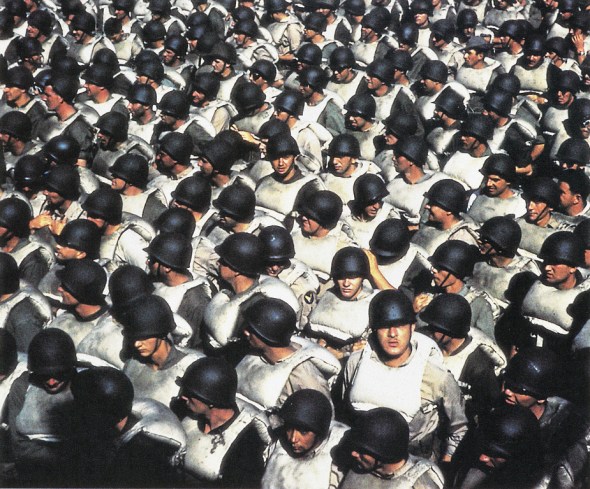
A U.S. Landing Craft Infantry (LCI) filled with invasion troops approaches the French coast from the sea in June of 1944. The GIs wear life vests in preparation for the landing. (Photo by Galerie Bilderwelt/Getty Images)
More D-Day stories:
The Daily Mail, D-Day heroes’ courage remembered.
AP via The Miami Herald, Vets, visitors return to Normandy to mark D-Day anniversary.
Constitution Daily, Ten fascinating facts on the 71st anniversary of D-Day.
The Daily Beast, The Stacks: A D-Day Vet Shows Normandy to His Son.
Pittsburgh Post-Gazette, Veterans of D-Day mark 71st anniversary: 4 will be honored today at Heinz History Center.
The Nation on what was happening in Congress on D-Day–a bunch of nonsense, just like today. June 6, 1944: D-Day Invasion of France.
Heavy, D-Day Invasion: Top 10 Best Quotes & Sayings.

A Recommendation
Before I get to the rest of the news, I want to highly recommend an HBO documentary I watched a few days ago called Tales of the Grim Sleeper. It’s the story of how serial killer Lonnie Franklin, Jr. murdered as many as 100 African-American women in South Central LA over more than 20 years while the LAPD ignored what was happening.
This isn’t the story of a serial killer–it’s about police attitudes toward the poor and people of color; and it fits right in with recent events in places like Ferguson, Cleveland, Staten Island, and Baltimore and with the Black Lives Matter movement.
This story could have happened in a poor neighborhood in any major American city. In fact, there was a similar case in Cleveland where Anthony Sowell murdered poor black women for years without getting caught because the crimes weren’t taken seriously.
If you have HBO or can get access to it, please watch this outstanding film.

Other News, links only
News News
Brian Beutler at The New Republic, Hillary Clinton’s Grand Strategy to Beat the GOP: Take Bold Positions Early and Often.
Politico, 2016 field descends on Iowa for Joni Ernst shindig.
New York Times, Beau Biden Funeral Draws Many Mourners, Including Obama.
LA Times, LAPD finds officers were justified in fatal shooting of mentally ill man, sources say.
Politico, Anti-war activist confronts Sen. Tom Cotton.
Paul Krugman, Lone Star Stumble.
Voice of America, Death Toll Jumps to Nearly 400 in China Ship Sinking.
BBC News, President Vladimir Putin tells West not to fear Russia
Sexual Molestation News
AP, via AOL, Sister: Brother had sexual relationship with Hastert.
NBC News, Dennis Hastert Case: Abuse Group Wants Congressional Portrait Removed.
Huffington Post, Dennis Hastert Hid His Skeletons As He Helped Push GOP’s Anti-Gay Agenda.
Fox News, Jessa: Josh Duggar was ‘in puberty and a little too curious about girls.’
ABC News, Duggars Put Locks on Doors as a Safeguard Following Alleged Molestation.
Is a crime still “alleged” after the perpetrator and his parents acknowledge that he did it? Just asking.
Time, Josh Duggar’s Sister on Molestation: ‘It Wasn’t Like a Horror Story.’
Yibada, Josh Duggar’s Sister Jill Dillard: My Parents Did Such An Amazing Job.
Gawker, The Truth About Josh Duggar’s Sham Cult-Center “Counseling.”
What else is happening? As always, treat this as an open thread.
Thursday Reads
Posted: July 11, 2013 Filed under: morning reads | Tags: Alexander Kouzminov, Boston Bombings, Bradley Manning, Don West, Dzhokhar Tsarnaev, Ed Fucarile, Edward Snowden, George Zimmerman, J.W. Carney, James "Whitey" Bulger, John Guy, Jr., Judge Debra Nelson, Kevin Weeks, Marc Fucarile, Mark O'Mara, Oleg Gordievsky, Trayvon Martin 66 Comments
Good Morning!!
There’s been quite a bit of legal and courthouse news this week, so I’m going to focus on that today.
Yesterday was a big day at the Boston Federal Courthouse as the Whitey Bulger trial was briefly eclipsed by the first court appearance of Boston Bombing suspect Dzhokhar Tsarnaev. From The Boston Globe:
Dzhokhar Tsarnaev shuffled into the courtroom, appearing confident despite the ankle chains and an orange jumpsuit so big on him that it made him appear younger than his 19 years.
As federal prosecutors read the charges against him Wednesday in his first appearance since being captured in April, Tsarnaev repeatedly looked over his shoulder at the packed courtroom, at one point blowing a kiss to his sisters, one sobbing and another holding a baby.
He leaned into the microphone in the hushed courtroom to tell Judge Marianne B. Bowler with an accent that he pleaded not guilty to 30 charges, including use of weapons of mass destruction. More than 30 victims of the Marathon bombings and about a dozen supporters who say they believe Tsarnaev is innocent watched intently as the accused terrorist yawned and stroked the side of his face, which appeared swollen from a wound.
Tsarnaev, who could receive the death penalty, fidgeted in his seat as he listened to the charges, one of his attorneys patting him on the back gently several times. He had a visible scar just below his throat and had a cast on his left arm.
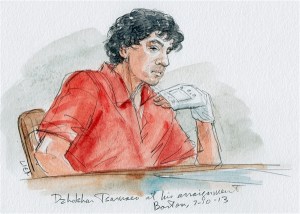
Dzhokhar Tsarnaev
ABC News talked to survivors of the April 15 bombings who showed up to watch Tsarnaev’s court appearance.
Friends and family members of people whose lives were shattered when two homemade bombs went off near the finish line of the Boston Marathon on April 15 packed three rooms in a federal courthouse on Wednesday as suspect Dzhokhar Tsarnaev pleaded not guilty to a 30-count indictment.
But the fleeting courtroom encounter brought little relief to Bostonians who said the 19-year-old —accused of conducting the deadly bombings with the help of his older brother Tamerlan Tsarnaev —showed little feeling.
“He came out and he smirked at the families,” said Ed Fucarile, 64, outside of the John Joseph Moakley federal courthouse along the water in South Boston. “The lawyers put their hands on his shoulders like it was going to be all right.”
Fucarile wore a Boston Strong t-shirt with the name of Marc Fucarile, his son who lost his right leg and still carries shrapnel in his body, the father said.
Marc Fucarile, 34, was standing near the second blast when it went off. He still has more surgeries to go, and has spent every day of the nearly three months since receiving medical care, his father said. Members of the family have taken weeks off work so that someone is always at Marc’s bedside, he said.
Read more survivors’ stories at the link.
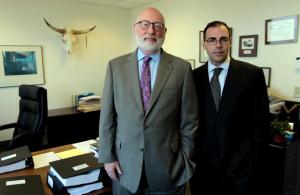
Bulger defense team: J.W. Carney Jr. and Hank Brennan
At the Whitey Bulger trial, there was a bit of comic relief as Bulger flew into a rage toward the end of testimony and exchanged curses with his former close friend and partner Kevin Weeks. It was reminiscent of a scene from Sopranos.
Bulger’s lawyer, J.W. Carney, tried to portray Weeks as an opportunist who knew how to manipulate the system, someone who cut a deal with prosecutors to serve just five years in prison for aiding and abetting five killings, several of which, Weeks testified, he saw Bulger commit.
“You won against the system,” said Carney.
“What did I win? What did I win,” Weeks said, his voice sounding strained and tired. “Five people are dead.”
Asked whether that bothered him, Weeks shot back, “We killed people that were rats, and I had the two biggest rats right next to me …”
At that, Bulger turned and hissed, “You suck.”
“F— you, OK,” snapped Weeks.
“F— you, too,” shouted Bulger as the jury watched.
“What do you want to do?” said Weeks, his eyes locked on Bulger, who was flushed and staring right back.
At one point Weeks even threatened Carney, asking him if he’d like to step outside.
Weeks grew belligerent and threatening as Carney accused him of lying, challenged his motivation for cooperating, and suggested that Weeks, not Bulger, was a rat.
“You can’t rat on a rat,” said Weeks, adding that he lives in South Boston and walks the streets without being called a rat.
When Carney asked Weeks what he would do if someone did call him a rat, Weeks snapped that if he stepped outside the courthouse he’d show him.
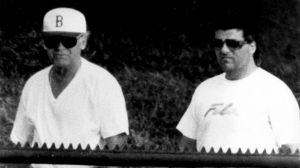
James Bulger and Kevin Weeks
Yesterday the testimony was even more grotesque and sickening, as forensic expert Ann Marie Mires testified about remains of murder victims Arthur Barrett, Deborah Hussey, John McIntyre, and Paul J. McGonagle. I’ll spare you the descriptions; you can go to the links and read more if you’re interested.
This morning Carney asked the judge for a break in the testimony so the defense team could catch up.
The defense team for James “Whitey” Bulger is asking the judge to suspend testimony until next week so they can catch up on evidence.
Defense attorney J.W. Carney filed the motion with the court on Thursday.
“Simply put, the defendant’s counsel have hit a wall, and are unable to proceed further without additional time to prepare for upcoming witnesses,” the motion reads. “Counsel have struggled mightily to be ready for each day of the trial since it began on June 3, 2013, working seven days a week and extraordinarily long hours.” [….]
“A major problem has been the delay in the receipt of discovery from the prosecution,” the motion reads, citing examples of receiving binders of documents pertaining to testimony to be given by witnesses the evening before they take the stand.
Yesterday defense teams rested in both the Bradley Manning and the George Zimmerman trials.
From the Guardian via Raw Story: Bradley Manning defense rests its case after calling just 10 witnesses
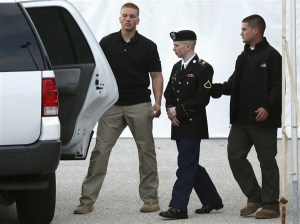
Having called just 10 witnesses over the space of three days, the defence phase of the trial was brought to a close far quicker than expected. The defence had indicated in earlier hearings that it intended to call more than 40 witnesses, although many may yet still be presented in court during the post-verdict sentencing stage of the court martial.
By contrast, the prosecution took 14 days to make its case, drawing on 80 witnesses.
On Wednesday, the defence team lead by the civilian lawyer David Coombs, focused its attentions on the most serious charge facing the Army private – that he “aided the enemy” by transmitting information to WikiLeaks knowing that it would be accessible to enemy groups notably al-Qaida. Manning faces a possible sentence of life in military custody with no chance of parole under this single charge.
The final defence witness called, the Harvard law professor Yochai Benkler, delivered blistering testimony in which he portrayed WikiLeaks as a legitimate web-based journalistic organisation. He also warned the judge presiding in the case, Colonel Denise Lind, that if the “aiding the enemy” charge was interpreted broadly to suggest that handing information to a website that could be read by anyone with access to the internet was the equivalent of handing to the enemy, then that serious criminal accusation could be levelled against all media outlets that published on the web.
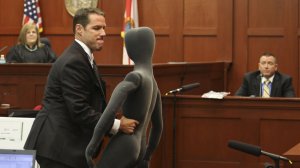
Prosecutor John Guy with dummy
Yesterday was quite a theatrical one in the Zimmerman trial, as a mannequin was brought into court and both a prosecutor and defense attorney Mark O’Mara got down on the floor and straddled the dummy in effort to act out what might have happened during an alleged altercation between Zimmerman and his victim Trayvon Martin.
As professional images go, what followed in the courtroom was probably not something for which Mark O’Mara would most like to be remembered.
Hitching up his pant legs and straddling a life-size human mannequin, Zimmerman’s lead defense counsel got down and dirty on the courtroom floor and proceeded to demonstrate for jurors the “ground and pound” move that they have been told Martin exerted on the accused.
Coming a day after he encouraged one of his witnesses, gym owner and mixed martial arts trainer Adam Pollack, to “step down from the stand to give me an example of a mounted position,” prostrating himself on the floor and asking Pollack, “Where do you want me?” the episode made for an awkward role play, leaving court observers snickering and biting their lips in the midst of an otherwise tragic plot.
Earlier in the day, prosecutor John Guy—described by one public observer in the courtroom on the trial’s opening day as “the supermodel of attorneys”—had also hopped on the mannequin for a similar demonstration in front of the all-female jury.
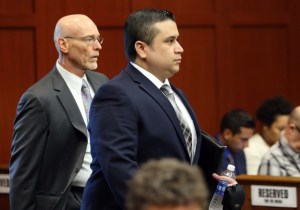
Don West and George Zimmerman
Later Judge Debra Nelson had a “testy exchange” with defense attorney Don West as she asked Zimmerman whether he planned to take the stand. Zimmerman seemed unsure, and West tried to step in.
West repeatedly challenged Nelson’s decision to press Zimmerman for a clear answer. The judge repeatedly slapped him down, her voice gathering volume every time.
“The court is entitled to ask Mr. Zimmerman about his determination as to whether he wants to testify,” Nelson insisted tersely after West objected to her line of questioning.
She looked back at Zimmerman: “How long do you think you need before you make that decision?” she inquired again, as the defendant—who had a minute earlier been made to raise his hand and swear under oath that any decision whether to testify would be his—turned to his counsel for help.
“I object to the court inquiring of Zimmerman about his intention to testify,” West whimpered for a second time.
“I object to the court inquiring of Zimmerman about his intention to testify,” West whimpered for a second time.
“And I have O-VER-RULED” Judge Nelson spat back—several times—as the objections kept coming.
Finally Zimmerman haltingly said he did not want to testify. I think he actually wanted to–if only. What a disaster that would have been for his attorneys! Closing arguments are scheduled to begin this afternoon.
In other news, I can’t resist sharing this article from Time Magazine about what former Russian spies think is probably happening to Edward Snowden in Russia.
In the summer of 1985, KGB colonel Oleg Gordievsky was called back to Moscow from the Soviet embassy in London, where he was serving as a resident spy. As a pretext, his commanders told him that he was going to receive an award for his service. But in fact the KGB suspected him of being a double agent — which he was — and they were looking to interrogate him. So upon his arrival, his KGB colleagues, still concealing their suspicions, took him to a comfortable country estate in the suburbs of the Russian capital, much like the one where Gordievsky and other former spies believe Edward Snowden, the NSA whistle-blower, has spent the past few weeks….
The official story coming from the Russian government since then is that Snowden has been holed up in the transit zone of Moscow’s Sheremetyevo airport, waiting for some third country to grant him asylum. But few experts or officials in Moscow still believe that to be true. The accepted wisdom, unofficially acknowledged by most Western and Russian sources, is that Snowden was taken soon after his arrival — if not immediately — to a secure location run by some arm of the Russian government.

Experts and former spies who have dealt with the Russian security services are sure that agents would want to get the encryption keys to the data stored on Snowden’s four laptops. The only way to do that would be to get Snowden to give them up.
So Gordievsky believes Snowden would have gotten roughly the same treatment that the KGB spy got back in 1985. “They would have fed him something to loosen his tongue,” Gordievsky says by phone from the U.K., where he has been living in exile for nearly three decades. “Many different kinds of drugs are available, as I experienced for myself.” Having been called back to Moscow, Gordievsky says his KGB comrades drugged him with a substance that “turned out his lights” and made him “start talking in a very animated way.” Although the drug wiped out most of his memory of the incident, the parts he did recollect horrified him the following morning, when he woke up feeling ill. “I realized that I had completely compromised myself,” he says.
One of the substances the KGB used for such purposes at the time was called SP-117, which is odorless, tasteless and colorless, according Alexander Kouzminov, a former Russian intelligence operative who describes the drug’s effectiveness in his book, Biological Espionage. Now living in New Zealand, Kouzminov worked in the 1980s and early 1990s for the Foreign Intelligence Service, the spy agency known as the SVR, which handles undercover agents, or “illegals,” stationed in foreign countries. In his book, Kouzminov writes that various drugs were used periodically to test these operatives for signs of disloyalty or diversion. Once the drug had worn off, the agents would have no recollection of what they had said and, if their test results were satisfactory, they could be sent back into the field as though nothing had happened.
Yesterday, Snowden announced through Glenn Greenwald that “I never gave any information to Chinese or Russian governments.” I guess he assumes that Chinese and Russian officials don’t read The Guardian, The Washington Post, or the South China Morning Post. Anyway now it’s not clear if he would even remember if he gave them anything.
For all you Snowden and Greenwald fans out there, this information comes from an article in Time Magazine based on interviews with people who have actual experience with the ways Russia deals with spies. Don’t shoot the messenger.
Now it’s your turn. What stories are you focused on today. Please share you links on any topic in the comment thread, and have a tremendous Thursday!
Omar Suleiman and the U.S. Rendition and Torture Program
Posted: January 30, 2011 Filed under: Barack Obama, Diplomacy Nightmares, Egypt, Foreign Affairs, U.S. Politics, Wikileaks | Tags: Barack Obama, Bill Clinton, Edward S. Walker, Eqyptian protests, Hillary Clinton, Hosni Mubarak, Jr., Omar Suleiman, rendition, Stephen Grey, Torture 34 Comments
Omar Suleiman
Omar Suleiman was recently appointed Vice President of Egypt by desperate dictator Hosni Mubarak. There has also been talk that Suleiman could become Mubarak’s successor now that Mubarak’s son Gamal is seemingly out of the picture.
It will be interesting to see how the Obama administration responds to this appointment, since the U.S. has had very close relations with Suleiman. Some basic background on Suleiman from Reuters:
* He has been the director of the Egyptian General Intelligence Services (EGIS) since 1993, a role in which he has played a prominent public role in diplomacy, including in Egypt’s relations with Israel and with key aid donor the United States.
* He was born on July 2, 1936 in Qena, in southern Egypt. He later enrolled in Egypt’s premier Military Academy in 1954, after which he received additional military training in the then Soviet Union at Moscow’s Frunze Military Academy.
* He also studied political science at Cairo University and Ain Shams University. In 1992 he headed the General Operations Authority in the Armed Forces and then became the director of the military intelligence unit before taking over EGIS.
* Suleiman took part in the war in Yemen in 1962 and the 1967 and 1973 wars against Israel.
* As Egypt’s intelligence chief, Suleiman was in charge of the country’s most important political security files, and was the mastermind behind the fragmentation of Islamist groups who led the uprising against the state in the 1990s.
Here is another profile from the BBC.
While he has shown little political ambition, General Suleiman has often been mentioned as a possible successor to the 82-year-old Mr Mubarak.
He would continue in the trend of military strongmen who have led Egypt since the 1952 revolution.
And perhaps more ominously, based on what you’re about to read about Suleiman’s activities,
Even if he is not the next president, even in a transitional capacity, some experts believe that Omar Suleiman is likely to be a kingmaker.

 peej
peej Carissa
 bostonboomer
 dakinikat
 ecocatwoman
 jjlolatina
 mablue2
 Mama Lopez
 peggysue22
 quixote
 skydancingguestblogger
 Mona (aka Wonk the Vote)



 Sky Dancing
Recent Comments