
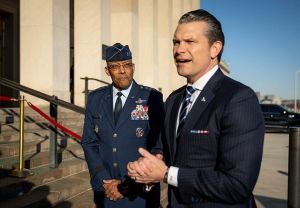
The Senate hearing, which featured five of the nation’s top intelligence officials, including Director of National Intelligence Tulsi Gabbard and CIA Director John Ratcliffe — both of whom were involved in the group chat over the Signal messaging app — was meant be a forum for the nation’s spy chiefs to offer their assessments of the top national security threats facing the nation.
Wednesday Reads: Signalgate and Social Security News
Posted: March 26, 2025 Filed under: Donald Trump, Social Security | Tags: Frank Bisignano, Houthis, Jeffrey Goldberg, John Ratcliffe, Karoline Leavitt, Kash Patel, Mike Waltz, Pete Hegseth, Senator Mark Warner, Signal Ap, Signalgate, The Atlantic, Tulsi Gabbard, Yemen 6 CommentsGood Afternoon!!

Jeffrey Goldberg
This morning The Atlantic’s Editor in Chief Jeffrey Goldberg released the full Signal text exchange that was the top news story all day yesterday. I’m sure you’re familiar with the story, but in case you missed it (unlikely), Goldberg was sent an invitation to a Signal group that included top administration officials. He accepted out of curiosity. Here is the original story published two days ago in The Atlantic (gift article): The Trump Administration Accidentally Texted Me Its War Plans.
And here is today’s article (gift): Here Are the Attack Plans That Trump’s Advisers Shared on Signal.
On Monday, shortly after we published a story about a massive Trump-administration security breach, a reporter asked the secretary of defense, Pete Hegseth, why he had shared plans about a forthcoming attack on Yemen on the Signal messaging app. He answered, “Nobody was texting war plans. And that’s all I have to say about that.”
At a Senate hearing yesterday, the director of national intelligence, Tulsi Gabbard, and the director of the Central Intelligence Agency, John Ratcliffe, were both asked about the Signal chat, to which Jeffrey Goldberg, the editor in chief of The Atlantic, was inadvertently invited by National Security Adviser Michael Waltz. “There was no classified material that was shared in that Signal group,” Gabbard told members of the Senate Intelligence Committee.
Ratcliffe said much the same: “My communications, to be clear, in the Signal message group were entirely permissible and lawful and did not include classified information.”
President Donald Trump, asked yesterday afternoon about the same matter, said, “It wasn’t classified information.”
These statements presented us with a dilemma. In The Atlantic’s initial story about the Signal chat—the “Houthi PC small group,” as it was named by Waltz—we withheld specific information related to weapons and to the timing of attacks that we found in certain texts. As a general rule, we do not publish information about military operations if that information could possibly jeopardize the lives of U.S. personnel. That is why we chose to characterize the nature of the information being shared, not specific details about the attacks.
Pete Hegseth
The statements by Hegseth, Gabbard, Ratcliffe, and Trump—combined with the assertions made by numerous administration officials that we are lying about the content of the Signal texts—have led us to believe that people should see the texts in order to reach their own conclusions. There is a clear public interest in disclosing the sort of information that Trump advisers included in nonsecure communications channels, especially because senior administration figures are attempting to downplay the significance of the messages that were shared.
Experts have repeatedly told us that use of a Signal chat for such sensitive discussions poses a threat to national security. As a case in point, Goldberg received information on the attacks two hours before the scheduled start of the bombing of Houthi positions. If this information—particularly the exact times American aircraft were taking off for Yemen—had fallen into the wrong hands in that crucial two-hour period, American pilots and other American personnel could have been exposed to even greater danger than they ordinarily would face. The Trump administration is arguing that the military information contained in these texts was not classified—as it typically would be—although the president has not explained how he reached this conclusion.
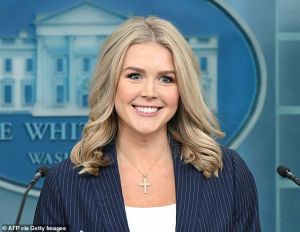
Karoline Leavitt
The Atlantic approached multiple people in the Trump administration, asking if they had objections to the publication of the entire Signal chant. Only press secretary Karoline Leavitt responded:
“As we have repeatedly stated, there was no classified information transmitted in the group chat. However, as the CIA Director and National Security Advisor have both expressed today, that does not mean we encourage the release of the conversation. This was intended to be a an [sic] internal and private deliberation amongst high-level senior staff and sensitive information was discussed. So for those reason [sic] — yes, we object to the release.” (The Leavitt statement did not address which elements of the texts the White House considered sensitive, or how, more than a week after the initial air strikes, their publication could have bearing on national security.)
Here is the relevant part of the text chain:
At 11:44 a.m. eastern time, Hegseth posted in the chat, in all caps, “TEAM UPDATE:”
The text beneath this began, “TIME NOW (1144et): Weather is FAVORABLE. Just CONFIRMED w/CENTCOM we are a GO for mission launch.” Centcom, or Central Command, is the military’s combatant command for the Middle East. The Hegseth text continues:
- “1215et: F-18s LAUNCH (1st strike package)”
- “1345: ‘Trigger Based’ F-18 1st Strike Window Starts (Target Terrorist is @ his Known Location so SHOULD BE ON TIME – also, Strike Drones Launch (MQ-9s)”
- “1410: More F-18s LAUNCH (2nd strike package)”
- “1415: Strike Drones on Target (THIS IS WHEN THE FIRST BOMBS WILL DEFINITELY DROP, pending earlier ‘Trigger Based’ targets)”
- “1536 F-18 2nd Strike Starts – also, first sea-based Tomahawks launched.”
- “MORE TO FOLLOW (per timeline)”
- “We are currently clean on OPSEC”—that is, operational security.
- “Godspeed to our Warriors.”
Read the whole article at The Atlantic. It isn’t very long. Those certainly look like war plans to me. This is a great opportunity for Democrats to fight back against Trump’s rapidly advancing coup. They did an excellent job in the Senate hearing yesterday.
The Washington Post (Gift article): Democrats slam spy chiefs over Trump team’s Signal leak of war plans.
Senate Democrats on Tuesday hammered the Trump administration’s top intelligence officials on how and why the vice president, defense secretary, national security adviser and other top Cabinet members made the “reckless” decision to use a commercial messaging app to discuss secret war plans for Yemen — while also inadvertently including a journalist in the group chat.
Instead, the routine annual hearing before the Senate Select Committee on Intelligence became a staging ground to interrogate the kind of “mind-boggling” behavior that the committee’s top Democrat, Sen. Mark R. Warner (Virginia), said would easily have gotten a lower-ranking military or intelligence officer fired.
Mike Waltz
In the Signal group chat, convened by national security adviser Michael Waltz, Defense Secretary Pete Hegseth and others reportedly detailed the targets, the attack sequencing and the weapons they would use in a U.S. air attack on Yemen’s Houthis, before the Pentagon launched the strikes on March 15, according to a bombshell report published Monday by the Atlantic.
“If this was the case of a military officer or an intelligence officer, and they had this kind of behavior, they would be fired,” Warner said in his opening remarks at Tuesday’s hearing, noting that in addition to the targeting information, the text chain included the identity of an active CIA officer. “This is one more example of the kind of sloppy, careless, incompetent behavior, particularly toward classified information,” exhibited by the Trump administration, Warner said. “This is not a one-off.”
How is it that “nobody bothered to even check? … Who are all the names?” Warner added.
Gabbard, Ratcliffe and the other government witnesses provided few answers.After Gabbard at first declined to say whether she was involved in the group chat at all, she and Ratcliffe then told senators that the information shared over Signal was not classified. At other times, they denied the details contained in the Atlantic’s reporting or said they could not recall the exact contents of the messages. They repeatedly deferred to Trump’s defense secretary and national security adviser to answer for them.
The deflections triggered an incredulous and angry backlash from the committee’s liberals.
Warner, who accused Gabbard of “bobbing and weaving and trying to filibuster,” demanded repeatedly that she reconcile her conflicting assertions that the information in the text chain was not classified, but also that she was not at liberty to talk about it. “If there are no classified materials, share it with the committee. You can’t have it both ways,” he said.
Well, now it has been shared with everyone, and the Trump officials look exactly as incompetent as we assumed they were. On top of everything else, one of the participants in the Signal chat, special envoy Steve Witkoff, was actually in Moscow waiting to speak to Vladimir Putin, while using his personal cell phone.
More from CBS News: Democrats call Trump intelligence officials’ use of group chat “reckless, sloppy and stunning.”
Director of National Intelligence Tulsi Gabbard and CIA director John Ratcliffe appeared before the Senate Intelligence Committee to testify about global threats facing the U.S. However the annual hearing, which typically focuses on threats posed by China, Russia, Iran, largely concentrated on the lapse.
FBI Director Kash Patel, National Security Agency Director Gen. Timothy Haugh and Defense Intelligence Agency Director Lt. Gen. Jeffrey Kruse also appeared, but received few questions.
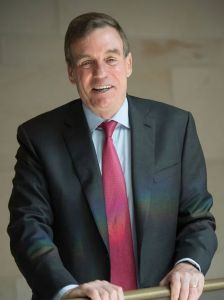
Senator Mark Warner
Sen. Mark Warner of Virginia, the top Democrat on the committee, addressed the controversy at the top of the hearing, calling it “mind-boggling” that none of the intelligence officials in the chat on the encrypted messaging app Signal thought to check who else was included.
“Are these government devices? Were they personal devices? Have the devices been collected to make sure there’s no malware?” Warner said in his opening remarks. “There’s plenty of declassified information that shows that our adversaries, China and Russia, are trying to break into encryption systems like Signal.”
Gabbard and Ratcliffe both denied that classified information was shared in the group chat in a feisty exchange with Warner. Confronted by Warner, Gabbard initially declined to say whether she was part of the chat….
Ratcliffe confirmed to Warner that he was a participant in the message thread, but pushed back on whether the decision to use Signal to communicate was a security lapse. Ratcliffe said Signal was on his CIA computer when he was confirmed as director earlier this year….
Ratcliffe confirmed to Warner that he was a participant in the message thread, but pushed back on whether the decision to use Signal to communicate was a security lapse. Ratcliffe said Signal was on his CIA computer when he was confirmed as director earlier this year. “As it is for most CIA officers,” he said, adding that the agency considers the commercial app “permissible” for work use.
The spy chiefs also denied that the conversation included information on weapons packages, targets or timing of the strikes, as Goldberg reported.
“Not that I’m aware of,” Ratcliffe said, with Gabbard adding “same answer.”
I guess they weren’t paying attention. There’s more at the CBS link.
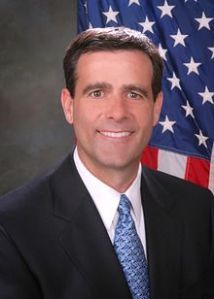
John Ratcliff
Tulsi Gabbard, Kash Patel, and John Ratcliff are appearing before the House Intelligence Committee today. That should be interesting. CBS News: Intel chiefs testify before House committee as new Signal texts emerge.
Director of National Intelligence Tulsi Gabbard and CIA Director John Ratcliffe are back on Capitol Hill to testify before the House Intelligence Committee on Wednesday after new text messages came to light from a group chat in which top Trump officials discussed sensitive plans to strike targets in Yemen.
Shortly before the hearing began, The Atlantic published additional messages showing Defense Secretary Pete Hegseth provided detailed information to the group of senior Trump officials about the strikes, including a timeline of when fighter jets would take off and what kind of weapons would be used. The group inadvertently included Jeffrey Goldberg, the editor in chief of The Atlantic who revealed the first batch of texts earlier this week….
Gabbard and Ratcliffe are appearing Wednesday alongside FBI Director Kash Patel, National Security Agency Director Gen. Timothy Haugh and Defense Intelligence Agency Director Lt. Gen. Jeffrey Kruse at a hearing ostensibly focused on the global security threats facing the U.S. But the Signal leak and its fallout dominated the early portions of questioning.
Rep. Jim Himes of Connecticut, the top Democrat on the committee, chastised the intelligence leaders at the start of the hearing, saying they put the lives of troops at risk.
“Everyone here knows that the Russians or the Chinese could have gotten all of that information, and they could have passed it on to the Houthis, who easily could have repositioned weapons and altered their plans to knock down planes or sink ships,” Himes said.
Gabbard acknowledged that the conversation was “sensitive” but again denied that classified information was shared in the chat.”There were no sources, methods, locations or war plans that were shared,” she told lawmakers, echoing the defense from the White House that “war plans” were not discussed, despite the detailed guidance for an impending attack.
Defense Secretary Pete Hegseth’s texts to a Signal group chat about military operations against the Houthis almost certainly contained classified information, according to current and former Pentagon officials.
The Atlantic on Wednesday released excerpts of a conversation among top national security leaders to which a journalist had accidentally been invited. Hegseth and the White House have denied sharing classified information or war plans.
“This information was clearly taken from the real time order of battle sequence of an ongoing operation,” said Mick Mulroy, a former deputy assistant Defense secretary under the first Trump administration. “It is highly classified and protected.
Hegseth identified the aircraft used and the precise timing of the attacks, according to texts from the group chat, which was started by national security adviser Mike Waltz. That information, if obtained by adversaries, could put U.S. troops in danger.
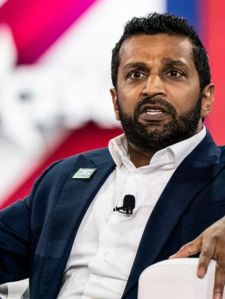
Kash Patel
A current defense official and former Air Force official both said that any forecasting of future operations and planned weapons are almost always classified information. The former and current officials were granted anonymity to speak about a sensitive issue.
Details about future airstrikes and the timing of launches is tightly controlled and usually provided only through classified documents, conversations and in secure email traffic. Few outside of top leadership and those involved usually know about the plans.
“The information that you have fighter aircraft launching off of an aircraft carrier, flying over enemy territory and impending combat operation is the most sensitive information we have at the federal government,” said Sen. Mark Kelly (D-Ariz.), a former Navy pilot, who added it was likely classified.
“Mike Waltz did a boneheaded thing. It was careless. I think what Pete Hegseth did was reckless and dangerous.”
Hegseth should be fired, but Waltz is more likely to be the scapegoat.
President Donald Trump was upset when he found out that National Security Adviser Mike Waltz accidentally included a journalist in a group chat discussing plans for a military strike. But it wasn’t just because Waltz had potentially exposed national security secrets.
Trump was mad — and suspicious — that Waltz had Atlantic editor-in-chief Jeffrey Goldberg’s number saved in his phone in the first place, according to three people familiar with the situation, who were granted anonymity to discuss private conversations. A fourth person said the president was also particularly perturbed by the embarrassing nature of the episode.
“The president was pissed that Waltz could be so stupid,” the person said. (A “Mike Waltz” invited Goldberg to the chat, according to The Atlantic).
But by Tuesday afternoon, the two men had made a show of smoothing things over and the White House was closing ranks around Waltz. Trump conducted brief interviews with both NBC News and Fox News pledging to stand behind his national security adviser. Two top Trump spokespeople suggested in posts on X that national security hawks were colluding with the media to make the issue bigger than it actually was. And Waltz attended a meeting of Trump’s ambassadors Tuesday afternoon.
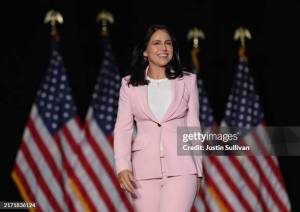
Tulsi Gabbard
“There’s a lot of journalists in this city who have made big names for themselves making up lies … This one in particular I’ve never met, don’t know, never communicated with, and we are looking into and reviewing how the heck he got into this room,” Waltz said during the meeting.
Trump followed up by calling Waltz “a very good man” and suggested he had been unfairly attacked. Yet the president also said he would look into government officials’ use of Signal, the app used in the chat with Goldberg that could have resulted in a security breach as top U.S. officials discussed plans to launch strikes in Yemen.
Still, several Trump allies cautioned this may not be the end of Waltz’s troubles. One of them, who like others was granted anonymity to discuss the sensitive matter, said the incident has strained Waltz’s relationship with Trump’s inner circle.
Brandi Buchman at HuffPost: Pete Hegseth Sued Over Signal Text Debacle.
A public watchdog group sued Defense Secretary Pete Hegseth and a slew of other Trump administration officials Tuesday after a journalist revealed he was inadvertently added to a text chain discussing U.S. war plans.
The lawsuit, brought by the watchdog group American Oversight and first reported by HuffPost, requests that a federal judge formally declare that Hegseth and other officials on the chat violated their duty to uphold laws around the preservation of official communications. Those laws are outlined in the Federal Records Act and, according to lawyers for American Oversight, if agency heads refuse to recover or protect their communications, the national archivist should ask the attorney general to step in.
On Monday, The Atlantic’s editor-in-chief Jeffrey Goldberg reported that national security adviser Michael Waltz inadvertently added him to a Signal group chat with more than a dozen Trump administration officials and aides including Vice President JD Vance, Defense Secretary Pete Hegseth, Secretary of State Marco Rubio, homeland security adviser Stephen Miller and Treasury Secretary Scott Bessent. CIA Director John Ratcliffe told members of the Senate Intelligence Committee on Tuesday that he was also in the Signal chat. Director of National Intelligence Tulsi Gabbard would not admit whether she was a participant, though Goldberg reported she was; instead, she said the matter was “still under review.”
As American Oversight lawyers pointed out in their lawsuit Tuesday, Rubio is also the acting archivist of the United States and, as such, “is aware of the violations” that allegedly occurred.
He is also “responsible for initiating an investigation through the Attorney General for the recovery of records or other redress,” the lawsuit said.
Axios reports that Trump nemesis Judge James Boasberg will preside of the Signalgate lawsuit: Judge who ruled against Trump deportation flights will oversee Signal lawsuit.
Social Security News:
Teresa Ghilarducci at Forbes: Social Security Is Breaking Down— Millions Will Feel It First.
U.S. Commerce Secretary Howard Lutnick recently offered a chilling glimpse into the Trump administration’s indifference to Social Security’s importance. “Let’s say Social Security didn’t send out their checks this month,” Lutnick said, according to Axios. “My mother-in-law, who’s 94, she wouldn’t call and complain.”
Perhaps the commerce secretary’s mother-in-law wouldn’t call. But millions of other Americans would—and not just to complain. They would call because they couldn’t pay rent, buy food, or refill essential medications. Lutnick’s casual comment downplayed the gravity of a missed Social Security check.
The comment also exposed the distance between elites and others. Elites may not care if they miss a Social Security check, but for a typical Americans a missing check is a gut punch. Calls to the Social Security office would be pouring in. But no one may answer.
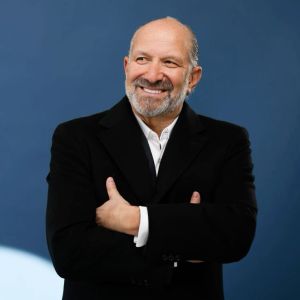
Howard Lutnick
Lutnick’s remarks come during a time when the Social Security system faces record demand and historic strain. And the remarks come during a month of extreme alarm and confusion about the system. Elon Musk demeaned the system publicly, calling it “the biggest Ponzi scheme of all time,” the New York Post reported. Field offices are overrun, wait times are spiking, and staffing levels have been slashed by 12% since 2020, notes The Washington Post. The very system that ensures timely payments to 73 million Americans is being stomped on, and senior citizens and families are feeling anxious and worse.
To be clear, Trump and DOGE have not cut or delayed Social Security checks—yet. The Social Security Administration does not miss checks. In 80 years, it never missed payment….
While Lutnick and others suggest that delays wouldn’t matter, the data tell another story. Social Security is the foundation of retirement security for most American seniors.
According to the Social Security Administration, nearly 90% of Americans over age 65 receive benefits, and those benefits make up an average of 31% of their income. But for many, the reliance is much deeper: 39% of older men and 44% of older women count on Social Security for more than half their income. Even more sobering, 12% of older men and 15% of older women rely on it for at least 90% of their income.
Older women, in particular, are at risk. They tend to earn less over their lifetimes, outlive their spouses, and have less saved for retirement. For them, Social Security is often not just the main source of income—it’s the only source.
The Washington Post (Gift link): Long waits, waves of calls, website crashes: Social Security is breaking down.
Terrifying Tuesday Reads
Posted: May 5, 2020 Filed under: just because, morning reads, U.S. Politics | Tags: 1918 flu pandemic, coronavirus, Covid-19, Director of National Intelligence, Donald Trump, genetic differences in Covid-19 cases, John Ratcliffe, Kawasaki disease, new strain of coronavirus, QAnon, scientific studies, sickness and rising extremism, toxic shock 47 Comments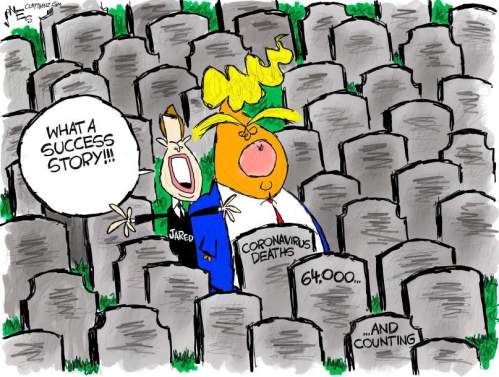
Good Morning!!
It’s another terrifying Tuesday in the American apocalypse. During his insane inauguration speech, Trump said he was going to end American carnage. Instead he has brought us to our knees as a country as we endure a pandemic and economic hardship with almost no help from the federal government. Trump has hollowed out or destroyed nearly every important American institution–the State Department, the Justice Department, the CDC, the Supreme Court, the federal court system, the Defense Department leadership, the Department of Homeland Security and FEMA. And now he’s working on taking control of the intelligence community.
This morning Trump’s insane appointee as Director of National Intelligence, Rep. John Ratcliffe of Texas is testifying in his Senate confirmation hearing.
CNN: Trump’s pick for spy chief testifying before Senate panel.
President Donald Trump’s pick to be director of national intelligence, Rep. John Ratcliffe, pledged to deliver unbiased intelligence to the President and Congress amid questions about the Texas Republican’s loyalty to a President deeply skeptical of the intelligence community.
Ratcliffe is appearing before the Senate Intelligence Committee after he was selected by the President a second time to be the nation’s spy chief. Ratcliffe withdrew from consideration when he was first tapped for the role last summer amid concerns from even some Republicans about exaggerations to his national security resume, but Trump picked him again in February for the role.
“Let me be very clear. Regardless of what anyone wants our intelligence to reflect, the intelligence I will provide, if confirmed, will not be impacted or altered as a result of outside influence. Above all, my fidelity and loyalty will always be with the Constitution and the rule of law, and my actions as DNI will reflect that commitment,” Ratcliffe said in his opening statement.
Ratcliffe appears to have the support he needs from Republicans who were skeptical the first time he was picked, but Democrats are sure to press him on his ability to be independent from Trump when the President has expressed an open distrust of the intelligence community and refused to agree with the assessment on Russian election interference.
The hearing comes amid questions about Trump’s claims of intelligence on the origins of the coronavirus outbreak in Wuhan, China, and the removal of top intelligence officials earlier this year, including former intelligence community inspector general Michael Atkinson and then-acting Director of National Intelligence Joseph Maguire….
Virginia Sen. Mark Warner, the committee’s top Democrat, said he has concerns about what he described as Ratcliffe’s “inexperience, partisanship, and past statements that seemed to embellish” his record.
In case you haven’t noticed, Ratcliffe is quite simply nuts. The Daily Beast: Trump’s Pick for Intelligence Chief Follows a Slew of QAnon Accounts.
Ratcliffe’s official, verified campaign Twitter account follows several accounts on the political fringe, including a 9/11 truther account with just one follower besides himself and four promoting the outlandish QAnon conspiracy theory, which posits that the world is run by a cabal of Democratic pedophile-cannibals—and has been ruled a potential source of domestic terrorism by the FBI.
The conspiracy theorists followed by Ratcliffe, whose nomination for director of national intelligence goes before the Senate intelligence committee Tuesday morning, cover a bizarre range of beliefs. They posit that John F. Kennedy Jr. faked his death to help Trump to take down the Deep State. Others claim a Democratic sex dungeon exists in in a Washington pizzeria. But Ratcliffe and the QAnon promoters he follows have one thing in common: utter loyalty to Trump.
Even before Ratcliffe’s QAnon interest was known, Sen. Ron Wyden (D-OR), a committee member, told The Daily Beast, “Congressman Ratcliffe is a partisan politician who has spent the last two years promoting conspiracy theories in defense of Donald Trump.” [….]
Veteran intelligence officials expressed alarm that the Senate may soon confirm a Trump loyalist atop the U.S.’s 16 intelligence agencies. “Ratcliffe would be the least qualified person to run the intelligence community, ever, and that includes Ric Grenell,” said former CIA and National Counterterrorism Center analyst Aki Peritz, referring to the acting director of national intelligence. “The hardest job for any intelligence officer is to speak truth to power. Based on Ratcliffe’s past performance, it’s doubtful he can resist the urge to politicize intelligence on behalf of Donald Trump.”
Read more at the Daily Beast link.
Meanwhile, as Trump pushes states to reopen their economies, predictions for the future course of the pandemic are alarming. Yesterday Dakinikat posted about a draft study that predicts we will see 200,000 Covid0-19 cases per day by June 1. That link goes to another story at The Washington Post.
Stephen Collinson at CNN: The price of reopening the economy: tens of thousands of American lives.
(CNN)President Donald Trump now knows the price of the haunting bargain required to reopen the country — tens of thousands more lives in a pandemic that is getting worse not better.
It’s one he now appears ready to pay, if not explain to the American people, at a moment of national trial that his administration has constantly underplayed.
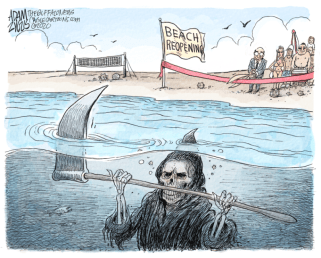
Depressing new death toll projections and infection data on Monday dashed the optimism stirred by more than half the country taking various steps to reopen an economy that is vital to Trump’s reelection hopes and has shed more than 30 million jobs. Stay-at-home orders slowed the virus and flattened the curve in hotspots like New York and California, but they have so far failed to halt its broader advance, leaving the nation stuck on a grim plateau of about 30,000 new cases a day for nearly a month.
Despite those projections, two administration officials told CNN’s Kaitlan Collins the latest numbers are not currently expected to affect the White House’s plans for reopening the country.
New evidence of the likely terrible future toll of Covid-19 came on a day when Trump stayed out of sight — his wild briefings that hurt his political prospects now paused — meaning he could not be questioned on his enthusiasm for state openings in the light of new evidence.But in an interview published in Tuesday’s edition of the New York Post, Trump said Americans were ready come out of isolation and get back to normal life.
“I think they’re starting to feel good now. The country’s opening again. We saved millions of lives, I think,” Trump said. “You have to be careful, but you have to get back to work,” he said. “People want the country open… I guess we have 38 states that are either opening or are very close.”
Opinion polls don’t support Trump’s claims however. Read more at CNN.
According to Calvin Woodward at the AP, Virus-afflicted 2020 looks like 1918 despite science’s march.
Despite a century’s progress in science, 2020 is looking a lot like 1918.
In the years between two lethal pandemics, one the misnamed Spanish flu, the other COVID-19, the world learned about viruses, cured various diseases, made effective vaccines, developed instant communications and created elaborate public-health networks.
Yet here we are again, face-masked to the max. And still unable to crush an insidious yet avoidable infectious disease before hundreds of thousands die from it.
As in 1918, people are again hearing hollow assurances at odds with the reality of hospitals and morgues filling up and bank accounts draining. The ancient common sense of quarantining is back. So is quackery: Rub raw onions on your chest, they said in 1918. How about disinfectant in your veins now? mused President Donald Trump, drawing gasps instead of laughs over what he weakly tried to pass off as a joke.
In 1918, no one had a vaccine, treatment or cure for the great flu pandemic as it ravaged the world and killed more than 50 million people. No one has any of that for the coronavirus, either.
Modern science quickly identified today’s new coronavirus, mapped its genetic code and developed a diagnostic test, tapping knowledge no one had in 1918. That has given people more of a fighting chance to stay out of harm’s way, at least in countries that deployed tests quickly, which the U.S. didn’t.
But the ways to avoid getting sick and what to do when sick are little changed. The failure of U.S. presidents to take the threat seriously from the start also joins past to present
The New York Times offers another historical comparison: A study by the Fed suggests sickness helped drive extremism in the 20th century.
A jump in flu deaths early in the 20th century may have helped to drive the rise of the Nazi Party in Germany, Federal Reserve Bank of New York research showed, in a stark warning that pandemics can drive societal change.
“Influenza deaths of 1918 are correlated with an increase in the share of votes won by right-wing extremists,” Fed economist Kristian Blickle wrote. The finding holds even counting for a city’s ethnic and religious makeup, regional unemployment, past right-wing voting, and other local characteristics.
He points out that local public spending dropped in the wake of the deadly flu, especially on services that benefitted young people, like school. That spending decline itself does not seem to drive the right-wing political extremism that followed, the paper found.
On the other hand, “the correlation between influenza mortality and the vote share won by right-wing extremists is stronger in regions that had historically blamed minorities, particularly Jews, for medieval plagues,” Mr. Blickle wrote. He adds that “the disease may have fostered a hatred of ‘others’, as it was perceived to come from abroad.”
Scientists are learning more about the virus and its effects on the human body. Here are three interesting (and scary) science-based articles to check out.
Raw Story reports on a study that supports something I have suspected–your genes may determine how the virus affects you and how sick you get.
When some people become infected with the coronavirus, they only develop mild or undetectable cases of COVID-19. Others suffer severe symptoms, fighting to breathe on a ventilator for weeks, if they survive at all.
Despite a concerted global scientific effort, doctors still lack a clear picture of why this is.
Could genetic differences explain the differences we see in symptoms and severity of COVID-19?
 The article is too dense to summarize in an excerpt, so you’ll need to read the article. But here’s the gist of the findings:
Based on our study, we think variation in HLA genes is part of the explanation for the huge differences in infection severity in many COVID-19 patients. These differences in the HLA genes are probably not the only genetic factor that affects severity of COVID-19, but they may be a significant piece of the puzzle. It is important to further study how HLA types can clinically affect COVID-19 severity and to test these predictions using real cases. Understanding how variation in HLA types may affect the clinical course of COVID-19 could help identify individuals at higher risk from the disease.
The New York Times: 15 Children Are Hospitalized With Mysterious Illness Possibly Tied to Covid-19.
Fifteen children, many of whom had the coronavirus, have recently been hospitalized in New York City with a mysterious syndrome that doctors do not yet fully understand but that has also been reported in several European countries, health officials announced on Monday night.
Many of the children, ages 2 to 15, have shown symptoms associated with toxic shock or Kawasaki disease, a rare illness in children that involves inflammation of the blood vessels, including coronary arteries, the city’s health department said.
None of the New York City patients with the syndrome have died, according to a bulletin from the health department, which describes the illness as a “multisystem inflammatory syndrome potentially associated with Covid-19.” [….]
The syndrome has received growing attention in recent weeks as cases began appearing in European countries hit hard by the coronavirus.
“There are some recent rare descriptions of children in some European countries that have had this inflammatory syndrome, which is similar to the Kawasaki syndrome, but it seems to be very rare,” Dr. Maria Van Kerkhove, a World Health Organization scientist, said at a news briefing last week.
 The Los Angeles Times: Scientists have identified a new strain of the coronavirus that appears to be more contagious.
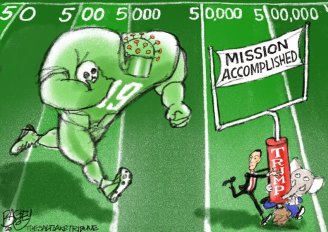
Scientists have identified a new strain of the coronavirus that has become dominant worldwide and appears to be more contagious than the versions that spread in the early days of the COVID-19 pandemic, according to a new study led by scientists at Los Alamos National Laboratory.
The new strain appeared in February in Europe, migrated quickly to the East Coast of the United States and has been the dominant strain across the world since mid-March, the scientists wrote.
In addition to spreading faster, it may make people vulnerable to a second infection after a first bout with the disease, the report warned.
The 33-page report was posted Thursday on BioRxiv, a website that researchers use to share their work before it is peer reviewed, an effort to speed up collaborations with scientists working on COVID-19 vaccines or treatments. That research has been largely based on the genetic sequence of earlier strains and might not be effective against the new one.
That’s it for me. What stories are you following today?

 peej
peej Carissa
 bostonboomer
 dakinikat
 ecocatwoman
 mablue2
 Mama Lopez
 peggysue22
 quixote
 skydancingguestblogger
 Mona (aka Wonk the Vote)



 Sky Dancing
Recent Comments