



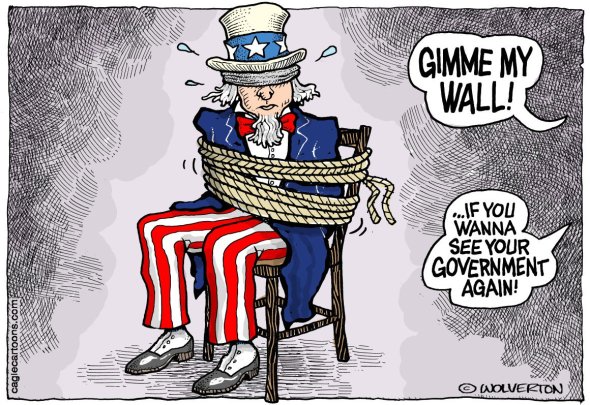



Emboldened in his job, Mr. Trump has rebelled against Kelly’s restrictions and mused about doing away with the chief of staff post entirely. It’s all leading White House staffers and Trump allies to believe that Kelly is working on borrowed time….
Mr. Trump recently told one confidant that he was “tired of being told no” by Kelly and has instead chosen to simply not tell Kelly things at all, according to a person who was not authorized to publicly discuss private conversations and spoke on condition of anonymity.
Thursday Reads: Another Crazy Day in Trump World
Posted: May 30, 2019 Filed under: Foreign Affairs, morning reads, U.S. Politics | Tags: Donald Trump, iran, Iraq War, John Bolton, John McCain, MAGA patches, Mike Pompeo, Robert Mueller, shock and awe, Twitter, USS John McCain, USS Wasp 20 CommentsGood Morning!!
Trump apparently worked himself up into a frenzy last night. He woke up an sent out a series of angry tweets, in one of which he admitted for the first time that Russia helped him get elected. He actually deleted the first tweet but sent out another in which he made the same admission.
A little later Trump emerged from the White House and unleashed a rage-filled 17 minute rant in which he angrily denigrated Robert Mueller. He also contradicted his own tweet, claiming that Russia didn’t help him in 2016.
The Washington Post: Trump attacks Mueller, says he would have brought charges if he had evidence of a crime.
“Robert Mueller should have never been chosen,” Trump said of the former special counsel, who was appointed by former deputy attorney general Rod J. Rosenstein, a Republican Trump appointee.
Trump told reporters that he considered Mueller “totally conflicted” because he had discussions about the position of FBI director early in the Trump administration and is friendly with former FBI director James B. Comey, whom Trump fired in 2017.
“He loves Comey,” Trump claimed. “Whether it’s love or a deep like, he was conflicted.” [….]
Trump also cited a “business dispute” with Mueller on which he did not elaborate. In the past, White House aides have pointed to an alleged dispute over membership fees at Trump National Golf Club in Northern Virginia….
“You know who got me elected? I got me elected,” he said. “Russia didn’t help me at all. Russia, if anything, I think, helped the other side.” [….]
In his comments to reporters, Trump downplayed the prospect of impeachment. A growing number of Democrats were advocating that course on Wednesday after Mueller’s appearance.
“It’s a dirty, filthy disgusting word and it has nothing to do with me,” Trump said. “There was no high crime and there was no misdemeanor.”
This morning’s rant continued as Trump unleashed a number of insults about McCain and how Trump was “never a fan.” He also denied demanding that John McCain’s name be hidden on the U.S. Navy battleship named after McCain’s father and grandfather while Trump was in Japan.
The New York Times: White House Asked Navy to Hide John McCain Warship During Trump’s Visit.
The White House asked the Navy to hide a destroyer named after Senator John McCain in order to avoid having the ship appear in photographs taken while President Trump was visiting Japan this week, White House and military officials said Wednesday.
Although Navy officials insisted they did not hide the ship, the John S. McCain, they did give all of the sailors aboard the day off on Tuesday as Mr. Trump visited Yokosuka Naval Base.
USS Battleship John McCain
Two Navy sailors, who spoke on the condition of anonymity because they were not authorized to speak publicly, said that the McCain sailors were not invited to hear Mr. Trump speak that day aboard the amphibious assault ship Wasp, while sailors from other American warships at the base were.
A Navy service member based on Yokosuka said that all of the American warships in the harbor were invited to send 60 to 70 sailors to hear Mr. Trump’s address, with the exception of the McCain. When several sailors from the McCain showed up anyway, wearing their uniforms with the ship’s insignia, they were turned away, the service member said.
White House aides, who spoke on the condition of anonymity because they were not permitted to speak publicly, confirmed the request was made but said that Mr. Trump did not know about it. A United States official said on Wednesday that the White House sent an email to the Navy with the request on May 15.
[Emphasis added] Raise your hand if you believe Trump had nothing to do with the request.
 On the other hand, sailors wearing MAGA patches in support of Trump were allowed to attend the speech.
CNN: Navy reviewing ‘Make Aircrew Great Again’ patches worn by sailors during Trump visit.
The Navy is conducting a review to examine whether President Donald Trump-themed patches worn by sailors on their uniforms during the President’s visit to the USS Wasp violated Navy rules.
“Navy leadership is aware of the incident and reviewing to ensure the patch doesn’t violate DoD policy or uniform regulations,” US Navy spokesperson Lt. Sam Boyle told CNN.Several service members aboard the USS Wasp were seen wearing the patches when Trump addressed sailors on Tuesday. The patches showed a Trump-like image and the slogan “Make Aircrew Great Again.” [….]Close-up of the MAGA patch
Military personnel often wear unofficial unit patches, sometimes imbued with humorous images, as part of an effort to build unit cohesion and morale.
However, service members are prohibited from exhibiting political messages while in uniform.Unit commanders are usually responsible for ensuring that the unofficial patches do not violate military regulations.Department of Defense guidelines say that “active duty personnel may not engage in partisan political activities and all military personnel should avoid the inference that their political activities imply or appear to imply DoD sponsorship, approval, or endorsement of a political candidate, campaign, or cause.”
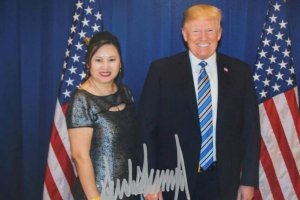
Trump faces more legal trouble about that massage parlor owner in Florida Cindy Yang.
The Miami Herald: Federal prosecutors demand Cindy Yang records from Mar-a-Lago, Trump campaign.
Federal prosecutors in Washington, D.C., this week sent subpoenas to Mar-a-Lago, President Donald Trump’s private club in Palm Beach, and Trump Victory, a political fundraising committee, demanding they turn over all records relating to Republican Party donor Li “Cindy” Yang and several of her associates and companies, the Miami Herald has learned.
Cindy Yang with Donald Trump
Yang, a South Florida massage-parlor entrepreneur, is the target of a public corruption investigation seeking to determine if she funneled money from China to the president’s re-election campaign or otherwise violated campaign-finance laws. She became a GOP donor in the 2016 election cycle and opened a consulting company that promised Chinese businesspeople the chance to attend events at Mar-a-Lago and gain access to Trump and his inner circle. Some of those events were campaign fundraisers that required guests to buy tickets for entry, payments that are considered political contributions. Foreign nationals are prohibited from donating to U.S. political campaigns.
Investigators are seeking evidence from Mar-a-Lago and Trump Victory as they build a potential case against Yang and possibly others close to her. The president’s club and the fundraising committee are not the targets of the investigation. The subpoenas cover records from January 2017 to the present. A spokeswoman for Yang did not immediately respond to a request for comment.
One subpoena, issued by a federal grand jury in West Palm Beach, compels Mar-a-Lago to turn over all documents, records and communications relating to Yang, as well as 11 other people, one charity and seven companies affiliated with her, according to a person familiar with the investigation who asked for anonymity to discuss an ongoing probe. The people named in that subpoena include Yang’s family members, former employees at her massage parlors and several donors to Trump Victory. Prosecutors were trying to serve the subpoena to Mar-a-Lago through a South Florida law firm, the source said.
Click the link to read the rest.
As Trump focuses on attacking the people on his enemies list, John Bolton and Mike Pompeo are moving us closer to war with Iran.
USA Today: Escalating Iran crisis looks a lot like the path US took to Iraq war.
March 20, 2003 – War With Iraq – Shock & Awe . . . And Then Invasion.
The U.S. military’s guided bombs brought “shock and awe” to Baghdad in 2003 when American forces invaded Iraq 16 years ago to hunt for weapons of mass destruction. They never found any. Many observers, today, consider that war a failure.
Now, half of all Americans believe the U.S. will go to war with Iran “within the next few years,” according to a Reuters/Ipsos public opinion poll released in late May amid increased tensions between the two countries, longtime geopolitical foes.
The escalating Tehran-Washington crisis comes as the White House claims, without providing detail or public evidence, that Iran poses an increased threat to American forces and facilities in the Middle East – one year after Trump withdrew from an accord between Iran and world powers aimed at limiting Tehran’s nuclear capabilities.
Is Iran doomed to be an Iraq redux? This is just one of the questions raised by a crisis that has eerie parallels to the missteps that led to the Iraq War in 2003, where the buildup to conflict was precipitated by faulty intelligence and confrontational foreign policymakers such as John Bolton in President George W. Bush’s administration.
Read all about it at the link above. Meanwhile, does anyone know what Trump foreign policy is?
Fred Kaplan at Slate: Who Speaks for the United States?
Tuesday’s New York Times story on the serious disagreements between President Donald Trump and national security adviser John Bolton misses the bigger picture—namely, that Trump is having disagreements with his entire foreign policy team. To put it another way, it is impossible to say just what U.S. foreign policy is—or, to put it more starkly still, the United States has no foreign policy.
The Times story focuses on disputes over Iran and North Korea.
Bolton has described North Korean leader Kim Jong-un’s latest short-range missile tests as violations of a U.N. Security Council resolution; Trump says they’re no big deal. Bolton has called for regime change in Iran; Trump said last week in Japan that he’s fine with the current regime, as long as it stays away from nuclear weapons.But this dispute involves more players than Trump and Bolton. State Department spokespeople, as well as National Intelligence Director Dan Coats, have said—in agreement with Bolton—that the North Korean tests violated a Security Council resolution. Trump stands utterly alone in his view that Kim is an honorable, trustworthy partner.
On Iran, in contrast with what Trump says now, Secretary of State Mike Pompeo recently laid out 12 preconditions for holding talks. Among the demands were that Tehran stop testing ballistic missiles, stop assisting militias in the region, and make several other concessions that would amount, in effect, to a regime change.
And of course, there are his long-standing disputes, over a host of issues, with the Joint Chiefs of Staff, various combatant commands, and pretty much the entire intelligence community.
Imagine if you were a world leader who wants to align, or improve relations, with the United States. What do you do? Do you agree with—and act in ways that advance the policies of—the president, the secretary of state, or the national security adviser? It’s impossible to placate all of them simultaneously. So you begin to wonder: Who speaks for the United States?
Please read the whole thing.
So . . . that’s what’s happening so far this morning. What stories are you following?
Tuesday Reads: Trump Tantrum Live From The Oval Office Tonight
Posted: January 8, 2019 Filed under: Foreign Affairs, morning reads, U.S. Politics | Tags: Barack Obama, Donald Trump, Dunning-Kruger effect, immigration policy, John Bolton, Kurds, Mike Pompeo, Nazi Germany, Recep Tayyip Erdogan, Reichstag fire, Turkey 40 CommentsGood Morning!!
The TV networks are giving Trump free time tonight to spout lies about a non-existent “crisis” at the Southern border. Fortunately, they are also giving equal time to Democrats to respond. But they should have just said no. After all, they refused to carry an Oval Office speech by Obama in 2014. Matthew Yglesias at Vox:
In 2014, Obama was ready to announce a series of executive actions on immigration in the wake of the collapse in negotiations over a bipartisan comprehensive immigration reform bill. The plan had a lot of moving parts, but the centerpiece was to give work permits and formal protection from deportation to millions of unauthorized immigrants while focusing the nation’s immigration enforcement resources on immigrants who’d committed violent crimes.
This was, naturally, very controversial. And Obama, naturally, wanted to try to make it less controversial by convincing people that it was a good idea.
Conservative pundits were, at the time, pushing the notion that Obama was essentially seizing power like a Latin American dictator, so essentially anything that refocused the conversation on banal policy details would have played to his advantage. TV networks, however, didn’t give him what he wanted, in part because it was November sweeps time, but officially because he was playing partisan politics rather than addressing a true national emergency.
So why are they running Trump’s obviously political speech? Because they’re scared. This is what what one anonymous network executive told CNN’s Brian Stelter.
This “exec” didn’t even have the guts to let Stelter use his name!
Here’s what the U.S. Secretary of State thinks of what Trump plans to say tonight.
These people are pathetic. Meanwhile, in Turkey, more pathetic incompetence from National Security Adviser John Bolton.
Bloomberg: Erdogan Snubs Trump Adviser Bolton for Blocking Syria Roadmap.
Turkish President Recep Tayyip Erdogan, frustrated by evolving U.S. conditions for quitting Syria, refused to meet with visiting National Security Adviser John Bolton and ripped into U.S. proposals to give Kurds a key role in Syria after the withdrawal.
Turkey is angered that Bolton, Secretary of State Michael Pompeo and top American military officials are slowing what President Donald Trump suggested only weeks ago would be a quick exit. The delay would restrict Turkey’s ability to launch an offensive against Syrian Kurdish fighters it considers enemies but who allied with a U.S. coalition to oust the Islamic State terrorist group from Syria.
“Although we made a clear agreement with U.S. President Trump, different voices are emerging from different parts of the administration,” Erdogan said as Bolton prepared to leave Ankara, where he met with other Turkish officials. “Trump’s remarks continue to be the main point of reference for us.”
It looks like attempts to walk back Trump’s insane policy decisions are no longer working.
Will Trump try to declare a national emergency tonight? I have no idea, but if he does it’s going to cause more problems than any of us can predict. Here are some opinions about what could happen, beginning with the worst case scenarios
Elizabeth Goitein at The Atlantic: What the President Could Do If He Declares a State of Emergency. A brief excerpt:
It would be nice to think that America is protected from the worst excesses of Trump’s impulses by its democratic laws and institutions. After all, Trump can do only so much without bumping up against the limits set by the Constitution and Congress and enforced by the courts. Those who see Trump as a threat to democracy comfort themselves with the belief that these limits will hold him in check.
But will they? Unknown to most Americans, a parallel legal regime allows the president to sidestep many of the constraints that normally apply. The moment the president declares a “national emergency”—a decision that is entirely within his discretion—more than 100 special provisions become available to him. While many of these tee up reasonable responses to genuine emergencies, some appear dangerously suited to a leader bent on amassing or retaining power. For instance, the president can, with the flick of his pen, activate laws allowing him to shut down many kinds of electronic communications inside the United States or freeze Americans’ bank accounts. Other powers are available even without a declaration of emergency, including laws that allow the president to deploy troops inside the country to subdue domestic unrest.
This edifice of extraordinary powers has historically rested on the assumption that the president will act in the country’s best interest when using them. With a handful of noteworthy exceptions, this assumption has held up. But what if a president, backed into a corner and facing electoral defeat or impeachment, were to declare an emergency for the sake of holding on to power? In that scenario, our laws and institutions might not save us from a presidential power grab. They might be what takes us down.
Read the whole thing at The Atlantic.
At Bloomberg, Noah Feldman disagrees, because only Congress can authorize spending: No ‘Emergency’ Will Allow Trump to Build His Wall.
President Donald Trump has said that he can declare a national emergency and order his border wall to be built. He’s wrong. The U.S. Constitution doesn’t contain any national emergency provision that would allow the president to spend money for purposes not allocated by Congress. And it’s clearer than clear that Congress not only hasn’t authorized money for a wall along the border with Mexico but also doesn’t intend to do so.
The upshot is that any attempt by Trump to get around Congress by using invented emergency powers would violate the Constitution. It almost certainly would be blocked by the courts. And it would constitute a high crime and misdemeanor qualifying him for impeachment.
Of course, Trump may not care. He’s established a pattern of taking clearly unconstitutional action, waiting for the courts to block it, and winning (at least in his estimation) political points with his Republican base regardless. It would be perfectly within that pattern for Trump to announce that he can do whatever he wants in a national emergency. He is expected to lay the groundwork for such a declaration in a prime-time address Tuesday. But we should recognize any such action for what it is: a usurpation of clear constitutional commands for the purposes of political grandstanding.
A bit more detail:
The Constitution does contain an emergency powers clause. Article I, Section 9 allows for the suspension of habeas corpus in cases of rebellion or invasion.
Those emergency powers are unsurprisingly varied and broad. But none of them can displace the Constitution itself. And it is the Constitution that says the Congress appropriates money and the executive spends it.
If there were some statutory provision saying that in an emergency the president could do things Congress otherwise has told him he can’t do, that would pose an intriguing constitutional question: Which law would prevail in a conflict between one saying the president could do something and another saying he couldn’t?
But I know of no law that says the president can spend money on purposes that Congress doesn’t want him to spend it on.
From the fact that the suspension clause exists, you can deduce something very basic to the U.S. constitutional system: There are no other inherent constitutional emergency powers. Yes, the president is commander in chief, with the power to defend the United States — but he can only do that with an army authorized and paid for by Congress.
That means any emergency power the president might have must come directly from Congress. The National Emergencies Act of 1976 is Congress’s last word on what emergency powers it gives the president. That law was enacted after Senate staffers’ research revealed some 470 emergency provisions across the whole of the U.S. Code.
As Trump often says, “we’ll see what happens.”
Trump thinks he knows better than anyone about anything, and yet we can all see that he knows almost nothing about what his job entails. This video has been floating around lately.
How to explain Trump’s illusion of competency? Seemingly in answer to this question, The Washington Post has posted an article on the Dunning-Kruger effect: What’s behind the confidence of the incompetent? This suddenly popular psychological phenomenon.
You may have witnessed this scene at work, while socializing with friends or over a holiday dinner with extended family: Someone who has very little knowledge in a subject claims to know a lot. That person might even boast about being an expert.
This phenomenon has a name: the Dunning-Kruger effect. It’s not a disease, syndrome or mental illness; it is present in everybody to some extent, and it’s been around as long as human cognition, though only recently has it been studied and documented in social psychology.
In their 1999 paper, published in the Journal of Personality and Social Psychology, David Dunning and Justin Kruger put data to what has been known by philosophers since Socrates, who supposedly said something along the lines of “the only true wisdom is knowing you know nothing.” Charles Darwin followed that up in 1871 with “ignorance more frequently begets confidence than does knowledge.”
Put simply, incompetent people think they know more than they really do, and they tend to be more boastful about it.
To test Darwin’s theory, the researchers quizzed people on several topics, such as grammar, logical reasoning and humor. After each test, they asked the participants how they thought they did. Specifically, participants were asked how many of the other quiz-takers they beat.
Dunning was shocked by the results, even though it confirmed his hypothesis. Time after time, no matter the subject, the people who did poorly on the tests ranked their competence much higher. On average, test takers who scored as low as the 10th percentile ranked themselves near the 70th percentile. Those least likely to know what they were talking about believed they knew as much as the experts.
That’s it for me today. I’m trying to decide whether to leave the TV off tonight or just mute it until the Democratic response begins. What are you going to do?
Thursday Reads
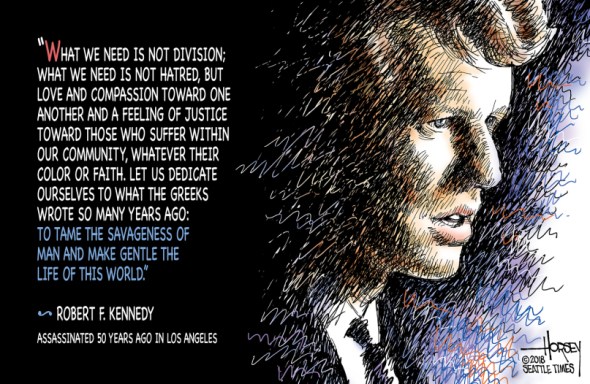
Posted: June 7, 2018 Filed under: Foreign Affairs, morning reads, U.S. Politics | Tags: 2018 midterm elections, alienating allies, Angela Merkel, blue wave, Bobby Kennedy, Canada, D-Day, Donald Trump, family separation, G7, Germany, golf, Heather Nauert, ICE, immigration, John Bolton, Kim Jong Un, North Korea summit, State Department, tariffs, trade war, US troops in South Korea, World War II 42 CommentsGood Morning!!
Here’s some good news for a change: a judge in the Southern District of California will allow a lawsuit by the ACLU challenging the Trump administration policy of separating parents and children at the border to go forward.
Bloomberg: Judge Calls Trump’s Border Separations of Children ‘Brutal.’
The Trump administration failed to kill a legal challenge to its practice of separating undocumented parents and children who seek to enter the U.S. to flee persecution at home, with a judge handing an early victory to civil rights activists who say the policy is unconstitutional and cruel.
U.S. District Judge Dana Sabraw in San Diego on Wednesday denied a motion to dismiss the suit, in which the American Civil Liberties Union argues that splitting up families at the border violates their due process rights.
The practice, spearheaded by Attorney General Jeff Sessions, caused widespread outrage after images of children in detention centers circulated on social media. The government argues separations are necessary to properly prosecute adults who cross into the U.S. illegally, while activists say children are being used as pawns in an informal policy intended to deter migrants.
“These allegations sufficiently describe government conduct that arbitrarily tears at the sacred bond between parent and child,” the judge wrote. The conduct, if true, “is brutal, offensive, and fails to comport with traditional notions of fair play and decency.” [….]
Sabraw said the ACLU’s claims are particularly troubling because the plaintiffs in the case had allegedly come to the U.S. seeking asylum out of fear for their well-being in their home countries. The suit applies to migrants who formally present themselves at ports of entry as political refugees as well as those who seek asylum after they are apprehended during illegal border crossings.
“The government actors responsible for the ‘care and custody’ of migrant children have, in fact, become their persecutors,” the judge said.
Read more at the link. The entire filing can be read here.
More good news: a new NBC/WSJ poll found that voters are much more likely to support candidates who stand up to Trump.
NBC News: Poll: Economic satisfaction under Trump isn’t helping his party’s 2018 chances.
By a whopping 25-point margin, voters say they’re more likely to back a congressional candidate who promises to serve as a check on President Donald Trump, according to a new national poll from NBC News and the Wall Street Journal.
And by a similar margin, they say they’re less likely to vote for someone who has supported the president on most issues.
At the same time, six-in-10 are satisfied with the U.S. economy, and a plurality of voters give Trump credit for the economic improvement.
Despite that economic optimism, however, the poll shows that Democrats enjoy a 10-point advantage on congressional preference, with 50 percent of registered voters wanting a Democratic-controlled Congress, versus 40 percent who want a GOP-controlled one.
Now if national Democrats would just wake up and realize that standing up to Trump is the best mid-term strategy!
The summit with North Korea is coming up next week, but Trump isn’t listening to advice from experts on how to proceed, according to Politico: Trump and Bolton spurn top-level North Korea planning.
National Security Adviser John Bolton has yet to convene a Cabinet-level meeting to discuss President Donald Trump’s upcoming summit with North Korea next week, a striking break from past practice that suggests the Trump White House is largely improvising its approach to the unprecedented nuclear talks.
For decades, top presidential advisers have used a methodical process to hash out national security issues before offering the president a menu of options for key decisions. On an issue like North Korea, that would mean White House Situation Room gatherings of the secretaries of state and defense along with top intelligence officials, the United Nations ambassador, and even the treasury secretary, who oversees economic sanctions.
But since Trump agreed on a whim to meet with North Korean dictator Kim Jong-un on March 8, the White House’s summit planning has been unstructured, according to a half-dozen administration officials. Trump himself has driven the preparation almost exclusively on his own, consulting little with his national security team outside of Secretary of State Mike Pompeo.
Senior officials from both the Barack Obama and George W. Bush administrations called the absence of a formal interagency process before such a consequential meeting troubling. Peter Feaver, a former National Security Council (NSC) official in the George W. Bush White House, said his colleagues would likely have held “quite a few” meetings of the so-called Principals Committee of Cabinet-level NSC members in a comparable situation. A former top Obama White House official echoed that point, calling the lack of top-level NSC meetings “shocking.”
Trump has also not presided personally over a meeting of those senior NSC officials, as a president typically does when making the most important decisions.
On the other hand, Trump has given serious thought to whether he should invite Kim Jong Un to play golf with him in Florida if the summit goes well. The Daily Beast reports:
Trump has floated hitting the links with his counterpart as he considers a secondary charm offensive to complement the diplomatic tête-à-tête. The president has already told those close to him and advisers that he is open to inviting Kim to a follow-up summit at Trump’s famous Mar-a-Lago estate and private club in Palm Beach, Florida, as Bloomberg first reported this week.
And, according to two administration officials, Trump has also raised the possibility of a leisurely activity and, perhaps, getting in 18 holes with Kim if the two end up getting along.
“He has also discussed [possibly] golfing with Kim,” a senior Trump administration official said.
It is unclear if such an outing would or could occur during a potential follow-up meeting or the one planned, then canceled, then planned again for Singapore. The site of the upcoming Singapore talks, a five-star hotel on Sentosa Island, is located near a theme park, resorts, and—as luck would have it—multiple golf courses.
The article says no one actually know if Kim even plays golf.
I suppose Kim would agree with Trump on this though. At The Washington Post, Josh Rogin writes that Trump still wants to pull U.S. troops out of South Korea.
For almost two years, President Trump has been talking about withdrawing large numbers of U.S. troops from South Korea, where there are currently around 28,000 stationed. The president’s advisers have repeatedly argued against a large-scale reduction, but he remains unpersuaded. And after his upcoming meeting with North Korean leader Kim Jong Un, Trump will have another big chance to push the issue.
Less publicly, but still privately, Trump continues to say he doesn’t agree with the argument that U.S. troops in South Korea are strategically necessary, and he thinks the United States gets nothing back from paying to keep them there, according to administration officials and people who have spoken to Trump directly about the issue. He often asks his generals to explain the rationale for America’s deployments in Asia and expresses dissatisfaction with their answers.
At Trump’s direction, the Pentagon has taken a hard line in ongoing negotiations with the South Korean government over a new cost-sharing agreement for U.S. troops there. If those negotiations fail, Trump could have another excuse to move forward with large reductions….
Inside the administration, top officials have been trying — and failing — to convince the president of the strategic value of the South Korea-based troops since the beginning of his administration. In February, Chief of Staff John F. Kelly reportedly talked Trump down from starting a withdrawal.
Trump has picked fights with most of our allies at this point. Now he’s whining about having to to the Canada on Friday because he’s mad at Justin Trudeau.
The president has vented privately about Canadian Prime Minister Justin Trudeau as their trade tensions have spilled into public view. He has mused about finding new ways to punish the United States’ northern neighbor in recent days, frustrated with the country’s retaliatory trade moves.
And Trump has complained to aides about spending two days in Canada for a summit of world leaders, believing the trip is a distraction from his upcoming Singapore summit with North Korean leader Kim Jong Un, according to three people familiar with Trump’s views.
In particular, the president said Tuesday to several advisers that he fears attending the Group of Seven summit in rural Charlevoix, Quebec, may not be a good use of his time because he is diametrically opposed on many key issues with his counterparts — and does not want to be lectured by them.
Additionally, Trump has griped periodically both about German Chancellor Angela Merkel — largely because they disagree on many issues and have had an uneasy rapport — as well as British Prime Minister Theresa May, whom he sees as too politically correct, advisers say.
Awwww . . . poor baby. BTW, have you heard that State Department spokesperson and former Fox and Friends host Heather Nauert thinks Germany was our ally during World War II? Rachel Maddow discussed this at the beginning of her show last night.
Please watch the video–even if you already saw it last night. These are the people who are running our foreign policy!
Politico reports that many foreign leaders are beginning to wake up to Trump’s insanity: Foreign leaders who embraced Trump now feel burned.
Trump calls Japanese prime minister Shinzo Abe, who visits the White House Thursday, his “good friend.” French president Emmanuel Macron is a “great friend.” And Canadian Prime Minister Justin Trudeau is a “great friend, neighbor, and ally.” All have sought to butter up Trump through friendly face time, recognizing that the quickest way to the president’s heart is through his ego.
But all, to varying degrees, are exasperated with Trump.
The president is moving ahead with a June 12 summit with North Korea despite Abe’s grave concerns about its wisdom. He has also threatened to slap tariffs on imported Japanese cars and metals. It’s hardly what Abe expected when he became the first foreign leader to meet with Trump after the November election or when he flew with Trump on Air Force One in February 2017 for golfing at his Mar a Lago resort.
Macron treated Trump to a military parade in Paris last summer. He and Trump also exchanged hugs and handshakes during an April visit by the French leader, during which Trump said of his guest: “He is perfect.” But a few weeks later, Trump pulled out of the Iran nuclear deal despite French pleas, and shows no sign of heeding Macron’s request that he rejoin the Paris climate accords, which Trump rejected last year.
Trump has also threatened trade sanctions on the European Union, and is already slapping them on Canada — prompting Trudeau to call Trump’s tariffs on steel imports “insulting and unacceptable.” That’s a change of tune from the early months of Trump’s presidency, when Trudeau avoided criticizing Trump, and even took Ivanka Trump and Jared Kushner to a Broadway play in March 2017.
All have paid a domestic political price back home for their efforts to make nice with a highly divisive U.S. president. One French parliamentarian fumed after Macron’s visit that France had “prostituted” and “humiliated” itself.
Angela Merkel knew who she was dealing with from day one, evidence that we need more women in leadership positions around the world.
That’s it for me today. What stories have you been following?
Lazy Saturday Reads
Posted: April 7, 2018 Filed under: Afternoon Reads, Foreign Affairs, U.S. Politics | Tags: China, Donald Trump, information overload, James Mattis, John Bolton, John Kelly, Stock Market, Syria, tariffs, trade war 35 Comments
Woman Reading by a Window Gari Melchers – circa 1905
Good Afternoon!!
I’ve been trying to find out where Trump is this weekend. I haven’t heard anything about him going to Florida, and I’m afraid that may mean there will be more chaos in the White House over the weekend. Will Scott Pruitt lose his job? Or will Trump really try to use him to replace Jeff Sessions? Is Trump really preparing to talk to Robert Mueller, as CNN reports?
Exclusive: Trump begins informal prep for potential Mueller interview.
President Donald Trump has begun the initial steps of preparing for a possible interview with the special counsel, a White House official and a person familiar with the situation said Friday, a sign the President’s legal team is intensifying its deliberations over whether to allow him to come under Robert Mueller’s questioning.
One source familiar with the proceedings stressed the preparation efforts is “in its infancy.”
The preparations have been short and informal and included going over potential topics with the President that Mueller would likely raise in an interview, the people said.The President has not formally agreed to sit for an interview with Mueller.
But word of early preparations is the clearest sign yet that Trump and his team remain open to an interview with Mueller, despite concerns from some people close to the President that such an interview could expose him to possible charges of perjury.
According to Tina Nguyen at Vanity Fair, Trump is now targeting one of his last “adult” advisers: Running Out of Punching Bags, Trump Turns on Mattis.
Drinking Coffee And Reading In The Garden Painting by Edward Killingworth Johnson
Until recently, Donald Trump’s campaign to purge naysayers had spared the Pentagon. In the absence of more proximate targets, however, it appears the president has turned his attention to foreign policy, jeopardizing his relationship with perhaps his only remaining sane adviser. Indeed, in the past week, Trump has made James Mattis’s job nearly impossible by declaring that he would send the military to guard the border with Mexico (the White House later clarified that he meant the National Guard), and insisting that the U.S. pull out of Syria (something Mattis promised last year would not happen), leading to a spectacular showdown on Tuesday, when the conflict between Trump and his generals reportedly boiled over during a meeting of top aides in the Situation Room.
According to the Associated Press, Mattis argued “that an immediate withdrawal” from Syria “could be catastrophic and was logistically impossible to pull off in any responsible way,” and offered a one-year timeline as an alternative—to which Trump responded that five or six months ought to do the trick, and “indicated that he did not want to hear in October that the military had been unable to fully defeat the Islamic State and had to remain in Syria for longer.” A person familiar with the meeting told CNN that attendees left Tuesday’s meeting “beside themselves,” arguing that Trump’s lack of desire to put together any sort of recovery plan for Syria—restoring basic needs such as water, power, and roads—would most certainly tip the country back into ISIS’s hands. “It is a huge gamble that ISIS is not going to come back and that we are going to rely on others to stabilize Syria,” an official said.
The same official noted the hypocrisy in Trump’s choice: “The president blasted Obama for a timeline in Iraq, but that is in essence what we have been given.”
It wasn’t the result top national security aides wanted. Trump’s desire for a rapid withdrawal faced unanimous opposition from the Joint Chiefs of Staff, the Pentagon, the State Department and the intelligence community, all of which argued that keeping the 2,000 U.S. soldiers currently in Syria is key to ensuring the Islamic State does not reconstitute itself.
Adolfe Monet reading in the garden, by Claude Monet
But as they huddled in the Situation Room, the president was vocal and vehement in insisting that the withdrawal be completed quickly if not immediately, according to five administration officials briefed on Tuesday’s White House meeting of Trump and his top aides. The officials weren’t authorized to discuss internal deliberations and requested anonymity.
If those aides failed in obtaining their desired outcome, it may have been because a strategy that’s worked in the past — giving Trump an offer he can’t refuse — appears to have backfired.
Rather than offer Trump a menu of pullout plans, with varying timelines and options for withdrawing step-by-step, the team sought to frame it as a binary choice: Stay in Syria to ensure the Islamic State can’t regroup, or pull out completely. Documents presented to the president included several pages of possibilities for staying in, but only a brief description of an option for full withdrawal that emphasized significant risks and downsides, including the likelihood that Iran and Russia would take advantage of a U.S. vacuum.
Ultimately, Trump chose that option anyway.
Will Mattis resign if Trump insists on pulling the U.s. military out of Syria? Or will Trump fire him? John Bolton is expected to begin his job as National Security Adviser on Monday. Will he agree with Trump’s newly formed foreign policy?
Chief of Staff John Kelly has also lost influence on the newly “emboldened” Trump according to CBS News: Trump freezes out chief of staff John Kelly, says he’s “tired of being told ‘no.'”
When President Donald Trump made a congratulatory phone call to Russian leader Vladimir Putin, White House chief of staff John Kelly wasn’t on the line. When Mr. Trump tapped John Bolton to be his next national security adviser, Kelly wasn’t in the room.
And when Mr. Trump spent a Mar-a-Lago weekend stewing over immigration and trade, Kelly wasn’t in sight.
Oscar Bluhm In the Pergola, 1892
Kelly, once empowered to bring order to a turbulent West Wing, has receded from view, his clout diminished, his word less trusted by staff and his guidance less tolerated by an increasingly go-it-alone president.
The stock market isn’t happy with Trump’s push for a trade war. Yahoo News (AP): Stock Market Plummets After Trump Explores $100 Billion in New Chinese Tariffs.
Another increase in trade tensions has stocks falling sharply Friday as the U.S. considers an even larger set of tariffs on imports from China and the two countries exchange pointed statements. Technology companies and banks are taking some of the worst losses.
Stocks have changed direction again and again this week as investors tried to get a sense of whether a trade dispute between the two nations will escalate, an outcome that could have major consequences for the global economy. The market didn’t get any help from a March jobs report that was weaker than expected.
The Dow Jones industrial average fell dropped 581 points, or 2.4 percent, to 23,916 as of 2:15 p.m. Eastern time. Earlier it fell as much as 620 points.
The S&P 500, which many index funds track, lost 53 points, or 2 percent, to 2,608. The Nasdaq composite slid 135 points, or 1.9 percent, to 6,940. The Russell 2000 index of smaller-company stocks dipped 29 points, or 1.9 percent, to 1,513.
The Dow average, which contains numerous multinational companies including industrial powerhouses Boeing and Caterpillar, has swung dramatically this week, with about 1,300 points separating its highest and lowest marks. It fell as much as 758 points Monday, then recovered all of those losses, and late Thursday it was up as much as 519 points for the week. It’s down 0.7 percent for the week.
Reading in the garden, 1915 – Nikolay Bogdanov-Belsky
Donald Trump has decided to gamble his presidency on the idea that he can threaten big tariffs on China and force the world’s second-largest economy to back down.
If he fails — and the odds are that he will — the fallout from a tariff battle with China could derail an otherwise strong U.S. economy, threaten Republican majorities in the midterm elections and turn the second half of Trump’s first term into a dismal slog to avoid impeachment votes.
So far, the exact scenario that free traders inside the White House and on Capitol Hill feared is playing out. China scoffed at Trump’s initial $50 billion in threatened tariffs and announced their own, aimed directly at Trump’s red-state base with levies on agricultural and manufactured products.

Although Trump has repeatedly bragged about stock market gains since he has been “president,” Bloomberg reports that Trump is now in 8th place in rankings of presidential success with the markets:
The Republican president’s renewed ramblings on trade dominated U.S. equity markets this week, with a tweet-induced swoon on Friday leaving the S&P 500 Index 1.4 percent lower than where it started on Monday. The gauge swung wildly, notching four moves of at least 1 percent in the five days, and the Cboe Volatility Index spiked above 20, nearly double its level for the past year.
All of which has dented Trump’s reputation as the stock market president.
Dow Jones Industrial Average return, if you invested in that basket of stocks, for a president’s first 444 days (ranked since 1900,) per Bloomberg:
FDR : 70.4%
Reagan: 41.4%
Teddy Roosevelt: 37.4%
Obama: 32.5%
Bill Clinton: 32.2%
George H.W. Bush: 21.4%
Trump: 20.7%
BTW, according to Think Progress, Trump doesn’t want his trade war to interfere with his daughter’s self-dealing: Ivanka Trump’s clothing company will be spared from tariffs, thanks to her dad.
U.S. officials say they used an algorithm to determine which goods to exclude from new tariffs. According to the Washington Post, the list was drafted to achieve “the lowest consumer impact,” ensuring goods like clothing and toys were excluded so as not to raise the cost on domestic consumer goods.
Reading Man in Park — August Macke 1915
Exempting clothing from the tariffs provides a big break to American clothing companies that hold trademarks in China. One of those clothing companies belongs to the First Daughter of the United States, Ivanka Trump.
A recent report by the Huffington Post found that the president’s daughter and closest adviser rakes in a total of $1.5 million a year from the Trump Organization while still working at the White House.
Her dual role as adviser to the president and private business executive has continuously raised ethical red flags. No one can be entirely sure that public policy by this administration isn’t being driven by business motives, or whether countries may pursue business deals with the Trump family as a means to curry political favor with the administration.

Once again, I’ve barely touched on all the important news that has broken over the past couple of days. I’ve reached the point of having to shut down for part of every day, because I’m so overwhelmed. Of course I’m not alone it that. In this vein Brian Klaas asks at The Washington Post: Can democracy survive information overload?
Last month, President Trump floated the idea of executing drug dealers; got sued by a porn star and a Playboy model; repeatedly attacked the FBI, his own attorney general and the Justice Department; instigated a trade war that punished long-standing U.S. allies; explicitly praised authoritarian consolidations of power in China and Egypt; “joked” about becoming “president for life”; congratulated Vladimir Putin on winning a sham election and reportedly invited him to the White House right after Russia’s government allegedly attempted to murder a former spy on the soil of the United States’ closest ally.
He also bullied a journalist for his physical appearance; boasted about making up statistics in meetings with Canada’s government; live-tweeted his favorite TV show; fired his secretary of state on Twitter; lost his Veterans Affairs secretary, national security adviser, chief economic adviser, communications director and a personal aide whose reported gambling habit was deemed a security risk; hired a new national security adviser who has repeatedly called to bomb North Korea and Iran; lashed out at the special counsel, who is investigating the president for potential crimes; and threatened to beat up the former vice president of the United States until he cried.
Woman Reading in a Garden by Harold Harvey
That’s just a small selection of news from March 2018: one crazy month of one crazy presidency.
This inescapable, overwhelming and disorienting flurry of activity, which has become the new normal since Trump’s inauguration, begs two simple but profound questions: Can democracy survive information overload? And can it survive a president who knows how to use the resulting chaos to dodge democratic accountability?
Authoritarian rulers have long understood that controlling and manipulating information are crucial to subverting democracy and getting away with breaking the rules. That’s why dictatorial governments such as China and Russia not only work overtime to control media and censor inconvenient facts but also use troll armies to spew out 24/7 torrents of disinformation. Despite Trump’s obvious envy of such methods, he’s stuck with American democracy, so he has innovated out of necessity. He can’t shut down the press or censor Democrats, but he can blind the American electorate with a steady smokescreen of bewildering stories pouring out of the White House.
From Ronald Reagan to Barack Obama, any one of those stories above would have captivated national attention for weeks, or more likely, months. But with Trump, even the most scandalous topic soon disappears into a never-ending flow of revelations. By the time the morning news shows end, it’s on to the next spectacle of dysfunction. We’re living in a chronic state of whiplash.

Thursday Reads: This Sh**t Never Ends!
Posted: March 29, 2018 Filed under: Afternoon Reads, U.S. Politics | Tags: China, corruption, David Shulkin, Donald Trump, Ivanka Trump, Jared Kushner, John Bolton, John Dowd, Kim John Un, Latvia, Michael Flynn, North Korea, Paul Manafort, presidential pardons, privatization, Robert Mueller, Russia investigation, U.S. Constitution, Veterans Affairs 31 Comments
Bette Davis
Good Afternoon!!
As usual in the horrifying new world of Trump, there is so much shocking news that there’s no way to deal with all of it. I guess the top story has to be that Trump’s former lawyer John Dowd dangled pardons in front of Michael Flynn and Paul Manifort last summer.
The New York Times: Trump’s Lawyer Raised Prospect of Pardons for Flynn and Manafort.
A lawyer for President Trump broached the idea of Mr. Trump’s pardoning two of his former top advisers, Michael T. Flynn and Paul Manafort, with their lawyers last year, according to three people with knowledge of the discussions.
The discussions came as the special counsel was building cases against both men, and they raise questions about whether the lawyer, John Dowd, who resigned last week, was offering pardons to influence their decisions about whether to plead guilty and cooperate in the investigation.
The talks suggest that Mr. Trump’s lawyers were concerned about what Mr. Flynn and Mr. Manafort might reveal were they to cut a deal with the special counsel, Robert S. Mueller III, in exchange for leniency. Mr. Mueller’s team could investigate the prospect that Mr. Dowd made pardon offers to thwart the inquiry, although legal experts are divided about whether such offers might constitute obstruction of justice.
Mr. Dowd’s conversation with Mr. Flynn’s lawyer, Robert K. Kelner, occurred sometime after Mr. Dowd took over last summer as the president’s personal lawyer, at a time when a grand jury was hearing evidence against Mr. Flynn on a range of potential crimes.
Flynn ultimately took the safe route and agreed to cooperate with the Mueller investigation; but this could explain why Paul Manafort is holding out even though the evidence against him is overwhelming and he could face life in prison if convicted.

Cary Grant, 1960
Constitutional experts are now discussing whether Trump could get away with pardoning Manafort and others, even if he did it with corrupt intent. Some opinions:
Alex Whiting at Just Security: Why Dangling a Pardon Could Be an Obstruction of Justice—Even if the Pardon Power is Absolute. A brief excerpt:
Some experts have argued that the pardon power is absolute and that the President’s motives in issuing a pardon thus could not be questioned, while others contend that it could be a crime to issue a pardon for corrupt purposes (such as in exchange for cash). But the debate over the absolute nature of the pardon power is actually not relevant to the alleged incidents involving Trump’s lawyer. Indeed, that entire debate can be set aside for the moment. Why? Because there’s been no pardon. Instead, a pardon has only been dangled before Flynn and Manafort, and the analysis of whether that action could become part of an obstruction case against Trump raises entirely different considerations….
The pardon dangle works completely differently—and in important respects has the opposite effects. First, this kind of dangle is not a public act. Therefore, as long as it remained secret, it could be done without incurring any of the political downstream consequences that come with actually pardoning someone. It hides the President from scrutiny rather than exposes him to it as a potential check on the use of the power. Second, the objective of the dangle appears to have been to foreclose the prospect of Flynn and Manfort’s cooperating or testifying. Once again, this is the opposite effect of an actual exercise of the pardon. The message of the dangle was sufficiently clear: hang in there and keep fighting (do not cut a deal with the special counsel) because you will be pardoned before you spend a day in jail. The President and his lawyer’s hope would have been that with the threat of jail eliminated, neither former aid would feel compelled to plead guilty and cooperate with Mueller to reduce his sentence. But, since they were not actually pardoned or not yet anyway, they still kept their Fifth Amendment privileges, and so Mueller could not simply demand they testify before the Grand Jury. In this way, the dangle could operate to stop any cooperation from Flynn and Manafort, who could then be pardoned later if and when they were indicted or even after their cases went through pretrial, trial and appeal. Indeed, you also have to put yourself back at the time these events all took place: before Manafort was indicted and Flynn pleaded guilty. That’s when the dangle could work its magic.
Ava Gardner
Because a pardon dangle is secret and seeks to discourage cooperation with an ongoing investigation without public scrutiny or consequences, it should be analyzed differently than a pardon when it comes to an obstruction case.

Former U.S. Attorney Harry Littman at The Washington Post: We may know why Paul Manafort has kept quiet. But his bet is still risky.
Manafort’s refusal to cooperate can’t be driven by a rational calculation that he has any reasonable chance of escaping conviction, multimillion-dollar legal fees and a prison sentence that will result in years behind bars.
The indictments against him lay out an overwhelming case of money laundering in particular. The meticulously gathered evidence will be as clear for the jury as a laundry detergent commercial: The jury will see the dirty money go in and the clean money come out. To the extent there had been a small risk, inherent in paper-driven chases, that the jury could become bored at the accounting presentation and tune out, Mueller now has a narrator for the trial in Manafort’s co-conspirator Rick Gates.
So is hoping for a Trump pardon a good bet for Manafort?
…the Times story does not definitively solve the Manafort mystery. First, Dowd’s reported overture, particularly if done with the president’s knowledge or consent, could have constituted a conspiracy to obstruct justice, a separate impeachable offense. That presumably is why the story includes a categorical denial from Dowd that he ever discussed pardons for the president’s former advisers with lawyers. For Dowd, the conduct would be putting his license at risk.
Second, Manafort surely recognizes that he can’t fully count on Trump, both because the president is a habitual liar and because the political dynamic is subject to such extreme and violent turns. (Of course, under this hypothesis, Manafort retains the valuable insurance policy of spilling the goods if Trump double-crosses him, leaving both huge losers in a real-life prisoners dilemma.)Marcello Mastroianni
Third, Manafort could still be required to testify after any pardon, when he would no longer be in federal jeopardy. Undoubtedly, the plan would be for him to deny assurances of a pardon from Trump. Still, were Mueller to catch him in a lie, the special counsel would surely come down on him.
Finally, it is likely that in the event of a pardon for federal crimes, which is all Trump can provide, some state attorneys general, such as New York’s Eric T. Schneiderman, would prosecute Manafort for financial crimes under their potent state statutes.

Maybe Manafort figures a possible pardon is a better bet than hoping Putin doesn’t send his goons to shut him (Manafort) up for good.
A few more pardon stories:
Bloomberg: Pardon Talk Could Put Trump Lawyer in Hot Water.
CNN: Emails reveal DOJ would have ‘very little involvement’ if Trump tweeted a pardon.
The Washington Post: This overlooked part of the Constitution could stop Trump from abusing his pardon power.
Another big story broke late yesterday. Trump fired Veterans Affairs Secretary David Shulkin. Today Shulkin is speaking out, claiming he was fired because he opposed privatizing the VA. Shulkin spoke to NPR’s Morning Edition:
Fired Veterans Affairs Secretary David Shulkin tells NPR’s Morning Edition that political forces in the Trump administration want to privatize the VA — and that he was standing in the way.
“There are many political appointees in the VA that believe that we are moving in the wrong direction or weren’t moving fast enough toward privatizing the VA,” he said. “I think that it’s essential for national security and for the country that we honor our commitment by having a strong VA. I was not against reforming VA, but I was against privatization.”
Lauren Bacall
Those political forces may be why Shulkin says he wasn’t allowed to speak out to defend himself against an ethics controversy over use of funds on a trip to Europe that he says was overhyped and intended to weaken him.
“This was completely mischaracterized,” Shulkin said. “There was nothing improper about this trip, and I was not allowed to put up an official statement or to even respond to this by the White House. … I think this was really just being used in a political context to try to make sure that I wasn’t as effective as a leader moving forward.”

Shulkin argued his case in an op-ed at The New York Times: David J. Shulkin: Privatizing the V.A. Will Hurt Veterans.
That’s a lot of news, but I’ve barely touched on everything that’s happening. Here’s a shocking Trump corruption story that broke at The Guardian this morning: FBI looked into Trump plans to build hotel in Latvia with Putin supporter.
In 2010, a small group of businessmen including a wealthy Russian supporter of Vladimir Putin began working on plans to build a glitzy hotel and entertainment complex with Donald Trump in Riga, the capital of Latvia.
A senior Trump executive visited the city to scout for locations. Trump and his daughter Ivanka spent hours at Trump Tower with the Russian, Igor Krutoy, who also knows compatriots involved in arranging a fateful meeting at the same building during the 2016 US election campaign.
Then the Latvian government’s anti-corruption bureau began asking questions.
The Guardian has learned that talks with Trump’s company were abandoned after Krutoy and another of the businessmen were questioned by Latvian authorities as part of a major criminal inquiry there – and that the FBI later looked into Trump’s interactions with them at Latvia’s request.
Michael Caine
Those involved deny that the inquiry was to blame for the deal’s collapse.
Latvia asked the US for assistance in 2014 and received a response from the FBI the following year, according to a source familiar with the process. Latvian investigators also examined secret recordings in which Trump was mentioned by a suspect.
This means the FBI looked into Trump’s efforts to do business deals in the former Soviet Union earlier than was widely known. Robert Mueller, the special counsel, is now investigating other Trump dealings with Russians as part of his wide-ranging criminal inquiry into alleged collusion between Moscow and members of Trump’s 2016 campaign team.
The Riga developers saw their potential partner in New York as a ticket to lucrative western revenues.

This shit just never ends. I haven’t even touched on the North Korea news or the Bolton mess or the fact that Trump wants to put his personal physician in charge of the VA. More headlines to check out:
The Washington Post: Who is Trump’s new Veterans Affairs pick, Ronny Jackson?
NBC News: Kim Jong Un met China’s Xi. What does it mean for Trump summit?
The Washington Post: Three big questions about a Trump-Kim summit.
Business Insider: Kim Jong Un became a regional power overnight by saying a single, meaningless word to Trump.
Vox: “Otherwise, they subpoena”: White House lawyer Ty Cobb on why Trump is cooperating with Mueller.
Bloomberg: Kelly Loses White House Clout as Trump Blazes Own Path.
CNN: Did Trump campaign and John Bolton PAC get help from overseas?
Talking Points Memo: WSJ: Kushner Has Phoned Bolton For Advice In The Past Year.
BBC News: Julian Assange has internet cut at Ecuadorean embassy in London.
The Daily Beast: ICE Now Detaining Pregnant Women, Thanks to Trump Order.
Slate: It’s Time to Stop Yammering About Liberal Bias.

 peej
peej Carissa
 bostonboomer
 dakinikat
 ecocatwoman
 mablue2
 Mama Lopez
 peggysue22
 quixote
 skydancingguestblogger
 Mona (aka Wonk the Vote)



 Sky Dancing
Recent Comments