
Indefinite Detention without Trial Open Thread
Posted: December 31, 2011 Filed under: Barack Obama, Psychopaths in charge, U.S. Military, U.S. Politics, We are so F'd | Tags: ACLU, Barack Obama, indefinite detention of American citizens, iran, National Defense Authorization Act (NDAA), oil, sanctions 37 Comments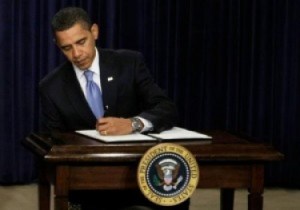
Today President Barack Obama signed into law the National Defense Authorization Act (NDAA) which, among other things, gives the President the power to indefinitely detain American citizens without trial. It also enshrines in law the ability of the government to use the military against American citizens.
At the same time, Obama issued a signing statement in which he says he will not use on the indefinite detention authority. As we know from three years experience, the President is a liar. Furthermore, the power will be passed on to future Presidents, and they may be less hesitant to use it. Here is the text of the signing statement (PDF), via the Washington Post. Some exerpts:
The fact that I support this bill as a whole does not mean I agree with everything in it. In particular, I have signed this bill despite having serious reservations with certain provisions that regulate the detention, interrogation, and prosecution of suspected terrorists. Over the last several years, my Administration has developed an effective, sustainable framework for the detention, interrogation and trial of suspected terrorists that allows us to maximize both our ability to collect intelligence and to incapacitate dangerous individuals in rapidly developing situations, and the results we have achieved are undeniable. Our success against al-Qa’ida and its affiliates and adherents has derived in significant measure from providing our counterterrorism professionals with the clarity and flexibility they need to adapt to changing circumstances and to utilize whichever authorities best protect the American people, and our accomplishments have respected the values that make our country an example for the world….
Section 1021 affirms the executive branch’s authority to detain persons covered by the 2001 Authorization for Use of Military Force (AUMF) (Public Law 107-40; 50 U.S.C. 1541
note).This section breaks no new ground and is unnecessary. The authority it describes was included in the 2001 AUMF, as recognized by the Supreme Court and confirmed through lower court decisions since then. Two critical limitations in section 1021 confirm that it solely codifies established authorities. First, under section 1021(d), the bill does not “limit or expand the authority of the President or the scope of the Authorization for Use of Military Force.” Second, under section 1021(e), the bill may not be construed to affect any “existing law or authorities relating to the detention of United States citizens, lawful resident aliens of the United States, or any other persons who are captured or arrested in the United States.” My Administration strongly supported the inclusion of these limitations in order to make clear beyond doubt that the legislation does nothing more than confirm authorities that the Federal courts have recognized as lawful under the 2001 AUMF. Moreover, I want to clarify that my Administration will not authorize the indefinite military detention without trial of American citizens. Indeed, I believe that doing so would break with our most important traditions and values as a Nation. My Administration will interpret section 1021 in a manner that ensures that any detention it authorizes complies with the Constitution, the laws of war, and all other applicable law.
In other words, Obama already had the power to detain American citizens, but because he is a great and magnanimous leader he will not act on the power, so we shouldn’t worry our pretty heads about it. Habeas Corpus is available only if granted by our benign and glorious leader.
Here’s the statement released by the ACLU on the President’s decision to sign the bill into law.
President Obama signed the National Defense Authorization Act (NDAA) into law today. The statute contains a sweeping worldwide indefinite detention provision. While President Obama issued a signing statement saying he had “serious reservations” about the provisions, the statement only applies to how his administration would use the authorities granted by the NDAA, and would not affect how the law is interpreted by subsequent administrations. The White House had threatened to veto an earlier version of the NDAA, but reversed course shortly before Congress voted on the final bill.
“President Obama’s action today is a blight on his legacy because he will forever be known as the president who signed indefinite detention without charge or trial into law,” said Anthony D. Romero, ACLU executive director. “The statute is particularly dangerous because it has no temporal or geographic limitations, and can be used by this and future presidents to militarily detain people captured far from any battlefield. The ACLU will fight worldwide detention authority wherever we can, be it in court, in Congress, or internationally.”
….
“We are incredibly disappointed that President Obama signed this new law even though his administration had already claimed overly broad detention authority in court,” said Romero. “Any hope that the Obama administration would roll back the constitutional excesses of George Bush in the war on terror was extinguished today.
There’s more at the link.
World War III Alert
Another dangerous portion of this new law imposes sanctions on Iran’s central bank. From the National Journal article cited above:
The bill also sets in motion strong sanctions against Iran’s Central Bank, in an attempt to rein in Tehran’s nuclear program, by impeding Iran’s ability to process payments for the roughly $90 billion in oil and gas it sells each year. The measures, which would penalize any foreign financial institution that does business with the central bank, sparked threats by Iranian officials to cut off access to the Strait of Hormuz, which could block transportation of most oil exports from the Persian Gulf.
The administration retains a national security waiver for the sanctions – and one to waive the petroleum sanctions if it determines there isn’t enough global supply to offset the lost Iranian oil – but has said it opposes being held to a timeline that could fragment to the international coalition working to isolate Iran or potentially spike oil prices.
Please discuss the NDAA, the signing statement, or any other topics that are on your mind.
Saturday Morning Reads
Posted: December 10, 2011 Filed under: just because | Tags: Donald Trump, FBI, iran, kidnapping, Los Angeles, Newsmax Republican debate, random shootings, Robert Levinson, Ross Truett Ashley, Russion protests, Virginia Tech, Vladimir Putin 12 Comments
Good Morning!! On Tuesday I was complaining about our weather, but it has been sunny now for two days straight. Just a little sun does wonders for my mood. If only it didn’t get dark at 3:30PM. I might have to start setting my alarm for 5AM so I can get more sun exposure. Okay, enough about Boston weather. Let’s what’s in the news. We’ll start with the lightweight stuff.
It was rumored yesterday afternoon that Donald Trump was going to cancel his debate, which is sponsored by Newsmax.
With the wheels coming off the GOP debate he is supposed to host, Donald Trump admitted Friday that he’s looking into canceling the sparsely-attended forum.
But Trump, in a typical display of chutzpah, said there’s another reason why he might pull the plug – he still may run for President.
“If the Republican, in my opinion, is not the right candidate [to defeat President Obama\],” Trump declared, “I am unwilling to give up my right to run as an independent candidate.”
But as of late last night, “organizers” claimed the debate was “still on,” according to the LA Times.
There may only be two candidates, but plans for a debate moderated by Donald Trump are “moving full steam ahead,” the organizers said Friday.
Only Newt Gingrich and Rick Santorum accepted the invitation from conservative media group Newsmax to attend the Dec. 27 forum in Iowa, broadcast on Ion Television.
Ion Television normally shows reruns of Criminal Minds, Ghost Whisperer, and other TV dramas, along with old movies on weekends. It seems appropriate that the Republican Candidates might appear in the Criminal Minds slot.
Steve Coz, Newsmax’s editorial director, said in an interview that the hosts were “absolutely not” considering dropping Trump from the event.
“We just had a full production meeting this morning. We’re moving full steam ahead,” he said.
Coz said he was “disappointed” that other candidates backed out.
“It’s because they’re afraid of Trump because he’s so tough and so smart,” he said, admitting he is not a “typical moderator.” “The fact that they’re so fearful of Donald Trump that they don’t come is ludicrous. How can you be running for president and afraid of Donald Trump?”
Donald Trump “smart?” Now I’ve heard everything. But I agree that if these candidates are afraid of an old windbag like Trump, they’re in the wrong business.
A video has been released of Robert Levinson, a former FBI agenct who disappeared five years ago at age 59.
The mystery surrounding the disappearance nearly five years ago of a former Federal Bureau of Investigation agent in Iran was rekindled Friday with the release of a hostage videotape showing him alive as of a year ago. In the video, the former agent, Robert A. Levinson, is shown in a makeshift cell looking gaunt and wearing a threadbare shirt.
Mr. Levinson, who worked as a private investigator after retiring from the F.B.I., disappeared in March 2007 while on Kish Island, a resort in the Persian Gulf. In the tape, which was received by Mr. Levinson’s family last November, he says that he has been held in captivity for three and a half years but does not identify his captors.
The tape was the first sign he was still alive. “I need the help of the United States government to answer the requests of the group that has held me,” he said on the tape as faint music played on a soundtrack. “Please help me get home. Thirty-three years of service to the United States deserves something.”
I don’t recall hearing about this before, does anyone else? Levinson’s family members have a web site where they have posted videos and appeals to his captors. The FBI is aware of the situation and there have been meetings between U.S. and Iranian officials. The Iranian government claims they had nothing to do with Levinson’s kidnapping, but are willing to help find him. According to the NYT article, Secretary of State Clinton indicated earlier this year that she believes Levinson is still alive.
The suspect in the Virgina Tech shooting has been identified as Ross Truett Ashley.
A 22-year-old Virginia man stole a Mercedes SUV at gunpoint the day before he shot dead a Virginia Tech police officer and then took his own life, police said Friday.
Virginia State Police on Friday identified Ross Truett Ashley, 22, as the man who killed Virginia Tech Police Officer Deriek Crouse and then himself about 30 minutes later.
A part-time student at Radford University, 15 miles southwest of Blacksburg, Ashley had no connection to or contact with Crouse before Thursday’s shooting, according to a news release from state police.
“State police investigators are continuing their work to establish a motive in the killing and to re-create Ashley’s movements in the days and hours leading up to the murder-suicide,” police said.
A little more on Ashley from the NYT:
Little was known about Mr. Ashley. He lived on East Main Street in Radford. He did not appear on Facebook or MySpace and had no criminal history. The only photograph the police could find was from the Department of Motor Vehicles.
On Wednesday, however, Mr. Ashley walked into a real estate office in Radford, pulled a gun and demanded the keys to an employee’s car, a white 2011 Mercedes-Benz S.U.V., the police said. The car was found Thursday on the Virginia Tech campus.
Mr. Ashley appeared to have considered his moves carefully. He had a change of clothes and a backpack, the police said. He drove to the campus in the stolen vehicle. But the police said they were still trying to establish why he walked up to Officer Crouse during a routine traffic stop and shot him dead….
After shooting Officer Crouse, Mr. Ashley fled to an area near the campus greenhouses. There he changed some of his clothes, leaving a wool hat and a pullover in his backpack, as well as an ID card, Ms. Geller said.
I guess we’ll have to wait for more answers. Apparently Ashley’s family hasn’t been interviewed by the media yet.
There was another mysterious random shooter in LA yesterday.
Los Angeles police detectives spread out to several parts of Southern California on Friday investigating addresses connect to a gunman who randomly opened fire on drivers and pedestrians in Hollywood before being fatally shot by Los Angeles Police Department officers.
Police have so far found no motive in the shooting and don’t believe the gunman knew his targets.
Law enforcement sources said detectives have checked on several addresses — including at least one in the San Gabriel Valley — to seek more information about the gunman, who has not been identified.
There is video of the shootings. A student, William Wiles heard shots outside his apartment and filmed the scene on his iPhone.
A brief video, which he provided to The Times, shows a man in the intersection firing a shot at a pickup truck.
The gunman was “being crazy and spastic,” Wiles said, adding that he heard the man yelling.
The gunman started shooting with no apparent motive. He was killed on Vine Street by Los Angeles police officers Friday morning.
A man in a silver Mercedes Benz who was shot in the jaw is in critical condition, police said. The 40-year-old victim was rushed to Cedars-Sinai Medical Center.
Other witnesses said the man was standing in the middle of the intersection, apparently “shooting randomly at cars and in the air,” said witness Gregory Bojorquez, who was on the way to the Bank of America.
“At first it seemed like a movie but then you could hear the shots hitting metal,” Bojorquez said.
I didn’t watch the video, because I’d rather not have that image in my mind right now.
Are we going to see a “Russian Spring?” From the Guardian UK:
Vladimir Putin is set to face the biggest show of opposition yet to his strongman rule with tens of thousands of Russians promising to take to the streets on Saturday in a popular wave of discontent unseen since he came to power 12 years ago.
The opposition coalesced around a set of concrete demands, including the annulment of a parliamentary vote marred by fraud and the holding of new elections.
“We expect the biggest political demonstration of the last 10 years,” said Ilya Ponomaryov, a Duma deputy with the Just Russia party and a protest organiser. “What will happen tomorrow is an important step in the development of our democracy.”
More than 35,000 people indicated via Facebook that they planned to join the protest in Moscow. After a day of intense negotiations, protest organisers agreed to demands by the city government to move from Revolution Square to Bolotnaya (Swamp) Square, away from the Kremlin. Some protesters expressed concern that the site, on an island accessible by bridges, could be cut off by police.
It really is looking like 2012 could resemble 1968.
Occupy Boston planned to hold a general assembly last night, one day after Mayor Menino had ordered them to leave Dewey Park. From the conservative Boston Herald
The refuse-to-die Boston Occupy movement is holding its general assembly tonight where they are bracing for police to sweep them out sometime after midnight, according to an alert the group sent out.
The warning comes as occupiers hold a general assembly at the Dewey Square encampment — defying Mayor Thomas M. Menino’s call for them to leave.
A new sign is also being showed off: “You Can’t Evict An Idea.” The rally has turned bitter as members take turns lashing out at the mayor’s eviction order.
According to The Boston Globe: Some Occupy Boston protesters said they plan to stay until they are forced to go.
With determination in his voice and a hammer in hand, Occupy Boston protester Harry said today he is willing to risk arrest in order to continue living at the Dewey Square encampment.
One day after Mayor Menino ordered an end to the tent village, the Dorchester man hammered a wooden stake into the ground to support the tent he intends to live in – until he is forcibly removed by Boston police.
“There is a good amount of hope and possibility left at this camp,’’ he said.
Asked what he will do if Boston police change tactics and arrest him as part of the effort to permanently close the encampment, Harry was resigned to being taken into custody.
“Oh, well,’’ he said. “What’s the worse thing they could do? Arrest us for a peaceful protest? Oh, well.’’
I just hope they’re discussing their next moves, because the occupation of parks seems to be played out, especially up here where the weather will be getting colder and messier soon.
Those are my Saturday offerings. What are you reading and blogging about today?
Friday Reads
Posted: December 9, 2011 Filed under: morning reads | Tags: captured drone, Christopher Hitchens, Filibuster, iran, recession, Senate Republicans, unemployment 20 Comments Good Morning!
I had another week full of weird things to do. I completely forgot my driver’s license expired last month on my birthday and had to rush out to get it renewed. I really don’t keep track of my age at all any more so I forgot the entire divisible-by-four thing. I also have been rushing around doing odds and ends that have just been driving me nuts. It just seems life is just one complex set of paperwork to fill out for someone or another these days. This week I had to prove all kinds of things to all kinds of people. I guess no one takes you at face value any more. We’ve turned into a nation where you have to show every one your papers. It made the week a combination of something Kafkaesque and Stalinesque. I simultaneously wanted to laugh, cry, and slap people multiple times this week.
There’s an interesting article at The Atlantic on how the economic recovery is affecting women differently from men. The article is called “The Recession was Sexist (So is the Recovery)” and it’s worth a read. It’s written by Jordan Weissmann.
Since November 2010, 70% of new jobs have gone to men. At first blush that sounds reasonable. If men lost more jobs, they should also recoup more. The problem crops up when you look at the number of job gains as a fraction of losses. Men have regained about a third of the jobs they shed in the recession. Women have only regained about one in five.
Ladies and gentlemen, we have a gender gap. And it’s not clear whether it will narrow. In November, female job gains actually outpaced males, 65,000 to 55,000. But going forward, women are going to have to contend with one of the most nastiest forces in job market: government budgets.
As the graphic to the left shows, women far outnumber men on state and local government payrolls, especially in public schools. Early in the recession, those employers were propped up by stimulus money. No longer. We live in an age of belt tightening, and government employees are being shown the door by the thousands. Last month, state and municipal payrolls shrank by 16,000 workers. There’s no sign of the trend letting up.
If you want to see the graphs that go with the discussion, you should check the article out. The trend is really noticeable.
There’s also continued filibusters from Mitch McConnell of anything that could remotely help the unemployed, families hurt by recession, and anything that looks like it might have gone near the President. I can’t believe all this belligerence is a winning strategy for them, but only time will tell. As much as I’ve had problems with Obama, McConnell’s got me so hopping mad and the clown set running for the Republican nomination have me more distressed. I’ve never seen a bunch of more mean-spirited, ignorant, hateful, religious fanatics in my life. In this situation, Obama is definitely the lesser of evils. This is an election that will bring the definition of evil to a new nadir. There’s not a woman- or child-friendly politician to be had any where.
The filibuster — a stall tactic that requires time-consuming motions and 60 votes to overcome — can be used on virtually all Senate business, including on whether to even bring up bills for debate.
…
Democrats say Republican tactics this week will come back to haunt them. On Thursday, Republicans are well-positioned to filibuster the nomination of Richard Cordray to head the new Consumer Financial Protection Bureau. For weeks, the GOP has demanded several changes to the bureau to roll back its powers.
Democrats say it’s “the first time in history” that a nominee will be blocked because of the concerns over the agency that the person was selected by the president to head — rather than the qualifications of the nominee.
“I said to some of my Republican colleagues, ‘Do you want this to happen when someday there’ll be a Republican president?’” said Sen. Sherrod Brown (D-Ohio). “It’s clearly a terrible precedent.”
en. Bob Menendez (D-N.J.) said he didn’t think any minority should adopt such tactics that he called “highly dangerous for the country.”
Republicans are highly dubious of the claims, saying there’s nothing unusual over holding up nominees until legitimate concerns over policy are addressed.
“This is the first time in history that I’m aware of that an agency of this kind has been created,” said Sen. Mike Crapo (R-Idaho), a member of the Senate Banking Committee.
The tit-for-tat has been going on since Tuesday when Republicans sustained a filibuster by a 54-45 vote on the Halligan nomination to the D.C. appellate court, accusing President Barack Obama of nominating an “activist judge” hostile to gun rights.
But Democrats said she was a well-qualified nominee with an exemplary résumé, and that the standard set by the so-called Gang of 14 senators in 2005 to only filibuster judicial nominees in “extraordinary circumstances” had been effectively nullifed.
Ruemmler, the White House counsel, said she could “rattle off a litany of folks who would be on any Republican shortlist” that would be rejected under the new standard, like attorney Paul Clement who is representing Republicans in the House in defending the Defense of Marriage Act. But she said it would be “ridiculous” if Democrats did that over such an ideological dispute.
The White House points to 20 judicial nominees awaiting Senate action, several of whom would fill posts considered “emergency” vacancies, and officials complain that the chamber is moving at a much slower pace now than it was when Bush was in office.
Iran has been showing film of a captured US drone. There’s been confirmation now that the film is authentic and so is the drone. This confirms some of the rumors floating around earlier this week.
Iran’s Press TV said that the Iranian army’s “electronic warfare unit” brought down the drone on 4 December as it was flying over the city of Kashmar.
Brig General Amir-Ali Hajizadeh, head of Iran’s Revolutionary Guards’ aerospace unit, told Iranian media that the drone “fell into the trap” of the unit “who then managed to land it with minimum damage”.
He said Iran was “well aware of what priceless technological information” could be gleaned from the aircraft.
Nato said at the weekend that an unarmed reconnaissance aircraft had been flying a mission over western Afghanistan late last week when its operators lost control of it.
Pentagon officials have said they are concerned about Iran possibly acquiring information about the technology.
I still haven’t gotten used to seeing armadillos all around the place since I moved down here. Looks like Kentucky is going to have to get used to them too as they are moving north and east. The move started in the 1980s and has been increasing since then. Like many local critters, they appear to be moving north with climates getting warmer.
“The first road-killed armadillo I encountered in Kentucky was in 2003, and the first live one I saw was in 2006,” said John MacGregor, a herpetologist with the Kentucky Department of Fish and Wildlife Resources.
MacGregor said in recent years there have been several confirmed sightings by staff biologists in eastern and south central Kentucky.
Steve Bonney, northeastern region wildlife coordinator for Kentucky Fish and Wildlife, encountered a road-killed armadillo in Rowan County in 2009 on the way to work. “I routinely record road kills. When I saw what I thought was an armadillo, my radar went off,” said Bonney. “It kind of shocked me.”
When Bonney arrived at work, he immediately drove back to the site of the road kill on Ky. 801 in Farmers, Kentucky to photograph and pick up the armadillo.
Of the 20 known species of armadillos, the nine-banded armadillo is the most widely distributed. It is the only armadillo species to have
ventured north of Mexico. Today, the nine-banded armadillo is established as far east as South Carolina and as far west as southern Nebraska. Loughry said range expansion “has been consistent over the years, and is the continuation of a long-term trend.”
But what biologists can’t agree on is why range expansion is occurring so fast. Factors that may be fueling this expansion include: climate change, the armadillo’s general adaptability, its high reproductive rate and little desire on the part of humans to hunt or eat armadillos.
The two most likely things to cause armadillo mortality are getting run over by vehicles on roads or being eaten by coyotes.
If any of them amble up to a neighborhood near you, here’s some cajun recipes for those of you brave enough to try them.
Here’s an interesting interview with Bruce Judson on the Societal Dangers of income inequality. Judson is a professor of management that specializes in entrepreneurship at Yale School of Managment. He has a new e-book coming out on making capitalism work for the 99%. BC is Bryce Covert of ND 2.0.
BC: What does inequality mean for the middle class, which is the foundation of our country’s economy?
BJ: Early America lacked the class barriers then prevalent in Europe: Everyone mixed with each other. This led the more fortunate to have empathy and a visceral understanding for the problems of the less fortunate. As economic inequality has increased, we see far less mixing among people at different income levels. Now everyone has less of a sense that they are part of one large community and that we have a responsibility to each other.
Political theorists, going back to Aristotle, have all concluded that a vibrant middle class is essential for a vibrant democracy. The members of the middle class hope to move up, so they want mobility to remain a desirable option, but they also fear moving down, so they are more likely to support a social safety net. In essence, the middle is the group that ensures stability as a barrier to legislative extremes that unduly reward the wealthy or harm the poor.
Unfortunately, inequality that chips away at the middle class can lead to violence. There was violence that occurred in the Depression, with riots in the Midwest. People also started to take the law into their own hands. In penny auctions, after your farm was foreclosed on, you showed up at the courthouse with all of your friends — farmers who had their rifles with them — and took over the bidding and bought back your farm for penny. As income inequality increases, the dispossessed may start to feel they have been treated unfairly and things can get ugly.
BC: Your work also predicted revolution. What’s your current take?
BJ: The book did not predict revolution. The book said that if we allow income inequality to continue growing unchecked, then we would face a high risk of political instability or revolution. We discussed earlier how the book detailed a series of stages, or a narrative, for how growing economic inequality can lead to social upheaval. Unfortunately the narrative I detailed seems to be happening.
My best estimate is we have now passed through 60 percent of the narrative. A lot needs to happen before the risk of political instability becomes a reality. I am hopeful that with inequality now on the national agenda, we will see the reforms needed.
So, there’s a lot of juicy stuff in that interview including Judson’s take on the Occupy movement.
BC: Does the emergence of the Occupy Wall Street movement make you more or less hopeful for the nation’s future?
BJ: It absolutely makes me hopeful that we will start to see some meaningful reforms. The Occupy movement is casting a bright and unforgiving light on some of the unacceptable practices in our society that, sadly, have become commonplace.
I believe the Occupy movement is not going away. The reason it grew so quickly is that it was the flashpoint for the country’s anger and widespread feelings of unfairness. It’s almost inevitable that in some way it will expand to include people who feel they’ve been unfairly foreclosed on, the record numbers of Americans experiencing long-term unemployment, and many of the unemployed in general who feel they’ve been cheated out of the opportunity to work – mainstream America.
The danger is that if the Occupy movement does not succeed, and nothing takes its place, we will move further along the narrative I described.
So, that’s my offerings this morning. I have a few more paper chases to do today before I settle in for the weekend. I’m thinking I’ll end this week with a nice long soak in the tub, some read wine, and the new Vanity Fair with the Gaga in red pic on the cover. I’m going to read about the romance between Queen Elizabeth and Prince Phillip and look at all those really old photos. I’d say that out to put reality out of my mind for awhile. Okay, I’m going to read the Stiglitz article first (Fix the Economy? What Obama and the GOP won’t tell you). Then, I’m going to read Christopher Hitchens on Nietzsche, then I’ll do the Queen’s young romance. So, okay, I”ll give you one taste.
Hitchens describes chemotherapy. This is something I know well. I also know what it’s like to kiss death and know that it hovers over your bed waiting for you to move closer to its embrace.
I often grandly say that writing is not just my living and my livelihood but my very life, and it’s true. Almost like the threatened loss of my voice, which is currently being alleviated by some temporary injections into my vocal folds, I feel my personality and identity dissolving as I contemplate dead hands and the loss of the transmission belts that connect me to writing and thinking.
These are progressive weaknesses that in a more “normal” life might have taken decades to catch up with me. But, as with the normal life, one finds that every passing day represents more and more relentlessly subtracted from less and less. In other words, the process both etiolates you and moves you nearer toward death. How could it be otherwise? Just as I was beginning to reflect along these lines, I came across an article on the treatment of post-traumatic stress disorder. We now know, from dearly bought experience, much more about this malady than we used to. Apparently, one of the symptoms by which it is made known is that a tough veteran will say, seeking to make light of his experience, that “what didn’t kill me made me stronger.” This is one of the manifestations that “denial” takes.
I am attracted to the German etymology of the word “stark,” and its relative used by Nietzsche, stärker, which means “stronger.” In Yiddish, to call someone a shtarker is to credit him with being a militant, a tough guy, a hard worker. So far, I have decided to take whatever my disease can throw at me, and to stay combative even while taking the measure of my inevitable decline. I repeat, this is no more than what a healthy person has to do in slower motion. It is our common fate. In either case, though, one can dispense with facile maxims that don’t live up to their apparent billing.
Tuesday Reads
Posted: March 22, 2011 Filed under: Baby Boomers, Bahrain, Foreign Affairs, health hazard, Iraq, Japan, Libya, morning reads, psychology, Syria, U.S. Military, U.S. Politics, Water, Yemen | Tags: 1960s, Ali Abdullah Saleh, Bahrain, Fukushim nuclear plant, Hillary Clinton, id, iran, Japan, Libya, LSD, Muammar Gaddafi, Owsley Stanley, personality, Sigmund Freud, Syria, Wisconsin, Yemen 30 Comments
Good Morning!!
I’m teaching a Psychology of Personality course this semester, and yesterday I started lecturing about Freud and psychoanalytic theory. I was explaining Freud’s notion of the three parts of the personality–the id, the ego, and the superego. You’re probably familiar with those terms, but basically the id is there when we are born–it is completely self-centered, doesn’t know the difference between fantasy and reality, all it cares about is pleasure. It wants what it wants when it wants it. Sometime during infancy, we develop an ego that gets the id under some control, and around age 4-6 we develop a superego–basically like a conscience, that tells us which behaviors are right or wrong or socially acceptable.
Anyway, after class I was thinking about Muammar Gaddafi and his bizarre behavior–the way he has insisted for weeks that there is no opposition and that he isn’t attacking Libyan citizens. No, he would never do that. It occurred to me that Gaddafi is pretty much acting from his id all the time. Of course his ego keeps him somewhat connected to reality so he can function in the world, but mostly he just cares about his own needs.
I wonder if that is what happens to all leaders who gain absolute control. Does the quote “power corrupts and absolute power corrupts absolutely,” really mean that power causes people to regress to an earlier stage of development?
It sounds peculiar, but think about how powerful people get so many of their needs met by others. Obama doesn’t have to worry about paying for things, getting food or clothing, even getting information. It is all provided by other people. In many ways, it’s a kind of childlike, dependent state. So if the leader doesn’t have a strong character (ego), he can end up behaving in a narcissistic, childlike way.
OK, well that’s my not-very-deep thought for today.
So what’s happening in the news? As has often been the case in recent weeks, much of the big news is coming from outside the U.S.
On Libya, there has been more criticism of the UN resolution and how it is being carried out. I posted quite a few examples of the criticism in my post last night. Most of the objections are based on the fact that Libya is not at all important to the U.S. strategically.
Today I want to recommend a couple of articles that explain why the intervention in Libya, while troubling in many ways, was probably the right thing to do–even for U.S. interests. The first is by Mark Lynch at the Foreign Policy blog. Lynch uses the name “abuardvark” on twitter. His post is headlined Libya in its Arab Context Although Lynch has misgivings about the intervention and has written about them, he still thinks what the U.S. is doing is the right thing–both for the Arab world and for advancing our interests. Here’s his basic argument:
Libya matters to the United States not for its oil or intrinsic importance, but because it has been a key part of the rapidly evolving transformation of the Arab world. For Arab protestors and regimes alike, Gaddafi’s bloody response to the emerging Libyan protest movement had become a litmus test for the future of the Arab revolution. If Gaddafi succeeded in snuffing out the challenge by force without a meaningful response from the United States, Europe and the international community then that would have been interpreted as a green light for all other leaders to employ similar tactics. The strong international response, first with the tough targeted sanctions package brokered by the United States at the United Nations and now with the military intervention, has the potential to restrain those regimes from unleashing the hounds of war and to encourage the energized citizenry of the region to redouble their efforts to bring about change. This regional context may not be enough to justify the Libya intervention, but I believe it is essential for understanding the logic and stakes of the intervention by the U.S. and its allies.
Libya’s degeneration from protest movement into civil war has been at the center of the Arab public sphere for the last month. It is not an invention of the Obama administration, David Cameron or Nicholas Sarkozy. Al-Jazeera has been covering events in Libya extremely closely, even before it tragically lost one of its veteran cameramen to Qaddafi’s forces, and has placed it at the center of the evolving narrative of Arab uprisings. Over the last month I have heard personally or read comments from an enormous number of Arab activists and protest organizers and intellectuals from across the region that events in Libya would directly affect their own willingness to challenge their regimes. The centrality of Libya to the Arab transformation undermines arguments that Libya is not particularly important to the U.S. (it is, because it affects the entire region) or that Libya doesn’t matter more than, say, Cote D’Ivoire (which is also horrible but lacks the broader regional impact).
Lynch is still worried about what could go wrong:
I continue to have many, many reservations about the military intervention, especially about the risk that it will degenerate into an extended civil war which will require troops regardless of promises made today. But as I noted on Twitter over the weekend, for all those reservations I keep remembering how I felt at the world’s and America’s failure in Bosnia and Rwanda. And I can’t ignore the powerful place which Libya occupies in the emerging Arab transformations, and how the outcome there could shape the region’s future. Failure to act would have damned Obama in the eyes of the emerging empowered Arab public, would have emboldened brutality across the region, and would have left Qaddafi in place to wreak great harm. I would have preferred a non-military response — as, I am quite sure, the Obama administration would have preferred. But Qaddafi’s military advances and the failure of the sanctions to split his regime left Obama and his allies with few choices. The intervention did not come out of nowhere. It came out of an intense international focus on the Arab transformations and a conviction that what happens now could shape the region for decades.
At CNN, Peter Bergen tries to explain Why Libya 2011 is not Iraq 2003 I recommend checking it out.
Another article worth reading is by Robert Fisk at The Independent: Right across the Arab world, freedom is now a prospect
In the Middle East, Yemen may be close to ousting President Ali Abdullah Saleh. From the Guardian:
A military showdown is looming in Yemen after the defence minister announced that the army would defend the president against any “coup against democracy”. His statement came hours after 12 military commanders, including a senior general, defected from the regime and promised to protect anti-government protesters in the capital, Sana’a.
[….]
Yemen’s president, Ali Abdullah Saleh, suffered a significant blow when General Ali Mohsen al-Ahmar, his longtime confidant and head of the Yemeni army in the north-west, announced that he would support “the peaceful revolution” by sending soldiers under his command to protect the thousands gathered in the capital to demand that Saleh step down.
“According to what I’m feeling, and according to the feelings of my partner commanders and soldiers … I announce our support and our peaceful backing to the youth revolution,” Ali Mohsen said.
Minutes after his defection, tanks belonging to the republican guards, an elite force led by Ahmed Ali, the president’s son, rolled into the streets of Sana’a, setting the stage for a confrontation between defectors and loyalists.
At Bloomberg: U.S. Faces Loss of Key Ally Against Al-Qaeda in Yemen
…Yemeni President Ali Abdullah Saleh appears unlikely to weather a popular uprising and defections among his ruling elite, former U.S. officials said.
“It’s clear at this point that Saleh will have to step down,” Barbara Bodine, a former U.S. ambassador to Yemen, said in an interview yesterday. With the “mounting numbers of senior people in his administration resigning, we know it’s over. The terms of his departure, I think, are still being negotiated.”
The March 18 killing of at least 46 protesters allegedly by police and pro-regime gunmen — which drew condemnation from Obama and Secretary of State Hillary Clinton and prompted the defection of key military, tribal and government officials — may well be the tipping point.
Protests are continuing to escalate in Syria as well.
In Deraa, hundreds of black-uniformed security forces wielding AK-47 assault rifles lined the streets but did not confront thousands of mourners who marched at the funeral of 23-year-old Raed al-Kerad, a protester killed in Deraa.
“God, Syria, freedom. The people want the overthrow of corruption,” they chanted. The slogan is a play on the words “the people want the overthrow of the regime,” the rallying cry of revolutions that overthrew the veteran rulers of Tunisia and Egypt.
Security forces opened fire last Friday on civilians taking part in a peaceful protest in Deraa to demand the release of 15 children detained for writing protest graffiti.
Authorities released the children on Monday in a sign they were hoping to defuse tension in the border town, which witnessed more protests after Friday’s crackdown.
And there is a lot happening in Bahrain too. This article is worth a read: Libya burns but Bahrain can shake the world
While the world attention remains glued to the fires in Libya potential stakes in Bahrain are actually a hundred times higher. Safaniya Oil Field, the largest oil field in the world, is less than 200 miles from Manama. The Strait of Hormuz, through which passes 20 percent of world oil shipments and 40 percent of the world’s sea-borne oil shipments, is within a 400-mile radius.
More importantly, United States Fifth Fleet, with a forward deployed Carrier Strike Group, Combat Command force, Anti-Terrorism force, Sea Stallion helicopters, Amphibious Force and Patrol and Reconnaissance Force, is headquartered at Naval Support Activity Bahrain (or NSA Bahrain). In essence, Bahrain is home to America’s military might that reigns over the Persian Gulf, Red Sea and the Arabian Sea-all put together.
On March 14, around 2,000 soldiers of the Saudi-led, US-backed Peninsula Shield Force, in their armored carriers and tanks, invaded Bahrain. The stated purpose of the invasion is: to crush an unarmed civilian uprising.
On March 15, King Hamad ibn Isa Al Khalifa of Mamlakat al Bahrayn declared martial law under which the Bahrain Defence Force (BDF), numbering around 10,000 personnel, was “empowered to take whatever actions it deems appropriate in dealing with the predominately Shiite-driven unrest.”
I recommend clicking on the link and reading the rest to learn how Iran could get involved in the Bahrain conflict. Yikes!
In Japan workers are still trying to get the Fukushima nuclear plant under control. We keep hearing that things are improving, but it’s kind of hard for me to trust what I hear from governments and corporations these days. After Iraq, Katrina, the BP oil spill, and on and on, I honestly believe just about everyone in government and private business lies their asses off. The biggest fear at the moment is the radiation that is turning up in food and water. Of course the authorities claim that’s nothing to worry about, but why should we believe them?
Away from the plant, mounting evidence of radiation in vegetables, water and milk stirred concerns among Japanese and abroad despite assurances from Japanese officials that the levels were not dangerous.
TEPCO said radiation was found in the Pacific ocean nearby , not surprising given rain and the hosing of reactors with seawater. Some experts said it was unclear where the used seawater was ultimately being disposed.
Radioactive iodine in the sea samples was 126.7 times the allowed limit, while cesium was 24.8 times over, Kyodo said. That still posed no immediate danger, TEPCO said.
“It would have to be drunk for a whole year in order to accumulate to one millisievert,” a TEPCO official said, referring to the standard radiation measurement unit. People are generally exposed to about 1 to 10 millisieverts each year from background radiation caused by substances in the air and soil.
Whatever. I wouldn’t want to drink from the tap or swim in the radioactive ocean water.
Back in the USA, Wisconsin Asks Appeals Court to Block Order Halting Union Bargaining Law
Wisconsin’s attorney general asked an appeals court to block a state judge’s order that temporarily halted a law curbing government employee unions’ collective- bargaining power.
State Attorney General J.B. Van Hollen today also asked the Wisconsin Court of Appeals for permission to file an appeal seeking to overturn the ruling by Circuit Court Judge Maryann Sumi.
“Contrary to established case law, the trial court injected itself into the legislative process and enjoined a legislative act,” Van Hollen said in court papers filed today in Madison. “There is absolutely no authority for the broad, overreaching step taken.”
Sumi on March 18 granted a temporary restraining order blocking publication of the measure signed into law by Governor Scott Walker on March 11, after a hearing in Madison, the state’s capital city. Publication gives the law full force and effect.
I’ll end on a lighter note. If you’re as old as I am, you might remember a guy named Owsley “Bear” Stanley: “the Sixties hero who ‘turned on’ a generation.” Stanley died a few days ago in a car crash at the age of 76.
Stanley, who died in a car crash in Australia on Sunday, fuelled the “flower power” counter-culture that took root in California in the mid-1960s, supplying it with acid that he manufactured after stumbling across a recipe in a chemistry journal.
He also worked with the psychedelic rock band Grateful Dead, who wrote their song “Alice D Millionaire” about him after a newspaper described him as an “LSD millionaire”. One batch of his drugs reputedly inspired Jimi Hendrix’s song “Purple Haze”, and he provided LSD for the notorious “Acid Test” parties hosted by the American writer Ken Kesey, which featured in books by Tom Wolfe and Hunter S Thompson.
News of Stanley’s death – his car swerved off a road and slammed into a tree near his home in north Queensland – elicited tributes, but also surprise. Despite a youth so misspent that his name became slang for good acid, Stanley had made it to the age of 76. He was even a great-grandfather. In a statement yesterday, his family mourned him as “our beloved patriarch”.
Supposedly, a batch of Owsley’s acid inspired Jimi Hendrix’s first big hit, Purple Haze. Rest in peace, Owsley. I am one “casualty” of the ’60s who did learn something significant from my experiences with LSD. One thing I eventually learned is that I don’t need drugs to “get high.”
I guess that’s another not-so-deep thought, but hey, I’m OK with that. What are you reading and blogging about today?
Tuesday Reads
Posted: November 30, 2010 Filed under: morning reads | Tags: Arab States, Budget Deficit, dread bunny Roberts, Federal Deficit, Federal Reserve, fiscal security, iran, Obama federal worker's salary freeze, Social Security, Wikileaks 58 Comments good morning!!!

Well, the top story is still the Wikileak’s data drop of all those diplomatic cables. Here’s an interesting take on all the information that was released about the Arab states and their feelings about Iran by The Atlantic.
Sure, we knew that Middle East governments were concerned about Iran. But we didn’t know to what degree. The cumulative impact of these cables is profound.
King Abdullah of Saudi Arabia, the largest, wealthiest, and among the most conservative Middle East nations, made “frequent exhortations to the US to attack Iran and so put an end to its nuclear weapons program,” the American embassy in Riyadh reported in April 2008. “He told you to cut off the head of the snake,” one of the King’s aides reminded the American ambassador to Iraq Ryan Crocker and Gen. David Petraeus when they were in the kingdom for a two day visit.
From tiny Bahrain, King Hamid, in a meeting with Gen. Petraeus seven months later, said that Iran was the source for much of the trouble in Iraq and Afghanistan. “He argued forcefully for taking action to terminate their nuclear program, by whatever means necessary,” according to a leaked cable from the American embassy there. “That program must be stopped,” the King told Gen. Petraeus. “The danger of letting it go on is greater than the danger of stopping it.”
This the same chilling language, which the American public is accustomed to hearing from hardline Israeli officials. Hearing it expressed by Muslim leaders in the Middle East might now have a profound effect on American public opinion.
Robert Mackey at the Lede Blog of the NYT has a group of things up that you may want to explore including videos and reactions from around the world. This one from Iran and its president takes the cake.
Asked about the leaked American cables — some of which frankly reveal the enmity of Arab leaders for Iran — Iran’s president, Mahmoud Ahmadinejad, told reporters in Tehran, “let me first correct you. The material was not leaked, but rather released in an organized way,” Iran’s state-run Press TV reported.
As my colleagues William Yong and Alan Cowell add:
Mr. Ahmadinejad said at a news conference on Monday that Iran’s relations with its neighbors would not be damaged by the reports.
“Regional countries are all friends with each other. Such mischief will have no impact on the relations of countries,” he said, according to Reuters.
“Some part of the American government produced these documents,” he said. “We don’t think this information was leaked. We think it was organized to be released on a regular basis and they are pursuing political goals.”
According to Press TV, Mr. Ahmadinejad also said the cables, “have no legal value and will not have the political effect they seek. He also called the documents released by WikiLeaks a “game,” adding that they are “not worth commenting upon and that no one would waste their time reviewing them.”
That seems to provide an answer to how Tehran would react to the disclosure of information that the leaders of several Arab countries had encouraged the United States to take action to stop its nuclear program. Speaking of Iran, Saudi Arabia’s King Abdullah, for instance, is quoted in the documents urging Washington to “cut off the head of the snake” while there was still time.
What’s that old joke about de Nile and it not being just a river in Egypt?
Progrowth liberal has a post up about Obama’s proposed two year salary freezes for federal workers. The title sounds oddly familiar. I bet if you do a search of this blog, you’ll find an old post or two with that same title. Hmmm. The title is ‘Barack Hoover?‘
This strikes me as short-term fiscal restraint but not a really serious attempt to getting the long-term fiscal house in order. In other words precisely the opposite of what we should be doing while in a very depressed economy. So why would this President make such a recommendation?
Okay, so my thought was it’s really an 11th dimensional chess move by the President to make sure he gets credit for Republican policies that pass before the Republicans can do it so he can move towards reelection when he’ll REALLY start work on those FDR initiatives Yes? (No, I didn’t write that with a straight face.) Or, we can follow PGL’s suggestion to Lawrence (Larry) Mishell over at Economic Policy Institute and a post called ‘Federal pay cuts: A bad idea for what gain?’ Go check the table out–not nifty but still useful–and then you’ll see why Mishell’s bottom line is what it is.
This is another example of the administration’s tendency to bargain with itself rather than Republicans, and in the process reinforces conservative myths, in this case the myth that federal workers are overpaid. Such a policy also ignores the fact that deficit reduction and loss of pay at a time when the unemployment rate remains above 9% will only weaken a too-weak recovery
So, what I want to know is who is he listening to because it certainly doesn’t seem like it’s any economists that I can find or read. Not even the monetarists and the conservatives are supporting these things.
The House will be voting on a bill to extend tax cuts to the middle class. You may want to check out the process on CSPAN. Here’s the coverage of that from The Hill. Frankly, I don’t need no stinking tax cuts. I need a damned job! I also would like Wall Street to stop looting my retirement savings.
Lawmakers said there was only a limited discussion of the tax cut issue at a caucus meeting Monday night. No final decisions on the timing or procedure for votes are expected until after congressional leaders meet with Obama at the White House on Tuesday, the chairman of the House Ways and Means Committee, Rep. Sander Levin (D-Mich.), said.
Van Hollen told reporters that the House vote would likely be held under a traditional rule, meaning Republicans would have at least one chance to offer an amendment to expand the tax cuts beyond the $250,000 level. If Democratic leaders hold the vote under suspension rules, the GOP would have no such opportunity but a two-thirds majority would be required for approval.
GOP leaders have argued against any tax hikes during a fragile economic recovery, saying that an increase for the top brackets could stifle small businesses.
Okay, so let me get this straight. The GOP calls it “a fragile economic recovery’ for folks making more than $250k a year, but thinks that extending unemployment benefits for the nation’s long term unemployed is just about enabling whining, lazy people so it’s just a bad idea. Right, ideology over economics and people. Check.
Oh, speaking of ideology and bunnies over economics and people, here’s another take on that stupid video about the QE2 and the Ben Bernank. It comes from Richard Alford–a retired economist for the NY FED–who guestposts on Naked Capitalism. (Oh, and any bunnies that talk like that down here get put into gumbo pots, just a warning.)
The video is popular and effective because it is not a detailed-footnoted-rigorous academic exercise. It humorously plays on what a substantial fraction of the audience already perceive to be true. It takes swipes at what many viewers see as an institution that is charged with promoting economic welfare yet they see it both detrimentally affecting their lives as well being arrogant and well insulated from accountability.
The Fed dismissed its critics while the housing bubble grew. It did so to its own detriment as well as to the detriment of the real economy and the financial sector. Those who defend of the Fed against the criticisms in this video may win every definitional battle, but they will lose the war for the hearts, minds and confidence of the American people.
Alford lists some things that the FED can do to counter the perceptions in the video that are at the heart of its effectiveness and viral status. It is more about how people feel rather than what they don’t know.
A liberal response was released to the Cat Food Commission. Matt Yglesias overviews it and links to the entire document. You may want to check it out. It doesn’t recommend devastating Social Security which is nice. If my kids were to support ruining Social Security, my assumption would be that they’re planning a house with a room for me some time soon. You might try that tactic with any mouthy young’n wanting privatization near you. Tell them that their moms will be moving back in with them or ask your kids which sofa is yours and when is it okay to move in? (Actually, I have to h/t Susie Madrak for that one. It’s a good suggestion.) This blueprint balances the budget by 2018.
Liberals didn’t like the Simpson-Bowles deficit plan largely because neither Simpson nor Bowles is a liberal so their proposal doesn’t encapsulate liberal thinking. Today the Our Fiscal Security coalition, comprised of Demos, the Economic Policy Institute, and the Century Foundation have released their fiscal blueprint which shows you would that liberal take would look like.
If you go to the site, you’ll find more details on Our Fiscal Security. It also has a lot of interesting links to facts on the budget, the deficit, taxes, jobs, and the recovery.
Putting our nation on a path of broad prosperity will require generating new jobs, investing in key areas, modernizing and restoring our revenue base, and greatly increasing the cost efficiency of the health care system. Achieving these goals, however, will require an informed and engaged public to help set national priorities.
The following report puts forth a blueprint that invests in America and creates jobs now, while putting the federal budget on a long-term sustainable path. We document the hard choices that need to be made and suggest specific policies that will yield lower deficits and a sustainable debt while preserving essential initiatives and investments.
Not that’s a refreshing change to the statements of glee about gridlocking the federal government and all its services coming from Simpson McScrooge doesn’t it?
Oh, and in keep in line with all of this spending stuff, did you read this at HuffPo?
The Obama administration will spend less than a quarter of the $50 billion it promised to homeowners facing foreclosure, the nonpartisan Congressional Budget Office said in a report Monday.
The CBO projection raises fresh questions about the success of the administration’s foreclosure-prevention efforts and its commitment to helping homeowners, even as unemployment hovers near 10 percent. Corporations and large banks appear to be in full-fledged recovery — last quarter, corporate profits reached an all-time high of $1.66 trillion on an annual basis — but households and small businesses seem to have been left out.
Washington policymakers talk constantly about helping “Main Street” recover from the steepest downturn since the Great Depression. Spending less than a quarter of the money promised to help residents of “Main Street” keep their homes may not seem in line with that goal
Okay, so, that’s about it from me this morning. I’m not sure how much of this FDR-style policy I can handle. I might become a socialist and you’ll have to search under your beds for me daily.
[MABlue’s spooky pick]
Because BostonBoomer did a great job spooking us early this morning, I decided to stick with the program by sharing a story I read a couple of days ago.
CIA successfully inherited KGB’s psychoactive drugs technology
“The most important evidence to prove the use of psychotropic substances in “the land of the free” is the “KUBARK Counterintelligence Interrogation” manual, which was declassified in 1997. The manual was used by CIA counterintelligence from 1963 to 1985. According to the document, US special services used such methods as disrupting human biorhythms, threats, physical violence, hypnosis and narcotics.
“The USA used such methods in all armed conflicts in which the country was involved. Now look at what they do to Guantanamo prisoners. To crown it all, The Washington Times wrote in 2001 that US federal courts could approve the use of the serum of truth in the search for Bin Laden.
“Therefore, it does not seem appropriate for Americans or British to stir hysteria about “brutal Russians using inhuman methods for obtaining confessionary statements”
Oh! While you’re there you can also read this:
C.I.A.: Cocaine Import Agency
The increase of drugs in the U.S. and the EU, and the global drug trade, go hand in hand with imperial military expansion around the world. The “fight against drugs is a farce … ”
The Mercury News of San Jose, California, revealed that CIA agents sold hundreds of tons of cocaine in the U.S. during the years of the conflict in Nicaragua, in order to obtain funds for the Contras (US-created paramilitaries to prevent the Sandinista revolution). The report explains that Contra leaders met with a CIA agent to plan the operation. The drugs were transported in military aircraft to airports in Texas.
The drugs were first distributed in the black ghettos of Los Angeles, California, from there it spread throughout the country. In the early 80’s, crack and cocaine ravaged neighborhoods in the U.S., destroying the brains and the will to fight and protest.

 peej
peej Carissa
 bostonboomer
 dakinikat
 ecocatwoman
 mablue2
 Mama Lopez
 peggysue22
 quixote
 skydancingguestblogger
 Mona (aka Wonk the Vote)



 Sky Dancing
Recent Comments