
Lazy Caturday Reads: We Are Screwed
Posted: September 21, 2019 Filed under: Afternoon Reads, The Media SUCKS, U.S. Politics | Tags: 2020 Democratic primaries, Beryl Cook, cats, caturday, Donald Trump, Elizabeth Warren, George W. Bush, Hunter Biden, impeachment, Iraq War, Jerry Nadler, Joe Biden, Kamala Harris, Media bias, Nancy Pelosi, off the table, Ukraine 24 Comments
Cat Lady Feeding the Cats, by Beryl Cook
Good Afternoon!!
This morning I’m having flashbacks to 2006. Democrats had just retaken the House and Nancy Pelosi became the first woman Speaker. But even before she took the gavel, she announced that “impeachment is off the table.” Never mind that Bush and Cheney had lied us into an endless war.
The New York Times, November 8, 2006: Pelosi: Bush Impeachment `Off the Table.’
House Democratic Leader Nancy Pelosi promised Wednesday that when her party takes over, the new majority will not attempt to remove President Bush from office, despite earlier pledges to the contrary from others in the caucus.
“I have said it before and I will say it again: Impeachment is off the table,” Pelosi, D-Calif., said during a news conference.
The Milk Man and Woman with Cat, by Beryl Cook
Pelosi also said Democrats, despite complaining about years of unfair treatment by the majority GOP, “are not about getting even” with Republicans.
She said the GOP, which frequently excluded Democrats from conference committee hearings and often blocked attempts to introduce amendments, would not suffer similar treatment.
“Democrats pledge civility and bipartisanship in the conduct of the work here and we pledge partnerships with Congress and the Republicans in Congress, and the president — not partisanship.”
She also extended an olive branch to Bush on the war in Iraq, saying she plans to work with him on a new plan but will not support the current strategy and supports beginning redeployment of troops by the end of the year.
Pelosi also said she supports the idea of a bipartisan summit on the war.

Now Pelosi is once again Speaker of the House and she’s doing a repeat performance with an even worse “president.” Until recently, I thought her arguments about “getting the facts” by holding hearings before rushing into impeachment made sense.
But the situation with Trump become an emergency. He is stonewalling any and all efforts to question witnesses in Congressional Committees. He is using mob tactics to force a foreign country into helping him get reelected. We can’t wait for the 2020 election to get rid of him, especially because there’s no guarantee that he won’t successfully win by cheating.
Please check out this piece by Tom Scocca at Slate: Someone Should Do Something.
After seeing the events of the past few days, in the light of the events of the days before those, in relation to the events that took place in the weeks, months, and years before that, I am strongly considering writing something that would address the question of whether Nancy Pelosi is bad at her job. If I did, I would argue that the House of Representatives, under Pelosi’s leadership, has come to function as a necessary complement to the corruption and incompetence of President Donald Trump—that a lawless presidency can only achieve its fullest, ripest degree of lawlessness with the aid of a feckless opposition party, which the Democrats are eager to provide.
Cats Eyeing a Lobster, by Beryl Cook
My editor thinks that I should write this article. I understand that in a week when one of the president’s most dedicated flunkies went before Congress to openly sneer at the idea that he should answer questions, making a show of obstructing what was supposed to be an investigation into obstruction of justice—a week now ending with reports, confirmed by the president’s jabbering ghoul of a lawyer on television, that the president tried to force a foreign country to act against the Democrats’ leading presidential candidate—there is good reason to feel that something needs to be written. It is certainly the sort of situation that someone could write about: the opposition party sitting on its hands and issuing vague statements of dismay while the entire constitutional order is revealed to be no match for the willingness of a president and his enablers to break the law.
At some point, in the future, it will probably be necessary to publish an article pointing out the terrifying mismatch between the ever-increasing speed with which our political system is falling apart and the slow trudge toward November 2020, when the Democratic Party hopes that voters will do what current elected Democratic officials will not do and take action to remove our visibly degenerating president from office. If someone did write an article like that, they could point out that by allowing Trump to remain in office unchallenged until the election, Pelosi and the Democratic leadership are saying that, although they hope the voters decide Trump is disqualified from office, they themselves do not think he has done anything wrong enough to merit his removal. If he had, they would do something, and they have not.


Feeding the Tortoise, Cat Looking On, by Beryl Cook
Scocca continues in this vein for several more paragraphs, ending with this conclusion:
Everyone in our democracy—citizens and officials alike, voters and writers, marchers and starers-at-screens—has a role to play, or to consider playing. If I were going to write about this, I would say that it might be time to plan on doing something.
Meanwhile, Jerry Nadler is supposedly thinking about maybe holding Corey Lewandowski in contempt for his disgraceful “testimony” several days ago.
We’re screwed, folks.
Yesterday it became clear that the New York Times is likely to do to Joe Biden what they did to Hillary Clinton and other media outlets will follow suit. Trump actually tweeted a video that featured NYT reporters arguing that Trump’s and Giuliani’s charges about Biden are legitimate.
And Trump (and the media, especially the NYT) will do the same thing to any Democratic candidate who ends up running against him.
https://twitter.com/JamesFallows/status/1175445312032444416
https://twitter.com/scarylawyerguy/status/1175450571442139136
We can see the future right now. It’s 2016 all over again.
Look at what happened to Kamala Harris at a forum on LGBT issues. Tommy Christopher at Mediaite: WATCH: ‘Biased’ LGBTQ Forum Question for Kamala Harris and Elizabeth Warren Goes Viral, Not in a Good Way.
On Friday, Democratic candidates participated in an LGBTQ forum in Iowa, moderated in part by Cedar Rapids Gazette columnist Lyz Lenz. Her first question to Senator Harris was about a case in which, as attorney general of California, she defended the state corrections department against a lawsuit seeking gender reassignment surgery for a transgender woman inmate named Michelle-Lael Norsworthy.
“During your time as attorney general in California, you did send a brief seeking to deny gender-affirmation surgery for trans inmates,” Lenz said, adding “You stated that at the time you were just enforcing the existing law.:
By Beryl Cook
“But with this history, the question is, how can trans people trust you will advocate for them, and not just enforce discriminatory laws?” Lenz asked.
Harris responded by noting the support she has received from LGBTQ organizations in her home state, and said “When that case came up, it was because as attorney general, I had clients, and one of them was the California Department of Corrections, and it was their policy. When I learned about what they were doing, behind the scenes, I got them to change the policy.”

And here is how Lenz treat a nearly identical question to Elizabeth Warren:
But when Lenz brought up an arguably more damaging stance on the same issue with Elizabeth Warren, it wasn’t framed as a matter of trust, or even as something for which Warren should answer.
“In 2012, you wrote that you did not support gender-affirming surgery for trans inmates,” Lenz said — to a “Yeah” from Warren — then added “In January of this year, you reversed your opinion and said you had changed on this issue.”
But instead of asking Warren how she could be trusted on an issue that she just got right on (checks notes) 8 months ago, Lenz said Warren’s change “is great,” then asked “So you just said we have to get everybody on board, how do we even do that?”
“So, the way I think about this, and America, equal means equal,” Warren said, but did not address her prior comments in the remainder of her answer.
I guarantee you that if Warren is the nominee, she too will get the Hillary Clinton treatment from the media while Trump mocks her “Pocahantas” on an hourly basis.
Here is what the U.S. media should be doing about Trump.
Lenore Taylor at The Guardian: As a foreign reporter visiting the US I was stunned by Trump’s press conference.
…watching a full presidential Trump press conference while visiting the US this week I realised how much the reporting of Trump necessarily edits and parses his words, to force it into sequential paragraphs or impose meaning where it is difficult to detect.
The press conference I tuned into by chance from my New York hotel room was held in Otay Mesa, California, and concerned a renovated section of the wall on the Mexican border.
I joined as the president was explaining at length how powerful the concrete was. Very powerful, it turns out. It was unlike any wall ever built, incorporating the most advanced “concrete technology”. It was so exceptional that would-be wall-builders from three unnamed countries had visited to learn from it.
There were inner tubes in the wall that were also filled with concrete, poured in via funnels, and also “rebars” so the wall would withstand anyone attempting to cut through it with a blowtorch.
The wall went very deep and could not be burrowed under. Prototypes had been tested by 20 “world-class mountain climbers – That’s all they do, they love to climb mountains”, who had been unable to scale it.
It was also “wired, so that we will know if somebody is trying to break through”, although one of the attending officials declined a presidential invitation to discuss this wiring further, saying, “Sir, there could be some merit in not discussing it”, which the president said was a “very good answer”.
The wall was “amazing”, “world class”, “virtually impenetrable” and also “a good, strong rust colour” that could later be painted. It was designed to absorb heat, so it was “hot enough to fry an egg on”. There were no eggs to hand, but the president did sign his name on it and spoke for so long the TV feed eventually cut away, promising to return if news was ever made.
By Beryl Cook
He did, at one point, concede that would-be immigrants, unable to scale, burrow, blow torch or risk being burned, could always walk around the incomplete structure, but that would require them walking a long way. This seemed to me to be an important point, but the monologue quickly returned to the concrete.
In writing about this not-especially-important or unusual press conference I’ve run into what US reporters must encounter every day. I’ve edited skittering, half-finished sentences to present them in some kind of consequential order and repeated remarks that made little sense.

But instead of focusing on Trump’s obvious ignorance, incompetence, and actual psychopathy and dementia, the media with focus on tearing down whichever Democrat wins the nomination. If it’s a black woman it will be even worse.
Finally, here’s the latest on the Ukraine scandal.
The Washington Post: How Trump and Giuliani pressured Ukraine to investigate the president’s rivals.
Politico: Trump tries to move Ukraine scandal’s focus toward Biden.
Three Republicans call for impeachment.
Tom Nichols at The Atlantic: If This Isn’t Impeachable, Nothing Is.
George Conway III and Neal Kaytal at The Washington Post: Trump has done plenty to warrant impeachment. But the Ukraine allegations are over the top.

Beryl Cook and her cat
Please post your thoughts and links in the comment thread below. Have a nice weekend Sky Dancers!!
Lazy Caturday Reads
Posted: July 27, 2019 Filed under: Afternoon Reads, U.S. Politics | Tags: #MoscowMitch, 2016 election, Baltimore, caturday, Donald Trump, election security, Elijah Cummings, Fox News, impeachment, John Brennan, Mitch McConnell, mpeachment inquiry, Racism, Rand Paul, Victor Blackwell 21 Comments
By Olga Kost
Good Afternoon!!
The occupant of the people’s White House began his morning with more racist attacks on people of color. This time it was Rep. Elijah Cummings and the people of Baltimore. I won’t subject you to the tweets, but he claimed that Cummings’ district in Maryland is “a disgusting, rat and rodent infested mess” and “very dangerous & filthy place” and that “no human being would want to live there.” He also called Cummings a “brutal bully” because he criticized Trump’s concentration camps.
Apparently the occupant was watching TV this morning before he heads out to play more golf.
Cummings also announced recently that he has subpoenaed the White House for employees’ emails sent on personal accounts. That would include Ivanka and Jared.
This morning, CNN’s Victor Blackwell gave an eloquent response to the occupant’s ugly tweets.
Of course the real source of Trump’s rage is the fact that Democrats on the House Judiciary Committee have opened an impeachment inquiry into his crimes.
Joshua Matz at The Washington Post: The House has already opened an impeachment investigation against Trump. (Matz is the co-author of To End a Presidency: The Power of Impeachment.
Has the House of Representatives opened an impeachment inquiry? That question is starkly presented by a petition that the House Judiciary Committee filed in federal court on Friday. It is also answered by that petition. No matter what certain House Democratic leaders might say about the politics of the matter, there can now be no doubt that the committee is engaged in an investigation of whether to impeach President Trump.
Flora Merleau, Dear Alexander
Through its petition, the committee seeks access to portions of the report by former special counsel Robert S. Mueller III that were redacted to protect grand jury secrecy. The panel also seeks grand jury testimony bearing on Trump’s knowledge of criminal acts, Russian interference in the 2016 presidential election and Russian connections to his campaign. Finally, the committee seeks grand jury testimony about actions taken by former White House counsel Donald McGahn; this last request probably anticipates the committee’s rumored plans to seek an order compelling McGahn to testify.
It is settled law that House committees can obtain grand jury materials as part of impeachment investigations. So the legal dispute will probably center on whether such an inquiry is underway.
The Constitution itself does not use phrases like “impeachment investigation” or “impeachment proceedings.” This has led some to mistakenly assume that the House is disregarding its impeachment power because it has not yet held a floor vote approving articles of impeachment (or expressly instructing the Judiciary Committee to deliberate on such articles).
But to those who specialize in these matters, that all-or-nothing vision of the impeachment power is mistaken. The Constitution’s text and structure — supported by judicial precedent and prior practice — show that impeachment is a process, not a single vote. And that process virtually always begins with an impeachment investigation in the judiciary committee, which is already occurring.

Here is the historic announcement made by Jerry Nadler, Chairman of the House Judiciary Committee.
At The Atlantic, four members of the House of Representatives Mary Gay Scanlon, David Cicilline, Pramila Jayapal, and Veronica Escobar write: Why We’re Moving Forward With Impeachment.
Mueller’s testimony before the House Judiciary and Intelligence Committees was a watershed moment. At this point, it is up to Congress to act on the evidence of multiple counts of obstruction of justice committed by the president, and to continue our investigation into whether he has committed other high crimes and misdemeanors.
Beryl Cook, The Great Cat
Despite assertions to the contrary by the president and his allies, the special counsel’s report and testimony are not the end of our investigations. We have now filed a petition in court to obtain the grand-jury documents referenced in the special counsel’s report. In that filing, we have made clear that we will utilize our Article I powers to obtain the additional underlying evidence, as well as enforce subpoenas for key witness testimony, and broaden our investigations to include conflicts of interest and financial misconduct.
While many people believe that beginning an impeachment investigation can begin only with a vote of the full House of Representatives, this is not true. Article I authorizes the House Judiciary Committee to begin this process.
As members of the House Judiciary Committee, we understand the gravity of this moment that we find ourselves in. We wake up every morning with the understanding of the oath that binds us as members of Congress, and the trust that our constituents placed in us to uphold that oath. We will move forward with the impeachment process. Our investigation will seriously examine all the evidence as we consider whether to bring articles of impeachment or other remedies under our Article I powers.
Our Constitution requires it. Our democracy depends on it.

An so finally, it is happening.
Yesterday, Mitch McConnell blocked two more election security bills in the Senate. Twitter responded by getting the hashtag #MoscowMitch trending. Newsweek:
The hashtag #MoscowMitch was trending on Twitter on Friday morning after Senate Majority Leader Mitch McConnell blocked two election bills designed to deter interference by Russia and other states, claiming it was “partisan legislation” by the Democratic Party.
It followed special counsel Robert Mueller’s testimony on Wednesday that Russia is still attempting to interfere in American democracy, further to its meddling in the 2016 presidential election, with a view to disrupting the 2020 contest.
Barbara Perrine Chu, Woman with Black Cat
Then on Thursday, the Senate Intelligence Committee published a report detailing Russian interference dating back to at least 2014 through to 2017 that targeted U.S. election infrastructure with an “unprecedented level of activity.”
Morning Joe host Joe Scarborough used the moniker “Moscow Mitch” in reference to McConnell, a Kentucky Republican, multiple times during his MSNBC show on Friday, and tore into the congressional leader for several minutes.
Scarborough made reference to an effort in 2016 ahead of the election by President Barack Obama to sound the alarm to American voters about Russian interference by urging congressional leaders to sign a bipartisan statement condemning it publicly.
At the time, according to The Washington Post, McConnell rebuffed Obama’s suggestion, and said he would view the White House talking publicly about Russian interference before polling day as an act of partisanship designed to aid the then Democratic candidate Hillary Clinton.

As everyone here knows, Sanctioned Russian Oligarch Oleg Deripaska has promised to pour millions into McConnell’s home state of Kentucky by opening a new aluminum plant there. In addition, Newsweek reports that Mitch McConnell received donations from voting maachine lobbyists before blocking election security bills.
This morning Dana Millbank went there at The Washington Post: Mitch McConnell is a Russian asset.
Mitch McConnell is a Russian asset.
This doesn’t mean he’s a spy, but neither is it a flip accusation. Russia attacked our country in 2016. It is attacking us today. Its attacks will intensify in 2020. Yet each time we try to raise our defenses to repel the attack, McConnell, the Senate majority leader, blocks us from defending ourselves.
By Mariana Kalacheva
Let’s call this what it is: unpatriotic. The Kentucky Republican is, arguably more than any other American, doing Russian President Vladimir Putin’s bidding.
Robert Mueller sat before Congress this week warning that the Russia threat “deserves the attention of every American.” He said “the Russian government’s efforts to interfere in our election is among the most serious” challenges to American democracy he has ever seen. “They are doing it as we sit here, and they expect to do it during the next campaign,” he warned, adding that “much more needs to be done in order to protect against these intrusions, not just by the Russians but others as well.”

Millbank provides specifics of McConnell’s unpatriotic behavior:
McConnell has blocked all such attempts [to protect our elections], including:
A bipartisan bill requiring Facebook, Google and other Internet companies to disclose purchasers of political ads, to identify foreign influence.
A bipartisan bill to ease cooperation between state election officials and federal intelligence agencies.
A bipartisan bill imposing sanctions on any entity that attacks a U.S. election.
A bipartisan bill with severe new sanctions on Russia for its cybercrimes.
McConnell has prevented them all from being considered — over and over again. This is the same McConnell who, in the summer of 2016, when briefed by the CIA along with other congressional leaders on Russia’s electoral attacks, questioned the validity of the intelligence and forced a watering down of a warning letter to state officials about the threat, omitting any mention of Russia.
Read the rest at the WaPo.
On Hardball yesterday, John Brennan discussed McConnell’s behavior in 2016.
This days, the GOP is filled with Russian assets like Trump’s suck-up golf buddy Lindsey Graham and Rand Paul, who tried to block funding to help 9/11 first responders but fights sanctions on a Russian pipeline. The Daily Beast:
Advocates for a massive Russian natural gas pipeline project have a powerful, quiet ally in Congress: Sen. Rand Paul, a Kentucky Republican and close friend of President Donald Trump. He has quietly worked against sanctions on the Nord Stream 2 project, which would dramatically expand Russia’s shipments of natural gas to Germany. Critics say it would also dramatically expand Russia’s influence in Western Europe while harming Ukraine. The Trump administration has weighed sanctioning the project, but has yet to do so. And Trump himself has criticized it.
On Thursday, the senator postponed the Senate Foreign Relations Committee’s mark-up of legislation that would have put sanctions on the project, according to multiple sources with knowledge of the committee’s proceedings. And while Paul hasn’t publicized his opposition to the proposed sanctions, he sent Senate colleagues a letter before the mark-up explaining his stance. The letter, which The Daily Beast obtained, argues that the legislation in question—a bipartisan bill introduced by Sens. Ted Cruz and Jeanne Shaheen—doesn’t clearly state which entities would be sanctioned.
That’s it for me today. What stories have you been following?
Thursday Reads: Media Works Tirelessly to Help Trump Destroy U.S. Democracy
Posted: July 25, 2019 Filed under: Afternoon Reads, Media, U.S. Politics | Tags: Brian Williams, Chuck Todd, Donald Trump, impeachment, MSNBC, Robert Mueller 27 Comments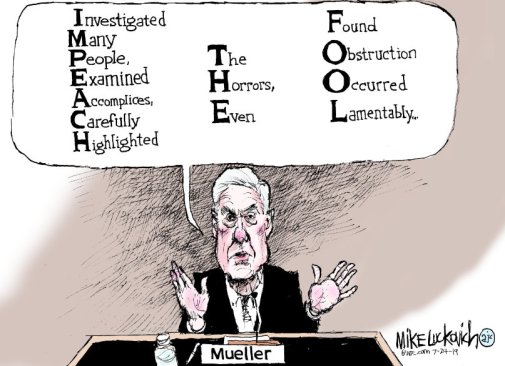
Good Afternoon!!
If Trump succeeds in destroying our democracy and becoming Hitler 2.0, the responsibility will be equally shared between the GOP and the U.S. political media. Yesterday Robert Mueller confirmed that Trump has committed high crimes and implied that Congress should impeach him. The media responded by reviewing the style and “optics” of his presentation, paying little attention to its content.
The ever-shallow Chuck Todd led the charge on Twitter. I won’t subject you to the video.
So-called leftist Michael Moore agreed with Todd.
The Columbia Journalism Review critiqued Chuck Todd’s remarks as well as those of other MSNBC hosts: MSNBC public editor: The Chuck Todd show.
Todd’s focus on the “entertainment” aspect of politics coverage is often in evidence—for example, in his own recent performance as moderator in the Democratic presidential debate. He managed to talk more than all but three of the candidates, even as he demanded that they keep their own answers brief….
For Chuck Todd all the political world’s a stage, and he’s the star….
And it’s not just Todd. Other MSNBC anchors reacted to the Mueller hearings similarly, finding fault with the Democrats’, and Mueller’s, lack of pizazz as performers. Brian Williams referred to “the caffeine gap” in the Judiciary Committee’s questioning. I can’t help pointing out that excessive concern with caffeinated pizzazz can warp a journalist’s judgement pretty severely, and is best avoided.
At a moment of particular gravity for the country, with the sitting president credibly accused of obstructing justice, and many of his campaign staff and associates under investigation and indictment, may I suggest that if you, a journalist, are bored with the politics of this—if you are demanding somehow to be entertained, right now—you’re not doing your job.
Politics isn’t entertainment, it is not a performance to be critiqued. Reporting on national politics is a public trust of solemn importance that affects hundreds of millions of people.
A sample of headlines from the “savvy” Washington press:
Peter Baker at The New York Times: The Blockbuster That Wasn’t: Mueller Disappoints the Democrats. [I skimmed the story, and could find no quotes from Democrats holding elected office. Several prominent experts were quoted arguing Mueller’s testimony was valuable.]
Sharon LaFraniere, Michael S. Schmidt, Noah Weiland and Adam Goldman at The New York Times: Mueller’s Labored Performance Was a Departure From His Once-Fabled Stamina.
Susan Glasser at The New Yorker: “Accountability”? The Mueller Hearing Is How Trump Escapes. [FYI: Susan Glasser is married to Peter Baker of the NYT.]
Some serious reactions to Mueller’s testimony:
Former Republican Jennifer Rubin: Mueller didn’t fail. The country did.
Being thousands of miles away from home in Portugal, a country that 45 years ago was in the grasp of a brutal dictatorship, gives me an interesting perspective on former special counsel Robert S. Mueller III’s Wednesday testimony and on the now nearly forgotten — was it only a week ago? — racist call for four nonwhite congresswomen to “go back” to where they came from.
Tom Toles Editorial Cartoon
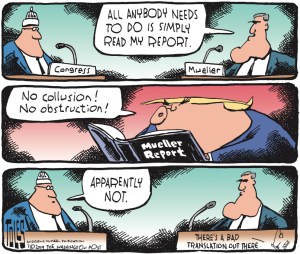
I worry that we — the media, voters, Congress — are dangerously unserious when it comes to preservation of our democracy. To spend hours of airtime and write hundreds of print and online reports pontificating about the “optics” of Mueller’s performance — when he confirmed that President Trump accepted help from a hostile foreign power and lied about it, that he lied when he claimed exoneration, that he was not completely truthful in written answers, that he could be prosecuted after leaving office and that he misled Americans by calling the investigation a hoax — tells me that we have become untrustworthy guardians of democracy.
The “failure” is not of a prosecutor who found the facts but might be ill equipped to make the political case, but instead, of a country that won’t read his report and a media obsessed with scoring contests rather than focusing on the damning facts at issue.
David Corn at Mother Jones: Mueller Reminds the Public: Trump Betrayed the United States.
There’s an old saying in newsrooms: News is stuff that people have forgotten. Robert Mueller’s dramatic appearance before the House Judiciary Committee on Wednesday morning was a striking reminder of this adage. The former special counsel did not drop any new revelations about the Trump-Russia affair. Yet in a simple but important manner, he reiterated the basics of this scandal—perhaps the most consequential political scandal in American history. These are the fundamentals that have often been subsumed by all the never-ending partisan squabbling and by the ongoing crusade mounted by Donald Trump and his defenders to distract from his perfidy. These are the facts that Trump has refused to acknowledge, and they are the facts that taint his presidency and undermine its legitimacy.
In his opening statement, Mueller emphasized the key finding from his report: “The Russian government interfered in our election in sweeping and systematic fashion.” And during the questioning, Mueller repeated the conclusion previously reached by the US intelligence community that Russia conducted this covert operation to help Trump get elected. “Did your investigation find that the Russian government perceived it would benefit from one of the candidates winning?” Mueller was asked by Rep. Zoe Lofgren (D-Calif.). He replied with one word: “Yes.” Lofgren followed up: “And which candidate would that be?” Mueller responded, “Well, it would be Trump.”
So Russia attacked an American election to help Trump. And what did Trump do? “The Trump campaign wasn’t exactly reluctant to take Russian help,” Lofgren remarked to Mueller. “You wrote it expected it would benefit electorally from information stolen and released through Russian efforts, isn’t that correct.”
Mueller answered with another brief sentence: “That’s correct.” That is, Trump sought to exploit a foreign adversary’s clandestine assault. And as Mueller noted in his report, during the campaign Trump dismissed the notion that Russia was intervening in the election, and after he was elected he continued to deny “that Russia aided his election.”
Click the link to read the rest.
David Graham at The Atlantic: The Most Revealing Exchange of the Mueller Hearing.
There’s a logical disconnect in volume 2 of Special Counsel Robert Mueller’s report that is unmissable to any careful reader.
As Mueller explains in the report, a charge of obstruction of justice requires three elements: an obstructive act, a nexus with an official proceeding, and corrupt intent. And in the report, Mueller’s team laid out several cases where President Donald Trump committed an obstructive act, in connection with an official proceeding, with what Mueller’s team concluded could be a corrupt intent.
But because Mueller had decided at the outset of his report that he could not and would not charge the president with crimes, thanks to Justice Department guidance and in the interest of fairness, Mueller did not make the otherwise obvious jump from laying out the ways that Trump’s behavior met the three-prong test to actually stating that Trump obstructed justice.
During today’s House Judiciary Committee hearing, Democratic Representative Hakeem Jeffries sought to demonstrate the disconnect by walking Mueller through the three-prong test.
“Let me refer you to page 87 and 88 of volume 2 where you conclude the attempt to remove the special counsel would qualify as an obstructive act if it would naturally obstruct the investigation and any grand-jury proceedings that might flow from the inquiry. Correct?” Jeffries asked.
“Yes,” Mueller said, confirming the obstructive act.
“Yes,” Mueller said, confirming the obstructive act.
“Your report found on page 89, volume 2, that substantial evidence indicates that by June 17, the president knew his conduct was under investigation by a federal prosecutor who would present any evidence of federal crimes to a grand jury. True?” Jeffries asked.
“True,” Mueller said, confirming the nexus to an official proceeding.
Jeffries then moved on to the third element, corrupt intent, and Mueller once again effectively affirmed the point:
Jeffries: Is it fair to say the president viewed the special counsel’s investigation as adverse to his own interest?
Mueller: I think that generally is true.
Jeffries: The investigation found evidence, quote, “that the president knew that he should not have directed Don McGahn to fire the special counsel.” Correct?
Mueller: Where do you have that quote?
Jeffries: Page 90, volume 2. “There’s evidence that the president knew he should not have made those calls to McGahn,” closed quote.
Mueller: I see that. Yes, that’s accurate.
Mueller, seeing the trick, tried to cut it off. “Let me just say, if I might, I don’t subscribe necessarily to your—the way you analyzed that. I’m not saying it’s out of the ballpark, but I’m not supportive of that analytical charge,” he said.
Graham writes that Mueller tried to backtrack, but the cat was out of the bag. Ted Lieu did something similar; head over the The Atlantic to read more.
This piece by Jonathan Bernstein at Bloomberg is worth a read: Worst Part of the Mueller Hearings? Republican Conspiracy Theories.
Instead of reading carefully into the evidence and finding contradictions or loose ends, House Republicans largely busied themselves with conspiracy theories. It wasn’t Donald Trump and his campaign who welcomed and benefited from Russian interference in the 2016 election; it was Hillary Clinton! Never mind what U.S. intelligence agencies and Senate investigators have concluded. Never mind that this reality-denying line of inquiry left lawmakers defending Wikileaks and even, seemingly, the Russian agents indicted by Mueller.
For these Republicans, it’s still supposedly inexplicable that the FBI started investigating in the first place. In their stated conception of things, only partisanship and hatred of the president could explain such an otherwise odd decision to look into the rich web of shady contacts between the Trump campaign and Russians. And yet those partisan and hateful investigators didn’t leak anything about the probe when it would’ve put Trump’s election in jeopardy; didn’t indict or recommend impeachment of the president; and didn’t rush to testify to Congress about any of it.
Meanwhile, with the notable exception of Texas Representative Will Hurd, Republicans showed no interest at all in the national-security implications of Russia’s interference. And remember, Senate Majority Leader Mitch McConnell is still blocking bipartisan legislation to strengthen U.S. defenses against future attacks.
These are the same Republicans, after all, who spent years looking into conspiracy theories about the deaths of Americans in Benghazi in 2012 without ever attending to the real security vulnerabilities that contributed to them. It was far more important to feed the Republican marketplace with loony ideas about how President Barack Obama (or Hillary Clinton) actively welcomed the disaster than to figure out what had actually gone wrong or what to do about it.
I’ll end with this tweet from the woman who should be president, written after Trump’s latest Nazi/KKK rally.
Thursday Reads
Posted: July 18, 2019 Filed under: morning reads, U.S. Politics | Tags: Bill Barr, Donald Trump, fascism, Ilhan Omar, impeachment, Jeffrey Epstein, Judge William H. Pauley, Michael Cohen, Nancy Pelosi, Rachel Maddow, Trump Nazi/KKK rally 29 CommentsGood Morning!!
 It appears that Cover-Up General Bill Barr has struck again. He apparently ordered the Southern District of New York to end their investigation of campaign finance violations by Michael Cohen and Individual 1 (AKA Donald Trump).
The Washington Post: Prosecutors have ‘concluded’ Michael Cohen campaign finance probe, judge says.
Federal prosecutors have concluded the campaign finance investigation centered on President Trump’s former personal attorney Michael Cohen, or at least key aspects of it, a federal judge overseeing the case wrote Wednesday, suggesting prosecutors will not charge executives in the Trump Organization or any others who have been linked to the matter.
The good news is that Judge William H. Pauley ordered the public release of search warrants and other documents related to the case. Prosecutors asked Pauley to allow some redactions of the materials, but the judge said no dice. The materials should be available sometime this morning.
He [Pauley] wrote that the government disclosed in a secret filing Monday that it had “concluded the aspects of its investigation that justified the continued sealing of the portions of the Materials relating to Cohen’s campaign finance violations.” He rejected their request to file the materials with redactions to protect “third-party privacy interests,” because, by his telling, the case is over and the public deserves to see everything.
“The campaign finance violations discussed in the Materials are a matter of national importance,” Pauley wrote. “Now that the Government’s investigation into those violations has concluded, it is time that every American has an opportunity to scrutinize the Materials.”
So Barr has made sure that the Trump Organization will no longer be in danger of prosecution. Will the investigations into Trump’s inauguration be axed next?
Rachel Maddow talked about this last night.
Folks, this is getting scarier with every passing day. Trump now controls the Department of Justice and apparently can order investigations stopped or opened. Republicans control the Senate, so nothing the Democrats pass will even be considered there, including impeachment. The only protection we have left is the courts, and Trump and the GOP are working overtime to stock them with Trump judges.
Last night Trump held another Nazi/KKK rally in North Carolina, during which he attacked has latest target Minnesota Rep. Ilhan Omar and encouraged the crowd as they screamed “send her back!”
And in case you thought Trump was ad libbing, here’s the proof that the attack was orchestrated.
From The Charlotte Observer editorial board: ’Send her back’: A dark reminder of who we are.
It happened in the first half of Wednesday’s speech. Donald Trump, our president, began to talk about Rep. Ilhan Omar, a Democratic from Minnesota who was among the four women of color he had attacked Sunday in a racist tweet. Everyone knew Trump would speak about the women at some point to the Greenville, North Carolina crowd. Did we know what would come next?
“Send her back.”
The chant rose quickly from a handful of voices to a chorus of bigotry. It was a chilling moment. It was “lock her up” in a white hood. It was despicable.
It could have happened at any Donald Trump rally. It might have happened in any state, north or south. But it happened in Greenville, in our state, and it was one of North Carolina’s darkest moments.
“Send her back.”
Or perhaps not. Maybe the chant will be absorbed in the vortex that is Donald Trump. In a presidency of so many shameful moments, of so many new lows, the singularly awful ones tend to lose their significance. It’s possible that North Carolina might be forgotten when the chant inevitably spreads to the next rally. But North Carolina shouldn’t forget.
The Associated Press: Trump leans on issue of race in bid for a 2nd term in 2020.
President Donald Trump has placed racial animus at the center of his reelection campaign, and even some of his critics believe it could deliver him a second term.
Every successful modern presidential campaign has been built on the notion of addition, winning over voters beyond core supporters. But Trump has chosen division on the belief that the polarized country he leads will simply choose sides over issues like race.
He intensified his attacks on Wednesday, blasting four young congresswomen of color during a rally in Greenville, North Carolina . The crowd responded by chanting, “Send her back!” echoing Trump’s weekend tweet in which he said the lawmakers, all American citizens, should “go back” to the countries from which they came.
“I do think I am winning the political fight,” Trump declared at the White House. “I think I am winning it by a lot.”
Not since George Wallace’s campaign in 1968 has a presidential candidate — and certainly not an incumbent president — put racial polarization at the center of his call to voters. Though Trump’s comments generated outrage and even a resolution of condemnation in the House, the president and his campaign believe the strategy carries far more benefits than risks.
The Irish Times: Fintan O’Toole: Trial runs for fascism are in full flow.
To grasp what is going on in the world right now, we need to reflect on two things. One is that we are in a phase of trial runs. The other is that what is being trialled is fascism – a word that should be used carefully but not shirked when it is so clearly on the horizon. Forget “post-fascist” – what we are living with is pre-fascism.
It is easy to dismiss Donald Trump as an ignoramus, not least because he is. But he has an acute understanding of one thing: test marketing. He created himself in the gossip pages of the New York tabloids, where celebrity is manufactured by planting outrageous stories that you can later confirm or deny depending on how they go down. And he recreated himself in reality TV where the storylines can be adjusted according to the ratings. Put something out there, pull it back, adjust, go again.
Fascism doesn’t arise suddenly in an existing democracy. It is not easy to get people to give up their ideas of freedom and civility. You have to do trial runs that, if they are done well, serve two purposes. They get people used to something they may initially recoil from; and they allow you to refine and calibrate. This is what is happening now and we would be fools not to see it.
 One of the basic tools of fascism is the rigging of elections – we’ve seen that trialled in the election of Trump, in the Brexit referendum and (less successfully) in the French presidential elections. Another is the generation of tribal identities, the division of society into mutually exclusive polarities. Fascism does not need a majority – it typically comes to power with about 40 per cent support and then uses control and intimidation to consolidate that power. So it doesn’t matter if most people hate you, as long as your 40 per cent is fanatically committed. That’s been tested out too. And fascism of course needs a propaganda machine so effective that it creates for its followers a universe of “alternative facts” impervious to unwanted realities. Again, the testing for this is very far advanced.
Read the rest at the link above.
Last night Trump also celebrated a meaningless vote in the house about impeachment. Politico suggests that he might actually think the vote has ended the threat.
IT BARELY TOOK THE PRESIDENT ANY TIME before he said this Wednesday evening at his campaign rally in Greenville, N.C.: “I just heard that the United States House of Representatives has overwhelmingly voted to kill the most ridiculous project I’ve ever been involved in: the resolution — how stupid is that — on impeachment. I want to thank those Democrats because many of them voted for us, the vote was a totally lopsided 332-95-1.” … Upon arriving in North Carolina, President Donald Trump said the same thing: “We have just received an overwhelming vote against impeachment. And that’s the end of it. Let the Democrats now go back to work….
a few smart, seasoned people in the White House wondered to us Wednesday night if TRUMP actually believes this vote ended impeachment. Of course, it didn’t. This was a procedural vote that means nothing in the grand scheme of things. There are still nearly 90 Democrats who are now on record supporting an impeachment inquiry, and ROBERT MUELLER is coming to the Hill next week. There are Democrats who believe the impeachment caucus will swell as soon as he opens his mouth.
At Bloomberg, Jonathan Bernstein writes: That Strange Impeachment Vote? It May Be a Big Deal.
Inflaming the base: July 16, 2019
Representative Al Green, a Democrat from Texas, has regularly introduced articles of impeachment against President Donald Trump. Usually, when a regular bill or resolution has been introduced, it’s then referred to committee. If the majority party doesn’t want to consider the bill, it will die with no further action. Under House rules, however, any member can force an impeachment resolution onto the floor as pending business. That’s what Green did Wednesday.
This maneuver doesn’t mean that impeachment gets a final vote, or even debate. What it does get is a “motion to table,” which means that lawmakers can vote to either keep the resolution as pending business or kill it off. When Green did this in 2017, 58 Democrats voted to keep the impeachment measure alive. In 2018, 66 did so. This time, it was up to 95.
Of course, there are more Democrats in the current Congress than in the previous one. And we can’t assume that all the votes to table were necessarily votes against impeachment (pro-impeachment independent Justin Amash voted to table, for instance). Some legislators may have objected to bringing the resolution straight to the floor on procedural grounds, or thought that Green’s articles were poorly drafted. Still, the vote offers a decent proxy for where impeachment sentiment stands in the House: It divides Democrats and unites Republicans in opposition. For now.
What I found interesting was that House Speaker Nancy Pelosi, who has said she opposes impeachment, apparently didn’t whip the vote. If that’s the case, what does it say about her real position? One interpretation is that she simply wanted to mollify pro-impeachment Democrats by giving them an easy opportunity to express their views. Another is that Pelosi isn’t as opposed to impeachment as she has let on, and was using this vote to gauge sentiment within the caucus – or even to demonstrate that support for ousting the president is growing.

(Emphasis added.)
 I’ll end with this breaking news from The Miami Herald: Judge keeps Jeffrey Epstein in N.Y. jail as prosecutors build on sex trafficking case.
Wealthy sex offender Jeffrey Epstein will have to wait out a sex trafficking trial from a jail cell after a federal judge in New York ruled Thursday against his request for release on bail.
Epstein, 66, had offered to put up any collateral the judge wished from his self-estimated $559 million fortune. He said he would live in isolation in his Manhattan mansion, and pay for private security to ensure he remains inside and that no one enters unless authorized by the courts.
But with prosecutors warning that Epstein could easily flee or attempt to interfere with their witnesses, Senior U.S. District Judge Richard Berman has ordered that Epstein remain at the Manhattan Correctional Institute as the U.S. Attorney for the Southern District of New York seeks his conviction on child sex trafficking and conspiracy charges. Berman, according to reporters covering the hearing in New York, cited concerns that Epstein is a “danger” to others.
Berman’s ruling is a major victory for Epstein’s accusers, who have grown by the dozens since he was first investigated on trafficking allegations in South Florida more than a dozen years ago. The wealthy financier was first arrested in Palm Beach County in the mid-2000s after police began to suspect that he was abusing underage girls.
I’ll post anything I find about the release of Cohen materials from SDNY. What stories are you following today?
Impeachment Monday Reads
Posted: June 17, 2019 Filed under: 2020 Elections, Donald Trump, morning reads, Nancy Pelosi | Tags: impeachment 21 Comments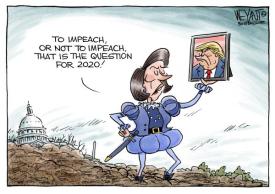 Good Morning Sky Dancers!
I guess now’s as good as any time to discuss the roadmap to impeachment. I don’t know about you but I’m more than ready to start the roadtrip. Let’s start with moving forward by looking back with The New Republic’s Matt Ford and his interview with an assistant to the Judge that decided that sitting presidents can’t be indicted while said Judge was writing the memo.
It’s a weird story that Rachel Maddow has covered because it links directly to Spiro Agnew. Her podcast, Bag Man, took on the legacy of Agnew and how his criminality impacted the approach to Nixon‘s removal. So, why can’t sitting presidents be indicted? Why can’t we just lock him up instead of letting him rot out here with unidicted co-conspirator status? Should we revisit the Dixon memo?
Robert Mueller made a surprising assertion last month about the limits of his power. In his report on Russia’s interference in the 2016 election and President Trump’s potential obstruction of the investigation, the special counsel explained that Justice Department policy effectively prevented him from charging Trump with a crime while in office. But in his surprise press conference in May, he went even further. “[The report] explains that under long-standing department policy, a president cannot be charged with a federal crime while he is in office,” he said. “That is unconstitutional. Even if the charge is kept under seal and hidden from public view—that too is prohibited.”
This remains an open legal question, despite Mueller’s unequivocal assertion. The Constitution itself is silent on the matter, and no court has ever ruled otherwise because no sitting president has ever been indicted. Mueller’s nod to “long-standing department policy” likely was a reference to the so-called Dixon memo, a 1973 Office of Legal Counsel opinion in which Assistant Attorney General Robert Dixon concluded that there were multiple practical and constitutional hurdles that made it effectively impossible. “The spectacle of an indicted president still trying to serve as chief president boggles the imagination,” Dixon wrote.
That memo’s primary purpose, however, was not to conclusively decide whether a president could be indicted while in office. While it’s commonly assumed that the memo came about during the Watergate scandal, it instead sprang from the Justice Department’s efforts to prosecute Vice President Spiro Agnew in a tax-evasion case. Agnew argued that he was only subject to impeachment by Congress, and Attorney General Elliot Richardson asked Dixon to write an opinion on the question.
To understand the Dixon memo’s unusual origins and its continuing impact, I spoke with J. T. Smith, an attorney who worked as Richardson’s executive assistant during the Watergate scandal. Smith was present at the creation, so to speak, of the Justice Department’s policy on indicting a sitting president. He told me that if Richardson “had the benefit or detriment we have of the behavior of this particular White House, he almost certainly would say it’s high time this whole matter get revisited.”
 The Dixon memo was FOIA’d last year. Here’s a link to the memo itself along with the letter acknowledging the FOIA request. So here’s the Judge’s assistant’s direct response to if the Dixon Memo should be revisited.
Did you happen to see Mueller’s press conference the other day, where he said outright that it would be unconstitutional to indict a sitting president?
I saw that, and I’m not clear why he said it. It’s one thing to say that it is Justice Department policy, long standing, that a sitting president should not be subject to criminal process, but he sort of surprised me when he characterized it as being unconstitutional. Because the Dixon memo of 1973, I think, ends up on grounds that are policy-based more than Constitution-based, and indeed, the Dixon memo says that the Constitution doesn’t squarely address the topic.
 This bit of wiggle has allowed Trump and his current AG to say, basically, nothing to see here when there is plenty to read there if any one would take the time to read the Mueller Report or listen to the folks that have.
Nancy Pelosi “is putting up guardrails” if you believe the analysis at WAPO by Amber Phillips.
As leader of the House of Representatives, she has quite a bit of sway. She is the top elected Democrat in Washington. And she decides what bills her chamber votes on. The lawmakers in the House and Senate actually running for president — 11 in all — just get to vote.
So it’s notable that under her leadership, the House hasn’t voted on any big-government policy package championed by the Bernie Sanderses and Elizabeth Warrens of the world.
In May, the House voted on seven health-care bills designed to bandage Obamacare now that the Trump administration is trying to kill it by a thousand cuts. Not a single one of those bills would establish universal health care, even though Medicare-for-all is a defining policy debate of the 2020 presidential primary. Five of the seven senators running for president support a Medicare-for-all bill.
She also hasn’t allowed a vote on the Green New Deal, a plan to tackle climate change with Roosevelt-era-style government-funded jobs, despite the fact that many 2020 candidates support some aspect of the plan. And she’s held off her party from taking the first steps to impeach President Trump even though 67 House Democrats — and a number of presidential candidates — want to.
Pelosi’s logic is simple. She’s not thinking about the Democratic primary.
She believes the battle for her House and the White House next November will be waged in communities that voted for President Trump in 2016 such as in Rep. Elise Slotkin’s Lansing, Mich., district or in Georgia where Rep. Lucy McBath got narrowly elected last year or in Iowa, where Rep. Abby Finkenauer is campaigning to stay elected after knocking off a Republican member of Congress. All three represent districts that voted for Trump in 2016 in states Trump won. None of them support impeachment of Trump.
 You can tell all of this talk of impeachment is getting to Trump. His tweets over the weekend were some of his most unhinged screeds to date. He also spoke to the many reporters questioning him on the topic.
The ABC interview with Stephanopolous was shown in Full on Sunday and Trump’s state of mind was on full display. His usual “no collusion, witchhunt” rant seemed particularly hollow this weekend. He’s fired a group of his pollsters and is undoubtedly flipping out about the latest poll showing the public’s move Impeachment Inquiry Curious. This is from The Hill.
The report cited more than 100 contacts between the Trump campaign and Russia but said there was insufficient evidence to conclude there was a conspiracy. Investigators also did not make a determination on whether Trump obstructed justice, with Mueller saying it was because a sitting president cannot be prosecuted.
In the same interview, Trump waved off a letter in which more than 1,000 federal prosecutors said he would have been indicted for obstruction were he not a sitting president, saying the signatories were “politicians” and “Trump haters.”
His interview was broadcast as a poll from NBC News and The Wall Street Journal found that support for impeachment hearings had increased 10 points since May, to 27 percent. The increase was largely driven by Democrats, 48 percent of whom now favor impeachment, up 18 points from last month.
The new poll found that the number of Americans who believe Congress should continue to investigate whether there is sufficient evidence to hold impeachment hearings fell 8 points to 24 percent.
A Fox News poll released Sunday, meanwhile, found that that 50 percent of respondents said they believe the Trump campaign coordinated with Russia, up 6 points from March. Forty-four percent of respondents said they don’t believe there was collusion.
Half of that poll’s respondents favored impeachment, with 43 percent supporting impeaching and removing Trump — a 1-point increase from March — and 7 percent endorsing impeachment but not removal, compared to 48 percent who opposed impeachment. The same survey found that 56 percent of respondents said it was “not at all” likely that Trump will eventually be impeached.
The surveys come amid increasing chagrin from the progressive wing of the Democratic Party over Speaker Nancy Pelosi’s (D-Calif.) hard line against impeachment proceedings.
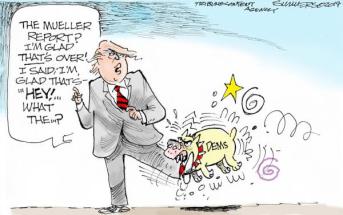
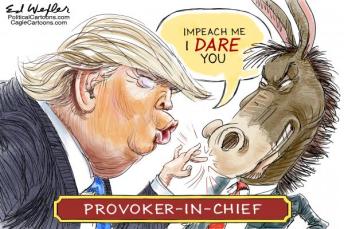 Heather Cox Richardson–writing for The Guardian–makes “The historical argument for impeaching Trump.” It’s a run down of all the times Republic Presidents pushed the envelope on the imperial presidency.
The question of impeaching Donald Trump is about replacing the toxic partisanship of today’s Republican party with America’s traditional rule of law. It has become a constitutional imperative.
Since Richard Nixon, Republican presidents have pushed the envelope of acceptable behavior under the guise of patriotism, and Democrats have permitted their encroaching lawlessness on the grounds of civility, constantly convincing themselves that Republicans have reached a limit beyond which they won’t go. Each time they’ve been proven wrong.
Nixon resigned in 1974 because his attempts to cover up his involvement in the Watergate burglary made his obstruction of justice clear. Republican leaders warned Nixon that if the House of Representatives impeached him, the Senate would convict. Republican congressmen of the time believed in the rule of law.
Gerald Ford’s subsequent pardon of Nixon was perhaps given in that spirit: when the law rules, it permits mercy. But the absence of a humiliating public exposure of Nixon’s participation in Watergate, and the lack of a permanent bipartisan condemnation, gave Nixon loyalists cover to argue that he wasn’t guilty of crimes. Instead they claimed Nixon had been hounded out of office by outlandish liberals determined to undermine him and the country.
Ever since, Republican extremists have employed this rhetoric whenever they break the law or erode constitutional norms.
When Ronald Reagan’s administration was exposed for having illegally sold arms to Iran to raise money covertly for the Contra rebels fighting the Nicaraguan government, Reagan acknowledged that the evidence was damning – yet defended the principle behind the scheme. Reagan’s successor, George HW Bush, pardoned the six leading figures of the Iran-Contra affair because, he said, “whether their actions were right or wrong”, they were motivated by “patriotism”. The investigation into their actions was “a criminalization of party differences”.
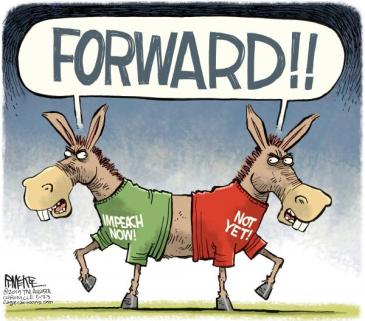 Quite a rundown, isn’t it? Well, put that in light of the Trumpian window.
The same Republicans who had threatened to impeach Hillary Clinton remained silent when, immediately after his surprise victory, Trump refused to abide by laws about emoluments or nepotism, openly profiting from the presidency and filling the White House with personal relatives. They continued to remain silent when Trump fired the FBI director, James Comey, who was investigating Russian interference in the 2016 election, then pointedly pardoned Scooter Libby, saying he was “treated unfairly”. They did not protest in February 2019 when the Trump administration openly defied the law by refusing to give Congress a required report on Saudi involvement in the murder of journalist Jamal Khashoggi.
By May of this year the White House was refusing to honor any congressional subpoenas on the grounds that “it’s very partisan – obviously very partisan”, as Trump told the Washington Post.
When the House committee on ways and means demanded Trump’s tax returns under a law that leaves no wiggle room, Steven Mnuchin, the treasury secretary, nonetheless refused to deliver them, saying he saw no “legitimate legislative purpose” for such a request. An attempt by the executive branch to dictate to the legislative branch, the only branch of the American government that has the unilateral power to make law, is shocking, but Republicans stayed quiet. They also stayed quiet when Trump used declarations of national emergency to override laws passed by Congress, and on Monday the Trump White House asserted in court that Congress had no authority to determine whether the president has committed crimes.
Yet only one congressional Republican – Michigan’s Justin Amash – has called for impeachment.
Special counsel Robert Mueller, investigating Russian interference in the 2016 election, provided ample evidence that the president should be investigated for obstruction of justice in his attempt to quell the Russia investigation by firing Comey and urging aides to lie. At the same time, Mueller reminded Americans that the constitution charges Congress with presidential oversight. Indeed, under current Department of Justice policy, a sitting president cannot be indicted; congressional oversight is the only way to rein in a lawless president.
It’s a long, thoughtful essay. You should read it all. Yes, one Republican has called for impeachment still and yes, there’s that pesky Dixon Memo again.
But back home in Michigan, many people who know Amash say they’re not surprised at all by his willingness to go against his own party — even if that decision costs him his seat in Congress.
“Five-year-old Justin Amash was a lot like 39-year-old Justin Amash is like,” says Jordan Bush, who first met Amash when they were in kindergarten.
Bush says Amash is diligent and intentional. Someone who doesn’t bend his principles.
Other longtime friends echo similar sentiments. In high school, Amash became known for always finishing his homework, even if it meant his friends had to wait to hang out. Amash eventually went on to become valedictorian.
Amash’s parents are both immigrants. His mother is originally from Syria. His father, Attallah, came to the United States in 1956 as a Christian refugee from Palestine.
“Justin just always had a keen sense of what was at stake in terms of what governments do or don’t do, how much they interfere, how much they limit themselves,” says Jessica Bratt Carle, who got to know Amash in high school.
By the time Bratt Carle and Bush got to know the Amash family, they had built a successful family business, which they still own.
“I think a lot of that work ethic,” Bush says, “largely comes from his father.”
When Justin Amash got elected to Congress, Bush served in his district office. He says he saw the same person there that he did in kindergarten.
“Justin is the least surprising representative in Congress once you have an understanding of how he views his role,” Bush says.
That role, according to Bush, is to uphold the Constitution and protect individual liberty.
Amash is known as one of the more libertarian members of Congress. Some have speculated Amash could even dump the Republican Party to run as the presidential candidate for the Libertarian Party. Amash has not ruled out that move.
But for now, he remains in the Republican Party, despite his many disagreements with party leadership.
When the 448-page report by former special counsel Robert Mueller was released to the public in April, Amash initially gave no comment. He posted on Twitter that he would read the report “carefully and completely” before saying anything.
And for nearly a month, Amash said nothing.
Then, in a string of tweets posted on May 18, Amash gave his conclusions from the report.
He said the report showed President Trump engaged in impeachable conduct and that Attorney General William Barr intentionally misled people about what’s in the report.
So, if you’d like cunning political commentary and a laugh to cheer you up then you should watch John Oliver whose commentary includes that impeachment talk is “effective hospice care” when a family with a father who died peacefully once they told him he Trump was impeached. But, there’s more than that … watch the clever comedian talk about Nancy Pelosi too.
With a national conversation underway about the possibility of impeachment, John Oliver discusses whether the benefits outweigh the potential risks.
And believe me, we all could use a good laugh at Trump’s expense in these times.
Impeachment in no way Guarantees the removal of a President.
With that, I’ll leave you to think on it and discuss. What’s on your reading and blogging list today?

 peej
peej Carissa
 bostonboomer
 dakinikat
 ecocatwoman
 mablue2
 Mama Lopez
 peggysue22
 quixote
 skydancingguestblogger
 Mona (aka Wonk the Vote)



 Sky Dancing
Recent Comments