It’s Friday, and I’m filling in for Dakinikat. I had another one of my sleepless nights last night, so please forgive me if this post is a little weird.
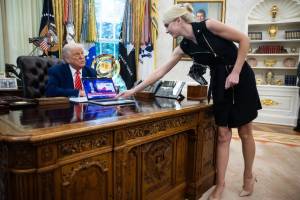
I know this isn’t politically correct, but I’ve always thought that Trump was a bit effeminate–in his looks and his behavior. How many “manly men” are obsessed with interior decoration even in the middle of a war?
Not to mention that he’s in an apparently loveless marriage. His wife doesn’t sleep with him or even live with him, and reportedly has to be paid to appear in public with him. Maybe Melania is just a beard.
President Trump delights in playing what he calls “the gay national anthem” whenever he wants to rev up a crowd. He’s obsessed with Elton John, was once friendly with Liza Minnelli, and has a Liberace-esque flair for gilded interiors. One of his favorite sports to watch—mixed martial arts—is basically sweaty, semi-naked dudes. And he is a deep and vocal admirer of the physique of fellow men, often announcing which ones he would cast in a movie: “They’re perfect specimens,” he said last year of the military pilots who had visited him in the Oval Office; “He looks like the Marlboro Man,” he cooed about a former Iowa state senator; “Young, handsome guy. It’s always nice to be young and handsome,” he complimented the president of Paraguay.
Some of Trump’s allies note that years before gay marriage was legalized, Trump had gay friends, took pro-gay stances, and allowed gay people to join his private club in Palm Beach starting in the mid-1990s. Ric Grenell became the first openly gay person to hold a Cabinet position when Trump appointed him acting director of national intelligence. Grenell, who is now the president’s envoy for special missions, once called Trump “the most pro-gay president in American history,” a title that Trump said he was honored to have.
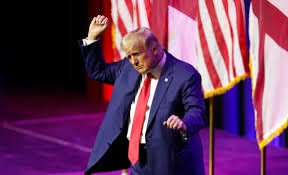
Trump “dancing” to YMCA.
To be clear: Trump says he is attracted only to women and, in fact, has been married to three of them. He once hosted the Miss Universe pageant, was caught on tape saying that he loves to grab women “by the pussy,” and was found civilly liable for sexually abusing a woman. Loads more have accused him of sexual misconduct. (Trump has denied the accusations.) “Women—I like. Men—no, I don’t have any interest,” Trump affirmed at a Board of Peace meeting earlier this year.
But there’s also little doubt that Trump has unabashedly embraced the aesthetic—the je ne sais quoi—of a certain kind of gay man. Some who are sympathetic to the president have gone even further. Blaze Media, a conservative outlet started by the talk-radio host Glenn Beck, ran a story in 2024 headlined “Donald Trump: Our First Gay President,” much in the way people talked about Bill Clinton as having been the first Black one. The story notes, in a section titled “Queen of Queens”: “He blows kisses to Hulk Hogan, weighs in on Fashion Week (‘used to be so glamorous and exciting! No stars, no fun—just boring’), and his rivalry with lesbian Rosie O’Donnell remains a gem of the catty naughties social feuds.” Pod Save America, a liberal podcast started by former aides to President Obama, declared that Trump would be a gay icon, if only he had “liberal social values.” The president, the episode’s title observes, “DEMANDS a Ballroom at the White House, Loves Musicals, & Wears Make-up.”
James Kirchick, the author of Secret City: The Hidden History of Gay Washington, told me that Trump’s personal story, a guy from Queens making it big in Manhattan, tracks with the “typical gay story” of men of his era. In another life, he continued, the 79-year-old could be a classic aging gay, “living in Wilton Manors, sitting at a bar, making bitchy comments to everyone who comes in.” (Of course, Trump’s perch from the Oval Office confers much more power than a bar stool does, and his comments have moved markets and sent allies reeling.) “It’s a gay man frozen in amber in the late 1970s and early 1980s, before AIDS,” Kirchick said, referring to the type of gay man he believes Trump would embody. “It’s a certain age and a certain era. It’s very campy.”
The comedian and podcaster Caleb Hearon deemed Trump to be of the “old-school-gay” era, “because, you know, gay guys used to be mean before media training,” he said in an interview with Ziwe Fumudoh on her YouTube comedy show. The president, Hearon continued, should have become “a red-carpet fashion adviser,” the sort who would say things like: “That dress, honey. I don’t think so!” “That would have been amazing. I would have watched every night,” he said. “Instead, he ran for office on a platform of mass deportation, so that’s where things got tricky, obviously.”
A little bit more:
Trump’s continued patter about men’s bodies has also drawn attention. As my colleague Marie-Rose Sheinerman and I dug into examples of these corporeal appraisals, we were surprised by their sheer quantity and just how much Trump seems to delight in complimenting other men. He has given the compliment of “handsome” at least 68 times so far in his second term—or 69 times, if we count the two Thanksgiving turkeys he also collectively described as such. He is unapologetic in his preference for Cabinet members and administration officials who seem to come out of “central casting”; he praised Treasury Secretary Scott Bessent, who is gay, for his Hollywood-worthy bona fides, before appreciatively noting that “under that beautiful exterior is a killer.”
He can almost never resist commenting on the physique of brawny men: “Look at the muscles on this guy!” he said, gazing upon a young cadet while delivering the commencement address at the U.S. Coast Guard Academy last week. Two days later, he took pains to praise the New York Giants quarterback Jaxson Dart, calling him a “beautiful guy” and waxing poetic about his “legs like tree trunks.” And speaking about the golfer Arnold Palmer in 2024, Trump managed to both reassert his preference for women while also remarking on the legend’s masculinity: “I love women, but this guy—this guy—this is a guy that was all man.” (He also noted Palmer’s powerful swing with “stiff-shafted clubs,” and his, um, alleged other assets: “When he took showers with the other pros, they came out of there—they said, Oh my God, that’s unbelievable.”)
I wonder if Trump would have acted on his attraction to men if he had grown up in a less repressed era? Check this out:
Paul Baker, the author of Camp!: The Story of the Attitude That Conquered the World, told me over email that when it comes to Trump, making the distinction between camp and campy is important. The latter is the more self-conscious, ironic adoption of camp. But Trump is “the original, pure form—it’s when someone’s behaviour is outrageous, excessive, subversive and unintentionally funny,” he said. “The person doesn’t realise they’re funny or that they’re camp. They’re just being themselves.”
OK, I’d better not quote any more of that article.
In the 2016 presidential contest, there has been one thing that supporters and detractors of Donald Trump have agreed on. The chest-pounding real estate mogul from New York has emerged as the quintessentially masculine candidate. Love him or loathe him, Trump’s campaign has been defined by the ways he has asserted his maleness—mocking his opponents for their low energy, bullying his critics, sneering at perceived weakness, boasting of his sexual prowess, vowing to hit back twice as hard as he’s been hit.
But academic research has picked up something that thousands of hours of campaign punditry has missed completely: Donald Trump talks like a woman. He might be preoccupied with grading women’s looks, penis size and “locker room talk,” but the way he speaks and the actual words he uses make for a distinctly feminine style. In fact, his speaking style is more feminine by far than any other candidate in the 2016 cycle, more feminine than any other presidential candidate since 2004.
More than just a comical curiosity, this fact about Trump’s mode of communication might help explain how a candidate who has been so extensively rebuked for his mean-spirited attacks on immigrants, women, the disabled and even prisoners of war has managed to attract support from millions of voters who adore the way he says openly what they feel. To some, Trump’s ascent is evidence that society still prizes the masculine over the feminine, but what’s happening is more complex, and Trump’s style has qualities that go beyond mere blustery aggression. Research has shown that the more feminine a speaker’s style, the more likable and trustworthy he seems. For Trump, who has been derided for his multiple contradictions and outright lies, that advantage might well have persuaded his supporters to listen to him and not the chorus of media fact checkers.
It’s not just a lazy stereotype that men and women speak differently. In fact, researchers who have sifted through thousands of language samples from men and women have identified clear statistical differences. Some of these differences are exactly what you’d expect—men are more likely to swear and use words that signal aggression, while women are more likely to use tentative language (words like maybe, seems or perhaps) and emotion-laden words (beautiful, despise). But other patterns are far from obvious. For example, contrary to the common stereotype that men can’t resist talking about themselves, women are heavier users than men of the pronoun “I” whereas the reverse is true for the pronoun “we”; women produce more common verbs (are, start, went) and auxiliary verbs (am, don’t,will), while men utter more articles (a, the) and prepositions (to, with, above); women use fewer long words than men when speaking or writing across a broad range of contexts.
Jennifer Jones, a doctoral candidate of political psychology at the University of California at Irvine, has combined these statistics into an index capturing the ratio of “feminine” to “masculine” words, and applied it to the language of 35 political candidates over the past decade. Hillary Clinton’s language falls above the average on this index—more feminine than George W. Bush’s, but less so than Barack Obama’s.
But Donald Trump is a stunning outlier. His linguistic style is startlingly feminine, so much so that the chasm between Trump and the next most feminine speaker, Ben Carson, is about as great as the difference between Carson and the least feminine candidate, Jim Webb. And Trump earns his ranking not just because he talks a lot about himself or avoids big words (both of which are true); according to Jones, he also shows feminine patterns on the more subtle measures, such as his use of prepositions and articles. The key then is not what Trump talks about—making Mexico pay for the wall or bombing the hell out of ISIL—but rather how he says it.
There’s much more at the Politico link.
Here we are in the middle of a war that Trump started, and he seems much more interested in his decorating projects than what is going on in his conflict in the Middle East. Some examples:
President Donald Trump has made little secret that his planned White House ballroom is a top priority, invoking the project more frequently than most other issues. And in recent weeks he has raged at anyone — including a federal judge, a Senate official and a local historian — whose actions threaten to slow construction.
On Monday, the president shared on social media a copy of a legal filing that closely resembled his own words and contended that the weekend’s shooting outside the White House campus proved the need for a ballroom.
Trump at the ballroom construction site.
“Without the construction of this great Project, the President cannot safely conduct the business of the United States,” acting attorney general Todd Blanche and two other senior Justice Department officials lawyers wrote, urging a federal judge to dissolve his order that could soon halt construction. “This is a terrible, tremendously harmful case to the United States of America, and all it stands for!”
The filing also mocked the National Trust for Historic Preservation, which has sued to halt the project, claiming that the group had been “defunded by Congress due to a total lack of respect for them.” Trump posted all six pages of the filing on his Truth Social platform.
Trump’s ballroom project has embodied executive power and its limitations.
The president was able to rapidly bulldoze the East Wing last year, clearing space for his planned 90,000-square-foot addition.Trump has remade independent federalcommissions — firing holdovers and installing loyalists, including his executive assistant — that have swiftly approved his project.He’s raised vast sums of money that he says can be put toward the ballroom’s estimated $400 million cost.
But so far,he has been constrained — barely — by the courts and Congress.
And it’s obvious that the ballroom means much more to him than the war or the struggling US economy.
House Democrats are set to introduce legislation aimed at blocking the construction of President Donald Trump’s planned 250-ft triumphal arch nearby Arlington National Cemetery.
“Trump’s vanity project would waste taxpayer money, brazenly violate existing law, and become yet another vehicle for his corruption,” Rep. Don Beyer of Virginia said in a statement Wednesday. “The Administration has also given no consideration to potential harmful effects on the region including impacts on air safety and traffic on major roadways.”’
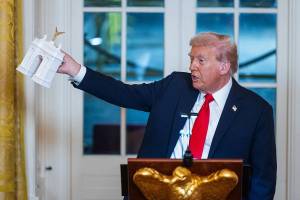
Trump holds up a model of his Arc de Trump.
Alongside Rep. Dina Titus of Nevada, Beyer plans to introduce what has been tentatively titled the “‘Arlington National Cemetery Viewshed Protection Act” on Friday, just days after the designs were approved by the U.S. Commission of Fine Arts, a panel made up of Trump appointees.
The bill seeks to prohibit the construction of the arch and the use of any federal funds for the project. Additionally, it would prohibit the construction of any triumphal arch exceeding 50-feet on any National Park Service lands within the capital region “except by express authorization of Congress.”
Democrats have argued that the proposed arch, which is set to include a public viewing deck, is an unnecessary financial expenditure, especially given the ongoing affordability crisis impacting many Americans.
“As President Trump strips away the necessary safety nets from Americans who are struggling to afford their basic needs like groceries and healthcare, he builds his unauthorized, grandiose Triumphal Arch,” said Titus. “While destroying historical monuments and artefacts important to our American identity, he is erecting monuments to honor himself.”
Unfortunately, Trump couldn’t care less about the public good. He only cares about building memorials to himself.
Trump dreams up new renovation projects nearly every day. Here are the latest ones we’ve heard about:
He boasted of fixing city fountains and power-washing a local pool — making careful distinctions between sandblasting versus pebble-blasting — and detailing efforts to repair brick walkways in a public park.
But this wasn’t a small-town mayor assuring a few dozen community members at a town hall that municipal improvement efforts would be completed in time for Little League season.
This was President Donald Trump — channeling his decades as a high-profile real estate developer — regaling his assembled Cabinet and a nationally televised audience on Wednesday with the ins and outs of beautification projects around Washington.
“I love construction. It’s very exciting,” Trump said, maintaining that the face-lift he’s helped oversee to the nation’s capital means “D.C. is looking beautiful.”
His aside lasted 10 minutes and was far more comprehensive than anything said about the other major issues discussed during the meeting, including the war in Iran. There were also only passing references to gas prices nationwide that have spiked and fears about a weakening economy that could hurt Trump’s Republican Party in its push to retain control of Congress after November’s midterm elections….
The president also said that, under his watch, construction crews were working to improve 28 fountains, then bragged about a push to renovate the “reflecting lake” or “reflecting pond” — actually the Lincoln Memorial Reflecting Pool — which he said had been steam-cleaned, fumigated and coated with “American flag blue” paint.
“Over the years, I built hundreds of pools,” Trump said, recalling his days as a construction mogul in 1970s and ’80s New York. “I always like to build Olympic-sized swimming pools.”
The president noted that, as part of the revamp, cleaning crews had removed “more than 10 dumpsters of garbage.”
President Donald Trump wants to paint the World War II Memorial in Washington, D.C., blue after slapping blue paint on the Reflecting Pool.
Trump, 79, revealed the latest memorial he wants to get his hands on during a nearly 10-minute rant about renovations he’s been focused on throughout the nation’s capital at the White House while surrounded by members of his Cabinet.
Trump says he wants to paint the fountain of the WWII Memorial as seen from the top of the Washington Monument in Washington, D.C., U.S., May 2, 2026.
“Now we’re looking at the World War II fountain because that’s also in pretty bad shape,” Trump declared.
He revealed he wanted to “duplicate” the fountain’s bottom with paint in a “slightly different color.”
“Actually, we’ll go with a lighter color, but Doug and I have a lot of fun doing it,” Trump told the room, referring to Interior Secretary Doug Burgum.
The WWII Memorial includes a series of stone and bronze sculptures surrounding a pool of water on the National Mall just down from the Reflecting Pool.
The president’s comment came after he rambled for several minutes about his administration slapping a fresh coat of paint on the Reflecting Pool between the Lincoln Memorial and the Washington Monument.
Trump called it the “reflecting lake” and said “nobody has ever seen anything like it” while also giving it the wrong dimensions and claiming it was longer than the tallest building in the world, which it is not.
Four massive bronze horses positioned along the roads surrounding the Lincoln Memorial still shine in the sun from their first restoration in the 1970s. But their gold-toned coating is faded and patchy, and their heavy stone bases are cracked and dirty.
The Trump administration wants them glittering with a fresh coat of gold in time for America’s 250th anniversary on July 4. So in mid-April, the National Park Service handed a $5 million contract to a gilding studio in Maryland to repair the statues and cover them with a thick layer of 23.75-karat gold leaf.
It awarded the project without a full competition, according to NPS documents reviewed by NOTUS.
Four bronze horses surrounding the Lincoln Memorial are getting a glow-up for America’s 250th anniversary on July 4. Kainaz Amaria, NOTUS
As Trump hurries to put his stamp on a city he’s long denigrated as crumbling and ugly, his administration has doled out tens of millions of dollars for contracts with short timelines and little oversight.
In total, the Interior Department is spending at least $95 million in taxpayer funds for new D.C. beautification projects, according to a NOTUS review of government spending data. All of the projects identified by NOTUS were initiated between December 2025 and April of this year. About $20 million in contracts, including the gilding of the four horses, have not previously been reported.
“It is within the realm of reason to say: It’s the 250th anniversary that’s coming up, and instead of spending a hundred million dollars we normally spend on the District of Columbia, we want to spend $250 million. That’s perfectly normal,” said one former General Services Administration official, making up the dollar amounts to illustrate their point. “What is not normal is the lack of transparency.”
In mid-April, the National Park Service hired The Gilders’ Studio in Maryland to restore the 80,000-pound statue pairs, known as the Arts of War and Arts of Peace. According to agency documentation, the gilding company is covering the statues in an unusually thick layer of nearly pure gold — heavier and purer than even the “extra-thick” gold the same studio used to refinish the exterior of the Wyoming state capital dome seven years ago.
The $5 million contract includes more work than just the gold leafing, although the gold itself is certain to be a significant part of the cost, with the price of gold essentially doubling over the last several years.
The National Park Service is using at least $67 million worth of park entrance fees to help fund President Trump’s beautification projects in Washington, according to a New York Times analysis of federal records.
Nearly $60 million in fees paid by visitors to national parks across the country is funding repairs to nine of the capital’s ornamental fountains, the analysis found. The government is putting another $7 million worth of entrance fees toward the renovation of the Lincoln Memorial Reflecting Pool, which costs $13.1 million overall, according to an internal Park Service document reviewed by The Times.
The National Park Service is spending millions in fees paid by visitors to parks across the country, like Yosemite National Park in California, to pay for restoration of nine ornamental fountains in Washington, D.C, AP
The analysis was based on a federal contracting database. The $7 million for the Reflecting Pool has not previously been reported.
Mr. Trump has proposed a host of initiatives to remake Washington in his own style and wants these projects completed by July 4, the 250th anniversary of American independence.
Some conservationists criticized the Trump administration for steering so much money to projects in Washington that appeared to be cosmetic fixes rather than urgent upgrades. National parks outside the capital have long maintenance backlogs, including repairs to deteriorating roads and water systems that threaten visitor safety.
“Our parks and public lands have been underfunded for decades, and there are many genuinely urgent projects in need of funding across the country,” said Aaron Weiss, the executive director of the Center for Western Priorities, a conservation group. “Instead, Interior Secretary Doug Burgum is determined to divert millions of dollars to projects that President Trump can see out his window.”
The spending is legal. Under the Federal Lands Recreation Enhancement Act of 2004, at least 80 percent of revenue from entrance fees must stay in the park where the fees were collected. But the other 20 percent can be used to improve sites that do not collect fees, such as the National Mall and Memorial Parks in Washington.
Katie Martin, a spokeswoman for the Interior Department, which includes the Park Service, did not respond to specific questions but defended the spending in general.
“The National Park Service has not only been focused on beautifying the district but has also been working on many deferred maintenance projects throughout the country,” Ms. Martin said in an email, adding that “we should all be grateful” for Mr. Trump’s focus on projects in Washington.
I for one am not grateful.
That’s my post for today. I hope it isn’t too weird. I just couldn’t spend time today reading about the war and elections.
Did you like this post? Please share it with your friends:
I spent the last 3 days reading books and relaxing, and mostly avoiding watching or reading news social media. My RA pain had been pretty bad lately, and it has definitely improved as a result. I’ll have to see what happens after I engage with the news for this post, but at the moment I plan to go back on a news diet when I finish. I definitely think my health is improved by avoiding news about Trump.
Ted Turner, the media mogul who cut a brash and vivid figure on the American scene of the late 20th century by dominating the cable television industry, creating the 24-hour news cycle with CNN, and extending his restless reach into professional sports, environmentalism and philanthropy, died on Wednesday at his home near Tallahassee, Fla. He was 87.
Phillip Evans, a spokesman for the family, confirmed the death. Mr. Turner announced in 2018 that he had Lewy body dementia, a progressive brain disorder.
Ted Turner
Mr. Turner’s signature creation was CNN — the Cable News Network — which revolutionized television news in 1980 by presenting it all hours of the day and eventually inspiring other media operations to follow suit. But his portfolio of business ventures bulged with much more, and their impact on American culture was considerable.
As a spinoff of CNN, Mr. Turner created the channel CNN Headline News and CNN International. He founded the cable and satellite sports and entertainment “superstation” that became known as TBS and spawned a sister channel, TNT, both of which continue to reach millions of homes.
In 1985, he bought for $1.5 billion the MGM studio’s library of films and nine years later created the cable franchise Turner Classic Movies, or TCM. He made a similar purchase of Hanna-Barbera cartoons and, relying on them, created the Cartoon Network in 1992. And in 1996, he merged his conglomerate, Turner Broadcasting System, with Time Warner to create one of the world’s largest media companies.
Along the way, he found the time and energy to captain the winning yacht in the America’s Cup race in 1977 and to take an active role as owner of the Atlanta Braves, giving the team extended national exposure on Turner-owned television.
“I’m trying to set the all-time record for achievement by one person in one lifetime,” he told the journalist Dale Van Atta in a Reader’s Digest article in 1998. “And that puts you in pretty big company: Alexander the Great, Napoleon, Gandhi, Christ, Mohammed, Buddha, Washington, Roosevelt, Churchill.”
Not even his staunchest admirers placed Mr. Turner on that high a pedestal. But even a bitter rival like the media magnate Rupert Murdoch — who once had his New York Post run the headline “Is Turner Insane?” — had to concede that he was one of the most influential figures in the history of mass media.
An Atlanta-based entrepreneur, Mr. Turner took astounding risks in business, often teetering on the edge of bankruptcy and then roaring back to multiply his fortune.
Against the advice of colleagues and the conventional wisdom of his industry peers, he poured millions of dollars into pioneering ventures that combined cable and satellite broadcasts. He warred against the big television networks. He almost lost his shirt in Hollywood but emerged from these gambles and brawls as a billionaire astride a vast cable empire of news, sports and entertainment channels.
Of course the big story is still Trump’s war with Iran. It’s difficult to know what to believe about what’s going on, since Trump and Hegseth lie constantly.
The United States and Iran are moving closer to an agreement on a short memorandum to end the Iran war, a regional source familiar with the negotiations said, although Trump administration officials cautioned that talks had previously fallen apart at the last minute.
The White House received positive feedback from Pakistani mediators on Tuesday that the Iranians were progressing toward a compromise, two administration officials told CNN while offering some skepticism about Pakistan’s optimism.
From CentCom: Project Freedom at Strait of Hormuz
But a renewed diplomatic push has emerged in recent days, the regional source said. President Donald Trump appears to be simplifying issues in peace negotiations so moderates in the Iranian regime can come back to the negotiating table, the source added, with the aim being to tackle thornier issues later.
A one-page plan being floated internally contains provisions that have been at the heart of negotiations to end the conflict, a person familiar with the plan told CNN. The document would declare an end to the war while triggering a 30-day negotiation period on resolving sticking points, including on nuclear issues, unfreezing Iranian assets and future security in the Strait of Hormuz, the person said.
Precise details of the plan couldn’t immediately be verified, but the source familiar said it would include discussion of a moratorium on uranium enrichment for a period of longer than 10 years. A previous US proposal had set it at 20 years.
The plan also requires Iran to ship its stockpile of highly enriched uranium out of the country, but details were still being negotiated.
News of positive movement from the Pakistanis helped spur Trump on Tuesday to announce a pause of “Project Freedom” – an operation to guide stranded ships out of the strait – citing progress in negotiations with Iran, the administration officials said. The pause came after Secretary of State Marco Rubio told reporters that Operation Epic Fury had ended and that the administration’s full focus was on Project Freedom.
The regional source told CNN that the harder the US pushed its agenda of Project Freedom and Operation Epic Fury, the more the hardliners in Iran stood up and had a bigger voice.
‘American wishlist, not a reality’: Iranian officials cast doubt on US proposal to end war.
Ebrahim Rezaei, the spokesperson of the Iranian parliament’s national security and foreign policy commission, has poured cold water on the Axios report claiming the US and Iran were nearing a one-page memorandum to end the war, saying it was an “American wishlist [and] not a reality”.
Ebrahim Rezaei
In a fiery statement on X, he said: “Americans will not gain in a lost war what they failed to achieve in face-to-face negotiations.Iran has its finger on the trigger and is ready; if they do not surrender and grant the necessary concessions, or if they or their lapdogs attempt any mischief, we will respond with a harsh and regrettable response.
Iran’s foreign ministry spokesperson, Esmail Baghaei, also responded to the Axios report, telling the Iranian Isna news agency that the US proposal is still being reviewed by Tehran.
“Once Iran concludes its assessment, it will convey its views to the Pakistani side,” Isna reported, adding that the US demands detailed in the Axios report “included excessive and unrealistic demands that have been strongly rejected by Iranian officials in recent days”.
Isna reported that the Iranian negotiating team is solely reviewing the “termination of the war” and the nuclear issue is not currently being discussed.
That doesn’t sound like an agreement is coming soon. And Trump is issuing threats.
The United States and Iran appeared to be moving closer Wednesday to an initial agreement to end the war, as U.S. President Trump sought to pressure Tehran with threats of a new wave of bombing if a deal is not reached.
Trump posted on social media that the two-month war could soon end and that oil and natural gas shipments disrupted by the conflict could restart. But he said that depends on Iran accepting a reported agreement that the president did not detail.
“If they don’t agree, the bombing starts,” Trump wrote.
Trump made his latest comments after he suspended a short-lived U.S. effort to force open a safe passage for commercial ships through the Strait of Hormuz, a vital waterway through which major oil and gas supplies, fertilizer and other petroleum products passed before the war.
Iran’s effective closure of the strait has sent fuel prices skyrocketing, rattled the global economy and put enormous economic pressure on countries, including major powers such as China.
China’s foreign minister called for a comprehensive ceasefire Wednesday after meeting in Beijing with Iran’s top envoy. Wang Yi said his country was “deeply distressed” by the conflict, which began Feb. 28 when the U.S. and Israel launched strikes against Iran.
China’s close economic and political ties to Tehran give it a unique position of influence. The Trump administration is pressing China to use that relationship to urge the Islamic Republic to open the strait.
Meanwhile it appears that the Trump administration has been trying to conceal how much damage Iran has done to U.S. bases in the Middle East region.
Iranian airstrikes have damaged or destroyed at least 228 structures or pieces of equipment atU.S. military sites across the Middle East since the war began, hitting hangars, barracks,fuel depots, aircraft and key radar, communications and air defense equipment, according to a Washington Post analysis of satellite imagery. The amount of destruction is far larger than what has been publicly acknowledged by the U.S. government or previously reported.
The threat of air attacks rendered some of the U.S. bases in the region too dangerous to staff at normal levels, and commanders moved most of the personnel from these sites out of the range of Iranian fire at the start of the war, officials have said.
Since the start of the war on Feb. 28, seven service members have died in strikes on U.S. facilities in the region — six in Kuwait and one in Saudi Arabia — and more than 400 troops have suffered injuries as of late April, the U.S. military said. While most of the wounded returned to duty within days, at least 12 suffered injuries that military officials classified as serious, according to U.S. officials who, among others, spoke on the condition of anonymity due to the sensitivity of the issue.
Satellite imagery of the Middle East is unusually difficult to acquire at present. Two of the largest commercial providers, Vantor and Planet, have complied with requests from the U.S. government — their biggest customer — to limit, delay or indefinitely withhold the publication of imagery of the region while the war is ongoing, making it difficult or impossible to assess Iran’s counterstrikes. Those restrictions began less than two weeks into the war.
Iranian state-affiliated news agencies, however, have from the start regularly published high-resolution satellite imagery on their social media accounts that claimed to document damage to U.S. sites.
Images of damage to Camp Buehring in Kuwait, released and annotated by Iranian state-affiliated media. Washington Post illustration.
For this examination — one of the first comprehensive public accounts of the damage to U.S. facilities in the region — The Post reviewed more than 100 high-resolution Iranian-released satellite images. The Post verified the authenticity of 109 of the those images by comparing them with lower-resolution imagery from the European Union’s satellite system, Copernicus, as well as high-resolution images from Planet where available. The Post excluded 19 Iranian images from the damage analysis because comparisons with the Copernicus imagery were inconclusive. No Iranian imagery was found to have been manipulated.
In a separate search of Planet imagery, Post reportersfound 10 damaged or destroyed structures that were not documented in the imagery released by Iran. In all, The Post found 217 structures and 11 pieces of equipment that were damaged or destroyed at 15 U.S. military sites in the region.
Experts who reviewed The Post’s analysis said the damage at the sites suggested that the U.S. military had underestimated Iran’s targeting abilities, not adaptedsufficiently to modern drone warfare and left some bases under-protected.
“The Iranian attacks were precise. There are no random craters indicating misses,” said Mark Cancian, a senior adviser with the Center for Strategic and International Studies and a retired Marine Corps colonel, who reviewed the Iranian images at The Post’s request. The Post previously revealed how Russia provided Iran with intelligence to target U.S. forces.
Read the rest and view more images using the gift link above. I wonder what it will take to repair the damage?
Americans are deeply uncomfortable with recent religion-related statements by President Donald Trump and Defense Secretary Pete Hegseth — a striking rebuke in a closely divided country, according to a Washington Post-ABC News-Ipsos poll.
The poll finds positive ratings for Pope Leo XIV, who has criticized U.S. actions on immigration andin Iran, drawing criticism from Trump that the president repeated on Tuesday.
Both expressions drew criticism even from Republicans and Trump voters, unusual at a time of deep political tribalism. Eighty percent of 2024 Trump voters had a negative reaction to Trump’s Jesus post, as did 79 percent of Republicans. On Hegseth’s prayer, more than 40 percent of both groups reacted negatively.
“There is only one Jesus! I found the posts to be inappropriate and offensive. Humility is at the core of being Jesus,” said Kimberly Chopin, a 57-year-old Catholic who lives in suburban Baton Rouge and voted for Trump. She added that Hegseth’s prayer calling for violence made her “extremely uncomfortable. That kind of language sounds like the language of al-Qaeda.”
Interesting.
Of course Trump is much less interested in the war he started as a distraction from the Epstein files than remaking the White House and surrounding buildings and monuments in his own image. And his number one obsession is his insane ballroom.
Now Republicans in Congress are getting into the act. We were told that the ballroom project would be paid for with private money. Suddenly, we learn that taxpayers are expected to cover the growing price tag.
Senate Republicans have inserted $1 billion for White House East Wing security enhancements in the immigration enforcement funding bill they hope to rush through Congress this month, setting up a political fight over a ballroom that President Trump has said would be financed with private money.
The leaders of the Judiciary and Homeland Security Committees on Monday released plans for the roughly $70 billion package, which would significantly bolster spending on Immigration and Customs Enforcement and border patrol through the end of Mr. Trump’s term using a party-line legislative process that can skirt a filibuster.
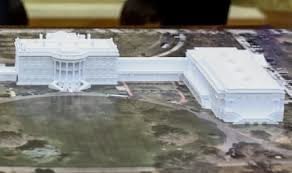
Trump’s proposed ballroom addition to the White House
A surprise addition to the measure was the $1 billion proposed by the Judiciary Committee for security work related to Mr. Trump’s East Wing renovation. The measure does not mention the president’s proposed new ballroom, which is being challenged in court, but Mr. Trump has insisted that a main reason for the project is to enhance security.
While the president has previously insisted that the renovation would be funded through private donations, a spokesman on Tuesday said the White House applauded the proposed security funding for a “long overdue” project.
Mr. Trump and congressional Republicans have escalated their efforts to defend the project after the attempted assault late last month at a journalism gala in Washington attended by the president.
The bill says the public money would be directed to “security adjustments and upgrades, including within the perimeter fence of the White House compound to support enhancements by the Secret Service relating to the East Wing Modernization Project, including above-ground and below-ground security features.” It also bars any of the funding being spent on “non-security elements.”
WTF?!
“Republicans are on a different planet than American families,” Senator Chuck Schumer of New York, the Democratic minority leader, said in a post on social media. “Republicans looked at families drowning in bills and decided what they really needed was more raids and a Trump ballroom.”
Top Democrats also noted that consideration of the bill would put all senators on the record on a White House construction project that polls have shown to be unpopular.
“Just flagging that now everyone gets an up or down vote on the ballroom,” Senator Brian Schatz, Democrat of Hawaii, said on social media.
Should the provision survive and be enacted into law, it could clear away legal obstacles to construction of the ballroom, which a federal judge has ruled requires congressional approval.
Republicans are advancing the legislation outside of normal congressional spending channels because Senate Democrats had blocked money for ICE and the border control in a dispute over the tactics and conduct of federal immigration officers. That fight shut down parts of the Department of Homeland Security for almost 80 days.
“The Senate Judiciary Committee is taking action to help provide certainty for federal law enforcement and safer streets for American families,” Senator Charles E. Grassley, Republican of Iowa and the chairman of the Judiciary Committee, said in a statement. “We will work to ensure this critical funding gets signed into law without unnecessary delay.”
President Trump is looking to make his mark on the White House and Washington, D.C., and not just politically.
The longtime real estate developer has either announced or embarked on a number of construction and renovation projects across the nation’s capital.
“I have two jobs,” Trump said in late 2025, the presidency being just one of them. “I have a construction job, which is really like relaxation for me because I have been doing it my entire life.”
The White House ballroom, reflecting pool resurfacing, Kennedy Center renovations and a triumphal arch are among the many changes Trump wants to make in D.C.
But many of the efforts in progress could reshape D.C.’s architectural landscape for decades to come.
Neil Flanagan, an architect and public historian in D.C., says while Trump had aesthetic ambitions during his first term, his “insistence on making it so much about his own style and his own brand and wearing this glory of America’s past is distinct to this term.” Many of his initiatives are connected to the country’s upcoming 250th anniversary in July.
“They all sort of declare the glory of America rather than actually building any kind of growth or future for America,” Flanagan says. “If you’re trying to slash the science budget … at the same [as you’re] building these grand monuments, you’re not building a creative America, you’re wearing a great American past as a costume.”
The latest change was to the Lincoln Memorial reflecting pool.
Trump is resurfacing the Lincoln Memorial Reflecting Pool, coating its gray bottom with a shade he described to reporters as “American flag blue.”
The 2,030-foot-long reflecting pool has been the backdrop of marches, speeches and inaugurations for a century.
It last underwent a major renovation from 2010 to 2012, both for structural fixes (to address decades of leaking and sinking) and aesthetic improvements (it was intentionally made shallower). But the Department of Interior says the wrong-size pipes were installed, resulting in the continued need for expensive refills (71 million additional gallons, exceeding $1 million, in 2019 alone).
Trump has been talking publicly about fixing the pool since at least November 2025, but ramped up his efforts in April after what he described as complaints about the state of the landmark. He told reporters that he is working with one of his best “pool builders” from his real estate days, who talked him out of a turquoise shade “like in the Bahamas.”
Flanagan says Trump is treating the pool, and the city itself, “like it’s his personal country club.”
“You get some pool guys and then they refinish it in a way that is more suitable to, basically, a swimming pool at Mar-a-Lago,” he adds.
That’s all I have for today. I can’t take anymore. \
Have a peaceful Wednesday.
Did you like this post? Please share it with your friends:
This morning, Steven Beschloss posted the following discussion question for his readers at his Substack “America America”: Is Love More Powerful Than Hate?
I had in mind to write about villainy. It’s a fact of our public life that the Trump regime is thick with this dark force and overloaded with people who revel in it. The villains come easily to mind: Pam Bondi, Kristi Noem, Robert F. Kennedy Jr., Pete Hegseth, Russel Vought, Greg Bovino (to name a few) and of course their ringleader, Donald Trump. They have motivated countless others to join their hateful cause to reject the Constitution and demolish democracy in America.
But on this day—Valentine’s Day—I want to turn this over and look at the flip side. Because behind this discussion of villains and villainy is my belief that their dark force can be defeated with the force of light and love. I don’t mean the biblical advice to “love your enemies,” although that may be a mindset that others more merciful than I can conjure.
I’m thinking more about the guidance found in the words of Martin Luther King, Jr. on the topic of love. Let me share four shining examples:
“Love is the greatest force in the universe. It is the heartbeat of the moral cosmos.”
“Hate cannot drive out hate. Only love can do that.”
“I believe that unarmed truth and unconditional love will have the final word in reality.”
“I know that love is ultimately the only answer to mankind’s problems.”
There are days that these insights—these deeply held convictions—may seem inadequate to confront the horrors we witness committed by men and women who have lost their moral compass, assuming that they once possessed one. But I’d like to suggest that the more powerful our revulsion toward the regime’s acts of villainy, the more we are influenced by the inverse.
I returned to yesterday’s essay, “Pam Bondi’s Utter Contempt for Justice,” to test this notion. If you read it and thought that I am horrified by her villainous behavior this week, you would be right. But let’s look at the basis for my horror in three sentences from the first several paragraphs: “It’s hard to imagine someone more overtly hostile to justice and more utterly incapable of basic human compassion…This person is responsible for serving the people…But when asked for the most basic show of humanity, she couldn’t bring herself to do it.” Behind the obvious criticism of her hateful action is love: For justice, for basic human compassion, for serving the people, for humanity.
My point is that in our articulation of the horrors, we can find the light that can inspire us to stay in the fight and overcome this dark chapter. “Love is the greatest force in the universe. It is the heartbeat of the moral cosmos,” King wrote. In other words, love is more powerful than hate and, as King also insisted, “the only answer to mankind’s problems.”
Bad Bunny sent a similar message with his Super Bowl performance. Is it true? Can love conquer hate? Food for thought on Valentine’s Day.
Now for the news, which is again filled with hate and fear.
Trump appears to be planning some sort of attack on Iran.
The U.S. military is preparing for the possibility of sustained, weeks-long operations against Iran if President Donald Trump orders an attack, two U.S. officials told Reuters, in what could become a far more serious conflict than previously seen between the countries.
The disclosure by the officials, who spoke on condition of anonymity due to the sensitive nature of the planning, raises the stakes for the diplomacy underway between the United States and Iran.
U.S. envoys Steve Witkoff and Jared Kushner will hold negotiations with Iran on Tuesday in Geneva, with representatives from Oman acting as mediators. U.S. Secretary of State Marco Rubio cautioned on Saturday that while Trump’s preference was to reach a deal with Tehran, “that’s very hard to do.”
Meanwhile, Trump has amassed military forces in the region, raising fears of new military action. U.S. officials said on Friday the Pentagon was sending an additional aircraft carrier to the Middle East, adding thousands more troops along with fighter aircraft, guided-missile destroyers and other firepower capable of waging attacks and defending against them.
Trump, speaking to U.S. troops on Friday at a base in North Carolina, openly floated the possibility of regime change in Iran, saying it “seems like that would be the best thing that could happen.” He declined to share who he wanted to take over Iran, but said “there are people.”
“For 47 years, they’ve been talking and talking and talking,” Trump said.
Trump has long voiced skepticism about sending ground troops into Iran, saying last year “the last thing you want to do is ground forces,” and the kinds of U.S. firepower arrayed in the Middle East so far suggest options for strikes primarily by air and naval forces.
President Trump said on Friday that regime change in Iran “would be the best thing that could happen,” as he continued to threaten military action against the country.
“For 47 years, they’ve been talking and talking and talking,” he told reporters after visiting troops at Fort Bragg. “In the meantime, we’ve lost a lot of lives while they talk.”
In recent weeks, Mr. Trump has called for new leadership in Iran, and The New York Times reported in January that he was mulling whether regime change would be a viable military option.

But his latest comments are, perhaps, Mr. Trump’s most overt endorsement of regime change, even as U.S. officials concede that ousting Ayatollah Ali Khamenei would be much more complex than the operation that captured Nicolás Maduro, then the leader of Venezuela.
Still, officials have said that Mr. Trump had not made a final decision and was considering a range of military options.
The Trump administration has been steadily building up its military capabilities in the Middle East as Mr. Trump considers whether to strike the country again. Mr. Trump threatened last month to attack Iran if its government did not agree to a deal to curb its nuclear program….
But senior U.S. officials remain skeptical that the Iranians will agree to a deal that satisfies Mr. Trump, who has shown a growing impatience with the negotiations. This month, Omani officials mediated talks between Iran and a U.S. delegation that included Steve Witkoff,
A bit more on possible attack plans:
Mr. Trump has been weighing a range of military actions, including targeting Iran’s nuclear program and its ability to launch ballistic missiles. He is also considering sending American commandos to go after Iranian military targets, among other moves, the officials said.
To prepare, the Pentagon has been building up an “armada,” as Mr. Trump calls it, in the region. It includes the U.S.S. Abraham Lincoln carrier strike group, eight guided missile destroyers that can shoot down Iranian ballistic missiles, land-based ballistic missile defense systems and submarines that can launch Tomahawk cruise missiles at targets in Iran.
And on Thursday, the crew of a second aircraft carrier, the U.S.S. Gerald R. Ford, was told it would leave the Caribbean, where the ship joined the U.S. operation last month to seize Mr. Maduro, and deploy to the Middle East as part of Mr. Trump’s pressure campaign.
The U.S. Southern Command said it struck a vessel allegedly transporting drugs in the Caribbean on Friday, killing three people.
“Joint Task Force Southern Spear conducted a lethal kinetic strike on a vessel operated by Designated Terrorist Organizations,” Southern Command said in a post on X, adding that “intelligence confirmed the vessel was transiting along known narco-trafficking routes in the Caribbean and was engaged in narco-trafficking operations.”
“Three narco-terrorists were killed during this action. No U.S. military forces were harmed,” the post said.
The U.S. has not provided evidence supporting its allegations about the boat, passengers, cargo or the number of people killed.
This latest strike comes after the U.S. on Monday struck a vessel also alleged to be transporting drugs in the eastern Pacific, killing two people and leaving one survivor.
A few days ago, there was a disturbing incident in Texas in which DHS used a powerful laser weapon with out notifying other parts of the government. It caused the FAA to close the air space over El Paso, Texas for a time. I have been curious about how this happened.
The abrupt closure of El Paso’s airspace late Tuesday was precipitated when Customs and Border Protection officials deployed an anti-drone laser on loan from the Department of Defense without giving aviation officials enough time to assess the risks to commercial aircraft, according to multiple people briefed on the situation.
The episode led the Federal Aviation Administration to abruptly declare that the nearby airspace would be shut down for 10 days, an extraordinary pause that was quickly lifted Wednesday morning at the direction of the White House.
Top administration officials quickly claimed that the closure was in response to a sudden incursion of drones from Mexican drug cartels that required a military response, with Transportation Secretary Sean Duffy declaring in a social media post that “the threat has been neutralized.”

But that assertion was undercut by multiple people familiar with the situation, who said that the F.A.A.’s extreme move came after immigration officials earlier this week used an anti-drone laser shared by the Pentagon without coordination with the F.A.A. The people spoke on the condition of anonymity because they were not authorized to speak publicly.
C.B.P. officials thought they were firing on a cartel drone, the people said, but it turned out to be a party balloon. Defense Department officials were present during the incident, one person said….
The military has been developing high-energy laser technology to intercept and destroy drones, which the Trump administration has said are being used by Mexican cartels to track Border Patrol agents and smuggle drugs into the United States.
The airspace closure provoked a significant backlash from local officials and sharp questions by lawmakers on Capitol Hill, including some Republicans, who expressed skepticism about the administration’s version of the events.
The sudden closure of El Paso’s airspace Wednesday came sometime after U.S. Customs and Border Protection officials used an anti-drone laser that was provided by the military to shoot down objects that were later identified as party balloons, four people familiar with the matter said.
The testing of U.S. military-owned laser technology was taking place in the proximity of the airport. The FAA responded by issuing a “temporary flight restriction notice,” which was to shut down the airspace for 10 days. It prevented flights, including helicopters used for medical transport, below 18,000 feet. The airport is a major hub for the region, with more than 50 flights scheduled every day.
The airspace was reopened several hours later Wednesday morning. The decision prompted confusion and finger-pointing inside the Trump administration over who was to blame….
One of the people familiar with the testing said the Defense Department has a working relationship with Homeland Security, where CBP is headquartered, that allows its personnel to use certain military equipment for its objectives, testing, evaluation and use along the southern border.
Recently, Defense Secretary Pete Hegseth authorized the use of the weapon for CBP, the people said. Spokespeople for CBP referred questions to the White House, which did not elaborate beyond initial statements.
It figures Hegseth would be involved in this mess.
AFTER PROLONGED CONFUSION, we may have some clarity on what caused the emergency restriction on the airspace around El Paso International Airport: Someone used a sophisticated anti-air laser against what they thought was a drone launched from Mexico, but turned out to be a party balloon. Understandably, the first suspects were the Army units at Fort Bliss, which abuts El Paso and the airport. But it wasn’t the Army that fired the weapon.
According to the New York Times, Customs and Border Protection personnel fired an experimental anti-drone laser on loan from the Department of Defense at what they thought was a cartel drone—without sufficient coordination with the Federal Aviation Administration. That prompted the FAA to shut down the airspace around the airport up to 18,000 feet in an extraordinary emergency move.
But focusing on the harmlessness of the target obscures the deeper issue: Why was this weapon employed without the discipline that governs every legitimate use of force in the military?

Fort Bliss sits on the edge of El Paso. While it’s a large post, and it has a very isolated desert training area, it borders a large city with hospitals, businesses, highways, civilian neighborhoods, and a relatively large international airport.
The post is home to the 1st Armored Division, an organization I once commanded. Like every major installation in the Army, Fort Bliss operates under detailed standing operating procedures governing weapons employment—whether on a live-fire range, during air-defense exercises, or in any activity that could affect surrounding airspace or population centers.
Those procedures are not bureaucratic red tape. They are necessary safety barriers. They exist precisely because military commanders understand various immutable facts: weapons are dangerous, coordination for any training event is critical, citizens live nearby, and mistakes do not stay contained.
It’s therefore unsurprising—though deeply concerning—that reports indicate the Fort Bliss commander and the command and staff of Northern Command were as alarmed as the FAA by the balloon shoot-down. That’s because they know any uncoordinated weapons use is not merely unsafe; it is unacceptable.
Please go read the rest at The Bulwark, if you’re interested. Personally, I find this incident deeply disturbing. There are simply too many incompetent–even stupid–people running our government. Eventually there is going to be a serious disaster.
More disturbing Trump Administration/DHS news–this time involving the Social Security Administration:
“If ICE comes in and asks if someone has an upcoming appointment, we will let them know the date and time,” an employee with direct knowledge of the directive says. They spoke on the condition of anonymity for fear of retaliation.
While the majority of appointments with SSA take place over the phone, some appointments still happen in person. This applies to people who are deaf or hard of hearing and need a sign language interpreter, or if someone needs to change their direct deposit information. Noncitizens are also required to appear in person to review continued eligibility of benefits.
Social Security numbers are issued to US citizens but also to foreign students and people legally allowed to live and work in the country. In some cases, when a child or dependent is a citizen and the family member responsible for them is not, that person might need to accompany the child or dependent to an office visit.

The order to share information, which was recently communicated verbally to workers at certain SSA offices, marks a new era of collaboration between SSA and the Department of Homeland Security, ICE’s parent agency….
The SSA has been sharing data with ICE for much of President Donald Trump’s second term. In April, WIRED reported that the Trump administration had been pooling sensitive data from across the government, including from the the SSA, DHS, and the Internal Revenue Service. By November, WIRED learned that the SSA had made the arrangements official and had updated a public notice that said the agency was sharing “citizenship and immigration information” with DHS. “It was shockingly clear that there was interest in getting access to immigration data by [the] Trump administration,” a former SSA official tells WIRED. The official spoke on the condition of anonymity due to concerns of retaliation.
The Social Security Administration has instructed employees newly assigned to answering phones to tell callers expressing suicidal thoughts that suicide is “one option,” raising concerns from employees and experts in the field who called the approach unorthodox.
SSA recently began shifting new swaths of its workforce to phone answering duty, including those who normally receive and process retirement and disability claims, manage the agency’s technology and work in the agency’s finances unit. Those employees received brief, three-hour training before they began answering calls.
As part of that training, they were warned some callers may express suicidal ideation and presented with examples using a theoretical employee named Fiona.
“It’s important for Fiona to keep the caller engaged and to remind her that suicide is only one option,” the animated trainer told employees in the video, a copy of which was obtained by Government Executive, “and that there is no urgency to make any decisions.”
Employees at the training, which occurred on Jan. 26 for benefits authorizers and post-entitlement technical experts, were taken aback by the comment and asked their supervisors for clarity. One employee at the training said there was “disbelief that it was just said” among those in the room.
Caitlin Thompson, a clinical psychologist who spent eight years at the Veterans Affairs Department as a clinical care coordinator on the Veterans Crisis Line and later as the department’s national director of suicide prevention, said SSA’s approach did not follow commonly accepted best practices.
“It’s not a normal thing to say,” Thompson said. “No. That’s not the thing you say to somebody who might be suicidal.”
Instead, SSA would be better suited telling employees to ask callers if they feel safe in the immediate term and if they say no, to tell the caller that they will work with their supervisor to get them in touch with a crisis line.
Read more at the link.
I’ll end with this update on Trump’s ballroom obsession.
New renderings shared Friday offer the clearest look yet at President Donald Trump’s proposed White House ballroom addition — a project advancing even as it is challenged in court and questioned on Capitol Hill.

Shalom Baranes Associates, the firm handling the project, shared the renderings with the National Capital Planning Commission, a committee charged by Congress with overseeing major federal construction projects in the region. The renderings include various angles of the ballroom building, an approximately 90,000-square-foot addition that would also include offices for White House staff. The White House has dubbed the project its “East Wing Modernization.”
The images reveal at least one significant change from earlier designs: the removal of a large triangular pediment above the ballroom’s southern portico. Rodney Cook Jr. — a Trump appointee who chairs the Commission of Fine Arts, another federal panel reviewing the project — had warned in January that the pediment was “immense” and pressed the architects about whether it could be reduced.
Despite the revisions, the proposed addition would remain the same height as the White House at its highest point — a priority for Trump and a major concern for outside architects and historical preservationists. Critics have warned the project could overshadow the iconic main mansion and alter long-protected sightliness around the complex. The new renderings indicate the buildingcould block views of the White House residence from certain viewpoints, such as locations on 15th Street NW, according to the designs shared Friday.
Bruce Redman Becker, an architect who was appointed to the Commission of Fine Arts by former president Joe Biden and removed by Trump last year, said the renderings show “a poorly proportioned pseudo-neoclassical structure that is completely out of scale with the White House.” He also said that the images shown in the renderings did not comply with decades-old guidelines developed by the National Park Service for construction projects at the White House and its neighboring park, which call for new additions to be compatible with the historic structure.
“The design team clearly ignored these guidelines, and should be asked to revise and resubmit plans that follow the guidelines,” Becker said.
You can use the gift link to read more and see the renderings.
That’s it for me today. What are your thoughts on all this? What else is on your mind?

Did you like this post? Please share it with your friends:
I’m really struggling with watching/read the national news these days. I’m sure I’m not alone in that. I have been trying to follow local reports of federal immigration/deportation activities. Trump hasn’t sent troops to Massachusetts yet, but ICE has still been very busy here. A few recent stories:
Last week, João Marciano do Carmo returned to his family in Milford, embraced his crying mother, and fell into the comfort of his living room couch. The 19-year-old had finally made the journey home from a jail in Mississippi, one of the detention facilities where he had been held since September on an immigration-related violation that, lawyers say, never warranted his detention in the first place.
He’s not alone, according to a Globe analysis of arrest and detention data and interviews with immigration attorneys and experts. Immigrants in New England targeted for deportation are being whisked away quicker and to farther locations than ever before. They are increasingly brought to remote areas of the country where they face more conservative judges who are less likely to grant them freedom,according to the interviews and the data analysis.
Kelly Lamphere, the mother-in-law of João Marciano do Carmo’s sister, embraced João as he arrived at his family’s home in Milford, Nov. 18. Erin Clark, Globe Staff
As agents carry out that agenda, advocates and legal analysts say, immigrants have lost essential due process rights. Detainees legally eligible for bondare moved quickly, and at times in violation of court orders. It can take days for them to be able to call their families. Often, not even their lawyers know where they are.
Legal experts warn the rapid rise in transfers to far-flung states is likely to accelerate as billions of dollars allocated by Congress in the One Big Beautiful Bill Act last summer begin to flow to detention centers.
“To be super clear, this is the beginning,” said Kathleen Bush-Joseph, an attorney and policy analyst at the Migration Policy Institute. “They are ramping up, but they have plans to go so much bigger.” [….]
ICE arrests in the Boston area more than tripled in the first seven months of this year compared to last, while the number of people sent to facilities outside New England spiked sixfold, according to the Globe analysis.
At the same time, the median period before someone was moved to an out-of-region facility was cut in half. Last year, it took around 20 days to move someone out of New England, while this year it took around 10 days.
What happened to João:
In Carmo’s case, the teenager, who moved to Milford from Brazil at age 11, was arrested on the way to work at a nearby farm with a friend from Milford High School. Immigration agents shattered his car window to apprehend them. The two teenagers, who have no criminal record, were put in a van with their hands and feet shackled.
For the first six days, they weren’t allowed to make a phone call. None of their family members or their lawyer could locate them. For days, their mothers in Milford wondered if they were alive.
In the seven weeks that followed, Carmo and Marcos Oliveira Martins were transferred from detention facility to detention facility, with stops in Massachusetts, New York, and Mississippi. They slept on concrete, the floor of a gymnasium, and in traditional jail cells.
“I was being really treated like an animal … I didn’t matter,” Carmo said at his home. His journey from New York to Mississippi lasted 16 hours between buses and a plane, and he was shackled the entire time.
Immigration authorities detained and swiftly deported a freshman at Babson College to Honduras last week while she was at Logan Airport on her way to surprise her family in Texas for Thanksgiving, according to attorneys and a family friend.
The young woman, Any Lucia Lopez Belloza, came to the United States from Honduras with her family when she was a young child and was at Logan Thursday to catch a flight to Texas, where her parents live, according to her attorney, Todd Pomerleau.
Lopez Belloza made it through security but was stopped as she was about to board the plane, Pomerleau said. “They wouldn’t tell her why she was being detained. She didn’t understand it at all,” Pomerleau said. She was then taken to the Burlington ICE field office, then flown to Texas, Pomerleau said.
abson college student, Any Lucia Lopez Belloza, at her high school graduation.Family Photo
After a frantic 48-hour search, her family received a call from her on Saturday from Honduras, a country she had not lived in since she was a child. The federal government had quickly deported her, the lawyers said, and Lopez Belloza had found her way to her grandparents’ house and called her father.
“It really didn’t feel like it was real life because nothing made sense,” said Ricky Soto, a close friend of the family who was desperately trying to contact attorneys to help the family. “I can only imagine how terrifying that was for her.”
Soto, 41, had bought Lopez Belloza plane tickets and helped organize the surprise for her family — he considers them family, too, and works with her father at a tailor shop in Texas.
The student’s parents and her two youngest siblings are also in Texas, and it would have been her first Thanksgiving break during college. “She was so excited, because she wasn’t expecting to come home,” Soto told the Globe.
Why did this happen?
Nayna Gupta, the policy director at the American Immigration Council, has also been assisting the family with the case, quickly scrambling to find local lawyers and contact representatives on Thursday evening after hearing of the case. Lopez Belloza apparently had a removal order from around 2017 that neither she nor her family was aware of, Gupta said.
“They didn’t know to show up somewhere, and she certainly had no idea of any of this,” Gupta said.
Before Trump, people in this category weren’t targeted; now that has changed. Now Lopez Belloza may not be able to continue her education.
Soto, the family friend, remembers Lopez Belloza‘s father learning of his daughter’s college acceptance last year, bursting into their shop with such enthusiasm to share the news.
“Based on what I know about her father and his family, and what they went through, and how he’s been able to grow and persevere, and have a family — and then his oldest daughter is achieving this,” Soto said, “everybody was just really proud.”
Pomerleau, Lopez Belloza‘s attorney based in Massachusetts, said that she is a business student who received a scholarship to attend Babson. Now, Lopez Belloza isn’t sure if she’ll be able to finish her finals, Pomerleau said. He was able to speak with Lopez Belloza for the first time on Monday.
“She was really sad,” Pomerleau said. “I told her, ‘We’re going to fight like hell until we bring you back.’”
There must be terrible stories like this all over the country. It makes me sick at heart.
Officials have detained the mother of White House press secretary Karoline Leavitt’s nephew amid the Trump administration’s ramped-up immigration enforcement efforts, a source familiar with the matter confirmed to NBC News.
Immigration and Customs Enforcement agents took the woman into custody in Revere, Massachusetts, this month, the source said.
Bruna Ferreira has an 11-year-old son with Michael Leavitt, who is the press secretary’s brother.
A Department of Homeland Security spokesperson said Bruna Caroline Ferreira is a “criminal illegal alien from Brazil” who overstayed her tourist visa, which expired in June 1999.
The woman has an arrest on suspicion of battery, the spokesperson said. It’s not clear how the case was resolved.
Ferreira, who the source familiar with the situation said has never lived with Leavitt’s nephew, is at the South Louisiana ICE Processing Center amid proceedings to have her removed, the DHS spokesperson said….
The source said Leavitt’s nephew has lived full time in New Hampshire with his father since he was born, has never resided with his mother and has not spoken with her in many years….
Ferreira’s family said in a GoFundMe campaign that she was brought to the United States as a child in 1998 and that she has done “everything in her power to build a stable, honest life here.”
It says she “maintained her legal status” in the United States by receiving protection under the Deferred Action for Childhood Arrivals (DACA) program, which seeks to allow immigrants brought to the United States as children, albeit illegally, to enjoy protection from removal.
With headline-grabbing posts on social media, combative interactions with reporters and speeches full of partisan red meat, Mr. Trump can project round-the-clock energy, virility and physical stamina. Now at the end of his eighth decade, Mr. Trump and the people around him still talk about him as if he is the Energizer Bunny of presidential politics.
The reality is more complicated: Mr. Trump, 79, is the oldest person to be elected to the presidency, and he is aging. To pre-empt any criticism about his age, he often compares himself to President Joseph R. Biden Jr., who at 82 was the oldest person to hold the office, and whose aides took measures to shield his growing frailty from the public, including by tightly managing his appearances….
Mr. Trump remains almost omnipresent in American life. He appears before the news media and takes questions far more often than Mr. Biden did. Foreign leaders, chief executives, donors and others have regular access to Mr. Trump and see him in action.
Still, nearly a year into his second term, Americans see Mr. Trump less than they used to, according to a New York Times analysis of his schedule. Mr. Trump has fewer public events on his schedule and is traveling domestically much less than he did by this point during his first year in office, in 2017, although he is taking more foreign trips.
He also keeps a shorter public schedule than he used to. Most of his public appearances fall between noon and 5 p.m., on average.
And when he is in public, occasionally, his battery shows signs of wear. During an Oval Office event that began around noon on Nov. 6, Mr. Trump sat behind his desk for about 20 minutes as executives standing around him talked about weight-loss drugs.
At one point, Mr. Trump’s eyelids drooped until his eyes were almost closed, and he appeared to doze on and off for several seconds. At another point, he opened his eyes and looked toward a line of journalists watching him. He stood up only after a guest who was standing near him fainted and collapsed.
A bit more:
Mr. Trump has prompted additional questions about his health by sharing news about medical procedures he has had, but not details about them. While in Asia, Mr. Trump revealed that he had undergone magnetic resonance imaging at Walter Reed National Military Medical Center in early October.
“I gave you the full results,” Mr. Trump told reporters, mischaracterizing the summary that was released by his physician, which did not say that Mr. Trump had an M.R.I. scan and contained few other details….
Trump dozing in an Oval Office meeting
Mr. Trump also applies makeup to a bruise on the back of his right hand, adding speculation about a medical condition that his physician and aides say is caused by taking aspirin and shaking so many hands. In September, the bruising on his hand, coupled with swollen ankles, caused observers on the internet to speculate wildly about his health….
According to a Times analysis of the official presidential schedules in a database maintained by Roll Call, Mr. Trump’s first official event starts later in the day. In 2017, the first year of his first term, Mr. Trump’s scheduled events started at 10:31 a.m. on average. By contrast, Mr. Trump in his second term has started scheduled events in the afternoon on average, at 12:08 p.m. His events end on average at around the same time as they did during the first year of his first term, shortly after 5 p.m.
The number of Mr. Trump’s total official appearances has decreased by 39 percent. In 2017, Mr. Trump held 1,688 official events between Jan. 20 and Nov. 25 of that year. For that same time period this year, Mr. Trump has appeared in 1,029 official events.
Mr. Trump still regularly comes down to the Oval Office after 11 a.m., according to a person familiar with his schedule. This routine is a holdover from his first term: After he complained about being overscheduled in the mornings, Mr. Trump kept so-called executive time hours in the White House residence before he headed downstairs for work.
It’s nothing we don’t know about, but at least the Times admits Trump is declining with age.
In the report, the Times noted, “… when he is in public, occasionally, his battery shows signs of wear. During an Oval Office event that began around noon on Nov. 6, Mr. Trump sat behind his desk for about 20 minutes as executives standing around him talked about weight-loss drugs,” before reporting that the 79-year-old president appeared to all observers to have dozed off as those around him spoke.
Clearly stung, Trump took to Truth Social on Wednesday morning to lash out, while also boasting about his last election win for some curious reason.
“The Creeps at the Failing New York Times are at it again. I won the 2024 Presidential Election in a Landslide, winning all Seven Swing States, the Popular Vote, and the Electoral College by a lot. I one our Nation’s Districts by 2750 to 550, a complete wipeout. I settled 8 Wars, have 48 New Stock Market Highs, our Economy is Great, and our Country is RESPECTED AGAIN all over the World, respected like never before. The last Administration had the Highest Inflation in history – I have already brought that down to normal, and prices, including groceries, are coming down,” he wrote.
He continued, “To do this requires a lot of Work and Energy, and I have never worked so hard in my life. Yet despite all of this the Radical Left Lunatics in the soon to fold New York Times did a hit piece on me that I am perhaps losing my Energy, despite facts that show the exact opposite.”
“They know this is wrong, as is almost every thing that they write about me, including election results, ALL PURPOSELY NEGATIVE. This cheap ‘RAG’ is truly an ‘ENEMY OF THE PEOPLE.’ The writer of the story, Katie Rogers, who is assigned to write only bad things about me, is a third rate reporter who is ugly, both inside and out,” he complained, once again insulting a female reporter’s physical appearance.
“Despite all of this, I have my highest Poll Numbers, ever, and with record setting investment being made in America, they should only go up,” he insisted before claiming, “There will be a day when I run low on Energy, it happens to everyone, but with a PERFECT PHYSICAL EXAM AND A COMPREHENSIVE COGNITIVE TEST (‘That was aced’) JUST RECENTLY TAKEN, it certainly is not now! GOD BLESS AMERICA & MAKE AMERICA GREAT AGAIN!!!”
He’s not just old; he’s certifiably insane.
Based on what is reported in the news, Trump spends much of his time on his redecorating obsessions.
President Donald Trump has argued with the architect he handpicked to design a White House ballroom over the size of the project, reflecting a conflict between architectural norms and Trump’s grandiose aesthetic, according to four people who spoke on the condition of anonymity to describe internal conversations.
Trump with ballroom architect James McCrery
Trump’s desire to go big with the project has put him at odds with architect James McCrery II, the people said, who has counseled restraint over concerns the planned 90,000-square-foot addition could dwarf the 55,000-square-foot mansion in violation of a general architectural rule: don’t build an addition that overshadows the main building.
A White House official acknowledged the two have disagreed but would not say why or elaborate on the tensions, characterizing Trump and McCrery’s conversations about the ballroom as “constructive dialogue.” [….]
Trump’s intense focus on the project and insistence on realizing his vision over the objections of his own hire, historic preservationists and others concerned by a lack of public input in the project reflect his singular belief in himself as a tastemaker and obsessive attention to details. In the first 10 months of his second term, Trump has waged a campaign to remake the White House in his gilded aesthetic and done so unilaterally — using a who’s-going-to-stop-me ethos he honed for decades as a developer.
Multiple administration officials have acknowledged that Trump has at times veered into micromanagement of the ballroom project, holding frequent meetings about its design and materials. A model of the ballroom has also become a regular fixture in the Oval Office.
The renovation represents one of the largest changes to the White House in its 233-year history, and has yet to undergo any formal public review. The administration has not publicly provided key details about the building, such as its planned height. The 90,000-square-foot structure also is expected to host a suite of offices previously located in the East Wing. The White House has also declined to specify its plans for an emergency bunker that was located below the East Wing, citing matters of national security.
President Trump said Jack Nicklaus, the retired professional golfer, will oversee an overhaul of the golf courses at Joint Base Andrews.
Trump told reporters he was tapping Nicklaus as the architect of the project on Saturday before boarding Marine One to head to Andrews, where he later took an aerial tour of the landscape.
85 year old Jack Nichlaus
“We’re doing some fix-up of the base, which it needs. We’re going to try and reinstitute the golf courses. I’m meeting with the greatest Jack Nicklaus,” Trump said.
“He’s involved in trying to bring their recreational facility back,” he added, calling it a “great place that has been destroyed over the years through lack of maintenance, so we’ll fix that up, and Jack will be the architect and he’ll design it.”
Trump said the project would address “two existing courses that are in very bad shape” and said, “We can, for very little money, fix it up.”
Trump has time for all this because he doesn’t really care about serious issues and leaves those to his staff, his pal Putin, and apparently Jared Kushner. I haven’t really gotten into politics and foreign policy in this post, but here are some headlines if you’re interested.
The Sky Dancing banner headline uses a snippet from a work by artist Tashi Mannox called 'Rainbow Study'. The work is described as a" study of typical Tibetan rainbow clouds, that feature in Thanka painting, temple decoration and silk brocades". dakinikat was immediately drawn to the image when trying to find stylized Tibetan Clouds to represent Sky Dancing. It is probably because Tashi's practice is similar to her own. His updated take on the clouds that fill the collection of traditional thankas is quite special.
You can find his work at his website by clicking on his logo below. He is also a calligraphy artist that uses important vajrayana syllables. We encourage you to visit his on line studio.
Recent Comments