
Countdown to Shutdown (live blog)
Posted: September 30, 2013 Filed under: Live Blog | Tags: government shutdown 68 Comments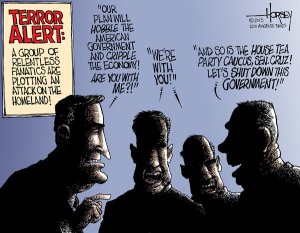 Well, it seems a shut down is eminent!
There are 233 Republicans in the House. Insiders estimate that three-quarters of them, or about 175 GOP lawmakers, are willing, and perhaps even eager, to vote for a continuing resolution that funds the government without pressing the Republican goal of defunding or delaying Obamacare.
On the other side, insiders estimate about 30 House Republicans believe strongly that Obamacare is such a far-reaching and harmful law that the GOP should do everything it can — everything — to stop it or slow it down. That includes precipitating a standoff leading to a government shutdown. “This isn’t just another bill,” Rep. Michele Bachmann, R-Minn., one of the most vocal of the 30, told me. “This isn’t load limits on turnip trucks that we’re talking about. This is … an extremely consequential bill that will impact every American, and that’s why you have such passionate opinions.”
Another 20 to 30 GOP members sympathize with that position but might be willing to compromise, except for the fact that they fear a primary challenge from the Right.
In the continuing resolution fight, it is the 30 most committed members, along with their 20-30 allies in the next-most-committed group, who are setting the House Republican agenda. The ones pushing for a fight over Obamacare, even if it leads to a shutdown, are controlling what the House does.
Which has led to the question: How can 30 Republicans beat 200 Republicans? How does that work?
Polls consistently show that Americans aren’t happy with Obamacare. They think the law will make health care more expensive, and decrease its quality. But a new survey of 1,976 registered votersfinds that only 33 percent believe that the health law should be repealed, delayed, or defunded. 29 percent believe that “Congress should make changes to improve the law,” 26 percent believe that “Congress should let the law take effect” and see what happens, and 12 percent believe that the law should be expanded. The bottom line? Voters are skeptical that Obamacare will live up to Democrats’ hype. But they also believe that it should be given a chance to succeed.
The new poll was conducted by the Morning Consult, a healthcare media company founded by Michael Ramlet. Ramlet, in evaluating the results of his survey, finds that voters are “unmoved by three months of the defund argument,” and that a majority would “blame congressional Republicans a lot for a government shutdown.”
How’s that working for Speaker Boehner? He really has to choose between his country and his tea party caucus. Many Republicans aren’t with him either. Does he really think he can keep his speakership either way?
Rep. Tom Cole (R-OK): Asked on MSNBC on Monday if a shutdown was “going to hurt the Republicans,” Cole said, “I do, but more importantly I think it’s going to hurt the American people.”
Rep. Charlie Dent (R-PA): “I’m prepared to vote for a clean resolution tomorrow… It’s time to govern. I don’t intend to support a fool’s errand at this point.”
Rep. Rodney Frelinghuysen (R-NJ): “Obamacare is definitely not ready for prime time. But I do not want the government to shut down. I think after voting against it some 40 times, we have represented our constituents and made our point.”
Rep. Chris Gibson (R-NY): “From my perspective, the desired end state remains the same — a delay of the Affordable Care Act/Obamacare and a temporary lifting of the sequester — both to January 2015… However, we need a successful strategy to get that implemented, and this approach will not do it.”
Rep. Michael Grimm (R-NY): “The circus created the past few days isn’t reflective of mainstream Republicans — it projects an image of not being reasonable. The vast majority of Republicans are pretty level-headed and are here to govern.”
Rep. Richard Hanna (R-NY): “[A]s a lifelong and consistent supporter of women’s rights and health care, I do not support addressing divisive social issues such as access to birth control on a last-minute continuing resolution.’’
Rep. Peter King (R-NY): “We should not be closing down the government under any circumstances… That doesn’t work, it’s wrong, and, you know, Obamacare passed. We have to try to defund it, we have to try to find ways to repeal it. But the fact is, we shouldn’t be using it as a threat to shut down the government.”
Rep. Devin Nunes (R-CA): “We’re pretty much out of options at this point. They’re all giddy about it. You know who benefits the most here from a shutdown? The Democrats benefit and they know that.”
Rep. Tom Rooney (R-FL): “The shutdown doesn’t do anything to help our reputation as an incompetent Congress,.. People hire us not to get to this point in the first place.”
Rep. Paul Ryan (R-WI): “We have to stay on the right side of public opinion…Shutting down the government puts us on the wrong side. The fight is on the debt limit.”
Rep. Frank Wolf (R-VA): Wolf warned that his party will be blamed in the case of a shutdown. “That’s the battle that’s going on in my party. There are some that are saying, ‘shut it down! … If we shut the government down, who’s going to fund the [Veteran Affairs] Hospital? Who’s going to fund the veteran who doesn’t have a leg? Who’s going to fund the FBI who’s working on a counter-terrorism case? Who’s going to fund cancer research?”
Exactly who is behind this push besides Cruz’s ego and a few maniacs like Bachmann?
Republicans and Democrats in Congress are trading blame ahead of Tuesday’s government shutdown, but there’s another culprit in DC’s latest dysfunction whose offices are not to be found in the gilded suites of the Capitol, but in a drab, fluorescent-lit office five blocks away. There, a team of organizers, lobbyists and 20-something social media specialists are harnessing the power of the Tea Party to drive a wrench into Congress’ gears. Heritage Action for America, the political arm of the once esteemed Heritage Foundation, has been working day and night for years to bring about just the crisis now gripping DC.
Since its founding in 2010, Heritage Action has worked aggressively to influence lawmakers on issues from immigration to agriculture to the budget. It uses a three-pronged strategy to twist arms on Capitol Hill: lobbying members on hot-button issues, ranking them publicly on how they vote, and getting word out far and wide when lawmakers buck the conservative line. That combination—unparalleled in either party—has given Heritage the ammo to take on the leadership of its own party, widening the gap between the conservative grassroots and their leaders in Congress. As Heritage’s clout accumulates, the group’s divisive style offers a window into the new way of doing business in Washington, where, thanks to redistricting, lawmakers are more worried about primary challengers than the opposition
I guess this is the revenge of outcasts like Demint and Grover Norquist who seem like prime candidates for the sociopath of the month club.
How long do you think this will last?

Thursday Reads: Who’s Really Running Things in the Middle East? . . . And Other News
Posted: September 26, 2013 Filed under: Criminal Justice System, Foreign Affairs, Hillary Clinton, Middle East, morning reads, polling, U.S. Economy, U.S. Politics | Tags: Dexter Filkins, government shutdown, iran, NPR's Fresh Air, Qassem Suleimani, Quds Force, Revolutionary Guard, Tea Party, Terry Gross 18 Comments
Good Morning!!
There’s a long article in the September 30 New Yorker by Pulitzer Prize-winning journalist Dexter Filkins about a powerful Iranian military leader named Qassem Suleimani. Sueimani is the Commander of the Quds Force. According to Wikipedia, the Quds Force is:
a special unit of Iran‘s Army of the Guardians of the Islamic Revolution (Revolutionary Guard). It has been tasked with “exporting” Iran’s Islamic revolution, and is responsible for “extraterritorial operations” of the Revolutionary Guard.
Filkins describes the functions Quds Force as follows:
The force is the sharp instrument of Iranian foreign policy, roughly analogous to a combined C.I.A. and Special Forces; its name comes from the Persian word for Jerusalem, which its fighters have promised to liberate. Since 1979, its goal has been to subvert Iran’s enemies and extend the country’s influence across the Middle East. Shateri had spent much of his career abroad, first in Afghanistan and then in Iraq, where the Quds Force helped Shiite militias kill American soldiers.

Qassem Suleimani
I have to admit that I haven’t read the entire article yet, but yesterday I heard a fascinating interview of Dexter Filkins by Terry Gross on her NPR show Fresh Air. You can listen to the interview at the link. It lasts about 44 minutes. Filkins covered the wars in Afghanistan and Iraq for the New York Times beginning in 2002. In addition, he is the author of the book The Forever War. Based on what I heard in the Fresh Air interview, just about everything many Americans think we know about Iran, Iraq, Syria and Iran’s powerful influence in the Middle East is going to have to be revised and updated. Even Filkins was surprised by what he learned through his research and reporting in Iran.
Here’s what Filkins writes about Suleimani:
Suleimani took command of the Quds Force fifteen years ago, and in that time he has sought to reshape the Middle East in Iran’s favor, working as a power broker and as a military force: assassinating rivals, arming allies, and, for most of a decade, directing a network of militant groups that killed hundreds of Americans in Iraq. The U.S. Department of the Treasury has sanctioned Suleimani for his role in supporting the Assad regime, and for abetting terrorism. And yet he has remained mostly invisible to the outside world, even as he runs agents and directs operations. “Suleimani is the single most powerful operative in the Middle East today,” John Maguire, a former C.I.A. officer in Iraq, told me, “and no one’s ever heard of him.”
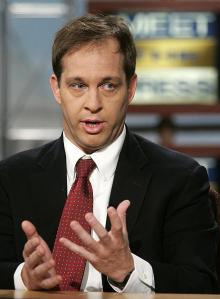
Dexter Filkins
According to Filkins, through Suleimani’s influence, after the U.S. took down Saddam Hussein and everything went to hell in Iraq, Iran has basically controlled what went on there; and now Iran is a powerful influence in the Syrian conflict. Here’s the introduction to the Filkins interview from Fresh Air site. Meet The Iranian Commander Pulling Strings In Syria’s War:
Perhaps the most important military commander in Syria’s civil war is not Syrian at all. He’s Iranian Maj. Gen. Qassem Suleimani, and he’s the subject of an article by Dexter Filkins in the current edition of The New Yorker.
For the past 15 years, Suleimani has been the chief of the Quds Force, a small but powerful branch of Iran’s Revolutionary Guard. He’s not a familiar name to Americans, but one former CIA officer described him to Filkins as “the single most powerful operative in the Middle East today.”
Filkins writes that Suleimani “has sought to reshape the Middle East in Iran’s favor, working as a power broker and as a military force: assassinating rivals, arming allies, and, for most of a decade, directing a network of militant groups that killed hundreds of Americans in Iraq. The U.S. Treasury Department has sanctioned Suleimani for his role in supporting the Assad regime, and for abetting terrorism.”
On Suleimani’s influence on the reshaping of the Middle East:
Qassem Suleimani — who is this extraordinarily powerful man behind the mask, very mysterious guy, very powerful guy — he was instrumental in 2010 in making sure that the Americans left no troops behind in Iraq. During the Iraq War, he supervised and directed militias which were responsible for hundreds of American deaths.
It appears, by the evidence, that the Iranians, and the Quds Force in particular, were behind the assassination of Rafik Hariri, the president of Lebanon, in 2005. Qassem Suleimani appears to be running or directing or at least playing a very large part in the war in Syria on behalf of the Assad government. So he’s everywhere, and, again, the Iranians have been extraordinarily aggressive over the past 15 years in asserting themselves in the Middle East, often at American expense.
Filkins also says that it’s clear the Iranians do want to develop nuclear weapons, and he doubts if the U.S. will be able to get them to agreed not to do it. The reason the Iranians are reaching out to the West right now is that the sanctions are really hurting them–basically the middle class in Iran has been decimated.
You can read more excerpts from the interview at the Fresh Air site. I plan to finish reading the Filkins article in the New Yorker today. I hope I’ve given you enough information to get you to read it too. I’m sure this article will be much discussed in the coming weeks.
Here’s Charles Pierce on the Filkins piece: The Limitless Bungling Of George W. Bush And Co.
Dexter Filkins has a long, fine piece in the September 30 New Yorker about one Qassam Suleimani, an Iranian who seems to be the Zelig of Middle East spookdom, and who is now currently working with the Assad government in Syria.
Since then, Suleimani has orchestrated attacks in places as far flung as Thailand, New Delhi, Lagos, and Nairobi-at least thirty attempts in the past two years alone. The most notorious was a scheme, in 2011, to hire a Mexican drug cartel to blow up the Saudi Ambassador to the United States as he sat down to eat at a restaurant a few miles from the White House. The cartel member approached by Suleimani’s agent turned out to be an informant for the U.S. Drug Enforcement Administration. (The Quds Force appears to be more effective close to home, and a number of the remote plans have gone awry.) Still, after the plot collapsed, two former American officials told a congressional committee that Suleimani should be assassinated. “Suleimani travels a lot,” one said. “He is all over the place. Go get him. Either try to capture him or kill him.” In Iran, more than two hundred dignitaries signed an outraged letter in his defense; a social-media campaign proclaimed, “We are all Qassem Suleimani.”
If you want evidence behind your essential instinct that the tangle in that part of the world is beyond our ability ever to untangle, you’ve got it here. But there is one other little tidbit that’s worth bringing up, given the fact that some officials formerly in the employ of C-Plus Augustus — most notably, David Frum — have snuck into the national dialogue again, probably through an unguarded window, instead of going off and living a penitent’s existence for what they did to the country.
(To be entirely fair, according to Filkins, Suleimani was formed by his participation in the savage Iran-Iraq War in which the United States, employing the brilliant realpolitik of blood-beast Henry Kissinger, helped both sides, guaranteeing that nobody would trust us thereafter. Genius!)
In other news,
Hillary had a few choice words for the Republicans who are trying to shut down the government in order to defund The Affordable Care Act. From the WaPo: Hillary Clinton says government shutdown ‘wouldn’t be the worst thing for Democrats’:
Hillary Rodham Clinton said Tuesday that if a “noisy minority” of Republican lawmakers force a government shutdown over funding for President Obama’s signature health-care law, they would face negative political consequences.
“It wouldn’t be the worst thing for Democrats if they tried to shut the government down,” said Clinton, a former secretary of state and potential 2016 Democratic presidential candidate. “We’ve seen that movie before and it didn’t work out so well for those so-called obstructionists.”
Clinton was referencing the political harm for Republicans in the mid-1990s when they forced a shutdown during husband Bill Clinton’s presidency.
“If they want to try to shut the government down, that’s on their head, that’s their responsibility,” she added.
Isn’t it great to have Hillary talking about politics again?
I’m really late with this post, so I’m going to wrap it up with a link dump:
From Gallup — Tea Party Support Dwindles to Near-Record Low: Republicans ambivalent about movement, while most Democrats oppose it
From Huffington Post — DC Exempts Itself From Federal Government Shutdown
From The Political Carnival: Don’t Buckle Your Seatbelt? Go To Jail — Or Your Death
From Vanity Fair, battles among the richie-riches in San Francisco’s toniest neighborhood —
Bluebloods & Billionaires
Scientific American — Peculiar Brain Signals Found in “Flat-Lined” Patient What does it really mean to be dead?
Now it’s your turn. What’s your recommended reading for today? Please let us know in the comment thread, and have a great day!
Sunday Night Open Thread: The Calm Before the Storm?
Posted: January 6, 2013 Filed under: Barack Obama, open thread, Republican politics, U.S. Economy, U.S. Politics | Tags: Debt Ceiling, Federal Budget, fiscal cliff, government shutdown, John Boehner, Mitch McConnell, sequester 37 Comments
I’ve been having this feeling all weekend that the entire country is holding its breath as we mark time until Washington DC blows sky high. Is anyone else feeling that way or is it just me? I’ve been somewhat out of the loop the past couple of days. I have some kind of sinus thingy and I ended up spending a lot of time updating my computer drivers and other software. But I’ve been surfing around this evening, and everything is looking very weird and wacky in the nation’s capital.
In the first place, why are Republicans all over the place threatening a government shutdown? And why aren’t Democrats countering the Republican lies? Failing to raise the debt limit won’t trigger a government shutdown. If the U.S. defaults on its debts it will trigger a national economic disaster–and perhaps a global meltdown. A shutdown would happen if Congress refused to appropriate funds to keep the government running. Defaulting on the debt would mean another lowering of our credit rating and higher interest on the debt in the future.
I can’t figure out if the Democrats are just giving the Republicans rope to hang themselves or if there is something else going on.
This morning on Dancin’ Dave’s Disco Dance Party, Mitch “Pruneface” McConnell wouldn’t respond to questions about the threatened “government shutdown.”
Pressed repeatedly on NBC’s “Meet the Press,” McConnell instead placed responsibility on President Obama for leading the country and avoiding a shutdown.
“I know what your question is,” McConnell said. “What I’m telling you is I haven’t given up on the president stepping up to the plate and tackling the single biggest issue confronting the country.”
Neither Dancin’ Dave nor McConnell addressed the most important issue–raising the debt ceiling. McConnell’s focus is squarely on cutting Social Security, Medicare, and Medicaid, but he wants the President to spell out the cuts. As Josh Marshall writes:
In other words, big cuts to key social insurance programs are not only the price of avoiding what would likely be a catastrophic government shutdown (a real one, not like what we had back in the 90s). But Democrats must also shield Republicans from the political consequences of cutting these programs by cutting them on the Republicans behalf.
McConnell apparently also claimed that “He Doesn’t Want Debt Ceiling Negotiations to Turn Into a Hostage Situation.”
In one of three Sunday talk show appearances, Senate Minority Leader Mitch McConnell said he wasn’t sure whether he’s prepared to “shoot the hostage” by letting the country default on its loans in the next round of the fiscal fight. While some Republicans are threatening to block a debt ceiling increase unless Democrats agree to major spending cuts, McConnell sidestepped the issue on ABC’s This Week. “It’s not even necessary to get to that point,” he said. “Why aren’t we trying to solve the problem? Why aren’t we trying to do something about reducing spending? … Waiting until the last minute is no way to run the government.” He added that he would not accept any new tax revenues in the next deal. “The tax issue is finished. Over. Completed. That’s behind us.”
Hmmmmm….
According to The Hill, some “appropriators” in Congress have been “working quietly to avoid government shutdown.”
House and Senate appropriators have been quietly working behind the scenes for months to craft 12 compromise annual spending bills to avoid a shutdown that is slated to occur when the current six-month stopgap spending bill expires.
That sounds ominous. Are these unnamed Congresscritters working out the details of “entitlement” cuts so they can whip them out at the last minute when everyone is desperate for an agreement?
“We’ve got most of it worked out,” said Rep. Mike Simpson (R-Idaho), the chairman on Interior and Environment appropriations subcommittee.
A Senate Democratic aide concurred that work is far along and will pick up again when the Senate returns Jan 22. Appropriators had been striving to attach an omnibus to the year-end “fiscal cliff” deal and new Senate Appropriations Chairwoman Barbara Mikulski (D-Md.) is ready to continue the effort.
The negotiations mean that disputes over individual programs and policy riders — such as those on abortion and defunding Obama’s health reform — that have exacerbated government shutdown crises like that in April 2011 are being minimized.
Nancy Pelosi did talk about the debt ceiling, and she recommended that Obama just take the bull by the horns and raise it himself.
House Minority Leader Nancy Pelosi (D-Calif.) urged the president on Sunday to drop his resistance to the idea and simply bypass the upcoming debate over raising the debt ceiling by deeming the entire cap unconstitutional.
Appearing on CBS’ “Face the Nation,” Pelosi offered her strongest endorsement to-date of the 14th Amendment option, which holds that Congress doesn’t have the power to use the debt ceiling as a hostage-taking device because the validity of the debt “shall not be questioned.”
Nancy Pelosi: Well, you ask the Republicans, because we always passed the debt ceiling. When President Bush was president, as he was incurring these massive debts, and the Republicans weren’t saying ‘boo’ at the time. There should be, this is a conversation where there should be no doubt. In fact, if I were president, I’d use the 14th Amendment, which says that the debt of the United States will always be paid.
Bob Schieffer: You would just go ahead and do it, you wouldn’t wait for the Congress?Nancy Pelosi: I would just go do it. But the Congress has incurred much of this debt. And so what are you saying, we incurred it but we’re not going to pay it? If you want to say, ‘We are not going to do it so much in the future,’ well that’s another thing. But you can’t say, ‘I’m not paying my past debts.’
Go Nancy, Go!!
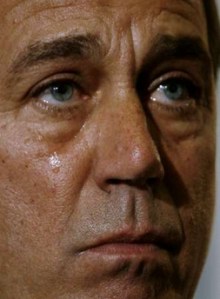
Now check this out from the Wall Street Journal: The Education of John Boehner.
What stunned House Speaker John Boehner more than anything else during his prolonged closed-door budget negotiations with Barack Obama was this revelation: “At one point several weeks ago,” Mr. Boehner says, “the president said to me, ‘We don’t have a spending problem.'” [….]
The president’s insistence that Washington doesn’t have a spending problem, Mr. Boehner says, is predicated on the belief that massive federal deficits stem from what Mr. Obama called “a health-care problem.” Mr. Boehner says that after he recovered from his astonishment—”They blame all of the fiscal woes on our health-care system”—he replied: “Clearly we have a health-care problem, which is about to get worse with ObamaCare. But, Mr. President, we have a very serious spending problem.” He repeated this message so often, he says, that toward the end of the negotiations, the president became irritated and said: “I’m getting tired of hearing you say that.”
Boehner, like McConnell announced there will be no more tax increases, period–only tax reform, and by that he means lower tax rates.
The speaker is adamant on two points: First, Republicans won’t be agreeing to any more tax increases during the next two years. “The tax issue is resolved,” he says, and it will be discussed only in the context of a broader debate about tax reform—specifically, lower rates. He dismisses the president’s declaration that any future budget cuts will have to be “balanced” with more tax hikes.
Second, Mr. Boehner says he won’t engage in any more closed-door budget negotiations with the White House, which are “futile.” He adds: “Sure, I will meet with the president if he wants to,” but House Republicans will from now on proceed with establishing a budget for the year following what is known as “regular order,” and they will insist that Harry Reid and Senate Democrats pass a budget—something they haven’t done in nearly four years—before proceeding.
The real showdown will be on the debt ceiling and the spending sequester in March….The debt bill is “one point of leverage,” Mr. Boehner says, but he also hedges, noting that it is “not the ultimate leverage.” He says that Republicans won’t back down from the so-called Boehner rule: that every dollar of raising the debt ceiling will require one dollar of spending cuts over the next 10 years. Rather than forcing a deal, the insistence may result in a series of monthly debt-ceiling increases.
The Republicans’ stronger card, Mr. Boehner believes, will be the automatic spending sequester trigger that trims all discretionary programs—defense and domestic.
It’s a long interview and it provides some insight into Boehner’s thinking, such as it is.
Roll Call has a piece called: Boehner Coup Attempt Larger Than First Thought
A concerted effort to unseat Speaker John A. Boehner was under way the day of his re-election to the position, but participants called it off 30 minutes before the House floor vote, CQ Roll Call has learned.
A group of disaffected conservatives had agreed to vote against the Ohio lawmaker if they could get at least 25 members to join the effort. But one member, whose identity could not be verified, rescinded his or her participation the morning of the vote, leaving the group one person short of its self-imposed 25-member threshold. Only 17 votes against Boehner were required to force a second ballot, but the group wanted to have insurance.Even with 24 members, the group would easily have been able to force a second ballot round, but the effort was aborted in frenetic discussions on the House floor.
“Aborted?” I thought Republicans were against that.
And did you hear that Thomas Gibson was arrested for DUI today?
The 50-year-old actor, known for his roles on “Criminal Minds” and “Dharma & Greg,” was driving in downtown L.A. at around 1:00 a.m. on Jan. 6 when he attempted to continue through a part of town that had been sectioned off for a half marathon.
Sources tell The Huffington Post that the race was not over when Gibson drove his Audi SUV right onto the course, interrupting several runners. The race started at 9 p.m., but the road was still blocked off and authorities were making sure no vehicles were let through.
According to TMZ, Gibson was stopped by police and told to go a different way, but he proceeded anyway.
I hope that won’t cause any problems for my favorite TV show, Criminal Minds.
So what are you all hearing? Are we headed for the storm of the century?
Tuesday Reads
Posted: September 27, 2011 Filed under: 2012 presidential campaign, Barack Obama, Democratic Politics, U.S. Economy, U.S. Military, U.S. Politics | Tags: Arch West, civil right violations, Dead Sea Scrolls, Deputy Inspector Anthony V. Bologna, Doritos, Gallup poll, government shutdown, jobs, LBJ, NYPD, occupy Wall Street, Paul Street, pepper spray, police brutality 21 Comments
Good Morning!! I’ve got a bit of a potpourri of news reads for you this morning. First, a followup to my post from Sunday night on the Occupy Wall Street protests in New York City.
The police officer who so enjoyed pepper spraying young women at the protest has been identified.
Saturday’s peaceful Occupy Wall Street protests in New York City were marred by what appears to be excessive use of force by several police officers, as video shows, and one officer who calmly walked up to police-fenced protesters and pepper-sprayed them, point blank, has been identified as Deputy inspector Anthony V. Bologna, of NYPD Patrol Borough Manhattan South, according to Common Dreams.
In response to the video (embedded in this article), the Police Department’s chief spokesman, Paul Browne, said the officer used pepper spray “appropriately,” according to the New York Times. “Pepper spray was used once,” he said, adding “after individuals confronted officers and tried to prevent them from deploying a mesh barrier, something
that was edited out or otherwise not captured in the video.”
I don’t buy that argument, and I doubt if many reasonable people will. Why was the mesh barrier even necessary in the first place? The Common Dreams link above has information on where to send complaints about Bologna’s behavior.
According to the UK Guardian, Bologna was accused of civil rights violations previously:
The Guardian has learned that the officer, named by activists as deputy inspector Anthony Bologna, stands accused of false arrest and civil rights violations in a claim brought by a protester involved in the 2004 demonstrations at the Republican national convention.
Then, 1,800 people were arrested during protests against the Iraq war and the policies of president George W Bush.
Alan Levine, a civil rights lawyer representing Post A Posr, a protester at the 2004 event, told the Guardian that he filed an action against Bologna and another officer, Tulio Camejo, in 2007. The case, filed at the New York Southern District Court, is expected to be heard next year.
Levine said that when he heard about the pepper spray incident “a bunch of us were wondering if any of the same guys were involved”.
You can read the details at the Guardian link.
You probably heard that the Senate has passed a “stopgap” bill that is designed to prevent a government shutdown by Republican America haters. From the Wall Street Journal:
The Senate, on a 79-12 vote, approved a bill late Monday to fund the government through Nov. 18. The vote came after the main sticking point in negotiations between the two parties was resolved.
Lawmakers had been in a standoff over Republicans’ demands for new budget cuts as a condition for sending additional money to the Federal Emergency Management Agency to aid victims of natural disasters through the end of the fiscal year on Friday.
But that dispute vanished Monday when FEMA announced that it may not run out of money before then—giving it more breathing room than expected. FEMA’s new statement about its finances cleared the way for Congress to put in place a funding mechanism for at least the start of the fiscal year that begins Saturday….
Under the compromise struck Monday night, the Senate approved two bills. One would keep the government running through Nov. 18, which the House is expected to pass when it returns from a recess next week. But to keep the government afloat until the House returns, a second measure was approved for funding through Oct. 4. That is expected to clear the House by voice vote before week’s end.
Apparently Boehner has given the bill his blessing. So I guess we can relax now and look forward to another squabble over keeping the government going in November.
Yesterday, Gallup reported that Americans are really disgusted with the U.S. government–and in “historic” numbers.
A record-high 81% of Americans are dissatisfied with the way the country is being governed, adding to negativity that has been building over the past 10 years.
Majorities of Democrats (65%) and Republicans (92%) are dissatisfied with the nation’s governance. This perhaps reflects the shared political power arrangement in the nation’s capital, with Democrats controlling the White House and U.S. Senate, and Republicans controlling the House of Representatives. Partisans on both sides can thus find fault with government without necessarily blaming their own party.

There’s a lot more at the link. Obama must be delusional if he thinks he’s going to be reelected just on the basis of some “inspiring” speeches. He’d better get busy, stay off the golf course and basketball court, and actually do something about jobs pretty soon or he’s a goner.
I learned from Dakinikat yesterday that Paul Street, who has authored two books about Obama, agrees with me that it’s time for this President to do an LBJ.
What does Obama have to look forward to in the future if he insists on trying for a second term? The stalled profits system seems ready to double dip back into full technical recession (the human recession never stopped beneath the mild statistical recovery), fitting him with the same fatal yoke of economic powerlessness that deep-sixed Herbert Hoover, Jimmy Carter and the first George (H.W) Bush’s hopes for second term. Unemployment remains sky high, contributing to a recent low in American history: the largest number U.S. citizens (46 million) ever recorded below the federal government’s notoriously inadequate poverty level. Obama’s job approval is at an all time low (43 percent), 7 points under his disapproval rating (50 percent). A preponderant majority of Americans say that the country is “on the wrong track.”
Four months after his empty, politically calculated execution and sea-dumping of Osama bin-Laden., Obama is widely perceived as weak and ineffective, as too eager to compromise with – and as incapable of standing up to – his (supposed) right-wing enemies. His party has recently lost two special House elections and one of those defeats came in a district Democrats had previously held for 88 years in a row. He has staked his future prospects on a highly flawed jobs bill – legislation that may well not pass the House and that is scaring off many conservative Democratic legislators. Most Americans think the bill won’t work.
The president is starting to look like the potential victim of a landslide in November of 2012. The Democratic base is widely disillusioned with him. Even many among his fake-progressive pseudo-liberal dead-end defenders sometimes squawk about his conservative corporatism and unwillingness to govern in accord with his idealistic campaign promises. Liberal and progressive Democratic elected officials in the House and Senate have been grumbling about his center-right proclivities for some time now. It is one thing to rightwardly triangulate on the backs of welfare mothers and declining unions in the mode of Bill Clinton; it is another thing to do so at the expense of the broadly popular programs Social Security and Medicare, all while passing on hyper-regressive Republican tax cuts for the obscenely rich and powerful.
And so on. If you haven’t read the whole thing yet, please do. Especially this part:
If he cared about his party, Obama would step down and give the nomination to Hillary Clinton, determined by a recent Bloomberg poll to be “the most popular national political figure in America today.” Ms. Clinton has distinct advantages over Obama in running against Perry or Mitt Romney in 2012. She is not a member of Congress, which has even lower popular approval than Obama. She is associated with economic prosperity thanks to the long neoliberal Clinton boom of the 1990s. And she carries a reputation for toughness, quite different from Obama’s emerging legacy as a 98-pound weakling who gets kicked around on the policy beach by bullies like John Boehner, Sean Hannity, and Eric Cantor. (For those of us on the radical left, a Hillary Clinton presidency might have the benefit of inducing at least some less confusion and tepidness among progressives than “the first black president.”)
Of course Obama doesn’t care about his party, but maybe he’ll care about his own reputation after a few more humiliating defeats by the Republicans. One can only hope.
In other news, Arch West, the inventor of Doritos, has died.
When Arch West, the man credited with inventing Doritos, is buried on Oct. 1, he will be joined by a sprinkling of the bright orange chips that have become a cheesy, tangy, American institution.
His daughter, Jana Hacker of Allen, Texas, told the Dallas Morning News that the family plans on “tossing Doritos chips in before they put the dirt over the urn.”
West, who was 97 when he died of natural causes last week, was a former Frito-Lay executive. He reportedly came up with the idea of Doritos when he was on vacation with his family in Mexico and came upon a snack shack selling fried tortilla chips.
The Dallas Morning News reports that Frito-Lay officials were not too impressed with the idea, but they rolled out the chips after consumer testing proved positive. Doritos were first introduced in Southern California in 1964, according to a Frito-Lay spokesperson; Doritos Toasted Corn launched nationally in 1967.
Finally, I was very excited to learn that the Dead Sea Scrolls can now be viewed on line.
High-quality digitized images of five of the 950 manuscripts were posted for free online for the first time this week by Google and the Israel Museum in Jerusalem, where the scrolls are housed. The post includes an English translation and a search feature to one of the texts, the Great Isaiah Scroll.
The scroll, one of seven animal skin parchments discovered in 1947 a cave in Wadi Qumran in the West Bqnk, is the largest and best preserved in the collection.
“Some of these images are appearing for the first time in Google — what no one has seen for 2,000 years and no scholar since the Dead Sea Scrolls were found,” says James Charlesworth, director and editor of the Princeton Dead Sea Scrolls Project, who is one of the few who has handled the ancient pieces of parchment. “Now images and letters that were never found are appearing in Google.”
Charlesworth said the new images allow him to decipher in 30 minutes fragments of documents that once took 14 hours to analyze. The digital project will preserve documents that were eaten by worms and so fragile they’re turning to dust or rotting away.
Here’s some more information on the project from the Google blog.
That’s all I’ve got for today. What are you reading and blogging about?
Another Standoff
Posted: September 23, 2011 Filed under: Federal Budget, Federal Budget and Budget deficit, U.S. Politics | Tags: FEMA funding, government shutdown, Harry Reid, John Boehner 14 CommentsLet’s see. Selling out on tax cuts to millionaires was supposed to be the end all to all stand offs. Didn’t  happen. Putting together a likely unconstitutional supercongress was supposed to be the end all to all stand offs. Yeah. That really worked well, didn’t it?
Things in our federal government are so broke and so dysfunctional that the day-to-day business of governing is threatened on a quarterly basis. This is nuts. Republicans offered up a bandage approach in the House. Harry Reid’s gone Dirty Harry on them.
Washington lurched toward another potential government shutdown crisis Friday, as the House approved by a 219-203 vote a GOP-authored short-term funding measure designed to keep the government running through Nov. 18 and Democrats in the Senate immediately vowed to reject the bill.
“We expect a vote fairly quickly,” said Senate Majority Leader Harry Reid (D-Nev.) on Friday morning.
In an after-midnight roll call, House Republican leaders persuaded conservatives early Friday morning to support a stop-gap measure nearly identical to one they had rejected just 30 hours earlier. By a narrow margin, 213 Republicans supported the plan, along with six Democrats; 179 Democrats opposed it, joined by 24 Republicans.
The bill, which will keep federal agencies funded through Nov. 18, passed over staunch objections from House Democrats, who opposed a provision that would pair increased funding for disaster relief with a spending cut to a program that makes loans to car companies to encourage energy efficient car production.
But House Speaker John Boehner’s (R-Ohio) victory is likely to be short-lived. Reid said late Thursday that the measure could not pass his chamber, with a vote expected sometime Friday. A Senate defeat would leave Congress at a new standoff.
“It fails to provide the relief that our fellow Americans need as they struggle to rebuild their lives in the wake of floods, wildfires and hurricanes, and it will be rejected by the Senate,” Reid said of the House bill.
Without a resolution, the Federal Emergency Management Agency’s disaster relief fund will run out of money early next week and the rest of the government would be forced to shutdown Oct. 1.
What exactly did Agent Orange and the Rindettes offer up that made Harry mad?
On Wednesday night, House Republicans failed to pass a continuing resolution to keep the government funded beyond Sept. 30, as 48 Republicans cut ranks with their leadership and voted against the measure (as did all but six Democrats, who object to the bill’s level of disaster aid and cuts to a clean vehicle manufacturing program). House Speaker John Boehner (R-OH) was reportedly incensed at the members who abandoned him on the vote, deriding them as “know-it-alls who have all the right answers.”
But early this morning, the House was able to pass a CR, after Boehner and the Republican leadership added a $100 million cut to a Department of Energy clean-energy loan program. Other than that cut, the bill was exactly the same as the one the House defeated on Wednesday. But the additional cut was enough to entice 23 Republican members into flipping their votes.
Boehner has to be one of the worst Speakers in history. He couldn’t walk a dog through the house successfully. Here’s more on Reid’s response.
Democrats opposed the GOP bill en masse because it partially offsets $3.65 billion in funding for the Federal Emergency Management Agency (FEMA) with a $1.5 billion cut to a separate Department of Energy manufacturing loan program.
“The bill the House will vote on tonight is not an honest effort at compromise. It fails to provide the relief that our fellow Americans need as they struggle to rebuild their lives in the wake of floods, wildfires and hurricanes, and it will be rejected by the Senate,” Senate Majority Leader Harry Reid (D-Nev.) said in a statement Thursday night before the House vote.
“I was optimistic that my House Republican colleagues would learn from their failure yesterday and move towards the middle. Instead, they moved even further towards the Tea Party.”Reid said the Senate was ready to stay in session next week, potentially canceling its scheduled recess. The House bill would fund the government through Nov. 18.
By pushing ahead with a tweaked version of his original bill, Boehner is hoping to jam the Senate with time running out.
It hasn’t even been a year yet and we’ve already had three hostage taking situations. WTF is wrong with our country? We can’t even help our own people any more that have been devastated by flooding, tornadoes, wild fires and hurricanes with out turning in to a government is the problem moment?
update: Bohner lies in press conference.
“With FEMA expected to run out of disaster funding as soon as Monday, the only path to getting assistance into the hands of American families immediately is for the Senate to approve the House bill,” Boehner said in an official statement Friday morning.
Well, that’s not exactly true. The House legislation received only 36 votes in the Senate. As noted above, the Senate passed a stand-alone disaster bill last week, which the House could take up and pass instead of scattering to the four winds.
On the Senate floor just after the House bill was tabled, Reid and Senate Minority Leader Mitch McConnell (R-KY) reluctantly agreed to hold a Monday vote on compromise legislation to top-off FEMA’s disaster account, and keep the federal government funded. McConnell urged Reid to hold a Friday vote, but Reid asked for delay, with the expectation that cooler heads will prevail over the weekend. McConnell, Reid, Boehner and House Minority Leader Nancy Pelosi (D-CA) will negotiate through the weekend to break the gridlock.

 peej
peej Carissa
 bostonboomer
 dakinikat
 ecocatwoman
 mablue2
 Mama Lopez
 peggysue22
 quixote
 skydancingguestblogger
 Mona (aka Wonk the Vote)



 Sky Dancing
Recent Comments