President Obama’s executive action on immigration tops the news today. Ferguson is a close second. I’ll be focusing mostly on those two stories in this post.
Immigration
Before I get started, I want to point you to a new post by Darren Hutchinson of Dissenting Justice. It will give you some reality-based ammunition to deal with crazy wingnut friends, relatives, and Facebook and Twitter followers.
FACT: Consistent with the Constitution, the INA gives the Executive Branch (President, Homeland Security, Attorney General, and Secretary of State) the power to enforce immigration laws (8 U.S.C. Sect. 1103-1104)….
FACT: The Executive Can “Cancel” the Removal of Certain Deportable Individuals.
The INA allows the Attorney General to cancel removal (deportation) or adjust the status of certain categories of undocumented individuals. The statute explicitly spells out the criteria for doing so. Thus, the statute provides an “intelligible criteria” for the Attorney General to follow. (8 U.S.C. Section 1229b(a)-(b))….
The Executive Can Give Temporary Protected Status to Certain Deportable Individuals. The INA also allows the Attorney General to grant “Temporary Protected Status” (TPS) to deportable individuals from certain countries that the Attorney General has placed on a TPS list. As required by Supreme Court doctrine, the INA gives SPECIFIC guidelines – or an intelligible principle – for the Attorney General to follow when determining whether to give TPS designation to a country. The statutory factors include serious conditions in the individual’s home country, like armed conflict; natural disasters; a request for temporary protected status by the country; or “extraordinary and temporary conditions” that preclude the safe return of the individual, so long as TPS does not conflict with the interests of the US. (8 U.S.C. Sections 1254a-i)
Those are the highlights. There’s more at the link. I plan to save Hutchinson’s post for future reference. I’m thinking of printing it out in case I get in a political argument with my brother over Thanksgiving dinner.
Obama has been vilified from day one by people who obviously have never read the Constitution or any U.S. laws dealing with their various political hobby horses, and I’m sick and tired of it.
You all know I not a fan of Obama when he ran for president in 2008, and I still think he’s a conservative technocrat who is far to willing to support privatization of public services. But he is the President of the United States now. I support his efforts to reform immigration laws. He’s only taking executive action because Congress is full of stupid and irrational people who are too lazy or stubborn to cooperate with him. Sadly, the DC media is largely made up of wealthy, privileged people who got their jobs because through nepotism and/or because they attended elite universities and are too lazy or stupid to provide accurate information to the public. Therefore, people who don’t focus on politics like we do get false information from TV news or “journalists” who do not understand what journalism is.
The president’s executive action would delay deportation for the undocumented mother of a child born in the U.S. on Thursday — but not an undocumented mother who gave birth here one day later. Similarly, the president has offered deferrals to children brought to this country by their parents before their 16th birthday — but not a few weeks after.
Such deadlines serve a purpose: They’re meant to discourage new immigrants from coming in the future, or to dissuade women already here from giving birth with the goal of securing deferrals. But they also show that the president’s action falls far short of a comprehensive solution. It offers, instead, a fragmented answer that will leave many immigrants disappointed.
Now that President Obama has announced his executive action to temporarily shield millions from deportation, confirming the administration’s view that this move is well within his authority, the battle now shifts to a political fight over the policy itself, and over whether it violates “political norms.” Is this action so provocative an affront to Congress that it sets a precedent for future GOP presidents to use discretion to selectively enforce laws liberals like?
Obama’s action temporarily shields from deportation the parents of children who are U.S. citizens and legal residents, and also expands the program (Deferred Action for Childhood Arrivals) to protect people brought here illegally as children. But it excludes parents of DACA recipients.
The reason for this offered by the OLC memo is that protecting parents of legal residents is in line with Congressional intent, as expressed in statute, while protecting DACA parents isn’t:
[T]he parents of DACA recipients are differently situated from the parents of U.S. citizens and LPRs [Legal Permanent Residents] under the family-related provisions of the immigration law. Many provisions of the INA [Immigration and Nationality Act] reflect Congress’ general concern about separating individuals who are legally entitled to live in the United States and their immediate family members….But the immigration laws do not express comparable concern for uniting persons who lack lawful status (or prospective lawful status in the United States with their families…Extending deferred action to the parents of DACA recipients would therefore expand family-based immigration relief in a manner that deviates in important respects from the immigration system Congress has enacted.
This legal opinion probably precludes any future expansion of this program to cover parents of DACA recipients. And it underscores two things: First, that the proposal is heavily focused on providing relief from humanitarian hardship endured by U.S. citizens and permanent residents, a longtime intention of Congress, as expressed in statute. Second, it shows that the proposal’s legal rationale is tightly circumscribed to reflect that Congressional intent.
I have some serious news reads for you this morning, but–just because it’s a feel-good story–I’m going to begin with one more Market Basket update. The Boston Globe published an article yesterday about the Market Basket store I shop at in, in Burlington, MA: A Market Basket store, returning to life. Recall that the shelves were mostly empty when the employees returned to work on Thursday morning.
The doors of the tractor-trailer open on a bounty of chicken, Swiss cheese, and sliced onions.
A swarm of grocery clerks in blue jackets and managers in red descends on the loading dock, using hand-operated electric jacks to spear pallets of food that the workers stack in the cavernous storage rooms in the back of the Market Basket supermarket….
Bob McKeown fills a display case with fresh-from-the-fryer doughnuts, a few garnished with smiley faces made of jelly. Samantha Bond decorates a cake to honor the moment, etching the words “Market Basket Strong” in icing and an image of the yellow giraffe that served as the employees’ mascot of sorts during the protest — for “sticking their necks out.” ….
This Market Basket store in Burlington came back to life over the last few days, resuscitated by a cadre of employees eager to get to work after the six-week protest that forced the return of Arthur T. Demoulas as head of the family food empire. Like the others in the 71-store chain, the Burlington store was the scene of a rapid restocking, a huge task involving thousands of pounds of produce, meat, bread, canned goods, and other groceries….
The first morning back had been about congratulations and hugs and handshakes as customers came in more to talk to employees than to shop. Amid the celebrations, workers admitted to anxious moments during the stoppage. They worried their defiance would cost them their jobs — “I’ve been living on antacids for the last six weeks,” one said — and couldn’t wait to get back to the unglamorous but satisfying routine of running a supermarket.
That routine had returned in full by early Friday.
It’s a nice story, and I’m so happy for these workers. Isn’t it great that this happened over Labor Day weekend?
The U.S. military launched an airstrike in Somalia on Monday targeting the leader of the al Qaeda-affiliated group behind the Kenya mall massacre. U.S. officials told NBC News that a military drone launched Hellfire missiles at at least two vehicles in a remote area of southern Somalia. Sources said Ahmed Abdi Godane, the top leader of al Shabab, was the attack’s target. Al Shabab claimed responsibility for last September’s Westgate Mall siege that left at least 67 dead and around 200 injured. One U.S. security source described Godane as “operationally savvy and ideologically driven, with aspirations off the charts.”
Rear Adm. John Kirby, the Pentagon’s press secretary, said in a statement late Monday that “we are assessing the results of the operation and will provide additional information as and when appropriate.” Godane has served as the group’s leader since a U.S. airstrike killed his predecessor Aden Hashi Ayro in 2008. In October, U.S. commandos launched raids in Somalia seeking to capture Godane, who is also known as Mukhtar Abu Zubeyr. Reuters reported that Godane’s close associate, Ahmed Mohamed Amey, was killed by a U.S. airstrike in January. In an online audio message following the Westgate Mall massacre, Godane said Kenya should be “prepared for an abundance of blood that will be spilt in your country.” Al Shabab, which means “The Youth” in Arabic, seized much of southern Somalia in 2006 before Somali forces and African peacekeeping troops ousted it five years later.
Al-Shabab, or “The Youth,” is an al-Qaeda-linked militant group and U.S.-designated Foreign Terrorist Organization fighting for the creation of a fundamentalist Islamic state in Somalia. The group, also known as Harakat al-Shabab al-Mujahideen, and its Islamist affiliates once held sway over Mogadishu and major portions of the Somali countryside, but a sustained African Union military campaign in recent years has weakened the group considerably. Still, security analysts warn that the group remains the principal threat in a politically volatile, war-torn state.
Al-Shabab’s terrorist activities have mainly focused on targets within Somalia, but it has also proven an ability to carry out deadly strikes in the region, including coordinated suicide bombings in Uganda’s capital in 2010 and a deadly raid on a Nairobi mall in 2013. Washington fears the group, which has successfully recruited members of the Somali-American diaspora, may orchestrate strikes on U.S. soil. In recent years, the United States has pursued a two-pronged policy in Somalia: providing funding, training, and logistical support to UN-backed African forces battling al-Shabab, while escalating counterterrorism operations including Special Forces and armed drones….
Somalia, one of the most impoverished countries in the world, has seen a number of radical Islamist groups come and go in its decades-long political tumult. The group analysts cite as al-Shabab’s precursor, and the incubator for many of its leaders, is Al-Ittihad Al-Islami (aka Unity of Islam), a militant Salafi extremist group that peaked in the 1990s after the fall of the Siad Barre military regime (1969-1991) and the outbreak of civil war.
AIAI, which sought to establish an Islamist emirate in Somalia, sprang from a band of Middle Eastern-educated Somali extremists and was partly funded and armed by al-Qaeda chief Osama bin Laden. Many of its fighters, including current al-Shabab commanders, fled the country and fought in Afghanistan in the late 1990s after being pushed out by the Ethiopian army and its Somali supporters. The group was designated a terrorist organization by the U.S. State Department in the days after the September 11, 2001 attacks.
In 2003, a rift developed between AIAI’s old guard, which had decided to create a new political front, and youth members who sought the establishment of a “Greater Somalia” under fundamental Islamic rule. The hardliners eventually joined forces with an alliance of sharia courts, known as the Islamic Courts Union, serving as its youth militia in the battle to conquer Mogadishu’s rivaling warlords. Al-Shabab and the ICU wrested control of the capital in June 2006, a victory that stoked fears of spillover jihadist violence in neighboring Ethiopia, a majority Christian nation.
President Barack Obama authorized the new military action, broadening U.S. operations in Iraq amid an international outcry over the threat to Amerli’s mostly ethnic Turkmen population.
U.S. aircraft delivered over a hundred bundles of emergency supplies and more aid was dropped from British, French and Australian planes, officials said, signaling headway in Obama’s efforts to draw allies into the fight against Islamic State.
Iraqi army and Kurdish forces closed in on Islamic State fighters on Saturday in a push to break the Sunni militants’ siege of Amerli, which has been surrounded by the militants for more than two months.
Armed residents of Amerli have managed to fend off attacks by Islamic State fighters, who regard the town’s majority Shi’ite Turkmen population as apostates. More than 15,000 people remain trapped inside.
“At the request of the government of Iraq, the United States military today airdropped humanitarian aid to the town of Amerli, home to thousands of Shia Turkmen who have been cut off from receiving food, water, and medical supplies for two months by ISIL,” Rear Admiral John Kirby, the Pentagon press secretary, said, using an alternative name for Islamic State.
“In conjunction with this airdrop, U.S. aircraft conducted coordinated air strikes against nearby ISIL terrorists in order to support this humanitarian assistance operation,” he said, adding that a key objective was to prevent a militant attack on civilians in the town.
President Obama leaves for Europe Tuesday with stops in Estonia and a NATO summit in Wales amid escalating crises in Ukraine and in Iraq and Syria, crises that are having a direct impact on a number of European nations.
While the Russian threat in Ukraine will be the focus of the upcoming summit, the meeting also puts President Obama, Secretary of State John Kerry and Defense Secretary Chuck Hagel face to face with European countries who may be willing to join the U.S. in dealing with the other crisis in Iraq and Syria.
Officially, however, NATO says it doesn’t want to be involved in dealing with the Islamic militant group called the Islamic State of Iraq and Syria (ISIS) that has swept across Iraq and Syria and poses a growing threat to the U.S. and parts of Western Europe that might be targeted by foreign fighters.
Why is Obama stopping in Estonia?
“It is clearly not accidental that the president has decided to stop in Estonia on the way to the NATO Summit. The two stops are essentially part of the same effort to send a message to the Russians that their behavior is unacceptable,” said Charles Kupchan, the White House’s senior director for European Affairs.
Estonia, like Ukraine, has a large Russian population and is concerned about the potential of pro-Russian unrest there too. But Kupchan said Mr. Obama will send the message that the Article 5 commitment to common defense of other nations is ironclad.
“Russia, don’t even think about messing around in Estonia or in any of the Baltic areas in the same way you have been messing around in Ukraine,” Kupchan said the president would relay to allies there.
Mr. Obama will meet with the leaders of Estonia, Latvia and Lithuania and also speak to young people there.
Read more details about the NATO Summit at the link.
MOSCOW — With NATO leaders expected to endorse a rapid-reaction force of 4,000 troops for Eastern Europe this week, a senior Russian military official said on Tuesday that Moscow would revise its military doctrine to account for “changing military dangers and military threats.”
In an interview with the Russian state news agency RIA Novosti, the official, Mikhail Popov, deputy secretary of Russia’s military Security Council, called the expansion of NATO “one of the leading military dangers for the Russian Federation.”
Mr. Popov said Russia expected that leaders of NATO would seek to strengthen the alliance’s long-term military presence in Eastern Europe by establishing new military bases in the region and by deploying tanks in Estonia, a member of NATO that borders Russia.
“We believe that the defining factor in our relationship with NATO remains the unacceptability for Russia of plans to move military infrastructures of the alliance to our borders, including by means of expanding the bloc,” Mr. Popov said.
The New York Times also has an important story about the sex-trafficking scandal in Great Britain. I read about it at the Guardian a few days ago, but we haven’t discussed it here. The Times reports, Years of Rape and ‘Utter Contempt’ in Britain. Here’s the introduction:
ROTHERHAM, England — It started on the bumper cars in the children’s arcade of the local shopping mall. Lucy was 12, and a group of teenage boys, handsome and flirtatious, treated her and her friends to free rides and ice cream after school.
Over time, older men were introduced to the girls, while the boys faded away. Soon they were getting rides in real cars, and were offered vodka and marijuana. One man in particular, a Pakistani twice her age and the leader of the group, flattered her and bought her drinks and even a mobile phone. Lucy liked him.
The rapes started gradually, once a week, then every day: by the war memorial in Clifton Park, in an alley near the bus station, in countless taxis and, once, in an apartment where she was locked naked in a room and had to service half a dozen men lined up outside.
She obliged. How could she not? They knew where she lived. “If you don’t come back, we will rape your mother and make you watch,” they would say.
At night, she would come home and hide her soiled clothes at the back of her closet. When she finally found the courage to tell her mother, just shy of her 14th birthday, two police officers came to collect the clothes as evidence, half a dozen bags of them.
But a few days later, they called to say the bags had been lost.
“All of them?” she remembers asking. A check was mailed, 140 pounds, or $232, for loss of property, and the family was discouraged from pressing charges. It was the girl’s word against that of the men. The case was closed.
God, what a horrible story! Here’s a related post at The Daily Beast, The Psychology of Sex Slave Rings, by Charlotte Lytton. Lytton asks a controversial question, “are grooming rings endemic within certain cultures?”
Back in the USA, CNN reports that the FBI is investigating a hacker who released nude photos of Jennifer Lawrence and several other female celebrities over the weekend. That’s good news. I hope they put catch the culprit and put him in prison for a very long time.
Former U.S. House Majority Leader Eric Cantor will join investment bank Moelis & Co as vice chairman and managing director, the company said, adding that Cantor will also be elected to its board….
“Eric has proven himself to be a pro-business advocate and one who will enhance our boardroom discussions with CEOs and senior management as we help them navigate their most important strategic decisions,” Moelis CEO Ken Moelis said in a statement.
The apparent (but not finalized) decision by the White House to push executive action on immigration reform past the November midterms means there is no forcing mechanism to create a shutdown fight when government funding runs out Sept. 30th. Qorvis’ Stan Collender, a top budget expert, emails: “I never thought a shutdown was likely this fall (next March is another issue), but in a rational world delaying action on immigration should kill any chance of one happening. Then again — Benghazi, Obamacare, etc”
So, those are this morning’s breaking news headlines. What else is happening? Please post your thoughts and links in the comment thread, and have a terrific Tuesday!
Did you like this post? Please share it with your friends:
Media reports (based on the Sheriff’s statement) on Robin Williams’ death are still saying the cause of his death is a “suspected suicide.” From the New York Times:
The Marin County sheriff’s office said in a statement that it “suspects the death to be a suicide due to asphyxia.” An investigation was underway.
The statement said that the office received a 911 call at 11:55 a.m. Pacific time, saying that a man had been found “unconscious and not breathing inside his residence.” Emergency personnel sent to the scene identified him as Mr. Williams and pronounced him dead at 12:02 p.m.
I can’t help but be curious about this–does that make me a bad person? My mind keeps going over possible scenarios, wondering how he died and why it isn’t clearly a suicide. I hope we’ll eventually find out what happened, so I can stop having disturbing visual thoughts about it. As someone who has strugged with depression and addiction, I can understand the agony that must have driven Williams to take his own life, but I wish he had reached out to someone first.
The NYT article has some interesting background on Williams’ childhood that I had never heard before.
The privileged son of a Detroit auto executive who grew up chubby and lonesome, playing by himself with 2,000 toy soldiers in an empty room of a suburban mansion, Mr. Williams, as a boy, hardly fit the stereotype of someone who would grow to become a brainy comedian, or a goofy one, but he was both.
This morning the Detroit Free Press republished an article from 1996 in which Williams talks about his childhood home. The interview took place “before the release of the film “Jack.”
“It’s gone; it doesn’t exist anymore, ” says Williams, the winsome memory of his childhood sanctuary written all over his face. Of course, everything is written on Williams’ face: He might as well have a sign in his hair that says, “Post bills here.”
Williams plays an overgrown — and I mean way overgrown — 10-year-old child in “Jack, ” which opens Friday. He’s recalling his own childhood in Bloomfield Hills in a home at the corner of Woodward and Long Lake, which, in his memory, was little short of a fairyland.
“It was a giant, beautiful old mansion, with a gatehouse, an empty garage with room for 25 cars, barns, and there was a very wonderful old English man, Mr. Williams, who looked after the gardens, ” Williams says. He is looking out the balcony window of his Los Angeles hotel suite onto a busy street, but Williams clearly is visualizing the past.
“We didn’t own it; we just rented it, ” says Williams, whose father was an auto executive. “Then we moved to Chicago, and when we came back to Detroit a few years later, we just lived in an apartment. And it was very different, you know. But the first house, it was so wonderful, so peaceful. There was no one for miles around. Only this giant golf course with people named Tad whacking the old ball.”
It’s a nice interview; you can read the rest at the link.
Thinking about Robin Williams’ movies reminded me that my Dad and I went to see Robert Altman’s Popeye together in 1980 when I was home in Indiana for a visit. That was Williams’ very first film. We both really enjoyed it. Williams was perfect as Popeye and Shelley Duvall was a marvelous Olive Oyl. The New York Daily News has a nice list of Williams’ finest performances: From ‘Popeye’ to ‘Good Will Hunting,’ the actor’s most iconic roles.
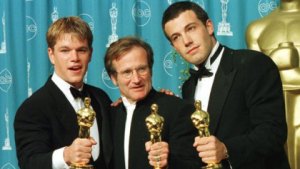
Of course Williams has a Boston connection too. He won an academy award for his role in Good Will Hunting. A great scene from the movie was shot on a bench in Boston Garden.
The bench that helped Robin Williams earn an Oscar is now the site of an impromptu memorial for the late actor, thanks to a few fans in Boston.
Shortly after they heard of the actor’s death Monday, Nicholas Rabchenuk and his girlfriend headed to the Boston Public Garden bench Williams and Matt Damon made famous in Good Will Hunting.
“We went to the [Boston] Common, and I was really surprised there wasn’t anything there,” Rabchenuk tells The Hollywood Reporter.
They brought flowers and chalk, and found two fans already sitting on the bench. The four of them teamed up to write lines from Good Will Hunting on the ground, including “Sorry guys, I went to see about a girl” and “Your move, chief.”
The plan is to honor Williams’ body of work, not just Good Will Hunting.Hook has already gotten some love (Bangarang!).
“I hope it catches on,” says Rabchenuk, who would like to see similar memorials pop up at benches around the world, as well as at other Boston-area sites portrayed in the film.
You can watch the park bench scene at the link. Here’s another well-acted scene from Good Will Hunting. The sound is a little low, unfortunately.
Williams won an Academy Award for his role in the 1997 film “Good Will Hunting.” Much of the film was shot in Boston and Cambridge, and while he was here, he made a big impression.
In a career that spanned decades, the time Williams spent in Boston seemed to have stuck with him as well.
L Street Tavern, the South Boston bar made famous in the film, still credits Williams and the crew for putting them on the map. When he accepted the Academy Award, he singled out Southie, telling the people of South Boston, “you’re a can of corn, you’re the best.”
Years later, while talking to WBZ-TV about the film “What Dreams May Come,” he was still cracking jokes about South Boston.
“You still a wicked pissah smart? How are ya, what are ya doing,” Williams said in a Boston accent during the 1998 interview. “Hello, all the folks at L Street. How ya doing?”
The L Street Tavern posted a statement on their Facebook page after learning of the actor’s death Monday night:
Rest Peacefully Robin Williams. You were a comedic genius and a friend to all here while filming Good Will Hunting. Thanks for recognizing South Boston in your Academy Award acceptance speech and the many fond memories at L Street Tavern and South Boston Bowl. You, too, are a “Can of Corn”.
Reminiscing endlessly about movies is easy for me, but I guess I should include some of the latest news in this post too.
I need to begin with some local Massachusetts stories that may have national repercussions.
First there is an update to the story of Ibragim Todashev, who was allegedly a friend of accused Boston bomber Tamerlan Tsarnaev. Both men are deceased. As you may recall, Todashev was shot and killed in his home in Orlando by an agent from the Boston FBI office on May 22, 2013.
The agent, along with an agent from the Orlando FBI office and two Massachusetts state troopers, had been questioning Todashev about his possible involvement with Tamerlan in the murders of three men in Waltham, MA on September 11, 2011.
According to the agent and the trooper who was there with him, Todashev attacked the agent with a table and the agent had shot him in self defense. Todashev had supposedly been writing a confession to his involvement in the murders when he suddenly attacked. The agent who shot Todashev was later absolved of any wrongdoing by reports by the Florida State Attorney’s office, the DOJ, and the FBI. The FBI report has not been released; and in the other two reports, much information, include the names of the agents and troopers, some portions of photos of the crime scene were redacted.
Now to the latest news (which so far has gone unnoticed by the corporate media). A couple of days ago, a blogger named B. Blake revealed that he/she had succeeded in downloading a version of the Florida Attorney’s report that was not properly redacted. The unredacted photos and the names of the agent who shot Todashev along with the two Mass. state troopers have been published on B. Blake’s blog “The Boston Marathon Bombings:What Happened?” The post includes an explanation of how the unredacted materials were obtained and authenticated. I’m not going to post the photos or names of law enforcement personnel; but you can see them at the above link. In another blog post, B. Blake reports some background information on the FBI agent involved.
So far I’ve seen nothing reported about this in the mainstream press, but it is all over Twitter. I don’t know if this will get out into the mainstream, but the FBI must have noticed it by now. I don’t know what will happen next, but when Twitter gets hold of a story, it generally gets noticed by the media eventually. I hope no harm will come to the three men whose names have been kept quiet until now. Stay tuned . . .
Massachusetts plans to scrap the state’s dysfunctional online health insurance website, after deciding it would be too expensive and time-consuming to fix, and replace it with a system used by several other states to enroll residents in plans.
Simultaneously, the state is preparing to temporarily join the federal HealthCare.gov insurance marketplace in case the replacement system is not ready by the fall.
As late as March, the state had considered rebuilding the balky Health Connector site, which has left thousands of consumers frustrated and many without coverage for months. But Sarah Iselin, the insurance executive whom Governor Deval Patrick tapped to oversee repairs to the site, said that approach turned out to be far too risky.
The state’s online insurance system must be ready by Nov. 15 for consumers to enroll in new health plans for 2015, and Massachusetts is one of several states under pressure from the Obama administration to make sure it meets the deadline.
The change mostly involves adopting a new software program and getting it up to speed by the deadline, which is set by law and has no flexibility.
Another unknown is whether the transition will create disruption for consumers. Eric Linzer, a spokesman for the Massachusetts Association of Health Plans, said some insurers may not be able to afford to remain in the program, meaning consumers could end up having to switch coverage.
“I can’t overstate the complexity and technical issues that come with not having to develop just one but two separate systems,’’ he said. “Given the time frame in which all this has to be implemented, this is going to be a significant undertaking for plans.’’
Massachusetts also provides more generous subsidies than the federal health insurance program for residents with incomes below 300 percent of the federal poverty level. Iselin said whether the state can retain those unique aspects of its program if it connects to the federal site is still under discussion with the Obama administration. According to the state’s plan, use of the federal website, if necessary, would be for no more than a year…
On the other hand, there is positive news long-term for Obamacare from a study of the effects of Massachusetts’ adopting universal health care in 2006. From the NYT: Mortality Drop Seen to Follow ’06 Health Law.
BOSTON — The death rate in Massachusetts dropped significantly after it adopted mandatory health care coverage in 2006, a study released Monday found, offering evidence that the country’s first experiment with universal coverage — and the model for crucial parts of President Obama’s health care law — has saved lives, health economists say.
The study tallied deaths in Massachusetts from 2001 to 2010 and found that the mortality rate — the number of deaths per 100,000 people — fell by about 3 percent in the four years after the law went into effect. The decline was steepest in counties with the highest proportions of poor and previously uninsured people. In contrast, the mortality rate in a control group of counties similar to Massachusetts in other states was largely unchanged.
A national 3 percent decline in mortality among adults under 65 would mean about 17,000 fewer deaths a year.
“It’s big,” said Samuel Preston, a demographer at the University of Pennsylvania and an authority on life expectancy. Professor Preston, who was not involved in the study, called the study “careful and thoughtful,” and said it added to a growing body of evidence that people with health insurance could reap the ultimate benefit — longer life.
Experts said the study, which was published online Monday in theAnnals of Internal Medicine, will not settle the long-debated question of whether being insured prolongs life, but it provides the most credible evidence yet that it might. Still, health improvements can take years to surface in mortality data, and some researchers were skeptical of the magnitude and suddenness of the decline.
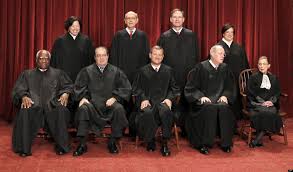
Justice Antonin Scalia is known as a consistent and principled defender of free speech rights.
It pained him, he has said, when he voted to strike down a law making flag burning a crime. “If it was up to me, if I were king,” he said, “I would take scruffy, bearded, sandal-wearing idiots who burn the flag, and I would put them in jail.” But the First Amendment stopped him.
That is a powerful example of constitutional principles overcoming personal preferences. But it turns out to be an outlier. In cases raising First Amendment claims, a new study found, Justice Scalia voted to uphold the free speech rights of conservative speakers at more than triple the rate of liberal ones. In 161 cases from 1986, when he joined the court, to 2011, he voted in favor of conservative speakers 65 percent of the time and liberal ones 21 percent.
He is not alone. “While liberal justices are over all more supportive of free speech claims than conservative justices,” the study found, “the votes of both liberal and conservative justices tend to reflect their preferences toward the ideological groupings of the speaker.”
Social science calls this kind of thing “in-group bias.” The impact of such bias on judicial behavior has not been explored in much detail, though earlierstudies have found that female appeals court judges are more likely to vote for plaintiffs in sexual harassment and sex discrimination suits.
Lee Epstein, a political scientist and law professor who conducted the new study with two colleagues, said it showed the justices to be “opportunistic free speech advocates.”
A lengthy New York magazine report published Sunday suggests that Logan’s return is far from certain. In the piece contributing editor Joe Hagan explores the tensions that simmered within CBS News, where his sources in the network described the current atmosphere as “toxic,” since Logan was forced to apologize last November for a flawed report on the Benghazi attacks.
The report that led to Logan’s suspension centered around a British security contractor, Dylan Davies, who gave a heroic first-person account of the attacks on the American consulate in Benghazi. The contractor’s credibility was called into question after the segment aired, when it was reported that Davies may not have been present on the night of the attacks at the compound.
TPM quotes some of Logan’s CBS co-workers:
“It’s not an accident that Lara Logan fucked up,” one of Logan’s colleagues told the magazine. “It was inevitable. Everybody saw this coming.”
During the fallout from the report, a founding member of “60 Minutes,” Morley Safer, reportedly marched into executive producer Jeff Fager’s office and demanded that Logan be fired, but to no avail. Another unnamed source suggested to the magazine that CBS President Les Moonves has since “soured” on Logan, whom he previously treated as a favorite.
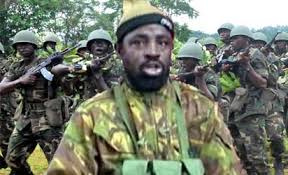
“I abducted your girls. I will sell them in the market, by Allah,” a man claiming to be Boko Haram leader Abubakar Shekau said in a video first obtained by Agence France-Presse.
“There is a market for selling humans. Allah says I should sell. He commands me to sell. I will sell women. I sell women,” he continued, according to a CNN translation from the local Hausa language….”Girls, you should go and get married,” he said.
Not surprisingly, there has been much criticism of the government’s response to the kidnappings.
Weeks after the girls’ April 14 kidnapping, Africa’s most populous country seems to be no closer to finding them, triggering complaints of ineptitude — some of which are expressed on Twitter with the globally trending hashtag #BringBackOurGirls.
Nigeria’s finance minister said Monday that her country’s government remains committed to finding the girls, but should have done a better job explaining the situation to the public.
“Have we communicated what is being done properly? The answer is no, that people did not have enough information,” Ngozi Okonjo-Iweala told CNN’s Richard Quest.
Revealing details about the investigation is tricky, she said, “because you are dealing with people that you don’t know, and you don’t know…what they might do to these girls.”
There is much more information about the Boko Haram group at the CNN link.
Those are my offerings for today. What stories are you following? Please share your links in the comment thread and have a lovely spring Tuesday!
Did you like this post? Please share it with your friends:
The blossoms reached peak Thursday and should still be putting on a good show this weekend. Because of the variability of weather, they aren’t always this near peak at parade time.
The parade proceeds west along Constitution Avenue from Seventh to 17th streets.
Further south, in Augusta GA, the azaleas are in full bloom just in time for the Masters Tournament, which is going into its third day despite the loss of Tiger Woods to back surgery this year and Phil Mickelson’s failure to make the cut. Left-hander Bubba Watson was leading the pack by 3 strokes as of last night.
Bubba Watson never led during the first three rounds of the 2012 Masters Tournament but rallied on the final day and won in sudden death. The former Georgia Bulldog is on top now, halfway through the 78th Masters, with some breathing room.
Watson, 35, ripped apart the second nine at Augusta National Golf Club on Friday with five consecutive birdies en route to 4-under-par 68 – which included bogey on No. 18 – to build a three-shot lead over John Senden, of Australia. It matched the largest 36-hole lead since 2006.
Senden, who qualified for the Masters on March 16, when he won the Valspar Championship, also had a second-round 68 and is alone in second place.
Australian and defending champion Adam Scott made a spirited comeback to stay within shouting distance of Watson. Scott, who opened with 69, was 3-over after five holes Friday but played his final seven in 3-under, finishing with 72, tied for third place, four behind Watson.
There was a feeling around the Masters that the absence of Tiger Woods might not hurt as much as expected. With Tiger having ceded some of the spotlight to younger golfers in recent years, the sport was healthy enough to survive without him in Augusta.
Television viewers apparently had a different opinion.
Okay, I know it’s unlikely that anyone else here cares about professional golf; I just wanted an excuse to post some pretty photos of spring flowers.
Up here in southern New England we’re just beginning to see a little yellow showing up on the forsythia bushes, but it’s going to be warm for the next few days, and soon Arnold Arboretum will showing off acres of yellow blossoms like those in the photo to the right. And it won’t be long before our cherry trees and azaleas are in bloom too!
Spring has sprung!
Can you tell I’m trying to avoid the news?
In a little over a week, Boston will host its big spring event, the Boston Marathon, and between now and then we’ll be hearing endless talk about what happened here last year.
I’d like to avoid all the coverage, but I’ve decided instead to try to pay close attention to the coverage in corporate and alternative media and notice how the powers that be attempt to shape the narrative of last year’s dramatic events as well as the public process of dealing with them.
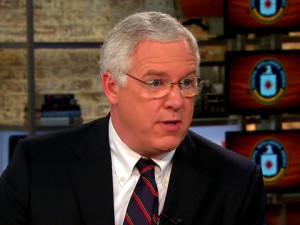
I was quite surprised that one of the participants, Janet Reitman of Rolling Stone Magazine brought up the fact that nearly every breaking story on the events of last year came from CBS’ John Miller, who was obviously the designated target for FBI leaks. And Reitman was actually permitted to discuss this issue at some length.
Miller began working for CBS in 2011; before that he worked for the Federal Government as “Associate Deputy Director of National Intelligence for Analytic Transformation and Technology”; and before that he was “Assistant Director for Public Affairs for the FBI.”
Currently he is working with his old friend Bill Bratton as “Deputy Commissioner of Intelligence” for the NYPD. Is this guy a journalist or is he a tool of law enforcement? He did work for ABC News in the 1990s. As such, he got an interview with Osama bin Laden in 1998. I wonder how that happened?
John Miller’s office at CBS News is filled with keepsakes from his two lives as top cop and leading reporter: badges from his tours with the New York and Los Angeles police departments; a photograph from his 1998 interview with Osama bin Laden in Afghanistan; his FBI badge and ID; even an LAPD Beach Patrol cap. (“The one job I never got,” Miller jokes.) “When I was covering the cops, I wasn’t one of those guys who showed up to work everyday saying ‘I’ve gotta find the scandal in the police department,'” says Miller. “And when I was with the police department, I didn’t hate the press for doing its job, either. Which I think has made it easier to toggle back and forth.”
But is avoiding anti-cop stories really the best attitude for a “journalist?” And how can such a journalist be expected to critically analyze leaks handed to him by law enforcement sources? I think the answers to those questions are obvious. And yet Miller basically shaped the news narrative on last year’s Boston Marathon bombings.
Last night NBC aired an hour-long program on the Boston attack: 108 Hours: Inside the Hunt for the Boston Marathon Bombers, hosted by Brian Williams. It was interesting for me to watch the video of the events that took place in Watertown as police hunted for the accused bombers; but of course no hard questions were asked. Everything law enforcement officials had to say was taken at face value.
One tidbit I learned was that President Obama had been on the phone with Governor Patrick during the lockdown of much of the city, and Obama had expressed concerns about the notion of government officials shutting down a major American city. I found that fascinating considering that critics on both the left and right have portrayed Obama as a tyrant who was probably in control of those kinds of decisions.
The news event that I’ve really been avoiding is the deadly bus accident in California.
Despite new regulations mandating seat belts on recently built tour buses, passengers are still losing their lives in crashes.
A crash Thursday in Northern California killed 10 people and injured 34 when a tour bus carrying Los Angeles-area students collided with a FedEx truck. Eerily, the crash occurred almost exactly one year from the date of a tour bus crash in Irving that killed three people and injured dozens of senior citizens.
The history of serious crashes involving tour buses or motor coaches stretches back into the 1950s and highlights a pattern of danger that federal regulations have just begun to attempt to mitigate.
Congress wrapped bus safety improvements, including a provision for seat belts in recently built tour buses, into a larger transportation bill which was signed into law in 2012. Those regulations, however, only apply to buses produced in 2007 or later. The regulations do not order buses built before 2007 to be retrofit with safety belts.
The industry opposes requiring that existing buses be retrofitted with seat belts saying the seats are not designed for them and may not be strong enough to withstand the repeated pulling of straps. Retrofitting is also more expensive than adding belts to new buses.
Read more at the link. The story references numerous other articles about bus accidents.
Investigators were focusing on Saturday on what caused a FedEx tractor-trailer to collide with a bus in a fiery crash in northern California that killed 10 people, five of them teenage students en route to a college recruitment event.
It remained unclear whether the FedEx driver was somehow distracted or lost consciousness, or whether a mechanical failure occurred when his truck swerved across the median of Interstate 5 and slammed head-on into the motor coach full of students from the Los Angeles area on Thursday.
The California Highway Patrol also raised the possibility that a separate collision on the truck’s side of the highway might have been a factor in Thursday evening’s fatal crash.
According to early highway patrol accounts of the accident, the truck side-swiped a car after crossing the center divider but before hitting the bus. Two witnesses, Bonnie and Joe Duran, who were reported to be in the clipped car, told California media outlets that the truck was on fire before the collision. “I was heading along in the outside lane and I looked over and saw the FedEx truck coming straight for me and he was in flames already,” Bonnie Duran told a local CBS-affiliate.
More at the link.
I have a few more interesting reads for you today that I’ll just list briefly.
The Sky Dancing banner headline uses a snippet from a work by artist Tashi Mannox called 'Rainbow Study'. The work is described as a" study of typical Tibetan rainbow clouds, that feature in Thanka painting, temple decoration and silk brocades". dakinikat was immediately drawn to the image when trying to find stylized Tibetan Clouds to represent Sky Dancing. It is probably because Tashi's practice is similar to her own. His updated take on the clouds that fill the collection of traditional thankas is quite special.
You can find his work at his website by clicking on his logo below. He is also a calligraphy artist that uses important vajrayana syllables. We encourage you to visit his on line studio.













 peej
peej Carissa
 bostonboomer
 dakinikat
 ecocatwoman
 mablue2
 Mama Lopez
 peggysue22
 quixote
 skydancingguestblogger
 Mona (aka Wonk the Vote)



 Sky Dancing
Recent Comments