
Thursday Reads
Posted: July 11, 2013 Filed under: morning reads | Tags: Alexander Kouzminov, Boston Bombings, Bradley Manning, Don West, Dzhokhar Tsarnaev, Ed Fucarile, Edward Snowden, George Zimmerman, J.W. Carney, James "Whitey" Bulger, John Guy, Jr., Judge Debra Nelson, Kevin Weeks, Marc Fucarile, Mark O'Mara, Oleg Gordievsky, Trayvon Martin 66 Comments
Good Morning!!
There’s been quite a bit of legal and courthouse news this week, so I’m going to focus on that today.
Yesterday was a big day at the Boston Federal Courthouse as the Whitey Bulger trial was briefly eclipsed by the first court appearance of Boston Bombing suspect Dzhokhar Tsarnaev. From The Boston Globe:
Dzhokhar Tsarnaev shuffled into the courtroom, appearing confident despite the ankle chains and an orange jumpsuit so big on him that it made him appear younger than his 19 years.
As federal prosecutors read the charges against him Wednesday in his first appearance since being captured in April, Tsarnaev repeatedly looked over his shoulder at the packed courtroom, at one point blowing a kiss to his sisters, one sobbing and another holding a baby.
He leaned into the microphone in the hushed courtroom to tell Judge Marianne B. Bowler with an accent that he pleaded not guilty to 30 charges, including use of weapons of mass destruction. More than 30 victims of the Marathon bombings and about a dozen supporters who say they believe Tsarnaev is innocent watched intently as the accused terrorist yawned and stroked the side of his face, which appeared swollen from a wound.
Tsarnaev, who could receive the death penalty, fidgeted in his seat as he listened to the charges, one of his attorneys patting him on the back gently several times. He had a visible scar just below his throat and had a cast on his left arm.

Dzhokhar Tsarnaev
ABC News talked to survivors of the April 15 bombings who showed up to watch Tsarnaev’s court appearance.
Friends and family members of people whose lives were shattered when two homemade bombs went off near the finish line of the Boston Marathon on April 15 packed three rooms in a federal courthouse on Wednesday as suspect Dzhokhar Tsarnaev pleaded not guilty to a 30-count indictment.
But the fleeting courtroom encounter brought little relief to Bostonians who said the 19-year-old —accused of conducting the deadly bombings with the help of his older brother Tamerlan Tsarnaev —showed little feeling.
“He came out and he smirked at the families,” said Ed Fucarile, 64, outside of the John Joseph Moakley federal courthouse along the water in South Boston. “The lawyers put their hands on his shoulders like it was going to be all right.”
Fucarile wore a Boston Strong t-shirt with the name of Marc Fucarile, his son who lost his right leg and still carries shrapnel in his body, the father said.
Marc Fucarile, 34, was standing near the second blast when it went off. He still has more surgeries to go, and has spent every day of the nearly three months since receiving medical care, his father said. Members of the family have taken weeks off work so that someone is always at Marc’s bedside, he said.
Read more survivors’ stories at the link.
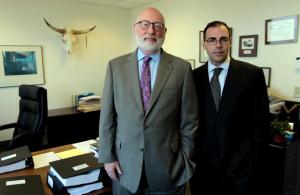
Bulger defense team: J.W. Carney Jr. and Hank Brennan
At the Whitey Bulger trial, there was a bit of comic relief as Bulger flew into a rage toward the end of testimony and exchanged curses with his former close friend and partner Kevin Weeks. It was reminiscent of a scene from Sopranos.
Bulger’s lawyer, J.W. Carney, tried to portray Weeks as an opportunist who knew how to manipulate the system, someone who cut a deal with prosecutors to serve just five years in prison for aiding and abetting five killings, several of which, Weeks testified, he saw Bulger commit.
“You won against the system,” said Carney.
“What did I win? What did I win,” Weeks said, his voice sounding strained and tired. “Five people are dead.”
Asked whether that bothered him, Weeks shot back, “We killed people that were rats, and I had the two biggest rats right next to me …”
At that, Bulger turned and hissed, “You suck.”
“F— you, OK,” snapped Weeks.
“F— you, too,” shouted Bulger as the jury watched.
“What do you want to do?” said Weeks, his eyes locked on Bulger, who was flushed and staring right back.
At one point Weeks even threatened Carney, asking him if he’d like to step outside.
Weeks grew belligerent and threatening as Carney accused him of lying, challenged his motivation for cooperating, and suggested that Weeks, not Bulger, was a rat.
“You can’t rat on a rat,” said Weeks, adding that he lives in South Boston and walks the streets without being called a rat.
When Carney asked Weeks what he would do if someone did call him a rat, Weeks snapped that if he stepped outside the courthouse he’d show him.
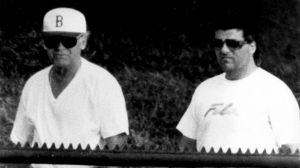
James Bulger and Kevin Weeks
Yesterday the testimony was even more grotesque and sickening, as forensic expert Ann Marie Mires testified about remains of murder victims Arthur Barrett, Deborah Hussey, John McIntyre, and Paul J. McGonagle. I’ll spare you the descriptions; you can go to the links and read more if you’re interested.
This morning Carney asked the judge for a break in the testimony so the defense team could catch up.
The defense team for James “Whitey” Bulger is asking the judge to suspend testimony until next week so they can catch up on evidence.
Defense attorney J.W. Carney filed the motion with the court on Thursday.
“Simply put, the defendant’s counsel have hit a wall, and are unable to proceed further without additional time to prepare for upcoming witnesses,” the motion reads. “Counsel have struggled mightily to be ready for each day of the trial since it began on June 3, 2013, working seven days a week and extraordinarily long hours.” [….]
“A major problem has been the delay in the receipt of discovery from the prosecution,” the motion reads, citing examples of receiving binders of documents pertaining to testimony to be given by witnesses the evening before they take the stand.
Yesterday defense teams rested in both the Bradley Manning and the George Zimmerman trials.
From the Guardian via Raw Story: Bradley Manning defense rests its case after calling just 10 witnesses
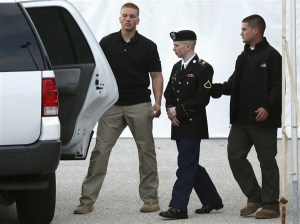
Having called just 10 witnesses over the space of three days, the defence phase of the trial was brought to a close far quicker than expected. The defence had indicated in earlier hearings that it intended to call more than 40 witnesses, although many may yet still be presented in court during the post-verdict sentencing stage of the court martial.
By contrast, the prosecution took 14 days to make its case, drawing on 80 witnesses.
On Wednesday, the defence team lead by the civilian lawyer David Coombs, focused its attentions on the most serious charge facing the Army private – that he “aided the enemy” by transmitting information to WikiLeaks knowing that it would be accessible to enemy groups notably al-Qaida. Manning faces a possible sentence of life in military custody with no chance of parole under this single charge.
The final defence witness called, the Harvard law professor Yochai Benkler, delivered blistering testimony in which he portrayed WikiLeaks as a legitimate web-based journalistic organisation. He also warned the judge presiding in the case, Colonel Denise Lind, that if the “aiding the enemy” charge was interpreted broadly to suggest that handing information to a website that could be read by anyone with access to the internet was the equivalent of handing to the enemy, then that serious criminal accusation could be levelled against all media outlets that published on the web.
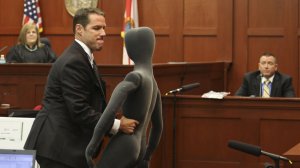
Prosecutor John Guy with dummy
Yesterday was quite a theatrical one in the Zimmerman trial, as a mannequin was brought into court and both a prosecutor and defense attorney Mark O’Mara got down on the floor and straddled the dummy in effort to act out what might have happened during an alleged altercation between Zimmerman and his victim Trayvon Martin.
As professional images go, what followed in the courtroom was probably not something for which Mark O’Mara would most like to be remembered.
Hitching up his pant legs and straddling a life-size human mannequin, Zimmerman’s lead defense counsel got down and dirty on the courtroom floor and proceeded to demonstrate for jurors the “ground and pound” move that they have been told Martin exerted on the accused.
Coming a day after he encouraged one of his witnesses, gym owner and mixed martial arts trainer Adam Pollack, to “step down from the stand to give me an example of a mounted position,” prostrating himself on the floor and asking Pollack, “Where do you want me?” the episode made for an awkward role play, leaving court observers snickering and biting their lips in the midst of an otherwise tragic plot.
Earlier in the day, prosecutor John Guy—described by one public observer in the courtroom on the trial’s opening day as “the supermodel of attorneys”—had also hopped on the mannequin for a similar demonstration in front of the all-female jury.
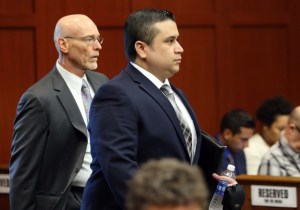
Don West and George Zimmerman
Later Judge Debra Nelson had a “testy exchange” with defense attorney Don West as she asked Zimmerman whether he planned to take the stand. Zimmerman seemed unsure, and West tried to step in.
West repeatedly challenged Nelson’s decision to press Zimmerman for a clear answer. The judge repeatedly slapped him down, her voice gathering volume every time.
“The court is entitled to ask Mr. Zimmerman about his determination as to whether he wants to testify,” Nelson insisted tersely after West objected to her line of questioning.
She looked back at Zimmerman: “How long do you think you need before you make that decision?” she inquired again, as the defendant—who had a minute earlier been made to raise his hand and swear under oath that any decision whether to testify would be his—turned to his counsel for help.
“I object to the court inquiring of Zimmerman about his intention to testify,” West whimpered for a second time.
“I object to the court inquiring of Zimmerman about his intention to testify,” West whimpered for a second time.
“And I have O-VER-RULED” Judge Nelson spat back—several times—as the objections kept coming.
Finally Zimmerman haltingly said he did not want to testify. I think he actually wanted to–if only. What a disaster that would have been for his attorneys! Closing arguments are scheduled to begin this afternoon.
In other news, I can’t resist sharing this article from Time Magazine about what former Russian spies think is probably happening to Edward Snowden in Russia.
In the summer of 1985, KGB colonel Oleg Gordievsky was called back to Moscow from the Soviet embassy in London, where he was serving as a resident spy. As a pretext, his commanders told him that he was going to receive an award for his service. But in fact the KGB suspected him of being a double agent — which he was — and they were looking to interrogate him. So upon his arrival, his KGB colleagues, still concealing their suspicions, took him to a comfortable country estate in the suburbs of the Russian capital, much like the one where Gordievsky and other former spies believe Edward Snowden, the NSA whistle-blower, has spent the past few weeks….
The official story coming from the Russian government since then is that Snowden has been holed up in the transit zone of Moscow’s Sheremetyevo airport, waiting for some third country to grant him asylum. But few experts or officials in Moscow still believe that to be true. The accepted wisdom, unofficially acknowledged by most Western and Russian sources, is that Snowden was taken soon after his arrival — if not immediately — to a secure location run by some arm of the Russian government.
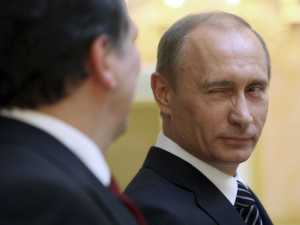
Experts and former spies who have dealt with the Russian security services are sure that agents would want to get the encryption keys to the data stored on Snowden’s four laptops. The only way to do that would be to get Snowden to give them up.
So Gordievsky believes Snowden would have gotten roughly the same treatment that the KGB spy got back in 1985. “They would have fed him something to loosen his tongue,” Gordievsky says by phone from the U.K., where he has been living in exile for nearly three decades. “Many different kinds of drugs are available, as I experienced for myself.” Having been called back to Moscow, Gordievsky says his KGB comrades drugged him with a substance that “turned out his lights” and made him “start talking in a very animated way.” Although the drug wiped out most of his memory of the incident, the parts he did recollect horrified him the following morning, when he woke up feeling ill. “I realized that I had completely compromised myself,” he says.
One of the substances the KGB used for such purposes at the time was called SP-117, which is odorless, tasteless and colorless, according Alexander Kouzminov, a former Russian intelligence operative who describes the drug’s effectiveness in his book, Biological Espionage. Now living in New Zealand, Kouzminov worked in the 1980s and early 1990s for the Foreign Intelligence Service, the spy agency known as the SVR, which handles undercover agents, or “illegals,” stationed in foreign countries. In his book, Kouzminov writes that various drugs were used periodically to test these operatives for signs of disloyalty or diversion. Once the drug had worn off, the agents would have no recollection of what they had said and, if their test results were satisfactory, they could be sent back into the field as though nothing had happened.
Yesterday, Snowden announced through Glenn Greenwald that “I never gave any information to Chinese or Russian governments.” I guess he assumes that Chinese and Russian officials don’t read The Guardian, The Washington Post, or the South China Morning Post. Anyway now it’s not clear if he would even remember if he gave them anything.
For all you Snowden and Greenwald fans out there, this information comes from an article in Time Magazine based on interviews with people who have actual experience with the ways Russia deals with spies. Don’t shoot the messenger.
Now it’s your turn. What stories are you focused on today. Please share you links on any topic in the comment thread, and have a tremendous Thursday!
Tuesday Reads: The Snowden Conundrum
Posted: July 9, 2013 Filed under: Foreign Affairs, morning reads, U.S. Politics | Tags: Barton Gellman, Bolivia, Booz Allen Hamilton, Dell, Edward Snowden, Glenn Greenwald, Jacob Applebaum, Julian Assange, Laura Poitras, Nicaragua, NSA, Pepe Escobar, Venezuela, Walter Pincus, Wikileaks 65 Comments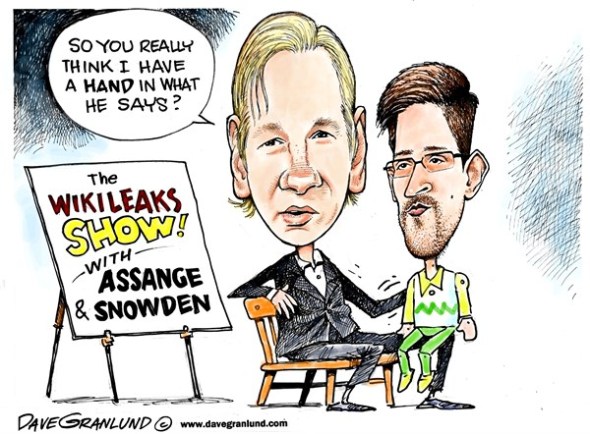
Good Morning!!
I’m going to focus on the Edward Snowden/NSA leaks story today, because there has been quite a bit of news breaking about it over the past few days.
As of this morning, Snowden hasn’t decided whether to accept one of the asylum offers made by three Latin American countries, Venezuela, Nicaragua, or Bolivia. From NBC News:
MOSCOW, Russia – The status of Edward Snowden’s bid for asylum in Venezuela remained unclear Tuesday after the country’s apparent deadline passed.
The Venezuelan Embassy in Moscow said it had no information on whether the fugitive NSA leaker had completed a deal that would allow him to leave the transit area of an airport in the Russian capital.
In Caracas, President Nicolas Maduro confirmed late Monday that Venezuela had received an official request for asylum from Snowden, telling reporters at a news conference that the self-declared leaker “will need to decide when he will fly here,” according to Russia Today.
Even if Snowden agrees an asylum deal with Venezuela, travel problems could take time to resolve: His U.S. passport has been canceled and U.S. allies may deny airspace to any flight on which he is believed to be traveling.
Venezuelan President Nicolas Maduro called on National Security Agency leaker Edward Snowden to decide if he wants to seek refuge in his country after the American reportedly sent an asylum request to Caracas.
Maduro told reporters at a press conference on Monday that the fugitive systems analyst must communicate his intent to accept Venezuela’s offer of asylum, The Wall Street Journal reported.
“He will have to say when he is flying here, if he definitely wants to come here,” Maduro was quoted as telling reporters.
He would probably have to take a private plane, which would be very expensive. Wikileaks is paying for Snowden’s expenses, but would they be able to spring for a private plane? Maybe. More on that in a minute.
One thing we know is very important to Snowden–internet access. One of the reasons he left Hong Kong for Moscow was his fear of not being able to get on the internet. From the Wall Street Journal on June 24:
A person familiar with Mr. Snowden’s case said his decision to get on a flight to Moscow was “very sudden,” made only in the day before departing. The decision was made in consultation with WikiLeaks, which encouraged Mr. Snowden to leave the city after communicating with others about his options abroad, the person said.
“He is very independent, but also very willing to listen to advice,” the person said, adding that Mr. Snowden was concerned that any further delay would result in his detainment by Hong Kong authorities. In part, Mr. Snowden’s determination to leave Hong Kong was based on the fear of losing access to the Internet—his vital link to the rest of the world—should he be detained, the person said. In part, Mr. Snowden’s determination to leave Hong Kong was based on the fear of losing access to the Internet—his vital link to the rest of the world—should he be detained, the person said.
Now Snowden is considering going to one of three countries that have limited access to the internet, according to an article by Alex Halperin at Salon. Venezuela is the best choice, with 40% of the population having internet connections. In Bolivia, it’s 30%, and in Nicaragua only 10.6%.
The Daily Beast has an article on “Wikileaks’ Money Trail” today.
Thankfully for WikiLeaks, its latest cause célèbre, Edward Snowden, is raking in some much-needed cash for the whistle-blowing organization. Snowden sympathizers have been donating generously since WikiLeaks decided to take on the NSA leaker’s case—and the organization desperately needs every dollar it can raise to stay in the black and pay for the legal fees and living costs of founder Julian Assange and now Snowden.
The money WikiLeaks has raised—nearly $90,000 in 2012, with about $1,300 coming in each day since it took Snowden under its wing—comes from people around the world, some of whom give just a few dollars to do their part in making the world a more transparent place.Assange and his team still say they need a lot more than they raise, and the organization always seems to be in the red. WikiLeaks’s operating budget was $510,197 in 2012, which is serious money, considering it is a simple .org with a staff of three paid software developers.
A look into how WikiLeaks is funded and how its money is spent reveals an irony that Assange has acknowledged: an organization dedicated to uncovering the truth keeps its finances intentionally complicated, and it’s next to impossible for donors to find out how their money is processed and where it goes.
Much more at the link. It doesn’t sound like Wikileaks would be able to fund a private plane flight, but maybe some wealthy person like Michael Moore would come through with the big bucks.
More of Snowden’s leaks about U.S. intelligence activities in other countries have been published over the past few days by Glenn Greenwald and Laura Poitras. Greenwald published a report of Snowden’s allegations of U.S. spying in Brazil that appeared in the Guardian and in the Brazilian paper El Globo, and a report on US collaboration with Australia in collecting data was published by the Sydney Morning Herald. Snowden also released a top secret map of sites in a number of countries that collaborate with NSA in collecting intelligence data.
IMHO, it’s likely that Snowden is giving information to countries he’d like to go to. Greenwald lives in Brazil, and Wikileaks’ Julian Assange is from Australia. I say this, because Greenwald explained on Twitter that Snowden revealed classified documents in Hong Kong and in order to gain friendly treatment by the government.
The most revealing recent stories have been published by Der Spiegel, which has been given access to some of the documents Snowden stole from NSA. The latest Der Spiegel piece included a blockbuster revelation. The German magazine published a previously unknown interview with Snowden that was conducted by Laura Poitras and Jacob Applebaum in mid-May, before Snowden left Hawaii for Hong Kong.
This is stunning news, because Applebaum’s name has never been mentioned in connection with the Snowden story until now, although he (Applebaum) has been very visible on Twitter defending Snowden and hyping Greenwald’s articles.
Applebaum is a well known hacker who has been prominently associated with Julian Assange and Wikileaks. He is one of the founders of the Tor network , which promotes encryption method to help people and organizations maintain anonymity on the internet. Although he acknowledges that Tor could be giving aid an comfort to criminals such as child pornographers, he believes that privacy rights take precedence over such concerns.
Both Poitras and Applebaum have come to the attention of the U.S. government and both have been stopped and harassed on return flights to the U.S. from other countries.
Shortly before he became a household name around the world as a whistleblower, Edward Snowden answered a comprehensive list of questions. They originated from Jacob Appelbaum, 30, a developer of encryption and security software. Appelbaum provides training to international human rights groups and journalists on how to use the Internet anonymously.
Appelbaum first became more broadly known to the public after he spoke on behalf of WikiLeaks founder Julian Assange at a hacker conference in New York in 2010. Together with Assange and other co-authors, Appelbaum recently released a compilation of interviews in book form under the title “Cypherpunks: Freedom and the Future of the Internet.”
Applebaum explains how he got involved.
“In mid-May, documentary filmmaker Laura Poitras contacted me,” Appelbaum said. “She told me she was in contact with a possible anonymous National Security Agency (NSA) source who had agreed to be interviewed by her.”
“She was in the process of putting questions together and thought that asking some specific technical questions was an important part of the source verification process. One of the goals was to determine whether we were really dealing with an NSA whistleblower. I had deep concerns of COINTELPRO-style entrapment. We sent our securely encrypted questions to our source. I had no knowledge of Edward Snowden’s identity before he was revealed to the world in Hong Kong. He also didn’t know who I was. I expected that when the anonymity was removed, we would find a man in his sixties.”
Please note the timeline: Poitras says Snowden contacted her in January, and Greenwald says he began working with Poitras and Snowden in February. Poitras also contacted Barton Gellman of the Washington Post in February–apparently without Greenwald’s knowlege. At some point Snowden was working for NSA as a Dell contractor, but he quit this job in order to get one at Booz Allen, where he would have access to more top secret information about U.S. spy facilities around the world. He took the job with Booz Allen sometime in March and went to a training course back in the U.S. that lasted a couple of months. According to Booz Allen, Snowden was employed by them for less than three months and was only on the job in Hawaii for about three weeks, during which time he stole four laptops full of classified documents.
There’s no doubt this operation was premeditated; Snowden admitted that in an interview with the South China Morning Post. The only real questions are whether it was initiated or aided by Julian Assange and Wikileaks and whether Jacob Applebaum aided Snowden in hacking into NSA computers. I’m not ready to argue that yet; but these new revelations, along with the fact that Wikileaks seems to have taken over communications with Snowden are certainly suggestive.
Here’s another possible piece of the timeline. In December 2012, Glenn Greenwald and some of his close friends started an organization called Freedom of the Press Foundation. Others on the board of directors of the foundation besides Greenwald are Laura Poitras and Daniel Ellsberg. According to their website, their purpose is to raise funds to support “public interest journalism.” Their criteria for choosing news organization to support is as follows:
Record of engaging in transparency journalism or supporting it in a material way, including support for whistleblowers.
Public interest agenda.
Organizations or individuals under attack for engaging in transparency journalism.
Need for support. The foundation’s goal is to prioritize support for organizations and individuals who are in need of funding or who face obstacles to gaining support on their own.
At the top of the list of organizations they support is Wikileaks.
Please note that I’m not yet proposing some grand conspiracy theory here. I’m just laying out the facts as I know them so far and connecting some dots. But some people are suggesting Wikileaks could have directed this operation. I was very surprised to see this article by Walter Pincus at the Washington Post yesterday: Questions for Snowden. Basically Pincus connected some dots and is asking some of the same questions I am asking. I’m going to excerpt a little more than I normally would from the Pincus piece. He writes:
Was he [Snowden] encouraged or directed by WikiLeaks personnel or others to take the job as part of a broader plan to expose NSA operations to selected journalists?
In the case of Pfc. Bradley Manning, the U.S. soldier on trial for disclosing thousands of classified documents to WikiLeaks, it was Julian Assange and his organization who directed the collection of documents, U.S. prosecutors have alleged. While Manning’s lawyers contend there is no evidence to support that finding, prosecutors have said there are hundreds of chats between Manning and Assange and WikiLeaks lists of desired material.
In Manning’s case, WikiLeaks and its founder, Assange, determined the news organizations that initially would receive the materials.
Pincus wants to know how Snowden decided to leak to Poitras, Greenwald, and Gellman.
Did Assange and WikiLeaks personnel help or direct Snowden to those journalists?
Poitras and Greenwald have had close connections with Assange and WikiLeaks. In December 2010, Greenwald said of the British arrest of Assange: “Whatever you think of WikiLeaks, they have not been charged with a crime, let alone indicted or convicted. Yet look what has happened to them. They have been removed from [the] Internet . . . their funds have been frozen . . . media figures and politicians have called for their assassination and to be labeled a terrorist organization.”
In a June 2012 Guardian column, Greenwald wrote, “As a foreign national accused of harming U.S. national security, he [Assange] has every reason to want to avoid ending up in the travesty known as the American judicial system.”
On April 10, 2012, Greenwald wrote for the WikiLeaks Press’s blog about Poitras and WikiLeaks being targeted by U.S. government officials.
Pincus also suggests that Julian Assange knew the contents of Glenn Greenwald’s first article on Snowden’s leaks.
Poitras has been working on a film on post-9/11 America, with a focus on the NSA and in which Assange and WikiLeaks are participating. Assange confirmed this in a May 29 interview on Democracy Now’s Web site.
In that same interview, Assange previewed the first Greenwald Guardian story based on Snowden documents that landed a week later. Speaking from Ecuador’s embassy in London, Assange described how NSA had been collecting “all the calling records of the United States, every record of everyone calling everyone over years. . . . Those calling records already [are] entered into the national security complex.”
Did he know ahead of time of that Guardian story describing the U.S. court order permitting NSA’s collection of the telephone toll records of millions of American Verizon customers and storing them for years?
This post is getting way too long, but just to be fair I’ll offer another conspiracy theory from Pepe Escobar of Asia Times. I’ll quote the first few paragraphs and you can go read the whole thing if you’re so inclined.
The working title of the Edward Snowden movie is still The Spy Who Remains in the Cold. Here’s where we stand:
– Snowden could only fly out of Hong Kong because China allowed it.
– Snowden could only arrive in Moscow because Russia knew it – in co-operation with China. This is part of their strategic relationship, which includes the BRICS group (along with Brazil, India and South Africa) and the Shanghai Cooperation Organization. No official source though would ever confirm it.
With the Latin American offers of asylum (Venezuela, Bolivia, Nicaragua; even Uruguay would consider it), we’re approaching the clincher: Moscow is now calculating whether – and how – to help Snowden reach his final destination while extracting maximum political capital out of Washington.Into this script comes roaring the coup-that-is-not-a-coup sub-plot in Egypt. Cynics’ eyebrows will be raised that just as the Barack Obama administration was going mental over the National Security Agency (NSA) spy scandal a revo-coup-o-lution explodes in Egypt. New revelations about the extent of the NSA-centric Orwellian Panopticon keep on coming, but they have been totally downgraded by US corporate media; it’s all Egypt all the time. After all, the Pentagon – to which the NSA is attached – owns the Egyptian military, something that even the New York Times had to acknowledge. [1]
Yet they don’t own Snowden. This has nothing to do with “terra”.
Meanwhile, the US intelligence gambit of intercepting a non-adversarial presidential plane spectacularly backfired in true Mad magazine Spy vs Spy fashion. Obama had said he would not “scramble fighter jets” to catch Snowden; of course not, just ground them.
Austrian paper Die Presse revealed that the US Ambassador in Austria, William Eacho, was responsible for spreading the (false) information about Snowden being on board Bolivia President Evo Morales’ Falcon out of Russia – leading to the denial of overflying rights in France, Spain, Portugal an Italy. [2] Eacho – a former CEO of a food distribution company with no diplomatic experience whatsoever – was appointed by Obama to go to Vienna in June 2009. Why? Because he was a top Obama fundraiser.
Read the rest at Asia Times. BTW, I’m not sure both of these conspiracy theories couldn’t be at least partially true.
Thanks for reading, and I look forward to your reactions.
Saturday Reads: We’re Having A Heat Wave Edition
Posted: July 6, 2013 Filed under: Foreign Affairs, morning reads, NSA, National Security Agency, Republican politics, U.S. Economy, U.S. Politics, War on Women, Women's Rights | Tags: abortion, assault on women's autonomy, Chile, Edward Snowden, Egypt, gun nuts, heat wave, human rights records, jobs numbers, Nicaragua, Nicolas Maduro, Sarah Harrison, Scott Walker, Venezuela, Wikileaks, Wisconsin abortion law 43 Comments
Good Morning!!
The long weekend continues, and so does the heat wave here in Greater Boston. This is our second heat wave of this summer. I know these are just normal temps for you hardy souls in the South, but for us Northerners, it’s quite a shock to the system.
From The Boston Globe: As heat wave hits, region falls under a sultry spell.
The torpor-inducing temperatures, expected to last through Sunday, will feel hotter than the last, said Bill Simpson, a National Weather Service meteorologist. Friday’s high was 95 degrees with 55 percent humidity, he said, but the heat index, which combines temperature and relative humidity to measure how hot it feels, hit nearly 100. There will be no relief until Monday, he said, when temperatures should cool to the mid- to low-80s.
In Boston, Mayor Thomas M. Menino issued a heat advisory through the weekend, urging residents to stay hydrated and in the shade or air conditioning….
To stave off the heat, many turned to ice. The number of convenience stores and restaurants needing extra ice rose “exponentially” since the beginning of the heat wave, said Charlotte Ploss, sales manager at Brookline Ice & Coal, which specializes in ice delivery. The phones there rang nonstop Friday morning and afternoon, sometimes with customers requesting ice for the second or third time of the day.
One supermarket ordered 4 tons of ice, Ploss said. A restaurant called for so many ice refills that Brookline Ice & Coal offered use of a company trailer, which holds 3,000 pounds of ice. Because the restaurant does not have enough space for the trailer, its owner is parking it in his driveway, she said.
So what else is going on? The President of Venezuela has offered asylum to Edward Snowden. From Reuters via the NYT:
CARACAS — Venezuelan President Nicolas Maduro offered asylum to former U.S. intelligence contractor Edward Snowden on Friday in defiance of Washington, which is demanding his arrest for divulging details of secret U.S. spy programs.
“In the name of America’s dignity … I have decided to offer humanitarian asylum to Edward Snowden,” Maduro told a military parade marking Venezuela’s independence day.
“He is a young man who has told the truth, in the spirit of rebellion, about the United States spying on the whole world.”

How Snowden would get to Venezuela from Moscow if he accepts the offer no one knows as yet.
There are no direct commercial flights between Moscow and Caracas, and the usual route involves changing planes in Havana. It is not clear if the Cuban authorities would let him transit….
One alternative flight plan would involve an aircraft taking off from Moscow, refueling in Vladivostok, and then continuing east over the Pacific to South America.
Nicaragua has also said it would consider offering Snowden asylum. Both Venezuela and Nicaragua have questionable human rights records; but no doubt, Snowden supporters will find ways to explain all that away.
The Washington Post has a feature on Sarah Harrison, “the woman from Wikileaks” who accompanied Snowden to Moscow and is reportedly still there.
Harrison began working with WikiLeaks in August 2010 on the internal vetting of confidential U.S. documents supplied by Army Pfc. Bradley Manning, which the site later released. At some point that year, according to two people with direct knowledge of the situation and who spoke on the condition of anonymity, Harrison and Assange became intimately involved. They cautioned that the relationship was not Harrison’s prime motivation in championing the WikiLeaks cause.
“She is firmly committed to what WikiLeaks is trying to do; she believes 100 percent in the mission,” one of the people said. “Any suggestion that her relationship with Julian is what has compelled her to do the things she has would be a totally wrong assumption.”
Although those who know her as an Assange confidante describe her as more comfortable behind the scenes, Harrison now finds herself in the spotlight. She has raced across continents to aid Snowden, assisting in his flight from Hong Kong and his search for asylum from Moscow. On Friday, Venezuela and Nicaragua offered Snowden asylum. All the while, she has has maintained a low profile and refrained from public statements.
Read the rest at the link.

In Chile, another human rights issue has arisen once again–the right of girls and women to control their own bodies. USA Today reports: Child’s pregnancy sets off Chile abortion debate.
SANTIAGO, Chile (AP) — The case of a pregnant 11-year old girl who was raped in Chile by her mother’s partner has set off a national debate about abortion in one of the most socially-conservative countries in Latin America.
Chileans were outraged on Friday after state TV reported that the girl is 14 weeks pregnant and was raped repeatedly over two years. Police in the remote southern city of Puerto Montt arrested her mother’s partner, who confessed to abusing the fifth grader. The case was brought to their attention by the pregnant child’s maternal grandmother.
Doctors say the girl’s life and that of the fetus are at high risk. But in Chile, ending the pregnancy is not an option.
Chile allowed abortions for medical reasons until they were outlawed in 1973 by Gen. Augusto Pinochet’s dictatorship. The current government of conservative President Sebastian Pinera has opposed any loosening of the prohibition.
One has to assume that Republicans here in the U.S. are applauding this horror, since they keep trying to limit women’s autonomy with nightmare legislation in numerous states. The latest is Wisconsin, where Gov. Scott Walker just signed a draconian new anti-abortion bill. The Milwaukee Journal-Sentinel reports:
Madison — Gov. Scott Walker signed a bill Friday requiring doctors who perform abortions to have hospital admitting privileges, and abortion clinics responded by immediately suing state officials over the measure.
The law — signed Friday by Walker in a private ceremony — would cut the number of clinics offering abortions in Wisconsin from four to two, and one of the remaining clinics would have to dramatically cut the number of abortions it provides, according to the operators of the clinics.
“When women don’t have access to safe, legal abortions, there are health consequences and women die,” said Teri Huyck, president and chief executive officer of Planned Parenthood of Wisconsin….
Planned Parenthood and Affiliated Medical Services filed the lawsuit in federal court in Madison. They brought it against Attorney General J.B. Van Hollen, Dane County District Attorney Ismael Ozanne, Safety and Professional Services Secretary Dave Ross and the members of the state Medical Examining Board — all of whom have authority to enforce the law or issue sanctions.
It will be heard by U.S. District Judge William Conley. It was unclear whether he would take action before the law takes effect Monday.
The National Journal is bullish on the latest jobs report. The Really Great News From the June Jobs Report: the April and May Numbers
Happy jobs day! First, the immediate good news: The June report showed the U.S. economy added 195,000 in June, strongly beating expectations in the 150,000-165,000 range. The unemployment rate, meanwhile, was unchanged at 7.6 percent.
But now for the really good news: We were quite wrong about job gains in April and May. Initial reports from the Bureau of Labor Statistics showed a jobs gain of 149,000 in April and 175,000 in May. In the latest reports, those numbers were revised upward to 199,000 in April and 195,000 in May. That’s a combined gain of 70,000 jobs from earlier reports. So, since April, it turns out that the economy has actually gained nearly 200,000 new jobs a month.
They admit the unemployment situation is still pretty horrible overall. Read about it at the link.

Here’s a wacky story out of Texas: Gun owners march on Houston police station with shotguns and assault rifles.
A group of gun owners and gun rights advocates celebrated Independence Day on Thursday by marching on the headquarters of the Houston Police Department while carrying an array of shotguns and assault rifles. According to the Washington Examiner, the group was organized via Facebook and numbered about 25 attendees.
“It’s Independence Day — where it all started,” said shotgun toting protester Jenn Kroll, to the Houston Chronicle. “What better day to show our rights?”
“If you don’t use your rights, they can take them away,” Ed Aldredge of Sugar Land said. Aldridge brought along his 11-year-old son, Austin, who carried a .22-caliber rifle.
No mention in the story about how Houston police reacted to the march.
Violence continues in Egypt where the army and Morsi supporters are battling each other. From BBC News:
More than 30 people were killed and more than 1,000 injured in Friday’s violence following the ousting of Egypt’s President Mohammed Morsi, it has emerged.
At least 12 died in Alexandria, and eight in two separate clashes in Cairo, the Health Ministry said….
Mr Morsi, Egypt’s first freely elected leader, is in detention.
Some senior figures of his Muslim Brotherhood movement have also been held.
Early on Saturday, state media reported the Brotherhood’s deputy leader Khairat el-Shater had been arrested at his Cairo home on suspicion of incitement to violence.
The Tamarod [Rebel] movement – which organised recent anti-Morsi protests – accused the ousted president of pursuing an Islamist agenda against the wishes of most Egyptians, and of failing to tackle economic problems.
So…quite a bit of news for a long holiday weekend. What are you reading and blogging about today?
Friday Nite Lite
Posted: July 5, 2013 Filed under: open thread, Political and Editorial Cartoons, U.S. Politics | Tags: Edward Snowden, Friday Night cartoons, George Zimmerman, Glenn Greenwald, Russia, Sarah Harrison, Trayvon Martin 8 Comments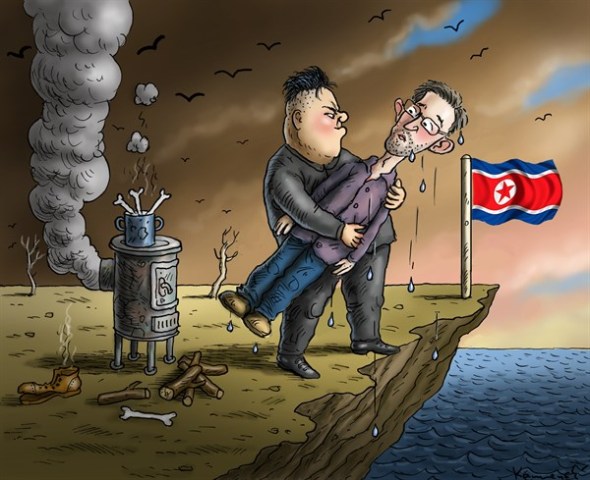
Snowden’s Last Option, by Marian Kamensky
Hello Sky Dancers!!
I have a question. How do we even know that Edward Snowden is still alive? For that matter, how do we know if Sarah Harrison, the woman who accompanied him to Russia, is still alive? Why haven’t we even seen a photo of either of them since they left Hong Kong and supposedly flew to Moscow’s Sheremetyevo Airport? Shouldn’t we at least be demanding proof of life–like a photo of them holding a current newspaper with the date visible?
Frankly I don’t believe either of them is at the airport. Hundreds of journalists have search every nook and cranny of Sheremetyevo to no avail. Glenn Greenwald says he hasn’t had any communication with Snowden since they left Hong Kong. Ed and Sarah just aren’t there. If either of the has an internet connection, why haven’t they contacted their families? They must be in a safe house somewhere if they are alive. And I have no doubt they have been interrogated. Or they could be dead. I think it’s truly amazing that reporters are not asking about this and demanding proof that these two are still alive.
Meanwhile, there have been no further “revelations” about NSA spying, despite promises from Glenn Greenwald of a huge “bombshell” that will “shock the world.” Are there any more leaks to be published? Every day the Guardian publishes articles that hype the story, but include no information about further leaked documents. Today it was an article by Spencer Ackerman arguing that Snowden is a whistleblower, not a spy. It’s almost as if they are trying to convince themselves.
OK, that’s my news commentary for tonight. The prosecution rested in the George Zimmerman case, but I haven’t been watching it so I can’t comment. Here’s USA Today:
SANFORD, Fla. — Prosecutors wrapped their case against George Zimmerman on Friday afternoon after the mother and brother of teenager Trayvon Martin testified Friday that they believed the screams on a 911 call seconds before his death were his, not those of Zimmerman.
“I heard my son screaming,” said Sybrina Fulton, who listened to the 911 tape of the final moments of his life on Feb. 26, 2012. Fulton said she had to listen to the tape only once to know it was her 17-year-old son. She also testified that she didn’t think Trayvon was responsible for his own death.
The defense began with Zimmerman’s mother, Gladys Zimmerman, briefly testifying that it was her son screaming for help on the phone. “That’s George’s voice,” she said.
Her testimony came after medical examiner Shiping Bao, who autopsied Trayvon’s body a day after his death, said Trayvon died from a 9mm gunshot wound to the heart. “My belief he was still alive, he was still in pain, he was still suffering” in the moments after he was shot.
He also said he believed that based on his experience Travyon was alive for between one and 10 minutes after he was shot by the weapon, which had “loose contact” with his body.
I can’t stand to watch the trial because George Zimmerman and his attorneys make me sick to my stomach. I just hope Zimmerman doesn’t get away with the murder he committed.
And now for some cartoons, specially chosen by our beloved JJ, who is not feeling well today.
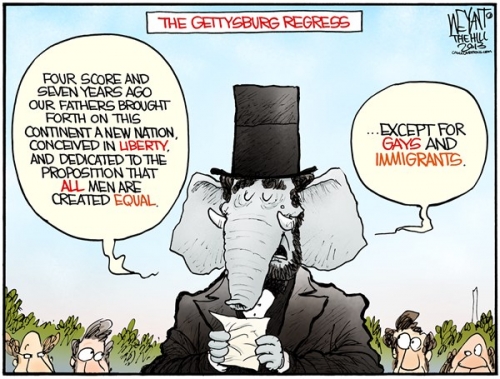
Gettysburg Regress, by Christopher Weyant (No mention of women not being treated equally, of course!)
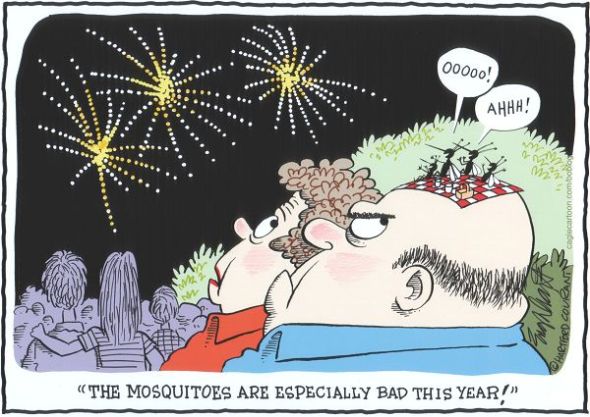
“The mosquitoes are especially bad this year!” by Bob Engelhart
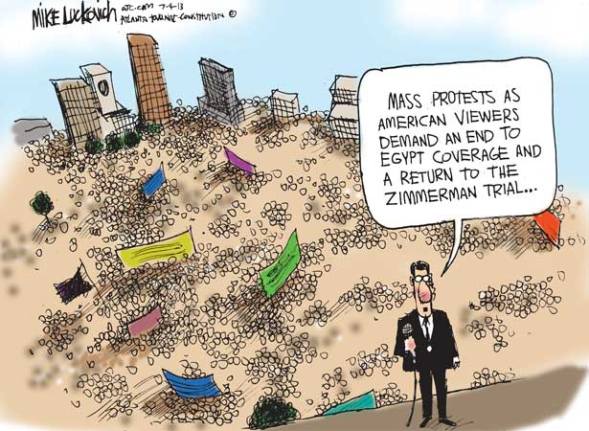
By popular demand, by Mike Luckovitch
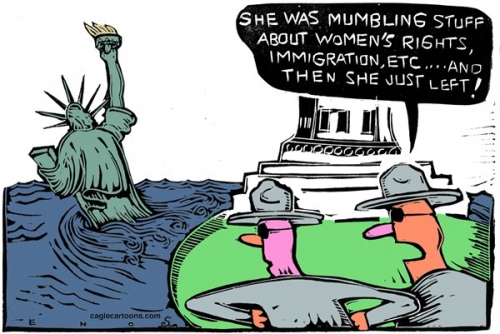
Statue of Liberty, by Randall Enos
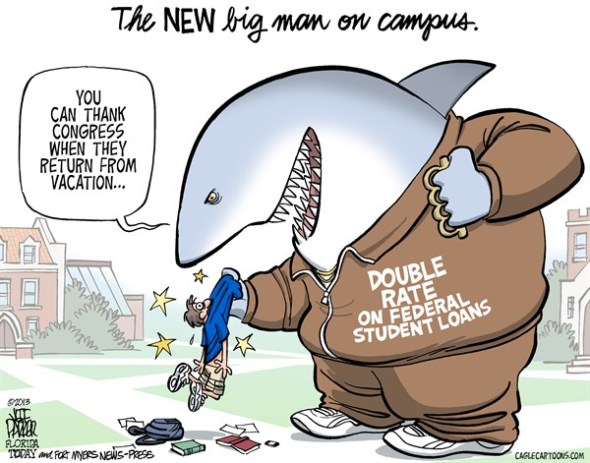
Student Loan Shark, by Jeff Parker
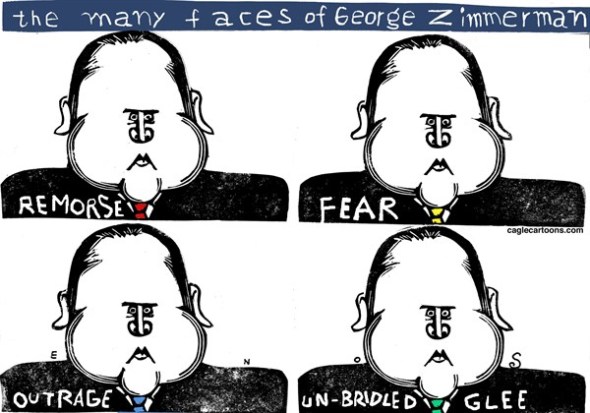
George Zimmerman, By Randall Enos
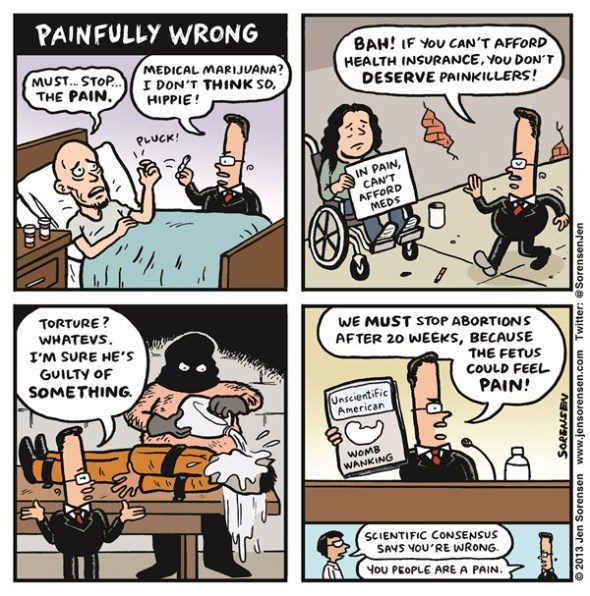
Painfully Wrong, by Jen Sorensen

Pluto’s New Moons, by Jeff Koterba
Have a great Friday night everyone!!
Tuesday Reads
Posted: July 2, 2013 Filed under: Barack Obama, Egypt, Foreign Affairs, morning reads, Russia, U.S. Politics, Violence against women | Tags: Arizona wildfires, Edward Snowden, firefighters, marijuana-schizophrenia connection, Mohammed Morsi, suicide and schizophrenia 73 Comments Good Morning!!
As the record-breaking heat wave continues in the West, firefighters in Arizona continue to fight the wildfires that killed 19 of their compatriots last night. NBC News reports:
Firefighters battling the Arizona blaze that killed 19 elite colleagues faced a tough task on Tuesday amid an excessive heat warning issued by the National Weather Service. Gusting winds of up to 20 mph threatened to fan the flames near Yarnell, Arizona, and officials were wary about propane tanks known to be in the town of 700 people. The dead firefighters’ colleagues continued to battle the raging blaze that by 9:30 p.m. local time Monday (11:30 p.m. ET) was zero percent contained. More firefighters are expected to join the 500-strong group. As the community began to mourn the loss of the men decribed as “heroes” by President Barack Obama, medical examiners were due to begin carrying out autopsies in the wake of the area’s “largest mass-casualty event in memory.”
The names of the men killed are:
Anthony Rose, 23; Eric Marsh, 43; Robert Caldwell, 23; Clayton Whitted , 28; Scott Norris, 28; Dustin Deford, 24; Sean Misner, 26; Garret Zuppiger, 27; Travis Carter, 31; Grant McKee, 21; Travis Turbyfill, 27; Jesse Steed, 36; Wade Parker, 22; Joe Thurston, 32; William Warneke, 25; and John Percin, 24; Kevin Woyjeck, 21; Chris MacKenzie, 30; and Andrew Ashcraft, 29.
From the Wall Street Journal: Sudden Turn in Flames Doomed Firefighters.
The men, aged between 21 and 43, were members of the Granite Mountain Interagency Hotshot Crew who endured grueling training together before being dispatched to battle wildfires nationwide. Based in Prescott, only 34 miles away from Yarnell, they knew the terrain. But late Sunday afternoon, the firefighters radioed from their positions on the ground that they were in trouble. A short time later, a helicopter pilot reported to the Arizona State Forestry’s dispatch center in Phoenix that firefighters were attempting to shelter themselves west of Yarnell under fire-shelter covers, a heat-resistant specialty fabric made of aluminum foil, woven silica, and fiberglass—their last line of defense. Smoky conditions and heat made it difficult to check on the firefighters. “It felt like forever,” said Carrie Dennett, state fire-prevention officer for Arizona State Forestry. What rescuers eventually found was that the men had been caught in a “burn over,” a sudden change in the direction of the fire that overtook them faster than they could get out of the way, according to a spokesman with the Prescott Fire Department.
Heartbreaking.
Edward Snowden’s search for a country that will grant him asylum continues.
This morning the list of countries he had applied to increased to 21, but so far none has offered to shelter him, according to CBS News. Snowden withdrew his request to Russia after Vladimir Putin said Snowden would have to stop leaking information designed to hurt the U.S.
CBS News correspondent Elizabeth Palmer reports that behind the scenes, the U.S. and Russia have been talking non-stop about how to resolve the Snowden conundrum. President Putin is between a rock and a hard place, explains Palmer; he won’t expel Snowden into U.S. custody, but he hopes to limit the damage to U.S.-Russian relations. With Snowden’s withdrawal of the asylum request to Russia, Palmer says, you could almost hear a sign of relief from the Kremlin. Poland rejected Snowden’s asylum request on Tuesday, and officials in Germany, Norway, Austria, Spain and Switzerland said that he could not apply for asylum from abroad. Many European countries require an asylum request to be made on their soil. Later Tuesday, India’s External Affairs Ministry said it had carefully examined Snowden’s request and decided to turn it down. Ministry spokesman Syed Akbaruddin told reporters the government had “concluded that we see no reason to accede to that request.” Venezuelan President Nicolas Maduro, coincidentally wrapping up a long-planned visit to Moscow, said Tuesday that his government had not yet received an official asylum request from Snowden, but that it would be considered if and when received.
The massive protests continue in Egypt.
From The Washington Post: Egypt protesters step up pressures with president facing military deadline and internal rifts.
CAIRO — With a military deadline for intervention ticking down, protesters seeking the ouster of Egypt’s Islamist president sought Tuesday to push the embattled leader further toward the edge with another massive display of people power. Meanwhile, Mohammed Morsi faced fissures from within after a stunning surge of street rage reminiscent of Egypt’s Arab Spring revolution in 2011 that cleared the way for Morsi’s long-suppressed Muslim Brotherhood to win the first open elections in decades. Three government spokesmen were the latest to quit as part of high-level defections that underscored his increasing isolation and fallout from the ultimatum from Egypt’s powerful armed forces to either find a political solution by Wednesday or the generals would seek their own way to end the political chaos. The Cabinet, led by the Morsi-backed Prime Minister Hesham Qandil, was scheduled to meet later Tuesday. But the defense and interior ministers were expected to boycott in a sign of support for the military’s warnings. The police, which are under control of the Interior Ministry, have stood on the sidelines of the protests, refusing even to protect the offices of the Muslim Brotherhood that have been attacked and ransacked.
President Obama weighed in on the Egyptian situation yesterday. From Bloomberg Businessweek:
President Barack Obama told Mursi in a telephone call yesterday that the U.S. “is committed to the democratic process in Egypt and does not support any single party or group,” according to a White House statement. Obama encouraged Mursi “to take steps to show that he is responsive” to the concerns of demonstrators, stressing “that democracy is about more than elections, it is also about ensuring that the voices of all Egyptians are heard and represented by their government.” During the conversation, Obama “underscored his deep concern about violence” and sexual assaults during the demonstrations and urged Mursi “to make clear to his supporters that all forms of violence are unacceptable,” according to the statement.
In other news,
There’s an interesting article in the Wall Street Journal by Samuel T. Wilkinson on the connection between marijuana and schizophrenia. Years ago the boyfriend of one of my closest friends developed schizophrenia after years of heavy daily pot-smoking. At the time I suspected that there was a connection. He probably had a genetic tendency toward the disease that might not have manifested without the marijuana use. Wilkinson writes:
Recent legislation has permitted the recreational use of marijuana in Colorado and Washington state. Those who support legalization often tout the lack of serious medical consequences associated with the drug. Most of us know people who used marijuana in high school or college and seem to have suffered no significant medical consequences. As the medical and scientific literature continues to accumulate, however, it is becoming clearer that the claim that marijuana is medically harmless is false. There is a significant and consistent relationship between marijuana use and the development of schizophrenia and related disorders. Schizophrenia is considered by psychiatrists to be the most devastating of mental illnesses. Patients who suffer from it often experience auditory or visual hallucinations, severe social withdrawal and cognitive impairment. Many require frequent and prolonged hospitalization in psychiatric wards. Schizophrenia affects almost three million Americans—more than six times the number of people with multiple sclerosis, two and a half times the number of people with Parkinson’s disease, and more than twice the number of people with HIV/AIDS. Less than one-third of patients with schizophrenia can hold a steady job or live independently. A large portion (about one-third) of homeless people in the U.S. suffer from the disease. Though they receive little attention in the legalization debate, the scientific studies showing an association between marijuana use and schizophrenia and other disorders are alarming. A 2004 article in the highly respected British Journal of Psychiatry reviewed four large studies, all of which showed a significant and consistent association between consumption of marijuana (mostly during teenage years or early 20s) and the later development of schizophrenia. The review concluded that marijuana is a “causal component,” among others, in the development of schizophrenia and other psychotic disorders.
I hope everyone will read this article. I don’t think anything is going to stop the legalization of marijuana at this point, but we need to be aware of the dangers of this drug to young people. Schizophrenia is a very serious illness that develops in early adulthood, usually before age 35. It is partly genetic but is usually triggered by some kind of environmental stress. Marijuana use appears to be one possible trigger. A high percentage of people with schizophrenia end up committing suicide.
A large 5-year World Health Organization study consisting of the follow-up of 1056 patients exhibiting psychotic symptoms found the most common cause of death in those with schizophrenia was suicide (Sartorius et al, 1986). In their review of the subject Caldwell and Gottesman (1990) found that 9-13% of patients with schizophrenia eventually commit suicide. At least 20-40% make suicide attempts (Meltzer & Fatemi, 1995) and 1-2% go on to complete in their attempt within the next 12 months (Meltzer & Okayli 1995). Therefore, suicide in schizophrenia has long been a major area of concern and research efforts.
In Denmark, Mortensen and Juel (1993) used the national case register to retrospectively examine mortality in a sample of 9156 patients following their first admission with schizophrenia, and reported 50% of males and 35% of females went on to commit suicide during the 17-year study period, with the relative risk of suicide increasing by 56% over this time. This suggests that the current level of risk is not stable, and is certainly not improving. The devastation that suicide brings for relatives, as well as the immense personal suffering the victim endures, must surely make this one of the most pressing issues for psychiatry to address. Carers and professionals are often left with feelings of profound ineffectualness and guilt in the face of suicide, and so it is vital for clinicians to feel confident in their understanding of risk assessment and management in this particularly vulnerable group.
My friend never recovered significantly; and the last I heard, he continued to have delusions and cognitive distortions. I doubt if he stayed on anti-psychotic medications–that wasn’t his style. He was employed at times and managed to stay in touch with some friends. But he was a completely different person than before he developed the disease. Before, he was a talented musician and earned a living playing in an Irish folk group. He was gregarious and had a many friends. For those of us who knew him, it was as if that person died and someone else took his place.

 peej
peej Carissa
 bostonboomer
 dakinikat
 ecocatwoman
 mablue2
 Mama Lopez
 peggysue22
 quixote
 skydancingguestblogger
 Mona (aka Wonk the Vote)



 Sky Dancing
Recent Comments