
Thursday Reads: Trump Publicly Admits Guilt Once Again
Posted: August 16, 2018 Filed under: morning reads, U.S. Politics | Tags: Donald Trump, John Brennan, Russia investigation 47 Comments
Among Lupine, Jeffrey T. Larson
Good Morning!!
Trump just can’t stop confessing his guilt. Yesterday, Trump stripped away John Brennan’s security clearance, claiming it was because of Brennan’s “erratic behavior” and “wild outbursts on the internet and television.” Then he proceeded to tell the Wall Street Journal that he did it because of the Russia investigation.
President Trump drew a direct connection between the special counsel investigation into alleged Russian interference in the 2016 election and his decision to revoke the security clearance of former CIA Director John Brennan and review the clearances of several other former officials.
In an interview Wednesday, Mr. Trump cited Mr. Brennan as among those he held responsible for the investigation, which also is looking into whether there was collusion between the Trump campaign and the Kremlin. Mr. Trump has denied collusion, and Russia has denied interfering.
Mr. Brennan was director of the Central Intelligence Agency in the Democratic administration of former President Obama and one of those who presented evidence to Mr. Trump shortly before his inauguration that Russia had interfered in the 2016 election.
“I call it the rigged witch hunt, [it] is a sham,” Mr. Trump said in an interview. “And these people led it!”
He added: “So I think it’s something that had to be done.”
Trump has quite an enemies list now, and everyone on it is involved in some way with the investigation.
Reading Girl. Ármin Glatter (Hungarian, 1861-1916). Oil on canvas.
Earlier in the day, White House spokeswoman Sarah Sanders said the administration was also reviewing the clearances of former Director of National Intelligence James Clapper, former FBI Director James Comey, and former National Security Agency and CIA chief Michael Hayden.
“I don’t trust many of those people on that list,” Mr. Trump said in the interview. “I think that they’re very duplicitous. I think they’re not good people.”
Most of the individuals left government service months or years ago under varied circumstances, including being fired by the president and his aides. Some, including Mr. Comey, have said they no longer have or use their clearances.

Aaron Blake at The Washington Post: Trump blurts out another Lester Holt moment.
You could be forgiven for having flashbacks to Trump’s interview with NBC Nightly News anchor Lester Holt in the aftermath of his firing last year of James B. Comey as FBI director. Then, as now, the White House offered a series of motivations for the crackdown on a person who was a liability in the Russia probe. Then, as now, it seemed clear what the actual motivation was. And then, as now, Trump appeared to go out and just admit the actual motivation….
In the case of the Holt interview, Trump never actually directly said that he fired Comey because of the Russia investigation; instead, he merely said that Russia was on his mind when he did it. “And in fact when I decided to just do it, I said to myself, I said, you know, this Russia thing with Trump and Russia is a made-up story; it’s an excuse by the Democrats for having lost an election that they should have won,” Trump said back in May 2017.
In this case, Trump refers directly to the role of Brennan and others in leading the investigation, and then says, “So I think it’s something that had to be done” — suggesting that this was an action taken in direct response to their participation in the probe. He is saying he is punishing people who were involved in that, which at the very least would seem to create a chilling effect for other would-be critics.
John Brennan responded in an op-ed in today’s New York Times:
The artist’s wife reading – Fyffe Christie
Having worked closely with the F.B.I. over many years on counterintelligence investigations, I was well aware of Russia’s ability to work surreptitiously within the United States, cultivating relationships with individuals who wield actual or potential power. Like Mr. Bortnikov, these Russian operatives and agents are well trained in the art of deception. They troll political, business and cultural waters in search of gullible or unprincipled individuals who become pliant in the hands of their Russian puppet masters. Too often, those puppets are found.
In my many conversations with James Comey, the F.B.I. director, in the summer of 2016, we talked about the potential for American citizens, involved in partisan politics or not, to be pawns in Russian hands. We knew that Russian intelligence services would do all they could to achieve their objectives, which the United States intelligence community publicly assessed a few short months later were to undermine public faith in the American democratic process, harm the electability of the Democratic candidate, Hillary Clinton, and show preference for Mr. Trump. We also publicly assessed that Mr. Putin’s intelligence services were following his orders. Director Comey and I, along with the director of the National Security Agency, Adm. Michael Rogers, pledged that our agencies would share, as appropriate, whatever information was collected, especially considering the proven ability of Russian intelligence services to suborn United States citizens.
The already challenging work of the American intelligence and law enforcement communities was made more difficult in late July 2016, however, when Mr. Trump, then a presidential candidate, publicly called upon Russia to find the missing emails of Mrs. Clinton. By issuing such a statement, Mr. Trump was not only encouraging a foreign nation to collect intelligence against a United States citizen, but also openly authorizing his followers to work with our primary global adversary against his political opponent.
Albert Gustaf Aristides Edelfelt (1854-1905)
Such a public clarion call certainly makes one wonder what Mr. Trump privately encouraged his advisers to do — and what they actually did — to win the election. While I had deep insight into Russian activities during the 2016 election, I now am aware — thanks to the reporting of an open and free press — of many more of the highly suspicious dalliances of some American citizens with people affiliated with the Russian intelligence services.
Mr. Trump’s claims of no collusion are, in a word, hogwash.


Today hundreds of newspapers published editorials condemning Trumps war on press freedom. CNN has publish a list of many of of these papers with links to their editorials. The list is broken down by state, so you can find your own newspaper. I’d love to read the one in my hometown newspaper The Boston Globe, but they only allow me to read two free articles per month and I can’t afford to subscribe. The free press isn’t accessible to all readers!
The jury in the Paul Manafort trial began deliberations this morning. CBS News reports:
After over an hour and a half of instructions from Judge T.S. Ellis, a jury, comprised of 6 men and 6 women, now begin deliberations on Thursday in the fraud trial of former Trump campaign chairman Paul Manafort. It’s unclear how long it will take for them to consider and vote on the 18 charges against Manafort. CBS News’ Paula Reid reports that at a minimum, it will take the jury a few hours just to sort through the procedural paperwork and weigh their vote.
The government has recommended to the court anywhere between 8 to 10 years in prison for falsifying tax returns, bank fraud conspiracy and failure to file reports of foreign bank and financial records. The maximum sentence for the 18 counts, however, is 305 years.
Emmanuel Garant
During Wednesday’s closing arguments, prosecutors told jurors Manafort lied to keep himself flush with cash for his luxurious lifestyle and lied some more to procure millions in bank loans when his income dropped off. In his defense, Manafort’s attorneys told jurors to question the entirety of the prosecution’s case as they sought to tarnish the credibility of Manafort’s longtime protege — and government witness — Rick Gates….
In the closing arguments, prosecutor Greg Andres said the government’s case boils down to “Mr. Manafort and his lies.”
“When you follow the trail of Mr. Manafort’s money, it is littered with lies,” Andres said as he made his final argument that the jury should find Manafort guilty of 18 felony counts.
Attorneys for Manafort, who is accused of tax evasion and bank fraud, spoke next, arguing against his guilt by saying he left the particulars of his finances to other people, including Gates.
Defense attorney Richard Westling noted that Manafort employed a team of accountants, bookkeepers and tax preparers, a fact he said showed his client wasn’t trying to hide anything. Westling also painted the prosecutions’ case as consisting of cherry-picked evidence that doesn’t show jurors the full picture.

The New York Times has a list of questions the jury will have to consider, including “Rick Gates’s credibility,” “the judge’s behavior,” “Manafort’s lifestyle.” Read all the details at the link.
That’s all I have for you today. What stories are you following?
Lazy Saturday Reads: Russia News
Posted: August 11, 2018 Filed under: Afternoon Reads, U.S. Politics | Tags: American institutions, corruption, Donald Trump, Emails, Hillary Clinton, Julia Davis, Matt Tait, Michael Flynn, Paul Manafort, Peter Smith, Robert Mueller, Russia investigation, Russian state TV, Suicide, Vitaly Tretyakov 16 Comments
The Athenaeum – Thérèse Reading in the Park at Meric (Jean Frederic Bazille)
Good Afternoon!!
Remember Peter Smith, the guy who was trying to help the Trump campaign get Hillary Clinton’s emails? He ended up supposedly committing suicide in a Minnesota hotel room in July, 2017, shortly after he was interviewed by Shane Harris of The Wall Street Journal. After the story broke, Matt Tait published an article at Lawfare about his involvement in the story. Today Buzzfeed News reporters Jason Leopold and Anthony Cormier have a new story on Smith: GOP Operative Made “Suspicious” Cash Withdrawals During Pursuit Of Clinton Emails.
In one of the most intriguing episodes of the 2016 presidential campaign, Republican activist Peter W. Smith launched an independent effort to obtain Hillary Clinton’s emails to help defeat her and elect Donald Trump. His quest, which reportedly brought him into contact with at least two sets of hackers that he himself believed were Russian, remains a key focus of investigations into whether the Trump campaign colluded with the Kremlin.
Now, BuzzFeed News has reviewed documents showing that FBI agents and congressional investigators have zeroed in on transactions Smith made right as his effort to procure Clinton’s emails heated up. Just a day after he finished a report suggesting he was working with Trump campaign officials, for example, he transferred $9,500 from an account he had set up to fund the email project to his personal account, later taking out more than $4,900 in cash. According to a person with direct knowledge of Smith’s project, the Republican operative stated that he was prepared to pay hackers “many thousands of dollars” for Clinton’s emails — and ultimately did so….
Maxwell Doig
The money trail, made public here for the first time, sheds new light on Smith’s effort, in which he told people he was in touch with both Russians on the dark web and Trump campaign officials — particularly Michael Flynn, who was then a top adviser to the Trump campaign and later served as national security adviser before having to resign after misleading White House officials about his meetings with the Russian ambassador to the United States.
Intelligence agencies have given the FBI information that Russian hackers talked about passing Clinton’s emails to Flynn through a cutout, according to two law enforcement officials with direct knowledge of the matter. It is not known if that cutout was in any way connected to Smith.

Smith claimed that the Russians had hacked Hillary’s private server and he was determined to get his hands on the emails.
Smith assembled a group of people including experts in technology, lawyers, and even a Russian-speaking investigator to figure out how to obtain Clinton’s emails, according to the Journal. On the Friday before the Labor Day weekend, Smith incorporated a company called KLS Research. In a proposal Smith put together describing the effort to obtain the emails, he named the company as the “preferred vehicle” for the research into Clinton’s email, and Smith would tell Tait that KLS Research would also help “avoid campaign reporting.”
Smith and his longtime business partner, John Szobocsan, were the two signers for a bank account linked to KLS Research….
Soon after Labor Day, Smith appears to have finished an operational plan, which included the names of top Trump campaign officials, some of whom have denied speaking with Smith anytime during the campaign. Smith’s report is dated Sept. 7.
Girl in Green by Sara Hayden (1862–1939), American
The next day, Smith withdrew $9,500 from the KLS Research account and deposited it into his personal bank account, both held at Northern Trust. From there, Smith took out a little more than $4,900 in cash and sent checks to an accountant and an LLC controlled by a private real estate company. Later in September, Smith made withdrawals of $500 and $700 from KLS Research.
These transactions came to light after Northern Trust received a subpoena from the FBI for Smith’s records last December. The subpoena specifically sought information about the $9,500 withdrawal from KLS Research’s account.
After scouring nine accounts that Smith controlled, Northern Trust turned over documents showing 88 suspicious cash withdrawals totaling about $140,000 between January 2016 and April 2017, including a $3,000 withdrawal six days after the election. Northern Trust found these transactions suspicious because officials could not determine the purpose of the withdrawals and because some of them took place over the time Smith was engaged in his project to obtain Clinton’s emails. Many of the cash transactions, the bank noted, were less than $10,000, small enough not to trigger an automatic alert to the government. After receiving the subpoena, the bank sent a report to Treasury’s financial crimes unit, which shared its findings with the FBI, special counsel Robert Mueller, and Senate Intelligence Committee investigators.

The story reports that “three US law enforcement officials” confirmed that Smith is still “an important figure” in the investigation and that Mueller’s investigators have interviewed people involved with Smith. I wonder if Mike Flynn is helping out with this aspect of the investigation?
Head over to Buzzfeed News to read the rest of the story.
Lawfare has a lengthy post up about the Buzzfeed story: Peter Smith’s Search for Hillary Clinton’s Emails: The Subplot Thickens. Here’s just a taste:
On its own, the Buzzfeed story might not be a groundbreaking development. But the article doesn’t stand alone. It comes in the wake of Mueller’s indictments of Russians involved in the Kremlin’s social media manipulation operation and, more importantly for present purposes, the hacking and leaking of Democratic Party materials during the 2016 campaign. In that context, it is highly significant that Buzzfeed reports that Smith’s efforts are actively being investigated by the special counsel’s team. Not only has Mueller’s team interviewed “people who Smith tried to recruit and others who worked on his operation to obtain Clinton’s emails,” it has also “tried to determine if [former national security adviser Michael] Flynn assisted Smith in his operation”—a question that Smith’s possible payments to hackers are “key” to answering, Buzzfeed writes.
Louis Buisseret (1888-1956, Belgian) Contemplation 1938
So how do the facts reported in the Peter Smith stories, particularly Buzzfeed’s latest, line up with Mueller’s indictments? Mueller’s allegations describe, in detail, a complex Russian conspiracy to shape the 2016 U.S. elections—a conspiracy that involved an influence operation conducted on social media, the publication of hacked information, and outreach to a person in contact with the Trump campaign, reportedly Roger Stone.
The Peter Smith stories—between the Journal’s reporting, Tait’s Lawfare account and the latest report from Buzzfeed—describe another plot, one that took shape on this side of the Atlantic. Whether this second plot amounts to a conspiracy is a legal question beyond the scope of this post, but it appears to have involved, at a minimum, an agreement among a number of actors to obtain illegally hacked emails, perhaps by buying them. Tait wrote that he specifically warned Smith that the person purporting to have Clinton’s emails was likely part of Russia’s campaign against the United States and that Smith didn’t care about the source, as long as he got the emails. So it’s certainly plausible that the Smith operation also involved a conspiracy of some sort.

Meanwhile, Russian state TV is getting more and more blatant about Putin’s influence on Trump. Raw Story: Russian state TV warns Trump to ‘do what we say’ if you want ‘support in the elections.’
Julia Davis, who runs the Russian Media Monitor website, reports via Twitter that news show “60 Minutes” this week held a panel discussion about actions Russia should take to retaliate against the latest round of American sanctions.
Vitaly Tretyakov, the dean of the Moscow State University’s School of Television, argued that the Russian government should use whatever leverage it had over Trump to bend the president to its will.
“Let’s turn this into a headache for Trump,” he said, according to Davis’ translation. “If you want us to support you in the elections, do what we say.”
At The Washington Post, Anne Applebaum asks if American institutions are really strong enough to stop Trump: Are you still sure there’s no need to worry?
William Moore Davis (1829 – 1920, American)
“Don’t worry, the institutions will stop him.” Or: “Don’t worry, he hasn’t done any real damage yet, the institutions have stopped him.” How many times have you heard some version of this analysis since the election of President Trump? Sometimes, the speaker is an optimist, someone with faith in the U.S. Constitution. Sometimes, the speaker is a skeptic, someone who dislikes the alleged “hysteria” of those who think Trump’s corrupt habits, autocratic language and authoritarian behavior are doing lasting damage. Either way, they are reassured, and reassuring: Congress will stop him. The judiciary will stop him. The FBI, the Republican Party, the Constitution will stop him. Don’t worry.
But America’s federal institutions are not the only ones designed to prevent someone like Trump from undermining the Constitution. We have other kinds of institutions, too — legal organs, regulatory bodies, banks — that are supposed to prevent men like Trump from staying in business, let alone acquiring political power. The truth is that many of these equally important American institutions failed a long time ago. Trump is not the cause of their failure. He is the result.

One example: Paul Manafort.
Here is a man who is alleged to have declared income as “loans,” concealed foreign bank accounts and lied about money that Ukrainian oligarchs were paying him via shell companies in Cyprus. For decades, in other words, U.S. law enforcement institutions were unable to spot the money-laundering, tax evasion and fraud that his partner Rick Gates spent several hours describing, even when carried out by a prominent person. As long ago as 1985, Manafort’s name featured in Jacob Weisberg’s still-famous New Republic cover story about Roger Stone, then his consulting partner. The headline: “The State-of-the-Art Washington Sleazeball.”
Summer (c.1958). Donald Moodie (British, 1892-1963)
For decades, Manafort’s “political consultancy” has helped crooks and autocrats retain power. But even leaving aside the question of morality: Why wasn’t Manafort put out of business for suspected fraud years ago? Did the police not have the resources? The motivation? Whatever the reason, here, for the optimists and skeptics, is a clear institutional failure: A society allegedly obsessed with “law and order,” so much so that it has the highest incarceration rates in the world, couldn’t be bothered to investigate a famously sleazy man who was spending hundreds of thousands of dollars on antique rugs and men’s suits in Northern Virginia.

And what about Trump’s career?
Nearly 40 years ago, in 1980, Trump employed 200 illegal Polish workers to destroy the Bonwit Teller department store, a historic building on Fifth Avenue, to make way for what would become Trump Tower. The men earned half the union wage and worked 12-hour shifts without hard hats; at one point, their contractor stopped paying them. Eventually they sued. In 1998, Trump paid $1.375 million to settle the case.
Trump broke immigration law and employment law, and he violated union rules, too. Yet neither immigration authorities nor employment regulators nor union bosses put him out of business. Why not? Why were the terms of that settlement kept confidential? Why, with his track record, was he allowed to get a casino license? Building permits? Wall Street banks did, it is true, stop lending to him. But when he began looking abroad for cash — doing extremely dodgy deals in Georgia and Azerbaijan, for example — no one stopped him.
Read the whole thing at the Post.
What else is happening? What stories are you following?
Tuesday Reads
Posted: August 7, 2018 Filed under: morning reads, U.S. Politics | Tags: Climate change, Collusion, conspiracy, Danny O'Connor, Donald Trump, Donald Trump Jr, Great White Sharks, heat wave, Ohio 12 special election, Richard Nixon 20 Comments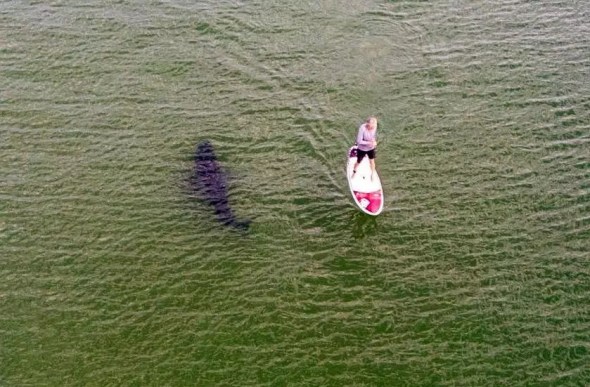
Great white shark swims beneath paddleboarding man on Cape Cod last week.
Good Morning!!
We’re having an incredible heat wave in Boston, and I know we’re not alone. It’s hot just about everywhere. Today it’s supposed to hit 100 degrees here. Anyone who believes the climate isn’t changing is delusional.
Maybe the sharks are affected too, because we’ve had some Great White close encounters here in Massachusetts lately. The Boston Globe: Shark sightings force swimmers out of the water in Plymouth, Cape Cod.
Swimmers at Plymouth and Wellfleet beaches looking to catch a break from the oppressive heat were forced out of the water Monday afternoon after sharks were spotted lurking nearby.
Plymouth beaches were closed after a great white shark was seen off Manomet Point. Red flags were flying at the beaches as crews investigated, the Plymouth harbormaster tweeted shortly after 2:30 p.m.
Researchers with the Atlantic White Shark Conservancy were about a quarter-mile from Marconi Beach in Wellfleet when they saw a great white shark at around 1:45 p.m. They reported it to beach officials, and lifeguards promptly pulled everyone out of the water, Leslie Reynolds, chief ranger at the Cape Cod National Seashore, said. The beach was closed for an hour as a standard precautionary measure.
Also from the Globe: ‘It came right up, and opened its mouth’: Great white shark breaches water below boat.
State biologist Greg Skomal got an up-close look at a great white shark during a recent excursion off Cape Cod when one of the apex predators that researchers had been observing breached the water right beneath him, exposing its large teeth.
“Did you see that?! Did you see that?!” Skomal can be heard saying in a video posted by the Atlantic White Shark Conservancy Monday morning. “It came right up, and opened its mouth right at my feet!”
In the video, Skomal can be seen standing on the research boat’s pulpit, as the captain closes in on a shark. Skomal was using a long pole with a GoPro camera attached at the end so he could dip it into the water and capture footage of the shark. That’s when it suddenly breached the ocean’s surface.
“Oh!,” the boat’s captain, John J. King II, can be heard saying. “Holy crap! It dove right out of the water.”
Here’s the video. Be sure to put it on full screen and wait for the close-up.
Holy crap!
Seriously though, have we already lost the fight to reverse climate change? That’s the argument put forth by Nathaniel Rich in last week’s New York Times Magazine: Losing Earth: The Decade We Almost Stopped Climate Change.
The world has warmed more than one degree Celsius since the Industrial Revolution. The Paris climate agreement — the nonbinding, unenforceable and already unheeded treaty signed on Earth Day in 2016 — hoped to restrict warming to two degrees. The odds of succeeding, according to a recent study based on current emissions trends, are one in 20. If by some miracle we are able to limit warming to two degrees, we will only have to negotiate the extinction of the world’s tropical reefs, sea-level rise of several meters and the abandonment of the Persian Gulf. The climate scientist James Hansen has called two-degree warming “a prescription for long-term disaster.” Long-term disaster is now the best-case scenario. Three-degree warming is a prescription for short-term disaster: forests in the Arctic and the loss of most coastal cities. Robert Watson, a former director of the United Nations Intergovernmental Panel on Climate Change, has argued that three-degree warming is the realistic minimum. Four degrees: Europe in permanent drought; vast areas of China, India and Bangladesh claimed by desert; Polynesia swallowed by the sea; the Colorado River thinned to a trickle; the American Southwest largely uninhabitable. The prospect of a five-degree warming has prompted some of the world’s leading climate scientists to warn of the end of human civilization.
Is it a comfort or a curse, the knowledge that we could have avoided all this?
Because in the decade that ran from 1979 to 1989, we had an excellent opportunity to solve the climate crisis. The world’s major powers came within several signatures of endorsing a binding, global framework to reduce carbon emissions — far closer than we’ve come since. During those years, the conditions for success could not have been more favorable. The obstacles we blame for our current inaction had yet to emerge. Almost nothing stood in our way — nothing except ourselves.
Check out the full story at the NYT.
Today there are some interesting primary elections and one special election to watch. Will we see portents of a blue wave in November?
Vox: Every August 7 primary election you should know about, briefly explained.
Voters head to the polls in five states Tuesday to test whether Democrats will get their “blue wave” on Election Day this fall.
Danny O’Connor
The most heated race to watch is a special election in Ohio’s 12th Congressional District, where a Democrat hasn’t won since the 1980s. Despite big spending by Republicans, a huge ground push, and even campaign appearances by President Donald Trump and Vice President Mike Pence, polls show the Democrat, Danny O’Connor, might actually beat Republican Troy Balderson.
Washington state’s top-two primary will be a similar test of how Democrats might perform in historically conservative districts.
In a governor’s race in Michigan and a House race in Kansas, meanwhile, Democrats will test whether the future of the party is rooted in its progressive wing.
To win back a House majority in November, Democrats will have to triumph in historically red districts, as they did in Pennsylvania earlier this year when Conor Lamb pulled off a surprise victory. Some big wins on Tuesday night could be another sign that a wave year is possible.

Read the details at Vox.
On Sunday, we watched Trump incriminate himself and throw his own son under the bus on Twitter. Will Don Jr. be indicted? Charles Savage at The New York Times: Donald Trump Jr.’s Potential Legal Troubles, Explained.
“I did not collude with any foreign government and did not know anyone who did,” Donald Trump Jr. told the Senate Judiciary Committee in September 2017. But his participation in the Trump Tower meeting with the Russians, as well as another meeting, has put that claim under scrutiny.
Ahead of the meeting with Russians, an intermediary promised Donald Trump Jr. that a “Russian government attorney” would provide “very high level” dirt on Hillary Clinton as “part of Russia and its government’s support for Mr. Trump.” He wrote back, “If it’s what you say I love it.”
In a meeting three months before the election, Donald Trump Jr. met with another small group offering to help his father win the election. It included an emissary for two wealthy Arab princes who run Saudi Arabia and the United Arab Emirates, as well as an Israeli specialist in social media manipulation. The younger Mr. Trump responded approvingly, a person with knowledge of the meeting told The New York Times.
Of course we all know by now that “collusion” is just another word for “conspiracy,” which can be a crime.
….lawyers instead talk about conspiracy: an agreement by two or more people to commit a crime — whether or not they end up doing so. A powerful tool for prosecutors, conspiracy charges allow them to hold each conspirator responsible for illegal acts committed by others in the circle as part of the arrangement. To convict someone of such a conspiracy, prosecutors would need to obtain evidence of an agreement to commit a specific crime….
A provision of the Federal Election Campaign Act, Section 30121 of Title 52, broadly outlaws donations or other contributions of a “thing of value” by any foreigner in connection with an American election — or even an express or implied promise to take such action, directly or indirectly.
Depending on how a grand jury interprets the facts the special counsel, Robert S. Mueller III, has gathered about the two Trump Tower meetings, it could find that the foreigners violated that law — and that Donald Trump Jr. conspired in that offense.
Another provision of the same statute makes it illegal for an American to solicit a foreigner for such illicit campaign help — again, even indirectly. If a grand jury were to interpret the evidence about Donald Trump Jr.’s words and actions as a solicitation, he could also be vulnerable to direct charges under that law, experts said.
Notably, the statute can be violated even if the promised or requested help is never provided.
Read the rest at the NYT.
At The Washington Post, William Ruckleshaus, who served as deputy attorney general under Nixon writes about Trump’s behavior: Only one other president has ever acted this desperate.
President Trump is acting with a desperation I’ve seen only once before in Washington: 45 years ago when President Richard M. Nixon ordered the firing of special Watergate prosecutor Archibald Cox. Nixon was fixated on ending the Watergate investigation, just as Trump wants to shut down the Mueller investigation into Russian interference in the 2016 election.
A lesson for the president from history: It turned out badly for Nixon. Not only could he not derail the investigation, but also, 10 months later, he was forced to resign the presidency.
In fact, in some ways, Trump is conducting himself more frantically than Nixon, all the while protesting his innocence. Nixon fought to the end because he knew that what was on the tape recordings that the prosecutor wanted would incriminate him. We don’t know what Trump is hiding, if anything. But if he is innocent of any wrongdoing, why not let Robert S. Mueller III do his job and prove it?
On the way Trump and his minions are attacking the investigation:
…the cynical conduct of this president, his lawyers and a handful of congressional Republicans is frightening to me and should be to every citizen of this country. We are not playing just another Washington political game; there is much more at stake.
The vehemence and irresponsibility of the rhetoric attacking the Mueller investigation tear at the very structure of our governance. Men who have sworn to use and protect our institutions of justice are steadily weakening them. Should the president finally decide to fire Mueller and put in place someone who will do his bidding, the country could be thrown into a political crisis that would scar our democracy and further erode the trust of our people in our governmental institutions.
We need leaders who tell the truth. This is not now happening. Mueller is living up to his superior reputation as a model public servant. His is a search for the truth; we should not complicate his job. Support him, and when he has finished his work, listen to what he has found.
Read the whole thing at the WaPo.
There are a lot more interesting reads out there today. Some to check out:
Forbes: New Details About Wilbur Ross’ Business Point To Pattern Of Grifting.
Rolling Stone: Rick Wilson: Trump’s Tweets May Actually Be His Undoing.
NBC News: Now the Trump administration wants to limit citizenship for legal immigrants.
Politico: Manafort prosecution’s frustration with judge leads to fiery clashes.
The Washington Post: Trump’s political base is weaker than it seems, our new study finds.
Think Progress: Here’s what a new trove of Russian Twitter accounts tell us about Moscow’s support for Jill Stein.
Buzzfeed News: Accused Russian Agent’s Journey To Washington Began In South Dakota.
Franklin Foer at The Atlantic: How Trump Radicalized ICE.
What stories are you following today?
Thursday Reads: “The United States faces a national-security emergency” — David Frum
Posted: July 19, 2018 Filed under: Foreign Affairs, morning reads, U.S. Politics | Tags: Donald Trump, Russia, Vladimir Putin 69 Comments
Baby reading for an apple, Mary Cassatt
Good Morning!!
I’m not too with it this morning. My mother is in the hospital and we still don’t know what is wrong with her. A few days ago, she started feeling weak and tired and she suddenly was unable to tie her shoes. Her blood pressure has been too high and her oxygen levels are too low. At the hospital the physical therapist found that her left hand wasn’t working properly, so that might explain the shoe-tying problem.
Whatever is wrong, it doesn’t seem to be life-threatening, because she has had all kinds of tests that have so far shown nothing wrong. She had an MRI yesterday and today they are going to check for blockage in her carotid artery she will work more with the physical therapist. A neurologist told my sister and my niece that she doesn’t think it’s serious, but they still don’t understand why her blood pressure is so high.
Anyway, I’ve been very anxious about Mom, and between that and the Trump madness. I can’t really think straight.
So what’s happening in the news today?

Mother and child, by Mitra Shadfar
I’m sure you’ve heard about the shocking story that broke in The New York Times last night: From the Start, Trump Has Muddied a Clear Message: Putin Interfered.
Two weeks before his inauguration, Donald J. Trump was shown highly classified intelligence indicating that President Vladimir V. Putin of Russia had personally ordered complex cyberattacks to sway the 2016 American election.
The evidence included texts and emails from Russian military officers and information gleaned from a top-secret source close to Mr. Putin, who had described to the C.I.A. how the Kremlin decided to execute its campaign of hacking and disinformation.
Mr. Trump sounded grudgingly convinced, according to several people who attended the intelligence briefing. But ever since, Mr. Trump has tried to cloud the very clear findings that he received on Jan. 6, 2017, which his own intelligence leaders have unanimously endorsed.
So Trump saw specific information proving that Vladimir Putin ordered the interference into our election to help him win, and he has spent his entire administration so far attempting to cover up for what his buddy Putin did.
The Jan. 6, 2017, meeting, held at Trump Tower, was a prime example. He was briefed that day by John O. Brennan, the C.I.A. director; James R. Clapper Jr., the director of national intelligence; and Adm. Michael S. Rogers, the director of the National Security Agency and the commander of United States Cyber Command.
The F.B.I. director, James B. Comey, was also there; after the formal briefing, he privately told Mr. Trump about the “Steele dossier.” That report, by a former British intelligence officer, included uncorroborated salacious stories of Mr. Trump’s activities during a visit to Moscow, which he denied.
The briefing revealed that a highly sensitive source close to Putin had provided information.
Mother and child, Pablo Picasso, 1901
According to nearly a dozen people who either attended the meeting with the president-elect or were later briefed on it, the four primary intelligence officials described the streams of intelligence that convinced them of Mr. Putin’s role in the election interference.
They included stolen emails from the Democratic National Committee that had been seen in Russian military intelligence networks by the British, Dutch and American intelligence services. Officers of the Russian intelligence agency formerly known as the G.R.U. had plotted with groups like WikiLeaks on how to release the email stash.
And ultimately, several human sources had confirmed Mr. Putin’s own role.
That included one particularly valuable source, who was considered so sensitive that Mr. Brennan had declined to refer to it in any way in the Presidential Daily Brief during the final months of the Obama administration, as the Russia investigation intensified.
Instead, to keep the information from being shared widely, Mr. Brennan sent reports from the source to Mr. Obama and a small group of top national security aides in a separate, white envelope to assure its security.
Mr. Trump and his aides were also given other reasons during the briefing to believe that Russia was behind the D.N.C. hacks.

I was exhausted last night and fell asleep early. I woke up about 3:30AM and check Twitter. A number of people were saying that this story was likely leaked to the NYT in response to Trump’s performance in Helsinki and afterwards and that the highly placed source must have been burned–possibly by Trump–or the story would not have been leaked.
https://twitter.com/MaxKennerly/status/1019770876915605504
No one except the interpreters knows what Trump gave away to Putin during their more than two hour meeting in Helsinki, and now Russia is claiming Trump and Putin made a number of deals.
The Washington Post: As Russians describe ‘verbal agreements’ at summit, U.S. officials scramble for clarity.
Two days after President Trump’s summit with Russian President Vladimir Putin, Russian officials offered a string of assertions about what the two leaders had achieved.
Delfina Flores Y Su Sobrina Modesta, Diego Rivera
“Important verbal agreements” were reached at the Helsinki meeting, Russia’s ambassador to the United States, Anatoly Antonov, told reporters in Moscow Wednesday, including preservation of the New Start and INF agreements, major bilateral arms control treaties whose futures have been in question. Antonov also said that Putin had made “specific and interesting proposals to Washington” on how the two countries could cooperate on Syria.
But officials at the most senior levels across the U.S. military, scrambling since Monday to determine what Trump may have agreed to on national security issues in Helsinki, had little to no information Wednesday.
At the Pentagon, as press officers remained unable to answer media questions about how the summit might impact the military, the paucity of information exposed an awkward gap in internal administration communications. The uncertainty surrounding Moscow’s suggestion of some sort of new arrangement or proposal regarding Syria, in particular, was striking because Gen. Joseph Votel, who heads U.S. Central Command, is scheduled to brief reporters on Syria and other matters Thursday.

This is interesting:
Defense Secretary Jim Mattis did not attend Wednesday’s Cabinet meeting with Trump and has not appeared in public this week or commented on the summit.
One thing Trump and Putin apparently discussed was allowing Russia to question 11 American citizens, including former Ambassador to Russia Michael McFaul.
The Washington Post: Outrage erupts over Trump-Putin ‘conversation’ about letting Russia interrogate ex-U.S. diplomat Michael McFaul.
At this week’s summit in Helsinki, Russian President Vladimir Putin proposed what President Trump described as an “incredible offer” — the Kremlin would give special counsel Robert S. Mueller III access to interviews with Russians who were indicted after they allegedly hacked Democrats in 2016. In return, Russia would be allowed to question certain U.S. officials it suspects of interfering in Russian affairs.
One of those U.S. officials is a former U.S. ambassador to Moscow, Michael McFaul, a nemesis of the Kremlin because of his criticisms of Russia’s human rights record.
On Wednesday, White House press secretary Sarah Huckabee Sanders declined to rule out the Kremlin’s request to question McFaul and other Americans. Asked during the daily press briefing whether Trump is open to the idea of having McFaul questioned by Russia, Sanders said President Trump is “going to meet with his team” to discuss the offer.
Read the rest at the WaPo.
The Daily Beast: U.S. Officials ‘at a Fucking Loss’ Over Latest Russia Sellout.

Sunshine Mother And Child, by Shijun Munns
Current and former American diplomats are expressing disgust and horror over the White House’s willingness to entertain permitting Russian officials to question a prominent former U.S. ambassador.
One serving diplomat, who spoke on condition of anonymity, said he was “at a fucking loss” over comments that can be expected to chill American diplomacy in hostile or authoritarian countries – a comment echoed by former State Department officials as well.
“It’s beyond disgraceful. It’s fundamentally ignorant with regard to how we conduct diplomacy or what that means. It really puts in jeopardy the professional independence of diplomats anywhere in the world, if the consequence of their actions is going to be potentially being turned over to a foreign government,” the U.S. diplomat told The Daily Beast.
During President Trump’s press conference with Vladimir Putin in Helsinki, Putin pivoted a question about extraditing the 12 Russian intelligence officers whom Robert Mueller has indicted into a quid pro quo for going after longtime betes noire currently beyond his reach.
Putin singled out Bill Browder, whose exposure of widespread Russian tax fraud led to the passage of a U.S. human rights sanctions law Putin hates. Standing next to Trump, the Russian president accused Browder of masterminding an illegal campaign contribution to Hillary Clinton and alleging vaguely that he had “solid reason to believe that some intelligence officers guided these transactions.” Should Trump permit the Russians to question people around Browder, Putin hinted, he will let Mueller’s people be “present at questioning” of the intelligence officers.
Unfuckingbelievable!
I’ll end with this piece by David Frump at The Atlantic: The Crisis Facing America. The country can no longer afford to wait to ascertain why President Trump has subordinated himself to Putin—it must deal with the fact that he has.
Mother with children by Dattatraya Thombare
We still do not know what hold Vladimir Putin has on Donald Trump, but the whole world has now witnessed the power of its grip.
Russia helped Donald Trump into the presidency, as Robert Mueller’s indictment vividly details. Putin, in his own voice, has confirmed that he wanted Trump elected. Standing alongside his benefactor, Trump denounced the special counsel investigating Russian intervention in the U.S. election—and even repudiated his own intelligence appointees….
The reasons for Trump’s striking behavior—whether he was bribed or blackmailed or something else—remain to be ascertained. That he has publicly refused to defend his country’s independent electoral process—and did so jointly with the foreign dictator who perverted that process—is video-recorded fact.
And it’s a fact that has to be seen in the larger context of his actions in office: denouncing the European Union as a “foe,” threatening to break up nato, wrecking the U.S.-led world trading system, intervening in both U.K. and German politics in support of extremist and pro-Russian forces, and continually refusing to act to protect the integrity of U.S. voting systems—it all adds up to a political indictment, whether or not it quite qualifies as a criminal one.
America is a very legalistic society, in which public discussion often deteriorates into lawyers arguing about whether any statutes have been violated. But confronting the country in the wake of Helsinki is this question: Can it afford to wait to ascertain why Trump has subordinated himself to Putin after the president has so abjectly demonstrated that he has subordinated himself? Robert Mueller is leading a legal process. The United States faces a national-security emergency.

Please share your thoughts and links in the comment thread and have a nice Thursday!
Lazy Saturday Reads: Trump’s Cringe-Inducing European Adventure and Other News
Posted: July 14, 2018 Filed under: Afternoon Reads, Foreign Affairs, U.S. Politics | Tags: bum's rush, children separated from parents, Donald Trump, Greenpeace, GRU, immigration, indictment of 12 Russian military officers, Queen Elizabeth, Robert Mueller, Rod Rosenstein, Scotland, Turnberry 12 Comments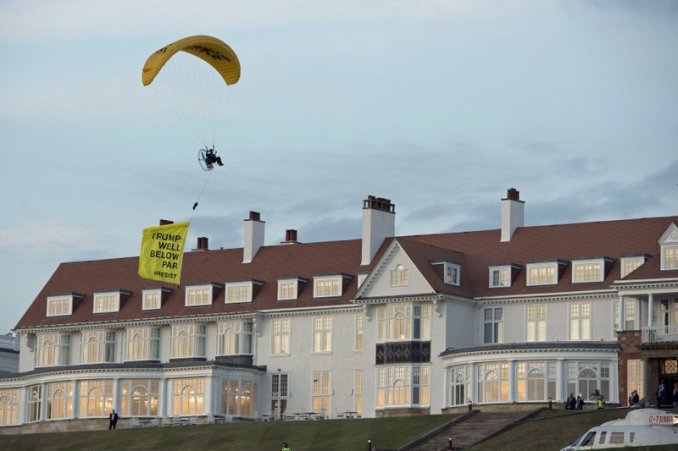
Good Afternoon!!
Trump in Scotland
Trump is at his golf resort in Turnberry, Scotland, and protesters are out in force there as they were in England. The Guardian:
Trump and his wife Melania arrived in Scotland on board Air Force One on Friday evening, before travelling by motorcade to his Trump Turnberry resort in Ayrshire.
By lunchtime, about 50 protesters had congregated on Turnberry beach. Just before 2pm, the US president appeared on the golf course and waved at the gathering on the beach, to be met with booing and chants of “no Trump, no racist USA”. Meanwhile, close to 10,000 marchers were streaming through the streets of Edinburgh, ending up in the Meadows park to the south of the city centre, where families sat in the sunshine and enjoyed picnics, music and speeches from local activists….
Towards the back of the crowd, the six-metre Trump baby balloon was straining against its tethers in the wind. Organiser Leo Murray described how a crew of “babysitters” had travelled up from London overnight on the sleeper train to fly the blimp at Saturday’s protest.
Murray had originally hoped to fly the balloon, which depicts Trump as an angry baby wearing a nappy, at his Turnberry course, but Police Scotland denied permission on security grounds.
Nevertheless, a Greenpeace protester managed to breach the no-fly zone on a hang glider with a sign reading ““Trump: well below par #resist” (see photo at the top of this post). Thank you to the people of Scotland for standing in solidarity with the U.S. resistance. I’m proud of my Scottish heritage today.
And while we’re talking about Trump’s Scottish golf course, be sure to check out this piece by Adam Davidson at The New Yorker: Where Did Donald Trump Get Two Hundred Million Dollars to Buy His Money-Losing Scottish Golf Club?
Between meeting the Queen of England and Vladimir Putin, President Trump will spend this weekend at Turnberry, the golf course he bought in 2014 and rechristened Trump Turnberry. This property has not received the attention it deserves. It is, by far, the biggest investment the Trump Organization has made in years. It is so much bigger than his other recent projects that it would not be unreasonable to describe the Trump Organization as, at its core, a manager of a money-losing Scottish golf course that is kept afloat with funds from licensing fees and decades-old real-estate projects.
No doubt, the President will be excited to visit. After buying the property for more than sixty million dollars, he then spent a reported hundred and fifty million pounds—about two hundred million dollars total—remaking the site, adding a new course, rehabbing an old one, and fixing up the lodgings. It is possible, though, that he will have some harsh words for his staff. The Turnberry has been losing an astonishing amount of money, including twenty-three million dollars in 2016. The Trump Organization argued that these losses were the result of being closed for several months for repair. However, revenue for the months it was open were so low—about $1.5 million per month—that it is hard to understand how the property will ever become profitable, let alone so successful that it will pay back nearly three hundred million dollars in investment and losses….
President Trump has proclaimed himself the “king of debt,” a proud master of “doing things with other people’s money.” So it was quite surprising when Jonathan O’Connell, David A. Fahrenthold, and Jack Gillum revealed in a Washington Post story in May that Trump had abruptly shifted strategies and begun spending hundreds of millions of dollars in cash to fund projects. In the nine years before he ran for President, the Post reported, the Trump Organization spent more than four hundred million dollars in cash on new properties—including fourteen transactions paid in full. In fifteen years, he bought twelve golf courses (ten in the U.S., one in Ireland, and a smaller one in Scotland), several homes, and a winery and estate in Virginia, and he paid for his forty-million-dollar share of the cost of building the Trump Hotel in Washington, D.C.—a property leased to Trump by the U.S. government. But his largest cash purchase was the Turnberry, followed by tens of millions of dollars in additional cash outlays for rehabbing the property.
Read the rest at The New Yorker.
Trump meets Queen Elizabeth
Yesterday, just as Rod Rosenstein was preparing to announce indictments of the 12 Russians who were responsible for hacking the DNC, DCCC, and Clinton campaign email servers and disseminating embarrassing information designed to hurt Hillary and help Trump during the 2016 election, Donald Trump was meeting with the Queen of England. And he managed to turn that into a clusterfuck just as he has everything else on his disastrous European trip.
The Washington Post: ‘Did Donald Trump just WALK IN FRONT OF THE QUEEN?’
It’s generally quite difficult to upstage the queen of England, but President Trump might have managed to do so.
Trump and Queen Elizabeth II met Friday as part of his working visit to the United Kingdom….
Trump’s walk with the queen during an inspection of guardsmen quickly became a hot topic.
Described as “cringeworthy” and “uncomfortable” viewing on social media, footage of their walk together came under intense scrutiny. While touring the castle grounds, Trump maintained a relatively brisk walk, which saw the queen, at times, fall behind him as he led the way.
At one point, the queen can be seen gesturing to Trump, although it’s unclear what exactly she may have been referring to. On social media, some speculated that Trump was being instructed on which side of her he should walk.
If that was the case, the president didn’t grasp the message.
The Trumps also arrived late for tea, making the Queen wait, and they did not bow or curtsy when they met her. That’s considered optional, but most people don’t opt to simply shake hands as the Trumps did. At least Trump didn’t do his vise grip and pull handshake with her. Then the Queen gave the Trumps the bum’s rush, ending the meeting after about half an hour.
https://twitter.com/gormangahst/status/1018161998570323974
Trump is a crude, crass, and classless pig. What an embarrassment that he is “president.” The Russians got exactly what they wanted. By contrast, the Obama’s got the full royal treatment.
Two great reads on the Mueller indictment released yesterday
Dan Friedman at Mother Jones: Mueller’s Indictment of 12 Russian Spies is Very Bad for Trump.
Special counsel Robert Mueller on Friday obtained an indictment of 12 members of a Russian military intelligence agency for hacking Democratic party emails during the 2016 election—a rebuke to President Trump, who has refused to fully acknowledge Russia’s election interference, just three days before his planned meeting with Russian President Vladimir Putin in Finland.
The indictment, announced Friday by Deputy Attorney General Rod Rosenstein, will probably not lead to immediate prosecutions—it doesn’t accuse any Americans of crimes, as the White House was quick to point out, and it’s unlikely that Russia will allow extradition of its own officials—but the charges are still a big deal in the Trump-Russia investigation and they offer extensive new details on how the Russian hacking effort actually worked.
Click on the link to read the “key takeaways.”
Emptywheel: The Russian Hack.
Mueller’s team just announced (and announced the transfer, as I predicted) of the Russian hack indictment, naming 12 GRU officers for the hack of the Hillary campaign, the DNC, and the DCCC. This will be a working thread.
Rod Rosenstein, as he did with the Internet Research Agency, made clear there are no Americans named in this indictment (and that those who interacted with Guccifer 2.0 and DC Leaks did not know they were interacting with Russians). That said, here are some of the interesting nods in it.
Again, click on the link to read the “interesting nods.” and Emptywheel’s timeline.
Trump’s Immigration Mess
Foreign Policy: White House Official Who Advocated for Refugees Sacked and Escorted From Office.
Jennifer Arrangio (center)
A senior White House official, Jennifer Arangio, was fired Thursday and escorted from her office, ending a turbulent tenure that saw her clashing with President Donald Trump’s most hard-line advisors over human rights and refugee issues, according to several current and former U.S. officials.
The officials said Arangio, a senior director for international organizations and alliances at the National Security Council, had fallen out of favor with Trump aide Stephen Miller over the number of refugees who should be allowed to enter the United States.
She had also sparred with Miller over continuing U.S. participation in international negotiations on a global migration compact, insisting that the United States could better shape international policies on migration from inside the tent.
She lost the argument, but Miller remained embittered by the rift, the officials said. When Arangio sought his endorsement for a position in the State Department, he refused to take a meeting with her.
Adding to the tension, Arangio had defended the State Department’s embattled refugee bureau amid campaigns by other top Trump aides to dismantle or defund it — efforts that were ultimately rebuffed by Congress.
“This is a disaster for the bureau,” one State Department official said. “She is really a good ally.”

Have your handkerchiefs ready for this one at The New York Times: Cleaning Toilets, Following Rules: A Migrant Child’s Days in Detention.
Adan Galicia Lopez, 3, was separated from his mother for four months.
Do not misbehave. Do not sit on the floor. Do not share your food. Do not use nicknames. Also, it is best not to cry. Doing so might hurt your case.
Lights out by 9 p.m. and lights on at dawn, after which make your bed according to the step-by-step instructions posted on the wall. Wash and mop the bathroom, scrubbing the sinks and toilets. Then it is time to form a line for the walk to breakfast.
“You had to get in line for everything,” recalled Leticia, a girl from Guatemala.
Small, slight and with long black hair, Leticia was separated from her mother after they illegally crossed the border in late May. She was sent to a shelter in South Texas — one of more than 100 government-contracted detention facilities for migrant children around the country that are a rough blend of boarding school, day care center and medium security lockup. They are reserved for the likes of Leticia, 12, and her brother, Walter, 10.
The facility’s list of no-no’s also included this: Do not touch another child, even if that child is your hermanito or hermanita — your little brother or sister.

Leticia had hoped to give her little brother a reassuring hug. But “they told me I couldn’t touch him,” she recalled.
This is a must read, even though the stories of these children are heartbreaking. Trump and his minions must be held accountable for this outrage.

 peej
peej Carissa
 bostonboomer
 dakinikat
 ecocatwoman
 jjlo
jjlo mablue2
 Mama Lopez
 peggysue22
 quixote
 skydancingguestblogger
 Mona (aka Wonk the Vote)





Recent Comments