Posted: February 25, 2020 | Author: bostonboomer | Filed under: Foreign Affairs, morning reads, U.S. Politics | Tags: Bernie Sanders, cuba, Donald Trump, Fidel Castro, South Carolina primary |
Good Morning!!
 I had a flu shot in January, and since then I’ve had a week-long bout a stomach flu and now I have a full-blown case of the flu. I came down with it on Saturday morning and since then I’ve had a low grade fever that comes and goes along with a hacking cough, headaches, ear pain, and muscle aches. I felt better yesterday, and my temperature was normal until late last night. Now it’s already over 100 again.
I’m really not looking forward to catching the corona virus, but according to James Hamblin at The Atlantic, we are all likely to get it eventually: You’re Likely to Get the Coronavirus. Most cases are not life-threatening, which is also what makes the virus a historic challenge to contain.
Coronaviruses are similar to influenza viruses in that they are both single strands of RNA. Four coronaviruses commonly infect humans, causing colds. These are believed to have evolved in humans to maximize their own spread—which means sickening, but not killing, people. By contrast, the two prior novel coronavirus outbreaks—SARS (severe acute respiratory syndrome) and MERS (Middle East respiratory syndrome, named for where the first outbreak occurred)—were picked up from animals, as was H5N1. These diseases were highly fatal to humans. If there were mild or asymptomatic cases, they were extremely few. Had there been more of them, the disease would have spread widely. Ultimately, SARS and MERS each killed fewer than 1,000 people.
COVID-19 is already reported to have killed more than twice that number. With its potent mix of characteristics, this virus is unlike most that capture popular attention: It is deadly, but not too deadly. It makes people sick, but not in predictable, uniquely identifiable ways. Last week, 14 Americans tested positive on a cruise ship in Japan despite feeling fine—the new virus may be most dangerous because, it seems, it may sometimes cause no symptoms at all.
Hamblin explains that this COVID-19 is likely to spread and then keep coming back every year, because it is contagious even when people have no symptoms and it doesn’t kill off most of the people who get it.
The Harvard epidemiology professor Marc Lipsitch is exacting in his diction, even for an epidemiologist. Twice in our conversation he started to say something, then paused and said, “Actually, let me start again.” So it’s striking when one of the points he wanted to get exactly right was this: “I think the likely outcome is that it will ultimately not be containable.”
 Containment is the first step in responding to any outbreak. In the case of COVID-19, the possibility (however implausible) of preventing a pandemic seemed to play out in a matter of days. Starting in January, China began cordoning off progressively larger areas, radiating outward from Wuhan City and eventually encapsulating some 100 million people. People were barred from leaving home, and lectured by drones if they were caught outside. Nonetheless, the virus has now been found in 24 countries….
Lipsitch predicts that, within the coming year, some 40 to 70 percent of people around the world will be infected with the virus that causes COVID-19. But, he clarifies emphatically, this does not mean that all will have severe illnesses. “It’s likely that many will have mild disease, or may be asymptomatic,” he said. As with influenza, which is often life-threatening to people with chronic health conditions and of older age, most cases pass without medical care. (Overall, around 14 percent of people with influenza have no symptoms.)
Lipsitch is far from alone in his belief that this virus will continue to spread widely. The emerging consensus among epidemiologists is that the most likely outcome of this outbreak is a new seasonal disease—a fifth “endemic” coronavirus. With the other four, people are not known to develop long-lasting immunity. If this one follows suit, and if the disease continues to be as severe as it is now, “cold and flu season” could become “cold and flu and COVID-19 season.”
The New York Times: ‘Recipe for a Massive Viral Outbreak’: Iran Emerges as a Worldwide Threat.
Religious pilgrims, migrant workers, businessmen, soldiers and clerics all flow constantly across Iran’s frontiers, often crossing into countries with few border controls, weak and ineffective governments and fragile health systems.
Now, as it struggles to contain the spread of the coronavirus, Iran is also emerging as the second focal point after China for the spread of the disease. Cases in Iraq, Afghanistan, Bahrain, Kuwait, Oman, Lebanon, the United Arab Emirates — even one in Canada — have all been traced to Iran, sending tremors of fear rippling out from Kabul to Beirut.
The Middle East is in many ways the perfect place to spawn a pandemic, experts say, with the constant circulation of both Muslim pilgrims and itinerant workers who might carry the virus. Iran’s economy has been strangled by sanctions, its people have lost trust in their government and its leaders are isolated from much of the world, providing little clarity about the extent of the epidemic.
Civil wars or years of unrest have shattered the health systems of several neighboring countries, like Syria, Iraq, Afghanistan and Yemen. And most of the region is governed largely by authoritarians with poor track records at providing public transparency, accountability and health services.
“It is a recipe for a massive viral outbreak,” said Peter Piot, director of the London School of Hygiene and Tropical Medicine and the former founding executive director of the Joint United Nations Program on H.I.V./AIDS.
An even more immediate threat is the rise of Bernie Sanders. Over the weekend Sanders used his 60 Minutes interview to defend his past support of Fidel Castro’s Cuba.
The reaction in Florida-home was swift and angry.
Marc Caputo at Politico: Florida Dems in uproar after Sanders’ Cuba comments.
Florida Democrats insist he‘s the worst-equipped [to defeat Donald Trump] after Sanders’ refusal Sunday night to thoroughly condemn the Cuban revolution. His comments on 60 Minutes sent shock waves through the nation’s biggest battleground state, where Democratic members of Congress, state legislators and party leaders warned that his nomination — and Sanders’ self-described “Democratic socialism” — will cost them the biggest battleground state of them all.
“Donald Trump wins Florida if Bernie is our nominee,” said state Rep. Javier Fernandez, a Democratic candidate in a majority-Hispanic state Senate district….
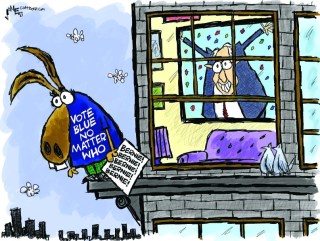 As a state with an influential cross-section of Latinos whose families fled leftist Latin American regimes and violence, Sanders embrace of far-left leaders and his past refusals to wholeheartedly condemn Latin American strongmen and the Soviet Union have long been seen as fatal flaws.
Sanders on Sunday did nothing to allay those concerns in a 60 Minutes interview in which he was asked about his 1985 comments stating that the Cuban people didn’t “rise up in rebellion against Fidel Castro” because “he educated their kids, gave their kids health care, totally transformed society.”
There was no mention of the firing squads, political purges and mass arrests that accompanied the 1959 revolution.
There’s much more at the link.
At least Sanders is finally getting vetted by the media. For example, Griffe Witte at The Washington Post: In Cold War travels, Bernie Sanders found much to admire behind enemy lines. Now that’s a problem for his campaign.
The mayor of tiny Burlington, Vt., was back from Nicaragua and eager to share the good news.
The country’s Soviet-backed government — forged via armed rebellion — was cutting infant mortality, reducing illiteracy and redistributing land to peasant farmers. Its Sandinista leaders, branded terrorists by the U.S. government, impressed him with “their intelligence and their sincerity.”
Three years later, Bernie Sanders was fresh off the plane from Moscow, reveling in the beauty of the land and the contentedness of the people.
And a year after that, he returned from Cuba having tapped into a revolutionary spirit “far deeper and more profound than I understood it to be.”
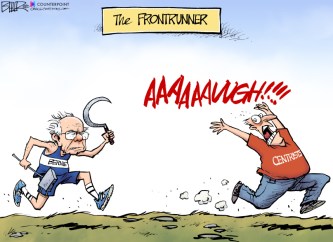 With Sanders now surging to the top of the Democratic presidential field, those three-decade-old impressions introduced a volatile new element in the race Monday as rivals reacted to Sanders’s decision to defend his remarks, not disclaim them….
The fact that Sanders’s long-ago travels in the communist world have become an issue in the 2020 campaign reflects how unorthodox a choice he would be to lead the Democratic Party….
Returning home from visits to some of the United States’ most avowed enemies, Sanders offered some criticism but also plenty of praise in Vermont community television recordings. Many of the videos were kept in storage for decades — including during his 2016 campaign — and, even after being posted online, have remained relatively unknown.
Now, Sanders’s comments are coming back to life as opponents say his warm feelings toward his hosts decades ago make him vulnerable to attack and reveal a soft spot for left-wing despots.
Read the rest at the WaPo. More Bernie critiques:
Jonathan Chait: If Democrats Aren’t Terrified of Bernie, They’re Not Paying Attention.
William Saletan at Slate: The Great Socialism Gap. Socialism doesn’t freak out Democratic voters the way it freaks out other Americans. That’s a problem.
Never Trumper Michael Gerson at The Washington Post: A Trump-Sanders election would destroy our politics.
The South Carolina primary is coming up on Saturday, followed three days later by Super Tuesday. There’s another debate tonight, and I hope Elizabeth Warren will finally get up the nerve to address Sanders’ many weaknesses instead continuing to focus on Mike Bloomberg. I’m pretty sure the other candidates won’t hesitate to attack Bernie.
Natasha Korecki at Politico: Sanders under fire in South Carolina from all directions.
 Joe Biden’s campaign is airing a new digital ad in South Carolina accusing Bernie Sanders of trying to undermine Barack Obama’s 2012 reelection by threatening to primary him. Pete Buttigieg was on TV in South Carolina hitting Sanders over health care and Mike Bloomberg targeted Sanders’ past gun votes.
“When it comes to building on Barack Obama’s legacy, Bernie Sanders just can’t be trusted,” the Biden ad, first obtained by POLITICO, warns.
The fusillade targeting Sanders on the eve of a Democratic debate in the fourth early state of South Carolina marked the latest turn in a Democratic primary that now has a decisive frontrunner. Each of the candidates, competing for a fraction of the moderate vote, are attempting to blunt the Vermont senator’s momentum coming off a landslide win in Nevada.
“When we rallied together to defend our president and all the progress he made they had his back,” the narrator says. Panning to then-Vice President Biden, the voice-over continues, “He had his back,” and moving to images of African American supporters at an Obama rally, says: “And you had his back.”
“But back in Washington, there was one guy with another plan,” the narrator says before an audio clip is heard of Sanders saying, “I think it would be a good idea if President Obama faced some primary opposition.”
More at the WaPo.
Are you going to watch the debate? I might give it a try. The last one was pretty entertaining, and it would be fun to see Bernie get his ass kicked. As always, this is an open thread.
Did you like this post? Please share it with your friends:
Posted: February 22, 2020 | Author: bostonboomer | Filed under: morning reads, U.S. Politics | Tags: Bernie Sanders, California primary, Department of Homeland Security, Donald Trump, FEMA, intelligence community, national security, Nevada Caucuses, Richard Grenell, Russian election interference, Super Tuesday |

Good Morning!!
The Nevada Caucuses will wrap up this afternoon, but thousands of people have already voted. Political pundits have already crowned Bernie Sanders the winner, but that may not be a sure thing.
David Byler at The Washington Post: We lack the data to predict Nevada’s outcome. Be wary of pundits’ gut instincts.
Nobody really knows what’s going on in the upcoming Nevada Democratic caucuses. Sure, we have a little bit of polling to go on — the RealClearPolitics average includes three recent polls, and it shows Bernie Sanders leading the pack at 30 percent, with Joe Biden, Elizabeth Warren, Pete Buttigieg, Tom Steyer and Amy Klobuchar all clustered between 16 percent and 10 percent of the vote. But it’s hard to nail down the electorate in a caucus state, and Nevada is flush with the sort of young, Hispanic voters that pollsters often have trouble contacting. So all we really know is that Sanders has a lead, but that he’s not invincible.
In a normal election, this lack of concrete information wouldn’t be a problem: Nobody ever died because they didn’t see enough Nevada polling. But primaries aren’t normal elections. The trajectory of the race is often influenced by media-created “expectations” and narratives about “momentum.” And in Nevada, many political pros will be setting those crucially important expectations using gut feelings and groupthink rather than real information. That’s a riskier undertaking for them than they might acknowledge — and for the voters who listen to them.
Much more at the link.
 Harry Enten at CNN: Why Nevada could surprise us.
There have been just eight polls released publicly over the last three months. Two of those were internal polls. Only five of those have been taken since the primary season began a few weeks ago, and of those, a grand total of zero meet CNN standards for publication….
Put all together, Sanders is something around a seven in 10 favorite to win in Nevada. That’s based off of the prediction markets and how good the polling in Nevada has been since 2008 (the first year in which Nevada was one of the first four states to vote). Biden and former South Bend, Indiana, Mayor Pete Buttigieg are next with somewhere around a one in 10 chance to win. Everybody has less than a one in 10 shot in Nevada.
Sanders clearly has a better shot than anyone else to win, but a seven in 10 shot is not an overwhelming favorite. It means that there’s a decent chance Sanders won’t win.
The lack of confidence we should have in the Nevada outcome is partially because of the lack of polling data, but also because the polling data has not been particularly predictive in the past.
Since 2008, Nevada has b een a polling wasteland. Looking at all candidates who polled at 10% or better after undecideds were allocated, Nevada polls taken after the Iowa caucuses have had an average error per candidate of 8 points. The 95% confidence interval for each candidate above 10% is something closer to +/- 20 points. That is, to put it mildly, a huge range.
Read the rest at CNN.

Cat Nap – A Pink Chair by the Window, Lara Meintjes
And we can’t forget that early voting has already been going on in many Super Tuesday states. I’ll be voting early here in Massachusetts next week.
Kelly Mena at CNN: Forget Nevada. Almost 2 million votes have already been cast in Super Tuesday states.
Super Tuesday is still more than a week away, but almost 2 million ballots have already been cast — including in delegate-rich California and Texas.
More than 1.3 million vote-by-mail ballots have been returned in California since February 3, according to county data provided by Sam Mahood, a spokesman for Secretary of State Alex Padilla. That’s out of more than 16 million ballots sent out — a flood that allows the vast majority of the state’s more than 20 million registered voters to cast their ballots before March 3.
“The California presidential primary may be on Super Tuesday, but for millions of Californians, it is really Super February,” Padilla said in a news release earlier this month.
California, with 494 delegates at stake — the most of any single state — has taken on new prominence this year after moving its primary date up in the calendar. Democratic candidates need 1,991 to clinch the nomination.
The other big delegate haul up for grabs on Super Tuesday is Texas, with 261 delegates. Almost half a million ballots have already been cast since early and by-mail voting opened on February 18, according to the secretary of state’s office. Texas has more than 16 million registered voters.
Unfortunately, Bernie is also leading in California polls; and he’s so confident of winning Nevada that he has already left to campaign in CA.

Cat on a chair, Diane Hoepner
Two polls released this week in California show Bernie Sanders holding a comfortable lead. The latest poll from The Public Policy Institute of California, released on Tuesday, shows Sanders ahead at 32%, with Joe Biden (14%), Elizabeth Warren (13%), Pete Buttigieg (12%) and Michael Bloomberg (12%) closely knotted in a race for second. Amy Klobuchar stood at 5% in that poll, with Tom Steyer at 3% and Tulsi Gabbard at 1%.
Monmouth University also released a California poll this week. Their poll finds Sanders leading with 24%, Biden at 17%, Bloomberg at 13%, Warren at 10% and Buttigieg at 9%. Behind them, Steyer (5%) and Klobuchar (4%) were about even, with Gabbard at 2%.
Yesterday we learned that Russia is trying to help Bernie win the Democratic nomination. The Washington Post reports:
U.S. officials have told Sen. Bernie Sanders that Russia is attempting to help his presidential campaign as part of an effort to interfere with the Democratic contest, according to people familiar with the matter.
President Trump and lawmakers on Capitol Hill also have been informed about the Russian assistance to the Vermont senator, those people said, speaking on the condition of anonymity to discuss sensitive intelligence.
It is not clear what form that Russian assistance has taken. U.S. prosecutors found a Russian effort in 2016 to use social media to boost Sanders’s campaign against Hillary Clinton, part of a broader effort to hurt Clinton, sow dissension in the American electorate and ultimately help elect Donald Trump.
So Bernie has known this for a month and did and said nothing about it. And he’s not happy with the media for reporting the news. He attacked the Post for reporting the story.
He is also furious with MSNBC for some reason. As far as I can tell, he is getting full support from Chris Hayes, Rachel Maddow and Ali Velshi, but I guess he’s angry with some of the guests on the network. Page Six: Bernie Sanders calls out MSNBC over campaign coverage.
Bernie Sanders went ballistic at NBC and MSNBC execs ahead of the Democratic debate this week — jabbing one top TV exec repeatedly in the face with his finger and accusing the networks of offensive negative coverage.
Surging Sanders stormed through the walk-through for the Las Vegas debate, singling out one top producer at the end and aggressively sticking his finger in his face. One shocked witness said, “Bernie marched right up to NBC and MSNBC’s head of creative production and began jabbing his finger right in his face, yelling, ‘Your coverage of my campaign is not fair . . . Your questions tonight are not going to be fair to me.’ ”
 Sanders did not hold back as he continued to rant about MSNBC coverage. According to the witness, “The NBC exec told Sanders he would be treated fairly.”
A separate insider confirmed the confrontation, saying Sanders was so steamed he also sparred with MSNBC boss Phil Griffin outside the green room moments before the debate began. “Sen. Sanders stated, ‘Phil, your network has not been playing a fair role in this campaign. I am upset. Is anything going to change? . . . I hope you will do better.’ ”
The Democratic front-runner has been left seeing red over repeated slights against him by liberal MSNBC pundits and hosts, including Chris Matthews, who suggested the senator might cheer socialist executions in Central Park. And Chuck Todd — a moderator of Wednesday’s debate — even quoted a story that described Sanders supporters as a “digital brownshirt brigade.” Todd was also tackled by seething Sanders onstage after the debate: “I do not appreciate your comment about my supporters,” adding the Holocaust reference was “offensive.”
Sanders’ campaign manager Faiz Shakir has said that even Fox News has been “more fair than MSNBC . . . which . . . is constantly undermining the Bernie Sanders campaign.”
There’s no doubt in my mind that Bernie is just a “socialist” mirror image of Trump. But Trump is actually president right now, and he’s undermining democracy in every way he and his thugs can think of. His latest efforts include a Stalinist-style purge of anyone who crosses him and a hostile takeover of the Intelligence community.
The Washington Post: Trump embarks on expansive search for disloyalty as administration-wide purge escalates.
President Trump has instructed his White House to identify and force out officials across his administration who are not seen as sufficiently loyal, a post-impeachment escalation that administration officials say reflects a new phase of a campaign of retribution and restructuring ahead of the November election.

Maine Coon Cat Sitting On Chair, by Rosanne Olson.
Johnny McEntee, Trump’s former personal aide who now leads the effort as director of presidential personnel, has begun combing through various agencies with a mandate from the president to oust or sideline political appointees who have not proved their loyalty, according to several administration officials and others familiar with the matter who spoke on the condition of anonymity to discuss internal deliberations.
The push comes in the aftermath of an impeachment process in which several members of Trump’s administration provided damning testimony about his behavior with regard to Ukraine. The stream of officials publicly criticizing Trump’s actions frustrated the president and caused him to fixate on cleaning house after his acquittal this month.
“We want bad people out of our government!” Trump tweeted Feb. 13, kicking off a tumultuous stretch of firings, resignations, controversial appointments and private skirmishes that have since spilled into public view.
The New York Times: Richard Grenell Begins Overhauling Intelligence Office, Prompting Fears of Partisanship.
Richard Grenell’s tenure as the nation’s top intelligence official may be short-lived, but he wasted no time this week starting to shape his team of advisers, ousting his office’s No. 2 official — a longtime intelligence officer — and bringing in an expert on Trump conspiracy theories to help lead the agency, according to officials.
Mr. Grenell has also requested the intelligence behind the classified briefing last week before the House Intelligence Committee where officials told lawmakers that Russia was interfering in November’s presidential election and that President Vladimir V. Putin of Russia favored President Trump’s re-election. The briefing later prompted Mr. Trump’s anger as he complained that Democrats would use it against him.
Joseph Maguire, the former acting director of national intelligence, and his deputy, Andrew P. Hallman, resigned on Friday. Mr. Grenell told Mr. Hallman, popular in the office’s Liberty Crossing headquarters, that his service was no longer needed, according to two officials. Mr. Hallman, who has worked in the office or at the C.I.A. for three decades, expressed confidence in his colleagues in a statement but also referred to the “uncertainties that come with change.”
The ouster of Mr. Hallman and exit of Mr. Maguire, who also oversaw the National Counterterrorism Center, allowed Mr. Grenell to install his own leadership team.
Much more at the WaPo link.
 Finally, here’s a deep dive into Trump’s attack on our National Security by Garrett Graff at Wired: How Trump Hollowed Out US National Security.
While vacancies and acting officials have become commonplace in this administration, the moves by President Donald Trump this week represent a troubling and potentially profound new danger to the country. There will soon be no Senate-confirmed director of the National Counterterrorism Center, director of national intelligence, principal deputy director of national intelligence, homeland security secretary, deputy homeland security secretary, nor leaders of any of the three main border security and immigration agencies. Across the government, nearly 100,000 federal law enforcement agents, officers, and personnel are working today without permanent agency leaders, from Customs and Border Protection and Immigrations and Customs Enforcement to the Drug Enforcement Administration and the Bureau of Alcohol, Tobacco, Firearms, and Explosives.
All the posts, and many more top security jobs, are unfilled or staffed with leaders who have not been confirmed by the Senate. Trump has done an end-around, installing loyalists without subjecting them to legally mandated vetting and approval by Congress.
Trump’s surprise ouster of Maguire, who took over as acting director of national intelligence last summer, came apparently in a tantrum over a congressional briefing that outlined how Russia is already trying to interfere with the 2020 election and help reelect Trump.
But understanding the true cost of Maguire’s firing requires understanding how the role first came to be. The director of national intelligence position was created after 9/11 specifically to coordinate the work of the nation’s 17 intelligence agencies and help “connect the dots” on disparate data and threats, work that wasn’t done before September 11, 2001. DNI is an immensely challenging job that includes serving legally as the president’s top intelligence adviser, and traditionally involves giving the president’s daily briefing on potential threats.
Graff also address Trump’s destruction of the Department of Homeland Security–including FEMA. I hope you’ll read the whole article.
Have a great weekend, Sky Dancers! As always, this is an open thread.
Did you like this post? Please share it with your friends:
Posted: February 18, 2020 | Author: bostonboomer | Filed under: morning reads, U.S. Politics | Tags: 2020 Democratic primaries, Bernie Sanders, Donald Trump, Joe Biden, Mike Bloomberg |

Good Morning!!
Just shoot me now. Could we really end up with a general election choice of Sanders vs. Trump? Please tell me this isn’t really happening. The latest NPR/PBS national poll came out this morning.
Vermont Sen. Bernie Sanders has opened up a double-digit lead in the Democratic nominating contest, according to a new NPR/PBS NewsHour/Marist poll.
Sanders has 31% support nationally, up 9 points since December, the last time the poll asked about Democratic voters’ preferences.
His next closest contender has 19%. But that second-place rival is former New York Mayor Michael Bloomberg. Many Americans have become familiar with Bloomberg lately in this race because of his ubiquitous TV ads. But now get ready to see him on the debate stage for the first time Wednesday. With this poll, Bloomberg has qualified for the Nevada debate, despite not being on the ballot there for Saturday’s caucuses.
You read that right. Joe Biden is now in third place, but he’s still running the strongest against Trump.
 Third among Democratic voters and Democratic-leaning independents is former Vice President Joe Biden with 15%, down 9 points since December.
The debate Wednesday, as well as Biden’s performance in Nevada Saturday and South Carolina a week later, are critical to whether the former vice president has a real chance at the nomination after disappointing fourth- and fifth-place showings in Iowa and New Hampshire, respectively….
Following Biden is Massachusetts Sen. Elizabeth Warren at 12%, also down from December — by 5 percentage points — after poor showings in Iowa and New Hampshire.
Next is Minnesota Sen. Amy Klobuchar at 9%. She’s up from 4% in December after surprisingly good finishes in the first two contests, and she has leaped ahead of Pete Buttigieg in this national survey.
The former South Bend, Ind., mayor is at just 8%, down from 13% in December, not a good sign for the candidate after very solid finishes in the first two contests [in Iowa and New Hampshire].
Politico reports: Major Latino group backs Sanders on eve of Nevada caucus.
A prominent national Latino group is endorsing Bernie Sanders four days ahead of the caucuses in Nevada, a state with a significant Hispanic electorate.
 Mijente, a grass-roots organization that mobilizes Latinx and Chicanx voters, decided to make its first-ever presidential endorsement in response to President Donald Trump’s rhetoric and policies targeting Latinos. The endorsement adds to the growing collection of progressive groups coalescing around the Vermont senator, after earlier expectations they would be divided between him and Elizabeth Warren.
The organization will use its reach on social media, its roughly 1,000 dues-paying members and more than 300,000-person email list to mobilize Latinos to vote and hit the pavement for Sanders in Nevada and other states.
Marisa Franco, director and cofounder of Mijente, said the group’s members picked Sanders after a lengthy process that included sit-downs with multiple candidates. In January, its members voted on four options: endorsing Sanders, Warren, both of them, or no endorsement at all. In the end, 70 percent of its members voted to endorse Sanders.
Of course the powerful Culinary Workers Union in Nevada strongly opposes Sanders’ “Medicare for all” policy. And there’s this Telemundo poll:
Early voting is going on this week in Nevada and will continue until the caucus on Saturday.
Folks, we are in deep deep trouble. We can only hope that someone other than Bernie wins in South Carolina. Unfortunately, that someone could be Bloomberg if Black voters give up on Biden. This entire primary has been a disaster. Tom Perez should resign and slink off into the sunset.
The debate is tomorrow night, so Sanders and Bloomberg will have an opportunity to attack each other in person. I think I’ll skip watching it and just read about it on Thursday.
To give you a sense of how Trump would run against Bernie Sanders, read this piece by Never Trumper Tom Nichols in USA Today: Sanders was ridiculously naive about the Soviet Union. The Trump ads write themselves.
As a Soviet expert and a politically homeless Never Trump voter, I am certain of three things when it comes to Bernie and the Soviets. First, his comments about the USSR show that his judgment is terrible. Second, he will be unable to wave away his comments merely by appending “democratic” to his preferred version of Soviet ideology.
And third, the Republicans will weaponize his remarks, and this will likely cost him the election. Indeed, it would be professional malpractice if Trump’s campaign people passed up this chance. Were I still a Republican and hoping for a GOP win, I could write those ads myself.
 …Sanders visited Yaroslavl and other cities — another coincidence, since that is a city I’ve visited as well — in 1988, when the Cold War was nearly over. By that point, Mikhail Gorbachev had been in power for three years and had welcomed Ronald Reagan to Moscow after they both had signed a landmark nuclear arms treaty.
Still, Sanders came back sounding like he had been bamboozled, like so many other credulous Westerners who visited the USSR and took what they were shown by their hosts at face value. Some of the juicier quotes, like the wince-inducing praise of Soviet youth organizations, are already floating around on social media.
Sanders was impressed with the Soviet Union’s government health care program. Nichols was actually part of a group that investigated it.
What we saw was grisly. Patients draining their wounds into open jars of pus. Post-operative infections worse than the problem that required surgery. Reusable metal hypodermics, dirty bedclothes, untended patients wandering about dimly lit hallways.
I saw an operating theater with windows — to the outside. As I looked at the trees and grass while standing next to the surgical table, I asked: “Do you open these? Ever?” When it gets hot, the Soviet doctors replied, nodding.
The American doctor was polite and professional, but at one point he leaned over to me and whispered that this was where American medicine was … in 1890.
The point here isn’t that Sanders should have known more about medicine. Rather, he should have known more about the Soviet Union. Maybe the Soviet health care system was behind by a decade in the best Kremlin hospitals. In the rest of the country, it was behind by a full century.
Of course the details are irrelevant. The Trump gang can just show all the videos of Sanders visiting and praising the Soviet Union.
No matter who wins the Democratic nomination, Trump will cheat again. Former Obama speechwriter Sarada Peri writes in the Atlantic: Trump Is Going to Cheat. How should Democrats fight against a president who has no moral or legal compass?
Democratic primary voters care deeply about electability. What most want is simple: a candidate who can beat President Donald Trump in November. So they worry about whether former Vice President Joe Biden will inspire young people, and about whether Senator Bernie Sanders will scare away old people. They debate whether a political revolution is necessary to energize the base, or whether the revolution will dissuade independents. Will the historic candidacy of a woman or a gay man take off or implode?
But these concerns about policy and broad cultural appeal are secondary to the true “electability” crisis facing whichever Democrat wins the nomination: He or she will need to run against a president seemingly prepared, and empowered, to lie and cheat his way to reelection….
If past is prologue, Trump will say absolutely anything necessary to attract and maintain support, including patent untruths. His pathological lying has been well documented and yet never ceases to stun….
How can Democrats run against a candidate who will simply deny his unpopular positions and make up nonexistent accomplishments? No amount of fact-checking can counter his constant stream of mendacity, which has become white noise in our political culture.
 Peri enumerates all the ways Trump will cheat, and he will probably find others. I kept reading to learn her recommendations for how to deal with this, and I didn’t find any. Here’s her concluding paragraph:
Electability, ultimately, cannot rest on the shoulders of whomever the party nominates, talented though that person may be. Electability does not depend, simply, on the nominee’s ability to earn the votes of a wide array of Americans in a few battleground states. It depends on all Americans’ willingness to demand an election that is, indeed, free and fair.
Good luck with that.
I’m sorry to sound so discouraged but all we need is another narcissistic screamer who has no clue how to accomplish anything through legislation. Would Bloomberg be better? I don’t know. I can’t stand to think about it anymore today.
Stories to check out, links only:
USA Today: Federal judges’ association calls emergency meeting after DOJ intervenes in case of Trump ally Roger Stone.
The Washington Post: Jeff Bezos commits $10 billion to fight climate change.
Quinta Jurecic and Benjamin Wittes at The Atlantic: Imagine If a Democrat Behaved Like Bill Barr. What would the attorney general say were a future administration to follow his lead?
Rebecca Traister at New York Magazine: The Immoderate Susan Collins: After a long career voting across the aisle, why did the Maine senator gamble her legacy on Trump?
AP: Homeland Security waives contracting laws for border wall.
Raw Story: Trump’s grab for border wall funds could backfire spectacularly in a key swing state.
Financial Times letter to the editor: George Soros: Remove Zuckerberg and Sandberg from their posts.
That’s all I have for you today. What stories are you following?
Did you like this post? Please share it with your friends:
Posted: February 15, 2020 | Author: bostonboomer | Filed under: Afternoon Reads, Foreign Affairs, U.S. Politics | Tags: authoritarian rule, Department of Justice, Donald Trump, Sally Yates, specter of dictatorship, Trump |

By Rudi Hurzlmeier, German cartoonist
Good Afternoon!!
Trump has gone to Florida for the long weekend, while the rest of us catch our breaths and try to process the horrifying events that followed the impeachment acquittal. More journalists are now writing about the specter of dictatorship in America.
Andrew Feinberg at The Independent: I spoke to experts on authoritarian rule about Trump’s behavior this week. They say 2020 could be our last free election.
Over the course of President Trump’s impeachment trial, Democrats warned the Republican-controlled Senate that acquitting Trump would mean he had successfully stymied most attempts to subject him or his administration to even a modicum of Congressional oversight. They warned that an acquittal would embolden him to finally exert full control over the entirety of the executive branch; norms, customs or guardrails be damned.
That’s exactly what Americans have seen in the days since Senate Republicans (minus Utah’s Mitt Romney) voted to absolve him of responsibility for his attempt to blackmail a foreign government.
According to several people closest to the President, he has internalized the exact lesson that Democrats feared he would, and for some time now has been intent on using the flexibility provided him by his acquittal and a compliant cohort of aides to begin settling scores.

Thursday’s Child – by Arthur Rackham (1907)
You’re familiar with the list of recent outrage, including the firings of Sondland and the Vindman brothers and trying to get the military to investigate Alexander Vindland, punishing New York by cutting off residents’ access to the Trusted Traveler program, and using Bill Barr to intervene in the Stone and Flynn cases.
…for scholars who study the authoritarian regimes for which the 45th President has repeatedly expressed admiration, Trump’s intervention in the Stone case represents a troubling milestone.
“The United States looks to be moving in the direction of Hungary or Poland, with the justice system starting to become a tool under the power of the executive branch that is being used for partisan ends,” said Jason Stanley, a Yale University philosophy professor who studies authoritarian politics.
“Republicans have shown no interest in sharing power or having a multi-party democracy, they’ve shown no interest in the rule of law,” he added, because a guiding concept of the Republican style of politics perfected by Trump is a wholesale rejection of the Democratic Party as a legitimate expression of voters’ political will….
Another scholar of authoritarianism, New York University’s Ruth Ben-Ghiat, said Trump’s co-opting of the Justice Department is typical of a democracy falling under the control of a dictator.
“You see this in authoritarian states… those in important positions like the attorney general or equivalent end up spending a lot of their time on the personal vendettas of their leader,” she said, offering the example of Barr’s recent trip to Italy to pressure Italian security services into providing information that would help discredit the Mueller investigation. “Inevitably, the people who last in the cabinet of an authoritarian leader are people who end up doing his personal-slash-official business, because you can no longer separate the two.”

Charles Frederick Tunnicliffe,Siamese cat on branch with apple blossom
Ben-Ghiat said the way Trump’s cabinet and congressional Republicans have adapted to him is a textbook example of “personalist rule.”
“This is a perfect example of when these men come to office and there is no longer a separation between their private profit and public office,” she explained, with various “lackeys” like Barr doing things that make it difficult to tell where the Justice Department’s business ends and Trump’s personal business begins.
And even though there is a presidential election in nine months, Ben-Ghiat said Republicans will continue to enable Trump’s whims and act as if there will never again be a Democratic president, because the endgame involves Trump and his allies protecting themselves by staying in power.
I recommend reading the whole article at The Independent.
At The Atlantic, Franklin Foer writes that Trump wants the U.S. to be like Ukraine: Now We Know What Kind of Authoritarian Trump Aspires to Be.
Donald Trump’s obsession with Ukrainian corruption turned out to be genuine: He wanted it thoroughly investigated—for the sake of its emulation. The diplomats who testified in front in Adam Schiff’s committee explained and exposed the Ukrainian justice system. Their descriptions may have been intended as an indictment of kleptocracy, but the president apparently regarded them as an instructional video on selective prosecution, the subversion of a neutral judiciary, and the punishment of whistle-blowers who expose corruption.
Over the course of Trump’s presidency, his critics have speculated about the model of illiberal democracy that he would adopt as his own. After the past week—which saw the firing of Lieutenant Colonel Alexander Vindman, the revocation of the Justice Department’s sentencing memo for Roger Stone, and Attorney General Bill Barr’s increasingly heavy-handed control of the investigations into his boss—there’s less doubt about the contours of the state Trump hopes to build. He’s creating Kyiv-on-the-Potomac.

Feridun Oral (1961-present, Turkish)
The House Intelligence Committee narrative featured a villainous bureau in Kyiv called the Office of the Prosecutor General. On paper, this department is akin to America’s own Department of Justice, but in practice, it acted more like an auction house where top government lawyers would entertain bids from oligarchs. These prosecutors have been integral to the maintenance and perversion of the system. Oligarchs would abuse the office to bring cases against old enemies; they also used the office to punish critics of their corrupt practices. And, in the most extreme example, one Ukrainian president weaponized the office against his primary political opponent: He actually locked her up. (It was Paul Manafort’s job, as a consultant to that president, to justify the arrest to the rest of the world.)
Again, I recommend reading the entire piece.
Sasha Abramsky at The Nation: Republicans Have Made It Clear They Will Let Trump Become a Dictator. Will We?
Trump’s attacks on the federal judiciary are the domestic Signal this week. Freed from all accountability by the Senate, the realtor’s inner autocrat is on full display, with a pressure campaign on the Justice Department to back off on its sentencing recommendations for his convicted friend Roger Stone, and with an extraordinary flurry of tweets personally attacking the judge in Stone’s case.
Trump’s actions got so extreme that, amazingly, even Attorney General Barr finally had enough. On Thursday evening, in an extraordinary exchange, Barr, who has done more than anyone else to protect and enable this lawless presidency, said that Trump’s tweets were making it impossible for him to do his job. Trump wasn’t humbled. By Friday, he was on the attack once again, claiming that he had the legal right to interfere in federal criminal cases.

By Rudi Hurzlmeier
For Senator Susan Collins, who absurdly claimed that Trump had learned his lesson after being impeached by the House, and for the other “moderate” Republicans who voted to acquit, this week has been a nightmare. Sure, they can dismiss it as simply more Trumpian Noise, but when the attorney general of the United States personally undermines his own career prosecutors to do a solid for the president, that’s far more serious than mere chatter.
And there’s no indication things will get better anytime soon. To the contrary, between now and November we are likely to see Trump fully unleashed.
We are heading into election season led by a president consumed with personal vendettas and convinced that he is surrounded by conspirators. Paranoid and narcissistic, he is firing anyone who stands in his way, demanding ever more craven demonstrations of loyalty from his courtiers. In Tennessee, legislators are debating a resolution to declare CNN and The Washington Post fake news because of their critical coverage of Trump.
Sally Yates at The Washington Post: Trump thinks the Justice Department is his personal grudge squad.
The imperative of Justice Department independence from political influence has deep roots. After the Watergate scandal, Attorney General Griffin Bell sought to reestablish Justice’s independence and ensure that the department would be “recognized by all citizens as a neutral zone, in which neither favor nor pressure nor politics is permitted to influence the administration of the law.” The nation had lost faith in the Justice Department and the rule of law, so during the Carter administration Bell instituted strict limits on communications between the White House and Justice to prevent any “outside interference in reaching professional judgment on legal matters.”

By Robert McClintock
Since Bell’s tenure, attorneys general in Democratic and Republican administrations alike have issued largely similar policies to adhere to the course Bell mapped for the department to live up to its promise of impartial justice. All have observed a “wall” between the White House and the Justice Department on criminal cases and investigations. While it is appropriate to communicate about administration policies and priorities, discussion with the White House about specific criminal cases has traditionally been off-limits. Presidents and department leaders from both parties have recognized that for case decisions to have legitimacy, they must be made without political influence — whether real or perceived. Implementation of these restrictions has not always been perfect, but the department’s independence has remained honored and unquestioned.
While the policy is ostensibly still in effect, it is a hollow ode to bygone days. From virtually the moment he took office, President Trump has attempted to use the Justice Department as a cudgel against his enemies and as a shield for himself and his allies.
But now Trump is trying to turn back time. Read the rest at the WaPo.
And what about Trump’s attacks on the Intelligence Community? Are they working? Jefferson Morley at The New Republic: Is the CIA’s Director Going Full MAGA?
When President Trump called in his State of the Union address for legislation that would allow crime victims to sue sanctuary cities for offenses committed by undocumented immigrants, CIA Director Gina Haspel rose to her feet, clapping. It was an unusual display of partisan spirit for the nation’s top intelligence officer, especially as it concerned a domestic law enforcement issue, an area where the agency is forbidden by law from acting.

By Valentina Andrukhova
It was “not right” for Haspel to attend the speech, much less applaud it, said Gen. Michael Hayden, who served as director of central intelligence under President George W. Bush. Bruce Riedel, the CIA’s former Saudi Arabia station chief, was similarly categorical. “It is odd that a DCI who avoids public appearances of any kind would make a public appearance at the most fractious SOTU in our time,” he told me in an email. “The job is being more politicized than it should be.”
Haspel was not required to attend the State of the Union. The CIA director is not even a Cabinet officer, noted ex-CIA officer John Kiriakou. “Why was she even there, much less in a seat of honor, up front?” he said in an interview. “The joint chiefs don’t applaud. The Supreme Court justices don’t applaud. The CIA director shouldn’t, either.”
Haspel’s appearance raises the unsettling possibility that Trump, for all his denunciations of the “deep state,” might have an ally at the top of the CIA. With Attorney General Bill Barr fulfilling Trump’s whims at the Justice Department, a compliant intelligence director in Langley would enhance Trump’s ability to pursue worse whims—including, potentially, foreign aid to his political and personal fortunes.
A few more stories to check out:
Lucian K. Truscott IV at Salon: Can we stop tiptoeing around the fact that Trump is behaving like a dictator?
Shan Wu at The Daily Beast: Bill Barr Is Wrecking the Justice Department, And It May Never Recover.
Eric Boelert at Press Run: Trump unleashed — does the press know how to handle his authoritarian ways?

Cat by Lionel Lindsay (1874-1961) Australian painter
I’ll end with this sobering piece by Fred Kaplan at Slate: “The President Has the Power to Basically Destroy the World”
On Oct. 30, 2017, the Senate Foreign Relations Committee held a hearing on whether the president needed new congressional authorization to use military force against terrorists around the world. When his turn came to ask questions, Democratic Sen. Edward Markey asked the witnesses whether Trump could launch a nuclear first strike without consulting anyone from Congress.
At first, the witnesses, Secretary of State Rex Tillerson and Secretary of Defense Jim Mattis, hesitated, calling the question “hypothetical,” but Markey wouldn’t relent, and finally, Mattis allowed that the president could order a first strike if an adversary was seen “preparing” to launch an attack.
Markey, a longtime advocate of nuclear arms treaties, knew the answer before asking the question, but some of the senators were surprised. Among them was the Republican chairman, Bob Corker. A businessman from Tennessee, Corker was deeply conservative, but he was also agitated by stories he’d been hearing about Trump’s mental state. Recently Corker had made a stir by likening the White House to an “adult day center” and warning that Trump’s reckless threats toward other countries could pave a “path to World War III.”
Read the rest at Slate if you dare.
Enjoy this long weekend Sky Dancers! With any luck Trump will spend his time on the golf course and watching TV so we can have a short break from his insanity. This is an open thread, as always.
Did you like this post? Please share it with your friends:
Posted: February 13, 2020 | Author: bostonboomer | Filed under: Afternoon Reads, U.S. Politics | Tags: Bill Barr, Donald Trump, James Madison, Jonathan Kravis, Roger Stone |

Good Afternoon!!
Are we in a Constitutional crisis yet? I think we are. Trump is acting as if he has dictatorial powers and it appears that some of our institutions are crumbling under his attacks.
The State Department and the Justice Department are going along with Trump’s undemocratic demands. Bill Barr has turned the DOJ into Trump’s private law firm. Trump is now attacking the judicial system, demanding that judges treat his cronies leniently and punish his enemies harshly.
The Defense Department has acquiesced to his taking funds appropriated for other purposes to build his idiotic border wall. The GOP-controlled Senate has refused to rein him in through his impeachment trial, and in the process they have damaged their own legislative and oversight powers.
Can we survive Trump’s attack on our democracy? It looks like our only hope is to defeat him in November, but Republicans in the Senate are doing their damnedest to prevent any attempts to protect election security. In acquitting him in the impeachment “trial,” GOP Senators endorsed Trump’s efforts to get foreign governments to help in his reelection. Finally, Trump could very well win enough electoral votes to win even if he loses the popular vote again.
We definitely need massive protests in the streets. Will it happen? We also need the media to wake up and take this crisis seriously. Yes Trump is a moron and does all kinds of moronic things, but this is no laughing matter. Investigative reporters need to continue revealing Trump’s corruption and his power grabs and political reporters need to focus more on vetting the Democratic candidates and writing about their policy proposals and less on the horse race.
Stories to check out today
Michael Gerhardt at The Atlantic: Madison’s Nightmare Has Come to America.
The Senate’s impeachment trial of President Donald Trump is over, ending with all but one Republican voting to acquit. But the effort to make sense of its constitutional ramifications is only beginning.
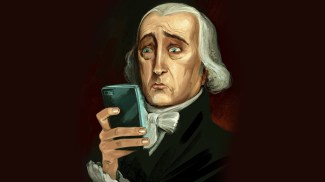 Almost a half century ago, President Richard Nixon’s resignation was thought to have proved that the constitutional system worked, with the House, the Senate, and a special prosecutor each having conducted long, painstaking investigations into his misconduct; the Supreme Court having directed President Nixon to comply with a judicial subpoena to turn over taped conversations; and the House Judiciary Committee having approved three articles of impeachment shortly before Nixon resigned.
In sharp contrast, few think that the acquittal of President Trump is a triumph for the Constitution. Instead, it reveals a different, disturbing lesson, about how the American political system—and the Constitution itself—might be fundamentally flawed.
Since the writing of the Constitution, three developments have substantially altered the effectiveness of impeachment as a check on presidential misconduct. The first is the rise of extreme partisanship, under which each party’s goal is frequently to vanquish the other and control as much of the federal government as possible. This aim is fundamentally incompatible with the system that James Madison designed, premised as it was on negotiation, compromise, and a variety of checking mechanisms to ensure that no branch or faction was beyond the reach of the Constitution or the law.
Read the rest at the link. It’s not very long.
Stephen Collinson at CNN: The President’s decision to expand his power post-trial has stunned Washington.
It’s time to stop asking whether President Donald Trump will learn lessons from the controversies he constantly stokes — of course he does. But far from stepping back or opting for contrition as his critics and appeasers hope, Trump draws darker political conclusions.
 The result is that he expands his own power by confounding institutional restraints and opening a zone of presidential impunity — while at the same time delighting his political base.
Trump’s interference in the sentencing of his long-time associate Roger Stone and a post-impeachment retribution splurge reflect a lifetime’s lessons of a real estate baron turned public servant.
On Wednesday, Trump publicly praised the Justice Department for reversing its call for a stiff jail term for Stone after his own critical late night tweet that laid bare fears of blatant interference in bedrock US justice.
“I want to thank the Justice Department for seeing this horrible thing. And I didn’t speak to them by the way, just so you understand. They saw the horribleness of a nine-year sentence for doing nothing,” the President told reporters.
He noted that the four prosecutors who quit the Stone case “hit the road,” raising the prospect that their protests failed to introduce accountability to the administration and only served to further hollow out the government and make it more pliable to the President.
Trump denied that he crossed a line. But his tweet left no doubt about what he wanted to happen. And his strategy, in this case and others, actually worked.
Just as he used US government power to smear Joe Biden in the Ukraine scandal, he succeeded in getting favorable treatment for a friend in the Stone case — though the final sentence will be up to a judge.
Chuck Rosenberg at The Washington Post: This is a revolting assault on the fragile rule of law.
Something extraordinary and deeply troubling happened at — and to — the Justice Department this week. Four federal prosecutors properly, and as a matter of conscience, withdrew from the Roger Stone case. They had shepherded that case through the criminal-justice system but in an alarming development were ordered to disavow a sentencing recommendation they filed with the federal judge overseeing the matter….
 We all understand that the leadership at the top of the department is politically appointed, and we make peace with that (in addition to my work as a career federal prosecutor, I served in political positions under Presidents George W. Bush and Barack Obama in the Justice Department and worked for thoughtful appointed leaders of both parties), but being asked by that leadership to allow politics to corrode our work is not remotely normal or permissible. And it is treacherous.
The rule of law is a construct. It was made by people — and is nurtured and preserved by people. It can also be destroyed by people. And unlike the law of gravity, which works everywhere and all the time (at least on this planet), the rule of law is precious and fragile. As citizens and prosecutors, we either safeguard it or we surrender it. That’s the choice. What political leadership did here — mandating a favor for a friend of the president in line with the president’s publicly expressed desire in the case — significantly damages the rule of law and the perception of Justice Department fairness.
Principled resignations by career federal prosecutors highlighted this dangerous stunt. I am proud of them for that.
But I find it revolting that they were pushed into that corner (one resigned his job; three others resigned from the case) and saddened by their sacrifice. This is not normal and it is not right,and it is dangerous territory for the rule of law.
Safeguard or surrender. You choose.
Bob Bauer at The New York Times: Trump and Barr Are Out of Control.

Jonathan Kravis
The resignation of a Justice Department prosecutor over the sentencing of Roger Stone is a major event. The prosecutor, Jonathan Kravis, apparently concluded that he could not, in good conscience, remain in his post if the department leadership appeared to buckle under White House pressure to abandon a sentencing recommendation in the case of Mr. Stone, the associate of President Trump who was convicted of obstructing a congressional inquiry into Russian meddling in the 2016 election.
Three of his colleagues quit the Stone case but remain with the department: Mr. Kravis left altogether. Even though the president for years has derided federal law enforcement officials, accusing them variously of conflicts of interest and criminality and weakness in not pursuing prosecution of his political opposition, Mr. Kravis’s is the first resignation in the face of these assaults.
Dramatically forceful responses to Mr. Trump’s assaults on rule-of-law norms have been all too rare. A resignation can set off an alarm bell for an institution whose failings an official might be unable to bring to light in no other way, or as effectively. It upholds rule of law norms in the very act of signaling that they are failing. It makes its point with power and transparency, and stands a chance of rallying support from those who remain in place and compelling other institutions like the press and Congress to take close notice.
The government official who resigns for these reasons is, paradoxically, doing his or her job by leaving it.
Read more at The NYT.
Natasha Bertrand and Daniel Lippman at Politico: ‘Really shocking’: Trump’s meddling in Stone case stuns Washington.
President Donald Trump’s post-impeachment acquittal behavior is casting a chill in Washington, with Attorney General William Barr emerging as a key ally in the president’s quest for vengeance against the law enforcement and national security establishment that initiated the Russia and Ukraine investigations.
 In perhaps the most tumultuous day yet for the Justice Department under Trump, four top prosecutors withdrew on Tuesday from a case involving the president’s longtime friend Roger Stone after senior department officials overrode their sentencing recommendation—a backpedaling that DOJ veterans and legal experts suspect was influenced by Trump’s own displeasure with the prosecutors’ judgment.
“With Bill Barr, on an amazing number of occasions … you can be almost 100 percent certain that there’s something improper going on,” said Donald Ayer, the former deputy attorney general in the George H.W. Bush administration.
The president has only inflamed such suspicions, congratulating Barr on Wednesday for intervening in Stone’s case and teeing off hours later on the prosecutors, calling them “Mueller people” who treated Stone “very badly.”
The president said he had not spoken with Barr about the matter, but Ayer called the attorney general’s apparent intervention “really shocking,” because Barr “has now entered into the area of criminal sanction, which is the one area probably more than any other where it’s most important that the Justice Department’s conduct be above reproach and beyond suspicion.”
What will today bring? I haven’t turned on the TV yet, but I’m very fearful of what Trump will do next. Courage, Sky Dancers! This is an open thread.
Did you like this post? Please share it with your friends:


 peej
peej Carissa
 bostonboomer
 dakinikat
 ecocatwoman
 jjlo
jjlo mablue2
 Mama Lopez
 peggysue22
 quixote
 skydancingguestblogger
 Mona (aka Wonk the Vote)





Recent Comments