
Mostly Monday Reads: Harsh Headlines
Posted: January 5, 2026 Filed under: #FARTUS, #We are so Fucked, Constitutional Crises, War on Venezuela | Tags: "A sickening moral slum of an administration, @johnbuss.bsky.social John Buss, attack on Venezuela, Colombia, cuba, Flowers of Peace, George F. Will, Greenland, Marco Rubio, Orange Caligula, Pete Hegseth weirdo sexual assaulter, Pete Seeger, Senator Mark Kelly, Threats Mexico 12 Comments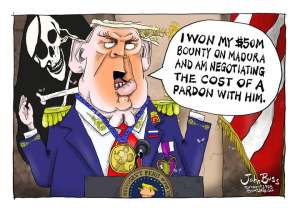
“Trump addresses the nation from Mar A Lardo to justify his invasion of Venezuela.” John Buss, @repeat1968
Good Day, Sky Dancers!
They say politics make strange bedfellows. The actions of the Rotter in the White House and his feckless lackies make even stranger ones. Today, I present a headline from George F. Will, writing at The Washington Post, with which I agree wholeheartedly. Stranger things may happen someday, but right now I’ll stick with my strangest of bedfellows. Kudos for this headline. “A sickening moral slum of an administration. Regarding Venezuela, Ukraine, and much more, Trump and his acolytes are worse than simply incompetent.”
This headline and article are about Hegesthordering the killing of those two survivors on board a sinking ship, and the recently launched Rubio position on the 28 Point Plan concerning Ukraine. It’s also a perfect fit for overthrowing the Venezuelan government, which followed the other two misadventures.
Defense Secretary Pete Hegseth seems to be a war criminal. Without a war. An interesting achievement.
In 1967, novelist Gwyn Griffin published a World War II novel, “An Operational Necessity,” that 58 years later is again pertinent. According to the laws of war, survivors of a sunken ship cannot be attacked. But a German submarine captain, after sinking a French ship, orders the machine-gunning of the ship’s crew, lest their survival endanger his men by revealing where his boat is operating. In the book’s dramatic climax, a postwar tribunal examines the German commander’s moral calculus.
Forty-four days after the survivors were killed, the four-star admiral who headed the U.S. Southern Command announced he would be leaving that position just a year into what is usually a three-year stint. He did not say why. Inferences are, however, permitted.
The killing of the survivors by this moral slum of an administration should nauseate Americans. A nation incapable of shame is dangerous, not least to itself. As the recent “peace plan” for Ukraine demonstrated.
Marco Rubio, who is secretary of state and Trump’s national security adviser, seemed to be neither when the president released his 28-point plan for Ukraine’s dismemberment. The plan was cobbled together by Trump administration and Russian officials, with no Ukrainians participating. It reads like a wish-list letter from Vladimir Putin to Santa Claus: Ukraine to cede land that Russia has failed to capture in almost four years of aggression; Russia to have a veto over NATO’s composition, peacekeeping forces in Ukraine and the size of Ukraine’s armed forces. And more.
Rubio, whose well-known versatility of convictions is perhaps not infinite, told some of his alarmed former Senate colleagues that the plan was just an opening gambit from Russia — although Trump demanded that Ukraine accept it within days. South Dakota Republican Sen. Mike Rounds, a precise and measured speaker, reported that, in a conference call with a bipartisan group of senators, Rubio said the plan was a Russian proposal: “He made it very clear to us that we are the recipients of a proposal that was delivered to one of our representatives. It is not our recommendation. It is not our peace plan.” Hours later, however, Rubio reversed himself, saying on social media that the United States “authored” the plan.
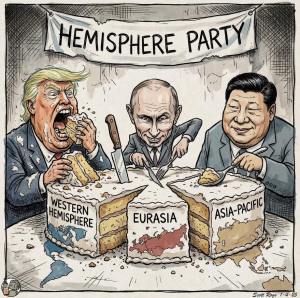 Meetings, speeches, and press conferences are ongoing today regarding the Venezuela situation, while additional actions appear to be in the planning stage. It would seem that more immediate active responses would be pertinent. This headline comes from today’s New York Times. “Trump Suggests U.S. Could Take Action Against More Countries. In remarks aboard Air Force One, President Trump threatened Colombia and its president, described Cuba as “ready to fall” and reasserted his desire to acquire Greenland.” This is reported by Yang Zuhang.
President Trump suggested on Sunday that the United States could take action against other countries after its attack on Venezuela. He threatened Colombia and its president, described Cuba as “ready to fall” and reasserted his desire to take control of Greenland.
Mr. Trump has been facing questions about his plans for Venezuela since a U.S. raid in Caracas captured the country’s president, Nicolás Maduro, and brought him to New York City to face federal drug trafficking and weapons charges. As Mr. Trump took questions about that on Sunday, he spoke of other countries in Latin America and beyond.
On Air Force One, Mr. Trump told reporters that Colombia was being “run by a sick man who likes making cocaine and selling it to the United States.”
“He’s not going to be doing it for very long,” he said of Colombia’s president, Gustavo Petro, who has frequently criticized Mr. Trump. “He has cocaine mills and cocaine factories.”
Mr. Trump and Mr. Petro have been locked in an escalating dispute over the United States’ series of boat strikes in the Caribbean and the eastern Pacific, which have ratcheted up pressure on Colombia, a nexus of the region’s drug trade.
Asked whether his administration would carry out an operation targeting Colombia, Mr. Trump replied, “It sounds good to me.”
Mr. Petro responded angrily in a post on X, warning that any attempt to detain him would unleash popular fury.
Mr. Trump also suggested that the United States could take action against other countries, including Mexico and Iran, over a range of issues.
He said that drugs were “pouring” through Mexico and that “we’re going to have to do something,” adding that the cartels there were “very strong.”
Mexico’s president, Claudia Sheinbaum brushed aside the remarks. “This is just President Trump’s manner of speaking,” she said at a news conference on Monday.
Of Iran, which is being roiled by protests, Mr. Trump said, “If they start killing people like they have in the past, I think they’re going to get hit very hard by the United States.”
Mr. Trump suggested that military intervention was unnecessary in Cuba, a key ally of Venezuela, because it was “ready to fall.”
“I don’t think we need any action,” Mr. Trump said. “It looks like it’s going down.”
“I don’t know if they’re going to hold out, but Cuba now has no income,” he added. “They got all their income from Venezuela, from the Venezuelan oil.”
Secretary of State Marco Rubio had suggested earlier in the day that Cuba could face U.S. military action.
Sounds to me like the United States Government has its eyes on creating a world war. It has a distinctly Trumpian tone. He’s got grievances, he’s found more ways to take money from others, and he’s narcissistic and enough of a psychopath to do it. Plus, he’s got a moral slum of an administration fecklessly following his insanity.
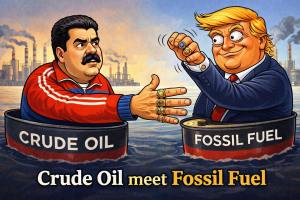 It’s difficult to gauge the responses to this. NATO (via Newseek) has already discussed responses to the threat to Greenland and to possible Russian invasion of NATO members. The UN is ‘boldly’ meeting as I write this. This is from The Times of London, as that’s the reporting we have available at the moment. There are live updates on the situation. “Venezuela latest: UN holds emergency meeting on US strikes — watch live. President Maduro and his wife are taken to a New York court on narco-terrorism charges as Trump repeats threats to annex Greenland.”
What you need to know
-
Nicolás Maduro is due to appear in court in New York at 5pm UK time
-
The UN security council is discussing the US intervention in Venezuela in an emergency meeting
-
Delcy Rodríguez is due to be sworn in on Monday as Venezuelan president, having offered to ‘work together’ with the US
-
China has said any agreements it has in place with Venezuela over oil exports will be ‘protected by law’, regardless of US action
-
Sir Keir Starmer has backed Denmark after President Trump suggested the US would annex Greenland
Other tidbits:
-
Mike Waltz, the US envoy to the United Nations, has said that America is not at war with Venezuela and it is not an occupying power in the country.
He made his remarks at the ongoing UN security council meeting.
-
Russia and China have called on the US to release President Maduro and his wife, Cilia Flores.
Moscow and Beijing’s envoys to the UN both made the call at the current meeting of the security council, which is ongoing in New York.
-
Denmark’s prime minister has said she believes President Trump is serious about wanting to take over Greenland.
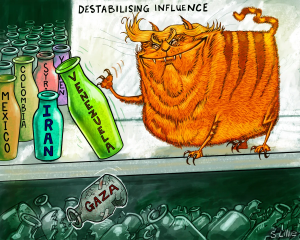 The New York Times provides live updates, with much attention also given to the courthouse where President Maduro and his wife are being held.
Nicolás Maduro, the ousted Venezuelan president, and his wife were brought to the federal courthouse in Lower Manhattan on Monday ahead of their arraignment on charges of drug trafficking and other crimes, two days after they were captured in a U.S. military raid in Caracas.
Mr. Maduro and his wife, Cilia Flores, were escorted off a helicopter in downtown Manhattan under heavy security and were set to face charges including narco-terrorism and conspiracy to import cocaine, according to an unsealed indictment. Their capture in a U.S. commando raid in Caracas, the Venezuelan capital, on Saturday followed a monthslong campaign by the Trump administration to drive out the autocratic leader.
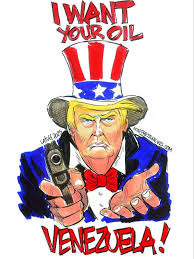 Additional details at the link. It appears that the attack on Venezuela has already claimed the lives of Cuban military personnel. This is from the AP. “Cuba says 32 Cuban officers were killed in US operation in Venezuela.”
An American military operation in Venezuela killed 32 Cuban officers over the weekend, the Cuban government said Sunday in the first official death count provided of the American strikes in the South American nation.
The Cuban military and police officers were on a mission the Caribbean country’s military was carrying out at the request of Venezuela’s government, according to a statement read on Cuban state TV on Sunday night.
What the Cubans were working on in the South American nation was unclear, but Cuba is a close ally of Venezuela’s government and has sent military and police forces to assist in operations for years. Rumors of the deaths circulated on the island over the weekend.
“You know, a lot of Cubans were killed yesterday,” U.S. President Donald Trump told reporters aboard Air Force One as he flew Sunday night from Florida back to Washington. “There was a lot of death on the other side. No death on our side.”
I want to include one more headline, unrelated to Venezuela, but very much on point about the moral slum. This is from CNBC. “Pentagon to cut Sen. Mark Kelly’s military retirement pay over ‘seditious’ video: Hegseth.”
The Pentagon will cut the military retirement pay of Sen. Mark Kelly for what Defense Secretary Pete Hegseth called the Arizona Democrat’s “seditious” statements on a video with other members of Congress telling service members they have the right to refuse to execute illegal orders.
Hegseth also issued a formal letter of censure against Kelly, which the Defense secretary said details “reckless misconduct” by the retired Navy captain and astronaut.
Hegesth said that the Defense Department has begun a proceeding aimed at reducing Kelly’s rank in retirement, which would in turn lead to a decrease in retirement pay.
“Six weeks ago, Senator Mark Kelly — and five other members of Congress — released a reckless and seditious video that was clearly intended to undermine good order and military discipline,” Hegseth said in a statement on X.“As a retired Navy Captain who is still receiving a military pension, Captain Kelly knows he is still accountable to military justice. And the Department of War — and the American people — expect justice,” Hegseth said.
Kelly has 30 days to file a response to the decision to cut his rank and retirement pay, according to Hegseth’s tweet.
The Pentagon in November announced a probe of Kelly for his involvement with the video, and said that further actions could include a recall to active duty and a court-martial proceeding.
Hegeth’s statement on Monday suggests that the Pentagon has ruled out that more severe option.
But, in his tweet, Hegseth warned, “Captain Kelly’s status as a sitting United States Senator does not exempt him from accountability, and further violations could result in further action.”
Kelly, in a statement on X, said, vowed to fight the disciplinary action “with everything I’ve got,” and called Hegseth “the most unqualified Secretary of Defense in our country’s history.”
“Over twenty-five years in the U.S. Navy, thirty-nine combat missions, and four missions to space, I risked my life for this country and to defend our Constitution – including the First Amendment rights of every American to speak out,” Kelly wrote. “I never expected that the President of the United States and the Secretary of Defense would attack me for doing exactly that.”
“My rank and retirement are things that I earned through my service and sacrifice for this country. I got shot at. I missed holidays and birthdays. I commanded a space shuttle mission while my wife Gabby recovered from a gunshot wound to the head– all while proudly wearing the American flag on my shoulder,” Kelly wrote. “Generations of servicemembers have made these same patriotic sacrifices for this country, earning the respect, appreciation, and rank they deserve.
“Pete Hegseth wants to send the message to every single retired servicemember that if they say something he or Donald Trump doesn’t like, they will come after them the same way,” the senator said. “It’s outrageous and it is wrong. There is nothing more un-American than that.”
It’s hard to describe the multitude of simultaneous feelings I have about all of this. The news about these actions is terrifying and reveals a deep-seated immorality. As this unfolds, we should be prepared for anything.
What’s on your reading and blogging list today?
Oh, the summertime is coming
And the leaves are sweet returning
But those flowers of peace
It’s for them I’m really yearning
Will they bloom, ever bloom?
Will they bloom in the springtime?
Oh, you flowers of peace
When the world should be ringtime
Will ye bloom, ever bloom?
I built my love a bower by a clear, crystal river
But the thing her heart desires is a thing I cannot give her
Oh, providеnce smiled impassive
Whilе I fell on bended knee
Said, the lives of you empires
Are no more than swarms of bees
If you and I would see those flowers
Get up and rouse your neighbors
When first the seed I’d planted
It takes long and careful labor
If you and I would see those flowers
Go out and till the fertile soil
It will take more than prayers
It takes hard and sweaty toil
Tuesday Reads: The Corona Virus and Finally Vetting Bernie
Posted: February 25, 2020 Filed under: Foreign Affairs, morning reads, U.S. Politics | Tags: Bernie Sanders, cuba, Donald Trump, Fidel Castro, South Carolina primary 22 CommentsGood Morning!!
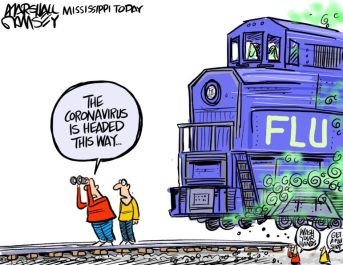 I had a flu shot in January, and since then I’ve had a week-long bout a stomach flu and now I have a full-blown case of the flu. I came down with it on Saturday morning and since then I’ve had a low grade fever that comes and goes along with a hacking cough, headaches, ear pain, and muscle aches. I felt better yesterday, and my temperature was normal until late last night. Now it’s already over 100 again.
I’m really not looking forward to catching the corona virus, but according to James Hamblin at The Atlantic, we are all likely to get it eventually: You’re Likely to Get the Coronavirus. Most cases are not life-threatening, which is also what makes the virus a historic challenge to contain.
Coronaviruses are similar to influenza viruses in that they are both single strands of RNA. Four coronaviruses commonly infect humans, causing colds. These are believed to have evolved in humans to maximize their own spread—which means sickening, but not killing, people. By contrast, the two prior novel coronavirus outbreaks—SARS (severe acute respiratory syndrome) and MERS (Middle East respiratory syndrome, named for where the first outbreak occurred)—were picked up from animals, as was H5N1. These diseases were highly fatal to humans. If there were mild or asymptomatic cases, they were extremely few. Had there been more of them, the disease would have spread widely. Ultimately, SARS and MERS each killed fewer than 1,000 people.
COVID-19 is already reported to have killed more than twice that number. With its potent mix of characteristics, this virus is unlike most that capture popular attention: It is deadly, but not too deadly. It makes people sick, but not in predictable, uniquely identifiable ways. Last week, 14 Americans tested positive on a cruise ship in Japan despite feeling fine—the new virus may be most dangerous because, it seems, it may sometimes cause no symptoms at all.
Hamblin explains that this COVID-19 is likely to spread and then keep coming back every year, because it is contagious even when people have no symptoms and it doesn’t kill off most of the people who get it.
The Harvard epidemiology professor Marc Lipsitch is exacting in his diction, even for an epidemiologist. Twice in our conversation he started to say something, then paused and said, “Actually, let me start again.” So it’s striking when one of the points he wanted to get exactly right was this: “I think the likely outcome is that it will ultimately not be containable.”
Containment is the first step in responding to any outbreak. In the case of COVID-19, the possibility (however implausible) of preventing a pandemic seemed to play out in a matter of days. Starting in January, China began cordoning off progressively larger areas, radiating outward from Wuhan City and eventually encapsulating some 100 million people. People were barred from leaving home, and lectured by drones if they were caught outside. Nonetheless, the virus has now been found in 24 countries….
Lipsitch predicts that, within the coming year, some 40 to 70 percent of people around the world will be infected with the virus that causes COVID-19. But, he clarifies emphatically, this does not mean that all will have severe illnesses. “It’s likely that many will have mild disease, or may be asymptomatic,” he said. As with influenza, which is often life-threatening to people with chronic health conditions and of older age, most cases pass without medical care. (Overall, around 14 percent of people with influenza have no symptoms.)
Lipsitch is far from alone in his belief that this virus will continue to spread widely. The emerging consensus among epidemiologists is that the most likely outcome of this outbreak is a new seasonal disease—a fifth “endemic” coronavirus. With the other four, people are not known to develop long-lasting immunity. If this one follows suit, and if the disease continues to be as severe as it is now, “cold and flu season” could become “cold and flu and COVID-19 season.”
The New York Times: ‘Recipe for a Massive Viral Outbreak’: Iran Emerges as a Worldwide Threat.
Religious pilgrims, migrant workers, businessmen, soldiers and clerics all flow constantly across Iran’s frontiers, often crossing into countries with few border controls, weak and ineffective governments and fragile health systems.
Now, as it struggles to contain the spread of the coronavirus, Iran is also emerging as the second focal point after China for the spread of the disease. Cases in Iraq, Afghanistan, Bahrain, Kuwait, Oman, Lebanon, the United Arab Emirates — even one in Canada — have all been traced to Iran, sending tremors of fear rippling out from Kabul to Beirut.
The Middle East is in many ways the perfect place to spawn a pandemic, experts say, with the constant circulation of both Muslim pilgrims and itinerant workers who might carry the virus. Iran’s economy has been strangled by sanctions, its people have lost trust in their government and its leaders are isolated from much of the world, providing little clarity about the extent of the epidemic.
Civil wars or years of unrest have shattered the health systems of several neighboring countries, like Syria, Iraq, Afghanistan and Yemen. And most of the region is governed largely by authoritarians with poor track records at providing public transparency, accountability and health services.
“It is a recipe for a massive viral outbreak,” said Peter Piot, director of the London School of Hygiene and Tropical Medicine and the former founding executive director of the Joint United Nations Program on H.I.V./AIDS.
An even more immediate threat is the rise of Bernie Sanders. Over the weekend Sanders used his 60 Minutes interview to defend his past support of Fidel Castro’s Cuba.
The reaction in Florida-home was swift and angry.
Marc Caputo at Politico: Florida Dems in uproar after Sanders’ Cuba comments.
Florida Democrats insist he‘s the worst-equipped [to defeat Donald Trump] after Sanders’ refusal Sunday night to thoroughly condemn the Cuban revolution. His comments on 60 Minutes sent shock waves through the nation’s biggest battleground state, where Democratic members of Congress, state legislators and party leaders warned that his nomination — and Sanders’ self-described “Democratic socialism” — will cost them the biggest battleground state of them all.
“Donald Trump wins Florida if Bernie is our nominee,” said state Rep. Javier Fernandez, a Democratic candidate in a majority-Hispanic state Senate district….
As a state with an influential cross-section of Latinos whose families fled leftist Latin American regimes and violence, Sanders embrace of far-left leaders and his past refusals to wholeheartedly condemn Latin American strongmen and the Soviet Union have long been seen as fatal flaws.
Sanders on Sunday did nothing to allay those concerns in a 60 Minutes interview in which he was asked about his 1985 comments stating that the Cuban people didn’t “rise up in rebellion against Fidel Castro” because “he educated their kids, gave their kids health care, totally transformed society.”
There was no mention of the firing squads, political purges and mass arrests that accompanied the 1959 revolution.
There’s much more at the link.
At least Sanders is finally getting vetted by the media. For example, Griffe Witte at The Washington Post: In Cold War travels, Bernie Sanders found much to admire behind enemy lines. Now that’s a problem for his campaign.
The mayor of tiny Burlington, Vt., was back from Nicaragua and eager to share the good news.
The country’s Soviet-backed government — forged via armed rebellion — was cutting infant mortality, reducing illiteracy and redistributing land to peasant farmers. Its Sandinista leaders, branded terrorists by the U.S. government, impressed him with “their intelligence and their sincerity.”
Three years later, Bernie Sanders was fresh off the plane from Moscow, reveling in the beauty of the land and the contentedness of the people.
And a year after that, he returned from Cuba having tapped into a revolutionary spirit “far deeper and more profound than I understood it to be.”
With Sanders now surging to the top of the Democratic presidential field, those three-decade-old impressions introduced a volatile new element in the race Monday as rivals reacted to Sanders’s decision to defend his remarks, not disclaim them….
The fact that Sanders’s long-ago travels in the communist world have become an issue in the 2020 campaign reflects how unorthodox a choice he would be to lead the Democratic Party….
Returning home from visits to some of the United States’ most avowed enemies, Sanders offered some criticism but also plenty of praise in Vermont community television recordings. Many of the videos were kept in storage for decades — including during his 2016 campaign — and, even after being posted online, have remained relatively unknown.
Now, Sanders’s comments are coming back to life as opponents say his warm feelings toward his hosts decades ago make him vulnerable to attack and reveal a soft spot for left-wing despots.
Read the rest at the WaPo. More Bernie critiques:
Jonathan Chait: If Democrats Aren’t Terrified of Bernie, They’re Not Paying Attention.
William Saletan at Slate: The Great Socialism Gap. Socialism doesn’t freak out Democratic voters the way it freaks out other Americans. That’s a problem.
Never Trumper Michael Gerson at The Washington Post: A Trump-Sanders election would destroy our politics.
The South Carolina primary is coming up on Saturday, followed three days later by Super Tuesday. There’s another debate tonight, and I hope Elizabeth Warren will finally get up the nerve to address Sanders’ many weaknesses instead continuing to focus on Mike Bloomberg. I’m pretty sure the other candidates won’t hesitate to attack Bernie.
Natasha Korecki at Politico: Sanders under fire in South Carolina from all directions.
Joe Biden’s campaign is airing a new digital ad in South Carolina accusing Bernie Sanders of trying to undermine Barack Obama’s 2012 reelection by threatening to primary him. Pete Buttigieg was on TV in South Carolina hitting Sanders over health care and Mike Bloomberg targeted Sanders’ past gun votes.
“When it comes to building on Barack Obama’s legacy, Bernie Sanders just can’t be trusted,” the Biden ad, first obtained by POLITICO, warns.
The fusillade targeting Sanders on the eve of a Democratic debate in the fourth early state of South Carolina marked the latest turn in a Democratic primary that now has a decisive frontrunner. Each of the candidates, competing for a fraction of the moderate vote, are attempting to blunt the Vermont senator’s momentum coming off a landslide win in Nevada.
“When we rallied together to defend our president and all the progress he made they had his back,” the narrator says. Panning to then-Vice President Biden, the voice-over continues, “He had his back,” and moving to images of African American supporters at an Obama rally, says: “And you had his back.”
“But back in Washington, there was one guy with another plan,” the narrator says before an audio clip is heard of Sanders saying, “I think it would be a good idea if President Obama faced some primary opposition.”
More at the WaPo.
Are you going to watch the debate? I might give it a try. The last one was pretty entertaining, and it would be fun to see Bernie get his ass kicked. As always, this is an open thread.
Friday Morning Reads
Posted: December 19, 2014 Filed under: Barack Obama, Foreign Affairs, morning reads, U.S. Politics | Tags: "Team America, "The Interview", Andrew Pietrowski, Art Acevedo, Austin PD, CIA, cuba, cyber attacks, cyber warfare, FBI, Hillary Clinton, Hollywood cowardice, Joy Diaz, kim jong il, Kim Jong Un, North Korea, Secret Service, Sexism, Sony Pictures, World Police", Zero Dark Thirty 10 Comments
Good Morning!!
I’m quite a bit behind schedule this morning. I’m still in Indiana with my Mom, and we had to have some workmen come by this morning. I’m also trying to get organized for my drive back to Boston over the weekend, so I’m somewhat tired and stressed out.
Anyway, I’m working on a post that I will put up either later today or when I get back home. For now, here’s a TGIF link dump/open thread.
Today’s top stories
The Sony Hack is getting lots of attention.
NYT editorial, Sony and Mr. Kim’s Thugs. Here’s the gist:
Corporations, even large ones like Sony, cannot stand up to a rogue state and shadowy hacker armies all by themselves. That’s why the Obama administration needs to take a strong stand on this and future attacks. Officials said on Thursday that they were considering a “proportional response.”
Retaliation by the Obama administration over this attack would risk escalation of tensions on the Korean Peninsula and between North Korea and Japan, where Sony’s corporate parent is based. However, there are things the United States can do. Although there are already heavy sanctions on North Korea, there may be ways to inflict more economic pain.
Washington could seek an international panel to investigate the attack and demand condemnation by the United Nations Security Council. The United States also needs to work with Japan and South Korea, two other regular targets of North Korean hacking, to improve their defenses and develop common responses like imposing sanctions.
China, North Korea’s main ally and benefactor, remains the best check on the Kim regime; experts say most North Korean hackers are based in China. But China has its own history of hacking American government and industry computers and has resisted Washington’s requests for talks on how to handle hacking attacks and their aftermath.
The international community needs to speed up work on norms on what constitutes a cyberattack and what the response should be. If China and the United States are unable to work together in this critical area, the Internet will become a free-for-all and everyone will pay the price.
CNN, Watch out world: North Korea deep into cyber warfare, defector says.
Jang Se-yul, who defected from North Korea seven years ago, told CNN that he thinks there are 1,800 cyberwarriors in the agency stationed around the world. But he says even the agents themselves don’t know how many others work for the secretive group, called Bureau 121, whose mission is to “conduct cyberattacks against overseas and enemy states.”
The South Korean government thinks Bureau 121 is the agency at the heart of numerous cyberattacks from North Korea against elements in foreign countries, a government official who requested to be anonymous told CNN on Thursday.
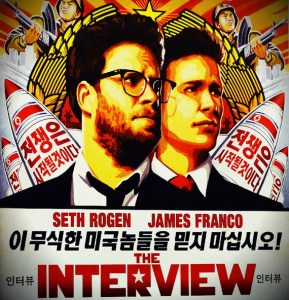
North Korea’s hacking capabilities have become a global talking point recently, after a massive hack of Sony Pictures — the studio behind “The Interview,” a comedy depicting the assassination of Pyongyang’s leader, Kim Jong Un. That was followed by warnings that the movie not be shown in theaters…
CNN, Washington outraged over Sony decision.
From Hollywood to Washington, the outrage is spreading over Sony Pictures’ decision to cancel a movie release following a cyber attack and threats from a group of North Korea-backed hackers.
Politicians urged Sony not to back down in the face of threats tied to the release of the controversial comedy “The Interview,” and then began lashing out when the studio made it clear it has no further plans to release the film, which depicts an assassination plot against North Korean leader Kim Jong Un….
FBI investigators tracked the hackers who broke into Sony’s servers, published private information and threatened moviegoers back to the North Korean regime, U.S. law enforcement officials told CNN on Wednesday. The North Korean regime slammed the movie this summer as “terrorism and a war action.”
And despite the hackers’ threat to attack movie theaters, the Department of Homeland Security has said “there is no credible intelligence” supporting an active plot against movie theaters.
Deadline Hollywood, Hollywood Cowardice: George Clooney Explains Why Sony Stood Alone In North Korean Cyberterror Attack.
EXCLUSIVE: As it begins to dawn on everyone in Hollywood the reality that Sony Pictures was the victim of a cyberterrorist act perpetrated by a hostile foreign nationon American soil, questions will be asked about how and why it happened, ending with Sony cancelling the theatrical release of the satirical comedy The Interviewbecause of its depiction of North Korean dictator Kim Jong-un. One of those issues will be this: Why didn’t anybody speak out while Sony Pictures chiefs Amy Pascal and Michael Lynton were embarrassed by emails served up by the media, bolstering the credibility of hackers for when they attached as a cover letter to Lynton’s emails a threat to blow up theaters if The Interview was released?
Read the interview with Clooney at the link.

The Daily Beast, Paramount Bans Showing ‘Team America’.
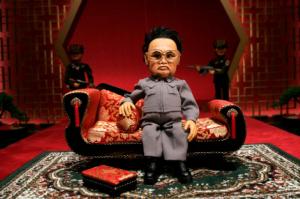
Three movie theaters say Paramount Pictures has ordered them not to show Team America: World Police one day after Sony Pictures surrendered to cyberterrorists and pulled The Interview. The famous Alamo Drafthouse in Texas, Capitol Theater in Cleveland, and Plaza Atlanta in Atlanta said they would screen the movie instead of The Interview, but Paramount has ordered them to stop. (No reason was apparently given and Paramount hasn’t spoken.)Team America of course features Kim Jong Un’s father, Kim Jong Il, as a singing marionette.
Apparently, both Team America: World Police and The Interview are chock full of racist memes about Asians.
North Korea Is Not Funny. Let’s be clear: The Interview isn’t a courageous act of defiance against a dictator, by Adrien Hong at The Atlantic.
In recent months, the uproar over The Interview, a comedy about assassinating North Korean leader Kim Jong Un, has triggered an escalating set of reactions: retaliatory threats from North Korean officials; a sophisticated cyberattack on Sony Pictures, reportedly orchestrated by North Korea; a pledge by the hackers to physically attack theaters showing the film; and now, on Wednesday, Sony’s decision to cancel the movie’s December 25 release altogether, as movie-theater chains began backing out of screenings. The latest development is an act of craven self-censorship and appeasement—a troubling precedent by the Free World’s leading culture-makers. But rightful calls to defend freedom of expression and go ahead with the movie are also mixing with a far more dubious strain of thinking: that the film itself is a form of defiance against a dictatorial regime. It is not.
Kim Jong Il puppet from “Team America World Police.”
In The Interview, directed by the Canadian comics Seth Rogen and Evan Goldberg, a celebrity journalist (James Franco) and his producer (Rogen), tired of producing meaningless content, score a major scoop: an interview with Kim Jong Un (Randall Park). The CIA learns about the trip and recruits the two to kill the leader—a task that, judging from reports and leaked footage, someone eventually succeeds in doing.
This film is not an act of courage. It is not a stand against totalitarianism, concentration camps, mass starvation, or state-sponsored terror. It is, based on what we know of the movie so far, simply a comedy, made by a group of talented actors, writers, and directors, and intended, like most comedies, to make money and earn laughs. The movie would perhaps have been better off with a fictitious dictator and regime; instead, it appears to serve up the latest in a long line of cheap and sometimes racism-tinged jokes, stretching from Team America: World Police to ongoing sketches on Saturday Night Live.
It’s a thoughtful article. I need to go back and give it a careful read.
In other news . . .
Bloomberg View, Hillary Clinton Secretly Pushed Cuba Deal for Years, by Josh Rogin.
Although President Barack Obama is taking the credit for Wednesday’s historic deal to reverse decades of U.S. policy toward Cuba, when Hillary Clinton was secretary of state, she was the main architect of the new policy and pushed far harder for a deal than the Obama White House.
From 2009 until her departure in early 2013, Clinton and her top aides took the lead on the sometimes public, often private interactions with the Cuban government. According to current and former White House and State Department officials and several Cuba policy experts who were involved in the discussions, Clinton was also the top advocate inside the government for ending travel and trade restrictions on Cuba and reversing 50 years of U.S. policy to isolate the Communist island nation. Repeatedly, she pressed the White House to move faster and faced opposition from cautious high-ranking White House officials.
After Obama announced the deal Wednesday, which included the release of aid contractor Alan Gross, Clinton issued a supportive statement distributed by the National Security Council press team. “As Secretary of State, I pushed for his release, stayed in touch with Alan’s wife Judy and their daughters, and called for a new direction in Cuba,” she said. “Despite good intentions, our decades-long policy of isolation has only strengthened the Castro regime’s grip on power.”
But according to the progs, Hillary is a triangulating warmonger. Hmmmmm . . .
ABC News, 5 Sweeping Changes Recommended for Secret Service After Fence Jumper Enters WH.
A bipartisan, independent panel scrutinizing the U.S. Secret Service after a man with a small knife in his pocket jumped the perimeter fence and made it deep inside the White House is recommending sweeping changes at the agency.
The Secret Service’s “paramount mission” of protecting the president and other high-ranking officials “allows no tolerance for error,” and a “single miscue, or even a split-second delay, could have disastrous consequences for the nation and the world,” warns the panel’s final report, commissioned by DHS Secretary Jeh Johnson after the September breach.
Read the recommendations at the link.

The New Yorker, The Unidentified Queen of Torture, by Jane Mayer.
The NBC News investigative reporter Matthew Cole has pieced together a remarkable story revealing that a single senior officer, who is still in a position of high authority over counterterrorism at the C.I.A.—a woman who he does not name—appears to have been a source of years’ worth of terrible judgment, with tragic consequences for the United States. Her story runs through the entire report. She dropped the ball when the C.I.A. was given information that might very well have prevented the 9/11 attacks; she gleefully participated in torture sessions afterward; she misinterpreted intelligence in such a way that it sent the C.I.A. on an absurd chase for Al Qaeda sleeper cells in Montana. And then she falsely told congressional overseers that the torture worked.
Had the Senate Intelligence Committee been permitted to use pseudonyms for the central characters in its report, as all previous congressional studies of intelligence failures, including the widely heralded Church Committee report in 1975, have done, it might not have taken a painstaking, and still somewhat cryptic, investigation after the fact in order for the American public to hold this senior official accountable. Many people who have worked with her over the years expressed shock to NBC that she has been entrusted with so much power. A former intelligence officer who worked directly with her is quoted by NBC, on background, as saying that she bears so much responsibility for so many intelligence failures that “she should be put on trial and put in jail for what she has done.”
Instead, however, she has been promoted to the rank of a general in the military, most recently working as the head of the C.I.A.’s global-jihad unit. In that perch, she oversees the targeting of terror suspects around the world. (She was also, in part, the model for the lead character in “Zero Dark Thirty.”)
According to sources in the law-enforcement community who I have interviewed over the years, and who I spoke to again this week, this woman—whose name the C.I.A. has asked the news media to withhold—had supervision over an underling at the agency who failed to share with the F.B.I. the news that two of the future 9/11 hijackers had entered the United States prior to the terrorist attacks. As I recount in my book “The Dark Side,” the C.I.A. got wind that one of these Al Qaeda operatives, Khalid al-Mihdhar, had obtained a multiple-entry visa into the United States eighteen months before 9/11. The agency also learned, months before the attacks, that another Al Qaeda operative, Nawaf al-Hazmi, had flown into Los Angeles. Yet the C.I.A. appears to have done nothing. It never alerted the F.B.I., which had the principle domestic authority for protecting the U.S. from terror attacks. Its agents had, in fact, been on the trail of at least one of the hijackers previously, but had no way of knowing that he had entered the United States. Nor did the C.I.A. alert the State Department, which kept a “TIPOFF” watch list for terror suspects.
KUT.org, Austin TX, Sexist Comment by Austin Police Officer: Isolated Incident or Part of Broader Culture?
Police Chief Art Acevedo suspended two officers in November for making jokes about rape victims. The Austin Police Association said at the time that the respective three-day and five-day suspensions were “fair and appropriate.” The incident took place after a local attorney had released a video in which the two Austin police officers are laughing and one of the officers comments: “Go ahead and call the cops. They can’t un-rape you.”
Recently, offensive comments were made to KUT’s reporter Joy Diaz, while she was covering a police-related story….
Just to set the scene, this reporter was at the police union’s building waiting to interview the head of the union. That’s when veteran officer [Andrew] Pietrowski approached me and started talking about the media fall-out over the video tape of NFL running back Ray Rice punching and knocking out his then-fiancé in a hotel elevator. Rice was suspended by the NFL and was released by his team.
Pietrowski says the event was blown out of proportion by the media. That’s when he explained.
“Now, stop and think about this. I don’t care who you are. You think about the women’s movement today, [women say] ‘Oh, we want to go [into] combat,’ and then, ‘We want equal pay, and we want this.’ You want to go fight in combat and sit in a foxhole? You go right ahead, but a man can’t hit you in public here? Bulls–t! You act like a whore, you get treated like one!”
Pietrowski retired from the force after learning that KUT planned to reveal his comments on the air.
S0 . . . . what else is happening? Please post links to the stories that interested you in the comment thread, and Happy Friday!
Thursday Reads: A Historic Agreement Between the U.S. and Cuba
Posted: December 18, 2014 Filed under: Barack Obama, Foreign Affairs, morning reads, Republican politics, U.S. Politics | Tags: cuba, Cuban artists, diplomacy, John Boehner, Marco Rubio 22 Comments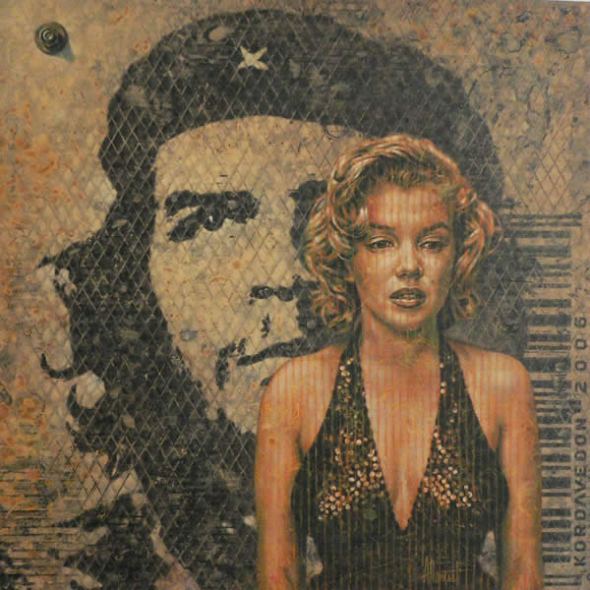
Good Morning!!
Finally we have some good news to discuss, if Republicans can somehow be prevented from ruining it. The U.S. and Cuba have reached an agreement to normalize relations between the two countries after 50 years of hostilities and sanctions. In celebration of this long-overdue step forward, I’m going to illustrate this post with the work of Cuban artists. You can read about the above painting of Marilyn Monroe superimposed on a photo of Che Guevara and the artist Adrian Rumbaut at the Cuban Art blog. Here’s a bit of background:
In the work, Adrian Rumbaut has reproduced Alberto Korda’s famous 1960 photograph of Che Guevara, and he inserts his vision of American Richard Avedon’s iconic photo of Marilyn Monroe as well. In the letters on the side of the painting, Rumbaut gives credit to both Korda and Avedon for their images, and provides the date of his painting.
Interestingly, Korda had worked as a fashion photographer as a young man, and he wanted very much to be the Richard Avedon of Cuba. He photographed the “beautiful people” of the Batista era before the revolution, and models lined up in front of his studio to have their picture taken. Taken by surprise by the “triumph of the revolution” in 1959, he worked subsequently with Raul Corrales, Castro’s official photographer, to capture the excitement of the revolution. In his image of Che, something survives of his earlier experience with beautiful women.
Korda’s image of Che — snapped in 1960 and also known as Guerrillero Heroico — has been repeatedly reproduced worldwide, serving as both a symbol of protest and as a fashion accessory.
The iconic photo has taken on increasingly exotic forms, each created with different intentions and evoking varied responses. Along with Marilyn Monroe, Jesus Christ, Madonna, and Princess Diana have all had their pictures adapted and inserted under Che’s familiar red star beret. It isn’t an exaggeration to note that Che the icon has overtaken Che the revolutionary.
The original “Che” photograph was taken at a dangerous moment, a time when the new revolutionary government was preparing for imminent US invasion. It was at the start of the Cuban Revolution’s second year, and Castro’s government had ordered a boatload of weapons and ammunition — mostly rifles and grenades — from Belgium. The armaments were loaded onto a French ship, La Coubre which, unfortunately, exploded upon arrival in Havana Harbor in March 1960. The crew and 75 Cuban dockers were killed. More than 200 were injured.
Here’s a wonderful example of Cuban street art that I found at a Cuban travel site, Insight Cuba.
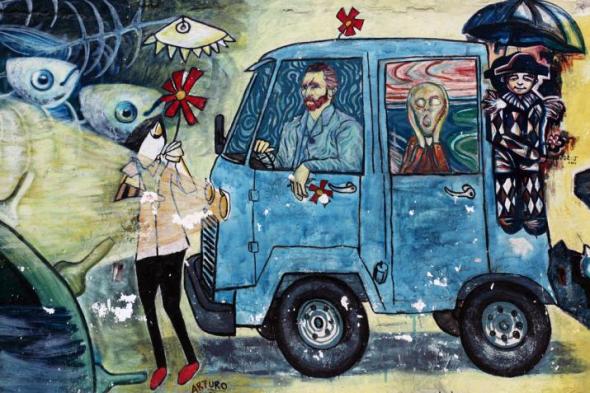
See more examples of Cuban “graffiti” at the link.
Some background on what’s happening from CNN yesterday: Cuba releases American Alan Gross, paves way for historic easing of American sanctions.
Washington (CNN) — U.S. contractor Alan Gross, held by the Cuban government since 2009, was freed Wednesday as part of a landmark deal with Cuba that paves the way for a major overhaul in U.S. policy toward the island, senior administration officials tell CNN.
President Barack Obama spoke with Cuban President Raul Castro Tuesday in a phone call that lasted about an hour and reflected the first communication at the presidential level with Cuba since the Cuban revolution, according to White House officials. Obama announced Gross’ release and the new diplomatic stance at noon in Washington. At around the same time, Cuban president Raul Castro was set to speak in Havana.
President Obama announced a major loosening of travel and economic restrictions on the country. And the two nations are set to re-open embassies, with preliminary discussions on that next step in normalizing diplomatic relations beginning in the coming weeks, a senior administration official tells CNN.
Talks between the U.S. and Cuba have been ongoing since June of 2013 and were facilitated by the Canadians and the Vatican in brokering the deal. Pope Francis — the first pope from Latin America — encouraged Obama in a letter and in their meeting this year to renew talks with Cuba on pursuing a closer relationship.
Gross’ “humanitarian” release by Cuba was accompanied by a separate spy swap, the officials said. Cuba also freed a U.S. intelligence source who has been jailed in Cuba for more than 20 years, although authorities did not identify that person for security reasons. The U.S. released three Cuban intelligence agents convicted of espionage in 2001.
The developments constitute what officials called the most sweeping change in U.S. policy toward Cuba since 1961, when the embassy closed and the embargo was imposed.
Read much more at the link. It’s a good article that provides quite a bit of background on the historic agreement.
More details on the secret negotiations from William M. LeoGrande and Peter Kornbluh, authors of the book Back Channel to Cuba: The Hidden History of Negotiations between Washington and Havana, published in October of this year.
Secret meetings with Cuba finally pay off.
Presidents frequently conduct sensitive diplomatic dialogues in secret, because the furor of public attention makes it politically impossible to reach the compromises necessary for agreement. These secret talks are often crucial for diplomatic advances — as we learned Wednesday with the stunning revelations about the impending talks between Washington and Havana that have been underway secretly for the past few months. President Barack Obama’s far-reading initiatives are reminiscent of the secret talks Henry Kissinger held with Beijing to lay the groundwork for President Richard M. Nixon’s historic diplomatic opening to China.
When the mere act of talking to an adversary is too politically sensitive, presidents can resort to private emissaries, despite the risks created by relying on amateur diplomats. Obama had help from both Canada and the Vatican in reaching these new agreements.
In our recent book, Back Channel to Cuba: The Hidden History of Negotiations between Washington and Havana, we uncovered literally dozens of secret diplomatic contacts and negotiations. Despite what Kissinger called the “perpetual antagonism” between the United States and Cuba, there is a rich and colorful history of dialogue between these two nations over the last 50 years.
There are lessons to be learned from this half-century of back-channel talks about what works and what doesn’t when conducting secret negotiations.
First, a history of animosity makes adversaries wary. Neither wants to appear weak by making concessions too easily. Goodwill gestures may go unrequited and the apparent obstinacy of one side or the other can doom a diplomatic process before it gets off the ground. When Fidel Castro was in power, for example, he worried constantly that any concession to U.S. demands would be read as weakness and lead to a redoubling of U.S. efforts to overthrow him.
Read all about it at the Reuters link.
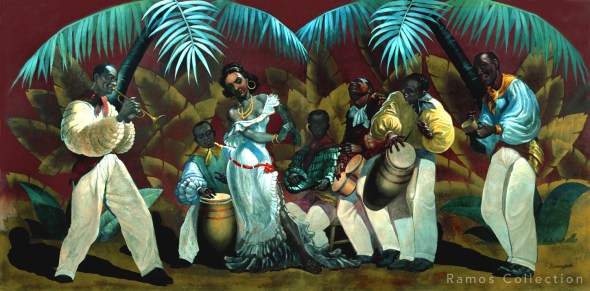
From the Masters of Cuban Art Image Gallery, “La Conga” by Evelio Garcia Mata.
“Garcia Mata plays the rhythm of the conga in the body of the mulatto dancer, who lifts her left arm as she does the kick-step. She wears a sensual typical dress and is accompanied by a group of six musicians. The painting beautifully represents when Afro-Cuban music became main-stream, and a representative of Cuban culture at large.”
– Alfredo Triff, Musician and Art Critic
Isn’t it amazing that Pope Francis–the first Latin American to lead the Church–was instrumental in making this happen? As a long-lapsed Catholic, I’m truly surprised and pleased. After years of regressive Popes, this guy seems to be a throwback to the days of Pope John the XXIII when it seemed that the Church might move into the 20th century.
From The Atlantic: How the Pope Helped End the Cuba Embargo.
On Wednesday, a senior Obama administration officials spoke of an “extraordinary letter” written by the pope to President Obama and Cuban President Raúl Castro over the summer in which he urged the two men to mend the relationship between their countries.
As one official noted, the correspondence “gave us greater impetus and momentum for us to move forward.”
In a press conference on Wednesday, which also happens to be the pope’s 78th birthday, President Obama credited Francis for his influential “personal plea” and thanked him for his “moral example.”
In particular, I want to thank his Holiness Pope Francis, whose moral example shows us the importance of pursuing the world as it should be, rather than simply settling for the world as it is.
According to officials, Pope Francis brought up Cuba several times during his meeting with the president in March and, given Francis’ significance as the first pope from Latin America, it’s fair to assume that his clout likely helped bring Castro to the table as well.
Vatican officials were also said to have been present during the negotiations between the United States and Cuba, marking them the only other country to directly participate in the talks. While Canada reportedly hosted the majority of the secret meetings of the two sides, according to a Vatican statement, the pope also hosted Cuban and American representatives together earlier this year during the final deal was struck.
Some reactions to Obama’s great achievement.
From the LA Times, Miami reacts to Obama’s Cuba move: Tears of joy, cries of ‘traitor’.
A tale of two restaurants unfolded in South Florida on Wednesday.
In Miami’s Little Havana, Versailles Restaurant hosted hard-line Cuban exiles railing against President Obama’s decision to establish full diplomatic ties with the Cuban government. They waved placards and hurled insults bilingually, putting on the show they’ve been rehearsing and staging for half a century.
The show at Versailles involved megaphones and pickup trucks, national news outlets parked in front of a spot that serves tasty espresso, and a handful of outspoken Cuban Americans who yell loud enough to scare viewers in Nebraska. Whenever major news breaks about Cuba, the media flocks to Versailles to take the pulse of the Cuban community.
Meanwhile in Hialeah, a city with a far larger number of Cubans and Cuban Americans than Little Havana, Tropical Restaurant served cafeteria-style meals to a quieter, more sanguine crowd. Here, many welcomed Obama’s decision.
“It’s going to be better for the Cuban people. It’s going to be better for the United States,” said ReinierOropeza, 33, an accountant who to came to the U.S. from Cuba in 1998.
Many Cubans here are young, or came to the United States more recently, or have closer ties with their families in Cuba.
Oropeza said many older Cubans are stuck in the past. “They are old and they stand back and blame Castro. They already did what they had to do. So young people have to take over now.”
Once again, read much more at the link.
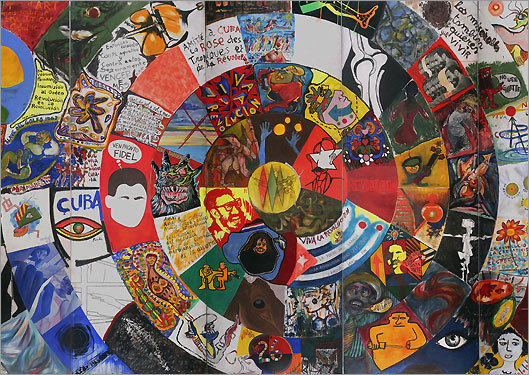
Read more about this mural by 100 Cuban artists at The New York Times, Feb. 3, 2008: It’s Not Politics. It’s Just Cuba.
Courtesy of the Montreal Museum of Fine Arts
“Cuba Colectiva,” a 1967 mural by 100 artists for the Salon de Mai exhibition in Havana, on view at the Montreal Museum of Fine Arts.
More reactions from Republican politicians:
Drunken party-pooper John Boehner is not happy.
(Reuters) – U.S. House Speaker John Boehner sharply criticized President Barack Obama’s policy change toward Cuba, calling it “another in a long line of mindless concessions” to a brutal dictatorship.
“Relations with the Castro regime should not be revisited, let alone normalized, until the Cuban people enjoy freedom – and not one second sooner,” Boehner said in a statement.
Cry me a river, a$$hole. At least Cubans have free health care.
Marco Rubio, who is supposedly a Catholic after transitioning through the Mormon and Southern Baptist churches, had the temerity to “call out the Pope on Cuba” according to Politico.
Sen. Marco Rubio, a Catholic, criticized Pope Francis on Wednesday after the pontiff played a key role in helping the United States and Cuba forge an agreement that resulted in the release of American Alan Gross from Cuba.
Rubio said he would “ask His Holiness to take up the cause of freedom and democracy.”
The Florida Republican said he didn’t criticize Francis’ personal appeals to help facilitate Gross’ release, but was speaking in response to the White House’s announcement about talks to normalize relations with Cuba after a nearly 50-year embargo with the country.
Rubio is set to play a major role in Cuba policy as the chairman of the Senate Foreign Relations subcommittee on Western Affairs, and he noted Wednesday some of Congress’ leverage points, such as funding for embassies and nomination of a U.S. ambassador to Cuba.
“I’m committed to doing everything I can to unravel as many of these changes as possible,” Rubio said.
More from Huffington Post: Marco Rubio Fires Back On Cuba: Obama Is The ‘Worst Negotiator’ In My Lifetime.
President Barack Obama will get no money for his Cuba policy, no ambassador will be confirmed and the embargo will never be lifted, Sen. Marco Rubio (R-Fla.) vowed in a blistering press conference on Wednesday.
In a historic move earlier in the day, Obama announced that the United States will begin talks with Cuba to normalize full diplomatic relations, marking the most significant shift in U.S. policy towards Cuba in 50 years. The president’s remarks followed the release on Wednesday morning of American Alan Gross, who had been held in a Cuban prison for five years. Gross’ release was negotiated in exchange for the freeing of three Cubans who had been jailed in the U.S. for spying.
“This entire policy shift announced today is based on an illusion, based on a lie,” Rubio, who is the son of Cuban immigrants, told reporters on Capitol Hill. “The White House has conceded everything and gained little.”
“I’m committed to doing everything I can to unravel as many of these changes as possible,” he added.
Why is this moron in the U.S. Senate? Obama will have more battles ahead with the Republican Congress, but he seems determined to move ahead with the changes he wants to make anyway. I’m rooting for him.
What do you think? What other stories are you following today? Please share your thoughts and links in the comment thread and enjoy your Thursday!
Tuesday Reads
Posted: August 27, 2013 Filed under: Barack Obama, China, Foreign Affairs, Iran, Iraq, morning reads, NSA, National Security Agency, Regulation, Russia, Syria, U.S. Politics | Tags: California wildfire, chemical weapons, cuba, David Miranda, Edward Snowden, GCHQ, Glenn Greenwald, John Kerry, Saddam Hussein, San Francisco water and power, Texas legislature, West Fertilizer Co., Yosemite National Park 30 Comments
Good Morning!!
The big news today is that President Obama appears likely to order “limited” strikes on Syria in the next few days in response to Syria’s use of chemical weapons against opposition fighters. From the WaPo: After Syria chemical allegations, Obama considering limited military strike.
President Obama is weighing a military strike against Syria that would be of limited scope and duration, designed to serve as punishment for Syria’s use of chemical weapons and as a deterrent, while keeping the United States out of deeper involvement in that country’s civil war, according to senior administration officials.
The timing of such an attack, which would probably last no more than two days and involve sea-launched cruise missiles — or, possibly, long-range bombers — striking military targets not directly related to Syria’s chemical weapons arsenal, would be dependent on three factors: completion of an intelligence report assessing Syrian government culpability in last week’s alleged chemical attack; ongoing consultation with allies and Congress; and determination of a justification under international law.
“We’re actively looking at the various legal angles that would inform a decision,” said an official who spoke about the presidential deliberations on the condition of anonymity. Missile-armed U.S. warships are already positioned in the Mediterranean.
I guess “looking at…legal angles” is code for that pesky rule in the Constitution where Congress has to declare wars. When’s the last time that happened–WWII?
Meanwhile, BBC News reports: Russia and China step up warning over strike.
Russian foreign ministry spokesman Alexander Lukashevich has called on the international community to show “prudence” over the crisis and observe international law.
“Attempts to bypass the Security Council, once again to create artificial groundless excuses for a military intervention in the region are fraught with new suffering in Syria and catastrophic consequences for other countries of the Middle East and North Africa,” he said in a statement.
Late on Monday, the US said it was postponing a meeting on Syria with Russian diplomats, citing “ongoing consultations” about alleged use of chemical weapons in Syria.
Hours later, Russia expressed regret about the decision. The two sides had been due to meet in The Hague on Wednesday to discuss setting up an international conference on finding a political solution to the crisis.
The Russian deputy defence minister, Gennady Gatilov said working out the political parameters for a resolution on Syria would be especially useful, with the threat of force hanging over the country.
Read more at the link.
Just as SOS Kerry was giving a speech to justify the upcoming military strikes, providing “Clear Evidence of Chemical Weapon Use in Syria” (NYT), a little birdie told Shane Harris and Matthew Aid of Foreign Policy magazine that the U.S. facilitated Saddam Hussein’s use of chemical weapons against Iran back in 1988.
The U.S. government may be considering military action in response to chemical strikes near Damascus. But a generation ago, America’s military and intelligence communities knew about and did nothing to stop a series of nerve gas attacks far more devastating than anything Syria has seen, Foreign Policy has learned.
In 1988, during the waning days of Iraq’s war with Iran, the United States learned through satellite imagery that Iran was about to gain a major strategic advantage by exploiting a hole in Iraqi defenses. U.S. intelligence officials conveyed the location of the Iranian troops to Iraq, fully aware that Hussein’s military would attack with chemical weapons, including sarin, a lethal nerve agent.
The intelligence included imagery and maps about Iranian troop movements, as well as the locations of Iranian logistics facilities and details about Iranian air defenses. The Iraqis used mustard gas and sarin prior to four major offensives in early 1988 that relied on U.S. satellite imagery, maps, and other intelligence. These attacks helped to tilt the war in Iraq’s favor and bring Iran to the negotiating table, and they ensured that the Reagan administration’s long-standing policy of securing an Iraqi victory would succeed. But they were also the last in a series of chemical strikes stretching back several years that the Reagan administration knew about and didn’t disclose.
U.S. officials have long denied acquiescing to Iraqi chemical attacks, insisting that Hussein’s government never announced he was going to use the weapons. But retired Air Force Col. Rick Francona, who was a military attaché in Baghdad during the 1988 strikes, paints a different picture.
“The Iraqis never told us that they intended to use nerve gas. They didn’t have to. We already knew,” he told Foreign Policy.
Read the rest of this long article at Foreign Policy.
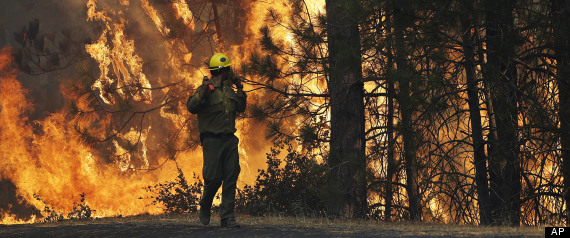
Firefighter A.J. Tevis watches the flames of the Rim Fire near Yosemite National Park, Calif., on Sunday, Aug. 25, 2013. With winds gusting to 50 mph on Sierra mountain ridges and flames jumping from treetop to treetop, hundreds of firefighters have been deployed to protect this and other communities in the path of the Rim Fire raging north of Yosemite National Park. (AP Photo/Jae C. Hong)
The wildfire in Northern California continues to spread into Yosemite National Park and has begun to threaten towns in the area. From the LA Times: Massive Rim fire continues to reshape lives and topography.
…even as firefighters worked furiously to hold a line outside of town, officials warned that this blaze was so hot it could send sparks more than a mile and a half out that could jump lines and start new hot spots. Evacuation advisories remain in effect for Tuolumne City and nearby areas.
On the north edge, the fire — now 134,000 acres — pushed into the Emigrant Wilderness Area and Yosemite National Park. It’s the one side of the fire with a natural last stand: Eventually it will run into granite walls that have snuffed out fires in this region for centuries.
Each day, what the massive blaze does depends on the wind. But officials were particularly attuned to each shift of breeze Sunday because of the weather’s eerie similarities to the day when the fire first exploded out of control.
So far the unpredictable blaze is only about 20% controlled, and it still threatens water and power sources for San Francisco.
The massive fire presents every challenge: steep slopes, dry fuel, rugged terrain and entire communities possibly in harm’s way.
The base camp and incident post, usually a haven outside fire lines, was a prominent example of the fire’s unpredictability: It’s in the middle of the burn zone, charred land with still-smoldering stumps on both sides.
Firefighters call such complete devastation “the black.” Entire ravines and ridges were a dusty gray moonscape. But some of the land was a “dirty burn” — meaning there were small circles of pine and aspen and even grass and wildflowers in the middle of charcoal-black areas where smoke still curled and embers glowed. The specks of beauty made firefighters nervous: To a fire, they are fuel.
My sister and her husband own a house north of San Francisco. It’s probably not in danger, but it still brings the scope of this disaster home to me. I sure hope Firefighers will begin to make progress soon. The burning area is now the size of the city of Chicago, according to CNN.
Yosemite National Park, California (CNN) — A massive northern California wildfire that’s threatening Yosemite National Park and San Francisco’s key water and power sources grew Monday, becoming the 13th largest in state history, state fire authorities said.
The Rim Fire, which has devoured 160,980 acres, has scorched an area about the size of the city of Chicago while more than 3,600 firefighters try to rein it in….
The wildfire, which was 20% contained Monday night, was spreading primarily to the east and threatened to grow amid extremely dry conditions and hot weather.
Part of the fire continued to spread Monday toward a key part of San Francisco’s water supply: the Hetch Hetchy Reservoir, which lies within Yosemite and is just east of the flames.
The fire also could threaten the area’s hydroelectric generators, which provide much of San Francisco’s electricity. Because of the approaching flames, officials shut down the generators, and the city — more than 120 miles to the west — temporarily is getting power from elsewhere.
Speaking of disasters, Charles Pierce reminds us that West, Texas is still recovering from the horrible explosion at the fertilizer plant there and that Texas still isn’t doing that much to prevent similar events in the future.
Read the rest of this entry »

 peej
peej Carissa
 bostonboomer
 dakinikat
 ecocatwoman
 mablue2
 Mama Lopez
 peggysue22
 quixote
 skydancingguestblogger
 Mona (aka Wonk the Vote)



 Sky Dancing
Recent Comments