
Thursday: A Mixed Bag of Reads
Posted: January 16, 2014 Filed under: Barack Obama, Crime, Foreign Affairs, morning reads, U.S. Politics, War on Women, Water, Women's Healthcare, Women's Rights, worker rights | Tags: "Paysage Bords de Seine", art theft, Baltimore Museum of Art, Brian Schweitzer, David Sirota, Elkhart Indiana, foreign espionage, grocery store shooting, Jamie Bouie, Martha Fuqua, NSA, phone metadata, Pierre-Auguste Renoir, Ron Paul, telephone companies 38 Comments
Good Morning!!
I’m going to begin with a quirky story about a stolen painting by Pierre-Auguste Renoir: Renoir painting allegedly sold at flea market returning to museum. From the LA Times:
A small Pierre-Auguste Renoir painting that a woman said she purchased for just $7 at a flea market will return to a Maryland museum that argued that the painting was stolen from its premises in 1951.
A federal judge in Virginia ruled on Friday that Renoir’s “Paysage Bords de Seine,” which was painted in 1879, is the rightful property of the Baltimore Museum of Art. The decision brought to an ostensible end a bizarre case that pitted a driving teacher against the museum in a battle over an Impressionist work estimated to be worth $22,000.
Martha Fuqua, who reportedly teaches driving in Virginia, had said that she acquired the painting from a flea market in West Virginia in 2009. She later attempted to sell the work at an auction, which came to the attention of the Baltimore Museum of Art.
The weird part is that people who knew Fuqua claimed they had seen the painting in her mother’s home. So who stole the painting? From the Washington Post:
…a number of people who know Fuqua have cast doubt on her flea market story, including her brother. Some family acquaintances told The Post that they remember seeing the Renoir in the 1980s and 1990s at the Fairfax County home of her mother, Marcia Fouquet, who attended art college in Baltimore at the time of the painting’s theft in 1951. (The mother passed away five months ago at the age of 85.)
Apparently, Marcia Fouqua was an art thief. Here’s the original police report (PDF).

Unfortunately, there’s more bad news today–another shooting, this time in a grocery store in Elkhart, Indiana. NBC News reports:
A gunman killed a member of staff and a customer at an Indiana grocery store before being shot dead by police, officials said early Thursday.
The man had his gun pointed at a third person when officers arrived at Martin’s Super Market in the city of Elkhart, Indiana State Police Sgt. Trent Smith said in a press conference early Thursday.
When he trained his weapon on the officers they shot him dead, Smith said…
Smith said it was a “huge crime scene” and that shots had been fired from one end of the store to the next. The victims were found 10 to 12 aisles apart.
Police rushed to the scene shortly after 10 p.m. on Wednesday after receiving a 911 call. They heard gunshots when they arrived and rushed to the section of the store from which the shots were fired.
Smith described the gunman as white man in his twenties who lived in the area. He said he was armed with a semiautomatic handgun and a large knife.
A little more from Reuters:
The three dead were believed to be a female store employee in her late teens or early 20s, a female shopper in her mid-40s, and the shooter, who was thought to be in his late teens or early 20s, Smith said.
Details such as what motivated the violence and whether there was any connection between the gunman and store employees were not immediately known, he said.
Police found a large knife and a semi-automatic handgun inside the store near the suspect, who was believed to live in the area, Smith said.
Police were withholding the suspect’s name pending notification of his family.

David Sirota was up to his old tricks yesterday on Twitter. Once Sirota pretended to support Barack Obama–that was in the days when you couldn’t blog on Dailykos unless you behaved like a zombie Obot. But even Kossaks mocked Sirota for his constant bragging about receiving a phone call from then-Senator Obama in 2006 and then being invited to interview Obama and his staff.
In those days, Sirota was critical of Obama. In the build-up to the 2012 election, Sirota became a Ron Paul Fan, calling him a “real progressive.” After Obama was elected to a second term Sirota became so “unhinged” by Obama Derangement Syndrome that he compared Obama to George Zimmerman!
These days, Sirota has fastened his presidential hopes on Brian Schweitzer, former governor of Montana. And so when Jamie Bouie dared to suggest that by “positioning himself as a liberal repudiation of Obama,” Schweitzer was in danger of alienating African American voters who still strongly support the President; Sirota responded by strongly implying that Bouie (an African American) is a racist by calling Bouie’s post at The Daily Beast an “[e]xample of how communities of color are condescendingly portrayed as monolithic & unthinking voting blocs.”
Wow.
Here’s a little bit of good news from yesterday’s LA Times: U.S. accuses Wal-Mart of labor violations.
The National Labor Relations Board, an independent federal agency tasked with policing bad behavior by employers, is targeting Wal-Mart Stores Inc. over the retail behemoth’s alleged crackdown on its protesting workers.
The NLRB filed a formal complaint Wednesday against the Bentonville, Ark. chain, alleging that the company violated the rights of more than 60 employees rallying over workplace conditions in 14 states — including California….
The Wednesday filing stems from NLRB findings released in November that deemed unlawful Wal-Mart’s reactions to employees who participated in strikes around Black Friday in 2012.
The rallies spread to 100 cities. Nineteen employees were discharged from the company, allegedly as a reprimand for their involvement in the rallies, according to the NLRB.
The agency said that efforts to broker a settlement between Wal-Mart and its workers failed, leading to Wednesday’s complaint. The filing names more than 60 Wal-Mart supervisors — 19 in California — and corporate communications vice president David Tovar.
The article quotes experts who speculate that the NLRB may be trying to signal to corporations that it is going to stand up for not only unionized workers, but also those in non-unionized businesses. If true, that is excellent news.

Last night Cincinnati acted to protect residents from the chemical plume that is making its way down the Ohio River from West Virginia. From WLW 700: Cincinnati Water Works Prepares to Close Water Intake Valves.
(Cincinnati)–Days after a hazardous chemical leaked into the Elk River in West Virginia the chemical has flowed into the Ohio River and the Cincinnati area.
The Chemical known as 4-methylcyclohexane methanol leaked from a 48,000-gallon storage tank owned by Freedom Industries, in West Virginia. Investigators believe the leak began on Thursday Jan, 9. and the chemical foaming agent seeped though a one inch hole, in the storage tank and into the River….
Lisa Cochran the Communication Coordinator with The Ohio River Valley Water Sanitation Commission (ORSANCO) said the Chemical MCHM was first detected Sunday Jan 12. in the Ohio River.
She adds (ORSANCO) is coordinating with multiple organizations, including Cincinnati Water Works, Northern Kentucky Water, Kentucky Division of Water, US Coast Guard, West Virginia American Water and others to monitor the progress of the spill. “We have field crew members who actually go out and take samples” to determine the concentration of the chemical.
Cincinnati Waterworks is prepared to close their Ohio River water intake valves when the hazardous chemical plume is found. Cochran says “they (Cincinnati Water Works) do plan to shut down when the plume reaches their water intake”.
In NSA news, The New York Times published more “revelations” from the material that Edward Snowden stole. As has become the accepted technique with NSA stories, the article begins with supposedly terrifying news: the NSA uses mysterious “radio technology” to attack computer that aren’t even connected to the internet! Aiiiiiiiiiieeeeeee!
But read on. So far the software has only been used on 100,000 computers since 2008, primarily in countries like China, Russia, and Pakistan, and the software must be physically installed by a human spy with a flash drive. It has never been used domestically.
The N.S.A. calls its efforts more an act of “active defense” against foreign cyberattacks than a tool to go on the offensive. But when Chinese attackers place similar software on the computer systems of American companies or government agencies, American officials have protested, often at the presidential level.
Among the most frequent targets of the N.S.A. and its Pentagon partner, United States Cyber Command, have been units of the Chinese Army, which the United States has accused of launching regular digital probes and attacks on American industrial and military targets, usually to steal secrets or intellectual property. But the program, code-named Quantum, has also been successful in inserting software into Russian military networks and systems used by the Mexican police and drug cartels, trade institutions inside the European Union, and sometime partners against terrorism like Saudi Arabia, India and Pakistan, according to officials and an N.S.A. map that indicates sites of what the agency calls “computer network exploitation.”
So basically, the NSA uses this technology to do its job–spying on foreign countries to protect U.S. interests. Horrors!
And as for the phone call metadata program, Phone companies don’t want the job of spying on customers’ calls. PBS Newshour:
President Barack Obama is expected to announce Friday what changes he is willing to make to satisfy privacy, legal and civil liberties concerns over the NSA’s surveillance practices. One of the most important questions is whether the government will continue to collect millions of Americans’ phone records every day so that the government can identify anyone it believes might be communicating with known terrorists.
The president’s hand-picked review committee has recommended ending the phone records program as it exists. It suggested shifting the storage of the phone records from the NSA to phone companies or an unspecified third party, and it recommended new legal requirements before the government could search anyone’s phone records.
The phone companies don’t want the job. Executives and their lawyers have complained about the plan in confidential meetings with administration officials and key congressional intelligence and other committees, according to interviews by The Associated Press. Two phone executives familiar with the discussions said the cellular industry told the government that it prefers the NSA keep control over the surveillance program and would only accept changes if they were legally required. The executives spoke on condition of anonymity because they were not authorized to disclose the private discussions. But there have been public complaints, too.
Frankly, I’ve never trusted the phone company. I’d much rather have this data stored on government computers, where it can’t be accessed without a warrant approved by the FISA court.
Finally, Rolling Stone is highlighting the Republican war on women’s reproductive rights with a long read by Janet Reitman: The Stealth War on Abortion. I haven’t read the article yet, but I hope it’s good. We need more high-profile publications to highlight what’s happening to women’s rights in red states.
So . . . there’s a mixed bag of reads to get you started on the day. What stories are you following? Please post your links in the comment thread, and have a great Thursday!
There Will Be Blood
Posted: February 23, 2012 Filed under: alternative energy, energy, Environment, First Nation, health hazard, Keystone XL pipeline, Northern Gateway pipeline, Regulation, tar sand oil, toxic waste, US & Canada, Water 22 CommentsIf you listen to the GOP, you’d be convinced that the WH, Democrats in general and crazed environmentalists specifically had nixed the Keystone Pipeline out of sheer orneriness or a deep-seated hatred of good ‘ole American Capitalism. Rick Santorum and his Prince of Darkness tour would no doubt smell brimstone in the midst of any pipeline dissent.
Well, surprise, surprise. The push back is not limited to protestors in the United States. Our northern neighbors in Canada have as many if not 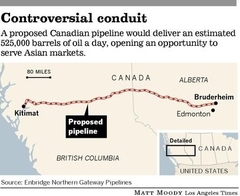 more objections to the Petro State ripping through their country, poisoning watersheds, destroying wildlife and property, causing disease and health problems among citizens, all in the name of King Oil and the desire to wring every last drop out of the planet.
The Hell with Consequences!
First Nation, the indigenous population of Canada, has already predicted:
There will be blood!
Why the outcry? Enbridge, Inc. and the conservative government in Canada is pressing forward with their own pipeline project, Northern Gateway, which would carry 500,000+ barrels a day 731 miles from a town near Edmonton, westward through the Rocky Mountains to a port on the British Columbia [BC] coast. Over 60 indigenous organizations have expressed their opposition, refusing to be moved by the promise of revenue, jobs and an increase in their quality of life because their lives are deeply attached to the natural resources of BC, most importantly the integrity of the salmon trade that depends on the streams and tributaries of the Fraser and Skeena Rivers. In addition, the proposed port on the coast, which would host over 200 oil tankers a year, could expose the Great Bear rainforest to irreparable damage.
Think Valdez!
Interestingly enough, First Nation opposition is the most serious threat to the Harper government’s enthusiastic endorsement of the pipeline. Unlike other indigenous groups, First Nation never signed treaties with the Canadian government and consequently never relinquished their lands to the Federal government. On the other hand, the government and oil companies have nearly unlimited funds to fight this battle in court.
According to the LA Times report Tribal Chief Jackie Thomas has said:
“It’s going to be a war. The only question is, who’s going to draw the first blood.”
And here’s a chilling factoid: Enbridge is the same company responsible for the leak of 800,000+ gallons [the EPA now reports over 1 million gallons] of tar sand oil into the Kalamazoo River, Michigan. Presumably, the oil company has spent $700 million in reclamation procedures. The area is still a gigantic mess.
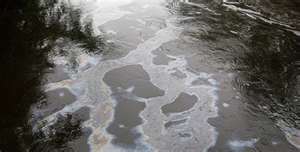
Kalamazoo River Spill
Added to the environmental risks [the cost of which is usually ignored] the Northern Pipeline is likely to boost the price of oil for Canadian consumers because like the Keystone proposal, the oil would be exported, not available domestically. The video below is instructive in a grim way.
Why are we having these bitter disputes?
Because we desperately need new energy sources. And there’s tons of money on the line. More importantly, we need an Energy Policy/Strategy, where the pros and cons of transitional sources are seriously considered–the trade-offs, the costs, what we as a culture are willing to put up with or risk until renewable, clean sources are developed and brought online. That’s a plan that would look at what we need today, five years down the road, 10, 20, 30 years. You set benchmarks. You invest in, encourage and unleash innovation, while focusing on increased efficiency from power plants–the traditional US coal power plant is only 35% efficient, meaning we’re wasting most of the energy we’re producing–to autos to buildings to everything else.
Where is that policy? Nada.
The Department of Defense’s push towards alternative energy is not a sign of the US military becoming rabid tree huggers. As the world’s largest institutional energy consumer, the DOD knows the score: the days of cheap fossil fuel are over and our dependence on foreign and unfriendly suppliers is a serious security issue. The Department’s commitment to this reality can be seen in proposed budget expenditures: $3 billion by 2015; $10 billion by 2030.
As GreenTech Media reported, this sort of shift has historical parallels:
Military spending in support of energy is not new. Winston Churchill’s decision in 1911 to move the British Navy, then the world’s then most dominant military force, from coal to oil changed the world’s energy marketplace. The emerging trend in DoD spending on renewables is an equally historic marker.
Neither American or Canadian energy needs should come down to an either/or contest: shut off the electricity or rip the environment apart, robbing people, wildlife, the very planet of their health, sustainability and future. We cannot poison our watersheds, jeopardize our aquifers or damage fertile farmlands for the sake of profits or our unwillingness to conserve and efficiently utilize what we have. King Oil has ruled long enough. The damage they’re willing to exact is unacceptable, even obscene.
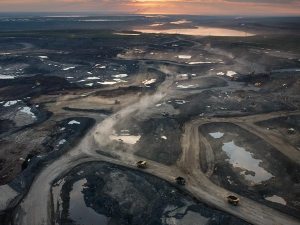
Alberta Tar Oil Sands, Aerial Satellite Shot
First Nation peoples of British Columbia know this and are willing to fight tooth and nail to preserve what’s left of their way of life and cultural traditions. To save the irreplaceable.

Great Bear Rainforest
There may very well be blood. It’s a worthy fight.
Zombies and Vultures and Pipelines, Oh My
Posted: February 5, 2012 Filed under: Domestic Policy, Environment, Environmental Protection, ethics, Gulf Oil Spill, health hazard, K street, legislation, lobbyists, Politics as Usual, Regulation, Republican politics, science, toxic waste, Water | Tags: Climate change, environmental problems, oil spills 6 CommentsThe zombies seem to be winning the war against the living. We have zombie banks, zombie politicians [think Rick Perry], zombie policy—free market fundamentalism preached as an untried economic theory.
And now zombie pipelines.
Just when you thought the Keystone XL controversy had been put to rest [at least temporarily], its zombie presence lunges forward, reanimated for all to see. Although I suspect supporters of this very bad idea are hoping the American public is not watching or if they are watching they will buy the swill on the non-existent benefits of a 1700-mile tar sands pipeline.
What am I talking about?
I found a disturbing inquiry [hattip to OEN] by Representative Henry Waxman to a Deborah Hohlt, who received $50,500 from the Great State of Indiana [that would be paid in state taxpayer monies] to lobby in DC on behalf of the TransCanada Keystone XL Pipeline. Indiana’s Governor Mitch Daniels provided the rebuttal to the President’s SOTU address, in which he referred to the Administration’s decision to ‘postpone’ the pipeline’s construction as an ‘extremist’ policy.
As you might remember the Republican chorus on this subject has been jobs, jobs, jobs. House Speaker Boehner has quoted 100,000 jobs at stake. TransCanada has been all over the map with job estimates, the last, most creative quote coming in at 250,000 jobs. Unfortunately, the numbers are at odds with the single independent analysis from Cornell Global Labor Institute, estimating the number at between 4000-6000 temporary jobs. The steel for the pipeline? Would be coming from India. The cry that the pipeline would reduce our reliance on foreign oil? The refined tar sands oil is contracted for export [80%] to South America and Europe.
The upsides are slim to none, considering the toxic, corrosive nature of tar sand oil, the sludge-like quality that requires pressure and heat to make a pipeline flow possible. That also increases the risk of a leak and an environmental disaster. Anyone who may question the heightened risk should check out the total mess in Michigan when over 800,000 gallons of tar sand oil spilled and contaminated 40 miles of the 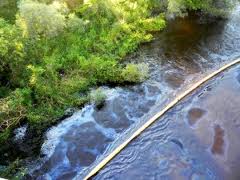 Kalamazoo River and surrounding properties.
And the reclamation? These corporations should hang their heads in utter shame. If you want to be thoroughly disgusted check out the You Tube clip I provided in an earlier post.
But here’s the really curious thing. The pipeline won’t be running through Indiana. The pipeline will not be running close to Indiana’s borders. No Indiana facilitities will have access to the pipeline. In fact, it appears that Indiana does not stand to be impacted in anyway by the Keystone pipeline and yet Governor Daniels felt compelled to call President Obama an extremist for postponing the pipeline’s construction. He was also willing to pay a $50,000+ [in state taxpayer money] to lobby for the Great State of Indiana in defense of the pipeline.
More curious still? TransCanada has stated that the pipeline will ‘increase’ oil prices for Indiana and other Midwestern residents because the area is ‘oversupplied.’ Keystone’s successful construction [this is stated in TransCanada’s application] will ensure higher prices for Canadian crude. By independent analysis costs will increase $6.55 per barrel in the Midwest and $3 per barrel everywhere else. The Indiana Petroleum Council thinks this is a swell idea.
Which begs the question: Who does Governor Daniels work for? His constituents or the oil companies?
So, it should not be any great surprise that a Senate group–laughably-called bi-partisan because it includes 1 Democrat, Joe Manchin from W. Va.–is reintroducing the Keystone proposal, pushing for immediate construction with or without the Administration’s approval. The Senate committee is invoking the Commerce Clause of the Constitution, which says Congress should have the power:
To regulate Commerce with foreign Nations, and among the several States, and with the Indian Tribes.
I love it when the Republicans start waving the Constitution. It’s a clear signal they’re up to no good. Did I mention that Koch Industries stands to make a killing on this project?
While reading Representative Waxman’s letter, I recalled something I’d read in Greg Palast’s book Vultures’ Picnic and found an accompanying and equally disturbing text online here and here. To quote Palast:
Reserves are the measure of oil recoverable at a certain price. Raise the price, raise the reserve. Cut the price and the amount of oil in the ground drops. In other words, it’s a fool’s errand to measure the “amount of oil we have left.” It depends on the price.
Specifically, oil companies and oil-related financiers are not interested in expanding oil supplies to the world, particularly cheap oil supplies  [because the days of cheap oil are over]. They’re interested in feeding the hunger for oil and controlling the price around the world with an iron fist. The higher, the better. The environment—air, water, soil–is not the concern. Our health or that of our children is not the concern. The bottom line—profit and power—is all that matters. If nations collapse? The Vultures are waiting to feast on the bones.
Sound harsh? It shouldn’t. Zombies and vultures are kissing cousins. They’re coming ‘round for a friendly visit. Again.
Japanese Officials Admit They Are Making No Progress
Posted: March 30, 2011 Filed under: Food, Foreign Affairs, Japan, toxic waste, Water, We are so F'd | Tags: cesium-137, contaminated food, contaminated water, Fukushim Dai-Ichi, Fukushima nuclear plant, Nuclear Contamination, radiation 30 Comments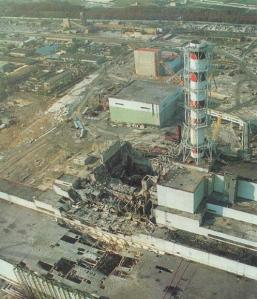
Chernobyl disaster: will it happen again?
The Guardian reports that radiation levels are rising in the ocean near the Fukushima nuclear plant, and Japanese officials admit they basically have no real solution for the apparent meltdown and/or meltdowns of the four damaged nuclear reactors.
The country’s nuclear and industrial safety agency, Nisa, said radioactive iodine-131 at 3,355 times the legal limit had been identified in the sea about 300 yards south of the plant, although officials have yet to determine how it got there.
Hidehiko Nishiyama, a Nisa spokesman, said fishing had stopped in the area, adding that the contamination posed no immediate threat to humans. “We will find out how it happened and do our utmost to prevent it from rising,” he said.
Good luck with that. The battle to control the reactors could go on for years.
The battle to control the slow-motion meldowns could take years, according to this Reuters article.
Plant operator Tokyo Electric Power Co. has conceded it faces a protracted and uncertain operation to contain overheating fuel rods and avert a meltdown.
“Regrettably, we don’t have a concrete schedule at the moment to enable us to say in how many months or years (the crisis will be over),” TEPCO vice-president Sakae Muto said in the latest of round-the-clock briefings the company holds.
Back to the Guardian piece:
Robert Peter Gale, a US medical researcher who was brought in by Soviet authorities after the Chernobyl disaster, said recent higher readings of radioactive iodine-131 and caesium-137 should be of greater concern than reports earlier this week of tiny quantities of plutonium found in soil samples.
But he added: “It’s obviously alarming when you talk about radiation, but if you have radiation in non-gas form I would say dump it in the ocean.”
Wonderful. The Japanese eat a lot of fish, don’t they?
Radiation measured at a village 40 kilometres from the Fukushima nuclear plant now exceeds a criterion for evacuation, the UN nuclear watchdog said.
And a Japanese nuclear expert has warned crews may have to keep pouring cooling water onto the stricken reactors for years.
Years. That is what multiple sources are now saying. It could take years. So how does it end? We hope for new discoveries that will solve the problem, while the reactors continue to melt down and release radioactive elements into the groundwater and the ocean? Or there is a catastrophic explosion?
Yes, I know the “experts” say that won’t happen, but if workers are going to be struggling with these plants for years, there is inevitably going to be human error. Besides, the “experts” have tried to minimize the dangers all along. Only now is the real truth beginning to come out.
From the Union of Concerned Scientists All Things Nuclear blog:
Today the IAEA has finally confirmed what some analysts have suspected for days: that the concentration per area of long-lived cesium-137 (Cs-137) is extremely high as far as tens of kilometers from the release site at Fukushima Dai-Ichi, and in fact would trigger compulsory evacuation under IAEA guidelines.
The IAEA is reporting that measured soil concentrations of Cs-137 as far away as Iitate Village, 40 kilometers northwest of Fukushima-Dai-Ichi, correspond to deposition levels of up to 3.7 megabecquerels per square meter (MBq/sq. m). This is far higher than previous IAEA reports of values of Cs-137 deposition, and comparable to the total beta-gamma measurements reported previously by IAEA and mentioned on this blog.
This should be compared with the deposition level that triggered compulsory relocation in the aftermath of the Chernobyl accident: the level set in 1990 by the Soviet Union was 1.48 MBq/sq. m.
Thus, it is now abundantly clear that Japanese authorities were negligent in restricting the emergency evacuation zone to only 20 kilometers from the release site.
This is bad, folks. Here is a summary of the health effects of cesium-137:
Like all radionuclides, exposure to radiation from cesium-137 results in increased risk of cancer.
Everyone is exposed to very small amounts of cesium-137 in soil and water as a result of atmospheric fallout. Exposure to waste materials, from contaminated sites, or from nuclear accidents can result in cancer risks much higher than typical environmental exposures.
If exposures are very high, serious burns, and even death, can result. Instances of such exposure are very rare. One example of a high-exposure situation would be the mishandling a strong industrial cesium-137 source. The magnitude of the health risk depends on exposure conditions. These include such factors as strength of the source, length of exposure, distance from the source, and whether there was shielding between you and the source (such as metal plating).
Please note that cesium-137, like plutonium doesn’t occur naturally in the environment. When officials and “experts” talk about “background” radiation, they are talking about elements that have been introduced through nuclear tests and nuclear reactor accidents and bi-products. This “background” radiation wasn’t around before the nuclear age, and I personally don’t believe that it has no effect on us.
From NPR: More radioactive material has been found in foods in Japan.
Yesterday, I asked in a comment what is being done with all the contaminated water that is being removed from the Fukushima reactors. Scarecrow addressed this question today at FDL.
They’ve got hundreds of tons of contaminated water preventing workers from getting close enough to pumps, valves, monitors needed to stabilize conditions. So they have to pump this water out and put it somewhere, but where? There are tanks at/near some units that can hold some of it, but not all, and external temporary storage may allow exposure to the atmosphere. Meanwhile, they must keep pumping more fresh water into the reactors and spent fuel storage pools, while more leaks out.
There are large pools of dangerously contaminated water in the turbine buildings adjacent to each reactor buidling, with more leaking in from somewhere, and few places to put it. Just outside the turbine buildings, there are long, deep trenches nearer the ocean and likely filled with water from the tsunami. But they’re now contaminated with radiation and water leaks from the turbine building.
Where can they put all this water? And given varying degrees of contamination, which water should they put where? For example, should they just pump out the least radioactive water in the trenches/pools and dump it in the ocean?
Believe it or not, some people are suggesting putting the water in large ships and letting them float around in the ocean. And what happens if there is a huge storm and the ships are damaged? Honestly, this gets scarier and scarier every day.
Even worse, today smoke was seen at another nuclear plant owned by Tepco!
The company said smoke was detected in the turbine building of reactor No. 1 at the Fukushima Daini nuclear power plant around 6 p.m. (5 a.m. ET).
Smoke could no longer be seen by around 7 p.m. (6 a.m. ET), a company spokesman told reporters.
The Fukushima Daini nuclear power plant is about 10 kilometers (6 miles) from the Fukushima Daiichi nuclear power plant, where workers have been scrambling to stave off a meltdown since the March 11 earthquake and tsunami knocked out cooling systems there….
After the dual disasters, Japanese authorities also detected cooling-system problems at the Fukushima Daini plant, and those living within a 10-kilometer radius (6 miles) of Fukushima Daini were ordered to evacuate as a precaution.
What next? Something tells me whatever happens next won’t be good.
Tuesday Reads
Posted: March 22, 2011 Filed under: Baby Boomers, Bahrain, Foreign Affairs, health hazard, Iraq, Japan, Libya, morning reads, psychology, Syria, U.S. Military, U.S. Politics, Water, Yemen | Tags: 1960s, Ali Abdullah Saleh, Bahrain, Fukushim nuclear plant, Hillary Clinton, id, iran, Japan, Libya, LSD, Muammar Gaddafi, Owsley Stanley, personality, Sigmund Freud, Syria, Wisconsin, Yemen 30 Comments
Good Morning!!
I’m teaching a Psychology of Personality course this semester, and yesterday I started lecturing about Freud and psychoanalytic theory. I was explaining Freud’s notion of the three parts of the personality–the id, the ego, and the superego. You’re probably familiar with those terms, but basically the id is there when we are born–it is completely self-centered, doesn’t know the difference between fantasy and reality, all it cares about is pleasure. It wants what it wants when it wants it. Sometime during infancy, we develop an ego that gets the id under some control, and around age 4-6 we develop a superego–basically like a conscience, that tells us which behaviors are right or wrong or socially acceptable.
Anyway, after class I was thinking about Muammar Gaddafi and his bizarre behavior–the way he has insisted for weeks that there is no opposition and that he isn’t attacking Libyan citizens. No, he would never do that. It occurred to me that Gaddafi is pretty much acting from his id all the time. Of course his ego keeps him somewhat connected to reality so he can function in the world, but mostly he just cares about his own needs.
I wonder if that is what happens to all leaders who gain absolute control. Does the quote “power corrupts and absolute power corrupts absolutely,” really mean that power causes people to regress to an earlier stage of development?
It sounds peculiar, but think about how powerful people get so many of their needs met by others. Obama doesn’t have to worry about paying for things, getting food or clothing, even getting information. It is all provided by other people. In many ways, it’s a kind of childlike, dependent state. So if the leader doesn’t have a strong character (ego), he can end up behaving in a narcissistic, childlike way.
OK, well that’s my not-very-deep thought for today.
So what’s happening in the news? As has often been the case in recent weeks, much of the big news is coming from outside the U.S.
On Libya, there has been more criticism of the UN resolution and how it is being carried out. I posted quite a few examples of the criticism in my post last night. Most of the objections are based on the fact that Libya is not at all important to the U.S. strategically.
Today I want to recommend a couple of articles that explain why the intervention in Libya, while troubling in many ways, was probably the right thing to do–even for U.S. interests. The first is by Mark Lynch at the Foreign Policy blog. Lynch uses the name “abuardvark” on twitter. His post is headlined Libya in its Arab Context Although Lynch has misgivings about the intervention and has written about them, he still thinks what the U.S. is doing is the right thing–both for the Arab world and for advancing our interests. Here’s his basic argument:
Libya matters to the United States not for its oil or intrinsic importance, but because it has been a key part of the rapidly evolving transformation of the Arab world. For Arab protestors and regimes alike, Gaddafi’s bloody response to the emerging Libyan protest movement had become a litmus test for the future of the Arab revolution. If Gaddafi succeeded in snuffing out the challenge by force without a meaningful response from the United States, Europe and the international community then that would have been interpreted as a green light for all other leaders to employ similar tactics. The strong international response, first with the tough targeted sanctions package brokered by the United States at the United Nations and now with the military intervention, has the potential to restrain those regimes from unleashing the hounds of war and to encourage the energized citizenry of the region to redouble their efforts to bring about change. This regional context may not be enough to justify the Libya intervention, but I believe it is essential for understanding the logic and stakes of the intervention by the U.S. and its allies.
Libya’s degeneration from protest movement into civil war has been at the center of the Arab public sphere for the last month. It is not an invention of the Obama administration, David Cameron or Nicholas Sarkozy. Al-Jazeera has been covering events in Libya extremely closely, even before it tragically lost one of its veteran cameramen to Qaddafi’s forces, and has placed it at the center of the evolving narrative of Arab uprisings. Over the last month I have heard personally or read comments from an enormous number of Arab activists and protest organizers and intellectuals from across the region that events in Libya would directly affect their own willingness to challenge their regimes. The centrality of Libya to the Arab transformation undermines arguments that Libya is not particularly important to the U.S. (it is, because it affects the entire region) or that Libya doesn’t matter more than, say, Cote D’Ivoire (which is also horrible but lacks the broader regional impact).
Lynch is still worried about what could go wrong:
I continue to have many, many reservations about the military intervention, especially about the risk that it will degenerate into an extended civil war which will require troops regardless of promises made today. But as I noted on Twitter over the weekend, for all those reservations I keep remembering how I felt at the world’s and America’s failure in Bosnia and Rwanda. And I can’t ignore the powerful place which Libya occupies in the emerging Arab transformations, and how the outcome there could shape the region’s future. Failure to act would have damned Obama in the eyes of the emerging empowered Arab public, would have emboldened brutality across the region, and would have left Qaddafi in place to wreak great harm. I would have preferred a non-military response — as, I am quite sure, the Obama administration would have preferred. But Qaddafi’s military advances and the failure of the sanctions to split his regime left Obama and his allies with few choices. The intervention did not come out of nowhere. It came out of an intense international focus on the Arab transformations and a conviction that what happens now could shape the region for decades.
At CNN, Peter Bergen tries to explain Why Libya 2011 is not Iraq 2003 I recommend checking it out.
Another article worth reading is by Robert Fisk at The Independent: Right across the Arab world, freedom is now a prospect
In the Middle East, Yemen may be close to ousting President Ali Abdullah Saleh. From the Guardian:
A military showdown is looming in Yemen after the defence minister announced that the army would defend the president against any “coup against democracy”. His statement came hours after 12 military commanders, including a senior general, defected from the regime and promised to protect anti-government protesters in the capital, Sana’a.
[….]
Yemen’s president, Ali Abdullah Saleh, suffered a significant blow when General Ali Mohsen al-Ahmar, his longtime confidant and head of the Yemeni army in the north-west, announced that he would support “the peaceful revolution” by sending soldiers under his command to protect the thousands gathered in the capital to demand that Saleh step down.
“According to what I’m feeling, and according to the feelings of my partner commanders and soldiers … I announce our support and our peaceful backing to the youth revolution,” Ali Mohsen said.
Minutes after his defection, tanks belonging to the republican guards, an elite force led by Ahmed Ali, the president’s son, rolled into the streets of Sana’a, setting the stage for a confrontation between defectors and loyalists.
At Bloomberg: U.S. Faces Loss of Key Ally Against Al-Qaeda in Yemen
…Yemeni President Ali Abdullah Saleh appears unlikely to weather a popular uprising and defections among his ruling elite, former U.S. officials said.
“It’s clear at this point that Saleh will have to step down,” Barbara Bodine, a former U.S. ambassador to Yemen, said in an interview yesterday. With the “mounting numbers of senior people in his administration resigning, we know it’s over. The terms of his departure, I think, are still being negotiated.”
The March 18 killing of at least 46 protesters allegedly by police and pro-regime gunmen — which drew condemnation from Obama and Secretary of State Hillary Clinton and prompted the defection of key military, tribal and government officials — may well be the tipping point.
Protests are continuing to escalate in Syria as well.
In Deraa, hundreds of black-uniformed security forces wielding AK-47 assault rifles lined the streets but did not confront thousands of mourners who marched at the funeral of 23-year-old Raed al-Kerad, a protester killed in Deraa.
“God, Syria, freedom. The people want the overthrow of corruption,” they chanted. The slogan is a play on the words “the people want the overthrow of the regime,” the rallying cry of revolutions that overthrew the veteran rulers of Tunisia and Egypt.
Security forces opened fire last Friday on civilians taking part in a peaceful protest in Deraa to demand the release of 15 children detained for writing protest graffiti.
Authorities released the children on Monday in a sign they were hoping to defuse tension in the border town, which witnessed more protests after Friday’s crackdown.
And there is a lot happening in Bahrain too. This article is worth a read: Libya burns but Bahrain can shake the world
While the world attention remains glued to the fires in Libya potential stakes in Bahrain are actually a hundred times higher. Safaniya Oil Field, the largest oil field in the world, is less than 200 miles from Manama. The Strait of Hormuz, through which passes 20 percent of world oil shipments and 40 percent of the world’s sea-borne oil shipments, is within a 400-mile radius.
More importantly, United States Fifth Fleet, with a forward deployed Carrier Strike Group, Combat Command force, Anti-Terrorism force, Sea Stallion helicopters, Amphibious Force and Patrol and Reconnaissance Force, is headquartered at Naval Support Activity Bahrain (or NSA Bahrain). In essence, Bahrain is home to America’s military might that reigns over the Persian Gulf, Red Sea and the Arabian Sea-all put together.
On March 14, around 2,000 soldiers of the Saudi-led, US-backed Peninsula Shield Force, in their armored carriers and tanks, invaded Bahrain. The stated purpose of the invasion is: to crush an unarmed civilian uprising.
On March 15, King Hamad ibn Isa Al Khalifa of Mamlakat al Bahrayn declared martial law under which the Bahrain Defence Force (BDF), numbering around 10,000 personnel, was “empowered to take whatever actions it deems appropriate in dealing with the predominately Shiite-driven unrest.”
I recommend clicking on the link and reading the rest to learn how Iran could get involved in the Bahrain conflict. Yikes!
In Japan workers are still trying to get the Fukushima nuclear plant under control. We keep hearing that things are improving, but it’s kind of hard for me to trust what I hear from governments and corporations these days. After Iraq, Katrina, the BP oil spill, and on and on, I honestly believe just about everyone in government and private business lies their asses off. The biggest fear at the moment is the radiation that is turning up in food and water. Of course the authorities claim that’s nothing to worry about, but why should we believe them?
Away from the plant, mounting evidence of radiation in vegetables, water and milk stirred concerns among Japanese and abroad despite assurances from Japanese officials that the levels were not dangerous.
TEPCO said radiation was found in the Pacific ocean nearby , not surprising given rain and the hosing of reactors with seawater. Some experts said it was unclear where the used seawater was ultimately being disposed.
Radioactive iodine in the sea samples was 126.7 times the allowed limit, while cesium was 24.8 times over, Kyodo said. That still posed no immediate danger, TEPCO said.
“It would have to be drunk for a whole year in order to accumulate to one millisievert,” a TEPCO official said, referring to the standard radiation measurement unit. People are generally exposed to about 1 to 10 millisieverts each year from background radiation caused by substances in the air and soil.
Whatever. I wouldn’t want to drink from the tap or swim in the radioactive ocean water.
Back in the USA, Wisconsin Asks Appeals Court to Block Order Halting Union Bargaining Law
Wisconsin’s attorney general asked an appeals court to block a state judge’s order that temporarily halted a law curbing government employee unions’ collective- bargaining power.
State Attorney General J.B. Van Hollen today also asked the Wisconsin Court of Appeals for permission to file an appeal seeking to overturn the ruling by Circuit Court Judge Maryann Sumi.
“Contrary to established case law, the trial court injected itself into the legislative process and enjoined a legislative act,” Van Hollen said in court papers filed today in Madison. “There is absolutely no authority for the broad, overreaching step taken.”
Sumi on March 18 granted a temporary restraining order blocking publication of the measure signed into law by Governor Scott Walker on March 11, after a hearing in Madison, the state’s capital city. Publication gives the law full force and effect.
I’ll end on a lighter note. If you’re as old as I am, you might remember a guy named Owsley “Bear” Stanley: “the Sixties hero who ‘turned on’ a generation.” Stanley died a few days ago in a car crash at the age of 76.
Stanley, who died in a car crash in Australia on Sunday, fuelled the “flower power” counter-culture that took root in California in the mid-1960s, supplying it with acid that he manufactured after stumbling across a recipe in a chemistry journal.
He also worked with the psychedelic rock band Grateful Dead, who wrote their song “Alice D Millionaire” about him after a newspaper described him as an “LSD millionaire”. One batch of his drugs reputedly inspired Jimi Hendrix’s song “Purple Haze”, and he provided LSD for the notorious “Acid Test” parties hosted by the American writer Ken Kesey, which featured in books by Tom Wolfe and Hunter S Thompson.
News of Stanley’s death – his car swerved off a road and slammed into a tree near his home in north Queensland – elicited tributes, but also surprise. Despite a youth so misspent that his name became slang for good acid, Stanley had made it to the age of 76. He was even a great-grandfather. In a statement yesterday, his family mourned him as “our beloved patriarch”.
Supposedly, a batch of Owsley’s acid inspired Jimi Hendrix’s first big hit, Purple Haze. Rest in peace, Owsley. I am one “casualty” of the ’60s who did learn something significant from my experiences with LSD. One thing I eventually learned is that I don’t need drugs to “get high.”
I guess that’s another not-so-deep thought, but hey, I’m OK with that. What are you reading and blogging about today?

 peej
peej Carissa
 bostonboomer
 dakinikat
 ecocatwoman
 mablue2
 Mama Lopez
 peggysue22
 quixote
 skydancingguestblogger
 Mona (aka Wonk the Vote)



 Sky Dancing
Recent Comments