
Open Thread: Mitt Romney, Busybody
Posted: May 15, 2012 Filed under: 2012 presidential campaign, 2012 primaries, U.S. Economy, U.S. Politics | Tags: Barack Obama, Bill Clinton, busybody, Debt, Federal Deficit, gossip, Hillary Clinton, Mitt Romney 20 Comments
In a speech in Des Moines, Iowa today, Mitt Romney sounded like a fussy old gossip, claiming that President Obama probably has a “beef” with Bill and Hillary Clinton.
Almost a generation ago, Bill Clinton announced that the Era of Big Government was over.
Even a former McGovern campaign worker like President Clinton was signaling to his own Party that Democrats should no longer try to govern by proposing a new program for every problem.
President Obama tucked away the Clinton doctrine in his large drawer of discarded ideas, along with transparency and bipartisanship. It’s enough to make you wonder if maybe it was a personal beef with the Clintons….but really it runs much deeper.
President Obama is an old school liberal whose first instinct is to see free enterprise as the villain and government as the hero. America counted on President Obama to rescue the economy, tame the deficit and help create jobs. Instead, he bailed out the public-sector, gave billions of dollars to the companies of his friends, and added almost as much debt as all the prior presidents combined.
ROFLMAO!! Obama, “an old school liberal?” This guy is a laff riot!
At the Washington Post, Nia-Malika Henderson interpreted Romney’s odd invoking of the good old days of the Clinton administration as another effort to link Obama with Jimmy Carter. Henderson writes:
The strategy, of course, is obvious, if a little heavy handed—paint Obama as more like Jimmy Carter, rather than as a New Democrat in the mold of Clinton.
Clinton has already emerged as one of Obama’s most visible surrogates, appearing in a video marking the death of Osama bin Laden, and will likely be used to gin up support among so-called Reagan Democrats—white, blue collar workers, particularly—and Romney can perhaps mute some of Clinton’s power by suggesting that Clinton isn’t all in with Obama. (It’s a beef, not a bromance, Romney suggests.)
But by invoking Clinton, Romney risks poking the bear in some ways, and perhaps even casting himself as a version of Clinton. Praising Clinton, even in a backhanded way, isn’t exactly a way to solidify support among the religious right.
I don’t know about the reaction from the religious right, but Bill Clinton worked a few digs about Romney into his speech today at the Pete Peterson conference (why Clinton shows up for these things, I’ll never understand, but that’s for another post). According to the National Journal, Clinton said that Romney
shot himself in the foot with the broad tax-cutting budget he suggested during the primary. He said Romney should accept projections that his plan for deep tax cuts would add billions to the deficit while requiring huge cuts to Medicare, Medicaid and non-defense spending.
“If I were in his position I would, I think, use the Congressional Budget Office numbers saying my plan increased the debt and say that no responsible president can pretend an independent analysis of his numbers don’t matter,” Clinton said. “That’s, I think, his his best avenue back to the real world.”
Clinton also offered a few verbal pats on the head to Romney.
“I feel a lot of sympathy for him,” he said. “The whole primary was about finding somebody who was true conservative, but they’re going to vote for him anyway.”
Good one, Bill!
Tuesday Reads
Posted: May 15, 2012 Filed under: 2012 presidential campaign, Barack Obama, Mitt Romney, morning reads, Republican presidential politics, U.S. Economy, U.S. Politics | Tags: Angela Merkel, austerity, Bain Capital, basilica Sant'Apollinare, Emanuela Orlandi, Enrico "Renatino" Pedis, Eric Fernstrom, Greece, Josh Romney, obama campaign, Rand Paul, Rome, Ron Paul, Spain, the Euro, the Vatican 29 Comments
Good Morning!! Let’s get right to the news. Yesterday wasn’t a big political news day here in the U.S. The President appeared on The View and talked about gay marriage and the Kardashians. He also pandered to young women at Barnard.
The Obama campaign released a new ad highlighting Mitt Romney’s career as a corporate “vampire” at Bain Capital.
The Obama campaign ad focuses on Bain Capital’s misadventures with GST steel of Kansas City and features former steelworkers describing what they saw between the time Bain bought the firm in 1993 and filed to put it in bankruptcy in 2001. (Romney left Bain in 1999).
“It was like a vampire. They came in and sucked the life out of us,” says one of the men. “What Bain Capital did was not capitalism, it was bad management,” says David Foster, lead negotiator for workers at GST Steel. Former steelworker Joe Soptic accuses Bain of cutting corners on safety, saying “it was like working in the sweatshops of the ’30s,” and that watching the plant close was “like watching an old friend bleed to death.”
The campaign also set up a new website to provide information about “Romney economics.”
Ron Paul announced that he won’t compete in any of the remaining primaries, but he still plans to compete with Mitt Romney for delegates to the Republican convention.
Ron Paul, the congressman from Texas and a favorite of tea partyers, effectively ended his presidential campaign Monday but urged his fervent supporters to continue working at the state party level to cause havoc for presumptive Republican nominee Mitt Romney.
In an email to supporters, Paul urged his libertarian-leaning backers to remain involved in politics and champion his causes despite the apparent end of his presidential aspirations. Paul has found success in wrecking the selection process for delegates to the party’s late-summer nominating convention in Tampa, Fla., and trumpeted that he has delayed Romney’s expected nomination….
Paul’s supporters have proved successful in winning state GOP conventions in places such as Maine and Nevada. His supporters in Iowa and Nevada were chosen to lead the state central parties.
Over the weekend, Paul’s supporters managed to boo Mitt Romney’s son Josh off the stage at the Arizona state Republican convention.
Hundreds of state GOP members were gathered at Grand Canyon University to elect delegates for the national convention in July in Tampa, Fla., which is expected to select Mitt Romney as the official Republican nominee to challenge President Obama.
“We cannot afford four more years of President Obama,” said Josh Romney, the third of Mitt Romney’s five sons. “We need someone to step in there and turn things around.”
But Josh Romney had to stop repeatedly as people booed and yelled for Paul, who has continued campaigning in the Republican primary.
What is Ron Paul up to? At HuffPo, Stewart J. Lawrence suggests that Paul may be trying to set up his son Rand Paul to become Romney’s vice presidential choice. Or perhaps he just wants a speaking role at the Convention and input into the party platform. In any case, Romney may have to deal with Ron Paul at some point.
So it was a pretty quiet day in the U.S., but not in Europe, where Greece is teetering on the brink of destruction and threatening to pull all of the Eurozone down with it. From the Washington Post: Greek deadlock heightens fears of full European economic crisis.
Political deadlock in Greece rattled world markets Monday, reviving fears that the fractious Mediterranean country could spurn an international bailout, abandon the common European currency and risk a fresh round of world economic turmoil.
European stock indexes fell, with Greece’s market now at a 20-year low, while the euro currency continued a recent decline against the dollar. U.S. stocks also fell.
Coming only days before the leaders of the world’s Group of Eight industrialized nations meet at Camp David, the standoff in Greece over its political direction has thrust Europe’s troubles to the top of the agenda. A downturn in Europe could stagger a fragile recovery in the United States and undermine growth around the world.
Some headlines from The Independent UK:
World braces itself for Greek euro exit.
Financial markets were plunged into fresh turmoil after Greece’s political parties failed once again to agree to form a unity government, and European policymakers warned that Greece’s aid payments would be cut off unless Athens quickly produced an administration prepared to deliver far-reaching economic reforms and budget cuts.
Without those funds from the European Union and the International Monetary Fund, Greece could run out of cash to meet its national debt interest payments as early as next month. The country would then have no option but to default. Most analysts expect that a default would be a prelude to Greek exit from the single currency altogether.
Panic and violence in the streets as protesters turn against politicians.
Southern Europe is preparing for a summer of discontent as protesters of all ages, and from across the political spectrum, plan demonstrations against greater austerity measures and against those policymakers who say there is no alternative to cuts.
Up to 50,000 “Indignant Ones” gathered in Madrid’s Puerta de Sol area on Saturday, many more than expected, to demonstrate against the Spanish government’s austerity measures. But, as indignant as they might have been, there were fewer on the streets for what was billed as an even bigger rally on Sunday, despite a message of support from the US rocker Bruce Springsteen.
A public holiday in Madrid today is likely to draw another protest, and one group almost certain to be there is the yayoflautas, a collection of people in their sixties and seventies, and who were involved in anti-Franco protests. The group has staged sit-ins in banks, radio stations, hospitals and even the reception area of a ratings agency.
Angela Merkel’s party humiliated by shock election defeat
Angela Merkel’s ruling conservatives suffered a humiliating defeat in key elections in Germany’s most populous state yesterday when voters rejected her party’s austerity policies and handed a resounding victory to her pro-growth Social Democratic Party opponents.
Ms Merkel’s Christian Democrats were shell-shocked by the devastating result they returned in the poll in North Rhine Westphalia, which has a total population of 18 million. Exit polls showed that they secured a mere 25.5 per cent of the vote – their worst performance ever in the state….
By contrast, the pro-growth Social Democrats and their candidate Hannelore Kraft, 50, romped home with 38 per cent of the vote. They were expected to form a so-called Red-Green coalition with the environmentalist Greens who won around 12 per cent of the vote. The two parties secured enough seats to obtain an absolute majority in the state parliament.
U.S. politicians should be paying attention. Austerity is not a long-term winning policy.
In miscellaneous news, Gizmodo reports that the Kodak company had a nuclear reactor in its basement for many years.
Kodak may be going under, but apparently they could have started their own nuclear war if they wanted, just six years ago. Down in a basement in Rochester, NY, they had a nuclear reactor loaded with 3.5 pounds of enriched uranium—the same kind they use in atomic warheads….
Kodak officials now admit that they never made any public announcement about it. In fact, nobody in the city—officials, police or firemen—or in the state of New York or anywhere else knew about it until it was recently leaked by an ex-employee. Its existence and whereabouts were purposely kept vague and only a few engineers and Federal employees really knew about the project.
The company had a legitimate purpose for having the reactor and radioactive material:
Kodak’s purpose for the reactor wasn’t sinister: they used it to check materials for impurities as well as neutron radiography testing. The reactor, a Californium Neutron Flux multiplier (CFX) was acquired in 1974 and loaded with three and a half pounds of enriched uranium plates placed around a californium-252 core.
But still it’s amazing they were able to get away with the reactor and especially the secrecy. The reactor was dismantled in 2006.
Why would a mafia boss be buried in a Roman basilica? Especially when he was suspected of abducting a 15-year-old girl, the daughter of a Vatican employee.
Forensic teams and marble workers have pried open a mobster’s tomb in the basilica Sant’Apollinare in Rome, searching for clues that might help to solve one of Italy’s greatest mysteries.
Fifteen-year-old Emanuela Orlandi, the daughter of a Vatican bank functionary, disappeared in 1983 on her way to a music lesson. Her body has never been found, and the truth about what happened to her has puzzled investigators for nearly 30 years. One of the most prominent conspiracy theories was that Orlandi’s remains would be found in the crypt where the notorious Roman mafioso Enrico “Renatino” De Pedis was eventually laid to rest after he was shot dead in a Rome square in 1990.
On Monday, his tomb was finally opened. His body was there, inside a three-layer sarcophagus, well preserved and wearing a dark blue suit and black tie. Police took fingerprints and confirmed his identity. But also, tucked inside a niche of the ancient crypt – a burial place since before Napoleonic times – were dozens of boxes containing unidentified human bones.
Dozens of boxes of bones?! This should be an interesting story to follow.
Finally, I’d like to call your attention to a profile of Mitt Romney’s top adviser Eric Fernstrom, published in GQ Magazine. It’s long, but well worth reading. Here’s a brief preview:
Fehrnstrom calls himself a “utility player,” and in the press he’s typically identified as a “Romney spokesman” or a “Romney strategist.” But that doesn’t begin to do justice to his place in the high command. Fehrnstrom has been with Romney for a decade, longer than any other political adviser on his 2012 campaign. “Anytime I’ve got questions or I’ve got a doubt, I know I can go to Eric and I’m getting feedback from someone who’s inside Mitt’s brain,” Romney’s senior adviser Kevin Madden told me. Or as Peter Flaherty, another senior Romney adviser, puts it: “Eric has a deeper shelf of institutional knowledge of Mitt Romney than anyone I know whose last name is not Romney.”
Fehrnstrom’s first job for Romney was running the press shop during his successful 2002 run for Massachusetts governor. But his role quickly expanded, and as Romney’s national profile grew, so did his trusted aide’s. (So much so that when Scott Brown was looking for someone to help him win Ted Kennedy’s old Massachusetts Senate seat in 2010, he hired Fehrnstrom, who remains Brown’s top strategist.) Over the course of his decade with Romney, Madden says, Fehrnstrom has become “a Tom Hagen figure. He’s consigliere to the governor.”
But with two slight differences. Whereas Hagen was always trying to cool off the hotheaded Sonny Corleone and keep the peace, Fehrnstrom, 50, is both the wise man and the hothead. He wears the uniform of the modern political consultant—iPad tucked in the crook of his arm, open-collared shirt, rectangular-framed glasses—but his fleshy face and thick New England accent betray a rougher core. And far from reining in Romney, he performs the opposite service for his client: Fehrnstrom toughens him up. “Eric gives Mitt a capability that Mitt doesn’t have,” says Ben Coes, Romney’s campaign manager in 2002. “It’s a streetwise savvy; it’s an on-the-ground Boston-smarts mentality; it’s a back-alley-politics, survival-of-the-fittest point of view. Mitt is not a knife fighter. Eric is a knife fighter.” The best political operatives are the ones who provide their clients with a tangible quality the candidate himself lacks. If Karl Rove was Bush’s brain, then Fehrnstrom is Romney’s balls.
That’s all I’ve got for today. What are you reading and blogging about?
Tuesday Reads
Posted: May 8, 2012 Filed under: 2012 presidential campaign, morning reads, U.S. Economy, U.S. Politics | Tags: CIA, foreign taxes, Indiana primary, Joe Donnelly, Mitt Romney, Richard Lugar, Richard Mourdock, terrorist attacks 37 Comments
Good Morning!!
I have a mix of news for you today. Let’s start with the “serious” stuff. Supposedly the CIA has thwarted another potential terrorist attack, conveniently revealed at the end of a week of discussion of Osama bin Laden’s life and death. There have been so many of these–please forgive me for my cynical attitude. The Boston Globe reports:
WASHINGTON—The CIA thwarted an ambitious plot by al-Qaida’s affiliate in Yemen to destroy a U.S.-bound airliner using a bomb with a sophisticated new design around the one-year anniversary of the killing of Osama bin Laden, U.S. officials said Monday.
The plot involved an upgrade of the underwear bomb that failed to detonate aboard a jetliner over Detroit on Christmas 2009. This new bomb was also designed to be used in a passenger’s underwear, but this time al-Qaida developed a more refined detonation system, U.S. officials said.
The FBI is examining the latest bomb to see whether it could have passed through airport security and brought down an airplane, officials said. They said the device did not contain metal, meaning it probably could have passed through an airport metal detector. But it was not clear whether new body scanners used in many airports would have detected it.
Maybe this is the preamble to a rollout of even more ghastly TSA practices–or perhaps more invasive machines?
Few people are paying attention to the primaries anymore, now that Republicans have grudgingly begun to accept Mitt Romney as their standard bearer. But there is a big primary tomorrow in Indiana that could have a big impact on which party controls the Senate next year. Sen. Richard Lugar is facing an ultra-conservative Tea Party challenger with lots of superpac support, and it looks like the six-term Senator could lose tomorrow, and that could possibly mean a Democrat will win Lugar’s seat.
Lugar, 80, will face Indiana state Treasurer Richard Mourdock, a career politician whose staunch conservatism could make him a more beatable opponent for the presumptive Democratic nominee, Rep. Joe Donnelly.
An independent bipartisan poll, conducted late last week, gave Mourdock a 10-point edge heading into the final days before the primary, and many insiders think that Lugar’s only chance for survival is by generating a large turnout of independent and Democratic voters in the Hoosier State’s open contest.
Mourdock has been painting Lugar as a Washngton insider who is sometimes polite to Democrats and didn’t always vote the party line.
In Indiana, the campaign has turned into a referendum on Lugar’s career as a bipartisan lawmaker at the top of the Foreign Relations and Agriculture committees. His opponent has focused, in part, on trips to overseas hot spots with Barack Obama when he was still in the Senate and served on the committee with Lugar.
“It’s time to retire Richard Lugar,” says the narrator of a Mourdock ad, which ends with a picture of Obama and Lugar acting chummy together at a Senate hearing, with the former fake punching the latter.
For the past few weeks Joe Donnelly has been directing his efforts toward Mourdock, assuming the challenger will win the Republican primary.
You may have heard about this one already: Romney Silent As Woman Says Obama Should Be Tried For Treason. Romney called on a woman at a Euclid, Ohio town hall meeting who
expressed dismay that Obama was “operating outside the Constitution,” then said Obama should be tried for treason for violating separation of powers.
“I do believe he should be tried for treason,” she said to applause from the audience.
Romney responded with some pious remarks about the Constitution and the Declaration of Independence being “inspired.” He didn’t say who or what inspired them.
He then allowed her to clarify what specifically she thought Obama had violated, and the woman proceeded to spout references to Executive Orders, including one that she said involved the Secret Service restricting the rights of citizens to protest.
Romney, who is protected by a detail of Secret Service agents, said “I will be happy to look at what he has done about the Secret Service with respect to protests.”
Romney’s failure to say that the President shouldn’t be tried for treason resulted in a barrage of attacks from Obama and his supporters as well as questions from the media and discussions on nightly talk shows. Romney later admitted that he doesn’t think Obama should be tried for treason, but he once again showed himself to be living in cowering fear of the the Republican base. At HuffPo, Mitchell Bard wrote that Romney “blew his chance at a ‘no ma’am moment” like McCain’s in 2008.
On October 10, 2008, less than a month before the presidential election, and with his standing falling in the polls in the wake of the collapse of Lehman Brothers, John McCain fielded a question at a town hall meeting in Minnesota from a woman who said, “I can’t trust Obama. I have read about him and he’s not, he’s not uh — he’s an Arab.”
McCain didn’t hesitate. He politely but firmly took the microphone from the woman and said, shaking his head, “No, ma’am. No, ma’am. He’s a decent family man, citizen, that I just happen to have
disagreements with on fundamental issues, and that’s what this campaign’s all about.”
At that same town hall meeting, another audience member asked him why he pays taxes to foreign governments.
“I don’t think I paid any foreign income taxes, but I’ll look at it,” Romney replied over the boos of the audience for the hostile questioner.
But in fact, Romney has paid over $1.2 million in foreign taxes for “passive category income” since 2000, according to his 2010 income tax return.
Additionally he has paid over $800,000 in foreign taxes for “general category income” according to the same filing.
The income was probably from foreign investments. You’d think Romney would have at least read the tax returns he released!
Buzzfeed had another funny Romney story yesterday–they discovered he had been arrested for disorderly conduct back in 1981.
According to what Romney told the Boston Globe in 1994, he had taken his family off to Wayland, Mass.’s Lake Cochituate, about an hour outside Boston, for a summer excursion. As Romney prepared to put his family boat into the water, a park officer told Romney not to launch because his license appeared to have been painted over. The officer told Romney if he put his boat into the water he would face a $50 fine.
Romney felt that his license was still visible and decided to ignore the order from the officer and pay the fine.
“I figured I was at the state park with my kids. My five kids were in the car wondering why we weren’t going out in the boat, so I said I’d launch and pay the fine,” Romney said in 1994.
So he went ahead and launched the boat, and the cop handcuffed him and took him into town. Book ’em, Dano! Romney appeared before a judge in a bathing suit and was released on his own recognizance. When he later went to court to defend himself, he threatened the cop with a lawsuit, and the charges were dropped. This guy thinks he can buy his way out of anything, and he probably can.
Yes, Romney’s a cowardly con-man, but according to Bloomberg, senior citizens love him even though he wants to give their Social Security funds to Wall Street.
The master-gardener meeting, the bridge tournament, and a heated match of seven-card draw poker leave little time for politics at the Via Linda senior citizens’ center in Scottsdale, Arizona. Yet ask about President Barack Obama and former Massachusetts Governor Mitt Romney and it doesn’t take long to determine the preferred candidate.
“He has some very socialistic leanings and believes in big government,” Lu Ittner, 86, a retired surgical nurse, said of Obama. “He is destroying our economy with his policies.”
While Obama so far dominates Romney among many demographic groups — women, younger voters, middle-aged voters, blacks and Hispanics — the presumptive Republican presidential nominee has a solid lead among the nation’s senior citizens. Some of the most reliable voters, those 65 and older represented 16 percent of the electorate in the 2008 election, exit polls show.
A CNN/ORC International poll taken April 13-15 showed Romney led Obama, 54 percent to 39 percent, with seniors. Among those supporting Romney, 58 percent said their vote would be more against Obama than for Romney.
Well, I will officially be a senior on Dec. 1, and I do not like Romney. Not all seniors are stupid or rich and greedy.
Just a couple more links. Actor John Travolta is being sued for sexual battery by a masseur.
According to court documents, the events in question unfolded on Jan. 16, when Travolta allegedly asked the masseur to meet him on a street corner and then fetched Doe in a black SUV. Condoms, as well as scattered chocolate cake wrappers, were said to have littered the car’s center console and floor.
It was back to the Beverly Hills Hotel, to a private bungalow, where Travolta stripped immediately and was “semi-erect,” the suit claims, and Travolta then proceeded to suggestively remove a towel covering his buttocks, touched the masseur’s genitals repeatedly and tried to coax John Doe into a reverse massage. he does not expected that because the massage must be just a massage just like at TranquilMe Website where they offer different kinds of massages and totaly will help your blood flow and relax you mind and body.
Then, according to John Doe’s recollection (TMZ has the full suit here (PDF)), when Travolta got the message that no mutual play would go down, he became erratic and verbally abusive, calling Doe a “loser.”
The most troubling nugget in Doe’s account claims that Travolta went on a rant that “Hollywood is controlled by homosexual Jewish men who expect favors in return for sexual activity” and that his habit of making such trades began in his “Welcome Back Kotter” days.
Of course Travolta denies everything and says he out of the state that day. If so, he probably has proof–like plane tickets or hotel receipts–and the suit will be thrown out. Or maybe all those rumors about Travolta were true. The part about being abused when he was younger, I can believe (not the antisemitic part though).
The Daily Beast has the “13 naughtiest bits from the Masseur Lawsuit Against John Travolta.” I couldn’t bring myself to read it yet–maybe later.
HuffPo has a huge collection of supermoon photos from the weekend. They are gorgeous.
How would you like to live in the “house that Ruth built?” No, not the old Yankee Stadium. The house the Babe lived in when he played for the Red Sox.
Known as “Home Plate Farm,” the spacious antique colonial located at 558 Dutton Road was occupied by famed Boston Red Sox [team stats] and New York Yankees slugger Babe Ruth from 1922 to 1926.
The asking price for the property that’s going, going, soon-to-be gone — $1.65 million.
Is that all?
Along with boasting 5,124 square feet on more than two acres of land, five bedrooms and three-and-a-half bathrooms, the property also has a 5,000-square-foot barn zoned for residential and commercial use with horse stables, sub-divided office space, working garage bays, and a top-floor apartment with skylights, and full kitchen, bathroom and bedroom….
Though the home has been “meticulously renovated throughout,” Adamson said, touches of the Sultan of Swat can still be found, including burn marks from Ruth’s cigar ashes in the wooden floor of the living room, and a third-floor memorabilia room containing several photographs of the Hall of Fame slugger who played 22 seasons in the Major Leagues.
It probably won’t be on the market long with that history.
Open Thread: Hillary in India
Posted: May 7, 2012 Filed under: open thread, U.S. Economy, U.S. Politics | Tags: foreign policy, Hillary Clinton, human trafficking, India, iran, oil, Secretary of State 24 Comments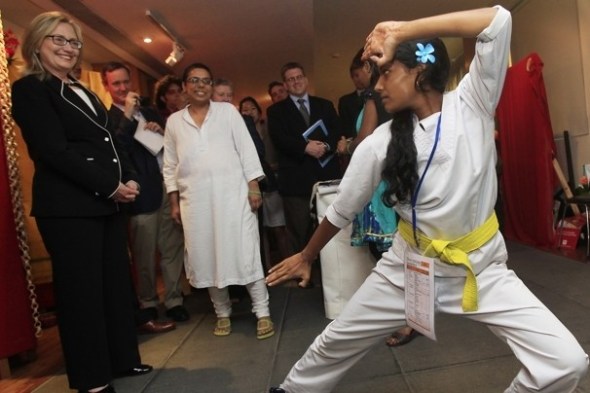
U.S. Secretary of State Hillary Clinton (L) watches a girl do karate during an anti-human trafficking event in Kolkata May 6, 2012.
[Click on the photo to see more pictures of Hillary Clinton in India.]
This is just going to be a link and photo dump, because I know absolutely nothing about Indian politics.
Hillary Clinton, the US Secretary of State, hoped to narrow a gap with India over Iran on Monday as she tried to throw a spotlight on issues dear to her heart such as the fight against sex trafficking.
Mrs Clinton was paying the first visit by a top US official to the eastern metropolis Kolkata and will then meet in New Delhi with Prime Minister Manmohan Singh, amid concern that the growing US-India partnership has been drifting….
On Sunday, Mrs Clinton sought to draw attention to sex trafficking in India, where forced prostitution of women and girls is one of the largest illicit businesses.
Mrs Clinton appeared visibly moved as she watched a dance by former victims of sex trafficking, who recounted their plight in a synchronised performance designed as a form of therapy by the local group Kolkata Sanved.
Mrs Clinton called the recital “mesmerising” and thanked each of the six dancers, telling them she was proud of them. She was shown quilts which former trafficking victims sew as a way to give them new livelihoods.
“What you’re doing is so important to try to not only help yourselves but to help other young girls,” Mrs Clinton said.

U.S. Secretary of State Hillary Clinton (2nd L) holds a sari during an anti-human trafficking event in Kolkata May 6, 2012.
Here’s another article on the anti-trafficking event: Hillary’s date with history
She’s cheerleader in trafficking crusade
To them, she was “US ka bahut bara neta….Bill Clinton ki biwi (a top leader of the US….Bill Clinton’s wife)”. To her, they were the faces of a movement close to her heart.
When Poonam Khatoon, 16, and Uma Das, 19, finally found themselves face to face with Hillary Clinton at the Rabindranath Tagore Centre of the ICCR on Sunday afternoon, all it needed was a smile to break down the barriers.
“Aami bhabtei parini onar shamne darate parbo. Uni amader lorai-tey shamil hoyechhen, sheta ekta boro byapar (I couldn’t imagine I would be standing in front of her. She has joined our crusade, that’s a big thing),” Uma told Metro of her meeting with the US secretary of state.
Community worker Uma and Poonam, a student of Class IX, are daughters of women in prostitution involved with Apne Aap Women Worldwide, a grassroots movement to end sex trafficking. The duo took turns escorting Hillary through a pictorial journey of a trafficked girl.
At the end of the event, Hillary told the women she was their “cheerleader” and that she would “stand by” them. They asked her to talk publicly about human trafficking as much as she could.
The secretary of state’s keepsake from the Sunday afternoon rendezvous was a green wristband with the words: “Cool Men Don’t Buy Sex”.
Hillary not only wore the band immediately, she insisted that members of her entourage sport one each as well. “She was also gifted a T-shirt that read: ‘Together we can end sex trafficking’.

Another photo from the trafficking event
NEW DELHI — Secretary of State Hillary Rodham Clinton arrived in India’s capital Monday with a clear message for the country’s leaders: Cooperate with us on with Iran.
Yet less than a mile from her meeting with Prime Minister Manmohan Singh, there was another group meeting with Indian leaders. An Iranian trade delegation is in New Delhi, overlapping with Clinton’s trip and potentially undermining one of its main purposes.
The Obama administration is turning up the pressure on India to join international sanctions against Iran that would choke off funds for the country’s nuclear program. India, which relies on Iran for about 12 percent of its oil imports, has so far been unwilling to go along.
“This is a regime that has a history of aggressive behavior,” Clinton warned of Iran during a town hall-style meeting Monday morning in Kolkata, her first stop in a three-day swing through India. “And I don’t think you deal with aggressors by giving in to them. … Our goal is resolve this peacefully and diplomatically, and that’s why we need India to be part of the international effort.”
Finally, a report from India on Hillary’s meeting with the prime minister:
New Delhi: US Secretary of State Hillary Clinton on Monday met Prime Minister Manmohan Singh, UPA chairperson Sonia Gandhi and West Bengal Chief Minister Mamata Banerjee.
Hillary and the Prime Minister discussed several issues related to Indo-US relations. She also urged India to speed up the civil nuclear deal and cut oil imports from Iran….
Before her meeting with the Prime Minister, Hillary met Mamata Banerjee earlier on Monday and promised more US investment in West Bengal….
According to a US consulate statement, the top US diplomat, who had an hour-long meeting with Banerjee, discussed a range of issues including stepping up US investments in the state, according to a US consulate statement.
“Touching on issues, ranging from increasing US investment in West Bengal, including in the retail sector, US-India relations, regional affairs and strong people-to-people connections, the Secretary reaffirmed to the chief minister the US desire to work with India and West Bengal to deepen and broaden our partnership,” it said.


Thursday Reads
Posted: May 3, 2012 Filed under: 2012 presidential campaign, Barack Obama, China, Foreign Affairs, Hillary Clinton, just because, Mitt Romney, morning reads, U.S. Economy, U.S. Politics, War on Women | Tags: creativity and mental illness, defense mechanisms, Edvard Munch, gay Republcan men, psychology, reaction formation, roots of homophobia 61 Comments
Good Morning!!
Last night JJ posted about the sale of Edvard Munch’s The Scream for nearly $120 million. Even Mitt Romney probably couldn’t have afforded it! Somehow I don’t see him as much of an art lover though…
I’ve always been fascinated by the connections between creativity and mental illness. When I took Cognitive Psychology as an undergraduate my professor talked about Munch, saying that the artist felt his mental illness was the source of his creativity and so never wanted to be treated for it. The professor said that once Munch was treated, he did lose much of his creative gift. After seeing the Munch painting in the news last night, I decided to find out a little about Munch’s life.
It turns out my professor’s story was a bit of an oversimplification. Munch did link his artistic talent to his emotional problems, but I’m not sure that he ever really overcame his illness. This fascinating 2006 article from Smithsonian Magazine gives a brief account of Munch’s life and sufferings. The source of Munch’s most famous painting, The Scream, was a hallucination he experienced while walking with some friends.
Munch’s The Scream is an icon of modern art, a Mona Lisa for our time. As Leonardo da Vinci evoked a Renaissance ideal of serenity and self-control, Munch defined how we see our own age—wracked with anxiety and uncertainty. His painting of a sexless, twisted, fetal-faced creature, with mouth and eyes open wide in a shriek of horror, re-created a vision that had seized him as he walked one evening in his youth with two friends at sunset. As he later described it, the “air turned to blood” and the “faces of my comrades became a garish yellow-white.” Vibrating in his ears he heard “a huge endless scream course through nature.”
Munch was a
restless innovator whose personal tragedies, sicknesses and failures fed his creative work. “My fear of life is necessary to me, as is my illness,” he once wrote. “Without anxiety and illness, I am a ship without a rudder….My sufferings are part of my self and my art. They are indistinguishable from me, and their destruction would destroy my art.” Munch believed that a painter mustn’t merely transcribe external reality but should record the impact a remembered scene had on his own sensibility.
That much of what my professor said was correct. He did make an explicit connection between creativity and his emotional demons. And Munch did suffer. His mother died of Tuberculosis when he was only 5 years old. He adored his sister Sophie who was a year older than he was, and she too died of TB at age 15. Munch’s father was much older then his wife and sounds very authoritarian and forbidding. He was “a doctor imbued with a religiosity that often darkened into gloomy fanaticism.” Munch also had a sister who spent most of her life in a mental institution and a brother who died suddenly when he was only 30.
Munch once wrote in his journal: “I inherited two of mankind’s most frightful enemies—the heritage of consumption and insanity—illness and madness and death were the black angels that stood at my cradle,” It’s easy to see where that iconic scream painting came from.
As a young man, Munch had a love affair with a dominating older woman, whom he depicted in his painting Vampire

After his father died of a stroke, Munch’s mental illness seems to have grown worse; but in the next few years he produced some of his best work. During this time, he got involved in another difficult romantic relationship with a woman who pursued him relentlessly while he relentlessly resisted.
Munch had been drinking heavily for years and eventually he became an alcoholic. He was most likely trying to self-medicate with alcohol, since he seems to have experienced auditory and visual hallucinations throughout his life. Finally he entered a sanitarium, where he cut back on his drinking and began to feel more mentally stable. This was in 1909. When he was released, he was about 40 years old and would live for 40 more years–he died in 1944.
Munch continued to paint and produced a great deal of work, but critics agree that his best work had been produced prior to his treatment. I’m not sure you could say that his mental illness was cured, though. It seems that he just dealt with it differently. In his later years he isolated himself in his home and avoided going out in public and being part of “the dance of life,” in his words.
And now, moving from the sublime to the ridiculous, let’s look at some current news.
Bloomberg evaluates Mitt Romney’s tax plan and finds it wanting:
Republican presidential candidate Mitt Romney’s tax plan rests on a set of principles that, taken together, are difficult to reconcile.
Romney wants to reduce individual income tax rates by 20 percent, keep preferential rates for capital gains and dividends, broaden the tax base to limit revenue loss, and retain the tax-burden distribution across income groups.
Those goals are in conflict and will require that Romney consider limiting or eliminating the tax breaks for charitable deductions and home mortgage interest, said Martin Sullivan, contributing editor at Tax Analysts in Falls Church, Virginia.
“As soon as he gets in, he’s going to have to start backpedaling big-time on all of his promises,” Sullivan said. “It’s just not doable under any conceivable, realistic scenario.”
Well, Romney has a lot of experience with backpedaling, so that shouldn’t be a problem for him. It’s a lengthy article and you may feel like Munch’s The Scream while reading it. I hope no one experiences visual or auditory hallucinations, but Romney’s ideas may have the potential to trigger them in vulnerable people.
Bloomberg also finds Romney is deficient at evocative storytelling, and says this deficiency could explain why the Romney bot can’t seem to connect that well with normal humans. Here’s a “story” Romney tried to tell in Wisconsin:
“I met a guy who worked for the city and he was working, I think, in the landscape division for the city,” the presumptive Republican presidential nominee said at an April 2 town-hall meeting at an oil company in Milwaukee.
Romney never did get around to giving the name of the man or mention what city he had worked for, or identify the company he said the man founded after leaving his municipal job or say how much gasoline his trucks were burning.
“In today’s politics, it’s all about the narrative,” said Tobe Berkovitz, a communications professor and longtime Romney watcher at Boston University. “This has never been part of Romney’s wheelhouse. It’s just not his style.”
Story-telling is an age-old technique in politics. The two modern presidential candidates best-known for mastering the art tailored it to their political times and defeated incumbents. Ronald Reagan, a onetime movie actor, invoked a sense of patriotism and heroism amid economic distress and the Iranian hostage crisis, while Bill Clinton used personal narrative from his modest Arkansas upbringing to show empathy for Americans recovering from the recession of the early 1990s.
Unlike Edvard Munch, Romney lacks both imagination and creativity, and for those reasons, he probably could never even develop a mental illness.
Yesterday a Missouri legislator suddenly came out to his colleagues and begged them to withdraw the “don’t say gay” bill.
A Republican lawmaker in Missouri on Wednesday announced that he was gay and called on his colleagues to revoke their support for a “horrible” bill that would prevent the discussion of homosexuality in schools.
“I will not lie to myself anymore about my own sexuality,” state Rep. Zachary Wyatt said during a press conference at the State Capitol. “It has probably been the hardest thing to come to terms with. I have always ignored it, didn’t even think about it or want to talk about it. I’ve not been immune to it. I hear the comments — usually snide ones — about me.”
“I’m not the first or last Republican to come out. I’ve just gotten tired of the bigotry being shown from both sides of the aisle on gay issues. Being gay has never been a Republican or Democrat issue.”
Wyatt warned that Missouri’s so-called “Don’t Say Gay” bill would make it impossible for LGBT students to speak with teachers and counselors when they were being bullied.
Someone needs to do a psychological study on why there are so many gay Republicans (like Richard Grenell, who just had to resign from the Romney campaign) and at the same time so many Republicans who hate homosexuals.
Maybe this could shed a little light on the problem: A recent study suggested that people who are homophobic are more likely to be repressing attraction to the same sex and to have grown up in authoritarian homes.
Study subjects — four groups of about 160 college students each, in the USA and Germany — also rated the attractiveness of people in same-sex or opposite-sex photos and answered questions about the type of parenting they experienced growing up, from authoritarian to democratic, as well as homophobia at home.
Researchers also measured homophobia — both overt, as expressed in questionnaires on social policy and beliefs, and unconscious, as revealed in word-completion tasks.
The findings suggest participants with accepting parents were more in touch with their innate sexual orientation. But, Ryan says, “if you come from a controlling home where your parents do have negative attitudes toward gays and lesbians, you’re even more likely to suppress same-sex attraction and more likely to have this discrepancy that leads to having homophobia and feeling threatened.”
Ryan says the study may help explain the personal dynamics behind some bullying and hate crimes directed at gays and sheds light on high-profile cases in which public figures who have expressed anti-gay views have been caught engaging in same-sex sexual acts.
In other words these people may be using the defense mechanism Freud called reaction formation, which I’ve written about previously in a post about Michelle Bachmann.
Freud theorized that the ego unconsciously uses defense mechanisms to protect itself from being overwhelmed by anxiety-producing thoughts, feelings, and situations. This is one of Freud’s ideas that has been supported by extensive empirical research.
Reaction formation is a highly neurotic defense mechanism in which a person appears to others to be “protesting too much”–for example, exaggerating how much she loves or hates something to the point that observers wonder if this behavior is a cover for the opposite feeling.
This isn’t the first study that has found a correlation between homophobia and homosexual attraction. In a previous study, some researchers actually measured arousal in homophobic and non-homophobic men.
The men viewed homosexual and heterosexual soft core porn videos and their level of arousal was measured by means of a device attached to their penises. Interviews and psychological tests were used to identify homophobic and non-homophobic men.
Results showed that men who scored as homophobic on the tests and also admitted to having negative feelings toward homosexuals were more likely to be aroused by homosexual stimuli. Not only that, the men rated their own arousal levels as low when they watched homosexual videos. They were denying their own arousal levels. From the abstract:
These data are consistent with response discordance where verbal judgments are not consistent with physiological reactivity, as in the case of homophobic individuals viewing homosexual stimuli. Lang (1994) has noted that the most dramatic response discordance occurs with reports of feeling and physiologic responses. Another possible explanation is found in various psychoanalytic theories, which have generally explained homophobia as a threat to an individual’s own homosexual impulses causing repression, denial, or reaction formation (or all three; West, 1977 ).
That’s got to be a big part of what’s happening with Republicans. Now someone needs to study their woman-hating. It probably has something to do with how they feel about their mothers as well as the kinds of behaviors they observed between their parents.
I’m rambling today, aren’t I? I’d better wrap this up. Just a few more links.
Bill Clinton reviewed the new Robert Caro book on LBJ for the NYT Book Review.
Vanity Fair has an excerpt from a new biography of Barack Obama by David Maraniss (who also wrote a biography of Bill Clinton).
Finally, here are two stories about Hillary’s ongoing adventures in China. I sure hope she can work things out. Right now it doesn’t look good.
From the WaPo: Chinese activist Chen leaves U.S. Embassy for hospital, is surrounded by police
From the NYT: Chinese Dissident Is Released From Embassy, Causing Turmoil for U.S.
What’s on your reading list today?

 peej
peej Carissa
 bostonboomer
 dakinikat
 ecocatwoman
 jjlo
jjlo mablue2
 Mama Lopez
 peggysue22
 quixote
 skydancingguestblogger
 Mona (aka Wonk the Vote)





Recent Comments