
Thursday Reads: Closed and Quiet Rooms
Posted: June 21, 2012 Filed under: 2012 presidential campaign, Banksters, Barack Obama, morning reads, U.S. Economy, U.S. Politics | Tags: closed rooms, heat wave, House Banking Committee, immigration, Jamie Dimon, Mitt Romney, quiet rooms, Senate Banking Committee, weather 26 Comments
Good Morning!!
Suddenly it’s hot here in New England. Just last week I actually had to turn my furnace on to warm up the house! It’s been a pretty cold June here, but yesterday the temperature reached 96 in Boston. Today is supposed to be a repeat performance. As I’m writing this late on Wednesday night, it’s still 84 degrees! It has been quite a shock to the system, let me tell you.
There is apparently a heat wave stretching from Chicago to the Northeast. And how appropriate, since the Summer Solstice took place yesterday at 7:09PM Eastern time. The Summer Solstice is usually on June 21, but since 2012 is a leap year, it fell on June 20.
So last week, JP Morgan CEO Jamie Dimon appeared before the Senate Banking Committee and got his ass kissed by the committee members–many of whom have received generous campaign donations from Dimon and/or his bank. If you haven’t read Matt Taibbi’s takedown of the committee’s embarrassing performance, please check it out. Here’s a sample:
I wasn’t prepared for just how bad it was. If not for Oregon’s Jeff Merkley, who was the only senator who understood the importance of taking the right tone with Dimon, the hearing would have been a total fiasco. Most of the rest of the senators not only supplicated before the blowdried banker like love-struck schoolgirls or hotel bellhops, they also almost all revealed themselves to be total ignoramuses with no grasp of the material they were supposed to be investigating.
That most of them had absolutely no conception of even the basics of the derivatives market was obvious. But what was even more amazing was that several of them had serious trouble even reading aloud the questions their more learned staffers prepared for them. Many seemed to be reading their own questions for the first time.
It would be one thing if this had been a bunch of hick congressmen from the plains asking a panel of MIT professors about, say, ozone depletion, or the potential dangers of nuclear fallout. But these were members of the Senate Banking Committee, asking Dimon questions as though he were an alien from another world: “Tell us, Mr. CEO, what is this ‘derivative trading’ to which you refer? How long has it been in use on your planet?” The whole tenor of the proceeding was incredibly embarrassing, and showed just how unlikely it is that you’ll ever get anything like real questioning in a Senate hearing when a) the level of general expertise among the members is so shamefully low, and b) the witness is a man who controls millions of dollars of campaign contributions.
This week it was the House Banking Committee’s turn to hear from Dimon, and they apparently did slightly better than their Senate counterparts. I was particularly struck by this quote reported by George Zornick of The Nation:
As the House Financial Services Committee hearing into recent failures at JPMorgan waned, bank CEO Jamie Dimon finally said what had already been obvious to everyone — he didn’t want to be there. “These are complex things that should be done the right way, in my opinion in closed rooms,” Dimon said. “I don’t think you make a lot of progress in an open hearing like this.” In the closed room, Dimon said, everyone would be “talking about what works, what doesn’t work, and collaborating with the business that has to conduct it.”
I was immediately reminded of a remark that Mitt Romney made in January about how inappropriate it was for President Obama to be talking about income inequality in public–that such things should only be discussed in “quiet rooms.” Watch it:
Romney tells Matt Lauer that we peasants “envy” his wealth, and then expresses shock that Obama had talked about income inequality in campaign speeches:
Romney: I think it’s fine to talk about those things in quiet rooms and discussions about tax policy and the like. But the president has made it part of his campaign rally. Everywhere he goes we hear him talking about millionaires and billionaires and executives and Wall Street. It’s a very envy-oriented, attack-oriented approach and I think it will fail.
Here is what I wrote about this at the time:
Never in my life have I heard a more naked expression of the conservative philosophy that the rich are better than the rest of us and that they alone should make important decisions. Romney clearly believes that we proles must be protected from the knowledge of how lowly we really are. Romney actually believes that discussions of government tax policies that make the rich richer and the poor poorer should not be discussed in public–such poor taste! These topics must only be talked about in “quiet rooms,” presumably in grand mansions where only the very rich and powerful can hear.
No doubt Romney is expressing a common opinion among those of his class. The good news is that Romney has so little self-awareness that he can’t seem to avoid expressing his elitist opinions in public. Does he think that the proles don’t watch TV? Or does he think we’re too stupid to understand what he’s saying?
I guess I was right. These richie-rich guys don’t want us to know what they’re really up to. Zornick notes that Dimon
is indeed quite effective in closed rooms. He’s received personal audiences with Treasury Secretary Timothy Geithner to push back against a strong Volcker rule, and his staff has enjoyed several more. The closed rooms at JPMorgan are populated by throngs of former Congressional staffers and even former members. The bank has plied current members with millions in donations, including over $522,000 to the Senate Banking Committee, where Dimon testified last week, and $168,000 to members of the House Financial Services Committee just this year.
This works well for Dimon and his allies. The financial services industry was unable to defeat the Dodd-Frank legislation in public view because overwhelming numbers of Americans supported the bill—it was arguably the only popular piece of regulatory legislation in the Obama era—but Wall Street has operated in closed rooms over the past two years to delay and weaken the rules.
Back in January, Charles Pierce also wrote about Romney’s “quiet rooms” remark. His post is well worth reading again.
Those words, and the entitled attitude with which they are so luxuriously chandeliered, should kill any campaign being conducted in 2012. The country is still staggering, blinking, out of the rubble of an economy that was shattered by an industry full to its gunwales with Willard Romneys. He is campaigning in South Carolina, where unemployment is pushing up at 10 percent. Do those people want to leave their fates up to a bunch of fancy haircuts in “quiet rooms” where they discuss how much more flesh they can pick off the carcass of what is laughingly called the “middle class” of this country?
Quiet rooms?
You mean like the one where these wonderful conversations took place among our lords of the universe, and aren’t they so very cute as they sit there making their funnies and giggle like the Pep Club while the tectonic plates of the national economy crack under their feet?
“Quiet rooms” should be enough. Willard Romney, stripper of companies, looter of pension, career gombeen man for the most unproductive “industry” in the history of man, thinks that a discussion of the nation’s staggering gap in inequality, and of the steady decline of a functioning middle-class, should be conducted in private, and not in the streets, where those hippies and their drum circles might disturb the plush japery of their betters. This is because, for Willard Romney, the world is divided into two kinds of people: Willard Romney and The Help.
I hope you don’t mind the trip down memory lane. But really, Mitt Romney and Jamie Dimon are very much alike: selfish, entitled, accustomed to being catered to, and oblivious to the needs of 99 percent of Americans. Romney sees no need to tell the peasants how much he pays in taxes, who contributes to his campaign, or even what policies he favors. We really really should bring back the guillotine.
In other news, Mitt Romney is giving a speech today in which he may have to get more specific about what he would do about Obama’s popular executive order on immigration.
Wall Street Journal: Romney’s Fine Line on Immigration
Mitt Romney’s address Thursday to Latino politicians will test whether he is willing to stake out immigration policy more in line with a growing bloc of Hispanic voters. But his bigger challenge may be striking a tone acceptable to his Republican Party, which remains deeply divided on the issue.
GOP congressional leaders are hoping Mr. Romney, with the Florida speech, will find a way to bridge divisions and define the party’s response to President Barack Obama’s announcement last week that he would allow many young people who came to the U.S. illegally as children to stay and apply for work permits.
That announcement was cheered by Hispanic leaders and likely boosted the president’s standing with Hispanics. It also reignited longstanding tensions within the GOP between those who consider aid for people who came to the U.S. illegally to be an unacceptable form of amnesty, and those looking for a softer approach—in part to appeal to Hispanic constituents.
Will he continue to equivocate on the issue, or will he finally embrace a specific policy? My money is on more beating around the bush. I’ll bet Romney would prefer to discuss the issue in “quiet rooms.”
This coming weekend, Romney will host a “retreat” in Utah for campaign donors who have raised at least $100,000 for him. It will all be very hush-hush–no press allowed. More of those discussions in “quiet rooms.”
The presumptive Republican nominee and his senior advisers and aides are hosting two days of policy sessions and campaign strategy discussions at the Deer Valley resort for more than 100 top fundraisers and their spouses. Those who raised more than $100,000 are expected to attend.
More than a dozen Republican heavy-hitters are scheduled to join the private retreat as special guests. According to a fundraiser who is attending, they include some GOP stars thought to be in contention to be Romney’s vice presidential running mate: Rep. Paul Ryan (Wis.), Louisiana Gov. Bobby Jindal and Sen. John Thune (S.D.).
George W. Bush strategist Karl Rove, who helps run American Crossroads, the well-funded GOP super PAC, is planning to speak at the retreat, said the fundraiser, who was not authorized to publicly discuss the event and spoke on the condition of anonymity. Rove’s appearance could raise questions because of laws barring any coordination between super PACs and campaigns.
Hey, rules are for the proles, not patricians like Willard Mitt Romney or Jamie Dimon for that matter.
So what else is going on? What’s on your reading and blogging list for today?
Saturday Morning Reads
Posted: June 16, 2012 Filed under: Austerity, Barack Obama, executive orders, immigration, legislation, Mitt Romney, morning reads, U.S. Economy, U.S. Politics | Tags: Affordable Care Act, Angela Merkel, Daily Caller, Egypt, eurozone crisis, Germany, Goodfellas, Greece, Henry Hill, Neil Munro, respect for the office of President, Ruth Bader Ginsburg, SCOTUS, the Euro, Tucker Carlson, White House press corps, wingnuts, wise guys, world economy 24 Comments
Good Morning!!
Yesterday was a pretty busy news day for a Friday. So if you’ve had your sugar bombs and coffee, let me fill you in on the latest before you head outside to enjoy a beautiful June day. The weather folks are saying this will be a nice weekend around the country.
Yesterday the President announced an executive order telling the Department of Homeland Security not to deport children who were brought to the U.S. illegally and have grown up here and gone to school here. These are the young people who would be eligible to stay here and have a path to citizenship under the “Dream Act” if Republicans in Congress would stop blocking the legislation.
In a move that seemed to be aimed at Hispanics whose enthusiasm for voting in the November 6 election could be crucial to Obama’s re-election chances, the president acted to potentially protect 800,000 people from deportation proceedings for at least two years.
Obama, who previously was reluctant to impose such an order even as Republicans in Congress blocked immigration reform bills he supported, called his action “the right thing to do.”
His announcement was on the 30th anniversary of a Supreme Court decision that said children of illegal-immigrant parents were entitled to public education in the United States.
Right wingers–including Mitt Romney–are of course calling the move “political,” but so what? I’ve said it before and I’ll say it again. Politicians make political decisions. Duh! But if they’re doing the right thing, I don’t care what their motivation is. The LA Times published some basic information for people who want to know what this change means to them.
During the President’s announcement of the policy change at a press availability in the Rose Garden, a wingnut blogger from The Daily Caller, rudely broke into Obama’s speech with an offensive question. David Graham at the Atlantic:
An extremely unusual occurrence happened today as President Obama spoke at the White House. The president was offering a statement on his executive order suspending deportations for certain illegal immigrants brought here as children….when a reporter started heckling him and shouting questions.
The reporter has been identified as Neil Munro of the Daily Caller, a conservative online news outlet run by Tucker Carlson….
Interrupting the president mid-speech is considered a serious breach of etiquette, and Obama’s reaction shows how peeved (and probably taken aback) he was. Munro, and the Daily Caller, have immediately come in for harsh criticism by a wide range of journalists, including conservative ones. The problem isn’t that Munro was asking tough questions; it’s that he interrupted the commander-in-chief to ask them and in doing so guaranteed that none of the assembled press would be able to ask any serious questions — since it’s fairly clear that Munro’s query was intended as provocation.
I have video of the confrontation, but youtube seems to be down at the moment. I’ll put it up again later if I can. Munro yelled “Why do you favor foreigners over Americans?” Then when Obama responded, he proceed to argue and then yell while Obama was speaking. Pretty unprofessional for a so-called “journalist.”
Even Bill O’Reilly condemned the wingnut hack’s behavior, along with Fox News talkers Shep Smith and Chris Wallace.
At CNN, Dean Obeidallah says this type of behavior by wingnuts is part of an overall effort to “delegitimize” Obama’s presidency.
A reporter from a right-wing media outlet heckled President Obama — not once, but twice — on Friday as he was unveiling a new immigration policy. If this shocks you, you haven’t been paying attention. This is simply the latest page from the right’s playbook to delegitimize Barack Obama’s presidency.
Some may dismiss it as an isolated incident, but it’s not. It goes much deeper. Believe me, I know hecklers — I’m a stand-up comedian. If someone heckles me once, it can be a mistake: too many drinks, overcome by emotion, etc. But when you heckle twice, you have an agenda.
BTW, Munro is an Irish immigrant. So what is his problem?
A quick perusal of Munro’s Twitter feed reveals he does not hide his contempt for President Obama. His tweets range from claims that Obama is using NASCAR and country music to attract “white non-college voters,” to slams of Michelle Obama, to allegations that Obama is racially discriminating against blacks in his White House hiring practices.
But this is all not about Munro — he is just a small cog in the right’s campaign to diminish the legitimacy of Obama’s presidency. I’m not talking about people disagreeing with policies. I mean specifically the campaign to paint Barack Obama as less than American — as an “other”–as someone whose presidency is not entitled to the same respect as that of the presidents who came before him.
OK, maybe I’m spending too much time on this, but I guess I’m a bit old fashioned. I believe in respecting the office of the President. I think it’s very important for the White House press corps to behave respectfully, while at the same time asking tough questions. In this case, Munro’s behavior led to the press conference being cut off before more responsible reporters could ask questions.
I have some other news for you, and I’ll give it to you quickly so you can get out an enjoy your day.
The send-off for Mitt Romney’s bus tour of “small-town America” was overshadowed by Obama’s announcement.
After weeks of gaining momentum amid a spate of bad economic news that has shaken Obama’s reelection campaign, Romney was faced with a classic demonstration of how the White House can use its power to reset the agenda.
For hours, Romney tried to ignore the news. Finally, after a rally here with a ragtime band playing “Yankee Doodle Dandy” in a town-square gazebo, Romney made a statement that struck a radically different tone from the hard-line approach he took on illegal immigration during the Republican primaries.
“I believe the status of young people who come here through no fault of their own is an important matter to be considered and should be solved on a long-term basis so they know what their future would be in this country,” he told reporters outside of his campaign bus.
“I think the action that the president took today makes it more difficult to reach that long-term solution, because an executive order is of course just a short-term matter. It could be reversed by subsequent presidents. I’d like to see legislation that deals with this issue.”
But he made no commitment to supporting any particular option.
Of course not. Just more meaningless huffing and puffing from an old stuffed suit.
Ruth Bader Ginsburg expects “sharp disagreement” in the Supreme Court over the Affordable Care Act.
The LA Times reports: Egypt revolution losing steam as military asserts power
Germany could be in trouble if Greece opts out of the Euro.
Why can’t the Euro nations agree on a plan? In Germany, the situation is being compared to Titanic, one of the greatest disasters in history.
Since Euro Zone is like the Titanic heading for an iceberg called Greece, there’s plenty of concern on the first-class deck called Germany. If Greece goes down, it can take even Europe’s biggest economy with it.
“I believe Europe is right in a crossroads right now,” Gerhard Hofmann, director of the German Cooperative Bank Group, told CBS News.
How the shock waves will hit the U.S. if it happens.
The NYT says Obama is “looking to Merkel” for aid and comfort.
A collapse of the euro could derail America’s fragile recovery and doom Mr. Obama’s re-election hopes. So the president finds himself in the strange position of having forged a relationship with Ms. Merkel that is perhaps the best he has with any foreign leader, but that has not yet resulted in the chancellor’s agreeing to what Mr. Obama thinks must be done in Europe: an American-style bailout and fiscal stimulus.
Mr. Obama and Ms. Merkel will meet again Monday at a Group of 20 summit meeting in Mexico, with the stakes for Europe even higher than they were last month. With Greece holding elections on Sunday that could precipitate its exit from the European currency union — the nightmare feared by the financial markets — Mr. Obama may be running out of time to make his case.
And there is no indication Ms. Merkel is any more inclined to heed his advice. In a speech to the German Parliament on Thursday, she said the world should not expect Berlin to be Europe’s savior, rejecting calls to create euro bonds to share the debt burden of the Mediterranean countries.
Boy is she ever stubborn. And she seems determined to bring the entire world economy crashing down. Mitt Romney must love her.
A new study suggests that Gay Men Have Evolutionary Benefit For Their Families.
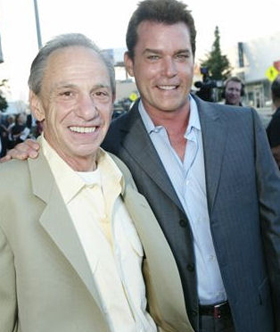
Henry Hill with Goodfellas star Ray Liotta
Finally, Henry Hill has died. He was the “wise guy” who was the inspiration for Martin Scorcese’s “Goodfellas.” Hill was only 69, and died from health problems related to smoking.
Henry Hill, the infamous mob informant whose life of crime was chronicled in the film classic “GoodFellas,” was the first to admit that he did “a lot of bad things back then.”
“I shot at people. I busted a lot of heads, and I buried a lot of bodies,” he told the London-based Daily Telegraph in 2010. “You can try to justify it by saying they deserved it, that they had it coming, but some just got whacked for absolutely no reason at all.”
….
Henry Hill, the infamous mob informant whose life of crime was chronicled in the film classic “GoodFellas,” was the first to admit that he did “a lot of bad things back then.”
“I shot at people. I busted a lot of heads, and I buried a lot of bodies,” he told the London-based Daily Telegraph in 2010. “You can try to justify it by saying they deserved it, that they had it coming, but some just got whacked for absolutely no reason at all.”
RIP, Henry.
Have a fabulous Saturday, and if you’re reading anything interesting today, please share!
Mitt Romney Says We Don’t Need More Firemen, Policemen, or Teachers
Posted: June 8, 2012 Filed under: 2012 presidential campaign, U.S. Economy, U.S. Politics | Tags: Barack Obama, jobs, Mitt Romney, private sector, public employees, public sector, unemployment 34 Comments
This afternoon Mitt Romney was in Council Bluffs, Iowa mocking President Obama for saying at a press conference earlier today that the private sector of the U.S. economy of the U.S. economy:
“The truth of the matter is that, as I said, we’ve created 4.3 million jobs over the last 27 months, over 800,000 just this year alone. The private sector is doing fine. Where we’re seeing weaknesses in our economy have to do with state and local government”
Of course, he shouldn’t have said it that way, but it actually is true that employment in the private sector has improved greatly, and overall unemployment wouldn’t be that bad except for cutbacks in state and local government workers. Here’s the private vs. public employment data, via TPM.
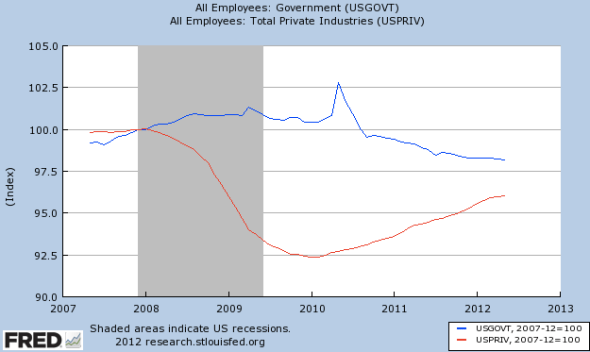
After Republicans crowed loudly about Obama’s “gaffe,” he “clarified” his remarks. Frankly, I would have preferred that he or a staffer had simply shown the above chart and explained what it means.
Here’s what Romney said at his campaign appearance in Council Bluffs, Iowa this afternoon:
“he wants another stimulus, he wants to hire more government workers. He says we need more fireman, more policeman, more teachers. Did he not get the message of Wisconsin? The American people did. It’s time for us to cut back on government and help the American people.”
How could that be the “message of Wisconsin?” Scott Walker exempted police and firefighters from laws banning collective bargaining? Walker at least understood that Americans want people to show up if their homes catch fire. People also want someone to protect them from crime. And certainly most people want teachers to help educate their children.
Romney claims Obama is “out of touch,” but how out of touch do you have to be not to understand the importance to communities of firefighters, police and teachers? Does Romney think these people are not Americans? What exactly is he proposing: that groups of people band together and raise funds to pay for these services outside of government?
Romney “longed” to serve in Vietnam, but took four draft deferments
Posted: June 6, 2012 Filed under: 2012 presidential campaign, Anti-War, U.S. Economy, U.S. Military, U.S. Politics | Tags: draft deferments, Etch-a-Sketch, flip-flopper, Mitt Romney, Mormon church, Vietnam War 20 Comments
Mitt Romney, age 19, demonstrates in favor of the draft at Stanford U., 1966
In his 2012 campaign for the presidency, Mitt Romney has been a strident supporter of every possible use of U.S. military power abroad.
He has said he wouldn’t hesitate to attack Iran in order to prevent them from getting nukes. He even wrote an op-ed about it for the Washington Post.
He has argued for U.S. military intervention in Syria, and has been loudly critical of President Obama’s approach to the Syrian uprisings. He has also criticized Obama’s decision to pull out of Iraq and his strategy in Afghanistan.
Finally, Romney has argued for dramatic increases in defense spending, while at the same time claiming he will cut the federal deficit if elected.
Based on his hawkish policy positions, it seems relevant to ask what Romney did when he was eligible for military service; and the AP recently took a look at Romney’s military service–actually his lack of military service. Not to put too fine a point on it, Romney is a chicken hawk. His (non)military history also shows that his etch-a-sketch behavior began quite early in life.
As you can see in the photo above, Mitt actually participated in a demonstration in favor of the Vietnam-era draft while a student at Stanford. From The Daily Mail, January 6, 2012:
Taken at the height of the swinging Sixties, Mr Romney holds a sign declaring ‘Speak Out, Don’t Sit In’ as, alongside like-minded individuals, he proclaims his support for Lyndon Johnson’s ever-expanding draft….
A newspaper clipping headlined ‘Governor’s son pickets the pickets’ states: ‘Mitt Romney, son of Michigan Gov. George Romney, was one of the pickets who supported the Stanford University administration in opposition to sit-in demonstrators.’
The photograph was taken on May 20, 1966, shortly after a group of students had taken over the office of Stanford University President Wallace Sterling.
They were protesting at the introduction of a test designed to help the authorities decide who was eligible for the draft.
Of course Romney himself could have been drafted in 1966, but he applied for and received a student deferment in the same year he participated in the pro-war demonstration. After one year at Stanford, young Mitt left school to serve as a mormon missionary in France. From MSNBC.com:
Though an early supporter of the Vietnam War, Romney avoided military service at the height of the fighting after high school by seeking and receiving four draft deferments, according to Selective Service records. They included college deferments and a 31-month stretch as a “minister of religion” in France, a classification for Mormon missionaries that the church at the time feared was being overused. The country was cutting troop levels by the time he became eligible for the draft, and his lottery number was not called.
Romney received three more deferments during his missionary service, even though the Mormon church was strongly supportive of the Vietnam war and was limiting the number of deferments it signed off on. Romney got three of them though. Gee, I wonder why?
After his first year at Stanford, Romney qualified for 4-D deferment status as “a minister of religion or divinity student.” It was a status he would hold from July 1966 until February 1969, a period he largely spent in France working as a Mormon missionary.
He was granted the deferment even as some young Mormon men elsewhere were denied that same status, which became increasingly controversial in the late 1960s. The Mormon church, a strong supporter of American involvement in Vietnam, ultimately limited the number of church missionaries allowed to defer their military service using the religious exemption.
Later, a 23-year old Romney had turned against the war he avoided.
“If it wasn’t a political blunder to move into Vietnam, I don’t know what is,” a 23-year-old Romney would tell The Boston Globe in 1970 during the fifth year of his deferment.
His 31-month religious deferment expired in early 1969. And Romney received an academic studies deferment for much of the next two years. He became available for military service at the end of 1970 when his deferments ran out and he could have been drafted. But by that time, America was beginning to slice its troop levels, and Romney’s relatively high lottery number — 300 out of 365 — was not called.
Later, when he ran for the Senate against Ted Kennedy in 1994, Romney was quoted in the Boston Herald as saying:
“I was not planning on signing up for the military”…”It was not my desire to go off and serve in Vietnam, but nor did I take any actions to remove myself from the pool of young men who were eligible for the draft,”
But he in fact had applied for and been granted four deferments–nearly as many as Dick Cheney got.
Mitt’s views on Vietnam continued to “evolve.” During his last run for president in 2007, he the Globe again quoted Romney on Vietnam:
“I was supportive of my country,” Romney said. “I longed in many respects to actually be in Vietnam and be representing our country there, and in some ways it was frustrating not to feel like I was there as part of the troops that were fighting in Vietnam.”
Romney’s views on Vietnam had gone full circle–from enthusiastic pro-war demonstrator, to draft dodger, to vocal critic of U.S. policy, to claiming he never wanted to go to war, but never tried to get out of it, to nostalgia for how much he “longed” to be in Vietnam while he served out his extra-long 4-D deferment.
What a guy!
Tuesday Reads: Wisconsin Recall Madness!
Posted: June 5, 2012 Filed under: 2012 elections, Labor unions, morning reads, Populism, Psychopaths in charge, Reproductive Rights, Republican politics, Right to Work, Tea Party activists, The DNC, the GOP, the villagers, U.S. Economy, U.S. Politics | Tags: Chris Cillizza, grass roots activism, InTrade, John Nichols, Koch Brothers, PPP polling, public employee unions, Rebecca Kleefisch, Scott Walker, Tom Barrett, voter turnout, Wisconsin recall election 65 Comments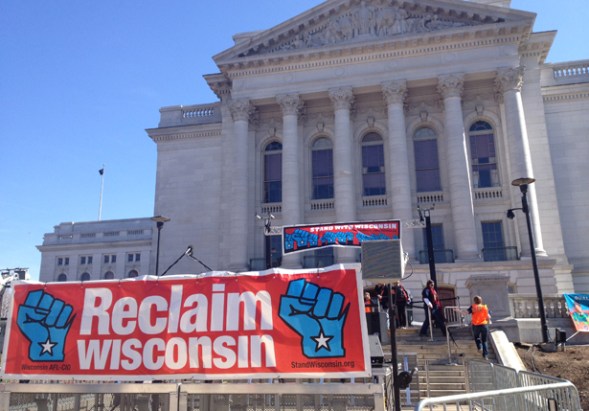
Good Morning!!
Today is the day of reckoning for Wisconsin. Voters will go to the polls today to decide the fate of Governor Scott Walker and five other Wisconsin Republicans: the Lieutenant Governor and four state senators. If the Democrats can win just one of those seats, they will regain the senate majority.
I think everyone here knows the genesis of this recall battle, but here’s a quick explainer from Chris Cillizza at the WaPo. Cillizza also speculates on possible surprising outcomes from the election.
Cillizza allows that Barrett could conceivably win and the Democrats could retake the senate–the latest poll by PPP had Walker leading by only 3 points, within the margin of error. The poll also suggested that Barrett had the momentum as of yesterday. On the other hand, InTrade had Walker’s chances at more than 90% late last night. The truth is no one really knows for sure, because the turnout and enthusiasm on each side will tell the tale. Cillizza, being a Villager, still thinks Walker will win, but thinks the Senate could switch.
When they filed petitions to recall Walker himself last fall, Democrats also filed papers to recall another four state senators — Senate Majority Leader Scott Fitzgerald, and Sens. Pam Galloway, Terry Moulton and Van Wanggaard, (Galloway resigned earlier this year; Republican state Rep. Jerry Petrowski is running for her seat.)
They need only win one race to take control.
Fitzgerald is likely safe given his heavily Republican district, although Lori Compas, his Democratic rival, has attracted a lot of media attention.
But Democrats are bullish on the races against Moulton and Wanggaard. Both districts went for President Obama in 2008; Wanggaard’s went narrowly for John Kerry in 2004. Whether Barrett wins or not, they expect to take back the state Senate.
Moulton faces former state Rep. Kristen Dexter; Wanggaard faces former state Sen. John Lehman (D). Outside groups have spent hundreds of thousands of dollars on both sides. State Rep. Donna Seidel (D) also has a shot at beating Petrowski; before Galloway the seat had gone Democratic for two decades.
Cillizza points out that if Barrett wins and the Democrats take the state senate and could get some of the Walker legislation overturned before another election could give the senate back to the Republicans. The other possibility, Cillizza mentions is that Democrats could defeat Walker’s Lt. Governor Rebecca Kleefisch, but that’s pretty unlikely. She’s leading in the polls at the moment.
The Seattle Times had a good article on Sunday about the national issues that are at stake in the election today.
Under fire for cutting budgets at the expense of public employees, Walker would be the third governor in U.S. history yanked from office in a recall election. Walker has an edge, but the race is close.
The campaign will mean more than who governs Wisconsin. It’s a test case of the larger clashes in American politics that are driving elections for the presidency and control of Congress, highlighting divisions over the costs of government.
With more than $30 million raised from conservative donors, many of them from other states, and visits from a who’s who of high-profile Republican governors (New Jersey’s Chris Christie, South Carolina’s Nikki Haley, Louisiana’s Bobby Jindal and Virginia’s Bob McDonnell), Walker’s campaign to survive the recall has the feel, the money and the stakes of a national race.
The state vote is raising questions that will echo nationwide. Can a tough-minded conservative Republican force cuts in government at the risk of angering public-employees unions and win a swing state such as Wisconsin? Will voters think he’s doing the best he can in a tough time? Or will they rise in a grass-roots backlash against the well-financed Republican effort?
Admittedly, that article has a Republican flavor, but it does do a pretty good job of spelling out the issues. For a more left-wing perspective, here’s a lengthy piece at by Sarah Jaffe of Alternet: Wisconsin’s Recall Drama Down to Nail-Biting Finish.
Wisconsin’s recall is, as reporter John Nichols put it, the kind of “renegade politics” that are disdained by the national Democratic party and even some state Democrats. It is being driven by the same activists who turned out by the thousands to occupy their capitol when Governor Scott Walker attacked workers’ right to organize and bargain collectively.
Now, a day before the biggest recall yet—of Governor Walker, Lieutenant Governor Rebecca Kleefisch, and four Republican state senators—the fight will be won or lost where it began: on the ground.
There’s a lot of big outside money pouring into Wisconsin, mostly to pump up Walker’s attempt to hang on to his seat, but the one thing that money can’t buy is an excited, driven grassroots movement. If Milwaukee mayor Tom Barrett beats Walker on Tuesday, it will be because of thousands of volunteers getting out the vote person by person.
“This is really a case of Walker raising $13 million against possibly the most widespread grassroots get-out-the-vote effort in the state’s history,” Matt Reiter, co-president of the Teaching Assistants’ Association at the University of Wisconsin at Madison, told AlterNet.
Please try to check that one out. It’s long, and very informative. John Nichols of The Nation (mentioned prominently in Jaffe’s piece) is Wisconsin native, and has written a book about the struggle in his home state. Here’s a piece Nichols wrote yesterday: How To Buy A Recall Election.
Governor Scott Walker is not trying to win the Wisconsin recall election that will be held June 5.
He is trying to buy it.
If the embattled governor does prevail, he will provide essential evidence not of his own appeal but of the power of money to define our politics.
On the other hand, if Walker is defeated, a template will have been developed for a people-power, message-power politics that might be able to challenge big money.
And there is no question that what is in play is very big money.
Read the gory details at the link.
At Salon, Josh Eidelson writes about the possible effects of some Wisconsin voters’ “resentment” of union workers on the recall outcome.
If Scott Walker survives tomorrow’s election, there will be plenty of reasons. Many people will point to his huge cash advantage, for good reason. But no factor will have been more important than the decades of decline in U.S. union membership.
“Unions had their place,” a woman named Jerri told me soon after I arrived in Wisconsin last week. “They did their part back in the ‘40s and ‘50s, and then they got too big, and are abusing their power.” Jerri and her husband, Tim (both declined to give last names), were eating at a bar in Wauwatosa, the purple Milwaukee suburb that’s home to Scott Walker. They both work in sales: She’s in retail at the mall; he’s in wholesale, selling caskets. Tim said Walker’s union “reforms” were necessary because local politicians had been “looking out for the union” instead of “people like me.” He said unions are for people who don’t “feel they should have to work very hard.” Jerri complained that unions “are sucking off my teat.” Public workers’ benefits, she said, “should be the same as anybody in any kind of private job.”
That last statement is most telling. While resentment toward unions has grown since the 1950s, it’s not because they got too big. It’s because they got too small. A multi-decade drop in unionization left fewer Wisconsinites who are union members or live in union households. Meanwhile, because governments are less prone than businesses to terrorize workers or shut down facilities to avert unionization, public sector unionization has remained more stable. In 2009, for the first time, there were more total U.S. union members in government employment than in the entire private sector.
That one is pretty scary for those of us who care about quality education and public services.
The Wall Street Journal highlights the importance of turnout in the recall election.
Both sides say few voters remain undecided, after more than $63.5 million in political spending saturated the airwaves and clogged voters’ mailboxes. A weekend survey by the Democratic group Public Policy Polling found Mr. Walker holding a slight lead and only 3% of likely voters undecided. With few voters left to persuade, the main question is which side will win the turnout battle.
Labor groups and their allies knocked on more than 300,000 doors during the past few days and placed more than 400,000 phone calls, said Brian Weeks, the assistant political director for the American Federation of State, County and Municipal Employees union.
Unions historically have had a strong ground game. But Republicans said they took a page from labor’s playbook and have developed a coordinated get-out-the-vote effort, which could also give the party a boost in the November presidential election, helping the GOP equal the Democrats’ election-day machinery.
Felicia Sonmez and Rachel Weiner of the WaPo write about the battle of “TV ad spending vs. boots on the ground.” They say that this election:
serves as a proxy for the national battle between Democrats’ much-touted ground organization and Republicans’ fundraising advantage.
With Walker ahead in the polls and leading Milwaukee Mayor Tom Barrett (D) in the money race by more than 7 to 1 – and with GOP-aligned outside groups far outspending their counterparts across the aisle — Democrats maintain that their shot at victory depends on a far superior get-out-the-vote operation buoyed in large part by organized labor.
According to Monica Davey at the NYT,
About 60 to 65 percent of Wisconsin residents of voting age are expected to go to the polls on Tuesday, the state’s Government Accountability Board said. That would be a higher turnout than two years ago, when Mr. Walker and a wave of Republicans largely swept state and federal offices here, but not as high as the more than 69 percent turnout in 2008, when Barack Obama easily won the state.
Only time will tell. We’ll have a live blog this evening so we can follow the results together. Now I need you to let me know what else is in the news. I look forward to clicking on your links.

 peej
peej Carissa
 bostonboomer
 dakinikat
 ecocatwoman
 jjlo
jjlo mablue2
 Mama Lopez
 peggysue22
 quixote
 skydancingguestblogger
 Mona (aka Wonk the Vote)





Recent Comments