
Thursday Reads: That Sense of Surreality…
Posted: December 12, 2013 Filed under: #Occupy and We are the 99 percent!, Barack Obama, Foreign Affairs, morning reads, Republican politics, Surreality, The Media SUCKS, U.S. Politics, We are so F'd | Tags: Edward Snowden, fake interpreter, Glenn Greenwald, John Kerry, michelle obama, Nelson Mandela funeral, Paypal, Pierre Omidyar, Raul Castro, Sarah Harrison, selfie, Sibel Edmonds, Ukrainian protests, Wikileaks 40 Comments
Good Morning!!
I’m having another one of those mornings. Once again, I woke up with that feeling of surreality–the world can’t be as strange as it seems, can it?
Lots of allegedly intelligent, liberal Americans have been freaking out for months about revelations leaked by Edward Snowden that the NSA spies on foreign countries in order to protect U.S. national security. Snowden and his public relations handler Glenn Greenwald are heroes to these people despite the fact that Greenwald apparently sold Snowden’s remaining secrets to the highest bidder–a libertarian, pro-corporate billionaire named Pierre Omidyar. More on this story later.
None of us likes the idea of being spied upon, but at least the President of the U.S. must be getting the best security money can buy, right?
I’m afraid not. It’s still possible for a person suffering from schizophrenia to get onto a stage filled with world leaders and stand shoulder-to-shoulder with President Obama and wave his arms around in some kind of meaningless pantomime. From this morning’s Boston Globe: Interpreter for Mandela event: I was hallucinating.
JOHANNESBURG (AP) — The man accused of faking sign interpretation next to world leaders at Nelson Mandela’s memorial told a local newspaper that he was hallucinating and hearing voices.
Thamsanqa Jantjie did not describe his qualifications for being a sign language interpreter, but told The Star he works for an interpreting company that paid him $85 for interpreting Tuesday’s event. He told Radio 702 Thursday he’s receiving treatment for schizophrenia and had an episode while on stage.
Watch video of the performance at the link.
ABC News has more detail via AP:
The man accused of faking sign interpretation while standing alongside world leaders like U.S. President Barack Obama at Nelson Mandela’s memorial service said Thursday he hallucinated that angels were entering the stadium, suffers from schizophrenia and has been violent in the past.
Thamsanqa Jantjie said in a 45-minute interview with The Associated Press that his hallucinations began while he was interpreting and that he tried not to panic because there were “armed policemen around me.” He added that he was once hospitalized in a mental health facility for more than one year.
Jatjie knew he had to do his best to act normal, so he waved his arms around and pretended to be interpreting the speeches of numerous world leaders, including Obama.
“What happened that day, I see angels come to the stadium … I start realizing that the problem is here. And the problem, I don’t know the attack of this problem, how will it comes. Sometimes I react violent on that place. Sometimes I will see things that chase me,” Jantjie said.
“I was in a very difficult position,” he added. “And remember those people, the president and everyone, they were armed, there was armed police around me. If I start panicking I’ll start being a problem. I have to deal with this in a manner so that I mustn’t embarrass my country.”
Asked how often he had become violent, he said “a lot” while declining to provide details.
So exactly who hired Jantjie? It’s a mystery. BBC News reports: Owners of Mandela ‘fake’ interpreter firm ‘vanish’ The BBC is also using a different spelling for the schizophrenic interpreter’s name.
Hendrietta Bogopane-Zulu apologised to the deaf community for the poor quality of interpretation given by Thamsanqa Dyantyi from SA Interpreters.
“He is Xhosa speaking. The English was a bit too much for him,” she said.
What is this man’s real name? I don’t know, but–get this–Bogopane-Zulu “did not rule out hiring him again”!
During a press conference, Ms Bogopane-Zulu, the deputy minister for women, children and people with disabilities, admitted that a mistake had been made but said there was no reason for the country to be embarrassed.
“There are as many as a hundred sign language dialects,” she said, to explain the difficulties he faced.
“He started well and later he became tired. Guidelines say we must switch interpreters every 20 minutes.”
She did not rule out employing him in some circumstances again.
Except the company she hired him through has “vanished into thin air.” And why didn’t they switch to other interpreters? The article doesn’t say, but it does say the man has interpreted at important events in the past.
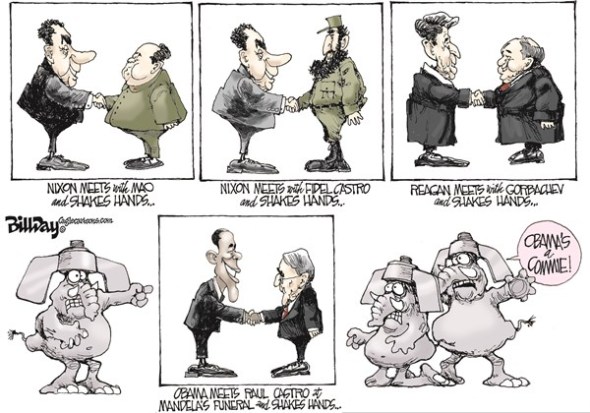
And then there’s the Republican outrage over Obama shaking hands with Raul Castro at Mandela’s funeral. WTF? From Time: Here’s 14 People Freaking Out On Twitter After Barack Obama and Raul Castro Shook Hands. What was Obama supposed to do–slap Castro across the face with a glove and challenge him to a duel? (Actually some of the tweeters were being sarcastic and Time apparently missed the point.) I think cartoonist Bill Day had the best response.
Seeing Red
And then there was the media freakout over Obama taking a “selfie” during Mandela’s funeral. Reliable Sources at the WaPo has the lowdown.
Was Michelle Obama annoyed when her husband took that selfie at Nelson Mandela’s memorial service? Roberto Schmidt, the Agence France-Presse photographer who snapped the photo of the president, British Prime Minister David Cameron and Danish Prime Minister Helle Thorning Schmidt, says no.
“I later read on social media that Michelle Obama seemed to be rather peeved on seeing the Danish prime minister take the picture,” Schmidt wrote on AFP’s blog. “But photos can lie. In reality, just a few seconds earlier the first lady was herself joking with those around her, Cameron and Schmidt included. Her stern look was captured by chance.”
The photo, which immediately became an Internet sensation, is only one piece of the day’s story; the leaders had a variety of expressions during the service and were acting “like human beings, like me and you,” he wrote. “I doubt anyone could have remained totally stony faced for the duration of the ceremony, while tens of thousands of people were celebrating in the stadium.”
But none of that matters, because the corporate media has decided that whatever Obama does must be harshly criticized. CNN even brought on Donald Trump to opine about Obama’s perceived gaffes, unemployment, and Obamacare. If that isn’t surreal, what is?
Here’s more strangeness: Secretary of State John Kerry expressed “disgust” at the government of Ukraine for cracking down on protesters. Here’s the official statement:
The United States expresses its disgust with the decision of Ukrainian authorities to meet the peaceful protest in Kyiv’s Maidan Square with riot police, bulldozers, and batons, rather than with respect for democratic rights and human dignity. This response is neither acceptable nor does it befit a democracy.
Last week in Brussels and Moldova, I underscored publicly the importance of all sides avoiding violence and called on President Yanukovych to fulfill the aspirations of the Ukranian people. We put the government on notice about our concern.
As Vice President Biden made clear to President Yanukovych during their phone call yesterday, respect for democratic principles, including freedom of assembly, is fundamental to the United States’ approach to Ukraine. This is a universal value not just an American one. For weeks, we have called on President Yanukovych and his government to listen to the voices of his people who want peace, justice and a European future. Instead, Ukraine’s leaders appear tonight to have made a very different choice.
We call for utmost restraint. Human life must be protected. Ukrainian authorities bear full responsibility for the security of the Ukrainian people.
As church bells ring tonight amidst the smoke in the streets of Kyiv, the United States stands with the people of Ukraine. They deserve better.
Has Kerry forgotten how peaceful “Occupy” protesters were treated in the streets of multiple U.S. cities just a couple of years ago? Some reports on the crackdowns (from foreign sources):
The Guardian: Police crack down on ‘Occupy Wall Street’ protests.
AlJazeera: Fierce crackdown on ‘Occupy Oakland’ protest
Getting back to the Greenwald-Snowden-Omidyar story, the attacks on Greenwald have moved from the usual critics to previous members of the Greenwald-Snowden cheering section. First Sarah Harrison–who accompanied Snowden from Hong Kong to Russia and then stayed with him for months gave an interview on the subject to a German newspaper. The Guardian reports, WikiLeaks’ Sarah Harrison: ‘How can you take Pierre Omidyar seriously?’
The WikiLeaks staffer and Snowden collaborator Sarah Harrison has criticised Pierre Omidyar, the eBay founder who is setting up a new journalism venture with Glenn Greenwald, Laura Poitras and Jeremy Scahill, for his involvement in the 2010 financial blockade against WikiLeaks.
In her first interview since leaving Moscow for Berlin last month, Harrison told German news weekly Stern: “How can you take something seriously when the person behind this platform went along with the financial boycott against WikiLeaks?”
Harrison was referring to the decision in December 2010 by PayPal, which is owned by eBay, to suspend WikiLeaks’ donation account and freeze its assets after pressure from the US government. The company’s boycott, combined with similar action taken by Visa and Mastercard, left WikiLeaks facing a funding crisis.
As for Greenwald’s decision to sell out to Omidyar,
Referring to Omidyar’s plans to set up a new media organisation, in which the former Guardian writer Greenwald – who wrote a number of stories from the Snowden revelations – will play a central part, Harrison said: “If you set up a new media organisation which claims to do everything for press freedom, but you are part of a blockade against another media organisation, then that’s hard for us to take it seriously. But I hope that they stick to their promises”.
Next, Greenwald was hit with an even harsher attack on his journalistic ethics by former FBI whistleblower Sibel Edmonds: Checkbook Journalism & Leaking to the Highest Bidders. It’s a pretty powerful critique.
A government whistleblower obtains over 50,000 pages of documents that implicate the government in severely illegal and unconstitutional practices. This whistleblower risks everything, including fleeing the country, in order to leak these documents and let the public know how its government has been breaking the nation’s laws and violating their rights. So he goes to another country and then entrusts all this evidence to a few reporters and wanna-be journalists. Why does he do that? He does it so that these reporters will present all this information to the public: not only those in the United States, but everyone all over the world. Think about it. Why else would someone risk everything, including his own life, to obtain and leak such documents? Are you thinking? Because what would be the point to all this, to taking all these risks, if 99% of these documents remain secret and hidden from the public? Ludicrous, right?
Now, here is what happens next: The whistleblower hands over these documents, and goes through a surreal escape journey. So surreal that even Hollywood could not have matched it. Of the handful of reporters who were entrusted with 50,000 documents, a few do nothing. By that I mean absolutely nothing. A couple from this entrusted group does a little bit more. They meet with a few mainstream media outlets, they spend many hours around the table with their mega companies’ mega attorneys and U.S. government mega representatives (the same government that is implicated in these documents).
Edmonds notes that Guardian editor Alan Rusbridger has admitted that only 1% of the Snowden material has been published.
The main wanna-be reporter begins his relentless pursuit of high dollars in return for … for what? In return for exclusive interviews where he would discuss some of this material. In return for a very lucrative book deal where he would expose a few extra pages of these 50,000-page documents. In return for a partnership with and extremely high salary from a Mega Corporation (think 1%) where he would … hmmmm, well, it is not very clear: maybe in return for sitting on and never releasing some of these documents, or, releasing a few select pages?
That’s right. The culprit is able to use his role in the whistleblower case, and his de facto ownership of the whistleblower’s 50,000-page evidence, to gain huge sums of money, fame, a mega corporate position, book and movie deals … yet, making sure that the public would never see more than a few percent of the incriminating evidence.
There’s much more scathing commentary at the link to Edmonds’ blog. Of course, Greenwald used his twitter timeline to call Edmonds “stupid,” and at the same time failed to respond to any of her criticisms. Of course Glenn had already had a bad day after Time chose the Pope as “Person of the Year” instead of Snowden.
So those are some of the stories that gave me that feeling of surreality this morning. What are you hearing and reading today? Please post your links in the comment thread, and enjoy your Thursday!
Saturday Reads
Posted: December 7, 2013 Filed under: Barack Obama, Foreign Affairs, morning reads, Republican politics, U.S. Politics | Tags: chronic brain injury, crime, Eric Cantor, FDR, immigration laws, James Downing, Merrill Newman, Nelson Mandela, North Korea, Onyango Obama, Pearl Harbor, Poverty, Richard Pena, Rick Santorum, Toxoplasmosis gondii, weather, winter storm Cleon, winter storm Dion 41 Comments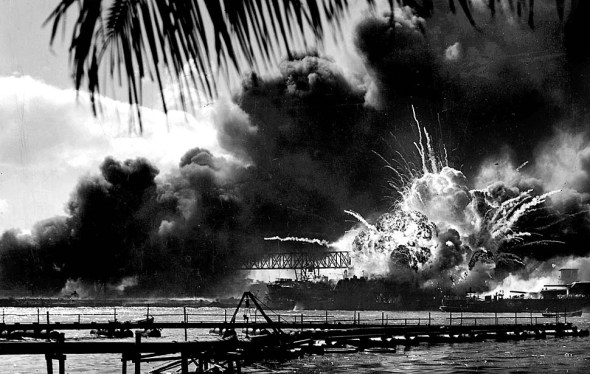
Dec. 7, 1941: The destroyer Shaw’s forward magazine explodes after being struck during the Japanese attack on Pearl Harbor (LA Times).
Good Morning!!
Today is Pearl Harbor Day, “a date which will live in infamy,” December 7, 1941. From the LA Times:
An Associated Press story on the Dec. 8, 1941, front page of the Los Angeles Times reported:
Japan assaulted every main United States and British possession in the Central and Western Pacific and invaded Thailand today (Monday) in a hasty but evidently shrewdly-planned prosecution of a war began Sunday without warning.
Her formal declaration of war against both the United States and Britain came 2 hours and 55 minutes after Japanese planes spread death and terrific destruction in Honolulu and Pearl Harbor at 7:35 a.m. Hawaiian time (10:05 a.m., P.S.T.) Sunday.
The claimed successes for the fell swoop included sinking of the United States battleship West Virginia and setting afire of the battleship Oklahoma.
On Dec. 8, 1941, President Franklin Delano Roosevelt started his famous speech:
Mr. Vice President, Mr. Speaker, members of the Senate and the House of Representatives: Yesterday, Dec. 7th, 1941 — a date which will live in infamy — the United States of America was suddenly and deliberately attacked by naval and air forces of the Empire of Japan.
Within an hour, Congress passed a declaration of war against Japan, bringing the United States into World War II. On Dec. 11, Germany and Italy declared war on the United States.
There are more dramatic photos at the link. There aren’t many survivors of that day left, but at least two of them talked to news outlets yesterday. From the Denver Post:
COLORADO SPRINGS — No one asked Navy Lt. James Downing to hurriedly memorize the names on the dog tags of the dead and injured during the attack on Pearl Harbor.
But Downing, then 28, did it because he could not bear the thought of families not knowing the fate of their loved ones. He wrote to as many families as he could.
The Colorado Springs resident, who celebrated his 100th birthday in August, is the oldest known survivor of the Dec. 7, 1941, Japanese sneak attack that killed more than 2,400 Americans .
Downing fought to save lives that day, all the while wondering whether it was the day his own life would end.
Downing was a gunner’s mate 1st class and postmaster, assigned to the USS West Virginia. The battleship had just returned to base after more than a week on patrol.His wife of five months, Morena, was cooking Sunday morning breakfast for a few servicemen in the couple’s home near the harbor when they heard explosions in the distance, Downing said.
“Then an anti-aircraft shell landed right outside and blew a crater about 25 feet across,” Downing said, illustrating with outstretched arms.
In those days, there was no way for survivors to let their families know they were okay–it took until Christmas for some to be able to to contact loved ones. Another Pearl Harbor survivor, Richard Pena, spoke to Huffington Post.
It was life and business as usual for Navy veteran Richard Pena until the bombs dropped on Pearl Harbor just before 8 a.m. on December 7, 1941.
Pena was eating breakfast and was about to head out for his morning duty as quartermaster to raise the flag when the attack started, he told HuffPost Live. As far as he recalls, the flags never went up that day, Pena said.
Before the attack, Pena said he and his fellow officers were living “the good life” stationed in Hawaii. Coming from San Antonio, Texas, it was his first time away from home.
“In the blinking of an eye, a split second, your life is turned topsy-turvy,” Pena reminisced. “It’s hard to describe what you’re feeling. People tell you you’ve trained for this all the time, but you didn’t know that it was going to happen the way it did.”
Back in December 2013, much of the country is dealing with stormy weather. CNN reports: Power outages, travel nightmare — and snow in Vegas?
More sleet and subfreezing temperatures are predicted to hit areas from Dallas to Memphis until Sunday, and Little Rock, Arkansas, until Monday.
The nation’s capital will not be spared from the cold either. Snow or sleet is forecast for Washington on Sunday.
In the central Appalachians through central New England, snow is expected into early Saturday morning, the National Weather Service said.
In addition to the plummeting temperatures, the drastic swings were startling. Hot Springs, Arkansas, experienced a record high of 75 on Wednesday. By Friday, it was in the middle of an ice storm.
The Dallas/Fort Worth area is among the hardest hit. It will have a high of 27 degrees Saturday, a day after the Dallas/Fort Worth International Airport canceled almost 700 flights, about 80% of those scheduled.
And, yes, Las Vegas will be in the 20’s over the weekend.
The bad weather across the South and Midwest came from winter storm Cleon. Out in the Northwest, winter storm Dion is gearing up to rush across the country, impacting the south and moving up into the Northeast. You can get live updates on Dion here. For once, eastern New England could be one of the least affected areas. We got some freezing rain last night and the streets are slippery this morning, but it’s no big deal. The only other impact on us will probably be some sleet and freezing rain on Monday morning. I’m really feeling for those of you who are suffering from these storms. Trust me, I know what you’re going through! Here are some of the records that have been set around the the country:
- Denver: Record low of -13 degrees on Wednesday beat the old record of -5 degrees set in 2008. Thursday’s low of -15 tied the daily record. Denver dropped to -13 degrees on Saturday morning, tying another record low.
- Ely, Nev.: Record low of -17 degrees on Wednesday crushed the old record of -5 degrees.
- Great Falls, Mont.: Record low of on Wednesday topped the old record of 22 degrees below zero.
- Casper, Wyo.: Record low of -22 degrees on Wednesday beat the old record of -11 degrees set in 1972.
- Medford, Ore: Record low of 18 degrees on Wednesday and a record low of 14 on Thursday. According to the National Weather Service, this is the coldest air mass in the city since 1998.
- Portland, Ore. and Astoria, Ore.: Three straight days with daily record lows through Tuesday through Thursday.
- Spokane, Wash.: Saw its first high in the teens since Feb. 26, 2011 on Thursday.
- Glasgow, Mont.: Recorded its first subzero high temperature since Jan. 18, 2012 on Thursday.
- Great Falls, Mont.: Low of -33 degrees on Saturday was the coldest temperature recorded so early in the season. Previous record was Dec. 8, 1972 (-36 degrees).
Some good news: North Korea has released (they say “deported”) 85-year old Korean war veteran Merrill Newman after holding him prisoner for more than a month and forcing him to “apologize.” The Independent reports:
North Korea has deported an elderly US tourist and Korean War veteran detained since October for alleged hostile acts against the country.
The country’s official state news agency Korean Central News Agency (KCNA) said Merrill Newman has been expelled on “humanitarian grounds” because of his age and health after he “confessed” to crimes during the 1950-53 war and apologised.
The 85-year-old flew to China this morning where he boarded a flight to San Francisco. Speaking to Japanese reporters at Beijing airport, he said: “I’m very glad to be on my way home. And I appreciate the tolerance the DPRK government has given to me to be on my way. I feel good, I feel good. I want to go home to see my wife.”
[Newman] has been in detention since being taken off a plane on October 26 by North Korean authorities following a 10-day tour of the country. KCNA claimed that Merrill had ordered the deaths of North Korean civilians and soldiers during the war. His family say he was a victim of mistaken identity.
I have some more new and some longer reads for you, which I’ll list link dump style.
MassLive: President Obama’s uncle, Onyango Obama, to face deportation hearing in Boston.
According to a court docket, the case will be heard by Immigration Judge Leonard Shapiro on Tuesday afternoon in Boston Immigration Court at the John F. Kennedy Federal Building.
Onyango Obama is the president’s father’s half brother.
A judge issued a deportation order against Onyango Obama, who is from Kenya, in 1992. But Obama never left the country. The Boston Globe reported that Obama was working as a liquor store manager when the Framingham Police arrested him for drunk driving in August 2011. He was sentenced to probation in that case, and the charges brought renewed attention to his immigration status.
The Globe reported that Obama has been living in the United States since 1963, when he came to enroll in school here as a 17-year-old. He was first ordered deported in 1986, although appeals continued in that case for six years.
For Pete’s sake, why can’t they just let the poor guy stay in the US? He’s been here for 50 years! Meanwhile, President Obama acknowledged that he lived with his uncle briefly in the 1980s. It had been thought that the two had never met, but no one bothered to ask the President directly about it until now.
New research on Toxoplasmosis gondii, the parasite associated with cat litter boxes, undercooked meat, and other sources, shows that it can have some positive effects on the brain.
New neuroscience research says that Toxo—the cysts in our brains from cats—can improve our self-control. For the 30 percent of people who have this infection, it’s about more than promiscuity, schizophrenia, and car crashes.
I’ll let you read the details at the link if you so desire. I decided not to read about it, since there’s nothing I can do if I have it…
This article in the Atlantic is from September, and it’s long; but I highly recommend it if you like human interest stories and/or true crime tales. Murder by Craigslist: A serial killer finds a newly vulnerable class of victims: white, working-class men. Fascinating and surprising reading–I highly recommend it.
From Technology Review: Identifying Signs of Chronic Brain Injury in Living Football Players
Eight former pro football players learned this year that they have signs of a degenerative brain disorder called chronic traumatic encephalopathy (CTE), a condition linked to depression, dementia, and memory loss. These somber findings were uncovered using a new method of brain imaging that, for the first time, enables researchers to spot signs of the condition in the living brain. Previously CTE could only be identified after a victim died.
The new method could help quantify the risks of repetitive blows to the head (see “Images of a Hard-Hitting Disease” and “Military Brains Donated for Trauma Research”). It could also help future players avoid the degenerative and sometimes lethal condition by limiting their exposure, and it may help scientists develop better protective gear and treatments.
Two interesting reads from Alternet:
20 Things the Poor Do Everyday That the Rich Never Have to Worry About
This one partially explains why I’m so down on Glenn Greenwald: Why Atheist Libertarians Are Part of America’s 1 Percent Problem
This morning’s stupid right winger stories:
Rick Santorum: Nelson Mandela Fought ‘Great Injustice,’ Just Like Republicans Are Battling Obamacare
Eric Cantor Calls the Police on Children Who Were Singing In His Office
House Majority Leader Brushes Off Young Girl As She Asks Him To Help Her Undocumented Father
The Right Wing’s Campaign To Discredit And Undermine Mandela, In One Timeline
Those are my offerings for today. What stories are you following? Please let us know in the comment thread, and if you are in the path of Cleon and/or Dion, please stay safe and warm and update us on your situations if you can.
Thursday Reads: Human Evolution, Snowden Leaks, and Other News
Posted: December 5, 2013 Filed under: Foreign Affairs, Great Britain, morning reads, Newt Gingrich, NSA, National Security Agency, The Media SUCKS, U.S. Politics, War on Women | Tags: Alan Rusberger, Barton Gellman, cell phones and privacy, David Miranda, Denisovans, DNA, Edward Snowden, Glenn Greenwald, human evolution, Laura Poitras, Louise Mensch, Mark Ames, Neanderthals, science, Sima de los Huesos 15 Comments
Good Morning!!
I seem to have caught a little cold, nothing serious; but I’m a little slow this morning. Anyway, I have a few interesting stories for you, beginning with an amazing discovery that has stunned scientists and forced them to adjust their assumptions about human evolution. From the NYT: Baffling 400,000-Year-Old Clue to Human Origins.
In a paper in the journal Nature, scientists reported Wednesday that they had retrieved ancient human DNA from a fossil dating back about 400,000 years, shattering the previous record of 100,000 years.
The fossil, a thigh bone found in Spain, had previously seemed to many experts to belong to a forerunner of Neanderthals. But its DNA tells a very different story. It most closely resembles DNA from an enigmatic lineage of humans known as Denisovans. Until now, Denisovans were known only from DNA retrieved from 80,000-year-old remains in Siberia, 4,000 miles east of where the new DNA was found.
The mismatch between the anatomical and genetic evidence surprised the scientists, who are now rethinking human evolution over the past few hundred thousand years. It is possible, for example, that there are many extinct human populations that scientists have yet to discover. They might have interbred, swapping DNA. Scientists hope that further studies of extremely ancient human DNA will clarify the mystery.
Now the experts are going to have to find a way to incorporate these new discoveries into their understanding of human history. The story offers several different possibilities from different scientists.
Hints at new hidden complexities in the human story came from a 400,000-year-old femur found in a cave in Spain called Sima de los Huesos (“the pit of bones” in Spanish). The scientific team used new methods to extract the ancient DNA from the fossil….
Since the 1970s, Spanish scientists have brought out a wealth of fossils from the cave dating back hundreds of thousands of years. “The place is very special,” said Dr. Arsuaga, who has found 28 nearly complete skeletons of humans during three decades of excavations.
Based on the anatomy of the fossils, Dr. Arsuaga has argued that they belonged to ancestors of Neanderthals, which lived in western Asia and Europe from about 200,000 to 30,000 years ago.
But based on newly discovered methods for extracting DNA, researchers learned something very different. Read the rest of this fascination story at the NYT link above.
Yesterday the Washington Post published a new story by Barton Gellman, based on the data stolen from the NSA by Edward Snowden: NSA tracking cellphone locations worldwide, Snowden documents show. Except if you read the whole story you’ll learn that this is being done only to collect foreign intelligence; it’s not being done in the U.S. Data from Americans who are overseas could get caught up in the data collection, but the point is to track the locations of suspected terrorists.
The NSA does not target Americans’ location data by design, but the agency acquires a substantial amount of information on the whereabouts of domestic cellphones “incidentally,” a legal term that connotes a foreseeable but not deliberate result.
One senior collection manager, speaking on the condition of anonymity but with permission from the NSA, said “we are getting vast volumes” of location data from around the world by tapping into the cables that connect mobile networks globally and that serve U.S. cellphones as well as foreign ones. Additionally, data are often collected from the tens of millions of Americans who travel abroad with their cellphones every year.
In scale, scope and potential impact on privacy, the efforts to collect and analyze location data may be unsurpassed among the NSA surveillance programs that have been disclosed since June. Analysts can find cellphones anywhere in the world, retrace their movements and expose hidden relationships among the people using them.
Honestly, is anyone really surprised by this? I’m not saying it’s a wonderful thing, but, as I recall, tracing cell phone locations was the method used to catch Osama bin Laden. Not only that, but local police in the U.S. routinely use cell phone tracking to investigate crimes–and like the Feds, they have to get warrants to do so.
Anyone who didn’t know that you have no expectation of privacy when using a cell phone must have been living in a cave for a very long time. But if you really think the NSA is listening in on all of your personal phone calls and reading your text messages, you’re–quite frankly–nuts. The NSA would have to have millions of employees in order to sift through everyone’s data.
Robert Litt, general counsel for the Office of the Director of National Intelligence, which oversees the NSA, said “there is no element of the intelligence community that under any authority is intentionally collecting bulk cellphone location information about cellphones in the United States.”
The NSA has no reason to suspect that the movements of the overwhelming majority of cellphone users would be relevant to national security. Rather, it collects locations in bulk because its most powerful analytic tools — known collectively as CO-TRAVELER — allow it to look for unknown associates of known intelligence targets by tracking people whose movements intersect.
As noted in the article, data collected from Americans overseas isn’t protected by the Fourth Amendment; and the Supreme Court decided long ago that telephone call data is owned by the phone companies and that Americans have no expectation of privacy when talking on the phone. If we want to increase privacy protections, it will have to be done through legislation–not by whining about the NSA doing it’s job, which is to collect foreign intelligence. (A side note: a short time ago, former NSA analyst John Schindler offered some suggestions for “Reforming NSA from the Top.”) I wish journalists would devote as much energy to investigating why millions of Americans can’t get jobs and why so many of the ones who do have jobs can’t get paid a living wage as they do to telling us things we already knew or strongly suspected about NSA data collection.
Meanwhile, there are some troubling questions and revelations about some of the journalists who have been involved in releasing the Snowden files. As everyone knows by now, Glenn Greenwald and Laura Poitras now have control of all of the data that Snowden stole. This data includes the names of all British and American intelligence agents. Greenwald and Poitras are currently working on developing a new news website, a project backed by libertarian Ebay billionaire Pierre Omidyar. Here’s an extensive profile of Omidyar by renegade investigative journalist MarkAmes.
Recently, Ames wrote another piece at Pando Daily questioning the ethics of Snowden’s cache of NSA data being controlled by two individuals who are beholden to one wealthy backer headlined Keeping Secrets: Pierre Omidyar, Glenn Greenwald and the privatization of Snowden’s leaks.
Who “owns” the NSA secrets leaked by Edward Snowden to reporters Glenn Greenwald and Laura Poitras?
Given that eBay founder Pierre Omidyar just invested a quarter of a billion dollars to
personally hire Greenwald and Poitras for his new for-profit media venture, it’s a question worth asking.It’s especially worth asking since it became clear that Greenwald and Poitras are now the only two people with full access to the complete cache of NSA files, which are said to number anywhere from 50,000 to as many as 200,000 files. That’s right: Snowden doesn’t have the files any more, the Guardian doesn’t have them, the Washington Post doesn’t have them… just Glenn and Laura at the for-profit journalism company created by the founder of eBay.
Edward Snowden has popularly been compared to major whistleblowers such as Daniel Ellsberg,Chelsea Manning and Jeffrey Wigand. However, there is an important difference in the Snowden files that has so far gone largely unnoticed. Whistleblowing has traditionally served the public interest. In this case, it is about to serve the interests of a billionaire starting a for-profit media business venture. This is truly unprecedented. Never before has such a vast trove of public secrets been sold wholesale to a single billionaire as the foundation of a for-profit company.
I didn’t realize this until yesterday, but apparently Greenwald did not have the data on British intelligence originally; but he somehow forced the Guardian to turn it over to him before he resign from the newspaper. This may be the data that Greenwald’s husband David Miranda was caught with at Heathrow airport when he was detained there awhile back. The British Parliament is currently investigating the behavior of the Guardian and its editor Alan Rusberger. From the blog of BBC journalist Louise Mensch: Rusbridger admits shipping agents’ names – what now?
MPs today got Alan Rusbridger to admit a number of things he, and his paper had previously denied.
Firstly, that he shipped the names of GCHQ agents abroad to newspapers and bloggers. Mr. Rusbridger was reminded that this was a criminal offence, and said he had a public interest defence. He also, however, kept arguing that he hadn’t published any names, which rather blows up his public interest defence – it’s self-evident that you don’t need the names of intelligence agents to report on GCHQ spying, so why not redact them?
The fact is, Rusbridger did acknowledge that it put GCHQ agents at risk when he first shipped files to ProPublica. He redacted the names of GCHQ agents from those files, and he promised the government he had done so….
In Parliament today when asked why he didn’t redact the names he said there were 58,000 documents – essentially, he could be bothered to go through the <100 files he FedExed to ProPublica, but could not be bothered to go through the entire batch he sent to the NYT.
Really? He couldn’t take a week, and black out agents’ names? There were copies of the docs in the Guardian offices in New York, so time was not an issue for Rusbridger – instead, he exposed the names.
Perhaps worst of all, Rusbridger confirmed my very worst suspicions, which were that he hadn’t even read through the top secret files before shipping them. He redacted no names; he redacted no operational details; he didn’t even read them. And by “he” I mean any employee of the Guardian. Nobody at that paper read the 58,000 documents through, not even once, before sharing them in bulk.
Mensch updated that post with more information yesterday: HAS Rusbridger exposed thousands of GCHQ personnel? A commenter on the original post explained that in revealing the names of intelligence personnel to multiple people, Rusberger and the Guardian essentially destroyed their careers and seriously damaged British intelligence efforts. Here’s the comment:
A comment was left on that last blog that I have to reproduce. It shows that every agent exposed by Rusbridger has had their career ruined for the duration of it; none of them can ever work in the field again. Furthermore, the writer makes the compelling case that the NSA-GCHQ wiki, which the New York Times published extracts from, and the directories of staff interests like gay and lesbian clubs, ghost hunting clubs etc, mean that Rusbridger has actually sent abroad not just a handful of names, as he claimed to Parliament “there were names on power points” but actually thousands of GCHQ names.
Read the whole explanation at the link. I apologize for writing this before I nail down every detail, but I think this is important and it’s highly unlikely the corporate media will look into it since they could also culpable.
I’m afraid I rambled on too long on the NSA story, so I’ll just add a few more links that you might like to check out.
Raw Story: Debbie Wasserman Schultz schools Newt Gingrich over ‘war on women’ crack about Joe Biden
Bloomberg: That’s Gonna Hurt: Bankers Brace for the Volcker Rule
AP via Business Insider: A Period Of Bitterly Cold Temperatures Not Seen In A Decade Is About To Hit Parts Of The US
JM Ashby at The Daily Banter: Their Kind of Individual Mandate
Politicus USA: CNN Throws In the Towel as it Schedules Hour-Long Glenn Beck Interview
Now it’s your turn. What stories are you focusing on this morning? Please share your links in the comment thread.
Tuesday Reads: Are Things Really As Bad As I Think?
Posted: December 3, 2013 Filed under: Barack Obama, George W. Bush, Health care reform, immigration, income inequality, morning reads, Political Affective Disorder, Politics as Usual, poverty, Psychopaths in charge, Real Life Horror, Surreality, The Media SUCKS, U.S. Economy, U.S. Politics, We are so F'd, Women's Rights | Tags: Amazon drones, gun violence, No Child Left Behind, Obamacare, PISA test scores, public education, Racism 44 Comments
Good Morning!!
I don’t even know where to begin this morning. I wish I could write a coherent diatribe like the one Dakinikat wrote yesterday, but I can’t do it. I have a sense that things are very wrong, but I can’t explain the feeling in any rational way.
As we head into the holiday season, I feel as if the country is leaderless. The public focus of the Obama administration and the media is on the glitches in a website; and yet in the background are terrible problems that are building and growing more and more intractable as our political “leadership” fiddles with nonsensical issues like Obamacare and Benghazi.
As Dakinikat noted yesterday, there is a problem of growing poverty and income inequality become institutionalized and normalized. There is the issue of gun violence and our total failure to respond to it with any kind of rational regulations on guns. There is the devolution of education in the U.S., and of course there is the continuing attack on women’s autonomy and Democratic politicians seeming willingness to use women’s bodies as bargaining chips. Finally there are the already institutionalized problems of racism and hatred of immigrants. What have I missed?
As our real problem grow, it seems the American political and media classes, either don’t notice because as part of the wealthy 1% they simply aren’t affected, or because they’ve got theirs and they just don’t care about the mass of people who are struggling to survive in a poisonous system. And because of the obsessive focus on the end-of-year holidays, nothing will happen in Washington until we hit the next debt limit and our “leaders” mobilize briefly to kick the can of our economic and social problems down the road once again and so they can return to their focus on minutiae.
Is there any solution to the political and economic stagnation we find ourselves in? Is the situation really as surreal as it feels to me on this Tuesday morning? Am I nuts?
Anyway, here a some of the stories leading the news at the moment.
Jeff Bezos tells Amazon customers to expect home delivery by drones. NBC News reports:
Amazon.com hopes to deliver small packages to your home in just 30 minutes by unmanned drones within five years, chief executive Jeff Bezos said Sunday.
In an interview on CBS’s “60 Minutes,” Bezos was actually less optimistic than what his company said in its online announcement, which declared that tiny robot aircraft could be landing on front porches as soon as 2015.
Bezos said Amazon already had the technology in place and had even flown a working prototype, which he showed off in a video the company published Sunday:
He promised “half-hour delivery, and we can carry objects, we think, up to five pounds, which covers 86 percent of the items that we deliver.”
The rest of the work, Bezos said, is in quality control and getting the plan OK’d by the Federal Aviation Administration — something technology experts said was unlikely on Bezos’ time frame.
So basically, this is just a silly idea that has no chance of actually happening anytime soon. But the media sees it as more urgent than poverty, income inequality, and people getting killed with guns day in and day out.
From the Washington Post: U.S. students lag around average on international science, math and reading test.
Scores in math, reading and science posted by 15-year-olds in the United States were flat while their counterparts elsewhere — particularly in Shanghai, Singapore and other Asian provinces or countries — soared ahead, according to results of a well-regarded international exam released Tuesday.
While U.S. teenagers scored slightly above average in reading, their scores were average in science and below average in math, compared to 64 other countries and economies that participated in the 2012 Program for International Student Assessment, or PISA, which was administered last fall. That pattern has not changed much since PISA was first administered in 2000.
Gee, I wonder why this is happening? It seems like something that should concern our “leaders.”
The test scores offer fresh evidence for those who argue that the United States is losing ground to competitors in the global market and others who say a decade’s worth of school reform has done little to improve educational outcomes.
“While the intentions may have been good, a decade of top-down, test-based schooling created by No Child Left Behind and Race to the Top — focused on hyper-testing students, sanctioning teachers and closing schools — has failed to improve the quality of American public education,” Randi Weingarten, president of the American Federation of Teachers, said in a statement. The AFT released a video on Monday in which it implored the public not to blame teachers, the unions, parents or students for poor PISA results.
But were intentions really good? Check out these years-old headlines on profiteers (including the Bush family) who cleaned up after passage of the Orwellianly titled “No Child Left Behind” law was passed.
Bush Profiteers Collect Billions from No Child Left Behind (Project Censored: The News That Didn’t Make The News, March 30, 2007)
Bush’s Family Profits From `No Child’ Act (LA Times, Oct. 22, 2006)
No Bush Left Behind (Bloomerg Businessweek, Oct. 15, 2006)
There are plenty more headlines where those came from.
And yet, nearly a decade later, we’re stuck with that awful law and the damage it has done to our public education system. Why have Democrats done nothing to reverse it? Most likely because they too profit from the continuing privatization of education.
What about the latest media narrative on Obama care?
From the Washington Post: Health-care enrollment on Web plagued by bugs:
The enrollment records for a significant portion of the Americans who have chosen health plans through the online federal insurance marketplace contain errors — generated by the computer system — that mean they might not get the coverage they’re expecting next month.
The errors cumulatively have affected roughly one-third of the people who have signed up for health plans since Oct. 1, according to two government and health-care industry officials. The White House disputed the figure but declined to provide its own.
The mistakes include failure to notify insurers about new customers, duplicate enrollments or cancellation notices for the same person, incorrect information about family members, and mistakes involving federal subsidies. The errors have been accumulating since HealthCare.gov opened two months ago, even as the Obama administration has been working to make it easier for consumers to sign up for coverage, the government and industry officials said.
Figuring out how to clean up the backlog of errors and prevent similar ones in the future is emerging as the new imperative if the federal insurance exchange is to work as intended. The problems were the subject of a meeting Monday between administration officials and a new “Payer Exchange Performance Team” made up of insurance industry leaders.
Okay, but what is with the bizarre impatience about some computer glitches from a media that couldn’t care less about institutionalized poverty, racism, and gun violence? And then there’s the Obama administration’s defensive response, as reported by USA Today: Obama to launch new health care law campaign
President Obama and his aides will seek to rally public support for his embattled health care plan in the coming weeks, starting with a White House event Tuesday.
Obama will promote the effort in a speech while surrounded by people who have benefited from the new law, according to an addition to the White House schedule.
The Affordable Care Act has come under heavy political attack since its rollout in October. Problems have included a malfunctioning website and the cancellations of polices that do not meet new federal standards.
In the coming days, Obama and aides will highlight what they call successful aspects of the law. They include provisions that prevent insurance companies from discriminating against people with pre-existing health conditions, and allow young people to stay on their parents’ insurance policies until age 26.
A few writers have tried to look at the “Obamacare crisis” slightly more rationally than the mainstream corporate media.
Here’s Bob Cesca at The Daily Banter: As Healthcare.gov Bugs Are Fixed, the ‘Obama’s Katrina’ Script Continues To Be Shredded.
It’s been 11 days since The National Journal‘s Ron Fournier wrote that Obamacare is President Obama’s Katrina. Oh, and it’s also his Iraq, Fournier wrote. Obama’s Katrina and Iraq. Both.
Since then, however, the Healthcare.gov website has been vastly improved and many of the bugs initially reported have been fixed, according to the administration late Sunday.
Back on November 20, Fournier made sure to provide himself with an escape hatch, though, noting that Healthcare.gov isn’t the same in terms of the actual events during and after Katrina, or throughout the Iraq War. Instead, Fournier wrote, the similarities had more to do with incompetence in the execution of a major policy initiative.
Yeah, so incompetence that lasted literally for years in both Iraq and New Orleans, leading to massive body counts on both fronts, is the same as a glitchy website launch. Okeedokee. Roger that. In reality, yes, both administrations made mistakes, but those mistakes were vastly different in terms of magnitude — not to mention that the Bush administration’s response to its mistakes was to, well, make even more mistakes. Again, foryears.
On the other hand, the Obama administration realized there were problems with the website and rushed to address those errors. Within two months most of those problems have been resolved, and, bonus, no one died.
For more rational perspective, read the rest of the post at the link.
I particularly like this uncharacteristically long post by TBogg at Raw Story: Are-We-There-Yet?-American [sic] just wants to go home because we aren’t there yet. Here’s just a taste:
You may remember that about a month ago, which is four score and seven years ago to the iPhone generation for whom a Japandroids download that takes over 20 seconds is an eternity times infinity, that the Great Socialism Project That Will Stomp America Flat (aka Obamacareor Communism) had some internet user problems which is why there are absolutely no healthcare services available in America right now so you should just rub some dirt on your burst appendix, suck it up, and quit yer bellyaching. In an effort to fix what wasn’t working, the Obama White House brought in some better quality nerds who, fortified with 5 Hour Energy IV drips, promised to get it up and working by Dec 1 or GTFO.
Please go read the rest.
Charles Pierce also had a few choice words for Ron Fournier and the rest of the Obama-hating press.
Ace reporter Ron Fournier of the Associated Press has another scoop for y’all. There is absolutely no fking way on god’s green and pleasant earth that this Obama fellow will be elected president again. He has blown his chance for that third term, and probably the fourth and fifth as well. Ron would like the Pulitzer committee to leave the medallion on the doorstep. Watch out, Obama. The Horsemen ride at daybreak! [….]
I heard my friend Eric Boehlert on the radio this morning, warning us that the traditional end-of-the-year retrospectives are likely to sing in close harmony on the theme of the collapsing Obama administration, even though his poll numbers are pretty much where they’ve been for a couple of years now, and even though the Republicans in Congress continue to have the approval ratings of skin disease. I think he’s right, and I think Fournier, who’s been a tool so long they ought to sell him at Home Depot, is just trying to get a jump on things here.
More hilarity at the link.
And what’s with the efforts to deny that racism exists? From Raw Story: Black female professor reprimanded for pointing out existence of structural racism to white male students.
A faculty member at Minneapolis Community and Technical College, Shannon Gibney, received a formal reprimand for her handling of a discussion about structural racism in her Introduction to Mass Communication course.
According to Gibney in an interview with City College News, a white male student asked her, “Why do we have to talk about this in every class? Why do we have to talk about this?”
She claims she was shocked, because “[h]is whole demeanor was very defensive. He was taking it personally. I tried to explain, of course, in a reasonable manner — as reasonable as I could given the fact that I was being interrupted and put on the spot in the middle of class — that this is unfortunately the context of 21st century America.”
Gibney says another white male student followed the first, saying “Yeah, I don’t get this either. It’s like people are trying to say that white men are always the villains, the bad guys. Why do we have to say this?”
When Gibney attempted, again, to inform the students that they were mistaking a systemic critique for a personal attack, the students continued to argue. Eventually, she told them that “if you’re really upset, feel free to go down to legal affairs and file a racial harassment discrimination complaint.” This is exactly what they did.
This probably has something to do with our f’d up education system too . . . . As far as I can tell, critical thinking has been banned.
Okay, I’ve ranted long enough. What interesting news have you been reading? Let us know in the comment thread.
Saturday Reads
Posted: November 30, 2013 Filed under: 2014 elections, China, Foreign Affairs, Great Britain, just because, morning reads, North Korea, NSA, National Security Agency, Russia, U.S. Economy, U.S. Politics, War on Women | Tags: Affordable Care Act (ACA), Edward Snowden, health care costs, Merrill Newman, Obamacare 25 Comments
Good Morning!!
There’s a little breaking news this morning. The Guardian reports: China scrambles fighter jets towards US and Japan planes in disputed air zone.
China scrambled fighter jets to investigate US and Japanese aircraft flying through its new air defence zone over the East China Sea on Friday as the regional clamour over the disputed airspace escalated.
The ministry of defence announced the move, which is the first time China is known to have sent military aircraft into the zone alongside foreign flights, stepping up its response to the challenge after its unilateral establishment of the zone. It previously said it had monitored US, Japanese and South Korean aircraft and had flown routine patrols in the area on Thursday.
The ministry’s statement said two US reconnaissance aircraft and 10 Japanese early warning, reconnaissance and fighter planes had entered the zone.
The airforce “monitored throughout the entire flights, made timely identification and ascertained the types”, defence ministry spokesman Shen Jinke told the official China News Service.
Meanwhile, according to The New York Times,
Even as China scrambled fighter jets to enforce its newly declared air defense zone, the Obama administration said on Friday that it was advising American commercial airlines to comply with China’s demands to be notified in advance of flights through the area.
While the United States continued to defy China by sending military planes into the zone unannounced, administration officials said they had made the decision to urge civilian planes to adhere to Beijing’s new rules in part because they worried about an unintended confrontation.
Although the officials made clear that the administration rejects China’s unilateral declaration of control of the airspace over a large area of the East China Sea, the guidance to the airlines could be interpreted in the region as a concession in the battle of wills with China.
“The U.S. government generally expects that U.S. carriers operating internationally will operate consistent with” notice requirements “issued by foreign countries,” the State Department said in a statement, adding that that “does not indicate U.S. government acceptance of China’s requirements.”
Just what we need, a fight with China….

Meanwhile North Korea is still holding Merrill Newman an 85-year old American who fought in Korea as a young man and had arranged a trip to visit the places he remembered. From Reuters, via the Times of India:
SEOUL: North Korea said on Saturday it had arrested US citizen Merrill E Newman for “hostile acts” against the state and accused him of being “a criminal” who was involved in the killing of civilians during the 1950-53 Korean War.
Newman “masterminded espionage and subversive activities against the DPRK and in this course he was involved in killings of service personnel of the Korean People’s Army and innocent civilians,” the North’s official KCNA news agency said.
North Korea apparently forced the elderly man to make a confession and apologize on video.
In a separate dispatch, KCNA carried what it said was a statement of apology by Newman, made after being detained.
“During the Korean War, I have been guilty of a long list of indelible crimes against DPRK government and Korean people as advisor of the Kuwol Unit of the U.N. Korea 6th Partisan Regiment part of the Intelligence Bureau of the Far East Command,” it said.
The unit appears to refer to one of the special operations units of partisan, or irregular, fighters acting against the North.
Newman, who had been visiting North Korea as a tourist, has been held in Pyongyang since officials took him off an Air Koryo plane that was scheduled to leave the country on October 26.
I really feel for Newman and his family. His wife must be frantic. The Daily Mail has photos and more details on the “apology.”
A video has been released by the North Korean government showing detained American veteran Merrill Newman, 85, admitting to being ‘guilty’ of crimes including killing innocent civilians when he was a soldier in the Korean War.
Newman, who has not been heard from since he was detained on October 26, is seen reading a four-page hand-scribbled letter on camera in an undisclosed location in the video released on Saturday.
The veteran from California looks uneasy in the video, and with shaking hands apologizes for what he supposedly did 60 years ago.
‘I realize that I cannot be forgiven for my offensives but I beg for pardon on my knees by apologizing for my offensives sincerely toward the DPRK government and the Korean people and I want not punish me,’ he reads.
There’s much much more on the public humiliation of this poor man. I hope he wasn’t tortured. Watch the video at the link if you want. I couldn’t bring myself to watch it. I just kept thinking of my Dad who was a WWII veteran. I would really like to know what the U.S. is doing to get Newman out of North Korea. It could be time for another rescue trip by Bill Clinton.

CNN is out with a new poll that found lots of Americans are unhappy with the way things are going in the U.S. these days.
[A] CNN/ORC International survey released Friday also indicates that less than a quarter of the public says that economic conditions are improving, while nearly four in ten say the nation’s economy is getting worse.
Forty-one percent of those questioned in the poll say things are going well in the country today, down nine percentage points from April, and the lowest that number has been in CNN polling since February 2012. Fifty-nine percent say things are going badly, up nine points from April.
Well, that isn’t too surprising, since the economy has been just awful for the vast majority of Americans for a very long time now. Good to know that more than half of the people polled have noticed something is off.
Besides an obvious partisan divide, which contributes to a urban-rural gap, the survey also indicates a difference of opinion between younger and older Americans.
“There’s a slight generational divide, with 46% of those under age 50 saying things are going well. That number drops to 36% for those 50 and older,” said CNN Polling Director Keating Holland.
So either older people are paying closer attention, or they can remember the pre-Reagan days when there was less income inequality; while younger people can’t recall a time when the economy was doing well.
It’s likely some of the negativity Americans are feeling is a reaction to the media’s constant trashing of the Affordable Care Act AKA “Obamacare.” This morning Reuters is reporting the the federal health care website–which was supposed to be fixed by today–is still experiencing problems and has been temporarily shut down.
Just hours before the Obama administration’s self-imposed deadline to get the insurance shopping website working for the “vast majority” of its users by Saturday, the Centers for Medicare and Medicaid Services (CMS) announced that it was taking down the website for an 11-hour period that would end at 8 a.m. EST on Saturday.
It was unclear whether the extended shutdown of the website – about seven hours longer than on typical day – represented a major setback to the Obama administration’s high-stakes scramble to fix the portal that it hopes eventually will enroll about 7 million uninsured and under-insured Americans under the Patient Protection and Affordable Care Act, also known as Obamacare.
At the very least, the shutdown suggested that nine weeks after the website’s disastrous launch on October 1 prevented most applicants from enrolling in coverage and ignited one of the biggest crises of Obama’s administration, U.S. officials are nervous over whether Americans will see enough progress in the website to be satisfied….
After weeks of round-the-clock upgrades of software and hardware, Obama officials said they were poised to successfully double its capacity by this weekend, to be able to handle 50,000 insurance shoppers at one time.
Paul Krugman defends the program based on a “dramatic” reduction in health-care costs that no one else in the media can be bothered to report.
Much of the Beltway establishment scoffed at the promise of cost savings. The prevalent attitude in Washington is that reform isn’t real unless the little people suffer; serious savings are supposed to come from things like raising the Medicare age (which the Congressional Budget Office recently concluded would, in fact, hardly save any money) and throwing millions of Americans off Medicaid. True, a 2011 letter signed by hundreds of health and labor economists pointed out that “the Affordable Care Act contains essentially every cost-containment provision policy analysts have considered effective in reducing the rate of medical spending.” But such expert views were largely ignored.
So, how’s it going? The health exchanges are off to a famously rocky start, but many, though by no means all, of the cost-control measures have already kicked in. Has the curve been bent?
The answer, amazingly, is yes. In fact, the slowdown in health costs has been dramatic….
Since 2010, when the act was passed, real health spending per capita — that is, total spending adjusted for overall inflation and population growth — has risen less than a third as rapidly as its long-term average. Real spending per Medicare recipient hasn’t risen at all; real spending per Medicaid beneficiary has actually fallen slightly.
Read the rest at the link.
Edward Snowden is still in the news, and there’s talk of making him “person of the year.” That would mean lots more money and attention for Glenn Greenwald. The latest link doesn’t seem that exciting to me–but what do I know? From The National Post: NSA tracked online sex activities of suspected terrorists, latest Edward Snowden leaked documents reveal.
LONDON — The American spy agency NSA tracked the online sexual habits of suspected terrorists in an attempt to expose them as hypocrites.
Details of the exercise emerged Wednesday in the latest leak of classified documents by the leaker Edward Snowden.
The spy agency identified six targets, all of whom were Muslim, as examples of how electronic surveillance could be used to gather potentially embarrassing information on individuals, such as evidence of visits to pornography sites.
One of the six “globally resonating foreign radicalizers” is believed to be a U.S. resident while the others live outside America. None of the targets, whose names have been redacted, is accused of being involved in terrorist plots.
I guess I should be all upset about this, but for some reason I’m a lot more freaked out by breadlines in NYC, the ongoing war against women, and the possibility of Republicans taking over the Senate and/or the White House.
A little more worrying is the possibility that the Greenwald/Snowden cult might decide to release the names of U.S. and U.K. intelligence agents. The Daily Telegraph: NSA terror over ‘doomsday’ cache of secrets stashed in online cloud by Edward Snowden
U.S. intelligence officials say they are worried about a ‘doomsday’ cache of highly classified, heavily encrypted material they believe former National Security Agency contractor Edward Snowden has stored on a data cloud.
The cache contains documents generated by the NSA and other agencies and includes names of U.S. and allied intelligence personnel, seven current and former U.S. officials and other sources briefed on the matter said.
The data is protected with sophisticated encryption, and multiple passwords are needed to open it, said two of the sources, who like the others spoke on condition of anonymity to discuss intelligence matters….
One source described the cache of still unpublished material as Snowden’s ‘insurance policy’ against arrest or physical harm.
U.S. officials and other sources said only a small proportion of the classified material Snowden downloaded during stints as a contract systems administrator for NSA has been made public.
Some Obama Administration officials have said privately that Snowden downloaded enough material to fuel two more years of news stories.
Ironically, Snowden himself is living under the thumb of Russian security services, according to a recent story at al Jazeera.
After a dramatic arrival and a prolonged confinement at Moscow’s Sheremetyevo airport, former National Security Agency contractor Edward Snowden, who is wanted by the United States government on espionage charges, has quietly vanished into a life of seclusion.
Nobody seems to know exactly where one of the most wanted and famous men in the world lives, who protects him or how he spends his days — beyond learning Russian and reading Dostoyevsky. Such glimpses into his life have been offered to the public by his Russian lawyer and de facto spokesman, Anatoly Kucherena.
Kucherena is a on the board of the FSB, Russia’s powerful intelligence agency.
“We know at this point that he’s not free,” said Yuri Felshtinsky, a Russian scholar who has written extensively about the Russian Federal Security Service (FSB). Felshtinsky, who believes the FSB controls Snowden, called the American exile a “Christmas gift” for President Vladimir Putin’s “public relations war” with the United States….
“He’s always going to be monitored and watched,” said Peter Savodnik, a journalist and author of a recently published book about another famous American defector who grew tired of his Soviet exile: Lee Harvey Oswald. “If he doesn’t already want to leave, he’s going to want to leave very soon.”
Good luck with that.
Those are my offerings for today. What stories are you following? Even if you’re just lazing around enjoying the final hours of the long weekend, please leave a comment or two and let us know what’s happening where you are.

 peej
peej Carissa
 bostonboomer
 dakinikat
 ecocatwoman
 jjlo
jjlo mablue2
 Mama Lopez
 peggysue22
 quixote
 skydancingguestblogger
 Mona (aka Wonk the Vote)





Recent Comments