
Saturday Reads: Remembering the Soundtrack to the ’60s, and Other News
Posted: June 21, 2014 Filed under: Barack Obama, morning reads, nature, Republican politics, science, U.S. Politics, Violence against women, War on Women | Tags: Carole King, Chris Christie, Eric Cantor, female coders, George Will, Gerry Goffin, Google, GOP scandals, honeybees, music, rape, rock 'n' roll, Scott Walker, sexual assault, the Shirelles, Will You Love Me Tomorrow? 35 Comments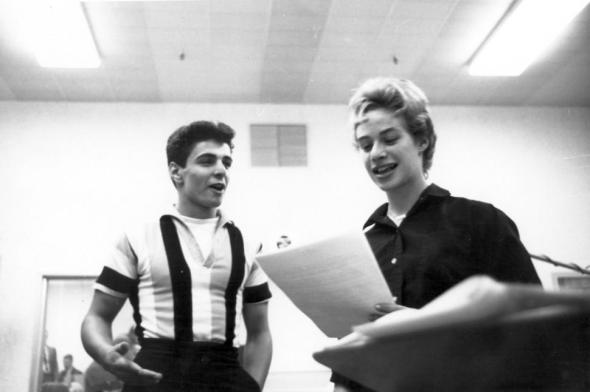
Husband and wife singer songwriting team Goffin and King rehearse during a recording session in a New York studio in 1959. (h/t NY Daily News)
Good Morning
On Thursday we lost another 1960s music great; Gerry Goffin, who wrote lyrics to Carole King’s music died at 75. The talented couple wrote the songs that accompanied my teenage years–so much great music associated with so many memories.
From the Guardian Gerry Goffin: the poet laureate of teenage pop:
Gerry Goffin, a trainee chemist who became the poet laureate of teenage pop, specialised in coming up with a great opening line to grab the audience’s attention. Plenty of people will remember the first time they heard “Tonight you’re mine completely/ You give your love so sweetly,” from Will You Love Me Tomorrow, or “Looking out on the morning rain/ I used to feel so uninspired,” from (You Make Me Feel Like) A Natural Woman. But he didn’t stop there.
Buried a little deeper in those wonderful songs are the lines that really touched his young listeners’ hearts. The words to the bridge, or middle section, of that first Shirelles hit from 1960 were almost like poetry: “Tonight with words unspoken/ You say that I’m the only one/ But will my heart be broken/ When the night meets the morning sun?” And when Goffin presented Aretha Franklin with the second verse of A Natural Woman – “When my soul was in the Lost and Found, you came along to claim it” – he gave countless ordinary lovers a way to express their deepest feelings.
Misleadingly, they are often called “Carole King songs”. She wrote the tunes, and later on she would sing them when, after Goffin and King divorced, she embarked on a hugely successful solo career. But whenever King sang her own, gentler versions of the Chiffons’ One Fine Day or the Drifters’ Up on the Roof, she was still singing Goffin’s words. They were written by the man she had met when she was 17 and he was 20, and with whom she had two daughters while they lived in an apartment in the Queens housing project LeFrak City – and with whom she travelled to work in Manhattan every day at their cubicle in the offices of Aldon Music at 1650 Broadway, where they pumped out hit after hit after hit.

From The New York Times: Gerry Goffin, Hitmaking Songwriter With Carole King, Dies at 75:
Mr. Goffin and Ms. King were students at Queens College when they met in 1958. Over the next decade they fell in love, married, had two children, divorced and moved their writing sessions into and out of 1650 Broadway, across the street from the Brill Building. (The Brill Building pop music of the late 1950s and ‘60s was mostly written in both buildings.)
Together they composed a catalog of pop standards so diverse and irresistible that they were recorded by performers as unalike as the Drifters, Steve Lawrence, Aretha Franklin and the Beatles. They were inducted together into the Songwriters Hall of Fame in 1987 and the Rock and Roll Hall of Fame in 1990. In 2004 the Recording Academy presented them jointly with a Trustees Award for lifetime achievement.
The couple’s writing duties were clearly delineated: Ms. King composed the music, Mr. Goffin wrote the lyrics — among them some of the most memorable words in the history of popular music.
“His words expressed what so many people were feeling but didn’t know how to say,” Ms. King said in a statement on Thursday.
A bit more about Goffin:
Gerald Goffin was born on Feb. 11, 1939, in Brooklyn and grew up in Jamaica, Queens. He began writing lyrics as a boy — “like some kind of game in my head,” he recalled once — but found he was unable to come up with satisfying music to accompany them.
He graduated from Brooklyn Technical High School before enrolling at Queens College. He was three years older than Ms. King, studying chemistry, when they met in the spring of her freshman year.
He asked her to help him write a musical. She was interested in rock ‘n’ roll. They hit it off anyway, and she was pregnant with their first child when they married on Aug. 30, 1959.

Gerry Goffin
After the couple divorced in 1968, King went on to become a singer and songwriter in her own right, although the two continued to collaborate and maintained a friendship. Goffin married again and and the couple had five children.
In addition to his wife, [Michelle] Mr. Goffin’s survivors include four daughters, Louise Goffin, Sherry Goffin Kondor, Dawn Reavis and Lauren Goffin; a son, Jesse Goffin; six grandchildren; and a brother, Al.
Goffin and King’s first hit was “Will You Love Me Tomorrow,” which they wrote in 1960 for the girl group the Shirelles. After the song hit #1 on the charts in 1961, Goffin quit his job as a chemist and began working full-time as a lyricist.
Goffin’s lyrics deftly touch on the doubt that lurks behind all new romances. As sung by Shirelles’ leader Shirley Owens in unflappable manner, the song doesn’t skimp on the wonder inherent in any fresh coupling. But it’s also unflinchingly realistic about the possibility that the fairy dust will dissolve at dawn.
“Can I believe the magic in your sighs?” Owens pointedly asks her paramour. In the bridge, Goffin’s words flow like champagne even as they fear the possible hangover: “Tonight with words unspoken/You’ll say that I’m the only one/But will my heart be broken/When the night meets the morning sun.” King’s melody plays a big role in the overall effect, arching high in the verses and middle eight while accompanied by strings that elegantly trip across the proceedings like moonlight dancers, before coming back down to Earth for the interrogative refrain.
In other news . . .
At Salon, Simon Malloy writes about the multiplying Republican scandals: GOP’s sudden scandal-mania: Why criminal probes and infighting are taking over the party.
It’s fashionable right now to talk about the premature end of Barack Obama’s presidency. He’s fast approaching the second half of his second term, which is historically the beginning of lame-duck season. His poll numbers aren’t what anyone would call ideal, and Republicans (in concert with some excitable members of the press) are rushing to proclaim the Obama presidency dead. “I saw a commentator today say that these polls, what they reflect, is that the Obama presidency is over,” Sen. Marco Rubio said, referring to NBC’s Chuck Todd. “And I agree with that. I think it is, in general.” Speaker John Boehner told reporters at his weekly press briefing yesterday: “You look at this presidency and you can’t help but get the sense that the wheels are coming off.” ….The funny thing is that as Republicans team up with pundits to chisel out Obama’s epitaph, the Republican Party itself is falling to pieces right before our eyes.
Yesterday’s news that Scott Walker and Chris Christie sinking deeper into their respective scandals is as good a sign as any of the GOP’s political disintegration. After Obama crushed Mitt Romney in 2012, Republicans began casting about for their 2016 redeemer, and Christie and Walker were high on the list. They won conservative hearts with their antagonism toward unions, but they had also found a way to win in reliably Democratic states. If the GOP hoped to take on candidate-in-waiting Hillary Clinton, they’d need someone who could peel away some Democratic voters. Walker had talked about the need to nominate an “outsider” like himself in 2016.
Now Christie and Walker are implicated in criminal investigations. Prosecutors in Wisconsin placed Walker at the center of a “criminal scheme” to coordinate campaign spending with outside groups. In New Jersey, the investigation stemming from the George Washington Bridge scandal is reportedly closing in on Christie himself. For both men, once considered potential saviors of the GOP, the political future looks considerably dimmer.
Read Malloy’s take on it at the link.
At FiveThirtyEightPolitics, David Wasserman has a long article on “What we can learn from Eric Cantor’s defeat.” You really need to read the whole thing, but here’s a small excerpt that deals with the contribution of public distrust of Congress:
Cantor was only the second House incumbent to lose a primary this year (the first was Texas Republican Ralph Hall), but the warning signs of discontent were abundant: Plenty of rank-and-file House incumbents had been receiving startlingly low primary vote shares against weak and under-funded opponents, including GOP Reps. Rodney Davis of Illinois, Lee Terry of Nebraska and David Joyce of Ohio. In fact, just a week before Cantor’s defeat and without much fanfare, socially moderate Rep. Leonard Lance of New Jersey received just 54 percent of the Republican primary vote against the same tea party-backed opponent he had taken 61 percent against in 2012.
Overall, 32 House incumbents have taken less than 75 percent of the vote in their primaries so far this year, up from 31 at this point in 2010 and just 12 at this point in 2006. What’s more, 27 of these 32 “underperforming” incumbents have been Republicans.1
In other words, while Congress’s unpopularity alone can’t sink any given member in a primary, it has established a higher baseline of distrust that challengers can build on when incumbents are otherwise vulnerable. And as the sitting House Majority Leader, Cantor was uniquely susceptible to voters’ frustration with Congress as an institution.
There’s much more interesting analysis at the link.
George Will’s recent column on campus rapes is still in the news. From Talking Points Memo, George Will’s Latest: College Rape Charges Fueled By ‘Sea Of Hormones And Alcohol’.
Will explained that he took issue with the practice of adjudicating campus sexual assault cases by a “preponderance” of evidence, rather than hitting the bar of evidence beyond a reasonable doubt. That flies in the face of due process, he argued, and ultimately harms young men’s future prospects.
“What’s going to result is a lot of young men and young women in this sea of hormones and alcohol, that gets into so much trouble on campuses, you’re going to have charges of sexual assault,” he said. “And you’re going to have young men disciplined, their lives often permanently and seriously blighted by this — don’t get into medical school, don’t get to law school, all the rest.”
Four Democratic senators reached out to Will after his column was published to torch the conservative columnist’s “ancient beliefs.” Will said he wrote a letter back to the senators and laid out his rebuttal in the C-SPAN interview.
“What I say is that: A) I take sexual assault more seriously than I think they do, because I agree that society has correctly said that rape is second only to murder as a serious felony,” Will said. “And therefore, when someone is accused of rape, it should be reported to the criminal justice system that knows how to deal with this, not jerry-built, improvised campus processes.”
“Second, I take, I think, sexual assault somewhat more seriously than the senators do because I think there’s a danger now of defining sexual assault so broadly, so capaciously, that it begins to trivialize the seriousness of it,” he added. “When remarks become sexual assault, improper touching — bad, shouldn’t be done, but it’s not sexual assault.”
Well, we can’t have young men’s lives “blighted” by rape charges. Much better for young women to just suck it up and deal with a years of post-traumatic stress on their own and keep their complaints to themselves.
Whatever you do, don’t miss this TBogg post at Raw Story: Gentleman George Will is getting damned tired of having to explain rape to you guttersnipes.
Victorian gas-pipe and Her Majesty’s Curator of Rape To The Colonies, George Will, has just about had it up to here with you people — YES, YOU PEOPLE.
And especially you. Don’t think by closing your laptop he can’t see you, because he can.
Oh yes, he most certainly can, you loathsome wastrel.
t seems that, after explaining the ins and out of rape to you ungrateful curs, he was shocked and dismayed to discover that you promiscuous info-trollops on the intertubes are unable to comprehend the pearls of wisdom that he dispenses to the riff-raff gratis, courtesy of Ye Olde Washminster Poste.
Hush now, let Gentleman George condescend to speak down to you and try, fruitlessly no doubt, to explain once again that rape is what George Will says rape is…
Now go read the rest at the link. You won’t be sorry.
This sounds like it could do some good: Google commits $50M to encouraging girls to code (CNet)
Google wants to see more women in technology, and it’s funding a $50 million initiative to encourage girls to learn how to code in an effort to close the gender gap.
Thursday night the company kicked off the Made with Code initiative here with celebrities former first daughter Chelsea Clinton and actress and comedienne Mindy Kaling.
Kaling, who emceed the event, said she has tons of ideas for apps but no idea to how make them work. She said she’d like to create a “What’s his deal?” app that takes a picture of guy and tells you whether he’s single, married, a weirdo, or what his car is like. Another idea is a Shazaam-like app for perfume.
“People my age have a million ideas for apps,” she said. “But we have no idea how to build them. Last week in the movies, I didn’t even know how to turn off the flashlight on my phone.”
Kaling isn’t alone. Women are woefully under-represented in the technology industry. Only about 20 percent of software developers in the US are women, according to the Labor Department. Last month, even Google admitted only 17 percent of its tech workers are women.
A bit more possible good news from the BBC: US sets up honey bee loss task force.
The Environmental Protection Agency (EPA) and the agriculture department will lead the effort, which includes $8m (£4.7m) for new honey bee habitats.
Bee populations saw a 23% decline last winter, a trend blamed on the loss of genetic diversity, exposure to certain pesticides and other factors.
A quarter of the food Americans eat, including apples, carrots and avocados, relies on pollination.
Honey bees add more than $15bn in value to US agricultural crops, according to the White House.
The decline in bee populations is also blamed on the loss of natural forage and inadequate diets, mite infestations and diseases.
There has also been an increase in a condition called colony collapse disorder (CCD) in which there is a rapid, unexpected and catastrophic loss of bees in a hive.
So . . . what stories are you following today? Please post your thoughts and links in the comment thread.
Monday Reads
Posted: June 16, 2014 Filed under: Foreign Affairs, morning reads, Republican politics, U.S. Politics | Tags: Afghanistan, bionic pancreas, Chelsea Manning, David Brat, Diabetes, Eric Cantor, IRAQ, LeBron James, Scott Walker, war crimes 32 Comments
Good Morning!!
There’s not a lot of good news to report this morning except that the Miami Heat lost the NBA championship last night, cementing LeBron James’ reputation as a choker. He couldn’t win in Cleveland, and he can’t lead in Miami. He’s just all about LeBron.
The situation in Iraq is getting more dire. I’m sure you heard about the reported mass executions of Iraqi troops by ISIS militants yesterday. From The New York Times:
BAGHDAD — Wielding the threat of sectarian slaughter, Sunni Islamist militants claimed on Sunday that they had massacred hundreds of captive Shiite members of Iraq’s security forces, posting grisly pictures of a mass execution in Tikrit as evidence and warning of more killing to come.
The possible mass killing came as militants cemented control of the city of Tal Afar, west of Mosul, after two days of fierce clashes with Iraqi troops, residents and senior security officials said. The city came under mortar attack, sending residents fleeing toward Sinjar in the north, which is under control of Kurdish pesh merga troops. Residents said the militants freed dozens of prisoners.
BAGHDAD — Wielding the threat of sectarian slaughter, Sunni Islamist militants claimed on Sunday that they had massacred hundreds of captive Shiite members of Iraq’s security forces, posting grisly pictures of a mass execution in Tikrit as evidence and warning of more killing to come.
The possible mass killing came as militants cemented control of the city of Tal Afar, west of Mosul, after two days of fierce clashes with Iraqi troops, residents and senior security officials said. The city came under mortar attack, sending residents fleeing toward Sinjar in the north, which is under control of Kurdish pesh merga troops. Residents said the militants freed dozens of prisoners.
Lovely. “War Crimes” hardly seems strong enough to characterize such horrendous acts.
In an atmosphere where there were already fears that the militants’ sudden advance near the capital would prompt Shiite reprisal attacks against Sunni Arab civilians, the claims by ISIS were potentially explosive. And that is exactly the group’s stated intent: to stoke a return to all-out sectarian warfare that would bolster its attempts to carve out a Sunni Islamist caliphate that crosses borders through the region.
The sectarian element of the killings may put more pressure on the Obama administration to aid Iraq militarily. In fact, the militants seemed to be counting on it. A pronouncement on Sunday by the group’s leader, Abu Bakr al-Baghdadi, had a clear message for the United States: “Soon we will face you, and we are waiting for this day.”

CNN reports that some U.S. embassy staff in Iraq have been moved to another location.
The Iraqi air force struck back at the militant group ISIS, the Islamic State in Iraq and Syria, killing more than 200 militants, Iraqi state TV reported Monday morning. The air raids took place in Saqlawiyah, northwest of Fallujah, according to a graphic run by state TV.
ISIS has been ruthlessly fighting to take control of Iraq and has apparently posted chilling photos on jihadi Internet forums seeming to show the executions of Iraqi security forces.
ISIS, an al Qaeda splinter group, wants to establish a caliphate, or Islamic state, that would stretch from Iraq into northern Syria. The group has had substantial success in Syria battling Syrian President Bashar al-Assad’s security forces.
According to The Washington Post, the insurgents have captured American equipment and may be in possession of “advanced radios” that would make them much more effective.
Iraq’s security forces, propped up by American equipment and weapons, have been routed by a contingent of insurgents bent on extending their territory from strongholds in Syria deep into Iraq. As Mosul and other cities fell, the West saw a host of images of once-American Humvees and helicopters firmly in the hands of its enemies.
Outrage followed shock, as years of effort in Iraq by the U.S. military seemed to unravel in a coup-de-grace that played out over the Internet. Analysts speculated that the newly seized weapons and vehicles could turn fighters from the Islamic State of Iraq and Syria into an even stauncher foe.
Yet, among the towed Black Hawk helicopters, Howitzer cannons and Humvees plastered all over social media lies an unseen weapon that could make the ISIS fighters exponentially more lethal if employed properly: advanced radio equipment.
Read more at the link.

Iran is sending in troops to aid the insurgents, according to CNN.
What’s happening in Iraq now has all the makings of a civil war — and a full-blown foreign policy crisis. The United States is mulling direct talks with Iran while it boosts security at the U.S. Embassy in Baghdad with military personnel.
Why Iran? In recent days, Iran has sent hundreds of troops to fight alongside Iraqi government security forces in Diyala province, a senior security official in Baghdad told CNN.
The article summarizes the latest events on the ground as of early this morning. Finally, an editorial in The Independent UK states bluntly that
The outside world, starting with the United States, cannot hope to reverse the course of events in Iraq by intervening on the ground, and President Barack Obama was right to rule out US troops going back there.
However, that doesn’t mean taking up an observer’s seat as the region descends into ever greater chaos. Washington should encourage the tentative rapprochement between Sunni Saudi Arabia and Shia Iran, both of which are starting to see just how dangerous the Sunni-Shia power struggle is becoming to each of them. We should do our utmost to shore up the defences of vulnerable but still stable states in the region, such as Jordan.
Western countries could also afford to be more generous in helping to address the humanitarian aspect of the latest crisis. Britain has so far offered an extra £3m to help tens of thousands of refugees fleeing the advance of Isis, most of whom are now camping in Kurdish-controlled areas of northern Iraq. It goes without saying that they do not have access to things like the best survival backpack or basic nutrition, it hardly seems an adequate gesture.
With any luck, the Sunnis in Syria and Iraq will at some point turn against their self-styled deliverers in Isis. In that case, it is vital that the Shia-dominated regime in Baghdad comes under pressure to keep the door open to talks about some kind of federal option for the Sunnis, and for the Kurds. It is late in the day for Iraq even to try to play with the federalisation option, but just possibly some kind of gossamer-thin state can be salvaged from the current mess. Right now, none of the options looks good, but despair is not the answer.
In other news,

Chelsea Manning has broken her silence with an op-ed in the Sunday New York Times in which she harshly criticizes the methods used by the military to control press coverage of the Iraq and Afghanistan wars and–presumably–the U.S. media’s acquiescence to that control. For example,
If you were following the news during the March 2010 elections in Iraq, you might remember that the American press was flooded with stories declaring the elections a success, complete with upbeat anecdotes and photographs of Iraqi women proudly displaying their ink-stained fingers. The subtext was that United States military operations had succeeded in creating a stable and democratic Iraq.
Those of us stationed there were acutely aware of a more complicated reality.
Military and diplomatic reports coming across my desk detailed a brutal crackdown against political dissidents by the Iraqi Ministry of Interior and federal police, on behalf of Prime Minister Nuri Kamal al-Maliki. Detainees were often tortured, or even killed.
Read much more at the link.
Speaking of media co-option, the NYT has an interesting op-ed by long-time reporter David Carr about the media’s failure to anticipate Eric Cantor’s stunning defeat in Virginia’s primary last week.
It’s now clear why the primary defeat of the House majority leader,Eric Cantor, came so completely out of the blue last week: Beltway blindness that put a focus on fund-raising, power-brokering and partisan back-and-forth created a reality distortion field that obscured the will of the people.
But that affliction was not Mr. Cantor’s alone; it is shared by the political press. Reporters and commentators might want to pause and wipe the egg off their faces before they go on camera to cluck-cluck about how Mr. Cantor, Republican of Virginia, missed signs of the insurgency that took him out. There was a lot of that going around, and the big miss by much of the political news media demonstrates that news organizations are no less a prisoner of Washington’s tunnel vision than the people who run for office.
All politics is local, which may explain why The Richmond Times-Dispatch and The Chesterfield Observer both took David Brat’s Tea Party challenge to Mr. Cantor seriously, but few of the publications inside the District that follow the majority leader’s every wiggle and wobble sensed that he was leaving the home fires dangerously unattended….
The same forces that keep politicians penned up within a few blocks of Pennsylvania Avenue work on journalists as well. No one wants to stray from the white-hot center of power for fear of being stuck in some forsaken locale when something big happens in Washington — which is why it has become one of the most overcovered places on earth.
This problem is compounded by the “diminution” of regional newspapers. Read more at the link.

I haven’t had time to work through the whole thing yet, but Alec MacGillis has a long profile of Wisconsin Governor Scott Walker that seems worth a read: The Unelectable Whiteness of Scott Walker: A journey through the poisonous, racially divided world that produced a Republican star.
I’ll end with some exciting science news from The Boston Globe: Boston-Led Team Developing ‘Bionic Pancreas’ for Diabetics.
Scientists have made big progress on a ‘‘bionic pancreas’’ to free some people with diabetes from the daily ordeal of managing their disease. A wearable, experimental device passed a real-world test, constantly monitoring blood sugar and automatically giving insulin or a sugar-boosting drug as needed, doctors said Sunday.
The device improved blood-sugar control more than standard monitors and insulin pumps did when tested for five days on 20 adults and 32 teens. Unlike other artificial pancreases in development that just correct high blood sugar, this one also can fix too-low sugar, mimicking what a natural pancreas does.
The device was developed at Massachusetts General Hospital and Boston University. Results were featured Sunday at an American Diabetes Association conference in San Francisco and were published online by the New England Journal of Medicine.
More from NPR: Father Devises A ‘Bionic Pancreas’ To Help Son With Diabetes. Very interesting!
I have a few more links that I’ll post in comments.
So . . . what else is happening? Please post your thoughts and links on any topic in the comment thread.
Lazy Saturday Reads: Challenging Misogyny and Electing a Woman President
Posted: June 14, 2014 Filed under: Barack Obama, morning reads, U.S. Politics, Women's Rights | Tags: "Hard Choices", 2008 Democratic primaries, 2016 presidential race, Hillary Clinton, misogyny, NPR's Fresh Air, same-sex marriage, Sexism, Terry Gross, woman hating 36 Comments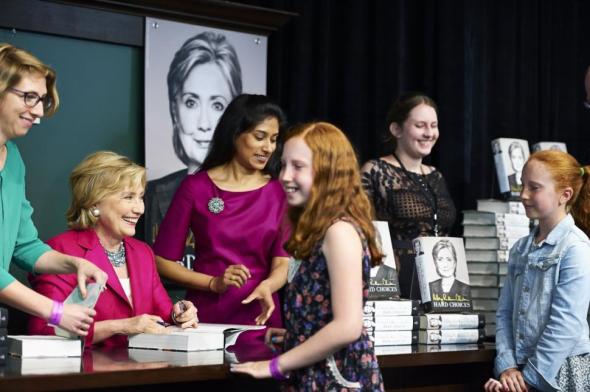
Good Morning!!
A couple of days ago, Dan Murphy of The Christian Science Monitor tweeted a link to a 2013 post he wrote about on-line misogyny and noted that “It’s only getting worse.” It’s refreshing that some men recognize the problem. But why is it “getting worse” this week? I doubt if even Dan Murphy knows what’s driving the recent increase in on-line expressions of woman hatred.
Hint: A powerful woman released a memoir on Tuesday. There are now 552 customer reviews of the book on Amazon, most written by misogynistic Hillary-haters who obviously have not read even a single paragraph of Hillary Clinton’s Hard Choices.
We watched it during the 2008 presidential campaign, and we always knew it would happen again if Hillary dared to run again. The truth is that misogyny is even stronger than racism in this country; hatred of women is so powerful that even pointing it out can unleash rape and murder threats. From Dan Murphy’s post from last year about misogyny in the UK:
Guardian columnist Hadley Freeman got the ball rolling this time by daring to write on Tuesday:
There’s been a lot of focus of late on the weirdy-weirdos who send rape threats on Twitter, and rightly so. But much of the coverage makes several misguided assumptions. First, that angry misogynists only communicate on Twitter (allow me to introduce you to something called Reddit). Second, that this is a man-versus-woman thing. Some of the angriest messages I’ve ever received on the Internet have come from women, usually telling me how ugly I am. Lovely to meet you, too! And third, that legislating against rape threats on the Internet is a contravention of freedom of speech. Seeing as legislation against hate speech in the real world has not, as far as I know, contravened anyone’s right to freedom of speech, this argument makes no sense, except, maybe, to people who make rape threats and whose grasp of logic is, perhaps, not whipsmart.
Ms. Freeman soon received a bomb threat on Twitter. Also in the UK last week feminist writer Caroline Criado-Perez and Labour Party politician Stella Creasy received rape threats via Twitter. After Ms. Criado-Perez complained to police she’d received dozens of sexual threats over the Internet, a 21-year old man was arrested.

The Hillary hate has been building up for awhile now, ever since Hillary stepped down as Secretary of State and the media began shrieking from the dark heart of its collective fear of a woman president–especially *This Woman.* I don’t know how bad its going to get, but I’m already sick of it. I want so much for Hillary to stand strong and prevail over the fear and hatred of women that is and will be projected on her for the next couple of years.
Even I fell for it yesterday when we discussed Hillary’s interview with NPR’s Terry Gross. I said I thought Hillary had sounded defensive when she responded to Gross’s question about changing her position on same-sex marriage. Luckily for me, Fannie and Janicen were there to point out my mistake:
Fannie
I am glad Hillary asserted herself and her tone. I don’t know why Terry Gross didn’t do her homework, or why she took the path that lead to the “twisting of her comments, insisting it was politics”. Hillary wasn’t trying to jump her (or as the media said, Hillary was being testy), she was being spot on about her response. Get ready, now that her book is out, we are going to see underreactions, overreactions, the ups and and downs, and everything else they will thrown into the mix. Hillary will be up against the Ducks, the Rick Perry’s who thinks gays are alcoholics, the tea party candidate who says the Bible tells me to stone gay people to death, and Rich Gohmert who debates at congressional hearings about who is and who is not going to heaven. She’s been around the block a couple times.
BB, you remember when Chris Hayes was attacked by a republican woman, she hammered his ass, and it was all because they “disagreed”. Hillary was NOT being nasty like this woman. She handled it well, I thought.
Let’s get back to Hillary’s history. She was speaking out against the oppression by the Uganda Bill “Kill the Gays”. She gave a hell of speech at George University. That was early in 2009.
Did Chris and Terry forget 2009 when she said:
“On behalf of Department of State and USAID, I want to congratulate the gays and lesbians in foreign affairs agencies on winning the Employee Resource Group of the Year Award by Out and Equal Work Place.”It was Hillary who changed the policy at the Dept. State, to help provide benefits for same sex partners of those work were in foreign service. It was after this that Obama followed with other federal agencies. Obama had been nodding his head, while she was actually changing the laws, and the records are there for everybody to see. Terry and Chris refused to see.
Hillary Clinton also developed policy on transgender employees at the state department. She said stand up and be who you are. Keep in mind, she said “the struggle for equality is never ever finished”…. and she is right.
Hillary has been advocate for LGBT community for long time. She knows that they (we) are all flustrated because change is slow to come. It coming but very slowly. It was Hillary who marched in Pride Parade when June was declared Pride Month, she was right there with them, while Obama was working out.
Chris is getting lazy, get up off his ass and speak to those she has helped for many many years.
janicen
June 13, 2014 at 11:55 am(Edit)
I have to disagree that she sounded defensive. I think she sounded decisive. Gross kept stupidly pushing her agenda again and again. Clinton was polite for as long as humanly possible and then she just had to put the idiot in her place. I’m glad she responded as she did. Until then she was sounding like a politician. Once she cold cocked her, Madame President sounded like a leader.
Thank you, my dear friends. That is a clear demonstration of the value of a community blog where we can argue share our analyses with each other. I’m so glad we are still hanging in there together!
Now a response to the chorus of media criticism of Hillary as “testy” (IOW *bitchy*) from Jeremy Holden at Media Matters: How NPR’s Terry Gross Created A False Impression That Hillary Clinton Stonewalled On Marriage Equality.
By repeatedly asking the same question, NPR correspondent Terry Gross created the false impression that Hillary Clinton was stonewalling and dodging over the issue of marriage equality, despite the fact that Clinton consistently and repeatedly answered Gross’ question.
As a senator and during her 2008 presidential run, Clinton supported civil unions for same-sex couples and opposed marriage equality. In a March 2013 statement, she announced that “I support marriage for lesbian and gay couples. I support it personally and as a matter of policy and law.” She explained that her travels as secretary of state and her daughter’s wedding had been key to her changing her opinion on the issue.
Gross’ central question was whether Clinton changed her publicly stated position and supported gay marriage out of political expedience, a question she asked seven separate times during an NPR interview. Clinton consistently rejected Gross’ characterization throughout the interview, instead saying that her views on the issue changed over time.

To me it seemed that Gross wanted Hillary to say that she had always supported same-sex marriage, but had pretended to oppose it for political reasons. Of course if Hillary had said that, she would have been pilloried for lying about her position. The truth is, as she stated very clearly, that Hillary’s views on same-sex marriage changed as she heard the logical arguments for it from LGBT activists–whom she had long supported. Here is Hillary’s clear response at the beginning of the exchange.
TERRY GROSS: Were there positions you believed in as senator but you couldn’t publicly support because you felt that it wasn’t time yet? That the positions would have been too unpopular? That the public wasn’t ready in regards to LGBT rights? And, you know, I often think that there are politicians who, you know, in their heart really support it but don’t publicly support it.
HILLARY CLINTON: Well, I was fully on board with ending discrimination in the workplace on behalf of the LGBT community. I did not support gay marriage when I was in the Senate or running for president, as you know, and as President Obama and others held the same position.But it, for me, became an opportunity to do what I could as secretary of state to make the workplace fairer – something I had always supported and spoke out about. And then when I was out of the secretary of state position and once again free to comment on domestic matters, I very shortly came out in favor of fully equality, including gay marriage.
Yet “progressives” like Chris Hayes writers at Firedoglake and Huffington Post ripped into Hillary for standing up for herself against Gross’s attempts to twist her responses.
Another defense of Hillary’s truthfulness–while expressing frustration with her positions–came from the Washington Post’s Johnathan Capehart: Gross misunderstanding of Hillary Clinton on gay marriage.
The history bears out Clinton’s contention. Her evolution on marriage equality was as irksome for the lesbian, gay, bisexual and transgender (LGBT) community as was President Obama’s. But what made Obama’s evolution especially painful to watch was knowing that as a candidate for state senate in 1996, he unequivocally stated, “I favor legalizing same-sex marriages and would fight efforts to prohibit such marriages.” As I covered Clinton from first lady to senator to presidential candidate, I never detected a whiff of that kind of political calculation in her opposition to same-sex marriage. If anything, her march to “yes” was maddeningly slow.

Here’s another interesting example of contrasting views on Hillary and her behavior. First The UK Guardian’s review of Hard Choices by David Runciman: Hard Choices by Hillary Clinton review – buttoned-up but still revealing.
If Hillary Clinton becomes the next American president she won’t just be the first woman to hold that office: she’ll be the first secretary of state to get there since James Buchanan in 1857. Unlike in Britain, where foreign secretaries and chancellors of the exchequer routinely go on to the top job, senior US cabinet positions are not seen as stepping stones to the White House. No secretary of the treasury has ever become president. Cabinet officers are meant to be functionaries: people whose job is to make sense of the world. Presidents are meant to be politicians: people whose job is to lead it. In this long, exhausting, faintly robotic but ultimately impressive book, Hillary makes her pitch to be both.
According to Runciman, Hillary’s book is way too cautious and “prosaic,” but still “an amazing story.
Above all, what comes through is Clinton’s sheer persistence. This is how she does politics, by keeping going and totting up the small victories so that they outweigh the defeats. Unlike Obama, who still appears to believe that politics is about rational argument, and unlike George Bush, who thought it was about vision, Hillary believes it is about breaking things down. She is a disaggregator, who can’t see a problem without trying to make it smaller, more manageable, and only then does she try to fit the pieces back together again. Peace, she tells us, doesn’t necessarily begin with a grand fanfare. Sometimes it comes out of the temporary ceasefire that holds just long enough to make a difference. Part of why this book is so exhausting is its thoroughness: she travels the whole world and tells us about the different challenges she faced, taking them all seriously. Early on she quotes approvingly a maxim from Deng Xiaoping: “Coolly observe, calmly deal with things, hold your position, hide your capacities, bide your time, accomplish things where possible.” The US could do worse than having Deng as its next president.
Perhaps that’s the only option for a powerful woman in the misogynistic rape culture of the U.S.?
Here’s feminist writer Jessica Valenti, also from The Guardian: Hillary Clinton’s book is exactly as ‘safe’ as female politicians are forced to be.
Hillary Clinton’s new book, Hard Choices – a memoir of her time as secretary of state – is finally out, and the critical consensus is that it’s a snore. CNN’s conservative commentator Ana Navarro called it “50 shades of boring” while the network’s liberal contributor Sally Kohn called it “safe” and “dry” – and joked that the book should have been called “Boring Choices“. The New Republic criticized its “dullness and lack of critical energy”. Politico’s Mike Allen called the 596-page book a “newsless snore”.
I’m not exactly sure how action-packed the minutiae of a diplomat’s life is supposed to be, but the Hard Choices haters ignore that a “safe” book was Clinton’s only real choice. After all, whenever she’s hinted at being anything other than measured and guarded, Clinton has been attacked as hysterical, a ballbuster or worse. So if people are bored by Hard Choices, they should blame the misogynist expectations of Washington, not the careful crafting of a seasoned politician.
When then-presidential hopeful Clinton teared up on the campaign trail in New Hampshire in 2008, for example, Maureen Dowd penned a column in the New York Times that asked “Can Hillary Cry Her Way Back to the White House?”On CNN, Glenn Beck said, “After spending decades stripping away all trace of emotion, femininity, and humanity, Hillary Clinton broke down and actually cried. … I don’t buy the hype.” On Fox News, Weekly Standard editor Bill Kristol called the emotional moment “solipsistic and narcissistic”. Similarly, when Clinton got into a heated exchange during her Benghazi testimony, the New York Post ran a cover of Clinton yelling with her fists clenched; the headline: NO WONDER BILL’S AFRAID.
Any emotion that Hillary Clinton shows has always been used against her, and it has become a kind of stand-in for the many reasons women are said to be oh-so-unfit to lead. The building-up of her protective public armor, post- and potentially pre-White House, isn’t just smart for Clinton personally – it’s essential for the growing national image of women in politics.
It’s clear from reading Hard Choices that sexism – particularly during Clinton’s 2008 run for president – has taken a toll on her. “I knew that it arose from cultural and psychological attitudes about women’s roles in society, but that didn’t make it any easier for me and my supporters,” she writes. Indeed, the frenzy of misogyny was so intense that it’s hard to imagine enduring it all while vying for the most important job in the world.
After seeing the racism that has plagued Barack Obama’s presidency–and has, if anything, increased during his second term–we now know that the misogyny from the media and society as a whole would continue throughout a Hillary Clinton presidency. That is what it will take for a woman to break through that ultimate glass ceiling. If we are going to support Hillary in her fight to do just that we will need to stay awake and aware of the various forms the efforts to bring her down will take. I learned that lesson here yesterday, and I will rely on other Sky Dancers to keep me focused on the ultimate goal. I hope I’ll be strong enough to do the same in return.
Now, what else is happening in the world today? Please post your thoughts and links on any topic in the comment thread.
Wednesday News
Posted: June 11, 2014 Filed under: morning reads, Republican politics, U.S. Politics | Tags: bus crashes, chimpanzee research, Eric Cantor, game theory, guns, school shootings 43 Comments
Good Morning!!
I’m still excited by the demise of Eric Cantor’s last night. Suddenly it feels as if there’s hope the GOP will finally give up the ghost and either return to something approaching the political center or else go the way of the dodo bird. I’m going to get you started with some headlines, because I haven’t heard anything from JJ. I hope all is well in Banjoville.
Here are a few headlines on the Eric Cantor loss–many writers are referring to it in earthquake terms.
From CNN: Cantor ‘earthquake’ rattles Capitol Hill
In a year when mainstream Republicans have mostly bested tea party-backed challengers, a little-known and little-funded tea party challenger in Virginia’s 7th Congressional District pulled the upset of the year, defeating House Majority Leader Eric Cantor by 10 percentage points.
The victory by economics professor Dave Brat gives the tea party an instant jolt of energy, sends shock waves through Capitol Hill, shakes up the GOP House hierarchy — as Cantor was seen by many as the next speaker — and effectively kills any chance of immigration reform passing through the House any time soon.
“I think this is a scale eight earthquake. I think it will shock the Washington establishment; it will shock the House Republicans,” former House Speaker Newt Gingrich said.
In a year when mainstream Republicans have mostly bested tea party-backed challengers, a little-known and little-funded tea party challenger in Virginia’s 7th Congressional District pulled the upset of the year, defeating House Majority Leader Eric Cantor by 10 percentage points.
The victory by economics professor Dave Brat gives the tea party an instant jolt of energy, sends shock waves through Capitol Hill, shakes up the GOP House hierarchy — as Cantor was seen by many as the next speaker — and effectively kills any chance of immigration reform passing through the House any time soon.
“I think this is a scale eight earthquake. I think it will shock the Washington establishment; it will shock the House Republicans,” former House Speaker Newt Gingrich said.
Chris Cillizza: The seismic political consequences of Eric Cantor’s stunning loss.
The defeat of the second-ranking Republican in the House by an ill-funded, little-known tea party-backed candidate ranks as the biggest congressional upset in modern memory and will immediately generate a series of political and policy-related shock waves in Washington and the Richmond-area 7th District.
“People don’t know how to respond because it’s never been contemplated,” said one Virginia Republican strategist, granted anonymity to speak candidly about Cantor’s loss. (Worth noting: Cantor didn’t just lose. He got walloped; David Brat, his challenger, won 56 percent to 44 percent.)
In conversations with a handful of GOP operatives in the aftermath of Cantor’s loss — a loss blamed largely on an inept campaign consulting team that misread the level of vitriol directed at the candidate due to his place in Republican leadership and the perception he supported so-called “amnesty” for illegal immigrants — there were several common threads about what it means for politics inside and outside the House.
Read Cillizza’s take on the reasons at the link.
Ben Jacobs at The Daily Beast: How Eric Cantor Sabotaged Himself.
The shock defeat of House Majority Leader Eric Cantor by college professor Dave Brat is the type of upset that audiences wouldn’t believe in a Disney movie. Perhaps the most cinematic twist is that, at least in part, Cantor did this to himself. A toxic mix of ignoring grassroots Republicans in his district and becoming a lightning rod on the controversial issue of immigration reform meant that a future Speaker of the House became a former congressman Tuesday night.
Cantor, the second most senior Republican in the House of Representatives, lost his primary Tuesday night to the largely unknown Tea Party candidate, who ran on an anti-immigration platform by a margin of 56-44.
Despite Cantor’s reputation as a strident partisan conservative nationally, his support for some form of immigration reform and ties to his party’s pro-business wing made him persona non grata among Tea Partiers and immigration hawks. Yet, his race never made it on the radar for most groups. While talk show host Laura Ingraham vocally condemned Cantor and Daily Caller writer Mickey Kaus beat the drum for Brat, few others on the right viewed the race as even potentially winnable.
The Boston Globe called attention to a map of the 74 (that’s right, 74!) school shootings that have taken place since Newtown. The map was designed by Gongloff.

That comes to 1.37 school shootings per school week! And that’s not counting the many other mass shootings that we’ve had and who knows how many accidental shootings of children. Isn’t it high time we did something about this bloodbath? More from the Globe:
Your gut feeling is right: School shootings have skyrocketed in recent years. In January 2013, the Ploychart blog tracked the number of American school shootings since 1979, using data from Jessie Klein’s book “The Bully Society.” Starting with three confirmed shootings in 1979, the number of shootings per year slowly swell, jumping to the upper single-digits in the late 80s and through the 90s.
The shootings actually dipped at the start of the new millennium, but skyrocketed in 2006. What was once the high-water mark for shootings in a year–nine–became the floor. In 2009, there were 18 school shootings. There were 16 in 2010 and eight in 2011.
Stein’s data ends in 2011. Everytown tracked 37 for 2013 and 37 so far in 2014. The Everytrown and Stein data sets don’t follow the same methodology, so they should not be viewed as one piece (meaning don’t just add the Everytown data to the end of the Stein data). Still, the trend is undeniably going in the wrong direction.
The way humans act sometimes, it kind of makes you wonder if we are really the smartest animals on Earth. Now check this out from C/NET: Chimps outsmart humans at simple strategy game.
Researchers at the California Institute of Technology have found that chimpanzees at the Kyoto University Primate Research Institute are consistently better at humans when playing simple competitive games.
In one game, called the Inspection Game, chimps and humans played a variation on hide-and-seek. In pairs of their own species (humans and chimps did not directly compete with each other for the study), the players sit back-to-back, each with a computer screen in front of them. After pushing a circle on the screen, they have to choose one of two boxes, right or left. They are then shown their opponent’s selection.
Each player has a different role. The “mismatchers” have to choose the opposite of their opponent’s selection, while the “matchers” have to choose the same as their opponent’s selection. Each game lasted 200 rounds, and players that “won” a round were given a reward. In order to consistently win, players had to be able to anticipate their opponent’s choices.
In game theory, there is a concept known as the Nash equilibrium. This means the balance that can be achieved when each player knows their opponent’s strategies, but has nothing to gain by changing their own strategy. The 16 Japanese students participating in the study performed as expected: slow to learn their opponents’ strategies, and not reaching the Nash equilibrium.
The six chimpanzees, however, learned the game and their opponents’ moves rapidly, very nearly reaching the Nash equilibrium, even when the researchers swapped the chimps’ roles and introduced higher rewards for specific choices. As the game changed, the chimps changed their strategies accordingly.
We’ve had an epidemic of school bus accidents lately, and there was a terrible on in Connecticut yesterday. From The Boston Globe: Crash of 2 School Buses Sends 20 Kids to Hospital.
TORRINGTON, Conn. (AP) — More than two dozen people were taken to hospitals with mostly minor injuries after a five-vehicle chain-reaction crash in Torrington involving two school buses and three other vehicles.
Police said a woman in one of the cars was flown to Hartford Hospital with serious injuries. Her condition wasn’t immediately released.
Police said a pickup truck ran into the back of the woman’s Jeep SUV at about 3:45 p.m. Tuesday, pushing it into the rear of a small school bus. The smaller bus then rear-ended the larger bus, and a third car also was struck.
Tim Lebouthiller, a spokesman for Charlotte Hungerford Hospital in Torrington, said the 20 children on the buses were treated and released. He said seven adults were brought to the hospital with non-life-threatening injuries, and most had been evaluated and released by mid-evening Tuesday.
What else is happening? I look forward to reading your thoughts and clicking on your links in the comment thread.
Monday Reads
Posted: June 9, 2014 Filed under: Foreign Affairs, morning reads, U.S. Politics | Tags: Afghanistan, Bowe Bergdahl, Cliven Bundy, Hillary Clinton, Karachi Airport attack, Las Vegas shootings, Pakistan, shooting sprees, Taliban, Tea Party, Turing Test breakthrough, White supremacists 23 Comments
Good Morning!
Another day, another shooting spree. The gun nuts don’t even take Sunday off. In Las Vegas, a married couple in their late 20s killed two police officers, Alyn Beck and Igor Soldo, and a civilian before killing themselves.
From the Las Vegas Review-Journal: Shooters in Metro ambush that left five dead spoke of white supremacy and a desire to kill police.
Two Las Vegas police officers were killed Sunday in what appears to be a politically motivated ambush in a pizza restaurant that spilled over to a nearby Wal-Mart, where the two shooters committed suicide after killing a woman in the store….
A law enforcement official who has been briefed on the incident said an officer — unconfirmed reports indicate it was Soldo — was refilling a soft drink when the female shooter approached him from behind and shot him in the head, killing him instantly.
The woman then shot the other officer several times as he drew his pistol. Gillespie said the officer was able to return fire but it was unclear if he hit anyone….
Witnesses told police one of the shooters yelled “This is the start of a revolution” before shooting the officers. Gillespie later said he could not confirm that.
The shooters then stripped the officers of their weapons and ammunition and badges, according to a law enforcement official with knowledge of the investigation. They then covered the officers with something that featured the Gadsden flag, a yellow banner with a coiled snake above the words, “Don’t tread on Me.”
Gee, you mean these terrorists weren’t muslims or Obama supporters? After shooting the two police officers the couple went across the street to a Walmart where they shot and killed a yet unidentified woman near the entrance. The woman then shot and wounded her partner and shot herself, and the man finished himself off. The two were carrying large duffle bags, and the bomb squad was called to the scene as well as to the couple’s apartment a few miles away. Now get this (emphasis added):
Several neighbors identified the man as Jared, while one called the woman Amanda.
Like many of the neighbors contacted, Krista Koch said she didn’t know the couple’s last names. She described them as “militant.” They talked about planning to kill police officers, “going underground” and not coming out until the time was right to kill.
Brandon Monroe, 22, has lived in the complex for about two weeks. He said the man who lived in the apartment that was being searched often rambled about conspiracy theories. He often wore camouflage or dressed as Peter Pan to work as a Fremont Street Experience street performer. A woman lived with him, Monroe said, but he didn’t see her as often.
They were weird people, Monroe said, adding that he thought the couple used methamphetamine.
“The man told Monroe he had been kicked off Cliven Bundy’s ranch 80 miles northeast of Las Vegas while people from throughout the U.S. gathered there in protest of a Bureau of Land Management roundup of Bundy’s cattle.” Jessica Anderson, 27, said. She lived next door.
There is still more detail at the article link.

Updates on the Bergdahl story:
From the Wall Street Journal, Official: Bowe Bergdahl has declined to speak to family.
While he spent five years in captivity after being captured by Afghan insurgents in 2009, Bergdahl doesn’t yet want to talk to his family on the phone, the official said.
Bergdahl has likely been shielded from most of the backlash his release has generated in the U.S. Some former platoon soldiers have accused him of deserting his post and lawmakers from both parties have questioned the decision to trade America’s lone prisoner of war in Afghanistan for five Talibanofficials held at Guantanamo Bay, Cuba.
Local authorities canceled a homecoming celebration in his Idaho hometown because of the backlash. The celebration was canceled specifically because of threats made against the family, officials said.
The Federal Bureau of Investigation confirmed that it was investigating threats made against Bergdahl’s parents.
From The New York Times: Bergdahl Was in Unit Known for Its Troubles.
The platoon was, an American military official would assert years later, “raggedy.”
On their tiny, remote base, in a restive sector of eastern Afghanistan at an increasingly violent time of the war, they were known to wear bandannas and cutoff T-shirts. Their crude observation post was inadequately secured, a military review later found. Their first platoon leader, and then their first platoon sergeant, were replaced relatively early in the deployment because of problems….
Indeed, an internal Army investigation into the episode concluded that the platoon suffered from lapses in discipline and security in the period before Sergeant Bergdahl — a private first class at the time who was promoted while in captivity — disappeared into Paktika Province, two officials briefed on the report said.
Bergdahl was not a peacenik.
Sergeant Bergdahl was viewed as standoffish or eccentric, smoking a pipe instead of spitting tobacco, as so many soldiers do, and reading voraciously when others napped or watched videos. But he was not isolated from his platoon mates, some said. And while he was, like other soldiers in the platoon, often disappointed or confused by their mission in Paktika, some of his peers also said that Sergeant Bergdahl seemed enthusiastic about fighting, particularly after the platoon was ambushed several weeks before his disappearance.
“He’d complain about not being able to go on the offensive, and being attacked and not being able to return fire,” said Gerald Sutton,who knew Sergeant Bergdahl from spending time together on their tiny outpost, Observation Post Mest Malak, near the village of Yahya Khel, about 50 miles west of the Pakistani border.
Read much more at the link.
From the LA Times: Most of 5 freed Taliban prisoners have less than hard-core pasts.
Obama critics have said the swap [of prisoners for Bergdahl] could endanger American lives, with Sen. John McCain (R-Ariz.) calling the five Taliban members “the hardest and toughest of all.”
A closer look at the former prisoners, however, indicates that not all were hard-core militants. Three held political positions in the Taliban government that ruled Afghanistan from 1996 to 2001 and were considered relative moderates. A fourth was a mid-level police official, experts say.
The fifth, however, has a darker past. Mohammed Fazl was chief of staff of the Taliban army and is accused of commanding forces that massacred hundreds of civilians in the final years of Taliban rule before the 2001 U.S.-led invasion. He was arrested in November 2001 after surrendering to U.S.-allied warlords in northern Afghanistan.
“Fazl is the only one of the five to face accusations of explicit war crimes and they are, indeed, extremely serious,” Kate Clark of the Afghanistan Analysts Network, a Kabul-based research group, wrote in a commentary published Wednesday.
The backgrounds of the prisoners, who are confined to the Persian Gulf nation of Qatar for one year under the terms of the exchange, indicate that they would have little utility on the battlefield after more than a decade in prison. They range in age from 43 to 47. In their absences, the Taliban movement they served has evolved into a complex and extremely violent insurgency that routinely kills civilians and has been decimated — although far from defeated — by years of U.S. counter-terrorism operations.
From the New York Times: Critics of P.O.W. Swap Question the Absence of a Wider Agreement.
When the heads of the two major intelligence committees criticized the Obama administration on Sunday for swapping Sgt. Bowe Bergdahl for five members of the Taliban, they homed in on one part of the deal that the White House has struggled for a week, unsuccessfully, to explain. The question is why the five were released without any commitments to a larger agreement, under which the Taliban would renounce international terrorism, and begin a process of reconciliation with the government of Afghanistan.

Other News:
According the The Independent UK, a computer has for the first time convinced humans that it was a real person: Turing Test breakthrough as super-computer becomes first to convince us it’s human.
A programme that convinced humans that it was a 13-year-old boy has become the first computer ever to pass the Turing Test. The test — which requires that computers are indistinguishable from humans — is considered a landmark in the development of artificial intelligence, but academics have warned that the technology could be used for cybercrime.
Computing pioneer Alan Turing said that a computer could be understood to be thinking if it passed the test, which requires that a computer dupes 30 per cent of human interrogators in five-minute text conversations.
Eugene Goostman, a computer programme made by a team based in Russia, succeeded in a test conducted at the Royal Society in London. It convinced 33 per cent of the judges that it was human, said academics at the University of Reading, which organised the test.
It is thought to be the first computer to pass the iconic test. Though other programmes have claimed successes, those included set topics or questions in advance.
The Wall Street Journal reports on an airport attack in Pakistan that killed at least 28 people: Karachi Airport Attack: Pakistani Taliban Claim Responsibility.
KARACHI, Pakistan—Militants stormed Karachi’s Jinnah International Airport late Sunday, exchanging fire with security forces and leaving at least 28 people dead, officials said.
Separately, gunmen and suicide bombers attacked pilgrims from the minority Shiite sect of Islam in the west of Pakistan, killing at least 25 pilgrims.
The Pakistani Taliban, a group closely linked to al Qaeda, claimed responsibility for the airport attack. The group, formally known as Tehreek-e-Taliban Pakistan, said the attack was revenge for recent Pakistani military airstrikes against them, which followed a breakdown in peace talks with the militants in the last few weeks….
At the airport, the assault began at around 10:20 p.m. local time Sunday and lasted at least six hours, with gunfire, explosions and a raging fire. All flights at the airport were suspended late Sunday. By midday Monday, local time, security officials said the airport was clear of militants. Flights were expected to resume by late afternoon.
“They attacked the airport security personnel and then entered,” Adnan, a witness who only gave his first name, said.
The assault focused on the airport’s relatively less heavily guarded Terminal One, which is used for cargo and VIP flights. Two cargo bays appeared to have been destroyed, witnesses said.

Hillary is about to begin her book tour, and the LA Times calls it a dry run for 2016.
e’s traveled the country mixing weighty policy pronouncements with joking references to her hair. She’s reflected on gender bias and offered career advice to young women, gushed about becoming a grandma and raked in a fortune in speaking fees on the lecture circuit.
After all that — and even having a shoe flung at her at a trash collectors’ convention in Las Vegas — Hillary Rodham Clinton takes her flirtation with the 2016 presidential race to a new level this week, beginning a minutely orchestrated book tour that will whisk her coast to coast for a mix of book signings and carefully calibrated television interviews.
Since stepping down as secretary of State 16 months ago, Clinton has managed to effectively freeze out any Democratic competition for the presidential nomination, no small feat in a party with a history of upstarts and upsets — especially for someone who has yet to say whether she even plans to run.
Throughout, she’s weathered a relentless degree of scrutiny, her daily travels exhaustively chronicled, her every utterance parsed for meaning. Even matters like her daughter Chelsea’s pregnancy are put to the will-or-won’t-she test.
The LA Times also reports that Hillary predicted the Bergdahl controversy, In new book, Clinton predicted furor over Taliban prisoner deal.
Former Secretary of State Hillary Rodham Clinton acknowledged in her new book that negotiations with the Taliban were bound to be hotly controversial with Americans, but wrote that bringing home captive Army Sgt. Bowe Bergdahl had to be a top priority.
Clinton writes in “Hard Choices” that “opening the door to negotiations with the Taliban would be hard to swallow for many Americans after so many years of war,” according to an account of excerpts published Thursday by CBS News. Yet in every contact with the Taliban, U.S. officials demanded the release of Bergdahl and made clear that “there would not be any agreement about prisoners without the sergeant coming home.”
Clinton’s book, due for release Tuesday, was written well before the swap of five top Taliban officials for Bergdahl last Saturday set off controversy in Washington. Her comments underscored, however, that the Obama administration was determined to complete the deal, despite its political risks.


 peej
peej Carissa
 bostonboomer
 ecocatwoman
 jjlo
jjlo mablue2
 Mama Lopez
 peggysue22
 quixote
 skydancingguestblogger
 Mona (aka Wonk the Vote)




