I just found out that JJ isn’t feeling well enough to do a post this morning, so I’m filling in. I have things to do this afternoon, so this will have to be a very quick link dump.
Personally, I have Spring Fever! It has been sunny and not so cold here for the past few days and I’m loving it. We still have piles of snow, but they are shrinking steadily. I think March is going to go out with like lamb here in Boston. AND . . . soon it will be staying light here until almost 7PM. Isn’t Spring great?
Ted Cruz is running for president. Or at least that’s officially what’s happening, according to his FEC filings. But if you actually listen to him, it seems like he is running for something else.
Cruz’s announcement speech at Liberty University was less like a first step toward the Oval Office, than the latest of many steps he has taken to becoming the political leader of the conservative movement. This is distinct from being the nominee of the Grand Old Party, of which that movement is just a devoted part.
There is nothing about Cruz that appeals to people beyond his political sect. The one rhetorical move independents and Democrats may relate to in Cruz’s speech was the tribute to his mother as a glass ceiling–smashing computer programmer. But otherwise his mode of speech is much like Mike Huckabee’s: sentimental, broadly evangelical, and reliant on personal charisma. Although it isn’t easy to pinpoint what about a candidate’s personality rubs a larger demographic cohort the wrong way, Huckabeefared terribly among non-rural, non-Evangelical voters in 2008. Cruz may be headed for the same fate.
Consider Cruz’s overt sense of personal destiny. He makes Mitt Romney seem positively shy. Cruz’s speech implicitly compared Ted Cruz to Patrick Henry, George Washington, Franklin Roosevelt, and Ronald Reagan.
“I may owe Mitt Romney an apology,” Jon Stewart said on Monday’s “Daily Show,” after learning that Cruz and his wife actually practiced waving and kissing before the announcement. “Even the Mitt Romneytron 3000 didn’t have to rehearse waving and kissing,” he continued.
If you were wondering why so many of the students in the audience looked bored out of their minds (and why one girl was even wearing a Rand t-shirt): It’s because the conservative Christian university required students to attend the Ted Cruz announcement as part of their weekly convocation. No word on whether the university also required students to text “constitution” to an undisclosed number, as per Cruz’s orders.
“Let me clarify this a little bit: Students at Liberty University were required to attend a partisan political speech where a small-government conservative who had just promised he would respect privacy rights, told them if they cared about freedom, text your information to a mysterious address that collects your cell phone number for undisclosed purposes,” Stewart said.
More good stuff in the video (see link). Can you believe Cruz and his wife practiced kissing before the event?
Sen. Ted Cruz says he wants to get rid of the Internal Revenue Service. This is a phenomenally bad idea, one so obviously wrongheaded it’s hard to believe he really means it….
This is not the first time Cruz has proposed this. He pitched it on Facebooktwo years ago and in multiple interviews since, even calling it the “single most important tax reform” and priority “No. 2” (after repealing Obamacare) in recent talks. The fact that he might make ending the IRS a centerpiece of a presidential campaign, though, is singularly scary, particularly given Republicans’ demonstrated appetite for cutting the agency’s funding to the bone and beyond….
Well, sorry to say it, but someone has to collect the money that keeps our government up and running, funding everything from Medicare to the military. The IRS is a cash-flow-positive agency, collecting an estimated$255 for every $1 appropriated to it, and dumping it would vastly widen existing government deficits. This is something fiscal conservatives, Cruz included, presumably already know. Yet the view that the IRS’s budget should be minimized, and perhaps zeroed out entirely, is peculiarly popular on the right.
WASHINGTON (The Borowitz Report) — Just hours after Senator Ted Cruz (R-Texas) told CNN that he had no choice but to sign up for Obamacare, President Barack Obama signed an executive order making Cruz ineligible for coverage under the Affordable Care Act.
“Clearly, the hardship of receiving Obamacare was causing Ted a great deal of pain,” the President said. “This should take care of that.”
Obama acknowledged that the executive order, which makes Cruz the only American expressly forbidden from signing up for Obamacare, was an extraordinary measure, but added, “I felt it was a necessary humanitarian gesture to protect Ted from the law he hates.”
A clearer picture began to emerge on Wednesday of the 150 people believed to have lost their lives in the crash of a Germanwings jet in southernFrance.
According to the airline, at least 67 Germans, including two infants, were on the Airbus A320 that crashed on Tuesday on its way to Düsseldorf,Germany, from Barcelona, Spain. Many Spaniards were also aboard. The passengers included two opera singers, as well as a class of 16 German high school students returning from a study program near Barcelona, along with their two teachers.
Germanwings was working to notify families before releasing further information about the 144 passengers and six crew members who were on the plane. But some countries whose citizens were aboard began to confirm their identities, and details also emerged from other sources.
Following months of intensified calls by Israel to block any deals with Iran, including Prime Minister Benjamin Netanyahu’s controversial speech to Congress, members of the US senate say that theiropinions on a nuclear deal with Iran have not budged.
Speaker John Boehner said he was “shocked” by a Wall Street Journal report Tuesday morning that said the Israelis were spying on negotiations by the U.S. and other world powers to strike a nuclear deal with Iran.
“I read that story this morning, and frankly, I was a bit shocked because there’s no information revealed to me whatsoever,” Boehner, a Republican from Ohio told reporters Tuesday morning. He added, “I was shocked by the fact that there were reports in this press article that information was being passed on from the Israelis to members of Congress. I’m not aware of that at all.”
He probably had a few too many before the meeting at which the leaks were discussed.
If all goes according to plan, U.S. officials will return home from here next week declaring they have reached a historic agreement that will restrict Iran’s nuclear program forever.
Iranian officials will be in Tehran triumphantly explaining that they have secured a deal that will free Iran in a few years to pursue its nuclear program just like any other country.
Major international agreements usually require both sides to acknowledge they’ve given ground. Because of the brutal politics of the nuclear issue, however, neither side has much room to acknowledge compromise.
As a result, over the next few months, U.S. and Iranian officials are likely to be making starkly contradictory cases about the deal they have reached, both seeking to sell it at home.
Inside windowless negotiating rooms here, “we can talk about looking for a middle ground,” said a European diplomat said, who declined to be identified discussing the sensitive negotiations.
Aren’t GOP presidential politics just great? You wake up one morning and suddenly Jeb Bush is the “anti-Israel candidate” in the Republican presidential primary field.
How did this happen? Last we checked, Jeb Bush loved the dickens out ofIsrael. He’s been very clear about his deep affection for any and everything that (the right wing of) Israel does. “Governor Bush’s support for Israel and its Prime Minister is clear,” Bush’s spokesperson, Kristy Campbell said Monday night. This is perfectly in line with his support for the dumb Tom Cotton letter, and his insistence that the nuclear deal being negotiated with Iran is “bad” and should be rejected because Israel. Et cetera et cetera, SO ON, AND SO ON. Jeb Bush has no interest in straying from the prevailing party line on Israel, which is that American foreign policy should be conducted by Israeli Prime Minister Benjamin Netanyahu.
But why, pray tell, was Kristy Campbell issuing this reassurance of Jeb Bush’s deep, unwavering, total love for Benjamin Netanyahu’s Israel late on a Monday night? Because James Baker, the former White House chief of staff, Treasury Secretary, and Secretary of State under Presidents Reagan and Bush Sr., had just addressed the annual J Street conference.
J Street is the advocacy group founded as a more liberal counterpart to AIPAC. It is critical of the Israeli right wing and does not see it as helping the prospects for peace in the Middle East. So naturally conservatives see J Street as a radical extremist left-wing terrorist organization in bed with the mullahs of Iran and hellbent on securing the total annihilation of Israel. (The views of American Jews at large, meanwhile, tend to align with J Street’s.)
Fascinating. I actually don’t think Jeb has a serious chance for the nomination. For one thing, he has zero charisma. He comes across as stuffy and boring.
“Have you ever fibbed on the air?” Letterman asked the Factor host.
“Fibbed? Not that I know of,” O’Reilly responded. “What I do is analysis — different from what other people do. So I bioviate and give my opinion, as you well know. But it’s not worth it for me to do that.”
Letterman countered that there was a common factor linking O’Reilly’s editorializing and NBC’s Brian Williams’ position as a network anchor.
“Trust is the residue of both positions,” the Late Showhost said. “People must trust you to the same degree. They might disagree with you, but they must trust you, the same way they trust Brian Williams.”
Fibbed? No, but he’s told hundreds of bald faced lies; and Fox viewers trust him because they can’t tell the difference between reality and propaganda.
Sarah Palin is using recent scandals to apparently push for the dismantling of the Veterans Administration.
The federal agency has been rocked in recent months by scandals – including the deaths of at least 40 veterans awaiting care at facilities in Arizona — that resulted in a shakeup of its top leadership.
New VA Secretary Robert McDonald was recently forced to apologize after misstating his military service record while speaking to a veteran during a photo opportunity, which Palin said called his character into question.
Palin cited these and other incidents in a Facebook video posted Tuesday evening as justification to “clean house” at the VA and “fire bad employees like we do out in the private sector.”
“It’s time to reform the VA so thoroughly that vets don’t have to depend on it for their basic needs,” Palin said.
That’s about as good an idea as Ted Cruz’s proposal to abolish the IRS.
Spring Clean by Mariette Voke
So . . . . What else is happening? Let us know in the comment thread and enjoy the rest of your early Spring Wednesday.
Did you like this post? Please share it with your friends:
Get your barf bags ready before you read the new “interview” with George Zimmerman. I put that word in quotes, because the so-called “interview” was with Zimmerman’s divorce lawyer Howard Iken, not an objective journalist who might have asked uncomfortable questions. I couldn’t bring myself to read the whole thing, but you can do so at the Ayo and Iken website. You can also watch the video if you can stomach it. I did read a couple of press reports:
In it, he faulted the media for portraying him as a racist and the criminal justice system for bringing him to trial but saved his harshest criticism for Obama, whom he accused of trying to prosecute “an innocent American.”
“For him to make incendiary comments as he did and direct the Department of Justice to pursue a baseless prosecution, he by far over-stretched, over-reached,” Zimmerman said.
The president, whom he referred to as “Barack Hussein Obama,” should have told the public, ” ‘Let’s not rush to judgment,’ ” Zimmerman said.
Zimmerman told his attorney that he doesn’t feel guilty about killing 17-year-old Trayvon Martin, who was unarmed and walking to his father’s home after buying skittles and iced tea at a local convenience store.
He said he’s convinced there’s nothing he could have done differently that would have allowed both him and Trayvon to survive their confrontation that night.
“In all fairness, you cannot as a human feel guilty for living, for surviving,” he said.
“I believe that God does everything for a purpose, and he had his plans and for me to second guess them would be hypocritical and almost blasphemous,” Zimmerman said. “Had I have had a fraction of a thought that I could have done something differently, acted differently so that both of us would’ve survived then I would have heavier weight on my shoulders.”
His lawyer, Howard Iken, asked him whether he was the same man he was five years ago.
“Absolutely not,” Zimmerman said. “I have to have my guard up significantly. … I still believe that people are truly good at heart, as Anne Frank has said, and I will put myself in any position to help another human in any way I can.”
Apparently “God” actually wanted Trayvon dead and Zimmerman just happened to be the medium for “God’s” handiwork. Because, you know, “God” is a racist who hates black teenagers….
Don’t put away that barf bag just yet. The next topic is Ted Cruz’ announcement yesterday that he’s running for president. Cruz made the big announcement at Liberty University in Virginia, which was founded by Jerry Falwell. You can read the full transcript at Time Magazine. Cruze praised the “christian” college profusely, but please note that Cruz himself chose to get his education at Princeton and Harvard.
Cruz led off the speech with a lengthy and sentimental description of his and his wife’s family history. Then he launched into his dream for the future of America.
I want to talk to you this morning about reigniting the promise of America: 240 years ago on this very day, a 38-year-old lawyer named Patrick Henry stood up just a hundred miles from here in Richmond, Virginia, and said, “Give me liberty or give me death.”
I want to ask each of you to imagine, imagine millions of courageous conservatives, all across America, rising up together to say in unison “we demand our liberty.”
Today, roughly half of born again Christians aren’t voting. They’re staying home. Imagine instead millions of people of faith all across America coming out to the polls and voting our values.
Today millions of young people are scared, worried about the future, worried about what the future will hold. Imagine millions of young people coming together and standing together, saying “we will stand for liberty.”
That’s not too specific, but I’m pretty sure that by “liberty” Cruz means taking away freedom of choice from women, taking away health care from millions of Americans, blocking immigration reform, and increasing income inequality through tax cuts and removal of government regulations that protect the environment and the health and safety of workers.
Cruz went on to provide some specifics:
Five years ago today, the president signed Obamacare into law. Within hours, Liberty University went to court filing a lawsuit to stop that failed law. Instead of the joblessness, instead of the millions forced into part-time work, instead of the millions who’ve lost their health insurance, lost their doctors, have faced skyrocketing health insurance premiums, imagine in 2017 a new president signing legislation repealing every word of Obamacare.
Imagine health care reform that keeps government out of the way between you and your doctor and that makes health insurance personal and portable and affordable.
Yes, you’ll just have to imagine that, because you won’t get it with a Republican president.
Instead of a tax code that crushes innovation, that imposes burdens on families struggling to make ends met, imagine a simple flat tax that lets every American fill out his or her taxes on a postcard.
Imagine abolishing the IRS.
So taxes would get paid on the honor system? And with a flat tax, the burden would fall mostly on lower wage earners. Again, it’s about “freedom” for the rich and the rest of us can pay for it.
Women and LGBT people can forget about their freedom under a Ted Cruz presidency.
Instead of a federal government that wages an assault on our religious liberty, that goes after Hobby Lobby, that goes after the Little Sisters of the Poor, that goes after Liberty University, imagine a federal government that stands for the First Amendment rights of every American.
Instead of a federal government that works to undermine our values, imagine a federal government that works to defend the sanctity of human life and to uphold the sacrament of marriage.
There’s much more of Cruz’s “freedom” talk at the link.
On the Democratic side, Hillary Clinton seems to be getting close to announcing her own run for president. Yesterday she had a private meeting with President Obama.
Clinton was in Washington for an event about the future of urban policy hosted by the Center for American Progress in the morning and the presentation of the Toner Award at a dinner in the evening.
In between, the all-but-declared Democratic presidential candidate swung by to see her old boss in the building she’s hoping to move into.
The White House wouldn’t comment about whether a meeting was going to happen earlier in the day, but White House press secretary Josh Earnest confirmed afterward that it had happened — though he provided few details.
“President Obama and Secretary Clinton enjoy catching up in person when their schedules permit,” Earnest said. “This afternoon they met privately for about an hour at the White House and discussed a range of topics.”
I wonder if they talked about Clinton’s announcement and what Obama would do to back her up?
Also at Politico, Gabriel DeBenedetti wrote that Clinton and other Democrats are thrilled that Ted Cruz will be running for the GOP nomination.
Democrats from both inside and outside the Clinton camp have groused for months that the all-but-certain candidate was moving too slowly in formulating and projecting a rationale for running for the White House outside of her gender and the dreaded “it’s my time” argument. She was relying too much on a platform of inevitability, they said — the same platform that doomed her bid in 2008. But those closest to the former secretary of state have counseled patience, arguing that a core element of Clinton’s plan was to get out of the way and let the dueling wings of the Republican Party savage each other while she floats above it all.
Cruz, they say, is Hillary’s wrecking ball.
People close to Clinton smiled at the sight of the first-term senator wandering alone on stage at Liberty University, implicitly threatening a civil war with the “mushy” establishment of his party that he loves to decry — while at the exact same time Clinton sat comfortably alongside heavyweights from her own party’s progressive and labor elements, who have thus far entirely declined to challenge her.
Meanwhile the clamoring of some liberal groups to recruit Massachusetts Sen. Elizabeth Warren, the progressive darling, was entirely unheard in downtown Washington as Clinton spent her morning discussing domestic policy at the headquarters of the Center for American Progress, a liberal think tank run by her allies. The presumptive Democratic front-runner sat near a pair of union bosses and current and former urban mayors, making sure to throw in some love for liberal hero Bill de Blasio, the New York City mayor, as she previewed pieces of her likely domestic policy platform.
She touched all corners of the Democratic Party in the morning performance before meeting with President Barack Obama in the White House and speaking at an award ceremony for political reporters in the evening, dogged only by barbs from her Republican critics.
So for Clinton, Monday was smooth sailing. For Republicans, her camp figures, it signaled the beginning of a wild and messy primary contest that will let Clinton appear to be the adult in the room before she takes on a bloodied GOP nominee.
Could the GOP clown car be even more packed with loonies in 2016 than it was in 2012?
What are you hearing? Please post your thoughts and links in the comment thread, and have a great day.
NOTE: The paintings of piano players by Matisse are meant as a tribute to our fearless leader Dakinikat and her new moneymaking enterprise.
Did you like this post? Please share it with your friends:
The day tends to leave a bad taste in my mouth because I associate it with the stubborn exclusion of LGBT people from the South Boston parade and with the riots against school busing in South Boston back in the 1970s. I can’t seem to get those associations out of my mind. I do have some Irish ancestry, but I identify more strongly with the Scottish and French Candian parts of my ethnic makeup.
St. Patrick’s Day in Boston
This year there finally was a change in the traditional Southie parade. From the Christian Science Monitor:
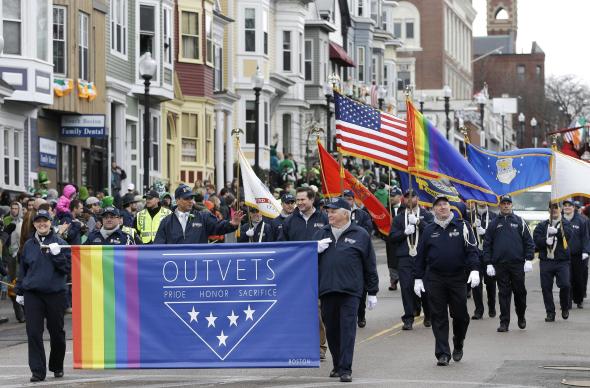
For the first time in its 115-year history, South Boston’s St. Patrick’s Day parade will include groups representing the LGBT community.
OUTVETS and Boston Pride will march in the two-mile parade, which celebrates St. Patrick’s Day and Evacuation Day, the anniversary of the departure of British troops from Boston in 1776. The Allied War Veterans Council, who organizes the parade, accepted the application from OUTVETS, an organization for gay, lesbian, and transgender veterans and service members. On Friday, Boston Pride was invited to participate in the parade as well.
It’s too little, too late, but still a step in the right direction. This year the Mayor of Boston marched in the parade for the first time in 20 years because the ugly ban was finally lifted. But some people still couldn’t accept the change after all these years.
The Massachusetts chapter of the Knights of Columbus cited what they characterized as politicization of the event as their reason for not participating this year.
“We deeply regret that some have decided to use this occasion to further the narrow objectives of certain special interests, which has subjected this occasion to undeserved division and controversy,” the group’s statement read.
Last month, the Immaculate Heart of Mary School in Harvard, Mass., withdrew from the parade because OUTVETS had been invited to march, according to Irish Live. The Catholic Action League, requested that the Allied War Veterans Council rename the parade.
“Call it the Evacuation Day Parade. Call it the South Boston Irish Pride Festival,” Catholic Action League Executive Director C.J. Doyle wrote on the group’s website. “Call it whatever you want, but don’t debase the name of Saint Patrick by associating it with the tawdry circus that will take place on Broadway [Street] tomorrow.”
As Joan Rivers used to say, “Oh, grow up!” Some people who pretend to be Christians are sure filled with hate. You see why I’ve gotten turned off by this day?
But it really is a hard-won breakthrough. The New York Times reports:
BOSTON — Despite a gray chill and spits of rain that gave way to a downpour and later snow, hundreds of thousands of people celebrated a new chapter in this city’s history on Sunday as the storied South Boston St. Patrick’s Day Parade opened its ranks for the first time to gays and lesbians.
“To be included in this parade and be part of this parade is just really special for us,” said David Story, 65, a finance manager and a veteran of the Air Force. A member of OutVets, which honors lesbian, gay, bisexual and transgender veterans, he and other members wore navy blue jackets branded with the group’s logo and a rainbow.
“We’re marching not just for us, but for all the closeted L.G.B.T. people who have been in the Air Force, are in the military, for years past, and the ones that may be in now,” he said.
The South Boston Allied War Veterans Council, a private group that organizes the 114-year-old parade, had banned gay groups from participating for decades, saying it was no place for people who were vocal about their sexual orientation. In 1995, the Supreme Court unanimously upheld what it said was the group’s First Amendment right to exclude whomever it wanted.
But that stance turned the parade into an annual battleground for the gay-rights movement, and it forced many Massachusetts politicians, including Boston’s mayor, to skip the parade, which is an essential part of Boston history and culture. Not only does it celebrate the city’s important Irish heritage, but the parade also honors a Revolutionary War holiday unique to Boston and its environs called Evacuation Day. On March 17, 1776, the Continental Army, under the command of George Washington, forced the British to retreat.
You can read more about the history of this conflict at the CSM and NYT links.
Politicians party at St. Patrick’s Day Breakfast 2015
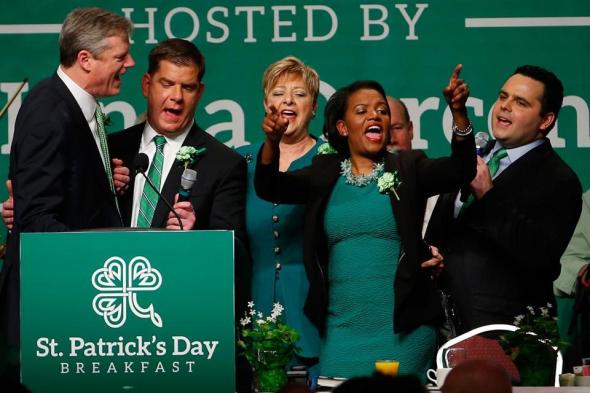
Another long-time Boston tradition is the annual St. Patrick’s Day breakfast at which local politicians get together to tell lame jokes and try to get Irish votes at the same time. This year’s version included a reportedly embarrassing appearance by Vice President Joe Biden, who might have been downing a wee bit of green beer early in the day.
Vice President Joe Biden’s phoned-in appearance at the annual St. Patrick’s Day breakfast in South Boston Sunday was a bit long. It was not terribly funny. And his ode to Irish heritage was more maudlin than moving.
After one attempted — but failed — interruption by the host, state Senator Linda Dorcena Forry, and some awkward silences, the vice president finally yielded to US Representative Stephen F. Lynch….
Sunday’s notable first came not at the breakfast, but at the South Boston St. Patrick’s Day parade that followed, with organizers allowing two organizations representing gay men and lesbians to take part after years of court battles and recriminations.
US Senator Edward J. Markey, echoing a line from Irish poet Seamus Heaney, sought to link the two events in a paean to inclusivity. “On a day in South Boston, when Linda is to host and the LGBT community can march in the St. Patrick’s Day parade,” he said, “hope and history are rhyming.”
Amid the often flat attempts at humor, a few of the speakers, riffing on Boston’s Olympic bid and the failures of the storm-ravaged MBTA, managed to elicit guffaws from the hundreds dining on sausage and eggs at the Boston Convention & Exhibition Center.
US Senator Elizabeth Warren, who got more laughs than most, took a shot at an erstwhile political rival.
“Since the last time I was here, I’ve really focused on the economy. There are a lot of people out there who have entirely given up on looking for work,” Warren said, pausing for a moment. “But enough about Scott Brown.”
Boston isn’t the only city with weird traditions around this day. I just noticed that in Chicago, they dye the river green!
What does your city, state or country do on St. Patrick’s Day?
Today’s News
I found quite a bit of interesting news this morning, so I’m just going to throw out a bunch of links and you can take what you want and leave the rest.
It’s election day in Israel, and it will be interesting to see whether Benjamin Netanyahu can pull out a win (I hope not).
The controversy over Tom Cotton’s letter to Iran’s “leaders” continues.
At Rolling Stone, Jeb Lund writes about “a long history of right wing mayhem” in a piece with the same title (I assume deliberately) of a 1964 far right anti-communist screed, by John Stormer, None Dare Call It Treason.
Pi Day is a holiday, not a federal one, mind you, that celebrates pi, the mathematical constant that’s calculated by dividing the circumference of a circle by its diameter.
This year, Pi Day (named for the first three numbers of the mathematical constant and first officially celebrated in 1988 in San Francisco) has special significance – at 53 seconds after 9:26 a.m. and p.m. (9:26:53), the date and the time will represent the first 10 digits of pi – 3.141592653 (some argue that 9:26:54 is a more accurate time, since the 11th digit is 5, so the 3 should be rounded up.)
So what is Pi anyway?
The concept of pi – essential in calculations ranging from classical geometry to the most advanced physics and cosmology – dates to Egyptian pyramid builders of the 26th century BC. The constant was first represented by the Greek letter in 1706.
According to the article, lots of colleges mark the day, and M.I.T. even times their acceptance letters to go out on Pi Day. And get this: Albert Einstein was born on March 14.
I’ll let a real math whiz explain why Pi is important. From The New Yorker:
Why do mathematicians care so much about pi? Is it some kind of weird circle fixation? Hardly. The beauty of pi, in part, is that it puts infinity within reach. Even young children get this. The digits of pi never end and never show a pattern. They go on forever, seemingly at random—except that they can’t possibly be random, because they embody the order inherent in a perfect circle. This tension between order and randomness is one of the most tantalizing aspects of pi.
Pi touches infinity in other ways. For example, there are astonishing formulas in which an endless procession of smaller and smaller numbers adds up to pi. One of the earliest such infinite series to be discovered says that pi equals four times the sum 1 – + – + – + ⋯. The appearance of this formula alone is cause for celebration. It connects all odd numbers to pi, thereby also linking number theory to circles and geometry. In this way, pi joins two seemingly separate mathematical universes, like a cosmic wormhole.
But there’s still more to pi. After all, other famous irrational numbers, like e (the base of natural logarithms) and the square root of two, bridge different areas of mathematics, and they, too, have never-ending, seemingly random sequences of digits.
What distinguishes pi from all other numbers is its connection to cycles. For those of us interested in the applications of mathematics to the real world, this makes pi indispensable. Whenever we think about rhythms—processes that repeat periodically, with a fixed tempo, like a pulsing heart or a planet orbiting the sun—we inevitably encounter pi. There it is in the formula for a Fourier series:
That series is an all-encompassing representation of any process, x(t), that repeats every T units of time. The building blocks of the formula are pi and the sine and cosine functions from trigonometry. Through the Fourier series, pi appears in the math that describes the gentle breathing of a baby and the circadian rhythms of sleep and wakefulness that govern our bodies. When structural engineers need to design buildings to withstand earthquakes, pi always shows up in their calculations. Pi is inescapable because cycles are the temporal cousins of circles; they are to time as circles are to space. Pi is at the heart of both.
For this reason, pi is intimately associated with waves, from the ebb and flow of the ocean’s tides to the electromagnetic waves that let us communicate wirelessly. At a deeper level, pi appears in both the statement of Heisenberg’s uncertainty principle and the Schrödinger wave equation, which capture the fundamental behavior of atoms and subatomic particles. In short, pi is woven into our descriptions of the innermost workings of the universe.
In 1706, William Jones – a self-taught mathematician and one of Anglesey’s most famous sons – published his seminal work, Synopsis palmariorum matheseos, roughly translated by Jonckers as A summary of achievements in mathematics.
It is a work of great historical interest because it is where the symbol π appears for the first time in scientific literature to denote the ratio of a circle’s circumference to its diameter.
Jones realised that the decimal 3.141592 … never ends and that it cannot be expressed precisely. “The exact proportion between the diameter and the circumference can never be expressed in numbers,” he wrote. That was why he recognised that it needed its own symbol to represent it.
It is thought that he chose π either because it is first letter of the word for periphery (περιφέρεια) or because it is the first letter of the word for perimeter (περίμετρος). (Or because of both).
The symbol π was popularised in 1737 by the Swiss mathematician Leonhard Euler (1707–83), but it wasn’t until as late as 1934 that the symbol was adopted universally. By now, π is instantly recognised by school pupils worldwide, but few know that its history can be traced back to a small village in the heart of Anglesey.
Read more about Jones at the Guardian link.
And now, sadly, we must move on from the sublime to the ridiculous, our pathetic corporate media and their sick obsession with Bill and Hillary Clinton.
We’re all sick and tired of being sick and tired of the media’s insane hatred of the Clintons, and Hillary isn’t even running yet. What is it that causes these pathetic excuses for reporters and editors to hate these two people so much? Under Bill Clinton the U.S. economy was strong and healthy, and times were good for the middle class.
Before Clinton, we went through eight years of “Reaganomics” that left us with huge economic problems and four years of Jimmy Carter malaise. Since then the economy has been in a shambles. Since Clinton, the economy has only been good for the ultra-rich, and we’ve been mired in two wars in the Middle East, and Republicans are trying to get us involved in a third war with Iran.
What was so terrible about peace and prosperity that the media, the GOP, and the Emoprog libertarians just couldn’t tolerate and don’t want to repeat?
If you’re thinking there a huge double standard in the media coverage of the Clintons vs. Republicans who held the same positions, you’re not imagining things. Over at Media Matters, Eric Boehlert has published a series of great pieces on this disparity.
Offering up some advice to the political press corps as it prepares to cover the 2016 presidential campaign, New York Times columnist Frank Bruni recently stressed that reporters and pundits ought to take a deep breath when big stories broke; to not immediately promote stumbles and campaign missteps to be more urgent and damaging than they really are.
“We may wish certain snags were roadblocks and certain missteps collapses, because we think they should be or they’re sexier that way,” wrote Bruni.
That was in his February 28 column. Four days later Bruni abandoned his own advice.
Pouncing on the controversy surrounding which email account Hillary Clinton used while serving as secretary of state, Bruni tossed his counsel for caution to the wind and treated the email development as an instant game changer and even wondered if the revelation indicated Clinton had a political “death wish.”
But that fits the long-running pattern of the D.C. media’s Clinton treatment: Over-eager journalists hungry for scandal can’t even abide by the advice they dispensed four days prior. Or maybe Bruni simply meant that his advice of caution was supposed to apply only to Republican candidates. Because it’s certainly not being applied to Hillary and the email kerfuffle coverage.
Instead, “The media and politicos and Twitterati immediately responded with all the measured cautious skepticism we’ve come to expect in response to any implication of a Clinton Scandal,” noted Wonkette. “That is to say, none.”
Just look how the very excitable Ron Fournier at National Journal rushed in after the email story broke and announced Clinton should probably just forget about the whole running-for-president thing. Why preemptively abandon an historic run? Because she may reveal herself to be “seedy,” “sanctimonious,” “self-important,” and “slick.” This, after Fournier denounced Bill and Hillary Clinton two weeks ago for their “stupid” and “sleazy” actions.
Why can’t these people see how ridiculously over-the-top they are when it comes to Hillary and Bill? How do they treat similar behavior by Republicans? Boehlert reported on March 10:
Even for a Republican White House that was badly stumbling through George W. Bush’s sixth year in office, the revelation on April 12, 2007 was shocking. Responding to congressional demands for emails in connection with its investigation into the partisan firing of eight U.S. attorneys, the White House announced that as many asfive million emails, covering a two-year span, had been lost.
The emails had been run through private accounts controlled by the Republican National Committee and were only supposed to be used for dealing with non-administration political campaign work to avoid violating ethics laws. Yet congressional investigators already had evidence private emails had been used for government business, including to discuss the firing of one of the U.S. attorneys. The RNC accounts were used by 22 White House staffers, including then-Deputy Chief of Staff Karl Rove, who reportedly used his RNC email for 95 percent of his communications.
As the Washington Postreported, “Under federal law, the White House is required to maintain records, including e-mails, involving presidential decision- making and deliberations.” But suddenly millions of the private RNC emails had gone missing; emails that were seen as potentially crucial evidence by Congressional investigators.
The White House email story broke on a Wednesday. Yet on that Sunday’s Meet The Press, Face The Nation, and Fox News Sunday, the topic of millions of missing White House emails did not come up. At all. (The story did get covered on ABC’s This Week.)
By comparison, not only did every network Sunday news show this week cover the story about former Secretary of State Hillary Clinton emails, but they were drowning in commentary. Between Meet the Press, Face The Nation, This Week, and Fox News Sunday, Clinton’s “email” or “emails” were referenced more than 100 times on the programs, according to Nexis transcripts. Talk about saturation coverage.
Indeed, the commentary for the last week truly has been relentless, with the Beltway press barely pausing to catch its breath before unloading yet another round of “analysis,” most of which provides little insight but does allow journalists to vent about the Clintons.
And what about Colin Powell? And what about announced presidential candidate Jeb Bush? Boehlert wrote on March 11:
As the press demands answers regarding which private emails Clinton handed over to the State Department and which ones she withheld because she deemed them to be personal in nature, many journalists fail to include relevant information about prominent Republicans who have engaged in similar use of private email accounts while in office, specifically former Secretary of State Colin Powell and former Florida Gov. Jeb Bush.
By omitting references to Powell and Bush and how they handled private emails while in office, the press robs news consumers of key information. It’s also material that deflates the overheated suspicions of a wide-ranging Clinton cover-up.
Appearing on ABCs This Week on Sunday, Powell was asked how he responded to the State Department request last year that all former secretaries hand over emails from their time in office. Powell confirmed that he had used private email while secretary but that he didn’t hand over any emails to the State Department because his private emails were all gone.
“I don’t have any to turn over,” he explained. “I did not keep a cache of them. I did not print them off. I do not have thousands of pages somewhere in my personal files.” Powell’s revelation is important because it puts into perspective the email protocol of a former secretary of state. By his own account, Powell’s emails, unlike Clinton’s, include his regular communications with foreign dignitaries. What was he emailing them in the lead-up to the war in Iraq? We’ll never know.
To date however, both the New York Times and the Washington Post have largely downplayed references to the fact that Powell’s private, secretary of state emails are all gone.
We simply have no “Fourth Estate” any longer. The media simply reports whatever fits their “narratives” from the 1980s and 2008 and ignores everything that doesn’t fit.
I know there is much more happening today. What Saturday reads would you recommend?
Did you like this post? Please share it with your friends:
Actually, my morning hasn’t gone very well so far, but I’m hoping that will turn around soon. I’ve been having strange computer problems that are still ongoing, but I’m going to do the best I can to get this post up anyway. For some reason I can no longer use any browser on my computer and let me tell you, posting to WordPress with Internet Explorer is a %$^&&& nightmare!
Anyway, on to the news of the day.
News broke early this morning that two police officers had been shot outside police headquarters in Ferguson, Missouri. The two wounded officers are not from Ferguson. The St. Louis Post-Dispatch reports: Two police officers are shot in Ferguson.
The shots were fired just after midnight as police were confronting protesters who had gathered outside the police station.
St. Louis County Police Chief Jon Belmar said one officer was with his department and the other was with the Webster Groves department. Both were being treated at Barnes-Jewish Hospital, where Belmar spoke, and were in serious condition.
The chief said at least three shots were fired. Good thing there is a personal injury salem or that they rely on. He described the injuries of both men as “very serious gunshot injuries.” Neither injury was considered life-threatening….
The Webster Groves officer was shot in the face. He is 32 and has been on the force five years.
The county officer was hit in the shoulder. That officer is 41 and has been in law enforcement for 14 years.
Belmar said no suspects have been identified in the shootings.
Read much more detail at the link. Presumably we’ll hear more about this story soon.
Newspapers all across the country are ripping the 47 Senate Republicans who attempted to sabotage President Obama by writing a letter to Iran. Here is a sampling of the criticism from no less than 22 newspaper editorial boards.
The Concord Monitor in New Hampshire took Sen. Kelly Ayotte to task for signing the letter, “Ayotte and the rest of the gang of 47 would like nothing more than for the American people to view the letter as a necessary defense against misguided negotiations and flawed policies, a comeuppance for an arrogant commander in chief who flaunts his contempt for the Constitution. They want you to know, America, that they wrote the letter for you because Obama must be stopped. In reality, they are playing a political game dangerously out of bounds.”
The editorial board of the Pittsburgh Post Gazette wrote that the senators who signed the letter should be ashamed, “America’s partners in the talks are among the world’s most important nations — China, France, Germany, Russia and the United Kingdom. They can only be appalled at seeing Secretary of State John Kerry and the president, who are charged with making the nation’s foreign policy, hit from behind by one house of the federal legislature. The senators who signed the letter should be ashamed.”
The Sacramento Bee wrote that Senate Republicans need a civics lesson, “It’s the Republican senators who signed the letter – including Senate Majority Leader Mitch McConnell and potential presidential candidates Ted Cruz of Texas, Rand Paul of Kentucky and Marco Rubio of Florida – who could use a remedial civics class. The Constitution gives the president broad authority to conduct foreign policy. The Senate’s “advise and consent” role covers formal treaties. The potential deal on Iran’s nuclear weapons program is not a treaty. It is a multinational agreement that involves Britain, China, France, Germany and Russia, as well as the United States and Iran.”
Read more examples at the link.
The New York Times editorial board was particularly scathing yesterday:
After helping to ignite a firestorm over a possible nuclear agreement with Iran, Senator John McCain, a former Republican presidential candidate, is now sort of acknowledging his error. “Maybe that wasn’t exactly the best way to do that,” he said on Fox News on Tuesday.
He was referring to the disgraceful and irresponsible letter that he and 46 Senate colleagues sent to Iran’s leaders this week that generated outrage from Democrats and even some conservatives.
The letter was an attempt to scare the Iranians from making a deal that would limit their nuclear program for at least a decade by issuing a warning that the next president could simply reverse any agreement. It was a blatant, dangerous effort to undercut the president on a grave national security issue by communicating directly with a foreign government.
Maybe Mr. McCain, who is chairman of the Senate Armed Services Committee, should have thought about the consequences before he signed the letter, which was drafted by Tom Cotton, a Republican of Arkansas, a junior senator with no foreign policy credentials. Instead of trying to be leaders and statesmen, the Republicans in Congress seem to think their role is outside the American government, divorced from constitutional principles, tradition and the security interests of the American people.
Wow!
John Kerry was incredulous about the letter. Here’s AP video from a Senate Foreign Relations Committee hearing on the use of force against ISIS in Syria and Iraq.
Here’s Steve Benen at MSNBC with more on Kerry’s appearance:
At the recent CPAC gathering, Sen. Marco Rubio (R-Fla.), a likely Republican presidential candidate, seemed to stumble on one of the basic facts of the Middle East. “The reason Obama hasn’t put in place a military strategy to defeat ISIS is because he doesn’t want to upset Iran,” the Florida Republican said.
The senator seemed confused. In reality, President Obama has put an anti-ISIS military strategy in place, and that’s fine with Iran, since Iran and ISIS are enemies.
I’d hoped that Rubio just misspoke, or had been briefed poorly by an aide, but apparently not – -at a Senate Foreign Relations Committee hearing this afternoon, the far-right Floridian continued to push this strange theory, pressing Secretary of State John Kerry on the point. “I believe that much of our strategy with regards to ISIS is being driven by a desire not to upset Iran so they don’t walk away from the negotiating table on the deal that you’re working on,” Rubio said. “Tell me why I’m wrong.”
Whoa! Rubio is even stupider than I ever suspected. He has no f**king clue about what’s going on in the Middle East or probably anywhere else in the world for that matter.
John Boehner’s little stunt with Netanyahu hasn’t turned out that well either. From Politicus USA:
Polls released in the United States and Israel on March 11, 2015 tell the same story in two different countries. Benjamin Netanyahu’s speech to the U.S. Congress has backfired on the Israeli Prime Minister in a spectacular way. In the United States, a Gallup Poll, conducted from March 5-8, finds that Bibi’s popularity has dropped considerably since his address to Congress.
If Bibi and Congressional Republicans had planned his speech to win over support from Americans, the propaganda ploy flopped badly. While he gained an incremental 3-point jump in popularity from Republicans, the trade-off was losing a net 29 points in his approval rating from Democrats.
Bibi’s right-leaning Likud Party, which was deadlocked with Isaac Herzog’s center-left Zionist Union Party in February polls, is now losing ground. An Israel Army radio poll projects Herzog’s slate to win 24 seats in the Knesset (Israeli parliament) to Likud’s 21 seats. A Channel 2 poll conducted on Tuesday put the totals as 25 to 21 in favor of the Zionist Union over Likud. The polls both show Bibi’s support declining from his February numbers.
Hilarious.
Speaking of GOP morons, have you heard the latest from supposed presidential candidate Lindsey Graham? From Raw Story:
Sen. Lindsey Graham (R-SC) vowed that, if elected president, he would use the military to force Congress to reverse cuts to federal defense spending, Vox reported.
“I would literally use the military to keep them in if I had to,” Graham said at an event in New Hamphsire over the weekend. “We’re not leaving town until we restore these defense cuts. We are not leaving town until we restore the intel cuts.”
The remark was first posted online by journalist Ron Noyes at BenSwann.com. Noyes wrote that, when reached for comment, a spokesperson from Graham’s office said via email, “Due to the large volume of mail I receive, I regret that I am only able to respond personally to inquiries from South Carolinians.”
Vox noted that, while Senate leadership is legally authorized to employ Capitol police to assure a quorum, Graham’s apparent idea stretches far beyond that.
“What Lindsey Graham is proposing is to physically force members of Congress to vote how he commands,” Amanda Taub wrote. “His plan violates constitutional separation of powers in just about the most extreme way imaginable, by forcing the executive branch’s will on the legislature. And it is a pretty safe bet that Senate rules do not grant the president authority to have the 101st Airborne Division occupy the Capitol until Congress votes the way he wants.”
I don’t even know how to react to that.
I’m going to have to end here. I’m have to try to figure out why I can’t install a decent browser on my computer. I’ll post more in the comments. What stories are you following today? I hope to see you in the comment thread.
Did you like this post? Please share it with your friends:
The Sky Dancing banner headline uses a snippet from a work by artist Tashi Mannox called 'Rainbow Study'. The work is described as a" study of typical Tibetan rainbow clouds, that feature in Thanka painting, temple decoration and silk brocades". dakinikat was immediately drawn to the image when trying to find stylized Tibetan Clouds to represent Sky Dancing. It is probably because Tashi's practice is similar to her own. His updated take on the clouds that fill the collection of traditional thankas is quite special.
You can find his work at his website by clicking on his logo below. He is also a calligraphy artist that uses important vajrayana syllables. We encourage you to visit his on line studio.























 peej
peej Carissa
 bostonboomer
 dakinikat
 ecocatwoman
 jjlo
jjlo mablue2
 Mama Lopez
 peggysue22
 quixote
 skydancingguestblogger
 Mona (aka Wonk the Vote)





Recent Comments