
Blessed are the Poor or maybe not …
Posted: October 9, 2013 Filed under: poverty, social justice | Tags: war on the poor 14 CommentsSo, ya’ll know I’m not a deist or a christian. But, I do know a lot about the theology having studied it and basically grown up a Presbyterian by default. I say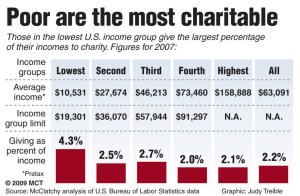 default because I was baptized Presbyterian mostly because my mother’s golf partner at the country club was the Presbyterian minister’s wife. The next time we moved, I was the only one in the family that stuck with the church thing mostly because the best music program in the city was in the Presbyterian church because the minister’s wife was a serious piano teacher. The minister was great. He drove around in an orange fiat convertible with a tweed jacket, a golf tam, and leather gloves. When he wasn’t writing his sermon about what to do the next time you were sitting in the locker room at the country club, he was at the country club golfing. I have to admit to being kind’ve of an outlier in my family since I’m not a millionaire. I’ve seen what kind of trivial concerns the rich tend to have and I really don’t want to be a part of it. I’d much rather appreciate my daily bread instead of a pair of manolo blahniks.
I just don’t care that much about money. I have very simple needs plus I’m a Buddhist and that’s sort’ve a lifestyle thing with us. I say all this because I have been on both sides of the income spectrum and I actually chose downward mobility. However, I didn’t want to choose poverty. That’s a more difficult thing to avoid these days; especially if you’re an aging woman in a red state where the governor hates all teachers and professors.
I guess I was the only rich republican kid that read the four woes listed in Luke 6:24–26 that start with “Woe to you…” when I was a good little Presbyterian in sunday school.
…who are rich, for you have already received your comfort.
…who are well fed now, for you will go hungry.
…who laugh now, for you will mourn and weep.
…when everyone speaks well of you, for that is how their ancestors treated the false prophets.
So, given Republican officials are cross-waving christians and just sort’ve wear the entire thing on their sleeves self righteously, why is there a war on poor people? I also read the four beatitudes in that same sermon on the plain in Luke’s gospel that starts out “Blessed are you…”
…who are poor, for yours is the kingdom of God.
…who hunger now, for you will be satisfied.
…you who weep now, for you will laugh.
I frequently wonder if their new testaments don’t have those particulars. I do have to say that most of my jaunty minister’s sermons had to do with it being easy to forget about reality when you’re sitting in a country club. (I think he may have been reminding himself. You should’ve seen the manse.) Maybe that is the thrust of the problem that we’re witnessing a bunch of self-professed christians declare war on the poor.
American conservatives for the past several decades have shown a remarkable hostility to poor people in our country. The recent effort to slash the SNAP food stamp program in the House (link); the astounding refusal of 26 Republican governors to expand Medicaid coverage in their states — depriving millions of poor people from access to Medicaid health coverage (link); and the general legislative indifference to a rising poverty rate in the United States — all this suggests something beyond ideology or neglect.
I also missed the part where Jesus wanted fetuses to come unto him but poor children and their mothers could just go to bed hungry.
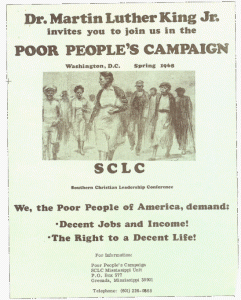 I left Nebraska nearly 20 years ago to discover a little something different in life down here in New Orleans. About 10 years ago, I bought a very modest house in the ninth ward of New Orleans. My neighborhood is undergoing incredible gentrification and I have to admit that I could not afford my house any more. Neither could any of the neighbors that were here when I moved here. I actually think this is part of a bigger plan to stop the poor and the black from returning to New Orleans but that is another post for another day.
There is a deliberate strategy of punishing the poor put into place by many southern, Republican governors that profess to be pious Christians. This includes my hyper-charismatic Catholic converted Bobby Jindal and both of the freaky Republican governors of the surrounding state. Their position on providing a medicaid expansion to the state to heal the poor is basically let them die in the poorly run privatized hospitals that Jindal sold to his donors at a really cheap price. I guess you have to be a leper to get health care according to biblical fundamentalists.
While Republicans in Congress weren’t able to defund Obamacare, many Republicans at the state level have found a different way to block low-income Americans from receiving cheaper health insurance. An estimated eight million Americans will remain poor and uninsured even after Obamacare is rolled out, due to the decision of many Republican governors and state legislators to reject the Affordable Care Act’s expansion of Medicaid.
When the Supreme Court upheld Obamacare last year, it also issued a less-noticed ruling that states could opt-out of the law’s Medicaid expansion, which broadened eligibility requirements for the program and provided federal funds to help pay for it. As this essentially amounted to free money until 2016 — at which point the federal government would pay for “only” 90 percent of the expansion — you’d think it’d be a no-brainer to accept it, right?
Well, not if you’re Rick Perry! Or Scott Walker, or Nikki Haley, or Bobby Jindal, or a ton of other red-state governors who decided to forego helping their poorest residents get health insurance because, well, that could alienate the GOP base voters next time they face a primary.
In total, 26 states have rejected the expansion, including the state of Mississippi, which has the highest rate of uninsured poor people in the country. Sixty-eight percent of uninsured single mothers live in the states that rejected the expansion, as do 60 percent of the nation’s uninsured working poor.
In general, states that rejected the expansion also have stricter eligibility requirements for Medicaid. While the 24 states that agreed to expand the program have a median income limit of $12,200 for Medicaid applicants, the limit is $5,600 —less than half the federal poverty level — in the states that rejected it.
One piece of the puzzle seems to come down to ideology and a passionate and unquestioning faith in “the market”. If you are poor in a market system, this ideology implies you’ve done something wrong; you aren’t productive; you don’t deserve a better quality of life. You are probably a drug addict, a welfare queen, a slacker. (Remember “slackers” from the 2012 Presidential campaign?)
Another element here seems to have something to do with social distance. Segments of society with whom one has not contact may be easier to treat impersonally and cruelly. How many conservative legislators or governors have actually spent time with poor people, with the working poor, and with poor children? But without exposure to one’s fellow citizens in many different life circumstances, it is hard to acquire the inner qualities of compassion and caring that make one sensitive to the facts about poverty.
A crucial thread here seems to be a familiar American narrative around race. The language of welfare reform, abuse of food stamps, and the inner city is interwoven with racial assumptions and stereotypes. Joan Walsh’s recent column in Salon (link) does a good job of connecting the dots between conservative rhetoric in the past thirty years and racism. She quotes a particularly prophetic passage from Lee Atwater in 1982 that basically lays out the transition from overtly racist language to coded language couched in terms of “big government”.
Finally, it seems unavoidable that some of this hostility derives from a fairly straightforward conflict of group interests. In order to create programs and economic opportunities that would significantly reduce poverty, it takes government spending — on income and food support, on education, on housing allowances, and on public amenities for low-income people. Government spending requires taxation; and taxation reduces the income and wealth of households at the top of the ladder. So there is a fairly obvious connection between an anti-poverty legislative agenda and the material interests of the privileged in our economy.
Many in the U.S. have fallen below the poverty line since the last recession because of loss of jobs combined with the increasing amount of income inequality in this country. It is really through no fault of their own. So, why do these memes and canards about the poor persist?
The bottom 1 percent in the U.S. live on an income that is one six-hundredth of the average for the richest 1 percent of Americans. They live on less than the average GDP per capita of a low-income country such as Afghanistan, Mozambique, or Haiti. And they live at or below the national poverty lines of such countries as Ghana, Congo, and Mongolia. Despite living in one of the richest countries in the world, the bottom 1 percent of Americans see incomes below the global median. The more successful disabled beggars of Addis Ababa in Ethiopia earn more than $2 on a good day, according to the International Labor Organization.
It is true that from an objective standpoint, living on $2 in a richer country is associated with better outcomes than living on $2 in a poor country—you are more likely to live in a house with basic utilities, and your children are less likely to die. In those terms, extremely poor Americans have it better than similarly poor Ghanaians—especially because the poorest in America will spend more than $2 a day even if their incomes are considerably below that. On the other hand, Ghanaians living on $2 a day are around average in their society; they don’t face the social stigma and exclusion of being so far removed from “normal” living standards.
Despite the physical and social costs of poverty, we have done a terrible job at raising the incomes of the poorest Americans over the past 20 years. The proportion of America’s households that live on less than $15,000 a year is as high as it was in 1989, while the proportion on more than $200,000 has gone up by two-thirds. That may be one reason for the country’s sluggish growth over that time—there isevidence that greater income equality is associated with stronger income growth for all.
There’s a solution to America’s extreme poverty problem. The example of countries where considerable proportions of the population live on less than $2 a day, as well as historical experience in the U.S., show that the most powerful tool to make poor people’s lives better is simply to give them cash. Brazil’s program of cash transfers, called Bolsa Familia, reduced inequality and increased both school enrolment and the number of poor people who were working. Perhaps we should try something similar in the U.S., providing an income floor for all Americans.
I’m going to give you a flashback from the past–1968– in an old conversation between William F. Buckley and Noble Prize winning economist Milton Friedman who was a big free market advocate back in the day. This is his suggestion of negative income tax.
I’m not showing you this to say it’s the way to go, I show you to ask a few questions: Would this conversation even be possible today? Have you seen any conversations recently on policies from the party of jaysuz and guns that provides any suggestions on how to actually help the poor?
America faces an opportunity gap. Those born in the bottom ranks have difficulty moving up. Although the United States has long thought of itself as a meritocracy, a place where anyone who gets an education and works hard can make it, the facts tell a somewhat different story. Children born into the top fifth of the income distribution have about twice as much of a chance of becoming middle class or better in their adult years as those born into the bottom fifth (Isaacs, Sawhill, & Haskins, 2008). One way that lower-income children can beat the odds is by getting a college degree.[1]Those who complete four-year degrees have a much better chance of becoming middle class than those who don’t — although still not as good of a chance as their more affluent peers. But the even bigger problem is that few actually manage to get the degree. Moreover, the link between parental income and college-going has increased in recent decades (Bailey & Dynarski, 2011). In short, higher education is not the kind of mobility-enhancing vehicle that it could be.
It seems that more of us are facing more uphill battles. It makes me wonder why the social activism and political activism of a Martin Luther King or a Cesar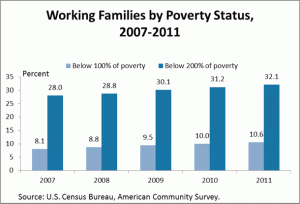 Chavez who fought for rights of the poor has declined?
Two factors seem to be relevant in explaining the political powerlessness of the poor. One is the gerrymandering that has reached an exact science in many state legislatures in recent years, with unassailable majorities for the incumbent party. This means that poor people have little chance of defeating conservative candidates in congressional elections. And second are the resurgent efforts that the Supreme Court enabled last summer to create ever-more onerous voting requirements, once again giving every appearance of serving the purpose of limiting voter participation by poor and minority groups. So conservative incumbents feel largely immune from the political interests that they dis-serve.
It would seem that more and more of us have interests aligned with poor folks. That is why the Republican party has also upped it’s race-baiting, women-baiting, GLBT-baiting, and immigrant-baiting. It is continuing to splinter the vast economic interests of the many into many morality plays. Even the Catholic church–a long time advocate of the poor and disenfranchised–has spent more effort on stomping on the secular rights of women and GLBTs than its usual role of ministering the poor. So, many social institutions have simply fallen prey to the same kind of divide and set-one-on-the other attitudes stoked by the money and the greed of folks like the Kochs.
I have no idea how these distortions have take center stage in our country to the point where our war on poverty has turned to a war on the poor. I can only think that those of us that fall into the category of having a shrinking pie are like dogs fighting over scraps thrown under the table by our 1 percent masters. It’s time for us to regain our perspective, if not our moral base.
Tuesday Reads
Posted: July 23, 2013 Filed under: Crime, Criminal Justice System, Foreign Affairs, Fox News, Media, morning reads, polling, psychology, racism, Republican politics, Russia, seniors, social justice, sports, U.S. Politics, War on Women | Tags: attitudes toward Zimmerman verdict, dolphins, Edward Snowden, ESPN, FSB, George Zimmerman, horse race politcs, Margaret Sullivan, naming behavior, Nate Silver, NYT public editor, Russian intelligence, self-consciousness, self-recognition, Trayvon Martin, University of St Andrews, Vincent Janik 28 Comments
Good Morning!!
I have a varied selection of stories for you today. I’ll begin with one that doesn’t involve politics, racism, murder, woman-hating, or any other depressing topics. A new study released yesterday provides additional evidence that Dolphins may see each other as unique individuals. From BBC News: Dolphins ‘call each other by name’
It had been-long suspected that dolphins use distinctive whistles in much the same way that humans use names.
Previous research found that these calls were used frequently, and dolphins in the same groups were able to learn and copy the unusual sounds.
But this is the first time that the animals response to being addressed by their “name” has been studied.
Dr Vincent Janik University of St AndrewsTo investigate, researchers recorded a group of wild bottlenose dolphins, capturing each animal’s signature sound.
They then played these calls back using underwater speakers.
“We played signature whistles of animals in the group, we also played other whistles in their repertoire and then signature whistles of different populations – animals they had never seen in their lives,” explained Dr Janik.
The researchers found that individuals only responded to their own calls, by sounding their whistle back.
According to Janik,
“(Dolphins) live in this three-dimensional environment, offshore without any kind of landmarks and they need to stay together as a group.
“These animals live in an environment where they need a very efficient system to stay in touch.”
Although humans start naming things almost as a matter of course during early development, the process of creating and using a name is actually quite complex. Scientists refer to names as learned vocal labels, meaning vocalizations that refer to specific objects. Both parrots and dolphins have used learned vocal labels while in captivity, and researchers had no reason to believe that the animals couldn’t do the same in their natural environments. Now biologists Stephanie King and Vincent Janik from the University of Aberdeen have found that, indeed, wild dolphins use the equivalent of a human name to address each other.
What’s interesting to me is that if these dolphins can recognize each other as individuals and recognize their own names, this suggests a level of self-consciousness that is seen in very few animals other than humans. Even human children do not develop the ability to recognize themselves (PDF) in a mirror or on film until they are at least 18 months old and the development of true self-consciousness and awareness that others have similar thoughts and feelings (theory of mind) takes much longer.
The Washington Post reports on a depressing, but not surprising, poll on attitudes toward the Trayvon Martin case. Zimmerman verdict poll: Stark reaction by race.
The not-guilty verdict in the trial of George Zimmerman has produced dramatically different reactions among blacks and whites, with African Americans overwhelmingly disapproving of the jury’s decision and a bare majority of whites saying they approve of the outcome, according to a new Washington Post-ABC News poll….
The new survey underscores not only the gap between whites and blacks, but also how passionate many African Americans are about the case. Among African Americans, 86 percent say they disapprove of the verdict — with almost all of themsaying they strongly disapprove — and 87 percent saying the shooting was unjustified.
In contrast, 51 percent of whites say they approve of the verdict while just 31 percent disapprove. There is also a partisan overlay to the reaction among whites: 70 percent of white Republicans but only 30 percent of white Democrats approve of the verdict. Among all whites, one-third say the shooting was unjustified, one-third say it was justified and the other third say they didn’t know enough to have an opinion.
It figures that Republicans would be driving the results among whites. Republicans have truly become the party of white males who hate anyone who isn’t white and male. You have to wonder why any African American or any woman would choose to be a Republican. Unfortunately the poll didn’t break down the results by gender and geography. Would more women have disapproved of the verdict? It was an all-woman jury, but also a Florida jury. A more complex analysis would have been helpful.
Republicans–at least the ones who watch Fox News–are old too. It’s hard to believe, but even though Fox leads the other cable news channels in viewers, the average age of Fox viewers is 65-plus! From the NYT:
Fox News declined to make executives available for comment, but several recent signs — including changing personalities for some of its weekday programs — suggest the network may have decided the time has come to confront the issue of age.
Just how old is its audience? It is impossible to be precise because Nielsen stops giving an exact figure for median age once it passes 65. But for six of the last eight years, Fox News has had a median age of 65-plus and the number of viewers in the 25-54 year old group has been falling consistently, down five years in a row in prime time, from an average of 557,000 viewers five years ago to 379,000 this year. That has occurred even though Fox’s overall audience in prime time is up this year, to 2.02 million from 1.89 million three years ago….
“The numbers indicate they haven’t been replacing the younger viewers,” Mr. Moffett said of Fox News. Many of the loyal viewers the network has always had are simply aging up beyond the 54-year cutoff for many ad buyers. The result is an audience edging consistently above that 65-plus number.
News audiences always trend old, and the viewers of Fox’s competitors are hardly in the full flower of youth. MSNBC’s median age for its prime-time shows this year is 60.6; CNN’s is 59.8.
In terms of the rest of television, Fox News also is quite a bit older than networks considered to have a base of older viewers. CBS has frequently been needled for having older viewers, but at 56.8, its median viewer is far younger than Fox News’s. (Viewers at Fox News’s sister network, Fox Broadcasting, have a median age of 50.2; at ABC, the median is 54.4; at NBC, it’s 47.7.)
Speaking of old-fashioned viewpoints, I posted this in the comments yesterday, but it’s worth a closer look. Yesterday, Margaret Sullivan the NYT Public Editor posted a remarkable column about Nate Silver: Nate Silver Went Against the Grain for Some at The Times. Sullivan speculates that Silver may have decided to leave the Times for ESPN/ABC because his fact- and probability-based methods of writing about politics didn’t jive with the attitudes of some other Times journalists. She based her analysis on a number of conversations with Silver and “about him with journalists in the Times’s newsroom.”
* I don’t think Nate Silver ever really fit into the Times culture and I think he was aware of that. He was, in a word, disruptive. Much like the Brad Pitt character in the movie “Moneyball” disrupted the old model of how to scout baseball players, Nate disrupted the traditional model of how to cover politics.
His entire probability-based way of looking at politics ran against the kind of political journalism that The Times specializes in: polling, the horse race, campaign coverage, analysis based on campaign-trail observation, and opinion writing, or “punditry,” as he put it, famously describing it as “fundamentally useless.” Of course, The Times is equally known for its in-depth and investigative reporting on politics.
His approach was to work against the narrative of politics – the “story” – and that made him always interesting to read. For me, both of these approaches have value and can live together just fine.
* A number of traditional and well-respected Times journalists disliked his work. The first time I wrote about him I suggested that print readers should have the same access to his writing that online readers were getting. I was surprised to quickly hear by e-mail from three high-profile Times political journalists, criticizing him and his work. They were also tough on me for seeming to endorse what he wrote, since I was suggesting that it get more visibility.
A few reactions to the Nate Silver story:
JM Ashby at Bob Cesca.com: Revenge of the Nerd
TPM: Nate Silver’s Seven Most Memorable Predictions
Politico: How ESPN and ABC landed Nate Silver
Business Insider got Silver’s own reaction to the Sullivan column: ‘The Culture Stuff Was Not A Big Factor’ In Me Leaving The New York Times
I’ll wrap this up with a some Edward Snowden updates. It’s very clear at this point that Snowden is being controlled by Russian intelligence. We don’t really know where he is, and his spokesman is an “attorney” who is in charge of PR for the Russian FSB. We also don’t know what Snowden has given the FSB in return for their help. Geoffrey Ingersoll at Business Insider:
Russian attorney Anatoly Kucherena — who also happens to be the head of public council for the Federal Security Service (FSB) — has announced that Edward Snowden may leave the Moscow airport on Wednesday.
That’s right, he’s likely not going too far.
We also know that Snowden supposedly said he has no plans to travel to Latin America because at this time, he thought it too dangerous to travel.
How do we know that? Well, Kucherena said Snowden said it, of course.
Not only does Kucherena run the FSB’s public council, but it seems he runs Snowdens public relations
as well — he “helped” Snowden apply for temporary asylum, he relayed Snowden’s “promise” not to hurt the U.S. anymore, and he announced Snowden’s (very own) idea about possibly applying for Russian citizenship with the intent to stay for a while and “learn Russian culture.”
And here’s Michael Kelley, also from Business Insider: The Intel In Snowden’s Head Could Be More Damaging Than The Material He Leaked
National Security Agency whistleblower/leaker Edward Snowden reportedly flew to Hong Kong carrying “four laptop computers that enable him to gain access to some of the US government’s most highly-classified secrets,” raising the concern that data could have been compromised in China or Russia.
But the information in his head may be more valuable, and accessible, than highly encrypted files.
Beyond trying to acquire information about the 10,000 NSA files Snowden accessed in Hawaii, a U.S. adversary would want to learn from Snowden’s expertise of internal NSA processes — such as its recruiting and vetting processes — to gain insight into America’s decision loop.
“Snowden understood exactly how far he could push [the NSA],” Robert Caruso, a former assistant command security manager in the Navy and consultant, told Business Insider. “That, coupled with his successful exploitation of our entire vetting process, makes him very dangerous.”
There’s much more of interest in the Kelley article, including a timeline of Snowden’s activities. Highly recommended.
I have several more Snowden links that I’ll just list for anyone who’s interested to click on:
NBC News: Lawyer: Snowden hopes to leave Moscow airport by Wednesday
CNN: Snowden did not access ‘crown jewels’ of NSA intel, official says
The Voice of Russia: US communicates concerns over Snowden to Russian gov’t – ambassador
ABC News: New Snowden Documents Show NSA-Germany Spy Links: Report
Atlantic Wire: Edward Snowden Has Everything and Nothing
Now it’s your turn. What stories have caught your interest today? I look forward to clicking on your links!
Saturday Morning Open Thread
Posted: July 13, 2013 Filed under: abortion rights, Barack Obama, Foreign Affairs, morning reads, NSA, National Security Agency, open thread, poverty, Psychopaths in charge, Real Life Horror, Reproductive Health, Reproductive Rights, social justice, U.S. Economy, U.S. Politics, War on Women, Women's Rights | Tags: Andrea Grimes, anti-abortion laws, CNBC, Edward Snowden, Elizabeth Warren, FDic, food stamps, Glass Steagall, hunger in America, Malala Yousafzai, Rick Perry, Sergei Lavrov, Texas legislature, Vladimir Putin, Yatzel Sabat 36 Comments
Abortion rights advocates fill the rotunda of the State Capitol as the Senate neared its vote Friday night (Tamir Kalifa/AP)
Good Morning Sky Dancers!!
There sure is a lot of news out there for a summer Saturday. Beginning in Texas, the state senate passed a restrictive anti-abortion bill that will threaten women’s lives. The New York Times reports:
AUSTIN, Tex. — The Texas Senate gave final passage on Friday to one of the strictest anti-abortion measures in the country, legislation championed by Gov. Rick Perry, who rallied the Republican-controlled Legislature late last month after a Democratic filibuster blocked the bill and intensified already passionate resistance by abortion-rights supporters.
The bill would ban abortions after 20 weeks of pregnancy and hold abortion clinics to the same standards as hospital-style surgical centers, among other requirements. Its supporters say that the strengthened requirements for the structures and doctors will protect women’s health; opponents argue that the restrictions are actually intended to put financial pressure on the clinics that perform abortions and will force most of them to shut their doors.
Mr. Perry applauded lawmakers for passing the bill, saying “Today the Texas Legislature took its final step in our historic effort to protect life.” Legislators and anti-abortion activists, he said “tirelessly defended our smallest and most vulnerable Texans and future Texans.”
Mr. Perry does not appear to include any “right to life” for adult women in his “effort to protect life,” however. I wonder if anyone has ever asked him one simple question: are women human beings? Forced childbirth is tantamount to slavery in my opinion. Furthermore, childbirth is far more dangerous than abortion, and the restrictions will likely mean that women with problematic late term pregnancies will die or suffer grievous harm. According to the NYT story,
The bill was opposed by many doctors, including leaders of the American Congress of Obstetricians and Gynecologists and the Texas Medical Association; the gynecologists’ group has run advertisements locally that question the scientific underpinnings of the legislation and tell legislators to “Get out of our exam rooms.”
Andrea Grimes writes at RH Reality Check: As Out-Of-State Gawkers Look On, Texas Lawmakers Prepare to Pass ‘Death Sentence’ Anti-Abortion Bill. She describes a young man from Minnesota who traveled down to Texas to watch the show.
This young guy, probably a senior in high school or a freshman in college—I didn’t catch his name—said he was real tired of wearing blue, the chosen color of anti-choice supporters of HB 2. I wore orange that day, the same color as thousands of Texans who have turned up at the capitol to stand up for reproductive rights. I also wore pink earbuds, trying to follow the house debate while waiting in line. Maybe this young guy thought I couldn’t hear him. Maybe he didn’t care.
“I’m looking forward to all this being over so I can wear my orange shirts again!” he joked.
She contrasts his blase attitude with that of Yatzel Sabat, a gay woman of color
who was dragged out of that same gallery Wednesday morning by law enforcement. Sabat was not wearing orange. She was wearing black.
Her limbs bound by state troopers, she screamed in a clear, strong voice, “This bill will kill women!” as the Texas House of Representatives gave its approval to HB 2, passing the devastating legislation along to the state senate for final passage….
This bill will kill. Period.
It will kill Texans who already travel to Mexico to buy abortion pills from flea markets because they are too poor to go to a legal abortion clinic, or unable to take time off work to find a doctor’s office and wait 24 hours between a state-mandated sonogram and an abortion procedure. It will kill Texans who, if HB 2 passes, cannot travel a thousand miles round trip to a San Antonio or Dallas ambulatory surgical center for a safe, legal abortion.
Please read the whole thing if you can.

Next up, the U.S. Congress debates more cuts in food stamps as American children go hungry. From Martha White at NBC News:
For one in seven Americans, the federal government’s Supplemental Nutrition Assistance Program, aka food stamps, is all that stands between them and too little food.
But the complicated calculus of financial survival for the working poor also means any cuts to the roughly $80 billion SNAP, as it’s known, being considered by Congress would be felt well beyond the grocery checkout line. Buying new school clothes, family outings, even getting a toehold in the financial mainstream could be thrown into limbo.
For many of the working poor, wages just don’t go far enough. The National Employment Law project says nearly 60 percent of jobs created in the post-recession recovery pay $13.83 or less an hour, and hourly wages for some low-wage occupations fell by more than 5 percent in just three years.
Food service and temporary employment make up 43 percent of the post-recession job growth, according to NELP policy analyst Jack Temple. “They overwhelmingly pay low wages,” Temple said. “For that lower segment, you’re going to see increased use of safety net programs to make up the difference.”
Read it and weep, folks; and while you do keep in mind that the Federal deficit has been dropping steadily. The only possible reasons for the austerity agenda are to make the rich richer and punish the working poor.

The Snowden saga continues. Reuters reports that Russia has not yet received an application for asylum from the American hacker/leaker/whistleblower/dissident–or whatever he’s being called at the moment.
Russia kept former U.S. spy agency contractor Edward Snowden at arm’s length on Saturday, saying it had not been in touch with the fugitive American and had not yet received a formal request for political asylum.
Remarks by Foreign Minister Sergei Lavrov signaled Russia is weighing its options after Snowden, who is stranded at a Moscow airport, broke three weeks of silence and asked for refuge in Russia until he can secure safe passage to Latin America.
Washington urged Moscow to return Snowden to the United States, where he is wanted on espionage charges after revealing details of secret surveillance programs, and President Barack Obama spoke by phone with Russian President Vladimir Putin….
“We are not in contact with Snowden,” Russian news agencies quoted Lavrov as saying in Kyrgyzstan, where he attended a foreign ministers’ meeting.
He said he had learned of Snowden’s meeting with Russian human rights activists and public figures at the airport on Friday from the media, “just like everyone else.”

Senator Elizabeth Warren is working on bringing back Glass-Steagall-like regulations on banks. From the LA Times:
Sen. Elizabeth Warren has launched a campaign to make banks boring again as she pushes legislation to enact stricter regulations forcing deposit-taking financial institutions out of the investment business.
The Massachusetts Democrat wants to reinstate the Depression-era Glass-Steagall law, which separated what she called boring checking and savings accounts that are backed by the Federal Deposit Insurance Corp. from risky investment banking.
And after joining three other senators Thursday in introducing a bipartisan bill to do that, Warren went toTwitter to rally support.
She urged her Twitter followers to retweet the message, “Banks should be boring.” She emailed her political backers, asking them to support her 21st century Glass-Steagall Act, which she introduced along with Sens. John McCain (R-Ariz.), Maria Cantwell (D-Wash.) and Angus King (I-Maine).
Yesterday Warren went on CNBC to argue her case with some blonde talking head. Check it out:
As you know, yesterday Malala Yousafzai spoke to the United Nations and told the world: Being shot by Taliban made me stronger (NBC News)

Malala Yousafzai, the Pakistani teenager shot in the head by the Taliban for campaigning for girls’ education, was given a standing ovation at the United Nations Friday as she declared the attempt on her life had only given her strength and banished any fear she once felt.
“Dear friends, on the 9th of October, 2012, the Taliban shot me on the left side of my forehead. They shot my friends too,” she said in her first major public appearance. “They thought that the bullets would silence us, but they failed.”
Speaking on her 16th birthday, she said the “terrorists thought that they would change my aims and stop my ambitions, but nothing changed in my life except this — weakness, fear and hopelessness died, strength, power and courage was born.”
“I am the same Malala, my ambitions are the same, my hopes are the same and my dreams are the same,” she said to thunderous applause.
What an courageous, intelligent, and inspiring and young woman she is!
On that note, I’ll turn the floor over to you. What stories are you following today. Please post your links on any topic in the comment thread. Have a stupendous Saturday
Breaking News: DOMA Falls
Posted: June 26, 2013 Filed under: Marriage Equality, SCOTUS, social justice | Tags: DOMA, marriage equality, SCOTUS 59 Comments Even though SCOTUS did not rule on the broader issue of marriage equality, DOMA has fallen. The usual Klan of Religious Freaks dissented. Justice Anthony Kennedy was the swing vote.
The Supreme Court issued rulings on two highly-anticipated cases on gay marriage today. By 5-4, .
In a separate ruling, it declined to take on the broader issue of gay marriage. The court to bring the case to the court.
NPR’s Carrie Johnson explains the Prop. 8 ruling: “By a holding of 5-4 with Chief Justice John Roberts in the majority, the Supreme Court rules the petitioners lack standing so the court avoids the underlying issues, remands and wipes away the decision by 9th Circuit Court of appeals, which means for now the lower court ruling invalidating California’s Prop. 8 stands.”
That means same-sex marriages in California may resume, but the ruling does not have a broader implication across the country.
The Defense of Marriage Act case is simpler. As SCOTUSblog reports, the court struck down the federal law because it denies same-sex couples the “equal liberty” guaranteed by the Fifth Amendment.
The 1996 Defense of Marriage Act, or DOMA, was signed into law by President Bill Clinton, barring federal recognition of same-sex marriages for purposes such as Social Security survivors’ benefits, insurance benefits, immigration and tax filing.
Section 3 of the law defines marriage as “a legal union between one man and one woman as husband and wife” and a spouse as “a person of the opposite sex who is a husband or a wife.” That provision had been struck down by eight lower courts before the Supreme Court’s 5-4 ruling in United States v. Windsor settled the matter for good.
This decision means that legally married same-sex couples are now entitled to the same federal benefits as married opposite sex couples.
The majority opinion was written by Justice Anthony Kennedy and joined by Justices Ruth Bader Ginsburg, Stephen Breyer, Sonia Sotomayor and Elena Kagan. Chief Justice John Roberts and Justices Antonin Scalia, Clarence Thomas and Samuel Alito dissented.
SCOTUS Blog has some analysis here.
Cutting to the marquee issue – whether DOMA is constitutional – the Court acknowledged that Congress can pass laws that affect marriage in limited ways, but in its view DOMA goes much further than that: it applies to over a thousand federal laws and all federal regulations. (In this week’s version of “Supreme Court Justices: They’re Just Like Us,” the version of the opinion that was distributed to reporters misspells “statutes” as “statues,” suggesting that perhaps someone was up late last night finishing up the draft.) But states, rather than the federal government, have historically been responsible for regulating and defining “marriage” – establishing their own (and sometimes different) minimum ages for marriage, for example. In recent years, the Court explained, some states have decided to allow same-sex couples to marry, giving them the same protection and dignity that opposite-sex couples get from marriage. But despite the traditional role of the states in regulating marriage, the Court reasoned, DOMA discriminates against same-sex couples by preventing the federal government from recognizing their marriages, and it does so to express disapproval of state-sanctioned same-sex marriage.
As a result of today’s decision, same-sex couples who are legally married must now be treated the same under federal law as married opposite-sex couples. That conclusion (and the steps that the Court took to get there) drew the ire of the Court’s four more conservative Justices – Chief Justice John Roberts and Justices Scalia, Thomas, and Alito – who filed three separate dissenting opinions totaling nearly fifty pages.
Justice Antonin Scalia read from the bench to demonstrate his severe disagreement with the ruling. The opinion is an “instant classic” that uses Scalia-isms like “jaw-dropping” and “rootless and shifting” to describe the Court’s rationales; at one point, he indicates that “[t]he sum of all the Court’s nonspecific hand-waving is that this law is invalid (maybe on substantive-due-process grounds, and perhaps with some amorphous federalism component playing a role).” Although the four dissenters did not completely agree on everything, they were united in their belief that DOMA is constitutional.
Here, in summary, is what the Court did — and did not do — on same-sex marriage on the final day of its 2012-13 Term:
** It ruled unconstitutional the Defense of Marriage Act’s Section 3, which defines marriage for purposes of one thousand federal laws and multitudes of official regulations as the union of one man and one woman only — a definition that excludes probably millions of already-married same-sex couples from any of those benefits or opportunities. “DOMA,” the Court majority said caustically, ”writes inequality into the entire U.S. Code.”
** It decided that sponsors of California’s “Proposition 8,” adopted by the state’s voters in an election almost five years ago, did not have a legal right to be in the Supreme Court or in a federal appeals court to try to defend that measure from constitutional attack. That is likely to have the early impact of putting into final effect a San Francisco federal judge’s 2010 decision striking down Proposition 8 under the U.S. Constitution. Some 18,000 California same-sex couples already had been married when they had a brief chance to do so as the issue developed in that state, but now millions are likely to gain the right to marry when the judge’s ruling is implemented by state officials. Happening perhaps in just a few weeks, that would make California the fourteenth — and largest — state to permit such marriages (along with Washington, D.C.).
** It declared, in quite explicit terms, that it was not deciding at this point whether the Constitution guarantees gays and lesbians a right to marry or whether the Constitution forbids states’ bans on such marriages. That will leave the promoters of marriage equality to continue with their efforts, in state legislatures and in lower courts, to try to win the right one more state at a time. The Court itself has a chance to take up that basic issue, as early as tomorrow, in a pair of new cases — from Arizona and Nevada — but it may not yet be ready to do so.
** And the Court did not spell out a new constitutional test for courts to use in judging new laws or other government actions that treat homosexuals less favorably than other people in similar settings and factual contexts. Although DOMA’s benefits ban was nullified under the Fifth Amendment’s guarantee of legal equality, the majority opinion did not sort out explicitly which level of judicial review — in escalating toughness — is supposed to be used in gay rights cases. In fact, the test that was applied this time appeared to be notably indistinct.
With the demise of the Defense of Marriage Act’s benefits ban in Section 3, for legally married gays and lesbians, the Court immediately — even if inadvertently — gave rise to a situation in which couples living in states that will not allow them to marry because they are homosexuals will still be able to qualify for federal benefits, many of which are handed out or managed by state governments.
But the ruling did not do anything explicitly about another section of DOMA — Section 2, which gives the states the right to refuse to recognize gay marriages performed in other states. That thus raised the prospect that a same-sex couple married in one of the states now allowing such unions could face obstacles to their marital rights when they moved into states that still do not recognize their unions. This might be a particular problem for already-married gay couples serving in the military, who often have to move from state to state.
Although Chief Justice John G. Roberts, Jr., dissented from the ruling in the DOMA case, he went to special lengths in his opinion in that case to apply the states’ rights language that Justice Anthony M. Kennedy’s majority opinion had employed in justifying the nullification of Section 3.
Roberts wrote, borrowing words from the Kennedy opinion: “While ‘the state’s power in defining the marital relation is of central relevance’ to the majority’s decision to strike down DOMA here, that power will come into play on the other side of the board in future cases about the constitutionality of state marriage definitions. So too will be concerns for state diversity and sovereignty that weighs against DOMA’s constitutionality in this case.”
The Court, the Chief Justice added, “may in the future have to resolve challenges to state marriage definitions affecting same-sex couples.” His remarks about the majority arguments on states’ rights in this field seemed to be telegraphing his views on the basic definition of marriage — and an implied suggestion that lower courts might be interested in following.
At least in one regard, we are closer to the reality of liberty and justice for all.
Where Have all the Flowers Gone?
Posted: July 5, 2012 Filed under: Economy, social justice, the villagers | Tags: hippy values, Kurt Anderson, the 1960s, the me generation 40 Comments I want to share the op-ed of Kurt Anderson in the NYT that is a think piece on the idea of American Liberty. There were several reasons I was drawn to it. First, he talks about growing up in a time and a place that we share. We went to high school together. He was the yearbook editor the year and a senior as I started my sophomore journalism class. I had a good friend that had a big crush on him and she would use me to get into the J-room just to get the chance to “accidentally” bump into him. He also hung out with those of us that frequented the social studies IRC which was a hot bed of political discussion at the time. Anderson’s experience–as voiced in this editorial–is basically my experience. Also, he writes on a question that I’ve asked myself a lot. Why has the myriad of movements and self-expression of the so-called “me” generation translated into this current philosophy of unfettered economic free marketeering that seems to betray the experiences of the 1960s and 1970s? Why the return to a gilded age by folks that grew up during a time that seemed in rebellion against all greed and power hoarding? I admit I saw most of the 1960s from grammar school but I still got the point.
Periodically Americans have gone overboard indulging our propensities to self-gratification — during the 1840s, during the Gilded Age, and again in the Roaring Twenties. Yet each time, thanks to economic crises and reassertions of moral disapproval, a rough equilibrium between individualism and the civic good was restored.
Consider America during the two decades after World War II. Stereotypically but also in fact, the conformist pressures of bourgeois social norms were powerful. To dress or speak or live life in unorthodox, extravagantly individualist ways required real gumption. Yet just as beatniks were rare and freakish, so were proudly money-mad Ayn Randian millionaires. My conservative Republican father thought marginal income tax rates of 91 percent were unfairly high, but he and his friends never dreamed of suggesting they be reduced below, say, 50 percent. Sex outside marriage was shameful, beards and divorce were outré — but so were boasting of one’s wealth and blaming unfortunates for their hard luck. When I was growing up in Omaha, rich people who could afford to build palatial houses did not and wouldn’t dream of paying themselves 200 or 400 times what they paid their employees. Greed as well as homosexuality was a love that dared not speak its name.
Anderson goes on to explain that maybe what ties the greedy to the bohemian is 1967. I find this an odd assertion but I’m willing to entertain it.
“Do your own thing” is not so different than “every man for himself.” If it feels good, do it, whether that means smoking weed and watching porn and never wearing a necktie, retiring at 50 with a six-figure public pension and refusing modest gun regulation, or moving your factories overseas and letting commercial banks become financial speculators. The self-absorbed “Me” Decade, having expanded during the ’80s and ’90s from personal life to encompass the political economy, will soon be the “Me” Half-Century.
People on the political right have blamed the late ’60s for what they loathe about contemporary life — anything-goes sexuality, cultural coarseness, multiculturalism. And people on the left buy into that, seeing only the ’60s legacies of freedom that they define as progress. But what the left and right respectively love and hate are mostly flip sides of the same libertarian coin minted around 1967. Thanks to the ’60s, we are all shamelessly selfish.
I’m not sure that that was my take away from the 1960s. It certainly does not explain my life choices that were made to escape the repressive conformity that’s so admired in Omaha. My desire to express myself does not take on the tone of oppressing other people in the process. I do not make decisions that actively advance my own interests at the cost of others. I have a difficult time equivocating the kind of get-ahead-greed-at-any-cost that I feel is typified by a Willard Romney and the desire to live life on your on terms as found in the denizens of the country’s gay and boho enclaves. You are not going to find the same kinds of “values” on Castro Street that you find on any street of a gated community. How exactly is being yourself on your own terms the same as doing everything possible to collect stuff and money including ensuring laws favor you at every turn?
I am reminded of a very famous phrase used by many writers through out the ages. That would be “comparisons are odious”.
Yup.

 peej
peej Carissa
 bostonboomer
 dakinikat
 ecocatwoman
 jjlolatina
 mablue2
 Mama Lopez
 peggysue22
 quixote
 skydancingguestblogger
 Mona (aka Wonk the Vote)



 Sky Dancing
Recent Comments