
Time for Media Talking Heads to Get Out of Boston and Head Down to Texas
Posted: April 21, 2013 Filed under: Barack Obama, Real Life Horror, Regulation, The Media SUCKS, U.S. Politics | Tags: ammonium nitrate, Buck Uptmor, CNN, Department of Homeland Security, Derrick Hurtt, disasters, Doug and Robert Snokhous, Jerry Chapman, Joey Pustejovsky, Kevin Sanders, West Fertilizer Co., West TX 42 Comments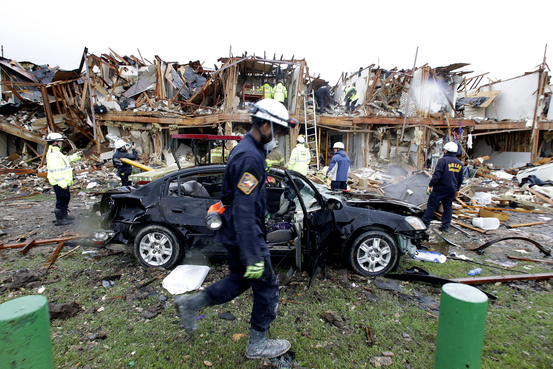
Firefighter conduct search and rescue of an apartment destroyed by an explosion at a fertilizer plant in West, Texas, Thursday, April 18, 2013.
I don’t watch much television, but tonight I turned on CNN for awhile. I was surprised to find that there were still numerous national reporters standing around in Watertown and Boston doing live stand-up reports. Why? The story is pretty much over at this point. What remains is mostly legal stories. Those don’t require on-sight reporting by media stars. Is it just the label “terrorism” that is keeping the national media focused on Boston?
Meanwhile, on Thursday there was a horrific disaster in the small town of West, Texas when a fertilizer plant exploded, killing 14 people, injuring 200, and destroying a school, a nursing home–basically about half of the small town. Hundreds of people in West are now homeless and desperately in need of help.
On CNN’s home page tonight, I could find only one prominently placed story about the Texas disaster: Texan town tries to rebuild with community, spirituality
Search and rescue efforts have evolved into search and recovery efforts, because officials don’t expect to find any more victims in the wreckage — alive or dead.
The explosion at West Fertilizer’s plant ruined much of the north side of town, and left hundreds of people injured, homeless and in need of help.
On television nationally, the scope of the tragedy was overshadowed by the dramatic events in New England, as investigators there pursued leads in the Boston Marathon bombing investigation, then pursued their suspects.
No kidding.
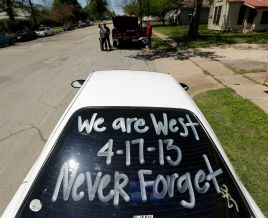
A sign is seen on a car window as residents wait to enter a damaged neighborhood Saturday, April 20, 2013, three days after an explosion at a fertilizer plant in West, Texas (Houston Chronicle)
But many Texans kept their focus on the great need close to home. Long lines of cars streamed by the community center, dropping off food, water and other rations throughout the weekend. Numerous church groups and restaurants handed out hot meals.
“These are our neighbors. They are coming to help,” Waco Police Department Sgt. William Patrick Swanton told reporters. “You will find that in Texas. You will find that across the United States. We put everything aside when it comes to these types of situations.”
The nine first responders from West who died battling the blaze represented nearly one-third of the town’s volunteer firefighting and EMT force. The fire destroyed two fire trucks and an ambulance. Firefighters and trucks from neighboring communities now fill the void at the West firehouse.
Another piece at CNN dated April 19, 11:41 PM lists “Five stories you may have missed during Boston bombings.” The list doesn’t include the Texas explosion!
There are plenty of national stories to be covered in West, Texas right now. For example, the fact that the feds had no clue of the danger that lurked inside the West Fertilizer Co. plant. The Houston Chronicle reports:
The Department of Homeland Security, the federal agency charged with regulating the highly explosive substance ammonium nitrate, wasn’t aware that West Fertilizer Co. stored 270 tons of ammonium nitrate – 1,300 times the threshold that triggers federal oversight.
But the small company did submit the information to another government agency – the Department of State Health Services.
Had federal officials been aware of the information contained in the state disclosure, DHS officials might have inspected the facility and required safer storage.
The patchwork of local, state and national laws regulating fertilizer facilities remains at the heart of the investigation into the deadly explosion that claimed 14 lives in the tiny Czech community of West. Saturday, company officials were unavailable to explain why they had not complied with DHS rules, promulgated in the last five years, requiring the disclosure of such a large quantity of ammonium nitrate.
Since 2006, the company complied with state agencies overseeing air emissions and product quality, but no state agency had the legal authority to inspect and enforce safety measures at the plant.
That is huge news! How many other industrial plants are there around the country with safety issues about which federal agencies have no knowledge? Time for the national media to get busy finding out the answer to that question.
I’m not going to go on and on about this; I think I’ve made my point. But here are a few more stories about the Texas disaster.
Huffington Post: Derrick Hurtt, West, Texas Resident, Describes Plant Explosion: ‘You Think You’re Dead’ (VIDEO)
Derrick Hurtt, a lifetime resident of West, Texas, says the major plant explosion that rocked his small hometown last week left him feeling for a split-second like he had died.
Hurtt caught the deadly blast on a cell phone camera a couple of blocks away, creating a video that ultimately went viral. The explosion at West Fertilizer Co. last week left at least 14 people dead and hundreds of others injured. Hurtt described his harrowing experience to the Waco Tribune Friday.
“It was pitch-black. You think you’re dead,” he said. “And then that mushroom sucked all the darkness back into the cloud, all that black smoke. In the daylight, you realize that you’re not dead.”
NY Daily News: Some stranded families allowed to return after West, Texas, fertilizer plant explosion
Stranded families growing weary and frustrated since a deadly Texas fertilizer plant explosion left them barricaded from their battered homes finally began returning Saturday, but only under a curfew and strict warnings to not wander beyond their own yards.
Authorities gave the much-awaited okay after a nervous morning. Emergency workers had told residents packed in a hotel — waiting for updates about their neighborhood — that leaking gas tanks were causing small fires near the blast site, keeping authorities from lifting blockades.
Officials quickly emphasized that the fires were contained and the town of West was not in danger. They later repeated that message as evacuees in a mile-long line of cars inched along a downtown road and toward the blast radius, although the chances that most would get to their houses Saturday night dimmed as a 7 p.m. curfew approached.
Miami Herald: 4 more first responders killed in Texas blast ID’d
On Sunday, professional organizations and family and friends identified four more of the first responders who died: brothers Doug and Robert Snokhous, who were both firefighters with the West Volunteer Fire Department; Jerry Chapman, a firefighter with the Abbott Volunteer Fire Department; and Kevin Sanders, who worked with West EMS and another area volunteer fire department.
Heartbreaking. The town didn’t even have a fire department–these were volunteers! Another report from the Miami Herald:
Buck Uptmor didn’t have to go to West Fertilizer Co. when the fire started. He wasn’t a firefighter like his brother and cousin, who raced toward the plant. But a ranch of horses next to the flames needed to be moved to safety.
“He went to help a friend,” said Joyce Marek, Uptmor’s aunt. “And then it blew.” [….]
The dead included Uptmor and Joey Pustejovsky, the city secretary who doubled as a member of the West Volunteer Fire Department. A captain of the Dallas Fire Department who was off-duty at the time but responded to the fire to help also died.
The explosion was strong enough to register as a small earthquake and could be heard for many miles across the Texas prairie. It demolished nearly everything for several blocks around the plant. More than 200 people were hurt, and Muska said five first-responders were among those who remained hospitalized Friday.
The first-responders “knew it was dangerous. They knew that thing could go up at any time,” said Ronnie Sykora, who was Pustejovsky’s deacon at St. Mary of the Assumption Catholic Church. “But they also knew that if they could extinguish that fire before it went up, that they could save tens of lives, hundreds of lives. That’s why they were in there.”
Fort Worth Star-Telegram: Investigators describe West explosion as a wave of destruction
WEST — On the grass outside the shredded apartment complex sat several large chunks of concrete, basketball-sized pieces of shrapnel that were sent flying by the force of Wednesday’s fertilizer plant explosion.
Officials said the concrete and other pieces of projectile had once been part of the West Fertilizer Co., which exploded about 20 minutes after a fire broke out early that evening….
When the explosion occurred, investigators said the blast radiated outward, slamming into a nearby railroad track berm. The explosion’s force was deflected upward by the berm before rushing back down to pummel the apartment complex, a nursing home and West Intermediate School and eventually moving into neighborhoods.
“The easiest way to describe it is think of a wave going out and it may come up and down with it,” said Kelly Kistner, said assistant State Fire Marshal.
The destruction from the blast spread over a 37-square-block area of West that was described as a “war zone” by Brian Hoback, the National Response Team leader with the Bureau of Alcohol, Tobacco and Firearms.
The story says that today “a handful of reporters and photographers were allowed to see some of the areas that were hit the hardest by the explosion…” A handful of reporters? Why weren’t there well-known national broadcast reporters down there doing live stand-ups?
Here’s another story they could be covering. The actual cause of the explosion is still unknown, according to NBC News.
Investigators have located the spot where the horrific Central Texas fertilizer plant explosion occurred but do not yet know what triggered the deadly blast, town officials said Sunday.
West, Texas, fire officials said at a news briefing that there is no evidence of criminal activity in last Wednesday’s massive explosion at the West Fertilizer Co., and that there are no longer any fires burning at or around the decimated facility….
A fire official announced the city has identified the “seat” — origin — of the explosion, but did not specify the exact site.
“We do have a large crater,” Assistant State Fire Marshal Kelly Kistner said.
The national media should be down in Texas finding out what the hell happened and holding federal agencies responsible for their failures–not to mention Congress and Texas state officials who have fought against government regulations on businesses. Besides I really want these bozos out of Boston. I can’t imagine how Dakinikat has put up with all these folks swarming around New Orleans over the past several years. They are driving me nuts!
President Obama should go down there too, and if he doesn’t I’d sure like to know why.
Late Night: Chain of Fools
Posted: April 10, 2013 Filed under: Barack Obama, Medicare, Political and Editorial Cartoons, Real Life Horror, Rick Perry, Social Security, U.S. Economy, U.S. Politics | Tags: cat food, Chained CPI, Dan Rostenkowski, middle class tax increases, social safety net 10 Comments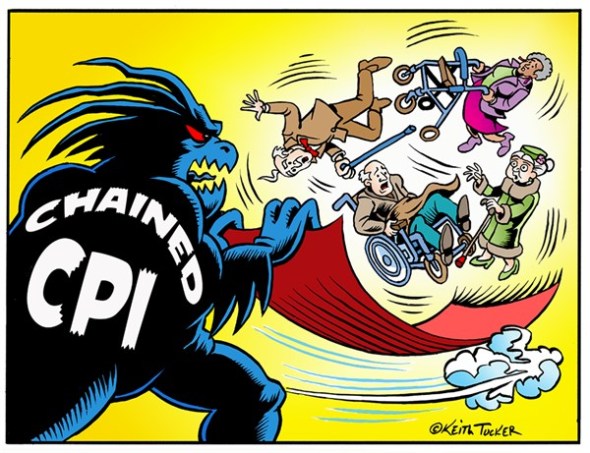
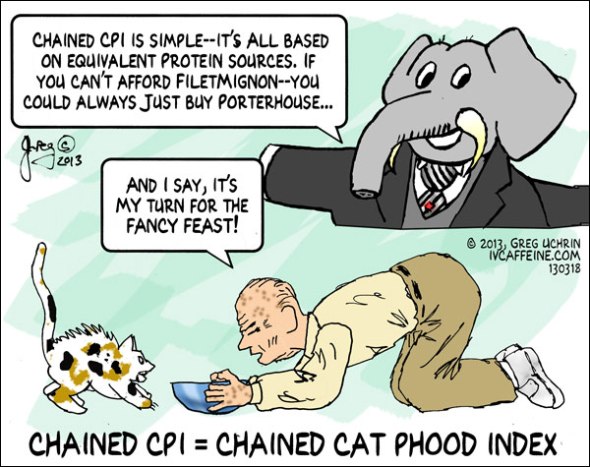
The President released his budget today, and it includes the promised benefit cuts to Social Security that the White House has tried to conceal by claiming it wants to institute a supposedly “more accurate” measure of cost-of-living, the Chained CPI. Of course at this point, anyone who is paying attention knows that the change will result in the average senior getting $1,000 less per year after 20 years. It’s a benefit cut pure and simple.
What many people don’t know yet is that switching Chained CPI will result in a significant tax increase for working poor and middle-class Americans.
Here’s your soundtrack for this post. Perhaps the great Aretha Franklin can make Obama’s budget slightly less nauseating. I’m also going to try to ease the pain with cartoons and visual aids.
Luckily, Grover Norquist and the folks at Americans for Tax Reform know darn well that Chained CPI amounts to a tax increase for people on the lower end of the income scale. This is right from their website.
The proposal in question is known as “Chained CPI.” The term is a Beltway euphemism for measuring inflation at a different, slower pace. Many tax and budget items are indexed to inflation, so slowing inflation’s measured rate of growth has both spending cut and tax increase implications.
On the tax side, all income tax brackets are subject to inflation. Slowing down the inflation rate slows down the annual rate of growth in all income tax brackets.
This means the Obama budget contains a tax increase on 100 percent of middle class taxpayers—anyone who pays the federal income tax.
Many other tax provisions—the standard deduction, the personal exemption, PEP and Pease, IRA and 401(k) contribution limits, and many others—are also tied to how CPI is measured.
Chained CPI as a stand-alone measure (that is, not paired with tax relief of equal or greater size) is a tax increase and a Taxpayer Protection Pledge violation. Various reports peg the tax increase amount as exceeding $100 billion over the next decade.
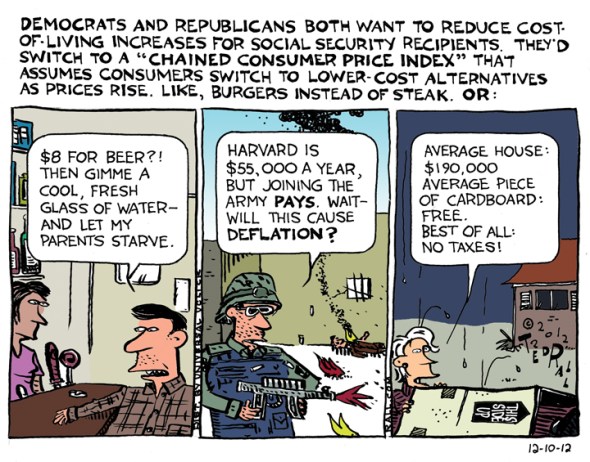
Ted Rall explains Chained CPI:
Dylan Matthews broke it all down (with charts) in a December 2012 post. Here’s the gist:
The group getting the biggest tax hike is families making between $30,000 and $40,000 a year. Their increase is almost six times that faced by millionaires. That’s because millionaires are already in the top bracket, so they’re not being pushed into higher marginal rates because of changing bracket thresholds. While a different inflation measure might mean that the cutoff between the 15 percent and 25 percent goes from $35,000 to $30,000, the threshold for the top 35 percent bracket is already low enough that all millionaires are paying it. Some of their income is taxed at higher rates because of lower thresholds down the line, but as a percentage of income that doesn’t amount to a whole lot.
All told, chained CPI raises average taxes by about 0.19 percent of income. So, taken all together, it’s basically a big (5 percent over 12 years; more, if you take a longer view) across-the-board cut in Social Security benefits paired with a 0.19 percent income surtax. You don’t hear a lot of politicians calling for the drastic slashing of Social Security benefits and an across-the-board tax increase that disproportionately hits low earners. But that’s what they’re sneakily doing when they talk about chained CPI.
That’s why watchdog groups like the Center for Budget and Policy Priorities argue that the only fair way to do chained CPI would be to pair it with an increase in Social Security benefits, and to exempt Supplemental Security Income, which provides support for impoverished elderly, disabled and blind people. Otherwise, it’s just a typical “raise taxes, cut benefits” plan, and an arguably regressive one at that.
So basically if you work for a living or depend on Social Security, you’re getting screwed coming and going.
Here’s another cartoonist’s evaluation of the situation:
Chained CPI will disproportionately affects women, according to the AARP (3/6/2013).
The Social Security benefit cut known as Chained CPI remains a piece of the deficit puzzle for reasons that baffle conservatives, veterans, progressives, and almost everyone in between. The $85 billion in sequester cuts for 2013 have begun and many in Washington have still said they’re willing to cut the modest Social Security benefits we’ve earned by $127 billion over 10 years, even though Social Security by law remains separate from the budget and its deficit. Let’s give every woman and anyone who has or has ever had a mother, sister, daughter, grandmother, aunt or girlfriend a reason to despise this wretched proposal.
This week AARP began running ads about the impact of what the Chained CPI Social Security benefit cuts would mean to women. Below is a copy of one of those ads.

Here’s what Terri O’Neill, president of NOW had to say about women and Chained CPI.

I’m sure you recall that our previous Republican President (let’s face it, Obama is a Democrat in name only) began his second term with the ambitious goal of privatizing Social Security. It didn’t end well for him. Here’s a cartoon from back then:

And another one:
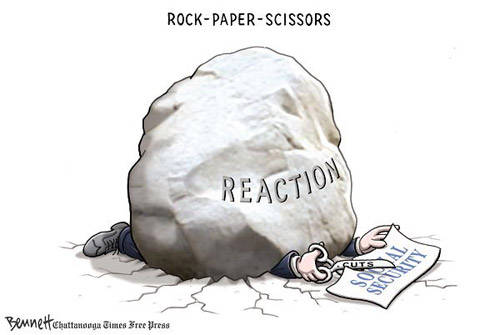
That’s the kind of reaction politicians tend to get when they attack the most successful and powerful government program in history. That’s why it’s called “the third rail.” Remember in when Texas Gov. Rick Perry attacked Social Security as a “Ponzi scheme?” Look what happened to him?
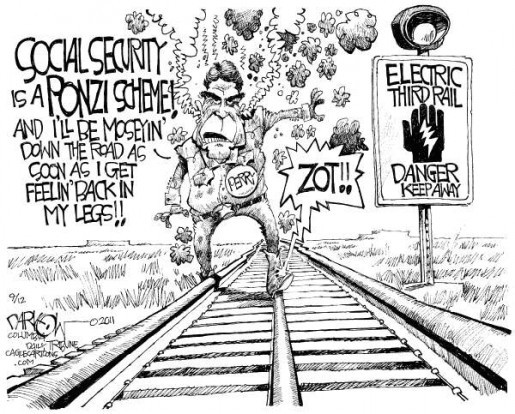
Obama is already beginning to learn why politicians who step on the “third rail” end up regretting it. He’s out there on a limb all by himself. Democrats hate his budget and so do Republicans, because the vast majority of Americans like Social Security and if it’s threatened they tend to get mad–especially seniors.
Yesterday, Digby recalled what can happen “When seniors get angry …” She referred to an incident in 1989 which Democrat Dan Rostenkowski–the powerful Chairman of the Ways and Means Committee–was chased down the street by enraged seniors.
Andrea Stone told the tale at AOL News in August 2010 after the Illinois Congressman’s death: Rosty’s ‘Catastrophic’ Moment Over Health Care Was a First.
The Medicare Catastrophic Coverage Act, first unveiled by President Ronald Reagan, became law in July 1989. The measure provided seniors on Medicare with protection against catastrophic medical expenses and coverage of prescription drug costs. The benefits were to be paid for exclusively by the elderly receiving them, with high-income seniors paying an extra premium surtax.
Soon after Congress passed the law on an overwhelmingly bipartisan vote, Rosty returned to his district. It was there, after a fairly civil meeting with seniors resentful over having to pay higher taxes for coverage they either already had from a former employer or didn’t want, that he was accosted by an angry mob of Social Security recipients.
As the Chicago Tribune reported the next day, Aug. 19, 1989:
Congressman Dan Rostenkowski, one of the most powerful politicians in the United States, was booed and chased down a Chicago street Thursday morning by a group of senior citizens after he refused to talk with them about federal health insurance. Shouting “coward,” “recall” and “impeach,” about 50 people followed the chairman of the U.S. House Ways and Means Committee up Milwaukee Avenue after he left a meeting in the auditorium of the Copernicus Center, 3106 N. Milwaukee Ave., in the heart of his 8th Congressional District on the city’s Northwest Side.
Eventually, the 6-foot-4-inch Rostenkowski cut through a gas station, broke into a sprint and escaped into his car, which minutes earlier had one of the elderly protesters, Leona Kozien, draped over the hood. Kozien, one of more than 100 senior citizens who attended the gathering, said she had hoped to talk to Rostenkowski, her congressman, at the meeting.
But Rostenkowski clearly did not want to talk with her, or any of the others who had come to tell their complaints about the high cost of federal catastrophic health insurance. “These people don’t understand what the government is trying to do for them,” the 61-year-old congressman complained as he tried to outpace his pursuers.
“This was a setup,” said Jaffe, who can be seen in the video ducking into the backseat of the car. “They were standing with made-for-television signs about how he had sold them out.”
As the Tribune reported, “Kozien was soon on the hood, determinedly holding her sign only inches from the windshield. Except for the glass, she was virtually face-to-face with her congressman. ‘I was a little nervous,’ Kozien said later. ‘But I could see through the car window that he looked more afraid than I was.'”
And there is even video of the incident:
Obama is all alone out there on his limb. The only people who have his back are his apparently not-to-bright advisers. Does he really want to be remembered as the first Democratic President to tamper with Social Security? And BTW, his budget also cuts Medicare significantly. Is this really what he wants as his “legacy?” Is it really good enough to gain the applause of Wall Street and the “Very Serious People” in Washington, DC today but go down in history as a worse president than Calvin Coolidge, Herbert Hoover and George W. Bush? We shall see.
Wacky Reads for a Surreal Saturday
Posted: March 30, 2013 Filed under: morning reads, Real Life Horror, Republican politics, Surreality, U.S. Politics, We are so F'd | Tags: "Holy Saturday", Ben Carson, Donnie Darko, evil bunny movies, Kim Jong Un, marriage equality, North Korea, nuclear war, Surpreme Court follies 36 Comments
Good Morning!!
Things are looking a bit surreal to me this morning. I babysat for my nephews last night and they managed to stay up until almost midnight! I sent them to bed around 10PM and they both claimed they couldn’t get to sleep. So I was up till all hours watching some strange kid show–a cartoon version of those “Survivor” reality TV programs. It was veeerrrrry strange. I slept too late, and when I checked the news headlines, I saw lots more strange stuff.
So What’s the deal with North Korea anyway? Kim Jong Un seems even crazier than his dear old dad. Supposedly North Korea is now “entering ‘state of war’ with” South Korea.
North Korea said on Saturday that it was entering a “state of war” with South Korea, following a call to arms by the country’s young leader Kim Jong Un and days of increasingly belligerent rhetoric from the isolated state.
The North’s official news agency KCNA published the joint statement issued by the government, political parties and other organizations.
“From this time on, the North-South relations will be entering a state of war and all issues raised between the North and the South will be handled accordingly,” it said.
The statement also warned that if the U.S. and South Korea carried out a pre-emptive attack, the conflict “will not be limited to a local war, but develop into an all-out war, a nuclear war.”
WTF?!!
According to an unnamed “senior administration official” it’s all a bunch of hooey.
“North Korea is in a mindset of war, but North Korea is not going to war,” said the official, who spoke on the condition of anonymity to offer insight into the latest administration thinking on the volatile situation on the Korean Peninsula.
The official said North Korea is doing two things that signal it is not spoiling for war: maintaining continuous and unfettered access to the Kaesong Industrial Complex six miles north of the Demilitarized Zone and by continuing to promote tourists visits to North Korea, even amid its banging of war drums.
“There is pot-banging and chest-thumping, but they have literature attracting tourists that explicitly says pay no attention to all that (public) talk about nuclear war or another kind of war,” the official said.
Kaesong is a hive of business activity and about 200 South Koreans travel there daily. It produces about $2 billion of annual trade and commerce revenue for the North. Many experts consider its fate and status the best signal of North Korea’s hostile intentions.
On Saturday, the North renewed its threat to close the complex, reportedly saying through its state-controlled news agency that references to its ongoing operation as a source of capital “damages our dignity.”
I wonder why this “senior official” felt he/she had to remain anonymous?
Some “analysts” who didn’t feel the need to conceal their identities told NBC News that North Korea[‘s] threats [are] predictable but Kim Jong Un is not.
The Surreal World of The Villagers vs. The Nightmare Reality of the 99 Percent
Posted: February 14, 2013 Filed under: morning reads, open thread, Political Affective Disorder, Real Life Horror, Surreality, The Media SUCKS, the villagers, U.S. Economy, U.S. Politics | Tags: Barack Obama, Marco Rubio, Salvador Dali, State of the Union, the 99 percent, the one percenters 44 Comments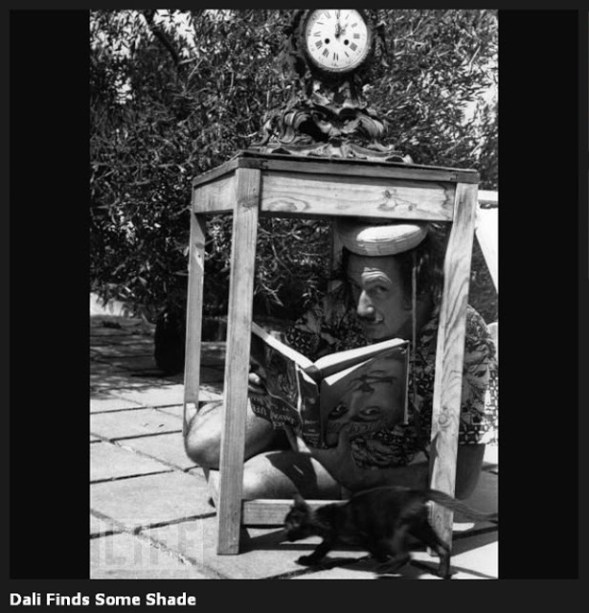
This is going to be sort of a cross between a morning reads post and a rant.
Yesterday, Dakinikat and I were talking about how lately it seems like it’s hard to find things to blog about because there’s nothing really new happening in the political world. Sure, there’s news coming out of DC, but it’s pretty much the same thing every day. The Republicans hate President Obama and continue to do their best to block everything he tries to do. Obama sort of sounds like a liberal at times, but he’s still offering that “grand bargain” to the Republicans who hate his guts and still letting down the voters who elected him in the process.
Republicans pretend to obsess over the federal deficit and debt and economic writers like Paul Krugman and Robert Reich repeatedly try to explain that the problem with our economy right now isn’t the deficit or the debt, but the high unemployment and stagnating wages that keep the lower 99 percent of us from spending our money as freely as we’d like.

Lugubrious Game, by Salvador Dali, 1929
As I looked around for Thursday reads last night, I began to feel as if I’d entered a surreal alternative reality–almost as if I had awakened to find myself in a Salvador Dali painting in which everything seems crazy and nothing ever changes. The only breaks from the tedium of the Village come when there’s news of another shooting and the media covers it for a few days–like the recent obsession with ex-cop “Rambo” Christopher Dorner.
Now that Dorner has gone down, there’s another high-profile shooting for the media to focus on. USA Today reports: Olympic runner Oscar Pistorius charged with murder.
South African police on Thursday said they would charge Olympic athlete Oscar Pistorius with murder after his girlfriend was shot and killed at his home earlier Thursday morning.
The circumstances of the incident are still unclear but police in South Africa said they would oppose bail when the Paralympic gold medalist appears in court Friday. The hearing was scheduled for Thursday afternoon but was delayed to give forensics investigators time to do their work, the Associated Press reported.
Police in South Africa do not name suspects in crimes until they have appeared in court but police spokesperson Brigadier Denise Beukes said that Pistorius was at his home after the death of the victim and that “there is no other suspect involved,” The Associated Press reported.
Britain’s Sky News first named the woman as Reeva Steenkamp, a model and recent contestant on Tropika Island of Treasure 5, a South African reality TV show. A talent agent for Steenkamp said she was the victim. However, police have yet to confirm the woman’s relationship with the Olympic and Paralympic athlete.
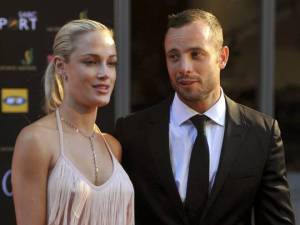
South African Olympic athlete Oscar Pistorius and Reeva Steenkamp attend an awards ceremony in Johannesburg, South Africa last November.(Photo: Lucky Nxumalo, AP)
Meanwhile, as the Villagers ignore the need for gun safety legislation and argue about the deficit and the supposed out-of-control government spending that isn’t actually happening, the rich get richer and the lower 99 percent get screwed. Case in point, please read this piece in The New Republic by Timothy Noah that the Villagers will either ignore or mock: The One Percent Gobbled Up the Recovery, Too. In fact, it put the 99 percent back in recession.
Emmanuel Saez, the Berkeley economist who (with Thomas Piketty, an economist at the École d’economie de Paris) first mapped the enormous 34-year run-up in income share for America’s top 1 percent, came up last year with a statistic that was widely quoted by people who care about rising income inequality. In 2010, the first year of economic recovery after the 2009-2010 recession, 93 percent of all pre-tax income gains went to the top 1 percent, which in that year meant any household making more than about $358,000. This was, I quipped at the time, a members-only recovery. No 99-percenters need apply.
Saez has now updated (PDF) this statistic to include 2011. When you look at the economic recovery’s first two years, the top one percent (which by 2011 meant any household making more than about $367,000) captured 121 percent of all pre-tax income gains.
How is it even possible for the one percent to capture more than 100 percent of all income gains since the last recession? Looked at from one point of view, it’s not. It is enough to say that in 2010 and 2011 all of the recovery went to the one percent. If you were in the bottom 99 percent, as by definition nearly all of us are, you didn’t see a dime of that recovery.
What happened to the rest of us then?
Over 2010 and 2011, it saw, on average, a slight net decline in pre-tax income of 0.4 percent. This “negative growth” is what, at least theoretically, boosts the one percent’s share of income gains from 100 percent to 121 percent. If you think of income distribution as a Pac-Man game, with the one percent as Pac-Man, imagine your Pac-Man consuming all the pac-dots in one game and then somehow, after you’ve left the arcade, gobbling up some of the pac-dots in the next player’s game too. Another way to put it is that the one percent didn’t just gobble up all of the recovery during 2010 and 2011; it put the 99 percent back into recession.
Sadly, airhead talking heads like Joe Scarborough will continue to have much more influence in the Village than actual economists like Emmanuel Saez and real reporters like Timothy Noah.
Speaking of airheads, after the SOTU speech on Tuesday night we had the pleasure of watching baby-faced Florida Senator Marco Rubio make a complete ass out of himself on the TeeVee. Hullabaloo blogger David Atkins, who–unlike Rubio–is somewhat knowledgeable about economics, tried to explain to the the latest “great Republican hope” (before his speech) that not only do deficits not cause unemployment, but also our federal deficit is steadily decreasing. Of course no reader of Dakinikat’s posts needs any of this explained. But I still want to link to Atkins’ concluding paragraphs.
Why is the deficit shrinking? Mostly, because of the pickup in economic activity. The elimination of some of the tax cuts for the wealthy will also help. The Affordable Care Act will also be taking a bite out of our extravagant healthcare costs.
4. None of this has any impact on unemployment. Generally speaking, there are two kinds of jobs: public sector and private sector. Even though the private sector is doing better, public sector jobs are still declining due to conservative policies theoretically designed to reduce deficits. Private sector jobs, meanwhile, depend on consumer demand–not corporate profit. American corporations are experiencing record profits, but they aren’t hiring because there’s not enough middle-class consumer demand for them to hire workers.
4a. The lack of consumer demand leading to poor private-sector job growth in spite of record profits has nothing to do with deficits or uncertainty in the investing climate. It has everything to do with income inequality and economic insecurity among the middle and lower classes.
4b. The obsession over deficits among conservative politicians is directly responsible for public sector job cuts that are helping to drive up the unemployment rate and kill consumer demand.
All of which means that politicians like Marco Rubio who insist that the deficit is directly hurting employment are either so ignorant of economics that they shouldn’t be handling public policy, or so cynically manipulative that they shouldn’t be handling public policy.
And no “reporter” in Washington or elsewhere should be covering Rubio’s statements without providing a basic lesson in macroeconomics as context for his fact-free response.
Actually, Village idiots “reporters” like Chris Cillizza pretty much ignored whatever substance there was in Rubio’s speech and approvingly reported on the personal history that Rubio discussed. But beforehand, Cillizza wrote that Obama should focus on deficit in State of the Union
It’s the deficit, stupid. A look back at Obama’s first three State of the Union speeches, plus the address to a joint session of Congress in 2009, suggests a similar thematic pattern: He starts with the economy, moves to education and then, in the middle section of the speech, addresses the deficit. (The exception was in 2011, when Obama began his speech with a riff on partisanship.) In 2012, Obama spent just five minutes on the debt — less time than he spent on partisanship (51/2 minutes) or foreign policy (six minutes).
He should flip that script in this State of the Union and spend the bulk of his time talking about the deficit. Here’s why: In January 2009 polling by Pew Research Center, 53 percent of respondents said reducing the deficit was a “top priority.” In January 2013, that number soared to 72 percent, by far the biggest increase of any issue over that time. (By contrast, 85 percent said strengthening the economy was a top priority in 2009, while 86 percent said so at the start of this year.)
The debt is the issue of the day, and one that, if Obama is beginning to eye his legacy as president, could go a long way toward shaping how history remembers him. Make this speech a deficit speech.
For Cillizza and his ilk, “the deficit” (or “the debt,” which he doesn’t seem to understand is not the same thing) is “the issue of the day,” and unemployment and the other struggles of the 99 percent are completely invisible. Oh, and by the way, Dick Cheney loved Rubio’s speech.
I could go on and on like this, but I’ll stop now. I just wanted to rant for a bit in hopes of pulling myself out of my current malaise. I’ve realized finally that there isn’t going to be any real change as because the Villagers (often including the President) are just going to continue focusing on cutting spending and ignoring the problems facing those of us who live in the real world.
If you stayed with me this far, thanks for letting me rant! Now, I welcome your links to whatever you are reading and blogging about today.
Real Life Horror: The Black Dahlia Murder Mystery
Posted: February 2, 2013 Filed under: Crime, Real Life Horror | Tags: Buster the cadaver dog, Elizabeth Short, George Hodel, Paul Dostie, Steve Hodel, The Black Dahlia 15 Comments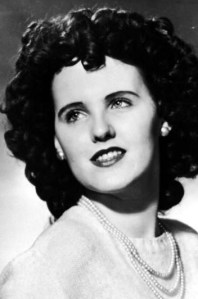
Elizabeth Short AKA The Black Dahlia
By now, everyone who reads this blog knows that I’m fascinated by true crime stories. Years ago, I read a book by former LA Homicide detective named Steve Hodel. The book was called Black Dahlia Avenger: A Genius for Murder. It was subsequently published in an updated paperback edition. Hodel believes his father was the murderer of Elizabeth Short and that he also murdered at least nine more women in his home and then posed their bodies around LA. In his book Hodel presented some convincing circumstantial evidence to back up his claims.
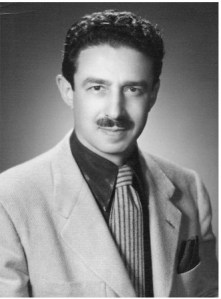
Dr. George Hodel
Hodel’s father George Hodel was a prime suspect in the Black Dahlia case, which officially has never been solved. In fact the LAPD wiretapped multiple rooms in Hodel’s house over a three-week period. But George Hodel, who was a prominent surgeon and knew many powerful people, was never arrested for the murder, although he was prosecuted and acquitted for incest with his own daughter (Steve Hodel’s stepsister).
A little background on the case from Wikipedia:
“The Black Dahlia” was a nickname given to Elizabeth Short (July 29, 1924 – c. January 15, 1947), an American woman who was the victim of a gruesome and much-publicized murder. Short acquired the moniker posthumously by newspapers in the habit of nicknaming crimes they found particularly colorful. Short was found mutilated, her body sliced in half at the waist, on January 15, 1947, in Leimert Park, Los Angeles, California. Short’s unsolved murder has been the source of widespread speculation, leading to many suspects, along with several books and film adaptations of the story. Short’s murder is one of the oldest unsolved murder cases in Los Angeles history….
The body of Elizabeth Short was found in the Leimert Park district of Los Angeles….Her remains had been left on a vacant lot on the west side of South Norton Avenue midway between Coliseum Street and West 39th Street (at 34.0164°N 118.333°W). The body was discovered by local resident Betty Bersinger, who was walking with her three-year-old daughter around 10 a.m. Bersinger initally mistook the body for a discarded store mannequin. Upon realizing it was a corpse, Bersinger rushed to a nearby house where she phoned the police.
Short’s severely mutilated body was severed at the waist and completely drained of blood. Her face had been slashed from the corners of her mouth toward her ears, creating an effect called the Glasgow smile. Short also had multiple cuts on her thigh and breasts, where entire portions of flesh had been removed. The body had been washed and cleaned and had been “posed” with her hands over her head, her elbows bent at right angles, and her legs spread. Near the body detectives found a cement sack which contained droplets of watery blood, as well as a heel print on the ground amidst tire tracks.
I won’t post links, but if you are so inclined, you can find the crime scene photos on Google images.
Believe it or not, there may be new forensic evidence forthcoming in this long-cold case. From The Daily Beast:

Buster
Last November, Hodel joined forces with former California police detective Paul Dostie and Buster, his rambunctious nine-year-old cadaver-sniffing black Labrador, for the first ever forensic search at Hodel’s former home. The property is now called the Sowden House and named after its first owner, photographer John Sowden, who had the house built for him in 1926 by Lloyd Wright, the son of architect Frank Lloyd Wright.
Buster is not just any old canine. He gained his experience the hard way, practicing at old cemeteries in Nevada. As his owner Dostie explain, decomposing bones give off a distinctive chemical mark that rises up through the soil, and Buster’s big sweaty nose can smell it even after decades have passed.
Because of his acute sniffing skills, Buster has twice gone on missions to the tiny Japanese island of Tarawa to help point out the locations of U.S. marines buried there after a 1943 battle. He has searched Belgium for Americans shot down in the Battle of the Bulge. He has scoured the land around the Barker Ranch, where Charles Manson and his cult hid after the murders of Sharon Tate and Rosemary LaBianca, searching for more buried victims. Just last month, Buster was flown to Key West, Florida, to search for remains in a 200-year-old pirate grave as well as an 1860 ship carrying 294 African slaves.
Back at the Hodel house last November, Buster was turned loose to search for scents related to human decomposition—and he perked up, or “alerted” as Dostie calls it, at several potential clues in the basement. Soil samples were taken and results are expected next week.
Read more about the results of Steve Hodel’s research at the above link.

A little more The Pasadena Star-News:
Hodel said it was clear the search would turn up something as soon as Buster was turned loose.
“Buster immediately took off … and ran to a vent located at the southwest corner of the property where he alerted, indicating he had picked up the scent of human decomposition.”Buster’s unique sense of smell led Hodel and Dostie to a vent just outside the home’s basement. Hodel said that portion of the Sowden House – designed by Lloyd Wright and built in 1926 – is largely unchanged and looks the same as it did in 1947, the year Elizabeth Short, the Black Dahlia, was slain.
Steve Hodel’s story was the subject of the first episode of Season 9 of Ghostbusters. Here’s the portion of the show dedicated to The Black Dahlia.

 peej
peej Carissa
 bostonboomer
 dakinikat
 ecocatwoman
 mablue2
 Mama Lopez
 peggysue22
 quixote
 skydancingguestblogger
 Mona (aka Wonk the Vote)



 Sky Dancing
Recent Comments