
Lazy Caturday Reads
Posted: May 23, 2020 Filed under: morning reads, U.S. Politics | Tags: Barack Obama, caturday, coronavirus pandemic, Donald Trump, Joe Biden, pandemics and historical change, vintage cat ladies 15 Comments
Good Morning!!
After several days of a media diet–reading and playing video games instead of following the news closely–I’m feeling a lot more grounded. The fake “president” is still insane and we are still living through a global pandemic that was made much worse by the actions and non-actions of Trump and his gang of evil thugs, but I feel more able to handle it today. It helps that it’s a long weekend and Trump might go play golf and leave us alone for some stretches of time.
Anyway, I hope all of you are doing well and staying safe in these crazy times. Please stay home as much as you can and take good care of yourselves and your loved ones.
Here’s the latest on the pandemic:
The Washington Post: Study estimates 24 states still have uncontrolled coronavirus spread.
The coronavirus may still be spreading at epidemic rates in 24 states, particularly in the South and Midwest, according to new research that highlights the risk of a second wave of infections in places that reopen too quickly or without sufficient precautions.
Researchers at Imperial College London created a model that incorporates cellphone data showing that people sharply reduced their movements after stay-at-home orders were broadly imposed in March. With restrictions now easing and mobility increasing with the approach of Memorial Day and the unofficial start of summer, the researchers developed an estimate of viral spread as of May 17.
It is a snapshot of a transitional moment in the pandemic and captures the patchwork nature across the country of covid-19, the disease caused by the virus. Some states have had little viral spread or “crushed the curve” to a great degree and have some wiggle room to reopen their economies without generating a new epidemic-level surge in cases. Others are nowhere near containing the virus.
The model, which has not been peer reviewed, shows that in the majority of states, a second wave looms if people abandon efforts to mitigate the viral spread.
“There’s evidence that the U.S. is not under control, as an entire country,” said Samir Bhatt, a senior lecturer in geostatistics at Imperial College.
The model shows potentially ominous scenarios if people move around as they did previously and do so without taking precautions. In California and Florida, the death rate could spike to roughly 1,000 a day by July without efforts to mitigate the spread, according to the report.
Nic Robertson at CNN: The pandemic could reshape the world order. Trump’s chaotic strategy is accelerating US losses.
London (CNN)Europe outright rejected US President Donald Trump’s vision of the world this week. Tensions between these historic democratic allies that have been simmering since Trump came to office three years ago have now come to a boil during the coronavirus pandemic.
Covid-19 has shocked the world by the speed of its spread, but it is also accelerating another global change in the balance of power — and not in America’s favor.
The extent of the divide became clear on Tuesday during a vote at the World Health Organization annual assembly in Geneva, Switzerland, backing Europe’s conciliatory approach to China relating to an investigation into the outbreak. Power had visibly ebbed away from the United States as its demand for a tougher approach was dismissed, a move that should sound alarm bells in Washington.Vladimir Sichov, street portrait
Five months into 2020 and it already feels like a new era: now there is only BC and AC — before and after coronavirus. Suddenly the dynamics of almost every single geopolitical dispute are being exacerbated by the pandemic, sharpened by the complexity and urgency of the situation.
Chief among these is the perennial, three-way battle for dominance between the US, Europe and China. Despite Trump’s early hailing of Xi Jinping’s handling of the pandemic, he has since blamed the Chinese President for covering up the early stages of China’s outbreak. Beijing has consistently denied such accusations, and criticized the US approach to the pandemic.

Trump has tried to blame China and WHO for his own disastrous response to the pandemic, but Europe is sticking with China and WHO.
Despite deep concerns about China’s handling of the pandemic, European leaders backed the WHO resolution calling for “a stepwise process of impartial independent and comprehensive evaluation, including using existing mechanisms, as appropriate to review experience gained and lessons learned” from the global response to Covid-19.
The language is convoluted and hardly inspires confidence China will atone appropriately for its early failures, but it is a measure of the gulf opening up between Trump and his European allies that such a compromise could even be countenanced….
Europe’s decision to reject Trump’s confrontation with China and the WHO will affect both parties vying to win this year’s US election. Regardless of who wins that race, Trump and his handling of Covid-19 are weakening America’s global leverage.
At The Atlantic, Charles C. Mann on “What history can tell us about the long-term effects of the coronavirus”: Pandemics Leave Us Forever Altered. I hope you’ll read the whole thing; here’s just a brief excerpt:
Americans may have forgotten the 1918 pandemic, but it did not forget them. Garthwaite matched NHIS respondents’ health conditions to the dates when their mothers were probably exposed to the flu. Mothers who got sick in the first months of pregnancy, he discovered, had babies who, 60 or 70 years later, were unusually likely to have diabetes; mothers afflicted at the end of pregnancy tended to bear children prone to kidney disease. The middle months were associated with heart disease.
Other studies showed different consequences. Children born during the pandemic grew into shorter, poorer, less educated adults with higher rates of physical disability than one would expect. Chances are that none of Garthwaite’s flu babies ever knew about the shadow the pandemic cast over their lives. But they were living testaments to a brutal truth: Pandemics—even forgotten ones—have long-term, powerful aftereffects.
The distinguished historians can be forgiven for passing over this truth. Most modern people assume that our species controls its own destiny. We’re in charge! we think. After all, isn’t this the Anthropocene? Being modern people, historians have had trouble, as a profession, truly accepting that brainless packets of RNA and DNA can capsize the human enterprise in a few weeks or months.
The convulsive social changes of the 1920s—the frenzy of financial speculation, the resurgence of the Ku Klux Klan, the explosion of Dionysian popular culture (jazz, flappers, speakeasies)—were easily attributed to the war, an initiative directed and conducted by humans, rather than to the blind actions of microorganisms. But the microorganisms likely killed more people than the war did. And their effects weren’t confined to European battlefields, but spread across the globe, emptying city streets and filling cemeteries on six continents.
Unlike the war, the flu was incomprehensible—the influenza virus wasn’t even identified until 1931. It inspired fear of immigrants and foreigners, and anger toward the politicians who played down the virus. Like the war, influenza (and tuberculosis, which subsequently hit many flu sufferers) killed more men than women, skewing sex ratios for years afterward. Can one be sure that the ensuing, abrupt changes in gender roles had nothing to do with the virus?
We will probably never disentangle the war and the flu. But one way to summarize the impact of the pandemic is to say that its magnitude was in the same neighborhood as that of the “war to end all wars.”
What societal and health changes will follow the coronavirus pandemic? Read Mann’s speculations at The Atlantic.
Some presidential election news:
The Guardian: Barack Obama poised to add his star appeal to Joe Biden’s campaign.
Former president Barack Obama has dipped his toes into the 2020 presidential campaign recently and is positioned to do more in the coming months as Joe Biden’s effort to defeat Donald Trump gathers steam.
Interviews with about a dozen Democratic strategists, party officials and people close to Obama want the popular former president utilizing his powerful online presence and focusing on rallying key Democrat constituencies that are critical to a Biden victory.
Obama is regarded as one of the most popular politicians in American politics and a huge asset within the Democratic party. He left the White House with a near-60% approval rating. His endorsement for any candidate is the political campaign equivalent of an oilman and hitting a gusher.
Obama would be most effective, interviewees said, in highlighting his former vice-president’s résumé, rallying key Democratic voting groups like African American women, and pushing voters to register.
The situation is unique. There hasn’t been a popular former two-term president eager to hit the trail for his former running mate for years. On top of that, the coronavirus pandemic limits in-person campaigning and rallies. Still, the strategists interviewed say Obama is valuable and should be used everywhere.
“You rarely have a former president that is more popular than the now-sort-of-nominee,” Democratic pollster Cornell Belcher said. “Barack Obama is the most popular political figure in America right now.”
Read the rest at The Guardian.
Trump may be losing some evangelicals. Politico: Behind Trump’s demand to reopen churches: Slipping poll numbers and alarm inside his campaign.
A sudden shift in support for Donald Trump among religious conservatives is triggering alarm bells inside his reelection campaign, where top aides have long banked on expanding the president’s evangelical base as a key part of their strategy for victory this November.
The anxiety over Trump’s standing with the Christian right surfaced after a pair of surveys by reputable outfits earlier this month found waning confidence in the administration’s coronavirus response among key religious groups, with a staggering decline in the president’s favorability among white evangelicals and white Catholics. Both are crucial constituencies that supported Trump by wide margins in 2016 and could sink his reelection prospects if their turnout shrinks this fall.
The polls paint a bleak picture for Trump, who has counted on broadening his religious support by at least a few percentage points to compensate for weakened appeal with women and suburban populations. One GOP official said the dip in the president’s evangelical support also appeared in internal party polling, but disputed the notion that it had caused panic. Another person close to the campaign described an April survey by the Public Religion Research Institute, which showed a double-digit decline in Trump’s favorability among white evangelicals (-11), white Catholics (-12) and white mainline protestants (-18) from the previous month, as “pretty concerning.”
To safeguard his relationship with religious conservatives, Trump on Friday demanded that America‘s governors permit houses of worship to immediately reopen, and threatened to “override“ state leaders who decline to obey his directive. The announcement — which came days after the Centers for Disease Control and Prevention omitted religious institutions in new guidance about industry reopenings — featured clear appeals to white evangelicals, many of whom have long supported Trump’s socially conservative agenda.
Read more at the link.
According to The Daily Beast, Trump wants an in-person convention despite the pandemic, and his advisers are afraid to tell him it might not happen: Trump Plows Ahead With His Convention Planning, Virus Be Damned.
President Donald Trump has been adamant that the 2020 Republican National Convention—or some version of it—go on. For months, he’s demanded that back-up options for less crowded gatherings be fully explored by his staff, if a full-blown convention isn’t ultimately possible or safe, according to three people familiar with his private insistence. But he has scoffed at the notion of a virtual convention in recent weeks, saying that it sounds like “something Joe Biden would do from his basement,” said a source who heard Trump mock the idea.
Trump’s desire to have some sort of coronation moment fits his love of pageantry and spectacle. But various staffers working on plotting the Republican gathering aren’t quite so optimistic that it’s doable, knowing that they are entirely at the mercy of the virus and that the convention may end up even sparser than some expect.
“I don’t want to be the one to tell the president,” the White House official said, envisioning a scenario in which a disappointed, possibly angry Trump is informed he would have to be livestreamed into his own convention.
More stories to check out, links only:
The New York Times: Trump’s Press Secretary Displays One of His Checks in a Little Too Much Detail.
The Washington Post: Trump administration discussed conducting first U.S. nuclear test in decades.
WJC CBS Baltimore: Baltimore Mayor Jack Young On President Trump’s Memorial Day Fort McHenry Visit: ‘I Think He’s Violating The Law’
New York Magazine: That Office AC System Is Great — at Recirculating Viruses.
NBC News: Jeff Sessions stands up to former boss Trump on Twitter.
Business Insider: Roughly half the Twitter accounts pushing to ‘reopen America’ are bots, researchers found.
Now it’s your turn. What stories are you following today?
Thursday Reads
Posted: May 21, 2020 Filed under: morning reads, U.S. Politics 13 Comments
Woman reading a newspaper by Partosh Sen
Good Morning Sky Dancers!
I’m still not handling the news very well. I’ve pretty much tried to tune it all out since my last post on Tuesday. It was probably a mistake to start reading The Stand, by Stephen King; but now I’m hooked, and I was already freaked out by the pandemic in real life anyway. So this post is going to be a quick one so I can go back to trying to maintain my sanity in this time of Trump and Covid-19.
Massachusetts is starting to open up, and people will be allowed to go to beaches beginning on Memorial day. I don’t think that’s a very good idea, but I have nothing to say about it. We are still seeing more than 100 deaths a day here. I’m planning to keep on staying home except for grocery shopping. I’m considering getting my hair cut in June. The hair salons are opening on the May 26th, with lots of restrictions. I got an email from my hairdresser explaining all the rules:
APPOINTMENTS
We appreciate your patience as some service providers may have limited availability. Due to the scheduled shifting of the Service Providers, your scheduled appointment may not stand as it was previously scheduled, however, you will be notified. We have limited phone staff that will be working to accommodate the many changes that have occurred.If you are experiencing any of the following symptoms; Fever (>100.4) or Feverish, Cough, Sore Throat, Shortness of Breath, Unusual Fatigue, Chills, Body Aches, we ask that you stay home and call us at 617-489-7733 to reschedule. Let’s all stay healthy.
UPON ARRIVAL
We ask that you arrive for your appointment at the time of your appointment and no earlier. Please wait in your car outside the salon for your appointment. We will text/call you when to enter. Please limit personal belongings to payment methods and cell phones. Please do not bring any guests with you and please do not bring children to your appointment at this time.CONTACTLESS CHECKOUT
Before you arrive for your appointment, we ask that you call and provide a credit card for us to securely store on file – the same way you might store it with Amazon or Netflix. After your appointment, we can simply charge your card through our system – no buttons to press, no screens to touch, no unnecessary physical contact required. Just safe & healthy service.
So it’s going to be pretty complicated. But I’m getting desperate.
Here are the news stories that caught my attention today.
This one isn’t really news to anyone, but it’s a reminder of Trump’s limited cognitive abilities and his deteriorating mental condition. The article is a response to Trump’s claims that intelligence briefers didn’t warn him adequately about the coming pandemic.

Man Reading Newspaper c.1918 – Hugo Scheibe
The New York Times: For Spy Agencies, Briefing Trump Is a Test of Holding His Attention.
Mr. Trump, who has mounted a yearslong attack on the intelligence agencies, is particularly difficult to brief on critical national security matters, according to interviews with 10 current and former intelligence officials familiar with his intelligence briefings.
The president veers off on tangents and getting him back on topic is difficult, they said. He has a short attention span and rarely, if ever, reads intelligence reports, relying instead on conservative media and his friends for information. He is unashamed to interrupt intelligence officers and riff based on tips or gossip he hears from the former casino magnate Steve Wynn, the retired golfer Gary Player or Christopher Ruddy, the conservative media executive.
Mr. Trump rarely absorbs information that he disagrees with or that runs counter to his worldview, the officials said. Briefing him has been so great a challenge compared with his predecessors that the intelligence agencies have hired outside consultants to study how better to present information to him.
Working to keep Mr. Trump’s interest exhausted and burned out his first briefer, Ted Gistaro, two former officials said. Mr. Gistaro did not always know what to expect and would sometimes have to brief an erratic and angry president upset over news reports, the officials said.
The simple truth is that Trump is a childish, narcissistic jerk with no interest in serving the American people. He’s never been particularly bright, and now he’s sinking into dementia. But the media continues to try to normalize him. It’s frightening how hard they work at it.

Woman reading a newspaper, Todros Geller, 1944
Mother Jones on the person who is supposedly leading the administration’s response to the pandemic: Jared Kushner Had One Job: Solve America’s Supply Crisis. He Helped Private Companies Instead.
On March 29, President Trump held a press briefing to tout “Project Airbridge,” the administration’s new effort to organize and pay for airlifts of personal protective equipment and other medical supplies from abroad. The first of Project Airbridge’s “big, great planes” coming from Asia had landed in New York that day, Trump said, bringing in “2 million masks and gowns, over 10 million gloves, and over 70,000 thermometers,” which would be distributed to virus hot spots across the country. The heads of some of the country’s biggest medical supply distributors joined him at the podium to pay tribute to the administration and talk about the project. “They’re big people,” Trump declared of the executives working together with the administration to deliver “record amounts of lifesaving equipment.”
The origins of Project Airbridge lie with MIT experts, who originally proposed a government led and funded airlift of supplies, according to the Washington Post. But it was seized upon by Trump’s son-in-law, Jared Kushner, who ran a volunteer shadow coronavirus task force that included his former roommate and people from private-equity companies and consulting firms like McKinsey. (“Young geniuses” Trump called them.) Unhappy employees at the Federal Emergency Management Agency (FEMA) dubbed them “the children.”
Yet less than two months later, after many glowing PR hits, the administration decided to put an end to Project Airbridge as members of Congress and the media started demanding answers about how the supplies were being distributed, who received them, and whether the White House was making distribution decisions based on politics rather than public health. On April 21, 10 Democratic senators, led by Elizabeth Warren, asked the inspector general of the Department of Health and Human Services to investigate the project. “The novelty and complexity of this arrangement demands heightened scrutiny and transparency,” they wrote in a letter. “However, the administration’s implementation of Project Airbridge has been completely opaque.”
The short-lived Project Airbridge is an example of how the Trump administration has taken advantage of the pandemic to boost some of the country’s biggest companies while doing little more than offer hard-hit states photo ops and the chance to compete against each other to pay exorbitant prices for PPE. And while the project did little to ameliorate national shortages of PPE, it may have a lasting impact on everything from health care costs to the consolidation of corporate power.
Read the rest at Mother Jones.

Jeffrey DeVore, Woman reading newspaper
Gabriel Sherman on Trump’s “Obamagate” obsession: “With Obama He’s Going for the Jugular”: As Trump Goes After Obama, Some in Trumpworld See a “Big Risk.”
On May 7, Donald Trump’s campaign manager, Brad Parscale, tweeted a GIF of the Death Star firing its planet-destroying laser to announce the start of the campaign’s war on Joe Biden. Parscale’s choice of pop-culture ephemera was widely mocked. But the meme’s biggest weakness was that it bore no resemblance to the campaign’s messaging, which so far has been all over the place. During a week when America’s COVID-19 death toll approached 90,000, Trump allies floated smears that Biden was a tool of China, an invalid eating from a spoon, and even a pedophile, none of which caused damage. Sources close to Trump said the president has vented to friends about the lack of focused firepower coming out of the campaign. “There is deep frustration that there is no overarching message,” an unofficial campaign adviser told me. (The White House and Trump campaign did not respond to requests for comment.)
According to sources, Trump believes the answer to the message weakness is to declare all-out war on Biden’s former boss: Barack Obama. “Trump knows Biden is only popular because he was Obama’s V.P.,” a prominent Republican told me. Which is why, a few days after Parscale’s Death Star tweet, Trump accused Obama of unnamed crimes under the umbrella of “Obamagate.” “Obama is going to be on the campaign trail in a big way. He’s the most popular Democrat of the past four decades. Trump knows you have to neutralize him, and he’s frustrated Brad didn’t think of that,” the campaign adviser said. “Trump feels he’s doing it all alone.”
But Trump’s targeting of Obama has been causing consternation among Republicans, who fear he is pursuing a base-incitement strategy when he needs to appeal to crucial suburban voters in must-win battleground states. “Going after Obama is a big risk,” a former West Wing official said. “Obama is seen as trustworthy and reasonable. If you attack him and people don’t buy it, then you have a huge swing and a miss in front of the entire country.” Another prominent Republican agreed: “Trump cannot draw Obama into this. Obama can’t be ‘softened’ up. American people know him and like him.”
Read the rest at Vanity Fair.

Painting by Armand Schönberger (Hungarian, 1885–1974)
It looks like Trump country is soon going be in deep trouble from the pandemic. The Daily Beast: White House’s Own Data Crunchers: Southern Counties About to Get Hit Hard.
A new analysis being reviewed by the White House shows southern states that moved too quickly to relax social distancing guidelines face significant risk for a resurgence of the coronavirus over the next several weeks. In several cases, counties will see hundreds of additional cases by June 17.
The study, which was put together by PolicyLab at Children’s Hospital of Philadelphia, is part of a data set being reviewed by top coronavirus task force officials and people working with the team, The Daily Beast reported earlier this month. A previous model by the PolicyLab predicted that if officials moved too quickly and too aggressively to reopen in mid-May, individual counties could witness hundreds, if not a thousand-plus, more coronavirus cases reported each day by August 1.
The new model shows that in southern counties, particularly in Texas, Florida, Alabama, and Virginia, the risk for resurgence is high over the next four weeks. These states have moved to reopen, at least partially, since the team published its last model in April.
The data set now takes into consideration current levels of social distancing rather than projections about what would happen when local communities reopened. It also includes data for more than 200 additional counties across the country. The findings indicate that the risk for large second waves of outbreaks remains low if communities continue to implement cautious, incremental plans to reopening that limit crowding and travel to non-essential businesses. Doctors working on the study said that without vigilance in masking, hygiene, and disinfection, certain southern counties will remain high risk.
The new data, which has been presented to members of the White House’s coronavirus task force, is likely to validate fears by doctors and scientists, including Dr. Anthony Fauci, the top infectious disease official in the administration, that opening states too soon could have disastrous health consequences.
That’s all I have the strength for today. I’m going to spend the rest of the day trying to pull myself out of my current funk. It’s hard not to feel despairing when the world is upside down and we have zero leadership on the national level.
Take care of yourselves Sky Dancers!
Can’t Take Any More Tuesday Reads
Posted: May 19, 2020 Filed under: morning reads, U.S. Politics | Tags: Ahmaud Arbery, coronavirus, Covid-19, Covid-19 antibodies, Donald Trump, hydroxychloroquine, immunity, lynching, nurses in art, U.S. global reputation 25 Comments
Richard Prince, Nurse of Greenmeadow (2002)
Good Morning!!
I’m going through one of my “I can’t take it anymore” phases. Yesterday I almost succeeded in shutting out the news entirely until last night when I accidentally learned that Trump claims to be taking hydroxycholoquine. He has to be lying, right? But the White House doctor sorta kinda confirmed it.
CNN: Trump says he is taking hydroxychloroquine though health experts question its effectiveness.
President Donald Trump claimed Monday he is taking daily doses of hydroxychloroquine, a drug he’s long touted as a potential coronavirus cure even as medical experts and the US Food and Drug Administration question its efficacy and warn of potentially harmful side effects.
Speaking at a meeting of restaurant executives, Trump said he began taking the antimalarial drug after consulting the White House doctor, though stopped short of saying his physician had actually recommended the drug.
“A couple of weeks ago, I started taking it,” Trump said. He later said he’d been taking it every day for a week and a half.
The admission was a dramatic development in Trump’s attempts to promote hydroxychloroquine as a treatment for coronavirus, which began earlier in the outbreak and has been met with resistance from medical professionals.Because the drug is prescribed to treat malaria and other conditions, Trump has cast it as safe and suggested coronavirus patients have little to lose by trying it.

The infirmary at Helgelandsmoen, Edvard Munch
But there are concerns about using the drug for coronavirus, which Trump claimed he doesn’t have:
…at least one study has shown the drug does not work against Covid-19 and could cause heart problems.
The study was published in the Journal of the American Medical Association. It follows a study published in the New England Journal of Medicine that also showed the drug doesn’t fight the virus.
Even before these reports were published, the FDA and the National Institutes of Health issued warnings about using the drug for coronavirus patients.
Trump said he hadn’t been exposed, and that he started taking the drug because he had heard from frontline responders who sent him letters saying they were taking it preventatively.
There’s no evidence for using it as a preventative, but Trump claims it works because “I get a lot of positive calls about it.” Shouldn’t this be the last straw for the V.P. and the Trump Cabinet? Shouldn’t they be invoking the 25th Amendment today? But of course it won’t happen, and the media will try to normalize his latest insanity.
At The Los Angeles Times, Chris Megerian, Noah Bierman, and Eli Stokols remind us that the hyroxychloroquine controversy is just part of Trump’s attempts to distract us from all the deaths he’s responsible for: Trump lashes out with distractions and disinformation.
President Trump has accelerated his attacks on government watchdogs, judges, reporters and other independent voices as he runs for reelection, escalating his spread of disinformation about perceived enemies and his administration’s record during the COVID-19 crisis.
Trump fired yet another inspector general, raged against a government whistleblower and repeatedly retweeted video of a local TV reporter being harassed in New York — all since Friday. He also amplified a sinister conspiracy theory he dubbed “Obamagate” in which he alleges, but never specifies, crimes by his predecessor.
Angry Nurse, Astrid Haereid
On Monday, Trump abruptly said he has been taking hydroxychloroquine pills daily for “about a week and a half” as a preventative against the novel coronavirus, dramatically intensifying his efforts to promote an unproved anti-malaria drug that he has touted as a potential “game changer” for dealing with the pandemic.
His comments caused alarm because the Food and Drug Administration warned last month that the prescription drug has “not been shown to be safe and effective” at treating or preventing COVID-19, saying it could cause “serious heart rhythm problems.”
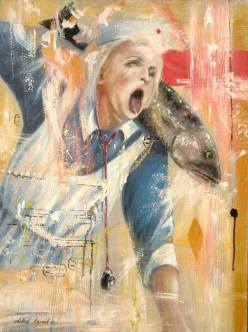
It’s crazy making.
Experts struggled to think of a historical parallel where the president has turned the world’s most powerful and influential office into a megaphone for wholesale fabrications and bizarre claims in an effort to confuse voters and salvage his own political future.
“Trump is certainly not the first politician to lie or invent stories,” said Eileen Culloty, who researches disinformation at Dublin City University in Ireland. “But his history of making baseless, conspiratorial claims — whether it’s Obama’s birth certificate, linking Ted Cruz’s family to the Kennedy assassination or now Obamagate — is striking for its scale and frequency.”
Critics said Trump’s messaging was particularly destructive as Americans struggle with the pandemic, which has crippled the economy and killed more than 90,000 in the U.S. as of Monday.
“A pandemic is the perfect laboratory for disinformation because people are scared, they’re anxious — and all of the social science around conspiracy theories shows when people feel anxious and scared, they’re more likely to believe conspiracy theories,” said Richard Stengel, a former editor of Time magazine and former senior State Department official.
“Trump has figured that out. This campaign is headed to a low point that we’ve never experienced before in American history, because he is not at all compelled to align his message with reality,” he added.
Read more at the LA Times.
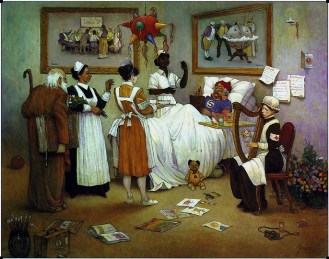
The Nurse, Jose Perez
Richard Stengel, quoted in the LA Times piece, writes at Vanity Fair about what Trump’s incompetence has done to our country’s reputation: The Bungling Superpower: COVID-19 Has Recast America as a Global Chump.
When I was under secretary of state for public diplomacy during the Barack Obama administration—the job that is essentially the chief marketing officer for the American brand around the world—I found that the most common request I got from international diplomats and leaders was, could I help them get in touch with the Silicon Valley tech companies? Would I introduce them to someone at Google, Apple, and Facebook? Our brand differentiator was no longer drones, Tomahawks, and foreign assistance—though all of them still mattered—it was search, likes, and Twitter. No, we weren’t as generous and deep-pocketed as we once had been, nor could we build bridges and highways like China was doing, but we were seen as the land of the future, and people wanted to know how we did it. It was a welcome change.
But the election of Donald Trump and our inept response to the coronavirus has reversed much of that. Even when we were the arrogant and galumphing superpower—a continuation of the Ugly American stereotype from the 1950s—we were always seen as competent. Yes, we were headstrong and naive, but we got things done. Now, thanks to the combination of Trump’s much-mocked America First doctrine and his administration’s chaotic and chuckleheaded response to the coronavirus, the Trump administration has recast our brand in a new way: the bungling superpower. The country that created the iPhone could not figure out how to manufacture enough cotton swabs. While Germany is led by a woman with a doctorate in quantum chemistry, the U.S. president was suggesting that people inject disinfectant to cure the virus.
Nursing, by Jeff Conway
Last week, in a rare move in its nearly 200-year history, the distinguished British medical journal The Lancet published an editorial saying that the U.S. had fallen from what it once was, the gold standard in disease detection and control, and must not reelect a president who prized partisanship above science. A poll in France earlier this month found that Angela Merkel, and not the American president, was overwhelmingly regarded as the leader of the free world. Only 2% of those polled said Trump was heading in the right direction. A Bosnian TV journalist proclaimed that the White House was dysfunctional and America was beginning to resemble the Balkans. The Balkans.
Many people have cited the line from the Irish Times that “the world has loved, hated, and envied the U.S. Now, for the first time, we pity it.” That’s not quite right. The emotion is not pity, but schadenfreude: people around the world are taking a secret pleasure in the U.S.’s ineptitude. They feel the U.S is getting payback for its self-righteousness, boasting, and incessant lecturing. It’s karmic retribution, not pity.
But there’s a greater and more existential threat to American influence than the scorn people around the world have for Trumpism: it is the increasing non-essentialness of America among nations and the discrediting of the American model of governance and capitalism.

Bloomberg reports on a study that shows that Covid Patients Testing Positive After Recovery Aren’t Infectious.
Researchers are finding evidence that patients who test positive for the coronavirus after recovering aren’t capable of transmitting the infection, and could have the antibodies that prevent them from falling sick again.
Gregg Chadwick, Nurses and therapy dog
Scientists from the Korean Centers for Disease Control and Prevention studied 285 Covid-19 survivors who had tested positive for the coronavirus after their illness had apparently resolved, as indicated by a previous negative test result. The so-called re-positive patients weren’t found to have spread any lingering infection, and virus samples collected from them couldn’t be grown in culture, indicating the patients were shedding non-infectious or dead virus particles.
The findings, reported late Monday, are a positive sign for regions looking to open up as more patients recover from the pandemic that has sickened at least 4.8 million people. The emerging evidence from South Korea suggests those who have recovered from Covid-19 present no risk of spreading the coronavirus when physical distancing measures are relaxed.
The results mean health authorities in South Korea will no longer consider people infectious after recovering from the illness. Research last month showed that so-called PCR tests for the coronavirus’s nucleic acid can’t distinguish between dead and viable virus particles, potentially giving the wrong impression that someone who tests positive for the virus remains infectious.
The research may also aid in the debate over antibody tests, which look for markers in the blood that indicate exposure to the novel coronavirus. Experts believe antibodies probably convey some level of protection against the virus, but they don’t have any solid proof yet. Nor do they know how long any immunity may last.

Read more at the link.
I’ll end with a non-Trump story from The Guardian: Exclusive: Police tried to tase Ahmaud Arbery in 2017 incident, video shows.
Police attempted to use a Taser on Ahmaud Arbery, the slain Georgia jogger, after questioning why he was sitting alone in his car in a park one morning in November 2017, according to records and a police video obtained by the Guardian.
Edwin Harleston, The Nurse
The video, obtained through a public records request, comes to light as law enforcement in the area faces scrutiny after Arbery was shot dead by two white men while jogging in February. Police did not arrest Gregory and Travis McMichael, who chased down and killed the unarmed Arbery, and a prosecutor assigned to the case wrote a lengthy memo explaining why the killing was legally justified….
In the video an officer patrolling the area suspected Arbery of using marijuana, saying he was in a park known for drug activity.
Arbery, dressed in a green hat, winter coat and athletic pants, said he didn’t have drugs and refused to let the officer search his car. He told the officer he was relaxing by rapping in his car over instrumental beats and had the day off from work at Blue Beacon Truck Wash.
The incident, previously described by the Atlanta Journal-Constitution, escalated when Arbery began to question why the officer, Michael Kanago, was hassling him. Kanago claimed he began to feel threatened by Arbery, later writing in his report that “veins were popping from [Arbery’s] chest, which made me feel that he was becoming enraged and may turn physically violent towards me”. Kanago requested help from a second officer.
“You’re bothering me for nothing,” Arbery said to Kanago, according to body camera footage. After Kanago told him he was looking for criminal activity, Arbery said “criminal activity? I’m in a fucking park. I work.”

How dare a young black man sass a George police officer. Well, they finally got him killed, didn’t they? Racist monsters.
That’s all I have for you today. What’s on your mind? What stories are you following?
Monday Morning: Death Chases the Open ’em crowd down US Streets and other news
Posted: May 18, 2020 Filed under: COVID19, morning reads | Tags: death chases the open it up flock 22 Comments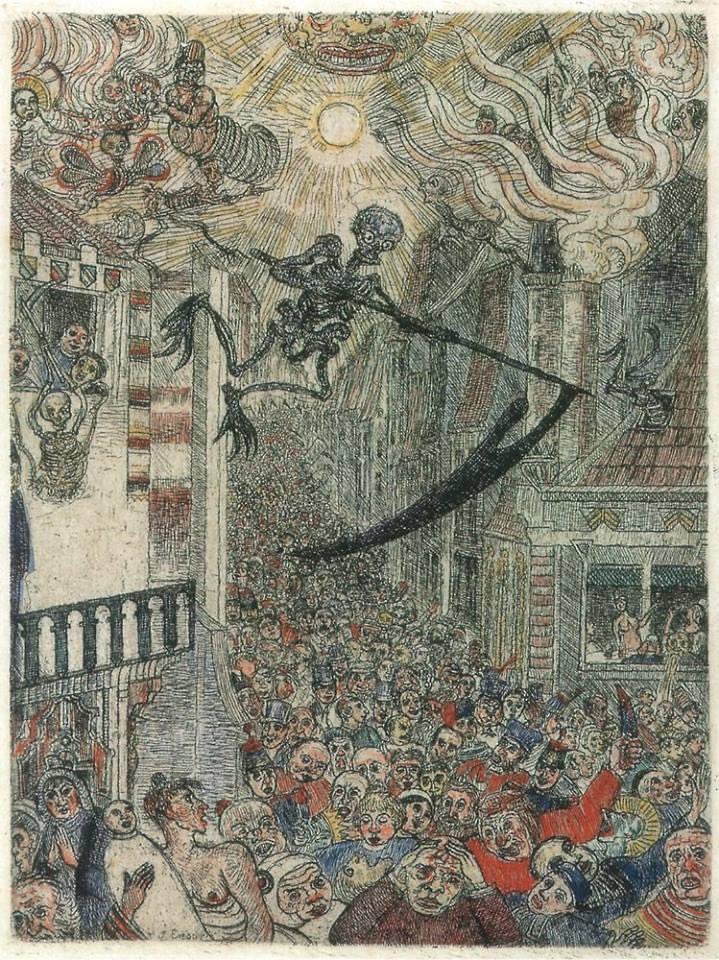
JAMES ENSOR DEATH CHASING A FLOCK OF MORTALS (1896) or what I call Open up Day across the USA
Good Day Sky Dancers!
This will be short. I’m still grading and they’re due in by tomorrow.
From The Guardian and Jason Wilson: “US lockdown protests may have spread virus widely, cellphone data suggests ” Way to go idiots!
Cellphone location data suggests that demonstrators at anti-lockdown protests – some of which have been connected with Covid-19 cases – are often traveling hundreds of miles to events, returning to all parts of their states, and even crossing into neighboring ones.
The data, provided to the Guardian by the progressive campaign group the Committee to Protect Medicare, raises the prospect that the protests will play a role in spreading the coronavirus epidemic to areas which have, so far, experienced relatively few infections.
The anonymized location data was captured from opt-in cellphone apps, and data scientists at the firm VoteMap used it to determine the movements of devices present at protests in late April and early May in five states: Michigan, Wisconsin, Illinois, Colorado and Florida.
They then created visualizations that tracked the movements of those devices up to 48 hours after the conclusion of protests. The visualizations only show movements within states, due to the queries analysts made in creating them. But the data scientist Jeremy Fair, executive-vice president of VoteMap, says that many of the devices that are seen to reach state borders are seen to continue across them in the underlying raw data.
One visualization shows that in Lansing, Michigan, after a 30 April protest in which armed protesters stormed the capitol building and state police were forced to physically block access to Governor Gretchen Whitmer, devices which had been present at the protest site can be seen returning to all parts of the state, from Detroit to remote towns in the state’s north.
One device visible in the data traveled to and from Afton, which is over 180 miles from the capital. Others reached, and some crossed, the Indiana border.
In the 48 hours following a 19 April “Operation Gridlock” protest in Denver, devices reached the borders of neighboring states including Wyoming, Nebraska, Oklahoma, New Mexico and Utah.
In Florida on 18 April, devices returned to all parts of the peninsula and up to the Georgia border. In Wisconsin on 24 April, devices returned to smaller towns like Green Bay and Wausau, and the borders of Minnesota and Illinois.
Following the initial wave of anti-lockdown protests in April, epidemiologists warned that they could lead to a new surge in cases.
In North Carolina in late April, one of the leaders of the state’s anti-lockdown protests tested positive for Covid-19 but said she would attend future rallies.

From CBS News: “Full Transcript: Fed Chair Jerome Powell’s 60 Minutes interview on economic recovery from the coronavirus pandemic”
SCOTT PELLEY, CBS NEWS / 60 MINUTES: There’s only one question that anyone wants an answer to, and that is: when does the economy recover?
JEROME POWELL, CHAIRMAN OF THE FEDERAL RESERVE: It’s a good question. And very difficult to answer because it really does depend, to a large degree, on what happens with the coronavirus. The sooner we get the virus under control, the sooner businesses can reopen. And more important than that, the sooner people will become confident that they can resume certain kinds of activity. Going out, going to restaurants, traveling, flying on planes, those sorts of things. So that’s really going to tell us when the economy can recover.
PELLEY: Many states are beginning to reopen their economies. Do you consider the virus under control?
POWELL: Well, I think we’re going to see what happens with that. People will need to take certain measures to protect themselves. Wash their hands, wear masks in certain situations and things like that. And I do think that over the next couple of months, you’re going to be seeing the beginnings of the recovery, as people, as businesses reopen and people go back to work.
The big thing we have to avoid during that period is a second wave of the virus. But if we do, then the economy can continue to recover. We’ll see GDP move back up after the very low numbers of this quarter. We’ll see unemployment come down. But I think though it’ll be a while before we really feel, well recovered.
I’m still with my Mayor’s program of “safest at home” but evidently uptown New Orleans put the message through white privilege and showed up in groups all over. That was the only place where people were overly anxious to socialize around here or so I was told.,
Trump’s reopening troubles play out in his White House The White House is struggling to keep its leaders and staffers safe while pushing for the reopening of America.
Reopening isn’t go well in the White House either. From Politico’s Nancy Cook: “Trump’s reopening troubles play out in his White House. The White House is struggling to keep its leaders and staffers safe while pushing for the reopening of America.”
Not far behind the scenes of the West Wing, however, normalcy is still a ways off. Trump’s own top staffers are increasingly working from home. The White House has started to schedule more meetings by teleconference after two staffers tested positive for Covid-19, including one of the president’s military valets. Aides are now required to wear face masks around the White House, and in-person meetings, if they occur at all, are held in the largest conference rooms possible.
Even the White House mess, where staffers grab lunch and coffee, has shut down and is open only through the take-out window.
The most prominent office in America — with all of the testing, resources and doctors it needs — is still struggling to keep its employees and leaders safe, even as more than a dozen states reopen businesses, restaurants, parks and beaches. The White House’s struggles and its ongoing revision of its health measures offer a window into the myriad challenges that thousands of companies and employers face as they consider bringing back non-essential workers.
The hallways of the Eisenhower Executive Office Building, across the street from the White House, are mostly empty, senior administration officials say — except for the vice president. He led meetings in that building last week in a secure room by phone instead of holding court in the situation room, after his press secretary, Katie Miller, tested positive.

This is from CNN and pretty much what I’m expecting with this open up early stuff: “A person who was Covid-19 positive attended a church service and exposed 180 people, officials say ”
A person who later learned they were positive for Covid-19 attended a California religious service on Mother’s Day, exposing 180 other people to the novel coronavirus, according to local health officials.
The individual got a positive diagnosis for Covid-19 the day after the service and is now in isolation at home, Butte County Public Health said in a statement Friday.
People who attended the service have been notified about their exposure and received instructions from health officials to self-quarantine, the statement said. Officials are working to get testing for everyone who was in attendance.
So, I’m off to finish up my coffee and grade things and chase down students. Wish me luck and strength!
Be safe! Be kind and gentle to yourself and others! Stay your ass home as much as possible!
What’s on your reading and blogging list today?
Thursday Reads: News Overload and Spring Flowers
Posted: May 14, 2020 Filed under: morning reads, U.S. Politics 21 Comments
Good Morning!!
There is so much news today that I can’t possibly get to all of it, but I’ll do my best.
This morning Dr. Rick Bright, the latest whistle blower to challenge Trump’s version of reality, is testifying in the House. The hearing in The energy and Commerce Committee’s Health Subcommittee is happening right now.
CNN: Dr. Rick Bright, ousted director of key vaccine agency, to testify before House panel Thursday.
Dr. Rick Bright, the ousted director of a crucial federal office charged with developing countermeasures to infectious diseases, will testify before Congress on Thursday that the US will face “unprecedented illness and fatalities” without additional preparations to curb the coronavirus pandemic.
“Our window of opportunity is closing,” Bright is expected to testify, according to his prepared remarks provided to CNN. “Without clear planning and implementation … 2020 will be (the) darkest winter in modern history.” [….]
Before the House Committee on Energy and Commerce’s health subcommittee, Bright is expected to urge the Trump administration to consider a number of actions, including increasing production of essential equipment and establishing both a national test strategy and a national standard of procurement of supplies. He calls on top officials to “lead” through example and wear face coverings and social distance.
Bright, now a senior adviser at the National Institutes of Health, claims that the administration “missed early warning signals” to prevent the spread of the virus and blames the leadership of the Health and Human Services for being “dismissive” of his “dire predictions.”
Read more at CNN.

Arum, irises and mimosa, Blue vase with flowers on a blue tablecloth, 1913, Henri Matisse
More from Raw Story: A Trump official tried to fast-track funding for his friend’s unproven COVID-19 ‘treatment’: whistleblower Rick Bright.
Last November, Rick Bright, then the director of a federal office that approves funding for medical emergencies, sat in on a meeting between his boss and two men — a pharmaceutical and biotech consultant and an Emory University professor — seeking millions of dollars for an unproven drug.
Bright wrote in a whistleblower complaint filed last week that he was wary as professor George Painter and consultant John Clerici described the drug “as a ‘cure all’ for influenza, Ebola, and nearly every other virus.” The team came back in February with an updated pitch after the coronavirus outbreak, suggesting its antiviral medication could be a treatment for COVID-19.
Painter, a pharmacology professor and CEO of a nonprofit biotech company, had already received $30 million from the National Institutes of Health and the Department of Defense for small-scale clinical trials. But as Bright described in his complaint, Painter sought more money from Bright’s office, the Biomedical Advanced Research and Development Authority (BARDA). Instead of going through Bright’s formal application process, Painter and Clerici sought funding through a separate, more “opaque” program created by Bright’s boss, Robert Kadlec — a Trump administration appointee and friend of Painter’s. Kadlec’s program was designed to support products, equipment and technology, Bright said, and lacked the expertise to evaluate drug development.
Bright said Kadlec looked favorably on the proposal from the beginning, but Bright urged caution, as Painter had no data on the drug’s effects in humans. For instance, Bright said he’d noted during the November meeting that other compounds similar to this drug had toxic effects, as the lab animals treated with those chemicals gave birth to offspring that were “born without teeth and without parts of their skulls.”
Bright said Kadlec tried to “circumvent” him to find funding for Painter’s drug, EIDD-2801, though he was ultimately unsuccessful.
It looks like Senator Richard Burr is in serious trouble over those suspicious stock trades he made after receiving a top secret briefing about the coming pandemic.
The Los Angeles Times: FBI serves warrant on senator in investigation of stock sales linked to coronavirus.
Federal agents seized a cellphone belonging to a prominent Republican senator on Wednesday night as part of the Justice Department’s investigation into controversial stock trades he made as the novel coronavirus first struck the U.S., a law enforcement official said.
Flowers in a Vase, 1866, Edvard Munch
Sen. Richard Burr of North Carolina, the chairman of the Senate Intelligence Committee, turned over his phone to agents after they served a search warrant on the lawmaker at his residence in the Washington area, the official said, speaking on condition of anonymity to discuss a law enforcement action.
The seizure represents a significant escalation in the investigation into whether Burr violated a law preventing members of Congress from trading on insider information they have gleaned from their official work.
To obtain a search warrant, federal agents and prosecutors must persuade a judge they have probable cause to believe a crime has been committed. The law enforcement official said the Justice Department is examining Burr’s communications with his broker.
Such a warrant being served on a sitting U.S. senator would require approval from the highest ranks of the Justice Department and is a step that would not be taken lightly. Kerri Kupec, a Justice Department spokeswoman, declined to comment.
A second law enforcement official said FBI agents served a warrant in recent days on Apple to obtain information from Burr’s iCloud account and said agents used data obtained from the California-based company as part of the evidence used to obtain the warrant for the senator’s phone.

The emoluments case against Trump is alive again.
Politico: Appeals court greenlights emoluments suit against Trump.
A lawsuit accusing President Donald Trump of violating the Constitution by accepting foreign government money through his luxury Washington hotel can proceed to fact-gathering about Trump’s profits, a federal appeals court ruled Thursday.
Lilacs in a window, Mary Cassatt, c. 1880-83
The Richmond-based 4th Circuit Court of Appeals voted, 9-6, to reject Trump’s bid to shut down the lawsuit the governments of Maryland and the District of Columbia brought alleging violations of the Constitution’s emoluments clauses.
Trump, who has vigorously fought a series of similar lawsuits for years, will now need relief from the Supreme Court if he wants to block Maryland and D.C. from pressing demands for his business records as his re-election campaign gets into full swing….
The 4th Circuit’s full bench essentially split along ideological lines with the Democratic appointees turning down Trump’s attempt to halt discovery ordered by a federal district court judge in Maryland and the Republican-appointed ones siding with Trump.
Chief Judge Roger Gregory, who was recess appointed by President Bill Clinton and got a permanent appointment under President George W. Bush, ruled against the president.
An all GOP-appointed panel of the 4th Circuit had previously voted unanimously to shut down the suit the Maryland and D.C. attorneys general filed back in 2017.
Two other appeals courts have reached disparate rulings on similar suits filed in other courts.

Read more at Politico.
Trump and Bill Barr have run into a snag in their efforts to exonerate Michael Flynn.
The Washington Post: Court asks retired judge to oppose Justice Dept. effort to drop Michael Flynn case, examine whether ex-Trump adviser committed perjury.
Michael Flynn’s sentencing judge Wednesday asked a former federal judge to oppose the Justice Department’s request to dismiss the former Trump national security adviser’s guilty plea and examine whether Flynn may have committed perjury.
Dahlias, Berthe Morrisot, 1876
The judge requested a nonbinding recommendation on whether Flynn should face a criminal contempt hearing for pleading guilty to a crime of which he now claims to be innocent: lying to the FBI in a January 2017 interview about his contacts with Russia’s ambassador to the United States.
U.S. District Judge Emmet G. Sullivan’s appointment of retired New York federal judge John Gleeson comes one day after Sullivan put on hold the Justice Department’s bid to drop charges against Flynn, saying he expects independent groups and legal experts to argue against the move.
The unusual move by the court plunges the Flynn case even deeper into uncharted legal waters, in which the Justice Department has taken a posture more common to defense lawyers by saying that the former three-star general should never have been interviewed in an investigation and therefore his lies were immaterial. The case also presents novel legal twists as the judge has appointed a former judge to determine whether other crimes occurred and the president’s supporters demand the immediate dismissal of the entire case.

More articles on the Flynn case to check out:
The New York Times: Ex-F.B.I. Official Is Said to Undercut Justice Dept. Effort to Drop Flynn Case.
Politico: Federal judge mulls contempt charge against Michael Flynn.
The New York Times: Trump White House Rewrites History, This Time About Flynn.
Anthony Fauci’s days in the Trump administration may be numbered.
The New York Times: Trump Pointedly Criticizes Fauci for His Testimony to Congress.
President Trump on Wednesday criticized congressional testimony delivered a day earlier by Dr. Anthony S. Fauci, the nation’s top infectious disease expert, who had warned against reopening the country too quickly and stressed the unknown effects the coronavirus could have on children returning to school.
Claude Monet Vase of Flowers
“I was surprised by his answer,” Mr. Trump told reporters who had gathered in the Cabinet Room for the president’s meeting with the governors of Colorado and North Dakota. “To me it’s not an acceptable answer, especially when it comes to schools.”
The president’s desire to reopen schools and businesses in order to bring back the economy has often led to public clashes over the guidance provided by Dr. Fauci, who has warned that taking a cavalier attitude toward reopening the country could invite unnecessary suffering caused by a virus scientists are still struggling to understand. He reiterated that position on Tuesday in testimony before a Senate committee.
“He wants to play all sides of the equation,” Mr. Trump said on Wednesday, before bragging that the economy next year would be “phenomenal.”
Dr. Fauci also told the Senate panel that a vaccine for the coronavirus would almost certainly not be ready in time for the new school year, and warned of the dangers of the virus to children.
“I think we better be careful, if we are not cavalier, in thinking that children are completely immune to the deleterious effects,” Dr. Fauci said. “You’re right in the numbers that children in general do much, much better than adults and the elderly and particularly those with underlying conditions. But I am very careful, and hopefully humble in knowing that I don’t know everything about this disease. And that’s why I’m very reserved in making broad predictions.”

Read the rest at the NYT.
More stories of interest:
The Daily Beast: Trump Feared Testing Too Many People for Virus Would Spook Stock Markets, Says Report.
Edward Luce at The Financial Times: Inside Trump’s coronavirus meltdown.
Time: There Are Sensible Ways to Reopen a Country. Then There’s America’s Approach.
Nicholas Kristof at The New York Times: America’s True Covid Toll Already Exceeds 100,000.
Jeffrey Goldberg at The Atlantic: The Conspiracy Theorists Are Winning. America is losing its grip on enlightenment values and reality itself.
Adrienne La France at The Atlantic: The Prophecies of Q. American conspiracy theories are entering a dangerous new phase.
A little humor from Alexandra Petri at The Washington Post: Obamagate was the worst crime ever committed and here is what it was.
I’ve tried to touch on the high points of today’s news, but I’m sure there’s plenty I’ve left out. What stories are you following today?

 peej
peej Carissa
 bostonboomer
 dakinikat
 ecocatwoman
 mablue2
 Mama Lopez
 peggysue22
 quixote
 skydancingguestblogger
 Mona (aka Wonk the Vote)



 Sky Dancing
Recent Comments