
Tuesday Reads: The Pandemic Is Still With Us
Posted: June 9, 2020 Filed under: morning reads, U.S. Politics | Tags: coronavirus pandemic, Covid-19, street art 10 Comments
Street Artist Corie Mattie, “I wanted to find some way to help raise awareness and also give hope.”
Good Morning!!
For the past couple of weeks, the Covid-19 pandemic has been pushed off the front pages by massive protests against police brutality triggered by the murder of George Floyd in Minneapolis. But the virus is still raging across the U.S. and we still are not doing enough to deal with the consequences, including economic ones.
The Washington Post: 14 states and Puerto Rico hit highest seven-day average of new coronavirus infections.
Since the start of June, 14 states and Puerto Rico have recorded their highest-ever seven-day average of new coronavirus cases since the pandemic began, according to data tracked by The Washington Post: Alaska, Arizona, Arkansas, California, Florida, Kentucky, New Mexico, North Carolina, Mississippi, Oregon, South Carolina, Tennessee, Texas and Utah.
If the pandemic’s first wave burned through dense metro hubs such as New York City, Chicago and Detroit, the highest percentages of new cases are coming from places with much smaller populations: Lincoln County, Ore., an area of less than 50,000, has averaged 20 new daily cases; the Bear River Health District in northern Utah has averaged 78 new cases a day in the past week, most of them tied to an outbreak at a meat processing plant in the small town of Hyrum.
The increase of coronavirus cases in counties with fewer than 60,000 people is part of the trend of new infections surging across the rural United States. Health experts worry those areas, already short of resources before the pandemic, will struggle to track new cases with the infrastructure that remains.
Adding to the disparity in health-care support, residents in states such as Mississippi, Florida and South Carolina are living under only minor-to-moderate restrictions — even as their average daily infection rate is rising.
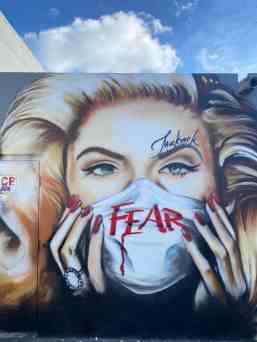
Jules Muck, artist. Photo by Paul Lara
Here’s a story from one of those states, Arizona. Tucson.com: Arizona hospitals bracing for crisis as COVID-19 cases surge.
Last week marked the largest week-to-week increase of coronavirus cases in both Arizona and Pima County since the pandemic began, and Banner Health is reporting its ICUs are at full capacity in Maricopa County and rapidly approaching full capacity in Tucson.
New, confirmed cases in Arizona totaled 4,500 from May 24 to May 30, according to the Arizona Department of Health Services, as of Saturday morning. That’s nearly a 50% increase from the week before.
In Pima County, cases totaled 481 over the same period, marking an 85% increase from the previous week.
The county Health Department is watching closely to see if these cases will turn into hospitalizations, visits to intensive care units and ultimately deaths, said Dr. Francisco Garcia, the county’s chief medical officer….
Dr. Marjorie Bessel, Banner Health’s chief clinical officer, said on Friday that COVID-19 hospitalizations are rapidly increasing and that, if these trends continue, Banner will soon need to start surge planning and increase bed capacity.
Most concerning, she said, is the steep incline of COVID-19 patients on ventilators. As of Thursday, Banner had 116 COVID-19 patients on ventilators statewide.
According to newly released studies, closing down states’ economies and urging people to stay home worked to reduce spread of the virus. The Washington Post: Shutdowns prevented 60 million coronavirus infections in the U.S., study finds.
Shutdown orders prevented about 60 million novel coronavirus infections in the United States and 285 million in China, according to a research study published Monday that examined how stay-at-home orders and other restrictions limited the spread of the contagion.
A separate study from epidemiologists at Imperial College London estimated the shutdowns saved about 3.1 million lives in 11 European countries, including 500,000 in the United Kingdom, and dropped infection rates by an average of 82 percent, sufficient to drive the contagion well below epidemic levels.
Street art, NYC
The two reports, published simultaneously Monday in the journal Nature, used completely different methods to reach similar conclusions. They suggest that the aggressive and unprecedented shutdowns, which caused massive economic disruptions and job losses, were effective at halting the exponential spread of the novel coronavirus.
“Without these policies employed, we would have lived through a very different April and May,” said Solomon Hsiang, director of the Global Policy Laboratory at the University of California at Berkeley, and the leader of the research team that surveyed how six countries — China, the United States, France, Italy, Iran and South Korea — responded to the pandemic.
His team estimated that, in the initial days after the virus was seeded in each country, and before the shutdowns, the number of infections was doubling every two days.
“The disease was spreading at a really extraordinary rate that is rare even among very infectious diseases,” he said in an interview. The global response to covid-19, the disease caused by the virus, resulted in “saving more lives in a shorter period of time than ever before,” he said in a separate conference call with reporters.

But at The Atlantic, Alexis C. Madrigal and Robinson Meyer write: America Is Giving Up on the Pandemic.
After months of deserted public spaces and empty roads, Americans have returned to the streets. But they have come not for a joyous reopening to celebrate the country’s victory over the coronavirus. Instead, tens of thousands of people have ventured out to protest the killing of George Floyd by police.
Demonstrators have closely gathered all over the country, and in blocks-long crowds in large cities, singing and chanting and demanding justice. Police officers have dealt with them roughly, crowding protesters together, blasting them with lung and eye irritants, and cramming them into paddy wagons and jails.
London, street art
There’s no point in denying the obvious: Standing in a crowd for long periods raises the risk of increased transmission of SARS-CoV-2, the virus that causes COVID-19. This particular form of mass, in-person protest—and the corresponding police response—is a “perfect set-up” for transmission of the virus, Anthony Fauci, the director of the National Institute of Allergy and Infectious Diseases, said in a radio interview on Friday. Some police-brutality activists (such as Black Lives Matter Seattle) have issued statements about the risk involved in the protests. Others have organized less risky forms of protests, such as Oakland’s Anti Police-Terror Project’s massive “caravan for justice.”
Americans may wish the virus to be gone, but it is not. While the outbreak has eased in the Northeast, driving down the overall national numbers, cases have only plateaued in the rest of the country, and they appear to be on the rise in recent days in COVID Tracking Project data. Twenty-two states reported 400 or more new cases Friday, and 14 other states and Puerto Rico reported cases in the triple digits. Several states—including Arizona, North Carolina, and California—are now seeing their highest numbers of known cases.
These numbers all reflect infections that likely began before this week of protest. An even larger spike now seems likely. Put another way: If the country doesn’t see a substantial increase in new COVID-19 cases after this week, it should prompt a rethinking of what epidemiologists believe about how the virus spreads.
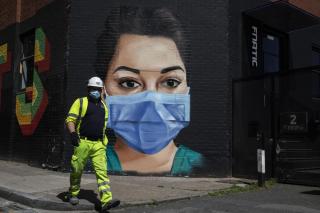
This is a long article, and I hope you’ll read the rest at the link above. But I want to quote one more paragraph.
Americans have not fully grasped that we are not doing what countries that have returned to normal have done. Some countries have almost completely suppressed the virus. Others had large outbreaks, took intense measures, and have seen life return to normal. Americans, meanwhile, never stayed at home to the degree that most Europeans have, according to mobility data from Apple and Google. Our version of the spring lockdown looked more like Sweden’s looser approach than like the more substantial measures in Italy, or even the United Kingdom and France. Swedish public-health officials have acknowledged that this approach may not have been the best path forward.
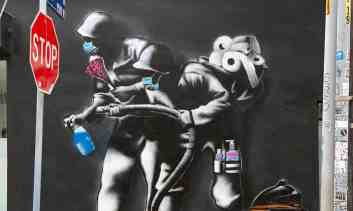
A piece by Hijack Art in Los Angeles.
I’m really worried that we’ll soon see spikes in infections in states like mine (Massachusetts) and others that have managed to reduce the spread and are now reopening.
There is also the matter of the economy. Is Congress going to do anything further to help Americans who lost jobs and are now facing hunger? Eater: Food Banks Need More Government Help to Address Unprecedented Levels of Food Insecurity.
One of the lasting images of the coronavirus pandemic will be that of thousands of cars lined up bumper to bumper in front of food banks, a reminder of how many people in the U.S. have lost their incomes and the ability to feed themselves and their families over the past three months. Food pantries and other nonprofit organizations have struggled to respond to record demand in the face of such food insecurity, while also dealing with difficulties brought on by disrupted supply chains and volunteers who themselves may be vulnerable to virus exposure….
But some lawmakers say that federal agencies’ response to address this crisis has been slow. Out of the $850 million that the CARES Act and the Family First Coronavirus Response Act set aside for food banks nearly two months ago, less than $300 million has been sent out so far, Democratic members on the Senate Appropriations Committee told the Washington Post. The Post reports that those lawmakers aren’t accusing the Trump administration of “deliberate foot-dragging,” but rather, are saying that the status quo federal bureaucracy has not acted with the urgency that such an unprecedented situation requires.
The government appears to be slow-walking money that has already been appropriated. The Washington Post: Food banks and other key programs have received a fraction of allotted coronavirus money, angering some lawmakers.
More than two months after passage of the $2 trillion Cares Act, funding for some key programs to address the economic devastation from the coronavirus is moving out slowly or not at all. Even after the United States added 2.5 million jobs last month, 20 million people remain out of work and federal bureaucracies charged with processing record sums of money to respond to the crisis are struggling to snap into action.
The Cares Act directed $850 million for food banks, but less than $300 million has been sent out so far, according to Democratic staff members on the Senate Appropriations Committee. That’s despite unprecedented demand, with the number of people served at food banks increasing by more than 50 percent from a year ago, according to a recent survey by the nonprofit group Feeding America.
Street artist Ruben Rojas
Similarly, Congress appropriated $9 billion in March for the Community Development Block Grant and Emergency Solutions Grant programs, which fund health facilities, child care centers, and services for seniors and homeless people, among other things. Only about $250 million of that money has been obligated.
In another example, $100 million dedicated specifically to help nursing homes certify compliance standards for issues like infection control remains unspent two months after it became law as part of the Cares Act. Another $100 million to help ensure access to broadband for Americans in rural parts of the country also remains unspent.
A separate $100 million appropriation to help the Federal Emergency Management Agency purchase personal protective equipment for firefighters also hasn’t been spent. Additionally, less than half the $16 billion Congress dedicated over four separate pieces of legislation to bulking up critical medical supplies in the Strategic National Stockpile has been spent, according to the Democrats’ calculations.

Politico: Food Banks Pushed to the Brink.
The coronavirus pandemic and economic slowdown has left at least 20 million Americans out of work, sending demand skyrocketing at food banks and other feeding programs around the U.S. The Agriculture Department is already spending $3 billion on surplus meat, dairy, fruits and vegetables to help nonprofits meet their needs, but anti-hunger advocates say there’s another way Washington should help: Increase food stamp benefits so hungry families can buy more groceries instead of leaning on food banks.
Here’s the problem: Bolstering the Supplemental Nutrition Assistance Program is almost a nonstarter in Congress, even as lawmakers pour billions of dollars into unemployment insurance, stimulus checks and other aid, writes Pro Ag’s Helena Bottemiler Evich. Democrats and Republicans have waged a fierce partisan tug-of-war over whether to shrink or expand the food safety net, and before the pandemic, USDA had issued a series of rules aiming to crack down on SNAP benefits when the economy was strong.
Recent data shows that food insecurity rates are going through the roof. For example, a national survey in late April found that more than 17 percent of mothers reported that their children under the age of 12 weren’t getting enough to eat because the family couldn’t afford enough food — a more than 400 percent increase from when the government last measured hunger rates in 2018.
The ask: Anti-hunger groups have been pressing Congress to increase food stamp benefits by 15 percent until unemployment rates come down, a move that would give SNAP recipients about $25 more per month. The request has repeatedly been rejected by Republicans, but Democrats have pledged to make sure the provision is included in a future coronavirus response package.
I know these issues aren’t as exciting as the protests, but it’s important to remember that that virus hasn’t gone away and the protests are very likely to increase the spread. We’re face overwhelming problems as a country, but are we really ready to accept tens of thousands more unnecessary deaths? It appears that many Americans have already made that calculation.
Please take care everyone. Stay safe and stay healthy.
Lazy Caturday Reads
Posted: June 6, 2020 Filed under: morning reads, U.S. Politics 9 Comments
Jean-Jacques Bachelier White Angora Cat Chasing a Butterfly
Good Morning!!
I finally got my hair cut yesterday. That was the first time I’ve gone anywhere except the grocery store or to take walks in my neighborhood since the lock downs began. I couldn’t believe how much I enjoyed getting out and seeing familiar people again. And it’s such a great feeling having my hair look neat and tidy–and not falling in my face!
The entire experience of the pandemic has been surreal, but combined with the insanity of living with an insane “president,” I’ve had a sense of unreality for a long time. I know I’m not alone in this.
I hope that we are really beginning to emerge from the dark days, but I’m worried that the protests are going to increase the spread of the virus and lead to a second wave of infections. James Hamblin writes at The Atlantic: Curfews and Arrests Will Inflame the Pandemic.
The inescapable fact is that the demonstrations protesting the police killing of George Floyd will lead to spikes in coronavirus deaths. There is no denying this. The question is how to minimize them. The science of how to conduct a perfectly safe mass demonstration in a pandemic is still imperfect, but one thing is clear: The answer is not to clamp down on peaceful gatherings, incarcerate more people, and give everyone less time and space to social distance with draconian curfews. Policing triggered these protests, and the policing, not the protesting, may turn out to be the primary driver of viral transmission during them.
Lucian Bernhard, Woman and Cat
“There are obvious measures that individuals can take during demonstrations, like wearing masks and trying to stay physically distant,” says Sten Vermund, dean of the Yale School of Public Health (where I’m a lecturer on health policy). “Of course that’s not always possible in a crowd.” And even when crowds are allowed adequate space to spread out, some images from protests show these measures being ignored. Some amount of transmission will likely result. As of now, Vermund told me, “we can’t be sure how much.”
The most hopeful element of the protests from a viral-transmission perspective is “the safety of the great outdoors,” Vermund said. The virus is known to spread mainly in confined indoor spaces where air is recirculated, among people who have prolonged close contact. During a rally or march, people are typically outside and, ideally, moving around—not long in proximity with any particular person who may be contagious.
Prolonged, close contact with other people becomes more of a concern when protests are confined to certain hours and certain areas of town. On Tuesday, for example, police blocked a large group of protesters from exiting the Manhattan Bridge, trapping them in a dense, stagnant crowd. Such density is also inevitable when people are arrested and detained. Yesterday, the U.S. marked 10,000 people arrested during the recent protests. Some have been loaded onto buses to be transported, and then held in crowded group cells. In addition to the usual constitutional dilemmas of arresting peaceful protesters, these measures carry especially ominous significance during a pandemic, when giving people space is of the utmost importance….
As President Donald Trump and some mayors threaten to forcibly contain more protesters, they contradict and undermine the very measures put in places that have only just begun to lower the infection rate in the United States. The more that people are forced into confined spaces, the more opportunity the virus will have to spread. Yet peaceful protesters have been arrested en masse for curfew violations in places including New York, the world’s hardest-hit city, where the death toll from COVID-19 is approaching 17,000.


Pierre-Auguste Renoir, Girl sleeping with cat 1880
Yesterday Trump celebrated a supposed improvement in unemployment figures, but there’s a problem with the data, according to Heather Long at the Washington Post: A ‘misclassification error’ made the May unemployment rate look better than it is. Here’s what happened.
When the U.S. government’s official jobs report for May came out on Friday, it included a note at the bottom saying there had been a major “error” indicating that the unemployment rate likely should be higher than the widely reported 13.3 percent rate.
The special note said that if this “misclassification error” had not occurred, the “overall unemployment rate would have been about 3 percentage points higher than reported,” meaning the unemployment rate would be about 16.3 percent for May.
The Bureau of Labor Statistics, the agency that puts out the monthly jobs reports, said it was working to fix the problem.
“BLS and the Census Bureau are investigating why this misclassification error continues to occur and are taking additional steps to address the issue,” said a note at the bottom of the Bureau of Labor Statistics report….
Economists say the BLS was trying to be as transparent as possible about how hard it is to collect real-time data during a pandemic. The BLS admitted that some people who should have been classified as “temporarily unemployed” during the shutdown were instead misclassified as employed but “absent” from work for “other reasons.”
The “other reason” category is normally used for people on vacation, serving jury duty or taking leave to care for a child or relative. These are typically situations where the worker decides to take leave. But in this unusual pandemic circumstance, the “other reason” category was applied to some people staying at home and waiting to be called back.
More on this situation and the fragile U.S. economy from Neil Irwin at The New York Times: Don’t Lose the Thread. The Economy Is Experiencing an Epic Collapse of Demand.
By Irina Kalentieva
You can already sense in the public debate over the economy that people are starting to lose the thread — viewing the slight rebound from epic collapse as a sign that a crisis has been averted. That certainly is the kind of optimism evident in the stock market, which is now down a mere 1.1 percent for the year.
But there are clear signs that the collapse of economic activity has set in motion problems that will play out over many months, or maybe many years. If not contained, they could cause human misery on a mass scale and create lasting scars for families.
The fabric of the economy has been ripped, with damage done to millions of interconnections — between workers and employers, companies and their suppliers, borrowers and lenders. Both the historical evidence from severe economic crises and the data available today point to enormous delayed effects.
“There’s a lot of denial here, as there was in the 1930s,” said Eric Rauchway, a historian at the University of California, Davis, who has written extensively about the Great Depression. “At the beginning of the Depression, nobody wanted to admit that it was a crisis. The actions the government took were not adequate to the scope of the problem, yet they were very quick to say there had been a turnaround.”
Though it may not attract the attention that reopening beaches and a soaring stock market might, the evidence is everywhere if you look closely.

Read the rest at the NYT link.

Connie Dillman, Afternoon Nap
According to Reuters, a massive demonstration will take place in Washington DC today: Washington prepares for major protest as U.S. officials move to rein in police.
Protesters are expected to gather in Washington for a huge demonstration on Saturday, its police chief said, as U.S. street marches over the killing of a black man in custody enter a 12th day and authorities move to rein in policing tactics….
“We have a lot of public, open source information to suggest that the event on this upcoming Saturday may be one of the largest we’ve ever had in the city,” Washington DC Police Chief Peter Newsham told local media, adding that much of the city center would be closed to traffic from early in the day.
Newsham did not give a crowd estimate. Local media has predicted tens of thousands of attendees.
At The Atlantic, George Packer argues that all this protesting may be for naught: Shouting Into the Institutional Void.
The urban unrest of the mid-to-late 1960s was more intense than the days and nights of protest since George Floyd was murdered by a Minneapolis policeman. More people died then, more buildings were gutted, more businesses were ransacked. But those years had one advantage over the present. America was coming apart at the seams, but it still had seams. The streets were filled with demonstrators raging against the “system,” but there was still a system to tear down. Its institutions were basically intact. A few leaders, in and outside government, even exercised some moral authority.
Lyndon B. Johnson created a commission to study the causes and prevention of urban unrest. The Kerner Commission—named for its chairman, Governor Otto Kerner Jr. of Illinois—was an emblem of its moment. It didn’t look the way it would today. Just two of the 11 members were black (Roy Wilkins, the leader of the NAACP, and Edward Brooke, a Republican senator from Massachusetts); only one was a woman. The commission was also bipartisan, including a couple of liberal Republicans, a conservative congressman from Ohio with a strong commitment to civil rights, and representatives from business and labor. It reflected a society that was deeply unjust but still in possession of the tools of self-correction….
Girl with a Cat. (1837-87} by Ivan Nikolaevich Kramskoi
The difference between 1968 and 2020 is the difference between a society that failed to solve its biggest problem and a society that no longer has the means to try. A year before his death, King, still insisting on nonviolent resistance, called riots “the language of the unheard.” The phrase implies that someone could be made to hear, and possibly answer. What’s happening today doesn’t feel the same. The protesters aren’t speaking to leaders who might listen, or to a power structure that might yield, except perhaps the structure of white power, which is too vast and diffuse to respond. Congress isn’t preparing a bill to address root causes; Congress no longer even tries to solve problems. No president, least of all this one, could assemble a commission of respected figures from different sectors and parties to study the problem of police brutality and produce a best-selling report with a consensus for fundamental change. A responsible establishment doesn’t exist. Our president is one of the rioters.

It’s an important piece. I hope you’ll go read the whole thing. Packer says we no longer have a political and cultural “establishment” to provide a foundation for societal change.
One more from The Atlantic’s Franklin Foer: The Trump Regime Is Beginning to Topple.
Over the course of his presidency, Donald Trump has indulged his authoritarian instincts—and now he’s meeting the common fate of autocrats whose people turn against them. What the United States is witnessing is less like the chaos of 1968, which further divided a nation, and more like the nonviolent movements that earned broad societal support in places such as Serbia, Ukraine, and Tunisia, and swept away the dictatorial likes of Milošević, Yanukovych, and Ben Ali.
And although Trump’s time in office will end with an election and not an ouster, it is only possible to grasp the magnitude of what we’re seeing and to map what comes next by looking to these antecedents from abroad.
As in the case of many such revolutions, two battles are being waged in America. One is a long struggle against a brutal and repressive ideology. The other is a narrower fight over the fate of a particular leader. The president rose to power by inflaming racial tensions. He now finds his own fate enmeshed in the struggle against police brutality and racism.
The most important theorist of nonviolent revolutions is the late political scientist Gene Sharp. A conscientious objector during the Korean War who spent nine months in prison, Sharp became a close student of Mahatma Gandhi’s struggles. His work set out to extract the lessons of the Indian revolt against the British. He wanted to understand the weaknesses of authoritarian regimes—and how nonviolent movements could exploit them. Sharp distilled what he learned into a 93-page handbook, From Dictatorship to Democracy, a how-to guide for toppling autocracy.
Sharp’s foundational insight is embedded in an aphorism: “Obedience is at the heart of political power.” A dictator doesn’t maintain power on his own; he relies on individuals and institutions to carry out his orders. A successful democratic revolution prods these enablers to stop obeying. It makes them ashamed of their complicity and fearful of the social and economic costs of continued collaboration.
Sharp posited that revolutionaries should focus first on the regime’s softest underbelly: the media, the business elites, and the police. The allegiance of individuals in the outer circle of power is thin and rooted in fear. By standing strong in the face of armed suppression, protesters can supply examples of courage that inspire functionaries to stop carrying out orders, or as Sharp put it, to “withhold cooperation.” Each instance of resistance provides the model for further resistance. As the isolation of the dictators grows—as the inner circles of power join the outer circle in withholding cooperation—the regime crumbles.
Read the rest at The Atlantic.
Have a great weekend, Sky Dancers!
Thursday Reads: Could This Be A Turning Point?
Posted: June 4, 2020 Filed under: morning reads, U.S. Politics | Tags: Black Lives Matter, Donald Trump, evangelicals, former presidents speak out, Gen. John Allen, George Floyd, James Mattis, protest rallies, Secretary of Defense Mark T. Esper 18 Comments
Good Morning!!
Could we finally have reached a turning point? Suddenly Trump is getting blowback from some powerful and respected quarters. Former presidents, the current Secretary of Defense, Trump’s former Secretary of Defense, retired generals, and former presidents are speaking out about Trump’s authoritarian tendencies and his misuse of the military. Even some in his evangelical base are speaking out.
The Atlantic: James Mattis Denounces President Trump, Describes Him as a Threat to the Constitution.
James Mattis, the esteemed Marine general who resigned as secretary of defense in December 2018 to protest Donald Trump’s Syria policy, has, ever since, kept studiously silent about Trump’s performance as president. But he has now broken his silence, writing an extraordinary broadside in which he denounces the president for dividing the nation, and accuses him of ordering the U.S. military to violate the constitutional rights of American citizens.
“I have watched this week’s unfolding events, angry and appalled,” Mattis writes. “The words ‘Equal Justice Under Law’ are carved in the pediment of the United States Supreme Court. This is precisely what protesters are rightly demanding. It is a wholesome and unifying demand—one that all of us should be able to get behind. We must not be distracted by a small number of lawbreakers. The protests are defined by tens of thousands of people of conscience who are insisting that we live up to our values—our values as people and our values as a nation.” He goes on, “We must reject and hold accountable those in office who would make a mockery of our Constitution.” [….]
“Donald Trump is the first president in my lifetime who does not try to unite the American people—does not even pretend to try. Instead, he tries to divide us,” Mattis writes. “We are witnessing the consequences of three years of this deliberate effort. We are witnessing the consequences of three years without mature leadership. We can unite without him, drawing on the strengths inherent in our civil society. This will not be easy, as the past few days have shown, but we owe it to our fellow citizens; to past generations that bled to defend our promise; and to our children.”
He goes on to contrast the American ethos of unity with Nazi ideology. “Instructions given by the military departments to our troops before the Normandy invasion reminded soldiers that ‘The Nazi slogan for destroying us … was “Divide and Conquer.” Our American answer is “In Union there is Strength.”’ We must summon that unity to surmount this crisis—confident that we are better than our politics.”
For some of us, it may be too little too late, but it’s possible Republicans will be influenced by retired general and former Defense Secretary James Mattis’ condemnation. Read the full statement at NPR.
Yesterday the current Secretary of Defense also distanced himself from Trump’s attempt to use the military to put down protests. Elizabeth N. Saunders at The Washington Post: The secretary of defense spoke out against Trump’s approach to the protests. Yes, this is a big deal.
At a Pentagon news conference Wednesday morning, Secretary of Defense Mark T. Esper said he opposed invoking the Insurrection Act and using active-duty military forces to help calm the largely peaceful protests that have been taking place around the country. Esper’s comments directly contradict President Trump, who in a nationally televised speech Monday threatened to use the military to “quickly solve the problem,” implicitly suggesting that he would invoke the 1807 law.
Esper’s comments also came after many criticized him for walking across Lafayette Square with the president and posing for a photo in front of St. John’s Episcopal Church, as well as using language like “we need to dominate the battlespace” on a Monday call with governors. On Tuesday evening, James Miller, a member of the Defense Science Board, which advises the Pentagon, wrote to Esper a letter, published in The Washington Post, to resign his position and to urge Esper to “consider closely both your future actions and your future words.”
It is tempting to dismiss Esper’s comments as words rather than action. He is not resigning in protest, as his recent predecessor, Jim Mattis, did in December 2018.
However, for Esper to give televised remarks from the Pentagon podium — something that is rare in this administration in normal times — is a significant development.
Click the link to read the reasons why this is so significant.
Retired Marine General John Allen at Foreign Policy: A Moment of National Shame and Peril—and Hope.
The slide of the United States into illiberalism may well have begun on June 1, 2020. Remember the date. It may well signal the beginning of the end of the American experiment.
The president of the United States stood in the Rose Garden of the White House on Monday, railed against weak governors and mayors who were not doing enough, in his mind, to control the unrest and the rioters in their cities, and threatened to deploy the U.S. military against American citizens. It was a stunning moment. But, in particular, it was notable for three important reasons.
First, Donald Trump expressed only the barest of condolences at the murder of George Floyd, but he also said nothing about the fundamental and underlying reasons for the unrest: systemic racism and inequality, a historic absence of respect, and a denial of justice. All of these factors are centuries old and deeply engrained in an American society that systematically delivers white privilege at the expense of people of color.
Yes, he mentioned George Floyd, but he did not touch on long-standing societal problems at all. He sees the crisis as a black problem—not as something to be addressed by creating the basis and impetus for a move toward social justice, but as an opportunity to use force to portray himself as a “law and order” president. The reasons were irrelevant to the opportunity. Remember the supposed invasion of the southern border and his deployment of federal troops ahead of the 2018 midterm elections? The president’s failure to understand the reality of the problem was on full display when, on Saturday, he attempted to explain that his supporters, the so-called Make America Great Again (MAGA) movement, “love African American people. They love black people. MAGA loves the black people.” Evidently his movement, MAGA, is a coherent thing, and it’s white, which leads to the next point about his speech.
Second, Trump was clear he views those engaged in the unrest and criminal acts in these riots as terrorists, an enemy. He said so, ostensibly as justification to deploy the U.S. military to apply federal force—his “personal” force—against the riots. Indeed, the secretary of defense used the military term “battlespace” to describe American cities.
Read the rest at Foreign Policy.
The Washington Post: All four living ex-presidents draw a sharp contrast with Trump on systemic racism.
Four U.S. presidents spoke this week about systemic racism and injustice. They used their platforms to illuminate the humanity in all Americans and to decry the dehumanization of some. And they summoned the nation to confront its failures, make change and come together.
A fifth U.S. president spoke instead this week about using military force to dominate Americans who are protesting racial injustice. He declared winners and losers among state and city officials trying to safeguard their streets. And, with his reelection campaign in mind, he sought to apply a partisan political lens to the national reckoning over racial inequities.
The outlier was President Trump.
Of course, Trump has long zigged when his four living predecessors zagged, and proudly so. But rarely has the dichotomy been clearer than this week, when Barack Obama, George W. Bush, Bill Clinton and Jimmy Carter injected their voices into the national discussion of race and justice following last week’s death of George Floyd.
Though each weighed in separately and in his own distinctive voice, the four former presidents were measured and compassionate in tone and conveyed an urgency in their lengthy messages. It presented a sharp contrast with the incumbent’s hard line and unemotional leadership.
“They’re all saying, essentially, that Donald Trump is not doing a very big part of his job, and we have to stage an intervention, even if that intervention is not coordinated,” historian Michael Beschloss said. “Foremost in the president’s job is to try to unite the country, especially in crisis. . . . These statements and gestures are saying, ‘Donald Trump is not carrying out these essential functions of the presidency, so we have to step in.’ ”
Head over to the WaPo to read the rest. Read Jimmy Carter’s full statement here.
Even some evangelicals are unhappy with Trump’s performance with a bible on Monday. The Guardian: Trump’s Bible photo op splits white evangelical loyalists into two camps.
On Monday when Donald Trump raised overhead a Bible – the Sword of the Spirit, to believers – he unwittingly cleaved his loyal Christian supporters into two camps.
His most ardent evangelical supporters saw it as a blow against evil and described his walk from the White House to St John’s Episcopal church, over ground violently cleared of protesters, as a “Jericho walk”….
But evangelicals are not monolithic: some saw the gesture as cynical, a ploy by a president whose decisions, both private and public, do not align with biblical principles.
“I guess it’s a sort of Rorschach test, then,” said Dallas pastor Robert Jeffress, who is one of Trump’s most important defenders among the faithful. “You see what you expect to see.”
But that’s not true, Trump’s emerging evangelical critics say: an objective measure is contained in the very book Trump wielded.
“Blessed are the peacemakers! Blessed are the merciful! It’s right there in the Sermon on the Mount,” said John Fea, a professor of American history at Messiah College. “Just read Jesus.”
“Pelting people with rubber bullets and spraying them with teargas for peacefully protesting is morally wrong,” said Russell Moore, president of the Ethics & Religious Liberty Commission of the Southern Baptist Convention. “What we need right now is moral leadership – from all of us, in the churches, in the police departments, in the courts, and in the White House. The Bible tells us so. So do our own consciences.”
The day’s events left Moore “alarmed”, he said.
Even crazy Pat Robertson is unhappy with Trump.
The staunchest of evangelicals, 90-year-old televangelist Pat Robertson, split from Trump on Tuesday.
He told his television viewers of the president: “He said, ‘I’m ready to send in military troops if the nation’s governors don’t act to quell the violence that has rocked American cities.’ A matter of fact, he spoke of them as being jerks. You just don’t do that, Mr President. It isn’t cool!”
More important stories to check out today
Jonathan Allen at NBC News: Trump lacks the consent of the governed.
NBC News: U.S. Park Police officers placed on administrative duty over assault on Australian journalists.
The Washington Post: Trump and allies try to rewrite history on handling of police brutality protests.
Matt Bai at The Washington Post: The Carterization of Donald Trump.
Susan Glasser at The New Yorker: #BunkerBoy’s Photo-Op War.
The Washington Post: A dangerous new factor in an uneasy moment: Unidentified law enforcement officers.
Masha Gessen at The New Yorker: Donald Trump’s Fascist Performance.
What do you think? What stories are you following today?
Tuesday Reads: Trump Declares War On American Citizens
Posted: June 2, 2020 Filed under: morning reads, U.S. Politics | Tags: australia, Bill Barr, Defense Secretary Mark Esper, Donald Trump, evangelicals, Joint Chiefs Chairman Gen. Mark Milley, law enforcement targeting journalists, St. John's Episcopal Church DC, U.S. Military 23 Comments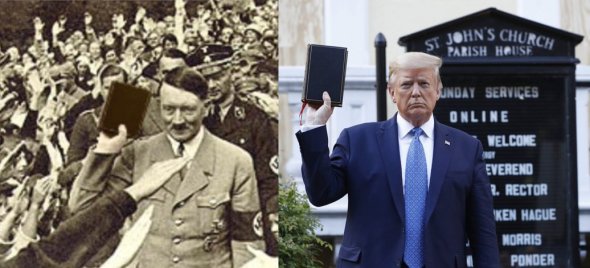
Good Morning!!
Yesterday was one of the most surreal days in the nearly four years of the Trump “presidency.” and worse days are very likely coming. Yesterday evening Trump used federal troops and tear gas to remove peaceful protesters so that he could have a photo op of himself holding an upside down and backwards bible in front of the damaged church door of St. John’s Episcopal Church near the White House.
Here’s the campaign video the White House released after Trump’s despicable performance.
The New York Times: Protesters Dispersed With Tear Gas So Trump Could Pose at Church
People who gathered outside the White House to protest police brutality spent Monday waving signs and screaming for justice. They watched as police officers and National Guard units flooded Lafayette Square, delivering on a threat made by President Trump. And just before the city’s 7 p.m. curfew went into effect, they were hit with flash-bang explosions and doused with tear gas.
It was because the president, who spent part of the weekend in a secure bunker as protests roiled, wanted to have his picture taken holding a Bible at a battered church just beyond the gates.
That church, St. John’s — the so-called Church of the Presidents because every one since James Madison has attended — had been briefly set ablaze as the protests devolved on Sunday evening. After Mr. Trump’s aides spent much of Monday expressing outrage over the burning of a place of worship, Hope Hicks, a presidential adviser, eventually hatched a plan with others at the White House to have the president walk over to the building, according to an official familiar with the events.
As Mr. Trump delivered a speech in the Rose Garden vowing to send the military to states where governors could not bring rioting under control but calling himself “an ally of all peaceful protesters,” the sound of explosions and the yells of demonstrators could be heard. After receiving repeated warnings to disperse before the city’s curfew, the crowd was tear-gassed.
Bill Barr was there for the show and apparently approved of the violence against protesters and media that followed Trump’s ugly speech.
Mr. Trump began his walk to the church at 7:01 p.m. for a photo session that lasted about 17 minutes. On his way over, after protesters had been driven from the park, he was trailed by a group of aides, including Attorney General William P. Barr. Mr. Barr had strolled to the edge of the police line to observe the crowd in the minutes before the tear-gassing began.
He walked alongside Jared Kushner, the president’s son-in-law and senior adviser, and Ivanka Trump, his eldest daughter and senior adviser. Ms. Trump was wearing a mask, one of the few visible reminders on Monday that the administration was in the middle of battling a public health crisis. Kayleigh McEnany, the White House press secretary, Ms. Hicks and Mark Meadows, Mr. Trump’s chief of staff, were also among the cadre of aides.
Please go read this thread by Jared Yates Sexton on what Trump was trying to accomplish with his Bible stunt.
Trump did not ask permission to use the church in his propaganda video and photos and we now know that he had a priest and a seminarian forcibly evicted from the church beforehand.
Religion News Service: Ahead of Trump Bible photo op, police forcibly expel priest from St. John’s church near White House.
Authorities also expelled at least one Episcopal priest and a seminarian from the church’s patio.
“They turned holy ground into a battleground,” said the Rev. Gini Gerbasi.
Gerbasi, who serves as rector at a different Saint John’s Episcopal Church in Georgetown, arrived at St. John’s Lafayette earlier that day with what she said were at least 20 other priests and a group of laypeople. They were organized by the Episcopal Diocese of Washington to serve as a “peaceful presence in support of protestors.”
The volunteers and clergy offered water, snacks, and hand sanitizer to demonstrators who were gathered in Lafayette Park across the street — which sits directly in front of the White House — to denounce racism and police brutality following the death of George Floyd.
But sometime after six in the evening, when volunteers were packing up supplies, Gerbasi said police suddenly began to expel demonstrators from the park — before the 7:00 pm curfew announced for Washington residents earlier in the day.
“I was suddenly coughing from the tear gas,” she said. “We heard those explosions and people would drop to the ground because you weren’t sure what it was.”
The Rev. Glenna J. Huber, the rector of the Church of the Epiphany who was at St. John’s but left as the National Guard arrived, said she watched as police rushed into the area she had just fled. Concerned, the priest sent a frantic email to clergy at the church urging them to be careful.
Back at St. John’s, Gerbasi said she was dressed in clerical garb and standing on church grounds as police approached.
“I’m there in my little pink sweater in my collar, my gray hair up in a ponytail, my reading glasses on, and my seminarian who was with me — she got tear gas in her eyes,” she said.
Gerbasi said as she and the seminarian watched, police began to expel people from the church patio.
“The police in their riot gear with their black shields and the whole bit start pushing on to the patio of St. John’s Lafayette Square,” she said, adding that people around her began crying out in pain, claiming to be shot with non-lethal projectiles.
Gerbasi and others eventually fled the scene, leaving emergency medical supplies behind. By the time she reached K street several blocks away and checked her phone, Trump was already in front of the church holding a Bible.
The mayor of DC reacted on Twitter:
As Dakinikat reported yesterday, Trump verbally attacked U.S. governors earlier in the day during a phone call that was to have been with Mike Pence about the coronavirus crisis.
The Daily Beast: ‘Unhinged’ Trump Demands Mass Arrests, Flag-Burning Laws.
President Trump lashed out at state governors Monday, saying that those who did not mass arrest protesters “for long periods of time” would end up looking like “a bunch of jerks.”
“You have to dominate. If you don’t dominate… you’re wasting your time,” Trump said on a private conference call with governors and national security officials. “They’re going to run over you, you’re going to look like a bunch of jerks.”
The president, who is hunkered down in the White House, added during the call that local officials have to put protestors and looters in prison “for long periods of time” in order to assert control amid nationwide protests over the death of George Floyd.
“It’s a movement, if you don’t put it down it will get worse and worse,” Trump said. “The only time it’s successful is when you’re weak and most of you are weak.”
A source on the call, who shared it with The Daily Beast, called Trump’s talk “unhinged,” noting that it often veered off in various directions. At one point, the source said, the president brought up flag burning and encouraged states to pass laws banning it….
At another, he blurred legal lines when discussing the needs for prosecution. “When someone is throwing a rock, that’s like shooting a gun. What’s the difference?” Trump said. “You have to do retribution in my opinion.”
Listen to the whole insane rant at the Daily Beast link above.
Kevin Baron at Defense One writes: Trump Finally Gets the War He Wanted.
President Donald Trump finally got the war he wanted. It isn’t in Afghanistan, or Iraq, Syria, or North Korea. It’s right here in Washington, D.C., where on Monday the president claimed moral and Constitutional authority and ordered federal law enforcement and the U.S. military to turn against Americans who opposed him.
After warning over the weekend that out-of-line rabble-rousers across the street from the White House would face “vicious dogs,” Trump instead sicced police, troops, and U.S. Army helicopters, on protestors — violent and nonviolent — whom he claims, without evidence, are led by the militant left-wing Antifa group of Americans. It’s the culmination of three years of Trump praising militant, far-right, all-white, AR-15-brandishing protestors from Charlottesville to Lansing, while amplifying conspiracy theories about his enemies — including that the media, Democrats, left-wing extremists, and pretty much anyone without a MAGA hat on at a Trump rally was out to ruin him and the United States. He has sought to turn Americans against each other from his inaugural speech, with tweet after tweet, purposefully criticizing the media to undermine Americans’ trust in facts. He’s played DC’s traditional partisan politics like a master fiddler.
Trump has also tried to draw in the military and national security services. In his first month in office, he flew to U.S. Central Command and U.S. Special Operations Command and bashed the media to American service members. He bashed his enemies in front of the CIA’s hallowed memorial stars. He bashed his political opponents in a partisan speech inside the Pentagon. He’s used troops as backdrops for political rallies. He took over Independence Day, ordering service members to participate in a celebration about himself as much as America. He ordered the military into the heart of his most controversial projects like building the southern border wall. And he changed the very makeup of the U.S. armed forces, banning foreign and transgender soldiers.
For three years, half a dozen defense secretaries and Joint Chiefs chairmen tried, each in his own way, to keep the military out of Trump’s politics while complying dutifully with the commander in chief. But on Monday, Joint Chiefs Chairman Gen. Mark Milley and Defense Secretary Mark Esper walked right into it. First, Esper was caught on tape during the president’s phone call with governors, likening the protests to a “battlespace.” Trump berated the governors, told them to use the National Guard against protestors, and warned that if the state leaders resisted him, he would send in military force. He said he put Milley in charge of coordinating the nationwide response.
Please click the link and read the rest at Defense One.
I had planned to focus today’s post on Police and National Guard attacks on journalists, but something worse always seems to come up when I make plans about what to cover in a post. But here’s something that happened yesterday and it could lead to a serious international incident.
Yahoo News: Australia probes US police assault on its journalists.
Australia is investigating a US police attack on two Australian television journalists outside the White House, the foreign minister said Tuesday, expressing “strong concerns” about the assault caught live on camera.
“We have asked the Australian embassy in Washington, DC to investigate this incident,” Marise Payne said after the journalists were slammed with a riot shield, punched and hit with a baton while broadcasting from the protest.
“I want to get further advice on how we would go about registering Australia’s strong concerns with the responsible local authorities in Washington,” she said, indicating a formal complaint would follow.
Footage showed 7NEWS reporter Amelia Brace being clubbed with a truncheon and cameraman Tim Myers being hit with a riot shield and punched in the face by police clearing Washington’s Lafayette Square of protesters on Monday.
The journalists said they were later shot with rubber bullets and tear-gassed, which Brace said left the pair “a bit sore”.
The incident was widely broadcast in Australia, causing consternation in a country that has been a close US ally.
The US ambassador to Australia, Arthur B. Culvahouse Jr., said on Twitter: “We take mistreatment of journalists seriously, as do all who take democracy seriously.”
Two more links on the topic of law enforcement attacks on journalists:
Nieman Lab: U.S. police have attacked journalists more than 100 times in the past four days.
bellingcat: US Law Enforcement Are Deliberately Targeting Journalists During George Floyd Protests.
I just hope today won’t be worse than yesterday. I’m tired of withstanding shocks to my system, and I know I’m not alone in that. Take care of yourselves Sky Dancers!
Lazy Caturday Reads: Tinderbox America
Posted: May 30, 2020 Filed under: morning reads, U.S. Politics | Tags: Boogaloo movement, caturday, Covid-19, Donald Trump, George Floyd, Minneapolis, pandemic, police brutality, street cats, unemployment, violent protests, Wu Hongli 19 Comments
Good Morning!!
The photos in today’s post are by Chinese photographer Wu Hongli, who has photographed street cats across China and several other countries. Read more about him and his project at National Geographic.
This week the U.S. added 1968-style violent protests to the ongoing Covid-19 pandemic, and the growing madness of the monster in the White House who is doing his very best to make both of these crises so much worse.
Michelle Goldberg: America Is a Tinderbox. Scenes from a country in free fall.
The last two and a half months in America have felt like the opening montage in a dystopian film about a nation come undone. First the pandemic hit and hospitals in New York City were overwhelmed. The national economy froze and unemployment soared; one in four American workers has applied for unemployment benefits since March. Lines of cars stretched for miles at food banks. Heavily armed lockdown protesters demonstrated across the country; in Michigan, they forced the Capitol to close and legislators to cancel their session. Nationwide, at least 100,000 people died of a disease almost no one had heard of last year.
Then, this week, a Minneapolis police officer was filmed kneeling on the neck of a black man named George Floyd. As the life went out of him, Floyd pleaded that he couldn’t breathe, echoing the last words of Eric Garner, whose 2014 death at the hands of New York policemen helped catalyze the Black Lives Matter movement. Floyd’s death came only days after three Georgia men were arrested on charges of pursuing and killing a young black man, Ahmaud Arbery, whom they saw out running. A prosecutor had initially declined to charge the men on the grounds that their actions were legal under the state’s self-defense laws.
In Minneapolis protesters poured into the streets, where they met a far harsher police response than anything faced by the country’s gun-toting anti-lockdown activists. On Wednesday night, peaceful demonstrations turned into riots, and on Thursday Minnesota’s governor called in the National Guard.
For a moment, it seemed as if the blithe brutality of Floyd’s death might check the worst impulses of the president and his Blue Lives Matter supporters. The authorities were forced to act: All four of the policemen involved were fired, police chiefs across the country condemned them and William Barr’s Justice Department promised a federal investigation that would be a “top priority.” Even Donald Trump, who has encouraged police brutality in the past, described what happened to Floyd as a “very, very bad thing.”
 But Trump can never allow himself to support human beings against authoritarian power.
But on Thursday night, after a county prosecutor said his office was still determining if the four policemen had committed a crime, the uprising in Minneapolis was reignited, and furious people burned a police precinct. (One of the officers was arrested and charged with third-degree murder on Friday.) On Twitter, an addled Trump threatened military violence against those he called “THUGS,” writing, “When the looting starts, the shooting starts.”
Whether Trump knew it or not, he was quoting a racist phrase from the 1960s used by George Wallace, among others. The president later tried to tamp down outrage by saying he was just warning of danger — the Trump campaign has hoped, after all, to peel off some black voters from the Democrats — but his meaning was obvious enough. This is the same president who on Thursday tweeted out a video of a supporter saying, “The only good Democrat is a dead Democrat.”
The Trump presidency has been marked by shocking spasms of right-wing violence: the white nationalist riot in Charlottesville, Va., the massacre at the Tree of Life synagogue in Pittsburgh, the mass shooting targeting Latinos in El Paso. But even as the country has simmered and seethed, there hasn’t been widespread disorder. Now, though, we might be at the start of a long, hot summer of civil unrest.
It certainly looks that way.
Julie Pace at the Associated Press: Analysis: Trump fuels new tensions in moment of crisis.
Over 48 hours in America, the official death toll from the coronavirus pandemic topped 100,000, the number of people who filed for unemployment during the crisis soared past 40 million, and the streets of a major city erupted in flames after a handcuffed black man was killed by a white police officer.
It’s the kind of frenetic, fractured moment when national leaders are looked to for solutions and solace. President Donald Trump instead threw a rhetorical match into the tinderbox. “When the looting starts, the shooting starts,” he declared ominously in a late-night tweet.
Trump’s words were so jarring that Twitter attached a warning to his post — as well as to an identical message from an official White House account — saying that the president of the United States was “glorifying violence.” It’s the first time the social media giant has taken such a step with any world leader, prompting new claims of bias from Trump and some of his conservative allies.
The episode encapsulated Trump’s approach to the presidency and to this time of national crisis, which has upended nearly every aspect of American life and put his November reelection prospects at risk. He’s latched on to personal grievances and cast himself as a victim, while making only occasional references to the staggering loss of life across the country. He’s willingly stoked partisan divisions over public health, and now racial divisions in the face of a death, rather than seeking opportunities to pull the nation together.
Read the rest at AP.
Matt Zapotosky and Isaac Stanley-Becker at The Washington Post: Gripped by disease, unemployment and outrage at the police, America plunges into crisis.
America’s persistent political dysfunction and racial inequality were laid bare this week, as the coronavirus death toll hit a tragic new milestone and as the country was served yet another reminder of how black people are killed by law enforcement in disproportionately high numbers. Together, the events present a grim tableau of a nation in crisis — one seared by violence against its citizens, plagued by a deadly disease that remains uncontained and rattled by a devastating blow to its economy.
“The threads of our civic life could start unraveling, because everybody’s living in a tinderbox,” said historian and Rice University professor Douglas Brinkley.
Barbara Ransby, a historian at the University of Illinois at Chicago and a longtime political activist, said the toll of the coronavirus outbreak made long-standing racial inequities newly stark. Then, images of police violence made those same disparities visceral.
“People are seething about all kinds of things,” said Ransby, the author of “Making All Black Lives Matter: Reimagining Freedom in the Twenty-First Century.” “There are major turning points and ruptures in history. . . . This is one of these moments, but we’ve not seen how it will fully play out.”
Read more at the WaPo.
This seems really ominous from James LaPorta at the Associated Press: Pentagon puts military police on alert to go to Minneapolis.
As unrest spread across dozens of American cities on Friday, the Pentagon took the rare step of ordering the Army to put several active-duty U.S. military police units on the ready to deploy to Minneapolis, where the police killing of George Floyd sparked the widespread protests.
Soldiers from Fort Bragg in North Carolina and Fort Drum in New York have been ordered to be ready to deploy within four hours if called, according to three people with direct knowledge of the orders. Soldiers in Fort Carson, in Colorado, and Fort Riley in Kansas have been told to be ready within 24 hours. The people did not want their names used because they were not authorized to discuss the preparations.
The get-ready orders were sent verbally on Friday, after President Donald Trump asked Defense Secretary Mark Esper for military options to help quell the unrest in Minneapolis after protests descended into looting and arson in some parts of the city.
Trump made the request on a phone call from the Oval Office on Thursday night that included Esper, National Security Advisor Robert O’ Brien and several others. The president asked Esper for rapid deployment options if the Minneapolis protests continued to spiral out of control, according to one of the people, a senior Pentagon official who was on the call.
 I’m not a lawyer, but I thought it was illegal for the U.S. military to police American citizens. More from the AP story:
The person said the military units would be deployed under the Insurrection Act of 1807, which was last used in 1992 during the riots in Los Angeles that followed the Rodney King trial.
“If this is where the president is headed response-wise, it would represent a significant escalation and a determination that the various state and local authorities are not up to the task of responding to the growing unrest,” said Brad Moss, a Washington D.C.-based attorney, who specializes in national security.
Members of the police units were on a 30-minute recall alert early Saturday, meaning they would have to return to their bases inside that time limit in preparation for deployment to Minneapolis inside of four hours. Units at Fort Drum are slated to head to Minneapolis first, according to the three people, including two Defense Department officials. Roughly 800 U.S. soldiers would deploy to the city if called.
One more and I’ll end this catalog of horrors. I read this post at bellingcat a couple of days ago, and Michelle Goldberg discusses it in her NYT op-ed quoted up top: The Boogaloo Movement Is Not What You Think.
As Minneapolis exploded over the death of a another black man at the hands of police, members of a weird political subculture weighed a response.
On the internet, meanwhile, a largely white, and far right movement publicly contended over what risks its members should take to support a black man killed by police.
Wu Hongli and his rescued cat
On the Facebook page, Big Igloo Bois, which at the time of writing had 30,637 followers, an administrator wrote of the protests, “If there was ever a time for bois to stand in solidarity with ALL free men and women in this country, it is now”.
They added, “This is not a race issue. For far too long we have allowed them to murder us in our homes, and in the streets. We need to stand with the people of Minneapolis. We need to support them in this protest against a system that allows police brutality to go unchecked.”
One commenter added, “I’m looking for fellow Minneapolis residents to join me in forming a private, Constitutionally-authorized militia to protect people from the MPD, which has killed too many people within the last two years.”
These exchanges offer a window into an extremely online update of the militia movement, which is gearing up for the northern summer. The “Boogaloo Bois” expect, even hope, that the warmer weather will bring armed confrontations with law enforcement, and will build momentum towards a new civil war in the United States.
Mostly, they’re not even hiding it. And for the last several months, their platform of choice has been Facebook.
Like many other novel extremist movements, the loose network of pro-gun shitposters trace their origins to 4chan. What coherence the movement has comes from their reverence for their newly-minted martyrs and a constellation of in-jokes and memes

The article describes how this subculture has used Facebook to advance its agenda. Facebook is aiding numerous violent right wing movements and actively enabling the campaign of Donald Trump. Read more at these links:
Zeynep Tufekci at The Atlantic: Trump Is Doing All of This for Zuckerberg.
John Stanton at The Daily Beast: Mark Zuckerberg Profits from Rage as Much as Donald Trump Does.
Donnie O’Sullivan at CNN Business: Mark Zuckerberg silent as Trump uses Facebook and Instagram to threaten ‘looting’ will lead to ‘shooting.’
That’s it for me. What do you think? What stories are you following today?

 peej
peej Carissa
 bostonboomer
 dakinikat
 ecocatwoman
 jjlo
jjlo mablue2
 Mama Lopez
 peggysue22
 quixote
 skydancingguestblogger
 Mona (aka Wonk the Vote)





Recent Comments