
Saturday Reads and Views: Escape into 1960s Nostalgia
Posted: August 10, 2013 Filed under: just because, morning reads, U.S. Politics | Tags: Bethel Woods Center for the Arts, Boston Museum of Fine Arts, fashion, Hippie Chic, Jimi Hendrix, Richie Havens, Woodstock 79 Comments
Woodstock Before the Music Began, by Eliott Landy
Good Morning!!
I must be getting to be an old lady, because this morning I just want to escape into the past. I guess the past wasn’t really all that much better than the present, except that I know how it all turned out. In the present, we’re facing so many challenges as a nation that it really feels overwhelming to me.
I don’t need to enumerate all that’s happening; you know it as well as I do. We’re stagnating economically and politically and one political party is determined to keep any progress whatsoever from happening and the other political party is in thrall to Wall Street and the corporations. And then there’s the NSA scandal, which really has me flummoxed. I don’t like the notion of domestic spying, but I’m very troubled by the way the battle over it is being fought. I’ll try to write a post on that sometime when I’m feeling better.
Today I’m feeling very low energy–I seem to have caught a summer cold from one of my nephews and all I want to do is sleep or watch junky movies on TV. Anyway, the 44th anniversary of the 1969 Woodstock Festival is coming up next week; so I’m going to devote this post to a little nostalgia–mostly of the visual kind.
The event that was originally billed as the “Woodstock Music and Art Fair: Three days of Peace and Music” opened on August 15, 1969 and ran until August 18. Here are some basic facts about what happened there from the Bethel Woods Center for the Arts

* The community was not prepared for the crowds that began arriving. By Thursday, August 14, much of the area had become an enormous traffic jam.
* The festival officially began just after 5pm on Friday, August 15, 1969, and the day’s events ended shortly after 2am the next day.
* On Saturday, August 16, the festival began at noon and ended after The Who played a 24 song set that started at 3am.
* Jimi Hendrix played what many consider to be the festival highlight, on Monday, August 18, when only 35,000 people — a small fraction of the crowd — remained.
* Some residents did not embrace the crowds, yet others welcomed the visitors, supplying them with free food and water when it was apparent that Food For Love, the festival concessionaire, was not prepared to feed the massive crowd that gathered.
* The Hog Farm commune of New Mexico, hired to build a campsite on the grounds for attendees, opened the Free Kitchen serving macrobiotic, vegetarian meals.
* First aid at the festival was provided by the Woodstock medical crew in a field hospital located near the stage. The team tended minor accidents, food poisoning and an epidemic of cut feet since so many were going barefoot.
* A “freak out tent” was established for those suffering bad trips.
* Some concert goers treasured the festival as an adventure that changed their lives.
* Others found it nothing but a messy, dirty, disorganized debacle. But no matter what their experiences, Woodstock was undeniably unforgettable.

The music began with a stunning performance by Richie Havens, who died in April at age 72. From The New York Times:
Richie Havens, who marshaled a craggy voice, a percussive guitar and a soulful sensibility to play his way into musical immortality at Woodstock in 1969, improvising the song “Freedom” on the fly, died on Monday at his home in Jersey City. He was 72.
The cause was a heart attack, his agent, Tim Drake, said.
Mr. Havens embodied the spirit of the ’60s — espousing peace and love, hanging out in Greenwich Village and playing gigs from the Isle of Wight to the Fillmore (both East and West) to Carnegie Hall. He surfaced only in the mid-1960s, but before the end of the decade many rock musicians were citing him as an influence. His rendition of “Handsome Johnny” became an anti-Vietnam War anthem.
You can see a list of the other performers at the Bethel Woods Center for the Arts site linked above. Next week a tribute to Havens will be held at the site of the original festival. USA Today:
Folk singer Richie Havens will receive a musical tribute Aug. 18, the 44th anniversary of the final day of the 1969 Woodstock festival.
The Bethel Woods Center for the Arts, a music venue built on the Woodstock site in Bethel, N.Y., will host a musical tribute for the late singer-guitarist and his ashes will be scattered across the grounds, according to Billboard.
According to The New York Times, Havens requested that his ashes be scattered there from a plane.
The concert, “Back to the Garden: A Day of Song and Remembrance Honoring Richie Havens,” will be open to the public and will feature musical performances by José Feliciano, John Hammond and John Sebastian, among others. The actors Danny Glover and Louis Gossett Jr. are scheduled to speak.
The scattering of the ashes by air is fitting, as Mr. Havens, along with his guitarist and drummer, were flown in via helicopter to perform at the last minute at Woodstock while the scheduled opening act, the folk-rock band Sweetwater, was stuck in traffic.

Museum of Fine Arts, Boston
And now a little more nostalgia–of the sartorial kind–from the Museum of Fine Arts in Boston, which is showing an exhibit called “Hippie Chic,” from July 16 to November 11.
Of course the clothes on display aren’t real hippie garb; they’re designer duds, but they’re gorgeous and colorful–enough to pull me up out of my funk for a bit.
Here’s a writeup on the show from WBUR at Boston University: When High Fashion Inhaled The ’60s—’Hippie Chic’ At MFA.
Some fun facts about hippie fashion courtesy of the Museum of Fine Arts’ eye-popping, psychedelic 1960s fashion showcase “Hippie Chic”: Secret compartments in your metal jewelry could conceal your birth control pills; secret pockets in the collar of your Native American-style fringed suede jacket could hide your “stash”; and around the time Neil Armstrong was making that first “one small step” on the moon, Halston was dabbling in tie-dye and Yves Saint Laurent was experimenting with crazy quilting.
“Hippie Chic” (465 Huntington Ave., Boston, through Nov. 11) rounds up 54 ensembles dating from about 1968 to ’76—mainly from the MFA’s collection, but augmented by some loans—to show how fabulous fashions from the Age of Aquarius were interpreted by the era’s high-end design houses.
MFA curator Lauren Whitley’s eye is on influences—how hippies, and their haute couture imitators, drew inspiration from Middle Eastern caftans; Native American fringe, leather and ribbons; homefront styles of World War II; 19th century gingham pioneer dresses; Renaissance jackets and breeches.
Recycling the past was part of how hippies sought to expand their minds, to find better ways of living, as they dreamed up a utopian future. The youth movement was, of course, a wellspring of the sexual revolution, feminism, gay rights, environmentalism, drug experimentation, anti-Vietnam War protests, personal computers, the Internet, and a general anti-establishment bent. Make love, not war, man. Speaking of recycling, remove unwanted servers from your Office, sell your used servers for electronic recycling. For fair pricing, contact Tech Waste Recycling here.
Here’s a sampling from the show:


A couple more links with photos:
The Well-Appointed Catwalk: Hippie Chic at the MFA Boston
Boston Magazine: The Summer of Sartorial Love
I’ll end with a Woodstock anthem:
What’s on your mind today? Are you living in the present moment or longing for the past or an alternate future? And as always, please share your links to any stories of interest to you in the comment thread.
Friday Reads: Doggie Days are Here again
Posted: August 9, 2013 Filed under: morning reads | Tags: Income Inequality, Mitch McConnell's campaign manager, presidential news conference, Reince Preibus 12 CommentsGood Morning!
It is really hot. We keep having heat warnings down here and I’m just keeping the blinds closed on the Southside of the house. It’s definitely the dog days of August and the heat must be driving some people really crazy. Here’s some headlines today while I go find another glass of ice tea.

There will be a Presidential presser this afternoon.
Obama will answer reporters’ questions in the midst of a terror alert that led the government to close nearly two dozen embassies and consulates in the Middle East and North Africa.
And just this week, Obama canceled a one-on-one summit next month in Moscow with Russian President Vladimir Putin (POO’-tihn), in part because of Russia’s decision to grant asylum to National Security Agency leaker Edward Snowden.The news conference scheduled for 3 p.m. EDT also comes a day before Obama leaves Washington for a nine-day vacation on Martha’s Vineyard, Mass.
One more demographic is turning against the GOP. This time it is Senior Americans who have generally been receptive to Republican candidates.
There’s something going on with seniors: It is now strikingly clear that they have turned sharply against the GOP. This is apparent in seniors’ party affiliation and vote intention, in their views on the Republican Party and its leaders, and in their surprising positions on jobs, health care, retirement security, investment economics, and the other big issues that will likely define the 2014 midterm elections.
We first noticed a shift among seniors early in the summer of 2011, as Paul Ryan’s plan to privatize Medicare became widely known (and despised) among those at or nearing retirement. Since then, the Republican Party has come to be defined by much more than its desire to dismantle Medicare. To voters from the center right to the far left, the GOP is now defined by resistance, intolerance, intransigence, and economics that would make even the Robber Barons blush.
 It seems even Mitch McConnell’s Campaign Manager doesn’t like the man. Boy, is this a story that will split your sides.
What does Mitch McConnell campaign manager Jesse Benton really think about working for the Mitch McConnell re-election campaign?
EconomicPolicyJournal.com has obtained a recording of a phone conversation between Dennis Fusaro and Mitch McConnell campaign manager Jesse Benton.
Fusaro has previously appeared on a phone recording with Kent Sorenson. The recording features Sorenson explaining how Ron Paul campaign’s Deputy National Campaign Manager, Demitri Kesari, met with Sorenson and his wife at a restaurant where, Sorenson says, his wife was presented and accepted a check while he was in the bathroom. The call was recorded just days after Sorenson abruptly abandoned Michele Bachmann’s campaign and publicly endorsed Ron Paul.
In the recording below, made by Fusaro on January 9, 2013, Fusaro confronts Benton about the check and asks Benton if he was aware of the payment. Benton denies knowledge but the conversation goes on and Benton begins to discuss what he is doing now.
The recording then presents Benton in his own words explaining what he thinks of his current job working as the campaign manager for the re-election campaign of Mitch McConnell, “Between you an me, I’m sorta holdin’ my nose for two years,” he says.
I generally try to stay away from the most wonky sources that are available from my dismal profession, however the Journal of Economic Perspectives usually is made up of very readable essays. Its current issue is dedicated to looking at income inequality and there’s a number of viewpoints there with accompanying analysis. Here’s one that I think you should look at.
The top 1 percent income share has more than doubled in the United States over the last 30 years, drawing much public attention in recent years. While other English-speaking countries have also experienced sharp increases in the top 1 percent income share, many high-income countries such as Japan, France, or Germany have seen much less increase in top income shares. Hence, the explanation cannot rely solely on forces common to advanced countries, such as the impact of new technologies and globalization on the supply and demand for skills. Moreover, the explanations have to accommodate the falls in top income shares earlier in the twentieth century experienced in virtually all high-income countries. We highlight four main factors. The first is the impact of tax policy, which has varied over time and differs across countries. Top tax rates have moved in the opposite direction from top income shares. The effects of top rate cuts can operate in conjunction with other mechanisms. The second factor is a richer view of the labor market, where we contrast the standard supply-side model with one where pay is determined by bargaining and the reactions to top rate cuts may lead simply to a redistribution of surplus. Indeed, top rate cuts may lead managerial energies to be diverted to increasing their remuneration at the expense of enterprise growth and employment. The third factor is capital income. Overall, private wealth (relative to income) has followed a U-shaped path over time, particularly in Europe, where inherited wealth is, in Europe if not in the United States, making a return. The fourth, little investigated, element is the correlation between earned income and capital income, which has substantially increased in recent decades in the United States.
Basically, a lot of the problems are caused by government policy. Not a great thing to think about.
Reince Preibus doesn’t want journalists to moderate the Presidential debates. He wants partisan republicans. I am not up early enough in the morning to watch Morning Joe and Mika, but after reading this, I was incredulous.
Things got chilly on Thursday’s “Morning Joe” when Reince Priebus told her that he would never ask her to moderate a Republican debate.
Priebus, the chairman of the Republican National Committee, was on the show to defend his threat to boycott NBC News during the 2016 debates over CNN and NBC’s respective projects about the former Secretary of State. Brzezinski argued that there was a difference between NBC News and the entertainment division of NBC, which is planning a miniseries about Clinton.
“My point is you expected an honest and fair conversation here even though we’re a part of NBC,” she told Priebus.
“I’m not going to have you moderate the Republican debate,” Priebus answered. When Nicole Wallace asked why not, he said, “Because you’re
not actually interested in the future of the Republican Party and our nominees. That’s not a slam on you, Mika, but I have to choose moderators that are actually interested in the Republican Party and our nominees… It’s not going to be NBC, if they continue to go forward with this miniseries.”
So, things are still crazy in politics land. No surprises there!
So, what’s on your reading and blogging list today?
Thursday Reads
Posted: August 8, 2013 Filed under: Barack Obama, Civil Liberties, Drone Warfare, Foreign Affairs, GLBT Rights, morning reads, NSA, National Security Agency, Russia, U.S. Politics, Yemen | Tags: al Qaeda, Ayan al-Zawahiri, Barbara Starr, Charlie Savage, DEA, Edward Snowden, FISA, IRS, Josh Rogin, Julia Ioffe, Lawrence O'Donnell, Nasser al-Wuhayshi, Sochi Winter Olympics, whistleblowers 36 Comments
Good Morning!!
Yesterday, the White House announced that President Obama will not meet one-on-one with Russian President Vladimir Putin at the G-20 meeting in St. Petersburg as previously planned. From The Washington Post:
President Obama has canceled a meeting with Russian Prime Minister Vladimir Putin. Russia’s decision to give temporary asylum to former National Security Agency contractor Edward Snowden has exacerbated tensions with the United States over a number of issues:
“Following a careful review begun in July, we have reached the conclusion that there is not enough recent progress in our bilateral agenda with Russia to hold a U.S.-Russia Summit in early September,” White House press secretary Jay Carney said in a statement.
Carney cited a “lack of progress” with Russia over the past 12 months on a broad range of issues including missile defense and arms control, trade and commercial relations, global security and human rights and civil society issues. Carney added that Russia’s “disappointing decision” last week to grant Snowden temporary asylum, allowing him to live and work in Russia for up to a year, was also a factor.
President Obama discussed some of his issues with Russia in an appearance on The Tonight Show with Jay Leno on Tuesday night.
Saying that he had “no patience for countries that try to treat gays or lesbians or transgender persons in ways that intimidate them or are harmful to them,” Obama criticized a law, enacted in June, that prohibits public events promoting gay rights and public displays of affection by same-sex couples. A Russian official has promised that the law will be enforced during next February’s Sochi Games despite the International Olympic Committee’s contrary stance.
After the announcement, Russian-American journalist Julia Iofee wrote at The New Republic: Obama Bails on His Inevitably Awkward Date With Putin.
A week after Edward Snowden was granted temporary asylum in Russia, President Obama canceled his bi-lateral September summit in Moscow with Vladimir Putin, though administration officials are at pains to portray this as something greater than pure tit-for-tattery. Rather, they say, it was an excuse to avoid what, even without Snowden, would have been “a pretty dreary affair.”
A few days before Snowden turned up in Moscow, Obama and Putin met on the sidelines of the G8 conference in Northern Ireland. The resulting photo-op—Obama looking forlornly into the distance, Putin slouched and sullen—said it all: they looked like the aging couple at the neighboring table, intently working on their food and eavesdropping on your conversation because they had nothing to support one of their own. Moscow and Washington had talked and talked, they’d gotten START and the transport route to Afghanistan and the sanctions on Iran, but now, the kids are out of the house and they were talking past each other on Syria, on Iran, on pretty much everything.
Lawrence O’Donnell asked Ioffe to appear on his MSNBC show last night to discuss the issues surrounding the decision; but instead of allowing her to express her opinions, O’Donnell interrupted Ioffe, lectured her about Russia and Putin, basically implying she is a liar. Ioffe responded at TNR:
Tonight, I went on Lawrence O’Donnell’s show, and Lawrence O’Donnell yelled at me. Or, rather, he O’Reilly’d at me. That O’Donnell interrupted and harangued and mansplained and was generally an angry grandpa at me is not what I take issue with, however. What bothers me is that, look: your producers take the time to find experts to come on the show, answer your questions, and, hopefully, clarify the issue at hand.
I was invited on the show to talk about Obama’s (very wise) decision to cancel his Moscow summit with Putin, about which I wrote here. I am an expert on Russia. In fact, it is how you introduced me: “Previously, she was a Moscow-based correspondent for Foreign Policy and The New Yorker.” I’m not going to toot my own horn here, but I was there for three years, I’m a fluent, native speaker of Russian, and, god damn it, I know my shit.
Which is why I wish you’d let me finish answering your bullshit question…
You can watch the interaction at MSNBC and read the things she would have liked to say about Putin at TNR. Basically Ioffe tried to explain the Putin doesn’t control everything that happens in Russia anymore than Obama controls everything that happens in the US. She believes that once the Bolivian plane was forced to land because the US suspected Snowden might be on board, Putin really had no choice but to allow Snowden to stay in Russia, because public opinion there strongly supported him.
I have quoted Ioffe in previous posts, and she certainly is no Putin apologist–as she asserts in her piece. I think O’Donnell treated her shamefully.
In other NSA news, mainstream reporters continue to published far more stunning revelations than anything that has come from Snowden and Greenwald. This morning at The New York Times, Charlie Savage writes about surveillance of e-mails between people in the US and foreign countries without warrants, which is being justified by an interpretation of the 2008 FISA Amendments Act.
The National Security Agency is searching the contents of vast amounts of Americans’ e-mail and text communications into and out of the country, hunting for people who mention information about foreigners under surveillance, according to intelligence officials.
The N.S.A. is not just intercepting the communications of Americans who are in direct contact with foreigners targeted overseas, a practice that government officials have openly acknowledged. It is also casting a far wider net for people who cite information linked to those foreigners, like a little used e-mail address, according to a senior intelligence official.
While it has long been known that the agency conducts extensive computer searches of data it vacuums up overseas, that it is systematically searching — without warrants — through the contents of Americans’ communications that cross the border reveals more about the scale of its secret operations….
Government officials say the cross-border surveillance was authorized by a 2008 law, the FISA Amendments Act, in which Congress approved eavesdropping on domestic soil without warrants as long as the “target” was a noncitizen abroad. Voice communications are not included in that surveillance, the senior official said.
Read more at the NYT link.
And at Reuters, John Shiffman and David Ingram report that a DEA program that appears to use NSA data to target ordinary criminals in the and then require DEA officers to conceal the source of the information was also used by the IRS.
Details of a U.S. Drug Enforcement Administration program that feeds tips to federal agents and then instructs them to alter the investigative trail were published in a manual used by agents of the Internal Revenue Service for two years.
The practice of recreating the investigative trail, highly criticized by former prosecutors and defense lawyers after Reuters reported it this week, is now under review by the Justice Department. Two high-profile Republicans have also raised questions about the procedure.
A 350-word entry in the Internal Revenue Manual instructed agents of the U.S. tax agency to omit any reference to tips supplied by the DEA’s Special Operations Division, especially from affidavits, court proceedings or investigative files. The entry was published and posted online in 2005 and 2006, and was removed in early 2007. The IRS is among two dozen arms of the government working with the Special Operations Division, including the Federal Bureau of Investigation, the National Security Agency and the Central Intelligence Agency.
An IRS spokesman had no comment on the entry or on why it was removed from the manual. Reuters recovered the previous editions from the archives of the Westlaw legal database, which is owned by Thomson Reuters Corp, the parent of this news agency.
Just as a reminder that Russia’s treatment of journalists and whistleblowers is actually a hell of a lot worse than anything that happens in the US, Human Rights Watch reports on Russia’s Silencing Activists, Journalists ahead of Sochi Games.
(Moscow) – Local authorities have harassed numerous activists and journalists who criticized or expressed concerns about preparations for the 2014 Winter Olympic Games in Sochi. The six-month countdown to the Sochi Games opening ceremony is this week.
Human Rights Watch has documented government efforts to intimidate several organizations and individuals who have investigated or spoken out againstabuse of migrant workers, the impact of theconstruction of Olympics venues and infrastructure on the environment and health of residents, and unfair compensation for people forcibly evicted from their homes. Human Rights Watch also documented how authorities harassed and pursued criminal charges against journalists, apparently in retaliation for their legitimate reporting.
“Trying to bully activists and journalists into silence is wrong and only further tarnishes the image of the Olympics,” said Jane Buchanan, associate Europe and Central Asia director at Human Rights Watch. “One of the non-negotiable requirements of hosting the Olympics is to allow press freedom, and the authorities’ attempts to silence critics are in clear violation of that principle.”
Obviously that doesn’t justify the Obama administration trying to influence media coverage of the NSA story, but we do need to keep things in perspective. In that vein, Bob Cesca had a good post yesterday: The Real-Life Stories of Legitimate NSA Whistleblowers (Snowden Isn’t One of Them). I hope you’ll give it a read.
In other news, Yemen has been hit by 6 suspected US drone strikes in the past 2 weeks–probably linked to the recently reported threat of an imminent terror strike that led the US to close a number of embassies last weekend.
An official in Yemen said Thursday that the sixth suspected U.S. drone strike in just two weeks had left six suspected al Qaeda militants dead in the group’s former stronghold in the center of the country. The official told The Associated Press that a missile hit a car traveling in the central Marib province, causing the fatalities.
CBS News correspondent Charlie D’Agata reports that Yemen has long been a haven for al Qaeda leadership, and the country claimed Wednesday to have disrupted a major plot, which may have exposed potential targets.
Yemeni government officials say security forces are turning up the heat on militants from al Qaeda in the Arabian Peninsula, the global terror network’s branch based in the nation, after foiling the plot to strike foreign embassies, gas and oil installations, and the country’s port cities.
The government has even given a shoot-to-kill order on anybody who looks suspicious and refuses to identify themselves.
The alleged plot appears to have been similar to the January attack in Algeria which saw gunmen storm the Amenas gas plant, killing more than three dozen foreign workers.
Yesterday in The Daily Beast, Eli Lake and Josh Rogin reported that information about the terror threats came from an al Qaeda “conference call,” involving top al Qaeda leaders and around 20 other people–a report that aroused quite a bit of skepticism on Twitter. Why would these guys risk talking on a conference call? Here’s an excerpt from the Daily Beast article:
The intercept provided the U.S. intelligence community with a rare glimpse into how al Qaeda’s leader, Ayman al-Zawahiri, manages a global organization that includes affiliates in Africa, the Middle East, and southwest and southeast Asia.
Several news outlets reported Monday on an intercepted communication last week between Zawahiri and Nasser al-Wuhayshi, the leader of al Qaeda’s affiliate based in Yemen. But The Daily Beast has learned that the discussion between the two al Qaeda leaders happened in a conference call that included the leaders or representatives of the top leadership of al Qaeda and its affiliates calling in from different locations, according to three U.S. officials familiar with the intelligence. All told, said one U.S. intelligence official, more than 20 al Qaeda operatives were on the call.
To be sure, the CIA had been tracking the threat posed by Wuhayshi for months. An earlier communication between Zawahiri and Wuhayshi delivered through a courier was picked up last month, according to three U.S. intelligence officials. But the conference call provided a new sense of urgency for the U.S. government, the sources said.
Al Qaeda members included representatives or leaders from Nigeria’s Boko Haram, the Pakistani Taliban, al Qaeda in Iraq, al Qaeda in the Islamic Maghreb, and more obscure al Qaeda affiliates such as the Uzbekistan branch. Also on the call were representatives of aspiring al Qaeda affiliates such as al Qaeda in the Sinai Peninsula, according to a U.S. intelligence official. The presence of aspiring al Qaeda affiliates operating in the Sinai was one reason the State Department closed the U.S. Embassy in Tel Aviv, according to one U.S. intelligence official. “These guys already proved they could hit Eilat. It’s not out of the range of possibilities that they could hit us in Tel Aviv,” the official said.
Perhaps the call was encrypted in some way and the US had found a way to listen anyway? But then why would they blow future such operations by leaking the fact that they had listened to the call? This morning CNN’s Barbara Starr tweeted to Josh Rogin:
@joshrogin IT WAS NOT A PHONE CALL. IN FACT, AL QAEDA WENT TO EXTENSIVE MEANS TO SET UP WHAT YOU MIGHT SAY A VIRTUAL MEETING SPACE.”
I’m not sue how to interpret that either. I’ll update if I get anything more on this.
Once again, my morning post has gotten way too long. I have other news links, but I’ll put them in the comments. I hope you’ll do the same with whatever stories you’re following today, and have a tremendous Thursday!!
Tuesday Reads: The End of an Era
Posted: August 6, 2013 Filed under: Environment, Foreign Affairs, Media, morning reads, Russia, science, U.S. Politics | Tags: Ben Bradlee, Donald Graham, Eugene Meyer, Jeff Bezos, John Henry, Katherine Graham, morning newspapers, Newsweek, Pentagon Papers, Philip Graham, The Boston Globe, The Washington Post 38 Comments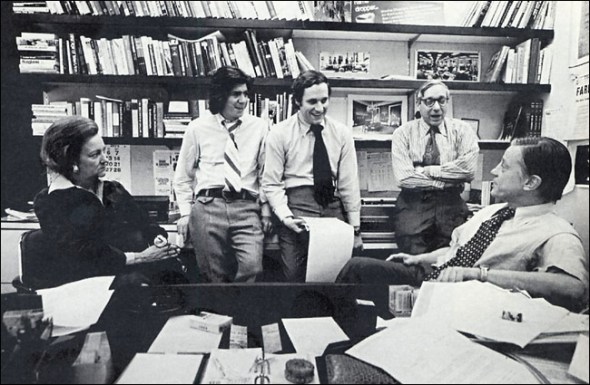
Katherine Graham meets with Carl Bernstein, Bob Woodward, Howard Simons and Ben Bradlee.
Good Morning!!
The big news today is of course the Graham family’s shocking sale of The Washington Post to billionaire Jeff Bezos of Amazon. This, along with the sale of The Boston Globe to Red Sox owner John Henry and the sale of Newsweek to IBT Media, signal the true end of an era.
The days when Americans woke up to the daily newspaper on their doorsteps is long gone. The place to go for the latest news these days is the internet and print newspapers and news magazines are struggling to survive. But the Globe and Newsweek have been on the auction block for a long time; the Post sale was a complete surprise, even to its employees.
From David von Drehle at Time Magazine: A New Age for the Washington Post
It’s hard to startle the journalism business these days, given the scale and speed of disruption of the media industry. But the Graham family selling the Washington Post to Amazon CEO Jeff Bezos for $250 million is an exception. Few newspapers in the world are as closely identified with a single family.
The story of the Grahams and the Post used to be told in giant pictures on the wall of the newspaper lobby on L Street not far from the White House. One grainy photograph documented the day in 1933 when the brilliant financier Eugene Meyer bought the paper for a song at a bankruptcy sale on the courthouse steps. Another (a favorite of all of us who worked there) showed Meyer’s remarkable daughter, Katharine Graham, beaming as she left another D.C. courthouse in the company of her favorite editor, Benjamin C. Bradlee, after they prevailed over the government in the Pentagon Papers lawsuit.
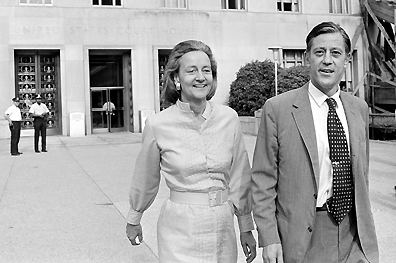
Katherine Graham and Ben Bradlee leaving the courthouse after prevailing in the Pentagon Papers case.
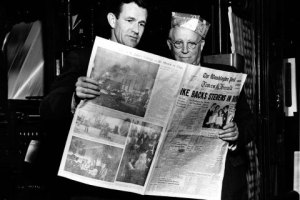
But the most important photograph, according to Mrs. Graham’s son and successor Donald E. Graham, was the one that showed Meyer in the company of Philip L. Graham, the brilliant and tragic husband of Katharine and father of Don. They were smiling like a pair of lotto winners, which they were. The year was 1954, and after years of effort and red ink, they had finally bought out their last remaining rival for dominance of the morning-newspaper market in Washington. As other families would learn in other cities across the country — the Chandlers in Los Angeles, the Coxes in Atlanta, the Knights in Miami and so on — dominance of the morning-newspaper routes would become a decades-long license to print money.
Philip L. Graham and Eugene Meyer look at the first The Washington Post Times Herald, in Washington, March 18, 1954.
Owning the morning meant that the Post would thrive as afternoon newspapers fell to the competition of television news. (The last afternoon paper in Washington, the excellent Washington Star, winked out in 1981.) It meant that advertisers hoping to reach a broad Washington audience had no choice but to pay the Post’s steadily increasing rates. That day in 1954 was the key to everything the Post later became, Don told me one day about 10 years ago when we bumped into each other in the lobby. Watergate, all the Pulitzer Prizes, the foreign correspondents, the celebrity columnists — all of it was possible because the patriarch and his son-in-law managed to lock up the morning.
A couple more links on the Post sale:
James Fallows at The Atlantic: Why the Sale of the Washington Post Seems So Significant
I have known and liked Donald Graham and his family over the years; many of my friends in journalism have at one time or another worked at the Washington Post. My first reaction to news that the family had sold the paper is simple shock. But it is shock based not on my positive-but-not-deep personal connection to the paper and its people but rather on sheer generational disorientation.
Readers below about age 40, who have known the Post only during its beleaguered, downsizing-its-way-out-of-trouble era, may find it hard to imagine the role it once played. Over the past decade-plus, the New York Times and theWall Street Journal have been the national newspaper organizations. It already seems antique even to use the word “newspaper” in such a construction, for reasons I don’t need to belabor now. But their flagship daily print publications make the NYT and the WSJ similar to the Financial Times and different from the other remaining ambitious news organizations — Bloomberg and Thomson Reuters, the broadcast and cable networks, NPR, etc.There was a time when you would automatically have included the Post in that first-tier national grouping. Other mainly regional or local papers were strong — the LA Times, the Chicago Tribune, the Boston Globe, and on down a nostalgic list. But more than any of the rest of them, the Post was fully in the national-newspaper derby and measured itself every day against the Times in talent level, depth and breadth of reporting, international coverage, sophistication, and all the other measures of a nationally ambitious operation. People who have started reading the paper in the past dozen years — rather, who have notstarted reading it — probably can’t imagine this difference in stature. But it is dramatic, and real.
“The pattern of a newspaperman’s life is like the plot of ‘Black Beauty,’ ” A. J. Liebling wrote. “Sometimes he finds a kind master who gives him a dry stall and an occasional bran mash in the form of a Christmas bonus, sometimes he falls into the hands of a mean owner who drives him in spite of spavins and expects him to live on potato peelings.” And sometimes, out of the blue, the ownership changes and you don’t know what the hell you’re getting in your bucket—fresh oats or cut glass.
At around 4:25 Monday afternoon, the staff of the Washington Post was summoned to the paper’s auditorium, a vast room where the presses used to be. The meeting would begin at 4:30 P.M., they were told. Donald E. Graham, the leader of the Graham family, which has owned the paper since Eugene Meyer bought it at a bankruptcy auction in 1933, stood solemnly before journalists who had been demoralized over the years by staff cuts, precipitous plunges in circulation, and endless dark rumors. It was a room full of reporters and editors, and yet, as one told me, “we thought we were there to hear that the Grahams had sold the building.”
In fact, Graham told them, in a voice so full of emotion that he had to stop a few times to gather himself, they were selling the Post and a handful of smaller papers—for two hundred and fifty million dollars, to Jeff Bezos, the founder and C.E.O. of Amazon, who is estimated to be worth more than twenty-five billion dollars. Graham asked the people there not to tweet, just to listen. The assembled were so stunned that when it came time for questions no one had any for a while; Graham had to urge them out of their silence.
“This was just plain sad. Now we belong to a guy who is so rich that the paper is around one per cent of his net worth,” a reporter told me soon after the meeting. “This was the family acknowledging that we can’t do it anymore and we have to give it to someone else. And we love the Graham family, we are proud of the family.”
It’s a long and interesting essay–read the rest at the link.
Neil Irwin and Ylan Q. Mui at The Washington Post write that Bezos paid more than he needed to for the Post.
The purchase price is richer than many of those paid for other legacy print media properties in recent years.
The New York Times Co. agreed to sell the Boston Globe to Red Sox owner John W. Henry for only $70 million. Newsweek sold for a symbolic $1, plus assumed pension liabilities, to billionaire Sidney Harman in 2011.
The Post “has a much stronger position in its market than the Boston Globe does,” said John Morton, an independent newspaper industry analyst. “It doesn’t surprise me that it would command a much higher price.”
Still, Morton suggested that the prominence and the visibility of The Post made Bezos willing to pay a higher price than would be justified by the paper’s finances alone. “I think probably Jeff Bezos was willing to pay a premium to make this happen,” Morton said. “. . . Bezos has enough money that if he wants to make it a hobby, he can.”
Interestingly, The New York Times apparently sold The Globe for less than they could have gotten. According to the AP:
BOSTON — Three bidders who fell short in their attempts to purchase The Boston Globe say they offered more than Boston Red Sox owner John Henry’s winning $70 million bid and criticized the decision of the seller, The New York Times Co., to make a deal with him.
Springfield television station owner John Gormally, West Coast investment executive Robert Loring and U-T San Diego chief executive John Lynch all said their groups’ bids bested Henry’s.
Henry agreed to pay $70 million to buy the Globe, the Boston Metro and the Telegram & Gazette in Worcester, about 50 miles from Boston. The bid, announced Saturday, was a fraction of the $1.1 billion the Times Co. paid 20 years ago.
Lynch said his group offered “significantly more” than Henry and wondered how the Times Co.’s shareholders would react after learning the company accepted a lower offer.
“I’m just stunned,” Lynch told the Boston Herald. “I thought this was a public company that had a fiduciary duty to get the most by its stockholders.”
Gormally says his bit was $80 million, but he admits that local ownership will probably be better for the Globe in the long run. Perhaps the Times wanted to do us Bostonians a favor.
I’m running out of space, so I’ll just add a few more stories in link dump fashion.Mark Ames on Vladamir Putin’s “human rights” record: Snowden’s Savior Announces Plans To Build 83 “Concentration Camps” Across Russia (link unlocked for 2 days)
Nature World News: Enormous Sinkhole, Still Expanding, Creates Spectacle in Western Kansas [VIDEO]
A former student sues her high school for bullying she suffered–first lawsuit based on new Massachusetts anti-bullying law
WSJ: Boston Bombing Suspect was Steeped in Conspiracies
Wendy Davis: Ready to ride for governor of Texas? (Christian Science Monitor)
How the World’s ‘Most Biodiverse Place’ Could Be Ransomed for Oil Money (Miami Herald via PBS)
The Independent: Japan calls for nuclear disarmament at 68th anniversary of Hiroshima bombing
Now it’s your turn. What are you reading and blogging about today? Please post your links on any topic in the comment thread.
Monday Reads: Lousyana Extra
Posted: August 5, 2013 Filed under: morning reads | Tags: Bobby Jindal, bywater new orleans, deficit ceiling, fiscal cliff, Jindal Scandals, Louisiana, Rick Santorum professional hater, Terror threats in MENA, unfit for any office 44 Comments Good Morning!
I got a lot of things that I didn’t bargain for when I moved South. I’ve been here long enough that you must know that I am a New Orleanian. I usually have dreams about not being able to get back to New Orleans when I am anywhere else; and they are usually high anxiety dreams. It’s like I am Dorothy just trying to find her way home.
I want to share some state news with you because the Jindal administration makes every thing about my state seem so damned backward these days. I know many of you think that these kinds of things can’t come to a state near you because the south is–well–so damned backwards. I am not so sure that a lot of this kind of nonsense isn’t going to sneak into places that might surprise you, so I am going to give you a little feel of the news down here that should make you very afraid of how parts of this country can completely toss modernity and the constitution aside to creep back in time. Take North Carolina or Florida or Ohio or a number of states. We’re living in a time where powers that be want to reassert their right to throw away any one that doesn’t fit their agenda.
This story is from right up the street from me. It is about the urban neighborhood between my Bywater and the French Quarter. We are in the process of gentrification. There are a lot of tensions that go with that. Now, it seems we have our own version of the Zimmerman case and a test of “Stand your Ground” laws. Are you in imminent danger when you’re like 30 feet away from an unarmed teenager? Is a minor break in really worth taking a life for?
Louisiana has its own version of the “stand your ground” law that got so much attention last year after neighborhood watch member George Zimmerman fatally shot 17-year-old Trayvon Martin in a Florida town.
The state’s law also embraces the “castle doctrine,” a centuries-old legal principle that grants people the right to legally protect their property — homes, cars, businesses — from intruders.
But some lawyers and legal experts said neither of those provisions seem to fit in the case of 33-year-old Merritt Landry, who was booked last week on an attempted murder count in the shooting of 14-year-old Marshall Coulter in his front yard.
If Orleans Parish District Attorney Leon Cannizzaro’s office decides to charge Landry, the case boils down to a simple argument over self-defense: Whether Landry could reasonably have felt himself in imminent danger of death or great bodily harm when he fired at Coulter, lawyers said.
Coulter reportedly jumped a gate into Landry’s Faubourg Marigny yard in the early morning hours of July 26. Landry, an inspector with the Historic District Landmarks Commission, told police he approached the boy “from his front yard, near his vehicle. As he grew closer, the victim made a thwarted move, as if to reach for something. At that time, Landry fired one shot, striking the victim.”
A witness, unnamed in the brief police account, gave a conflicting account, though the report doesn’t describe the difference.
Just what “thwarted move” means, or what Coulter did, is unclear. But the report says police found a single, spent shell casing some 30 feet from the boy’s blood — about the span from Landry’s back door to the gate.
That distance suggests Landry wasn’t in a “stand your ground” situation, and it may complicate his case for self-defense, local defense attorney Craig Mordock said.
“This is far worse than Zimmerman for the defendant. If Zimmerman had these facts, I think he would have been convicted,” Mordock said. “If you’re 30 feet away, are you under a threat of imminent harm? Remember, Trayvon Martin is on top of Zimmerman.”
According to police, Coulter was not armed.
 We’ve also made news at Politico and I’m not really proud of how we are “reinventing high school with private sector help.” Here is yet one more way to filter funds to republican donors at the expense of public schools and of children. Also, notice that we’re not the only state trying to do this.
Louisiana Gov. Bobby Jindal’s latest plans to reinvent public education with the aid of the business community will accelerate this fall with the launch of a novel program that lets high school students take classes from the private sector on the public dime.
State Superintendent John White said Monday that nearly 3,000 students have enrolled in an array of private-sector classes that the state has agreed to pay for, from math and literature to Japanese and German to hair styling, welding and nail manicuring. The classes, which carry regular high school credits, are taught by an eclectic mix of nonprofits, unions, trade associations and for-profit companies, as well as local colleges.
White said he had only budgeted $2 million for the program but would find another $1 million to cover demand, perhaps by leaving some open jobs in the state education department unfilled. And he plans to expand the program substantially next year. White said he is particularly interested in adding more vocational classes, though an analysis of enrollments that the state provided to POLITICO shows one of the most popular offerings is ACT Prep.
Louisiana’s Course Choice program represents a first foray into a new approach to public education as an “a la carte” offering. States including Utah, Idaho and Florida let public-school students take some classes online from approved providers.
But Louisiana aims to go further still, allowing students of all income levels to customize their course lists using taxpayer dollars to pay a broad range of public and private providers for classes they can’t get — or don’t believe are well taught — in their neighborhood schools.
It’s hard for me to watch our state move backwards to a plantation system of economy while having these steps touted as progress by the media and right wing politicians. Jindal continues to be our absentee governor as he moves around the country stumping with his unusual gift for bad speeches and confused rhetoric. He was in Iowa recently and now he’s gone to Virginia to dis Terry McAuliffe.
Republican Governors Association Chairman Bobby Jindal called on Democrats on Sunday to drop Terry McAuliffe as their nominee for governor of Virginia.
The governor of Louisiana seized on a report that the Securities and Exchange Commission is investigating GreenTech Automotive, the electric car company McAuliffe co-founded, over its conduct in soliciting foreign investors.
This is laughable given the hot water Jindal is in here at home. Jindal’s in trouble on many fronts. First there is the number and types of donors to his wife’s ‘charity’.
- After Jindal’s administration signed off on Marathon Oil’s request to increase its oil refinery’s output, the oil giant committed $250,000 to the foundation.
- AT&T needed Jindal’s signature on a bill giving the company more freedom to sell cable TV services. It committed $250,000 to his wife’s foundation.
- Northrop Grumman, a military contractor, forged a deal with the government to build a maintenance facility at a former Air Force base. It has pledged $10,000.
- Dow Chemical, a petrochemical company, was under investigation for a spill at one of its plants and, in 2009, the state proposed fining the company. Dow has pledged $100,000 to the charity and thus far hasn’t been fined.
- Alon USA, an Israeli oil company, wanted approval to release more pollutants at one of its refineries. It has pledged $250,000.
- D&J Construction has won $67.6 million in state contracts since 2009. It has pledged $10,000.
- Governor Jindal hasn’t “entirely distanced himself” from the charty, notes the Times. He’s pictured with his wife on the charity’s corporate solicitation web page and his chief fund-raiser is the charity’s treasurer, according to its tax returns.
Did Governor Bobby Jindal’s staff and Louisiana’s state education superintendent conspire to suppress a news story that the state had ”not
performed site visits or extensive review of voucher applications?” It looks like it. From reporter Barbara Leader in the Monroe News-Star:
Emails between Louisiana Education Superintendent John White, Gov. Bobby Jindal’s spokesman Kyle Plotkin and Jindal’s policy adviser Stafford Palmieri show White devising a scheme to “muddy up a narrative” and to “take some air out of the room” after a news report about the new voucher program that was published before his Senate confirmation hearing in May.
In the email exchange, White proposes creating a news story about the “due diligence” process for school voucher approvals to counter the impact of a News-Star article that revealed the sate Department of Education had not performed site visits or extensive review of voucher applications.
Read All of Louisiana’s ( School) Vouchergate Scandal Erupts
Then there is the resignation of the Secretary of Health and Human Services over bid rigging.
Louisiana’s health secretary, Bruce Greenstein, is resigning amid state and federal inquiries into the awarding of a Medicaid contract to a company where Mr. Greenstein once worked. Gov. Bobby Jindal’s administration last week canceled the nearly $200 million state contract with CNSI, which is based in Maryland, after details leaked about a federal grand jury subpoena involving the contract award. The governor’s office announced the resignation on Friday but said Mr. Jindal, a Republican, did not seek it. When the Medicaid contract was awarded two years ago, Mr. Greenstein denied any involvement in the selection of the company, but he acknowledged that a change he promoted in the bid solicitation made CNSI eligible for the contract. Mr. Greenstein gave no explanation for quitting in his resignation letter to the governor.
Immediately after the Southeast Louisiana Flood Protection Authority filed an historic lawsuit against over 100 oil and gas companies, Governor Bobby Jindal “demanded” the authority drop the suit. Curiously, though, neither he nor any member of his administration have ever criticized the actual merits of the litigation; instead, Jindal and company seem to be infuriated with the idea that lawyers may make money off of this. “This is nothing but a windfall for a handful of trial lawyers,” Jindal said. “It boils down to trial lawyers who see dollar signs in their future and who are taking advantage of people who want to restore Louisiana’s coast. These trial lawyers are taking this action at the expense of our coast and thousands of hardworking Louisianians who help fuel America by working in the energy industry.”
Governor Jindal, in doing the bidding of the oil and gas industry, failed to mention that the only way these “trial lawyers” could make a significant amount of money from this litigation is if they win. And if they win, Louisiana stands to gain billions that would be used for coastal restoration. If they lose the case, they make nothing. And if, for some political reason, the lawyers, whose contract was unanimously approved by the authority, are forced to abandon the lawsuit, they can only be compensated for the work they’ve already done. It’s a standard contingency fee agreement. Governor Jindal’s contemptuous comments about “trial lawyers” not only reflect a cynical politicization of the most critical issue in Louisiana, they also promote an insidious and ignorant disdain for the rule of law, the legal profession, and the judicial process.
It is easy to try to write this off as just another Louisiana example of corrupt politics or just another example of a backward Southern state. But, remember, this man is running for president as a main stream republican candidate and on the grounds that he is modernizing and bringing a new environment of openness in government. This is hardly the case. All of these Republican governors need to be watched very carefully. I feel like our state is just one big Tea Pot Dome Scandal eruption every few months.
Here are some other headlines you may want to watch:
The State Department has extended its reaction to Terror threats in key MENA regions.
The State Department announced late Sunday it would extend the closures of 19 foreign embassies across the Middle East and Northern Africa through next Saturday, as the terror threat across the region remained high through the final days of Ramadan.
Santorum is heading to Iowa for three days next week, where he’ll attend a GOP fundraiser, a state fair and a leadership summit — a schedule that’s prompted speculation that he’s laying the groundwork for another presidential campaign. In 2012, he made stops in each of Iowa’s counties, ultimately winning the state by a slim margin.
Obama and the Republicans are likely to come to blows even as the deficit closes. Raise the deficit ceiling? Fiscal Cliff? Shut down the Government? Here we go again!
Obama is insisting Congress raise the debt ceiling with no strings attached, while a group of Republicans say they are willing to stop paying the government’s bills unless the president’s signature health care law is defunded.
“Both sides are more dug in than in the past,” said Jared Bernstein, a former chief economist for Vice President Joe Biden who is senior fellow at the Washington-based Center for Budget and Policy Priorities, a fiscal research group.
Lawmakers return from a five-week break on Sept. 9, just three weeks before government funding runs out. For the new fiscal year starting Oct. 1, House Appropriations Committee Chairman Hal Rogers of Kentucky favors a one- or two-month extension of current yearly spending levels, which are $988 billion, said Jennifer Hing, a spokeswoman.
If Congress concurs, that would push the broader fiscal fight into November, when the U.S. is expected to reach its $16.7 trillion debt limit.

So, thanks for letting me let off steam over my freaking incompetent and corrupt governor. Pictures of the Bywater Riviera–that is the west bank of the Industrial canal two blocks behind my house most famously known for overtaking the Lower 9 after Katrina–are courtesy of Youngest Daughter. Those of you that have ever talked to me on the phone know the sound of the New Orleans Beltway Rail Road really well too. You gotta cross it to get to the Bywater Beach.
So, what is on your reading and blogging list today?

 peej
peej Carissa
 bostonboomer
 dakinikat
 ecocatwoman
 mablue2
 Mama Lopez
 peggysue22
 quixote
 skydancingguestblogger
 Mona (aka Wonk the Vote)



 Sky Dancing
Recent Comments