
Monday Reads: The Heart is Still a Lonely Hunter
Posted: August 19, 2013 Filed under: morning reads | Tags: Bill Kristol is an idiot, Mandatory Drug sentences, Princess Diana 41 Comments Good Morning!
I am in one of those becoming states. It’s heartening in some way, I suppose, to think that one can be so firmly planted in adulthood and smug only to realize they still have so much work to do on issues that seem to crop up out of no where. I remember clearly where I was when Princess Diana died in Paris in that tragic auto crash 16 years ago. I was in my French Quarter apartment with the man who brought me to New Orleans. I thought he would be the love for and of the rest of my life. I have never known such passion right up and beyond the day it ended. It did not end well.
It is sixteen years later and life and love remain ephemeral as they are by design. Those days gave birth to my intense Buddhist practice. These days I do not feel like I can find the pure wisdom of dakinimind. The day of Diana’s death was a turning point for me because I was about to be left for a woman half my age and everything would fall apart by the end of the year. I had a creeping feeling that summer when he spoke of a certain student but felt that taboos where too big to cross. They were not.
“We” fell apart. I fell apart. My job disappeared. The ink on my divorce decree dried well. This man actually wrote to me right before my daughter’s wedding last year to reconnect. He congratulated me on the doctorate because he knew that it was a central pursuit of my life and he knew what it was like to get one. He found me again or had been watching me evidently. The e-missive was ignored because I have grown in many ways and I have no desire to revisit that relationship. At that point, nearly 15 years after, it seemed impossible for me to believe I would ever mutter the words “I love you” again to another man and I haven’t until last month. Too much had been lost even though much had been gained like the kathouse, the mighty mustang, the doctorate, and the wonders of New Orleans and my tangential career in music. My life has been an adventure that would have been unknown in Nebraska. You know that I have had a rich life here and met many of my goals. But, I tossed the love thing and men in general in the dustbin of expendable items by the time Diana’s death was a year old. Hence, I have earned the nickname “Cold Pizza” because that’s about how I’ve treated men for the last 16 years of my life. It never tastes good reheated so might as well toss it out. I actually sustained several simultaneous relationships for a number of years. One for nearly 7 years. Still, no mention of the goal of the lonely hunter. So now, on this nearing anniversary of Diana and her tragic death and her endless search to just be loved by one person without reservation and without boundary, I am drawn back to the hunt of her lonely heart. This path is one I know well no matter how overgrown or recently cleared it may be.
Hers is one of those stories that still draws others in too but for many different reasons. For me, it is because I so desperately understand her need to be loved unequivocally. You’d have to know the troubled story of my mother to really understand that statement but you are not my psychologist and this post is not directly about the bonds of early attachment. It is about the result of attachment gone unresolved. It is why I try to let all the people in my life know they are loved without condition. This includes you. I have Bodhisattva vows even though I fall sadly short of them and I try to expand love to encompass every being out there. DIana appeared universally loved but yet that was not enough for her. There was something compelling her from childhood to find the one sort of love that she felt she had never experienced. I think she loved without bounds too because it was the one thing she felt she never was given in her most basic relationships. To me, she exists beyond the boundaries of time and history like a tragic Shakespeare heroine or a mythical being. Her central story is still her quest for unconditional love.
Conspiracy theories are back surrounding the deaths of Princess Diana and her companion Dodi al Fayed, after British media reported allegations that the couple may have been murdered by British special forces.
Despite a $7 million joint French and British police investigation that concluded that Diana, al Fayed and their driver Henri Paul’s deaths in 1997 were accidents, a report in The Mirror claims they were allegedly murdered and it was all covered up.
The allegation surfaced at a second court martial of Sgt. Danny Nightingale, who was found guilty of illegal gun possession, The Mirror reported. Among the evidence presented at the trial was a letter from a former soldier’s estranged in-laws that makes the claim that the SAS (Special Air Service) “was behind Princess Diana’s death,” the newspaper reported.
On Saturday, Scotland Yard said that British police were looking into new information that has surfaced in connection with the deaths of Diana and al Fayed, but police declined to say what that new information was.
“The Metropolitan Police Service is scoping information that has recently been received in relation to the deaths and assessing its relevance and credibility,” Scotland Yard officials said in a statement. “The assessment will be carried out by officers from the specialist crime and operations command.
“This is not a re-investigation and does not come under Operation Paget,” the statement said.
These new conspiracy theories are not what has driven me back to the Diana chronicles. It was her portrait once again shining from my issue of Vanity Fair. This story is about another love in Diana’s life. It makes me wonder what drove her on this endless search for love and acceptance when the world offered it up to her?
Diana’s closest confidants in her last years did not need an inquest to know the absurdity of Al Fayed’s claims. Not only was she not planning to marry Dodi Al Fayed, or pregnant with his child, they say, but she was in fact still “madly in love,” as one of them describes it, with another man, an unassuming Pakistani heart surgeon named Hasnat Khan.
Perhaps, her hunt for love will be better memorialized in yet another movie. My hope is that it will not be one more sophomoric soap opera filled with less complex people than you find at any mundane Republican convention. The royals are anything but simple folk.
With the birth of her first grandson she’ll never meet, Princess Diana is again in the headlines. Now she’s gazing out at us from the September cover of Vanity Fair, just as a new and controversial movie about her final love affair is preparing to open.
It is hard to imagine two more unparallel lives than me and my two daughters and the late Diana and her heir and spare. Yet, I continue to be drawn by her story because her search and mine seem inexorably linked by more than the timing of her death and a betrayal that made me such an Ice Queen for so long. Her post-betrayal life was seriously different. I am still here in New Orleans and trying to deal once again with outcroppings of our shared pursuit. Even after all these years of time on the mat and time in my mind, of trying to find a way to love without grasping, love without differentiating between my flesh and blood and the hungry dog on the street, and seeking the ability to understand that love should be beyond just two, I struggle again.
 The endless pursuit of humans for all kinds of things seems to be all encompassing at times. Some of them are higher pursuits, some of them are the tasks and errands of fools.
The Weekly Standard‘s Bill Kristol was one of Sarah Palin’s earliest supporters to be picked as the 2008 Republican vice presidential nominee, and now he says she can “resurrect herself” by running to be a senator from Alaska.
In an interview on Sunday, ABC’s Benjamin Bell asked Kristol if Palin had disappointed him after he pushed so hard for her to be on the 2008 ticket.
“I was for taking the gamble of putting her on the ticket, I don’t think it hurt the ticket in 2008,” Kristol explained. “I think her stepping down as governor of Alaska was a big problem. People don’t like to see a candidate, a governor, an executive — absent some medical reason or whatever — just leave office early. And she had been a good governor — incidentally — of Alaska until then. So, I think that is something, I think, she has to recover from in terms of being a serious leader in the party. Still has a lot of loyalty, still can shape the debate, she still has a great political touch.”
“I think the way Palin would possibly resurrect herself — if that’s the right word or rehabilitate herself, I think is a better way of putting it — run for Senate in Alaska in 2014,” he continued. “I’m not urging that. I’m just saying, if I were her adviser, I would say, ‘Take on the incumbent, you have to win a primary, then you have to beat an incumbent Democrat, it’s not easy.’”
“But if she did that, suddenly — if you can imagine that,” Kristol added, smiling. “Sarah Palin, freshman senator, January 2015 in Washington having beaten an incumbent. That would be pretty interesting.”
Bell also asked Kristol about the presidential ambitions of billionaire mogul Donald Trump.
“I don’t think he’d be a particularly good one, and I don’t think he’s going to be one,” the conservative columnist quipped.
But Kristol did have some ideas about how Republicans nationwide could be in “good shape” by following the lead of conservative lawmakers in North Carolina.
I just have one thing to say to that interview. WTF?
Unfortunately, many start filling the days of an uneventful hunt with drugs. What has mandatory drug sentencing done to our society? Why not treat the disease instead of punishing the outcomes? The money appears to be in the punishment these days as the profit motive and the Reagan/Nixon Drug Wars creates more US Gulags than Stalin. This is from the keyboard of Adam Gropnik at The New Yorker.
As I wrote last year, there are more African-American men now incarcerated in America than were held in slavery in 1861, and more Americans under “judicial control” of one kind or another than Stalin held in his Gulag.
But even if this is the first decisive small stone pitched against a national shame, its specific effect on the imprisoned will still be minimal. Most
prosecutions are not federal, no one now in prison will be released, and the careful hedge of politic exceptions—no mercy for drug gangs, dealers, etc.—is bound to create many complications. As so often, though, the critics, I suspect, both underestimate the difficulty of big change and the geometric, multiplier effect of small ones. The mandatory-minimum movement was a way, typical of the fear-and-revenge cycle of the eighties, to prevent those damned liberal judges from letting drug offenders loose. It was a way to short-circuit permissiveness—not to mention decency, common sense, and simple mercy—by insisting that an offense that is no worse, really, than being caught with a Martini in a speakeasy should be met with enough prison time to ruin a life. It expressed an ideology. By expressing its opposite, the new rules discredit the old one. As with gay marriage, a signal from on high can often have as much value as a successful bit of comprehensive legislation. The clarity of the sign is plain even if the power of the signal is weak: the thirty years of irrational vengefulness expressed in those mandatory minimums that filled our prisons to no real social purpose is now robbed of its appearance of natural legitimacy, of social consensus. What should follow, surely, is its end.
Republicans are in search of something. Obama’s media guru David Plouffe says that they don’t have anything to sell. How does a party repackage and sell bupkis? Here’s what Plouffe has to say about Preibus saying that no media outlet that isn’t interested in Republicans gets a debate.
“They (Republicans) don’t have a product to sell.” He elaborated, while trying not to laugh too hard at the endless endurance of Republican delusion, that they could open all of the field offices in the world but without a product to sell, it would not translate to national electoral victory.
Plouffe said, “Chairman Priebus just talked about all of the field organizers — by the way 160 people in this big country isn’t very much — they don’t have a product to sell. You can hire 10,000 people to win the presidency in 2016, 2020 — these are facts, not opinions — but they have to grow their vote with Hispanics, suburban women, younger voters, the growing Asian communities.”
Plouffe added that the GOP is not rehabilitating; they are retrenching.
This is accurate. The media likes to portray Democrats as partisan and thus as blind and inaccurate as Republicans, but that is a lazy false equivalency. Plouffe is the author of The Audacity to Win: The Inside Story and Lessons of Barack Obama’s Historic Victory, in which he laid out the strategies and tactics that he used during Obama’s groundbreaking 2008 campaign. He didn’t do that by pretending that opening field offices in areas where minorities reside would sell them on policies that would harm them.
Obama opened field offices (largely manned by volunteers, I might add) in areas where his policies were a natural fit — that is, anywhere that the 98% and/or the morally responsible reside.

During the 2012 campaign, the Obama team kept telling the media that their polls told them something different than the polling companies. The media and the Romney campaign happily ignored these warnings. That was a mistake, because it turned out that the Obama team weren’t bluffing. It turned out that they actually dealt with reality in order to strategize a winning plan.
Republicans can’t win until they either face reality or come up with a new way to sell people on policies that are harmful for them. So far, Republicans are doubling down on their Southern Strategy, which is not new and is finally starting to backfire. And let’s face it, if they believed in their own press, they wouldn’t be working so hard to disenfranchise the very people they claim their field offices are going to appeal to. They know that they can’t sell bigotry and hate to minorities, but they must sell it to whatever is left of the whites-only contingency because it is all they have.
With that, I leave you to hunt some good links and blog threads to share with us. Have a great day!
Friday Reads: Potomac Fever
Posted: August 16, 2013 Filed under: morning reads | Tags: NSA, Senator Ron Wyden, Syrian Electronic Army, the Whale, violence against women 45 Comments
Good Morning!
I continue to feel lethargic even though we’ve switched to a pattern of thunderstorms that has broken the most severe heat. It’s August and things seems just wet,soggy, hot and tired. That statement really includes me. Everything seems unresolved and oppressive just like the heat. I do have some really good news to share. I got an email last night from a scholarly publisher in the EU–Germany actually–that wants to publish my recent research as a book. I am seriously in a state of awe and humility. I published my first academic book at the ripe old age of 29 but it was nothing like this work which is the basically the culmination of a lot of deep personal grok. It is basically all the essays surrounding my dissertation. I am in a state of OMG. It probably won’t sell many copies, but it sure will look great on my VC, add salary potential, and up my creds. I am registering as an author with them this morning. Please tack my feet to the floor!
Here’s some stats on how badly the NSA has been managing the rules surrounding surveillance from WAPO. Maybe WAPO will just have to seek asylum in Russia! (J/K)
The National Security Agency has broken privacy rules or overstepped its legal authority thousands of times each year since Congress granted the agency broad new powers in 2008, according to an internal audit and other top-secret documents.
Most of the infractions involve unauthorized surveillance of Americans or foreign intelligence targets in the United States, both of which are restricted by law and executive order. They range from significant violations of law to typographical errors that resulted in unintended interception of U.S. e-mails and telephone calls.
The documents, provided earlier this summer to The Washington Post by former NSA contractor Edward Snowden, include a level of detail and analysis that is not routinely shared with Congress or the special court that oversees surveillance. In one of the documents, agency personnel are instructed to remove details and substitute more generic language in reports to the Justice Department and the Office of the Director of National Intelligence.
In one instance, the NSA decided that it need not report the unintended surveillance of Americans. A notable example in 2008 was the interception of a “large number” of calls placed from Washington when a programming error confused U.S. area code 202 for 20, the international dialing code for Egypt, according to a “quality assurance” review that was not distributed to the NSA’s oversight staff.
In another case, the Foreign Intelligence Surveillance Court, which has authority over some NSA operations, did not learn about a new collection method until it had been in operation for many months. The court ruled it unconstitutional.
The Obama administration has provided almost no public information about the NSA’s compliance record. In June, after promising to explain the NSA’s record in “as transparent a way as we possibly can,” Deputy Attorney General James Cole described extensive safeguards and oversight that keep the agency in check. “Every now and then, there may be a mistake,” Cole said in congressional testimony.
You went from supporting the Patriot Act in 2001 to pushing relentlessly for its de-authorization. What was the tipping point?
My concerns obviously deepened when I first learned that the Patriot Act was being used to justify the bulk collection of Americans’ records, which was in late 2006 or early 2007. So Senator Russ Feingold and I dutifully set about to write classified letters to senior officials urging them to make their official interpretation of the Patriot Act public. Back then, in those early days, we were rebuffed after we made repeated requests that the intelligence community inform the public what the government had secretly decided the law actually meant. In fact, there was a secret court opinion that authorized massive dragnet domestic surveillance, and the American people, by that point, were essentially in the dark about what their government was doing with respect to interpreting an important law.You use the term “secret law” quite frequently – what do you actually mean by that?
I use the term “secret law” to refer to the federal government’s increasing tendency to rely on secret legal analysis to justify major programs and activities, without telling the public exactly what government agencies believe the law allows them to do. This is fundamentally inconsistent with democratic principles, but it’s unfortunately become increasingly common over the past decade. And the broad interpretations of the Patriot Act and other laws that have been issued by the secret Foreign Intelligence Surveillance Court are still secret, so right now the public can’t see how the Court concluded that the government’s authority to obtain records that are “relevant to an investigation” allowed the NSA to collect information on hundreds of millions of ordinary Americans. But there are an increasing number of lawmakers who are interested in pushing for more openness in this area, which is encouraging.
In a strange turn of events, WAPO has been hacked by the Syrian Electronic Army. This is a bizarre story if ever there was one.
So, you may have heard we’re having some problems with the Syrian Electronic Army (SEA) lately. Earlier this week the Twitter account of one of our journalists was compromised as part of a larger attack aimed at social media management groupSocialFlow, and Thursday an attack on content recommendation service Outbrain caused some of our stories to redirect to the the SEA homepage.
Who is the Syrian Electronic Army?
The SEA is a group of computer hackers who support embattled Syrian President Bashar al-Assad. It initially emerged in April 2011 during the rise of anti-regime protests in Syria.
Are they supported by the Assad regime?
Probably not. While Assad has a background in computing, and once explicitly referenced his “electronic army,” the group’s formal ties to the administration are unclear. The quality of their attacks suggest that the SEA includes both professional quality hackers, who might be receiving some form of compensation, and young volunteers who believe in the regime.
Those volunteers might include Syrian diaspora; some of their hacks have usedcolloquial English and reddit memes. After Washington Post reporter Max Fisher called their jokes unfunny, one hacker associated with the group told a Vice interview “haters gonna hate.”
Who has this “army” been attacking?
The group targets both dissidents within Syria and “sympathizers” outside the country. But that “sympathizer” label appears to be applied to anyone who talks about the Syrian conflict in almost any context without expressly endorsing the Assad regime.
Some of the SEA’s early activity included spamming pages with pro-Assad comments, but activity later escalated to large scale Distributed Denial of Service (DDoS) attacks. Those attacks work by jamming Web sites with too many traffic requests and making normal visitors unable to access the page. The group has also battled onlinewith hacker collective Anonymous, who once hacked the Syrian Ministry of Defense Web site.
Parents of all backgrounds have had to live with a very similar anxiety, worrying whether their daughter(s) is walking alone at night, if a date (or a stranger) will rape her, if ruphees will be slipped in her drink at a party, if the older brother at her friend’s slumber party will sneak into bed with her at night, etc.
Since the beginning of time, parents with daughters have had to sit their girls down and teach them simple guidelines about how to avoid violence in everyday life, too.
So, really, the anxieties and responsibilities of parenting young black males and young women in the U.S. aren’t so different. In fact, I think they are remarkably similar.
Let’s take, for example, what one parent blogging on the Huffington Post called the Black Male Code – a series of guidelines that he taught his 12-year-old black son to prevent him from becoming the next Trayvon Martin.
It went like this:
Always pay close attention to your surroundings, son, especially if you are in an affluent neighborhood where black folks are few. Understand that even though you are not a criminal, some people might assume you are, especially if you are wearing certain clothes.
Never argue with police, but protect your dignity and take pride in humility. When confronted by someone with a badge or a gun, do not flee, fight, or put your hands anywhere other than up.
Please don’t assume, son, that all white people view you as a threat. America is better than that. Suspicion and bitterness can imprison you. But as a black male, you must go above and beyond to show strangers what type of person you really are.
With a very slight reworking, the code is likely something parents of daughters might use:
Always pay close attention to your surroundings, daughter, especially if you are walking at night, and especially if you are alone (but please don’t ever walk alone at night, or down alley ways). Understand that even though you are not a slut, some people might assume you are, especially if you are wearing certain clothes.
Never argue with police, but protect your dignity and take pride in humility. When confronted by someone with a gun who is demanding your purse, do not argue, just give them your purse. But don’t be afraid to use your pepper spray.

Wow, something to think on!!
Calling all Cops! Calling all Cops!! There appear to be some Ex-JP Morgan Traders on the loose over the Whale debacle.
U.S. prosecutors urged former London-based JPMorgan Chase & Co. (JPM) traders Javier Martin-Artajo and Julien Grout to surrender and face charges that they attempted to hide trading losses tied to the bank’s $6.2 billion loss on derivatives bets last year.
Martin-Artajo, a Spanish citizen, andGrout, a French citizen, should “do the right thing,” Manhattan U.S. Attorney Preet Bharara said at a press conference yesterday. Both men face as long as 20 years in prison if convicted of the most serious counts, including conspiracy and wire fraud.
While Bharara said he was “hopeful” they would return, he had arrest warrants filed under seal along with criminal complaints Aug. 9, according to court records. The warrants were to be served on the State Department, Interpol and foreign law enforcement agencies. The next day, police showed up at Grout’s London home, according to a person with knowledge of the matter. Grout wasn’t there. His lawyers have said he’s inFrance.
Martin-Artajo oversaw trading strategy for the synthetic portfolio at JPMorgan’s chief investment office in London, while Grout was a trader who worked for him. They are charged with conspiring to falsify securities filings from March to May of 2012. The U.S. sought to keep the charges secret while arrests were attempted, but eventually had them unsealed yesterday.
JPMorgan Chief Executive Officer Jamie Dimon characterized the $6.2 billion loss as “the stupidest and most embarrassing situation I have ever been a part of.” First disclosed in May 2012, the bad bets led to an earnings restatement, a U.S. Senate subcommittee hearing and probes by the Securities and Exchange Commission and U.K. Financial Conduct Authority.
Why can’t we hold Jamie responsible?
Anyway, that’s my contribution today. What’s on you reading and blogging list?
Thursday Reads: This and That
Posted: August 15, 2013 Filed under: 2016 elections, academia, Barack Obama, Civil Rights, Egypt, Foreign Affairs, Iraq, Journalism, morning reads, Republican politics, Surreality, the GOP, U.S. Politics | Tags: Erroll Flynn reading, Hillary Clinton, Jack Germond, Muslim Brotherhood, Rand Paul, Steve Stockman 30 Comments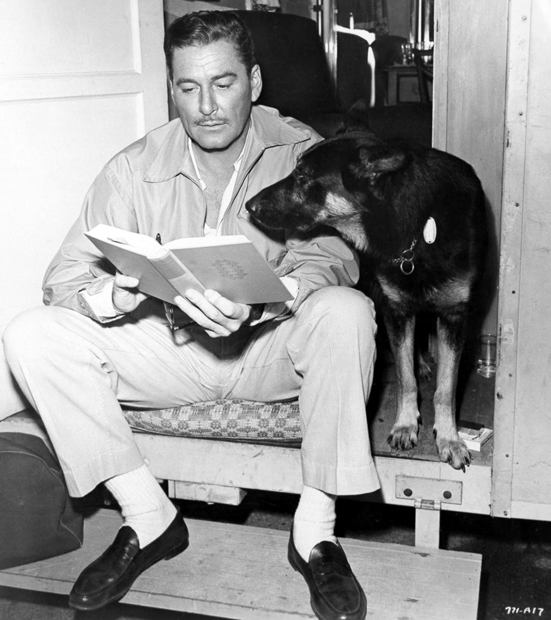
Good Morning!!
This post is going to be a little bit of this and a little bit of that along with some eye candy for the classic film buffs out there–just because I’m feeling a little silly and mixed up today.
I haven’t been paying much attention to the situation in Egypt lately–except to notice out of the corner of my eye that it seems to be getting out of hand. Here are a few links on what’s happening now.
LA Times: Death toll in Egypt crackdown hits 525
CAIRO — The death toll in the violence that has engulfed Egypt climbed to 525 Thursday as the nation awoke to scenes of charred streets, battered cars, funerals and deepening divisions between Islamists and the largely secular military-backed government.
The Health Ministry reported that the dead, mostly supporters of deposed Islamist president Mohamed Morsi, included at least 43 police officers. More than 3,700 people were also wounded in clashes that ignited Wednesday when security forces broke up two sit-ins by protesters loyal to Morsi and his Muslim Brotherhood.
The Brotherhood claims at least 2,000 people were killed in street battles that swept the country. Many of the deaths occurred when riot police firing tear gas and automatic weapons stormed the six-week old Islamist rally outside the Rabaa al Adawiya mosque in Cairo.
The violence stunned world leaders, and Thursday Turkish Prime Minister Recep Tayyip Erdogan demanded that the U.N. Security Council move to condemn what he characterized as a massacre by Egyptian soldiers and security forces.
“I am calling on Western countries. You remained silent in Gaza, you remained silent in Syria. … You are still silent on Egypt. So how come you talk about democracy, freedom, global values and human rights?” he told a news conference.
The Daily Mail: Horrifying moment Egyptian protestors pushed an armoured police van 50ft off a bridge before officers were stoned by mob
The van plunged off the 6th October Bridge before demonstrators attacked the wreckage yesterday. It is not known how many people were on board and how many people survived the fall, but bloodied men were seen lying around the van moments afterwards. Unconfirmed reports on Twitter claimed five were dead.
The dramatic pictures show the van being ambushed by dozens of people before crashing through a protective fence on the bridge. It then falls upside down and then rolls onto its roof as it lands. Blood can then be seen on the ground as nearby police officers pull injured men out of the crushed vehicle.
See photos at the the link.
There is a lot of criticism of the Obama administration’s handing (or non-handling) of the situation. Some samples:
Slate: Lost In Egypt
The bloody crackdown began early Wednesday morning, as Egyptian riot police and plainclothes officers began their assault on the thousands of Muslim Brotherhood members who defied the government’s warnings to end their protests in support of the ousted former president, Mohamed Morsi. Security forces showed no restraint as they stormed the two massive sit-ins: Bulldozers cleared makeshift barriers, while snipers took aim at protesters and plumes of tear gas engulfed the streets. Hospitals were quickly overrun with the dead and wounded, and eyewitness reports described hallways slick with blood and lines of corpses with gunshot wounds to the head, neck, and chest. By the end of the siege, nearly 300 people were reported dead—including women and children—and it’s likely the death toll will climb higher.
It being August, the duty of offering the Obama administration’s first reaction to the Egyptian regime’s brutal attack fell to deputy press secretary Josh Earnest. The White House condemned the violence (as if it were being committed equally by both sides), asked that the military and security forces show restraint (while corpses were being counted), promised to hold the interim government accountable (as if the interim government were anything more than a fig leaf for the military), and suggested that an “inclusive process” would be best (that must not have occurred to the snipers as they reloaded their guns). In other words, it was the same talking points the administration has produced each time Egypt has erupted in a spasm of violence this summer. It is hard to imagine a more feckless response than the Obama administration’s approach to dealing with Egypt’s generals.
When asked whether the administration might want to revise its position on whether the July 3 ouster of Egypt’s first democratically elected president was a coup, Earnest replied, “It is not in the interests of the United States to make that determination.” That answer echoed State Department spokeswoman Jen Psaki’s statement on July 26 that “we have determined legally that we do not need to make a determination.” In other words, we aren’t going to say and you can’t make us.
Business Insider: Obama Is Getting Shredded Over His Handling Of Egypt And Ongoing Support Of The Government
Both The Washington Post and The New York Times have printed scathing editorials that demand the U.S. suspend $1.3 billion in aid to Egypt after a military crackdown led to the deaths of more than 550 people, including two foreign journalists, on Wednesday.
“[T]he Obama administration is complicit in the new and horrifyingly bloody crackdown launched Wednesday by the de facto regime against tens of thousands of protesters who had camped out in two Cairo squares.”
“This refusal to take a firm stand against massive violations of human rights is as self-defeating for the United States as it is unconscionable.”
“President Obama must make clear his unequivocal opposition to the Egyptian military’s conduct. He can do so by immediately suspending military aid and canceling joint military exercises scheduled for September.”
“And if suspending a $1.3 billion subsidy does not do the trick, it will at least tell rank-and-file Egyptians that the United States is no longer underwriting repression.”
More examples at the link.
Things aren’t looking very good in Iraq either.
From Reuters: Baghdad bomb attacks kill at least 33
A series of car bombs in Baghdad killed at least 33 people and wounded more than 100 on Thursday, with one near the “Green Zone” diplomatic complex, fuelling a death toll that has soared since the beginning of the year to levels not seen since 2008.
Militant groups, including al Qaeda, have increased attacks in recent months in an insurgency against Iraq’s Shi’ite-led government, raising fears of a return to full-blown sectarian conflict after U.S. troops withdrew 18 months ago.
Iraqi police sources said one bomb exploded just 200-300 meters (yards) outside Baghdad’s international zone, close to Iraq’s Foreign Ministry, killing four and wounding 12 people….
Since the start of the year, attacks using multiple car bombs have become an almost daily occurrence, killing scores of people in Iraq, including during a religious holiday last weekend when bombers targeted families celebrating outside.
Each of the past four months has each been deadlier than any in the previous five years, dating back to a time when U.S. and government troops were engaged in battles with militiamen.
Back in the USA, veteran newsman Jack Germond died yesterday at age 85. From The Baltimore Sun:
Jack W. Germond, the irascible, portly columnist and commentator who was a fixture on the American political scene for nearly 50 years, including nearly 20 of them in The Baltimore Sun’s Washington bureau, died Wednesday morning of chronic obstructive pulmonary disease at his home in Charles Town, W.Va. He was 85.
“Jack was a truly dedicated reporter and had an old-fashioned relationship with politicians. He liked them, but that did not prevent him from being critical when they did bad things and behaved badly. That was a trademark of Jack’s,” said Jules Witcover, his longtime writing partner.
“Jack enjoyed his life and work. He personified that,” said Ernest B. “Pat” Furgurson, former chief of The Sun’s Washington bureau. “He had a positive personality, but when he was bitching about something, and in that mood, he’d suddenly say, ‘Isn’t this a great job?'”
He used to be on TV a lot, and I always liked him. He was a real old-time journalist who wasn’t afraid to speak his mind.
More news from our crumbling country: Republicans are still crazy.
Rand Paul: ‘I Don’t Think There Is Any Particular Evidence’ Of Black Voters Being Prevented From Voting (Think Progress)
Sen. Rand Paul (R-KY), a tea party senator with a long history of opposition to civil rights laws, told an audience in Louisville, Kentucky on Wednesday that there is no evidence of black voters being excluded from the franchise. According to local NPR host Phillip Bailey, Paul said that he does not believe “there is any particular evidence of polls barring African Americans from voting,” during aspeech to the non-partisan Louisville Forum.
If Paul is not aware of the evidence indicating widespread efforts to prevent African Americans from voting, then he must not be looking very hard. During the 2012 election, black and Hispanic voters waited nearly twice as long to cast a ballot as white voters. In Florida, lines of up to six hours led an estimated 201,000 people to become frustrated and leave the polls. These lines existed largely because of a voter suppression bill signed into law by Gov. Rick Scott (R-FL) which reduced early voting hours in the state. After the election, top Republicans admitted that the purpose of cutting early voting was to reduce Democratic turnout. One Republican operative conceded that early voting was cut on the Sunday proceeding Election Day because “that’s a big day when the black churches organize themselves.”
Meanwhile, voter ID laws are rampant in states led by conservatives, despite the fact that these laws cannot be justified by any legitimate purpose. Although their proponents routinely claim that an ID requirement is necessary to prevent voter fraud at the polls, such fraud barely exists. According to one study, just 0.0023 percent of votes are the product of in person voter fraud. Meanwhile, even conservative estimates suggest that 2 to 3 percent of legitimate voters will turn turned away by a voter ID law — and these voters are disproportionately African American.
And Texas Republicans are beyond the pale: Rep. Stockman invites Obama rodeo clown to perform in Texas.
A conservative Texas lawmaker is inviting a rodeo clown banned from the Missouri state fair to perform in the Lone Star State instead.
Rep. Steve Stockman (R-Tex.) says that the unidentified rodeo clown and his colleagues have been unfairly targeted by liberals “to create a climate of fear.” He invited them to come perform at a fair in his southeastern Texas district instead.
“Liberals want to bronco bust dissent. But Texans value speech, even if its speech they don’t agree with,” Stockman said in a statement issued by his office Wednesday. “From Molly Ivins to Louie Gohmert and every opinion between Texans value free and open political speech. I’m sure any rodeo in Texas would be proud to have performers.”
Missouri state and fair officials reacted swiftly over the weekend after a rodeo clown donned a mask of President Obama and asked people if they want to see the president “run down by a bull.”
The White House declined to comment on the disgusting display of racism and disrespect for the office of the President.
Hillary Clinton is getting job offers from academia, according to Politico.
Hillary Clinton is fielding offers from colleges and universities — including Harvard and her law school alma mater, Yale — to give her a formal academic role, a move that would give her a platform outside her family’s foundation….
The advantage to Clinton of an academic platform, beyond the scope of her policy interests, could be huge for someone considering a presidential run. It would provide her with a credible backdrop for speeches and events that would take her outside of a hotel ballroom or something sponsored by her family’s foundation or another outside group.
Hmmm…. I’m sure the Politico gang would much prefer to see Hillary in academia rather than the White House.
On the chance Clinton doesn’t run for president, academia would be a potential next act for her careerwise.
The schools have included the Harvard Kennedy School, Yale, New York University — where her daughter, Chelsea, has a title — and the Baruch College discussions, the sources said. One source indicated there are others as well who have approached Clinton about an academic partnership, going back to when she was still at Foggy Bottom.
Okay, there’s a mish-mash of news and “views” to give you a start on your Thursday. Now what stories are you interested in today? Please share your links in the comment thread.
Tuesday Reads: Neanderthal Tools, Hillary on Voting Rights, Bulger Verdict, and NDE Research
Posted: August 13, 2013 Filed under: 2016 elections, Civil Rights, Crime, Criminal Justice System, FBI, Hillary Clinton, morning reads, U.S. Politics | Tags: ACLU, American Bar Association, bone tools, death, Debra Davis, higher states of consciousness, James "Whitey" Bulger, John Martorano, leather-working, NAACP, national security, Neanderthals, near death experiences, North Carolina, Pat McCrory, Rev. William Barber, Scott Hotyckey, transparency, Voter ID laws, voter suppression, voting rights 40 Comments
Good Morning!!
I’ve been somewhat out of the loop for the past few days because I’ve had some kind of weird virus that has made it difficult for me to think. If it weren’t August, I’d wonder if it’s the flu. Everything ached. For a couple of days it felt like my skin actually hurt. Anyway I’ve been vegetating in front of the TV watching Criminal Minds reruns and Lifetime movies. I’m feeling better now, although I’m still sleepy all the time.
I’ve been surfing around this morning, and there is quite a bit of interesting news out there. I’ll begin with a fascinating archaeological find. According to a new study reported in Nature, Neanderthals invented tools made of bone that are still used today for leather-working.
Excavations of Neanderthal sites more than 40,000 years old have uncovered a kind of tool that leather workers still use to make hides more lustrous and water resistant. The bone tools, known as lissoirs, had previously been associated only with modern humans. The latest finds indicate that Neanderthals and modern humans might have invented the tools independently.
The first of the lissoir fragments surfaced a decade ago at a rock shelter called Pech-de-l’Azé in the Dordogne region of southwest France. Archaeologist Marie Soressi of the Max Planck Institute for Evolutionary Anthropology in Leipzig, Germany, knew the tool at once, says her colleague Shannon McPherron.
The tools are also known as slickers and burnishers, says McPherron. Soressi contacted luxury-goods manufacturer Hermès in Paris, and found that their high-end leather workers use just such a tool. “She showed them a picture, and they recognized it instantly,” says McPherron. The company’s line includes the wildly popular Birkin handbag, which sells for around US$10,000 and upwards.
McPherron says that a single artefact, however, was not enough for the researchers to draw broad conclusions. “You find one, and there’s always some doubt. You’re worried that it’s not a pattern — that it’s anecdotal behaviour.” But subsequent digs at Pech-de-l’Azé and nearby Abri Peyrony turned up further lissoir fragments, leading the researchers to conclude that Neanderthals made the tools routinely.

Neanderthal bone tools
The researchers say it’s not clear if these kinds of tools were first invented by Neanderthals or modern humans. It’s even possible that modern humans could have learned how to make and use the bone tools from Neantherthals, although most archaeologists believe that Neanderthals learned the skills from humans. From Live Science:
Neanderthals created artifacts similar to ones made at about the same time by modern humans arriving in Europe, such as body ornaments and small blades. Scientists hotly debated whether such behavior developed before or after contact with modern humans.
“There is a huge debate about how different Neanderthals were from modern humans,” said Shannon McPherron, an archaeologist at the Max Planck Institute for Evolutionary Anthropology in Leipzig, Germany.
Now, McPherron and his colleagues have discovered that Neanderthals created a specialized kind of bone tool previously only seen in modern humans. These tools are about 51,000 years old, making them the oldest known examples of such tools in Europe and predating the known arrival of modern humans.
Yesterday North Carolina Gov. Pat McCrory signed a new voter suppression voter ID law and the ACLU, NAACP, and the Southern Coalition for Social Justice immediately filed suit against it. USA Today:
Republicans who backed the legislation said it was meant to prevent voter fraud, which they claim is both rampant and undetected in North Carolina. Independent voting rights groups joined Democrats and libertarians in suggesting the true goal was to suppress voter turnout, especially among blacks, the young, the elderly and the poor.
“It is a trampling on the blood, sweat and tears of the martyrs — black and white — who fought for voting rights in this country,” said the Rev. William Barber, president of the state chapter of the NAACP. “It puts McCrory on the wrong side of history.” [….]
Barber called the Republican-backed measure one of the worst attempts in the nation at voting reform and said the National Association for the Advancement of Colored People considered the package an all-out attack on existing laws long seen as a model of voter participation….
The legislation signed by McCrory and approved last month by state lawmakers requires voters to present government-issued photo IDs at the polls and shortens early voting by a week, from 17 days to 10. It also ends same-day registration, requiring voters to register, update their address or make any other needed changes at least 25 days ahead of an election. A high school civics program that registers tens of thousands of students to vote each year in advance of their 18th birthdays has been eliminated.
Yesterday Hillary Clinton spoke out against the North Carolina law and other efforts to deny and suppress voting rights in a speech before the American Bar Association. HuffPo:
On the same day that North Carolina Gov. Pat McCrory (R) signed a restrictive voter ID bill into law, Clinton criticized the Supreme Court decision that she believes “stripped out the pre-clearance formula that made [the Voting Rights Act] so effective.”
She noted that Texas, Florida and North Carolina are states whose recent voter legislation has shifted the burden, slamming the North Carolina bill as one that “reads like the greatest hits of voter suppression.”
“In the weeks since the ruling, we’ve seen an unseemly rush by previously covered jurisdictions to enact or enforce laws that will make it harder for millions of our fellow Americans to vote,” Clinton said.
Clinton also went after several provisions of the North Carolina bill that she believes place a greater burden on citizens facing discrimination, including limited voting hours, stricter ID requirements and restricted early voting.
CNN reports that Hillary also plans to discuss national security and transparency in an upcoming speech.
Clinton said her appearance at the annual meeting of the American Bar Association marked the beginning of a speaking series she’ll embark upon that will also include an address on the United States’ national security policies next month in Philadelphia.
Clinton said the September address would focus of issues of “transparency and balance.” The former top diplomat had not yet publicaly addressed the classified National Security Agency surveillance programs that were revealed through leaks at the beginning of the summer.
The move into the political realm marks a new phase in Clinton’s post-State Department life, which was previously occupied by speeches to global women’s organizations and a schedule of paid appearances. She is also writing a diplomacy-focused memoir for release in 2014.
The speeches will likely fuel speculation that Clinton is planning to jump into the race for the 2016 Democratic presidential nomination, where she is considered an early favorite.
Well there’s some exciting news! It’s becoming more an more clear that Hillary plans to run for president in 2016.
I’m sure you’ve already heard that James “Whitey” Bulger has been found guilty of murder and racketeering, among other charges. It was always a foregone conclusion. The only surprise is that the jury was only able to find him guilty of 11 murders out of the 19 he was charged with. The New York Times:
BOSTON — James (Whitey) Bulger, the mobster who terrorized South Boston in the 1970s and ‘80s, holding the city in his thrall even after he disappeared, was convicted Monday of a sweeping array of gangland crimes, including 11 murders. He faces the prospect of spending the rest of his life in prison.
The verdict delivers long-delayed justice to Mr. Bulger, 83, who disappeared in the mid-1990s after a corrupt agent with the Federal Bureau of Investigation told him he was about to be indicted. He left behind a city that wondered if he would ever be caught — and even if the F.B.I., which had been complicit in many of his crimes and had relied on him as an informer, was really looking for him.
“This was the worst case of corruption in the history of the F.B.I.,” said Michael D. Kendall, a former federal prosecutor who investigated Mr. Bulger’s associates. “It was a multigenerational, systematic alliance with organized crime, where the F.B.I. was actively participating in the murders of government witnesses, or at least allowing them to occur.”
Of course there won’t be any punishment for the FBI except for embarrassment, if that troubles them. And there was only minor punishment for the parade of hit men and other criminals who were given generous deals in exchange for their testimony.

Debbie Davis, left, with her mother Olga, right, was the girlfriend of Stephen Flemmi, Whitey Bugler’s gangster partner. She vanished in 1981 and her body was found dismembered in 2000
(Daily Mail)
The families of the victims of the 7 murders Bulger was not convicted of were disappointed and angry.
As a clerk read the verdicts in the lengthy and complicated list of charges, Mr. Bulger looked away from the jury and showed no reaction. He was found guilty of 31 of 32 counts of his indictment, the one exception involving an extortion charge. While the jury of eight men and four women convicted him of 11 murders, they found the government had not proved its case against him in seven others, and in one murder case it made no finding, leading to gasps inside the courtroom by relatives of those murder victims and explosive scenes outside the court.
“My father just got murdered again 40 years later in that courtroom,” said the son of William O’Brien, who is also named William….
Perhaps one glimmer of gratification for Mr. Bulger was that the jury reached “no finding” in the death of Debra Davis, one of two women he was accused of strangling. He has long maintained that his personal code of honor did not allow for the killing of women, although the jury did determine that he had killed the other woman, Deborah Hussey. Ms. Davis was the longtime girlfriend of Stephen Flemmi, Mr. Bulger’s former partner in crime who testified against him. Ms. Hussey was the daughter of another of Mr. Flemmi’s longtime girlfriends.

Hit man John Martorano
One of the jurors has already talked to local Boston media about how stressful the experience was.
One of the jurors who voted to convict Boston mobster James “Whitey” Bulger for a string of gangland crimes described how the more than 32 hours of deliberations were “stressful” and involved “all kinds of dissension.”
“Slamming doors,” Scott Hotyckey told CBS station WBZ-TV. “People leaving. Peolpe wanting to get off the jury.” [….]
Hotyckey, juror number 5, said the evidence was overwhelming.
“If you could believe the testimony, and believe what you heard,” Hotyckey said. “I don’t see how you couldn’t find the person guilty.”
But Hotyckey says not all of the jurors believed the testimony they heard – especially from John Martorano, a former hit man who got a plea deal from prosecutors to testify against Bulger.
“There was one juror that constantly said that his testimony was not believable,” Hotyckey recalled. “(He said) over and over again that you couldn’t believe anything (Martorano) said because of the government.”
I’ll wrap this post up with another interesting science story from BBC News about an experiment on rats that shows what happens at the moment of death.
A study on rats shows that the brain experiences a huge surge of electricity during the moment of death, suggesting that they are experiencing a higher state of consciousness.
It could explain why people claim to see white light or “life flash before their eyes” during near-death experiences.
Dr Jason Braithwaite from the University of Birmingham says that since this surge is happening in rats, it could also happen in humans.
Watch an interview with Braithwaite at the BBC link. More detail on the study:
A study carried out on dying rats found high levels of brainwaves at the point of the animals’ demise.
US researchers said that in humans this could give rise to a heightened state of consciousness.
The research is published in the Proceedings of the National Academy of Sciences.
The lead author of the study, Dr Jimo Borjigin, of the University of Michigan, said: “A lot of people thought that the brain after clinical death was inactive or hypoactive, with less activity than the waking state, and we show that is definitely not the case.
“If anything, it is much more active during the dying process than even the waking state.”
Much more at the link.
Now it’s your turn. What stories have caught your fancy today? Please share your links in the comment thread.
Monday Reads: Political Ink
Posted: August 12, 2013 Filed under: morning reads | Tags: Christie Paul rift, drought, Fed Chair, fracking, Hiroshima bomb, Larry Summers, Martin Luther King, Paul Tibbets, state funded crisis pregnancy center shams, Texas, water shortage 28 Comments
Good Morning!
Here’s a little bit of this and that to get your political juices flowing for the week.
The NYT profiles potential FED chair candidate La La Summers as some one that has many flaws but much power and personal wealth. He has the credentials and the connections but does he really have the gravitas for the job?
Mr. Summers’s wealth comes mainly from two periods of private sector work between government postings. After a lengthy tenure at the Treasury Department in the 1990s, he became the president of Harvard — a job that Robert E. Rubin, who preceded Mr. Summers as Treasury secretary, helped him obtain.
But in 2006, Mr. Summers was forced out of the university presidency for a variety of reasons, including remarks he made questioning why few women engage in advanced scientific and mathematical work. Soon after, a young Harvard alum brought him into the hedge fund world with a part-time posting at D. E. Shaw. That firm, one of the largest in the industry, paid Mr. Summers more than $5 million.
Mr. Summers’s wealth soared from around $400,000 in the mid-1990s to between $7 million and $31 million in 2009, when he joined the Obama administration, according to a financial disclosure he filed at the time. Before returning to government service, he earned $2.7 million from speeches in one year alone.
As for his current work, representatives for Citigroup, Nasdaq and D. E. Shaw declined to disclose his pay. His speaking rates today run into the six figures, according to an associate who spoke on the condition of anonymity, and Mr. Summers has spoken to Wall Street companies like Goldman Sachs, JPMorgan Chase and Citigroup.
The job that is likely to generate the most scrutiny for Mr. Summers is his work with Citigroup, which was rescued from the brink of bankruptcy by the federal government’s bailout. Though he does not have an office there, two people with direct knowledge of the matter said he was a regular consultant. In a statement, Citigroup said he provided “insight on a broad range of topics including the global and domestic economy” to prestigious clients, and attended internal meetings.
Citigroup hired Mr. Summers in part to advise Vikram S. Pandit, who resigned as chief executive last year. With his work there, Mr. Summers followed in the footsteps of his friend, Mr. Rubin, who joined Citigroup after he left the government and earned more than $100 million.
Another political analyst–this one writing for Bloomberg–thinks that the Republicans are inching towards civil war and that the next election may look like  1964. The focus has been on the Paul-Christie rift.
As Republicans continue to sort through their future, having lost the popular vote for president in five of the last six elections, they are having intramural battles with echoes of 1964, when Barry Goldwater won the nomination at a convention rife with division over the role of the U.S. in the world and civil rights at home. Derided as an extremist, he went on to lose to President Lyndon Johnson in a landslide.
Now, Republicans are squabbling over the National Security Agency surveillance program, immigration and gay marriage. The Christie-Paul rift last week highlighted the divide, with the governor calling the senator’s criticism of the NSA program “dangerous” and the Kentuckian responding that his critic must have forgotten the Bill of Rights.
“It’s always healthy to have discussions from different wings of the party as the party works on its identity going into the midterms,” said LaTourette, who chose not to seek re-election to Congress in 2012 citing the extreme positions among some of his Republican colleagues. “It wouldn’t be so healthy if this was next year or 2015 and the focus is on who the presidential nominee will be.
Martin Luther King III has a written a book on what it meant to grow up the footsteps of his father. Even better, you can get it to read with your child or grandchildren because it is written for children!! You can read about or listen to an NPR interview with King here.
Martin Luther King III recounts this and other stories from his childhood in his new children’s book, My Daddy, Dr. Martin Luther King, Jr. Martin Luther King III had been thinking about writing about his child’s-eye view of his father for almost a decade, but the 50th anniversary of the March on Washington became a personal deadline. The book, written for young children, has just been published, three weeks ahead of the anniversary.
Now Martin Luther King III and his wife, Andrea, have a 5-year-old daughter, Yolanda Renée. She was named for Martin Luther King III’s oldest sister, who died suddenly in 2006. In the book, young Martin Luther King III tells readers about the games he played with his father.
Martin Luther King III also retells stories of accompanying his father on marches from time to time. On one, they were confronted by a police officer “with a huge dog that growled at me. I was terrified.” That is, he was scared until his dad took his hand and told him they would be fine.
“I felt safe. My dad was not a tall man, but he always made me feel like he was a giant. I was never afraid when I was with him,” Martin Luther King III writes.
Long after his father’s death, Martin Luther King III has had to deal with others’ expectations that he would take up the cause. King is deeply grateful that decades ago, his mother relieved him of some of that pressure.
“You don’t have to be your father,” Coretta Scott King told him. “Just be your best self, whatever that is. We are going to support you.”
This has to be the worst use of tax dollars that I’ve seen in years. A report shows State-Funded Crisis Pregnancy Centers Talk Women Out Of Birth Control and Condoms. Is this really the way to prevent unwanted pregnancies and abortions?
When a woman walked into a state-funded “crisis pregnancy center” in Manassas, Va., this summer and told the counselor she might be pregnant, she was told that condoms don’t actually prevent STDs and that birth control frequently causes hair loss, memory loss, headaches, weight gain, fatal blood clots and breast cancer.
“The first three ingredients in the birth control pill are carcinogens,” the CPC counselor said, adding that she always tries to talk women out of taking it.
The counselor also told the woman that condoms are not effective at preventing pregnancy or sexually transmitted diseases because they are “naturally porous.”
“Safe sex is a joke,” she said. “There’s no such thing.”
NARAL Pro-Choice Virginia recorded the exchange, released Wednesday, as part of its undercover investigation into the 58 state-funded “crisis pregnancy centers” in Virginia. The organizations are part of a national network of about 2,500 Christian centers that advertise health and pregnancy services, but do not offer abortions, contraception or prenatal care. Instead, they are intended to talk women out of having abortions and to advocate abstinence until marriage.
These organizations receive state money through the sale of “Choose Life” license plates at the Virginia Department of Motor Vehicles. Ken Cuccinelli, Virginia’s Republican gubernatorial candidate, sponsored the legislation that established that fundraising system during his time in the state senate.
NARAL sent undercover women into several crisis pregnancy centers throughout Virginia and recorded their interactions. The investigation revealed that 71 percent of the CPCs in Virginia give out medically inaccurate information about the health consequences and effectiveness of birth control, condoms and abortion.
According to the report, in addition to criticizing the use of birth control and condoms, 40 of the CPCs told women that abortion causes long-term psychological damage and leads women to develop eating disorders and drug addictions. One counselor allegedly told NARAL’s undercover investigator that if she was a certain blood type, the abortion could cause her body to create antibodies that would attack her fetus the next time she tried to get pregnant.
Greg Mitchell recalls interviewing the man that dropped the A-Bomb on Hiroshima in this blog post.
Paul W. Tibbets, pilot of the plane, the “Enola Gay” (named for his mother), which dropped the atomic bomb over Hiroshima on August 6, 1945. died at 92 in 2007, defending the bombing to the end of his life. Some of the obits noted that he had requested no funeral or headstone for his grave, not wishing to create an opportunity for protestors to gather.
I had a chance to interview Tibbets nearly 30 years ago, and wrote about it for several newspapers and magazines and in the book I wrote with Robert Jay Lifton, Hiroshima in America.
The hook for the interview was this: While spending a month in Japan on a grant in 1984, I met a man named Akihiro Takahashi. He was one of the many child victims of the atomic attack, but unlike most of them, he survived (though with horrific burns and other injuries), and grew up to become a director of the memorial museum in Hiroshima. The August 6 bombing led to the deaths of at least 75,000 people in a flash and at least that many more in the days and years that followed. At least 90% of them were civilians, mainly women and children.
Takahashi showed me personal letters to and from Tibbets, which had led to a remarkable meeting between the two elderly men in Washington, D.C. At that recent meeting, Takahashi expressed forgiveness, admitted Japan?s aggression and cruelty in the war, and then pressed Tibbets to acknowledge that the indiscriminate bombing of civilians was always wrong.
But the pilot (who had not met one of the Japanese survivors previously) was non-committal in his response, while volunteering that wars were a very bad idea in the nuclear age. Takahashi swore he saw a tear in the corner of one of Tibbets’ eyes.
So, on May 6, 1985, I called Tibbets at his office at Executive Jet Aviation in Columbus, Ohio, and in surprisingly short order, he got on the horn. He confirmed the meeting with Takahashi (he agreed to do that only out of “courtesy”) and most of the details, but scoffed at the notion of shedding any tears over the bombing. That was, in fact, “bullshit.”
“I’ve got a standard answer on that,” he informed me, referring to guilt. “I felt nothing about i.” .I’m sorry for Takahashi and the others who got burned up down there, but I felt sorry for those who died at Pearl Harbor, too….People get mad when I say this but — it was as impersonal as could be. There wasn’t anything personal as far as I?m concerned, so I had no personal part in it.“It wasn’t my decision to make morally, one way or another. I did what I was told — I didn’t invent the bomb, I just dropped the damn thing. It was a success, and that’s where I?ve left it. I can assure you that I sleep just as peacefully as anybody can sleep.” When August 6 rolled around each year “sometimes people have to tell me. To me it’s just another day.”
So, we have a few Texas Sky Dancers here. This Guardian article on Texas being all Oil and no Water is kind’ve frightening.
Beverly McGuire saw the warning signs before the town well went dry: sand in the toilet bowl, the sputter of air in the tap, a pump working overtime to no effect. But it still did not prepare her for the night last month when she turned on the tap and discovered the tiny town where she had made her home for 35 years was out of water.
“The day that we ran out of water I turned on my faucet and nothing was there and at that moment I knew the whole of Barnhart was down the tubes,” she said, blinking back tears. “I went: ‘dear God help us. That was the first thought that came to mind.”
Across the south-west, residents of small communities like Barnhart are confronting the reality that something as basic as running water, as unthinking as turning on a tap, can no longer be taken for granted.
Three years of drought, decades of overuse and now the oil industry’s outsize demands on water for fracking are running down reservoirs and underground aquifers. And climate change is making things worse.
In Texas alone, about 30 communities could run out of water by the end of the year, according to the Texas Commission on Environmental Quality.
Nearly 15 million people are living under some form of water rationing, barred from freely sprinkling their lawns or refilling their swimming pools. In Barnhart’s case, the well appears to have run dry because the water was being extracted for shale gas fracking.
The town — a gas station, a community hall and a taco truck – sits in the midst of the great Texan oil rush, on the eastern edge of the Permian basin.
A few years ago, it seemed like a place on the way out. Now McGuire said she can see nine oil wells from her back porch, and there are dozens of RVs parked outside town, full of oil workers.
But soon after the first frack trucks pulled up two years ago, the well on McGuire’s property ran dry.
No-one in Barnhart paid much attention at the time, and McGuire hooked up to the town’s central water supply. “Everyone just said: ‘too bad’. Well now it’s all going dry,” McGuire said.
Ranchers dumped most of their herds. Cotton farmers lost up to half their crops. The extra draw down, coupled with drought, made it impossible for local ranchers to feed and water their herds, said Buck Owens. In a good year, Owens used to run 500 cattle and up to 8,000 goats on his 7,689 leased hectares (19,000 acres). Now he’s down to a few hundred goats.
The drought undoubtedly took its toll but Owens reserved his anger for the contractors who drilled 104 water wells on his leased land, to supply the oil companies.
So, what is on your reading and blogging list today?

 peej
peej Carissa
 bostonboomer
 dakinikat
 ecocatwoman
 mablue2
 Mama Lopez
 peggysue22
 quixote
 skydancingguestblogger
 Mona (aka Wonk the Vote)



 Sky Dancing
Recent Comments