
It’s true that public opinion surveys are not showing any 2010-style GOP “wave,” but Democrats are rightly nervous that when polls begin identifying likely voters closer to November, superior Republican “base enthusiasm” could put a thumb on the scales in their favor.
Thursday Reads: Through the Looking Glass?
Posted: July 31, 2014 Filed under: 2014 elections, 2016 elections, Barack Obama, morning reads, Republican politics, Rick Perry, the GOP, The Media SUCKS, U.S. Politics, VAGINA Rick Santorum, Voter Ignorance, We are so F'd | Tags: Bobby Jindal, Ed Kilgore, GOP crazies, impeachment, insanity, IRS, John Boehner, John Dickerson, Lois Lerner, Marco Rubio, Nate Silver, right wing talk show hosts 36 Comments
Reading Woman, Armando Barrios
Good Morning!!
I’ve spent the past week or so reading escapist literature and watching old TV shows in an effort to anesthetize myself against the overload of bad news we’ve been hit with lately. Yesterday I was feeling a lot better–my escapism seemed to be working to improve my overall mood.
Then last night as I was surfing around in search of interesting reads for this morning’s post, I came across something that jumpstarted me right through Alice’s looking glass.
You’ve probably heard about it too. Lois Lerner, who used to work for the IRS and who is at the center of one of the GOP’s crazy efforts to create a scandal that will bring down President Obama used the word “crazies” in a private e-mail to a colleague who was complaining about right wing radio hosts. Here’s the text of e-mail as quoted in The Washington Post yesterday.
During the exchange, Lerner says she is traveling in Great Britain. The name of the person she is emailing with was blacked out.
Lerner: “I’m ready. Overheard some ladies talking about American today. According to them we’ve bankrupted ourselves and at through. We’ll never be able to pay off our debt and are going down the tubes. They don’t seem to see that they can’t afford to keep up their welfare state either. Strange.”
Other person: “Well, you should hear the whacko wing of the GOP. The US is through; too many foreigners sucking the teat; time to hunker down, buy ammo and food, and prepare for the end. The right wing radio shows are scary to listen to.”
Lerner: “Great. Maybe we are through if there are that many assholes.”Other person: “And I’m talking about the hosts of the shows. The callers are rabid.”
Lerner: “So we don’t need to worry about alien teRrorists. It’s our own crazies that will take us down.”

My initial response was the same as that of Mark NC at News Corpse (a site that makes fun of Fox News), So F**king What? Former IRS Official Says That GOP Crazies Are…CRAZY!
Republicans and their friends at Fox News have mastered the art of building mountains of bullshit from the lowliest troll-hills. It’s one of their favorite tactics to malign Democrats. Just grab a sentence fragment from a long speech and pretend that it is the whole of the comment from which it was extracted. Then feign outrage that such an awful remark could have been uttered.
The latest example of this rhetorical deceit was demonstrated when the GOP chair of the House Ways and Means Committee, Dave Camp, unscrupulously and selectively released some emails purported to be from Lois Lerner, the former IRS official who has been hounded by malevolent cretins like Rep. Darrell Issa in an attempt to fabricate ammunition to use against President Obama. Despite hundreds of wasted hours (costing millions of taxpayer dollars) engaged in hyper-partisan investigations, the Republican Inquisition has produced nothing implicating the President in any untoward activity.
The emails that Camp is now crowing about are just as meaningless as all of the other bogus “smoking guns” that these wingnuts have claimed would topple the administration. The headline that Camp has wrenched from the documents is that Lerner may have referred to certain individuals as “crazies” or “a-holes.” And, of course, this would only be an atrocity if those individuals were Republicans. Suffice to say that Camp wouldn’t give a Fig Newton if they were Democrats.
As Camp characterized this affair, Lerner was allegedly caught red-handed expressing her disgust for Republicans. And as the person at the center of the controversy over whether the IRS improperly subjected Tea Party groups to extra scrutiny when they applied for tax-exempt status, Camp believes that these emails prove that she was biased. Consequently, Camp regards the emails as justification for appointing a special prosecutor and escalating the legal assault on Lerner and, ultimately, the White House.
There’s just one problem. The emails don’t don’t say what Camp alleges they say. And even if they did it wouldn’t mean anything. Most people in government have personal opinions and allegiances. There isn’t anything wrong with that, so long as it doesn’t interfere with the fair execution of their duties. And the evidence shows that Lerner’s department scrutinized applications of all political persuasions. The only organization that was denied tax-exempt status during the time in question was a liberal group.
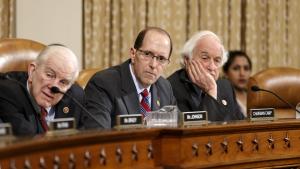
House Ways and Means Committee Chairman Rep. Dave Camp, R-Mich. (center), flanked by the committee’s ranking member, Sander Levin, D-Mich. (right), and Sam Johnson, R-Texas.
Please read the rest at the link.
So this humorous site agrees with me, but more mainstream sites are seemingly going along with the Camp’s notion that this e-mail is evidence of a major scandal. For example, Dave Wiegel characterized it as a “bombshell,” although he does point out that Lerner’s anonymous “e-mail partner” was talking about talk radio hosts, not Republicans in general. Huffington Post reported that Lerner had made “two disparaging remarks about members of the GOP.” Both HuffPo and Politico write that in one e-mail Lerner referred to Republicans as “a–holes,” but they sidestep the fact the context was a discussion of right wing talk show hosts.
As we approach the midterm elections, I can’t help but feel that most of the mainstream media is cheering for a Republican takeover. Am I the crazy one?
Here’s another example from self-described libertarian Nate Silver, Democrats Are Way More Obsessed With Impeachment Than Republicans.
House Speaker John Boehner said Tuesday that Republicans have no plans to impeach President Obama, and that all the impeachment talk was driven by Democrats hoping to stir up their base.
Boehner’s statement isn’t literally true: There have been mentions of impeachment around the edges of the GOP and by some Republican members of Congress. But on the whole, Democrats are spending a lot more time talking about impeachment than Republicans.
Consider, for example, the Sunlight Foundation’s Capitol Words database, which tracks words spoken in the House and Senate. So far in July, there have been 10 mentions of the term “impeachment” in Congress and four others of the term “impeach.” Eleven of the 14 mentions have been made by Democratic rather than Republican members of Congress, however.
Impeachment chatter has also become common on cable news. On Fox News this month, Sarah Palin, the former Alaska governor, called for Obama’s impeachment, for instance. But for every mention of impeachment on Fox News in July, there have been five on liberal-leaning MSNBC.
OK, so that’s this month. And this proves what? Democrats are throwing around the word “impeachment” in hopes of calling attention to what Republicans have been saying for years! So f$%king what?!

Again, I must resort to News Corpse for a sensible interpretation of the impeachment talk, CONSPIRACY: President Obama Is Trying To Impeach Himself.
Ever since the first inauguration of President Obama, right-wingers have been trying to undo the people’s decision to make him America’s chief executive. They declared that their top legislative objective was to make Obama a one-term president. In pursuit of that goal they have blocked most of his policy initiatives, judges, and government reforms. At the same time they have been hyper investigatory on everything from Fast and Furious, to the IRS, to ObamaCare, to his birthplace. All of this was squarely aimed at crippling or revoking his presidency.
This year Obama’s critics came out of the impeachment closet and began openly advocating for that legal nuclear option despite not having any legal basis for it. While many Tea-Publican whack jobs were earlier to the gate, Sarah Palin burst onto the scene a couple weeks ago with her own demand that Congress do their duty and trump up some phony articles of impeachment. It got so absurdly intense that Obama addressed it himself with fitting mockery.
So of course the next shoe to drop in this melodrama is that, along with everything else in the world, Obama is to blame for this too. In fact, according to some in the rightist crackpot community, it was all part of his nefarious plot to embarrass the GOP. Here is what Texas Republican Steve Stockman had to say about it when interviewed by the ultra-fringe rightists at WorldNetDaily:
“President Obama is begging to be impeached. […] He wants us to impeach him now, before the midterm election because his senior advisers believe that is the only chance the Democratic Party has to avoid a major electoral defeat. Evidently Obama believes impeachment could motivate the Democratic Party base to come out and vote.”
There you have it. The evil genius in the White House orchestrated the whole Obama-hate campaign from its earliest days in 2008 just so that he would be able to use impeachment, which is every president’s dream, as an election strategy six years into his presidency.
Earth to Nate Silver and the rest of the mainstream media: Steve Stockman, although insane, is an actual member of the House of Representatives, not some fringe character with no influence. And he has plenty of company in the House and even in the Senate (Ted Cruz anyone?). These people are crazy and they are in positions of awesome power.
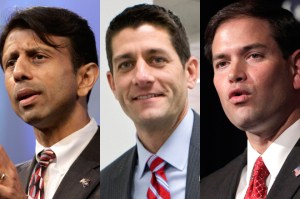
GOP idea men?
Here’s one more example of mainstream acceptance of GOP insanity before I end this post and run screaming into the street while pulling my hair out in handfuls. From John Dickerson of Slate (via CBS News), Why the GOP’s class of 2016 hopefuls may be the best in generations.
What if they held a presidential campaign and a think tank broke out? House Budget Committee Chairman Paul Ryan, who is considering running for president, offered his thoughts on poverty last week. Sen. Marco Rubio has been giving regular policy speeches on poverty, college loans, and helping the middle class. Former senator and GOP presidential candidate Rick Santorum is promoting a book of policy proposals on education, family, and revitalizing American manufacturing. Sen. Rand Paul is offering ideas on criminal justice and will give a big foreign policy speech in the fall. Louisiana Gov. Bobby Jindal has given speeches on health care and education aimed at a national audience. His staff recently sent an email titled “policy leader” that linked to a Time piece about how he is preparing to be the candidate of ideas in 2016.
What the f&cking f&ck? Rich Santorum? Bobby Jindal? Marco Rubio? Paul motherf&&cking Ryan?! These are “candidates of ideas?” Dickerson continues,
Who isn’t trying to be the ideas candidate in the 2016 campaign? Texas Gov. Rick Perry is working to overcome his 2012 debate aphasia, so he’s trying to show some policy chops. Though former Florida Gov. Jeb Bush holds controversial ideas on Common Core education standards and immigration, those close to him say he won’t run unless he can promote those ideas with gusto.
It isn’t usually this policy-thick in the GOP presidential field. In primaries, there is sometimes one conservative candidate who tries to position himself through the creativity of his proposals, but mostly candidates engage in displays of strength on questions of orthodoxy–how much they want to cut taxes, shrink regulation, and lock up the borders. Now the Republican candidates are not only seeking to distinguish themselves from each other with the quality and originality of their ideas, but they are making the case that unless the party promotes new ideas, it will not prevail.
The class of candidates for 2016 has the potential to be the most robust in almost 40 years–perhaps in modern Republican history. It depends on who finally decides to run, of course, but six governors and four senators are thinking seriously about it.
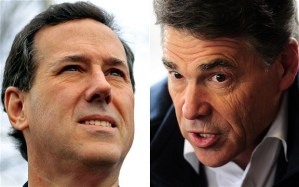
GOP idea men?
I’m sorry. Dickerson thinks these morons are competing with each other on “quality and originality of…ideas?” Am I nuts? Am I hallucinating this crap? Surely Dickerson can’t really believe this sh#t.
Here’s a little sanity from Ed Kilgore of Washington Monthly, Can the Big Brains of the GOP Survive the Primaries? and Damon Linker of The Week, Why GOP reformers are bound to fail. But even Kilgore seems to believe that Republicans will take over the Senate. From Talking Points Memo:
At least Kilgore thinks that catering to the base could hurt Republicans in the 2016 presidential election.
Why? Why would anyone vote for these insane right-wingers? And why is the media rooting for them? I just don’t get it. Am I crazy or what?
Now it’s your turn. What stories are you following today? Share your thoughts and links in the comment thread.
Tuesday Reads
Posted: July 29, 2014 Filed under: #Occupy and We are the 99 percent!, 2014 elections, 2016 elections, Democratic Politics, Hillary Clinton, morning reads, Ralph Nader, Voter Ignorance, We are so F'd 29 CommentsGood Morning!
The state of America’s democratic experiment really worries me these days. It seems so railroaded by the interests of the very few. I’m not sure if you got a  chance to read the following article at Salon by Bill Curry. You should. It’s about how the Democratic Party got co-opted by Wall Street interests and helped continue us down the road to complete plutocracy. It starts with out following the decline in the party’s alignment with ordinary Americans and the history of Ralph Nader’s formation of the consumer protection movement. Ultimately, it is about Nader and his new book. But,the details of the re-alignment and Nader’s personal history are an interesting read when put into the context of our road to corporate tyranny.
In the late ’70s, deregulation fever swept the nation. Carter deregulated trucks and airlines; Reagan broke up Ma Bell, ending real oversight of phone companies. But those forays paled next to the assaults of the late ’90s. The Telecommunications Act of 1996 had solid Democratic backing as did the Financial Services Modernization Act of 1999. The communications bill authorized a massive giveaway of public airwaves to big business and ended the ban on cross ownership of media. The resultant concentration of ownership hastened the rise of hate radio and demise of local news and public affairs programming across America. As for the “modernization” of financial services, suffice to say its effect proved even more devastating. Clinton signed and still defends both bills with seeming enthusiasm.
The Telecommunications Act subverted anti-trust principles traceable to Wilson. The financial services bill gutted Glass-Steagall, FDR’s historic banking reform. You’d think such reversals would spark intra-party debate but Democrats made barely a peep. Nader was a vocal critic of both bills. Democrats, he said, were betraying their heritage and, not incidentally, undoing his life’s work. No one wanted to hear it. When Democrats noticed him again in 2000 the only question they thought to ask was, what’s got into Ralph? Such is politics in the land of the lotus eaters.
The furor over Nader arose partly because issues of economic and political power had, like Nader himself, grown invisible to Democrats. As Democrats continued on the path that led from Coehlo to Clinton to Obama, issues attendant to race, culture and gender came to define them. Had they nominated a pro-lifer in 2000 and Gloria Steinem run as an independent it’s easy to imagine many who berated Nader supporting her. Postmortems would have cited the party’s abandonment of principle as a reason for its defeat. But Democrats hooked on corporate cash and consultants with long lists of corporate clients were less attuned to Nader’s issues.
Democrats today defend the triage liberalism of social service spending but limit their populism to hollow phrase mongering (fighting for working families, Main Street not Wall Street). The rank and file seem oblivious to the party’s long Wall Street tryst. Obama’s economic appointees are the most conservative of any Democratic president since Grover Cleveland but few Democrats seem to notice, or if they notice, to care.
 This also happened along side a group of democratic senators–including Joe Biden–that helped seat the 5 generic, oddball Catholic men that threaten everything the country stands for by deciding almost SCOTUS decisions in oddball Catholic ways. (You have to wonder if they listen at all to the current Pope.) Additionally, things have gotten so right wing in the diplomacy sector that John Kerry and Barack Obama’s state department seem to be tilting in the same direction as the neocon-infested, apartheid loving Israeli government of Bibi the Butcher of Gaza.
This certainly isn’t the party of my FDR-loving Great Grandmother Nancy Anna Chisholm Williams whose father and uncle blazed the west with the Chisholm Trail and who lived and died a Depression surviving Okie. Big political interests keep driving the Democrats into very undemocratic places.
The Obama administration deserves much of the blame for the failure of the latest round of Israeli-Palestinian peace talks.
It had originally been hoped that the United States would present a binding framework along the lines of what moderate Israeli and Palestinian political leaders had agreed to in unofficial talks in Geneva in 2003: Israel would recognize a Palestinian state based roughly on the pre-1967 borders with mutual territorial swaps, which would leave the Palestinians with 22 percent of historic Palestine and allow Israel to keep the remaining 78 percent; the Palestinian state would be demilitarized and all irregular militias disarmed; illegal settlements in occupied Palestinian territory near the Israeli border—encompassing close to 80 percent of the settlers—would be incorporated into Israel while settlers in the more remote settlements would be required to return to Israel; there would be no right of return for Palestinian refugees to Israel, but there would be international assistance in helping them resettle in the new Palestinian state; and some Israeli troops would remain along border crossings between the Palestinian state and its Arab neighbors, eventually to be replaced by international forces.
The Palestinian government agreed to these terms. Israel rejected them. Rather than make public this framework, and thereby hope the Israeli public would pressure its right-wing government to compromise, the Obama administration instead insisted that “both sides” had shown a lack of will to compromise.
An interview with an anonymous U.S. official close to the peace talks in an Israeli publication confirmed numerous other reports that, despite the Obama administration’s claims to the contrary, the Palestinian side made major concessions while the Israeli side essentially refused to make any, generally refusing to talk about any substantive issues.
A host of Democratic and Republican former officials—including a former national security adviser, secretary of defense, chair of the House Foreign Affairs Committee, trade representative, and undersecretary of state for political affairs—went on record arguing that the Obama administration would have to challenge the Israeli government’s hard line towards the Palestinians in order for the peace process to be successful. Unfortunately, the White House apparently had no interest in doing so.
Instead, Washington has focused on Palestinian Authority President Mahmoud Abbas’s refusal to give in to U.S. and Israeli demands that he recognize Israel as a “Jewish state.” While the Palestinian government, the Palestine Liberation Organization, and the ruling Fatah party have all recognized the state of Israel for more than 20 years, the Obama administration has effectively moved the goalposts by declaring that recognizing the Israeli government, acknowledging its right to exist, and providing security guarantees is not enough, insisting that the Palestinians explicitly recognize the state of Israel’s ethno-religious identity as well. No previous administration has put forward such a requirement. President Carter never made such demands on Egypt, nor did President Clinton require this of Jordan as a condition for their peace treaties with Israel. Abbas has said that Israel can identify itself however it wants, but—given that 20 percent of the Israeli population is ethnically Palestinian Arab—it would be politically impossible to agree to something that would acknowledge second-class status for other Palestinians.
Never in history has any country been required to recognize the ethnic or religious identity of another state as a condition for peace. It appears, then, that the Obama administration’s demand may have been an effort to destroy any chance of a peace agreement and leave an opening to blame the Palestinians—despite their agreement to virtually every other issue—for the failure of the peace process.
The failure may also come from President Obama’s trusting Secretary of State John Kerry, a longtime supporter of the Israeli right, to play such a key role in the peace talks. In 2004, Kerry unconditionally endorsed an Israeli plan to unilaterally and illegally annex large areas of the West Bank, leaving the Palestinians with only a series of small non-contiguous cantons surrounded by Israel as their “state,” a proposal denounced worldwide as a violation of the UN Charter, a series of UN Security Council resolutions, and basic principles of international law. Indeed, Kerry has long insisted that it was “unrealistic” to demand an Israeli withdrawal from its occupied territories. (By contrast, Kerry has demanded that Russia withdraw completely from Crimea, citing the illegality of any country acquiring “part or all of another state’s territory through coercion or force.”)
A Democratic administration is basically supporting an apartheid state replete with ethnic cleansing. Under what world does a secular, U.S.  democracy support an apartheid-creating theocracy that won’t follow any agreements it made previously? Why are we the lone country cowering in the corner with a government gone genocidal instead of searching out the country’s numerous moderates and secular leaders and finding a path to coexistance? It truly worries me that former SOS Hillary Clinton who went on Fareed Zakaria’s show on Sunday may continue down this road of letting huge political donors outweigh solutions and fairness. Yet, her interview sounded like there’s some key differences between Kerry’s handling of this situation and the previous problems handled by Clinton. Is she distancing herself from her former boss and signalling that things will be different with her in charge? Will US domestic and foreign policy stop lurching to the right?
ZAKARIA: Bibi Netanyahu…
CLINTON: Right.
ZAKARIA: You say you had a complicated, and it sounded like a difficult relationship with him.
CLINTON: Well, I have to say, I’ve known Bibi a long time. And I have a very good relationship with him, in part because we can yell at each other and we do. And I was often the designated yeller. Something would happen, a new settlement announcement would come and I would call him up, “What are you doing, you’ve got to stop this.” And we understood each other, because I know how hard it is to be the leader of a relatively small country that is under constant pressure, and does face a lot of legitimate threats to its existence from those around it. And I also care deeply about how Israel is able not just to survive, but thrive, and just fundamentally disagreed with Bibi in the ’90s that I was in favor of a two-state solution. I was the first person associated with any administration to say that out loud. And he did not. But then when he came back in in 2009, he did. And I’ve sat with him, as you and I are sitting, and I really believed that if he thought he could get adequate security guarantees for a long enough period of time, he would be able to resolve everything with the exception of Jerusalem, which is the hardest issue. You can get borders and if you can figure out how to do security within those borders, some of which may require having IDF and international forces in the Jordan Valley, for example, then if you could move toward a state and leave Jerusalem to be worked on, because that’s the hardest issue for all sides.
ZAKARIA: But, you know, he gave an interview recently to, I think it was The Times of Israel where he said there are no circumstances under which we will ever relinquish security control of the area west of the Jordan, meaning, the West Bank. That sounds like it’s a – it’s going back on his acceptance of the two-state solution.
CLINTON: Well, Fareed, I see that as an – as an opening negotiating position, because I’ve had the private one-on-one conversations and the private conversations with him sitting there and – and Mahmoud Abbas sitting there and George Mitchell sitting there. And I know that Abbas, in my conversations, was willing to entertain a number of years where there could be some continuing security. Remember, the IDF – the Israel Defense Forces – have a working relationship with the Palestinian Authority security forces, which have been incredibly professional. We’ve helped to provide training, as has Jordan and others, and the positions that Netanyahu has taken. Now, once they take a position, and I know the years that Abbas has said are – are permitted and – and I know the years that Bibi has demanded, you’re in a negotiation. But if there’s no process going on, which is why we can’t even leave the vacuum of no process, despite how incredibly frustrating it is, then, of course Abbas is going to say never, not under any circumstances, and Bibi is going to say absolutely forever.
ZAKARIA: In 2009, you said that you wanted Israel settlement activity to stop. In fact, you were pretty blunt. You said no exceptions.
CLINTON: Um-hmm.
ZAKARIA: You write in the book that that was a tactical mistake because it made on – Bibi Netanyahu get even more hardline.
CLINTON: Right.
ZAKARIA: But Martin Indyk has just resigned as the you know, the kind of – the sherpa of the peace process. And he says that the immediate trigger, in his view, there were many, but was the fact that the Palestinians looked at the Israeli continued settlement activity…
CLINTON: Right.
ZAKARIA: – and said these guys are not serious, we’re never going to be able to get a state…
CLINTON: Right.
ZAKARIA: – look at what they’re doing.
CLINTON: This is my biggest complaint, with the Israeli government. I am a strong supporter of Israel, a strong supporter of their right to defense themselves. But the continuing settlements, which have been denounced by successive American administrations on both sides of the aisle, are clearly a terrible signal to send, if, at the same time, you claim you’re looking for a two-state solution. Now, when I was negotiating and I had been able to put together three face-to-face meetings between Netanyahu and Abbas, it was clear that if we were working off the ’67 borders, which was our stated position that President Obama had outlined, some of the settlements would be within any responsible drawing of borders for Israel. But a number of them would not. And those that would not would have to be either dismantled or live under Palestinian rule. There are deep wells of mistrust and misunderstanding on both sides. And what I’ve urged the Israelis to do is do more to help the Palestinians in the West Bank right now. Don’t monopolize the water. Don’t make it difficult to build. So even while we’re struggling over the end issues that would resolve the conflict, like borders, don’t make life so miserable, you know, because that’s not any way to begin to try to deal with the mistrust. You know, the longer I do this, Fareed, the more convinced I am that mistrust and misunderstanding are often the real fundamental obstacles to bringing people together. And that means that people from both sides of whatever divide it is, whether it’s Israeli, Palestinian, you know, Russian-speaking, Ukraine-speaking, whatever it might be, people have to start listening and working together to build habits of cooperation that might possibly lead to greater trust.
 There are a number of articles where you read recent interviews with Hillary where she sounds more and more like a candidate these days. I want to hear that Hillary will take us back to democracy for all. Not just for those who can purchase it. Here’s Hillary on the US Border situation.
In a smart move, Hillary Clinton firmed up her position on the crisis in an interview that aired over the weekend — in a manner that, intentionally or not, sharpened the contrast with the position of most Republicans.
Speaking to Fusion’s Jorge Ramos, Clinton came out against any changes to the 2008 trafficking law, which Republicans are seeking to expedite deportations of arriving minors as a condition for supporting any money to address the debacle.
“I don’t agree that we should change the law,” Clinton told Ramos. She added that she wanted a more strenuous effort to distinguish between “migrant” children and “refugees,” to ensure that those who genuinely qualify for humanitarian relief in the U.S. obtain it. “I’m advocating an appropriate procedure, well funded by the Congress, which they are resisting doing, so that we can make individual decisions,” Clinton said. “We should be setting up a system in Honduras, Guatemala, El Salvador, to screen kids over there, before they get in the hands of coyotes.”
In opposing changes to the 2008 law, Clinton has placed herself a bit to the left of even Obama, who initially signaled openness to such changes before backtracking after Congressional Dems objected. And Clinton is also clarifying her previous suggestion that the kids should be “sent back.”
“Like Pelosi and Reid, she’s realized that the tough line of President Obama – change the law, send ‘em back – is not the position of most Democratic voters and lawmakers,” immigration advocate Frank Sharry tells me. “She’s repositioned herself. Smart.”
 Is it likely Hillary will move us back to more traditional Democratic policies or is she likely to continue the rightward drift of elected Democratic Leaders like Obama and even Bill Clinton? A recent poll shows that Hillary is popular with white voters; more so than a lot of Democratic pols before her.
This entire idea of having a crazy right wing nut of GOP while Democrats continue to cater to neocons and plutocrats still worries me. We use to have two functioning parties that represented fairly diverse groups of voters. It wasn’t all sweetness and light, but there wasn’t such a concentration of policy that benefited so few coming out of them both. They also did the business of the people. Now we still have two parties. It’s just that one represents crazy religionists and whacked out billionaire libertarians and the other one that occasionally does something for the common american still is likely to slide further to the right to attract rich, powerful donors.
So, that’s what’s on my mind. What’s on your reading and blogging list today?
Monday Reads: “Lucy” and Media Consolidation
Posted: July 28, 2014 Filed under: morning reads 45 Comments
Scarlett Johansson reading Conrad’s ‘Heart of Darkness’
Good Morning!!
As usual, U.S. and world news is mostly bad, so I thought I’d focus on some news emanating from escapist Hollywood. I do have a serious point to make later on.
The latest action movie hit is Luc Besson’s “Lucy,” starring Scarlett Johansson as an ordinary woman who suddenly begins using the full capacity of her brain (this is based on the oft-repeated notion that humans only use 10% of their brains) after she accidentally absorbs some kind of super-drug that Korean drug lords have surgically implanted in her abdomen so they can use her as a drug mule. If that sounds like an idiotic premise, just wait till you either watch the movie or otherwise get the details of the so-called plot.
“Lucy” is the epitome of what’s known as a “high concept” film. The main character’s name is presumably drawn from the name that has been attached to a partial skeleton of a female Australopithecus Afarensis that was discovered in Ethiopia in 1974. “Lucy” could walk upright, but her small skull indicated she didn’t have much brain capacity; scientists argued from this that bipedalism led to larger human brains.
Thus, the Lucy of the film demonstrates the how humans could further evolve if they used the brain’s full potential, get it? The Wall Street Journal loved it; Here’s their review, ‘Lucy’: A Diamond in the Action-Thriller Sky
The problem with the concept is that we humans are already using the full capacity of our brains, and the idea that we only use 10% is complete bullshit. Here’s a brief explanation from brain scientist David Eagleman at NPR: Sorry, Lucy: The Myth Of The Misused Brain Is 100 Percent False. But, like the GOP, Hollywood couldn’t care less about scientific facts.
In case you don’t mind a bunch of spoilers, here’s a hilarious review of the movie by Christopher Orr at The Atlantic: Lucy: The Dumbest Movie Ever Made About Brain Capacity. Here the introduction; you can click the link to read the rest.
Every now and then a movie comes along that’s so beyond-the-pale sloppy, so disastrous in both conceit and execution, that it simply defies conventional analysis. It happened with The Happening. There was something unspeakably wrong with The Words. And Broken City was utterly beyond repair.
So, too, with Lucy, writer/director/producer Luc Besson’s mind-bendingly miscalculated sci-fi vehicle for Scarlett Johansson. In its defense, I can offer only that Johansson is a moderately charismatic presence (despite playing a character who barely qualifies as a character) and that the film clocks in at a mercifully brief 89 minutes. That said, the sheer quantity of inanity that Besson squeezes into his limited screen time beggars that of awful movies of substantially greater length.
Consequently, what follows is not a review but a spoilereview. If you are genuinely considering watching Lucy—and I urgently recommend that you reconsider—you should stop reading now. If, by contrast, you plan to give the movie a pass and would like to have your good judgment ratified (or, alternatively, if you have stumbled out of the theater bewildered and seeking commiseration), read on. Because while Besson has made very, very bad films in the past—most recently, last year’s The Family—this is the first time he has made a film so idiotic that the only way to properly convey its flaws is to enumerate them.

Australopithecus Afarensis AKA “Lucy”
Read on for a complete dissection of the movie’s plot. Whatever happened to intelligent films made for adults? Maybe it has something to do with the growing control of media by just a few giant corporations. And it’s going to get worse.
Did you know that Rupert Murdock is trying to buy Time-Warner? From The New York Times on July 17, A Potential Combination of Two of Hollywood’s Most Successful Studios.
LOS ANGELES — What for years has been a whisper in Hollywood — the possible consolidation of major studios in the face of tough industry economics — has become a starkly real option with the disclosure on Wednesday that Rupert Murdoch’s 21st Century Fox made an $80 billion bid to acquire Time Warner Inc.
In the bid, which Time Warner rejected, Mr. Murdoch is said to have made clear that his 20th Century Fox and Time Warner’s Warner Bros., two of Hollywood’s six major studios, would be managed jointly, but kept essentially separate.
But business history and market pressures in both the movie and television industries make it almost inevitable that studio overhead would be cut, back-office operations would be combined, and jobs would be eliminated if a merger happens.
“In size and structure, the studio of the 21st century still looks very similar, if not identical, to the studio of the 20th century,” said Marc Shmuger, a producer who was formerly co-chairman of Universal Pictures. “That has to change,” he added.
Murdoch is worried because Comcast is currently working on (and will likely succeed in) merging with Time-Warner Cable. Harvard professor of intellectual property Susan Crawford explains what’s going on:
Both sides of the negotiating table — programming and distribution — are already highly concentrated. In 1983, 50 companies ran 90 percent of American media; today, just five mega-entities control 90 percent of what we read, watch and listen to. Among the notable properties owned by Murdoch are Fox, as part of Twenty-First Century Fox, and the Wall Street Journal and New York Post, as part of the spun-off News Corp. Time Warner has CNN and HBO. Comcast Corp., now thoroughly vertically integrated, has NBCUniversal….
After the merger, Comcast will be available to 70 percent of American homes. Most of these will have no other choice for high-speed data distribution: anything over 10 Mbps download. That means the programmers — even though they’re giant companies with gigantic quantities of high-value video — won’t have competing distribution outlets to play against one another in negotiations. In order to reach most Americans, they’ll have to deal with Comcast. That means they have to make sure that Comcast needs them more than they need Comcast.
The merged Comcast-Time Warner Cable entity will control 20 of the top 25 metropolitan areas in the U.S. and a vast number of regional sports networks. (Sports is at the heart of this story; Murdoch knows he will need the heft to negotiate for sports rights that Comcast will need.) …. Because there will be so few alternative content buyers, and because Comcast’s control over its data flows is so absolute, if the programmer someday decides to go “over the top” — across the Internet, as Netflix has — its fate will be utterly dependent on Comcast’s good graces.

You’ll note that once Murdoch owns Time-Warner, he’ll be in control of HBO, one of the few remaining producers of quality video content. From Bloomberg Businessweek July 16:
No matter who winds up owning Time Warner (TWX)—Rupert Murdoch’s 21st Century Fox (FOXA), Disney (DIS), Amazon (AMZN), or even its current shareholders—it is clear that one of the shiniest jewels in the entertainment company is the 30-year-old cash-printing machine once known as Home Box Office.
A report in Bloomberg News, citing an unnamed source familiar with the bid, put the perceived value of HBO alone at $20 billion as part of Fox’s offer of $75 billion or more for Time Warner. “It’s really now HBO that’s the driver, and I think that’s the Holy Grail that Rupert had his eye on,” Porter Bibb, managing partner at Mediatech Capital Partners, said in a radio interview on Bloomberg Surveillance. “It’s a huge money maker with a huge potential. And probably the only Netflix killer that’s in the world right now.” ….
…virtually no other enterprise in Hollywood has been able to crack the code of critical and financial success with the same consistency as HBO, the most-cited darling of those who praise today as television’s golden age. The network’s recent hit, True Detective, pulled in almost 12 million viewers per episode, a feat never before accomplished in its first season by an HBO series. And the ongoing Game of Thrones series, which recently concluded its fourth season, has drawn audiences of 17 million in what has become the biggest show for the network since The Sopranos.
I guess we can kiss all that goodbye once either Murdoch or Comcast buys Time-Warner. Because it’s not about producing a quality product; it’s about making money by appealing to the lowest common denominator. Here’s a deeply disturbing NYT report on what’s going on and what we can expect in the future: When Media Mergers Limit More Than Competition, and a quick digest version from the Sky Valley Chronicle:
By 2012, just six companies — including Fox (then part of News Corporation) and Time Warner — controlled that 90 percent, according to testimony before the House Judiciary Committee examining Comcast’s acquisition of NBCUniversal.
So what does a merger between 21st Century Fox and Time Warner mean for consumers of media in this country?
~ “The situation is already terrible and this would make it worse,” according to Susan Crawford, a visiting professor in intellectual property at Harvard Law School. Coupled with giant cable and Internet distributors, like Comcast and AT&T, “you’ve got two highly concentrated markets that need each other to survive and protect their profits,” Professor Crawford said. “The public interest side of this conversation is hopelessly outgunned.”
~ Such a merger would reduce control of the major Hollywood studios to five owners, from six, and major television producers to four, from five.
~ Supreme Court Justice Hugo Black once wrote in a 1945 antitrust case, “The widest possible dissemination of information from diverse and antagonistic sources is essential to the welfare of the public.”
~ Regarding the proposed 21st Century Fox and Time Warner merger, “These so-called horizontal mergers always reduce competition, the only issue being whether it’s enough to warrant blocking the merger or imposing conditions on it,” according to the report.
~ “When you’re dealing with media, you’ve got to look more carefully at the impact than with other commodities,” said Allen P. Grunes, an antitrust lawyer at the firm GeyerGorey, and an author, with Maurice E. Stucke, of “Antitrust and the Marketplace of Ideas.” “It has an impact on democracy and what the public discourse is.”
Here’s a graphic depiction of the situation:

We’ve seen what happened to journalism after media consolidation; now we’re learning what happens when the people who control the news also control the entertainment industry. We end up with endless reality TV shows and mindless high-concept movies. Then what?
So . . . that’s what’s on my mind today. What’s on yours? Please post your thoughts and links on any topic in the comment thread.
Lazy Saturday Reads
Posted: July 26, 2014 Filed under: Barack Obama, Foreign Affairs, Hamas, immigration, Libya, morning reads, Palestine, Real Life Horror, Republican politics, Russia, science, U.S. Politics, Ukraine, We are so F'd | Tags: bad news, Gaza, impeachment, israel, polls, West Bank 38 Comments
Good Morning!!
I don’t know about you, but I’m getting really sick of bad news. I’ve completely stopped watching TV and listening to radio news, because I just can’t take any more details of wars, plane crashes, dead children. If it weren’t for writing these morning posts, I wouldn’t have a clue what’s happening. I get all my news from Google, Twitter, and various blogs, including Sky Dancing. So I’m going to quickly link to the major stories topping Google this morning, and then I’ll post some interesting longer reads that I came across around the ‘net.
Israel-Palestine Conflict
There’s a 12-hour cease fire in Gaza right now. BBC News has extensive coverage, Gaza conflict: 12-hour truce as deaths top 900.
Residents in Gaza are using a 12-hour humanitarian truce to return to their homes, gather essential supplies and search for those trapped in the rubble.
At least 85 bodies have been pulled from the rubble during the truce, a Palestinian health official says.
That raises the Palestinian death toll to 985 since the Israel-Hamas conflict began on 8 July, the spokesman said. Thirty-nine Israelis have died.
International talks on a longer truce have resumed in Paris.
Israel said it would continue to “locate and neutralise” Hamas tunnels during the pause, which began at 08:00 local time (05:00 GMT).
So far 31 tunnels have been discovered, with about half destroyed, Israeli’s military says.
Lots of details and photos at the BBC link.

From AP via The Boston Globe, Gaza Sides Agree to Lull But Truce Efforts Stall.
JERUSALEM (AP) — Israel-Hamas fighting looked headed for escalation after U.S. Secretary of State John Kerry failed Friday to broker a weeklong truce as a first step toward a broader deal and Israel’s defense minister warned Israel might soon expand its Gaza ground operation ‘‘significantly.’’
Hours after the U.S.-led efforts stalled, the two sides agreed to a 12-hour humanitarian cease-fire to begin Saturday. However, the temporary lull was unlikely to change the trajectory of the current hostilities amid ominous signs that the Gaza war is spilling over into the West Bank.
In a ‘‘Day of Rage,’’ Palestinians across the territory, which had been relatively calm for years, staged protests against Israel’s Gaza operation and the rising casualty toll there. In the West Bank, at least six Palestinians were killed by Israeli fire, hospital officials said.
The latest diplomatic setbacks, after several days of high-level diplomacy in the region, signaled that both sides are digging in and that the fighting in Gaza is likely to drag on.
An op-ed from Al Jazeera, Israel’s war of disproportionate force on Gaza, by Britain Eaken.
The recent killing of four Palestinian children by an Israeli airstrike while they played soccer on a beach in Gaza should call into question Israel’s claim that it’s waging a war of self-defense. Western journalists who saw the attack witnessed firsthand an ugly reality of life in Gaza — Palestinian civilians are too often caught in the crossfire in this tiny, densely populated and besieged coastal strip.
Early Sunday, an Israeli incursion into the Shujayea neighborhood in Gaza killed at least 60 more Palestinians. Most of the injuries being treated at Gaza’s al-Shifa hospital belong to civilians suffering from shrapnel injuries and amputations. More than 100 children have been killed so far and the Palestinian death toll just surpassed 400 with more than 3000 injured.
The UN says more than 70 percent of Palestinian casualties are civilians, a marked increase from previous Israeli assaults.
The toll on civilians has raised United Nations’ concerns of the Israeli use of disproportionate force in Gaza in violation of international humanitarian law. But the use of disproportionate force and the targeting of civilian infrastructure isn’t a new or surprising tactic for Israel. In fact, it’s a primary strategy according to Gabi Siboni, head of the Military and Strategic Affairs program at the Institute for National Security Studies in Israel. This strategy has a well-documented history in Gaza.
I have no words.
Libya

Yes, there’s still fighting in Libya, and the violence is getting so bad than the U.S. has closed and evacuated its embassy there. NPR reports: U.S. Embassy Compound In Libya Shut Down Amid Fighting.
The U.S. has closed its embassy in Libya and evacuated diplomats amid what is being described as a significant deterioration in security, with rival militant factions battling in the capital, Tripoli.
“Due to the ongoing violence resulting from clashes between Libyan militias in the immediate vicinity of the U.S. Embassy in Tripoli, we have temporarily relocated all of our personnel out of Libya,” State Department spokeswoman Marie Harf said.
“Securing our facilities and ensuring the safety of our personnel are top department priorities, and we did not make this decision lightly,” Harf said. “Security has to come first. Regrettably, we had to take this step because the location of our embassy is in very close proximity to intense fighting and ongoing violence between armed Libyan factions.”
In a separate statement, Pentagon spokesman Rear Adm. John Kirby said: “[All] embassy personnel were relocated, including Marine security guards who were providing security at the embassy during the movement.”
AP via ABC News: US Evacuates Embassy in Libya Amid Clashes.
The United States shut down its embassy in Libya on Saturday and evacuated its diplomats to neighboring Tunisia under U.S. military escort amid a significant deterioration in security in Tripoli as fighting intensified between rival militias, the State Department said….
The evacuation was accompanied by the release of a new State Department travel warning for Libya urging Americans not to go to the country and recommending that those already there leave immediately. “The Libyan government has not been able to adequately build its military and police forces and improve security,” it said. “Many military-grade weapons remain in the hands of private individuals, including antiaircraft weapons that may be used against civilian aviation.” ….
“We are committed to supporting the Libyan people during this challenging time, and are currently exploring options for a permanent return to Tripoli as soon as the security situation on the ground improves. In the interim, staff will operate from Washington and other posts in the region,” Harf said. The evacuated staffers will continue to work on Libya issues in Tunis, elsewhere in North Africa and Washington.
Ukraine

Ukraine is still roiling, but it seems to have receded into the background for the moment. Here are a few headlines just to keep you current.
Fox News: Ukraine crisis: European Union hits Russian intelligence chiefs with sanctions.
WaPo: Russia, Ukraine trade accusations of cross-border shelling.
Bloomberg: U.S. Says Russia Set to Supply New Arms to Ukraine Rebels.
The Economist: The shooting down of an airliner shows how reckless Vladimir Putin’s sponsorship of Ukrainian rebels has been.
From the WaPo editorial board: If the West doesn’t do more for Ukraine now, it might soon be too late.
From the Are You Kidding Me? File
From the LA Times: White House aide says Republicans might impeach Obama over immigration.
Pesident Obama will propose broad-ranging executive action on immigration reform later this summer that could provoke Republicans into trying to impeach him, a senior White House official said Friday.
While details of the immigration plan are still being worked on, it will mark “an important step in the arc of the presidency” that will shape both the substance and politics of immigration policy for years, White House senior advisor Dan Pfeiffer told reporters at a breakfast sponsored by the Christian Science Monitor.
That move is certain to “increase the angry reaction from Republicans” who already accuse Obama of exceeding his executive authority, Pfeiffer said, highlighting recent statements by former vice presidential candidate Sarah Palin in which she backed an impeachment move.
“I would not discount the possibility” that Republicans would seek to impeach Obama, he said, adding that House Speaker John A. Boehner (R-Ohio) has “opened the door to impeachment” by his plans to sue Obama for allegedly exceeding his executive authority.

Is this just an effort by the White House to put the impeachment question out there so Americans can let the GOP what they think about it? The Hill reports: White House taking impeachment seriously.
Senior White House advisers are taking very seriously the possibility that Republicans in Congress will try to impeach President Obama, especially if he takes executive action to slow deportations.
Dan Pfeiffer, a senior adviser to Obama, said Friday that the White House is taking the prospect of impeachment in the GOP-controlled House more seriously than many others in Washington, who see it as unlikely.
Pfeiffer noted that former Alaska Gov. Sarah Palin, who has a large following among Tea Party conservatives, has called for Obama’s impeachment and a large block of the GOP’s base favors it.
“I saw a poll today that had a huge portion of the Republican Party base saying they supported impeaching the president. A lot of people in this town laugh that off. I would not discount that possibility,” he told reporters Friday at a breakfast sponsored by The Christian Science Monitor.
Pfeiffer said Speaker John Boehner’s (R-Ohio) decision to file a lawsuit against Obama over his use of executive actions increased the chance of impeachment proceedings in the future.
A little reality testing from Sean Sullivan at the WaPo: These two numbers show why impeachment talk is trouble for the GOP.
By about 2-1, Americans say they don’t think President Obama should be impeached and removed from office, according to a new CNN/ORC International poll released Friday.
But a majority of Republicans disagree.
That, in a nutshell, is why talk about impeaching the president is nothing but trouble for the GOP heading toward the November midterms.
Sixty-five percent of Americans say Obama should not be impeached, compared to just 33 percent who say he should. Very one-sided. It’s clear that impeachment is a political loser when it comes to the public as a whole.
The “public as a whole” numbers matter because with most of the consequential primaries behind us, Republican candidates in key Senate races — the battle for the Senate is the main midterm event — have to be concerned about playing to broad statewide audiences.
Some (mostly) longer reads
These aren’t all that cheery either, but they are interesting.
This one from the NYT Sunday Magazine is for Dakinikat: Why Do Americans Stink at Math?
Why do people leave their kids in hot cars? How can you forget you’ve got your kid with you? I just don’t get it, and it makes me furious! There’s a long article about these cases at NBC News, Fatal Mistake: What Everyone Should Know About Hot Car Deaths, by Alex Johnson.
This NYT op-ed isn’t a long read, but it’s a useful one: Why the Border Crisis Is a Myth, by Veronica Escobar.
Remember all that talk about how there was going to be some kind of horrible disaster in 2012? Well it turns out that something awful almost happened. From NASA Science News, Near Miss: The Solar Superstorm of July 2012. If you don’t want to wade through the whole article, The Boston Globe has a shorter summary, Apparently Earth ‘Just Missed’ a Solar Superstorm in 2012.
Finally, something entertaining and not depressing, This Is What Happens When You Ask Contemporary Artists To Reimagine Maps Of The World. Check it out!
What stories are you following today? Please post your thoughts and links in the comment thread.
Friday Reads: American Business Model is ruining Higher Ed
Posted: July 25, 2014 Filed under: education, morning reads 24 CommentsGood Morning!
 I’ve been watching the death of higher education in Louisiana as Sociopathic Governor Jindal continues his war on 99%of humanity in search of higher office. Right wing Donors are the only folks worth subsidizing and saving in Jindal’s sick mind. I was thinking the other day that I was glad that the girls graduated before it’s gotten to this point. Youngest daughter experienced a bit of the issue at the end of her undergrad degree since class offerings were decreasing. I’ve also been thinking about the Duquesne adjunct professor who died last year in abject poverty. I think that I’ve most likely seen my future. Here’s a refresher about her death last August.
On Friday, Aug. 16, Margaret Mary Vojtko, an adjunct French professor who’d recently lost her job at Duquesne University at the age of 83, suffered a cardiac arrest on a street corner in Homestead, Pa.* Vojtko collapsed yards from the house where she had lived almost her entire life. She was rushed to the hospital, but she never regained consciousness. Vojtko died on Sunday, Sept. 1.
Two and a half weeks later, Vojtko’s lawyer, Daniel Kovalik, published an op-ed about Vojtko called “Death of an Adjunct” in thePittsburgh Post-Gazette. Kovalik wrote that “unlike a well-paid tenured professor, Margaret Mary worked on a contract basis from semester to semester, with no job security, no benefits, and with a salary of $3,000 to $3,500 per three-credit course.” (In fact, for many years, she’d earned less—only $2,556 per course.) She’d been receiving cancer treatment, he said, and she’d become essentially homeless over the winter because she couldn’t afford to maintain and heat her house. Then, in the spring, she’d been told that her contract wouldn’t be extended after the current semester. A social worker from a local government agency had been tipped off that she might need help taking care of herself, which horrified Vojtko—“For a proud professional like Margaret Mary, this was the last straw,” according to the op-ed.
Her recent life hits way too close to home for me. I’ve noticed the rise of administration in higher education and how they seem to be embracing the  same kind of things that are wrecking secondary education. They want standardized testing and proof that the professor is doing their job to the point that I feel like I’m a lowly graduate student with an absentee professor. I spend a lot of time grading things that I’m pretty sure are not contributing to anything but some administrator’s report that justifies their high salary and position. I can also tell that many colleagues just do it arbitrarily and not too well because my students are obviously doing the same old things like recycling other people’s homework and other people’s papers. I remind you that I only teach graduate students and those at the end of their career and those doing an academic degree that should be tougher than something like an MBA. So, all of this leads up to this link from a speech by Noam Chomsky who relates the hiring of faculty to that of the Walmart hiring paradigm. Faculty are basically now mostly temps. Business like workers who live in fear and insecurity. They also like them exhausted.
That’s part of the business model. It’s the same as hiring temps in industry or what they call “associates” at Wal-Mart, employees that aren’t owed benefits. It’s a part of a corporate business model designed to reduce labor costs and to increase labor servility. When universities become corporatized, as has been happening quite systematically over the last generation as part of the general neoliberal assault on the population, their business model means that what matters is the bottom line. The effective owners are the trustees (or the legislature, in the case of state universities), and they want to keep costs down and make sure that labor is docile and obedient. The way to do that is, essentially, temps. Just as the hiring of temps has gone way up in the neoliberal period, you’re getting the same phenomenon in the universities. The idea is to divide society into two groups. One group is sometimes called the “plutonomy” (a term used by Citibank when they were advising their investors on where to invest their funds), the top sector of wealth, globally but concentrated mostly in places like the United States. The other group, the rest of the population, is a “precariat,” living a precarious existence.
This idea is sometimes made quite overt. So when Alan Greenspan was testifying before Congress in 1997 on the marvels of the economy he was running, he said straight out that one of the bases for its economic success was imposing what he called “greater worker insecurity.” If workers are more insecure, that’s very “healthy” for the society, because if workers are insecure they won’t ask for wages, they won’t go on strike, they won’t call for benefits; they’ll serve the masters gladly and passively. And that’s optimal for corporations’ economic health. At the time, everyone regarded Greenspan’s comment as very reasonable, judging by the lack of reaction and the great acclaim he enjoyed. Well, transfer that to the universities: how do you ensure “greater worker insecurity”? Crucially, by not guaranteeing employment, by keeping people hanging on a limb than can be sawed off at any time, so that they’d better shut up, take tiny salaries, and do their work; and if they get the gift of being allowed to serve under miserable conditions for another year, they should welcome it and not ask for any more. That’s the way you keep societies efficient and healthy from the point of view of the corporations. And as universities move towards a corporate business model, precarity is exactly what is being imposed. And we’ll see more and more of it.
 Also part of the business model is making sure you’re as miserable as possible and that your assigned management baby sitter loads you down with so much nonsense that even when you don’t have anything productive to do, you have to pretend you are. Chomsky sums up the goal of all this.
Well how do you indoctrinate the young? There are a number of ways. One way is to burden them with hopelessly heavy tuition debt. Debt is a trap, especially student debt, which is enormous, far larger than credit card debt. It’s a trap for the rest of your life because the laws are designed so that you can’t get out of it. If a business, say, gets in too much debt it can declare bankruptcy, but individuals can almost never be relieved of student debt through bankruptcy. They can even garnish social security if you default. That’s a disciplinary technique. I don’t say that it was consciously introduced for the purpose, but it certainly has that effect. And it’s hard to argue that there’s any economic basis for it. Just take a look around the world: higher education is mostly free. In the countries with the highest education standards, let’s say Finland, which is at the top all the time, higher education is free. And in a rich, successful capitalist country like Germany, it’s free. In Mexico, a poor country, which has pretty decent education standards, considering the economic difficulties they face, it’s free. In fact, look at the United States: if you go back to the 1940s and 50s, higher education was pretty close to free. The GI Bill gave free education to vast numbers of people who would never have been able to go to college. It was very good for them and it was very good for the economy and the society; it was part of the reason for the high economic growth rate. Even in private colleges, education was pretty close to free. Take me: I went to college in 1945 at an Ivy League university, University of Pennsylvania, and tuition was $100. That would be maybe $800 in today’s dollars. And it was very easy to get a scholarship, so you could live at home, work, and go to school and it didn’t cost you anything. Now it’s outrageous. I have grandchildren in college, who have to pay for their tuition and work and it’s almost impossible. For the students that is a disciplinary technique.
And another technique of indoctrination is to cut back faculty-student contact: large classes, temporary teachers who are overburdened, who can barely survive on an adjunct salary. And since you don’t have any job security you can’t build up a career, you can’t move on and get more. These are all techniques of discipline, indoctrination, and control. And it’s very similar to what you’d expect in a factory, where factory workers have to be disciplined, to be obedient; they’re not supposed to play a role in, say, organizing production or determining how the workplace functions—that’s the job of management. This is now carried over to the universities. And I think it shouldn’t surprise anyone who has any experience in private enterprise, in industry; that’s the way they work.
The Corporate apparatchik are the only ones that gain from a workforce that behave and think like sheep. There are so many examples of intellectual  laziness these days on the part of so-called professionals that I could spend a weeks worth of posts on it. But, let’s just start with a few recent ones. Ever read BuzzFeed? Well, it seems one editor lifted material from Yahoo. I wonder who taught him that Yahoo is an appropriate source?
Yahoo! Answers, one of the great artifacts of Internet history, is intently studied at viral news website BuzzFeed, where its trove of half-literate questions (and even less literate answers) has supplied material for at least fifty different posts and listicles. One BuzzFeed editor, however, has streamlined this aggregation process to its vanishing point: Simply copying text from Yahoo! Answers and pasting it, without attribution, into his own work.
Two pseudonymous Twitter users pointed out today that BuzzFeed’s Viral Politics editor, Benny Johnson, has periodically lifted text from a variety of sources—Wikipedia, U.S. News & World Report, a random press release—all without credit. The users, @blippoblappo and@crushingbort, supply convincing evidence that Johnson slightly reworded various sentences to make them his own.
I struggle daily with telling students that none of those sites are appropriate sources. But, under the pressure of grading deadlines and having to give them tons of busy work, it sure is tempting just to throw my hands up and pass so that I can spend less time and maybe approach the minimum wage.
The funny thing is that the costs of higher education focused on by the press are cost of tenured faculty. What they don’t seem to understand is that a lot of faculty–especially those in the really low paying subject areas–generally run to administrative jobs for wages. A lot of the money is also going to fancy dorms, student centers, and leather chair laden classrooms for executives so the university can attract the cash cow students. I really don’t think people–like whoever wrote this article in The Economist--actually look at where the money goes. They believe that online education is going to be the norm in the future.
In the meantime, a second generation of MOOC is trying to mirror courses offered at traditional universities. Georgia Institute of Technology and Udacity have joined forces with AT&T, a telecoms firm, to create an online master’s degree in computing for $7,000, to run in parallel with a similar campus-based qualification that costs around $25,000. Mona Mourshead, who runs McKinsey’s education consultancy, sees a turning point. “If employers accept this on equal terms, the MOOC master’s degree will have taken off. Others will surely follow,” she says.
Although some companies have authored online courses (Google, for instance, has made a MOOC on how to interpret data), established universities still create most of them. To encourage them to spare their best academics’ time to put the courses together, online-learning companies must give them a financial incentive. EdX says it is “self-sustaining” but provides no details of its revenues. The Chronicle of Higher Education reported last year that edX lets universities use its platform in return for the first $50,000 generated by the course, plus a cut of future revenues. An alternative model that it reportedly offers is to charge $250,000 for “production assistance” in creating a course, plus further fees every term that the course is offered. Coursera reveals only its revenue from certification—around $4m since its launch in 2012—for which it charges students between $30 and $100.
Some have struggled to make a business out of this. Last year Udacity underwent an abrupt “pivot”, declaring that the free model was not working and that from then on it would sell professional online training. Although web-based courses are much cheaper than on-campus ones, they will not retain ambitious students unless they replicate the interaction available in good universities. Making teachers available for digital seminars and increasing the level of interactivity could help. So would more detailed online feedback. Improvements like these raise costs. So a more varied MOOC-ecology might end up with varying price-tiers, ranging from a basic free model to more expensive bespoke ones.
The universities least likely to lose out to online competitors are elite institutions with established reputations and low student-to-tutor ratios. That is good news for the Ivy League, Oxbridge and co, which offer networking opportunities to students alongside a degree. Students at universities just below Ivy League level are more sensitive to the rising cost of degrees, because the return on investment is smaller. Those colleges might profit from expanding the ratio of online learning to classroom teaching, lowering their costs while still offering the prize of a college education conducted partly on campus.
Notice that last suggestion still says that the cost of the professor is the problem not all the supporting infrastructure and bureaucracy.
The problem that I have with all this is the underlying assumption that the private, corporate business model is efficient, effective, and lower cost. The deal is that most of the lower costs come from de-professionalizing almost all employees in the hierarchy and de-emphasizing personal service. Everything is consolidated away from service provision.
Anyway, I doubt I’ll visit this topic again anytime soon, but I did want to offer up the nightmare that’s become a university teaching job. I have to say I get ready to get my social security more and more every day. This is no longer the stuff written about in Wallace Stegner and John Updike books. I’ve started to feel like an overworked and insecure cog in a wheel over which I have no control. Yup, that’s the stench of American Business.
What’s on your reading and blogging list today?

 peej
peej Carissa
 bostonboomer
 dakinikat
 ecocatwoman
 jjlo
jjlo mablue2
 Mama Lopez
 peggysue22
 quixote
 skydancingguestblogger
 Mona (aka Wonk the Vote)





Recent Comments