
Extra Lazy Saturday Reads
Posted: September 13, 2014 Filed under: children, Crime, Criminal Justice System, Feminists, Hillary Clinton, morning reads, physical abuse, science, social justice, U.S. Politics, Ukraine, Violence against women | Tags: . #gamergate, Adrian Peterson, Antia Sarkeesian, domestic abuse, Ferguson MO, Michael Brown killing witnesses, Minnesota Vikings, NFL, Oscar PIstorious, Roger Goodell, Samantha Taylor, video games, voting, Zoe Quinn 18 CommentsGood Morning (Just Barely)!!

Father and Son, Bryce BrownGood Morning!!
The NFL domestic violence news is even worse this morning than it seemed yesterday. It turns out the child that Minnesota Vikings star Adrian Peterson beat up is only four years old. And TMZ has published photos of some of the wounds.
The report had been that the child was hit with a “switch,” but according to TMZ, it was a belt. A four year old child! Peterson should never be allowed to see his children again without a very large social worker present. TMZ live updates:
4:12 PM PT — According to the police report, Peterson allegedly sent text messages to the child’s mother saying he “felt bad” because he struck the kid in the testicles.
“Got him in the nuts once I noticed. But I felt so bad, n I’m all tearing that butt up when needed!” the text said.
Peterson allegedly sent a follow up text saying, “Never do I go overboard! But all my kids will know, hey daddy has he biggest heart but don’t play no games when it comes to acting right.”
4:10 PM PT — According to the police report, the child told authorities he had also been hit by a belt and there were “a lot of belts in daddy’s closet.”
The child also said AP had put leaves in his mouth when he was being struck and that his pants were down.
3:50 PM PT — The Vikings have deactivated Peterson for Sunday’s game….
3:00 PM PT — The police report on the case includes photos of cuts on the boy’s thigh and hands. He also had bruises on his lower back and buttocks, and according to the report … Peterson admitted punishing him.

Photos of injuries to Adrian Peterson’s son.
The child may have been confused about the weapon he was attacked with, because police report that it was a tree branch (AKA a “switch.”) The child’s mother told police that several of the wounds were still bleeding when the child arrived at home in Minnesota.
Peterson will not be playing against the New England Patriots today, but why hasn’t he been suspended by the team and the league? He was arrested and charged back in May!
Gary Myers writes in The New York Daily News, Roger Goodell should throw Adrian Peterson out of the NFL for the Vikings RB’s alleged acts of child abuse.
This might be the worst week in the history of the NFL, with another despicable act by a privileged player taking Roger Goodell’s league to an unfathomable low.
Could it get any worse than the elevator video that surfaced Monday of Ray Rice knocking out Janay Palmer with a vicious punch to the face? Apparently it can with the indictment Friday of Vikings superstar running back Adrian Peterson, one of the faces of the NFL, for injuring his 4-year-old son by spanking him with a tree branch in May after removing the leaves. A warrant has been issued for Peterson’s arrest.
Goodell can begin to make up for his mishandling of the Rice case by immediately suspending Peterson for the season and then throwing him out of the league. Peterson’s attorney, Rusty Hardin, issued a
statement saying Peterson used the same type of discipline on his son that he experienced as a child growing up in East Texas, as if that condones pulling the boy’s pants down and inflicting cuts and bruises doctors found all over the little boy’s body.
It’s barbaric.
It certainly is. Texas authorities should throw the book at Peterson. Get this, according to Myers, the punishment was for the four-year-old pushing another one of Peterson’s children away from a video game. For that, this small child was beaten with a tree branch. And Peterson doesn’t believe what he did was wrong! In my opinion, no one should ever hit a child. Period. Hitting a child isn’t effective in changing behavior in the first place, and in the second place, violence against children only perpetuates the generational cycle of violence. If we are ever to be a truly civilized society, we must work together to change the idea that it is okay to hit children.

Father and child, Cbabi Bayoc
According to Myers, Roger Goodell doesn’t have to wait for a conviction to discipline Peterson.
One of the circumstances that allows Goodell to punish Peterson is “conduct that imposes inherent danger to the safety and well-being of another person.”
The Vikings at least deserve credit for doing the right thing and deactivating Peterson for Sunday’s home opener against the Patriots, which pretty much eliminates any chance they had to win the game. They value common decency over winning. If Goodell doesn’t suspend Peterson, the Vikings should deactivate him every week.
Regardless of what he decides to do now that the photos and police report have been made public, it’s time for Goodell to step down.
Rant over for now.
I need to take a few deep, cleansing breaths . . . .
Ferguson Updates
CNN has released new video of two witnesses reacting right after the Officer Darren Wilson shot and killed unarmed teenager Michael Brown.
(CNN) — Two men, shocked at what they saw, describe an unarmed teenager with his hands up in the air as he’s gunned down by a police officer.
They were contractors doing construction work in Ferguson, Missouri, on the day Michael Brown was killed.
And the men, who asked not to be identified after CNN contacted them, said they were about 50 feet away from Officer Darren Wilson when he opened fire.
An exclusive video captures their reactions during the moments just after the shooting.
“He had his f**n hands up,” one of the men says in the video….
The men didn’t see the beginning of the altercation, but:
“The cop didn’t say get on the ground. He just kept shooting,” the man said.
That same witness described the gruesome scene, saying he saw Brown’s “brains come out of his head,” again stating, “his hands were up.”
The video shows the man raising his arms in the air — just as, he says, Brown was doing when he was shot.
The other contractor told CNN he saw Brown running away from a police car.
Brown “put his hands up,” the construction worker said, and “the officer was chasing him.”
The contractor says he saw Wilson fire a shot at Brown while his back was turned.
I wonder if the grand jury is hearing from any of the witness that the media has located?

Portrait of Alexander J. Cassatt and his son Robert Kelso Cassatt, by Mary Cassatt
The Houston Chronicle reports that there is a New focus on minority voting after Brown’s death.
FERGUSON, Mo. (AP) — A few miles from the street where Michael Brown died is the grave of Dred Scott, a slave who went to the Supreme Court and tried, unsuccessfully, to be recognized as a free American citizen.
One hundred and fifty-seven years later, a white police officer’s fatal shooting of Brown — unarmed, black and 18 years old — raises fresh questions about the extent to which blacks in suburban towns are regarded as full partners by the officials and law enforcers elected largely by and responsive to small segments of the population.
Political participation is increasing on the national level for blacks and Hispanics. On the local level, voting continues to be struggle, as it is in this St. Louis suburb.
In the most recent city election in April, only 1,484 of Ferguson’s 12,096 registered voters cast ballots, easily re-electing the mayor. Next year voters can weigh in again on their municipal government through city council elections.
Nationally, only 1 in 4 four voters turns out for mayoral elections in the largest cities, according to a 2013 study of 340 mayoral elections in 144 cities from 1996 to 2012 by Thomas M. Holbrook and Aaron C. Weinschenk of the University of Wisconsin Milwaukee and the University of Wisconsin Green Bay.
Missouri does not ask about race or ethnicity on its voter registration forms. But roughly two-thirds of Ferguson’s residents are black. The police force is predominantly white. Five of Ferguson’s six city council members are white, as is the mayor. The grand jury investigating the Brown case has six white men, three white women, two black women and one black man.
#Gamergate
I don’t know if anyone else is following “Gamergate,” the controversy of on-line attacks on women who design and write about video games. Recently feminist video game critic Anita Sarkeesian was forced to leave her home after receiving death threats from male gamers who were enraged her video blogs. Yesterday The Guardian published an article about another female game creator, Zoe Quinn.
Zoe Quinn on Gamergate: ‘We need a proper discussion about online hate mobs,’ by Alex Hern
Since late August Zoe Quinn, the developer of indie gaming’s critical hit Depression Quest, has been the target of a campaign that saw her Tumblr hacked, address posted online and terrifyingly plausible plans to cripple her laid out with cold-blooded straightforwardness….
In public the rationale for this was the allegation that Quinn lay at the centre of a network of corruption in videogaming that saw personal favours traded to elevate a network of her friends with controversial ideas about gaming above “true” gamers.
In private the rationale was simpler. Quinn was an example of a “social justice warrior”: a critic of games culture interested in opening the medium to audiences including women, queer people and people of colour. Her persecutors discussed how best to fulfil the aim of driving “SJWs” from gaming while maintaining the pretence that the campaign was about corruption.
One of the problems with using an anonymous platform to orchestrate your hate campaign is that you can never quite be sure who is listening. On 6 September, the inhabitants of a chatroom called #Burgersandfries learned this themselves.
The site was where a small collection of gamers linked to /v/, the videogame subforum of notorious image board 4chan, met to organise their “raids” on Quinn.
What they didn’t know was that Quinn was watching.
You probably need to read the whole story to understand the dynamics of this issue, so head over to The Guardian if you’re interested.

Father and child, Ben Shahn
Oscar Pistorius Verdict
I hate to keep posting so much about violence against women, but that is what is in the news this week. After the Oscar Pistorius verdict, ABC News spoke to Pistorius’ former girlfriend, Samantha Taylor: Oscar Pistorius’ Ex-Girlfriend: ‘It Could’ve Been Me’.
Taylor said she dated Pistorius before he began dating Steenkamp. At his murder trial, Taylor served as a valuable witness for the prosecution. She said parts of Pistorius’ story about what happened the night Steenkamp died did not ring true.
“There were things that didn’t match up to my experience staying at his house,” she said.
For example, while Pistorius claimed during his testimony the bedroom was pitch black so he didn’t see Steenkamp go to the bathroom, Taylor said Pistorius did not typically keep his room that dark.
“He usually slept with the curtains fairly open. He always had some light coming in,” said Taylor.
And although Pistorius did startle easily, Taylor said he would always ask her about any sudden noises and found it odd that he said he didn’t make physical contact with Steenkamp the night she was killed.
Taylor said she was just 17 years old when she first met the then 24-year-old Pistorius at a rugby match in 2010.
“When I met him, I actually didn’t know who he was,” Taylor said. “He was very charming. He is a really good guy, you know. He was very respectful, very kind.”
But over time, Taylor said Pistorius would get angry at her for little things, such as not taking her plate to the kitchen, and that he could be jealous and possessive.
“He used to often look through my phone, ask me who my friends were. I think he had that control over who’s in my life and who’s not,” she said. “I was his.”
According to Taylor, Pistorious always carried a gun, and once when she was in a car with him, he shot a gun out of the sunroof.

Father and child, Buwa Shete
A few more headlines, links only
BBC News, Spinosaurus fossil: ‘Giant swimming dinosaur’ unearthed.
The Boston Globe, The Northern Lights Shined on New England in Incredible Color Last Night.
The Guardian via Climate Central, Climate Change Threatens Half of North America’s Birds.
Will Scotland vote for independence from Great Britain? The Wall Street Journal, Severing Scotland From U.K. Is No Easy Task.
USA Today, Pa. police: 1 trooper dead, another injured in shooting.
National Post, Ukraine repels rebel attack on key Donetsk airport, as more than 200 trucks from Russia deliver aid.
The Washington Post, U.S.-led coalition seeks to exclude Iran from fight against Islamic State.
Raw Story, Jerry Seinfeld questions Bill Maher: ‘What do you care’ if Hillary Clinton’s running or not? (Maher says he’ll vote for Rand Paul over Hillary Clinton.)
What else is happening? Let us know in the comment thread, and have a great weekend!
Friday Reads: What would we do without all this Mansplaining?
Posted: September 12, 2014 Filed under: 2014 elections, morning reads, Women's Healthcare, Women's Rights 39 CommentsGood Morning!
As you all know, birth control has been under attack by religious extremists in the right wing of the Republican Party. It seems the logical end of science and modernity denial coupled with the need of right wing men to control women. The  easiest way to get around the birth control insurance coverage would be to make most forms of birth control over-the-counter and but would it lower costs?
In recent weeks, some opponents of the Affordable Care Act’s (ACA) contraceptive coverage guarantee have promoted the idea that oral contraceptive pills should be available to adult women without a prescription. Sens. Kelly Ayotte (R-NH) and Mitch McConnell (R-KY), for example, recently introduced the so-called Preserving Religious Freedom and a Woman’s Access to Contraception Act, a bill that would urge the Food and Drug Administration (FDA) to study whether to make contraceptives over the counter (OTC)—though for adults only.
Making birth control pills available over the counter, if done right, would meaningfully improve access for some groups of women. However, such a change is no substitute for public and private insurance coverage of contraceptives—let alone justification for rolling back coverage of all contraceptive methods and related services for the millions of women who currently have it.
The Policy Behind Over-The Counter Contraception
Making birth control pills available OTC has merit, and the Guttmacher Institute is part of a coalition that has been working toward this goal for years. Leading medical groups have also endorsed such a move, including the American Medical Association and the American Congress of Obstetricians and Gynecologists. By removing the need to obtain a prescription, OTC status would eliminate this potential barrier to contraceptive use and thereby increase access.This is especially true for uninsured women and those who don’t have time for a doctor’s visit or otherwise can’t readily reach a health care provider. However, if the goal is to truly expand access to contraceptive care—and not just provide cover for undercutting insurance coverage for contraceptives—the case to move birth control pills to OTC status should proceed alongside several other important policies and goals:
Protect contraceptive coverage and full method choice: The ACA requires most private health plans to cover the full range of women’s contraceptive methods and services, without out-of-pocket costs for the patient. This policy eliminates cost as a barrier to women’s ability to choose the method that is best for them at any given point in their lives, an approach that has been proven to make a substantial difference in facilitating access to and use of contraceptive services.
Contrary to what some policymakers and commenters have claimed, giving the pill OTC status would not be an effective substitute for the ACA policy. First, it would do nothing to help women access any contraceptive method other than the pill. This matters, since most women use four or more different contraceptive methods over their lifetime to meet their changing needs. If only the pill were available OTC and contraceptives were no longer covered by insurance, women would face significant new barriers in choosing the method that best suited their needs. Cost is a particularly steep barrier for highly effective methods like the IUD or implant that not only have high upfront expenses, but also require a trained provider for insertion and therefore are not candidates for OTC status.
Even for the pill itself, there is no convincing evidence to suggest that moving it to OTC status would substantially lower out-of-pocket costs to patients, let alone come close to the $0 out-of-pocket cost guaranteed under the ACA policy. Rather, making the pill available OTC, if done at the expense of insurance coverage, would replace one barrier (ease of access) with another (cost). Likewise, greater reliance on Health Savings Accounts or Flexible Spending Accounts, as some opponents of insurance coverage have proposed, would also merely replace full insurance coverage with patient out-of-pocket costs—leaving most privately insured women, particularly low-income women, worse off. Uninsured women on average pay $370 for a full year’s supply of the pill, the equivalent of 51 hours of work at the federal minimum wage of $7.25.
 Missouri continues to be the nexus of the dark ages. Here’s a Senator that wants to make sure that the Affordable Healthcare Act doesn’t give his daughters access to birth control. Please notice the age of two of his daughters.
One Missouri lawmaker has taken the fight against birth control coverage to a new and very personal place: His own daughters, two of whom are adults.
State Rep. Paul Joseph Wieland and his wife Teresa are suing the Obama administration over its minimum coverage requirements for health plans under the Affordable Care Act, which includes contraception. They say the government is forcing them to violate their religious beliefs because they have three daughters, ages 13, 18 and 19, who are on their parents’ plan and might get birth control at no additional cost.
The Wielands’ case was filed before the Supreme Court ruled in Burwell v. Hobby Lobby that private employers could deny contraceptive coverage to their employees, but they say that decision strengthens their case.
“The employees are to Hobby Lobby what the daughters are to Paul and Teresa Wieland,” Timothy Belz, an attorney from the conservative Thomas More Society, who represents the Wielands, told a panel of three federal judges on the appeals court in St. Louis on Monday. A district court had dismissed the case, saying the Wielands lacked standing to sue.
Belz also said that making birth control more accessible under health plans was “as though the federal government had passed an edict that said that parents must provide a stocked unlocked liquor cabinet in their house whenever they’re away for their minor and adult daughters to use, and Mormons came in and objected to that. It is exactly the same situation.”
One of the judges pointed out that parents might have more control over their kids than employers, and that parents could just say to their kids, “We expect you do abide by our religious tenets.” Belz replied, “Well, we all have high hopes for our kids, that is true. We all expect and want them to obey us, they don’t always …”
In other words, the Wielands are asking the federal government to enforce their parental guidelines on their daughters. It may sound outlandish, but plenty of people thought Hobby Lobby and related cases were outlandish when they were filed, too.
Missouri women seeking abortions will face one of the nation’s longest waiting periods, after state lawmakers overrode the governor’s veto to enact a 72-hour delay that includes no exception for cases of rape or incest.
The new requirement will take effect 30 days after Wednesday’s vote by the Republican-led Legislature, overruling the veto of Democratic Gov. Jay Nixon. He had denounced the measure as “extreme and disrespectful” toward women.
The abortion bill was one of the most prominent Republican victories in a record-setting September session, during which Missouri lawmakers also overrode 47 line-item budget vetoes and nine other bills, including one creating a training program for teachers to carry guns in schools.
Earlier this year, the Republican-led Legislature overrode Nixon’s veto to enact the state’s first income tax rate reduction in nearly a century.
About half the states, including Missouri, already have abortion waiting periods of 24 hours. Missouri’s current one also lacks an exception for cases of rape or incest.
The new law will be the second most-stringent behind South Dakota, where its 72-hour wait can sometimes extend even longer because weekends and holidays are not counted. Utah is the only other state with a 72-hour delay, but it grants exceptions for rape, incest and other circumstances.
Missouri lawmakers specifically rejected an amendment earlier this year that would have granted exceptions for rape and incest. Abortion opponents argued that it would have diminished the value of some lives depending on how they were conceived.
Supporters of the legislation describe it as a “reflection period” for women and their families.

Is Kay Hagan’s “war on women” strategy beginning to pay off? The embattled incumbent Democrat has now moved ahead of Republican challenger Thom Tillis in North Carolina’s U.S. Senate race.
The latest Rasmussen Reports statewide telephone survey of Likely North Carolina Voters shows Hagan leading Tillis 45% to 39%. Six percent (6%) like some other candidate in the race, and nine percent (9%) are undecided. (To see survey question wording, click here.)
The numbers were reversed a month ago with Tillis ahead 45% to 40%. The two were virtually tied in early May, with Tillis posting a one-point lead. The GOP state House speaker was ahead by seven – 47% to 40% – in our first look at the race in late January.
Among voters who say they are certain to vote on Election Day, it’s a much closer race: Hagan 45%, Tillis 43%.
Still, North Carolina now moves from a Toss-Up to Leans Democrat in the Rasmussen Reports 2014 Senate Balance of Power rankings.
Hagan who was elected to the Senate in 2008 with 53% of the vote has long been considered one of this year’s most vulnerable incumbents, in large part because of her support of Obamacare which remains unpopular in North Carolina. But she has made the so-called “war on women” a centerpiece of her campaign, hammering Tillis for state budget cutbacks in the women’s health area and his opposition to the contraceptive mandate in the health care law.
While Tillis leads by nine points among male voters in the state, Hagan has a 21-point lead among women. Tillis has lost ground among male voters over the past month, while Hagan’s lead among women has grown.
 Indeed, Republicans continue to demonstrate gross insensitivity to women and minorities.
A Republican state senator in Georgia sparked a dispute with a pastor in his district after complaining about early voting being implemented in a predominantly African-American neighborhood, the Atlanta Journal-Constitution reported.
“I would prefer more educated voters than a greater increase in the number of voters,” state Sen. Fran Millar (R) wrote on his Facebook page. “If you don’t believe this is an efort [sic] to maximize Democratic votes pure and simple, then you are not a realist. This is a partisan stunt and I hope it can be stopped.”
Earlier in the day, Millar posted a statement criticizing the county’s interim CEO, Lee May, for allowing early voting on Oct. 26, a Sunday, at several polling places in DeKalb County, including one at South DeKalb Mall.
“Per Jim Galloway of the AJC, this location is dominated by African American shoppers and it is near several large African American mega churches such as New Birth Missionary Baptist,” Millar wrote.
When DuBose Porter, who chairs the state’s Democratic Party, accused Millar of wanting to stifle votes in Black neighborhoods, Millar issued a follow-up statement rejecting that argument.
“I defined educated as being informed on the issues,” Millar wrote. “Finally Mr. Porter is welcome to look at my DeKalb NAACP award, so don’t try to accuse me of trying to suppress the African-American vote.”
I continue to be amazed at the complete lack of empathy and understanding shown by many Republican Elected officials.

Today on “The 700 Club,” a viewer asked host Pat Robertson how she should handle the news that her 21-year-old daughter is in a same-sex relationship. In response, Robertson gladly offered up some of his patented bad advice for the parents of LGBT kids. –
“She needs somebody to help her get her identity straight,” he said. “She may not be right in this, she may have thought she has a crush on some older girl along the way and she’s actually homosexual when she’s not, I don’t know. Why is she that way? Was she molested when she was younger?”
After co-host Terry Meeuwsen lamented that people are “telling kids to explore, it’s crazy,” Robertson criticized “the girl-on-girl movies” where “they’re getting straight actresses to play lesbians and straight men to play homosexuals and if you say anything against homosexuality you are just hooted out of court.”
“You need to love your daughter and give her a chance to work this out because if she gets deeper and deeper in it, sooner or later she is going to be disillusioned and say, ‘this is wrong, I want to come out of it,’” he added.
Yup, womenz are just so confuzzled about things. What would we do without all these old white guys to explain everything to us? Why if they didn’t pass laws to control all of us we’d just all be hussies and lesbians using abortion for birth control!!!
So, what’s on your reading and blogging list today?
Thursday Reads
Posted: September 11, 2014 Filed under: Barack Obama, Crime, Criminal Justice System, Foreign Affairs, Iran, morning reads, nature, Saudi Arabia, science, Syria, U.S. Military, U.S. Politics, Ukraine, Violence against women | Tags: 9/11 13th anniversary, Islamic State militants, Pablo Picasso, peace, Racism, war 44 Comments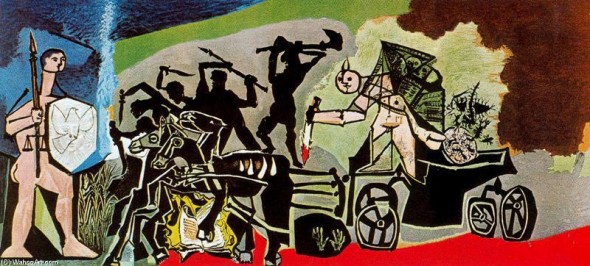
War, Pablo Picasso
Good Morning!!
Here are are on the 13th anniversary of the 9/11 attacks and the never-ending war in the Middle East continues onward. Last night President Obama promised not to send ground troops back to Iraq or into Syria, but it’s very difficult to trust that promise, even though I do think Obama is sincere in his wish to keep the battle against the Islamic State extremists circumscribed.
Reactions to Obama’s speech
From The Washington Post, Countering Islamic State will be hard in Iraq and harder in Syria, officials say.
President Obama’s strategy to beat back Islamic State militants spread across Iraq and Syria will depend on far more than U.S. bombs and missiles hitting their intended targets.
In Iraq, dissolved elements of the army will have to regroup and fight with conviction. Political leaders will have to reach compromises on the allocation of power and money in ways that have eluded them for years. Disenfranchised Sunni tribesmen will have to muster the will to join the government’s battle. European and Arab allies will have to hang together, Washington will have to tolerate the resurgence of Iranian-backed Shiite militias it once fought, and U.S. commanders will have to orchestrate an air war without ground-level guidance from American combat forces.
“Harder than anything we’ve tried to do thus far in Iraq or Afghanistan” is how one U.S. general involved in war planning described the challenges ahead on one side of the border that splits the so-called Islamic State.
But defeating the group in neighboring Syria will be even more difficult, according to U.S. military and diplomatic officials. The strategy imagines weakening the Islamic State without indirectly strengthening the ruthless government led by Bashar al-Assad or a rival network of al-Qaeda affiliated rebels — while simultaneously trying to build up a moderate Syrian opposition.
All that “makes Iraq seem easy,” the general said, speaking on the condition of anonymity to share views on policy. “This is the most complex problem we’ve faced since 9/11. We don’t have a precedent for this.”
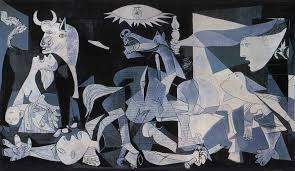
Guernica, Pablo Picasso
The Wall Street Journal, Obama Pushes U.S. Deeper Into Middle East to Fight Islamic State.
In asking Americans to support another military incursion in the Middle East, Mr. Obama said his strategy to combat Islamic State, also called ISIS and ISIL, would be bolstered by a coalition of Arab and European nations. His plan builds on his authorization in August of airstrikes in Iraq to protect American personnel threatened by Islamic State and to provide humanitarian assistance to besieged Iraqis.
Mr. Obama said the U.S. goal now is to help Iraqis reclaim large swaths of territory the group has rapidly overtaken in recent months since spilling over from its stronghold in neighboring Syria. His speech paves the way for the first U.S. strikes at the group’s bases and havens in Syria.
“America will lead a broad coalition to roll back this terrorist threat,” Mr. Obama said in remarks from the White House. “I will not hesitate to take action against ISIL in Syria, as well as Iraq. This is a core principle of my presidency: If you threaten America, you will find no safe haven.”
The president gave no timetable for the new, U.S.-led fight against what he described as “a terrorist organization” with members “unique in their brutality.”
In addition to launching airstrikes against the militants in Syria, Mr. Obama pledged a new dose of support for moderate Syrian fighters also battling the extremist group. Taken together, the steps draw the U.S. closer toward the volatile Syrian civil war and open a new front for American efforts in the region.
Saudi Arabia has offered to host a U.S.-run training facility for moderate Syrian rebels, U.S. and Arab officials said. The facility is expected to be able to handle as many as 10,000 fighters, but details are still being worked out, the officials said.
According to the article, John McCain and Lindsey Graham are on board with the plan. That gives me the creeps, frankly.

Guernica 2: Hommage to Picasso’s Guernica, Jose Garcia y Mas
Geoff Dyer at The Financial Times, Obama’s bold ambition at odds with strategic caution.
Faced with the rapid advances of Isis in both Iraq and Syria, the approach described by Mr Obama attempts to meet the political realities that the president faces, both in the Middle East and at home.
In spite of the technological superiority of US forces, Mr Obama believes a durable military victory against Isis can only be achieved by soldiers from the region, especially Sunni forces from the areas to which Isis is laying claim. Otherwise a similar group could reappear once the US has left.
At the same time, it gives him some political protection at home. Recent polls have shown that Americans are alarmed about Isis after the filmed beheadings of two US citizens, but that does not mean they will support another long ground war that leads to hundreds more US casualties.
Yet the problem with Mr Obama’s latest strategy is that it risks being a series of half-measures that establish incredibly ambitious goals while lacking the means to achieve them.
It’s an interesting article. It spells out my fear that this campaign against ISIL is going to expand more and more–just like Vietnam, Afghanistan, and Iraq.
A couple more interesting stories to check out:
Imran Kahn at Aljazira, Iraq and the Obama plan: Officials and experts broadly welcome US president’s plan to destroy the Islamic State group, but with crucial caveats.
Ian Black at The Guardian, Obama puts Isis firmly in US sights but peace in Syria looks harder than before.
Violence Against Women News

From Picasso’s War, a commentary on race hatred
I haven’t followed the trial of Oscar Pistorius in South Africa, but from what I know about the killing of his girlfriend Reeva Steenkamp, I was surprised to see the headlines this morning saying that he has been found not guilty of murder. Here’s the latest from The Washington Post, Judge: Oscar Pistorius not guilty of premeditated murder, but ‘it is clear his conduct was negligent’.
The prosecution has not proven beyond a reasonable doubt that Oscar Pistorius committed premeditated murder, Judge Thokozile Masipa said this morning. However, the judge added that it “is clear that his conduct was negligent.”
Pistorius’s negligence pertains to a lesser charge the athlete faces, “culpable homicide,” or manslaughter. The judge applied “the test of a reasonable man” to this charge.
In other words, the judge examined whether it was reasonable for Pistorius to fire four shots through his bathroom door at what he believed was an intruder. In her judgement, Pistorius did not pass this test.
“All the accused had to do was pick up phone and ring security,” Masipa said of Pistorius’s reaction. She added that Pistorius could have also “run to balcony and call for help.” Masipa added that she was “not persuaded that a reasonable person with the accused disabilities,” she said, “would have fired four shots” into the home’s bathroom.
She said that while she thought Pistorius was an “evasive” witness, that does not make him guilty. She said the prosecution has not demonstrated that he “reasonably could have foreseen” that his girlfriend, Reeva Steenkamp, was behind the bathroom door into which he fired four shots, killing her.
On the Ray Rice story, yesterday the AP reported that law enforcement sources in NJ told them that the NFL had received a copy of the tape of Rice knocking out Janay Palmer in an Atlantic City casino elevator in February. Following that unsurprising revelation, NFL Commissioner Roger Goodell went deeper into damage control mode, asking former FBI director Robert Mueller to head an independent investigation into the NFL’s handling of the case. The Washington Post reports, AP story prompts NFL to investigate its handling of the Ray Rice case.
The NFL appointed an independent investigator to look into its handling of the Ray Rice case Wednesday night, hours after a new report contradicted the league’s insistence no one in the league office saw video until Monday that depicted Rice striking his then-fiancee in an Atlantic City hotel.
That report by the Associated Press came as several people familiar with the inner workings of the league said NFL Commissioner Roger Goodell has no plans to heed the calls for him to resign over his handling of the case.
The league announced Wednesday night that Robert S. Mueller III, former director of the FBI, will “conduct an independent investigation into the NFL’s pursuit and handling of evidence in the Ray Rice domestic violence incident.”
Owners John Mara of the New York Giants and Art Rooney II of the Pittsburgh Steelers are to oversee the investigation, according to the league.
The final report resulting from the investigation will be released to the public, the NFL said.

Brooding Woman, Pablo Picasso
I found a couple more disturbing reports about what actually happened at the casino that night in February. Security officers from the casino said that Rice spat in Palmer’s face twice and claimed that she was unconscious from drinking too much.
ESPN reports, Sources: Ray Rice spat at fiancee.
Three current or former security staffers, who spoke with “Outside the Lines” this week on the condition of anonymity, described additional details of the ugly scene captured on video. Two of the men were on duty the night of the assault, while a third had full access to the security video, which he said he has watched dozens of times. TMZSports.com released a video this week that showed Rice punching Palmer in the face, appearing to knock her unconscious. Revel security workers watched the incident from the operations room through a security camera of the elevator.
One former staffer said Rice, the former Baltimore Ravens running back, spat in his then-fiancée’s face twice, “once outside the elevator and once inside,” prompting her to retaliate with movements that were ultimately countered with a knockout punch. According to the men, as Rice punched Palmer, the elevator the couple rode was rapidly approaching the hotel lobby just two floors above the casino floor. A security staffer, dispatched from his lobby post, saw Rice starting to drag his fiancée, who appeared to still be unconscious, out of the elevator.
“Get him away from her! Get him away from her!” the first responder was told by another security officer over a radio, one former security staffer told “Outside the Lines.” The staffer had full access to the security footage.
The security staffers said they did not see any sign of injury on Palmer’s face or head but added that her hair was covering much of her face, making it hard to determine her condition. They also said they didn’t see any blood in the elevator or on the hip-level railing that Palmer’s head appeared to strike as she fell to the elevator floor.
“The first thing he [Rice] said is, ‘She’s intoxicated. She drank too much. I’m just trying to get her to the room,'” one staffer said.
“When she regained consciousness she said, ‘How could you do this to me? I’m the mother of your kid,'” that same staffer told “Outside the Lines.”
There’s much more at the link, and it only makes the entire sorry episode and the NFL’s failure to deal adequately with it more sickening.
A few more links:
NBC Sports, Did Ray Rice Lie to Roger Goodell?
SB Nation, Ray Rice speaks out for the first time since his release.
CBS Sports, Ray Rice’s wife: How could you do this to me? I’m the mother of your kid.
NYT, In Ray Rice cast, NFL sees only what it wants to see.

Cat with bird, Pablo Picasso
Other News, Links Only
AP, USIS, the contractor that handled Edward Snowden’s security clearance loses federal contract.
BBC News, Michael Brown death: Ferguson highway protest blocked.
The Guardian, Ferguson reform to courts system could leave residents paying more.
The Washington Post, Richard Kiel, who played lovable giant ‘Jaws’ in ‘James Bond’ films, is dead at 74.
ABC News, Five things that may happen if Scotland votes for independence.
Wall Street Journal, EU agrees to implement more sanctions against Russia Friday.
Time Magazine, Ozone layer shows signs of recovery, study finds.
HNGN, Baboons With Closer Friends Have Longer Lives Than Loners.
Forbes, Scientists find gene that may delay aging of whole body.
That’s all I’ve got. What stories are you following today? Please post your thoughts and links in the comment thread, and have terrific Thursday.

Peace, Pablo Picasso
Tuesday Reads: Art as Therapy to Help Deal With Depressing News
Posted: September 9, 2014 Filed under: Barack Obama, Crime, Criminal Justice System, Foreign Affairs, Iraq, morning reads, Political Affective Disorder, psychology, Psychopaths in charge, Real Life Horror, social justice, U.S. Military, U.S. Politics, Ukraine, Violence against women, War on Women | Tags: Atlantic County NJ Prosecutor James McClain, Baltimore Ravens, Chief Thomas Jackson, Ferguson MO, FOIA requests, ISIS, Janay Palmer, Malaysia Flight 17, Michael Brown, NFL, police brutality, police killings, Racism, Ray Rice, Roger Goodell, Rutgers University, St. Louis, The Islamic State, TMZ 36 Comments
Still Life with a Red Rug, Henri Matisse (1906)
Good Morning!!
I decided I needed to look at some Matisse paintings this morning, and I’m going to include a few in this post to provide contrast to the news of the day, which is filled with violence, hate, and despair. According to the WebMuseum, Matisse was “a man of anxious temperament.”
Matisse’s art has an astonishing force and lives by innate right in a paradise world into which Matisse draws all his viewers. He gravitated to the beautiful and produced some of the most powerful beauty ever painted. He was a man of anxious temperament, just as Picasso, who saw him as his only rival, was a man of peasant fears, well concealed. Both artists, in their own fashion, dealt with these disturbances through the sublimation of painting: Picasso destroyed his fear of women in his art, while Matisse coaxed his nervous tension into serenity. He spoke of his art as being like “a good armchair”– a ludicrously inept comparison for such a brilliant man– but his art was a respite, a reprieve, a comfort to him.
Can art be therapy? I think so. So can reading literature or listening to music. From a review of Art as Therapy at Brain Pickings,
The question of what art is has occupied humanity since the dawn of recorded history. For Tolstoy, the purpose of art was to providea bridge of empathy between us and others, and for Anaïs Nin, a way to exorcise our emotional excess. But the highest achievement of art might be something that reconciles the two: a channel of empathy into our own psychology that lets us both exorcise and better understand our emotions — in other words, a form of therapy.
In Art as Therapy, philosopher Alain de Botton — who has previously examined such diverse and provocative subjects as why work doesn’t work,what education and the arts can learn from religion, and how to think more about sex — teams up with art historian John Armstrong to examine art’s most intimate purpose: its ability to mediate our psychological shortcomings and assuage our anxieties about imperfection. Their basic proposition is that, far more than mere aesthetic indulgence, art is a tool — a tool that serves a rather complex yet straightforwardly important purpose in our existence:
Like other tools, art has the power to extend our capacities beyond those that nature has originally endowed us with. Art compensates us for certain inborn weaknesses, in this case of the mind rather than the body, weaknesses that we can refer to as psychological frailties.
Read about “the seven core functions of art” at the Brain Pickings link. And now, regrettably, I must turn to today’s news.

Tea in the Garden, Henri Matisse (1919)
Ray Rice Domestic Violence News.
Yesterday’s news was dominated by reactions to gossip site TMZ’s release of the video of Baltimore Ravens running back Ray Rice hitting his then fiance–now wife–Janay Palmer and knocking her unconscious in an Atlantic city casino elevator in February.
Suddenly, the Ravens went into ass-covering mode. The Ravens released Rice and the NFL suspended him indefinitely. But why did it take so long? At the time, a video had been released showing Rice dragging Palmer from the elevator like a sack of potatoes.
Here’s a timeline of the Rice case from SB Nation. On Feb. 15th, after the beating, Rice and Palmer were both arrested and charged with simple assault (the charges against Palmer were later dropped). On the 19th a video was released that showed Rice coldly dragging an unconscious Palmer from the elevator like a sack of potatoes–her dress pulled up, her legs spread open to the camera. Rice makes shows no apparent concern for her well-being.
Those of us with any experience with domestic violence could easily surmise what had taken place inside the elevator. But the men of the NFL somehow assumed (or wanted to believe) that Palmer had viciously attacked Rice, and that he had only defended himself by knocking her unconscious!
On March 27 Rice was indicted for aggravated assault, and the next day the couple married. Did Rice marry her to shut her up? Rice ended up getting a slap on the wrist from Prosecutor James McClain (who, like Rice graduated from Rutgers). Rice was allowed to enter a one-year diversion program with counseling instead of getting jail time. And btw, McClain is still defending his decision.
On May 23, Ray Rice game a non-apology “apology” for his disgusting actions in which he apologized to everyone under the sun except his wife Janay. Rice acted as if the two were equally responsible for “the incident.”
From SB Nation, May 23: Ray Rice is an asshole and the Ravens couldn’t care less.
Ray Rice is sorry. He wants you to know how sorry he is for knocking out his fiancée Janay, who is now his wife. He would like to sincerely apologize for dragging her out of an Atlantic City hotel elevator. We know this because Rice told us so. He told the world in a televised public apology broadcast Friday afternoon from Baltimore.
“I apologize for the situation my wife and I were in,” the Baltimore Ravens running back said….
Rice’s apology is special because he really believes it; a shocking portion of Rice’s press conference was devoted to Successories-style affirmations about how he will recover from and get past this … situation that … occurred. Stranger still, Rice somehow managed to get his wife Janay — whom he married right before he was supposed to go to trial for a more serious version of domestic assault — to accept an equal share of blame for the incident. She apologized, too.
Those of us familiar with the dynamics of domestic violence know that Palmer’s behavior was typical of victims–blaming themselves and trying to protect their emotional and economic security.
Finally, in July NFL Commissioner Roger Goodell suspended Rice for two games. NFL and Ravens officials implied to journalists that there was some kind of mitigating evidence that showed Palmer to be at fault. Public outrage was immediate. I recall JJ posting about it at that time. On Aug. 28, realizing he had made a terrible public relations blunder, Goodell announced a new NFL policy on “domestic violence.”
Finally, on Sept. 8, TMZ released video of what actually transpired inside the elevator: Rice spitting in Palmer’s face, and decking her with a “crushing” left hook. Not long afterward, the Ravens and the NFL finally too action, claiming they had never seen this video footage that they could have gotten easily from the casino or law enforcement.
But guess what? Rice will still receive $25 million from his contract with the Ravens. If Roger Goodell keeps his job after this, the NFL will be permanently damaged. After all, half of the people who follow football are women? Why do you think the NFL make their players wear pink (ugh!) once a year in honor of breast cancer awareness?

The Red Madras Headdress, Henri Matisse
Here are some links to other stories on this horrible and shameful debacle:
Dan Shaughnessy at The Boston Globe: In Ray Rice case, one failure after another.
Mike Wise at The Washington Post: Ray Rice finally must answer for his actions; when will NFL Commissioner Roger Goodell?
Baltimore Sun: Janay Rice breaks her silence, describes situation as ‘horrible nightmare’ (She blames the media, not her husband).
SB Nation: White House on Ray Rice: ‘Hitting a woman is not something a real man does’.
TMZ: NFL Commish in the Dark by Choice?
President Obama to Lay out Case for Stepping Up Campaign Against Islamic State
From The Washington Post, As Obama Makes Case, Congress Is Divided on Campaign Against Militants.
WASHINGTON — President Obama on Tuesday will begin laying out his case for an expanded military campaign against the Islamic State in Iraq and Syria when he faces congressional leaders who are averse to taking an election-year stand but are being pushed by lawmakers who want a say in matters of war.
Mr. Obama’s meeting with Republican and Democratic leaders on Tuesday in the Oval Office will be the first of several between White House officials and lawmakers as the administration tries to persuade Congress to embrace the president’s plan to halt the momentum of the Sunni militant group known as ISIS.
A year after opposition in Congress thwarted plans for missile strikes in Syria, the White House is again putting the issue of military force in the Middle East before a skeptical Congress and a war-weary public.
But what about Congress?
Democratic leaders in the Senate and Republican leaders in the House want to avoid a public vote to authorize force, fearing the unknown political consequences eight weeks before the midterm elections on Nov. 4.
“A lot of people would like to stay on the sideline and say, ‘Just bomb the place and tell us about it later,’ ” said Representative Jack Kingston, Republican of Georgia, who supports having an authorization vote. “It’s an election year. A lot of Democrats don’t know how it would play in their party, and Republicans don’t want to change anything. We like the path we’re on now. We can denounce it if it goes bad, and praise it if it goes well and ask what took him so long.”
Other lawmakers, especially some Democrats, are arguing that as long as the president keeps the operation limited to airstrikes, he does not need to get congressional approval.
Benjy Sarlin at MSNBC: The Politics of ISIS
Ahead of a Wednesday public address from President Obama where he’s set to lay out a “game plan” for military action in Iraq and as the right mocks Democrats as weak-willed appeasers, former Vice President Dick Cheney is heading to Capitol Hill to deliver a pep talk to House Republicans.
Is it the 2002 election all over again? Not exactly. But the escalating conflict against ISIS is starting to show up on the trail as Republican candidates seem eager to put major past differences on foreign policy aside and join together in criticizing the White House’s response to the Islamic State.
A number of candidates and GOP officials have gone out of their way to attack Obama over his remark at a press conference that “we don’t have a strategy yet” for confronting ISIS. Republican Senate nominees including Scott Brown in New Hampshire, David Perdue in Georgia, and Thom Tillis in North Carolina, among others, have highlighted the quote while demanding action to turn back the Islamist group’s gains. Joni Ernst in Iowa and Tom Cotton in Arkansas, both of whom served in the Middle East during the Iraq War, have also called for a clearer plan to tackle ISIS.
Read the rest at the link.

Odalique with a Turkish Chair, Henri Matisse
Ferguson Updates
St. Louis Business Journal: Ferguson to reform municipal courts, add police review board.
As national attention mounts on the way St. Louis municipalities use court fine revenuefor city operations and on police use of force in the area, the Ferguson City Council has announced the proposal of three major reforms.
The city will hold ward meetings for public input on the reforms, with some of the proposals on the agenda for Tuesday night’s City Council meeting. It will be held at 7 p.m. at Greater Grace Church, 3690 Pershall Road.
Here’s the breakdown of the proposed reforms:
- Establishing a Citizen Review Board to work with the police department to review their actions.
- I ntroducing an ordinance that will keep court fine revenues at or below 15 percent of Ferguson’s revenue. Any excess will be earmarked for special community projects, not general revenue.
- Reforming the way Ferguson’s municipal court works by repealing the “failure to appear” offense, abolishing some administrative fees which may impact low-income persons to a greater extent and the creation of a special docket for defendants having trouble making monthly payments.
Likewise, the council announced, the municipal judge has called for a warrant recall to run from Sept. 15 through Oct. 15. Those who have outstanding warrants are encouraged to call the municipal court cler k for information on the recall.

Woman in a Purple Coat, Henri Matisse (1937)
Truthout: St. Louis Police Shot 16 Before Michael Brown in 2014
By the time of Michael Brown’s murder, St. Louis area police had already shot at least 16 people in 2014, the vast majority of whom were black.
Truthout obtained this figure by examining news reports from January 1 to August 6 of 2014. On August 10, protests opposing the police killing of unarmed black teenager Michael Brown began.
Read the list of victims at the link.
In the vast majority of incidents where the race of an individual shot by police was known, the individuals were black. Truthout was not able to determine how many (if any) of these police shootings were “justified” because data concerning police shootings is so limited.
Police shootings, along with other uses of force by the St. Louis area police, are not a new development. In Ferguson, seven active or former officers have now been named in civil lawsuits for excessive use of force; and in March 2014, two officers with the St. Louis Police Department severely beat a man with disabilities. In another recentcivil case, an amount of over $800,000 was awarded to a victim of excessive force by the St. Louis Metropolitan Police Force.
In 2012, US District Judge Carol Jackson stated that the St. Louis Board of Police Commissioners may be “deliberately indifferent” or even tacitly approving of a “widespread persistent pattern of unconstitutional conduct.” In a separate 2010 federal civil lawsuit, which accused the St. Louis police of excessive force, the victim’s lawyer cited statistics showing that the St. Louis internal affairs investigators sustained only one of 322 citizens’ physical abuse complaints against police from 1997 to 2002.
Read the rest at Truthout. It’s a good article.
Matthew Keys at The Blot: Ferguson Police Chief Lied About Michael Brown Surveillance Tape.
The chief of police for the Ferguson Police Department misled members of the media and the public when he asserted that his hand was forced in releasing surveillance footage that purported to show 18-year-old resident Michael Brown engaged in a strong-arm robbery at a convenience store minutes before he was fatally shot by a police officer.
Chief Thomas Jackson distributed copies of the surveillance tape at a press conference on Aug. 15 in tandem with the public release of the identity of the officer who was responsible for shooting Brown.
When questioned by members of the press about the tape — which apparently had nothing to do with the fatal shooting of the unarmed teenager — Jackson told reporters that he was legally obligated to release the tape because members of the media had submitted an open records requests for it.
“We’ve had this tape for a while, and we had to diligently review the information that was in the tape, determine if there was any other reason to keep it,” Jackson said at the press event. “We got a lot of Freedom of Information requests for this tape, and at some point it was just determined we had to release it. We didn’t have good cause, any other reason not to release it under FOI.”
Except there were no specific FOIA requests for the tape. Keys and The Blot got all media requests for information through an open records request. Read all about it at the Blot.

Dance “What hope might look like” — Henri Mattisse
Shootdown of Malaysia Flight 17 in Ukraine
From the LA Times: Dutch report: Malaysia jet downed in Ukraine by ‘high-energy objects’
A preliminary report on Malaysia Airlines Flight 17 appears to confirm initial assertions that the passenger plane was hit by a surface-to-air-missile in mid-flight July 17 before crashing in Ukraine.
“The pattern of damage observed on the forward fuselage and cockpit section of the aircraft appears to indicate that there were impacts from a large number of high-energy objects from outside the aircraft,” concluded a report issued Tuesday by the Netherlands’ air safety board.
The Boeing 777, en route from Amsterdam to Kuala Lumpur, the Malaysian capital, was flying at about 33,000 feet over separatist-held territory in southeastern Ukraine when it broke apart in midair and crashed, killing all 298 passengers and crew members on board.
The report says that fragments of the aircraft reveal numerous puncture holes and indentations on the plane’s skin that would be consistent with damage from missile shrapnel and, investigators say, rule out pilot error or any mechanical fault as the cause of the disaster.
Although investigators have not been able to recover these pieces for forensic examination, the report states that “the pattern of damage observed … was not consistent with the damage that would be expected from any known failure mode of the aircraft, its engines or systems.”
I’ll end there, as this post is far too long already. I hope you’ll share your thoughts and links in the comment thread.
Monday Reads
Posted: September 8, 2014 Filed under: morning reads | Tags: DNA analysis, identity of Jack the Ripper 66 CommentsGood Morning!
So, I’m really tired of the political news right now. The global news is depressing. That goes without saying. So, here’s a little distraction for your morning coffee.
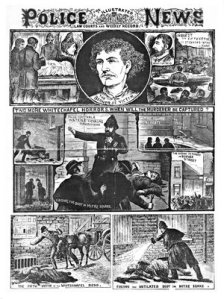 DNA tests appears may have identified Jack the Ripper.
It is the greatest murder mystery of all time, a puzzle that has perplexed criminologists for more than a century and spawned books, films and myriad theories ranging from the plausible to the utterly bizarre.
But now, thanks to modern forensic science, The Mail on Sunday can exclusively reveal the true identity of Jack the Ripper, the serial killer responsible for at least five grisly murders in Whitechapel in East London during the autumn of 1888.
DNA evidence has now shown beyond reasonable doubt which one of six key suspects commonly cited in connection with the Ripper’s reign of terror was the actual killer – and we reveal his identity.
A shawl found by the body of Catherine Eddowes, one of the Ripper’s victims, has been analysed and found to contain DNA from her blood as well as DNA from the killer.
The landmark discovery was made after businessman Russell Edwards, 48, bought the shawl at auction and enlisted the help of Dr Jari Louhelainen, a world-renowned expert in analysing genetic evidence from historical crime scenes.
Using cutting-edge techniques, Dr Louhelainen was able to extract 126-year-old DNA from the material and compare it to DNA from descendants of Eddowes and the suspect, with both proving a perfect match.
The revelation puts an end to the fevered speculation over the Ripper’s identity which has lasted since his murderous rampage in the most impoverished and dangerous streets of London.
A DNA sample has proven Polish immigrant Aaron Kosminski was Jack the Ripper. The owner of the shawl shares his story and the forensic and criminal research from the Ripper scenes.
Before buying it, I spoke to Alan McCormack, the officer in charge of the Crime Museum, also known as the Black Museum. He told me the police had always believed they knew the identity of the Ripper. Chief Inspector Donald Swanson, the officer in charge of the investigation, had named him in his notes: Aaron Kosminski, a Polish Jew who had fled to London with his family, escaping the Russian pogroms, in the early 1880s.
Kosminski has always been one of the three most credible suspects. He is often described as having been a hairdresser in Whitechapel, the occupation written on his admission papers to the workhouse in 1890. What is certain is he was seriously mentally ill, probably a paranoid schizophrenic who suffered auditory hallucinations and described as a misogynist prone to ‘self-abuse’ – a euphemism for masturbation.
McCormack said police did not have enough evidence to convict Kosminski, despite identification by a witness, but kept him under 24-hour surveillance until he was committed to mental asylums for the rest of his life. I became convinced Kosminski was our man, and I was excited at the prospect of proving it. I felt sure that modern science would be able to produce real evidence from the stains on the shawl. After a few false starts, I found a scientist I hoped could help.
 A Pennsylvania mom is headed for prison for giving her daughter miscarriage-inducing pills. This is pretty much what you get when you make abortion difficult and expensive.
A Pennsylvania woman has been sentenced to up to 18 months in prison for obtaining so-called abortion pills online and providing them to her teenage daughter to end her pregnancy.
Jennifer Ann Whalen, 39, of Washingtonville, a single mother who works as a nursing home aide, pleaded guilty in August to obtaining the miscarriage-inducing pills from an online site in Europe for her daughter, 16, who did not want to have the child.
Whalen was sentenced on Friday by Montour County Court of Common Pleas Judge Gary Norton to serve 12 months to 18 months in prison for violating a state law that requires abortions to be performed by physicians.
She was also fined $1,000 and ordered to perform 40 hours of community service after her release. The felony offense called for up to seven years in prison and a $15,000 fine.
Matthew Bingham Banks, Whalen’s lawyer, previously told Reuters criminal prosecutions of this kind were not common.
Whalen told authorities there was no local clinic available to perform an abortion and her daughter did not have health insurance to cover a hospital abortion, the Press Enterprise newspaper of Bloomsburg reported.
Her daughter experienced severe cramping and bleeding after taking the pills and Whalen took her to a hospital near her home for treatment, the newspaper said.
The closest abortion clinic to Whalen’s home is about 74 miles away in Harrisburg.
The Pennsylvania case follows the prosecution of a Florida man who pleaded guilty to tricking his girlfriend into taking an abortion pill. He was sentenced in January to 13 years in prison and $28,500 restitution. In June, Florida toughened state law to allow for prosecutions in the death of non-viable fetuses.
 How can a chemically induced miscarriage be considered “performing” an abortion which sounds somewhat surgical to me? Suppose I will have to ask Doctor Daughter this question next time I talk to her.
Textbooks segregate twenty-five decades of enslavement into one chapter, painting a static picture. Millions of people each year visit plantation homes where guides blather on about furniture and silverware. As sites, such homes hide the real purpose of these places, which was to make African Americans toil under the hot sun for the profit of the rest of the world. All this is the “symbolic annihilation” of enslaved people, as two scholars of those weird places put it.2 Meanwhile, at other points we tell slavery’s story by heaping praise on those who escaped it through flight or death in rebellion, leaving the listener to wonder if those who didn’t flee or die somehow “accepted” slavery. And everyone who teaches about slavery knows a little dirty secret that reveals historians’ collective failure: many African-American students struggle with a sense of shame that most of their ancestors could not escape the suffering they experienced.
The truth can set us free, if we can find the right questions. But back in the little house in Danville, Anderson was reading from a list of leading ones, designed by white officials—some well- meaning, some not so well-meaning. He surely felt how the gravity of the questions pulled him toward the planet of plantation nostalgia. “Did slaves mind being called ‘nigger’?” “What did slaves call master or mistress?” “Have you been happier in slavery or free?” “Was the mansion house pretty?” Escaping from chains is very difficult, however, so Anderson dutifully asked the prescribed questions and poised his pencil to take notes.
Ivy listened politely. He sat still. Then he began to speak: “My mother’s master was named William Tunstall. He was a mean man. There was only one good thing he did, and I don’t reckon he intended to do that. He sold our family to my father’s master George H. Gilman.”
Perhaps the wind blowing through the window changed as a cloud moved across the spring sun: “Old Tunstall caught the ‘cotton fever.’ There was a fever going round, leastways it was like a fever. Everyone was dying to get down south and grow cotton to sell. So old Tunstall separated families right and left. He took two of my aunts and left their husbands up here, and he separated altogether seven husbands and wives. One woman had twelve children. Yessir. Took ‘em all down south with him to Georgia and Alabama.”
Pervasive separations. Tears carving lines on faces. Lorenzo remembered his relief at dodging the worst, but he also remembered knowing that it was just a lucky break. Next time it could’ve been his mother. No white person was reliable, because money drove their decisions. No, this wasn’t the story the books told.
So Anderson moved to the next question. Did Ivy know if any slaves had been sold here? Now, perhaps, the room grew darker.
For more than a century, white people in the United States had been singling out slave traders as an exception: unscrupulous lower-class outsiders who pried apart paternalist bonds. Scapegoaters had a noble precedent. In his first draft of the Declaration of Independence, Thomas Jefferson tried to blame King George III for using the Atlantic slave trade to impose slavery on the colonies. In historians’ tellings, the 1808 abolition of the Atlantic trade brought stability to slavery, ringing in the “Old South,” as it has been called since before the Civil War. Of course, one might wonder how something that was brand new, created after a revolution, and growing more rapidly than any other commodity-producing economy in history before then could be considered “old.” But never mind. Historians depicted slave trading after 1808 as irrelevant to what slavery was in the “Old South,” and to how America as a whole was shaped. America’s modernization was about entrepreneurs, creativity, invention, markets, movement, and change. Slavery was not about any of these things—not about slave trading, or moving people away from everyone they knew in order to make them make cotton. Therefore, modern America and slavery had nothing to do with each
When Cornell University professor Ed Baptist read The Economist review of his book on slavery, he knew that it would be a big deal. The review dismissed his work as “advocacy” because “all the blacks in his book are victims, almost all the whites villains.”
That characterization of his work, which attracted the most backlash from journalists and academics, was not entirely a surprise to Baptist, he told TPM on Friday. It is something he has heard in history circles before the reaction to his new book, “The Half Has Never Been Told.”
“I thought that was silly,” he said. “But I’ve been talking about this kind of stuff for a while in academic circles and public history circles, and it’s not uncommon for people to protest that I’m not being sensitive enough to the inner lives of enslavers.”
“On one level, I want to respond, ‘No, actually, I think I’m being very sensitive to it and I’m just unfurling these other sides to the story that are often left under the sheets as it were,'” he continued. “The point that other people have made that I think is so effective is that for me to write a book about the exploitation of enslaved people, by definition, is going to show enslaved people as the objects of all kinds of victimizing processes and, on the other hand, enslavers as the agents of those processes.”
The Economist did apologize and withdraw the review, though Baptist said he believed the magazine had only apologized for the last line on “victims” and “villains.” Another bit of the review, which questioned the reliability of ex-slaves in relating experiences under slavery, struck him as “blatantly racist.”
“One thing that really did aggravate me about the review was this suggestion and this sort of implicit argument that ex-slaves had some sort of vested interest and are unreliable reporters on what actually happened,” he said. “That is such an old struggle when you’re talking about the history of slavery, the constant undermining of testimony from survivors.”
“That was not apologized for,” he said, “and that was I thought blatantly racist, blatantly something that you would have heard in the 1850s or something like that.”
It’s amazing to me that we still have such a profound level of racism in the world and in this country. Of course, the sexism overwhelms me too. I’m trying to be much more aware of the idea of swimming in privilege.
So, hopefully this little thread will get you to share what you’re reading and blogging today.

 peej
peej Carissa
 bostonboomer
 dakinikat
 ecocatwoman
 jjlo
jjlo mablue2
 Mama Lopez
 peggysue22
 quixote
 skydancingguestblogger
 Mona (aka Wonk the Vote)





Recent Comments